Cambridge A Level Portuguese - Language (AS Level only) 8684 — 2012 May/June Paper 2 · Variant 1
8684/21/M/J/12 · 70 marks · ≈79 min
The question paper and its mark scheme, free to read here and free to download. This is Cambridge’s own paper, exactly as it was sat.
Question paper8 pages
Mark scheme8 pages
Answers below. Sit the paper first if you are practising.
Paper as text
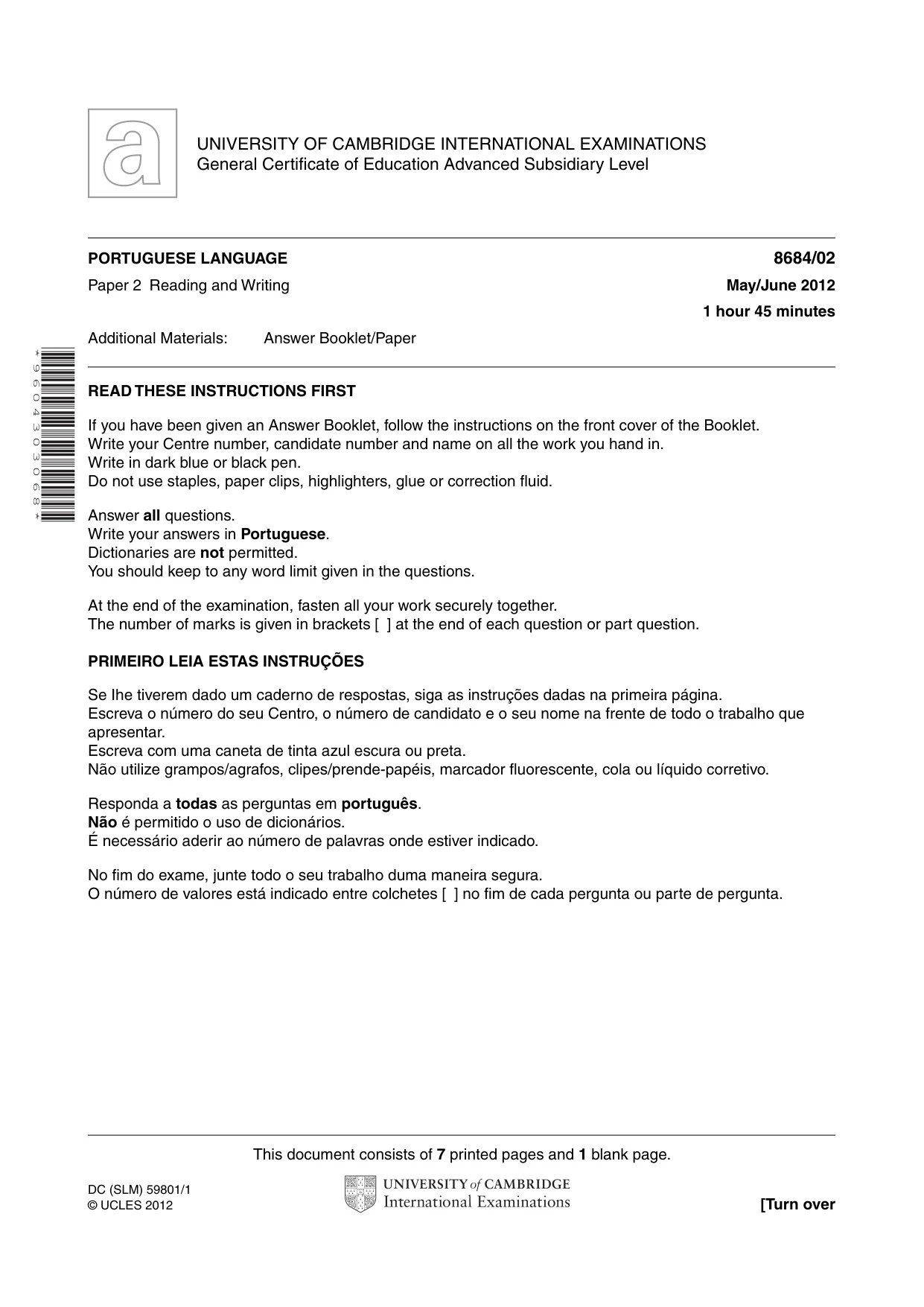
Question paper, page 1
This document consists of 7 printed pages and 1 blank page. DC (SLM) 59801/1 © UCLES 2012 [Turn over UNIVERSITY OF CAMBRIDGE INTERNATIONAL EXAMINATIONS General Certificate of Education Advanced Subsidiary Level READ THESE INSTRUCTIONS FIRST If you have been given an Answer Booklet, follow the instructions on the front cover of the Booklet. Write your Centre number, candidate number and name on all the work you hand in. Write in dark blue or black pen. Do not use staples, paper clips, highlighters, glue or correction fluid. Answer all questions. Write your answers in Portuguese. Dictionaries are not permitted. You should keep to any word limit given in the questions. At the end of the examination, fasten all your work securely together. The number of marks is given in brackets [ ] at the end of each question or part question. PRIMEIRO LEIA ESTAS INSTRUÇÕES Se Ihe tiverem dado um caderno de respostas, siga as instruções dadas na primeira página. Escreva o número do seu Centro, o número de candidato e o seu nome na frente de todo o trabalho que apresentar. Escreva com uma caneta de tinta azul escura ou preta. Não utilize grampos/agrafos, clipes/prende-papéis, marcador fluorescente, cola ou líquido corretivo. Responda a todas as perguntas em português. Não é permitido o uso de dicionários. É necessário aderir ao número de palavras onde estiver indicado. No fim do exame, junte todo o seu trabalho duma maneira segura. O número de valores está indicado entre colchetes [ ] no fim de cada pergunta ou parte de pergunta. * 9 6 0 4 3 0 3 0 6 8 * PORTUGUESE LANGUAGE 8684/02 Paper 2 Reading and Writing May/June 2012 1 hour 45 minutes Additional Materials: Answer Booklet/Paper
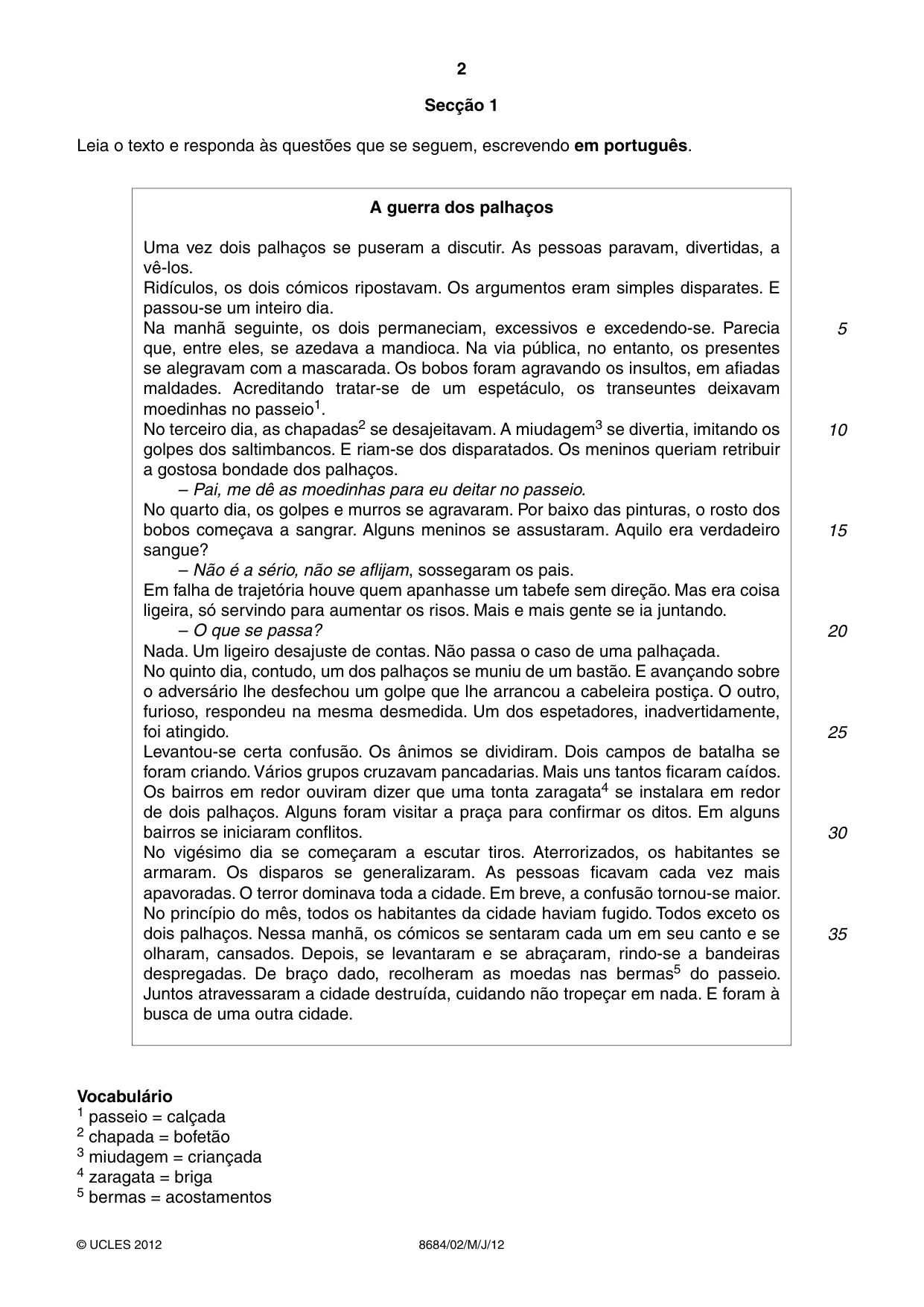
Question paper, page 2
2 8684/02/M/J/12 © UCLES 2012 Secção 1 Leia o texto e responda às questões que se seguem, escrevendo em português. A guerra dos palhaços Uma vez dois palhaços se puseram a discutir. As pessoas paravam, divertidas, a vê-los. Ridículos, os dois cómicos ripostavam. Os argumentos eram simples disparates. E passou-se um inteiro dia. Na manhã seguinte, os dois permaneciam, excessivos e excedendo-se. Parecia que, entre eles, se azedava a mandioca. Na via pública, no entanto, os presentes se alegravam com a mascarada. Os bobos foram agravando os insultos, em afiadas maldades. Acreditando tratar-se de um espetáculo, os transeuntes deixavam moedinhas no passeio1. No terceiro dia, as chapadas2 se desajeitavam. A miudagem3 se divertia, imitando os golpes dos saltimbancos. E riam-se dos disparatados. Os meninos queriam retribuir a gostosa bondade dos palhaços. – Pai, me dê as moedinhas para eu deitar no passeio. No quarto dia, os golpes e murros se agravaram. Por baixo das pinturas, o rosto dos bobos começava a sangrar. Alguns meninos se assustaram. Aquilo era verdadeiro sangue? – Não é a sério, não se aflijam, sossegaram os pais. Em falha de trajetória houve quem apanhasse um tabefe sem direção. Mas era coisa ligeira, só servindo para aumentar os risos. Mais e mais gente se ia juntando. – O que se passa? Nada. Um ligeiro desajuste de contas. Não passa o caso de uma palhaçada. No quinto dia, contudo, um dos palhaços se muniu de um bastão. E avançando sobre o adversário lhe desfechou um golpe que lhe arrancou a cabeleira postiça. O outro, furioso, respondeu na mesma desmedida. Um dos espetadores, inadvertidamente, foi atingido. Levantou-se certa confusão. Os ânimos se dividiram. Dois campos de batalha se foram criando. Vários grupos cruzavam pancadarias. Mais uns tantos ficaram caídos. Os bairros em redor ouviram dizer que uma tonta zaragata4 se instalara em redor de dois palhaços. Alguns foram visitar a praça para confirmar os ditos. Em alguns bairros se iniciaram conflitos. No vigésimo dia se começaram a escutar tiros. Aterrorizados, os habitantes se armaram. Os disparos se generalizaram. As pessoas ficavam cada vez mais apavoradas. O terror dominava toda a cidade. Em breve, a confusão tornou-se maior. No princípio do mês, todos os habitantes da cidade haviam fugido. Todos exceto os dois palhaços. Nessa manhã, os cómicos se sentaram cada um em seu canto e se olharam, cansados. Depois, se levantaram e se abraçaram, rindo-se a bandeiras despregadas. De braço dado, recolheram as moedas nas bermas5 do passeio. Juntos atravessaram a cidade destruída, cuidando não tropeçar em nada. E foram à busca de uma outra cidade. Vocabulário 1 passeio = calçada 2 chapada = bofetão 3 miudagem = criançada 4 zaragata = briga 5 bermas = acostamentos 5 10 15 20 25 30 35
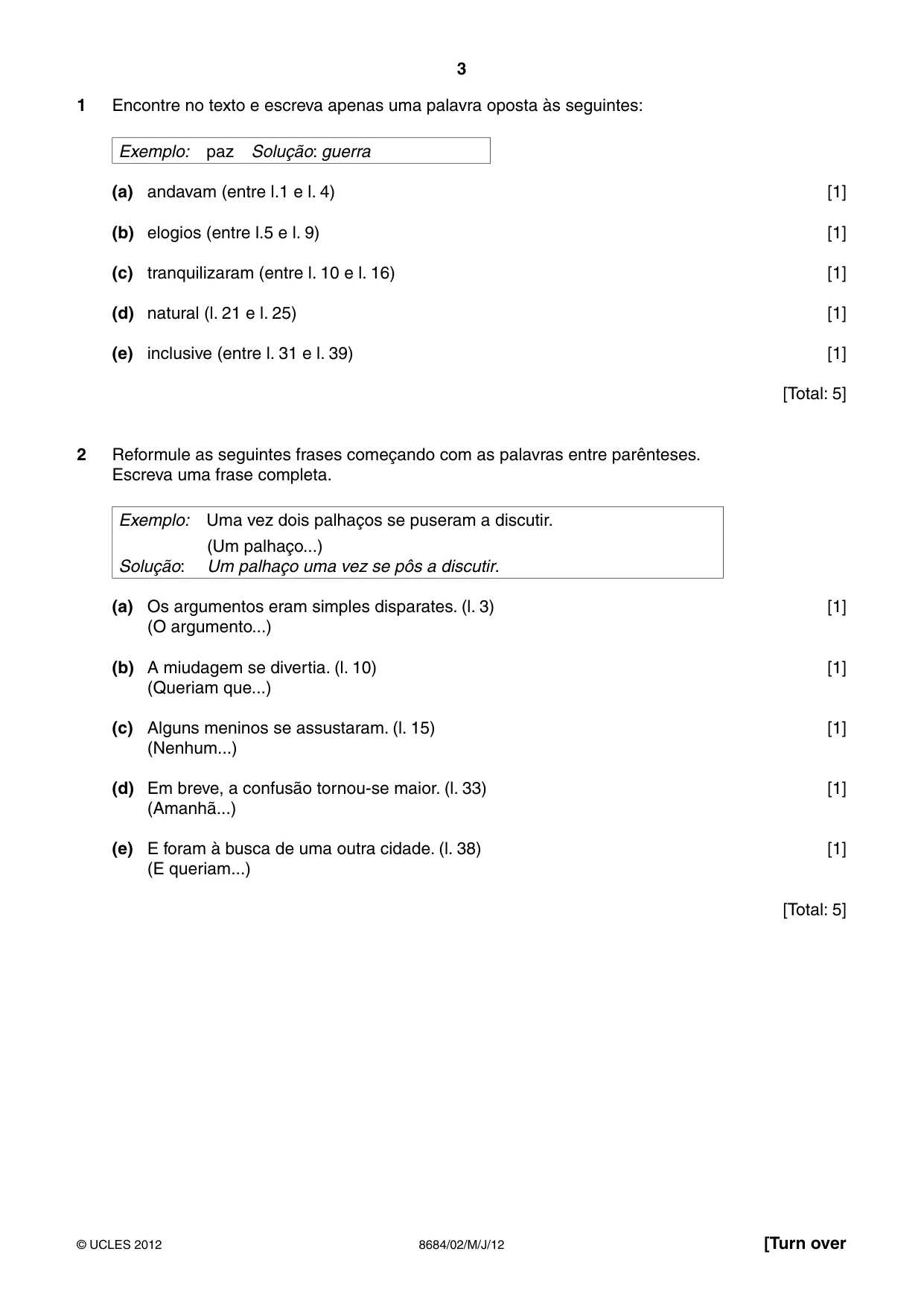
Question paper, page 3
3 8684/02/M/J/12 © UCLES 2012 [Turn over 1 Encontre no texto e escreva apenas uma palavra oposta às seguintes: Exemplo: paz Solução: guerra (a) andavam (entre l.1 e l. 4) [1] (b) elogios (entre l.5 e l. 9) [1] (c) tranquilizaram (entre l. 10 e l. 16) [1] (d) natural (l. 21 e l. 25) [1] (e) inclusive (entre l. 31 e l. 39) [1] [Total: 5] 2 Reformule as seguintes frases começando com as palavras entre parênteses. Escreva uma frase completa. Exemplo: Uma vez dois palhaços se puseram a discutir. (Um palhaço...) Solução: Um palhaço uma vez se pôs a discutir. (a) Os argumentos eram simples disparates. (l. 3) [1] (O argumento...) (b) A miudagem se divertia. (l. 10) [1] (Queriam que...) (c) Alguns meninos se assustaram. (l. 15) [1] (Nenhum...) (d) Em breve, a confusão tornou-se maior. (l. 33) [1] (Amanhã...) (e) E foram à busca de uma outra cidade. (l. 38) [1] (E queriam...) [Total: 5]
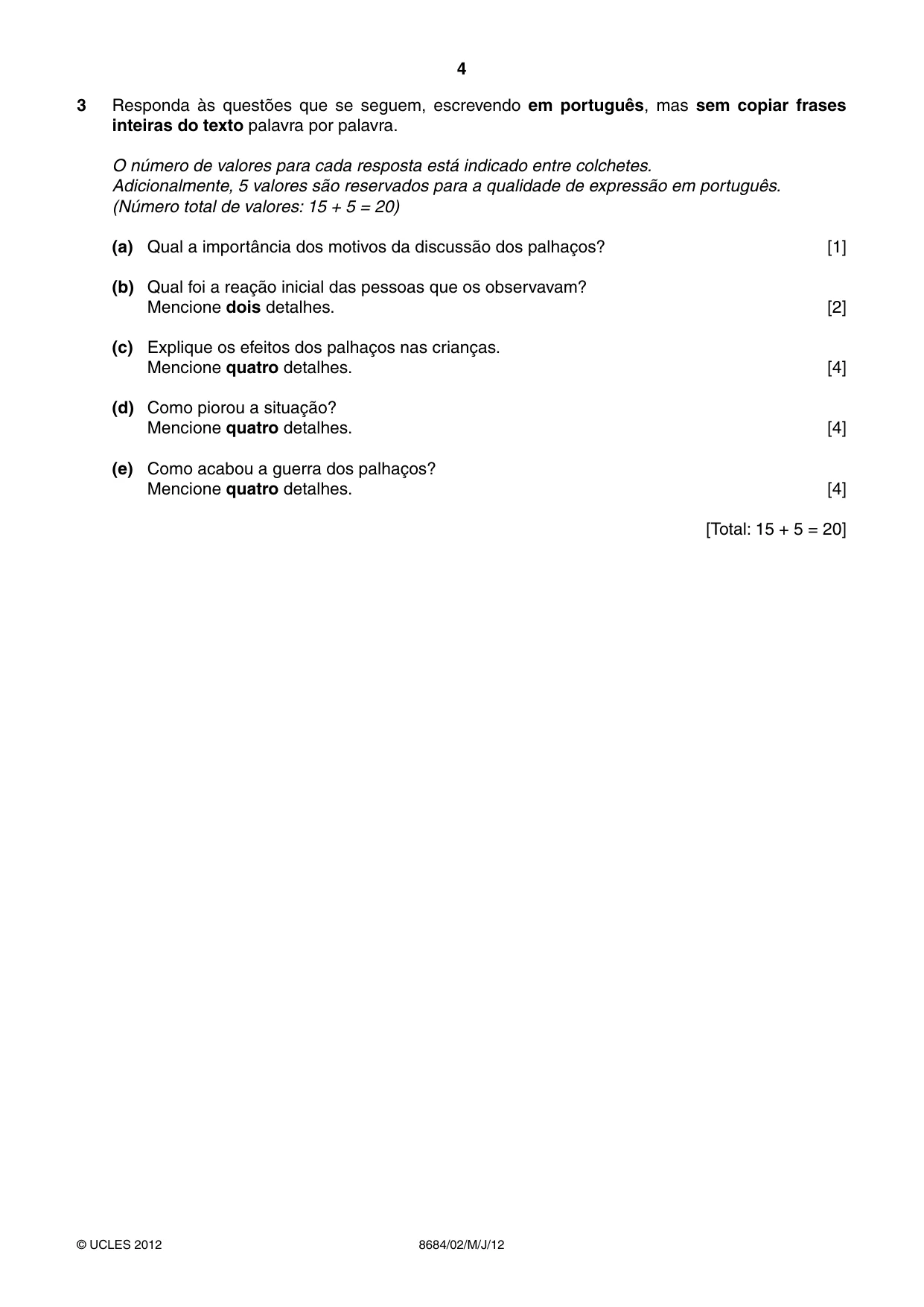
Question paper, page 4
4 8684/02/M/J/12 © UCLES 2012 3 Responda às questões que se seguem, escrevendo em português, mas sem copiar frases inteiras do texto palavra por palavra. O número de valores para cada resposta está indicado entre colchetes. Adicionalmente, 5 valores são reservados para a qualidade de expressão em português. (Número total de valores: 15 + 5 = 20) (a) Qual a importância dos motivos da discussão dos palhaços? [1] (b) Qual foi a reação inicial das pessoas que os observavam? Mencione dois detalhes. [2] (c) Explique os efeitos dos palhaços nas crianças. Mencione quatro detalhes. [4] (d) Como piorou a situação? Mencione quatro detalhes. [4] (e) Como acabou a guerra dos palhaços? Mencione quatro detalhes. [4] [Total: 15 + 5 = 20]
Question paper, page 5
5 8684/02/M/J/12 © UCLES 2012 [Turn over Turn over for Section 2
Question paper, page 6
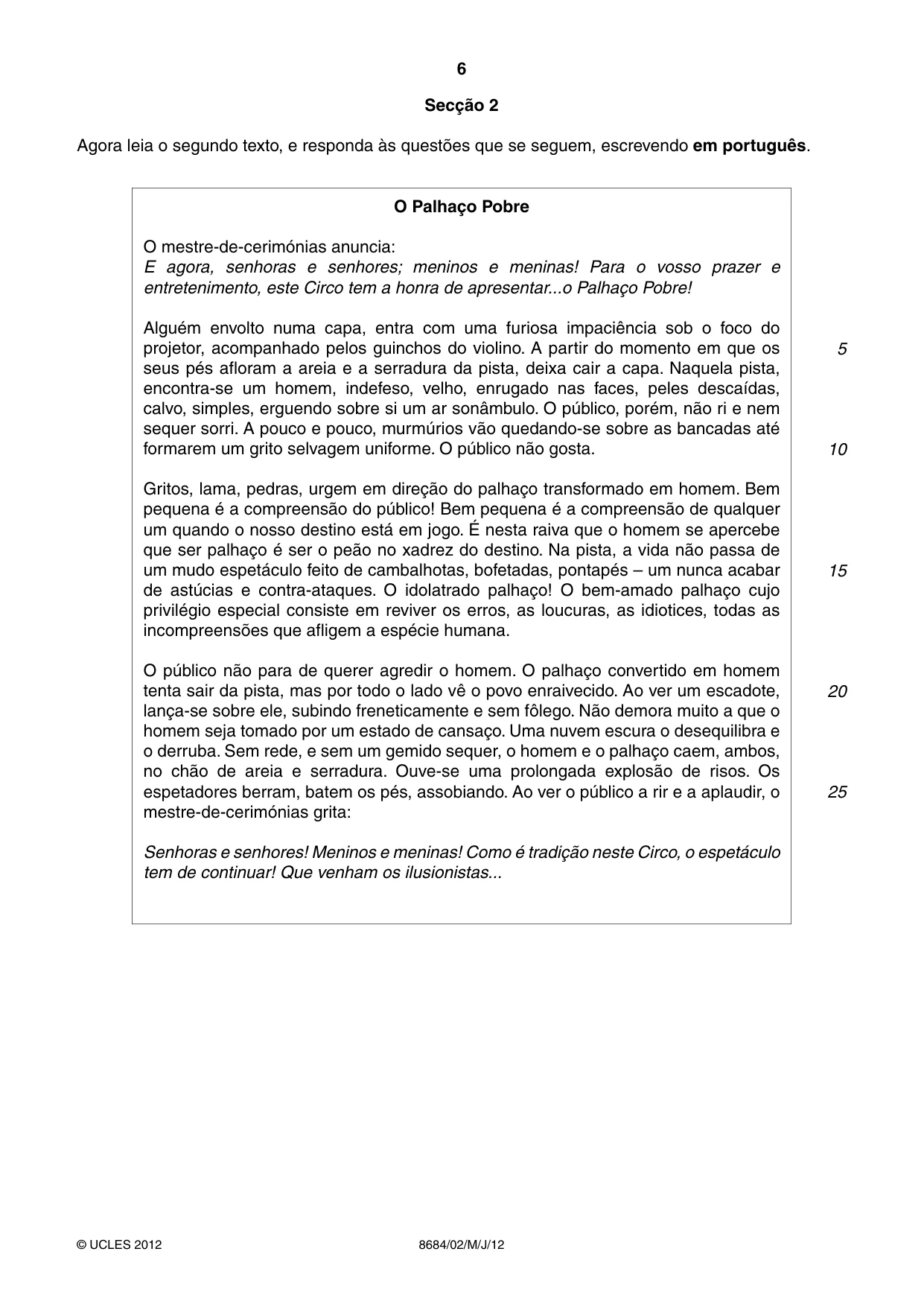
6 8684/02/M/J/12 © UCLES 2012 Secção 2 Agora leia o segundo texto, e responda às questões que se seguem, escrevendo em português. O Palhaço Pobre O mestre-de-cerimónias anuncia: E agora, senhoras e senhores; meninos e meninas! Para o vosso prazer e entretenimento, este Circo tem a honra de apresentar...o Palhaço Pobre! Alguém envolto numa capa, entra com uma furiosa impaciência sob o foco do projetor, acompanhado pelos guinchos do violino. A partir do momento em que os seus pés afloram a areia e a serradura da pista, deixa cair a capa. Naquela pista, encontra-se um homem, indefeso, velho, enrugado nas faces, peles descaídas, calvo, simples, erguendo sobre si um ar sonâmbulo. O público, porém, não ri e nem sequer sorri. A pouco e pouco, murmúrios vão quedando-se sobre as bancadas até formarem um grito selvagem uniforme. O público não gosta. Gritos, lama, pedras, urgem em direção do palhaço transformado em homem. Bem pequena é a compreensão do público! Bem pequena é a compreensão de qualquer um quando o nosso destino está em jogo. É nesta raiva que o homem se apercebe que ser palhaço é ser o peão no xadrez do destino. Na pista, a vida não passa de um mudo espetáculo feito de cambalhotas, bofetadas, pontapés – um nunca acabar de astúcias e contra-ataques. O idolatrado palhaço! O bem-amado palhaço cujo privilégio especial consiste em reviver os erros, as loucuras, as idiotices, todas as incompreensões que afligem a espécie humana. O público não para de querer agredir o homem. O palhaço convertido em homem tenta sair da pista, mas por todo o lado vê o povo enraivecido. Ao ver um escadote, lança-se sobre ele, subindo freneticamente e sem fôlego. Não demora muito a que o homem seja tomado por um estado de cansaço. Uma nuvem escura o desequilibra e o derruba. Sem rede, e sem um gemido sequer, o homem e o palhaço caem, ambos, no chão de areia e serradura. Ouve-se uma prolongada explosão de risos. Os espetadores berram, batem os pés, assobiando. Ao ver o público a rir e a aplaudir, o mestre-de-cerimónias grita: Senhoras e senhores! Meninos e meninas! Como é tradição neste Circo, o espetáculo tem de continuar! Que venham os ilusionistas... 5 10 15 20 25
Question paper, page 7
7 8684/02/M/J/12 © UCLES 2012 4 Responda às questões que se seguem, escrevendo em português, mas sem copiar frases inteiras do texto palavra por palavra. O número de valores para cada resposta está indicado entre colchetes. Adicionalmente, 5 valores são reservados para a qualidade de expressão. (Número total de valores: 15 + 5 = 20) (a) Descreva como o Palhaço Pobre se apresentou ao público. Mencione quatro detalhes. [4] (b) Como reagiu o público? Mencione três detalhes. [3] (c) De que se deu conta o Palhaço Pobre quanto às expectativas do público? Mencione quatro detalhes. [4] (d) Porque é que o Palhaço Pobre subiu o escadote? [1] (e) Como é que a sessão do Palhaço Pobre acabou? Mencione três detalhes. [3] [Total: 15 + 5 = 20] 5 Responda às seguintes questões em português. (a) Baseando-se nos dois textos, descreva, em resumo, a atuação dos três palhaços. Escreva entre 90 e 110 palavras. [10] (b) Na sua opinião, qual das duas cenas é mais trágica? Escreva entre 30 e 50 palavras. [5] [Qualidade de expressão: 5] [Total: 10 + 5 + 5 = 20]
Question paper, page 8
8 8684/02/M/J/12 © UCLES 2012 BLANK PAGE Copyright Acknowledgements: Section 1 Text 1 © M Couto; A Guerra dos Palhaços; Estórias Abensonhadas: Editorial Caminho; 1994. Section 1 Text 2 © http://void.weblog.com.pt/arquivo/187578.html. Permission to reproduce items where third-party owned material protected by copyright is included has been sought and cleared where possible. Every reasonable effort has been made by the publisher (UCLES) to trace copyright holders, but if any items requiring clearance have unwittingly been included, the publisher will be pleased to make amends at the earliest possible opportunity. University of Cambridge International Examinations is part of the Cambridge Assessment Group. Cambridge Assessment is the brand name of University of Cambridge Local Examinations Syndicate (UCLES), which is itself a department of the University of Cambridge.
Mark scheme, page 1
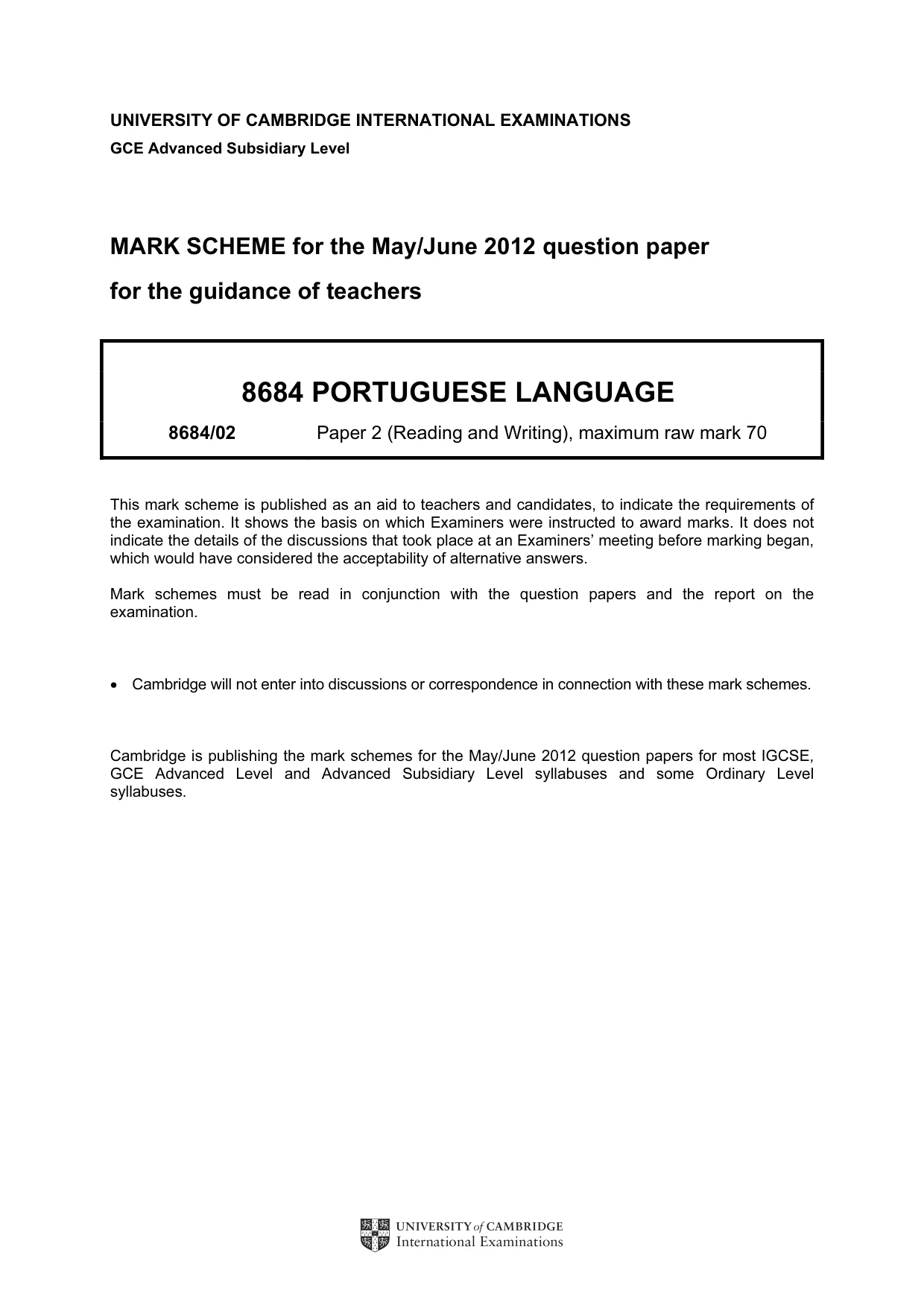
UNIVERSITY OF CAMBRIDGE INTERNATIONAL EXAMINATIONS GCE Advanced Subsidiary Level MARK SCHEME for the May/June 2012 question paper for the guidance of teachers 8684 PORTUGUESE LANGUAGE 8684/02 Paper 2 (Reading and Writing), maximum raw mark 70 This mark scheme is published as an aid to teachers and candidates, to indicate the requirements of the examination. It shows the basis on which Examiners were instructed to award marks. It does not indicate the details of the discussions that took place at an Examiners’ meeting before marking began, which would have considered the acceptability of alternative answers. Mark schemes must be read in conjunction with the question papers and the report on the examination. • Cambridge will not enter into discussions or correspondence in connection with these mark schemes. Cambridge is publishing the mark schemes for the May/June 2012 question papers for most IGCSE, GCE Advanced Level and Advanced Subsidiary Level syllabuses and some Ordinary Level syllabuses.
Mark scheme, page 2
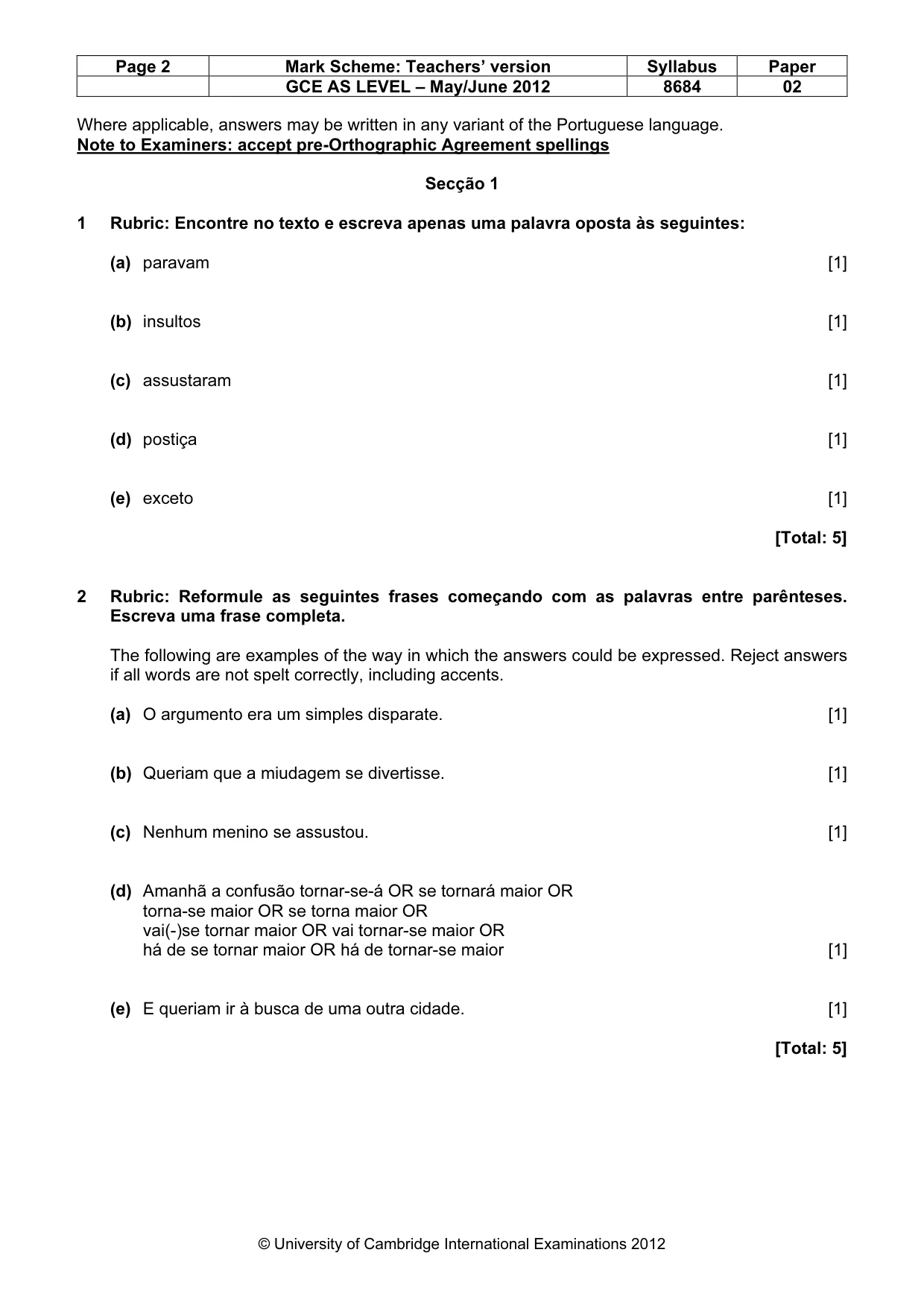
Page 2 Mark Scheme: Teachers’ version Syllabus Paper GCE AS LEVEL – May/June 2012 8684 02 © University of Cambridge International Examinations 2012 Where applicable, answers may be written in any variant of the Portuguese language. Note to Examiners: accept pre-Orthographic Agreement spellings Secção 1 1 Rubric: Encontre no texto e escreva apenas uma palavra oposta às seguintes: (a) paravam [1] (b) insultos [1] (c) assustaram [1] (d) postiça [1] (e) exceto [1] [Total: 5] 2 Rubric: Reformule as seguintes frases começando com as palavras entre parênteses. Escreva uma frase completa. The following are examples of the way in which the answers could be expressed. Reject answers if all words are not spelt correctly, including accents. (a) O argumento era um simples disparate. [1] (b) Queriam que a miudagem se divertisse. [1] (c) Nenhum menino se assustou. [1] (d) Amanhã a confusão tornar-se-á OR se tornará maior OR torna-se maior OR se torna maior OR vai(-)se tornar maior OR vai tornar-se maior OR há de se tornar maior OR há de tornar-se maior [1] (e) E queriam ir à busca de uma outra cidade. [1] [Total: 5]
Mark scheme, page 3
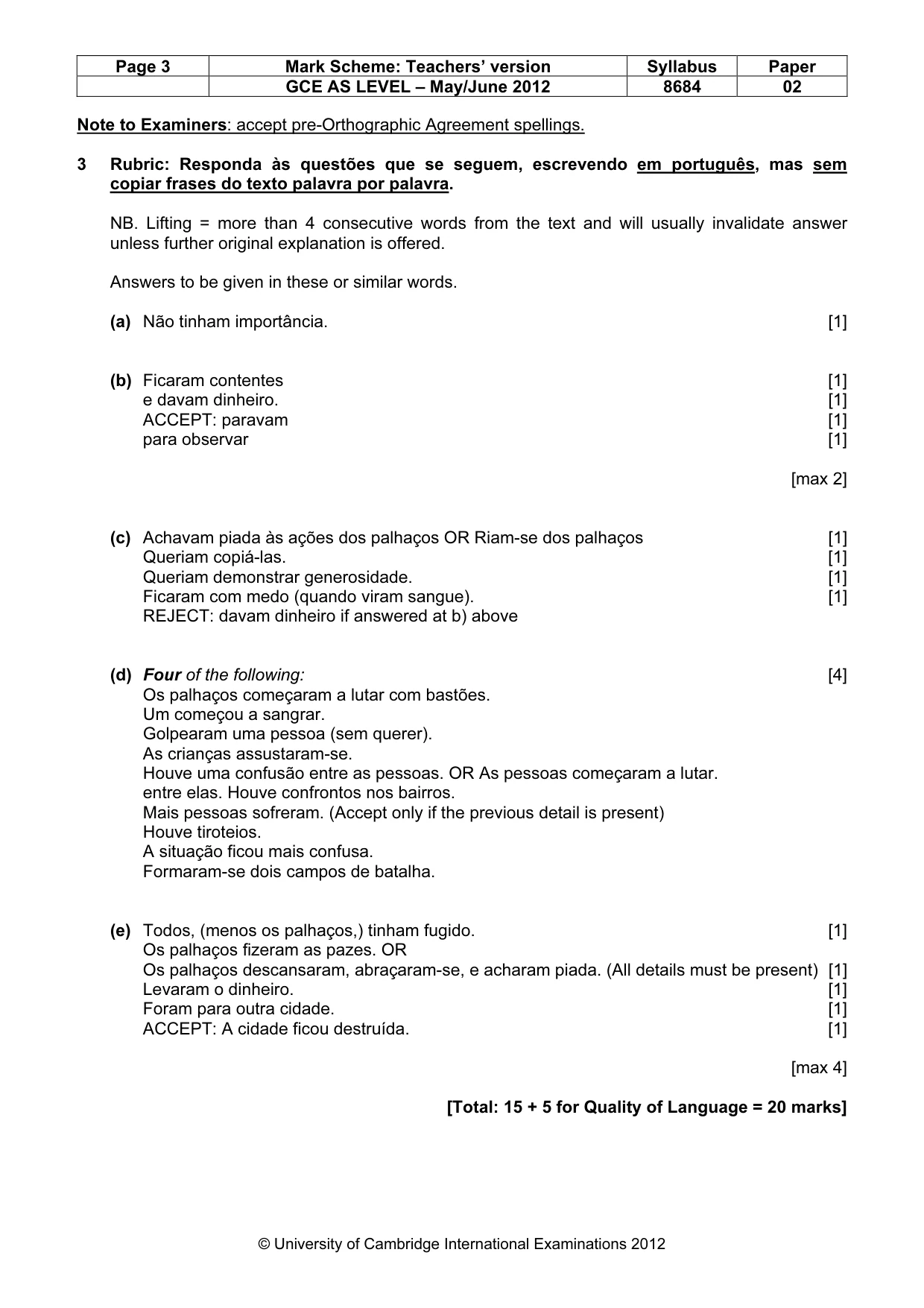
Page 3 Mark Scheme: Teachers’ version Syllabus Paper GCE AS LEVEL – May/June 2012 8684 02 © University of Cambridge International Examinations 2012 Note to Examiners: accept pre-Orthographic Agreement spellings. 3 Rubric: Responda às questões que se seguem, escrevendo em português, mas sem copiar frases do texto palavra por palavra. NB. Lifting = more than 4 consecutive words from the text and will usually invalidate answer unless further original explanation is offered. Answers to be given in these or similar words. (a) Não tinham importância. [1] (b) Ficaram contentes [1] e davam dinheiro. [1] ACCEPT: paravam [1] para observar [1] [max 2] (c) Achavam piada às ações dos palhaços OR Riam-se dos palhaços [1] Queriam copiá-las. [1] Queriam demonstrar generosidade. [1] Ficaram com medo (quando viram sangue). [1] REJECT: davam dinheiro if answered at b) above (d) Four of the following: [4] Os palhaços começaram a lutar com bastões. Um começou a sangrar. Golpearam uma pessoa (sem querer). As crianças assustaram-se. Houve uma confusão entre as pessoas. OR As pessoas começaram a lutar. entre elas. Houve confrontos nos bairros. Mais pessoas sofreram. (Accept only if the previous detail is present) Houve tiroteios. A situação ficou mais confusa. Formaram-se dois campos de batalha. (e) Todos, (menos os palhaços,) tinham fugido. [1] Os palhaços fizeram as pazes. OR Os palhaços descansaram, abraçaram-se, e acharam piada. (All details must be present) [1] Levaram o dinheiro. [1] Foram para outra cidade. [1] ACCEPT: A cidade ficou destruída. [1] [max 4] [Total: 15 + 5 for Quality of Language = 20 marks]
Mark scheme, page 4
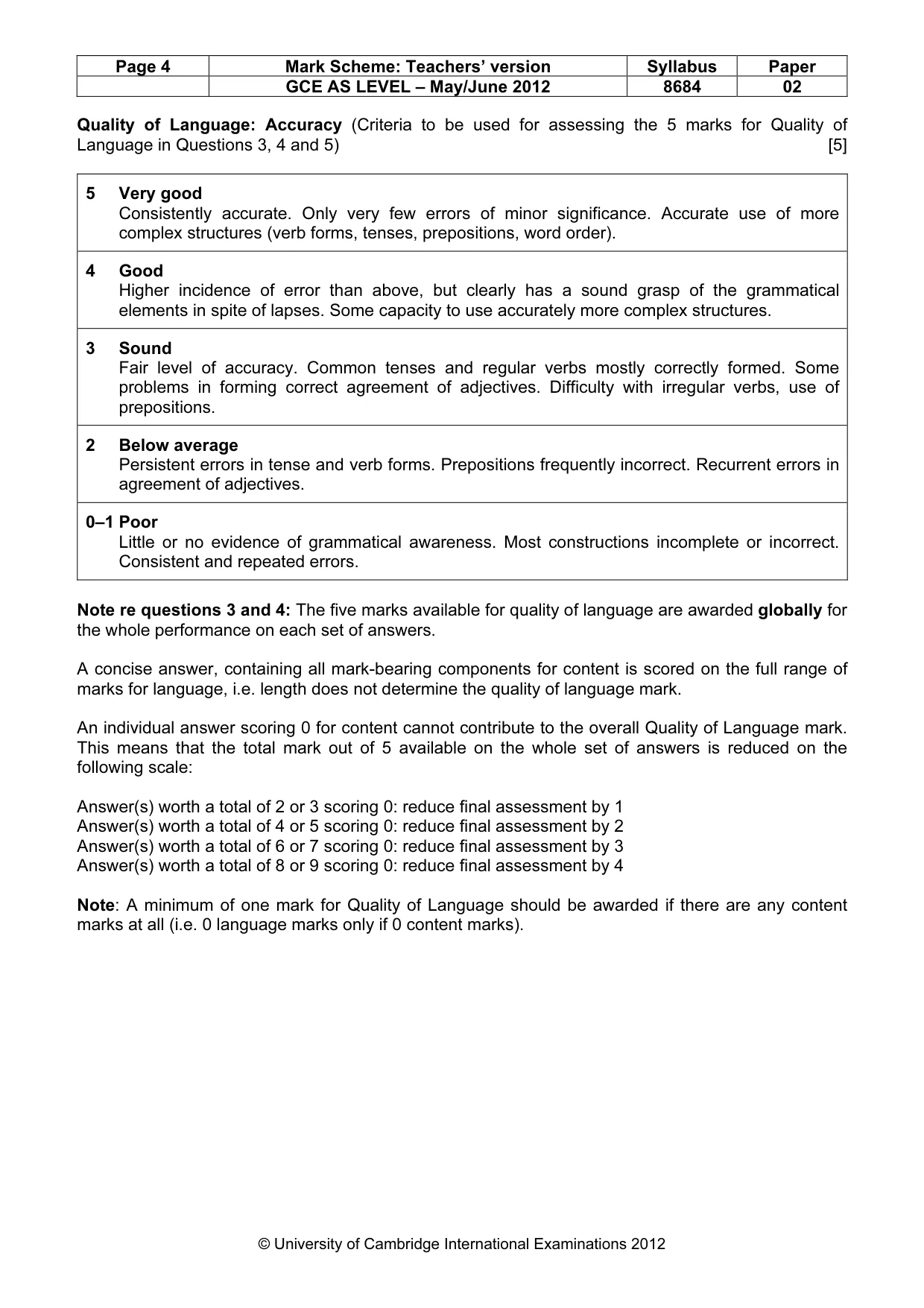
Page 4 Mark Scheme: Teachers’ version Syllabus Paper GCE AS LEVEL – May/June 2012 8684 02 © University of Cambridge International Examinations 2012 Quality of Language: Accuracy (Criteria to be used for assessing the 5 marks for Quality of Language in Questions 3, 4 and 5) [5] 5 Very good Consistently accurate. Only very few errors of minor significance. Accurate use of more complex structures (verb forms, tenses, prepositions, word order). 4 Good Higher incidence of error than above, but clearly has a sound grasp of the grammatical elements in spite of lapses. Some capacity to use accurately more complex structures. 3 Sound Fair level of accuracy. Common tenses and regular verbs mostly correctly formed. Some problems in forming correct agreement of adjectives. Difficulty with irregular verbs, use of prepositions. 2 Below average Persistent errors in tense and verb forms. Prepositions frequently incorrect. Recurrent errors in agreement of adjectives. 0–1 Poor Little or no evidence of grammatical awareness. Most constructions incomplete or incorrect. Consistent and repeated errors. Note re questions 3 and 4: The five marks available for quality of language are awarded globally for the whole performance on each set of answers. A concise answer, containing all mark-bearing components for content is scored on the full range of marks for language, i.e. length does not determine the quality of language mark. An individual answer scoring 0 for content cannot contribute to the overall Quality of Language mark. This means that the total mark out of 5 available on the whole set of answers is reduced on the following scale: Answer(s) worth a total of 2 or 3 scoring 0: reduce final assessment by 1 Answer(s) worth a total of 4 or 5 scoring 0: reduce final assessment by 2 Answer(s) worth a total of 6 or 7 scoring 0: reduce final assessment by 3 Answer(s) worth a total of 8 or 9 scoring 0: reduce final assessment by 4 Note: A minimum of one mark for Quality of Language should be awarded if there are any content marks at all (i.e. 0 language marks only if 0 content marks).
Mark scheme, page 5
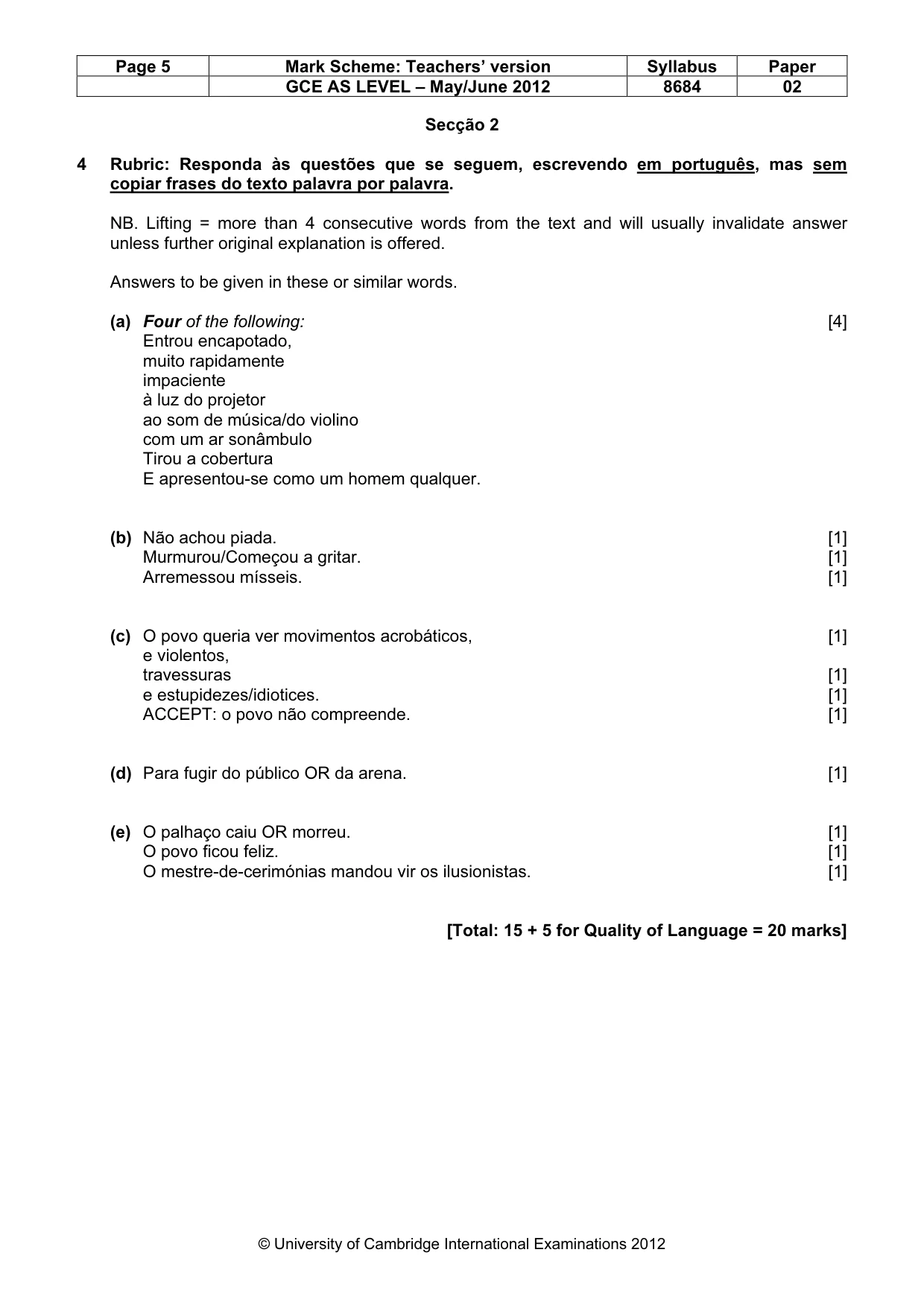
Page 5 Mark Scheme: Teachers’ version Syllabus Paper GCE AS LEVEL – May/June 2012 8684 02 © University of Cambridge International Examinations 2012 Secção 2 4 Rubric: Responda às questões que se seguem, escrevendo em português, mas sem copiar frases do texto palavra por palavra. NB. Lifting = more than 4 consecutive words from the text and will usually invalidate answer unless further original explanation is offered. Answers to be given in these or similar words. (a) Four of the following: [4] Entrou encapotado, muito rapidamente impaciente à luz do projetor ao som de música/do violino com um ar sonâmbulo Tirou a cobertura E apresentou-se como um homem qualquer. (b) Não achou piada. [1] Murmurou/Começou a gritar. [1] Arremessou mísseis. [1] (c) O povo queria ver movimentos acrobáticos, [1] e violentos, travessuras [1] e estupidezes/idiotices. [1] ACCEPT: o povo não compreende. [1] (d) Para fugir do público OR da arena. [1] (e) O palhaço caiu OR morreu. [1] O povo ficou feliz. [1] O mestre-de-cerimónias mandou vir os ilusionistas. [1] [Total: 15 + 5 for Quality of Language = 20 marks]
Mark scheme, page 6
Page 6 Mark Scheme: Teachers’ version Syllabus Paper GCE AS LEVEL – May/June 2012 8684 02 © University of Cambridge International Examinations 2012 Quality of Language: Accuracy (same as for questions 3 and 5) [5] 5 Very good Consistently accurate. Only very few errors of minor significance. Accurate use of more complex structures (verb forms, tenses, prepositions, word order). 4 Good Higher incidence of error than above, but clearly has a sound grasp of the grammatical elements in spite of lapses. Some capacity to use accurately more complex structures. 3 Sound Fair level of accuracy. Common tenses and regular verbs mostly correctly formed. Some problems in forming correct agreement of adjectives. Difficulty with irregular verbs, use of prepositions. 2 Below average Persistent errors in tense and verb forms. Prepositions frequently incorrect. Recurrent errors in agreement of adjectives. 0–1 Poor Little or no evidence of grammatical awareness. Most constructions incomplete or incorrect. Consistent and repeated errors. Note re questions 3 and 4: The five marks available for quality of language are awarded globally for the whole performance on each set of answers. A concise answer, containing all mark-bearing components for content is scored on the full range of marks for language, i.e. length does not determine the quality of language mark. An individual answer scoring 0 for content cannot contribute to the overall Quality of Language mark. This means that the total mark out of 5 available on the whole set of answers is reduced on the following scale: Answer(s) worth a total of 2 or 3 scoring 0: reduce final assessment by 1 Answer(s) worth a total of 4 or 5 scoring 0: reduce final assessment by 2 Answer(s) worth a total of 6 or 7 scoring 0: reduce final assessment by 3 Answer(s) worth a total of 8 or 9 scoring 0: reduce final assessment by 4 Note: A minimum of one mark for Quality of Language should be awarded if there are any content marks at all (i.e. 0 language marks only if 0 content marks). [Total: 20]
Mark scheme, page 7
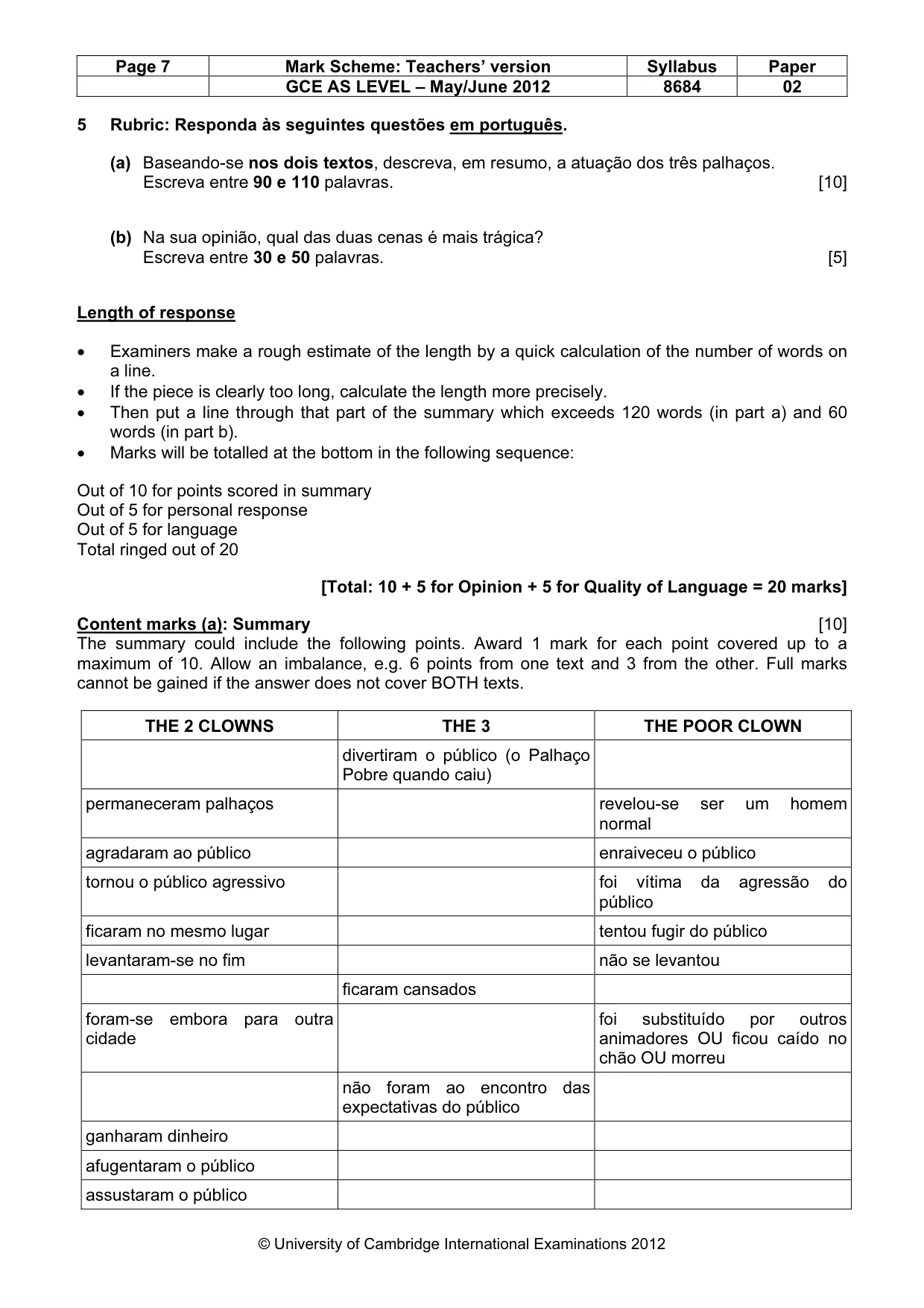
Page 7 Mark Scheme: Teachers’ version Syllabus Paper GCE AS LEVEL – May/June 2012 8684 02 © University of Cambridge International Examinations 2012 5 Rubric: Responda às seguintes questões em português. (a) Baseando-se nos dois textos, descreva, em resumo, a atuação dos três palhaços. Escreva entre 90 e 110 palavras. [10] (b) Na sua opinião, qual das duas cenas é mais trágica? Escreva entre 30 e 50 palavras. [5] Length of response • Examiners make a rough estimate of the length by a quick calculation of the number of words on a line. • If the piece is clearly too long, calculate the length more precisely. • Then put a line through that part of the summary which exceeds 120 words (in part a) and 60 words (in part b). • Marks will be totalled at the bottom in the following sequence: Out of 10 for points scored in summary Out of 5 for personal response Out of 5 for language Total ringed out of 20 [Total: 10 + 5 for Opinion + 5 for Quality of Language = 20 marks] Content marks (a): Summary [10] The summary could include the following points. Award 1 mark for each point covered up to a maximum of 10. Allow an imbalance, e.g. 6 points from one text and 3 from the other. Full marks cannot be gained if the answer does not cover BOTH texts. THE 2 CLOWNS THE 3 THE POOR CLOWN divertiram o público (o Palhaço Pobre quando caiu) permaneceram palhaços revelou-se ser um homem normal agradaram ao público enraiveceu o público tornou o público agressivo foi vítima da agressão do público ficaram no mesmo lugar tentou fugir do público levantaram-se no fim não se levantou ficaram cansados foram-se embora para outra cidade foi substituído por outros animadores OU ficou caído no chão OU morreu não foram ao encontro das expectativas do público ganharam dinheiro afugentaram o público assustaram o público
Mark scheme, page 8
Page 8 Mark Scheme: Teachers’ version Syllabus Paper GCE AS LEVEL – May/June 2012 8684 02 © University of Cambridge International Examinations 2012 (b) A sentence or two must express the required opinion. [5] [Total: 10 + 5 for Opinion + 5 for Quality of Language = 20] Content marks (b): Response to the passage/Opinion A sentence or two must express the required opinion. This should be marked as a mini-essay according to the variety and interest of the opinions and views expressed, the candidate’s response to the original text stimulus, and their ability to express a personal point of view. 5 Very good Varied and interesting ideas, showing an element of flair and imagination, a capacity to express a personal point of view. 4 Good Not the flair and imagination of the best candidates, but work still shows an ability to express a range of ideas, maintain interest and respond to the issues raised. 3 Sound A fair level of interest and ideas. May concentrate on a single issue, but there is still a response to ideas in the text. 2 Below average Limited range of ideas; rather humdrum. May disregard the element of response to the text, and write a largely unrelated free-composition. 0–1 Poor Few ideas to offer on the theme. Banal and pedestrian. No element of personal response to the text. Repeated error. Quality of language: Accuracy (same as for questions 3 and 4) [5] 5 Very good Consistently accurate. Only very few errors of minor significance. Accurate use of more complex structures (verb forms, tenses, prepositions, word order). 4 Good Higher incidence of error than above, but clearly has a sound grasp of the grammatical elements in spite of lapses. Some capacity to use accurately more complex structures. 3 Sound Fair level of accuracy. Common tenses and regular verbs mostly correctly formed. Some problems in forming correct agreement of adjectives. Difficulty with irregular verbs, use of prepositions. 2 Below average Persistent errors in tense and verb forms. Prepositions frequently incorrect. Recurrent errors in agreement of adjectives. 0–1 Poor Little or no evidence of grammatical awareness. Most constructions incomplete or incorrect. Consistent and repeated errors.
What you needed in this session
Cambridge’s own grade thresholds for 2012 May/June, Paper 2 · Variant 1. A higher threshold means an easier paper — the bar moves with how the cohort did.