Cambridge A Level Portuguese - Language (AS Level only) 8684 — 2011 May/June Paper 2 · Variant 1
8684/21/M/J/11 · 70 marks · ≈79 min
The question paper and its mark scheme, free to read here and free to download. This is Cambridge’s own paper, exactly as it was sat.
Question paper8 pages



Mark scheme8 pages
Answers below. Sit the paper first if you are practising.
Paper as text
Question paper, page 1
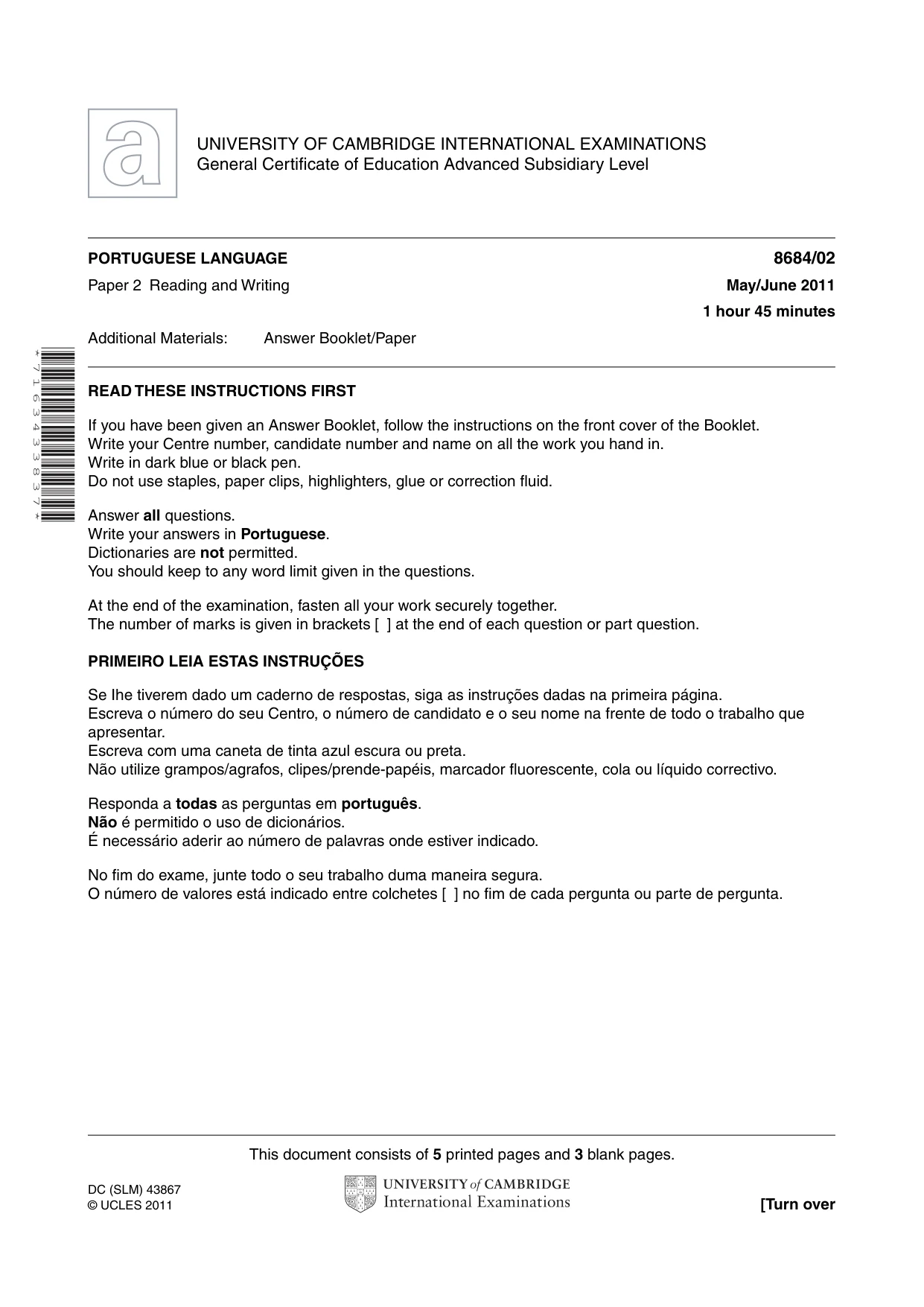
This document consists of 5 printed pages and 3 blank pages. DC (SLM) 43867 © UCLES 2011 [Turn over UNIVERSITY OF CAMBRIDGE INTERNATIONAL EXAMINATIONS General Certificate of Education Advanced Subsidiary Level READ THESE INSTRUCTIONS FIRST If you have been given an Answer Booklet, follow the instructions on the front cover of the Booklet. Write your Centre number, candidate number and name on all the work you hand in. Write in dark blue or black pen. Do not use staples, paper clips, highlighters, glue or correction fluid. Answer all questions. Write your answers in Portuguese. Dictionaries are not permitted. You should keep to any word limit given in the questions. At the end of the examination, fasten all your work securely together. The number of marks is given in brackets [ ] at the end of each question or part question. PRIMEIRO LEIA ESTAS INSTRUÇÕES Se Ihe tiverem dado um caderno de respostas, siga as instruções dadas na primeira página. Escreva o número do seu Centro, o número de candidato e o seu nome na frente de todo o trabalho que apresentar. Escreva com uma caneta de tinta azul escura ou preta. Não utilize grampos/agrafos, clipes/prende-papéis, marcador fluorescente, cola ou líquido correctivo. Responda a todas as perguntas em português. Não é permitido o uso de dicionários. É necessário aderir ao número de palavras onde estiver indicado. No fim do exame, junte todo o seu trabalho duma maneira segura. O número de valores está indicado entre colchetes [ ] no fim de cada pergunta ou parte de pergunta. * 7 1 6 3 4 3 3 8 3 7 * PORTUGUESE LANGUAGE 8684/02 Paper 2 Reading and Writing May/June 2011 1 hour 45 minutes Additional Materials: Answer Booklet/Paper
Question paper, page 2
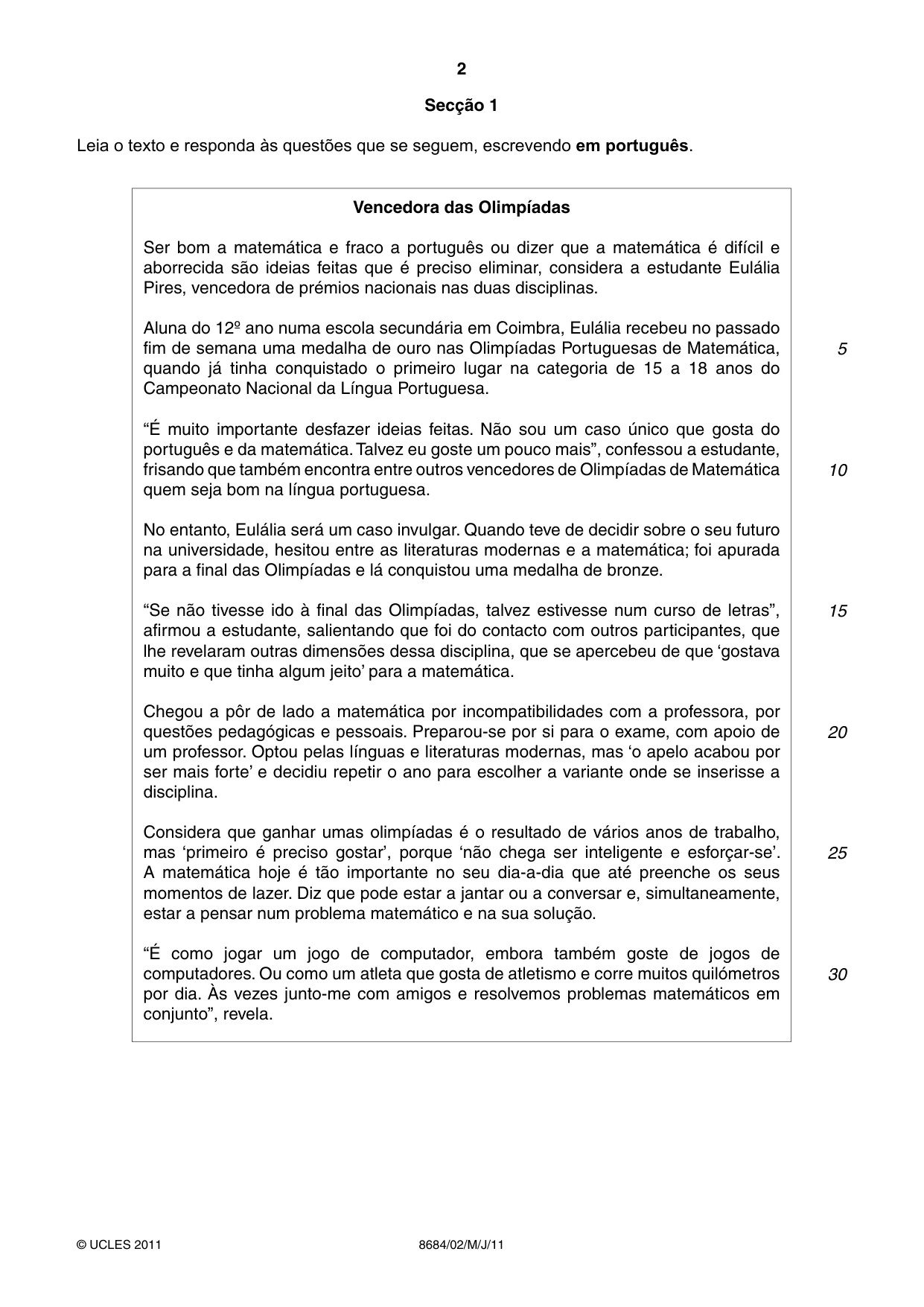
2 8684/02/M/J/11 © UCLES 2011 Secção 1 Leia o texto e responda às questões que se seguem, escrevendo em português. Vencedora das Olimpíadas Ser bom a matemática e fraco a português ou dizer que a matemática é difícil e aborrecida são ideias feitas que é preciso eliminar, considera a estudante Eulália Pires, vencedora de prémios nacionais nas duas disciplinas. Aluna do 12º ano numa escola secundária em Coimbra, Eulália recebeu no passado fim de semana uma medalha de ouro nas Olimpíadas Portuguesas de Matemática, quando já tinha conquistado o primeiro lugar na categoria de 15 a 18 anos do Campeonato Nacional da Língua Portuguesa. “É muito importante desfazer ideias feitas. Não sou um caso único que gosta do português e da matemática. Talvez eu goste um pouco mais”, confessou a estudante, frisando que também encontra entre outros vencedores de Olimpíadas de Matemática quem seja bom na língua portuguesa. No entanto, Eulália será um caso invulgar. Quando teve de decidir sobre o seu futuro na universidade, hesitou entre as literaturas modernas e a matemática; foi apurada para a final das Olimpíadas e lá conquistou uma medalha de bronze. “Se não tivesse ido à final das Olimpíadas, talvez estivesse num curso de letras”, afirmou a estudante, salientando que foi do contacto com outros participantes, que lhe revelaram outras dimensões dessa disciplina, que se apercebeu de que ‘gostava muito e que tinha algum jeito’ para a matemática. Chegou a pôr de lado a matemática por incompatibilidades com a professora, por questões pedagógicas e pessoais. Preparou-se por si para o exame, com apoio de um professor. Optou pelas línguas e literaturas modernas, mas ‘o apelo acabou por ser mais forte’ e decidiu repetir o ano para escolher a variante onde se inserisse a disciplina. Considera que ganhar umas olimpíadas é o resultado de vários anos de trabalho, mas ‘primeiro é preciso gostar’, porque ‘não chega ser inteligente e esforçar-se’. A matemática hoje é tão importante no seu dia-a-dia que até preenche os seus momentos de lazer. Diz que pode estar a jantar ou a conversar e, simultaneamente, estar a pensar num problema matemático e na sua solução. “É como jogar um jogo de computador, embora também goste de jogos de computadores. Ou como um atleta que gosta de atletismo e corre muitos quilómetros por dia. Às vezes junto-me com amigos e resolvemos problemas matemáticos em conjunto”, revela. 5 10 15 20 25 30
Question paper, page 3
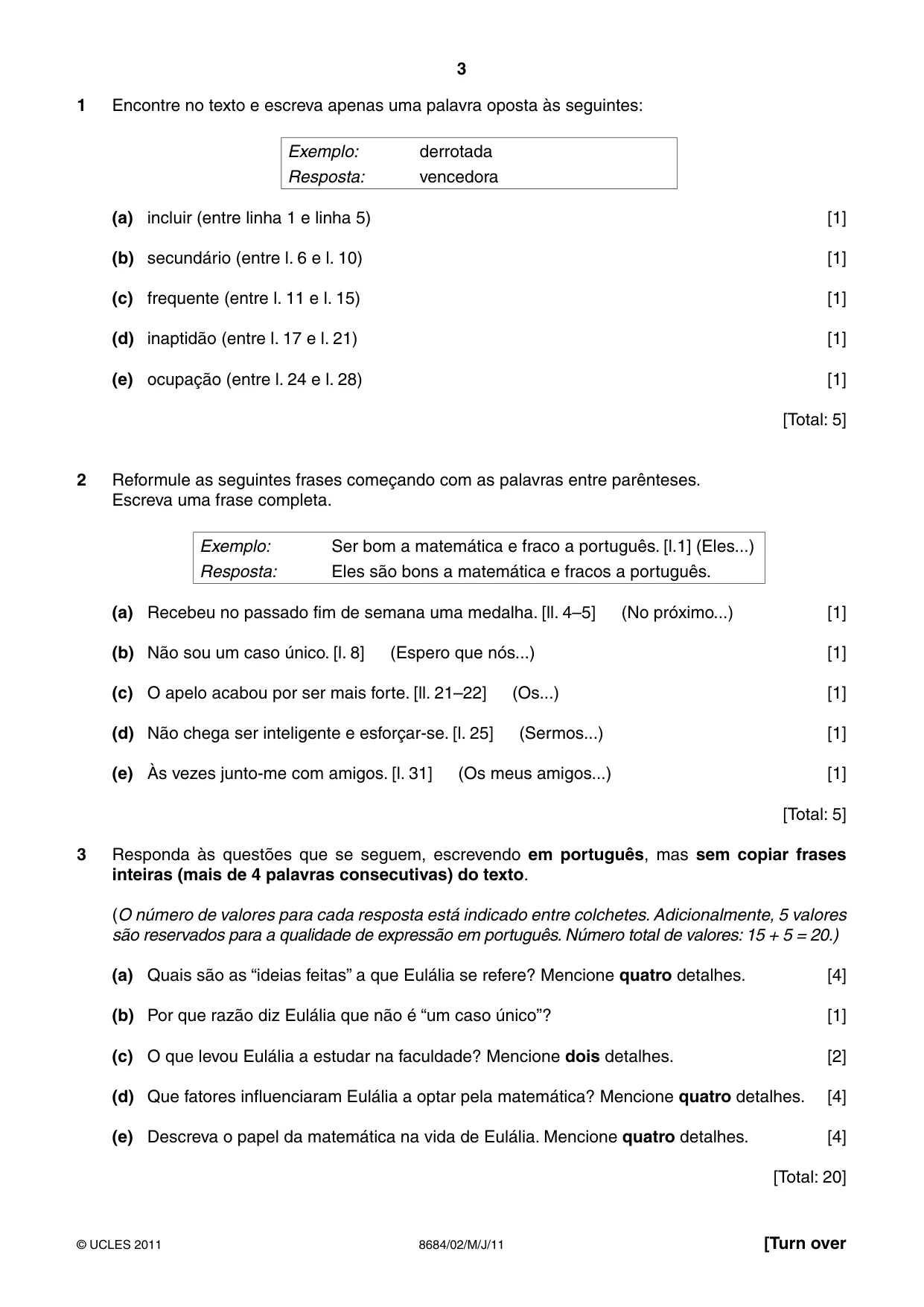
3 8684/02/M/J/11 © UCLES 2011 [Turn over 1 Encontre no texto e escreva apenas uma palavra oposta às seguintes: Exemplo: derrotada Resposta: vencedora (a) incluir (entre linha 1 e linha 5) [1] (b) secundário (entre l. 6 e l. 10) [1] (c) frequente (entre l. 11 e l. 15) [1] (d) inaptidão (entre l. 17 e l. 21) [1] (e) ocupação (entre l. 24 e l. 28) [1] [Total: 5] 2 Reformule as seguintes frases começando com as palavras entre parênteses. Escreva uma frase completa. Exemplo: Ser bom a matemática e fraco a português. [l.1] (Eles...) Resposta: Eles são bons a matemática e fracos a português. (a) Recebeu no passado fim de semana uma medalha. [ll. 4–5] (No próximo...) [1] (b) Não sou um caso único. [l. 8] (Espero que nós...) [1] (c) O apelo acabou por ser mais forte. [ll. 21–22] (Os...) [1] (d) Não chega ser inteligente e esforçar-se. [l. 25] (Sermos...) [1] (e) Às vezes junto-me com amigos. [l. 31] (Os meus amigos...) [1] [Total: 5] 3 Responda às questões que se seguem, escrevendo em português, mas sem copiar frases inteiras (mais de 4 palavras consecutivas) do texto. (O número de valores para cada resposta está indicado entre colchetes. Adicionalmente, 5 valores são reservados para a qualidade de expressão em português. Número total de valores: 15 + 5 = 20.) (a) Quais são as “ideias feitas” a que Eulália se refere? Mencione quatro detalhes. [4] (b) Por que razão diz Eulália que não é “um caso único”? [1] (c) O que levou Eulália a estudar na faculdade? Mencione dois detalhes. [2] (d) Que fatores influenciaram Eulália a optar pela matemática? Mencione quatro detalhes. [4] (e) Descreva o papel da matemática na vida de Eulália. Mencione quatro detalhes. [4] [Total: 20]
Question paper, page 4
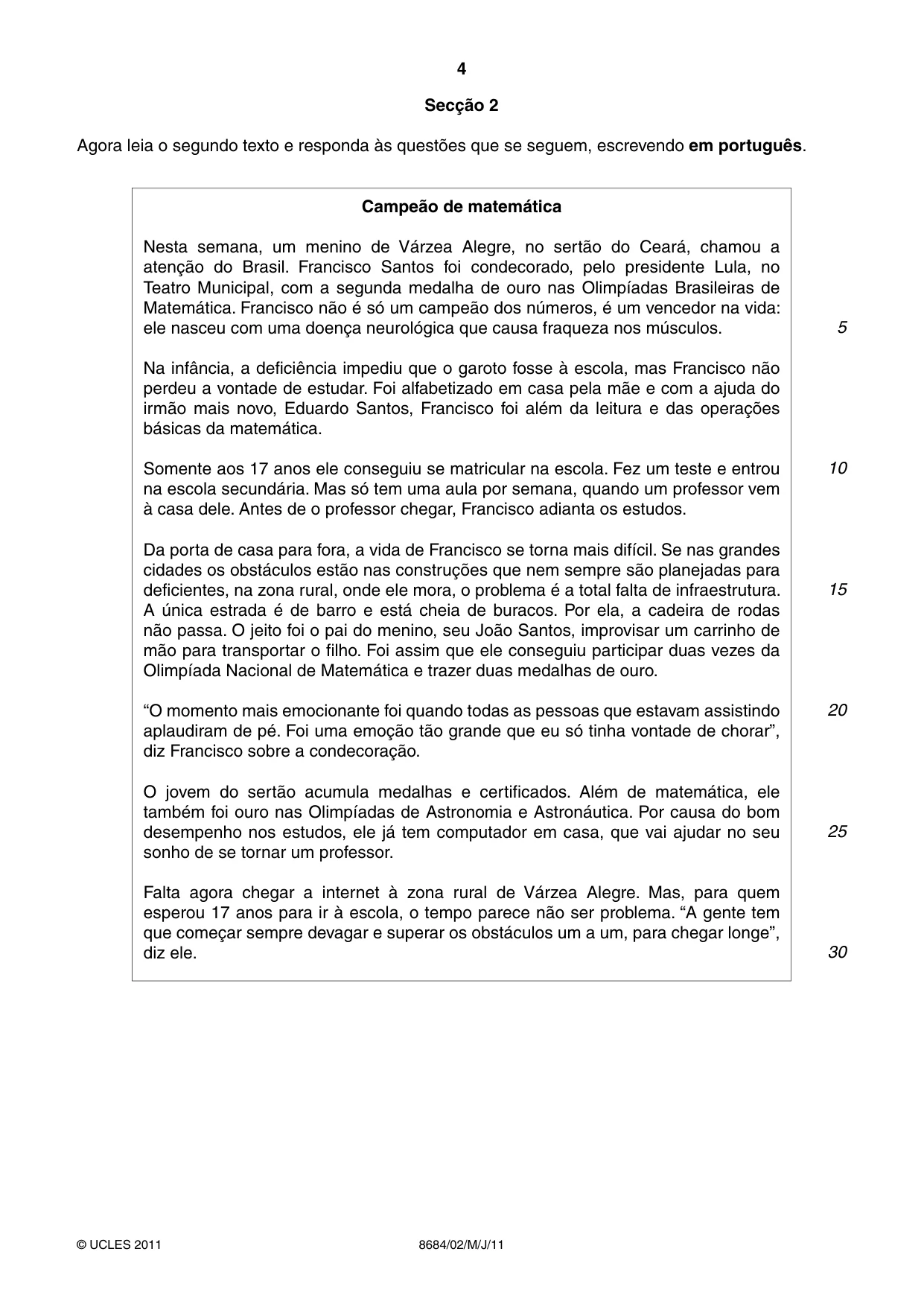
4 8684/02/M/J/11 © UCLES 2011 Secção 2 Agora leia o segundo texto e responda às questões que se seguem, escrevendo em português. Campeão de matemática Nesta semana, um menino de Várzea Alegre, no sertão do Ceará, chamou a atenção do Brasil. Francisco Santos foi condecorado, pelo presidente Lula, no Teatro Municipal, com a segunda medalha de ouro nas Olimpíadas Brasileiras de Matemática. Francisco não é só um campeão dos números, é um vencedor na vida: ele nasceu com uma doença neurológica que causa fraqueza nos músculos. Na infância, a deficiência impediu que o garoto fosse à escola, mas Francisco não perdeu a vontade de estudar. Foi alfabetizado em casa pela mãe e com a ajuda do irmão mais novo, Eduardo Santos, Francisco foi além da leitura e das operações básicas da matemática. Somente aos 17 anos ele conseguiu se matricular na escola. Fez um teste e entrou na escola secundária. Mas só tem uma aula por semana, quando um professor vem à casa dele. Antes de o professor chegar, Francisco adianta os estudos. Da porta de casa para fora, a vida de Francisco se torna mais difícil. Se nas grandes cidades os obstáculos estão nas construções que nem sempre são planejadas para deficientes, na zona rural, onde ele mora, o problema é a total falta de infraestrutura. A única estrada é de barro e está cheia de buracos. Por ela, a cadeira de rodas não passa. O jeito foi o pai do menino, seu João Santos, improvisar um carrinho de mão para transportar o filho. Foi assim que ele conseguiu participar duas vezes da Olimpíada Nacional de Matemática e trazer duas medalhas de ouro. “O momento mais emocionante foi quando todas as pessoas que estavam assistindo aplaudiram de pé. Foi uma emoção tão grande que eu só tinha vontade de chorar”, diz Francisco sobre a condecoração. O jovem do sertão acumula medalhas e certificados. Além de matemática, ele também foi ouro nas Olimpíadas de Astronomia e Astronáutica. Por causa do bom desempenho nos estudos, ele já tem computador em casa, que vai ajudar no seu sonho de se tornar um professor. Falta agora chegar a internet à zona rural de Várzea Alegre. Mas, para quem esperou 17 anos para ir à escola, o tempo parece não ser problema. “A gente tem que começar sempre devagar e superar os obstáculos um a um, para chegar longe”, diz ele. 5 10 15 20 25 30
Question paper, page 5
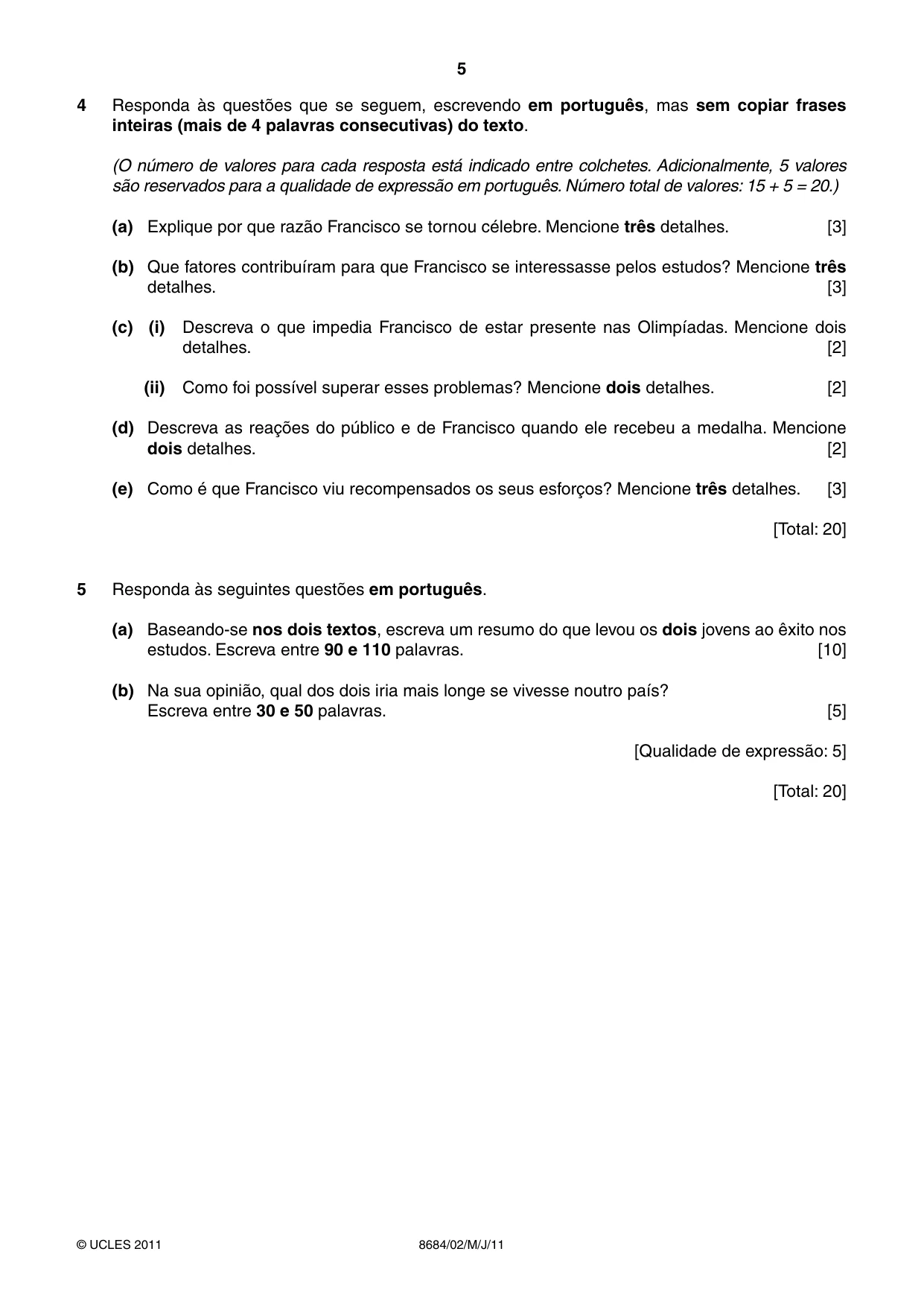
5 8684/02/M/J/11 4 Responda às questões que se seguem, escrevendo em português, mas sem copiar frases inteiras (mais de 4 palavras consecutivas) do texto. (O número de valores para cada resposta está indicado entre colchetes. Adicionalmente, 5 valores são reservados para a qualidade de expressão em português. Número total de valores: 15 + 5 = 20.) (a) Explique por que razão Francisco se tornou célebre. Mencione três detalhes. [3] (b) Que fatores contribuíram para que Francisco se interessasse pelos estudos? Mencione três detalhes. [3] (c) (i) Descreva o que impedia Francisco de estar presente nas Olimpíadas. Mencione dois detalhes. [2] (ii) Como foi possível superar esses problemas? Mencione dois detalhes. [2] (d) Descreva as reações do público e de Francisco quando ele recebeu a medalha. Mencione dois detalhes. [2] (e) Como é que Francisco viu recompensados os seus esforços? Mencione três detalhes. [3] [Total: 20] 5 Responda às seguintes questões em português. (a) Baseando-se nos dois textos, escreva um resumo do que levou os dois jovens ao êxito nos estudos. Escreva entre 90 e 110 palavras. [10] (b) Na sua opinião, qual dos dois iria mais longe se vivesse noutro país? Escreva entre 30 e 50 palavras. [5] [Qualidade de expressão: 5] [Total: 20] © UCLES 2011
Question paper, page 6
6 8684/02/M/J/11 © UCLES 2011 BLANK PAGE
Question paper, page 7
7 8684/02/M/J/11 © UCLES 2011 BLANK PAGE
Question paper, page 8
8 8684/02/M/J/11 © UCLES 2011 Copyright Acknowledgements: Section 1 © Vencedora de olímpiadas desfaz “ideia feita”. http://diario.iol.pt/sociedade/matematica-olimpiadas-ouro-medalhas-leiria/929020-4071.html Section 2 © Campeão de matemática luta contra doença para estudar. http://g1.globo.com/Noticias/Vestibular/0,,MUL334233-5604,00- CAMPEAO+DE+MATEMATICA+LUTA+CONTRA+DOENCA+PARA+ESTUDAR.html; 6 November 2009. Permission to reproduce items where third-party owned material protected by copyright is included has been sought and cleared where possible. Every reasonable effort has been made by the publisher (UCLES) to trace copyright holders, but if any items requiring clearance have unwittingly been included, the publisher will be pleased to make amends at the earliest possible opportunity. University of Cambridge International Examinations is part of the Cambridge Assessment Group. Cambridge Assessment is the brand name of University of Cambridge Local Examinations Syndicate (UCLES), which is itself a department of the University of Cambridge. BLANK PAGE
Mark scheme, page 1
UNIVERSITY OF CAMBRIDGE INTERNATIONAL EXAMINATIONS GCE Advanced Subsidiary Level MARK SCHEME for the May/June 2011 question paper for the guidance of teachers 8684 PORTUGUESE LANGUAGE 8684/02 Paper 2 (Reading and Writing), maximum raw mark 70 This mark scheme is published as an aid to teachers and candidates, to indicate the requirements of the examination. It shows the basis on which Examiners were instructed to award marks. It does not indicate the details of the discussions that took place at an Examiners’ meeting before marking began, which would have considered the acceptability of alternative answers. Mark schemes must be read in conjunction with the question papers and the report on the examination. • Cambridge will not enter into discussions or correspondence in connection with these mark schemes. Cambridge is publishing the mark schemes for the May/June 2011 question papers for most IGCSE, GCE Advanced Level and Advanced Subsidiary Level syllabuses and some Ordinary Level syllabuses.
Mark scheme, page 2
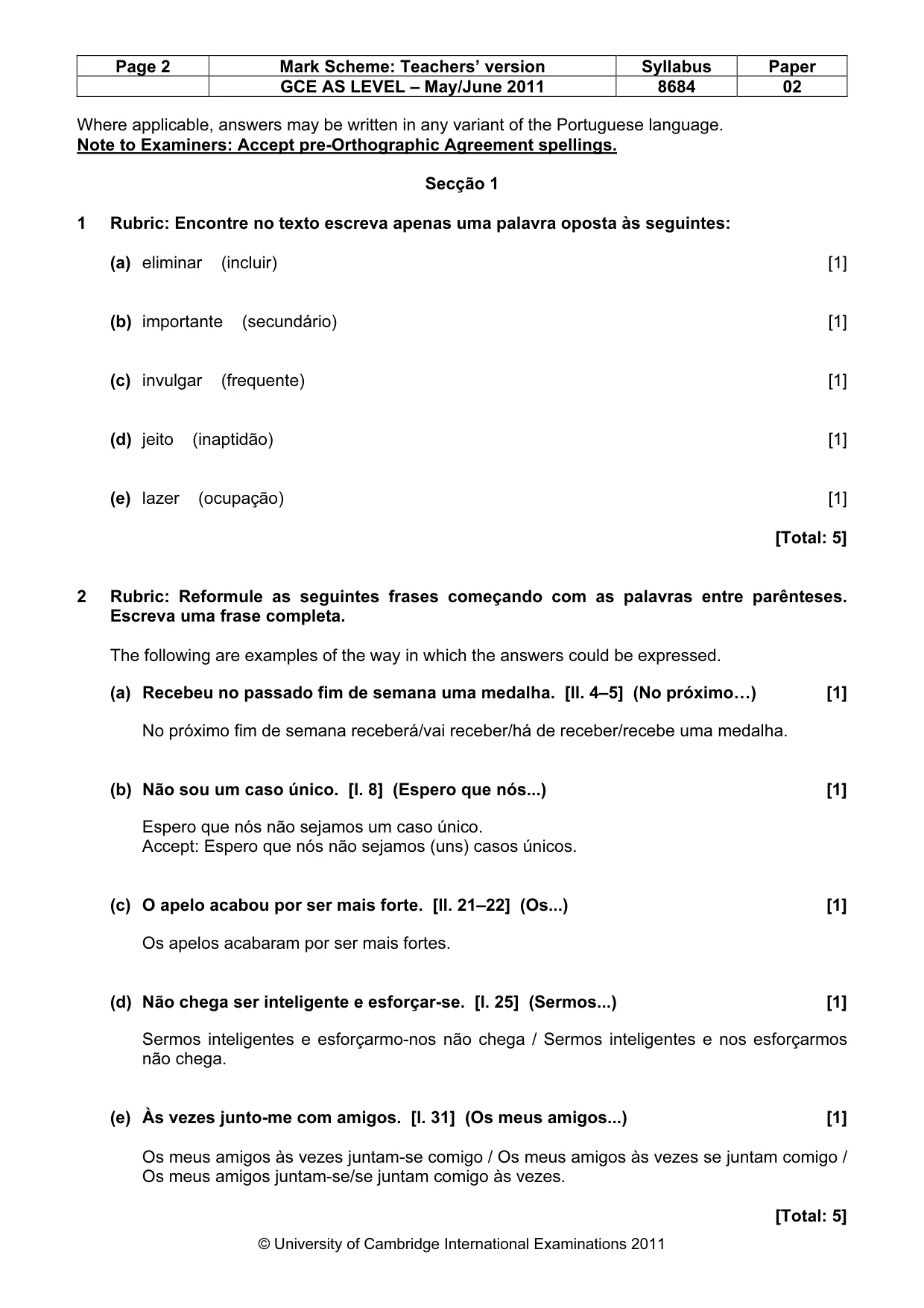
Page 2 Mark Scheme: Teachers’ version Syllabus Paper GCE AS LEVEL – May/June 2011 8684 02 © University of Cambridge International Examinations 2011 Where applicable, answers may be written in any variant of the Portuguese language. Note to Examiners: Accept pre-Orthographic Agreement spellings. Secção 1 1 Rubric: Encontre no texto escreva apenas uma palavra oposta às seguintes: (a) eliminar (incluir) [1] (b) importante (secundário) [1] (c) invulgar (frequente) [1] (d) jeito (inaptidão) [1] (e) lazer (ocupação) [1] [Total: 5] 2 Rubric: Reformule as seguintes frases começando com as palavras entre parênteses. Escreva uma frase completa. The following are examples of the way in which the answers could be expressed. (a) Recebeu no passado fim de semana uma medalha. [ll. 4–5] (No próximo…) [1] No próximo fim de semana receberá/vai receber/há de receber/recebe uma medalha. (b) Não sou um caso único. [l. 8] (Espero que nós...) [1] Espero que nós não sejamos um caso único. Accept: Espero que nós não sejamos (uns) casos únicos. (c) O apelo acabou por ser mais forte. [ll. 21–22] (Os...) [1] Os apelos acabaram por ser mais fortes. (d) Não chega ser inteligente e esforçar-se. [l. 25] (Sermos...) [1] Sermos inteligentes e esforçarmo-nos não chega / Sermos inteligentes e nos esforçarmos não chega. (e) Às vezes junto-me com amigos. [l. 31] (Os meus amigos...) [1] Os meus amigos às vezes juntam-se comigo / Os meus amigos às vezes se juntam comigo / Os meus amigos juntam-se/se juntam comigo às vezes. [Total: 5]
Mark scheme, page 3
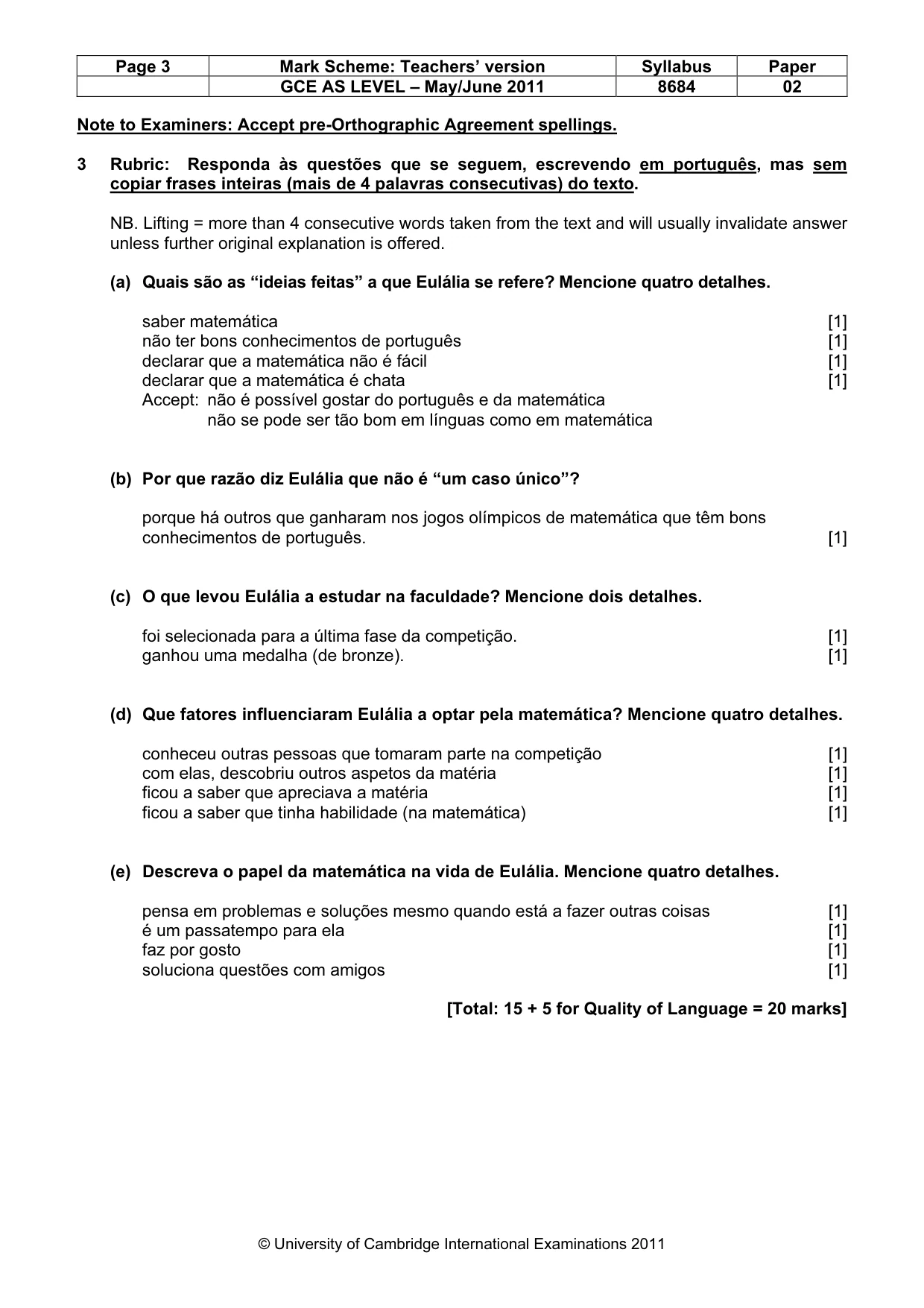
Page 3 Mark Scheme: Teachers’ version Syllabus Paper GCE AS LEVEL – May/June 2011 8684 02 © University of Cambridge International Examinations 2011 Note to Examiners: Accept pre-Orthographic Agreement spellings. 3 Rubric: Responda às questões que se seguem, escrevendo em português, mas sem copiar frases inteiras (mais de 4 palavras consecutivas) do texto. NB. Lifting = more than 4 consecutive words taken from the text and will usually invalidate answer unless further original explanation is offered. (a) Quais são as “ideias feitas” a que Eulália se refere? Mencione quatro detalhes. saber matemática [1] não ter bons conhecimentos de português [1] declarar que a matemática não é fácil [1] declarar que a matemática é chata [1] Accept: não é possível gostar do português e da matemática não se pode ser tão bom em línguas como em matemática (b) Por que razão diz Eulália que não é “um caso único”? porque há outros que ganharam nos jogos olímpicos de matemática que têm bons conhecimentos de português. [1] (c) O que levou Eulália a estudar na faculdade? Mencione dois detalhes. foi selecionada para a última fase da competição. [1] ganhou uma medalha (de bronze). [1] (d) Que fatores influenciaram Eulália a optar pela matemática? Mencione quatro detalhes. conheceu outras pessoas que tomaram parte na competição [1] com elas, descobriu outros aspetos da matéria [1] ficou a saber que apreciava a matéria [1] ficou a saber que tinha habilidade (na matemática) [1] (e) Descreva o papel da matemática na vida de Eulália. Mencione quatro detalhes. pensa em problemas e soluções mesmo quando está a fazer outras coisas [1] é um passatempo para ela [1] faz por gosto [1] soluciona questões com amigos [1] [Total: 15 + 5 for Quality of Language = 20 marks]
Mark scheme, page 4
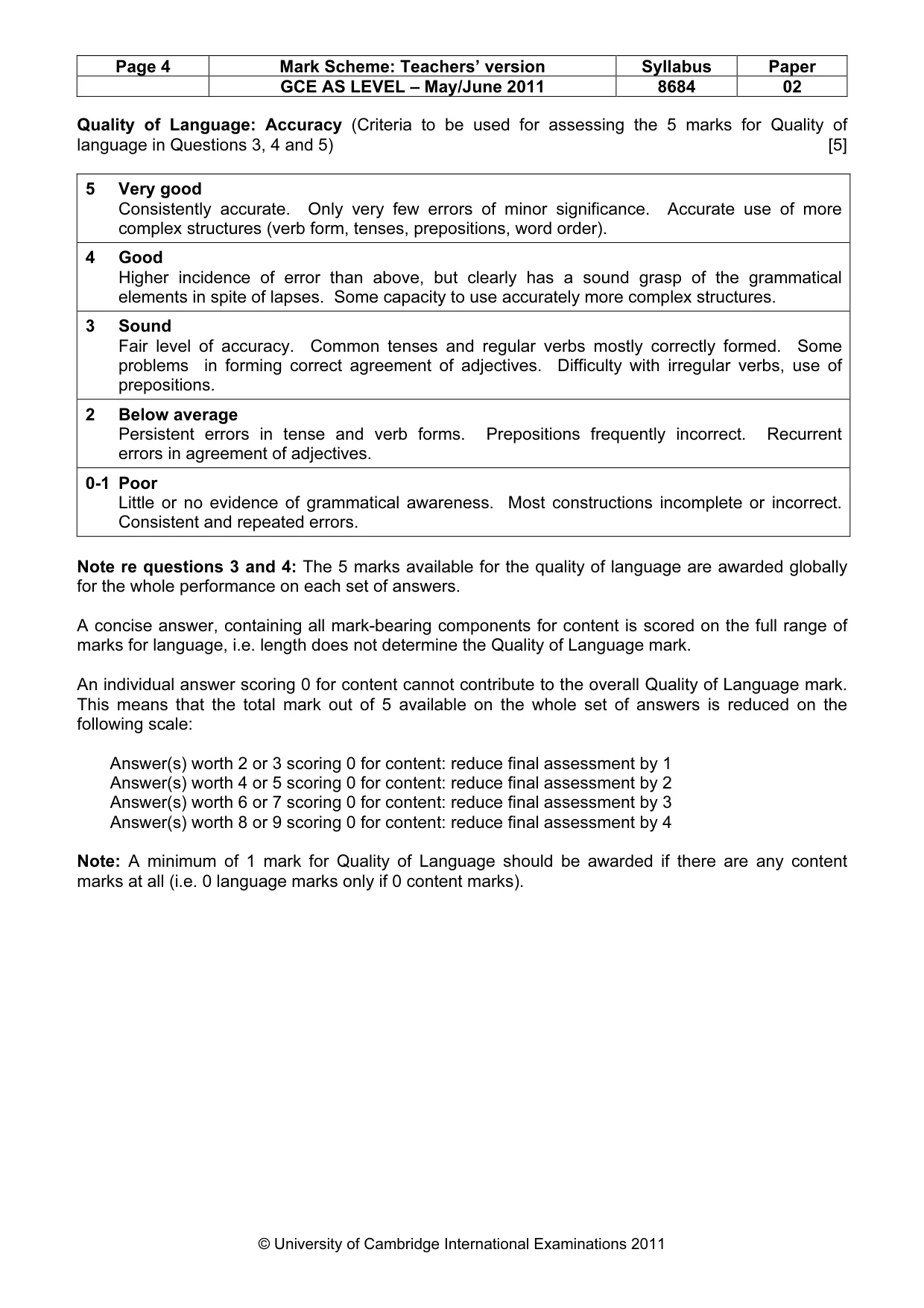
Page 4 Mark Scheme: Teachers’ version Syllabus Paper GCE AS LEVEL – May/June 2011 8684 02 © University of Cambridge International Examinations 2011 Quality of Language: Accuracy (Criteria to be used for assessing the 5 marks for Quality of language in Questions 3, 4 and 5) [5] 5 Very good Consistently accurate. Only very few errors of minor significance. Accurate use of more complex structures (verb form, tenses, prepositions, word order). 4 Good Higher incidence of error than above, but clearly has a sound grasp of the grammatical elements in spite of lapses. Some capacity to use accurately more complex structures. 3 Sound Fair level of accuracy. Common tenses and regular verbs mostly correctly formed. Some problems in forming correct agreement of adjectives. Difficulty with irregular verbs, use of prepositions. 2 Below average Persistent errors in tense and verb forms. Prepositions frequently incorrect. Recurrent errors in agreement of adjectives. 0-1 Poor Little or no evidence of grammatical awareness. Most constructions incomplete or incorrect. Consistent and repeated errors. Note re questions 3 and 4: The 5 marks available for the quality of language are awarded globally for the whole performance on each set of answers. A concise answer, containing all mark-bearing components for content is scored on the full range of marks for language, i.e. length does not determine the Quality of Language mark. An individual answer scoring 0 for content cannot contribute to the overall Quality of Language mark. This means that the total mark out of 5 available on the whole set of answers is reduced on the following scale: Answer(s) worth 2 or 3 scoring 0 for content: reduce final assessment by 1 Answer(s) worth 4 or 5 scoring 0 for content: reduce final assessment by 2 Answer(s) worth 6 or 7 scoring 0 for content: reduce final assessment by 3 Answer(s) worth 8 or 9 scoring 0 for content: reduce final assessment by 4 Note: A minimum of 1 mark for Quality of Language should be awarded if there are any content marks at all (i.e. 0 language marks only if 0 content marks).
Mark scheme, page 5
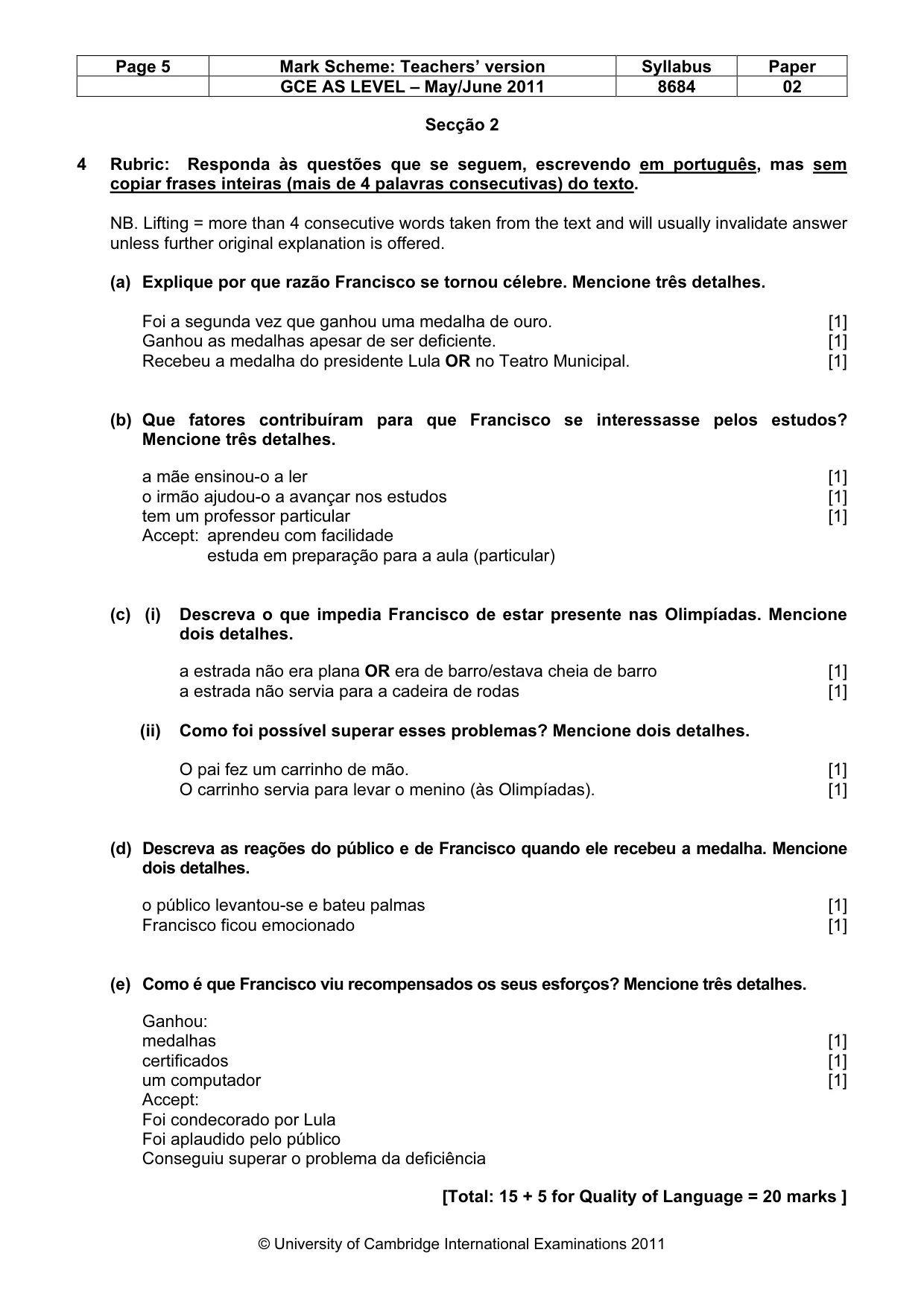
Page 5 Mark Scheme: Teachers’ version Syllabus Paper GCE AS LEVEL – May/June 2011 8684 02 © University of Cambridge International Examinations 2011 Secção 2 4 Rubric: Responda às questões que se seguem, escrevendo em português, mas sem copiar frases inteiras (mais de 4 palavras consecutivas) do texto. NB. Lifting = more than 4 consecutive words taken from the text and will usually invalidate answer unless further original explanation is offered. (a) Explique por que razão Francisco se tornou célebre. Mencione três detalhes. Foi a segunda vez que ganhou uma medalha de ouro. [1] Ganhou as medalhas apesar de ser deficiente. [1] Recebeu a medalha do presidente Lula OR no Teatro Municipal. [1] (b) Que fatores contribuíram para que Francisco se interessasse pelos estudos? Mencione três detalhes. a mãe ensinou-o a ler [1] o irmão ajudou-o a avançar nos estudos [1] tem um professor particular [1] Accept: aprendeu com facilidade estuda em preparação para a aula (particular) (c) (i) Descreva o que impedia Francisco de estar presente nas Olimpíadas. Mencione dois detalhes. a estrada não era plana OR era de barro/estava cheia de barro [1] a estrada não servia para a cadeira de rodas [1] (ii) Como foi possível superar esses problemas? Mencione dois detalhes. O pai fez um carrinho de mão. [1] O carrinho servia para levar o menino (às Olimpíadas). [1] (d) Descreva as reações do público e de Francisco quando ele recebeu a medalha. Mencione dois detalhes. o público levantou-se e bateu palmas [1] Francisco ficou emocionado [1] (e) Como é que Francisco viu recompensados os seus esforços? Mencione três detalhes. Ganhou: medalhas [1] certificados [1] um computador [1] Accept: Foi condecorado por Lula Foi aplaudido pelo público Conseguiu superar o problema da deficiência [Total: 15 + 5 for Quality of Language = 20 marks ]
Mark scheme, page 6
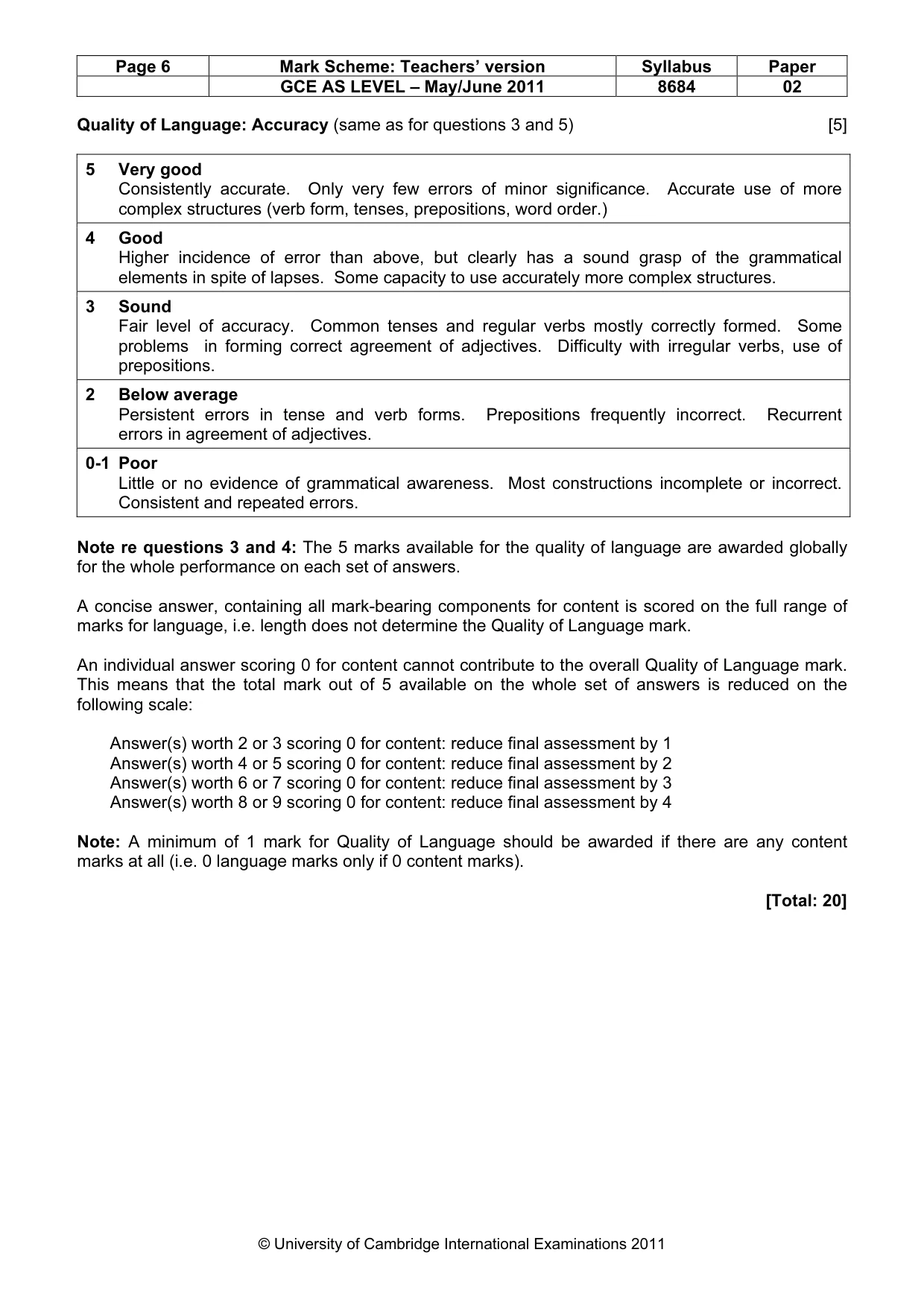
Page 6 Mark Scheme: Teachers’ version Syllabus Paper GCE AS LEVEL – May/June 2011 8684 02 © University of Cambridge International Examinations 2011 Quality of Language: Accuracy (same as for questions 3 and 5) [5] 5 Very good Consistently accurate. Only very few errors of minor significance. Accurate use of more complex structures (verb form, tenses, prepositions, word order.) 4 Good Higher incidence of error than above, but clearly has a sound grasp of the grammatical elements in spite of lapses. Some capacity to use accurately more complex structures. 3 Sound Fair level of accuracy. Common tenses and regular verbs mostly correctly formed. Some problems in forming correct agreement of adjectives. Difficulty with irregular verbs, use of prepositions. 2 Below average Persistent errors in tense and verb forms. Prepositions frequently incorrect. Recurrent errors in agreement of adjectives. 0-1 Poor Little or no evidence of grammatical awareness. Most constructions incomplete or incorrect. Consistent and repeated errors. Note re questions 3 and 4: The 5 marks available for the quality of language are awarded globally for the whole performance on each set of answers. A concise answer, containing all mark-bearing components for content is scored on the full range of marks for language, i.e. length does not determine the Quality of Language mark. An individual answer scoring 0 for content cannot contribute to the overall Quality of Language mark. This means that the total mark out of 5 available on the whole set of answers is reduced on the following scale: Answer(s) worth 2 or 3 scoring 0 for content: reduce final assessment by 1 Answer(s) worth 4 or 5 scoring 0 for content: reduce final assessment by 2 Answer(s) worth 6 or 7 scoring 0 for content: reduce final assessment by 3 Answer(s) worth 8 or 9 scoring 0 for content: reduce final assessment by 4 Note: A minimum of 1 mark for Quality of Language should be awarded if there are any content marks at all (i.e. 0 language marks only if 0 content marks). [Total: 20]
Mark scheme, page 7
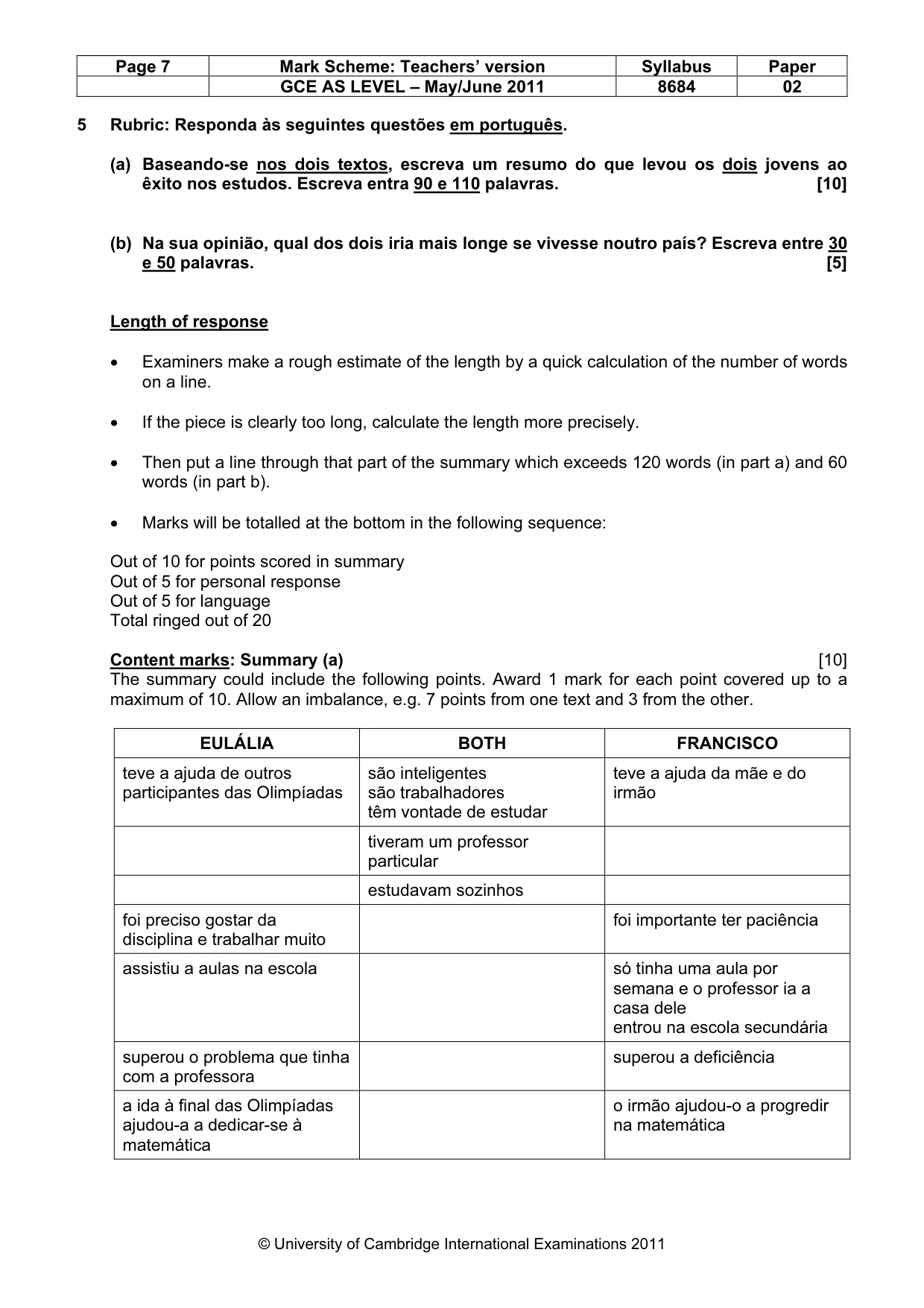
Page 7 Mark Scheme: Teachers’ version Syllabus Paper GCE AS LEVEL – May/June 2011 8684 02 © University of Cambridge International Examinations 2011 5 Rubric: Responda às seguintes questões em português. (a) Baseando-se nos dois textos, escreva um resumo do que levou os dois jovens ao êxito nos estudos. Escreva entra 90 e 110 palavras. [10] (b) Na sua opinião, qual dos dois iria mais longe se vivesse noutro país? Escreva entre 30 e 50 palavras. [5] Length of response • Examiners make a rough estimate of the length by a quick calculation of the number of words on a line. • If the piece is clearly too long, calculate the length more precisely. • Then put a line through that part of the summary which exceeds 120 words (in part a) and 60 words (in part b). • Marks will be totalled at the bottom in the following sequence: Out of 10 for points scored in summary Out of 5 for personal response Out of 5 for language Total ringed out of 20 Content marks: Summary (a) [10] The summary could include the following points. Award 1 mark for each point covered up to a maximum of 10. Allow an imbalance, e.g. 7 points from one text and 3 from the other. EULÁLIA BOTH FRANCISCO teve a ajuda de outros participantes das Olimpíadas são inteligentes são trabalhadores têm vontade de estudar teve a ajuda da mãe e do irmão tiveram um professor particular estudavam sozinhos foi preciso gostar da disciplina e trabalhar muito foi importante ter paciência assistiu a aulas na escola só tinha uma aula por semana e o professor ia a casa dele entrou na escola secundária superou o problema que tinha com a professora superou a deficiência a ida à final das Olimpíadas ajudou-a a dedicar-se à matemática o irmão ajudou-o a progredir na matemática
Mark scheme, page 8
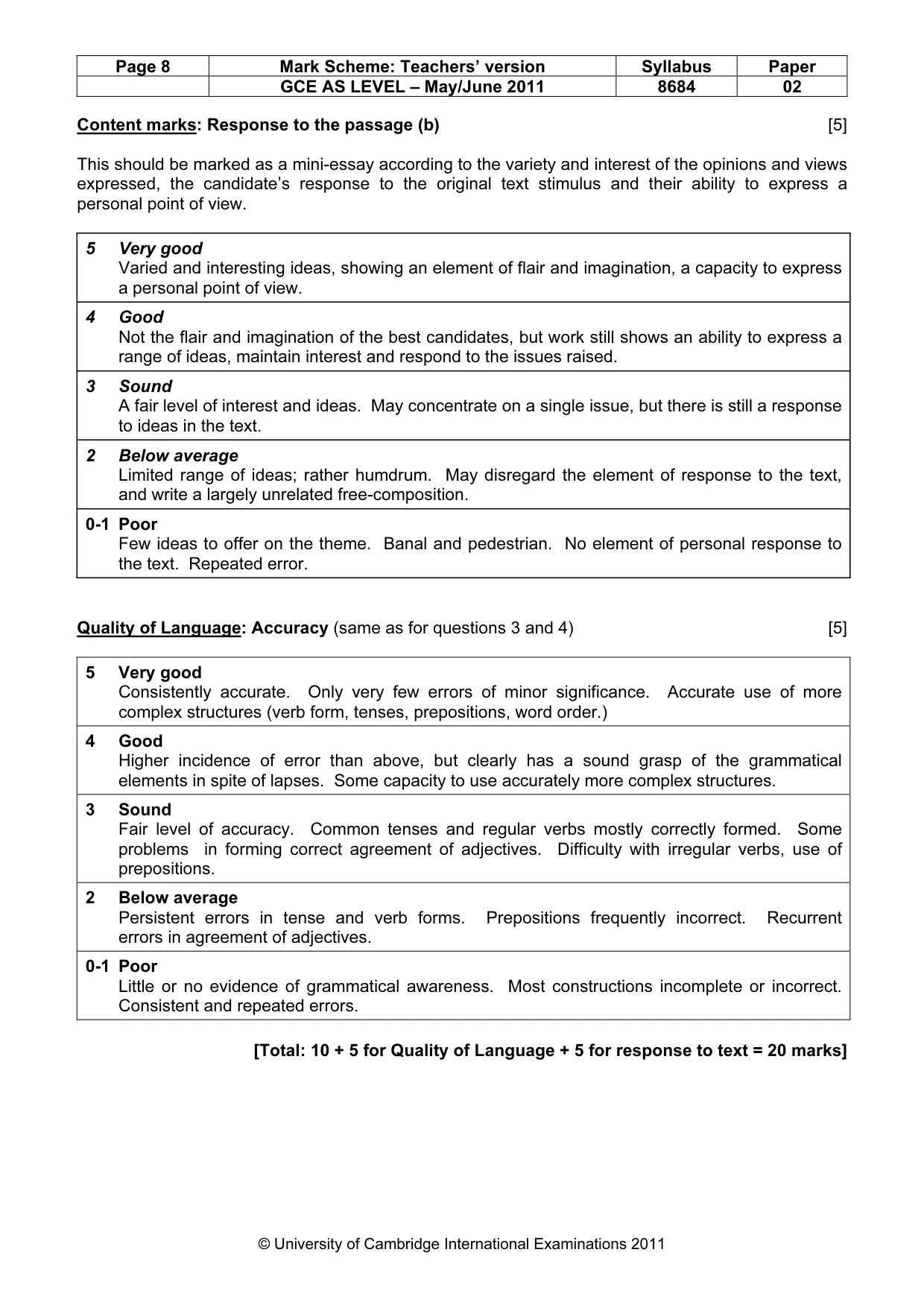
Page 8 Mark Scheme: Teachers’ version Syllabus Paper GCE AS LEVEL – May/June 2011 8684 02 © University of Cambridge International Examinations 2011 Content marks: Response to the passage (b) [5] This should be marked as a mini-essay according to the variety and interest of the opinions and views expressed, the candidate’s response to the original text stimulus and their ability to express a personal point of view. 5 Very good Varied and interesting ideas, showing an element of flair and imagination, a capacity to express a personal point of view. 4 Good Not the flair and imagination of the best candidates, but work still shows an ability to express a range of ideas, maintain interest and respond to the issues raised. 3 Sound A fair level of interest and ideas. May concentrate on a single issue, but there is still a response to ideas in the text. 2 Below average Limited range of ideas; rather humdrum. May disregard the element of response to the text, and write a largely unrelated free-composition. 0-1 Poor Few ideas to offer on the theme. Banal and pedestrian. No element of personal response to the text. Repeated error. Quality of Language: Accuracy (same as for questions 3 and 4) [5] 5 Very good Consistently accurate. Only very few errors of minor significance. Accurate use of more complex structures (verb form, tenses, prepositions, word order.) 4 Good Higher incidence of error than above, but clearly has a sound grasp of the grammatical elements in spite of lapses. Some capacity to use accurately more complex structures. 3 Sound Fair level of accuracy. Common tenses and regular verbs mostly correctly formed. Some problems in forming correct agreement of adjectives. Difficulty with irregular verbs, use of prepositions. 2 Below average Persistent errors in tense and verb forms. Prepositions frequently incorrect. Recurrent errors in agreement of adjectives. 0-1 Poor Little or no evidence of grammatical awareness. Most constructions incomplete or incorrect. Consistent and repeated errors. [Total: 10 + 5 for Quality of Language + 5 for response to text = 20 marks]
What you needed in this session
Cambridge’s own grade thresholds for 2011 May/June, Paper 2 · Variant 1. A higher threshold means an easier paper — the bar moves with how the cohort did.