Cambridge A Level Portuguese (A Level only) 9718 — 2012 May/June Paper 4 · Variant 1
9718/41/M/J/12 · 75 marks · ≈84 min
The question paper and its mark scheme, free to read here and free to download. This is Cambridge’s own paper, exactly as it was sat.
Question paper8 pages


Mark scheme2 pages
Answers below. Sit the paper first if you are practising.
Paper as text
Question paper, page 1
This document consists of 5 printed pages and 3 blank pages. DC (LEO) 51293/4 © UCLES 2012 [Turn over UNIVERSITY OF CAMBRIDGE INTERNATIONAL EXAMINATIONS General Certificate of Education Advanced Level * 6 8 4 4 6 9 6 3 6 6 * PORTUGUESE 9718/04 Paper 4 Texts May/June 2012 2 hours 30 minutes Additional Materials: Answer Booklet/Paper Invigilators must refer to the Additional Materials List for instructions on the use of set texts in the examination. READ THESE INSTRUCTIONS FIRST If you have been given an Answer Booklet, follow the instructions on the front cover of the Booklet. Write your Centre number, candidate number and name on all the work you hand in. Write in dark blue or black pen. Do not use staples, paper clips, highlighters, glue or correction fluid. Answer any three questions, each on a different text. You must choose one from Section 1, one from Section 2 and one other. Write your answers in Portuguese. Dictionaries are not permitted. You should write between 500 and 600 words for each answer. At the end of the examination, fasten all your work securely together. All questions in this paper carry equal marks. PRIMEIRO LEIA ESTAS INSTRUÇÕES Se Ihe tiverem dado um caderno de respostas, siga as instruções dadas na primeira página. Escreva o número do seu Centro, o número de candidato e o seu nome na frente de todo o trabalho que apresentar. Escreva com uma caneta de tinta azul escura ou preta. Não utilize grampos/agrafos, clipes/prende-papéis, marcador fluorescente, cola ou líquido correctivo. Responda a três perguntas, cada uma sendo sobre um texto diferente. É necessário escolher uma pergunta da Secção 1, uma da Secção 2 e uma terceira. Escreva as suas respostas em português. Não é permitido o uso de dicionários. Deve escrever entre 500 e 600 palavras por resposta. No fim do exame, junte todo o seu trabalho duma maneira segura. Todas as perguntas neste exame têm o mesmo número de valores.
Question paper, page 2
2 9718/04/M/J/12 © UCLES 2012 Secção 1 1 LYGIA FAGUNDES TELLES, Ciranda de Pedra Responda à pergunta (a) ou à pergunta (b): (a) – Claro que me lembro de Natércio, claro. Como vai ele, filhota? Tanto tempo, imagine... Virgínia sentiu no rosto uma onda de calor. Ela ainda pedia notícias, coisa que não acontecia nunca. E mostrara-se interessada, ah, mais dia, menos dia, Daniel e Luciana seriam castigados. “O mal acaba sendo vencido como o dragão de São Jorge!” – Bruna dissera. E Bruna sabia. Eles seriam esmagados e o bem triunfaria, o bem que era a mãe curada voltando para o pai, só amando o pai. – Todas as terças-feiras, você sabe, passo a tarde lá e ele não deixa de perguntar por você, sempre tão triste, quase não fala... Frau Herta disse uma vez que nunca mais ele vai gostar de outra porque ainda não se esqueceu de você. Frau Herta disse isso prà copeira mas eu ouvi, juro que ouvi! E a casa dele, mãe!... Que casa! Você precisa ver essa nova casa com um jeito assim bem antigo, lá no fundo de um gramado que não acaba mais. Tem um caramanchão cheio de plantas e perto do caramanchão uma fonte no meio de uma roda de cinco anõezinhos de pedra, você precisa ver que lindo os anõezinhos de mãos dadas! É bom beber aquela água, tão geladinha! Na semana passada ele trocou o automóvel por um novo, todo preto, com almofada vermelha, uma beleza de automóvel. Bruna e Otávia parecem duas princesas. –Você gostaria de morar lá? Virgínia baixou os olhos cheios de lágrimas. Do capítulo I (i) Onde é que Virgínia passa as tardes de terça-feira? Desenvolva. (ii) Explique o valor desta “roda de cinco anõezinhos de pedra”. Ou (b) Identifique e caracterize a protagonista do romance.
Question paper, page 3
3 9718/04/M/J/12 © UCLES 2012 [Turn over 2 CAMILO CASTELO BRANCO, A Queda dum Anjo Responda à pergunta (a) ou à pergunta (b): (a) Fechado em seu gabinete de estudo, o morgado da Agra sentou-se à banca, apanhou entre dois dedos o beiço superior, e esteve assim meditabundo largo espaço. Depois, ergueu-se para dar largas ao coração que pulava, e andou passeando com desusada agilidade e aprumo de corpo. Parou diante da livraria, tirou de entre os poetas clássicos o dilecto António Ferreira, sentou-se, abriu à sorte, e leu, declamando os dois quartetos do soneto V: Dos mais fermosos olhos, mais fermoso Rosto, qu’entre nós há, do mais divino Lume, mais branca neve, oiro mais fino, Mais doce fala, riso mais gracioso: Dum Angélico ar, de um amoroso Meneo, de um spírito peregrino S’acendeu em mim o fogo, de qu’indino Me sinto, e tanto mais assi ditoso. Repetiu, fez pausa, suspirou, e declamou ainda o primeiro verso do terceto: Não cabe em mim tal bem-aventurança! Nisto, a imagem de sua prima e esposa D. Teodora Figueiroa, trazida ali por decreto do alto, antepôs-se-lhe aos olhos enleados na imagem de Adelaide. Do capítulo XIV, Tentação! Amor! Poesia! (i) O que leva Calisto a ler poesia? Justifique. (ii) Analise o papel das mulheres nesta obra. Ou (b) Que tipo de personagem encontramos em Calisto Elói ao longo da obra? Desenvolva.
Question paper, page 4
4 9718/04/M/J/12 © UCLES 2012 3 MACHADO DE ASSIS, Dom Casmurro Responda à pergunta (a) ou à pergunta (b): (a) Eis aqui outro seminarista. Chamava-se Ezequiel de Sousa Escobar era um rapaz esbelto, olhos claros, um pouco fugitivos, como as mãos, como os pés, como a fala, como tudo. Quem não estivesse acostumado com ele podia acaso sentir-se mal, não sabendo por onde lhe pegasse. Não fitava de rosto, não falava claro nem seguido as mãos não apertavam as outras, nem se deixavam apertar delas, por que os dedos, sendo delgados e curtos, quando a gente cuidava tê-los entre os seus, já não tinha nada. O mesmo digo dos pés, que lia depressa estavam aqui como lá. Esta dificuldade em pousar foi o maior obstáculo que achou para tomar os costumes do seminário. O sorriso era instantâneo, mas também ria folgado e largo. Uma cousa não seria tão fugitiva, como o resto, a reflexão; íamos dar com ele, muita vez, olhos enfiados em si, cogitando. Respondia-nos sempre que meditava algum ponto espiritual, ou então que recordava a lição da véspera. Quando ele entrou na minha intimidade pedia-me freqüentemente explicações e repetições miúdas, e tinha memória para guardá-las todas, até as palavras. Talvez esta faculdade prejudicasse alguma coisa. Era mais velho que eu três anos, filho de um advogado de Curitiba, aparentado com um comerciante do Rio de Janeiro, que servia de correspondente ao pai. Este era homem de fortes sentimentos católicos. Escobar tinha uma irmã, que era um anjo, dizia ele. – Não é só na beleza que é um anjo, mas também na bondade. Não imagina que boa criatura que ela é. Escreve-me muita vez, hei de mostrar-lhe as cartas dela. De fato, eram simples e afetuosas, cheias de carícias e conselhos. Escobar contava-me histórias dela, interessantes, todas as quais vinham a dar na bondade e no espírito daquela criatura; tais eram que me fariam capaz de acabar casando com ela se não fosse Capitu. Morreu pouco depois. Eu, seduzido pelas palavras dele, estive quase a contar-lhe logo, logo, a minha história. A princípio fui tímido, mas ele fez-se entrado na minha confiança. Do capítulo 56, Um Seminarista (i) Descreva o tipo de relação entre Bentinho e Escobar. (ii) Explique o papel da família na vida dos seminaristas. Ou (b) Analise a importância da religião na obra.
Question paper, page 5
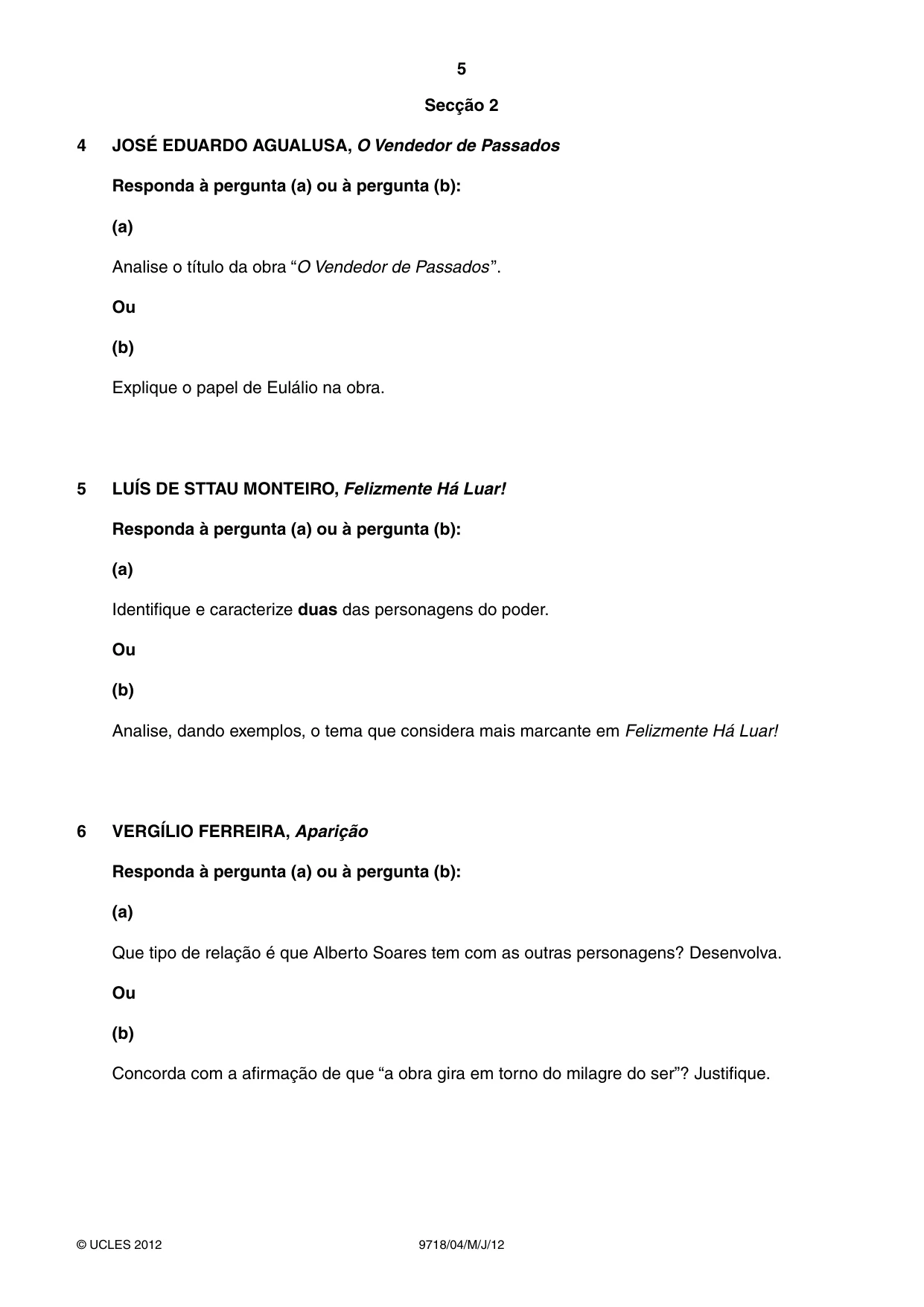
5 9718/04/M/J/12 © UCLES 2012 Secção 2 4 JOSÉ EDUARDO AGUALUSA, O Vendedor de Passados Responda à pergunta (a) ou à pergunta (b): (a) Analise o título da obra “O Vendedor de Passados ”. Ou (b) Explique o papel de Eulálio na obra. 5 LUÍS DE STTAU MONTEIRO, Felizmente Há Luar! Responda à pergunta (a) ou à pergunta (b): (a) Identifique e caracterize duas das personagens do poder. Ou (b) Analise, dando exemplos, o tema que considera mais marcante em Felizmente Há Luar! 6 VERGÍLIO FERREIRA, Aparição Responda à pergunta (a) ou à pergunta (b): (a) Que tipo de relação é que Alberto Soares tem com as outras personagens? Desenvolva. Ou (b) Concorda com a afirmação de que “a obra gira em torno do milagre do ser”? Justifique.
Question paper, page 6
6 9718/04/M/J/12 © UCLES 2012 BLANK PAGE
Question paper, page 7
7 9718/04/M/J/12 © UCLES 2012 BLANK PAGE
Question paper, page 8
8 9718/04/M/J/12 © UCLES 2012 Permission to reproduce items where third-party owned material protected by copyright is included has been sought and cleared where possible. Every reasonable effort has been made by the publisher (UCLES) to trace copyright holders, but if any items requiring clearance have unwittingly been included, the publisher will be pleased to make amends at the earliest possible opportunity. University of Cambridge International Examinations is part of the Cambridge Assessment Group. Cambridge Assessment is the brand name of University of Cambridge Local Examinations Syndicate (UCLES), which is itself a department of the University of Cambridge. BLANK PAGE
Mark scheme, page 1
UNIVERSITY OF CAMBRIDGE INTERNATIONAL EXAMINATIONS GCE Advanced Level MARK SCHEME for the May/June 2012 question paper for the guidance of teachers 9718 PORTUGUESE 9718/04 Paper 4 (Texts), maximum raw mark 75 This mark scheme is published as an aid to teachers and candidates, to indicate the requirements of the examination. It shows the basis on which Examiners were instructed to award marks. It does not indicate the details of the discussions that took place at an Examiners’ meeting before marking began, which would have considered the acceptability of alternative answers. Mark schemes must be read in conjunction with the question papers and the report on the examination. • Cambridge will not enter into discussions or correspondence in connection with these mark schemes. Cambridge is publishing the mark schemes for the May/June 2012 question papers for most IGCSE, GCE Advanced Level and Advanced Subsidiary Level syllabuses and some Ordinary Level syllabuses.
Mark scheme, page 2
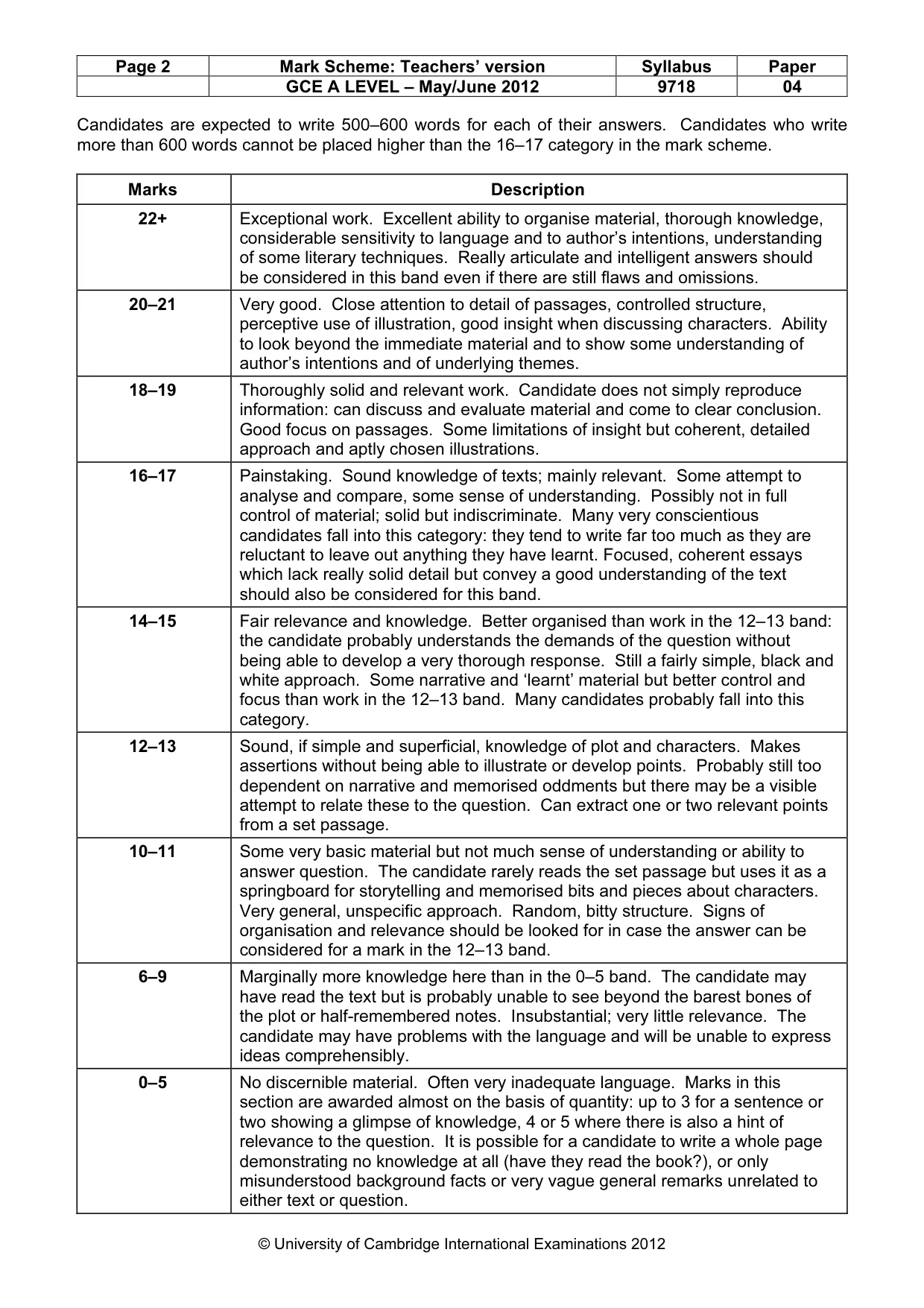
Page 2 Mark Scheme: Teachers’ version Syllabus Paper GCE A LEVEL – May/June 2012 9718 04 © University of Cambridge International Examinations 2012 Candidates are expected to write 500–600 words for each of their answers. Candidates who write more than 600 words cannot be placed higher than the 16–17 category in the mark scheme. Marks Description 22+ Exceptional work. Excellent ability to organise material, thorough knowledge, considerable sensitivity to language and to author’s intentions, understanding of some literary techniques. Really articulate and intelligent answers should be considered in this band even if there are still flaws and omissions. 20–21 Very good. Close attention to detail of passages, controlled structure, perceptive use of illustration, good insight when discussing characters. Ability to look beyond the immediate material and to show some understanding of author’s intentions and of underlying themes. 18–19 Thoroughly solid and relevant work. Candidate does not simply reproduce information: can discuss and evaluate material and come to clear conclusion. Good focus on passages. Some limitations of insight but coherent, detailed approach and aptly chosen illustrations. 16–17 Painstaking. Sound knowledge of texts; mainly relevant. Some attempt to analyse and compare, some sense of understanding. Possibly not in full control of material; solid but indiscriminate. Many very conscientious candidates fall into this category: they tend to write far too much as they are reluctant to leave out anything they have learnt. Focused, coherent essays which lack really solid detail but convey a good understanding of the text should also be considered for this band. 14–15 Fair relevance and knowledge. Better organised than work in the 12–13 band: the candidate probably understands the demands of the question without being able to develop a very thorough response. Still a fairly simple, black and white approach. Some narrative and ‘learnt’ material but better control and focus than work in the 12–13 band. Many candidates probably fall into this category. 12–13 Sound, if simple and superficial, knowledge of plot and characters. Makes assertions without being able to illustrate or develop points. Probably still too dependent on narrative and memorised oddments but there may be a visible attempt to relate these to the question. Can extract one or two relevant points from a set passage. 10–11 Some very basic material but not much sense of understanding or ability to answer question. The candidate rarely reads the set passage but uses it as a springboard for storytelling and memorised bits and pieces about characters. Very general, unspecific approach. Random, bitty structure. Signs of organisation and relevance should be looked for in case the answer can be considered for a mark in the 12–13 band. 6–9 Marginally more knowledge here than in the 0–5 band. The candidate may have read the text but is probably unable to see beyond the barest bones of the plot or half-remembered notes. Insubstantial; very little relevance. The candidate may have problems with the language and will be unable to express ideas comprehensibly. 0–5 No discernible material. Often very inadequate language. Marks in this section are awarded almost on the basis of quantity: up to 3 for a sentence or two showing a glimpse of knowledge, 4 or 5 where there is also a hint of relevance to the question. It is possible for a candidate to write a whole page demonstrating no knowledge at all (have they read the book?), or only misunderstood background facts or very vague general remarks unrelated to either text or question.
What you needed in this session
Cambridge’s own grade thresholds for 2012 May/June, Paper 4 · Variant 1. A higher threshold means an easier paper — the bar moves with how the cohort did.