Cambridge A Level Portuguese (A Level only) 9718 — 2010 May/June Paper 4 · Variant 1
9718/41/M/J/10 · 75 marks · ≈84 min
The question paper and its mark scheme, free to read here and free to download. This is Cambridge’s own paper, exactly as it was sat.
Question paper8 pages



Mark scheme2 pages
Answers below. Sit the paper first if you are practising.
Paper as text
Question paper, page 1
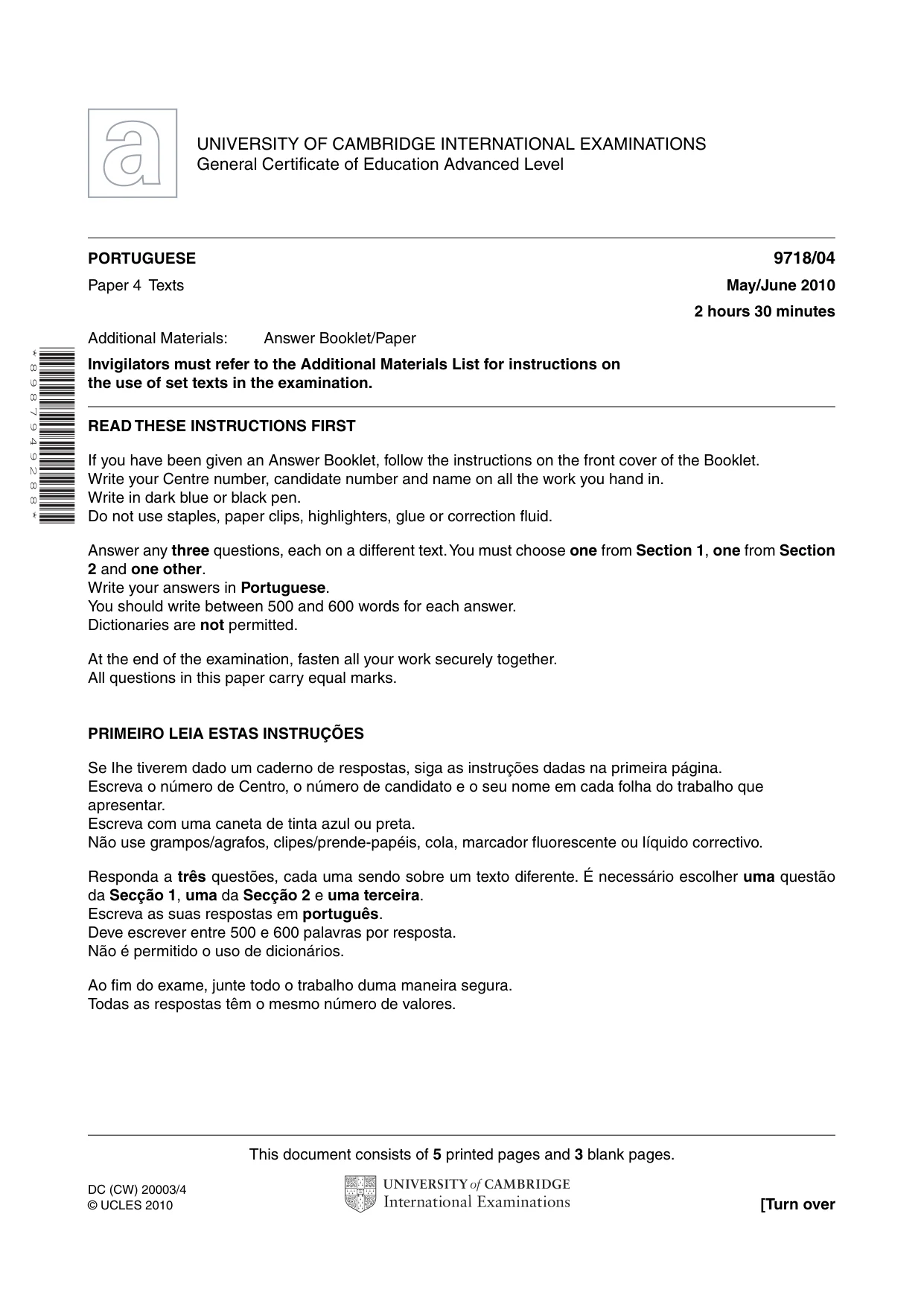
This document consists of 5 printed pages and 3 blank pages. DC (CW) 20003/4 © UCLES 2010 [Turn over UNIVERSITY OF CAMBRIDGE INTERNATIONAL EXAMINATIONS General Certificate of Education Advanced Level READ THESE INSTRUCTIONS FIRST If you have been given an Answer Booklet, follow the instructions on the front cover of the Booklet. Write your Centre number, candidate number and name on all the work you hand in. Write in dark blue or black pen. Do not use staples, paper clips, highlighters, glue or correction fluid. Answer any three questions, each on a different text. You must choose one from Section 1, one from Section 2 and one other. Write your answers in Portuguese. You should write between 500 and 600 words for each answer. Dictionaries are not permitted. At the end of the examination, fasten all your work securely together. All questions in this paper carry equal marks. PRIMEIRO LEIA ESTAS INSTRUÇÕES Se Ihe tiverem dado um caderno de respostas, siga as instruções dadas na primeira página. Escreva o número de Centro, o número de candidato e o seu nome em cada folha do trabalho que apresentar. Escreva com uma caneta de tinta azul ou preta. Não use grampos/agrafos, clipes/prende-papéis, cola, marcador fluorescente ou líquido correctivo. Responda a três questões, cada uma sendo sobre um texto diferente. É necessário escolher uma questão da Secção 1, uma da Secção 2 e uma terceira. Escreva as suas respostas em português. Deve escrever entre 500 e 600 palavras por resposta. Não é permitido o uso de dicionários. Ao fim do exame, junte todo o trabalho duma maneira segura. Todas as respostas têm o mesmo número de valores. * 8 9 8 7 9 4 9 2 8 8 * PORTUGUESE 9718/04 Paper 4 Texts May/June 2010 2 hours 30 minutes Additional Materials: Answer Booklet/Paper Invigilators must refer to the Additional Materials List for instructions on the use of set texts in the examination.
Question paper, page 2
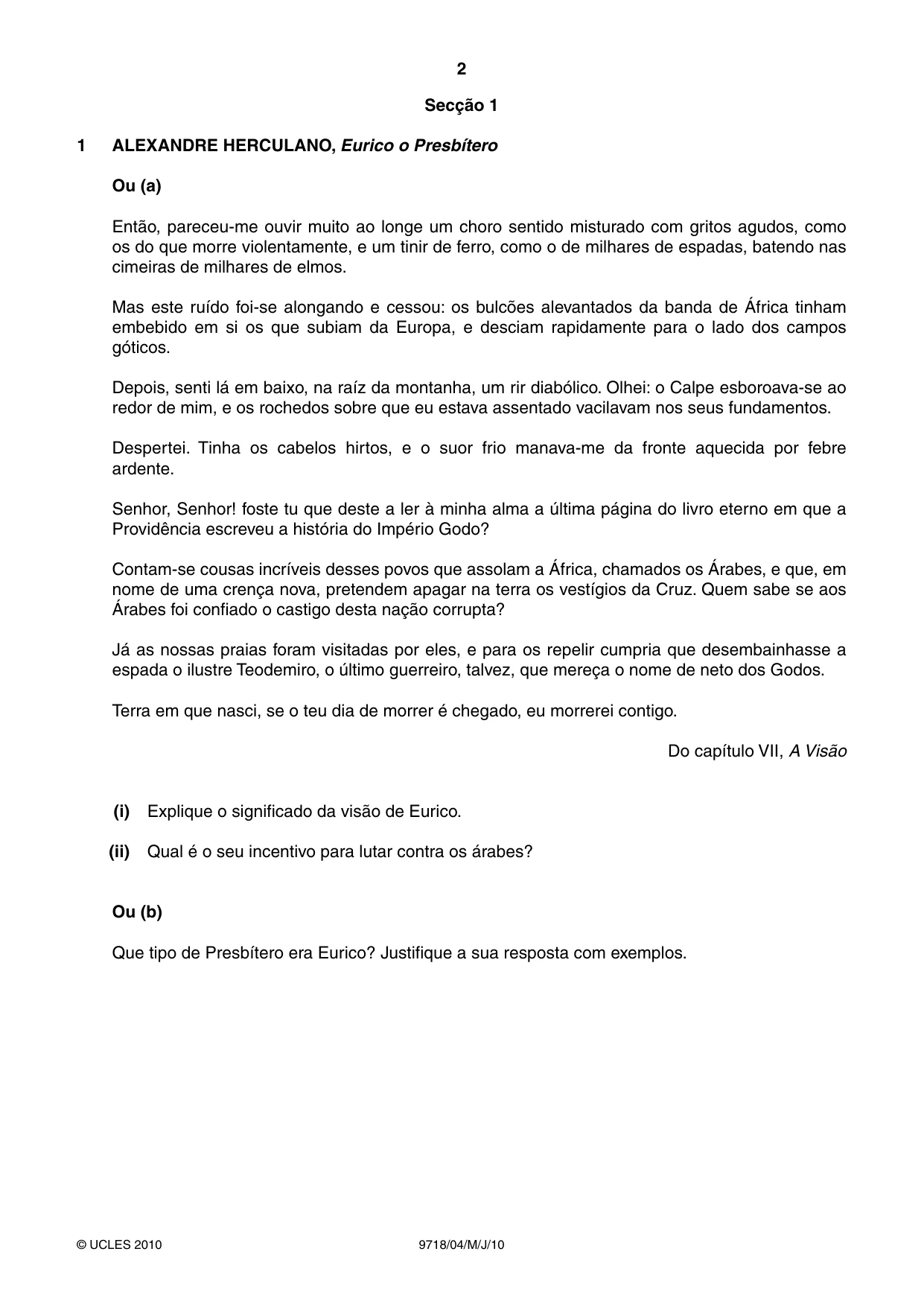
2 9718/04/M/J/10 © UCLES 2010 Secção 1 1 ALEXANDRE HERCULANO, Eurico o Presbítero Ou (a) Então, pareceu-me ouvir muito ao longe um choro sentido misturado com gritos agudos, como os do que morre violentamente, e um tinir de ferro, como o de milhares de espadas, batendo nas cimeiras de milhares de elmos. Mas este ruído foi-se alongando e cessou: os bulcões alevantados da banda de África tinham embebido em si os que subiam da Europa, e desciam rapidamente para o lado dos campos góticos. Depois, senti lá em baixo, na raíz da montanha, um rir diabólico. Olhei: o Calpe esboroava-se ao redor de mim, e os rochedos sobre que eu estava assentado vacilavam nos seus fundamentos. Despertei. Tinha os cabelos hirtos, e o suor frio manava-me da fronte aquecida por febre ardente. Senhor, Senhor! foste tu que deste a ler à minha alma a última página do livro eterno em que a Providência escreveu a história do Império Godo? Contam-se cousas incríveis desses povos que assolam a África, chamados os Árabes, e que, em nome de uma crença nova, pretendem apagar na terra os vestígios da Cruz. Quem sabe se aos Árabes foi confiado o castigo desta nação corrupta? Já as nossas praias foram visitadas por eles, e para os repelir cumpria que desembainhasse a espada o ilustre Teodemiro, o último guerreiro, talvez, que mereça o nome de neto dos Godos. Terra em que nasci, se o teu dia de morrer é chegado, eu morrerei contigo. Do capítulo VII, A Visão (i) Explique o significado da visão de Eurico. (ii) Qual é o seu incentivo para lutar contra os árabes? Ou (b) Que tipo de Presbítero era Eurico? Justifique a sua resposta com exemplos.
Question paper, page 3
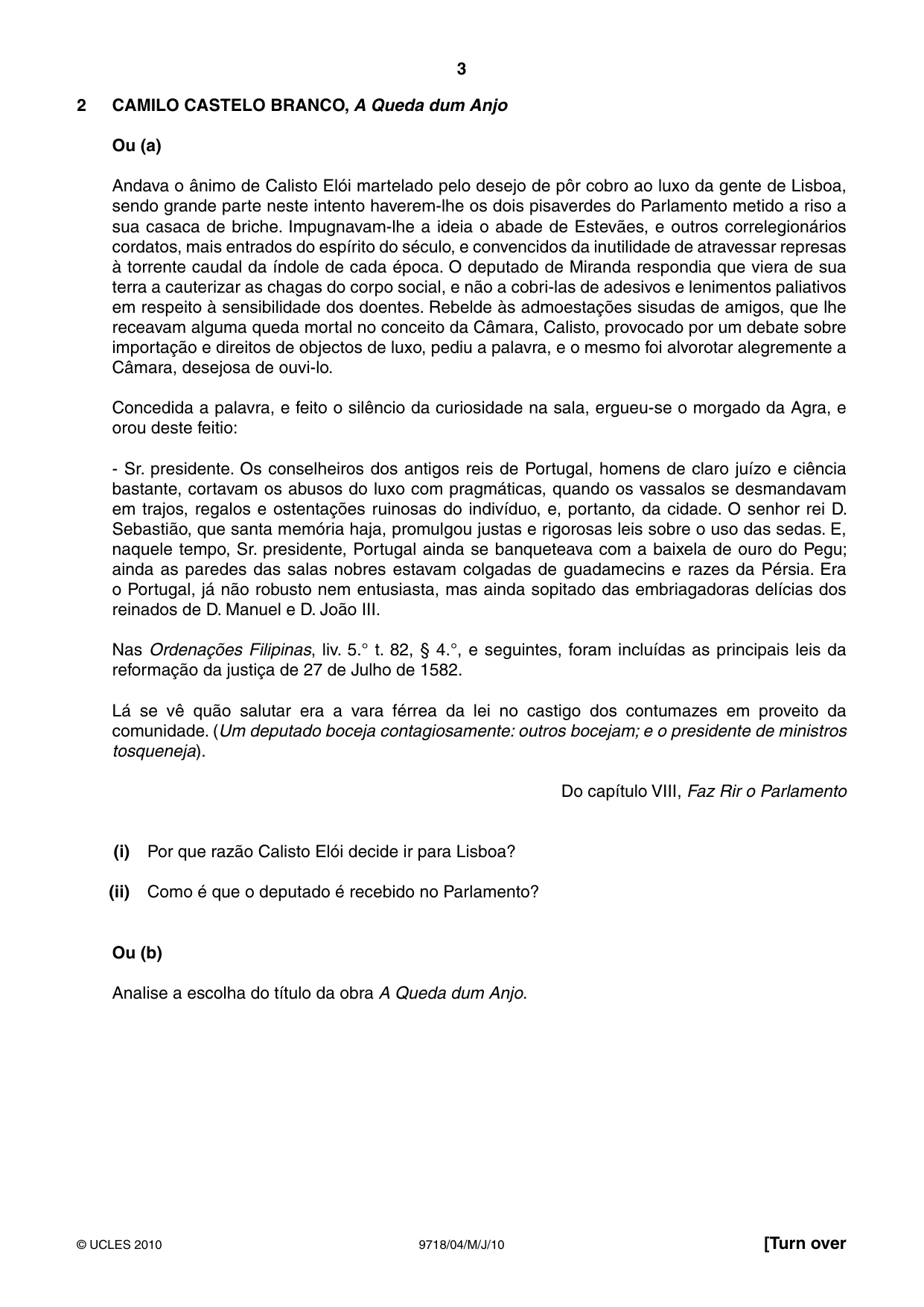
3 9718/04/M/J/10 © UCLES 2010 [Turn over 2 CAMILO CASTELO BRANCO, A Queda dum Anjo Ou (a) Andava o ânimo de Calisto Elói martelado pelo desejo de pôr cobro ao luxo da gente de Lisboa, sendo grande parte neste intento haverem-lhe os dois pisaverdes do Parlamento metido a riso a sua casaca de briche. Impugnavam-lhe a ideia o abade de Estevães, e outros correlegionários cordatos, mais entrados do espírito do século, e convencidos da inutilidade de atravessar represas à torrente caudal da índole de cada época. O deputado de Miranda respondia que viera de sua terra a cauterizar as chagas do corpo social, e não a cobri-las de adesivos e lenimentos paliativos em respeito à sensibilidade dos doentes. Rebelde às admoestações sisudas de amigos, que lhe receavam alguma queda mortal no conceito da Câmara, Calisto, provocado por um debate sobre importação e direitos de objectos de luxo, pediu a palavra, e o mesmo foi alvorotar alegremente a Câmara, desejosa de ouvi-lo. Concedida a palavra, e feito o silêncio da curiosidade na sala, ergueu-se o morgado da Agra, e orou deste feitio: - Sr. presidente. Os conselheiros dos antigos reis de Portugal, homens de claro juízo e ciência bastante, cortavam os abusos do luxo com pragmáticas, quando os vassalos se desmandavam em trajos, regalos e ostentações ruinosas do indivíduo, e, portanto, da cidade. O senhor rei D. Sebastião, que santa memória haja, promulgou justas e rigorosas leis sobre o uso das sedas. E, naquele tempo, Sr. presidente, Portugal ainda se banqueteava com a baixela de ouro do Pegu; ainda as paredes das salas nobres estavam colgadas de guadamecins e razes da Pérsia. Era o Portugal, já não robusto nem entusiasta, mas ainda sopitado das embriagadoras delícias dos reinados de D. Manuel e D. João III. Nas Ordenações Filipinas, liv. 5.° t. 82, § 4.°, e seguintes, foram incluídas as principais leis da reformação da justiça de 27 de Julho de 1582. Lá se vê quão salutar era a vara férrea da lei no castigo dos contumazes em proveito da comunidade. (Um deputado boceja contagiosamente: outros bocejam; e o presidente de ministros tosqueneja). Do capítulo VIII, Faz Rir o Parlamento (i) Por que razão Calisto Elói decide ir para Lisboa? (ii) Como é que o deputado é recebido no Parlamento? Ou (b) Analise a escolha do título da obra A Queda dum Anjo.
Question paper, page 4
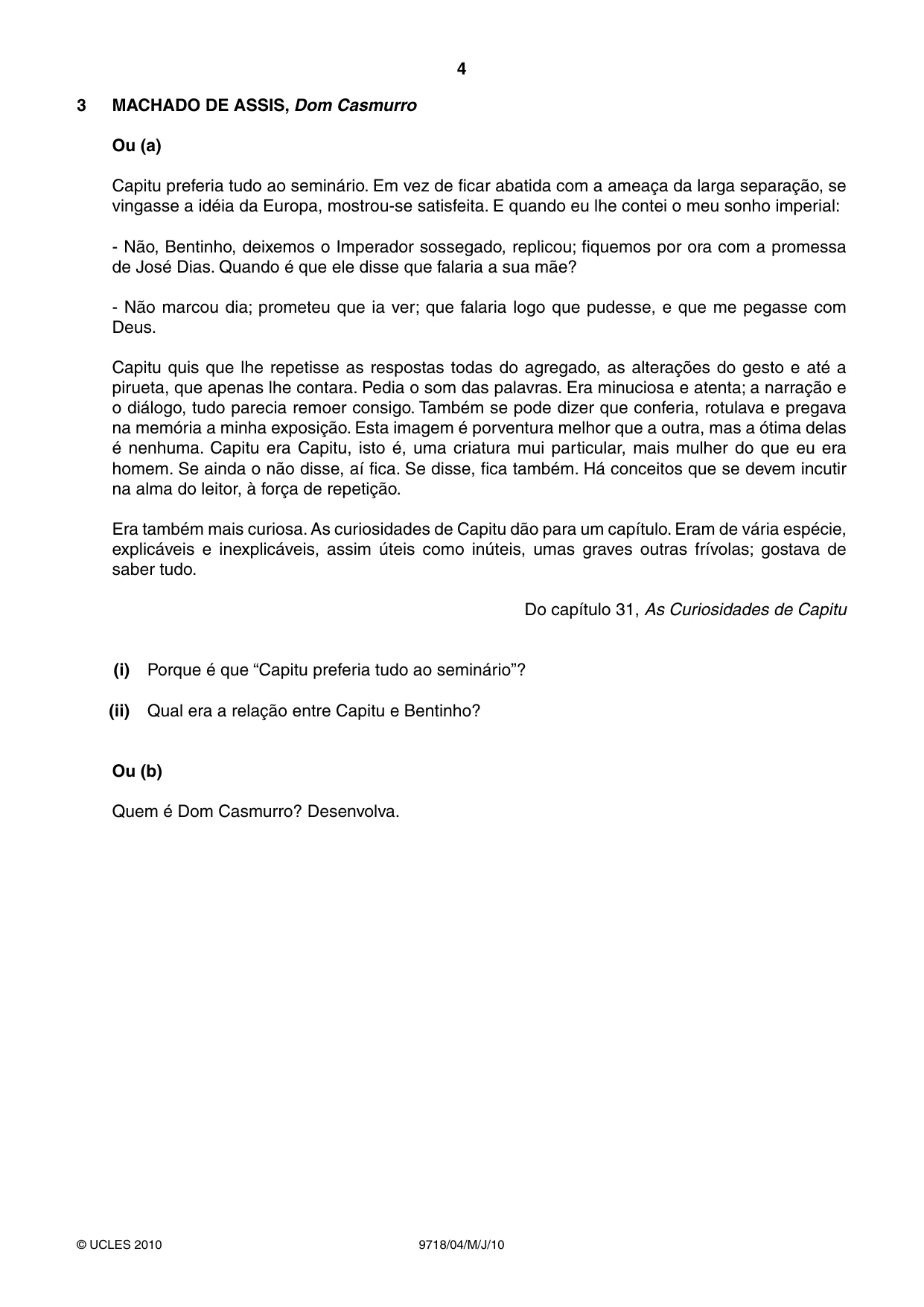
4 9718/04/M/J/10 © UCLES 2010 3 MACHADO DE ASSIS, Dom Casmurro Ou (a) Capitu preferia tudo ao seminário. Em vez de ficar abatida com a ameaça da larga separação, se vingasse a idéia da Europa, mostrou-se satisfeita. E quando eu lhe contei o meu sonho imperial: - Não, Bentinho, deixemos o Imperador sossegado, replicou; fiquemos por ora com a promessa de José Dias. Quando é que ele disse que falaria a sua mãe? - Não marcou dia; prometeu que ia ver; que falaria logo que pudesse, e que me pegasse com Deus. Capitu quis que lhe repetisse as respostas todas do agregado, as alterações do gesto e até a pirueta, que apenas lhe contara. Pedia o som das palavras. Era minuciosa e atenta; a narração e o diálogo, tudo parecia remoer consigo. Também se pode dizer que conferia, rotulava e pregava na memória a minha exposição. Esta imagem é porventura melhor que a outra, mas a ótima delas é nenhuma. Capitu era Capitu, isto é, uma criatura mui particular, mais mulher do que eu era homem. Se ainda o não disse, aí fica. Se disse, fica também. Há conceitos que se devem incutir na alma do leitor, à força de repetição. Era também mais curiosa. As curiosidades de Capitu dão para um capítulo. Eram de vária espécie, explicáveis e inexplicáveis, assim úteis como inúteis, umas graves outras frívolas; gostava de saber tudo. Do capítulo 31, As Curiosidades de Capitu (i) Porque é que “Capitu preferia tudo ao seminário”? (ii) Qual era a relação entre Capitu e Bentinho? Ou (b) Quem é Dom Casmurro? Desenvolva.
Question paper, page 5
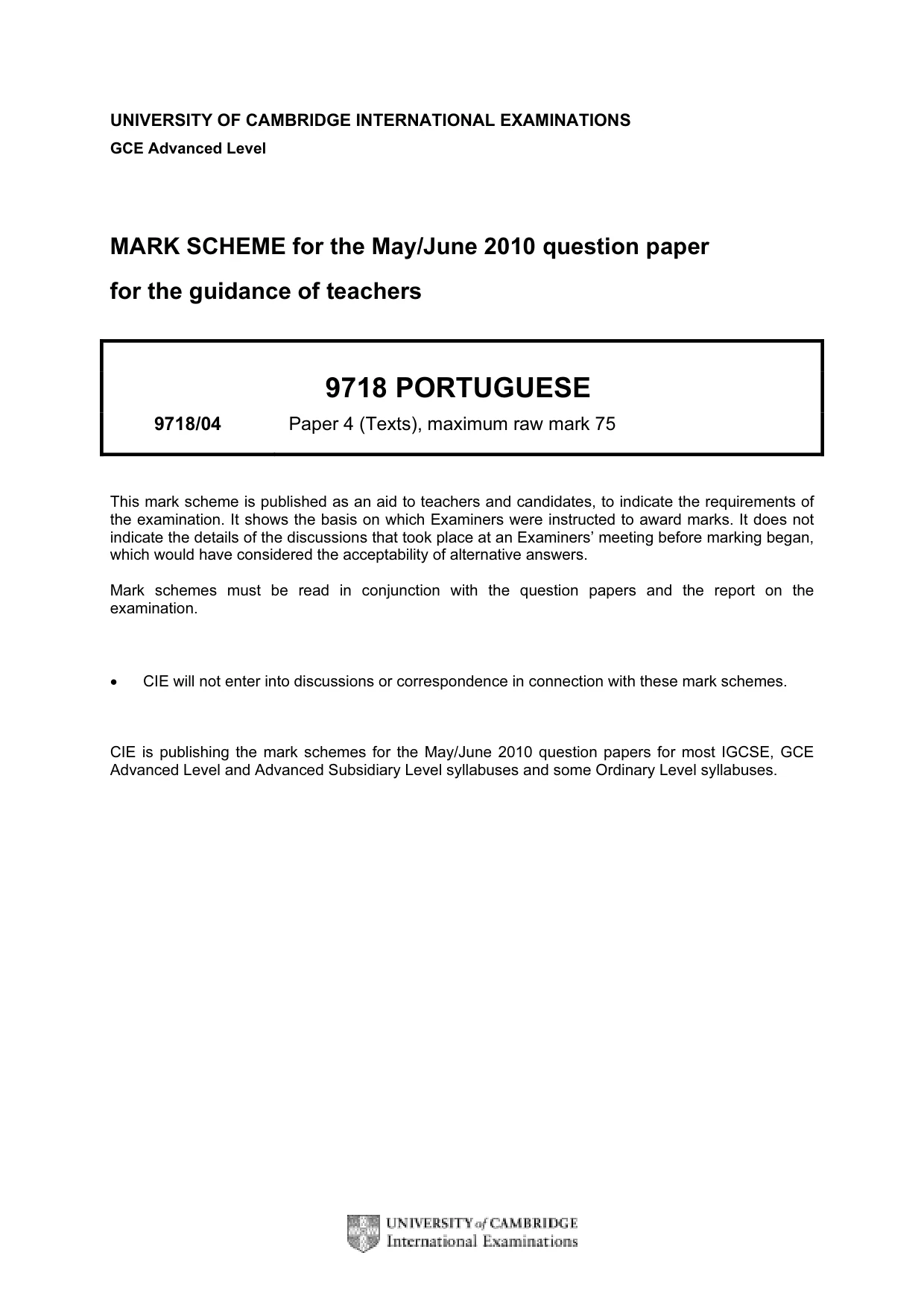
5 9718/04/M/J/10 © UCLES 2010 Secção 2 4 GERMANO ALMEIDA, O Testamento do Sr. Napumoceno da Silva Araújo Ou (a) Qual a importância das viagens na vida do Sr. Napumoceno? Dê exemplos e justifique. Ou (b) Que tipo de personagem podemos encontrar em Carlos ao longo da obra? Elabore. 5 LUÍS DE STTAU MONTEIRO, Felizmente há Luar! Ou (a) Identifique e comente alguns dos símbolos que ilustram a esperança da liberdade e a situação vivida na época retratada no livro. Ou (b) Por que é que Matilde de Melo tenta desafiar o estado político, social e religioso da época? Comente. 6 VERGÍLIO FERREIRA, Aparição Ou (a) Analise o impacto que a morte do pai de Alberto Soares teve na sua vida. Ou (b) Será Alberto Soares um ser em conflito e fragmentado? Justifique a sua resposta.
Question paper, page 6
6 9718/04/M/J/10 © UCLES 2010 BLANK PAGE
Question paper, page 7
7 9718/04/M/J/10 © UCLES 2010 BLANK PAGE
Question paper, page 8
8 9718/04/M/J/10 © UCLES 2010 BLANK PAGE Permission to reproduce items where third-party owned material protected by copyright is included has been sought and cleared where possible. Every reasonable effort has been made by the publisher (UCLES) to trace copyright holders, but if any items requiring clearance have unwittingly been included, the publisher will be pleased to make amends at the earliest possible opportunity. University of Cambridge International Examinations is part of the Cambridge Assessment Group. Cambridge Assessment is the brand name of University of Cambridge Local Examinations Syndicate (UCLES), which is itself a department of the University of Cambridge.
Mark scheme, page 1
UNIVERSITY OF CAMBRIDGE INTERNATIONAL EXAMINATIONS GCE Advanced Level MARK SCHEME for the May/June 2010 question paper for the guidance of teachers 9718 PORTUGUESE 9718/04 Paper 4 (Texts), maximum raw mark 75 This mark scheme is published as an aid to teachers and candidates, to indicate the requirements of the examination. It shows the basis on which Examiners were instructed to award marks. It does not indicate the details of the discussions that took place at an Examiners’ meeting before marking began, which would have considered the acceptability of alternative answers. Mark schemes must be read in conjunction with the question papers and the report on the examination. • CIE will not enter into discussions or correspondence in connection with these mark schemes. CIE is publishing the mark schemes for the May/June 2010 question papers for most IGCSE, GCE Advanced Level and Advanced Subsidiary Level syllabuses and some Ordinary Level syllabuses.
Mark scheme, page 2
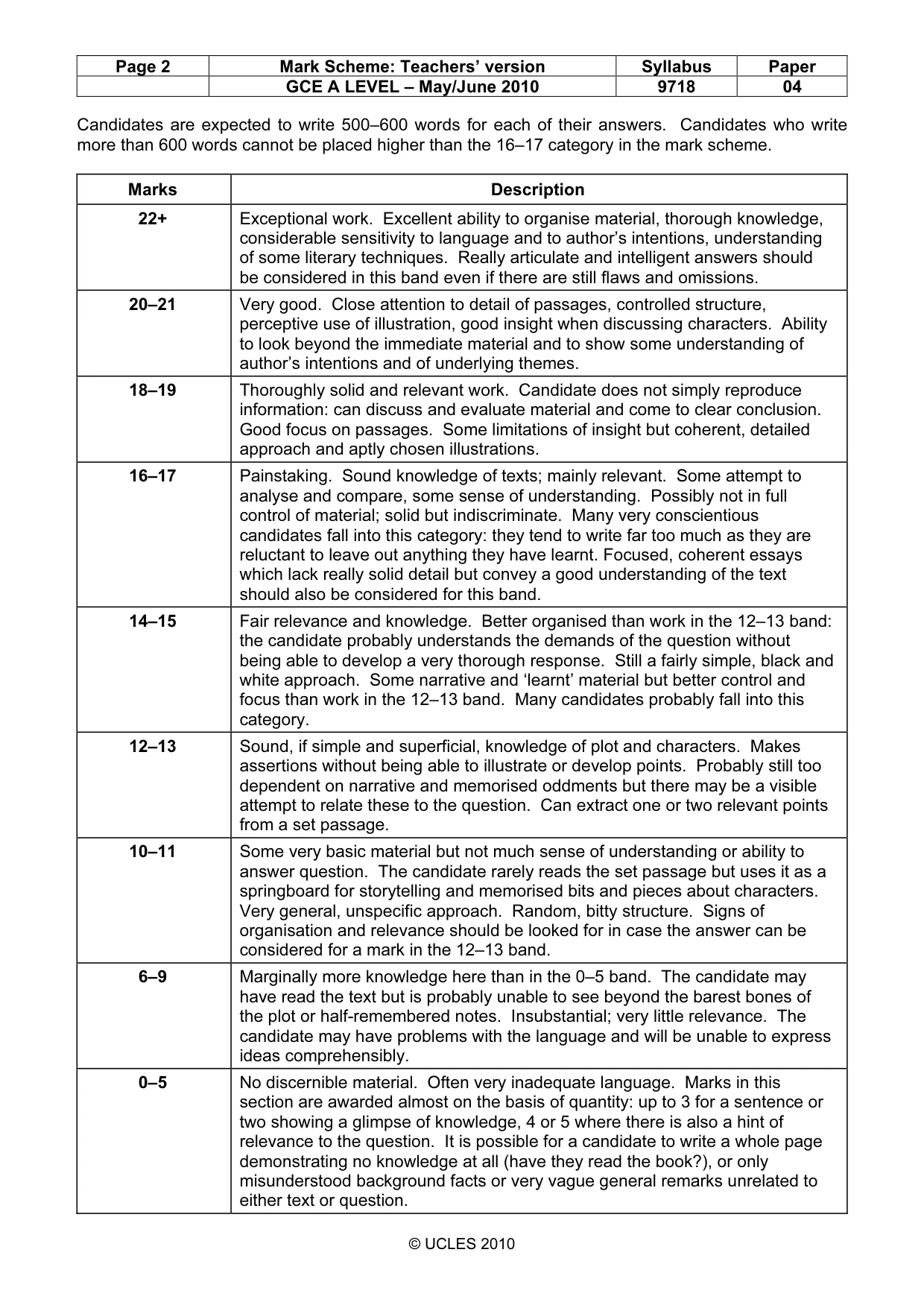
Page 2 Mark Scheme: Teachers’ version Syllabus Paper GCE A LEVEL – May/June 2010 9718 04 © UCLES 2010 Candidates are expected to write 500–600 words for each of their answers. Candidates who write more than 600 words cannot be placed higher than the 16–17 category in the mark scheme. Marks Description 22+ Exceptional work. Excellent ability to organise material, thorough knowledge, considerable sensitivity to language and to author’s intentions, understanding of some literary techniques. Really articulate and intelligent answers should be considered in this band even if there are still flaws and omissions. 20–21 Very good. Close attention to detail of passages, controlled structure, perceptive use of illustration, good insight when discussing characters. Ability to look beyond the immediate material and to show some understanding of author’s intentions and of underlying themes. 18–19 Thoroughly solid and relevant work. Candidate does not simply reproduce information: can discuss and evaluate material and come to clear conclusion. Good focus on passages. Some limitations of insight but coherent, detailed approach and aptly chosen illustrations. 16–17 Painstaking. Sound knowledge of texts; mainly relevant. Some attempt to analyse and compare, some sense of understanding. Possibly not in full control of material; solid but indiscriminate. Many very conscientious candidates fall into this category: they tend to write far too much as they are reluctant to leave out anything they have learnt. Focused, coherent essays which lack really solid detail but convey a good understanding of the text should also be considered for this band. 14–15 Fair relevance and knowledge. Better organised than work in the 12–13 band: the candidate probably understands the demands of the question without being able to develop a very thorough response. Still a fairly simple, black and white approach. Some narrative and ‘learnt’ material but better control and focus than work in the 12–13 band. Many candidates probably fall into this category. 12–13 Sound, if simple and superficial, knowledge of plot and characters. Makes assertions without being able to illustrate or develop points. Probably still too dependent on narrative and memorised oddments but there may be a visible attempt to relate these to the question. Can extract one or two relevant points from a set passage. 10–11 Some very basic material but not much sense of understanding or ability to answer question. The candidate rarely reads the set passage but uses it as a springboard for storytelling and memorised bits and pieces about characters. Very general, unspecific approach. Random, bitty structure. Signs of organisation and relevance should be looked for in case the answer can be considered for a mark in the 12–13 band. 6–9 Marginally more knowledge here than in the 0–5 band. The candidate may have read the text but is probably unable to see beyond the barest bones of the plot or half-remembered notes. Insubstantial; very little relevance. The candidate may have problems with the language and will be unable to express ideas comprehensibly. 0–5 No discernible material. Often very inadequate language. Marks in this section are awarded almost on the basis of quantity: up to 3 for a sentence or two showing a glimpse of knowledge, 4 or 5 where there is also a hint of relevance to the question. It is possible for a candidate to write a whole page demonstrating no knowledge at all (have they read the book?), or only misunderstood background facts or very vague general remarks unrelated to either text or question.
What you needed in this session
Cambridge’s own grade thresholds for 2010 May/June, Paper 4 · Variant 1. A higher threshold means an easier paper — the bar moves with how the cohort did.