Cambridge A Level Physics 9702 — 2013 May/June Paper 5 · Variant 2
9702/52/M/J/13 · 2 questions · 30 marks · ≈34 min
The question paper and its mark scheme, free to read here and free to download. This is Cambridge’s own paper, exactly as it was sat.
Question paper8 pages

Mark scheme4 pages
Answers below. Sit the paper first if you are practising.
Questions as text
Q1 · A student is investigating how the peak alternating current I0 varies with frequency f in…
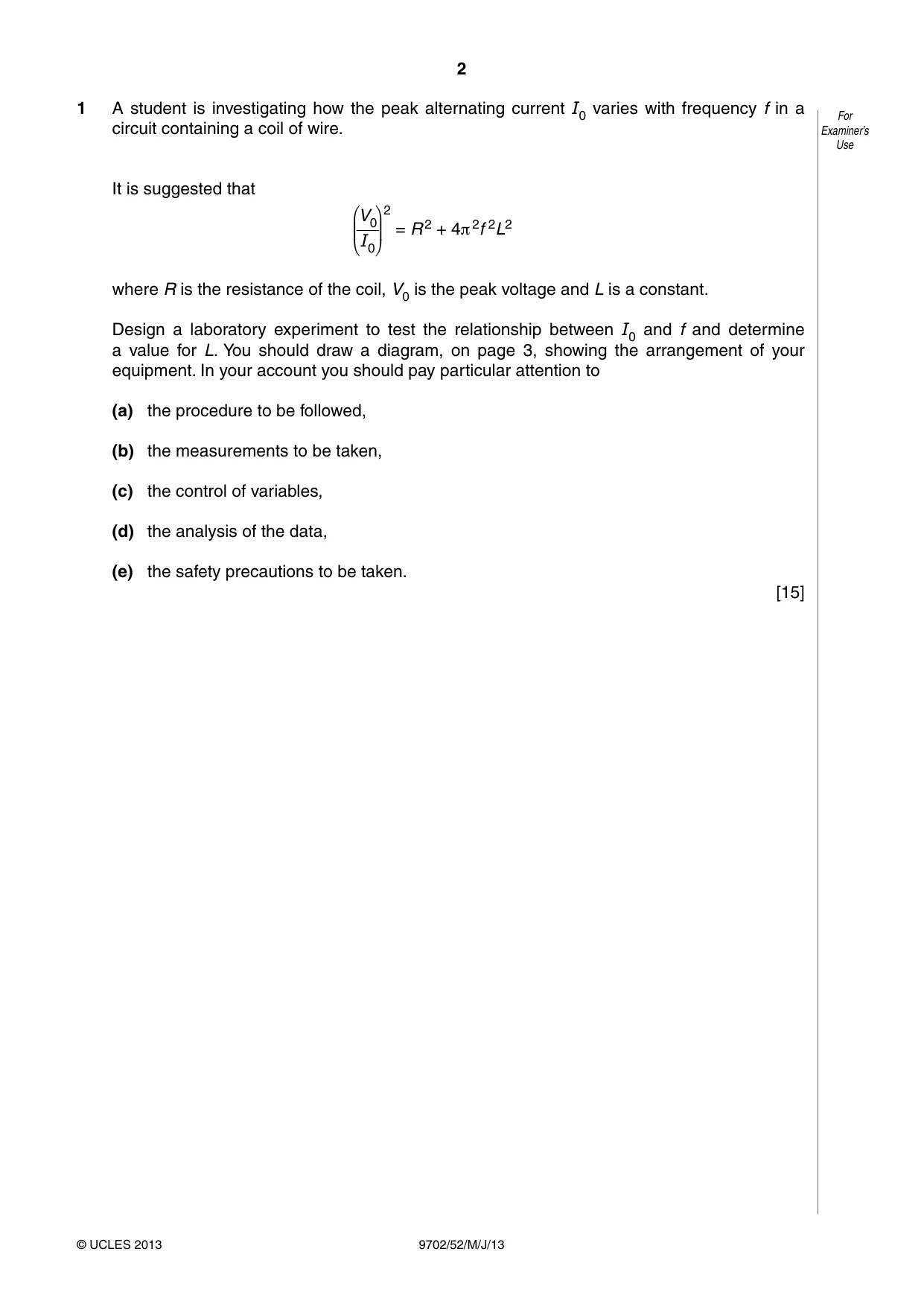
1 A student is investigating how the peak alternating current I0 varies with frequency f in a For circuit containing a coil of wire. Examiner’s Use It is suggested that V0 2 2 = R + 4π 2f 2L2 I0 where R is the resistance of the coil, V0 is the peak voltage and L is a constant. Design a laboratory experiment to test the relationship between I0 and f and determine a value for L. You should draw a diagram, on page 3, showing the arrangement of your equipment. In your account you should pay particular attention to (a) the procedure to be followed, (b) the measurements to be taken, (c) the control of variables, (d) the analysis of the data, (e) the safety precautions to be taken. [15] Diagram For Examiner’s Use ......................................................................................................................................................... ......................................................................................................................................................... ......................................................................................................................................................... ......................................................................................................................................................... ......................................................................................................................................................... ......................................................................................................................................................... ......................................................................................................................................................... ......................................................................................................................................................... ......................................................................................................................................................... ......................................................................................................................................................... ......................................................................................................................................................... ......................................................................................................................................................... ......................................................................................................................................................... ......................................................................................................................................................... ......................................................................................................................................................... For ......................................................................................................................................................... Examiner’s Use ......................................................................................................................................................... ......................................................................................................................................................... ......................................................................................................................................................... ......................................................................................................................................................... ......................................................................................................................................................... ......................................................................................................................................................... ......................................................................................................................................................... ......................................................................................................................................................... ......................................................................................................................................................... ......................................................................................................................................................... ......................................................................................................................................................... ......................................................................................................................................................... ......................................................................................................................................................... ......................................................................................................................................................... ......................................................................................................................................................... ......................................................................................................................................................... ......................................................................................................................................................... ......................................................................................................................................................... ......................................................................................................................................................... ......................................................................................................................................................... ......................................................................................................................................................... ......................................................................................................................................................... ......................................................................................................................................................... Defining the Methods of Method of Safety Additional For problem data collection analysis considerations detail Examiner’s Use
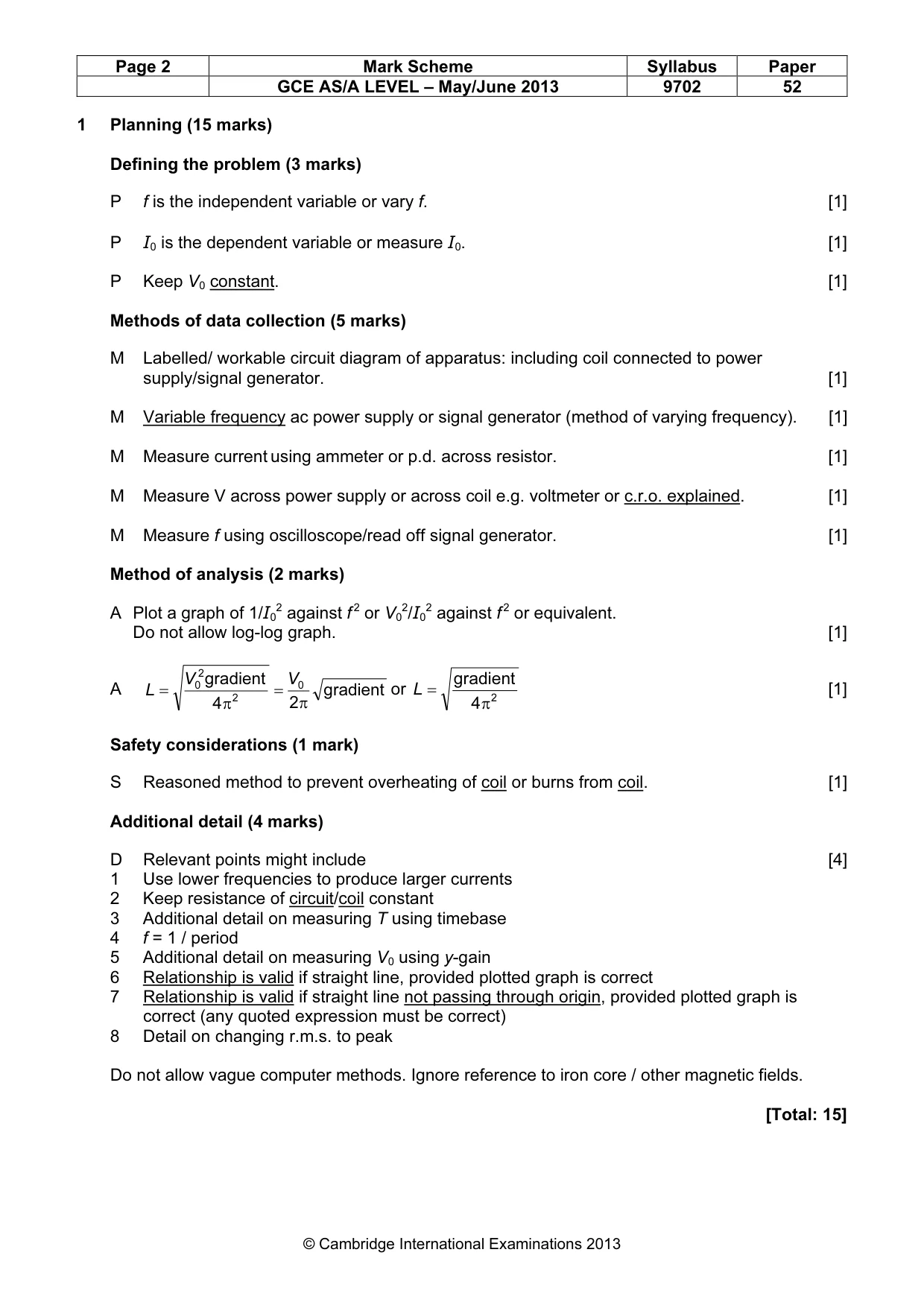
Mark scheme: 1 Planning (15 marks) Defining the problem (3 marks) P f is the independent variable or vary f. [1] P I0 is the dependent variable or measure I0. [1] P Keep V0 constant. [1] Methods of data collection (5 marks) M Labelled/ workable circuit diagram of apparatus: including coil connected to power supply/signal generator. [1] M Variable frequency ac power supply or signal generator (method of varying frequency). [1] M Measure current using ammeter or p.d. across resistor. [1] M Measure V across power supply or across coil e.g. voltmeter or c.r.o. explained. [1] M Measure f using oscilloscope/read off signal generator. [1] Method of analysis (2 marks) A Plot a graph of 1/I02 against f 2 or V02/I02 against f 2 or equivalent. Do not allow log-log graph. [1] V02 gradient V0 gradient A L = = gradient or L = 2 [1] 2 4 π 2 π 4 π Safety considerations (1 mark) S Reasoned method to prevent overheating of coil or burns from coil. [1] Additional detail (4 marks) D Relevant points might include [4] 1 Use lower frequencies to produce larger currents 2 Keep resistance of circuit/coil constant 3 Additional detail on measuring T using timebase 4 f = 1 / period 5 Additional detail on measuring V0 using y-gain 6 Relationship is valid if straight line, provided plotted graph is correct 7 Relationship is valid if straight line not passing through origin, provided plotted graph is correct (any quoted expression must be correct) 8 Detail on changing r.m.s. to peak Do not allow vague computer methods. Ignore reference to iron core / other magnetic fields. [Total: 15] GCE AS/A LEVEL – May/June 2013 9702 52
Q2 · An electron beam is accelerated by a voltage V before entering a uniform electric field…
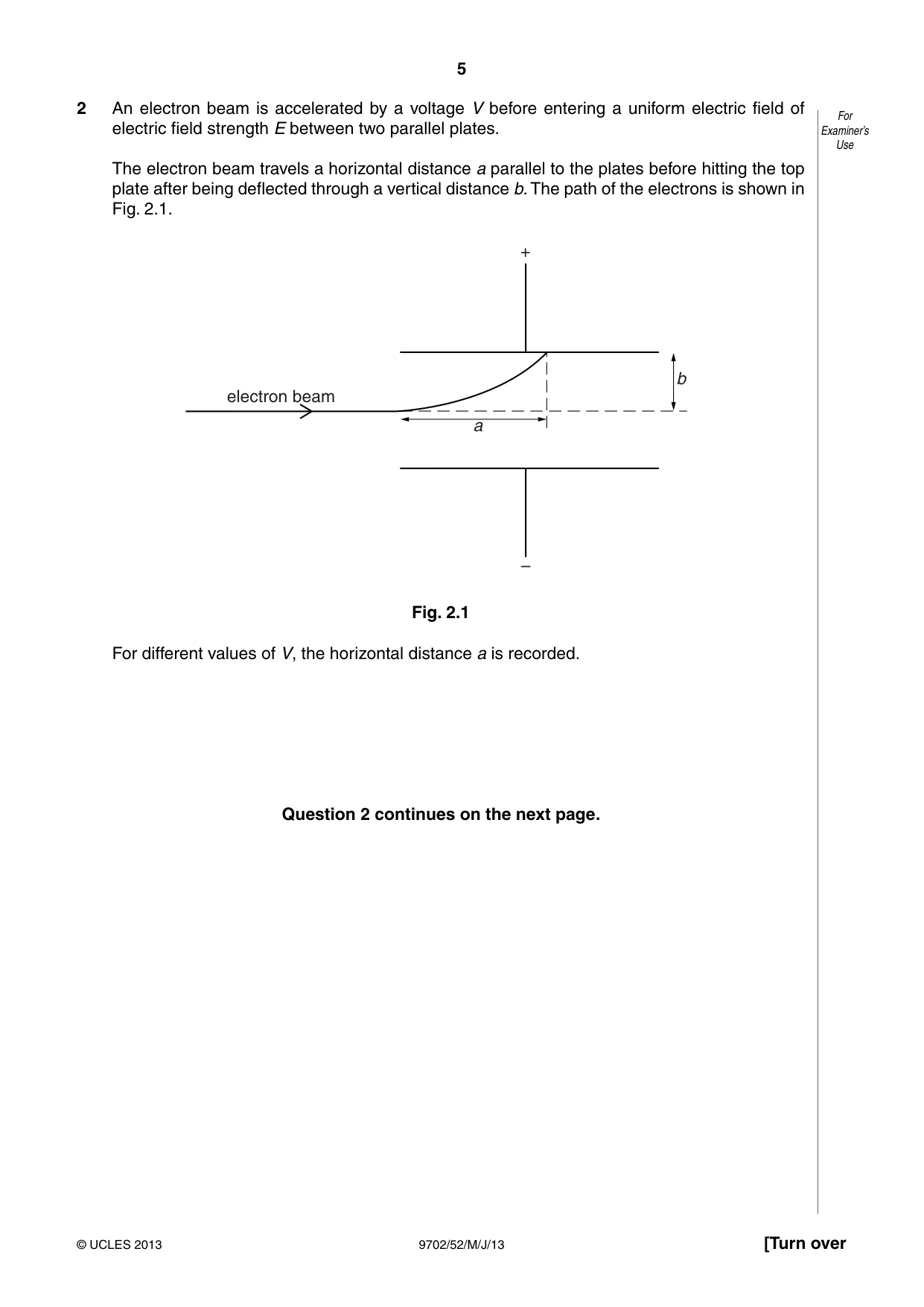
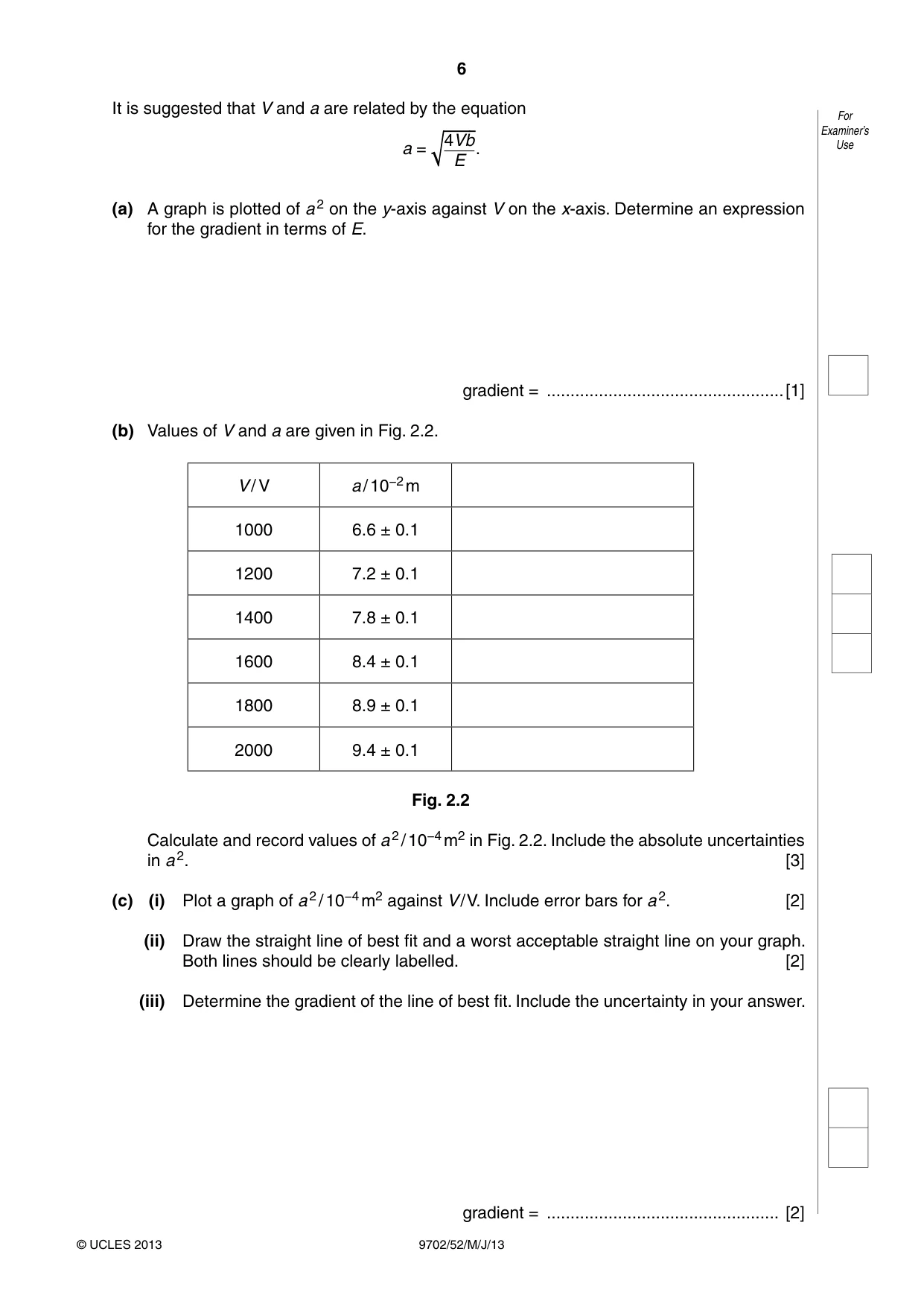
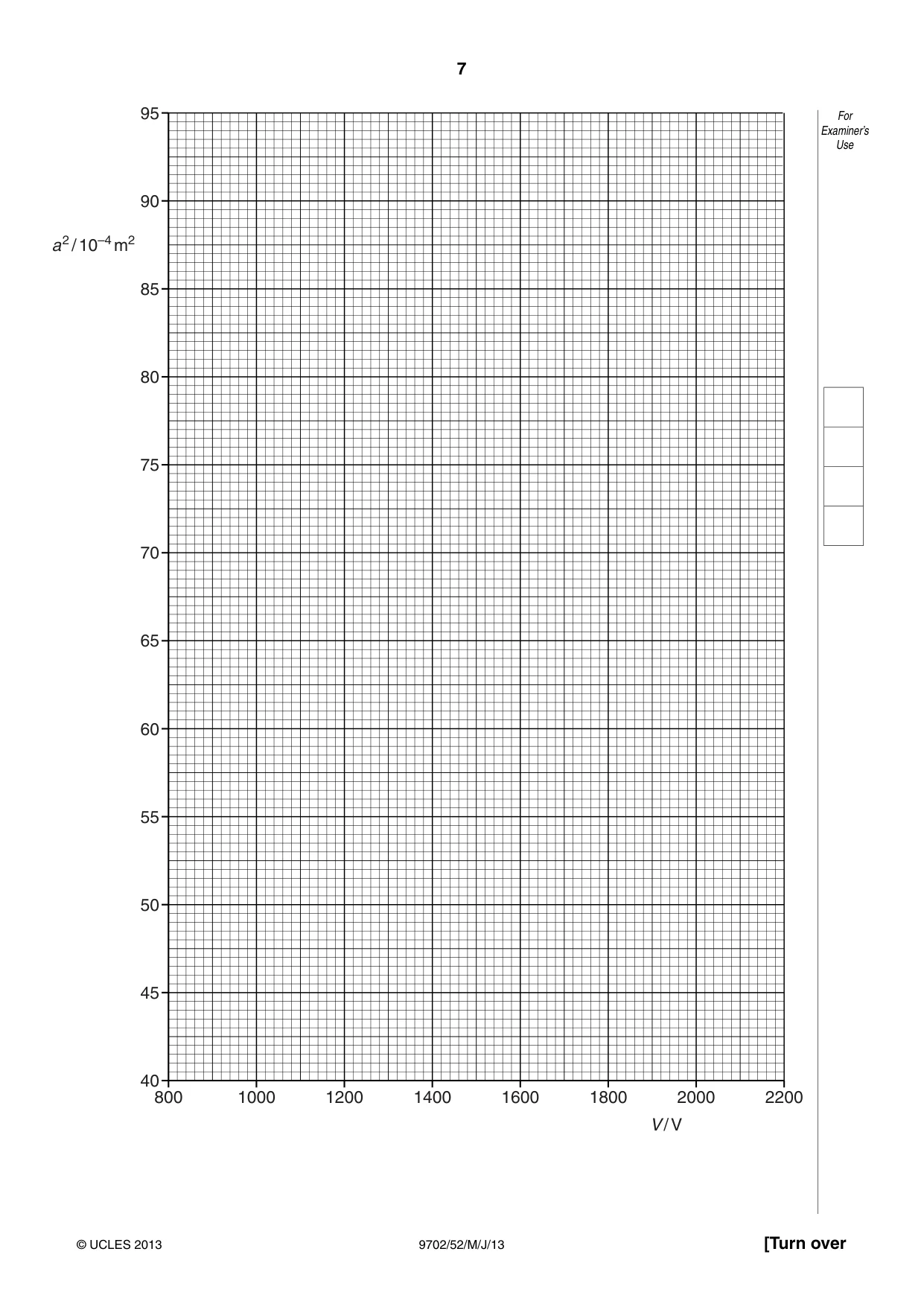
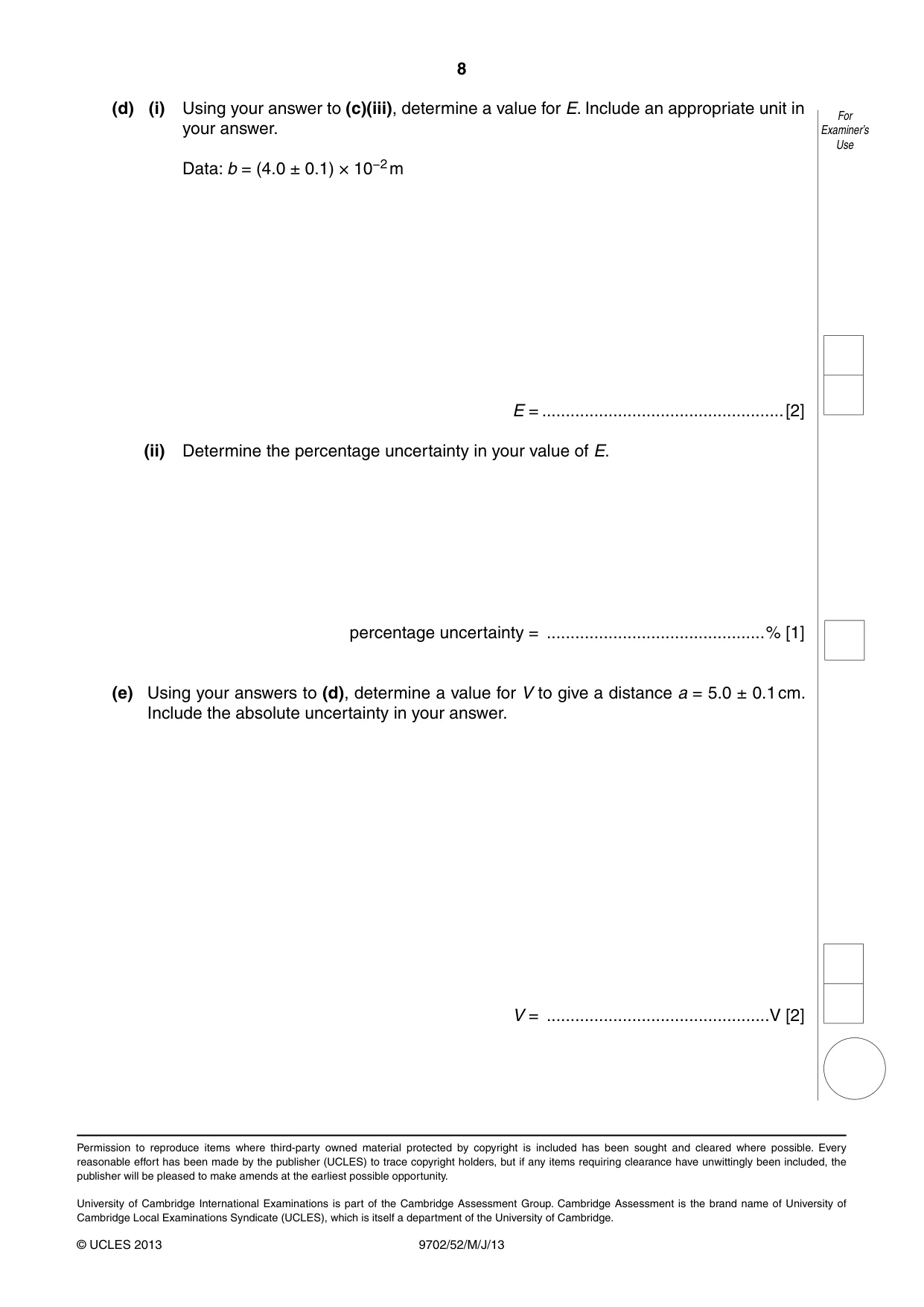
2 An electron beam is accelerated by a voltage V before entering a uniform electric field of For electric field strength E between two parallel plates. Examiner’s Use The electron beam travels a horizontal distance a parallel to the plates before hitting the top plate after being deflected through a vertical distance b. The path of the electrons is shown in Fig. 2.1. + b electron beam a – Fig. 2.1 For different values of V, the horizontal distance a is recorded. Question 2 continues on the next page. It is suggested that V and a are related by the equation For Examiner’s 4Vb Use a = . E (a) A graph is plotted of a 2 on the y-axis against V on the x-axis. Determine an expression for the gradient in terms of E. gradient = ..................................................[1] (b) Values of V and a are given in Fig. 2.2. V / V a / 10−2 m 1000 6.6 ± 0.1 1200 7.2 ± 0.1 1400 7.8 ± 0.1 1600 8.4 ± 0.1 1800 8.9 ± 0.1 2000 9.4 ± 0.1 Fig. 2.2 Calculate and record values of a 2 / 10−4 m2 in Fig. 2.2. Include the absolute uncertainties in a 2. [3] (c) (i) Plot a graph of a 2 / 10−4 m2 against V / V. Include error bars for a 2. [2] (ii) Draw the straight line of best fit and a worst acceptable straight line on your graph. Both lines should be clearly labelled. [2] (iii) Determine the gradient of the line of best fit. Include the uncertainty in your answer. gradient = ................................................. [2] 95 For Examiner’s Use 90 a 2 / 10–4 m2 85 80 75 70 65 60 55 50 45 40 800 1000 1200 1400 1600 1800 2000 2200 V / V
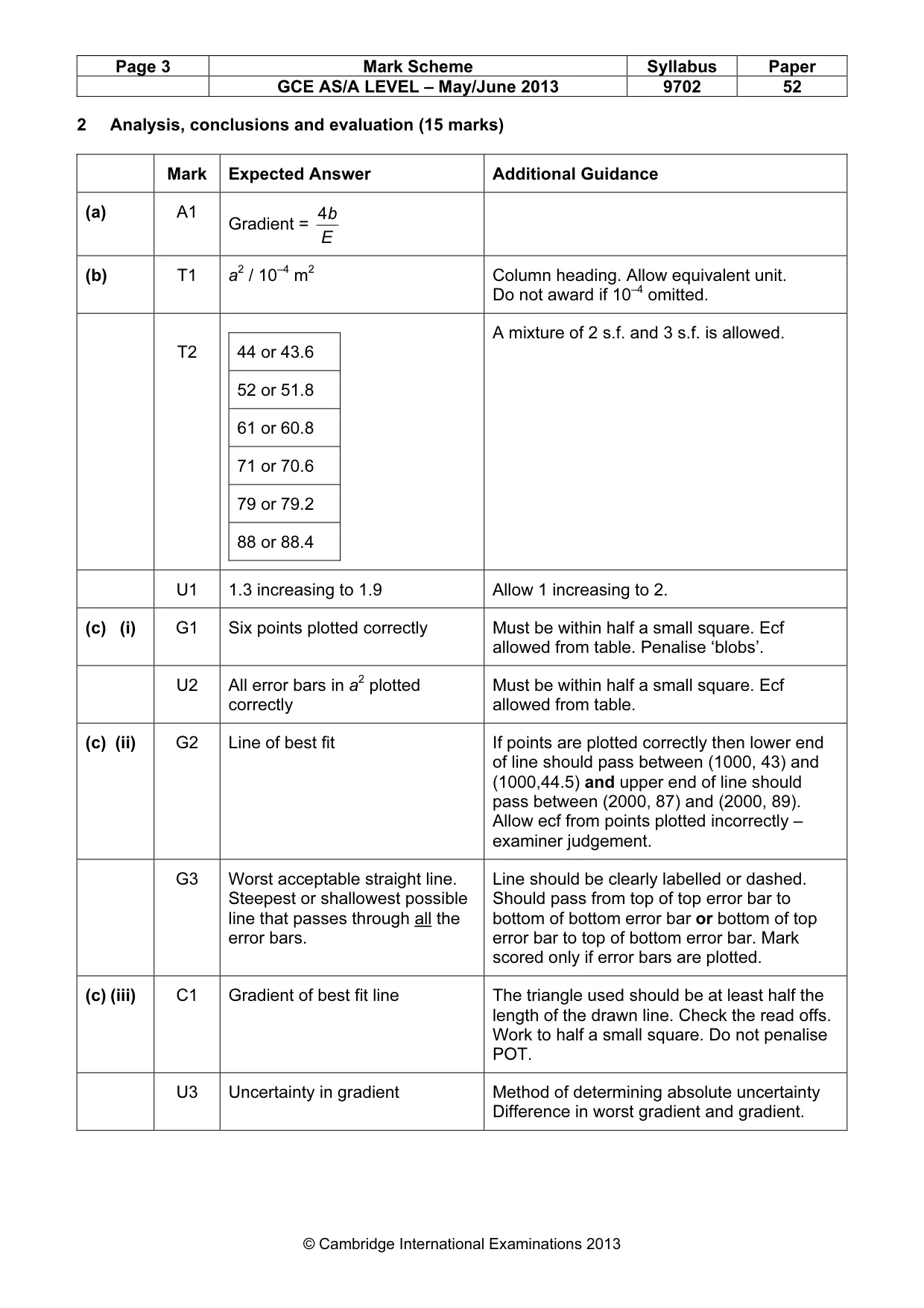
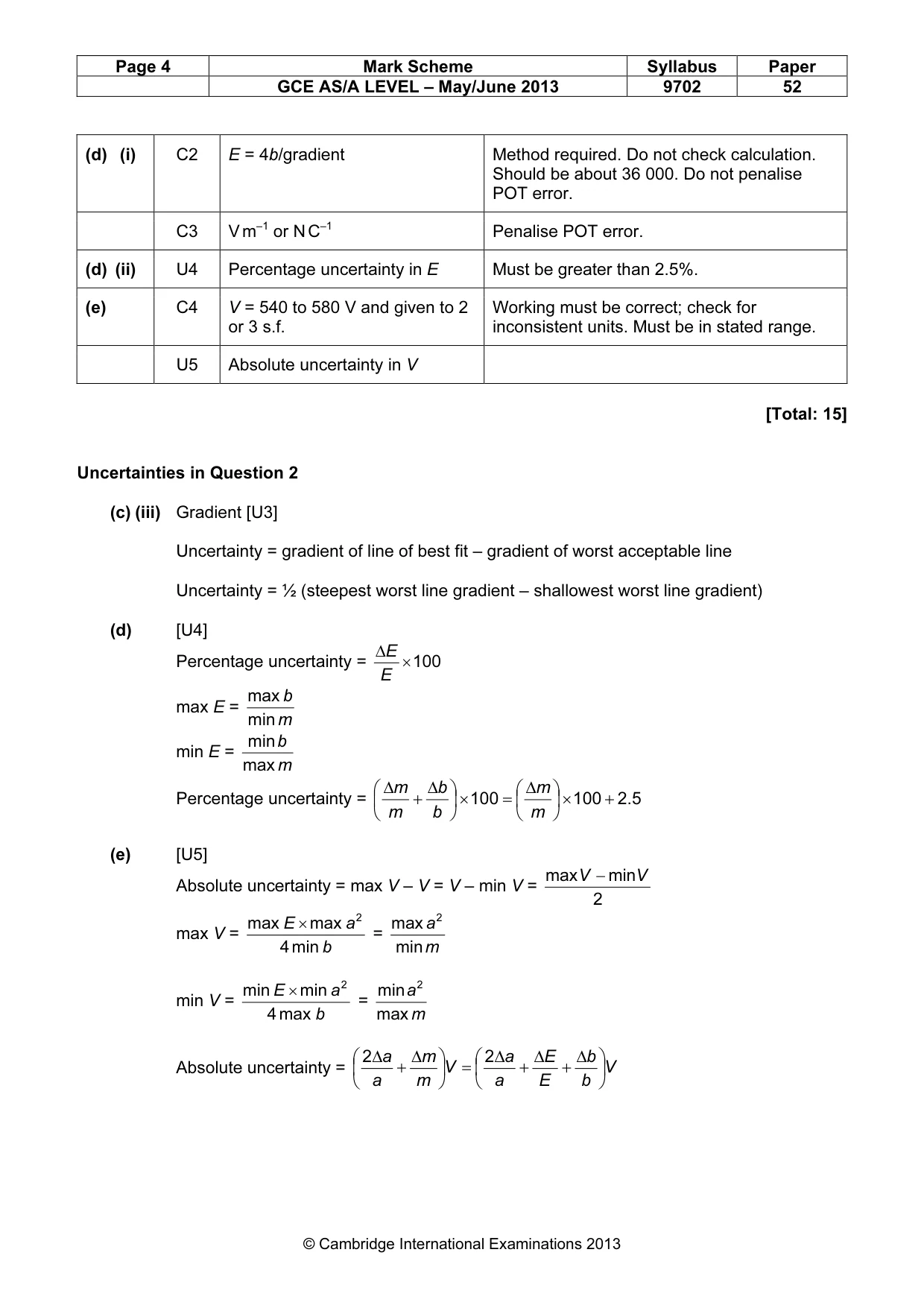
Mark scheme: 2 Analysis, conclusions and evaluation (15 marks) Mark Expected Answer Additional Guidance (a) A1 4 b Gradient = E (b) T1 a2 / 10–4 m2 Column heading. Allow equivalent unit. Do not award if 10–4 omitted. A mixture of 2 s.f. and 3 s.f. is allowed. T2 44 or 43.6 52 or 51.8 61 or 60.8 71 or 70.6 79 or 79.2 88 or 88.4 U1 1.3 increasing to 1.9 Allow 1 increasing to 2. (c) (i) G1 Six points plotted correctly Must be within half a small square. Ecf allowed from table. Penalise ‘blobs’. U2 All error bars in a2 plotted Must be within half a small square. Ecf correctly allowed from table. (c) (ii) G2 Line of best fit If points are plotted correctly then lower end of line should pass between (1000, 43) and (1000,44.5) and upper end of line should pass between (2000, 87) and (2000, 89). Allow ecf from points plotted incorrectly – examiner judgement. G3 Worst acceptable straight line. Line should be clearly labelled or dashed. Steepest or shallowest possible Should pass from top of top error bar to line that passes through all the bottom of bottom error bar or bottom of top error bars. error bar to top of bottom error bar. Mark scored only if error bars are plotted. (c) (iii) C1 Gradient of best fit line The triangle used should be at least half the length of the drawn line. Check the read offs. Work to half a small square. Do not penalise POT. U3 Uncertainty in gradient Method of determining absolute uncertainty Difference in worst gradient and gradient. GCE AS/A LEVEL – May/June 2013 9702 52 (d) (i) C2 E = 4b/gradient Method required. Do not check calculation. Should be about 36 000. Do not penalise POT error. C3 V m–1 or N C–1 Penalise POT error. (d) (ii) U4 Percentage uncertainty in E Must be greater than 2.5%. (e) C4 V = 540 to 580 V and given to 2 Working must be correct; check for or 3 s.f. inconsistent units. Must be in stated range. U5 Absolute uncertainty in V [Total: 15] Uncertainties in Question 2 (c) (iii) Gradient [U3] Uncertainty = gradient of line of best fit – gradient of worst acceptable line Uncertainty = ½ (steepest worst line gradient – shallowest worst line gradient) (d) [U4] ∆E Percentage uncertainty = × 100 E max b max E = min m min b min E = max m ∆m ∆b ∆m Percentage uncertainty = + × 100 = × 100 + 2.5 m b m (e) [U5] max V − minV Absolute uncertainty = max V – V = V – min V = 2 max E × max a 2 max a 2 max V = = 4 min b min m min E × min a 2 min a 2 min V = = 4 max b max m 2 ∆a ∆m 2 ∆a ∆E ∆b Absolute uncertainty = + V = + + V a m a E b
What was in this paper
The subtopics covered by these 2 questions, and how many questions each got. Open one in a new tab to see every Cambridge question on it.
What you needed in this session
Cambridge’s own grade thresholds for 2013 May/June, Paper 5 · Variant 2. A higher threshold means an easier paper — the bar moves with how the cohort did.