Cambridge A Level Physics 9702 — 2013 May/June Paper 5 · Variant 3
9702/53/M/J/13 · 2 questions · 30 marks · ≈34 min
The question paper and its mark scheme, free to read here and free to download. This is Cambridge’s own paper, exactly as it was sat.
Question paper8 pages
Mark scheme4 pages
Answers below. Sit the paper first if you are practising.
Questions as text
Q1 · A student is investigating the flow of water through a horizontal tube
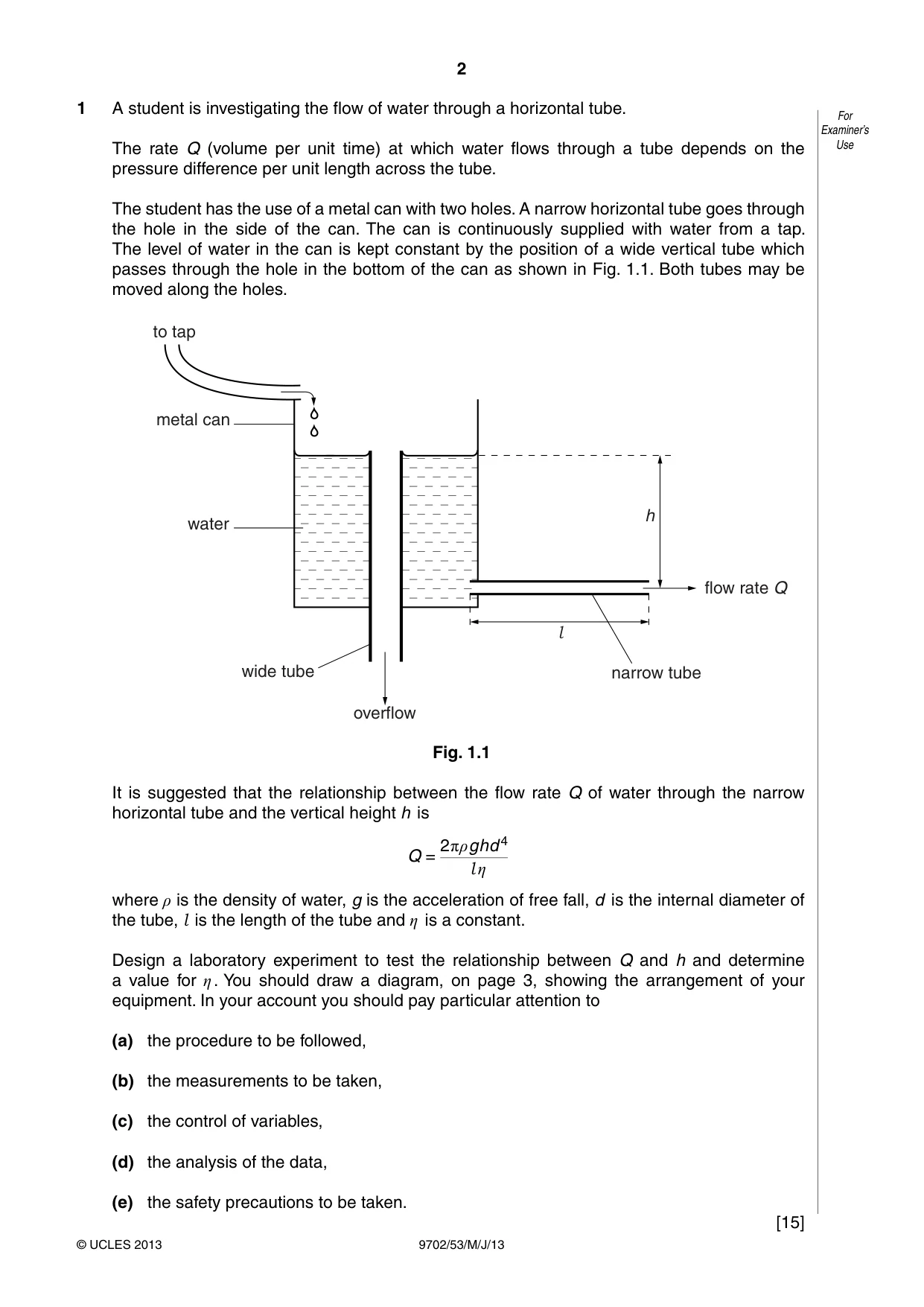
1 A student is investigating the flow of water through a horizontal tube. For Examiner’s The rate Q (volume per unit time) at which water flows through a tube depends on the Use pressure difference per unit length across the tube. The student has the use of a metal can with two holes. A narrow horizontal tube goes through the hole in the side of the can. The can is continuously supplied with water from a tap. The level of water in the can is kept constant by the position of a wide vertical tube which passes through the hole in the bottom of the can as shown in Fig. 1.1. Both tubes may be moved along the holes. to tap metal can h water flow rate Q l wide tube narrow tube overflow Fig. 1.1 It is suggested that the relationship between the flow rate Q of water through the narrow horizontal tube and the vertical height h is 2 π ρ g h d 4 Q = l η where ρ is the density of water, g is the acceleration of free fall, d is the internal diameter of the tube, l is the length of the tube and η is a constant. Design a laboratory experiment to test the relationship between Q and h and determine a value for η . You should draw a diagram, on page 3, showing the arrangement of your equipment. In your account you should pay particular attention to (a) the procedure to be followed, (b) the measurements to be taken, (c) the control of variables, (d) the analysis of the data, (e) the safety precautions to be taken. [15] Diagram For Examiner’s Use ......................................................................................................................................................... ......................................................................................................................................................... ......................................................................................................................................................... ......................................................................................................................................................... ......................................................................................................................................................... ......................................................................................................................................................... ......................................................................................................................................................... ......................................................................................................................................................... ......................................................................................................................................................... ......................................................................................................................................................... ......................................................................................................................................................... ......................................................................................................................................................... ......................................................................................................................................................... ......................................................................................................................................................... ......................................................................................................................................................... For ......................................................................................................................................................... Examiner’s Use ......................................................................................................................................................... ......................................................................................................................................................... ......................................................................................................................................................... ......................................................................................................................................................... ......................................................................................................................................................... ......................................................................................................................................................... ......................................................................................................................................................... ......................................................................................................................................................... ......................................................................................................................................................... ......................................................................................................................................................... ......................................................................................................................................................... ......................................................................................................................................................... ......................................................................................................................................................... ......................................................................................................................................................... ......................................................................................................................................................... ......................................................................................................................................................... ......................................................................................................................................................... ......................................................................................................................................................... ......................................................................................................................................................... ......................................................................................................................................................... ......................................................................................................................................................... ......................................................................................................................................................... ......................................................................................................................................................... Defining the Methods of Method of Safety Additional For problem data collection analysis considerations detail Examiner’s Use
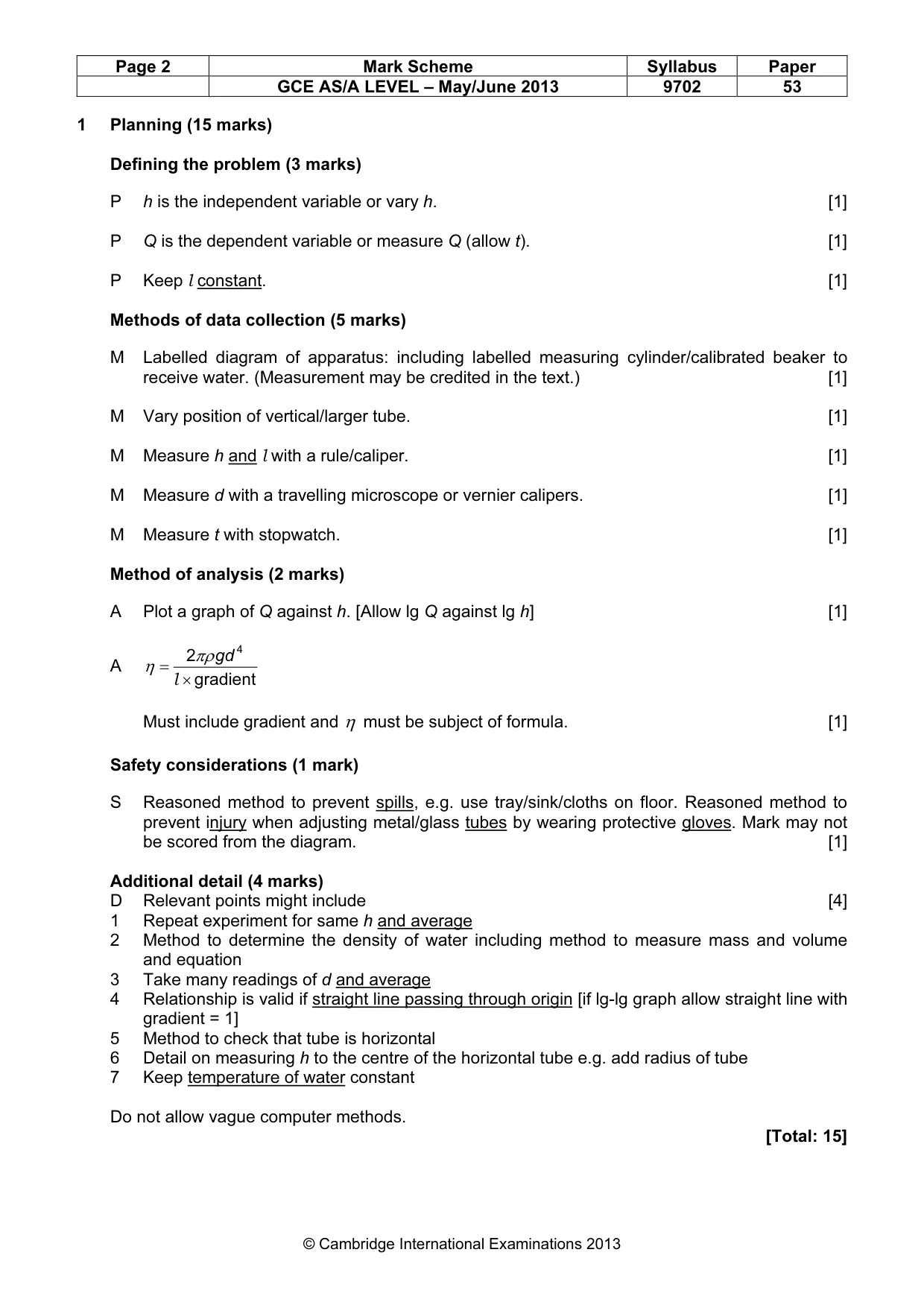
Mark scheme: 1 Planning (15 marks) Defining the problem (3 marks) P h is the independent variable or vary h. [1] P Q is the dependent variable or measure Q (allow t). [1] P Keep l constant. [1] Methods of data collection (5 marks) M Labelled diagram of apparatus: including labelled measuring cylinder/calibrated beaker to receive water. (Measurement may be credited in the text.) [1] M Vary position of vertical/larger tube. [1] M Measure h and l with a rule/caliper. [1] M Measure d with a travelling microscope or vernier calipers. [1] M Measure t with stopwatch. [1] Method of analysis (2 marks) A Plot a graph of Q against h. [Allow lg Q against lg h] [1] 2πρ gd 4 A η = l × gradient Must include gradient and η must be subject of formula. [1] Safety considerations (1 mark) S Reasoned method to prevent spills, e.g. use tray/sink/cloths on floor. Reasoned method to prevent injury when adjusting metal/glass tubes by wearing protective gloves. Mark may not be scored from the diagram. [1] Additional detail (4 marks) D Relevant points might include [4] 1 Repeat experiment for same h and average 2 Method to determine the density of water including method to measure mass and volume and equation 3 Take many readings of d and average 4 Relationship is valid if straight line passing through origin [if lg-lg graph allow straight line with gradient = 1] 5 Method to check that tube is horizontal 6 Detail on measuring h to the centre of the horizontal tube e.g. add radius of tube 7 Keep temperature of water constant Do not allow vague computer methods. [Total: 15] GCE AS/A LEVEL – May/June 2013 9702 53
Q2 · A student is investigating the discharge of capacitors
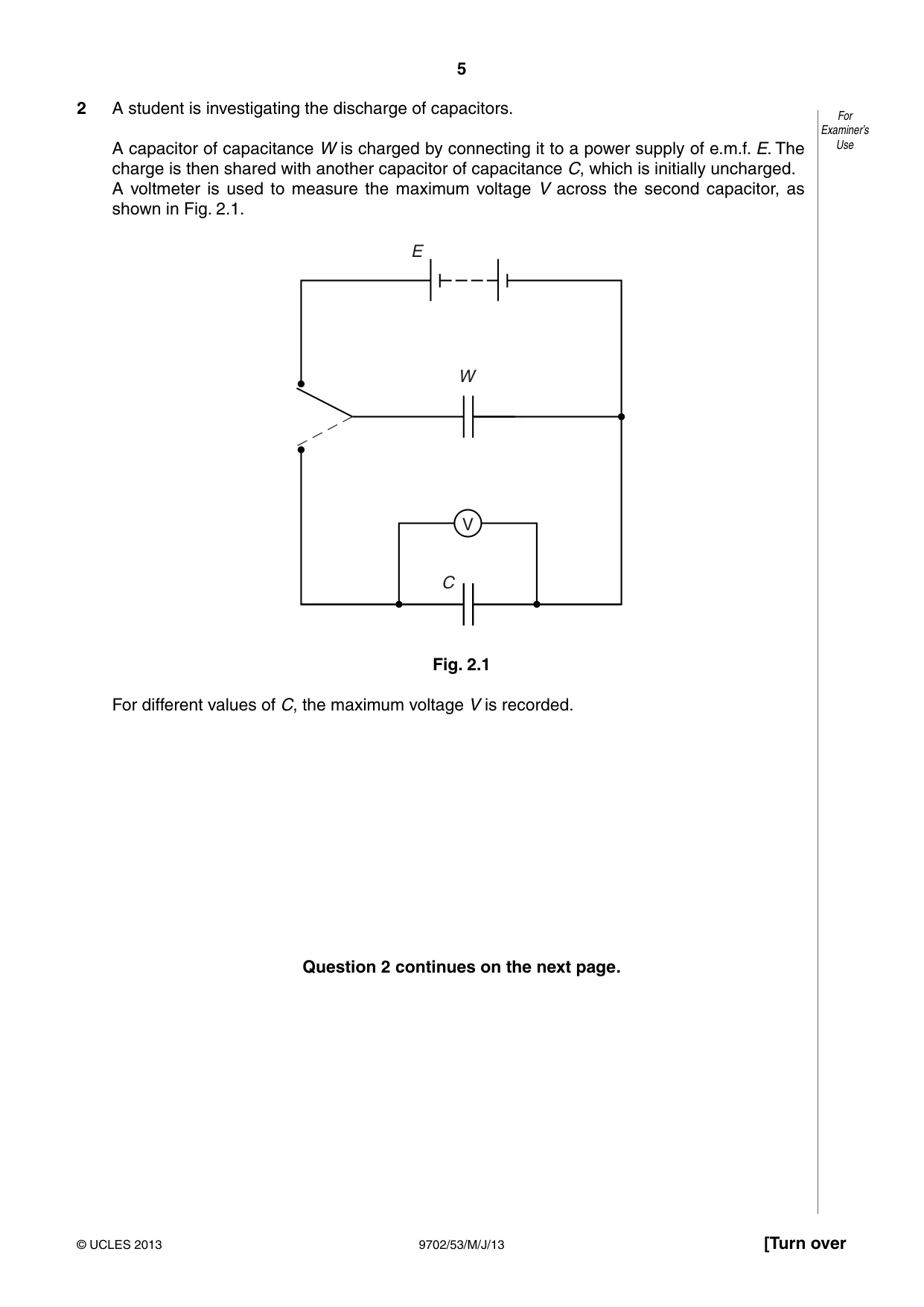
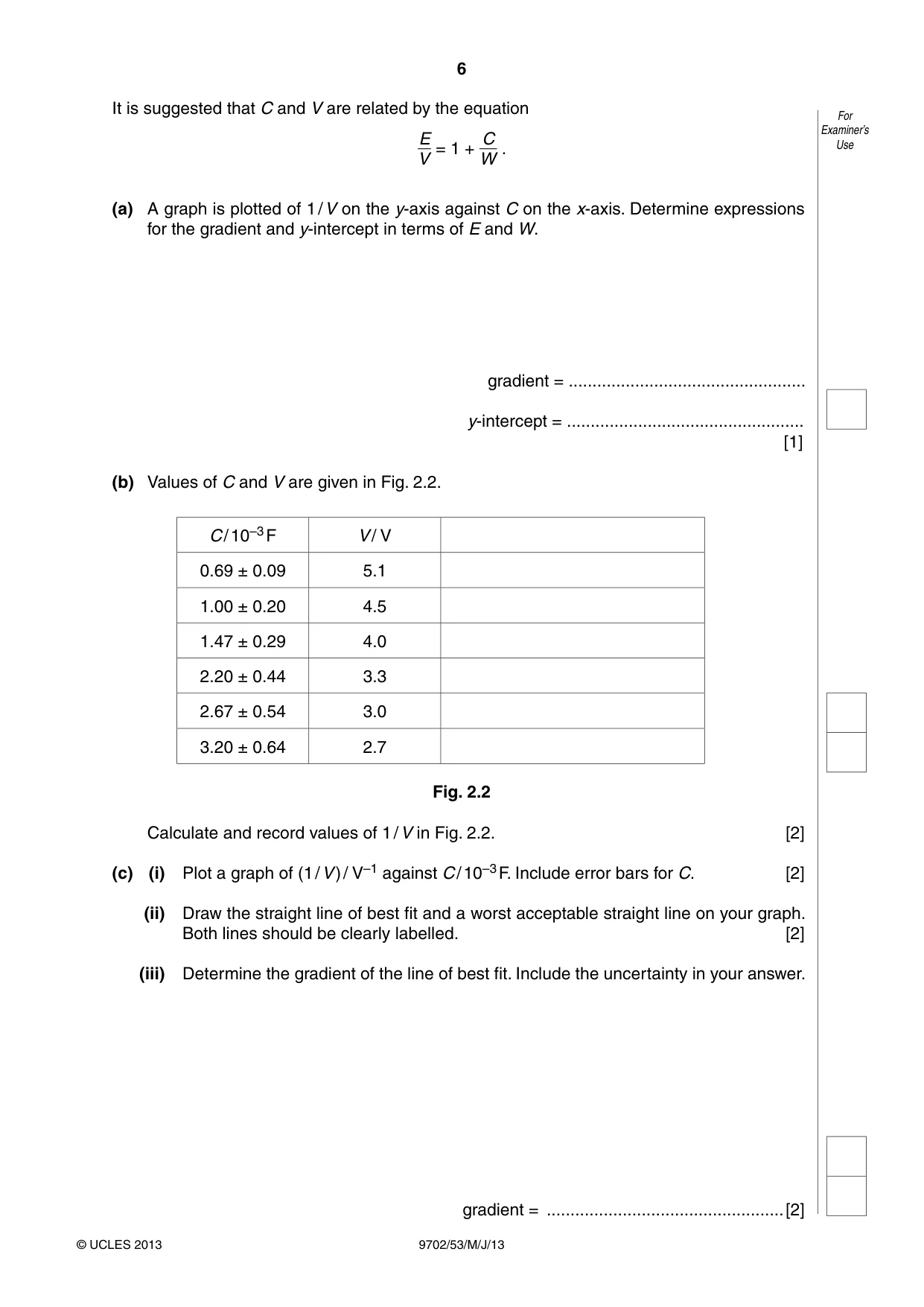
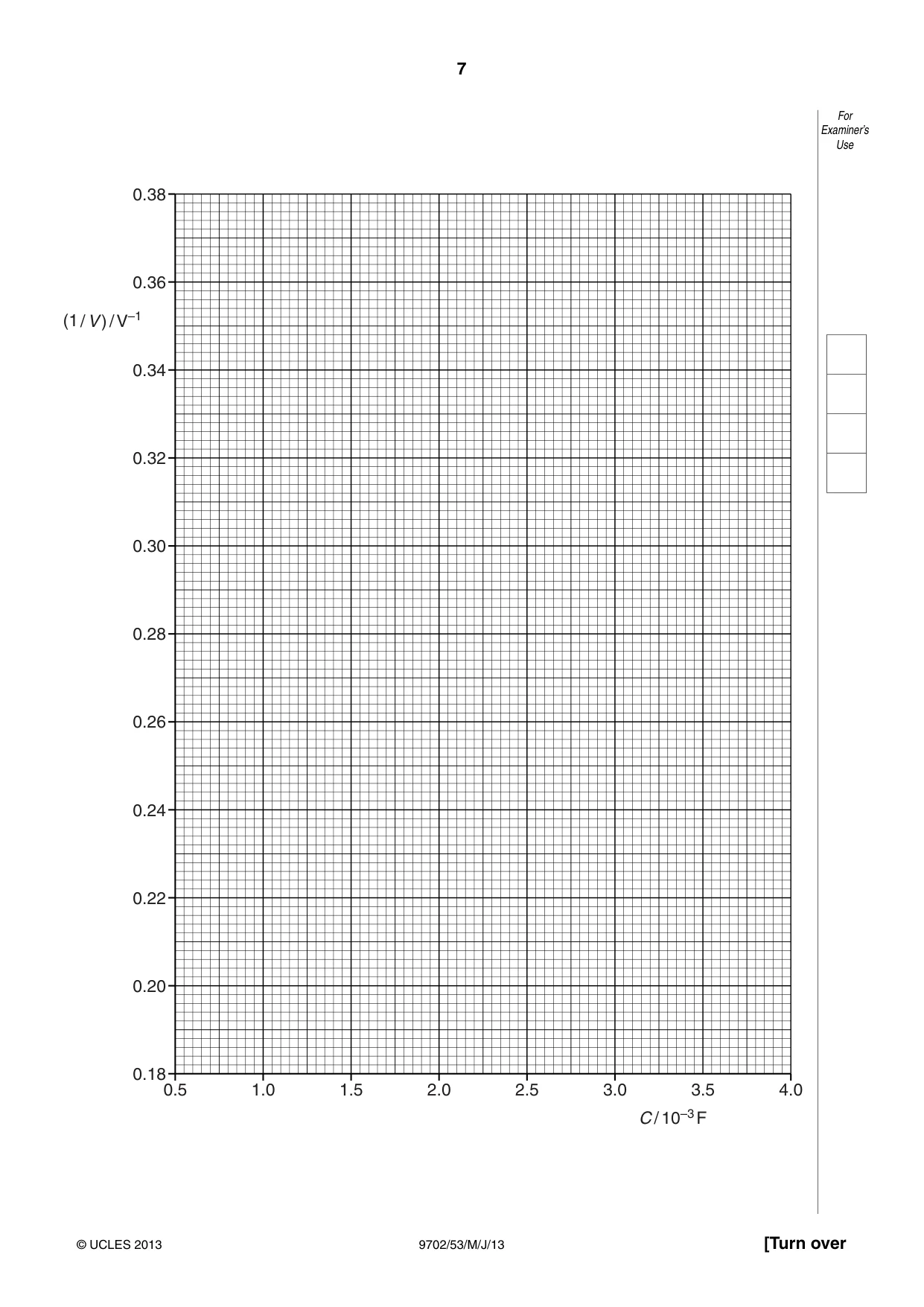
2 A student is investigating the discharge of capacitors. For Examiner’s A capacitor of capacitance W is charged by connecting it to a power supply of e.m.f. E. The Use charge is then shared with another capacitor of capacitance C, which is initially uncharged. A voltmeter is used to measure the maximum voltage V across the second capacitor, as shown in Fig. 2.1. E W V C Fig. 2.1 For different values of C, the maximum voltage V is recorded. Question 2 continues on the next page. It is suggested that C and V are related by the equation For Examiner’s E C Use = 1 + . V W (a) A graph is plotted of 1 / V on the y-axis against C on the x-axis. Determine expressions for the gradient and y-intercept in terms of E and W. gradient = .................................................. y-intercept = .................................................. [1] (b) Values of C and V are given in Fig. 2.2. C / 10–3 F V / V 0.69 ± 0.09 5.1 1.00 ± 0.20 4.5 1.47 ± 0.29 4.0 2.20 ± 0.44 3.3 2.67 ± 0.54 3.0 3.20 ± 0.64 2.7 Fig. 2.2 Calculate and record values of 1 / V in Fig. 2.2. [2] (c) (i) Plot a graph of (1 / V ) / V–1 against C / 10–3 F. Include error bars for C. [2] (ii) Draw the straight line of best fit and a worst acceptable straight line on your graph. Both lines should be clearly labelled. [2] (iii) Determine the gradient of the line of best fit. Include the uncertainty in your answer. gradient = ..................................................[2] For Examiner’s Use 0.38 0.36 (1 / V ) / V–1 0.34 0.32 0.30 0.28 0.26 0.24 0.22 0.20 0.18 0.5 1.0 1.5 2.0 2.5 3.0 3.5 4.0 C / 10–3 F
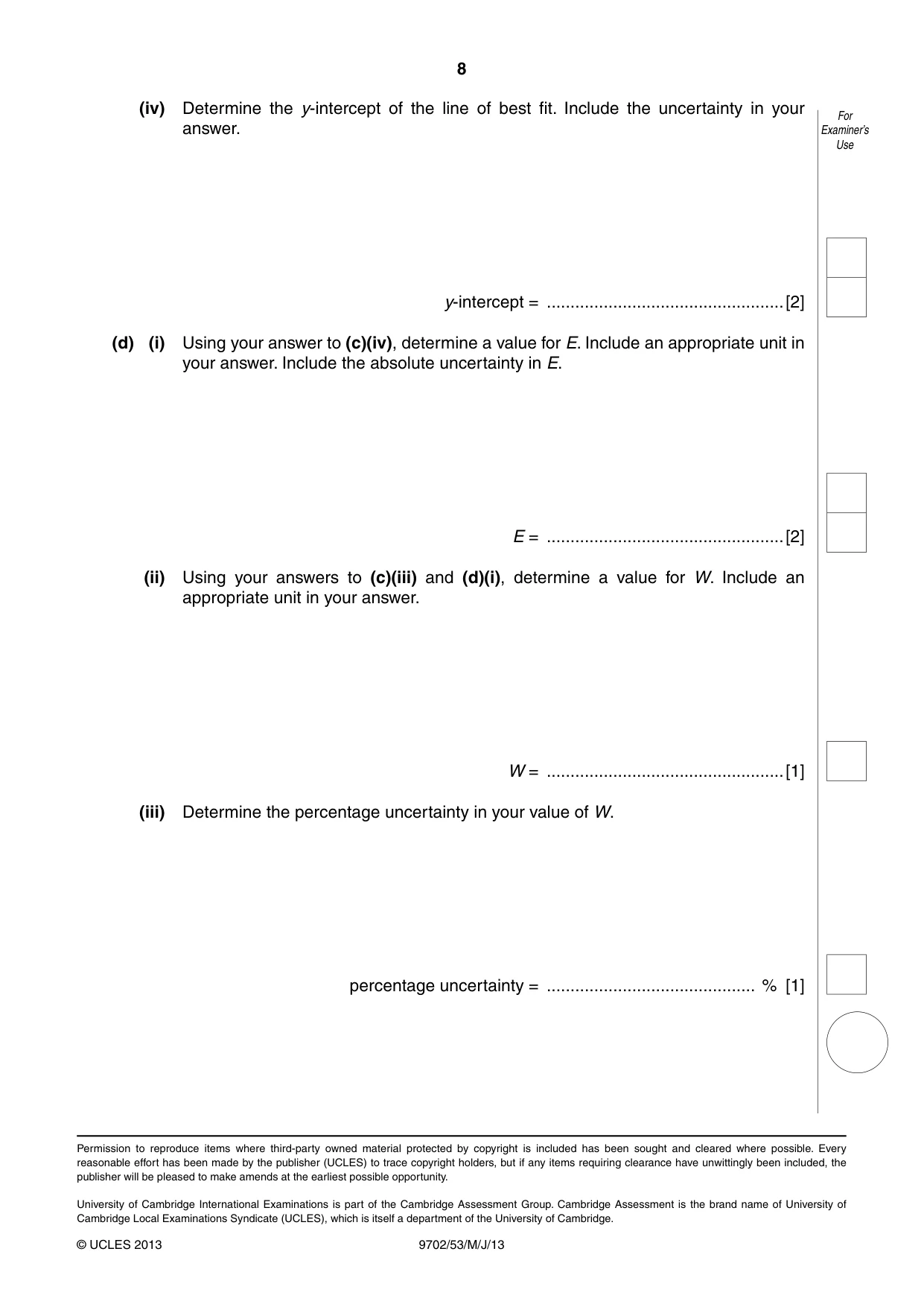
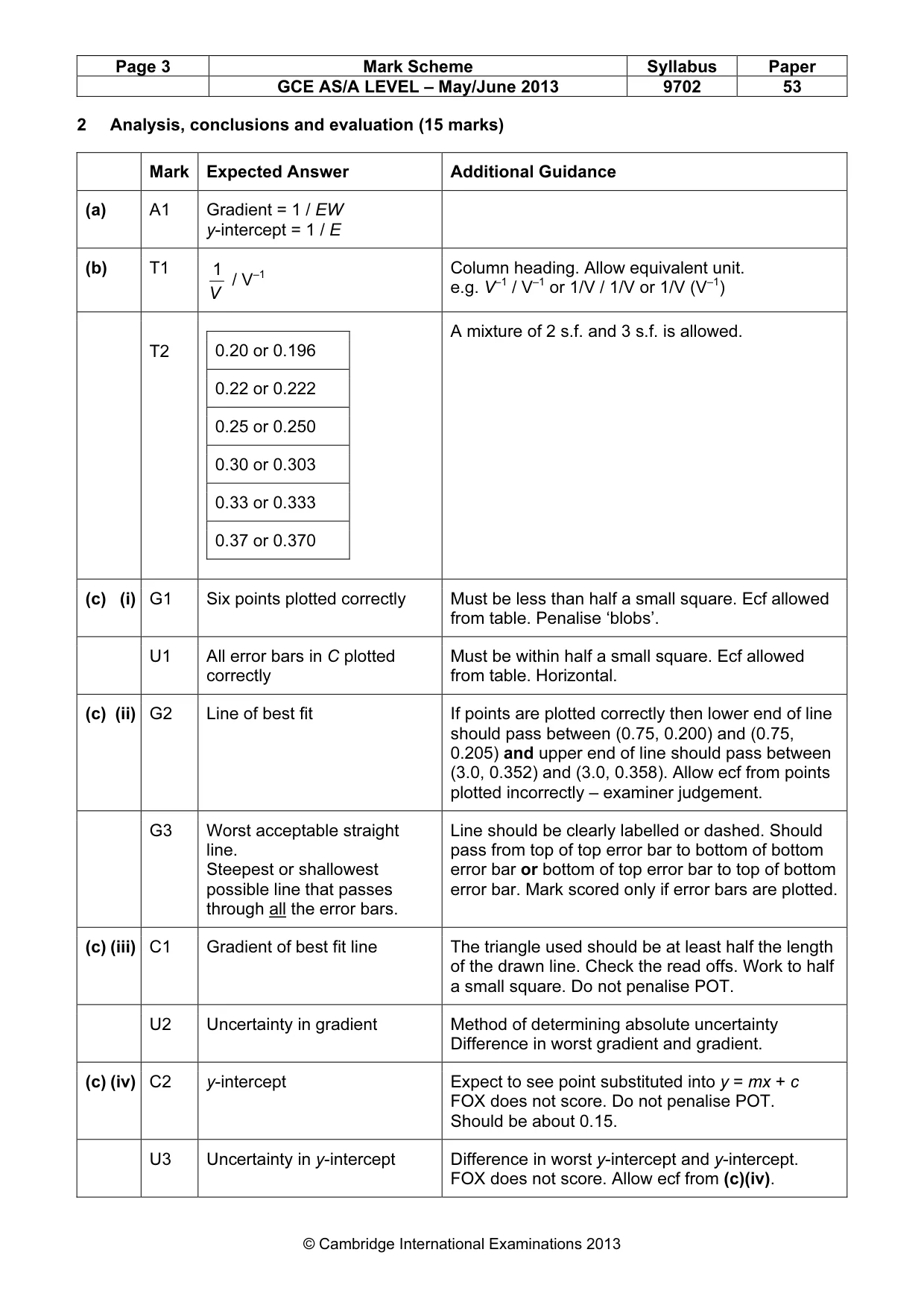
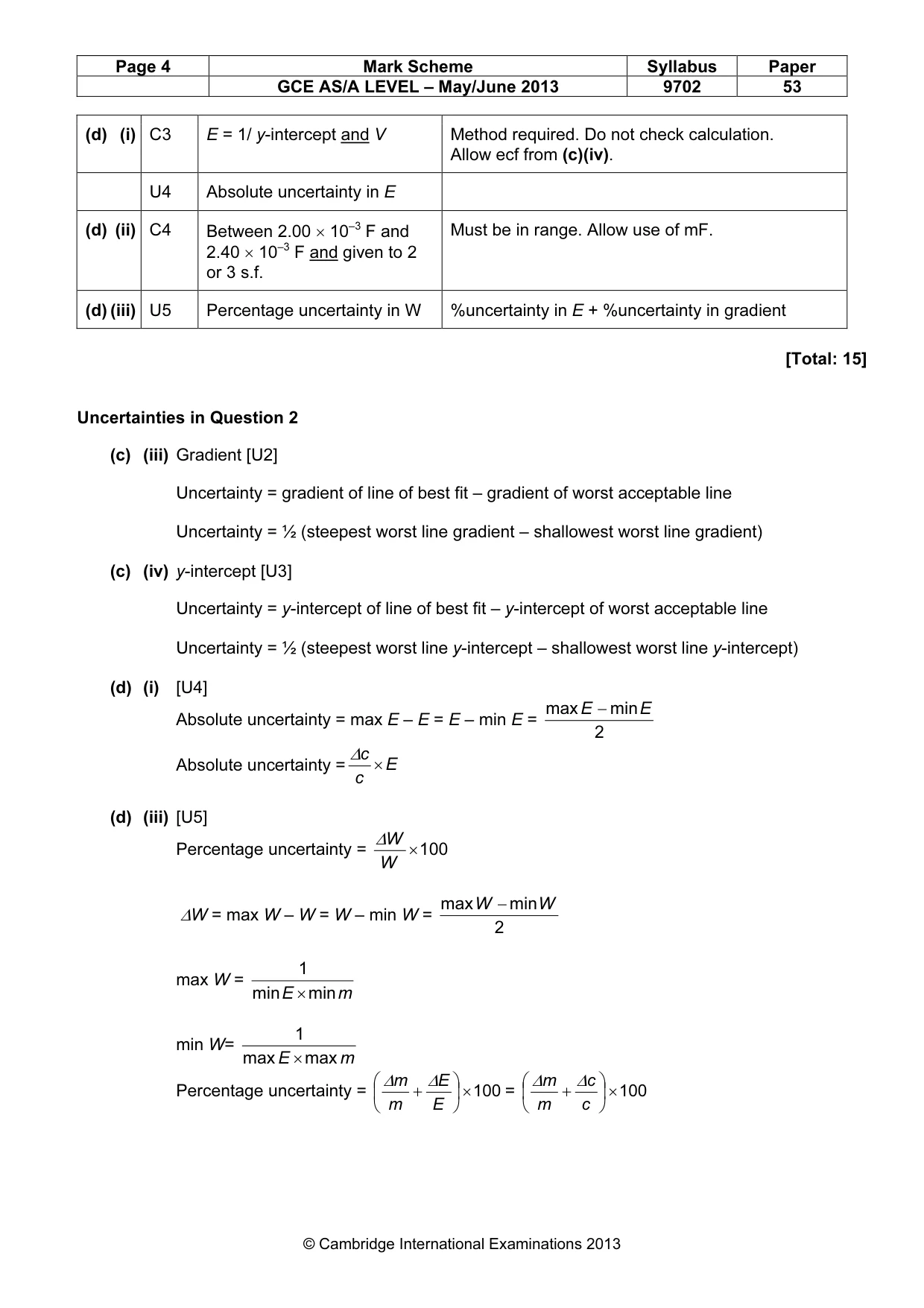
Mark scheme: 2 Analysis, conclusions and evaluation (15 marks) Mark Expected Answer Additional Guidance (a) A1 Gradient = 1 / EW y-intercept = 1 / E (b) T1 1 Column heading. Allow equivalent unit. / V–1 e.g. V–1 / V–1 or 1/V / 1/V or 1/V (V–1) V A mixture of 2 s.f. and 3 s.f. is allowed. T2 0.20 or 0.196 0.22 or 0.222 0.25 or 0.250 0.30 or 0.303 0.33 or 0.333 0.37 or 0.370 (c) (i) G1 Six points plotted correctly Must be less than half a small square. Ecf allowed from table. Penalise ‘blobs’. U1 All error bars in C plotted Must be within half a small square. Ecf allowed correctly from table. Horizontal. (c) (ii) G2 Line of best fit If points are plotted correctly then lower end of line should pass between (0.75, 0.200) and (0.75, 0.205) and upper end of line should pass between (3.0, 0.352) and (3.0, 0.358). Allow ecf from points plotted incorrectly – examiner judgement. G3 Worst acceptable straight Line should be clearly labelled or dashed. Should line. pass from top of top error bar to bottom of bottom Steepest or shallowest error bar or bottom of top error bar to top of bottom possible line that passes error bar. Mark scored only if error bars are plotted. through all the error bars. (c) (iii) C1 Gradient of best fit line The triangle used should be at least half the length of the drawn line. Check the read offs. Work to half a small square. Do not penalise POT. U2 Uncertainty in gradient Method of determining absolute uncertainty Difference in worst gradient and gradient. (c) (iv) C2 y-intercept Expect to see point substituted into y = mx + c FOX does not score. Do not penalise POT. Should be about 0.15. U3 Uncertainty in y-intercept Difference in worst y-intercept and y-intercept. FOX does not score. Allow ecf from (c)(iv). GCE AS/A LEVEL – May/June 2013 9702 53 (d) (i) C3 E = 1/ y-intercept and V Method required. Do not check calculation. Allow ecf from (c)(iv). U4 Absolute uncertainty in E (d) (ii) C4 Between 2.00 × 10⁻³ F and Must be in range. Allow use of mF. 2.40 × 10⁻³ F and given to 2 or 3 s.f. (d) (iii) U5 Percentage uncertainty in W %uncertainty in E + %uncertainty in gradient [Total: 15] Uncertainties in Question 2 (c) (iii) Gradient [U2] Uncertainty = gradient of line of best fit – gradient of worst acceptable line Uncertainty = ½ (steepest worst line gradient – shallowest worst line gradient) (c) (iv) y-intercept [U3] Uncertainty = y-intercept of line of best fit – y-intercept of worst acceptable line Uncertainty = ½ (steepest worst line y-intercept – shallowest worst line y-intercept) (d) (i) [U4] max E − min E Absolute uncertainty = max E – E = E – min E = 2 ∆c Absolute uncertainty = × E c (d) (iii) [U5] ∆W Percentage uncertainty = × 100 W max W − min W ∆W = max W – W = W – min W = 2 1 max W = min E × min m 1 min W= max E × max m ∆m ∆E ∆ m ∆ c Percentage uncertainty = + × 100 = + × 100 m E m c
What was in this paper
The subtopics covered by these 2 questions, and how many questions each got. Open one in a new tab to see every Cambridge question on it.
What you needed in this session
Cambridge’s own grade thresholds for 2013 May/June, Paper 5 · Variant 3. A higher threshold means an easier paper — the bar moves with how the cohort did.