Cambridge A Level Physical Education 9396 — 2010 Oct/Nov Paper 3 · Variant 1
9396/31/O/N/10 · 90 marks · ≈101 min
The question paper and its mark scheme, free to read here and free to download. This is Cambridge’s own paper, exactly as it was sat.
Question paper4 pages

Mark scheme
No mark scheme is in the library for this paper.
Paper as text
Question paper, page 1
This document consists of 4 printed pages. DC (LEO/SW) 15010/3 © UCLES 2010 [Turn over UNIVERSITY OF CAMBRIDGE INTERNATIONAL EXAMINATIONS General Certificate of Education Advanced Subsidiary Level and Advanced Level READ THESE INSTRUCTIONS FIRST If you have been given an Answer Booklet, follow the instructions on the front cover of the Booklet. Write your Centre number, candidate number and name on all the work you hand in. Write in dark blue or black pen. You may use a soft pencil for any diagrams, graphs or rough working. Do not use staples, paper clips, highlighters, glue or correction fluid. Answer all questions. At the end of the examination, fasten all your work securely together. The number of marks is given in brackets [ ] at the end of each question or part question. * 4 6 5 9 6 1 5 3 7 1 * PHYSICAL EDUCATION 9396/31 Paper 3 October/November 2010 2 hours 30 minutes Additional Materials: Answer Booklet/Paper www.XtremePapers.com
Question paper, page 2
2 9396/31/O/N/10 © UCLES 2010 Answer all questions. Section A: Exercise and Sport Physiology 1 (a) (i) Outline the alactic energy system which is predominantly used by an athlete during a 100 m sprint. [6] (ii) Describe both the advantages and disadvantages of the alactic energy system. [4] (iii) Describe a method of performance enhancement that is used to increase the threshold of the alactic energy system. Give reasons why this method of performance enhancement is used. [4] (b) (i) Plyometric training is commonly used by sprint athletes. Describe the features of plyometric training. [3] (ii) Why is plyometric training beneficial to sprint athletes? [3] (c) Discuss the physiological benefits of a warm-up on the muscular system prior to a plyometric training session. [4] (d) PNF (Proprioceptive Neuromuscular Facilitation) is a popular method of training used to develop flexibility. (i) Describe the method of PNF training. [3] (ii) Outline the physiological adaptations that occur as a result of PNF training. [3] [Total: 30]
Question paper, page 3
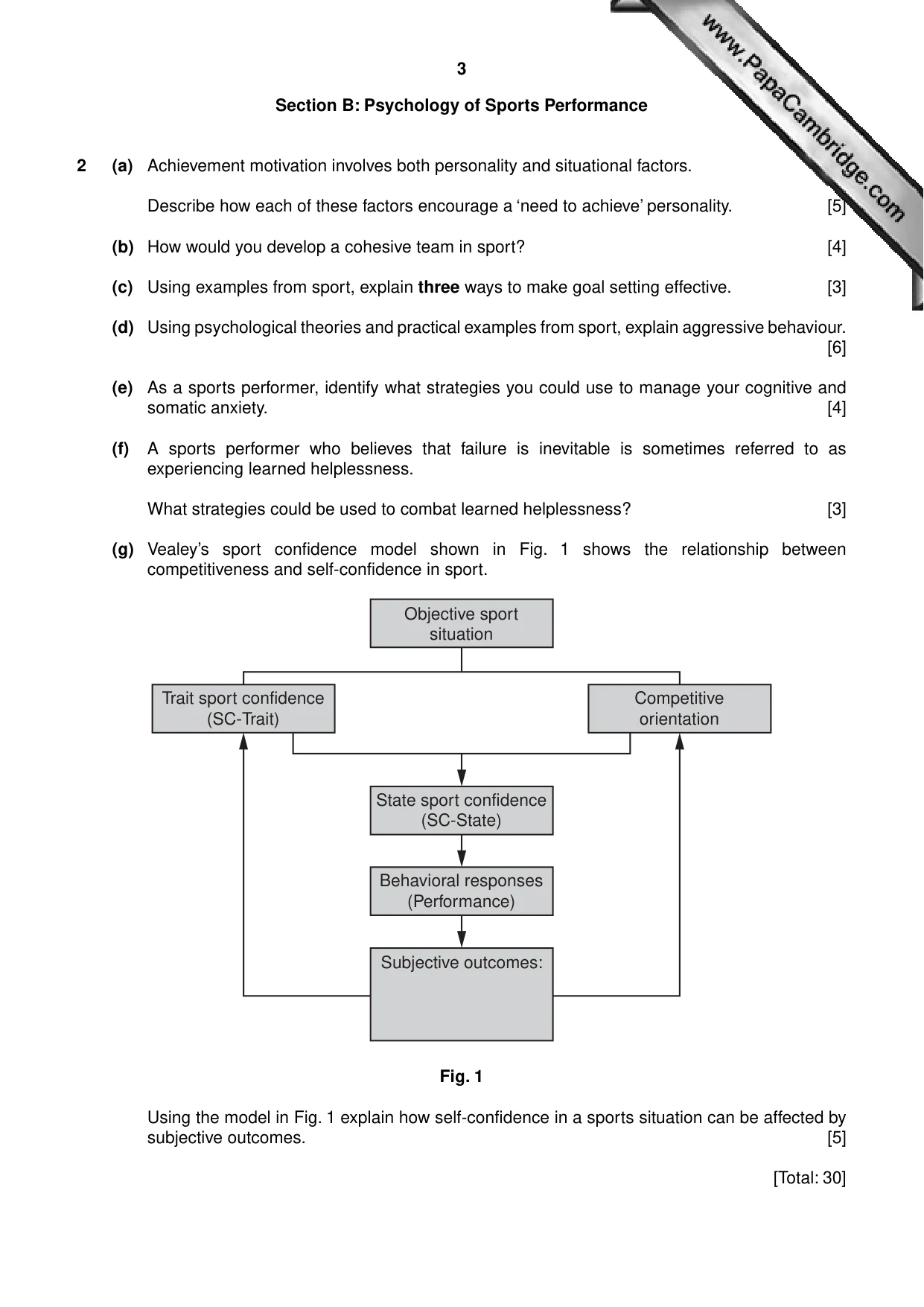
3 9396/31/O/N/10 © UCLES 2010 [Turn over Section B: Psychology of Sports Performance 2 (a) Achievement motivation involves both personality and situational factors. Describe how each of these factors encourage a ‘need to achieve’ personality. [5] (b) How would you develop a cohesive team in sport? [4] (c) Using examples from sport, explain three ways to make goal setting effective. [3] (d) Using psychological theories and practical examples from sport, explain aggressive behaviour. [6] (e) As a sports performer, identify what strategies you could use to manage your cognitive and somatic anxiety. [4] (f) A sports performer who believes that failure is inevitable is sometimes referred to as experiencing learned helplessness. What strategies could be used to combat learned helplessness? [3] (g) Vealey’s sport confidence model shown in Fig. 1 shows the relationship between competitiveness and self-confidence in sport. Objective sport situation State sport confidence (SC-State) Trait sport confidence (SC-Trait) Competitive orientation Behavioral responses (Performance) Subjective outcomes: Fig. 1 Using the model in Fig. 1 explain how self-confidence in a sports situation can be affected by subjective outcomes. [5] [Total: 30]
Question paper, page 4
4 9396/31/O/N/10 © UCLES 2010 Section C: Olympic Games: A Global Perspective 3 (a) The motto of the Beijing Olympics was ‘one dream one world’. Explain how the Olympic Games contribute to a united world. [5] (b) Discuss the reasons why politics play such an important part in the Olympic Games. [7] (c) Describe the changing role of women from the Ancient Olympic Games to the Modern Games. [6] (d) Compare the methods of nurturing talent used by the United States of America and The Peoples Republic of China to ensure that they achieve gold medals in Olympic Games. [8] (e) Outline the sources of funding which the host nation of the Olympic Games may use to ensure that they host a spectacular event. [4] [Total: 30] Permission to reproduce items where third-party owned material protected by copyright is included has been sought and cleared where possible. Every reasonable effort has been made by the publisher (UCLES) to trace copyright holders, but if any items requiring clearance have unwittingly been included, the publisher will be pleased to make amends at the earliest possible opportunity. University of Cambridge International Examinations is part of the Cambridge Assessment Group. Cambridge Assessment is the brand name of University of Cambridge Local Examinations Syndicate (UCLES), which is itself a department of the University of Cambridge.
What you needed in this session
Cambridge’s own grade thresholds for 2010 Oct/Nov, Paper 3 · Variant 1. A higher threshold means an easier paper — the bar moves with how the cohort did.