Cambridge A Level Music 9703 — 2011 Oct/Nov Paper 1 · Variant 1
9703/11/O/N/11 · 100 marks · ≈113 min
The question paper and its mark scheme, free to read here and free to download. This is Cambridge’s own paper, exactly as it was sat.
Question paper2 pages
Mark scheme4 pages
Answers below. Sit the paper first if you are practising.
Paper as text
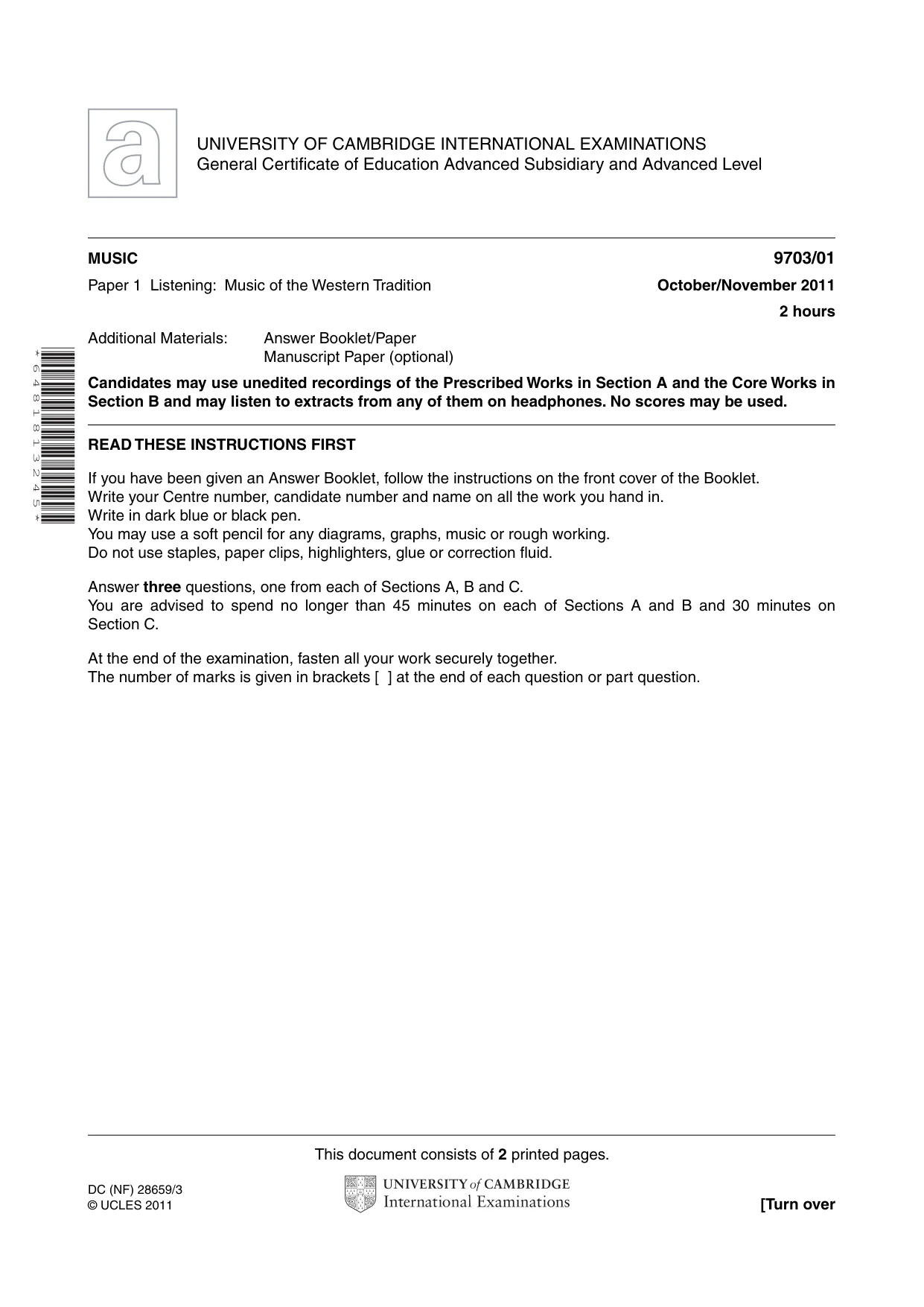
Question paper, page 1
This document consists of 2 printed pages. DC (NF) 28659/3 © UCLES 2011 [Turn over UNIVERSITY OF CAMBRIDGE INTERNATIONAL EXAMINATIONS General Certificate of Education Advanced Subsidiary and Advanced Level * 6 4 8 1 8 1 3 2 4 5 * MUSIC 9703/01 Paper 1 Listening: Music of the Western Tradition October/November 2011 2 hours Additional Materials: Answer Booklet/Paper Manuscript Paper (optional) Candidates may use unedited recordings of the Prescribed Works in Section A and the Core Works in Section B and may listen to extracts from any of them on headphones. No scores may be used. READ THESE INSTRUCTIONS FIRST If you have been given an Answer Booklet, follow the instructions on the front cover of the Booklet. Write your Centre number, candidate number and name on all the work you hand in. Write in dark blue or black pen. You may use a soft pencil for any diagrams, graphs, music or rough working. Do not use staples, paper clips, highlighters, glue or correction fluid. Answer three questions, one from each of Sections A, B and C. You are advised to spend no longer than 45 minutes on each of Sections A and B and 30 minutes on Section C. At the end of the examination, fasten all your work securely together. The number of marks is given in brackets [ ] at the end of each question or part question.
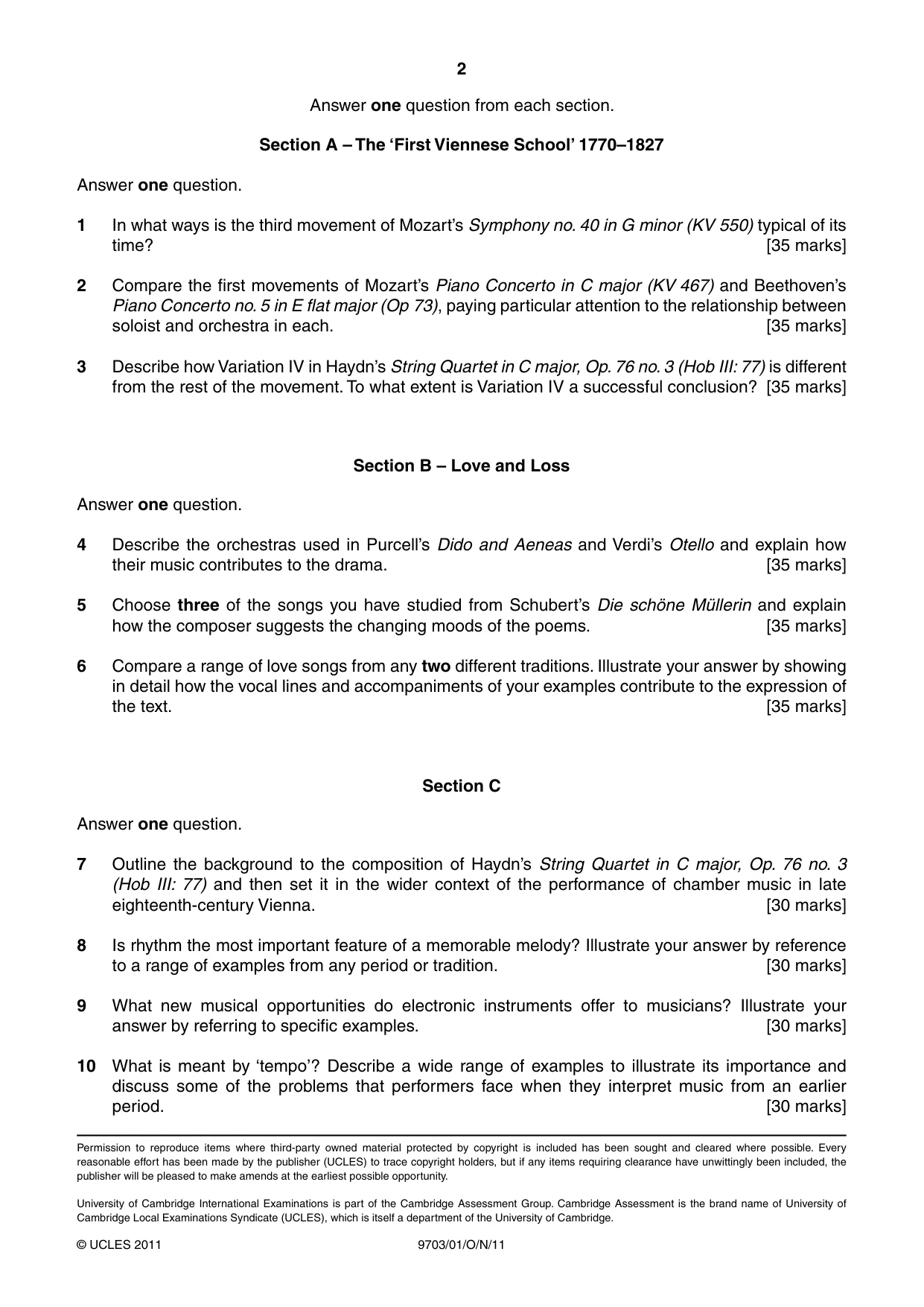
Question paper, page 2
2 9703/01/O/N/11 © UCLES 2011 Permission to reproduce items where third-party owned material protected by copyright is included has been sought and cleared where possible. Every reasonable effort has been made by the publisher (UCLES) to trace copyright holders, but if any items requiring clearance have unwittingly been included, the publisher will be pleased to make amends at the earliest possible opportunity. University of Cambridge International Examinations is part of the Cambridge Assessment Group. Cambridge Assessment is the brand name of University of Cambridge Local Examinations Syndicate (UCLES), which is itself a department of the University of Cambridge. Answer one question from each section. Section A – The ‘First Viennese School’ 1770–1827 Answer one question. 1 In what ways is the third movement of Mozart’s Symphony no. 40 in G minor (KV 550) typical of its time? [35 marks] 2 Compare the first movements of Mozart’s Piano Concerto in C major (KV 467) and Beethoven’s Piano Concerto no. 5 in E flat major (Op 73), paying particular attention to the relationship between soloist and orchestra in each. [35 marks] 3 Describe how Variation IV in Haydn’s String Quartet in C major, Op. 76 no. 3 (Hob III: 77) is different from the rest of the movement. To what extent is Variation IV a successful conclusion? [35 marks] Section B – Love and Loss Answer one question. 4 Describe the orchestras used in Purcell’s Dido and Aeneas and Verdi’s Otello and explain how their music contributes to the drama. [35 marks] 5 Choose three of the songs you have studied from Schubert’s Die schöne Müllerin and explain how the composer suggests the changing moods of the poems. [35 marks] 6 Compare a range of love songs from any two different traditions. Illustrate your answer by showing in detail how the vocal lines and accompaniments of your examples contribute to the expression of the text. [35 marks] Section C Answer one question. 7 Outline the background to the composition of Haydn’s String Quartet in C major, Op. 76 no. 3 (Hob III: 77) and then set it in the wider context of the performance of chamber music in late eighteenth-century Vienna. [30 marks] 8 Is rhythm the most important feature of a memorable melody? Illustrate your answer by reference to a range of examples from any period or tradition. [30 marks] 9 What new musical opportunities do electronic instruments offer to musicians? Illustrate your answer by referring to specific examples. [30 marks] 10 What is meant by ‘tempo’? Describe a wide range of examples to illustrate its importance and discuss some of the problems that performers face when they interpret music from an earlier period. [30 marks]
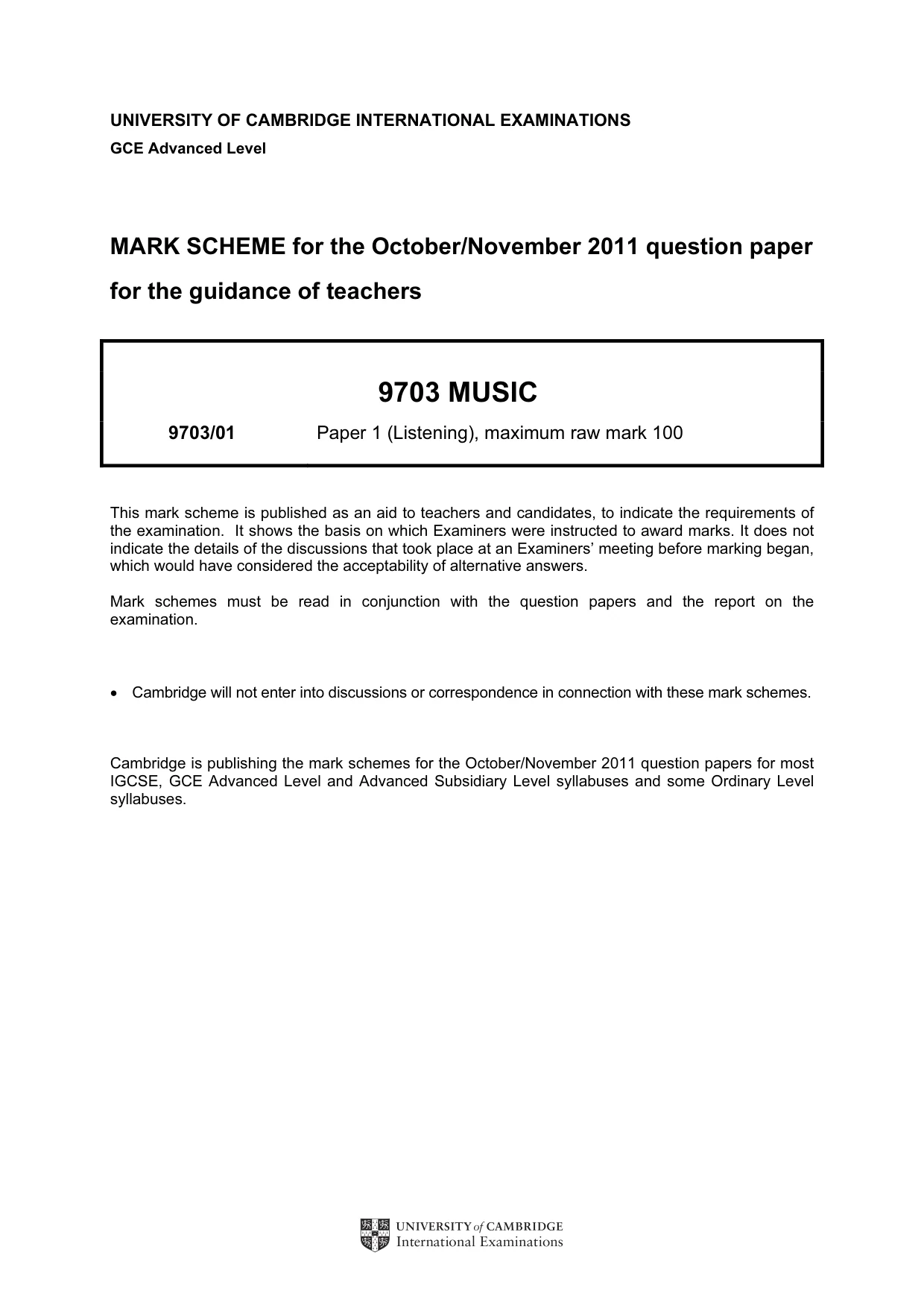
Mark scheme, page 1
UNIVERSITY OF CAMBRIDGE INTERNATIONAL EXAMINATIONS GCE Advanced Level MARK SCHEME for the October/November 2011 question paper for the guidance of teachers 9703 MUSIC 9703/01 Paper 1 (Listening), maximum raw mark 100 This mark scheme is published as an aid to teachers and candidates, to indicate the requirements of the examination. It shows the basis on which Examiners were instructed to award marks. It does not indicate the details of the discussions that took place at an Examiners’ meeting before marking began, which would have considered the acceptability of alternative answers. Mark schemes must be read in conjunction with the question papers and the report on the examination. • Cambridge will not enter into discussions or correspondence in connection with these mark schemes. Cambridge is publishing the mark schemes for the October/November 2011 question papers for most IGCSE, GCE Advanced Level and Advanced Subsidiary Level syllabuses and some Ordinary Level syllabuses.
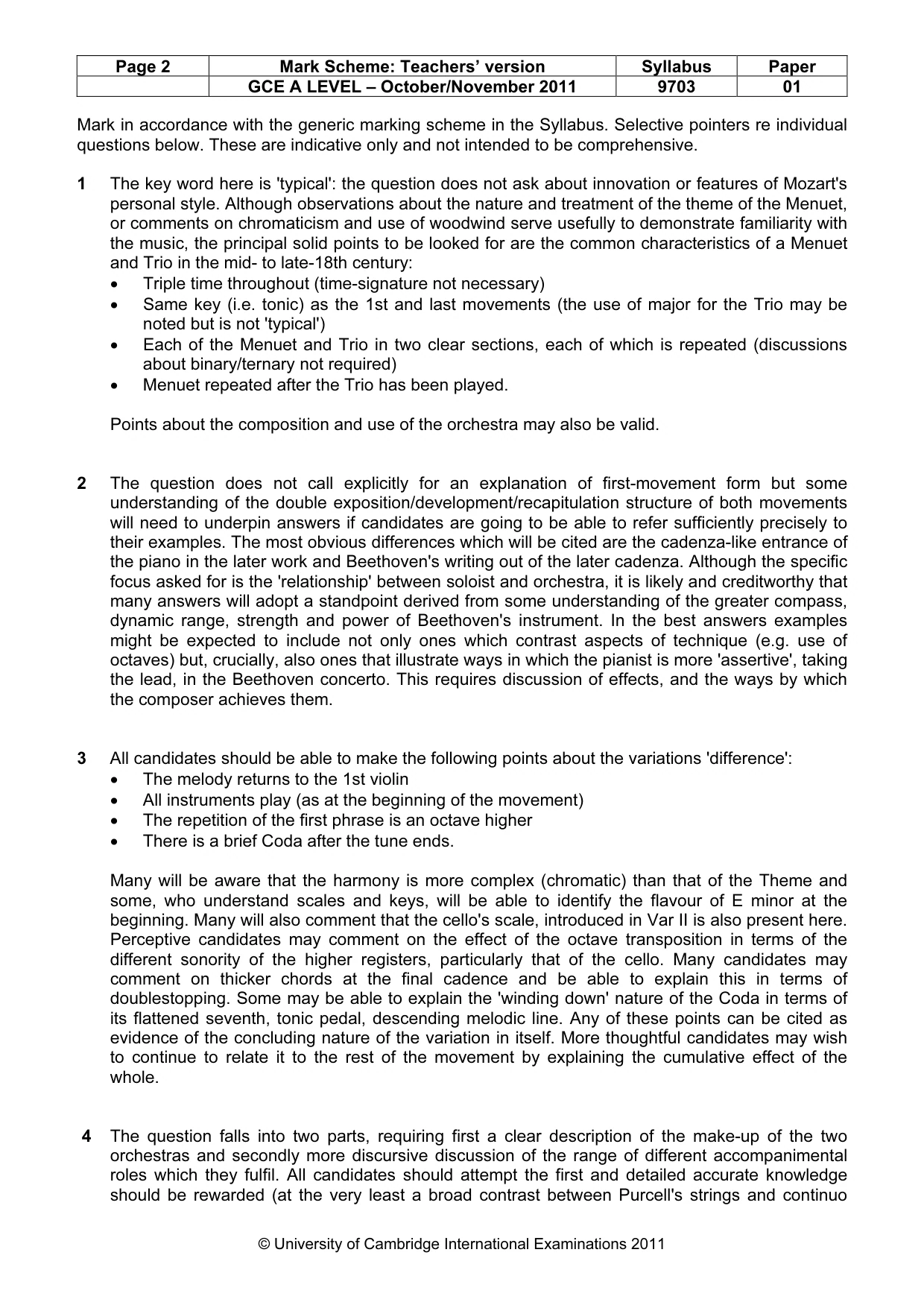
Mark scheme, page 2
Page 2 Mark Scheme: Teachers’ version Syllabus Paper GCE A LEVEL – October/November 2011 9703 01 © University of Cambridge International Examinations 2011 Mark in accordance with the generic marking scheme in the Syllabus. Selective pointers re individual questions below. These are indicative only and not intended to be comprehensive. 1 The key word here is 'typical': the question does not ask about innovation or features of Mozart's personal style. Although observations about the nature and treatment of the theme of the Menuet, or comments on chromaticism and use of woodwind serve usefully to demonstrate familiarity with the music, the principal solid points to be looked for are the common characteristics of a Menuet and Trio in the mid- to late-18th century: • Triple time throughout (time-signature not necessary) • Same key (i.e. tonic) as the 1st and last movements (the use of major for the Trio may be noted but is not 'typical') • Each of the Menuet and Trio in two clear sections, each of which is repeated (discussions about binary/ternary not required) • Menuet repeated after the Trio has been played. Points about the composition and use of the orchestra may also be valid. 2 The question does not call explicitly for an explanation of first-movement form but some understanding of the double exposition/development/recapitulation structure of both movements will need to underpin answers if candidates are going to be able to refer sufficiently precisely to their examples. The most obvious differences which will be cited are the cadenza-like entrance of the piano in the later work and Beethoven's writing out of the later cadenza. Although the specific focus asked for is the 'relationship' between soloist and orchestra, it is likely and creditworthy that many answers will adopt a standpoint derived from some understanding of the greater compass, dynamic range, strength and power of Beethoven's instrument. In the best answers examples might be expected to include not only ones which contrast aspects of technique (e.g. use of octaves) but, crucially, also ones that illustrate ways in which the pianist is more 'assertive', taking the lead, in the Beethoven concerto. This requires discussion of effects, and the ways by which the composer achieves them. 3 All candidates should be able to make the following points about the variations 'difference': • The melody returns to the 1st violin • All instruments play (as at the beginning of the movement) • The repetition of the first phrase is an octave higher • There is a brief Coda after the tune ends. Many will be aware that the harmony is more complex (chromatic) than that of the Theme and some, who understand scales and keys, will be able to identify the flavour of E minor at the beginning. Many will also comment that the cello's scale, introduced in Var II is also present here. Perceptive candidates may comment on the effect of the octave transposition in terms of the different sonority of the higher registers, particularly that of the cello. Many candidates may comment on thicker chords at the final cadence and be able to explain this in terms of doublestopping. Some may be able to explain the 'winding down' nature of the Coda in terms of its flattened seventh, tonic pedal, descending melodic line. Any of these points can be cited as evidence of the concluding nature of the variation in itself. More thoughtful candidates may wish to continue to relate it to the rest of the movement by explaining the cumulative effect of the whole. 4 The question falls into two parts, requiring first a clear description of the make-up of the two orchestras and secondly more discursive discussion of the range of different accompanimental roles which they fulfil. All candidates should attempt the first and detailed accurate knowledge should be rewarded (at the very least a broad contrast between Purcell's strings and continuo
Mark scheme, page 3
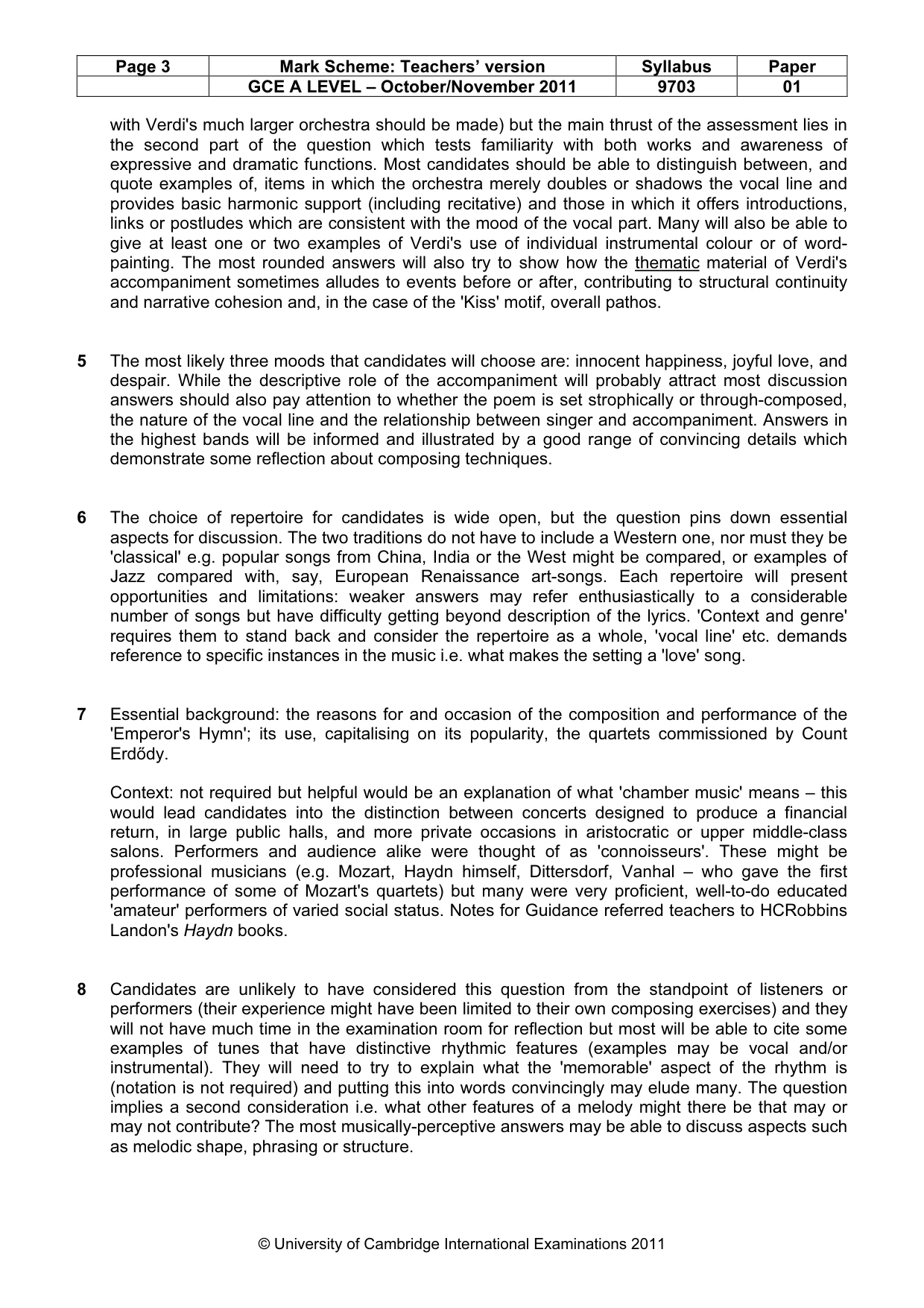
Page 3 Mark Scheme: Teachers’ version Syllabus Paper GCE A LEVEL – October/November 2011 9703 01 © University of Cambridge International Examinations 2011 with Verdi's much larger orchestra should be made) but the main thrust of the assessment lies in the second part of the question which tests familiarity with both works and awareness of expressive and dramatic functions. Most candidates should be able to distinguish between, and quote examples of, items in which the orchestra merely doubles or shadows the vocal line and provides basic harmonic support (including recitative) and those in which it offers introductions, links or postludes which are consistent with the mood of the vocal part. Many will also be able to give at least one or two examples of Verdi's use of individual instrumental colour or of word- painting. The most rounded answers will also try to show how the thematic material of Verdi's accompaniment sometimes alludes to events before or after, contributing to structural continuity and narrative cohesion and, in the case of the 'Kiss' motif, overall pathos. 5 The most likely three moods that candidates will choose are: innocent happiness, joyful love, and despair. While the descriptive role of the accompaniment will probably attract most discussion answers should also pay attention to whether the poem is set strophically or through-composed, the nature of the vocal line and the relationship between singer and accompaniment. Answers in the highest bands will be informed and illustrated by a good range of convincing details which demonstrate some reflection about composing techniques. 6 The choice of repertoire for candidates is wide open, but the question pins down essential aspects for discussion. The two traditions do not have to include a Western one, nor must they be 'classical' e.g. popular songs from China, India or the West might be compared, or examples of Jazz compared with, say, European Renaissance art-songs. Each repertoire will present opportunities and limitations: weaker answers may refer enthusiastically to a considerable number of songs but have difficulty getting beyond description of the lyrics. 'Context and genre' requires them to stand back and consider the repertoire as a whole, 'vocal line' etc. demands reference to specific instances in the music i.e. what makes the setting a 'love' song. 7 Essential background: the reasons for and occasion of the composition and performance of the 'Emperor's Hymn'; its use, capitalising on its popularity, the quartets commissioned by Count Erdődy. Context: not required but helpful would be an explanation of what 'chamber music' means – this would lead candidates into the distinction between concerts designed to produce a financial return, in large public halls, and more private occasions in aristocratic or upper middle-class salons. Performers and audience alike were thought of as 'connoisseurs'. These might be professional musicians (e.g. Mozart, Haydn himself, Dittersdorf, Vanhal – who gave the first performance of some of Mozart's quartets) but many were very proficient, well-to-do educated 'amateur' performers of varied social status. Notes for Guidance referred teachers to HCRobbins Landon's Haydn books. 8 Candidates are unlikely to have considered this question from the standpoint of listeners or performers (their experience might have been limited to their own composing exercises) and they will not have much time in the examination room for reflection but most will be able to cite some examples of tunes that have distinctive rhythmic features (examples may be vocal and/or instrumental). They will need to try to explain what the 'memorable' aspect of the rhythm is (notation is not required) and putting this into words convincingly may elude many. The question implies a second consideration i.e. what other features of a melody might there be that may or may not contribute? The most musically-perceptive answers may be able to discuss aspects such as melodic shape, phrasing or structure.
Mark scheme, page 4
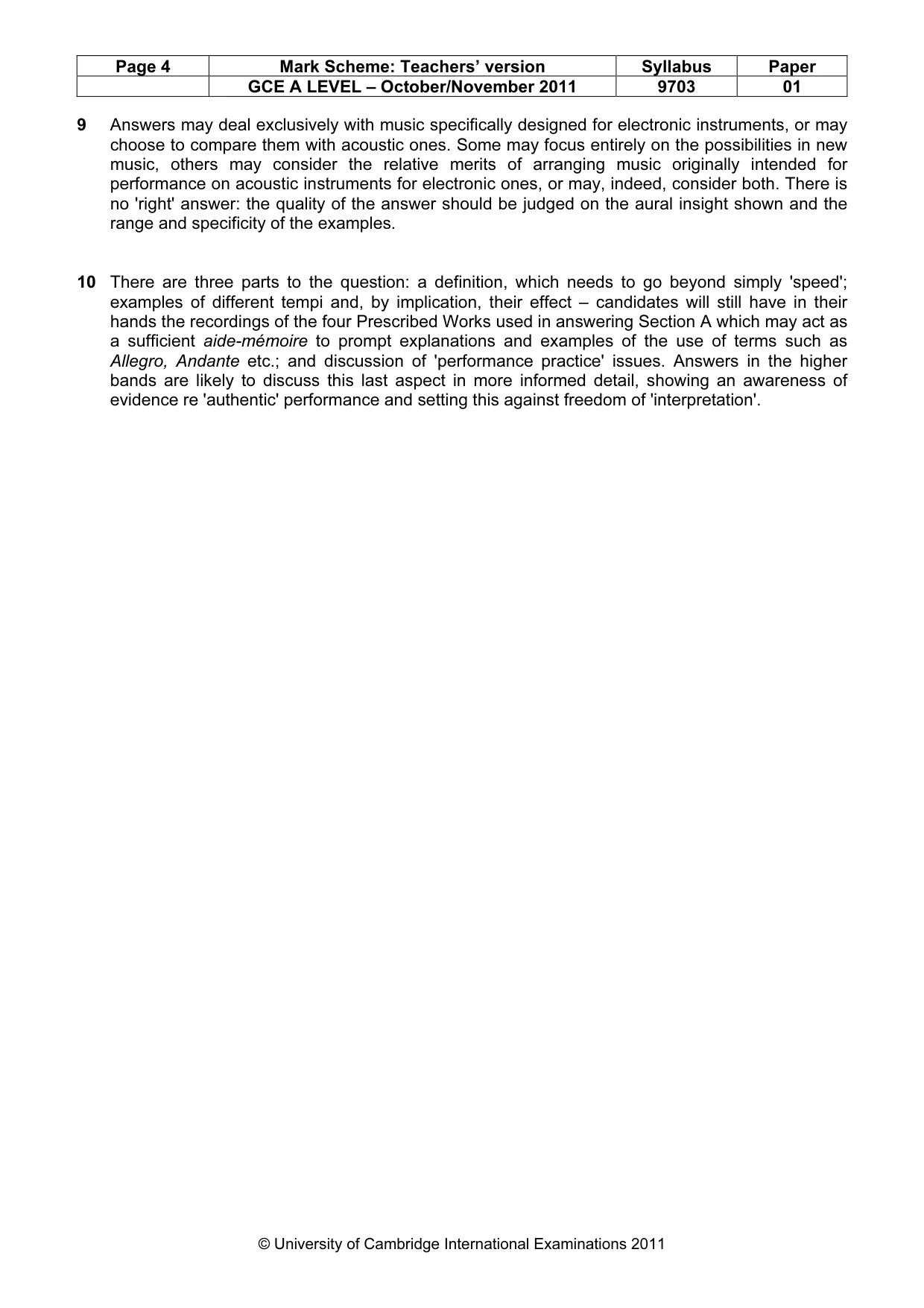
Page 4 Mark Scheme: Teachers’ version Syllabus Paper GCE A LEVEL – October/November 2011 9703 01 © University of Cambridge International Examinations 2011 9 Answers may deal exclusively with music specifically designed for electronic instruments, or may choose to compare them with acoustic ones. Some may focus entirely on the possibilities in new music, others may consider the relative merits of arranging music originally intended for performance on acoustic instruments for electronic ones, or may, indeed, consider both. There is no 'right' answer: the quality of the answer should be judged on the aural insight shown and the range and specificity of the examples. 10 There are three parts to the question: a definition, which needs to go beyond simply 'speed'; examples of different tempi and, by implication, their effect – candidates will still have in their hands the recordings of the four Prescribed Works used in answering Section A which may act as a sufficient aide-mémoire to prompt explanations and examples of the use of terms such as Allegro, Andante etc.; and discussion of 'performance practice' issues. Answers in the higher bands are likely to discuss this last aspect in more informed detail, showing an awareness of evidence re 'authentic' performance and setting this against freedom of 'interpretation'.
What you needed in this session
Cambridge’s own grade thresholds for 2011 Oct/Nov, Paper 1 · Variant 1. A higher threshold means an easier paper — the bar moves with how the cohort did.