Cambridge A Level Music 9703 — 2010 May/June Paper 1 · Variant 1
9703/11/M/J/10 · 100 marks · ≈113 min
The question paper and its mark scheme, free to read here and free to download. This is Cambridge’s own paper, exactly as it was sat.
Question paper2 pages
Mark scheme5 pages
Answers below. Sit the paper first if you are practising.
Paper as text
Question paper, page 1
This document consists of 2 printed pages. DC (SM) 14198/2 © UCLES 2010 [Turn over UNIVERSITY OF CAMBRIDGE INTERNATIONAL EXAMINATIONS General Certificate of Education Advanced Level READ THESE INSTRUCTIONS FIRST If you have been given an Answer Booklet, follow the instructions on the front cover of the Booklet. Write your Centre number, candidate number and name on all the work you hand in. Write in dark blue or black pen. You may use a soft pencil for any diagrams, graphs, music or rough working. Do not use staples, paper clips, highlighters, glue or correction fluid. Answer three questions, one from each of Sections A, B and C. You are advised to spend no longer than 45 minutes on each of Sections A and B and 30 minutes on Section C. At the end of the examination, fasten all your work securely together. The number of marks is given in brackets [ ] at the end of each question or part question. * 1 9 5 0 6 1 0 3 8 3 * MUSIC 9703/01 Paper 1 Listening: Music of the Western Tradition May/June 2010 2 hours Additional Materials: Answer Booklet/Paper Manuscript Paper (optional) Candidates may use unedited recordings of the Prescribed Works in Section A and may listen to extracts from any of them on headphones. No scores may be used.
Question paper, page 2
2 9703/01/M/J/10 © UCLES 2010 Section A – The ‘First Viennese School’ 1770–1828 Answer one question. 1 Explain in detail how Haydn varies the textures of the music in the second movement of his String Quartet in C major, Op 76 No. 3 (Hob. III:77). Refer to each of the variations as well as the theme itself. [35 marks] 2 Compare the slow movement of Mozart’s Piano Concerto in C major (KV 467) with the slow movement from Beethoven’s Piano Concerto no. 5 in E flat major (Op 73). You may discuss any aspect of melody, rhythm, harmony, form, use of instruments, tempo or mood, but do not have to mention them all. [35 marks] 3 What is meant by ‘Recapitulation’? Illustrate your answer by reference to examples from at least two of the Prescribed Works. [35 marks] Section B – Expressions of War and Peace in Twentieth Century Music Answer one question. 4 Discuss some of the ways composers use instruments to suggest images of war. Refer to a range of examples from at least one Core Work and any other music you have studied. [35 marks] 5 How do the different groupings of vocal and instrumental resources contribute to the overall effectiveness of the last movement of Britten’s War Requiem? [35 marks] 6 Refer to a wide range of examples (from any period or tradition) to show how music can be used to support and/or protest against war. [35 marks] Section C Answer one question. 7 What are the principal differences between the pianos for which Mozart and Beethoven composed their concertos and those of today? [30 marks] 8 Explain what improvisation is. In your answer refer to music of more than one period or tradition. [30 marks] 9 What changes have taken place since the eighteenth century in the way that new music is financed and accessed? [30 marks] 10 Discuss the interpretative features that might make one performance of a piece of music sound different from another. [30 marks] Permission to reproduce items where third-party owned material protected by copyright is included has been sought and cleared where possible. Every reasonable effort has been made by the publisher (UCLES) to trace copyright holders, but if any items requiring clearance have unwittingly been included, the publisher will be pleased to make amends at the earliest possible opportunity. University of Cambridge International Examinations is part of the Cambridge Assessment Group. Cambridge Assessment is the brand name of University of Cambridge Local Examinations Syndicate (UCLES), which is itself a department of the University of Cambridge.
Mark scheme, page 1
UNIVERSITY OF CAMBRIDGE INTERNATIONAL EXAMINATIONS GCE Advanced Subsidiary Level and GCE Advanced Level MARK SCHEME for the May/June 2010 question paper for the guidance of teachers 9703 MUSIC 9703/01 Paper 1 (Listening), maximum raw mark 100 This mark scheme is published as an aid to teachers and candidates, to indicate the requirements of the examination. It shows the basis on which Examiners were instructed to award marks. It does not indicate the details of the discussions that took place at an Examiners’ meeting before marking began, which would have considered the acceptability of alternative answers. Mark schemes must be read in conjunction with the question papers and the report on the examination. • CIE will not enter into discussions or correspondence in connection with these mark schemes. CIE is publishing the mark schemes for the May/June 2010 question papers for most IGCSE, GCE Advanced Level and Advanced Subsidiary Level syllabuses and some Ordinary Level syllabuses.
Mark scheme, page 2
Page 2 Mark Scheme: Teachers’ version Syllabus Paper GCE A/AS LEVEL – May/June 2010 9703 01 © UCLES 2010 Section A [35 marks] Mark in accordance with generic marking scheme in Syllabus (p.15 hard copy / p.19 on website). Selective pointers re individual questions below. They are indicative only and not intended to be comprehensive. 1 The answer to this question requires precision. It should be clear at all times which variation (or the theme) is under discussion. Most answers will be able to describe which instrument plays what in terms of theme, bass-line etc but technical language identifying figuration (e.g. arpeggio) is not expected, provided appropriate aural recognition is adequately conveyed. The best answers will probably attempt some relevant comparisons between variations, making significant observations that demonstrate close familiarity with the music and show an ability to reflect on musical effects that goes beyond concrete description. 2 The list of relevant aspects for discussion suggested in the question itself may tempt candidates to present their answers in list form. This is not a barrier to achieving marks in the higher bands: this will depend not only on the number of valid comparisons made but also on the ability shown to communicate an awareness of the different ‘flavours’ of the two movements (this does not imply that stylistic comparisons are expected). In this respect the last of the suggestions (‘tempo or mood’) may well be taken first: most candidates should point out the similarity in that both movements are slow, but the more informed might manage to distinguish between Andante (Mozart) and Adagio (Beethoven) since these markings will have been identified on the CD Track information; and that both movements are mainly quiet and reflective. The use of apt descriptive phrases may help to indicate the level of appreciation, but it must be borne in mind that English is not, for many candidates, their first language and a few more mundane words may serve the purpose equally well. In terms of melodic material, Mozart treats the pianist’s treble line almost like an operatic soprano with a high, sometimes ornamented, lyrical melody, accompanied by chugging chords or bare bass notes, roughly in alternation with the orchestra. The orchestral introduction and closing passages, and the way in which the piano takes centre-stage with further melodies, also has operatic resonances. Beethoven also gives the soloist a highly ornamented melodic line, but too high for a singer (exploiting the full range of the pianos of nearly 25 years later) and with more idiomatic pianistic figurations, with a flowing harmonic accompaniment. The orchestra’s opening bars do not function in the same way as an introduction as the piano only picks up their more hymn-like melody later in the movement, where the principal overall difference between the two movements becomes clear – Beethoven’s is a loose set of variations on one main theme. Most answers should comment on the more open-ended nature of Beethoven’s movement and the role of the bassoon sustained notes and semitone shift as a link to the next movement. Other specific features that candidates might pick out include the wide leaps from treble to bass notes in the Mozart, and the slow, rising crescendo of trills in the Beethoven. Details such as these will confirm the extent of the candidate’s familiarity with the sound of the music.
Mark scheme, page 3
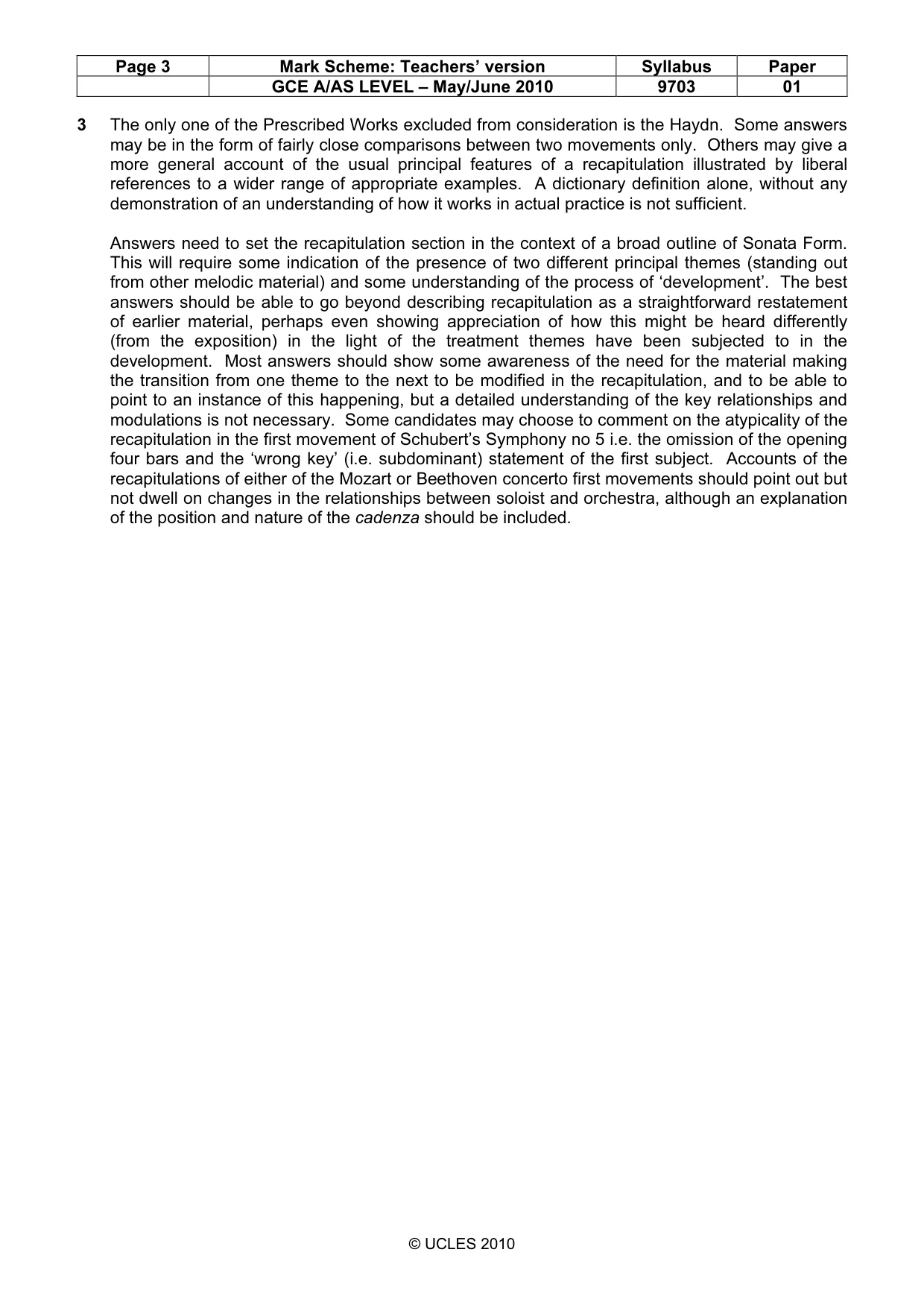
Page 3 Mark Scheme: Teachers’ version Syllabus Paper GCE A/AS LEVEL – May/June 2010 9703 01 © UCLES 2010 3 The only one of the Prescribed Works excluded from consideration is the Haydn. Some answers may be in the form of fairly close comparisons between two movements only. Others may give a more general account of the usual principal features of a recapitulation illustrated by liberal references to a wider range of appropriate examples. A dictionary definition alone, without any demonstration of an understanding of how it works in actual practice is not sufficient. Answers need to set the recapitulation section in the context of a broad outline of Sonata Form. This will require some indication of the presence of two different principal themes (standing out from other melodic material) and some understanding of the process of ‘development’. The best answers should be able to go beyond describing recapitulation as a straightforward restatement of earlier material, perhaps even showing appreciation of how this might be heard differently (from the exposition) in the light of the treatment themes have been subjected to in the development. Most answers should show some awareness of the need for the material making the transition from one theme to the next to be modified in the recapitulation, and to be able to point to an instance of this happening, but a detailed understanding of the key relationships and modulations is not necessary. Some candidates may choose to comment on the atypicality of the recapitulation in the first movement of Schubert’s Symphony no 5 i.e. the omission of the opening four bars and the ‘wrong key’ (i.e. subdominant) statement of the first subject. Accounts of the recapitulations of either of the Mozart or Beethoven concerto first movements should point out but not dwell on changes in the relationships between soloist and orchestra, although an explanation of the position and nature of the cadenza should be included.
Mark scheme, page 4
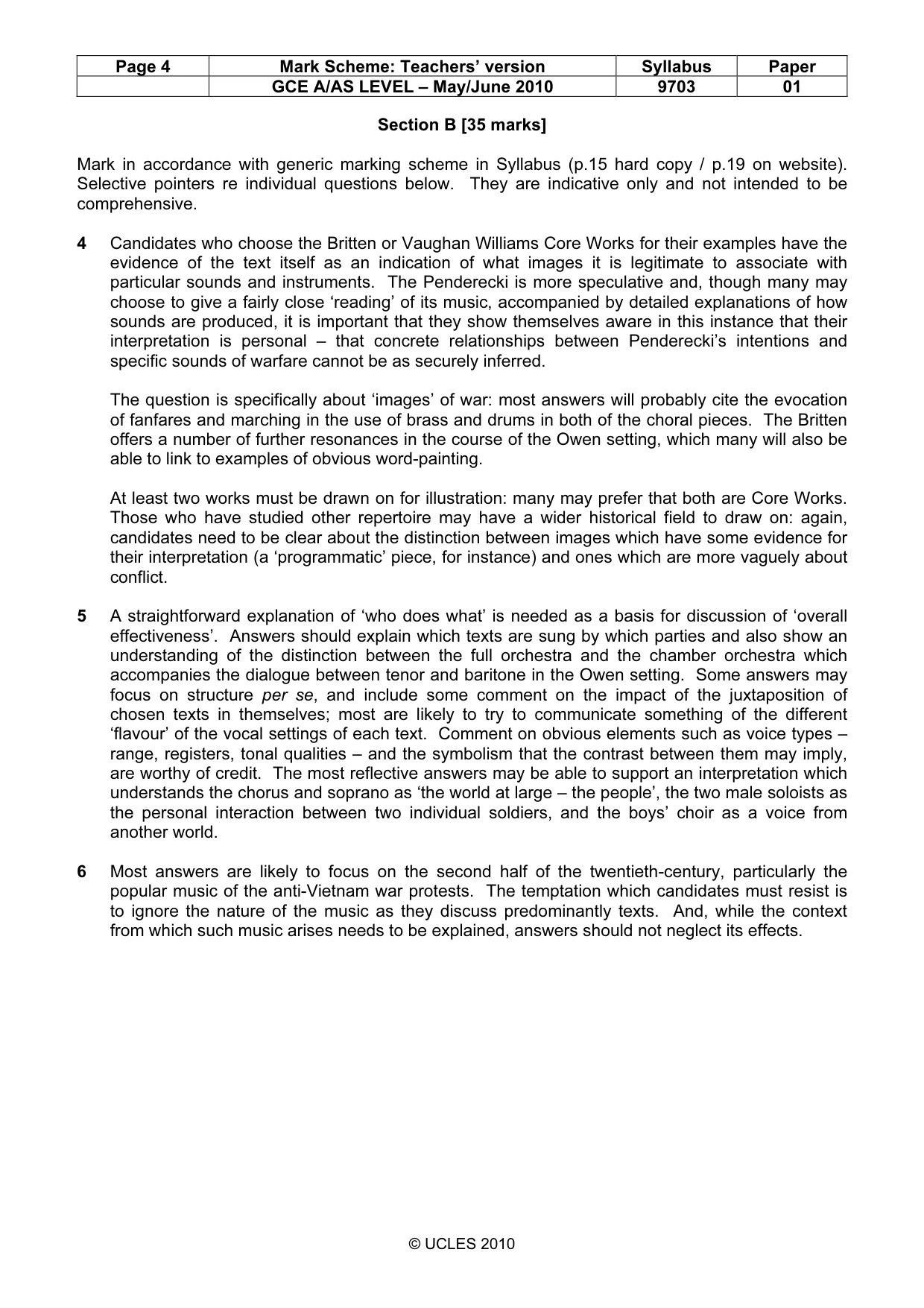
Page 4 Mark Scheme: Teachers’ version Syllabus Paper GCE A/AS LEVEL – May/June 2010 9703 01 © UCLES 2010 Section B [35 marks] Mark in accordance with generic marking scheme in Syllabus (p.15 hard copy / p.19 on website). Selective pointers re individual questions below. They are indicative only and not intended to be comprehensive. 4 Candidates who choose the Britten or Vaughan Williams Core Works for their examples have the evidence of the text itself as an indication of what images it is legitimate to associate with particular sounds and instruments. The Penderecki is more speculative and, though many may choose to give a fairly close ‘reading’ of its music, accompanied by detailed explanations of how sounds are produced, it is important that they show themselves aware in this instance that their interpretation is personal – that concrete relationships between Penderecki’s intentions and specific sounds of warfare cannot be as securely inferred. The question is specifically about ‘images’ of war: most answers will probably cite the evocation of fanfares and marching in the use of brass and drums in both of the choral pieces. The Britten offers a number of further resonances in the course of the Owen setting, which many will also be able to link to examples of obvious word-painting. At least two works must be drawn on for illustration: many may prefer that both are Core Works. Those who have studied other repertoire may have a wider historical field to draw on: again, candidates need to be clear about the distinction between images which have some evidence for their interpretation (a ‘programmatic’ piece, for instance) and ones which are more vaguely about conflict. 5 A straightforward explanation of ‘who does what’ is needed as a basis for discussion of ‘overall effectiveness’. Answers should explain which texts are sung by which parties and also show an understanding of the distinction between the full orchestra and the chamber orchestra which accompanies the dialogue between tenor and baritone in the Owen setting. Some answers may focus on structure per se, and include some comment on the impact of the juxtaposition of chosen texts in themselves; most are likely to try to communicate something of the different ‘flavour’ of the vocal settings of each text. Comment on obvious elements such as voice types – range, registers, tonal qualities – and the symbolism that the contrast between them may imply, are worthy of credit. The most reflective answers may be able to support an interpretation which understands the chorus and soprano as ‘the world at large – the people’, the two male soloists as the personal interaction between two individual soldiers, and the boys’ choir as a voice from another world. 6 Most answers are likely to focus on the second half of the twentieth-century, particularly the popular music of the anti-Vietnam war protests. The temptation which candidates must resist is to ignore the nature of the music as they discuss predominantly texts. And, while the context from which such music arises needs to be explained, answers should not neglect its effects.
Mark scheme, page 5
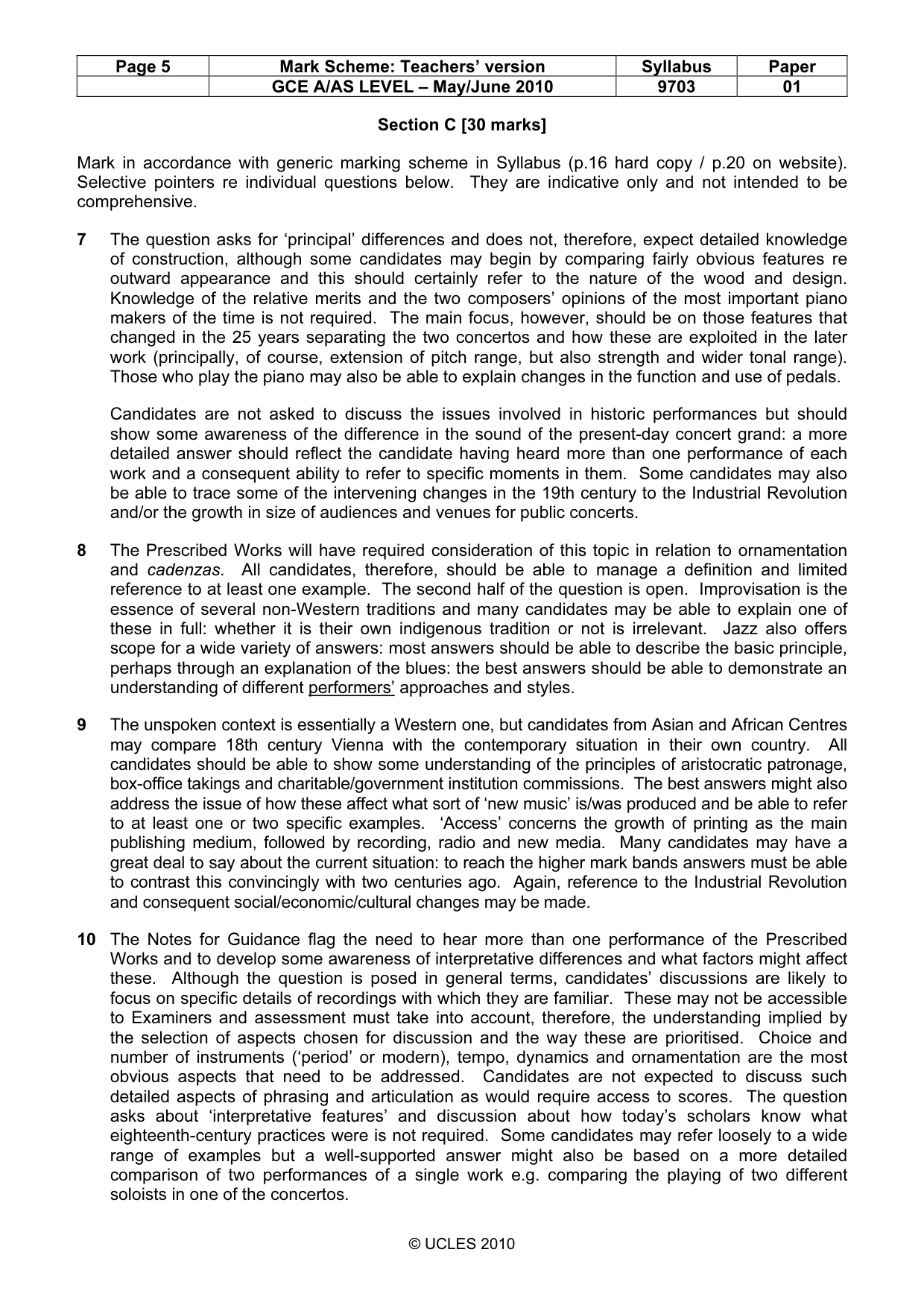
Page 5 Mark Scheme: Teachers’ version Syllabus Paper GCE A/AS LEVEL – May/June 2010 9703 01 © UCLES 2010 Section C [30 marks] Mark in accordance with generic marking scheme in Syllabus (p.16 hard copy / p.20 on website). Selective pointers re individual questions below. They are indicative only and not intended to be comprehensive. 7 The question asks for ‘principal’ differences and does not, therefore, expect detailed knowledge of construction, although some candidates may begin by comparing fairly obvious features re outward appearance and this should certainly refer to the nature of the wood and design. Knowledge of the relative merits and the two composers’ opinions of the most important piano makers of the time is not required. The main focus, however, should be on those features that changed in the 25 years separating the two concertos and how these are exploited in the later work (principally, of course, extension of pitch range, but also strength and wider tonal range). Those who play the piano may also be able to explain changes in the function and use of pedals. Candidates are not asked to discuss the issues involved in historic performances but should show some awareness of the difference in the sound of the present-day concert grand: a more detailed answer should reflect the candidate having heard more than one performance of each work and a consequent ability to refer to specific moments in them. Some candidates may also be able to trace some of the intervening changes in the 19th century to the Industrial Revolution and/or the growth in size of audiences and venues for public concerts. 8 The Prescribed Works will have required consideration of this topic in relation to ornamentation and cadenzas. All candidates, therefore, should be able to manage a definition and limited reference to at least one example. The second half of the question is open. Improvisation is the essence of several non-Western traditions and many candidates may be able to explain one of these in full: whether it is their own indigenous tradition or not is irrelevant. Jazz also offers scope for a wide variety of answers: most answers should be able to describe the basic principle, perhaps through an explanation of the blues: the best answers should be able to demonstrate an understanding of different performers’ approaches and styles. 9 The unspoken context is essentially a Western one, but candidates from Asian and African Centres may compare 18th century Vienna with the contemporary situation in their own country. All candidates should be able to show some understanding of the principles of aristocratic patronage, box-office takings and charitable/government institution commissions. The best answers might also address the issue of how these affect what sort of ‘new music’ is/was produced and be able to refer to at least one or two specific examples. ‘Access’ concerns the growth of printing as the main publishing medium, followed by recording, radio and new media. Many candidates may have a great deal to say about the current situation: to reach the higher mark bands answers must be able to contrast this convincingly with two centuries ago. Again, reference to the Industrial Revolution and consequent social/economic/cultural changes may be made. 10 The Notes for Guidance flag the need to hear more than one performance of the Prescribed Works and to develop some awareness of interpretative differences and what factors might affect these. Although the question is posed in general terms, candidates’ discussions are likely to focus on specific details of recordings with which they are familiar. These may not be accessible to Examiners and assessment must take into account, therefore, the understanding implied by the selection of aspects chosen for discussion and the way these are prioritised. Choice and number of instruments (‘period’ or modern), tempo, dynamics and ornamentation are the most obvious aspects that need to be addressed. Candidates are not expected to discuss such detailed aspects of phrasing and articulation as would require access to scores. The question asks about ‘interpretative features’ and discussion about how today’s scholars know what eighteenth-century practices were is not required. Some candidates may refer loosely to a wide range of examples but a well-supported answer might also be based on a more detailed comparison of two performances of a single work e.g. comparing the playing of two different soloists in one of the concertos.
What you needed in this session
Cambridge’s own grade thresholds for 2010 May/June, Paper 1 · Variant 1. A higher threshold means an easier paper — the bar moves with how the cohort did.