Cambridge A Level Music 9703 — 2009 May/June Paper 1 · Variant 1
9703/11/M/J/09 · 100 marks · ≈113 min
The question paper and its mark scheme, free to read here and free to download. This is Cambridge’s own paper, exactly as it was sat.
Question paper2 pages
Mark scheme6 pages
Answers below. Sit the paper first if you are practising.
Paper as text
Question paper, page 1
This document consists of 2 printed pages. SP SJF4973 T74001/2 © UCLES 2009 [Turn over UNIVERSITY OF CAMBRIDGE INTERNATIONAL EXAMINATIONS General Certificate of Education Advanced Subsidiary Level and Advanced Level READ THESE INSTRUCTIONS FIRST If you have been given an Answer Booklet, follow the instructions on the front cover of the Booklet. Write your Centre number, candidate number and name on all the work you hand in. Write in dark blue or black pen. You may use a soft pencil for any diagrams, graphs, music or rough working. Do not use staples, paper clips, highlighters, glue or correction fluid. Answer three questions, one from each of Sections A, B and C. You are advised to spend no longer than 45 minutes on each of Sections A and B and 30 minutes on Section C. At the end of the examination, fasten all your work securely together. The number of marks is given in brackets [ ] at the end of each question or part question. * 5 4 1 9 5 1 4 8 3 1 * MUSIC 8663/01 9703/01 Paper 1 Listening: Music of the Western Tradition May/June 2009 2 hours Additional Materials: Answer Booklet/Paper Manuscript Paper (optional) Candidates may use unedited recordings of the Prescribed Works in Section A and may listen to extracts from any of them on headphones. No scores may be used.
Question paper, page 2
2 9703/01/M/J/09 © UCLES 2009 Section A – The ‘First Viennese School’ 1770–1828 Answer one question. 1 Choose one of the three movements in Mozart’s Piano Concerto in C major (KV 467) and compare it in detail with the equivalent movement in Beethoven’s Piano Concerto no 5 in E flat major (Op 73). You should refer to matters such as form, the relationship between soloist and orchestra and the way the composers use the piano. [35 marks] 2 Show how Schubert makes use of Sonata Form in the first movement of his Symphony no. 5. [35 marks] 3 Compare the final variation in the second movement of Haydn’s String Quartet in C major (Op 76 No. 3) with the opening statement of the Theme. [35 marks] Section B – Picturing Music Answer one question. 4 Explain how Vivaldi’s music illustrates the poems of each of the second movements of the concertos you have studied (Summer and Winter ). [35 marks] 5 Compare the orchestras used by Holst and Ravel (in The Planets and Pictures at an Exhibition) and describe a range of examples to show how effectively you think they use their orchestras to suggest moods, people, pictures or ideas. [35 marks] 6 Give a full account of any work that is related to an extra-musical idea, explaining the programme, image or idea, and showing how it is expressed in the music. You may choose music from any tradition but it should not be by any of the composers of the Core Works. [35 marks] Section C Answer one question. 7 Give a brief account of musical life in Vienna between approximately 1785 and 1820 and show what roles at least two of Haydn, Mozart, Beethoven and Schubert played in it. [30 marks] 8 How far should future generations of performers respect the intentions of the original composer of a piece of music? Support your answer by referring to specific examples. [30 marks] 9 What is the difference between a ‘classical’ tradition and a ‘folk’ tradition? Refer to the music of more than one country or region in your answer. [30 marks] 10 How important are repetition and contrast in holding the listener’s attention? Refer in detail to a range of examples to support your answer. [30 marks] Permission to reproduce items where third-party owned material protected by copyright is included has been sought and cleared where possible. Every reasonable effort has been made by the publisher (UCLES) to trace copyright holders, but if any items requiring clearance have unwittingly been included, the publisher will be pleased to make amends at the earliest possible opportunity. University of Cambridge International Examinations is part of the Cambridge Assessment Group. Cambridge Assessment is the brand name of University of Cambridge Local Examinations Syndicate (UCLES), which is itself a department of the University of Cambridge.
Mark scheme, page 1
UNIVERSITY OF CAMBRIDGE INTERNATIONAL EXAMINATIONS GCE Advanced Subsidiary Level and GCE Advanced Level MARK SCHEME for the May/June 2009 question paper for the guidance of teachers 8663 and 9703 MUSIC 8663/01 and 9703/01 Paper 1 (Listening), maximum raw mark 100 This mark scheme is published as an aid to teachers and candidates, to indicate the requirements of the examination. It shows the basis on which Examiners were instructed to award marks. It does not indicate the details of the discussions that took place at an Examiners’ meeting before marking began, which would have considered the acceptability of alternative answers. Mark schemes must be read in conjunction with the question papers and the report on the examination. • CIE will not enter into discussions or correspondence in connection with these mark schemes. CIE is publishing the mark schemes for the May/June 2009 question papers for most IGCSE, GCE Advanced Level and Advanced Subsidiary Level syllabuses and some Ordinary Level syllabuses.
Mark scheme, page 2
Page 2 Mark Scheme: Teachers’ version Syllabus Paper GCE A/AS LEVEL – May/June 2009 8663, 9703 01 © UCLES 2009 1 The relative weight of any of the relevant aspects will depend on which movements are chosen for comparison. All answers should address basic similarities of structure: 1st Movements: both use the conventional amalgam of sonata and ritornello form with distinct orchestral and solo expositions; Mozart reserves the entry of the 2nd subject for the piano, and Beethoven allows his piano a dominating prelude before the exposition proper gets under way. Both soloists introduce additional new material. Development and Recapitulation as normal: Mozart expects the soloist to improvise a cadenza, Beethoven forbids this and inserts his own structurally-important one. 2nd Movements: Mozart’s is in a tightly-structured but slightly unorthodox form (an opening orchestra ritornello repeated by piano followed by episodes each concluded by fragments of ritornello material, with a full return to the ritornello beginning in a remote key – A flat major but candidates are not required to know this); Beethoven’s is a loose set of variations on a theme stated by the orchestra with diversions before a hushed link into the last movement. 3rd Movements: both Rondos with elements of Sonata Form (tonic-dominant relationships and developmental passages in the middle). Mozart creates another opportunity for a cadenza but Beethoven writes instead a dialogue with timpani before a great rush to the end. Most answers will probably refer to a difference in the relative balance between piano and orchestra; at its most basic this may be discussed in terms of ‘light’ and ‘heavy’ or degrees of loudness. More informed answers may know something about the development of the piano in the 24 years which separate the two concertos and be able to point to examples of where Beethoven uses its greater compass and power. The most perceptive will be able to demonstrate how Beethoven’s piano is treated less in dialogue with the orchestra but rather in contest with it. ‘Who does what, when’ is relevant here. Aspects that ‘interest’ candidates may be mood (perhaps the slow movement of Mozart’s concerto in particular, which might prompt some evocative writing), instrumentation or virtuosity – there is plenty of ‘brilliance’ in the 1st movement of the Mozart. The features which candidates choose should be rewarded in proportion to their relevance to the comparison and to the specificity with which they are discussed. The above points exclude references to tonality, although this is widely understood to be crucial to discussion of the Beethoven Concerto. Some candidates may know that Mozart’s slow movement is in a conventional key (the subdominant) and Beethoven’s in his favourite flat submediant (B major enharmonically C flat): but lack of specific reference to keys is not a bar to accessing the higher mark bands. However, candidates who choose e.g. the entry of the horns at the end of the cadenza as one of their ‘interesting’ moments, should be able to distinguish between minor and major.
Mark scheme, page 3
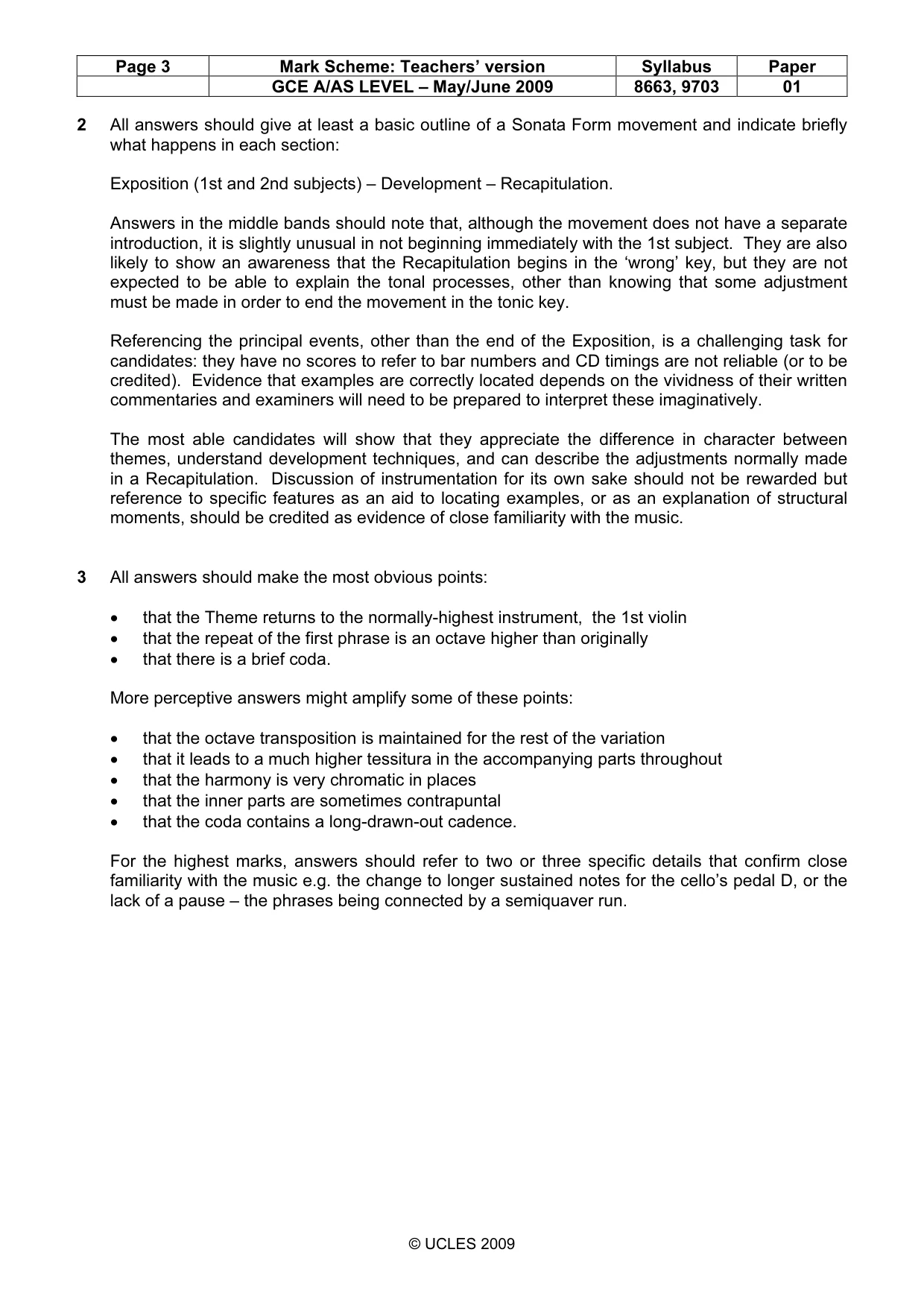
Page 3 Mark Scheme: Teachers’ version Syllabus Paper GCE A/AS LEVEL – May/June 2009 8663, 9703 01 © UCLES 2009 2 All answers should give at least a basic outline of a Sonata Form movement and indicate briefly what happens in each section: Exposition (1st and 2nd subjects) – Development – Recapitulation. Answers in the middle bands should note that, although the movement does not have a separate introduction, it is slightly unusual in not beginning immediately with the 1st subject. They are also likely to show an awareness that the Recapitulation begins in the ‘wrong’ key, but they are not expected to be able to explain the tonal processes, other than knowing that some adjustment must be made in order to end the movement in the tonic key. Referencing the principal events, other than the end of the Exposition, is a challenging task for candidates: they have no scores to refer to bar numbers and CD timings are not reliable (or to be credited). Evidence that examples are correctly located depends on the vividness of their written commentaries and examiners will need to be prepared to interpret these imaginatively. The most able candidates will show that they appreciate the difference in character between themes, understand development techniques, and can describe the adjustments normally made in a Recapitulation. Discussion of instrumentation for its own sake should not be rewarded but reference to specific features as an aid to locating examples, or as an explanation of structural moments, should be credited as evidence of close familiarity with the music. 3 All answers should make the most obvious points: • that the Theme returns to the normally-highest instrument, the 1st violin • that the repeat of the first phrase is an octave higher than originally • that there is a brief coda. More perceptive answers might amplify some of these points: • that the octave transposition is maintained for the rest of the variation • that it leads to a much higher tessitura in the accompanying parts throughout • that the harmony is very chromatic in places • that the inner parts are sometimes contrapuntal • that the coda contains a long-drawn-out cadence. For the highest marks, answers should refer to two or three specific details that confirm close familiarity with the music e.g. the change to longer sustained notes for the cello’s pedal D, or the lack of a pause – the phrases being connected by a semiquaver run.
Mark scheme, page 4
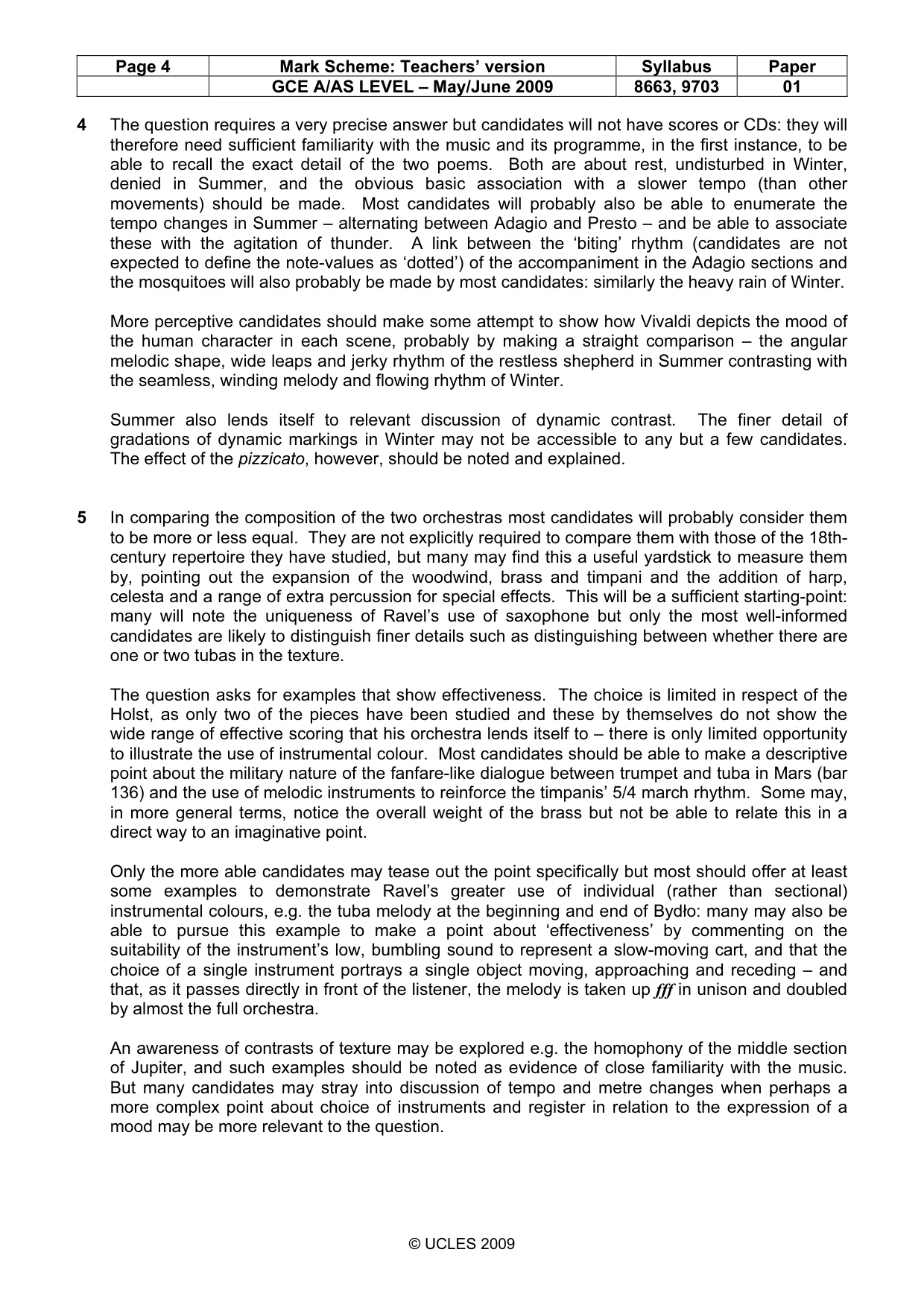
Page 4 Mark Scheme: Teachers’ version Syllabus Paper GCE A/AS LEVEL – May/June 2009 8663, 9703 01 © UCLES 2009 4 The question requires a very precise answer but candidates will not have scores or CDs: they will therefore need sufficient familiarity with the music and its programme, in the first instance, to be able to recall the exact detail of the two poems. Both are about rest, undisturbed in Winter, denied in Summer, and the obvious basic association with a slower tempo (than other movements) should be made. Most candidates will probably also be able to enumerate the tempo changes in Summer – alternating between Adagio and Presto – and be able to associate these with the agitation of thunder. A link between the ‘biting’ rhythm (candidates are not expected to define the note-values as ‘dotted’) of the accompaniment in the Adagio sections and the mosquitoes will also probably be made by most candidates: similarly the heavy rain of Winter. More perceptive candidates should make some attempt to show how Vivaldi depicts the mood of the human character in each scene, probably by making a straight comparison – the angular melodic shape, wide leaps and jerky rhythm of the restless shepherd in Summer contrasting with the seamless, winding melody and flowing rhythm of Winter. Summer also lends itself to relevant discussion of dynamic contrast. The finer detail of gradations of dynamic markings in Winter may not be accessible to any but a few candidates. The effect of the pizzicato, however, should be noted and explained. 5 In comparing the composition of the two orchestras most candidates will probably consider them to be more or less equal. They are not explicitly required to compare them with those of the 18th- century repertoire they have studied, but many may find this a useful yardstick to measure them by, pointing out the expansion of the woodwind, brass and timpani and the addition of harp, celesta and a range of extra percussion for special effects. This will be a sufficient starting-point: many will note the uniqueness of Ravel’s use of saxophone but only the most well-informed candidates are likely to distinguish finer details such as distinguishing between whether there are one or two tubas in the texture. The question asks for examples that show effectiveness. The choice is limited in respect of the Holst, as only two of the pieces have been studied and these by themselves do not show the wide range of effective scoring that his orchestra lends itself to – there is only limited opportunity to illustrate the use of instrumental colour. Most candidates should be able to make a descriptive point about the military nature of the fanfare-like dialogue between trumpet and tuba in Mars (bar 136) and the use of melodic instruments to reinforce the timpanis’ 5/4 march rhythm. Some may, in more general terms, notice the overall weight of the brass but not be able to relate this in a direct way to an imaginative point. Only the more able candidates may tease out the point specifically but most should offer at least some examples to demonstrate Ravel’s greater use of individual (rather than sectional) instrumental colours, e.g. the tuba melody at the beginning and end of Bydło: many may also be able to pursue this example to make a point about ‘effectiveness’ by commenting on the suitability of the instrument’s low, bumbling sound to represent a slow-moving cart, and that the choice of a single instrument portrays a single object moving, approaching and receding – and that, as it passes directly in front of the listener, the melody is taken up fff in unison and doubled by almost the full orchestra. An awareness of contrasts of texture may be explored e.g. the homophony of the middle section of Jupiter, and such examples should be noted as evidence of close familiarity with the music. But many candidates may stray into discussion of tempo and metre changes when perhaps a more complex point about choice of instruments and register in relation to the expression of a mood may be more relevant to the question.
Mark scheme, page 5
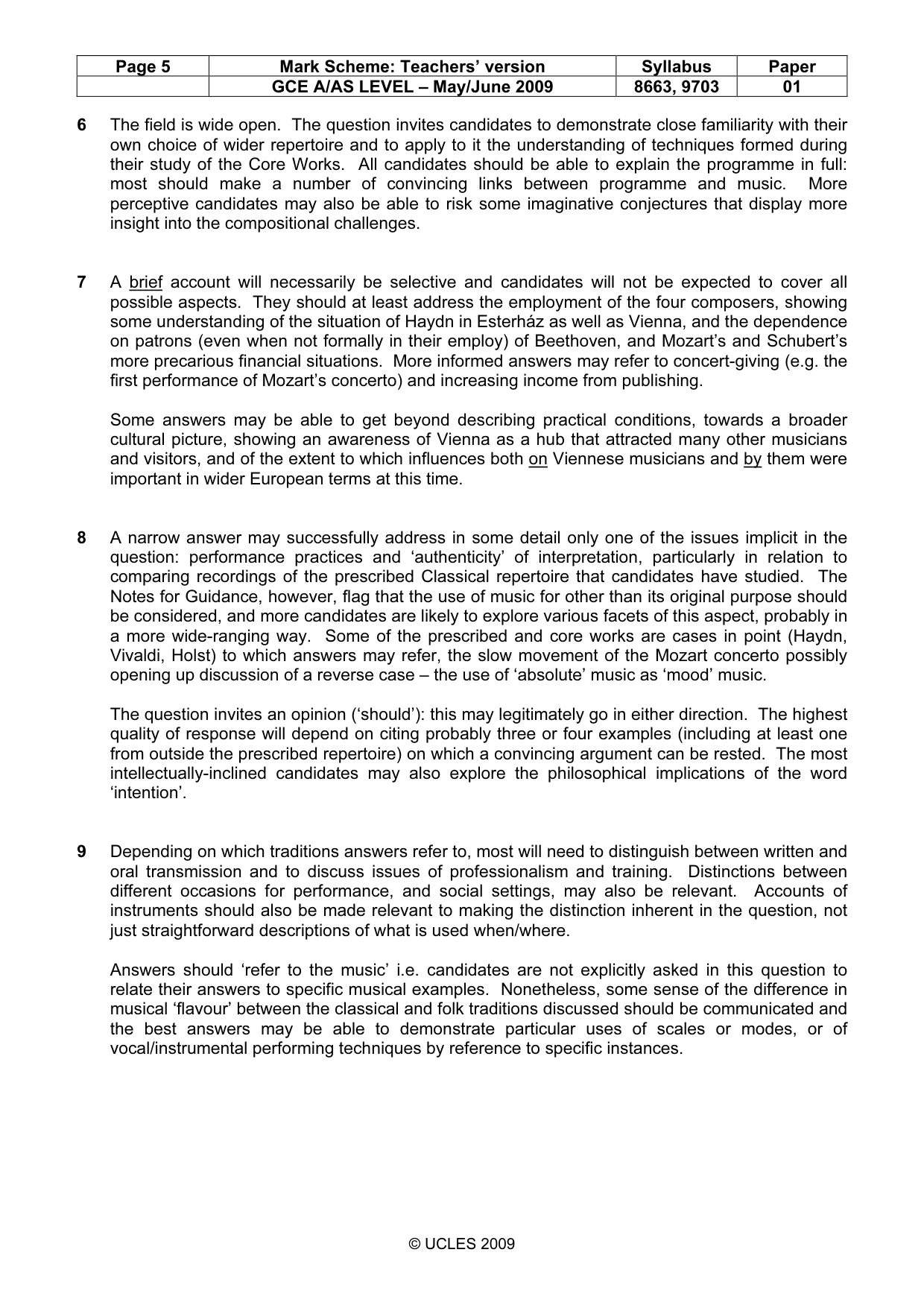
Page 5 Mark Scheme: Teachers’ version Syllabus Paper GCE A/AS LEVEL – May/June 2009 8663, 9703 01 © UCLES 2009 6 The field is wide open. The question invites candidates to demonstrate close familiarity with their own choice of wider repertoire and to apply to it the understanding of techniques formed during their study of the Core Works. All candidates should be able to explain the programme in full: most should make a number of convincing links between programme and music. More perceptive candidates may also be able to risk some imaginative conjectures that display more insight into the compositional challenges. 7 A brief account will necessarily be selective and candidates will not be expected to cover all possible aspects. They should at least address the employment of the four composers, showing some understanding of the situation of Haydn in Esterház as well as Vienna, and the dependence on patrons (even when not formally in their employ) of Beethoven, and Mozart’s and Schubert’s more precarious financial situations. More informed answers may refer to concert-giving (e.g. the first performance of Mozart’s concerto) and increasing income from publishing. Some answers may be able to get beyond describing practical conditions, towards a broader cultural picture, showing an awareness of Vienna as a hub that attracted many other musicians and visitors, and of the extent to which influences both on Viennese musicians and by them were important in wider European terms at this time. 8 A narrow answer may successfully address in some detail only one of the issues implicit in the question: performance practices and ‘authenticity’ of interpretation, particularly in relation to comparing recordings of the prescribed Classical repertoire that candidates have studied. The Notes for Guidance, however, flag that the use of music for other than its original purpose should be considered, and more candidates are likely to explore various facets of this aspect, probably in a more wide-ranging way. Some of the prescribed and core works are cases in point (Haydn, Vivaldi, Holst) to which answers may refer, the slow movement of the Mozart concerto possibly opening up discussion of a reverse case – the use of ‘absolute’ music as ‘mood’ music. The question invites an opinion (‘should’): this may legitimately go in either direction. The highest quality of response will depend on citing probably three or four examples (including at least one from outside the prescribed repertoire) on which a convincing argument can be rested. The most intellectually-inclined candidates may also explore the philosophical implications of the word ‘intention’. 9 Depending on which traditions answers refer to, most will need to distinguish between written and oral transmission and to discuss issues of professionalism and training. Distinctions between different occasions for performance, and social settings, may also be relevant. Accounts of instruments should also be made relevant to making the distinction inherent in the question, not just straightforward descriptions of what is used when/where. Answers should ‘refer to the music’ i.e. candidates are not explicitly asked in this question to relate their answers to specific musical examples. Nonetheless, some sense of the difference in musical ‘flavour’ between the classical and folk traditions discussed should be communicated and the best answers may be able to demonstrate particular uses of scales or modes, or of vocal/instrumental performing techniques by reference to specific instances.
Mark scheme, page 6
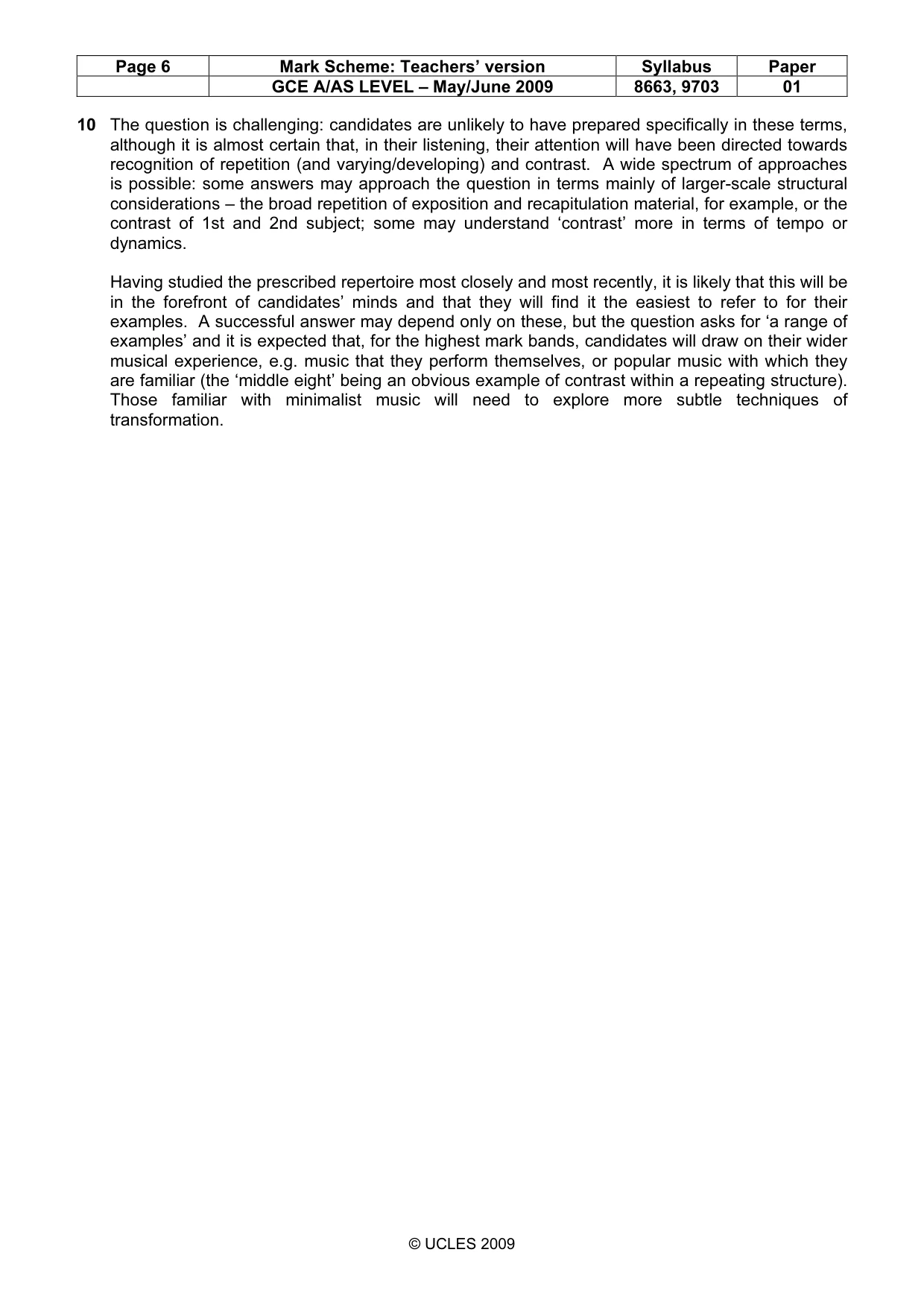
Page 6 Mark Scheme: Teachers’ version Syllabus Paper GCE A/AS LEVEL – May/June 2009 8663, 9703 01 © UCLES 2009 10 The question is challenging: candidates are unlikely to have prepared specifically in these terms, although it is almost certain that, in their listening, their attention will have been directed towards recognition of repetition (and varying/developing) and contrast. A wide spectrum of approaches is possible: some answers may approach the question in terms mainly of larger-scale structural considerations – the broad repetition of exposition and recapitulation material, for example, or the contrast of 1st and 2nd subject; some may understand ‘contrast’ more in terms of tempo or dynamics. Having studied the prescribed repertoire most closely and most recently, it is likely that this will be in the forefront of candidates’ minds and that they will find it the easiest to refer to for their examples. A successful answer may depend only on these, but the question asks for ‘a range of examples’ and it is expected that, for the highest mark bands, candidates will draw on their wider musical experience, e.g. music that they perform themselves, or popular music with which they are familiar (the ‘middle eight’ being an obvious example of contrast within a repeating structure). Those familiar with minimalist music will need to explore more subtle techniques of transformation.
What you needed in this session
Cambridge’s own grade thresholds for 2009 May/June, Paper 1 · Variant 1. A higher threshold means an easier paper — the bar moves with how the cohort did.