Cambridge A Level Music 9483 — 2023 Oct/Nov Paper 1 · Variant 1
9483/11/O/N/23 · 100 marks · ≈113 min
The question paper and its mark scheme, free to read here and free to download. This is Cambridge’s own paper, exactly as it was sat.
Question paper12 pages
Mark scheme
No mark scheme is in the library for this paper.
Paper as text
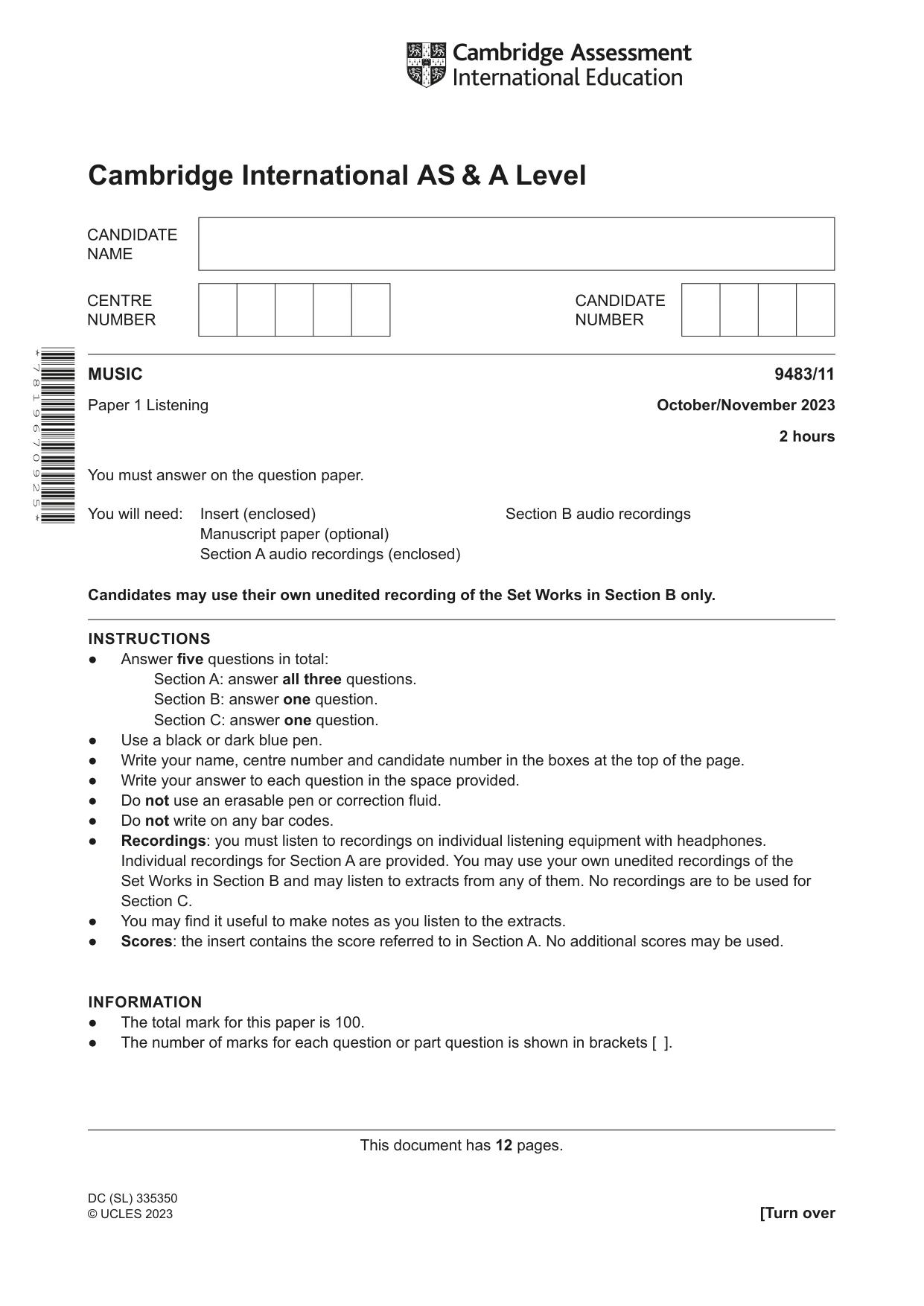
Question paper, page 1
This document has 12 pages. [Turn over Cambridge International AS & A Level DC (SL) 335350 © UCLES 2023 MUSIC 9483/11 Paper 1 Listening October/November 2023 2 hours You must answer on the question paper. You will need: Insert (enclosed) Section B audio recordings Manuscript paper (optional) Section A audio recordings (enclosed) Candidates may use their own unedited recording of the Set Works in Section B only. INSTRUCTIONS ● Answer five questions in total: Section A: answer all three questions. Section B: answer one question. Section C: answer one question. ● Use a black or dark blue pen. ● Write your name, centre number and candidate number in the boxes at the top of the page. ● Write your answer to each question in the space provided. ● Do not use an erasable pen or correction fluid. ● Do not write on any bar codes. ● Recordings: you must listen to recordings on individual listening equipment with headphones. Individual recordings for Section A are provided. You may use your own unedited recordings of the Set Works in Section B and may listen to extracts from any of them. No recordings are to be used for Section C. ● You may find it useful to make notes as you listen to the extracts. ● Scores: the insert contains the score referred to in Section A. No additional scores may be used. INFORMATION ● The total mark for this paper is 100. ● The number of marks for each question or part question is shown in brackets [ ]. * 7 8 1 9 6 7 0 9 2 5 *
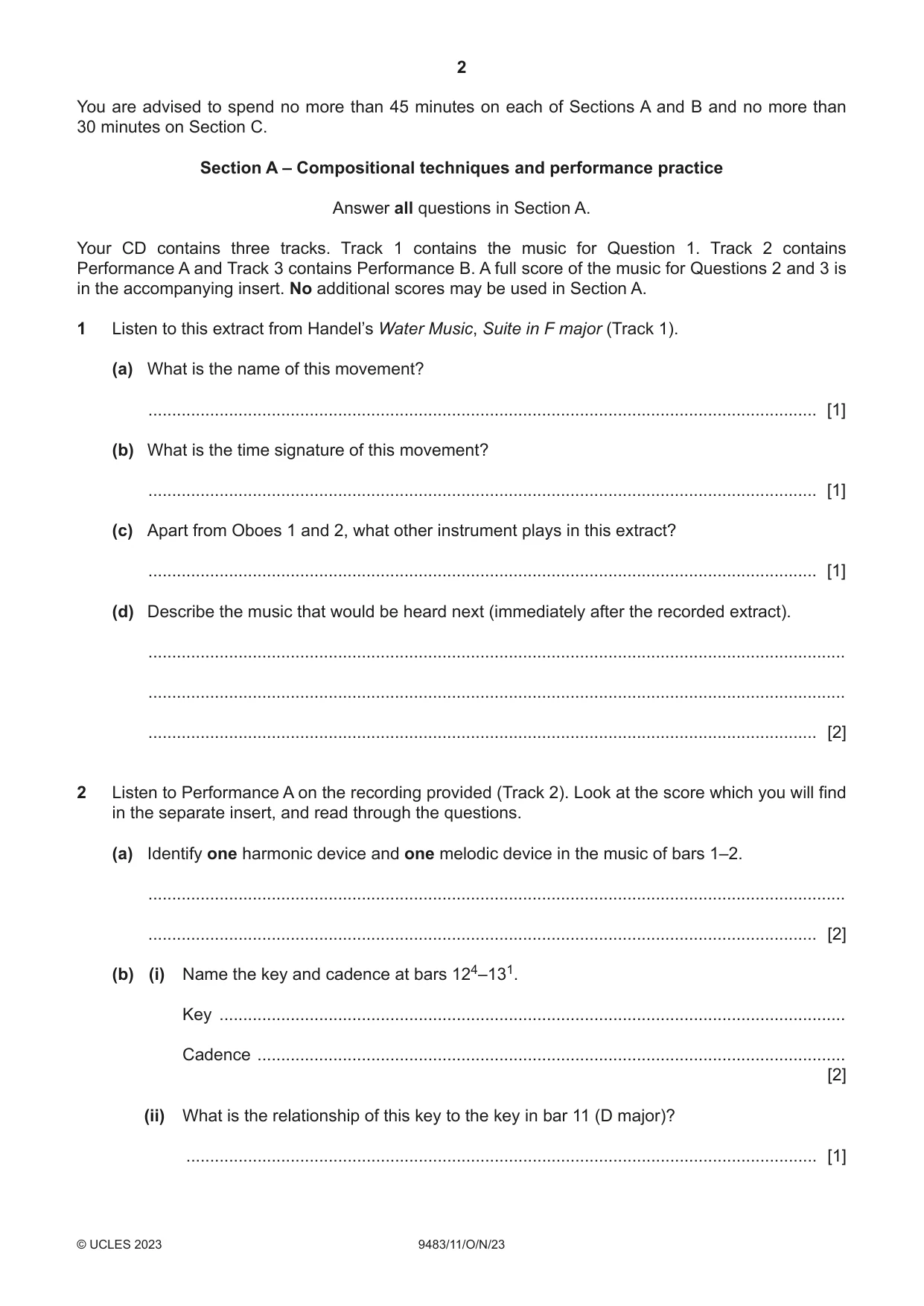
Question paper, page 2
2 9483/11/O/N/23 © UCLES 2023 You are advised to spend no more than 45 minutes on each of Sections A and B and no more than 30 minutes on Section C. Section A – Compositional techniques and performance practice Answer all questions in Section A. Your CD contains three tracks. Track 1 contains the music for Question 1. Track 2 contains Performance A and Track 3 contains Performance B. A full score of the music for Questions 2 and 3 is in the accompanying insert. No additional scores may be used in Section A. 1 Listen to this extract from Handel’s Water Music, Suite in F major (Track 1). (a) What is the name of this movement? … [1] (b) What is the time signature of this movement? … [1] (c) Apart from Oboes 1 and 2, what other instrument plays in this extract? … [1] (d) Describe the music that would be heard next (immediately after the recorded extract). … … … [2] 2 Listen to Performance A on the recording provided (Track 2). Look at the score which you will find in the separate insert, and read through the questions. (a) Identify one harmonic device and one melodic device in the music of bars 1–2. … … [2] (b) (i) Name the key and cadence at bars 124–131. Key … Cadence … [2] (ii) What is the relationship of this key to the key in bar 11 (D major)? … [1]
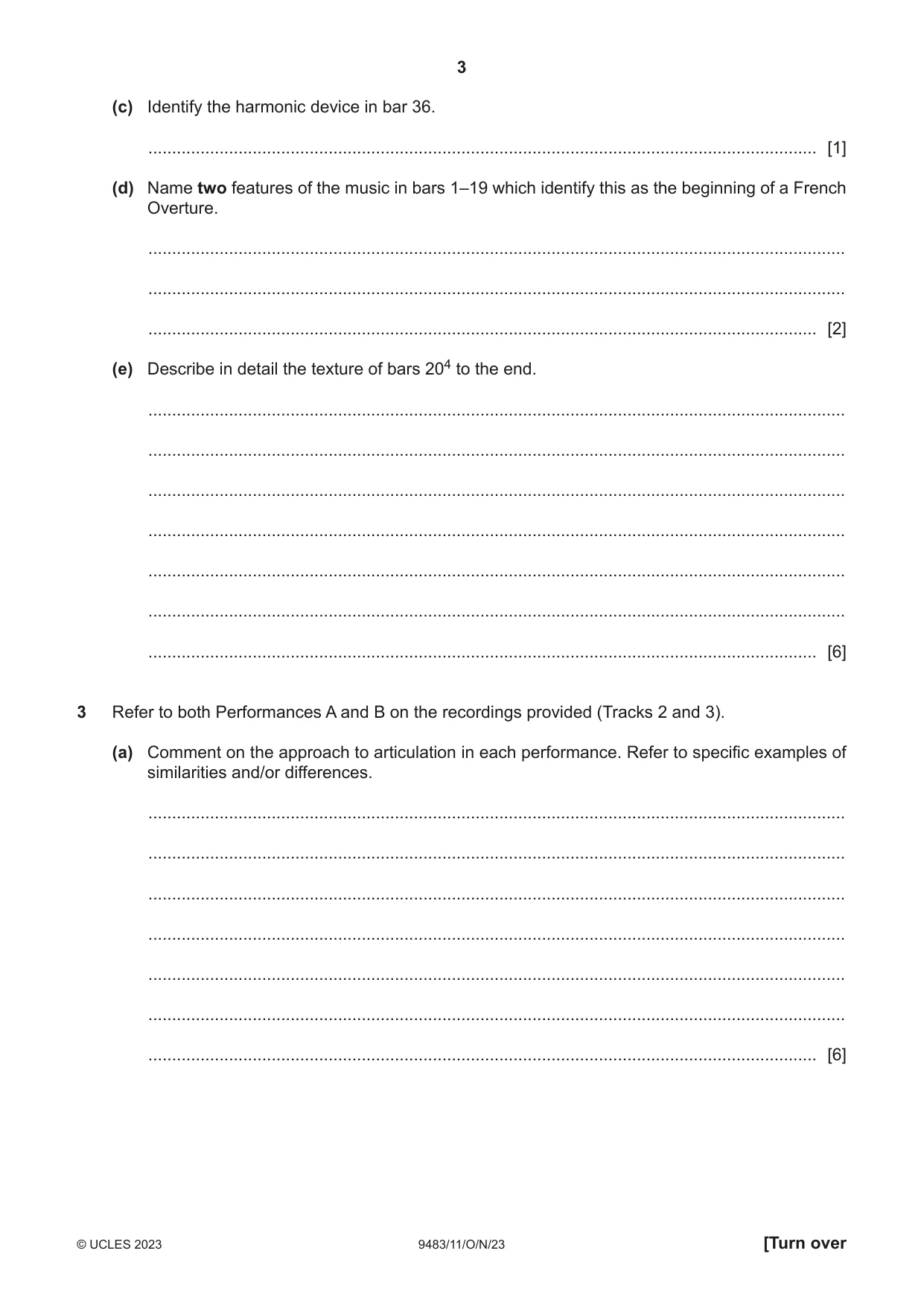
Question paper, page 3
3 9483/11/O/N/23 © UCLES 2023 [Turn over (c) Identify the harmonic device in bar 36. … [1] (d) Name two features of the music in bars 1–19 which identify this as the beginning of a French Overture. … … … [2] (e) Describe in detail the texture of bars 204 to the end. … … … … … … … [6] 3 Refer to both Performances A and B on the recordings provided (Tracks 2 and 3). (a) Comment on the approach to articulation in each performance. Refer to specific examples of similarities and/or differences. … … … … … … … [6]
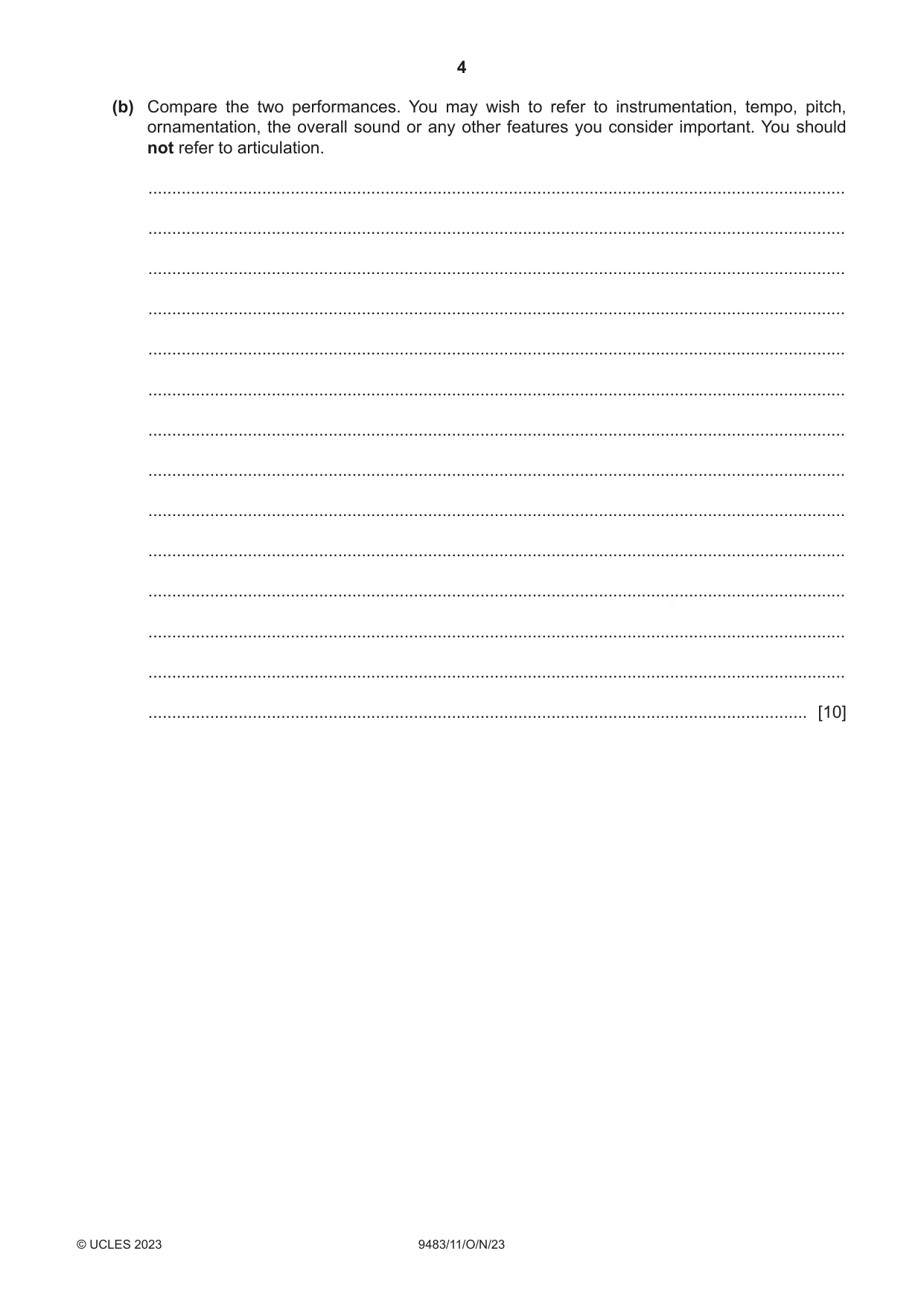
Question paper, page 4
4 9483/11/O/N/23 © UCLES 2023 (b) Compare the two performances. You may wish to refer to instrumentation, tempo, pitch, ornamentation, the overall sound or any other features you consider important. You should not refer to articulation. … … … … … … … … … … … … … … [10]
Question paper, page 5
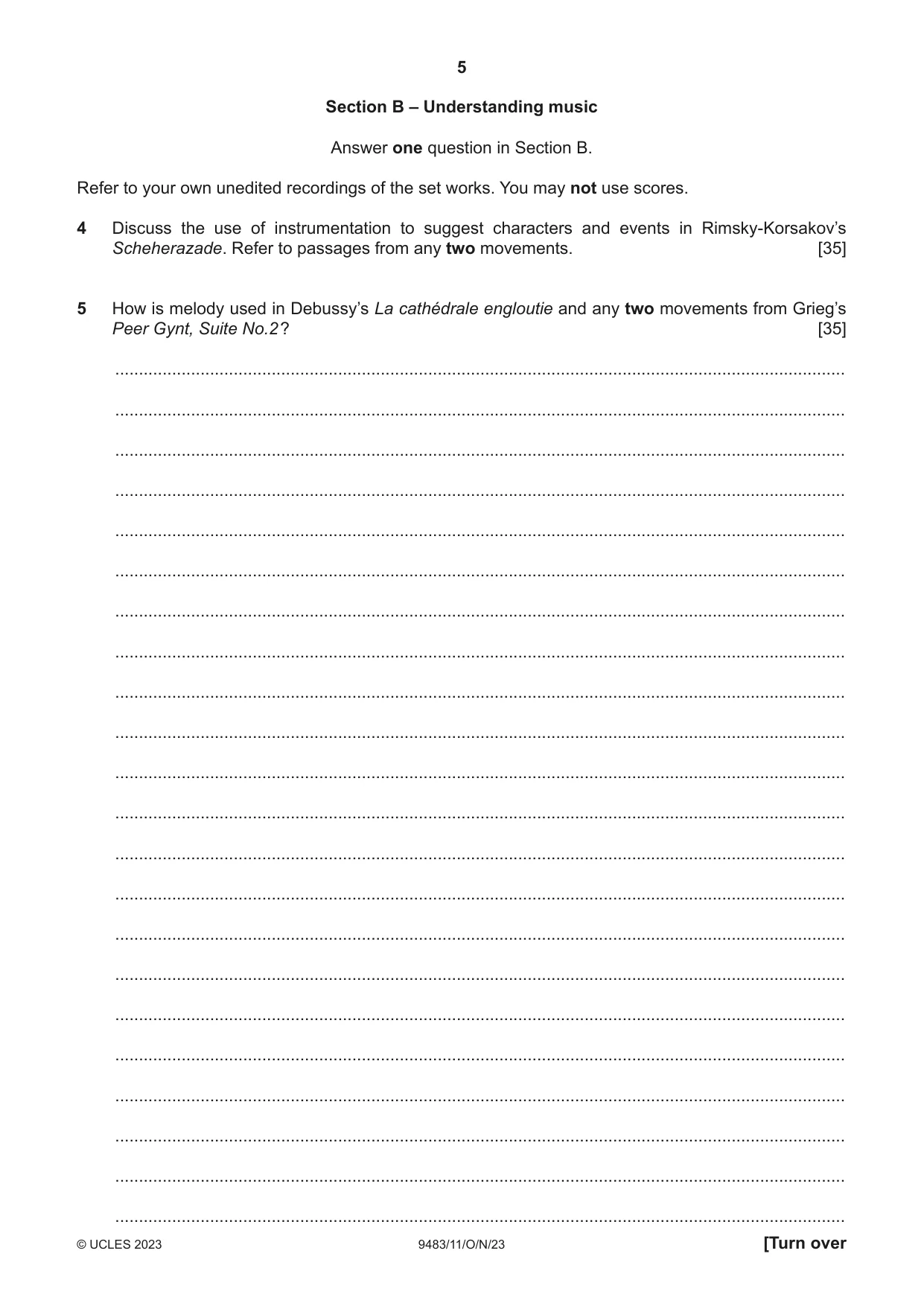
5 9483/11/O/N/23 © UCLES 2023 [Turn over Section B – Understanding music Answer one question in Section B. Refer to your own unedited recordings of the set works. You may not use scores. 4 Discuss the use of instrumentation to suggest characters and events in Rimsky-Korsakov’s Scheherazade. Refer to passages from any two movements. [35] 5 How is melody used in Debussy’s La cathédrale engloutie and any two movements from Grieg’s Peer Gynt, Suite No.2 ? [35] … … … … … … … … … … … … … … … … … … … … … …
Question paper, page 6
6 9483/11/O/N/23 © UCLES 2023 … … … … … … … … … … … … … … … … … … … … … … … … … … … …
Question paper, page 7
7 9483/11/O/N/23 © UCLES 2023 [Turn over … … … … … … … … … … … … … … … … … … … … … … … … … … … …
Question paper, page 8
8 9483/11/O/N/23 © UCLES 2023 … … … … … … … … … … … … … … … … … … … … … … … … … … … …
Question paper, page 9
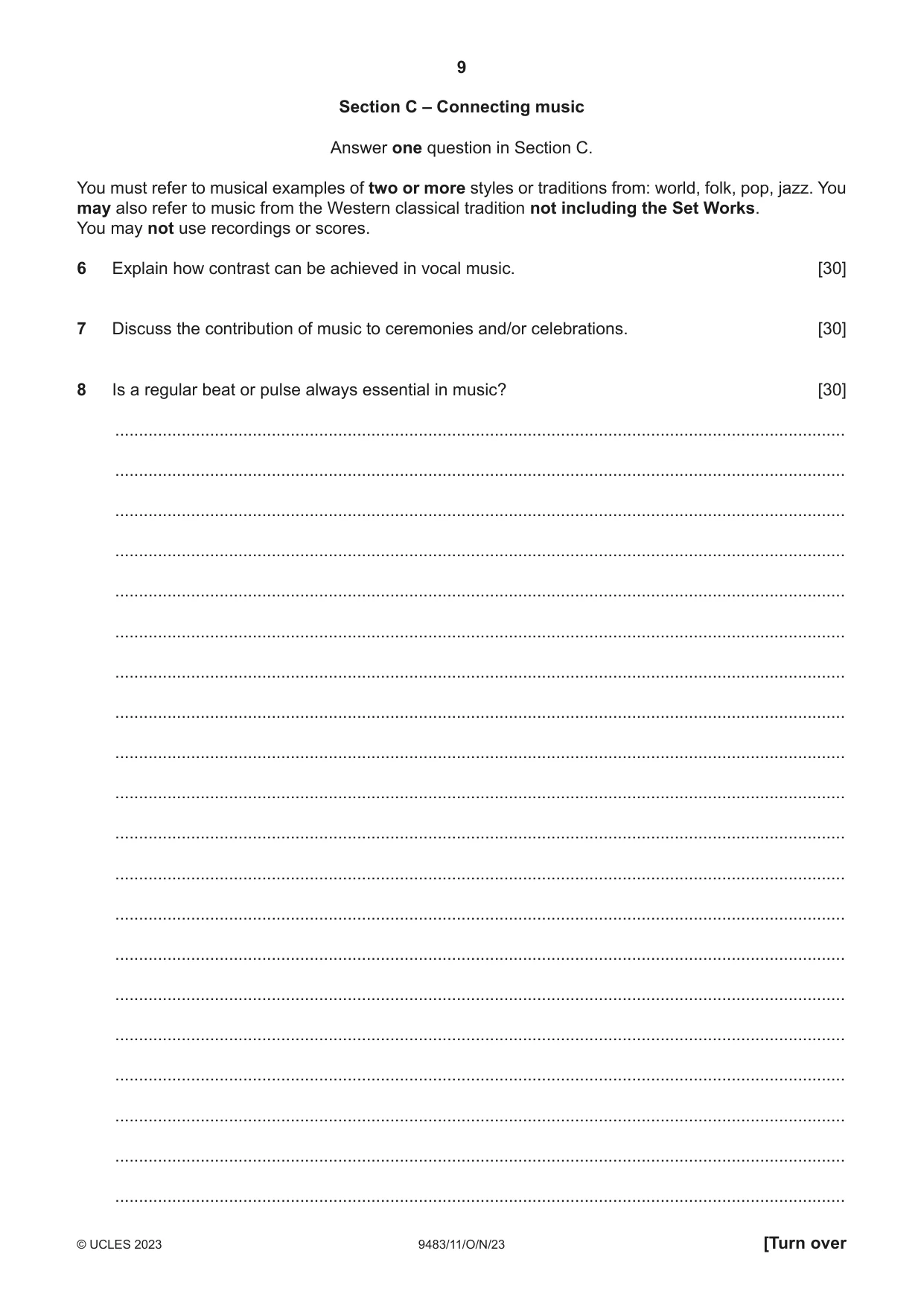
9 9483/11/O/N/23 © UCLES 2023 [Turn over Section C – Connecting music Answer one question in Section C. You must refer to musical examples of two or more styles or traditions from: world, folk, pop, jazz. You may also refer to music from the Western classical tradition not including the Set Works. You may not use recordings or scores. 6 Explain how contrast can be achieved in vocal music. [30] 7 Discuss the contribution of music to ceremonies and/or celebrations. [30] 8 Is a regular beat or pulse always essential in music? [30] … … … … … … … … … … … … … … … … … … … …
Question paper, page 10
10 9483/11/O/N/23 © UCLES 2023 … … … … … … … … … … … … … … … … … … … … … … … … … … … …
Question paper, page 11
11 9483/11/O/N/23 © UCLES 2023 [Turn over … … … … … … … … … … … … … … … … … … … … … … … … … … … …
Question paper, page 12
12 9483/11/O/N/23 © UCLES 2023 Permission to reproduce items where third-party owned material protected by copyright is included has been sought and cleared where possible. Every reasonable effort has been made by the publisher (UCLES) to trace copyright holders, but if any items requiring clearance have unwittingly been included, the publisher will be pleased to make amends at the earliest possible opportunity. To avoid the issue of disclosure of answer-related information to candidates, all copyright acknowledgements are reproduced online in the Cambridge Assessment International Education Copyright Acknowledgements Booklet. This is produced for each series of examinations and is freely available to download at www.cambridgeinternational.org after the live examination series. Cambridge Assessment International Education is part of Cambridge Assessment. Cambridge Assessment is the brand name of the University of Cambridge Local Examinations Syndicate (UCLES), which is a department of the University of Cambridge. … … … … … … … … … … … … … … … … … … … … … … … …
What you needed in this session
Cambridge’s own grade thresholds for 2023 Oct/Nov, Paper 1 · Variant 1. A higher threshold means an easier paper — the bar moves with how the cohort did.