Cambridge A Level Music 9483 — 2022 Oct/Nov Paper 1 · Variant 1
9483/11/O/N/22 · 100 marks · ≈113 min
The question paper and its mark scheme, free to read here and free to download. This is Cambridge’s own paper, exactly as it was sat.
Question paper12 pages






Mark scheme18 pages
Answers below. Sit the paper first if you are practising.
Paper as text
Question paper, page 1
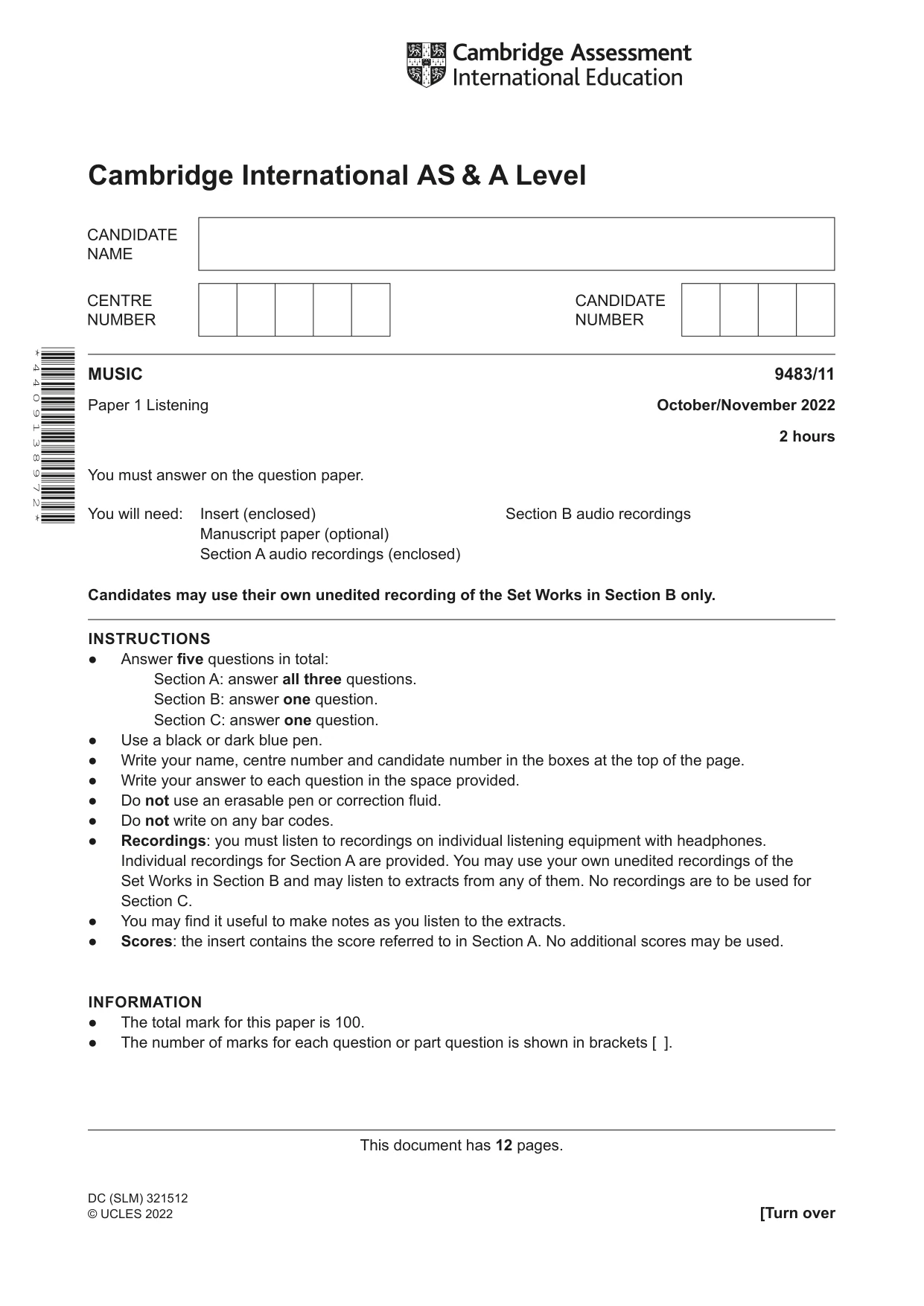
This document has 12 pages. [Turn over Cambridge International AS & A Level DC (SLM) 321512 © UCLES 2022 MUSIC 9483/11 Paper 1 Listening October/November 2022 2 hours You must answer on the question paper. You will need: Insert (enclosed) Section B audio recordings Manuscript paper (optional) Section A audio recordings (enclosed) Candidates may use their own unedited recording of the Set Works in Section B only. INSTRUCTIONS ● Answer five questions in total: Section A: answer all three questions. Section B: answer one question. Section C: answer one question. ● Use a black or dark blue pen. ● Write your name, centre number and candidate number in the boxes at the top of the page. ● Write your answer to each question in the space provided. ● Do not use an erasable pen or correction fluid. ● Do not write on any bar codes. ● Recordings: you must listen to recordings on individual listening equipment with headphones. Individual recordings for Section A are provided. You may use your own unedited recordings of the Set Works in Section B and may listen to extracts from any of them. No recordings are to be used for Section C. ● You may find it useful to make notes as you listen to the extracts. ● Scores: the insert contains the score referred to in Section A. No additional scores may be used. INFORMATION ● The total mark for this paper is 100. ● The number of marks for each question or part question is shown in brackets [ ]. * 4 4 0 9 1 3 8 9 7 2 *
Question paper, page 2
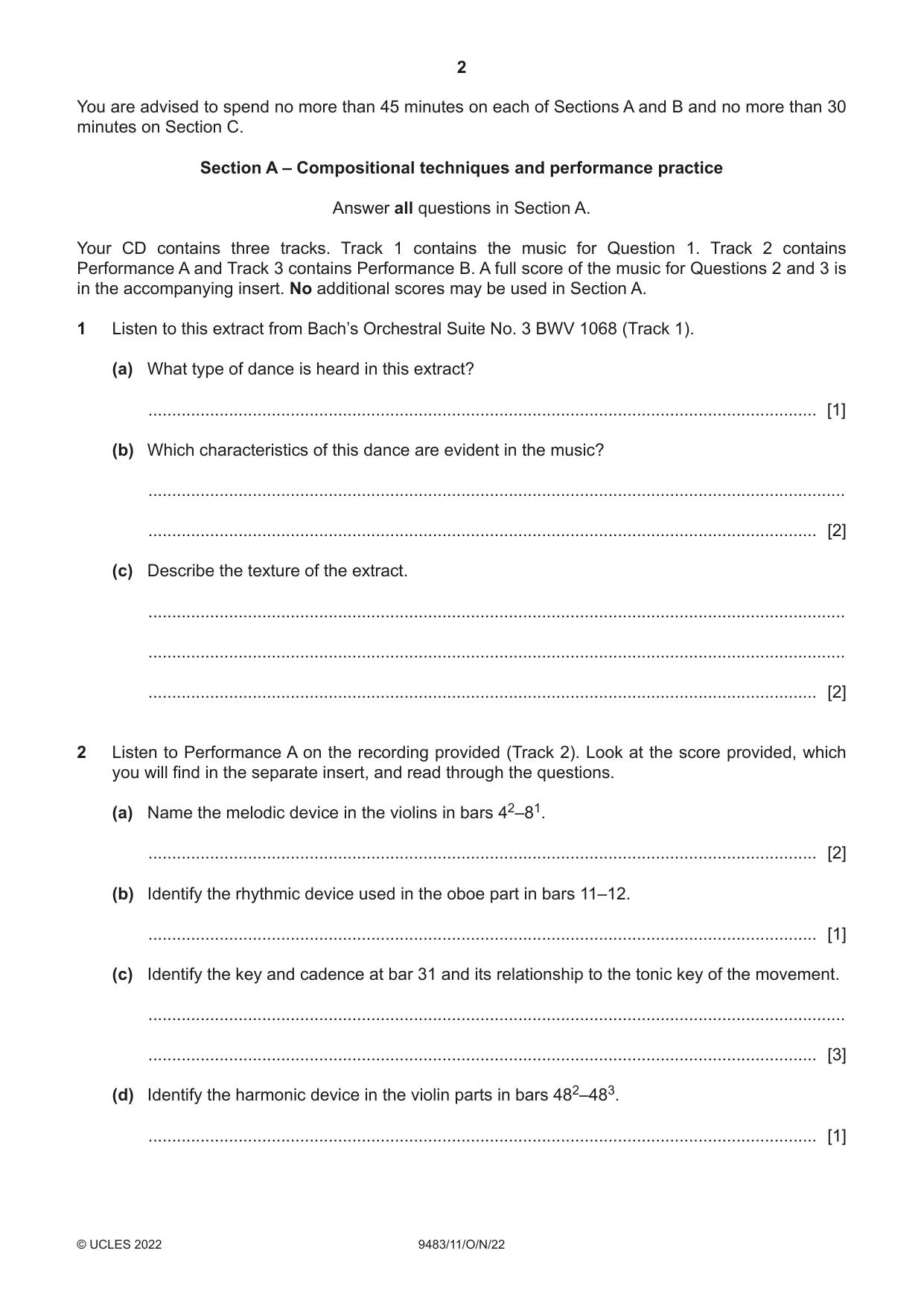
2 9483/11/O/N/22 © UCLES 2022 You are advised to spend no more than 45 minutes on each of Sections A and B and no more than 30 minutes on Section C. Section A – Compositional techniques and performance practice Answer all questions in Section A. Your CD contains three tracks. Track 1 contains the music for Question 1. Track 2 contains Performance A and Track 3 contains Performance B. A full score of the music for Questions 2 and 3 is in the accompanying insert. No additional scores may be used in Section A. 1 Listen to this extract from Bach’s Orchestral Suite No. 3 BWV 1068 (Track 1). (a) What type of dance is heard in this extract? … [1] (b) Which characteristics of this dance are evident in the music? … … [2] (c) Describe the texture of the extract. … … … [2] 2 Listen to Performance A on the recording provided (Track 2). Look at the score provided, which you will find in the separate insert, and read through the questions. (a) Name the melodic device in the violins in bars 42–81. … [2] (b) Identify the rhythmic device used in the oboe part in bars 11–12. … [1] (c) Identify the key and cadence at bar 31 and its relationship to the tonic key of the movement. … … [3] (d) Identify the harmonic device in the violin parts in bars 482–483. … [1]
Question paper, page 3
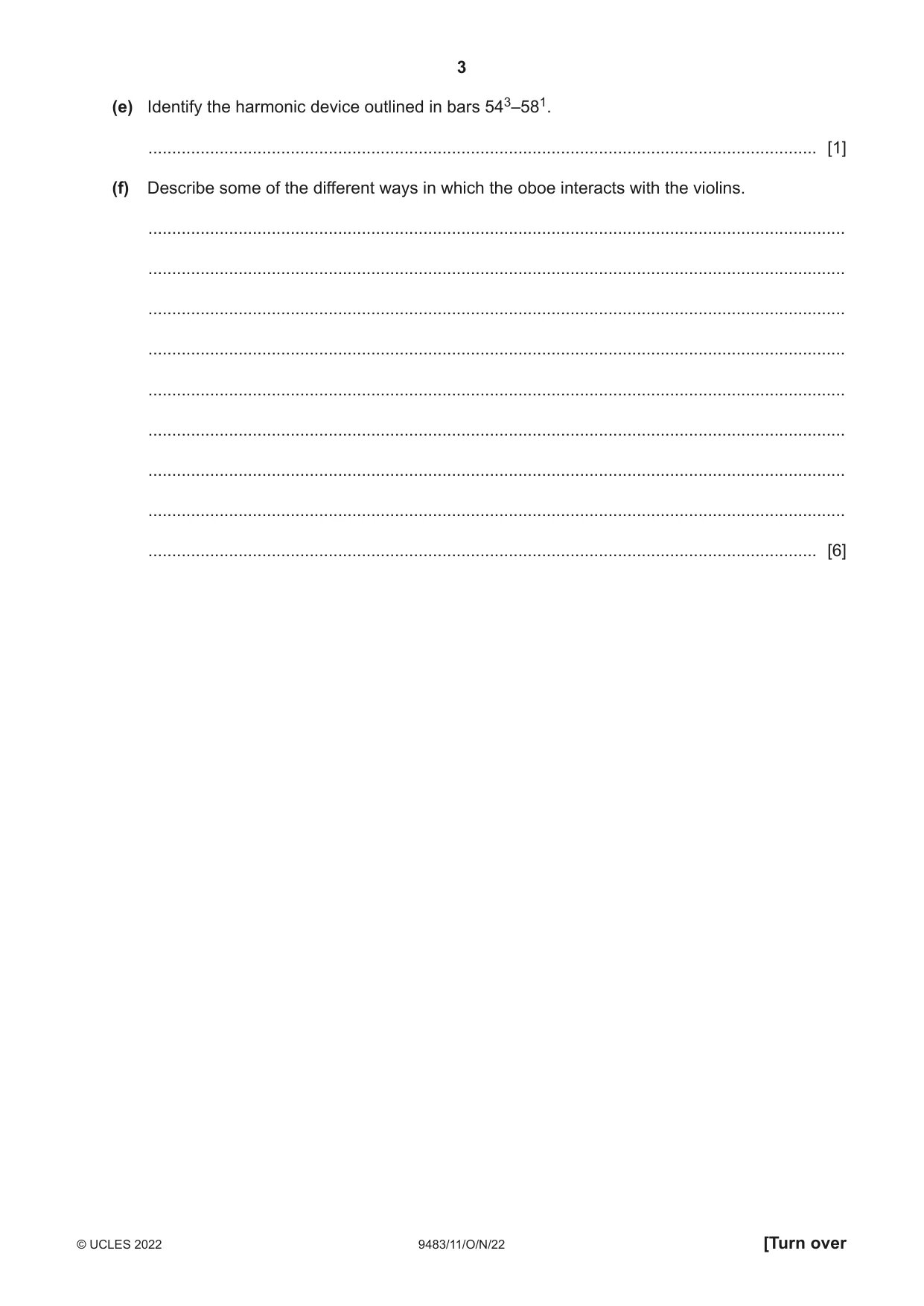
3 9483/11/O/N/22 © UCLES 2022 [Turn over (e) Identify the harmonic device outlined in bars 543–581. … [1] (f) Describe some of the different ways in which the oboe interacts with the violins. … … … … … … … … … [6]
Question paper, page 4
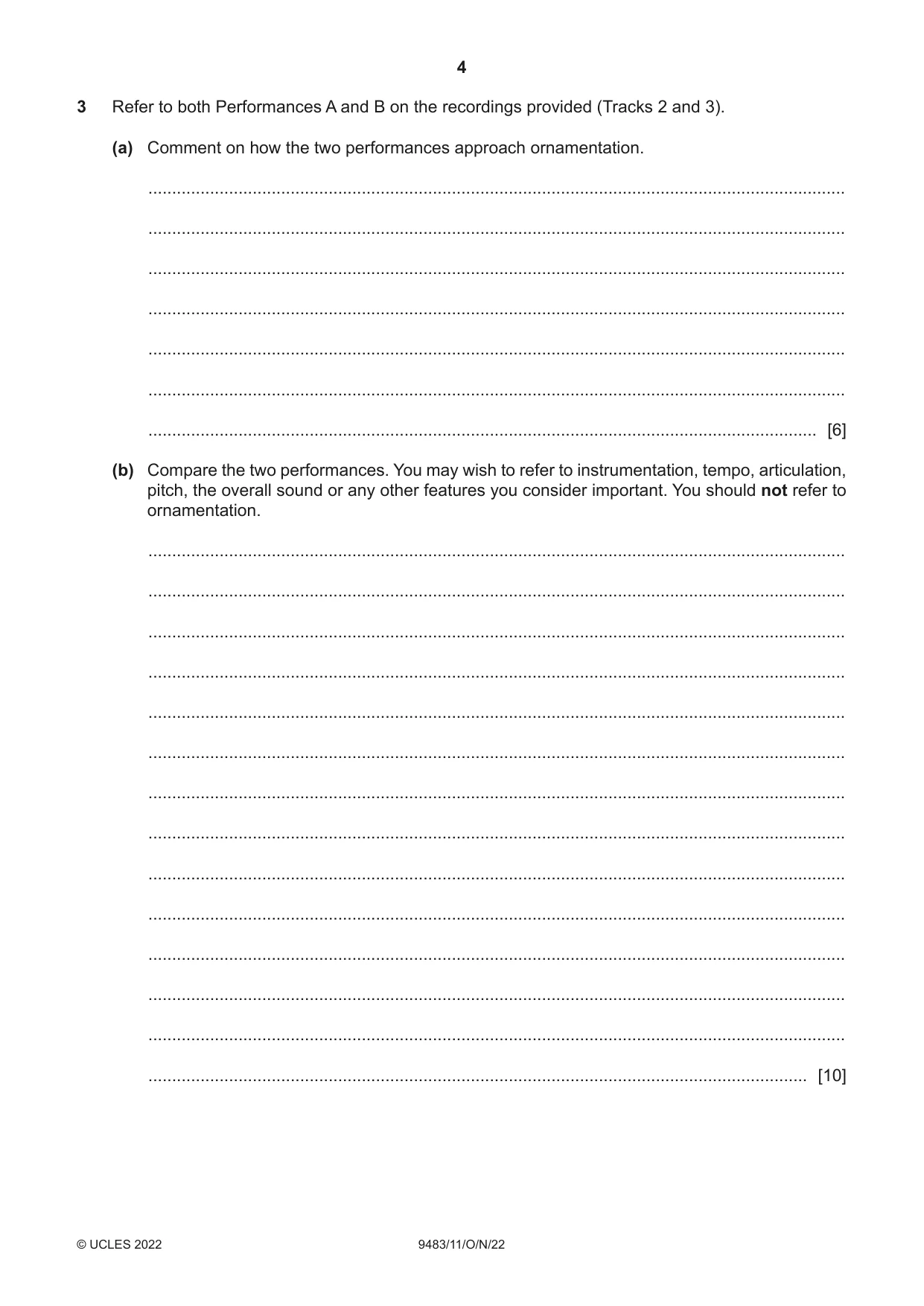
4 9483/11/O/N/22 © UCLES 2022 3 Refer to both Performances A and B on the recordings provided (Tracks 2 and 3). (a) Comment on how the two performances approach ornamentation. … … … … … … … [6] (b) Compare the two performances. You may wish to refer to instrumentation, tempo, articulation, pitch, the overall sound or any other features you consider important. You should not refer to ornamentation. … … … … … … … … … … … … … … [10]
Question paper, page 5
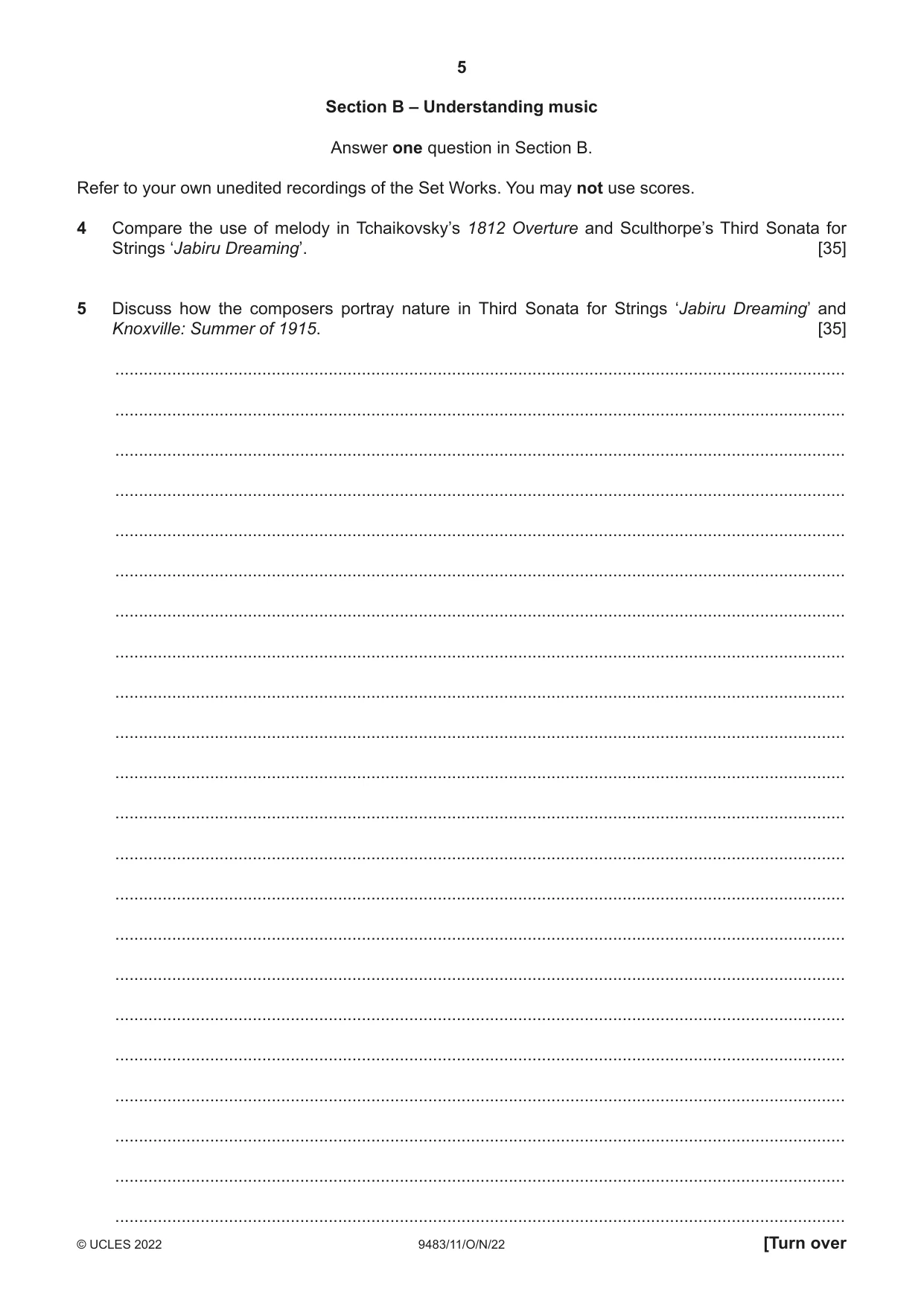
5 9483/11/O/N/22 © UCLES 2022 [Turn over Section B – Understanding music Answer one question in Section B. Refer to your own unedited recordings of the Set Works. You may not use scores. 4 Compare the use of melody in Tchaikovsky’s 1812 Overture and Sculthorpe’s Third Sonata for Strings ‘Jabiru Dreaming’. [35] 5 Discuss how the composers portray nature in Third Sonata for Strings ‘Jabiru Dreaming’ and Knoxville: Summer of 1915. [35] … … … … … … … … … … … … … … … … … … … … … …
Question paper, page 6
6 9483/11/O/N/22 © UCLES 2022 … … … … … … … … … … … … … … … … … … … … … … … … … … … …
Question paper, page 7
7 9483/11/O/N/22 © UCLES 2022 [Turn over … … … … … … … … … … … … … … … … … … … … … … … … … … … …
Question paper, page 8
8 9483/11/O/N/22 © UCLES 2022 … … … … … … … … … … … … … … … … … … … … … … … … … … … …
Question paper, page 9
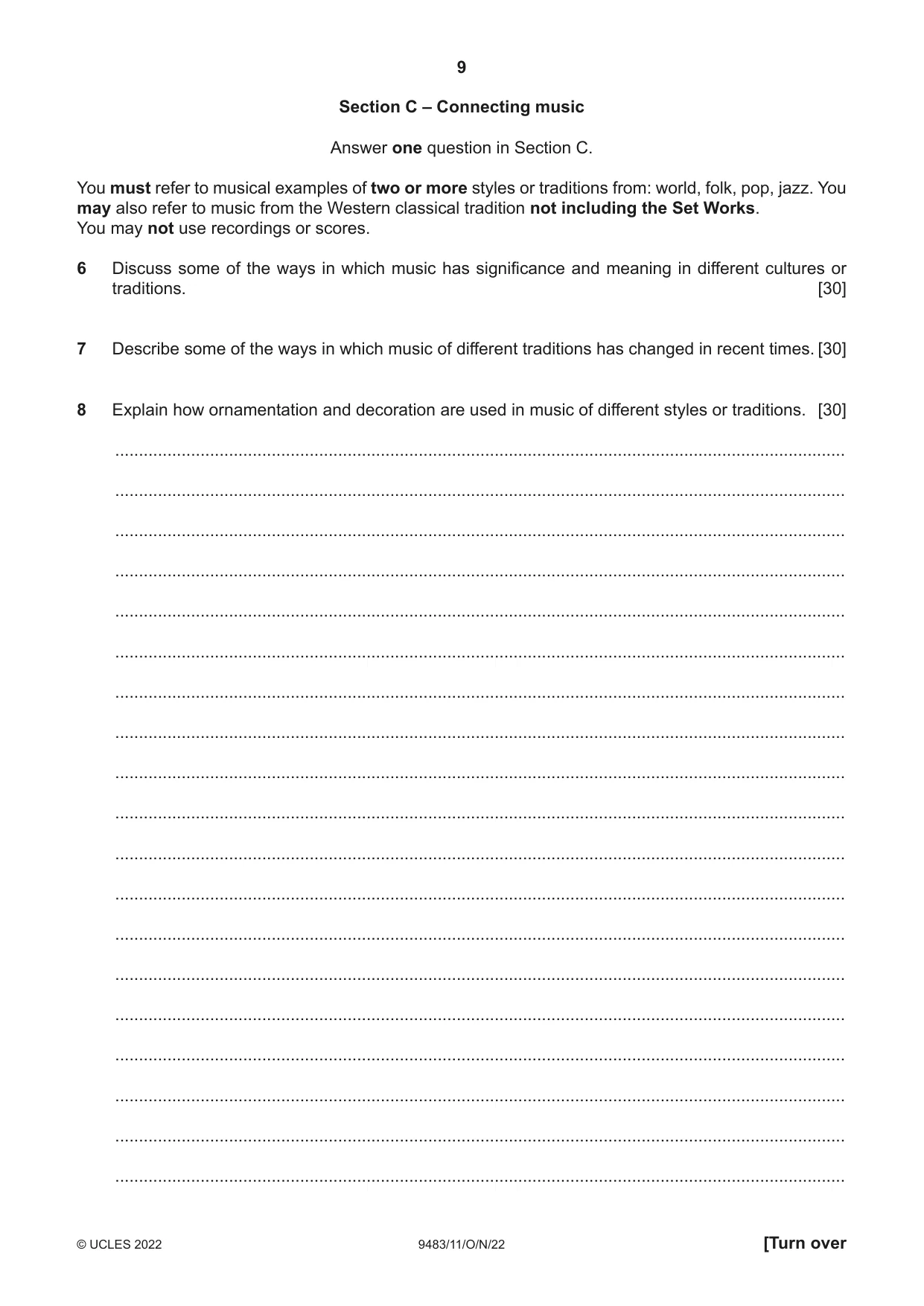
9 9483/11/O/N/22 © UCLES 2022 [Turn over Section C – Connecting music Answer one question in Section C. You must refer to musical examples of two or more styles or traditions from: world, folk, pop, jazz. You may also refer to music from the Western classical tradition not including the Set Works. You may not use recordings or scores. 6 Discuss some of the ways in which music has significance and meaning in different cultures or traditions. [30] 7 Describe some of the ways in which music of different traditions has changed in recent times. [30] 8 Explain how ornamentation and decoration are used in music of different styles or traditions. [30] … … … … … … … … … … … … … … … … … … …
Question paper, page 10
10 9483/11/O/N/22 © UCLES 2022 … … … … … … … … … … … … … … … … … … … … … … … … … … … …
Question paper, page 11
11 9483/11/O/N/22 © UCLES 2022 [Turn over … … … … … … … … … … … … … … … … … … … … … … … … … … … …
Question paper, page 12
12 9483/11/O/N/22 © UCLES 2022 Permission to reproduce items where third-party owned material protected by copyright is included has been sought and cleared where possible. Every reasonable effort has been made by the publisher (UCLES) to trace copyright holders, but if any items requiring clearance have unwittingly been included, the publisher will be pleased to make amends at the earliest possible opportunity. To avoid the issue of disclosure of answer-related information to candidates, all copyright acknowledgements are reproduced online in the Cambridge Assessment International Education Copyright Acknowledgements Booklet. This is produced for each series of examinations and is freely available to download at www.cambridgeinternational.org after the live examination series. Cambridge Assessment International Education is part of Cambridge Assessment. Cambridge Assessment is the brand name of the University of Cambridge Local Examinations Syndicate (UCLES), which is a department of the University of Cambridge. … … … … … … … … … … … … … … … … … … … … … … … …
Mark scheme, page 1
This document consists of 18 printed pages. © UCLES 2022 [Turn over Cambridge International AS Level MUSIC 9483/11 Paper 1 Listening October/November 2022 MARK SCHEME Maximum Mark: 100 Published This mark scheme is published as an aid to teachers and candidates, to indicate the requirements of the examination. It shows the basis on which Examiners were instructed to award marks. It does not indicate the details of the discussions that took place at an Examiners’ meeting before marking began, which would have considered the acceptability of alternative answers. Mark schemes should be read in conjunction with the question paper and the Principal Examiner Report for Teachers. Cambridge International will not enter into discussions about these mark schemes. Cambridge International is publishing the mark schemes for the October/November 2022 series for most Cambridge IGCSE™, Cambridge International A and AS Level components and some Cambridge O Level components.
Mark scheme, page 2
9483/11 Cambridge International AS Level – Mark Scheme PUBLISHED October/November 2022 © UCLES 2022 Page 2 of 18 Generic Marking Principles These general marking principles must be applied by all examiners when marking candidate answers. They should be applied alongside the specific content of the mark scheme or generic level descriptors for a question. Each question paper and mark scheme will also comply with these marking principles. GENERIC MARKING PRINCIPLE 1: Marks must be awarded in line with: • the specific content of the mark scheme or the generic level descriptors for the question • the specific skills defined in the mark scheme or in the generic level descriptors for the question • the standard of response required by a candidate as exemplified by the standardisation scripts. GENERIC MARKING PRINCIPLE 2: Marks awarded are always whole marks (not half marks, or other fractions). GENERIC MARKING PRINCIPLE 3: Marks must be awarded positively: • marks are awarded for correct/valid answers, as defined in the mark scheme. However, credit is given for valid answers which go beyond the scope of the syllabus and mark scheme, referring to your Team Leader as appropriate • marks are awarded when candidates clearly demonstrate what they know and can do • marks are not deducted for errors • marks are not deducted for omissions • answers should only be judged on the quality of spelling, punctuation and grammar when these features are specifically assessed by the question as indicated by the mark scheme. The meaning, however, should be unambiguous. GENERIC MARKING PRINCIPLE 4: Rules must be applied consistently, e.g. in situations where candidates have not followed instructions or in the application of generic level descriptors.
Mark scheme, page 3
9483/11 Cambridge International AS Level – Mark Scheme PUBLISHED October/November 2022 © UCLES 2022 Page 3 of 18 GENERIC MARKING PRINCIPLE 5: Marks should be awarded using the full range of marks defined in the mark scheme for the question (however; the use of the full mark range may be limited according to the quality of the candidate responses seen). GENERIC MARKING PRINCIPLE 6: Marks awarded are based solely on the requirements as defined in the mark scheme. Marks should not be awarded with grade thresholds or grade descriptors in mind.
Mark scheme, page 4
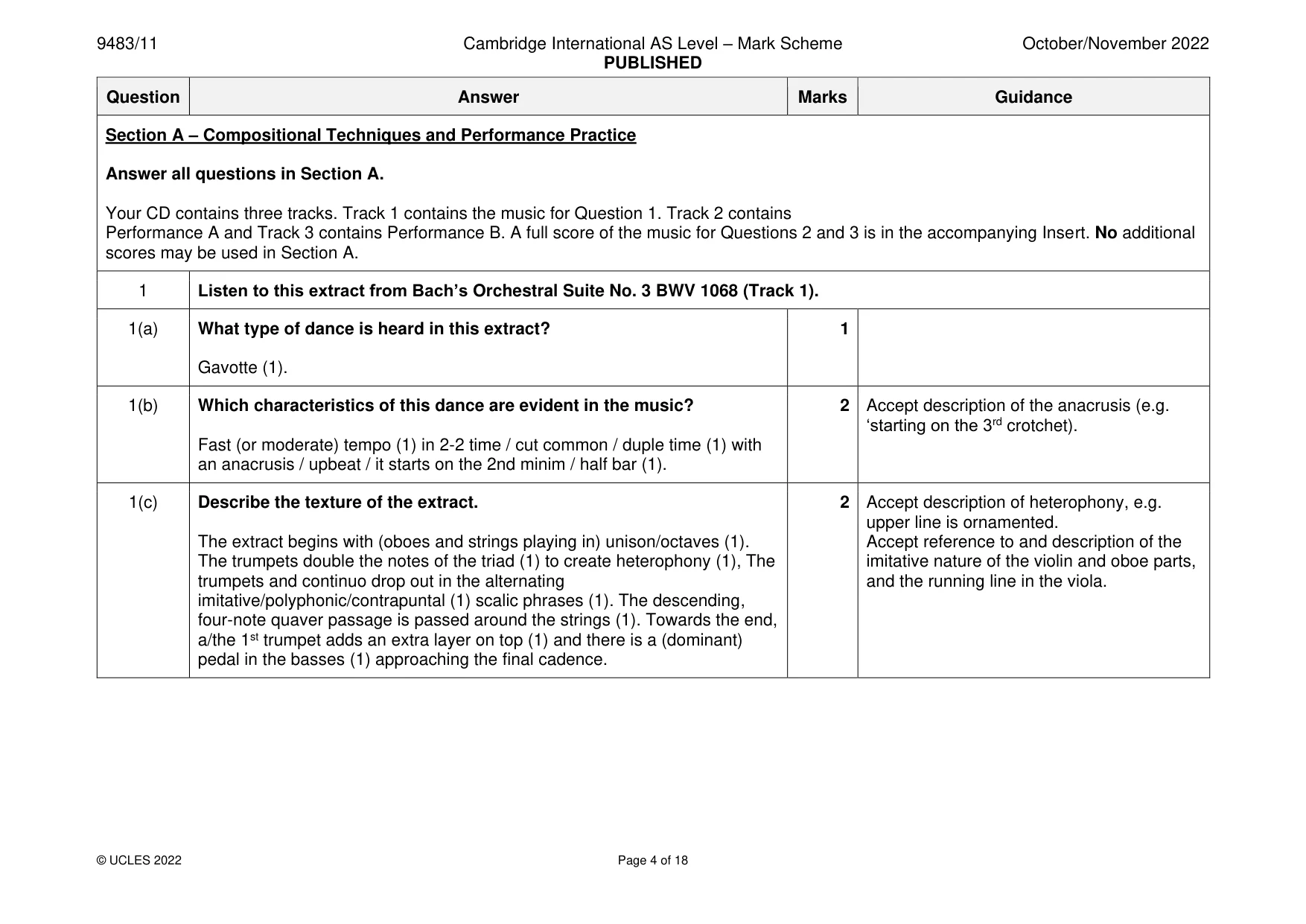
9483/11 Cambridge International AS Level – Mark Scheme PUBLISHED October/November 2022 © UCLES 2022 Page 4 of 18 Question Answer Marks Guidance Section A – Compositional Techniques and Performance Practice Answer all questions in Section A. Your CD contains three tracks. Track 1 contains the music for Question 1. Track 2 contains Performance A and Track 3 contains Performance B. A full score of the music for Questions 2 and 3 is in the accompanying Insert. No additional scores may be used in Section A. 1 Listen to this extract from Bach’s Orchestral Suite No. 3 BWV 1068 (Track 1). 1(a) What type of dance is heard in this extract? Gavotte (1). 1 1(b) Which characteristics of this dance are evident in the music? Fast (or moderate) tempo (1) in 2-2 time / cut common / duple time (1) with an anacrusis / upbeat / it starts on the 2nd minim / half bar (1). 2 Accept description of the anacrusis (e.g. ‘starting on the 3rd crotchet). 1(c) Describe the texture of the extract. The extract begins with (oboes and strings playing in) unison/octaves (1). The trumpets double the notes of the triad (1) to create heterophony (1), The trumpets and continuo drop out in the alternating imitative/polyphonic/contrapuntal (1) scalic phrases (1). The descending, four-note quaver passage is passed around the strings (1). Towards the end, a/the 1st trumpet adds an extra layer on top (1) and there is a (dominant) pedal in the basses (1) approaching the final cadence. 2 Accept description of heterophony, e.g. upper line is ornamented. Accept reference to and description of the imitative nature of the violin and oboe parts, and the running line in the viola.
Mark scheme, page 5
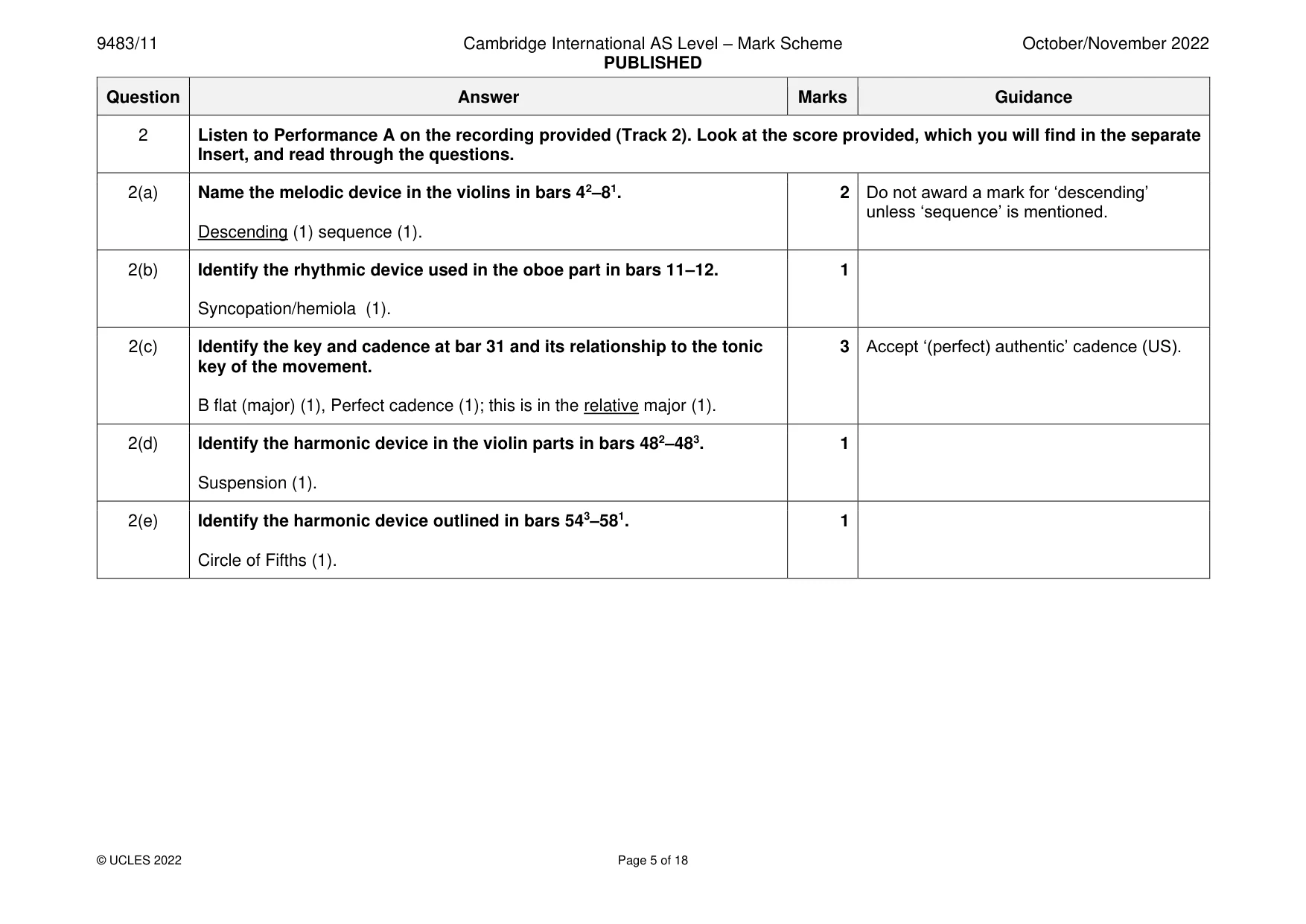
9483/11 Cambridge International AS Level – Mark Scheme PUBLISHED October/November 2022 © UCLES 2022 Page 5 of 18 Question Answer Marks Guidance 2 Listen to Performance A on the recording provided (Track 2). Look at the score provided, which you will find in the separate Insert, and read through the questions. 2(a) Name the melodic device in the violins in bars 42–81. Descending (1) sequence (1). 2 Do not award a mark for ‘descending’ unless ‘sequence’ is mentioned. 2(b) Identify the rhythmic device used in the oboe part in bars 11–12. Syncopation/hemiola (1). 1 2(c) Identify the key and cadence at bar 31 and its relationship to the tonic key of the movement. B flat (major) (1), Perfect cadence (1); this is in the relative major (1). 3 Accept ‘(perfect) authentic’ cadence (US). 2(d) Identify the harmonic device in the violin parts in bars 482–483. Suspension (1). 1 2(e) Identify the harmonic device outlined in bars 543–581. Circle of Fifths (1). 1
Mark scheme, page 6
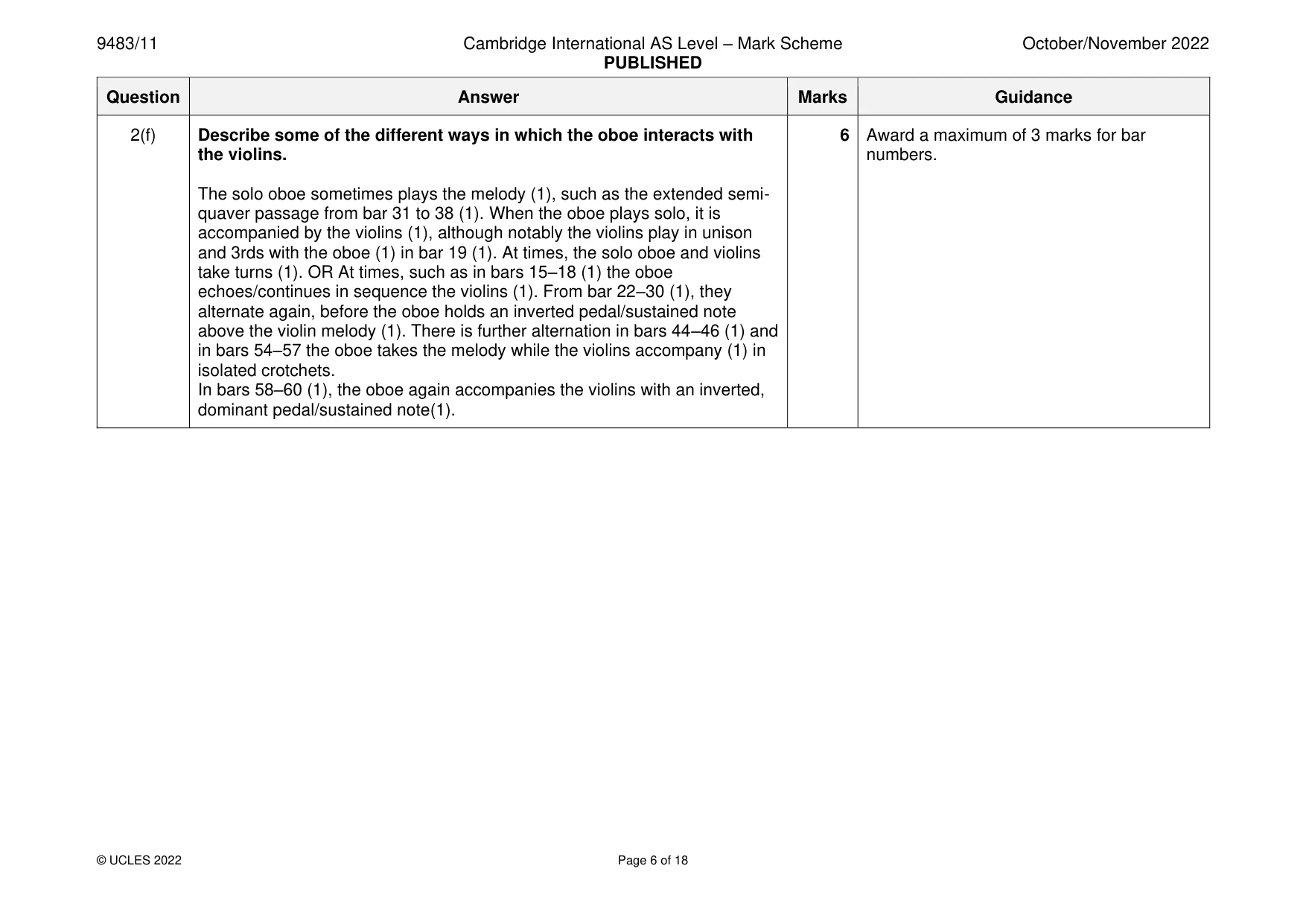
9483/11 Cambridge International AS Level – Mark Scheme PUBLISHED October/November 2022 © UCLES 2022 Page 6 of 18 Question Answer Marks Guidance 2(f) Describe some of the different ways in which the oboe interacts with the violins. The solo oboe sometimes plays the melody (1), such as the extended semi- quaver passage from bar 31 to 38 (1). When the oboe plays solo, it is accompanied by the violins (1), although notably the violins play in unison and 3rds with the oboe (1) in bar 19 (1). At times, the solo oboe and violins take turns (1). OR At times, such as in bars 15–18 (1) the oboe echoes/continues in sequence the violins (1). From bar 22–30 (1), they alternate again, before the oboe holds an inverted pedal/sustained note above the violin melody (1). There is further alternation in bars 44–46 (1) and in bars 54–57 the oboe takes the melody while the violins accompany (1) in isolated crotchets. In bars 58–60 (1), the oboe again accompanies the violins with an inverted, dominant pedal/sustained note(1). 6 Award a maximum of 3 marks for bar numbers.
Mark scheme, page 7
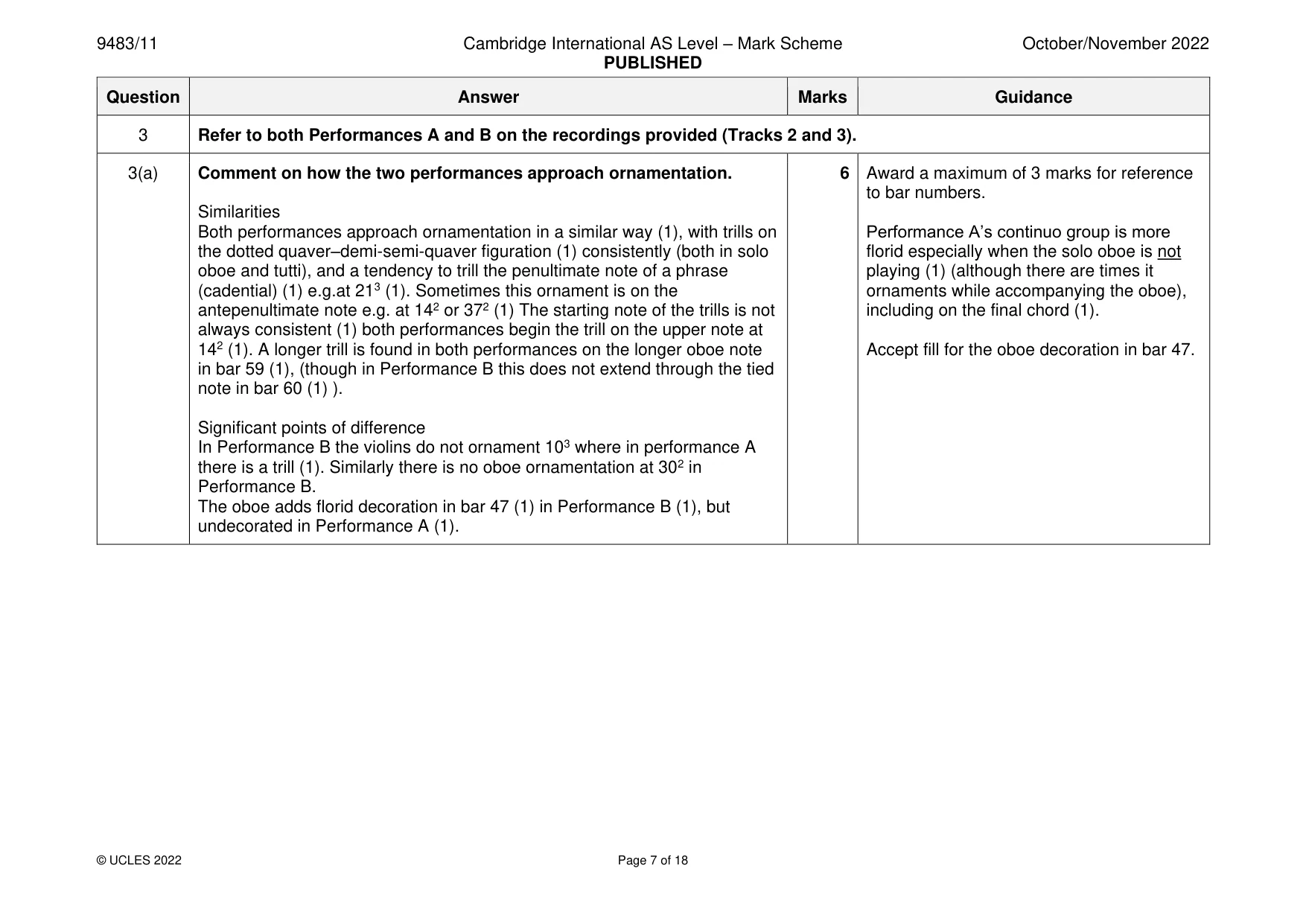
9483/11 Cambridge International AS Level – Mark Scheme PUBLISHED October/November 2022 © UCLES 2022 Page 7 of 18 Question Answer Marks Guidance 3 Refer to both Performances A and B on the recordings provided (Tracks 2 and 3). 3(a) Comment on how the two performances approach ornamentation. Similarities Both performances approach ornamentation in a similar way (1), with trills on the dotted quaver–demi-semi-quaver figuration (1) consistently (both in solo oboe and tutti), and a tendency to trill the penultimate note of a phrase (cadential) (1) e.g.at 213 (1). Sometimes this ornament is on the antepenultimate note e.g. at 142 or 372 (1) The starting note of the trills is not always consistent (1) both performances begin the trill on the upper note at 142 (1). A longer trill is found in both performances on the longer oboe note in bar 59 (1), (though in Performance B this does not extend through the tied note in bar 60 (1) ). Significant points of difference In Performance B the violins do not ornament 103 where in performance A there is a trill (1). Similarly there is no oboe ornamentation at 302 in Performance B. The oboe adds florid decoration in bar 47 (1) in Performance B (1), but undecorated in Performance A (1). 6 Award a maximum of 3 marks for reference to bar numbers. Performance A’s continuo group is more florid especially when the solo oboe is not playing (1) (although there are times it ornaments while accompanying the oboe), including on the final chord (1). Accept fill for the oboe decoration in bar 47.
Mark scheme, page 8
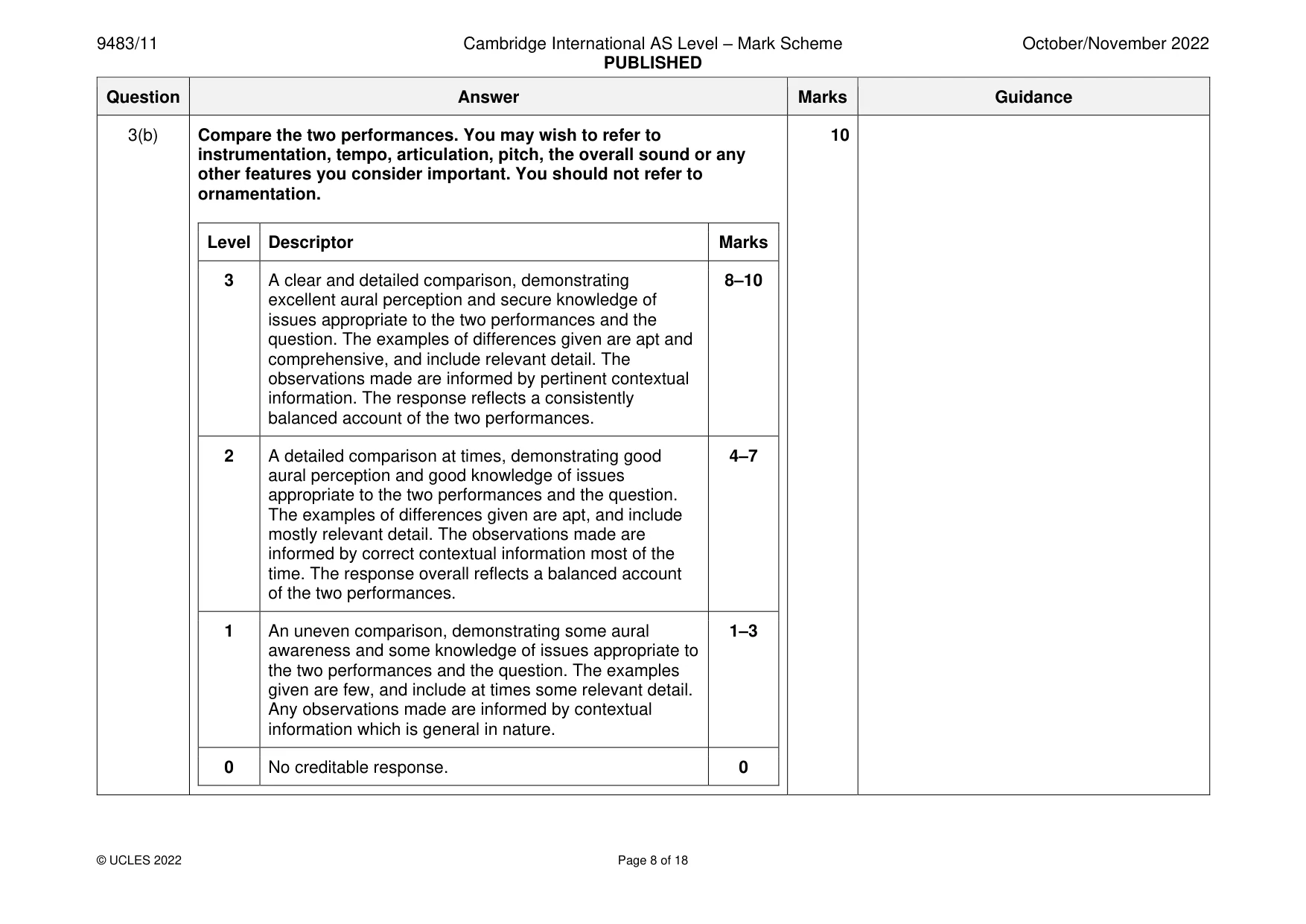
9483/11 Cambridge International AS Level – Mark Scheme PUBLISHED October/November 2022 © UCLES 2022 Page 8 of 18 Question Answer Marks Guidance 3(b) Compare the two performances. You may wish to refer to instrumentation, tempo, articulation, pitch, the overall sound or any other features you consider important. You should not refer to ornamentation. Level Descriptor Marks 3 A clear and detailed comparison, demonstrating excellent aural perception and secure knowledge of issues appropriate to the two performances and the question. The examples of differences given are apt and comprehensive, and include relevant detail. The observations made are informed by pertinent contextual information. The response reflects a consistently balanced account of the two performances. 8–10 2 A detailed comparison at times, demonstrating good aural perception and good knowledge of issues appropriate to the two performances and the question. The examples of differences given are apt, and include mostly relevant detail. The observations made are informed by correct contextual information most of the time. The response overall reflects a balanced account of the two performances. 4–7 1 An uneven comparison, demonstrating some aural awareness and some knowledge of issues appropriate to the two performances and the question. The examples given are few, and include at times some relevant detail. Any observations made are informed by contextual information which is general in nature. 1–3 0 No creditable response. 0 10
Mark scheme, page 9
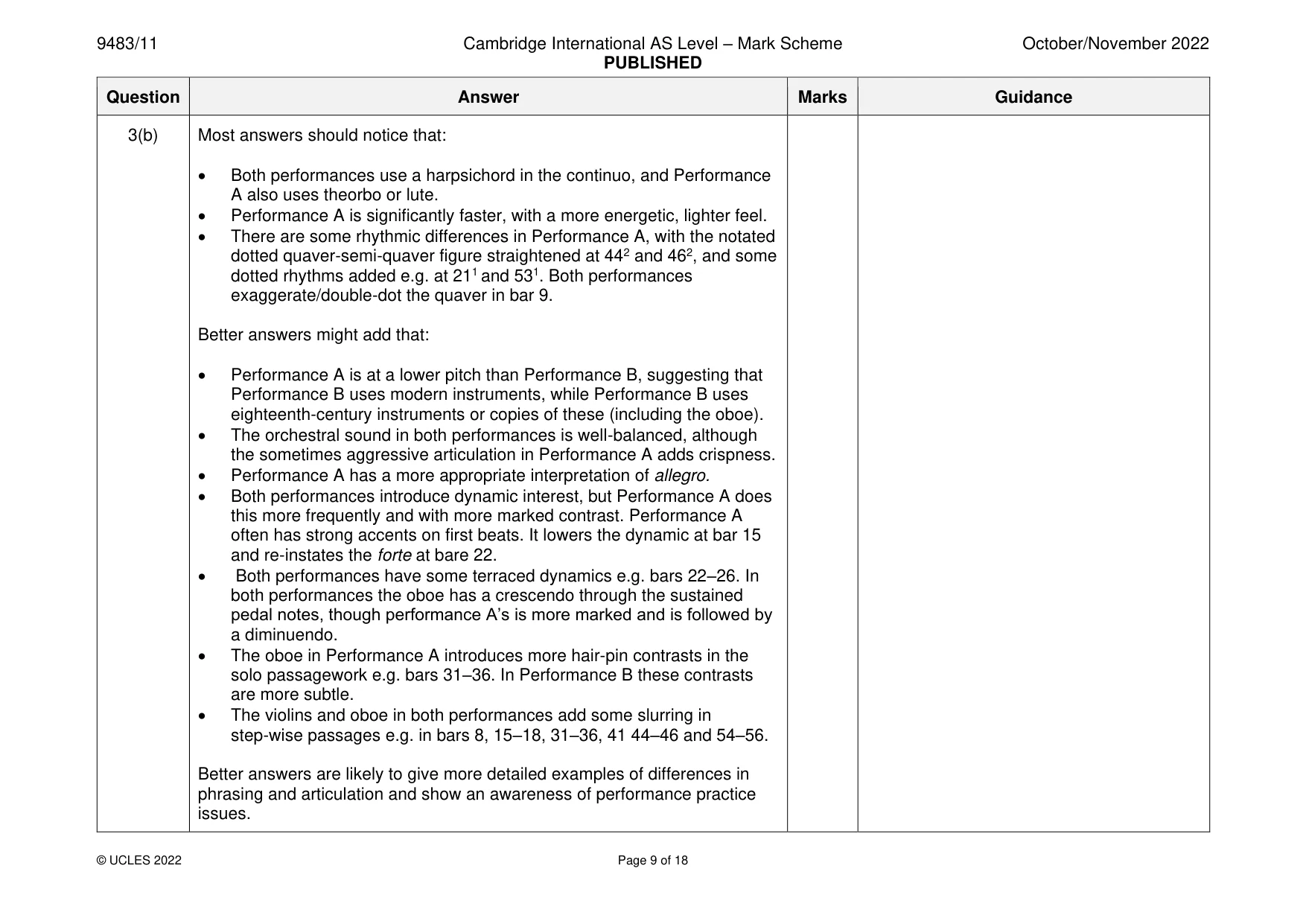
9483/11 Cambridge International AS Level – Mark Scheme PUBLISHED October/November 2022 © UCLES 2022 Page 9 of 18 Question Answer Marks Guidance 3(b) Most answers should notice that: • Both performances use a harpsichord in the continuo, and Performance A also uses theorbo or lute. • Performance A is significantly faster, with a more energetic, lighter feel. • There are some rhythmic differences in Performance A, with the notated dotted quaver-semi-quaver figure straightened at 442 and 462, and some dotted rhythms added e.g. at 211 and 531. Both performances exaggerate/double-dot the quaver in bar 9. Better answers might add that: • Performance A is at a lower pitch than Performance B, suggesting that Performance B uses modern instruments, while Performance B uses eighteenth-century instruments or copies of these (including the oboe). • The orchestral sound in both performances is well-balanced, although the sometimes aggressive articulation in Performance A adds crispness. • Performance A has a more appropriate interpretation of allegro. • Both performances introduce dynamic interest, but Performance A does this more frequently and with more marked contrast. Performance A often has strong accents on first beats. It lowers the dynamic at bar 15 and re-instates the forte at bare 22. • Both performances have some terraced dynamics e.g. bars 22–26. In both performances the oboe has a crescendo through the sustained pedal notes, though performance A’s is more marked and is followed by a diminuendo. • The oboe in Performance A introduces more hair-pin contrasts in the solo passagework e.g. bars 31–36. In Performance B these contrasts are more subtle. • The violins and oboe in both performances add some slurring in step-wise passages e.g. in bars 8, 15–18, 31–36, 41 44–46 and 54–56. Better answers are likely to give more detailed examples of differences in phrasing and articulation and show an awareness of performance practice issues.
Mark scheme, page 10
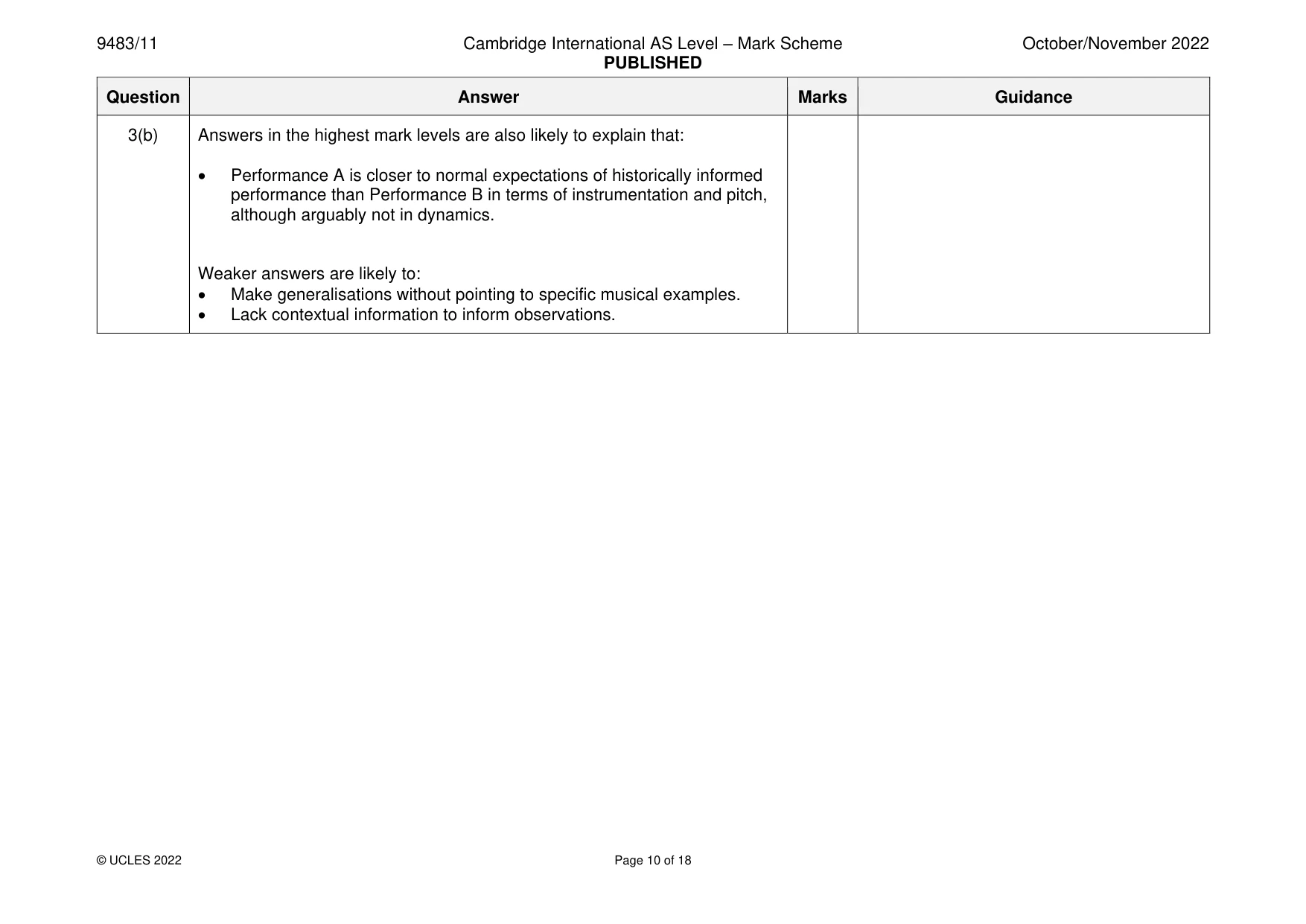
9483/11 Cambridge International AS Level – Mark Scheme PUBLISHED October/November 2022 © UCLES 2022 Page 10 of 18 Question Answer Marks Guidance 3(b) Answers in the highest mark levels are also likely to explain that: • Performance A is closer to normal expectations of historically informed performance than Performance B in terms of instrumentation and pitch, although arguably not in dynamics. Weaker answers are likely to: • Make generalisations without pointing to specific musical examples. • Lack contextual information to inform observations.
Mark scheme, page 11
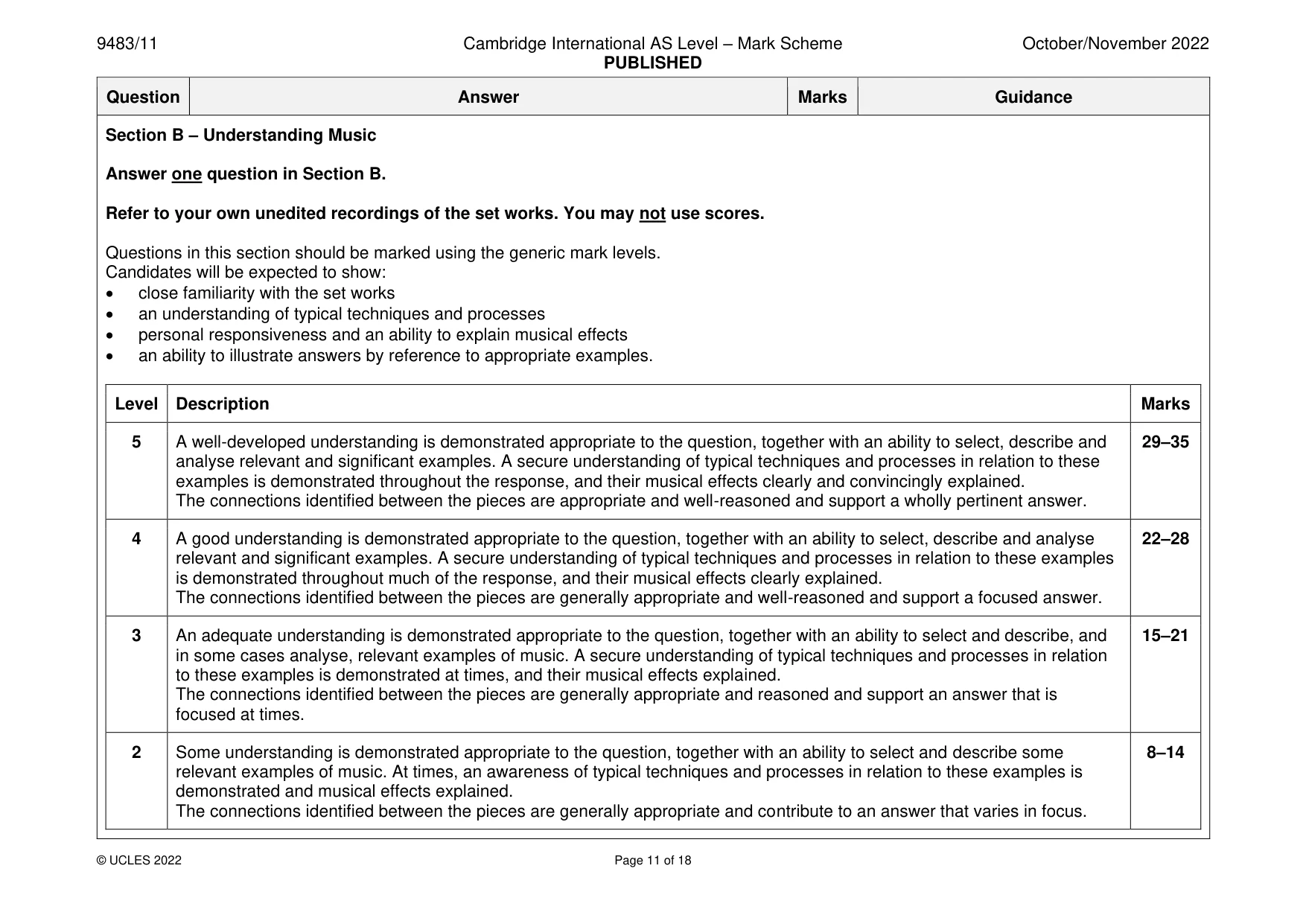
9483/11 Cambridge International AS Level – Mark Scheme PUBLISHED October/November 2022 © UCLES 2022 Page 11 of 18 Question Answer Marks Guidance Section B – Understanding Music Answer one question in Section B. Refer to your own unedited recordings of the set works. You may not use scores. Questions in this section should be marked using the generic mark levels. Candidates will be expected to show: • close familiarity with the set works • an understanding of typical techniques and processes • personal responsiveness and an ability to explain musical effects • an ability to illustrate answers by reference to appropriate examples. Level Description Marks 5 A well-developed understanding is demonstrated appropriate to the question, together with an ability to select, describe and analyse relevant and significant examples. A secure understanding of typical techniques and processes in relation to these examples is demonstrated throughout the response, and their musical effects clearly and convincingly explained. The connections identified between the pieces are appropriate and well-reasoned and support a wholly pertinent answer. 29–35 4 A good understanding is demonstrated appropriate to the question, together with an ability to select, describe and analyse relevant and significant examples. A secure understanding of typical techniques and processes in relation to these examples is demonstrated throughout much of the response, and their musical effects clearly explained. The connections identified between the pieces are generally appropriate and well-reasoned and support a focused answer. 22–28 3 An adequate understanding is demonstrated appropriate to the question, together with an ability to select and describe, and in some cases analyse, relevant examples of music. A secure understanding of typical techniques and processes in relation to these examples is demonstrated at times, and their musical effects explained. The connections identified between the pieces are generally appropriate and reasoned and support an answer that is focused at times. 15–21 2 Some understanding is demonstrated appropriate to the question, together with an ability to select and describe some relevant examples of music. At times, an awareness of typical techniques and processes in relation to these examples is demonstrated and musical effects explained. The connections identified between the pieces are generally appropriate and contribute to an answer that varies in focus. 8–14
Mark scheme, page 12
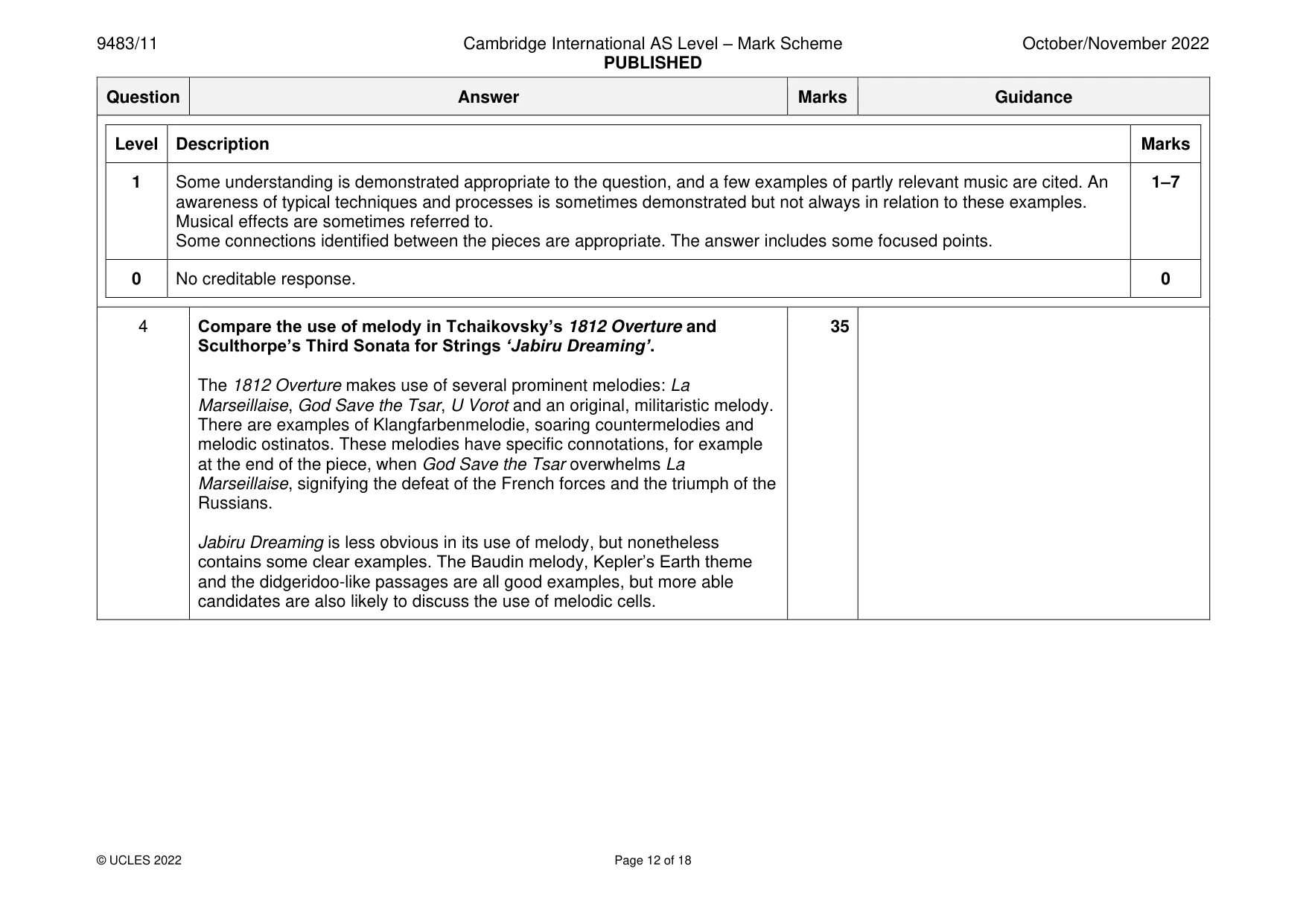
9483/11 Cambridge International AS Level – Mark Scheme PUBLISHED October/November 2022 © UCLES 2022 Page 12 of 18 Question Answer Marks Guidance Level Description Marks 1 Some understanding is demonstrated appropriate to the question, and a few examples of partly relevant music are cited. An awareness of typical techniques and processes is sometimes demonstrated but not always in relation to these examples. Musical effects are sometimes referred to. Some connections identified between the pieces are appropriate. The answer includes some focused points. 1–7 0 No creditable response. 0 4 Compare the use of melody in Tchaikovsky’s 1812 Overture and Sculthorpe’s Third Sonata for Strings ‘Jabiru Dreaming’. The 1812 Overture makes use of several prominent melodies: La Marseillaise, God Save the Tsar, U Vorot and an original, militaristic melody. There are examples of Klangfarbenmelodie, soaring countermelodies and melodic ostinatos. These melodies have specific connotations, for example at the end of the piece, when God Save the Tsar overwhelms La Marseillaise, signifying the defeat of the French forces and the triumph of the Russians. Jabiru Dreaming is less obvious in its use of melody, but nonetheless contains some clear examples. The Baudin melody, Kepler’s Earth theme and the didgeridoo-like passages are all good examples, but more able candidates are also likely to discuss the use of melodic cells. 35
Mark scheme, page 13
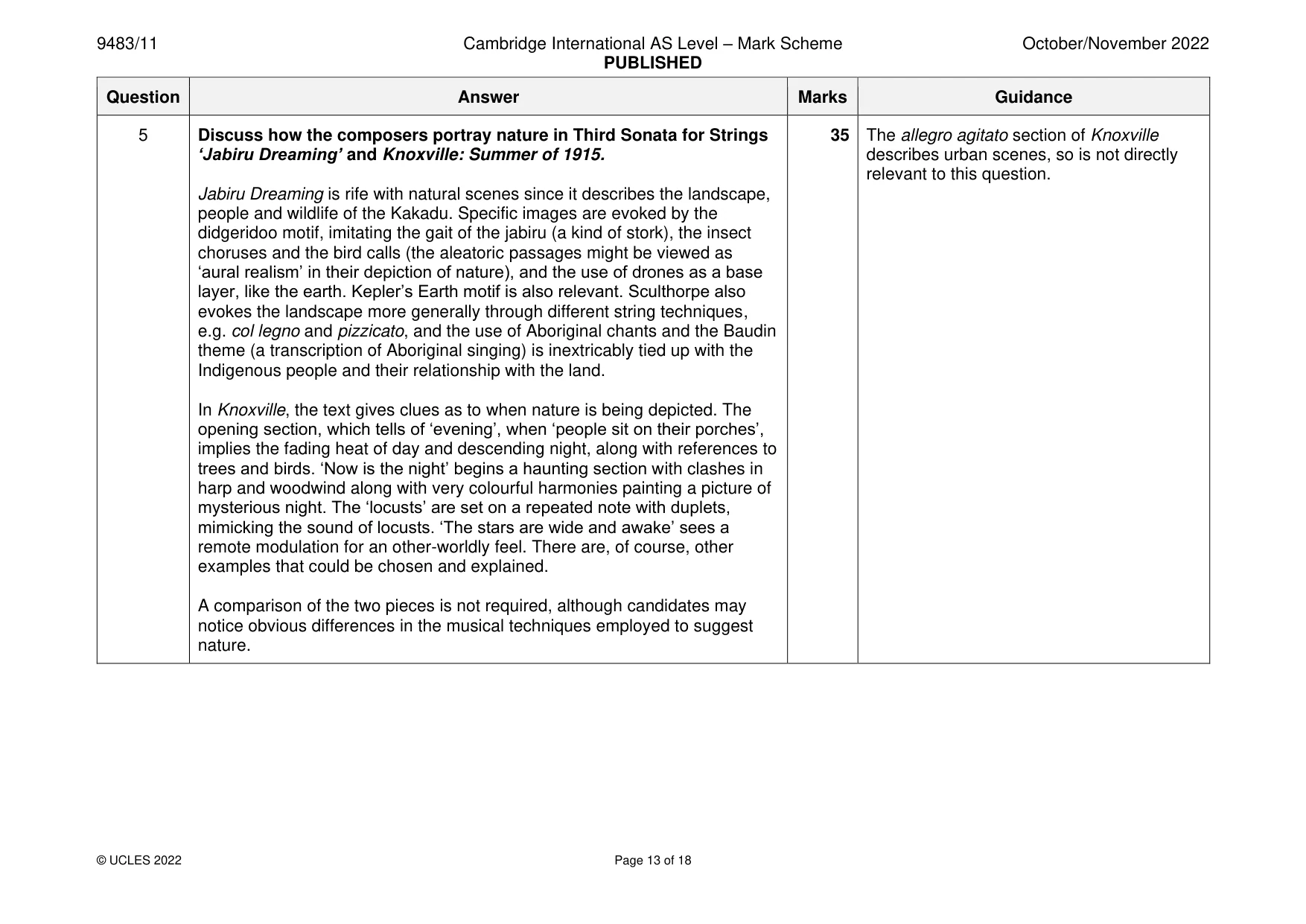
9483/11 Cambridge International AS Level – Mark Scheme PUBLISHED October/November 2022 © UCLES 2022 Page 13 of 18 Question Answer Marks Guidance 5 Discuss how the composers portray nature in Third Sonata for Strings ‘Jabiru Dreaming’ and Knoxville: Summer of 1915. Jabiru Dreaming is rife with natural scenes since it describes the landscape, people and wildlife of the Kakadu. Specific images are evoked by the didgeridoo motif, imitating the gait of the jabiru (a kind of stork), the insect choruses and the bird calls (the aleatoric passages might be viewed as ‘aural realism’ in their depiction of nature), and the use of drones as a base layer, like the earth. Kepler’s Earth motif is also relevant. Sculthorpe also evokes the landscape more generally through different string techniques, e.g. col legno and pizzicato, and the use of Aboriginal chants and the Baudin theme (a transcription of Aboriginal singing) is inextricably tied up with the Indigenous people and their relationship with the land. In Knoxville, the text gives clues as to when nature is being depicted. The opening section, which tells of ‘evening’, when ‘people sit on their porches’, implies the fading heat of day and descending night, along with references to trees and birds. ‘Now is the night’ begins a haunting section with clashes in harp and woodwind along with very colourful harmonies painting a picture of mysterious night. The ‘locusts’ are set on a repeated note with duplets, mimicking the sound of locusts. ‘The stars are wide and awake’ sees a remote modulation for an other-worldly feel. There are, of course, other examples that could be chosen and explained. A comparison of the two pieces is not required, although candidates may notice obvious differences in the musical techniques employed to suggest nature. 35 The allegro agitato section of Knoxville describes urban scenes, so is not directly relevant to this question.
Mark scheme, page 14
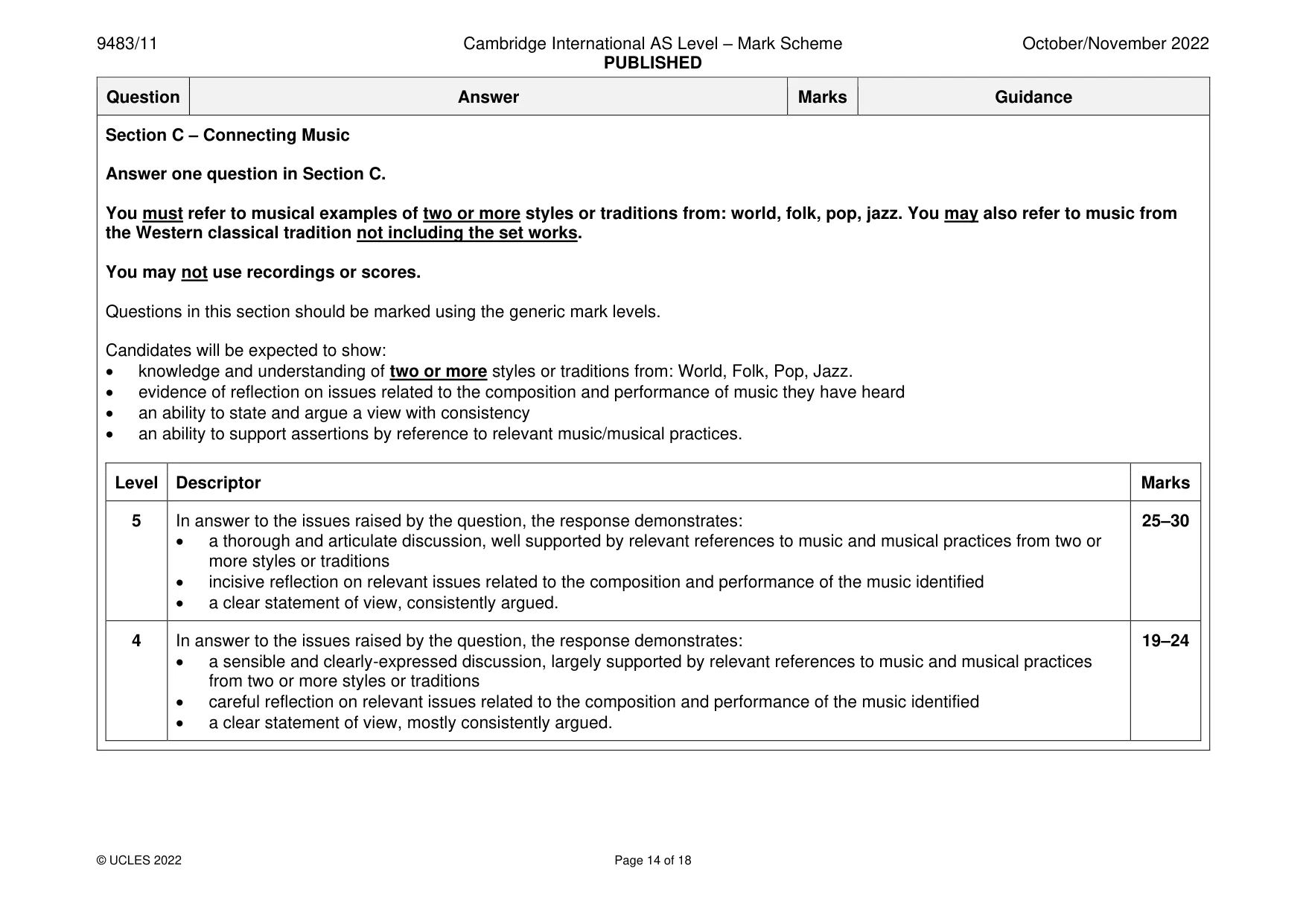
9483/11 Cambridge International AS Level – Mark Scheme PUBLISHED October/November 2022 © UCLES 2022 Page 14 of 18 Question Answer Marks Guidance Section C – Connecting Music Answer one question in Section C. You must refer to musical examples of two or more styles or traditions from: world, folk, pop, jazz. You may also refer to music from the Western classical tradition not including the set works. You may not use recordings or scores. Questions in this section should be marked using the generic mark levels. Candidates will be expected to show: • knowledge and understanding of two or more styles or traditions from: World, Folk, Pop, Jazz. • evidence of reflection on issues related to the composition and performance of music they have heard • an ability to state and argue a view with consistency • an ability to support assertions by reference to relevant music/musical practices. Level Descriptor Marks 5 In answer to the issues raised by the question, the response demonstrates: • a thorough and articulate discussion, well supported by relevant references to music and musical practices from two or more styles or traditions • incisive reflection on relevant issues related to the composition and performance of the music identified • a clear statement of view, consistently argued. 25–30 4 In answer to the issues raised by the question, the response demonstrates: • a sensible and clearly-expressed discussion, largely supported by relevant references to music and musical practices from two or more styles or traditions • careful reflection on relevant issues related to the composition and performance of the music identified • a clear statement of view, mostly consistently argued. 19–24
Mark scheme, page 15
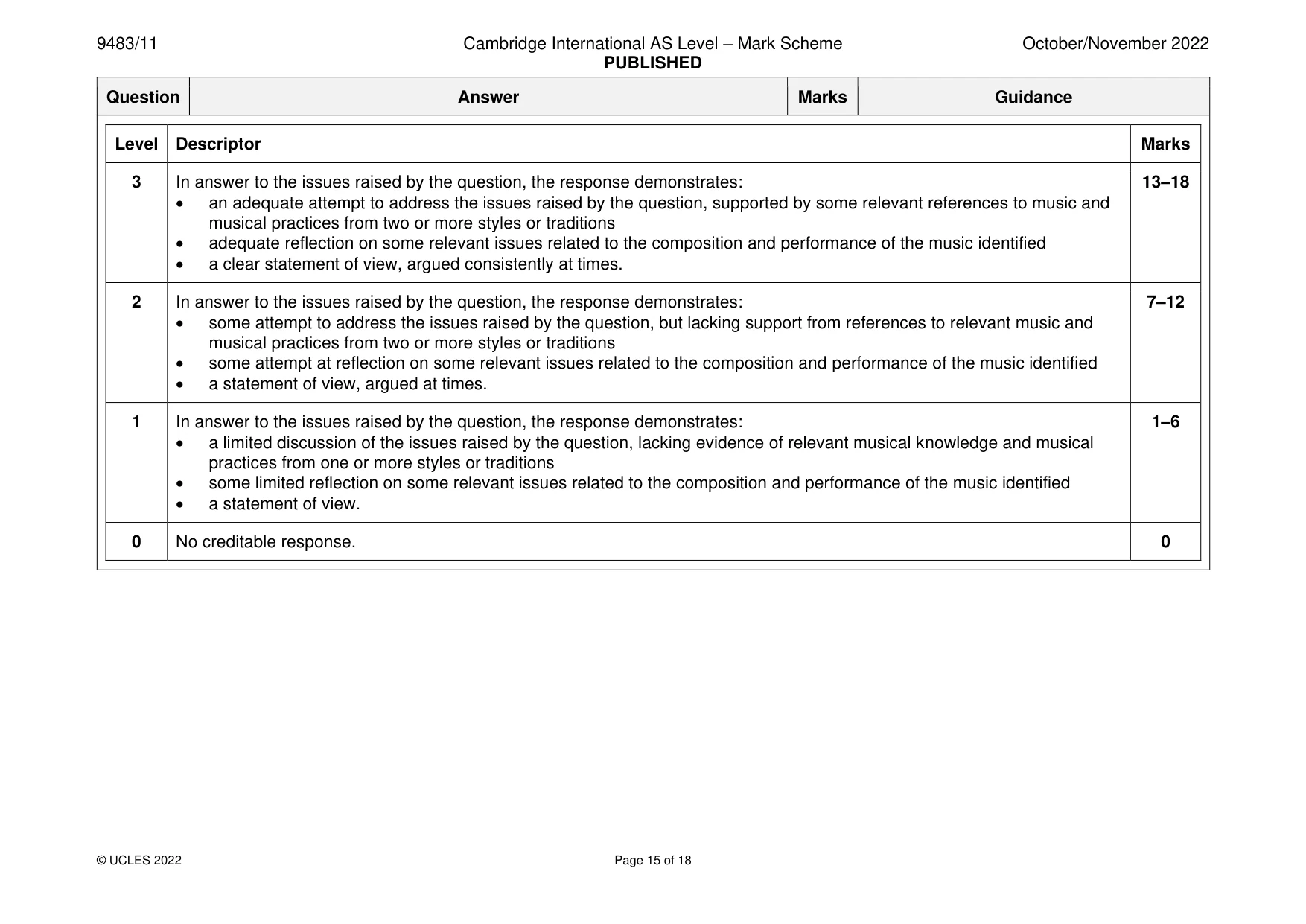
9483/11 Cambridge International AS Level – Mark Scheme PUBLISHED October/November 2022 © UCLES 2022 Page 15 of 18 Question Answer Marks Guidance Level Descriptor Marks 3 In answer to the issues raised by the question, the response demonstrates: • an adequate attempt to address the issues raised by the question, supported by some relevant references to music and musical practices from two or more styles or traditions • adequate reflection on some relevant issues related to the composition and performance of the music identified • a clear statement of view, argued consistently at times. 13–18 2 In answer to the issues raised by the question, the response demonstrates: • some attempt to address the issues raised by the question, but lacking support from references to relevant music and musical practices from two or more styles or traditions • some attempt at reflection on some relevant issues related to the composition and performance of the music identified • a statement of view, argued at times. 7–12 1 In answer to the issues raised by the question, the response demonstrates: • a limited discussion of the issues raised by the question, lacking evidence of relevant musical knowledge and musical practices from one or more styles or traditions • some limited reflection on some relevant issues related to the composition and performance of the music identified • a statement of view. 1–6 0 No creditable response. 0
Mark scheme, page 16
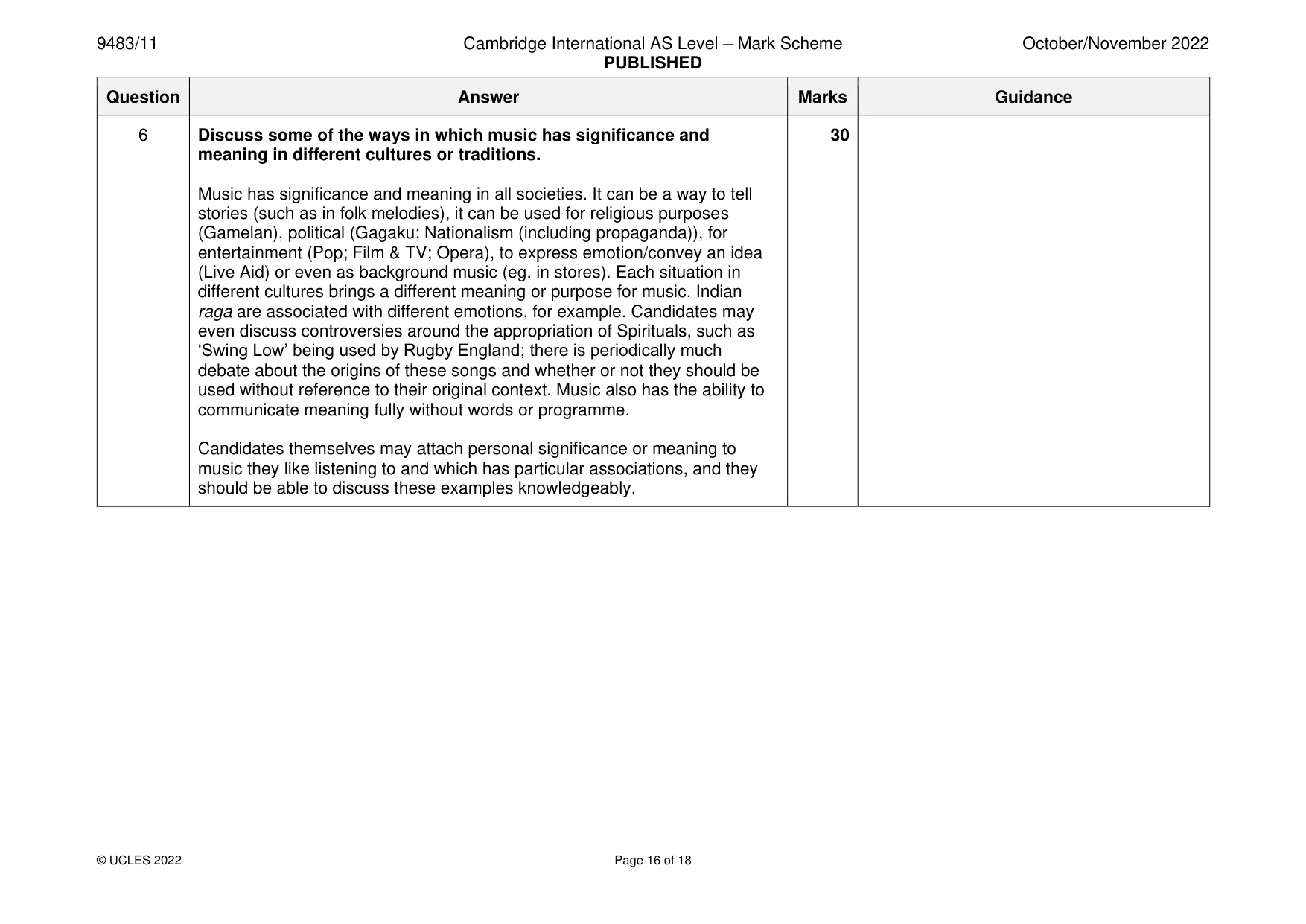
9483/11 Cambridge International AS Level – Mark Scheme PUBLISHED October/November 2022 © UCLES 2022 Page 16 of 18 Question Answer Marks Guidance 6 Discuss some of the ways in which music has significance and meaning in different cultures or traditions. Music has significance and meaning in all societies. It can be a way to tell stories (such as in folk melodies), it can be used for religious purposes (Gamelan), political (Gagaku; Nationalism (including propaganda)), for entertainment (Pop; Film & TV; Opera), to express emotion/convey an idea (Live Aid) or even as background music (eg. in stores). Each situation in different cultures brings a different meaning or purpose for music. Indian raga are associated with different emotions, for example. Candidates may even discuss controversies around the appropriation of Spirituals, such as ‘Swing Low’ being used by Rugby England; there is periodically much debate about the origins of these songs and whether or not they should be used without reference to their original context. Music also has the ability to communicate meaning fully without words or programme. Candidates themselves may attach personal significance or meaning to music they like listening to and which has particular associations, and they should be able to discuss these examples knowledgeably. 30
Mark scheme, page 17
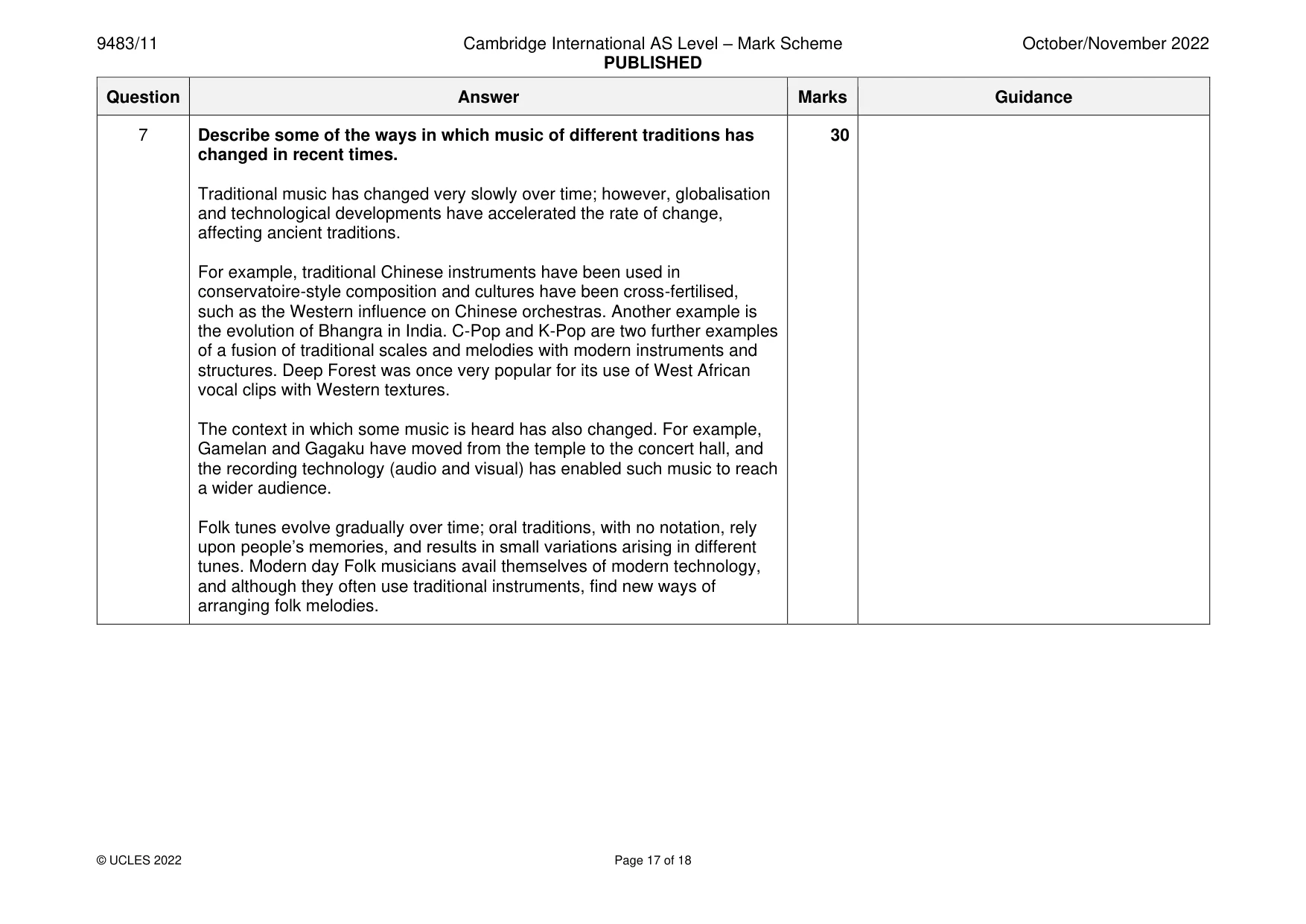
9483/11 Cambridge International AS Level – Mark Scheme PUBLISHED October/November 2022 © UCLES 2022 Page 17 of 18 Question Answer Marks Guidance 7 Describe some of the ways in which music of different traditions has changed in recent times. Traditional music has changed very slowly over time; however, globalisation and technological developments have accelerated the rate of change, affecting ancient traditions. For example, traditional Chinese instruments have been used in conservatoire-style composition and cultures have been cross-fertilised, such as the Western influence on Chinese orchestras. Another example is the evolution of Bhangra in India. C-Pop and K-Pop are two further examples of a fusion of traditional scales and melodies with modern instruments and structures. Deep Forest was once very popular for its use of West African vocal clips with Western textures. The context in which some music is heard has also changed. For example, Gamelan and Gagaku have moved from the temple to the concert hall, and the recording technology (audio and visual) has enabled such music to reach a wider audience. Folk tunes evolve gradually over time; oral traditions, with no notation, rely upon people’s memories, and results in small variations arising in different tunes. Modern day Folk musicians avail themselves of modern technology, and although they often use traditional instruments, find new ways of arranging folk melodies. 30
Mark scheme, page 18
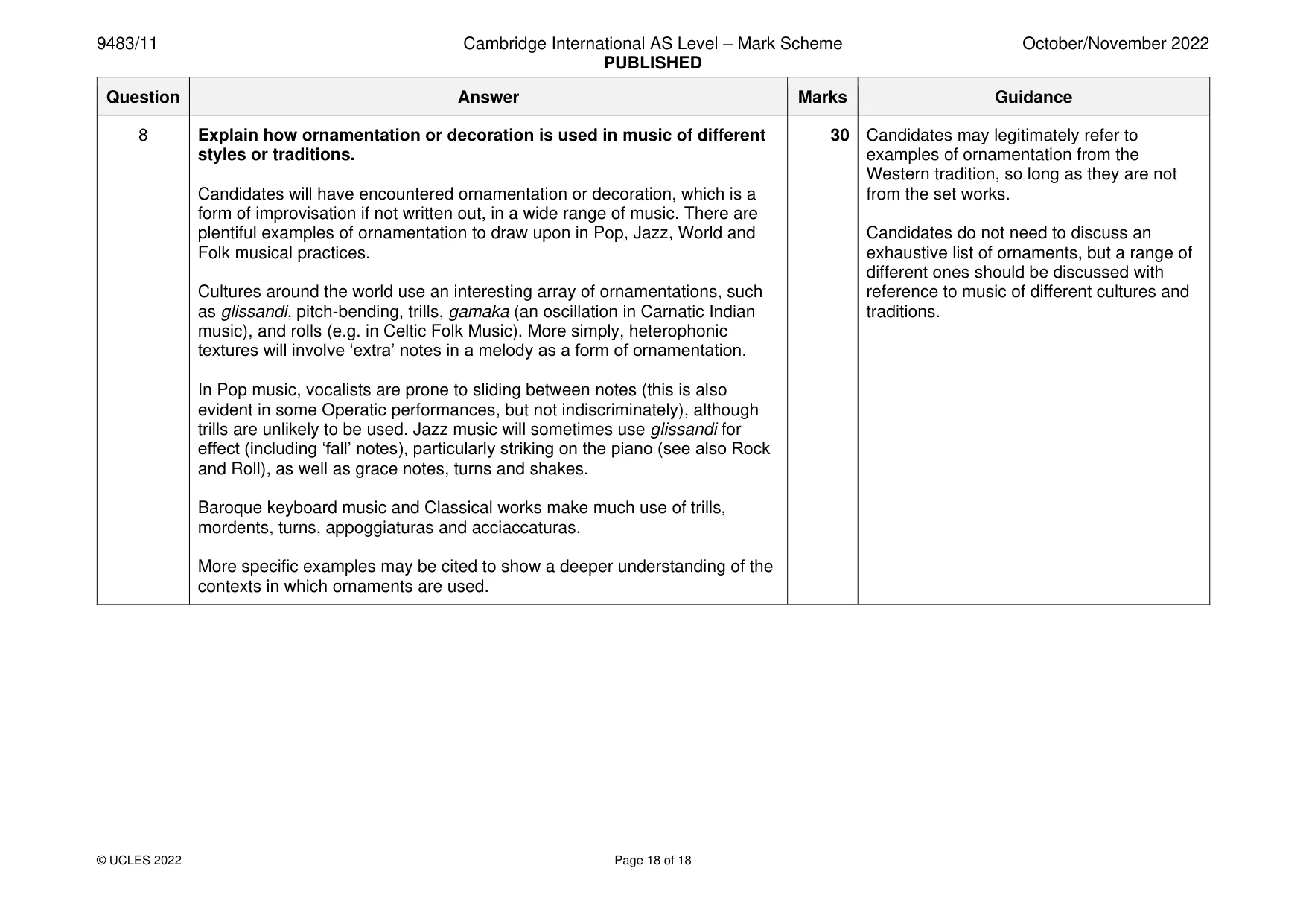
9483/11 Cambridge International AS Level – Mark Scheme PUBLISHED October/November 2022 © UCLES 2022 Page 18 of 18 Question Answer Marks Guidance 8 Explain how ornamentation or decoration is used in music of different styles or traditions. Candidates will have encountered ornamentation or decoration, which is a form of improvisation if not written out, in a wide range of music. There are plentiful examples of ornamentation to draw upon in Pop, Jazz, World and Folk musical practices. Cultures around the world use an interesting array of ornamentations, such as glissandi, pitch-bending, trills, gamaka (an oscillation in Carnatic Indian music), and rolls (e.g. in Celtic Folk Music). More simply, heterophonic textures will involve ‘extra’ notes in a melody as a form of ornamentation. In Pop music, vocalists are prone to sliding between notes (this is also evident in some Operatic performances, but not indiscriminately), although trills are unlikely to be used. Jazz music will sometimes use glissandi for effect (including ‘fall’ notes), particularly striking on the piano (see also Rock and Roll), as well as grace notes, turns and shakes. Baroque keyboard music and Classical works make much use of trills, mordents, turns, appoggiaturas and acciaccaturas. More specific examples may be cited to show a deeper understanding of the contexts in which ornaments are used. 30 Candidates may legitimately refer to examples of ornamentation from the Western tradition, so long as they are not from the set works. Candidates do not need to discuss an exhaustive list of ornaments, but a range of different ones should be discussed with reference to music of different cultures and traditions.
What you needed in this session
Cambridge’s own grade thresholds for 2022 Oct/Nov, Paper 1 · Variant 1. A higher threshold means an easier paper — the bar moves with how the cohort did.