Cambridge A Level Music 9483 — 2023 Oct/Nov Paper 1 · Variant 2
9483/12/O/N/23 · 100 marks · ≈113 min
The question paper and its mark scheme, free to read here and free to download. This is Cambridge’s own paper, exactly as it was sat.
Question paper12 pages






Mark scheme17 pages
Answers below. Sit the paper first if you are practising.
Paper as text
Question paper, page 1
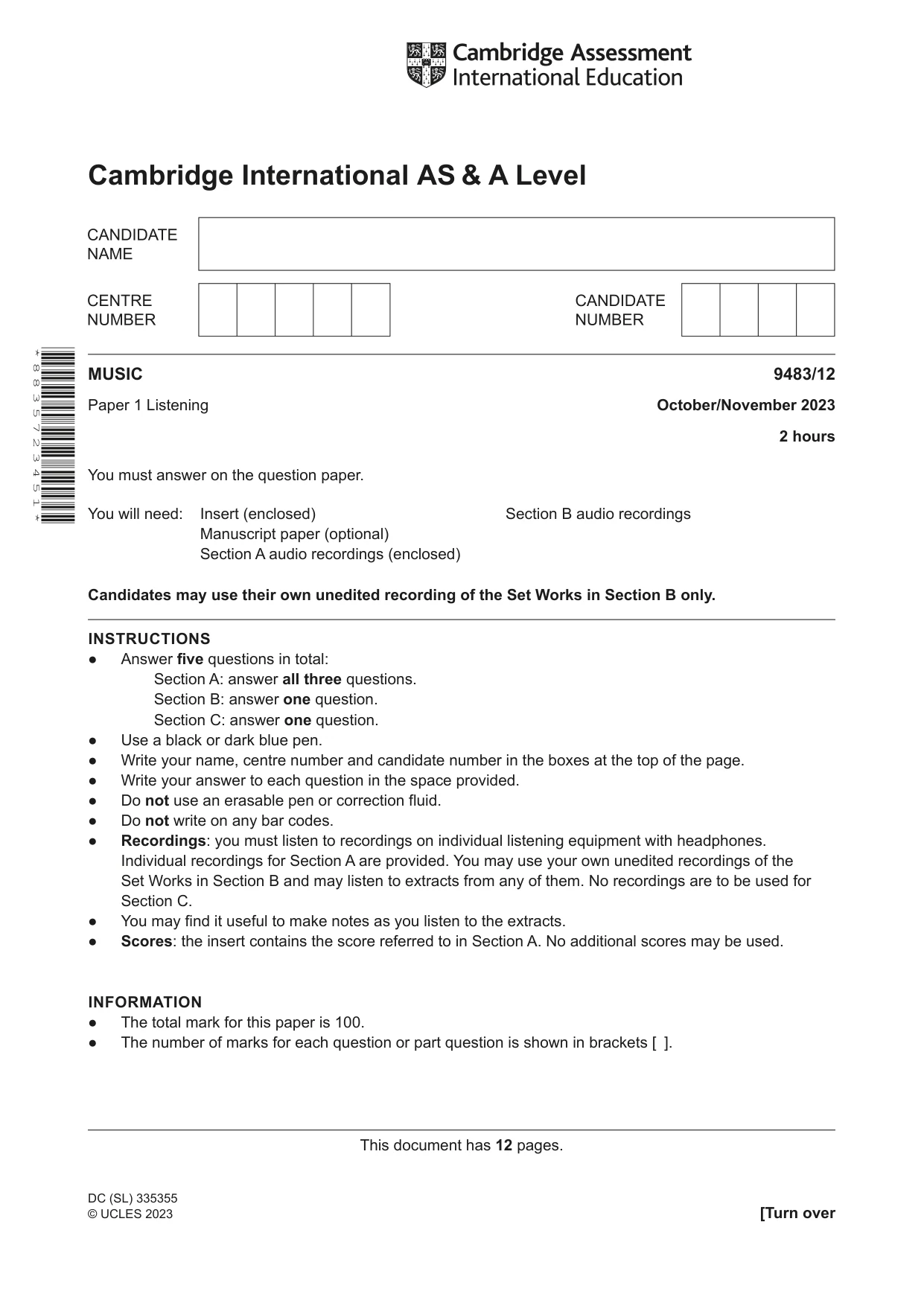
This document has 12 pages. [Turn over Cambridge International AS & A Level DC (SL) 335355 © UCLES 2023 MUSIC 9483/12 Paper 1 Listening October/November 2023 2 hours You must answer on the question paper. You will need: Insert (enclosed) Section B audio recordings Manuscript paper (optional) Section A audio recordings (enclosed) Candidates may use their own unedited recording of the Set Works in Section B only. INSTRUCTIONS ● Answer five questions in total: Section A: answer all three questions. Section B: answer one question. Section C: answer one question. ● Use a black or dark blue pen. ● Write your name, centre number and candidate number in the boxes at the top of the page. ● Write your answer to each question in the space provided. ● Do not use an erasable pen or correction fluid. ● Do not write on any bar codes. ● Recordings: you must listen to recordings on individual listening equipment with headphones. Individual recordings for Section A are provided. You may use your own unedited recordings of the Set Works in Section B and may listen to extracts from any of them. No recordings are to be used for Section C. ● You may find it useful to make notes as you listen to the extracts. ● Scores: the insert contains the score referred to in Section A. No additional scores may be used. INFORMATION ● The total mark for this paper is 100. ● The number of marks for each question or part question is shown in brackets [ ]. * 8 8 3 5 7 2 3 4 5 1 *
Question paper, page 2
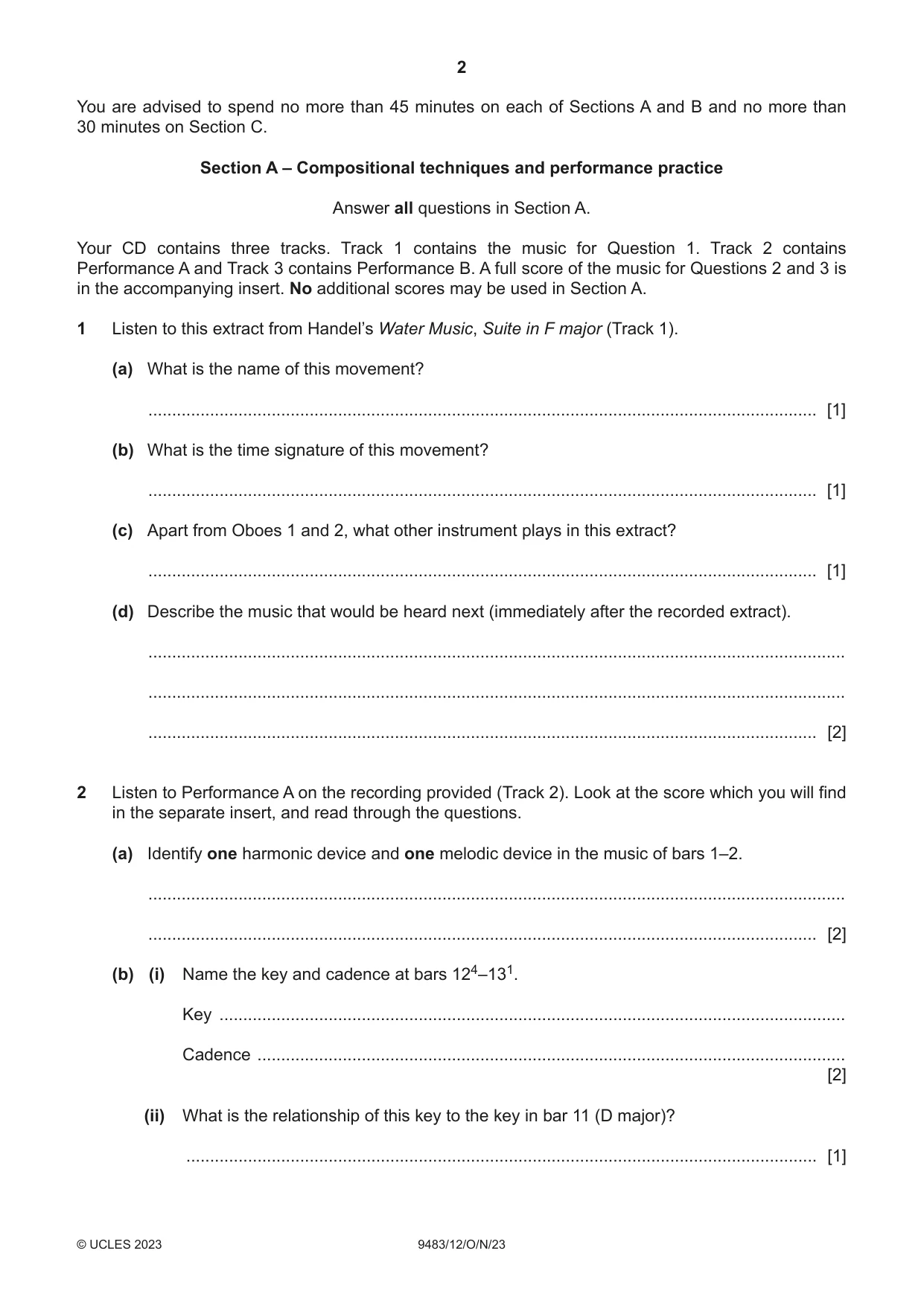
2 9483/12/O/N/23 © UCLES 2023 You are advised to spend no more than 45 minutes on each of Sections A and B and no more than 30 minutes on Section C. Section A – Compositional techniques and performance practice Answer all questions in Section A. Your CD contains three tracks. Track 1 contains the music for Question 1. Track 2 contains Performance A and Track 3 contains Performance B. A full score of the music for Questions 2 and 3 is in the accompanying insert. No additional scores may be used in Section A. 1 Listen to this extract from Handel’s Water Music, Suite in F major (Track 1). (a) What is the name of this movement? … [1] (b) What is the time signature of this movement? … [1] (c) Apart from Oboes 1 and 2, what other instrument plays in this extract? … [1] (d) Describe the music that would be heard next (immediately after the recorded extract). … … … [2] 2 Listen to Performance A on the recording provided (Track 2). Look at the score which you will find in the separate insert, and read through the questions. (a) Identify one harmonic device and one melodic device in the music of bars 1–2. … … [2] (b) (i) Name the key and cadence at bars 124–131. Key … Cadence … [2] (ii) What is the relationship of this key to the key in bar 11 (D major)? … [1]
Question paper, page 3
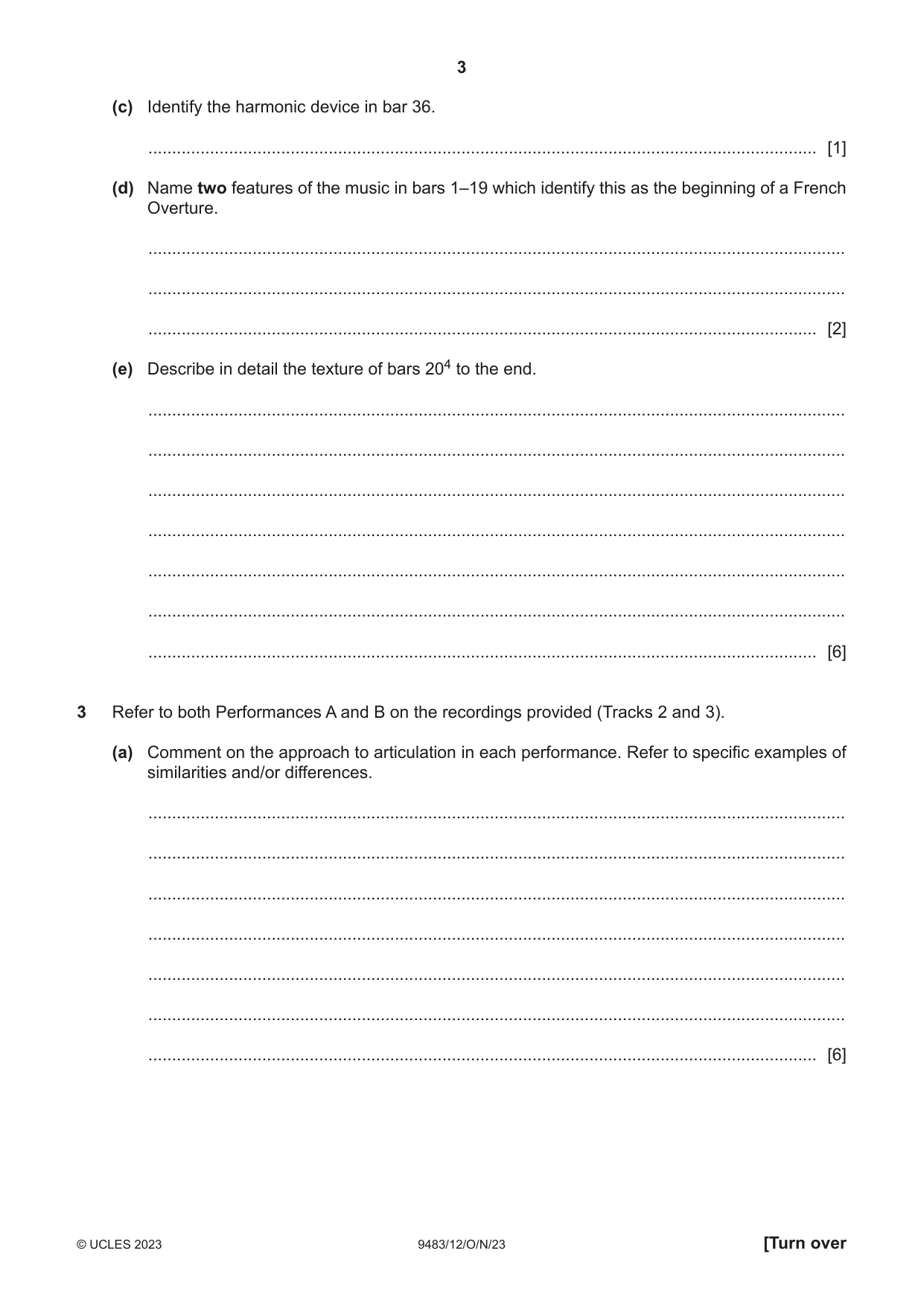
3 9483/12/O/N/23 © UCLES 2023 [Turn over (c) Identify the harmonic device in bar 36. … [1] (d) Name two features of the music in bars 1–19 which identify this as the beginning of a French Overture. … … … [2] (e) Describe in detail the texture of bars 204 to the end. … … … … … … … [6] 3 Refer to both Performances A and B on the recordings provided (Tracks 2 and 3). (a) Comment on the approach to articulation in each performance. Refer to specific examples of similarities and/or differences. … … … … … … … [6]
Question paper, page 4
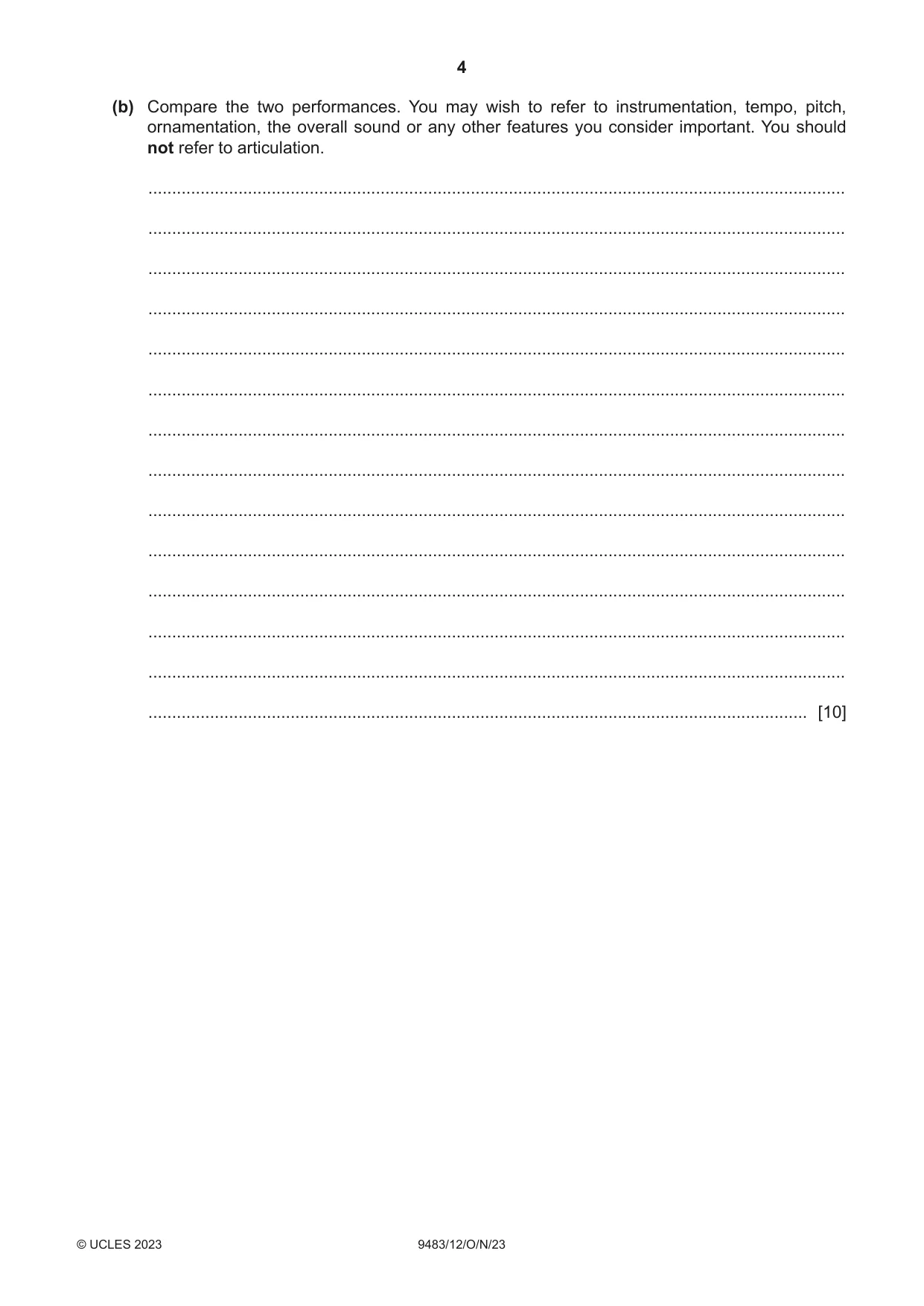
4 9483/12/O/N/23 © UCLES 2023 (b) Compare the two performances. You may wish to refer to instrumentation, tempo, pitch, ornamentation, the overall sound or any other features you consider important. You should not refer to articulation. … … … … … … … … … … … … … … [10]
Question paper, page 5
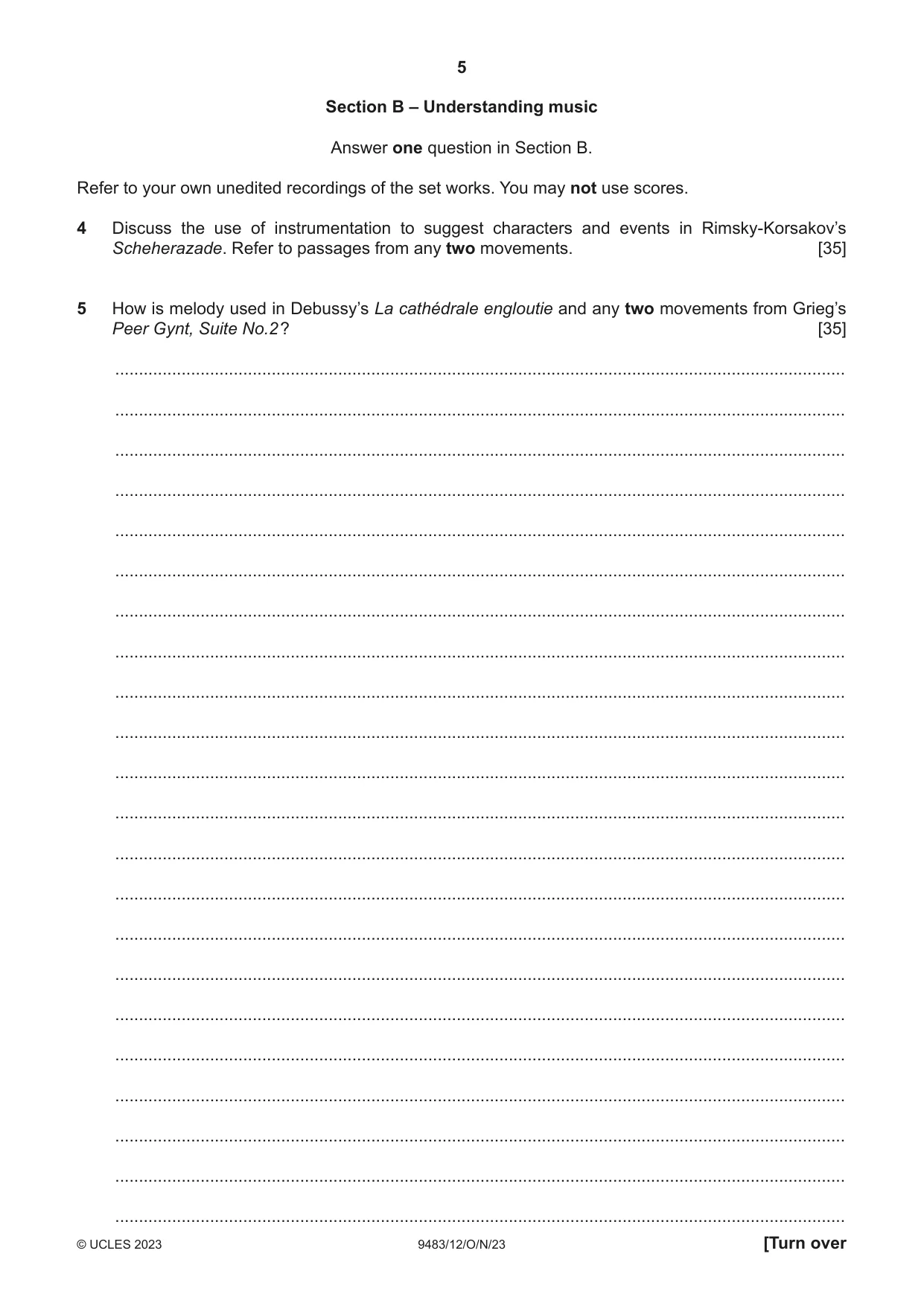
5 9483/12/O/N/23 © UCLES 2023 [Turn over Section B – Understanding music Answer one question in Section B. Refer to your own unedited recordings of the set works. You may not use scores. 4 Discuss the use of instrumentation to suggest characters and events in Rimsky-Korsakov’s Scheherazade. Refer to passages from any two movements. [35] 5 How is melody used in Debussy’s La cathédrale engloutie and any two movements from Grieg’s Peer Gynt, Suite No.2 ? [35] … … … … … … … … … … … … … … … … … … … … … …
Question paper, page 6
6 9483/12/O/N/23 © UCLES 2023 … … … … … … … … … … … … … … … … … … … … … … … … … … … …
Question paper, page 7
7 9483/12/O/N/23 © UCLES 2023 [Turn over … … … … … … … … … … … … … … … … … … … … … … … … … … … …
Question paper, page 8
8 9483/12/O/N/23 © UCLES 2023 … … … … … … … … … … … … … … … … … … … … … … … … … … … …
Question paper, page 9
9 9483/12/O/N/23 © UCLES 2023 [Turn over Section C – Connecting music Answer one question in Section C. You must refer to musical examples of two or more styles or traditions from: world, folk, pop, jazz. You may also refer to music from the Western classical tradition not including the Set Works. You may not use recordings or scores. 6 Explain how contrast can be achieved in vocal music. [30] 7 Discuss the contribution of music to ceremonies and/or celebrations. [30] 8 Is a regular beat or pulse always essential in music? [30] … … … … … … … … … … … … … … … … … … … …
Question paper, page 10
10 9483/12/O/N/23 © UCLES 2023 … … … … … … … … … … … … … … … … … … … … … … … … … … … …
Question paper, page 11
11 9483/12/O/N/23 © UCLES 2023 [Turn over … … … … … … … … … … … … … … … … … … … … … … … … … … … …
Question paper, page 12
12 9483/12/O/N/23 © UCLES 2023 Permission to reproduce items where third-party owned material protected by copyright is included has been sought and cleared where possible. Every reasonable effort has been made by the publisher (UCLES) to trace copyright holders, but if any items requiring clearance have unwittingly been included, the publisher will be pleased to make amends at the earliest possible opportunity. To avoid the issue of disclosure of answer-related information to candidates, all copyright acknowledgements are reproduced online in the Cambridge Assessment International Education Copyright Acknowledgements Booklet. This is produced for each series of examinations and is freely available to download at www.cambridgeinternational.org after the live examination series. Cambridge Assessment International Education is part of Cambridge Assessment. Cambridge Assessment is the brand name of the University of Cambridge Local Examinations Syndicate (UCLES), which is a department of the University of Cambridge. … … … … … … … … … … … … … … … … … … … … … … … …
Mark scheme, page 1
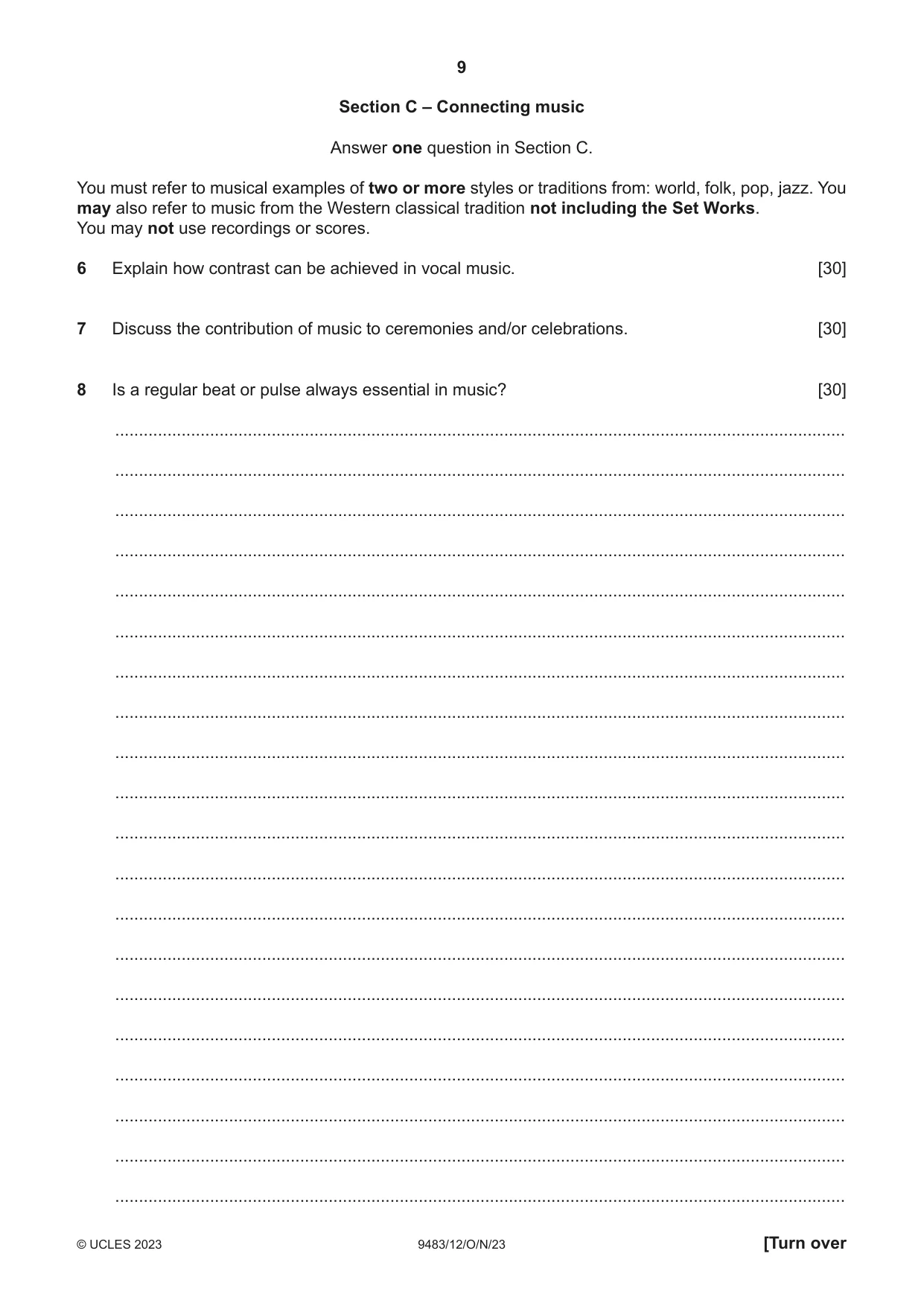
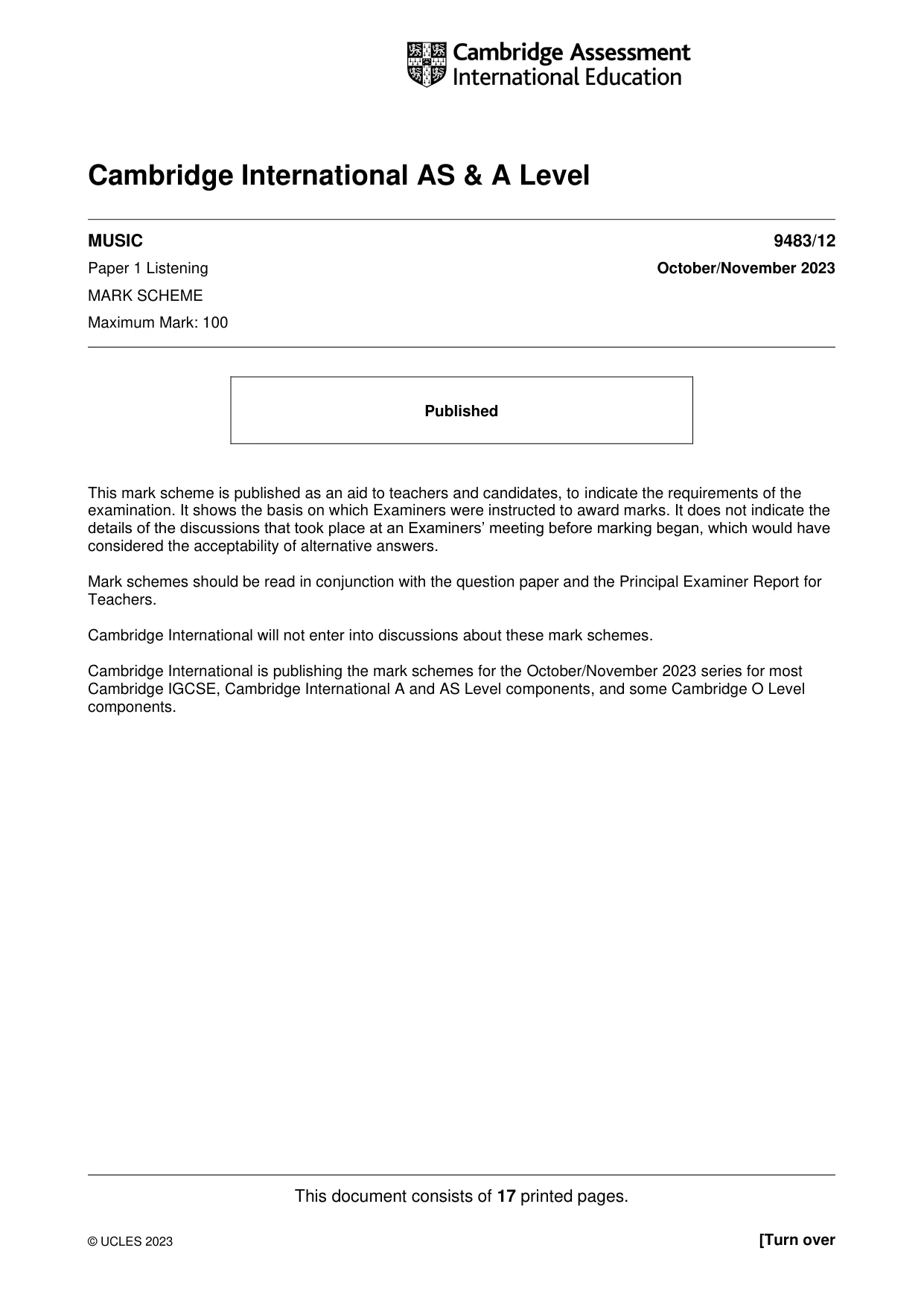
This document consists of 17 printed pages. © UCLES 2023 [Turn over Cambridge International AS & A Level MUSIC 9483/12 Paper 1 Listening October/November 2023 MARK SCHEME Maximum Mark: 100 Published This mark scheme is published as an aid to teachers and candidates, to indicate the requirements of the examination. It shows the basis on which Examiners were instructed to award marks. It does not indicate the details of the discussions that took place at an Examiners’ meeting before marking began, which would have considered the acceptability of alternative answers. Mark schemes should be read in conjunction with the question paper and the Principal Examiner Report for Teachers. Cambridge International will not enter into discussions about these mark schemes. Cambridge International is publishing the mark schemes for the October/November 2023 series for most Cambridge IGCSE, Cambridge International A and AS Level components, and some Cambridge O Level components.
Mark scheme, page 2
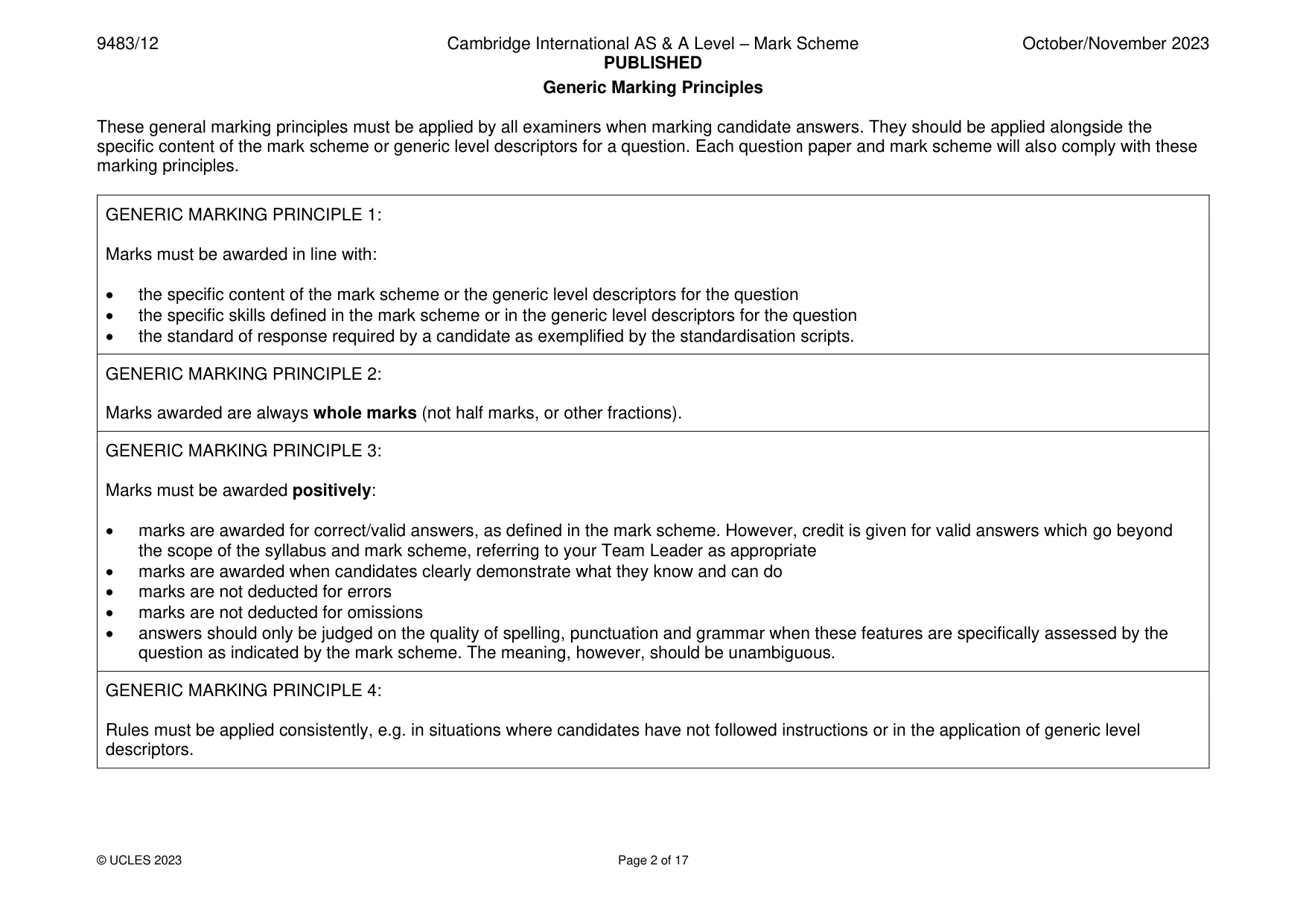
9483/12 Cambridge International AS & A Level – Mark Scheme PUBLISHED October/November 2023 © UCLES 2023 Page 2 of 17 Generic Marking Principles These general marking principles must be applied by all examiners when marking candidate answers. They should be applied alongside the specific content of the mark scheme or generic level descriptors for a question. Each question paper and mark scheme will also comply with these marking principles. GENERIC MARKING PRINCIPLE 1: Marks must be awarded in line with: • the specific content of the mark scheme or the generic level descriptors for the question • the specific skills defined in the mark scheme or in the generic level descriptors for the question • the standard of response required by a candidate as exemplified by the standardisation scripts. GENERIC MARKING PRINCIPLE 2: Marks awarded are always whole marks (not half marks, or other fractions). GENERIC MARKING PRINCIPLE 3: Marks must be awarded positively: • marks are awarded for correct/valid answers, as defined in the mark scheme. However, credit is given for valid answers which go beyond the scope of the syllabus and mark scheme, referring to your Team Leader as appropriate • marks are awarded when candidates clearly demonstrate what they know and can do • marks are not deducted for errors • marks are not deducted for omissions • answers should only be judged on the quality of spelling, punctuation and grammar when these features are specifically assessed by the question as indicated by the mark scheme. The meaning, however, should be unambiguous. GENERIC MARKING PRINCIPLE 4: Rules must be applied consistently, e.g. in situations where candidates have not followed instructions or in the application of generic level descriptors.
Mark scheme, page 3
9483/12 Cambridge International AS & A Level – Mark Scheme PUBLISHED October/November 2023 © UCLES 2023 Page 3 of 17 GENERIC MARKING PRINCIPLE 5: Marks should be awarded using the full range of marks defined in the mark scheme for the question (however; the use of the full mark range may be limited according to the quality of the candidate responses seen). GENERIC MARKING PRINCIPLE 6: Marks awarded are based solely on the requirements as defined in the mark scheme. Marks should not be awarded with grade thresholds or grade descriptors in mind.
Mark scheme, page 4
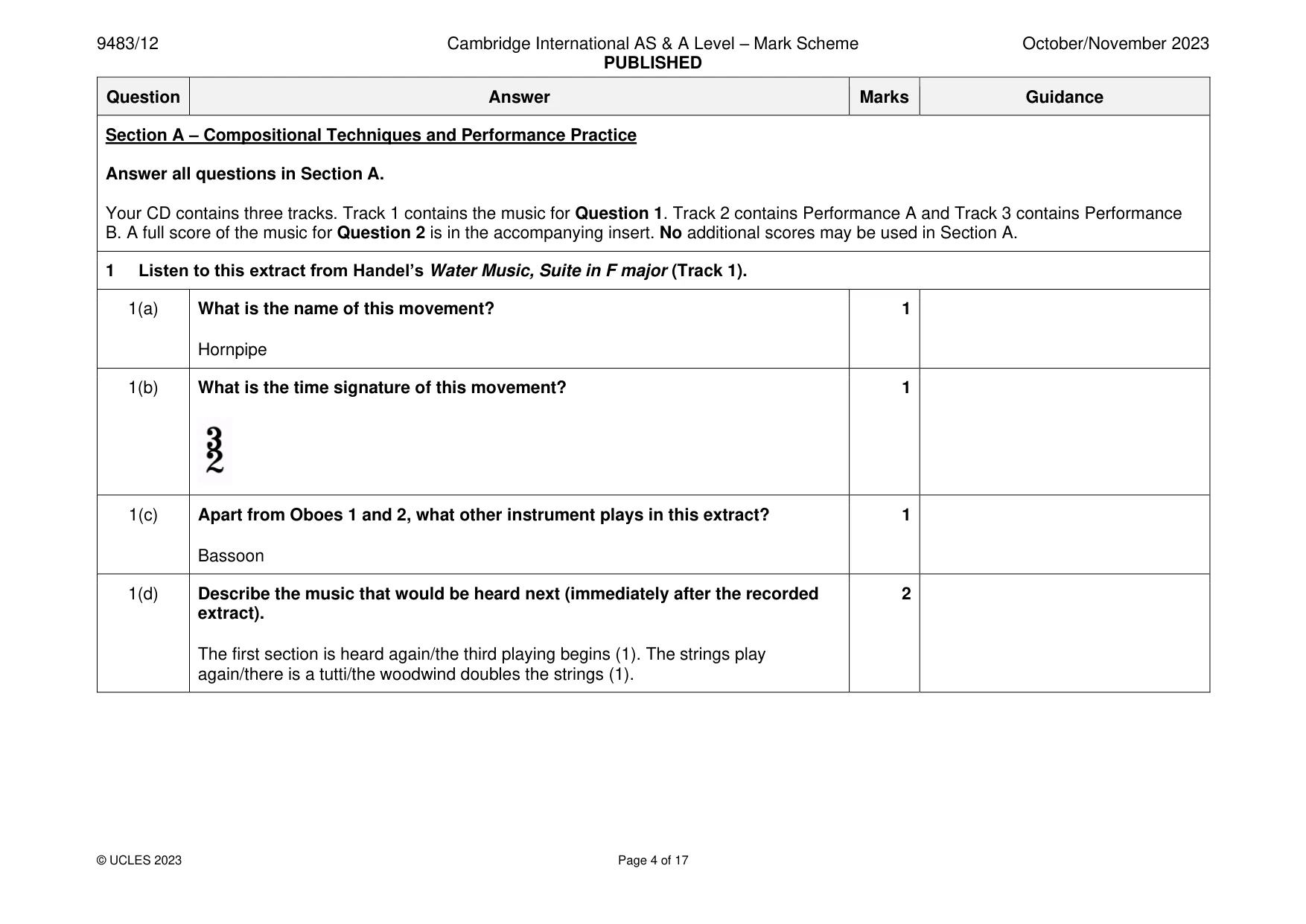
9483/12 Cambridge International AS & A Level – Mark Scheme PUBLISHED October/November 2023 © UCLES 2023 Page 4 of 17 Question Answer Marks Guidance Section A – Compositional Techniques and Performance Practice Answer all questions in Section A. Your CD contains three tracks. Track 1 contains the music for Question 1. Track 2 contains Performance A and Track 3 contains Performance B. A full score of the music for Question 2 is in the accompanying insert. No additional scores may be used in Section A. 1 Listen to this extract from Handel’s Water Music, Suite in F major (Track 1). 1(a) What is the name of this movement? Hornpipe 1 1(b) What is the time signature of this movement? 1 1(c) Apart from Oboes 1 and 2, what other instrument plays in this extract? Bassoon 1 1(d) Describe the music that would be heard next (immediately after the recorded extract). The first section is heard again/the third playing begins (1). The strings play again/there is a tutti/the woodwind doubles the strings (1). 2
Mark scheme, page 5
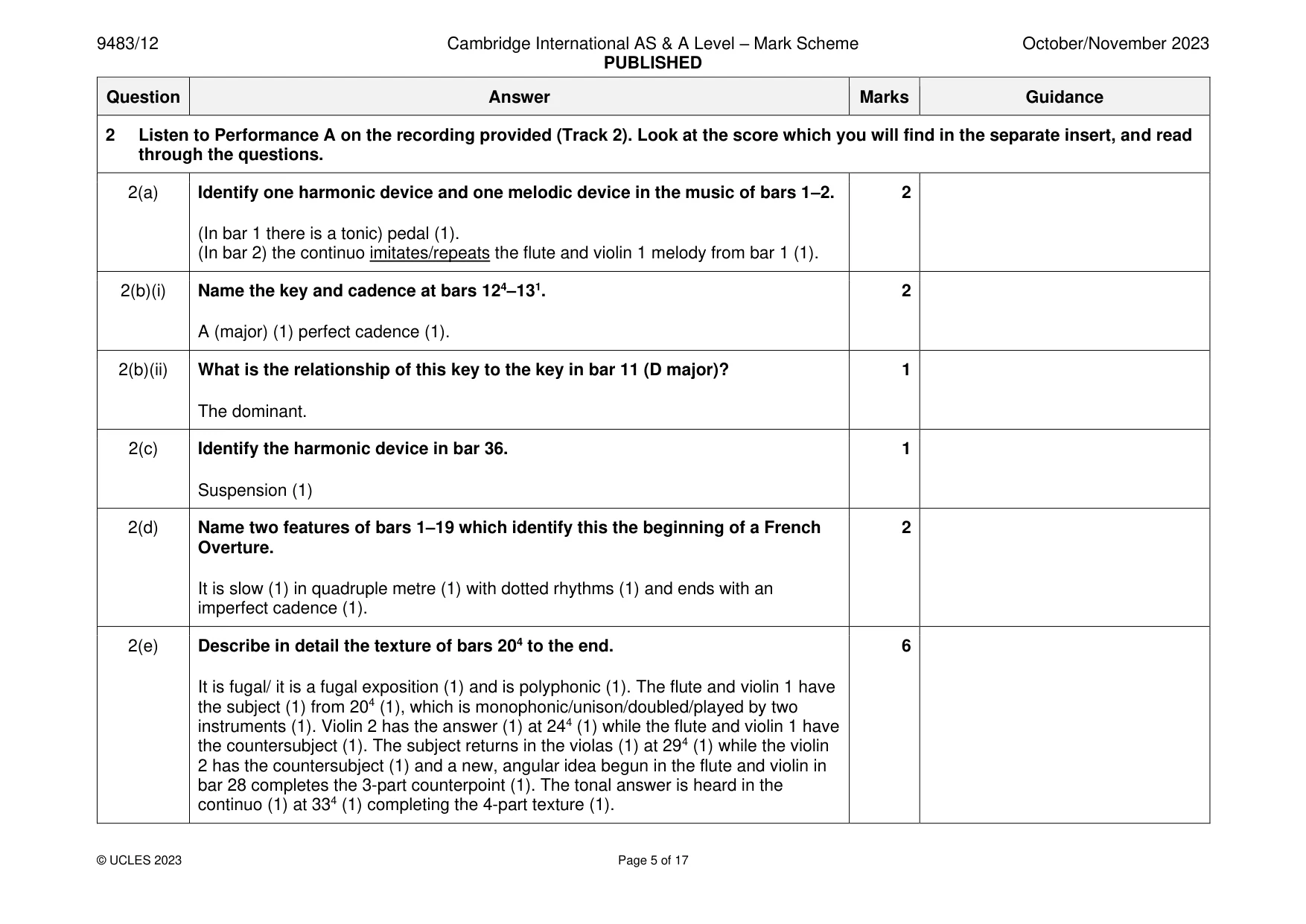
9483/12 Cambridge International AS & A Level – Mark Scheme PUBLISHED October/November 2023 © UCLES 2023 Page 5 of 17 Question Answer Marks Guidance 2 Listen to Performance A on the recording provided (Track 2). Look at the score which you will find in the separate insert, and read through the questions. 2(a) Identify one harmonic device and one melodic device in the music of bars 1–2. (In bar 1 there is a tonic) pedal (1). (In bar 2) the continuo imitates/repeats the flute and violin 1 melody from bar 1 (1). 2 2(b)(i) Name the key and cadence at bars 124–131. A (major) (1) perfect cadence (1). 2 2(b)(ii) What is the relationship of this key to the key in bar 11 (D major)? The dominant. 1 2(c) Identify the harmonic device in bar 36. Suspension (1) 1 2(d) Name two features of bars 1–19 which identify this the beginning of a French Overture. It is slow (1) in quadruple metre (1) with dotted rhythms (1) and ends with an imperfect cadence (1). 2 2(e) Describe in detail the texture of bars 204 to the end. It is fugal/ it is a fugal exposition (1) and is polyphonic (1). The flute and violin 1 have the subject (1) from 204 (1), which is monophonic/unison/doubled/played by two instruments (1). Violin 2 has the answer (1) at 244 (1) while the flute and violin 1 have the countersubject (1). The subject returns in the violas (1) at 294 (1) while the violin 2 has the countersubject (1) and a new, angular idea begun in the flute and violin in bar 28 completes the 3-part counterpoint (1). The tonal answer is heard in the continuo (1) at 334 (1) completing the 4-part texture (1). 6
Mark scheme, page 6
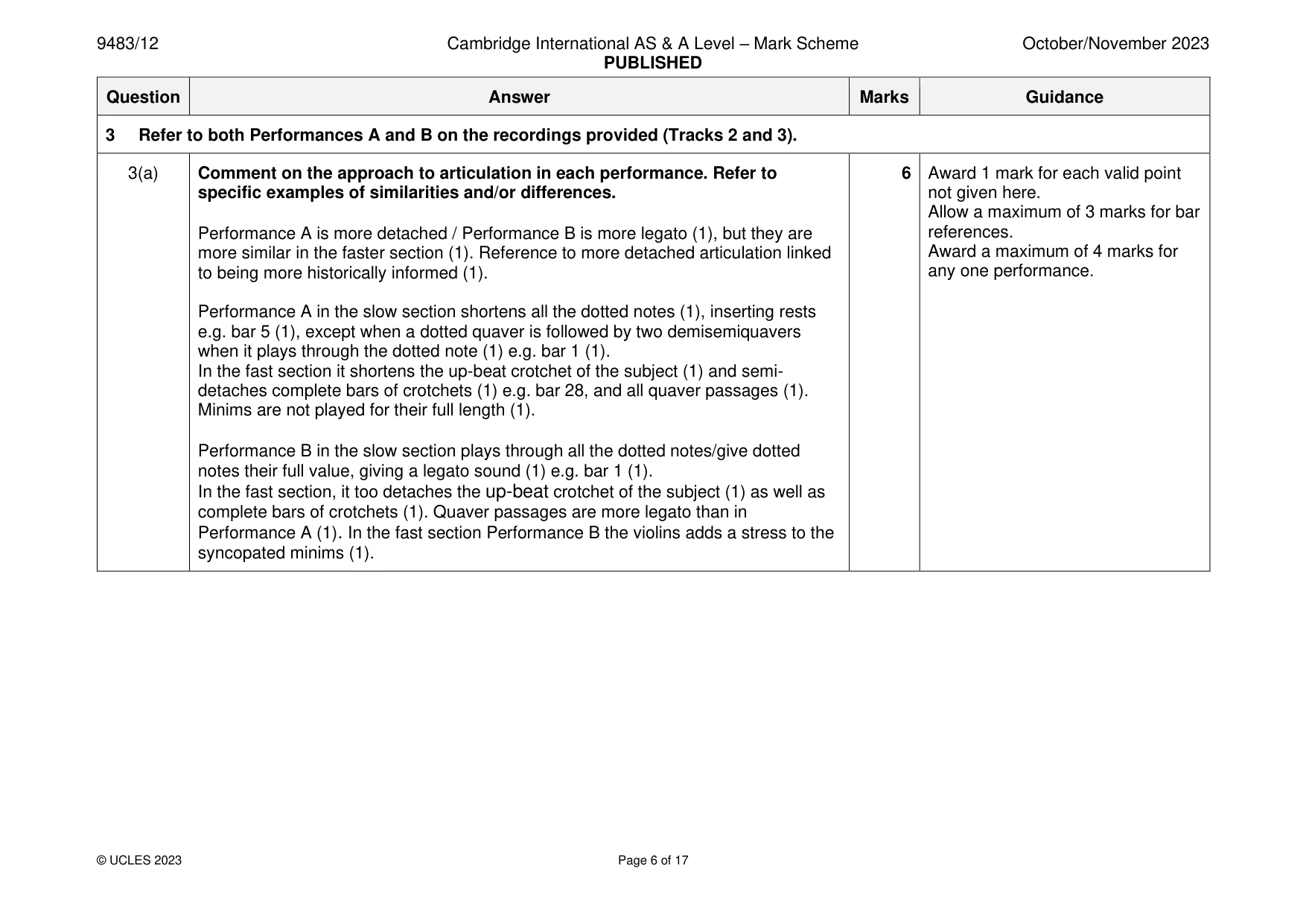
9483/12 Cambridge International AS & A Level – Mark Scheme PUBLISHED October/November 2023 © UCLES 2023 Page 6 of 17 Question Answer Marks Guidance 3 Refer to both Performances A and B on the recordings provided (Tracks 2 and 3). 3(a) Comment on the approach to articulation in each performance. Refer to specific examples of similarities and/or differences. Performance A is more detached / Performance B is more legato (1), but they are more similar in the faster section (1). Reference to more detached articulation linked to being more historically informed (1). Performance A in the slow section shortens all the dotted notes (1), inserting rests e.g. bar 5 (1), except when a dotted quaver is followed by two demisemiquavers when it plays through the dotted note (1) e.g. bar 1 (1). In the fast section it shortens the up-beat crotchet of the subject (1) and semi- detaches complete bars of crotchets (1) e.g. bar 28, and all quaver passages (1). Minims are not played for their full length (1). Performance B in the slow section plays through all the dotted notes/give dotted notes their full value, giving a legato sound (1) e.g. bar 1 (1). In the fast section, it too detaches the up-beat crotchet of the subject (1) as well as complete bars of crotchets (1). Quaver passages are more legato than in Performance A (1). In the fast section Performance B the violins adds a stress to the syncopated minims (1). 6 Award 1 mark for each valid point not given here. Allow a maximum of 3 marks for bar references. Award a maximum of 4 marks for any one performance.
Mark scheme, page 7
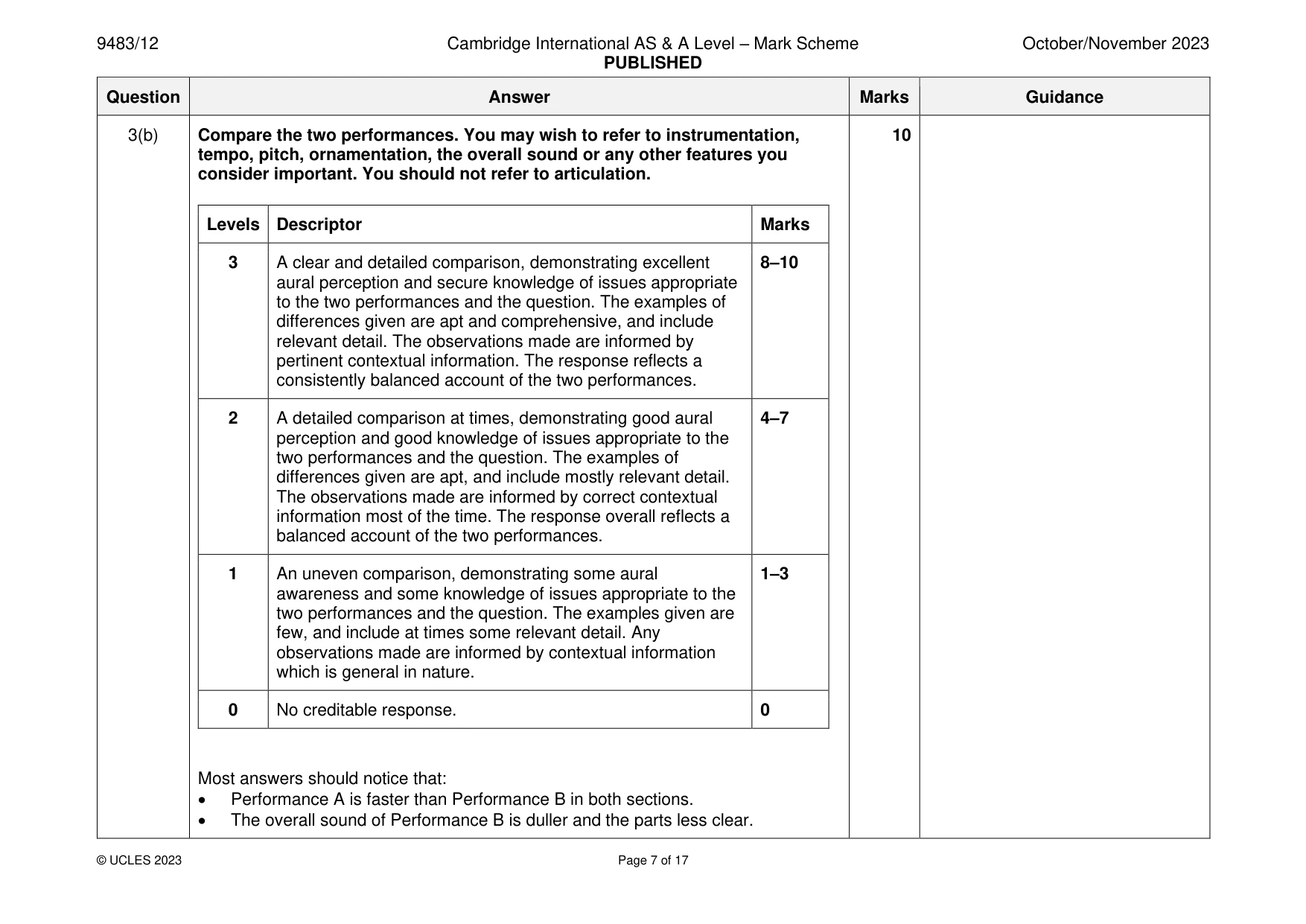
9483/12 Cambridge International AS & A Level – Mark Scheme PUBLISHED October/November 2023 © UCLES 2023 Page 7 of 17 Question Answer Marks Guidance 3(b) Compare the two performances. You may wish to refer to instrumentation, tempo, pitch, ornamentation, the overall sound or any other features you consider important. You should not refer to articulation. Levels Descriptor Marks 3 A clear and detailed comparison, demonstrating excellent aural perception and secure knowledge of issues appropriate to the two performances and the question. The examples of differences given are apt and comprehensive, and include relevant detail. The observations made are informed by pertinent contextual information. The response reflects a consistently balanced account of the two performances. 8–10 2 A detailed comparison at times, demonstrating good aural perception and good knowledge of issues appropriate to the two performances and the question. The examples of differences given are apt, and include mostly relevant detail. The observations made are informed by correct contextual information most of the time. The response overall reflects a balanced account of the two performances. 4–7 1 An uneven comparison, demonstrating some aural awareness and some knowledge of issues appropriate to the two performances and the question. The examples given are few, and include at times some relevant detail. Any observations made are informed by contextual information which is general in nature. 1–3 0 No creditable response. 0 Most answers should notice that: • Performance A is faster than Performance B in both sections. • The overall sound of Performance B is duller and the parts less clear. 10
Mark scheme, page 8
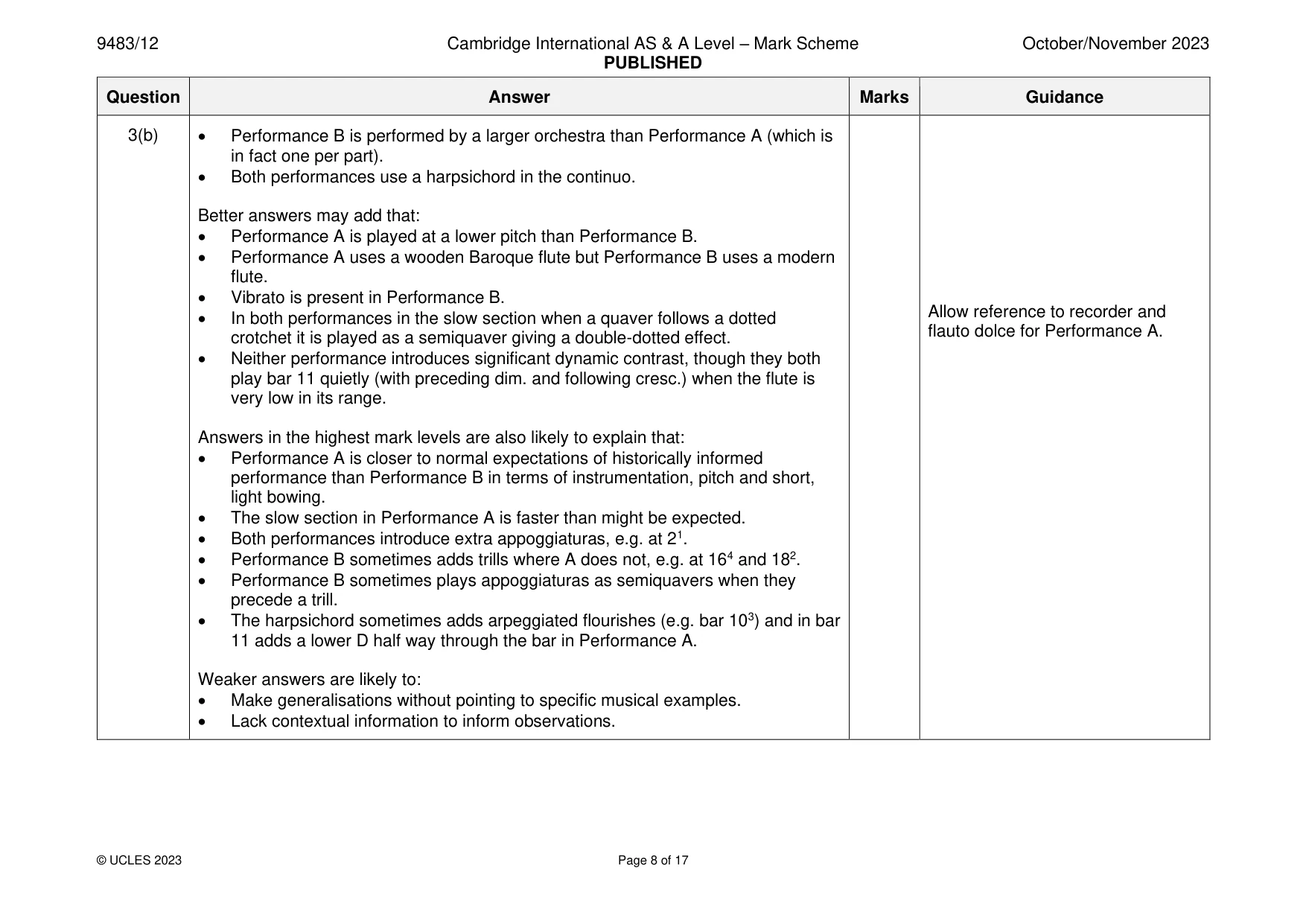
9483/12 Cambridge International AS & A Level – Mark Scheme PUBLISHED October/November 2023 © UCLES 2023 Page 8 of 17 Question Answer Marks Guidance 3(b) • Performance B is performed by a larger orchestra than Performance A (which is in fact one per part). • Both performances use a harpsichord in the continuo. Better answers may add that: • Performance A is played at a lower pitch than Performance B. • Performance A uses a wooden Baroque flute but Performance B uses a modern flute. • Vibrato is present in Performance B. • In both performances in the slow section when a quaver follows a dotted crotchet it is played as a semiquaver giving a double-dotted effect. • Neither performance introduces significant dynamic contrast, though they both play bar 11 quietly (with preceding dim. and following cresc.) when the flute is very low in its range. Answers in the highest mark levels are also likely to explain that: • Performance A is closer to normal expectations of historically informed performance than Performance B in terms of instrumentation, pitch and short, light bowing. • The slow section in Performance A is faster than might be expected. • Both performances introduce extra appoggiaturas, e.g. at 21. • Performance B sometimes adds trills where A does not, e.g. at 164 and 182. • Performance B sometimes plays appoggiaturas as semiquavers when they precede a trill. • The harpsichord sometimes adds arpeggiated flourishes (e.g. bar 103) and in bar 11 adds a lower D half way through the bar in Performance A. Weaker answers are likely to: • Make generalisations without pointing to specific musical examples. • Lack contextual information to inform observations. Allow reference to recorder and flauto dolce for Performance A.
Mark scheme, page 9
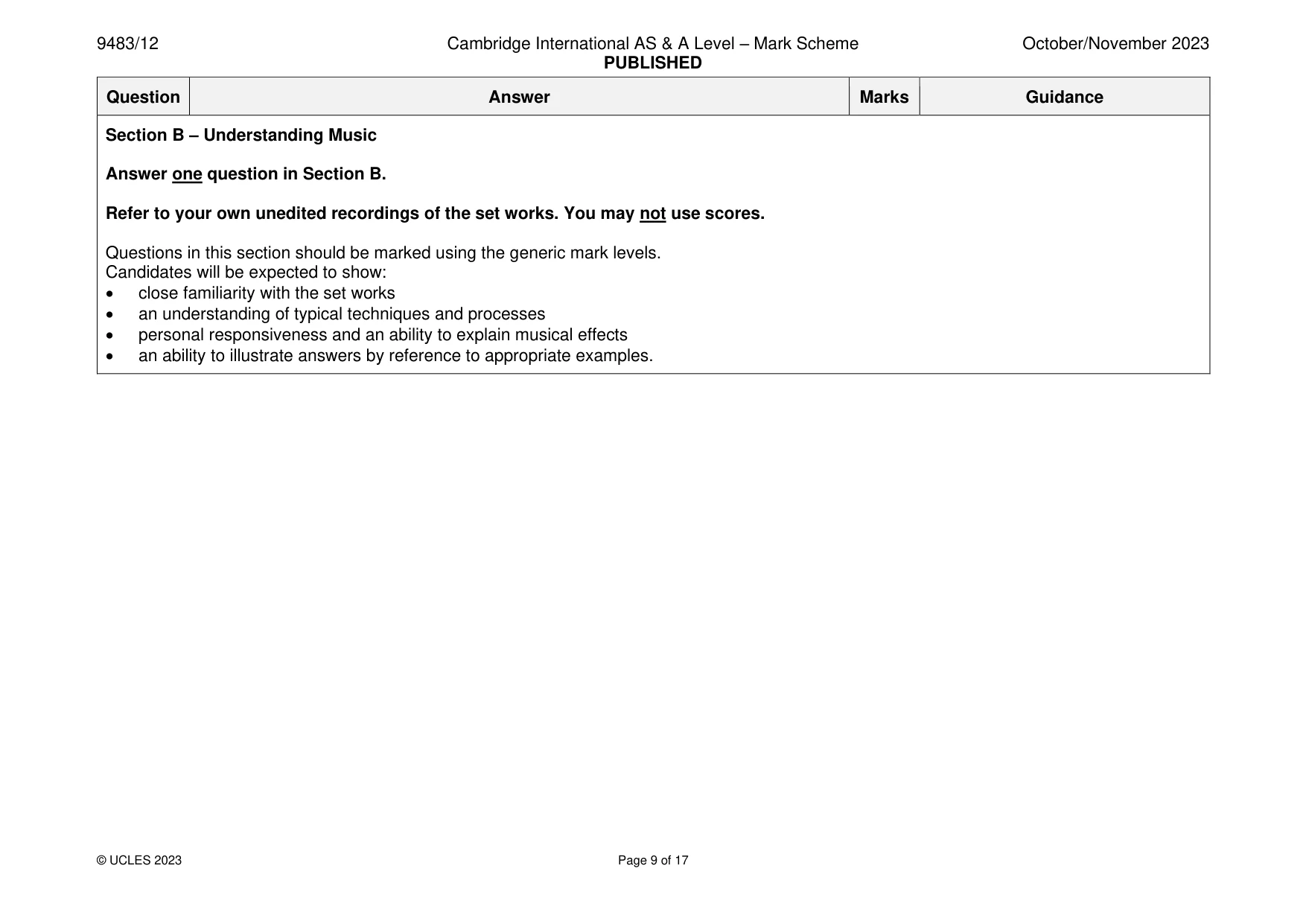
9483/12 Cambridge International AS & A Level – Mark Scheme PUBLISHED October/November 2023 © UCLES 2023 Page 9 of 17 Question Answer Marks Guidance Section B – Understanding Music Answer one question in Section B. Refer to your own unedited recordings of the set works. You may not use scores. Questions in this section should be marked using the generic mark levels. Candidates will be expected to show: • close familiarity with the set works • an understanding of typical techniques and processes • personal responsiveness and an ability to explain musical effects • an ability to illustrate answers by reference to appropriate examples.
Mark scheme, page 10
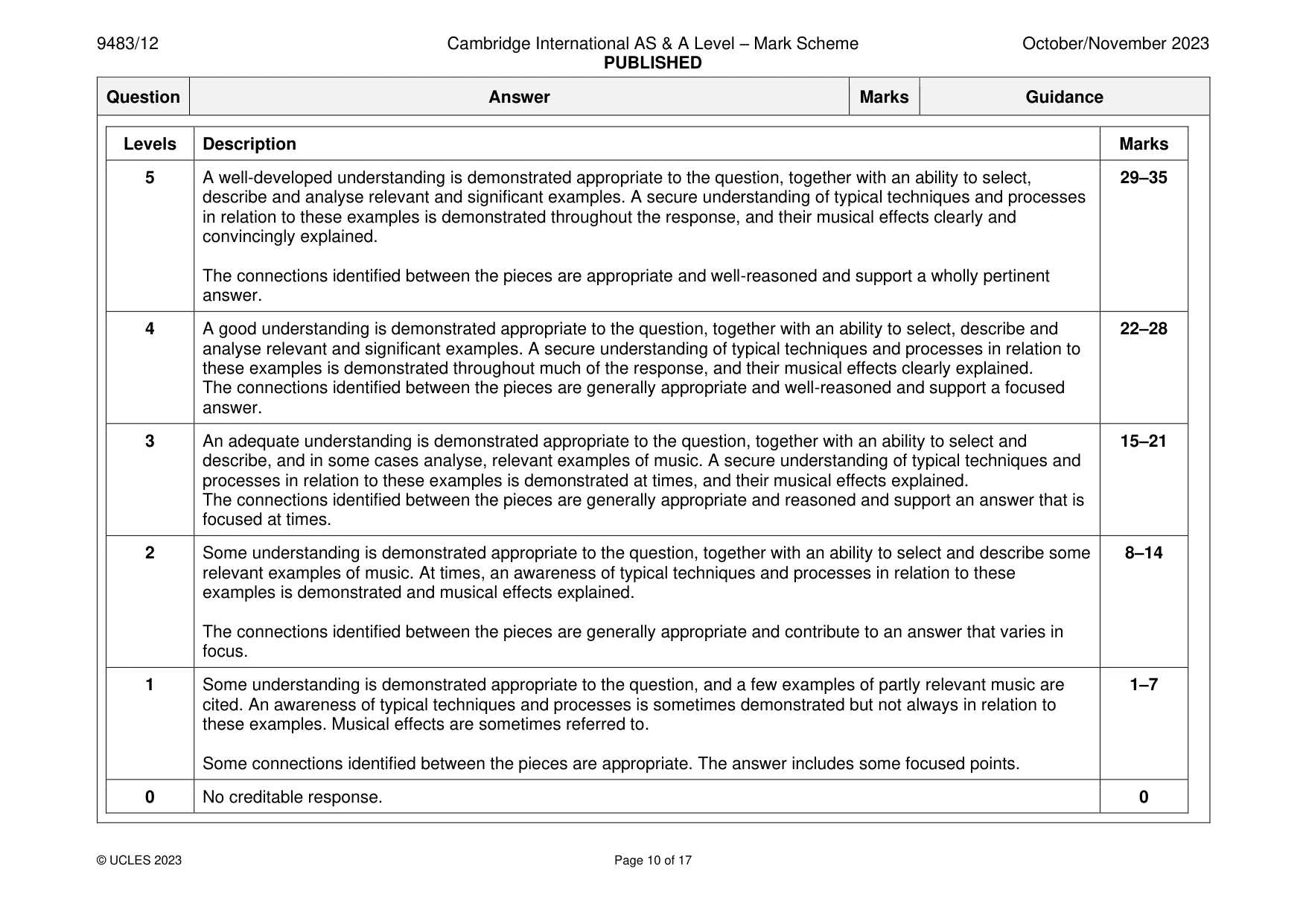
9483/12 Cambridge International AS & A Level – Mark Scheme PUBLISHED October/November 2023 © UCLES 2023 Page 10 of 17 Question Answer Marks Guidance Levels Description Marks 5 A well-developed understanding is demonstrated appropriate to the question, together with an ability to select, describe and analyse relevant and significant examples. A secure understanding of typical techniques and processes in relation to these examples is demonstrated throughout the response, and their musical effects clearly and convincingly explained. The connections identified between the pieces are appropriate and well-reasoned and support a wholly pertinent answer. 29–35 4 A good understanding is demonstrated appropriate to the question, together with an ability to select, describe and analyse relevant and significant examples. A secure understanding of typical techniques and processes in relation to these examples is demonstrated throughout much of the response, and their musical effects clearly explained. The connections identified between the pieces are generally appropriate and well-reasoned and support a focused answer. 22–28 3 An adequate understanding is demonstrated appropriate to the question, together with an ability to select and describe, and in some cases analyse, relevant examples of music. A secure understanding of typical techniques and processes in relation to these examples is demonstrated at times, and their musical effects explained. The connections identified between the pieces are generally appropriate and reasoned and support an answer that is focused at times. 15–21 2 Some understanding is demonstrated appropriate to the question, together with an ability to select and describe some relevant examples of music. At times, an awareness of typical techniques and processes in relation to these examples is demonstrated and musical effects explained. The connections identified between the pieces are generally appropriate and contribute to an answer that varies in focus. 8–14 1 Some understanding is demonstrated appropriate to the question, and a few examples of partly relevant music are cited. An awareness of typical techniques and processes is sometimes demonstrated but not always in relation to these examples. Musical effects are sometimes referred to. Some connections identified between the pieces are appropriate. The answer includes some focused points. 1–7 0 No creditable response. 0
Mark scheme, page 11
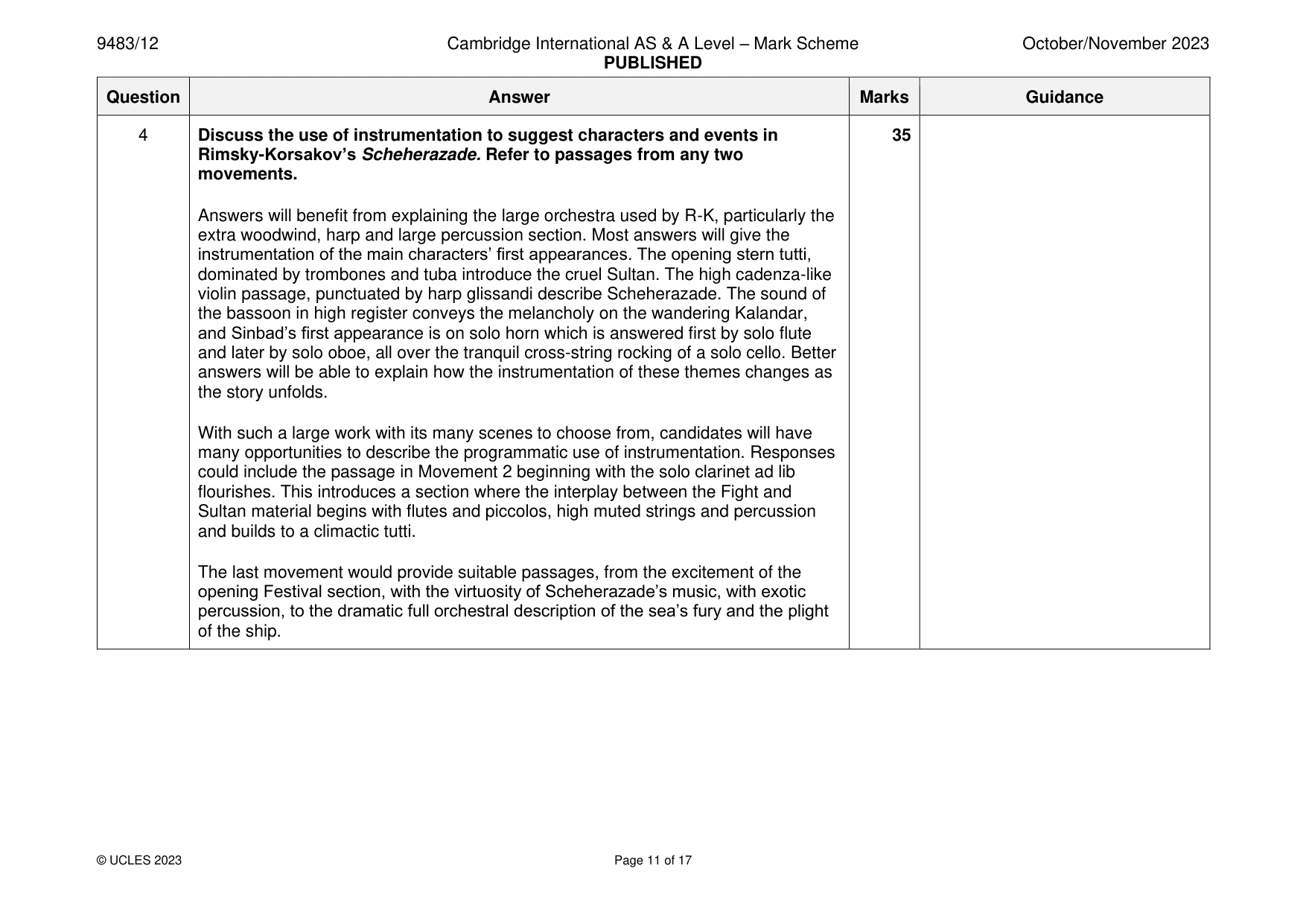
9483/12 Cambridge International AS & A Level – Mark Scheme PUBLISHED October/November 2023 © UCLES 2023 Page 11 of 17 Question Answer Marks Guidance 4 Discuss the use of instrumentation to suggest characters and events in Rimsky-Korsakov’s Scheherazade. Refer to passages from any two movements. Answers will benefit from explaining the large orchestra used by R-K, particularly the extra woodwind, harp and large percussion section. Most answers will give the instrumentation of the main characters’ first appearances. The opening stern tutti, dominated by trombones and tuba introduce the cruel Sultan. The high cadenza-like violin passage, punctuated by harp glissandi describe Scheherazade. The sound of the bassoon in high register conveys the melancholy on the wandering Kalandar, and Sinbad’s first appearance is on solo horn which is answered first by solo flute and later by solo oboe, all over the tranquil cross-string rocking of a solo cello. Better answers will be able to explain how the instrumentation of these themes changes as the story unfolds. With such a large work with its many scenes to choose from, candidates will have many opportunities to describe the programmatic use of instrumentation. Responses could include the passage in Movement 2 beginning with the solo clarinet ad lib flourishes. This introduces a section where the interplay between the Fight and Sultan material begins with flutes and piccolos, high muted strings and percussion and builds to a climactic tutti. The last movement would provide suitable passages, from the excitement of the opening Festival section, with the virtuosity of Scheherazade’s music, with exotic percussion, to the dramatic full orchestral description of the sea’s fury and the plight of the ship. 35
Mark scheme, page 12
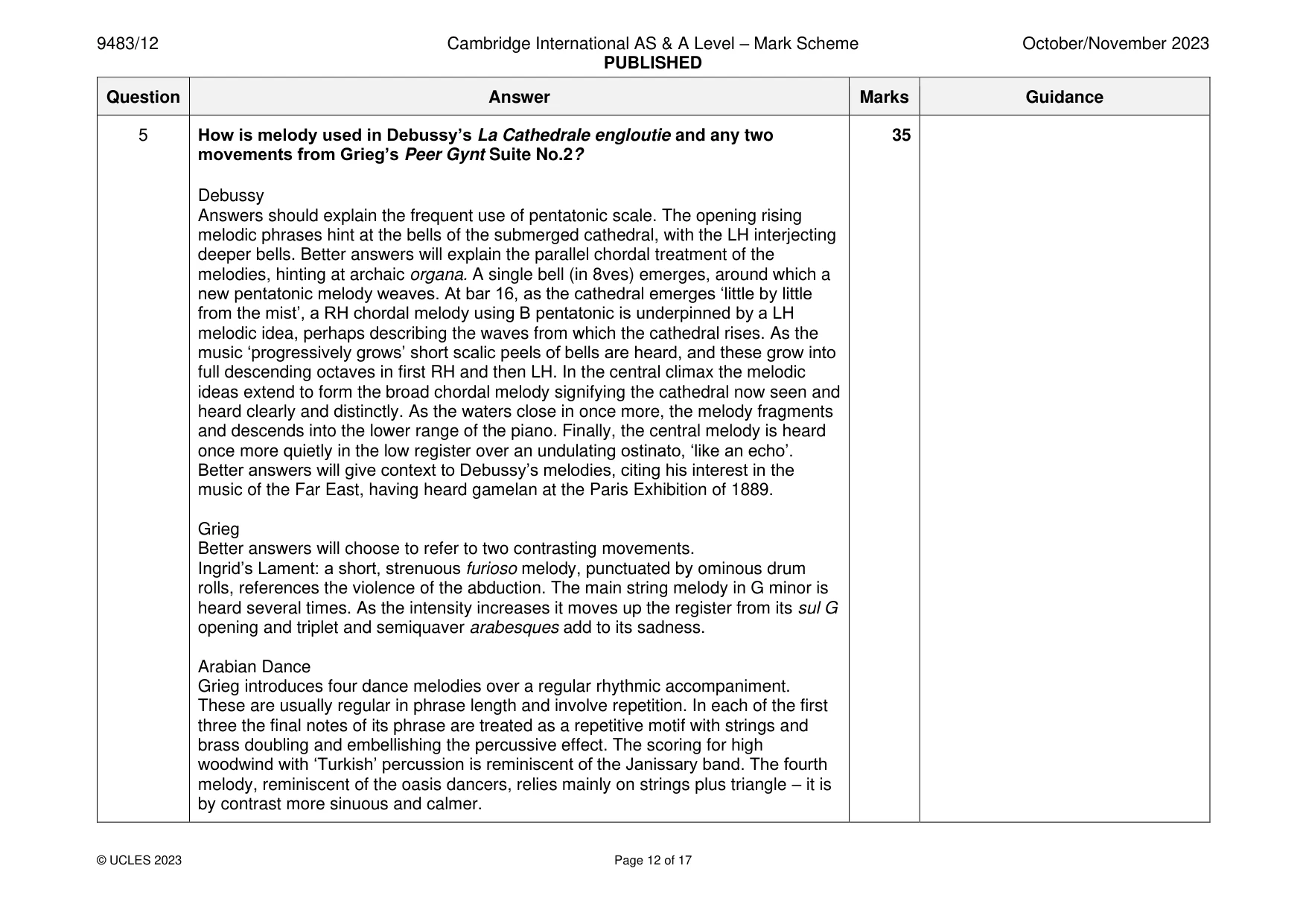
9483/12 Cambridge International AS & A Level – Mark Scheme PUBLISHED October/November 2023 © UCLES 2023 Page 12 of 17 Question Answer Marks Guidance 5 How is melody used in Debussy’s La Cathedrale engloutie and any two movements from Grieg’s Peer Gynt Suite No.2? Debussy Answers should explain the frequent use of pentatonic scale. The opening rising melodic phrases hint at the bells of the submerged cathedral, with the LH interjecting deeper bells. Better answers will explain the parallel chordal treatment of the melodies, hinting at archaic organa. A single bell (in 8ves) emerges, around which a new pentatonic melody weaves. At bar 16, as the cathedral emerges ‘little by little from the mist’, a RH chordal melody using B pentatonic is underpinned by a LH melodic idea, perhaps describing the waves from which the cathedral rises. As the music ‘progressively grows’ short scalic peels of bells are heard, and these grow into full descending octaves in first RH and then LH. In the central climax the melodic ideas extend to form the broad chordal melody signifying the cathedral now seen and heard clearly and distinctly. As the waters close in once more, the melody fragments and descends into the lower range of the piano. Finally, the central melody is heard once more quietly in the low register over an undulating ostinato, ‘like an echo’. Better answers will give context to Debussy’s melodies, citing his interest in the music of the Far East, having heard gamelan at the Paris Exhibition of 1889. Grieg Better answers will choose to refer to two contrasting movements. Ingrid’s Lament: a short, strenuous furioso melody, punctuated by ominous drum rolls, references the violence of the abduction. The main string melody in G minor is heard several times. As the intensity increases it moves up the register from its sul G opening and triplet and semiquaver arabesques add to its sadness. Arabian Dance Grieg introduces four dance melodies over a regular rhythmic accompaniment. These are usually regular in phrase length and involve repetition. In each of the first three the final notes of its phrase are treated as a repetitive motif with strings and brass doubling and embellishing the percussive effect. The scoring for high woodwind with ‘Turkish’ percussion is reminiscent of the Janissary band. The fourth melody, reminiscent of the oasis dancers, relies mainly on strings plus triangle – it is by contrast more sinuous and calmer. 35
Mark scheme, page 13
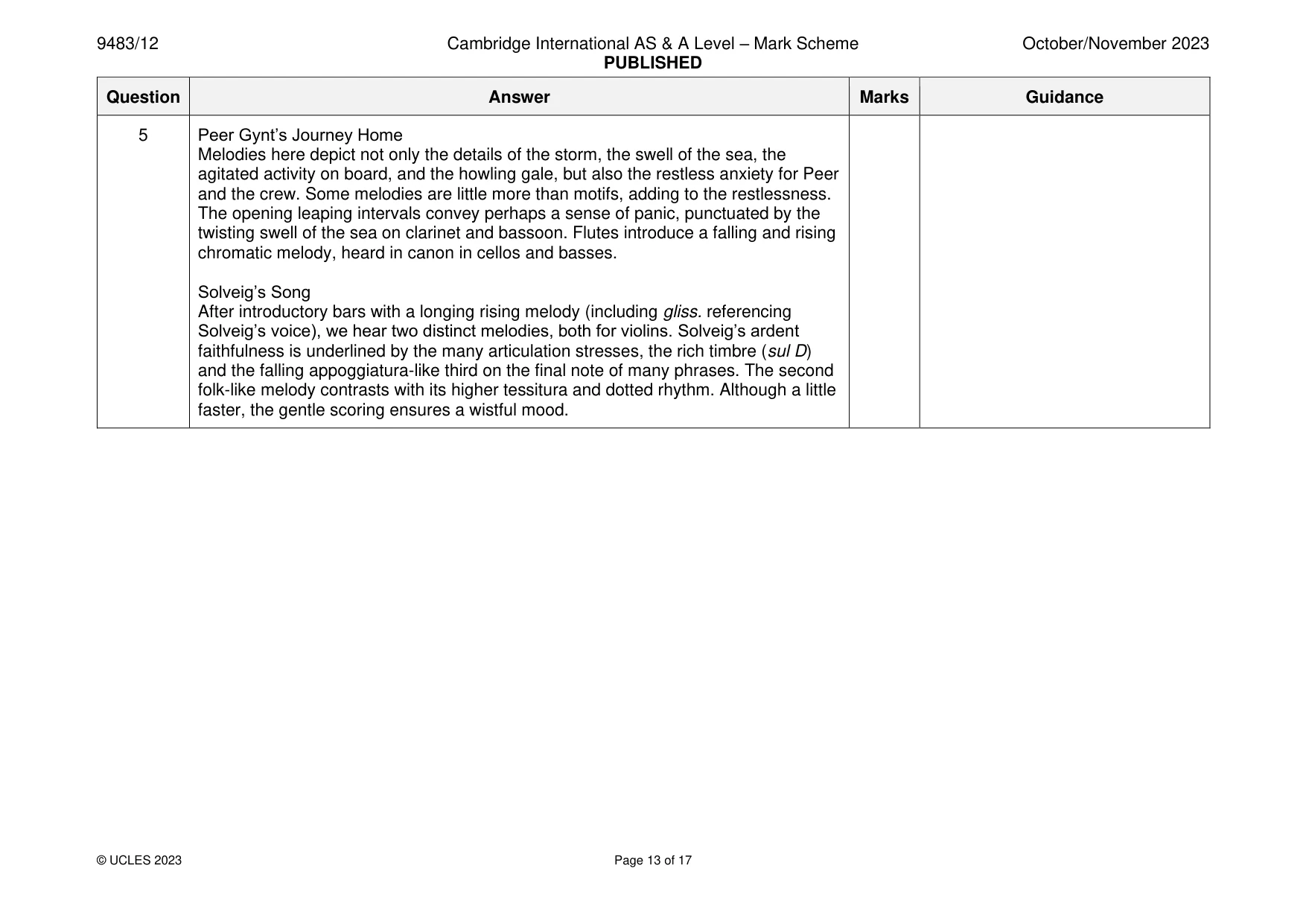
9483/12 Cambridge International AS & A Level – Mark Scheme PUBLISHED October/November 2023 © UCLES 2023 Page 13 of 17 Question Answer Marks Guidance 5 Peer Gynt’s Journey Home Melodies here depict not only the details of the storm, the swell of the sea, the agitated activity on board, and the howling gale, but also the restless anxiety for Peer and the crew. Some melodies are little more than motifs, adding to the restlessness. The opening leaping intervals convey perhaps a sense of panic, punctuated by the twisting swell of the sea on clarinet and bassoon. Flutes introduce a falling and rising chromatic melody, heard in canon in cellos and basses. Solveig’s Song After introductory bars with a longing rising melody (including gliss. referencing Solveig’s voice), we hear two distinct melodies, both for violins. Solveig’s ardent faithfulness is underlined by the many articulation stresses, the rich timbre (sul D) and the falling appoggiatura-like third on the final note of many phrases. The second folk-like melody contrasts with its higher tessitura and dotted rhythm. Although a little faster, the gentle scoring ensures a wistful mood.
Mark scheme, page 14
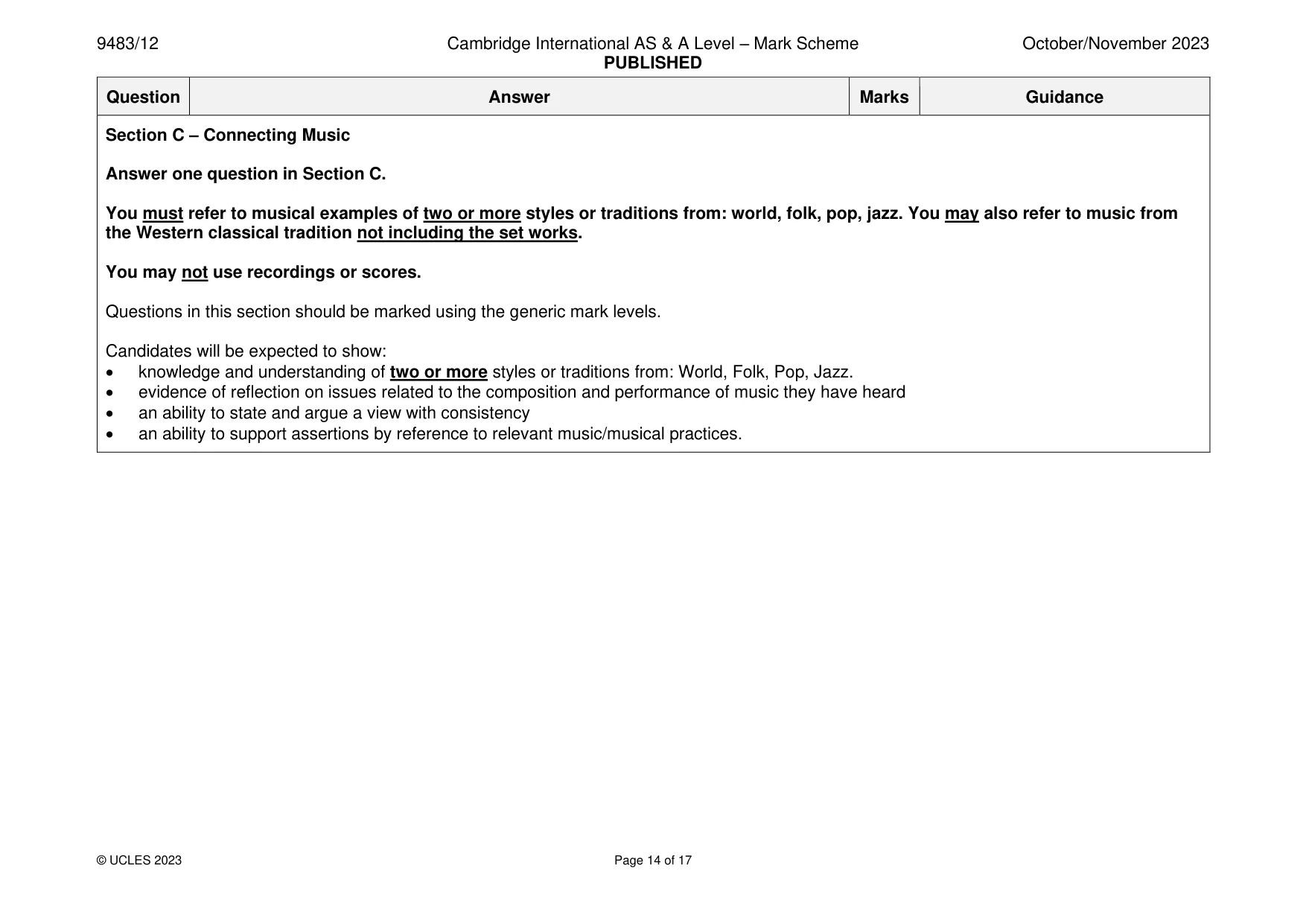
9483/12 Cambridge International AS & A Level – Mark Scheme PUBLISHED October/November 2023 © UCLES 2023 Page 14 of 17 Question Answer Marks Guidance Section C – Connecting Music Answer one question in Section C. You must refer to musical examples of two or more styles or traditions from: world, folk, pop, jazz. You may also refer to music from the Western classical tradition not including the set works. You may not use recordings or scores. Questions in this section should be marked using the generic mark levels. Candidates will be expected to show: • knowledge and understanding of two or more styles or traditions from: World, Folk, Pop, Jazz. • evidence of reflection on issues related to the composition and performance of music they have heard • an ability to state and argue a view with consistency • an ability to support assertions by reference to relevant music/musical practices.
Mark scheme, page 15
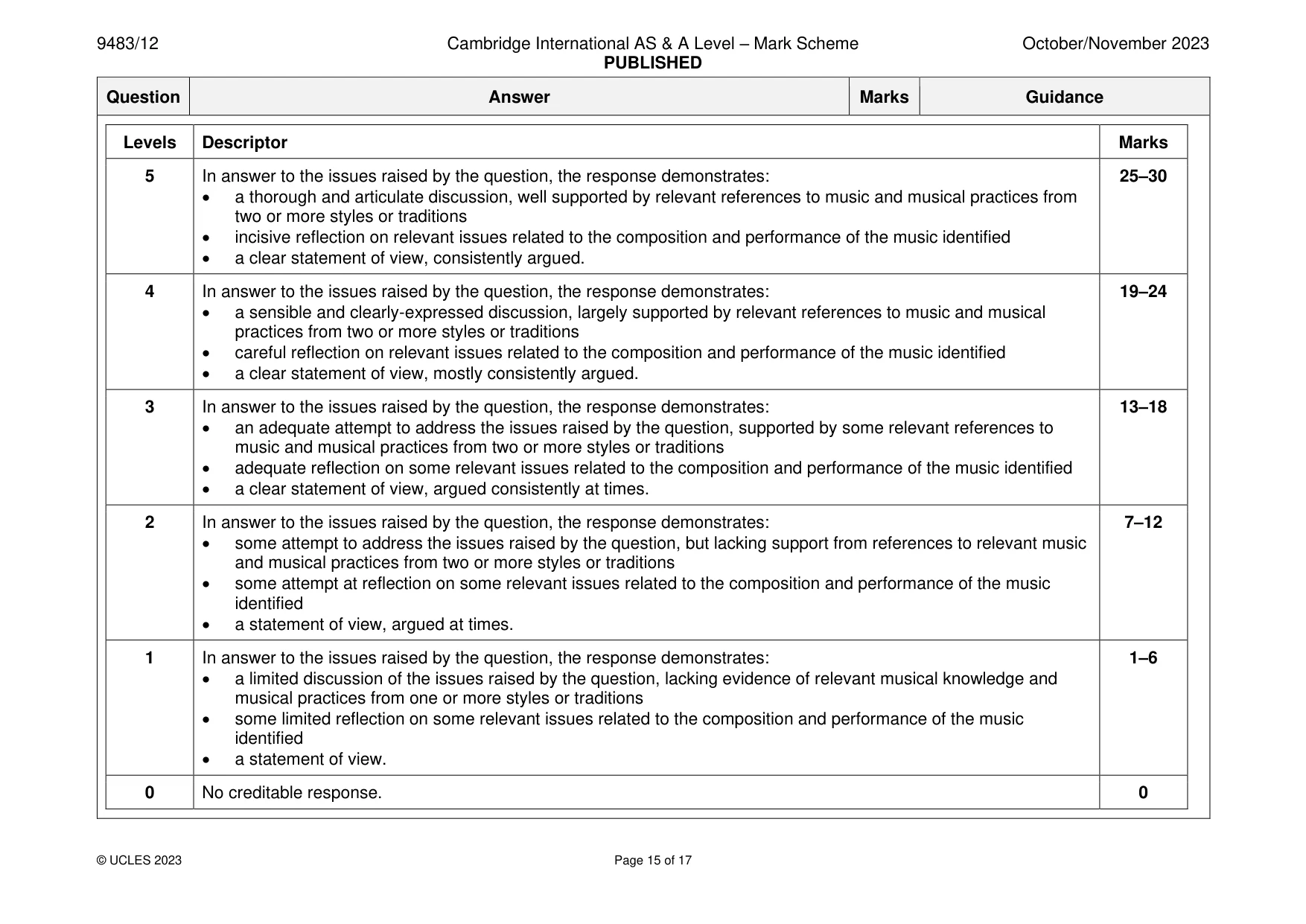
9483/12 Cambridge International AS & A Level – Mark Scheme PUBLISHED October/November 2023 © UCLES 2023 Page 15 of 17 Question Answer Marks Guidance Levels Descriptor Marks 5 In answer to the issues raised by the question, the response demonstrates: • a thorough and articulate discussion, well supported by relevant references to music and musical practices from two or more styles or traditions • incisive reflection on relevant issues related to the composition and performance of the music identified • a clear statement of view, consistently argued. 25–30 4 In answer to the issues raised by the question, the response demonstrates: • a sensible and clearly-expressed discussion, largely supported by relevant references to music and musical practices from two or more styles or traditions • careful reflection on relevant issues related to the composition and performance of the music identified • a clear statement of view, mostly consistently argued. 19–24 3 In answer to the issues raised by the question, the response demonstrates: • an adequate attempt to address the issues raised by the question, supported by some relevant references to music and musical practices from two or more styles or traditions • adequate reflection on some relevant issues related to the composition and performance of the music identified • a clear statement of view, argued consistently at times. 13–18 2 In answer to the issues raised by the question, the response demonstrates: • some attempt to address the issues raised by the question, but lacking support from references to relevant music and musical practices from two or more styles or traditions • some attempt at reflection on some relevant issues related to the composition and performance of the music identified • a statement of view, argued at times. 7–12 1 In answer to the issues raised by the question, the response demonstrates: • a limited discussion of the issues raised by the question, lacking evidence of relevant musical knowledge and musical practices from one or more styles or traditions • some limited reflection on some relevant issues related to the composition and performance of the music identified • a statement of view. 1–6 0 No creditable response. 0
Mark scheme, page 16
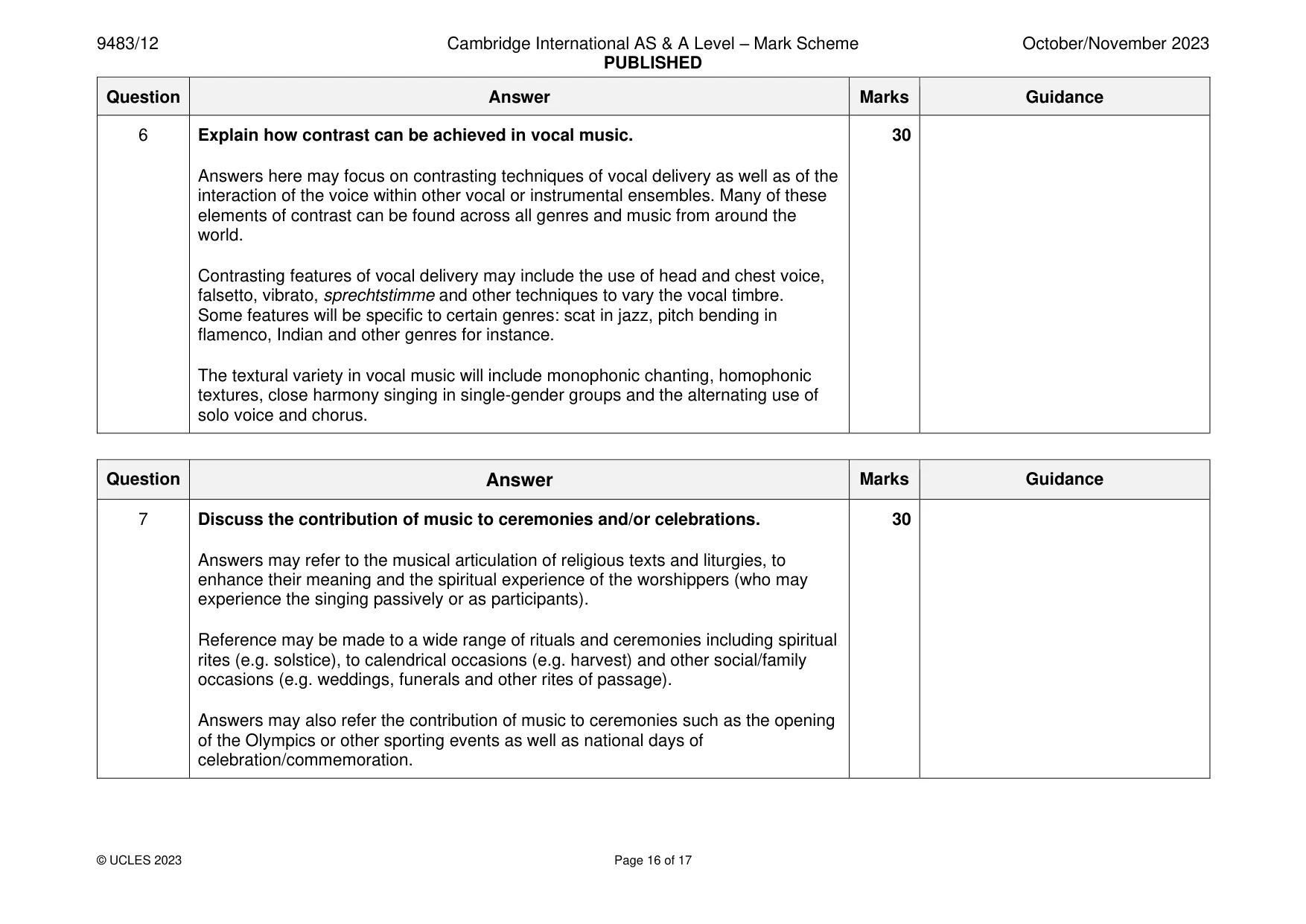
9483/12 Cambridge International AS & A Level – Mark Scheme PUBLISHED October/November 2023 © UCLES 2023 Page 16 of 17 Question Answer Marks Guidance 6 Explain how contrast can be achieved in vocal music. Answers here may focus on contrasting techniques of vocal delivery as well as of the interaction of the voice within other vocal or instrumental ensembles. Many of these elements of contrast can be found across all genres and music from around the world. Contrasting features of vocal delivery may include the use of head and chest voice, falsetto, vibrato, sprechtstimme and other techniques to vary the vocal timbre. Some features will be specific to certain genres: scat in jazz, pitch bending in flamenco, Indian and other genres for instance. The textural variety in vocal music will include monophonic chanting, homophonic textures, close harmony singing in single-gender groups and the alternating use of solo voice and chorus. 30 Question Answer Marks Guidance 7 Discuss the contribution of music to ceremonies and/or celebrations. Answers may refer to the musical articulation of religious texts and liturgies, to enhance their meaning and the spiritual experience of the worshippers (who may experience the singing passively or as participants). Reference may be made to a wide range of rituals and ceremonies including spiritual rites (e.g. solstice), to calendrical occasions (e.g. harvest) and other social/family occasions (e.g. weddings, funerals and other rites of passage). Answers may also refer the contribution of music to ceremonies such as the opening of the Olympics or other sporting events as well as national days of celebration/commemoration. 30
Mark scheme, page 17
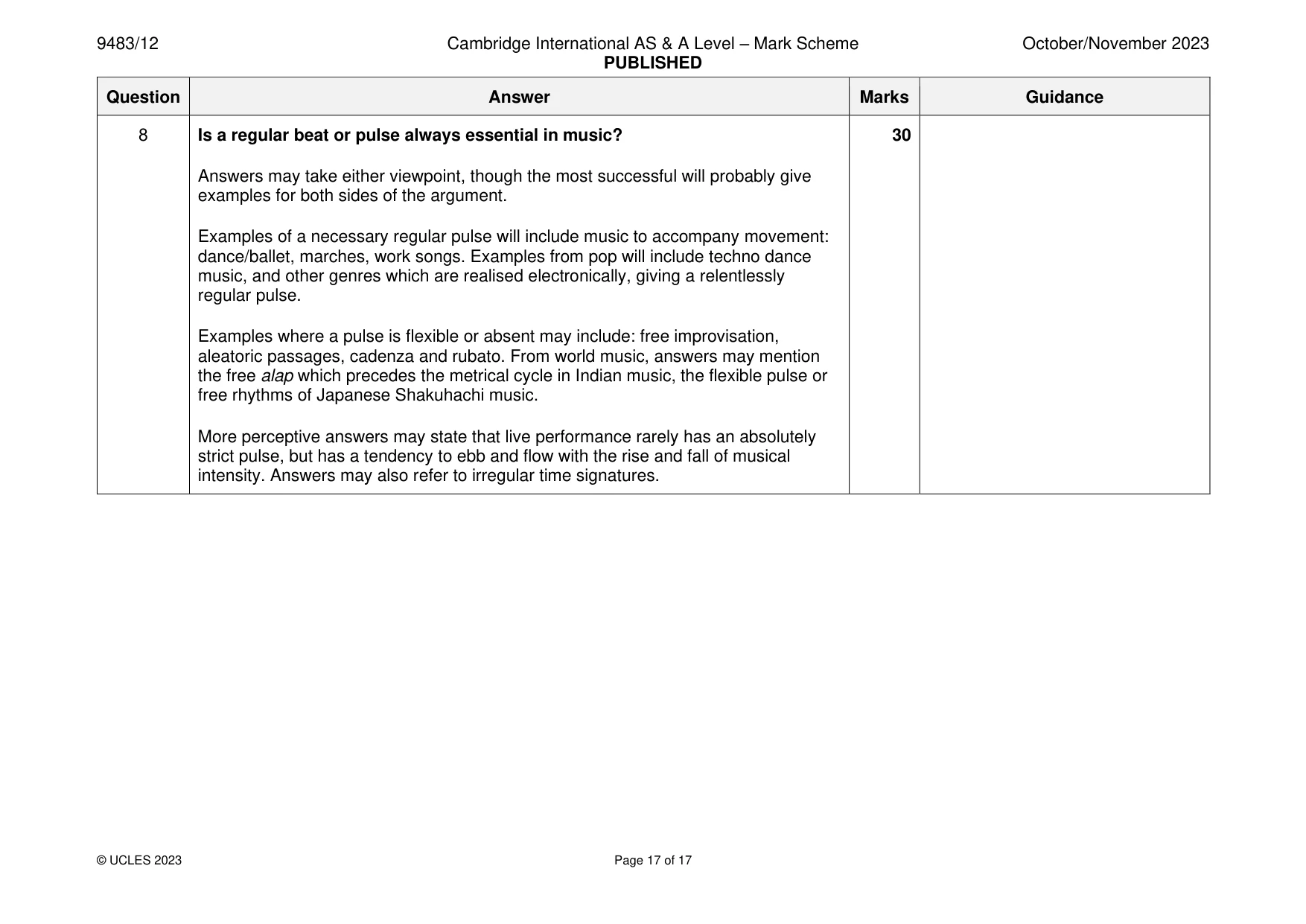
9483/12 Cambridge International AS & A Level – Mark Scheme PUBLISHED October/November 2023 © UCLES 2023 Page 17 of 17 Question Answer Marks Guidance 8 Is a regular beat or pulse always essential in music? Answers may take either viewpoint, though the most successful will probably give examples for both sides of the argument. Examples of a necessary regular pulse will include music to accompany movement: dance/ballet, marches, work songs. Examples from pop will include techno dance music, and other genres which are realised electronically, giving a relentlessly regular pulse. Examples where a pulse is flexible or absent may include: free improvisation, aleatoric passages, cadenza and rubato. From world music, answers may mention the free alap which precedes the metrical cycle in Indian music, the flexible pulse or free rhythms of Japanese Shakuhachi music. More perceptive answers may state that live performance rarely has an absolutely strict pulse, but has a tendency to ebb and flow with the rise and fall of musical intensity. Answers may also refer to irregular time signatures. 30
What you needed in this session
Cambridge’s own grade thresholds for 2023 Oct/Nov, Paper 1 · Variant 2. A higher threshold means an easier paper — the bar moves with how the cohort did.