Cambridge A Level Media Studies 9607 — 2024 May/June Paper 2 · Variant 2
9607/22/M/J/24 · 50 marks · 120 min
The question paper and its mark scheme, free to read here and free to download. This is Cambridge’s own paper, exactly as it was sat.
Question paper4 pages

Mark scheme18 pages
Answers below. Sit the paper first if you are practising.
Paper as text
Question paper, page 1
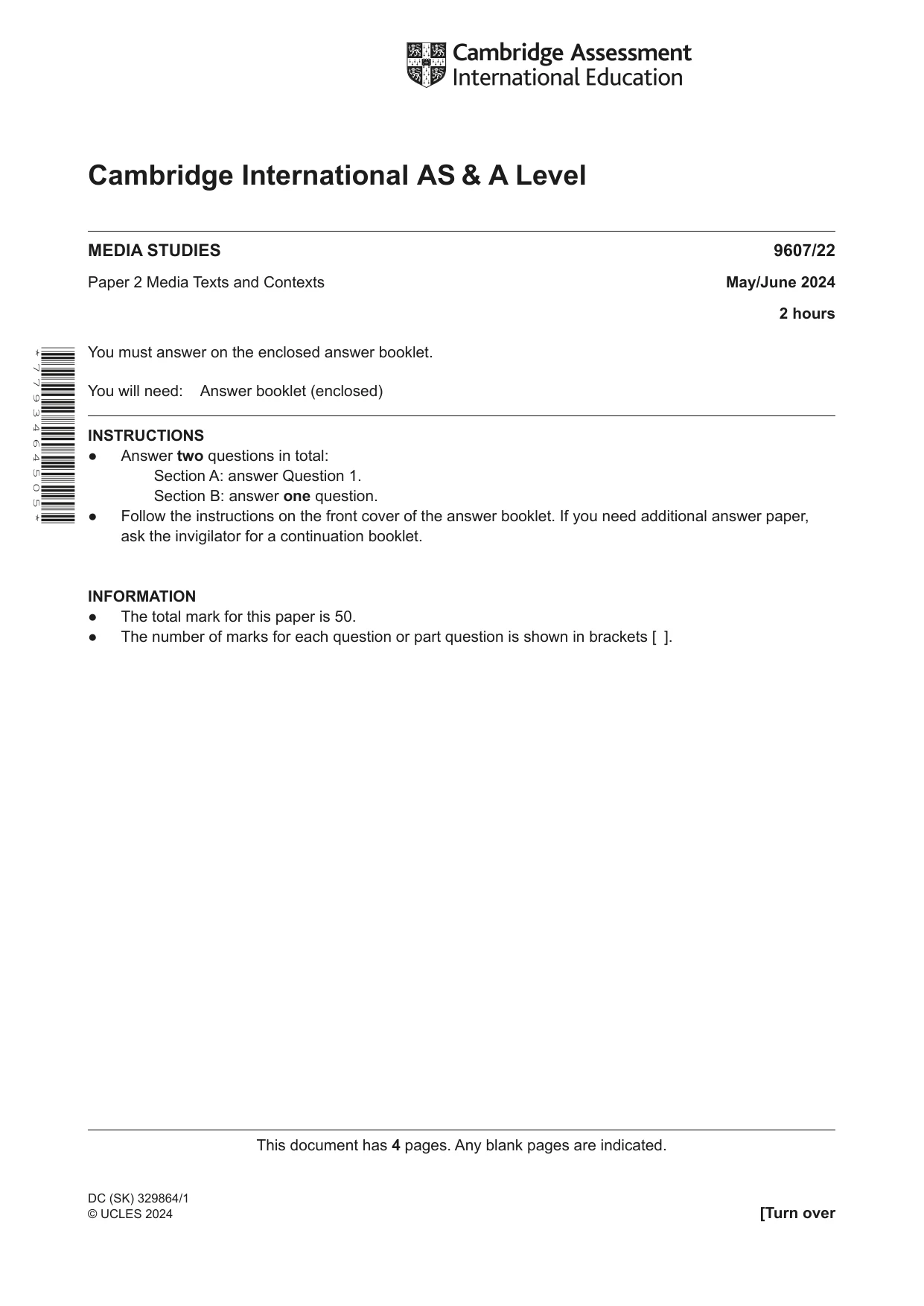
This document has 4 pages. Any blank pages are indicated. [Turn over Cambridge International AS & A Level DC (SK) 329864/1 © UCLES 2024 * 7 7 9 3 4 6 4 5 0 5 * MEDIA STUDIES 9607/22 Paper 2 Media Texts and Contexts May/June 2024 2 hours You must answer on the enclosed answer booklet. You will need: Answer booklet (enclosed) INSTRUCTIONS ● Answer two questions in total: Section A: answer Question 1. Section B: answer one question. ● Follow the instructions on the front cover of the answer booklet. If you need additional answer paper, ask the invigilator for a continuation booklet. INFORMATION ● The total mark for this paper is 50. ● The number of marks for each question or part question is shown in brackets [ ].
Question paper, page 2
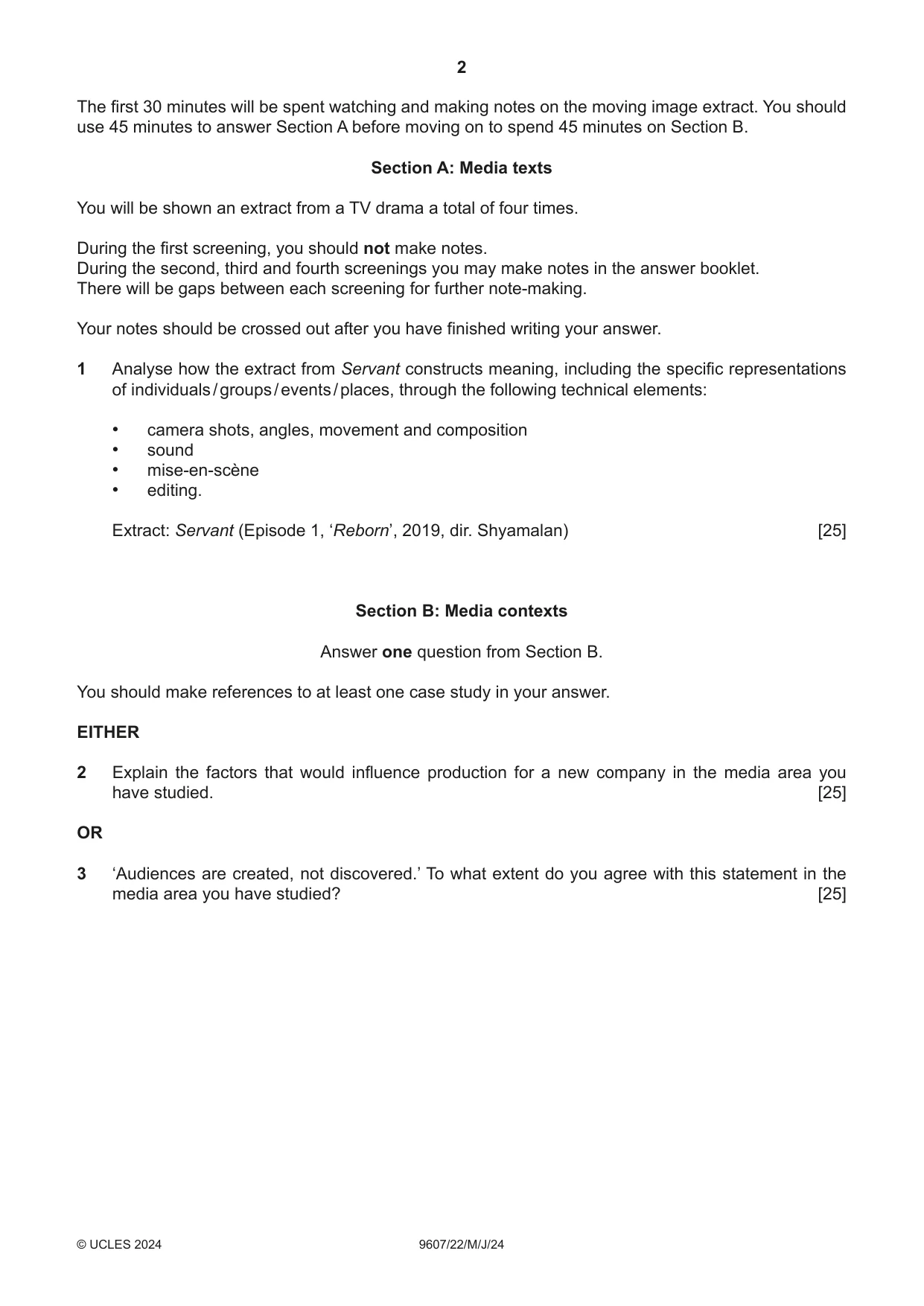
2 9607/22/M/J/24 © UCLES 2024 The first 30 minutes will be spent watching and making notes on the moving image extract. You should use 45 minutes to answer Section A before moving on to spend 45 minutes on Section B. Section A: Media texts You will be shown an extract from a TV drama a total of four times. During the first screening, you should not make notes. During the second, third and fourth screenings you may make notes in the answer booklet. There will be gaps between each screening for further note-making. Your notes should be crossed out after you have finished writing your answer. 1 Analyse how the extract from Servant constructs meaning, including the specific representations of individuals / groups / events / places, through the following technical elements: • camera shots, angles, movement and composition • sound • mise-en-scène • editing. Extract: Servant (Episode 1, ‘Reborn’, 2019, dir. Shyamalan) [25] Section B: Media contexts Answer one question from Section B. You should make references to at least one case study in your answer. EITHER 2 Explain the factors that would influence production for a new company in the media area you have studied. [25] OR 3 ‘Audiences are created, not discovered.’ To what extent do you agree with this statement in the media area you have studied? [25]
Question paper, page 3
3 9607/22/M/J/24 © UCLES 2024 BLANK PAGE
Question paper, page 4
4 9607/22/M/J/24 © UCLES 2024 Permission to reproduce items where third-party owned material protected by copyright is included has been sought and cleared where possible. Every reasonable effort has been made by the publisher (UCLES) to trace copyright holders, but if any items requiring clearance have unwittingly been included, the publisher will be pleased to make amends at the earliest possible opportunity. To avoid the issue of disclosure of answer-related information to candidates, all copyright acknowledgements are reproduced online in the Cambridge Assessment International Education Copyright Acknowledgements Booklet. This is produced for each series of examinations and is freely available to download at www.cambridgeinternational.org after the live examination series. Cambridge Assessment International Education is part of Cambridge Assessment. Cambridge Assessment is the brand name of the University of Cambridge Local Examinations Syndicate (UCLES), which is a department of the University of Cambridge. BLANK PAGE
Mark scheme, page 1
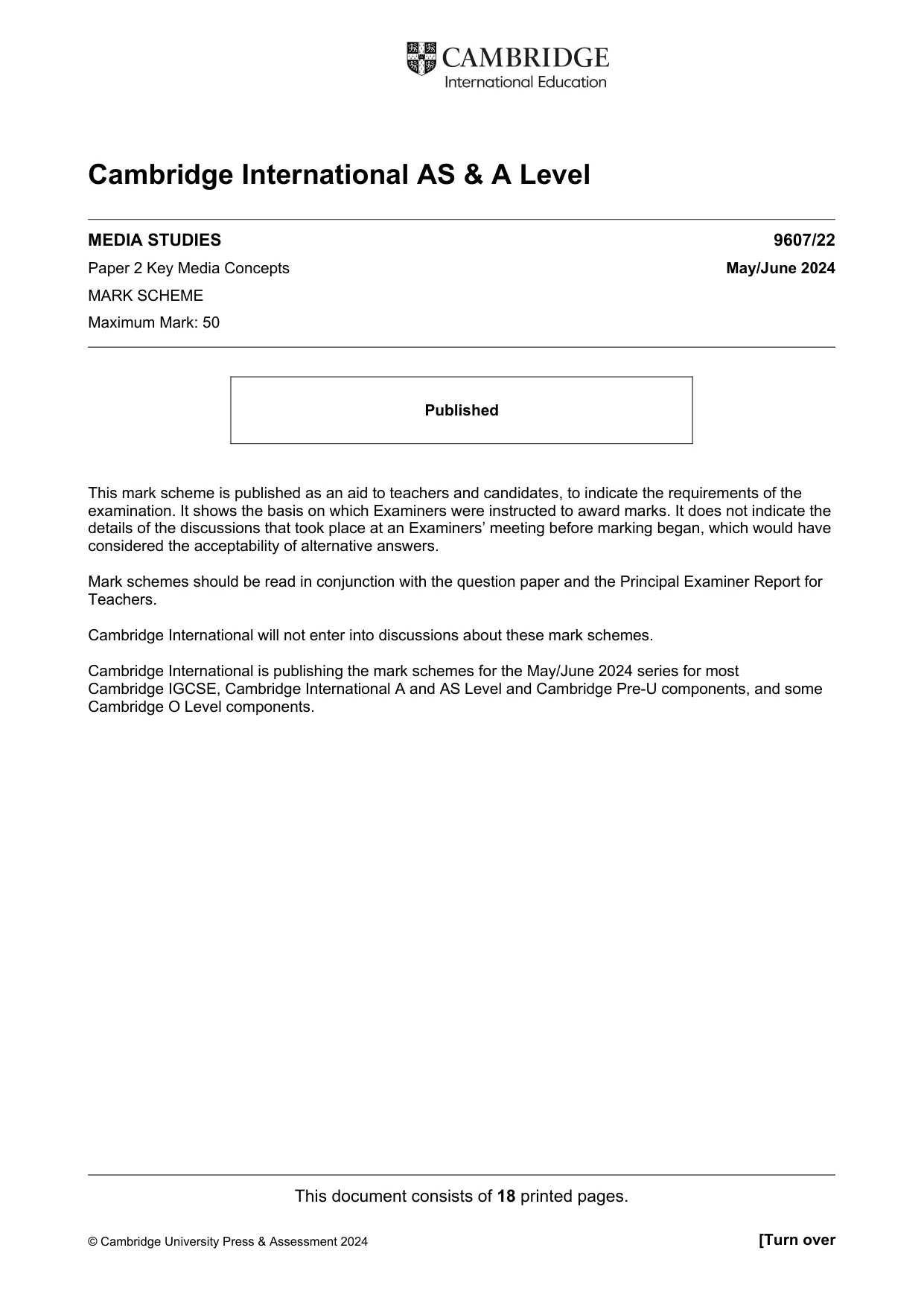
This document consists of 18 printed pages. © Cambridge University Press & Assessment 2024 [Turn over Cambridge International AS & A Level MEDIA STUDIES 9607/22 Paper 2 Key Media Concepts May/June 2024 MARK SCHEME Maximum Mark: 50 Published This mark scheme is published as an aid to teachers and candidates, to indicate the requirements of the examination. It shows the basis on which Examiners were instructed to award marks. It does not indicate the details of the discussions that took place at an Examiners’ meeting before marking began, which would have considered the acceptability of alternative answers. Mark schemes should be read in conjunction with the question paper and the Principal Examiner Report for Teachers. Cambridge International will not enter into discussions about these mark schemes. Cambridge International is publishing the mark schemes for the May/June 2024 series for most Cambridge IGCSE, Cambridge International A and AS Level and Cambridge Pre-U components, and some Cambridge O Level components.
Mark scheme, page 2
9607/22 Cambridge International AS & A Level – Mark Scheme PUBLISHED May/June 2024 © Cambridge University Press & Assessment 2024 Page 2 of 18 Generic Marking Principles These general marking principles must be applied by all examiners when marking candidate answers. They should be applied alongside the specific content of the mark scheme or generic level descriptions for a question. Each question paper and mark scheme will also comply with these marking principles. GENERIC MARKING PRINCIPLE 1: Marks must be awarded in line with: • the specific content of the mark scheme or the generic level descriptors for the question • the specific skills defined in the mark scheme or in the generic level descriptors for the question • the standard of response required by a candidate as exemplified by the standardisation scripts. GENERIC MARKING PRINCIPLE 2: Marks awarded are always whole marks (not half marks, or other fractions). GENERIC MARKING PRINCIPLE 3: Marks must be awarded positively: • marks are awarded for correct/valid answers, as defined in the mark scheme. However, credit is given for valid answers which go beyond the scope of the syllabus and mark scheme, referring to your Team Leader as appropriate • marks are awarded when candidates clearly demonstrate what they know and can do • marks are not deducted for errors • marks are not deducted for omissions • answers should only be judged on the quality of spelling, punctuation and grammar when these features are specifically assessed by the question as indicated by the mark scheme. The meaning, however, should be unambiguous. GENERIC MARKING PRINCIPLE 4: Rules must be applied consistently, e.g. in situations where candidates have not followed instructions or in the application of generic level descriptors.
Mark scheme, page 3
9607/22 Cambridge International AS & A Level – Mark Scheme PUBLISHED May/June 2024 © Cambridge University Press & Assessment 2024 Page 3 of 18 GENERIC MARKING PRINCIPLE 5: Marks should be awarded using the full range of marks defined in the mark scheme for the question (however; the use of the full mark range may be limited according to the quality of the candidate responses seen). GENERIC MARKING PRINCIPLE 6: Marks awarded are based solely on the requirements as defined in the mark scheme. Marks should not be awarded with grade thresholds or grade descriptors in mind.
Mark scheme, page 4
9607/22 Cambridge International AS & A Level – Mark Scheme PUBLISHED May/June 2024 © Cambridge University Press & Assessment 2024 Page 4 of 18 English & Media subject specific general marking principles (To be read in conjunction with the Generic Marking Principles (and requiring further guidance on how to place marks within levels)) Components using level descriptors: • We use level descriptors as a guide to broad understanding of the qualities normally expected of, or typical of, work in a level. • Level descriptors are a means of general guidance, and should not be interpreted as hurdle statements. • Where indicative content notes are supplied for a question, these are not a prescription of required content, and must not be treated as such. Alternative correct points and unexpected answers in candidates’ scripts must be given marks that fairly reflect the knowledge and skills demonstrated. • While we may have legitimate expectations as to the ground most answers may occupy, we must at all times be prepared to meet candidates on their chosen ground, provided it is relevant ground (e.g. clearly related to and derived from a relevant passage/text and meeting the mark scheme requirements for the question). Components using point-based marking: Point marking is often used to reward knowledge, understanding and application of skills. We give credit where the candidate’s answer shows relevant knowledge, understanding and application of skills in answering the question. We do not give credit where the answer shows confusion. From this it follows that we: a DO credit answers which are worded differently from the mark scheme if they clearly convey the same meaning (unless the mark scheme requires a specific term). b DO credit alternative answers/examples which are not written in the mark scheme if they are correct. c DO credit answers where candidates give more than one correct answer in one prompt/numbered/scaffolded space where extended writing is required rather than list-type answers. For example, questions that require n reasons (e.g. State two reasons…). d DO NOT credit answers simply for using a ‘key term’ unless that is all that is required. (Check for evidence it is understood and not used wrongly.). e DO NOT credit answers which are obviously self-contradicting or trying to cover all possibilities. f DO NOT give further credit for what is effectively repetition of a correct point already credited unless the language itself is being tested. This applies equally to ‘mirror statements’ (i.e. polluted/not polluted). g DO NOT require spellings to be correct, unless this is part of the test. However spellings of syllabus terms must allow for clear and unambiguous separation from other syllabus terms with which they may be confused (e.g. Corrasion/Corrosion).
Mark scheme, page 5
9607/22 Cambridge International AS & A Level – Mark Scheme PUBLISHED May/June 2024 © Cambridge University Press & Assessment 2024 Page 5 of 18 Assessment Objectives The Assessment Objectives are applied to each question. The assessment objectives for the paper are: • AO1 Demonstrate knowledge and understanding of media concepts, contexts and critical debates, using terminology appropriately. (60%) • AO2 Analyse media products, and evaluate their own work, by applying knowledge and understanding of theoretical and creative approaches, supported with relevant textual evidence. (40%) The Level Descriptors guide examiners to an understanding of the qualities normally expected of, or typical of, work in a band. They are a means of general guidance and must not be interpreted as hurdle statements. For the purposes of standardisation of marking, they are to be used in conjunction with the Standardisation scripts discussed during the coordination meeting and with Team Leaders, as well as the question-specific notes. The indicative content provided is for general guidance; it is not designed as prescriptions of required content and must not be treated as such. Whilst there are legitimate expectations of the content of most answers, examiners may see responses that include ideas not covered in the indicative content. For these cases, examiners should credit valid responses fairly and not penalise candidates for including valid points outside the mark scheme. Using a banded mark scheme Place the answer in a level first. Look for the “best fit” of the answer into a level. An answer needs to show evidence of most but not necessarily ALL of the qualities described in a level in order to be placed in that band. Then award a mark for the relative position of the answer within the level. Higher level responses (Levels 4 and 5) will demonstrate excellent knowledge and understanding of the key concepts (AO1). They should use a wide range of terminology accurately (AO1). They should show clear understanding of how meaning is created in the text (AO2). They should support their answer with many detailed references to the text (AO2). Middle range responses (Level 3) will demonstrate satisfactory knowledge and understanding of the key concepts – there may be uneven coverage or some misunderstanding (AO1). They should use some terminology, but not always accurately (AO1). They should show some understanding of how meaning is created in the text (AO2). They should support their answer with some references to the text (AO2). Basic responses (Levels 1 and 2) will demonstrate basic knowledge and understanding of the key concepts –misunderstanding might be common (AO1). They might use some terminology, but rarely accurately (AO1). They will have limited understanding of how meaning is created in the text (AO2). They rarely support their answer with references to the text (AO2).
Mark scheme, page 6
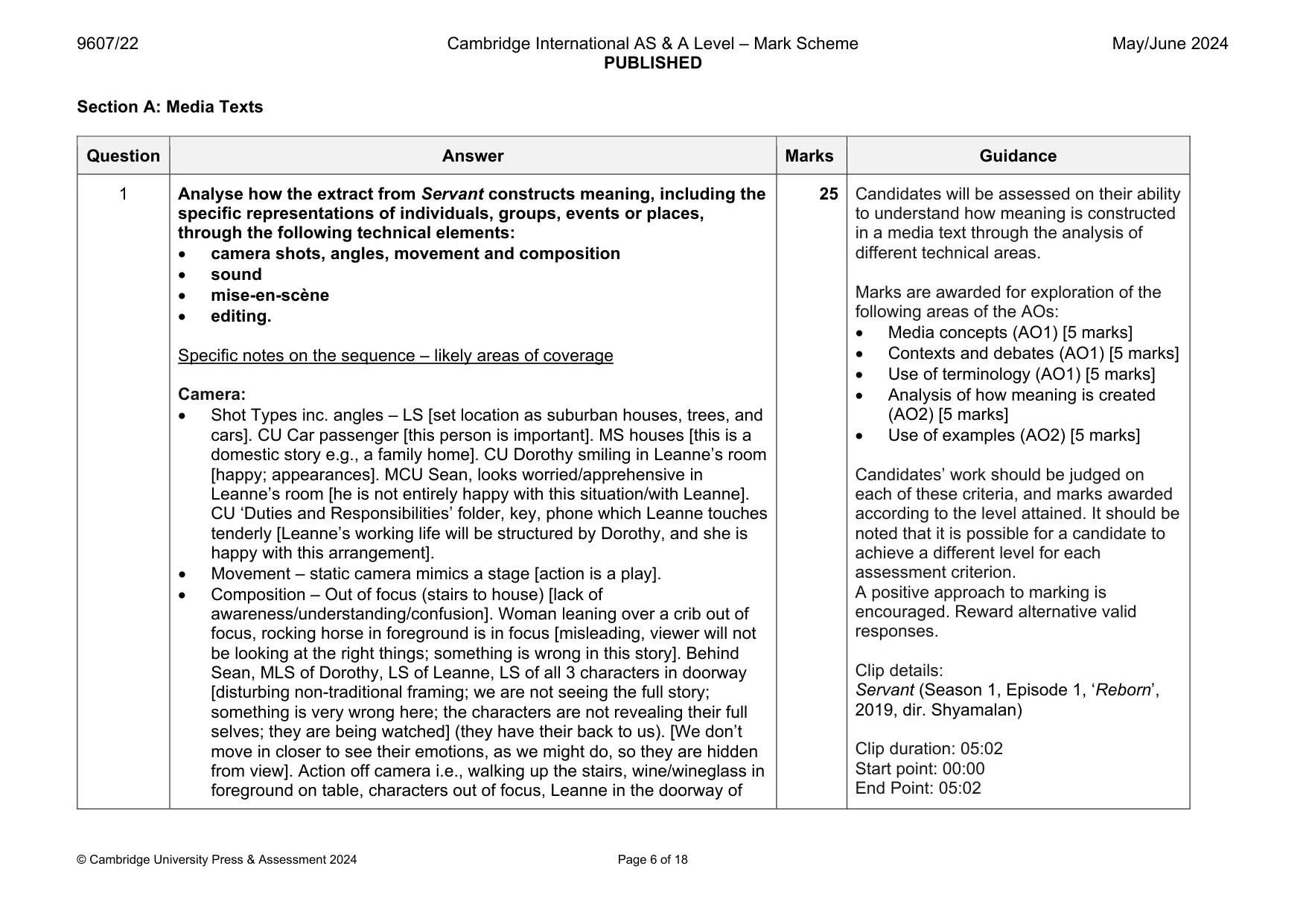
9607/22 Cambridge International AS & A Level – Mark Scheme PUBLISHED May/June 2024 © Cambridge University Press & Assessment 2024 Page 6 of 18 Section A: Media Texts Question Answer Marks Guidance 1 Analyse how the extract from Servant constructs meaning, including the specific representations of individuals, groups, events or places, through the following technical elements: • camera shots, angles, movement and composition • sound • mise-en-scène • editing. Specific notes on the sequence – likely areas of coverage Camera: • Shot Types inc. angles – LS [set location as suburban houses, trees, and cars]. CU Car passenger [this person is important]. MS houses [this is a domestic story e.g., a family home]. CU Dorothy smiling in Leanne’s room [happy; appearances]. MCU Sean, looks worried/apprehensive in Leanne’s room [he is not entirely happy with this situation/with Leanne]. CU ‘Duties and Responsibilities’ folder, key, phone which Leanne touches tenderly [Leanne’s working life will be structured by Dorothy, and she is happy with this arrangement]. • Movement – static camera mimics a stage [action is a play]. • Composition – Out of focus (stairs to house) [lack of awareness/understanding/confusion]. Woman leaning over a crib out of focus, rocking horse in foreground is in focus [misleading, viewer will not be looking at the right things; something is wrong in this story]. Behind Sean, MLS of Dorothy, LS of Leanne, LS of all 3 characters in doorway [disturbing non-traditional framing; we are not seeing the full story; something is very wrong here; the characters are not revealing their full selves; they are being watched] (they have their back to us). [We don’t move in closer to see their emotions, as we might do, so they are hidden from view]. Action off camera i.e., walking up the stairs, wine/wineglass in foreground on table, characters out of focus, Leanne in the doorway of 25 Candidates will be assessed on their ability to understand how meaning is constructed in a media text through the analysis of different technical areas. Marks are awarded for exploration of the following areas of the AOs: • Media concepts (AO1) [5 marks] • Contexts and debates (AO1) [5 marks] • Use of terminology (AO1) [5 marks] • Analysis of how meaning is created (AO2) [5 marks] • Use of examples (AO2) [5 marks] Candidates’ work should be judged on each of these criteria, and marks awarded according to the level attained. It should be noted that it is possible for a candidate to achieve a different level for each assessment criterion. A positive approach to marking is encouraged. Reward alternative valid responses. Clip details: Servant (Season 1, Episode 1, ‘Reborn’, 2019, dir. Shyamalan) Clip duration: 05:02 Start point: 00:00 End Point: 05:02
Mark scheme, page 7
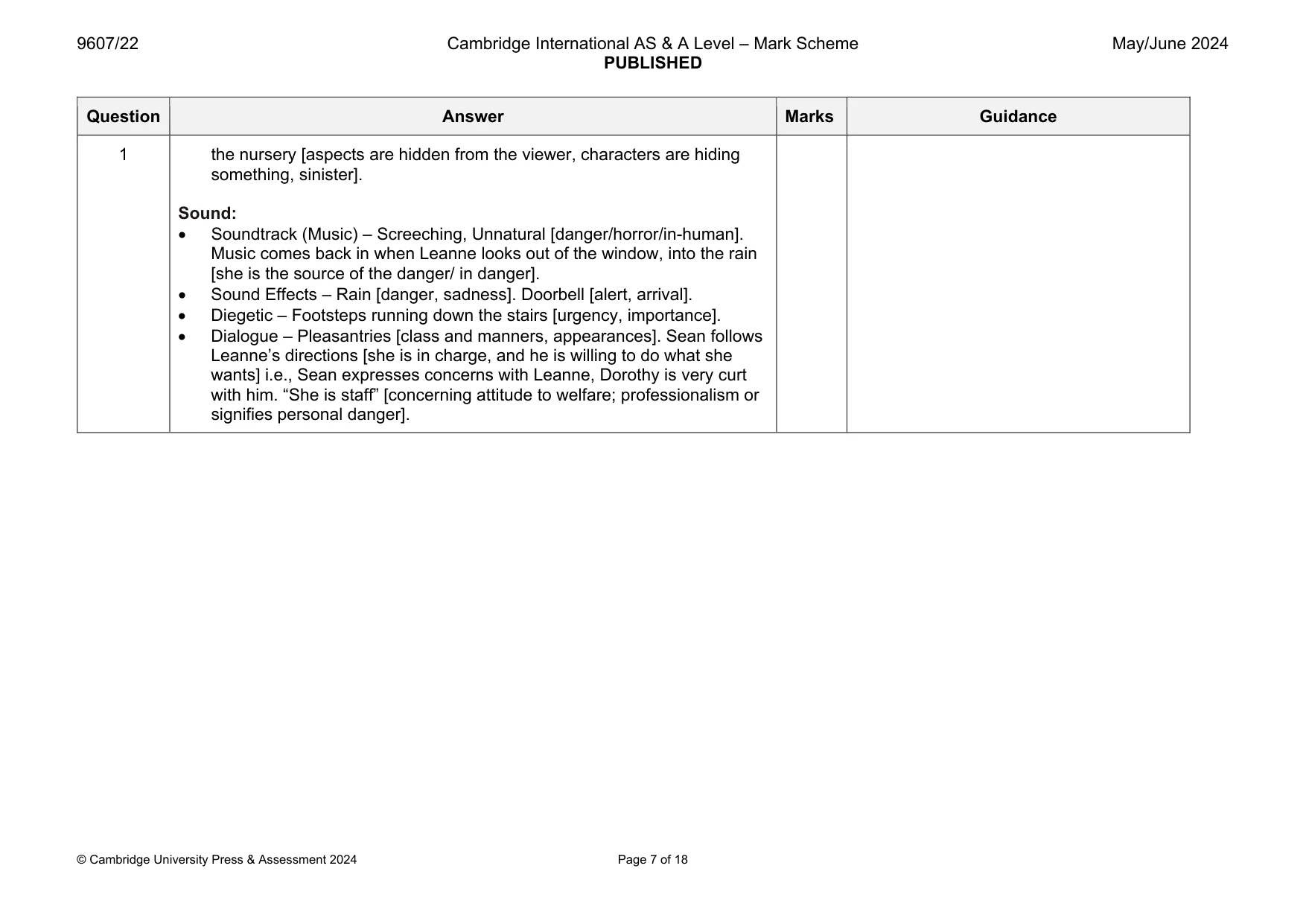
9607/22 Cambridge International AS & A Level – Mark Scheme PUBLISHED May/June 2024 © Cambridge University Press & Assessment 2024 Page 7 of 18 Question Answer Marks Guidance 1 the nursery [aspects are hidden from the viewer, characters are hiding something, sinister]. Sound: • Soundtrack (Music) – Screeching, Unnatural [danger/horror/in-human]. Music comes back in when Leanne looks out of the window, into the rain [she is the source of the danger/ in danger]. • Sound Effects – Rain [danger, sadness]. Doorbell [alert, arrival]. • Diegetic – Footsteps running down the stairs [urgency, importance]. • Dialogue – Pleasantries [class and manners, appearances]. Sean follows Leanne’s directions [she is in charge, and he is willing to do what she wants] i.e., Sean expresses concerns with Leanne, Dorothy is very curt with him. “She is staff” [concerning attitude to welfare; professionalism or signifies personal danger].
Mark scheme, page 8
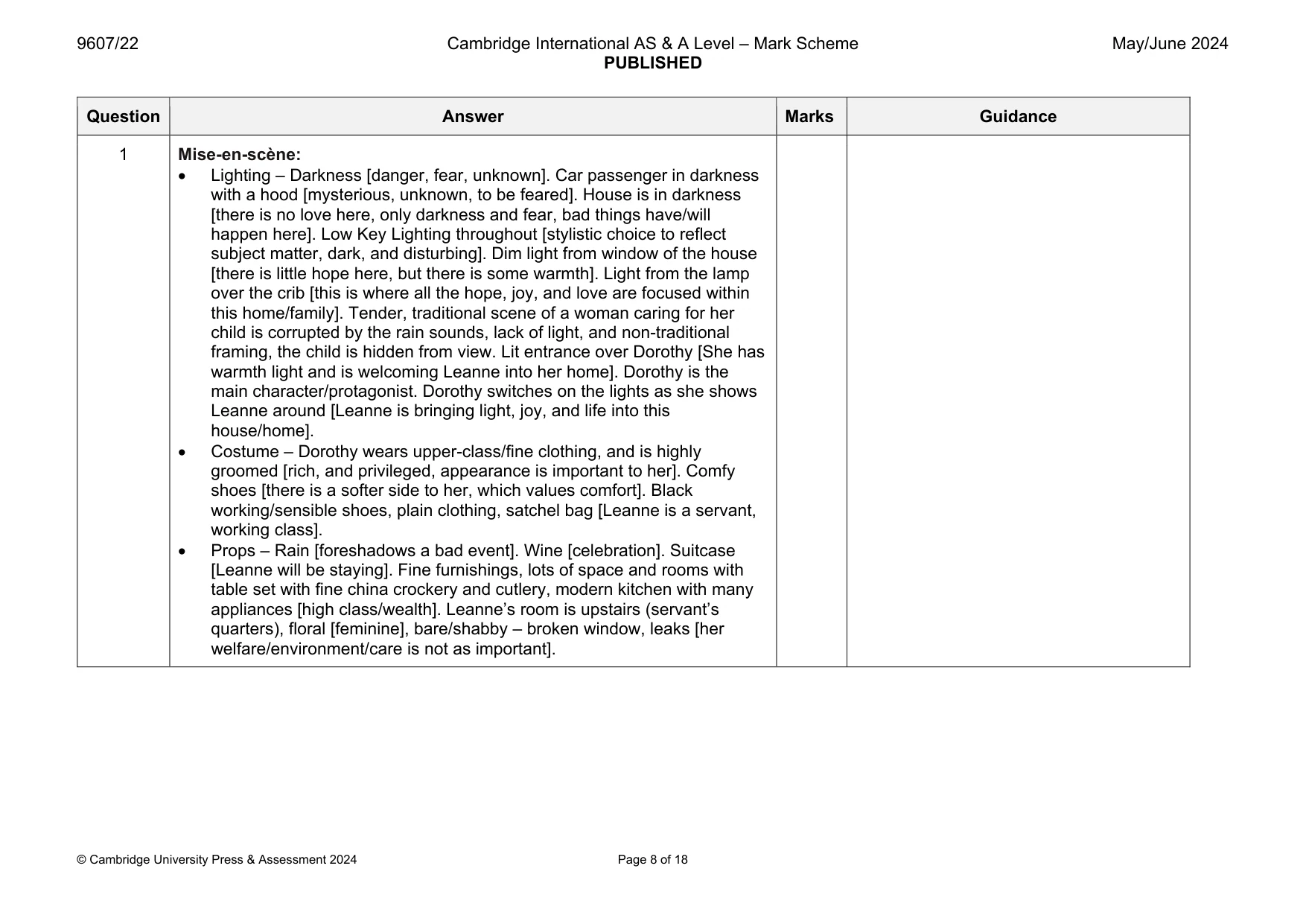
9607/22 Cambridge International AS & A Level – Mark Scheme PUBLISHED May/June 2024 © Cambridge University Press & Assessment 2024 Page 8 of 18 Question Answer Marks Guidance 1 Mise-en-scène: • Lighting – Darkness [danger, fear, unknown]. Car passenger in darkness with a hood [mysterious, unknown, to be feared]. House is in darkness [there is no love here, only darkness and fear, bad things have/will happen here]. Low Key Lighting throughout [stylistic choice to reflect subject matter, dark, and disturbing]. Dim light from window of the house [there is little hope here, but there is some warmth]. Light from the lamp over the crib [this is where all the hope, joy, and love are focused within this home/family]. Tender, traditional scene of a woman caring for her child is corrupted by the rain sounds, lack of light, and non-traditional framing, the child is hidden from view. Lit entrance over Dorothy [She has warmth light and is welcoming Leanne into her home]. Dorothy is the main character/protagonist. Dorothy switches on the lights as she shows Leanne around [Leanne is bringing light, joy, and life into this house/home]. • Costume – Dorothy wears upper-class/fine clothing, and is highly groomed [rich, and privileged, appearance is important to her]. Comfy shoes [there is a softer side to her, which values comfort]. Black working/sensible shoes, plain clothing, satchel bag [Leanne is a servant, working class]. • Props – Rain [foreshadows a bad event]. Wine [celebration]. Suitcase [Leanne will be staying]. Fine furnishings, lots of space and rooms with table set with fine china crockery and cutlery, modern kitchen with many appliances [high class/wealth]. Leanne’s room is upstairs (servant’s quarters), floral [feminine], bare/shabby – broken window, leaks [her welfare/environment/care is not as important].
Mark scheme, page 9
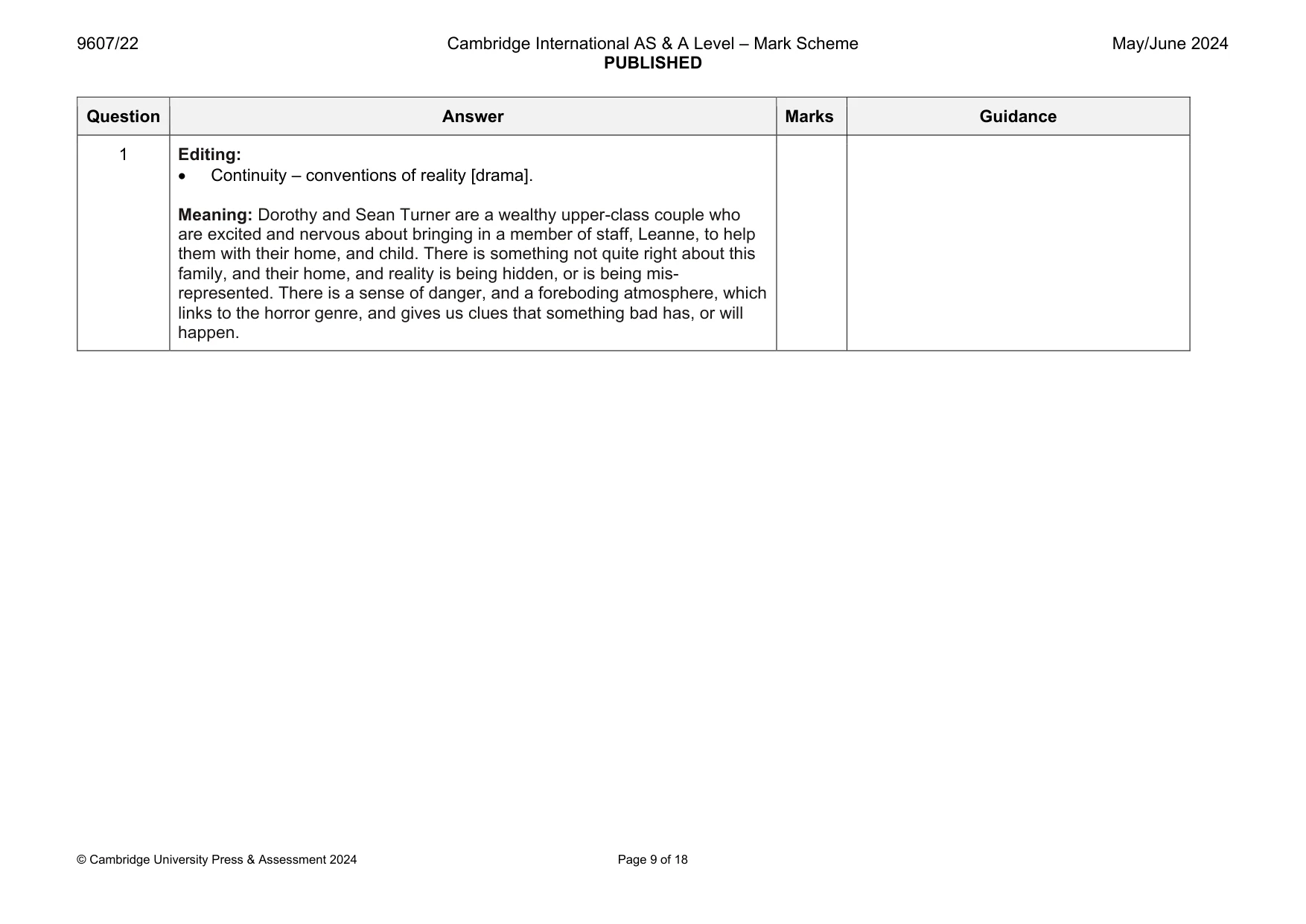
9607/22 Cambridge International AS & A Level – Mark Scheme PUBLISHED May/June 2024 © Cambridge University Press & Assessment 2024 Page 9 of 18 Question Answer Marks Guidance 1 Editing: • Continuity – conventions of reality [drama]. Meaning: Dorothy and Sean Turner are a wealthy upper-class couple who are excited and nervous about bringing in a member of staff, Leanne, to help them with their home, and child. There is something not quite right about this family, and their home, and reality is being hidden, or is being mis- represented. There is a sense of danger, and a foreboding atmosphere, which links to the horror genre, and gives us clues that something bad has, or will happen.
Mark scheme, page 10
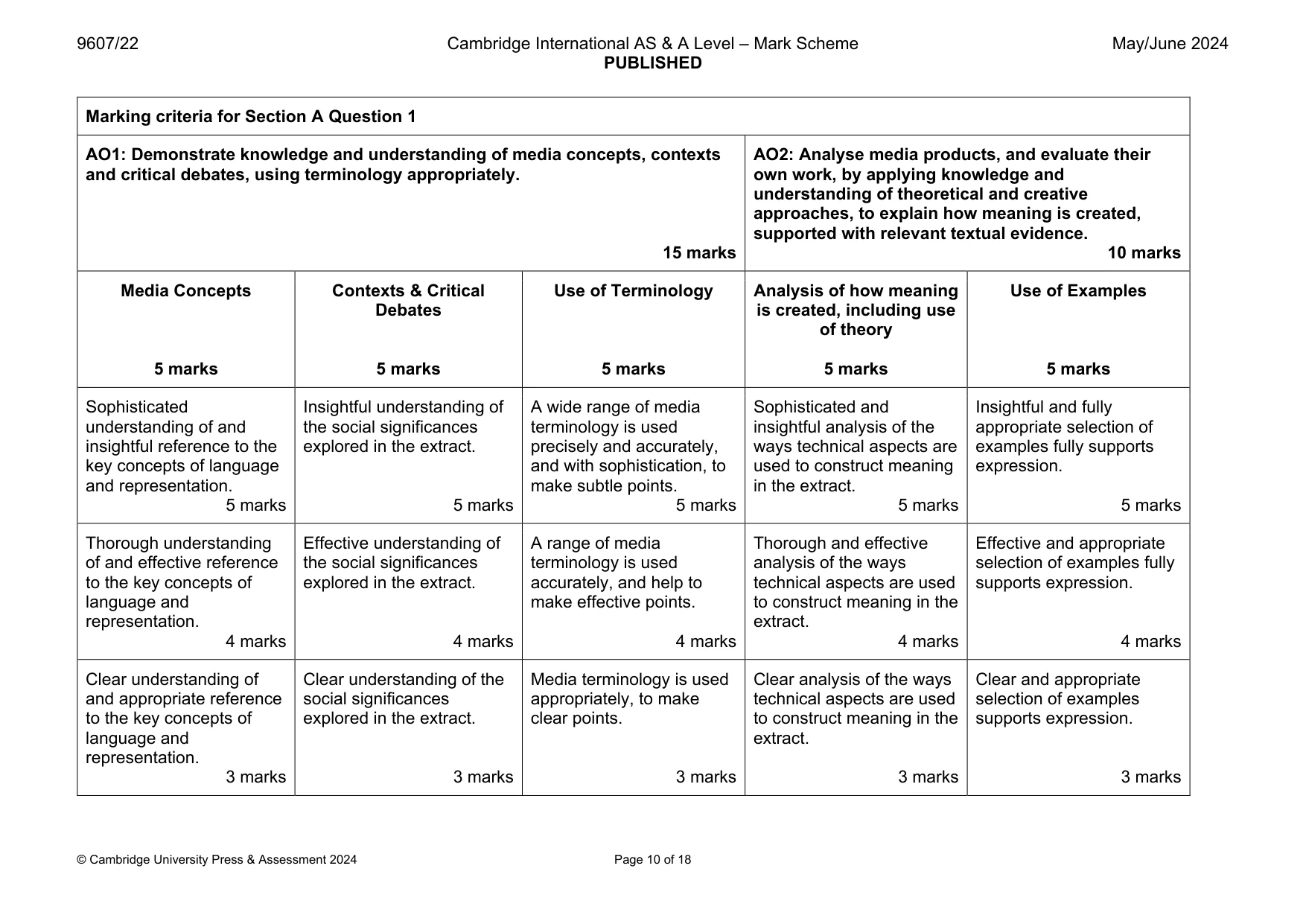
9607/22 Cambridge International AS & A Level – Mark Scheme PUBLISHED May/June 2024 © Cambridge University Press & Assessment 2024 Page 10 of 18 Marking criteria for Section A Question 1 AO1: Demonstrate knowledge and understanding of media concepts, contexts and critical debates, using terminology appropriately. 15 marks AO2: Analyse media products, and evaluate their own work, by applying knowledge and understanding of theoretical and creative approaches, to explain how meaning is created, supported with relevant textual evidence. 10 marks Media Concepts 5 marks Contexts & Critical Debates 5 marks Use of Terminology 5 marks Analysis of how meaning is created, including use of theory 5 marks Use of Examples 5 marks Sophisticated understanding of and insightful reference to the key concepts of language and representation. 5 marks Insightful understanding of the social significances explored in the extract. 5 marks A wide range of media terminology is used precisely and accurately, and with sophistication, to make subtle points. 5 marks Sophisticated and insightful analysis of the ways technical aspects are used to construct meaning in the extract. 5 marks Insightful and fully appropriate selection of examples fully supports expression. 5 marks Thorough understanding of and effective reference to the key concepts of language and representation. 4 marks Effective understanding of the social significances explored in the extract. 4 marks A range of media terminology is used accurately, and help to make effective points. 4 marks Thorough and effective analysis of the ways technical aspects are used to construct meaning in the extract. 4 marks Effective and appropriate selection of examples fully supports expression. 4 marks Clear understanding of and appropriate reference to the key concepts of language and representation. 3 marks Clear understanding of the social significances explored in the extract. 3 marks Media terminology is used appropriately, to make clear points. 3 marks Clear analysis of the ways technical aspects are used to construct meaning in the extract. 3 marks Clear and appropriate selection of examples supports expression. 3 marks
Mark scheme, page 11
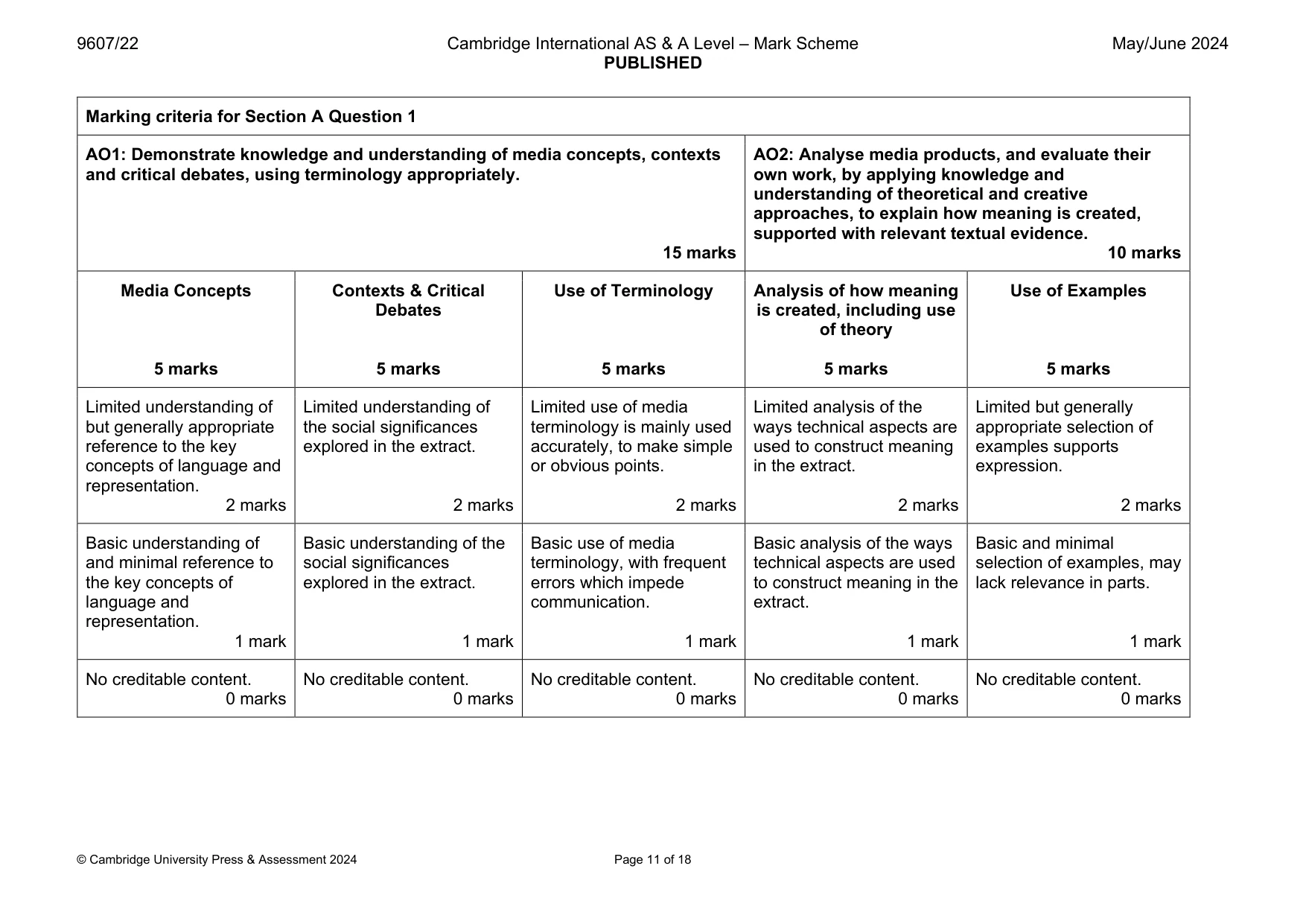
9607/22 Cambridge International AS & A Level – Mark Scheme PUBLISHED May/June 2024 © Cambridge University Press & Assessment 2024 Page 11 of 18 Marking criteria for Section A Question 1 AO1: Demonstrate knowledge and understanding of media concepts, contexts and critical debates, using terminology appropriately. 15 marks AO2: Analyse media products, and evaluate their own work, by applying knowledge and understanding of theoretical and creative approaches, to explain how meaning is created, supported with relevant textual evidence. 10 marks Media Concepts 5 marks Contexts & Critical Debates 5 marks Use of Terminology 5 marks Analysis of how meaning is created, including use of theory 5 marks Use of Examples 5 marks Limited understanding of but generally appropriate reference to the key concepts of language and representation. 2 marks Limited understanding of the social significances explored in the extract. 2 marks Limited use of media terminology is mainly used accurately, to make simple or obvious points. 2 marks Limited analysis of the ways technical aspects are used to construct meaning in the extract. 2 marks Limited but generally appropriate selection of examples supports expression. 2 marks Basic understanding of and minimal reference to the key concepts of language and representation. 1 mark Basic understanding of the social significances explored in the extract. 1 mark Basic use of media terminology, with frequent errors which impede communication. 1 mark Basic analysis of the ways technical aspects are used to construct meaning in the extract. 1 mark Basic and minimal selection of examples, may lack relevance in parts. 1 mark No creditable content. 0 marks No creditable content. 0 marks No creditable content. 0 marks No creditable content. 0 marks No creditable content. 0 marks
Mark scheme, page 12
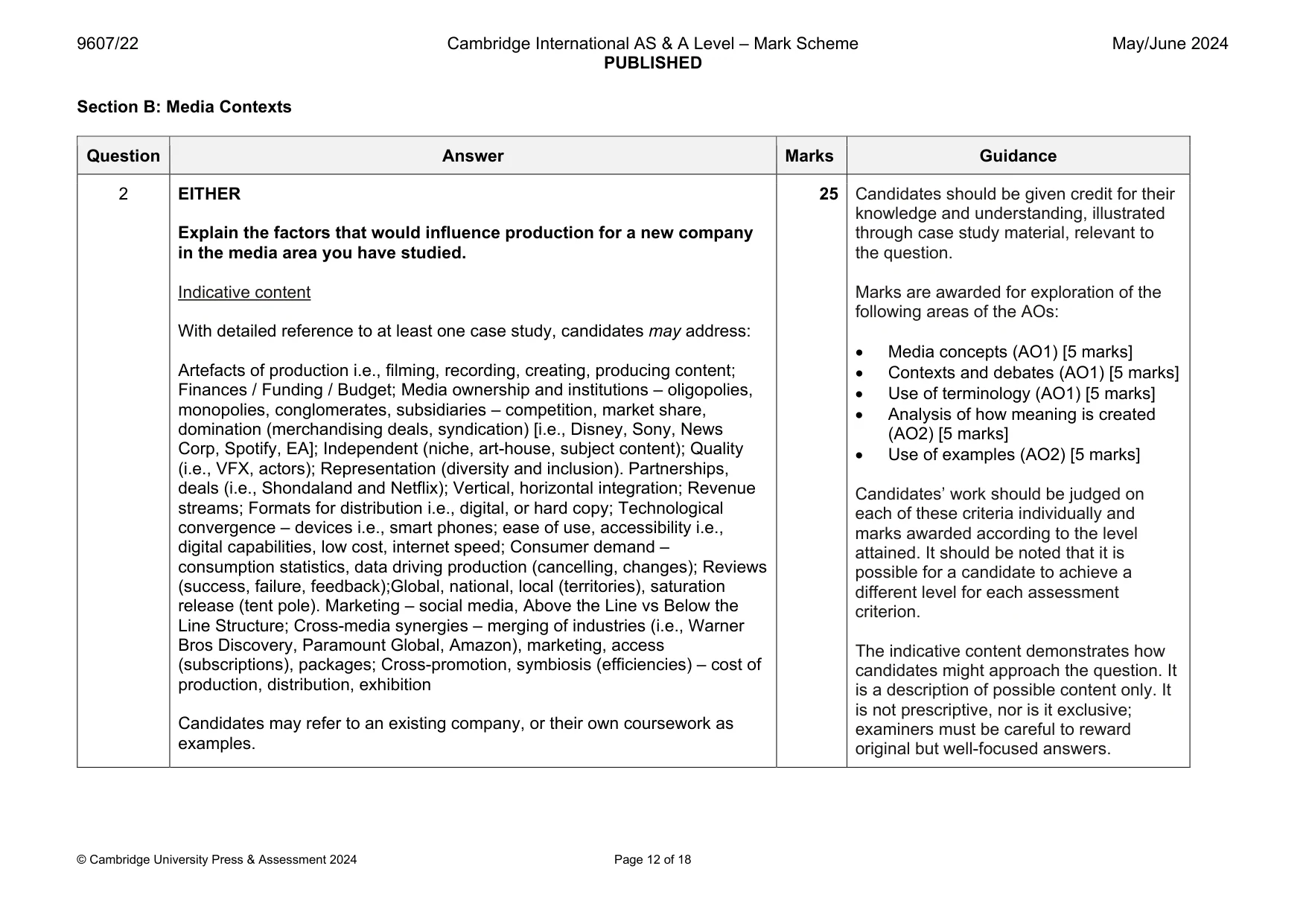
9607/22 Cambridge International AS & A Level – Mark Scheme PUBLISHED May/June 2024 © Cambridge University Press & Assessment 2024 Page 12 of 18 Section B: Media Contexts Question Answer Marks Guidance 2 EITHER Explain the factors that would influence production for a new company in the media area you have studied. Indicative content With detailed reference to at least one case study, candidates may address: Artefacts of production i.e., filming, recording, creating, producing content; Finances / Funding / Budget; Media ownership and institutions – oligopolies, monopolies, conglomerates, subsidiaries – competition, market share, domination (merchandising deals, syndication) [i.e., Disney, Sony, News Corp, Spotify, EA]; Independent (niche, art-house, subject content); Quality (i.e., VFX, actors); Representation (diversity and inclusion). Partnerships, deals (i.e., Shondaland and Netflix); Vertical, horizontal integration; Revenue streams; Formats for distribution i.e., digital, or hard copy; Technological convergence – devices i.e., smart phones; ease of use, accessibility i.e., digital capabilities, low cost, internet speed; Consumer demand – consumption statistics, data driving production (cancelling, changes); Reviews (success, failure, feedback);Global, national, local (territories), saturation release (tent pole). Marketing – social media, Above the Line vs Below the Line Structure; Cross-media synergies – merging of industries (i.e., Warner Bros Discovery, Paramount Global, Amazon), marketing, access (subscriptions), packages; Cross-promotion, symbiosis (efficiencies) – cost of production, distribution, exhibition Candidates may refer to an existing company, or their own coursework as examples. 25 Candidates should be given credit for their knowledge and understanding, illustrated through case study material, relevant to the question. Marks are awarded for exploration of the following areas of the AOs: • Media concepts (AO1) [5 marks] • Contexts and debates (AO1) [5 marks] • Use of terminology (AO1) [5 marks] • Analysis of how meaning is created (AO2) [5 marks] • Use of examples (AO2) [5 marks] Candidates’ work should be judged on each of these criteria individually and marks awarded according to the level attained. It should be noted that it is possible for a candidate to achieve a different level for each assessment criterion. The indicative content demonstrates how candidates might approach the question. It is a description of possible content only. It is not prescriptive, nor is it exclusive; examiners must be careful to reward original but well-focused answers.
Mark scheme, page 13
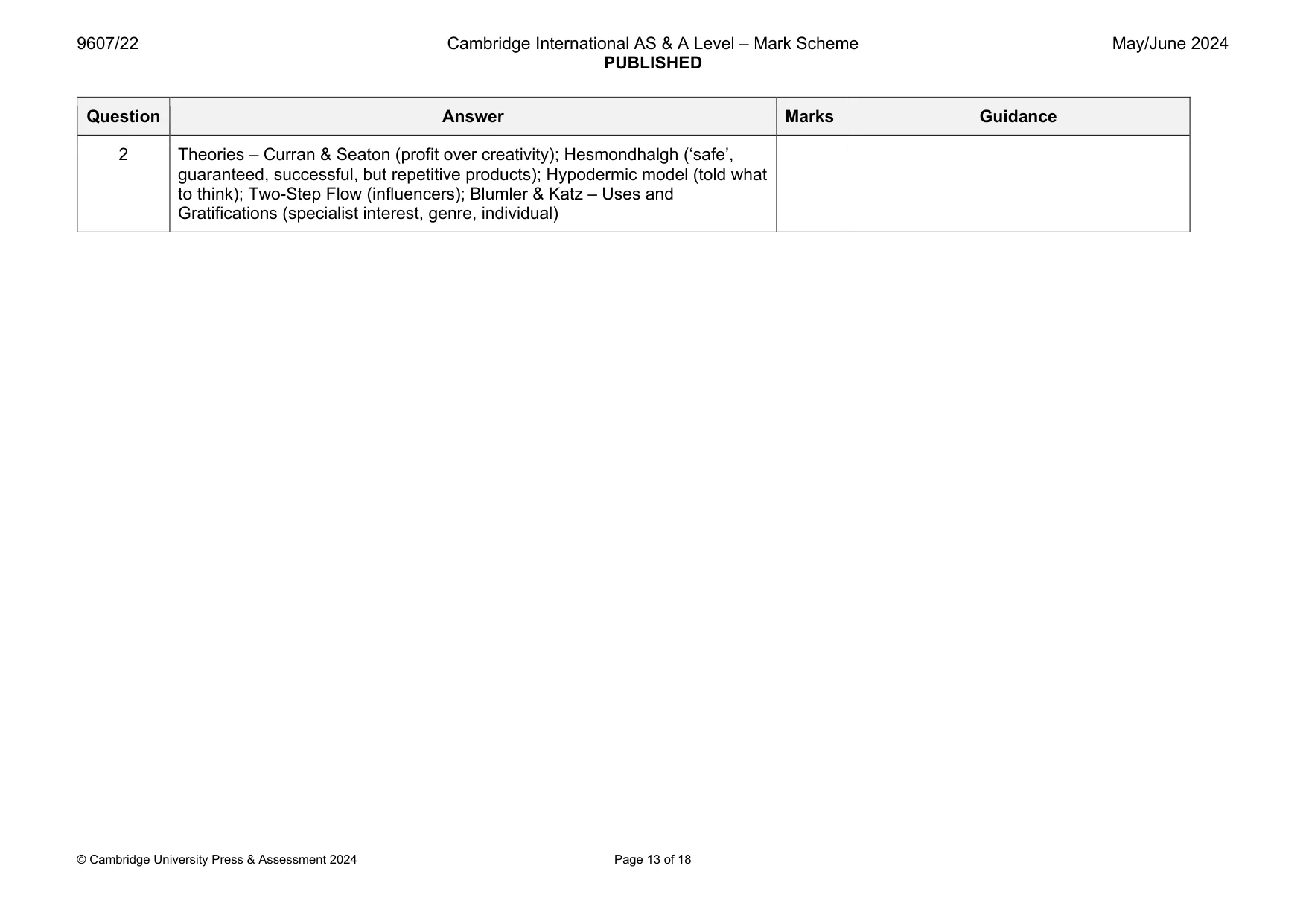
9607/22 Cambridge International AS & A Level – Mark Scheme PUBLISHED May/June 2024 © Cambridge University Press & Assessment 2024 Page 13 of 18 Question Answer Marks Guidance 2 Theories – Curran & Seaton (profit over creativity); Hesmondhalgh (‘safe’, guaranteed, successful, but repetitive products); Hypodermic model (told what to think); Two-Step Flow (influencers); Blumler & Katz – Uses and Gratifications (specialist interest, genre, individual)
Mark scheme, page 14
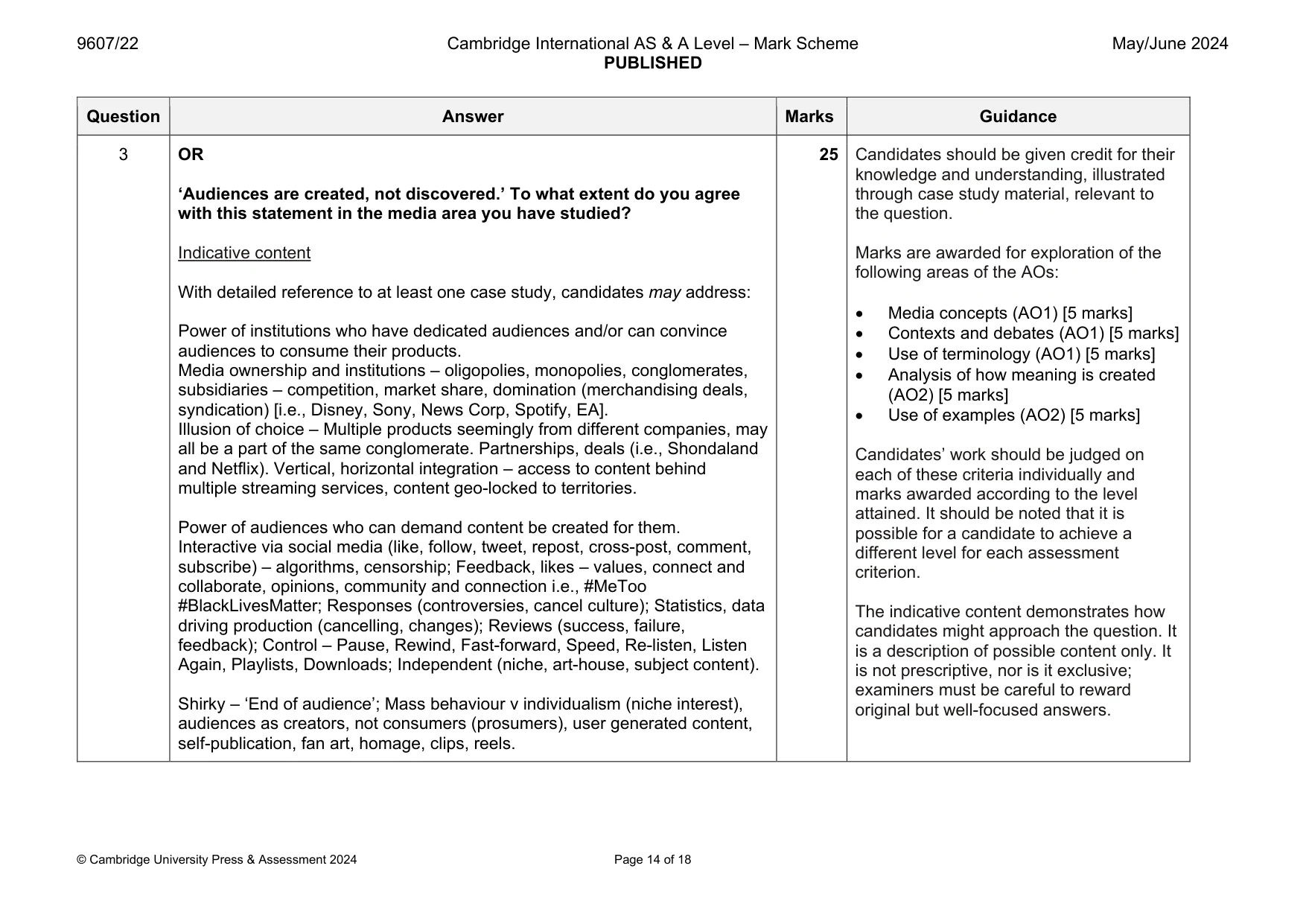
9607/22 Cambridge International AS & A Level – Mark Scheme PUBLISHED May/June 2024 © Cambridge University Press & Assessment 2024 Page 14 of 18 Question Answer Marks Guidance 3 OR ‘Audiences are created, not discovered.’ To what extent do you agree with this statement in the media area you have studied? Indicative content With detailed reference to at least one case study, candidates may address: Power of institutions who have dedicated audiences and/or can convince audiences to consume their products. Media ownership and institutions – oligopolies, monopolies, conglomerates, subsidiaries – competition, market share, domination (merchandising deals, syndication) [i.e., Disney, Sony, News Corp, Spotify, EA]. Illusion of choice – Multiple products seemingly from different companies, may all be a part of the same conglomerate. Partnerships, deals (i.e., Shondaland and Netflix). Vertical, horizontal integration – access to content behind multiple streaming services, content geo-locked to territories. Power of audiences who can demand content be created for them. Interactive via social media (like, follow, tweet, repost, cross-post, comment, subscribe) – algorithms, censorship; Feedback, likes – values, connect and collaborate, opinions, community and connection i.e., #MeToo #BlackLivesMatter; Responses (controversies, cancel culture); Statistics, data driving production (cancelling, changes); Reviews (success, failure, feedback); Control – Pause, Rewind, Fast-forward, Speed, Re-listen, Listen Again, Playlists, Downloads; Independent (niche, art-house, subject content). Shirky – ‘End of audience’; Mass behaviour v individualism (niche interest), audiences as creators, not consumers (prosumers), user generated content, self-publication, fan art, homage, clips, reels. 25 Candidates should be given credit for their knowledge and understanding, illustrated through case study material, relevant to the question. Marks are awarded for exploration of the following areas of the AOs: • Media concepts (AO1) [5 marks] • Contexts and debates (AO1) [5 marks] • Use of terminology (AO1) [5 marks] • Analysis of how meaning is created (AO2) [5 marks] • Use of examples (AO2) [5 marks] Candidates’ work should be judged on each of these criteria individually and marks awarded according to the level attained. It should be noted that it is possible for a candidate to achieve a different level for each assessment criterion. The indicative content demonstrates how candidates might approach the question. It is a description of possible content only. It is not prescriptive, nor is it exclusive; examiners must be careful to reward original but well-focused answers.
Mark scheme, page 15
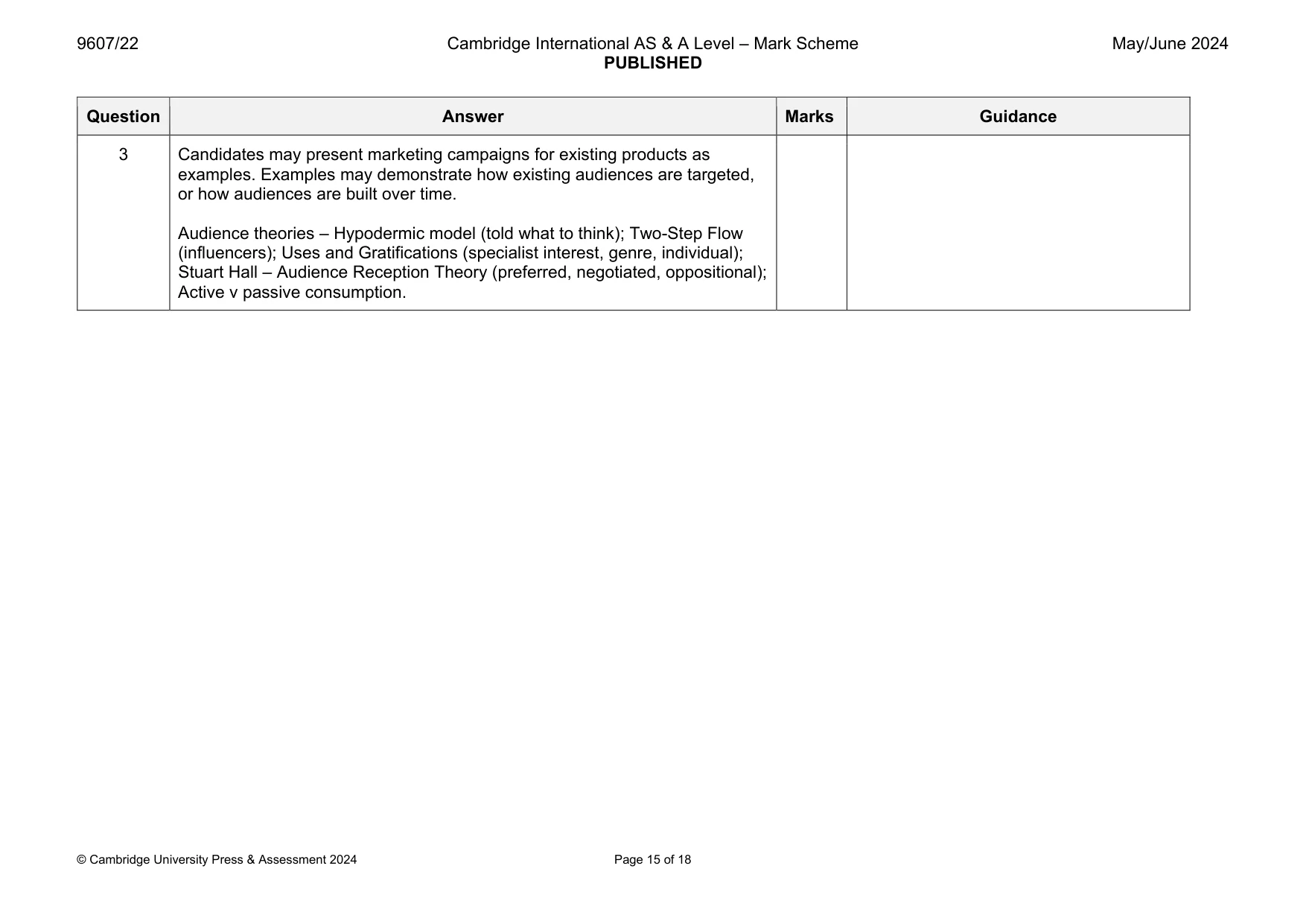
9607/22 Cambridge International AS & A Level – Mark Scheme PUBLISHED May/June 2024 © Cambridge University Press & Assessment 2024 Page 15 of 18 Question Answer Marks Guidance 3 Candidates may present marketing campaigns for existing products as examples. Examples may demonstrate how existing audiences are targeted, or how audiences are built over time. Audience theories – Hypodermic model (told what to think); Two-Step Flow (influencers); Uses and Gratifications (specialist interest, genre, individual); Stuart Hall – Audience Reception Theory (preferred, negotiated, oppositional); Active v passive consumption.
Mark scheme, page 16
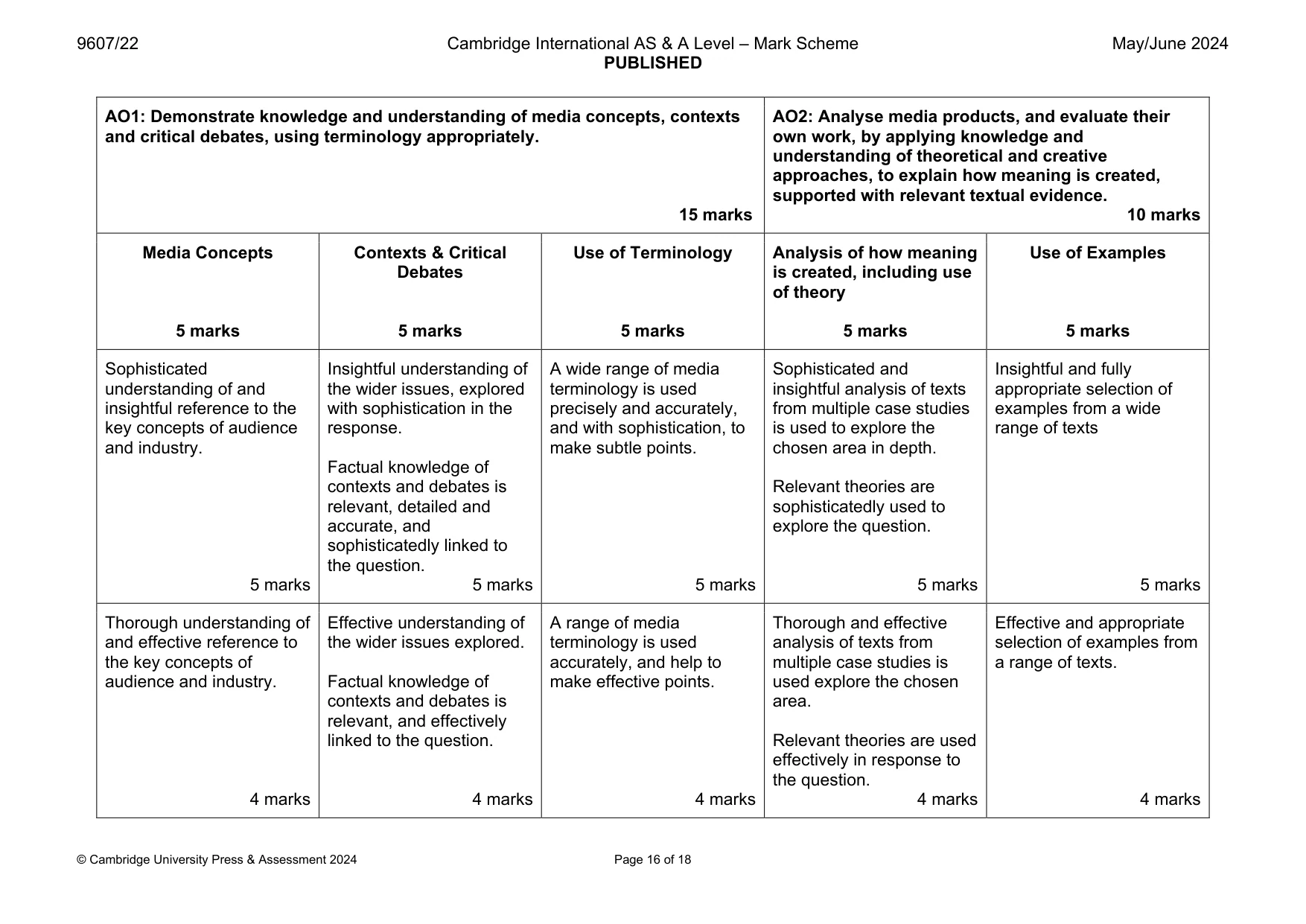
9607/22 Cambridge International AS & A Level – Mark Scheme PUBLISHED May/June 2024 © Cambridge University Press & Assessment 2024 Page 16 of 18 AO1: Demonstrate knowledge and understanding of media concepts, contexts and critical debates, using terminology appropriately. 15 marks AO2: Analyse media products, and evaluate their own work, by applying knowledge and understanding of theoretical and creative approaches, to explain how meaning is created, supported with relevant textual evidence. 10 marks Media Concepts 5 marks Contexts & Critical Debates 5 marks Use of Terminology 5 marks Analysis of how meaning is created, including use of theory 5 marks Use of Examples 5 marks Sophisticated understanding of and insightful reference to the key concepts of audience and industry. 5 marks Insightful understanding of the wider issues, explored with sophistication in the response. Factual knowledge of contexts and debates is relevant, detailed and accurate, and sophisticatedly linked to the question. 5 marks A wide range of media terminology is used precisely and accurately, and with sophistication, to make subtle points. 5 marks Sophisticated and insightful analysis of texts from multiple case studies is used to explore the chosen area in depth. Relevant theories are sophisticatedly used to explore the question. 5 marks Insightful and fully appropriate selection of examples from a wide range of texts 5 marks Thorough understanding of and effective reference to the key concepts of audience and industry. 4 marks Effective understanding of the wider issues explored. Factual knowledge of contexts and debates is relevant, and effectively linked to the question. 4 marks A range of media terminology is used accurately, and help to make effective points. 4 marks Thorough and effective analysis of texts from multiple case studies is used explore the chosen area. Relevant theories are used effectively in response to the question. 4 marks Effective and appropriate selection of examples from a range of texts. 4 marks
Mark scheme, page 17
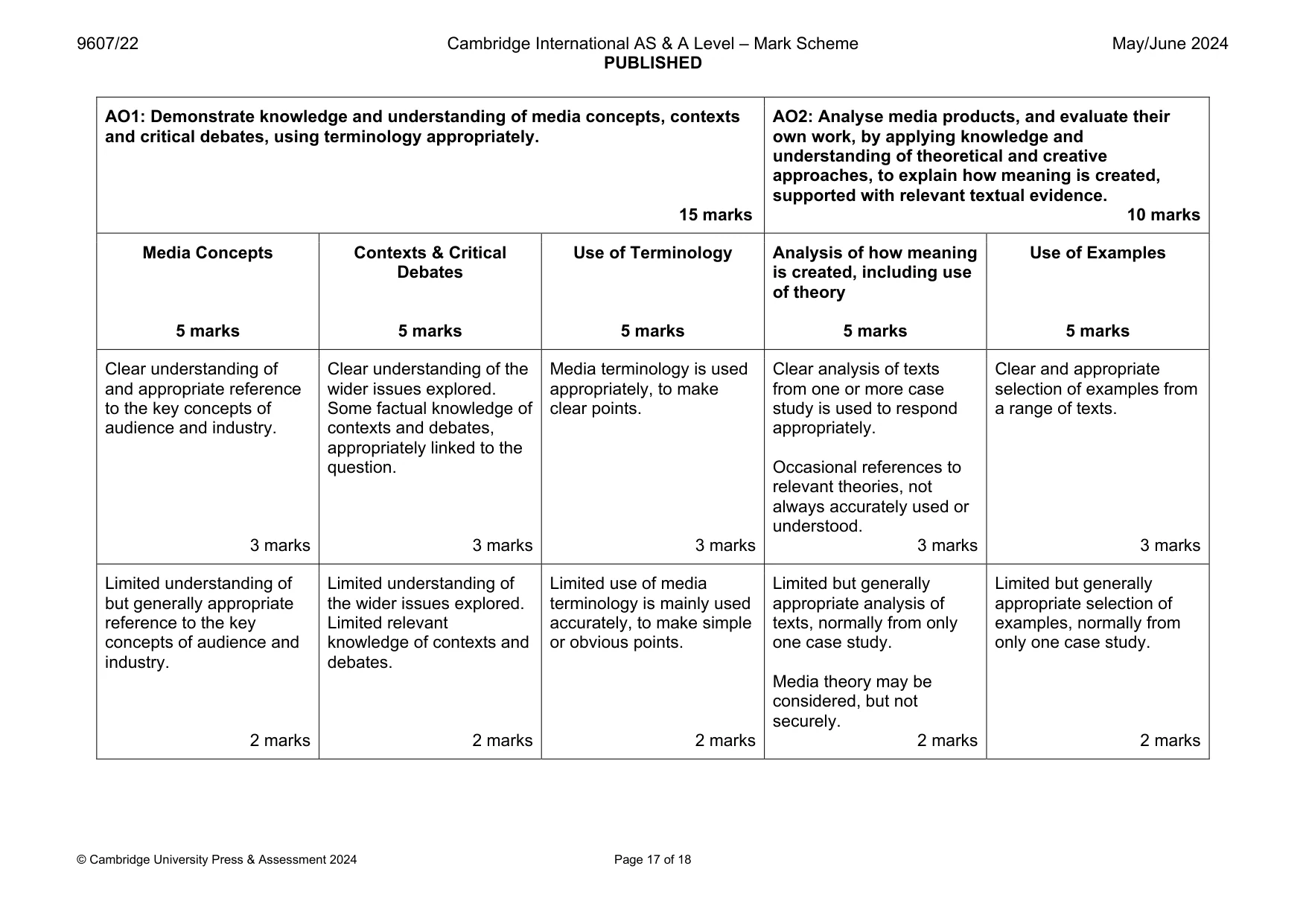
9607/22 Cambridge International AS & A Level – Mark Scheme PUBLISHED May/June 2024 © Cambridge University Press & Assessment 2024 Page 17 of 18 AO1: Demonstrate knowledge and understanding of media concepts, contexts and critical debates, using terminology appropriately. 15 marks AO2: Analyse media products, and evaluate their own work, by applying knowledge and understanding of theoretical and creative approaches, to explain how meaning is created, supported with relevant textual evidence. 10 marks Media Concepts 5 marks Contexts & Critical Debates 5 marks Use of Terminology 5 marks Analysis of how meaning is created, including use of theory 5 marks Use of Examples 5 marks Clear understanding of and appropriate reference to the key concepts of audience and industry. 3 marks Clear understanding of the wider issues explored. Some factual knowledge of contexts and debates, appropriately linked to the question. 3 marks Media terminology is used appropriately, to make clear points. 3 marks Clear analysis of texts from one or more case study is used to respond appropriately. Occasional references to relevant theories, not always accurately used or understood. 3 marks Clear and appropriate selection of examples from a range of texts. 3 marks Limited understanding of but generally appropriate reference to the key concepts of audience and industry. 2 marks Limited understanding of the wider issues explored. Limited relevant knowledge of contexts and debates. 2 marks Limited use of media terminology is mainly used accurately, to make simple or obvious points. 2 marks Limited but generally appropriate analysis of texts, normally from only one case study. Media theory may be considered, but not securely. 2 marks Limited but generally appropriate selection of examples, normally from only one case study. 2 marks
Mark scheme, page 18
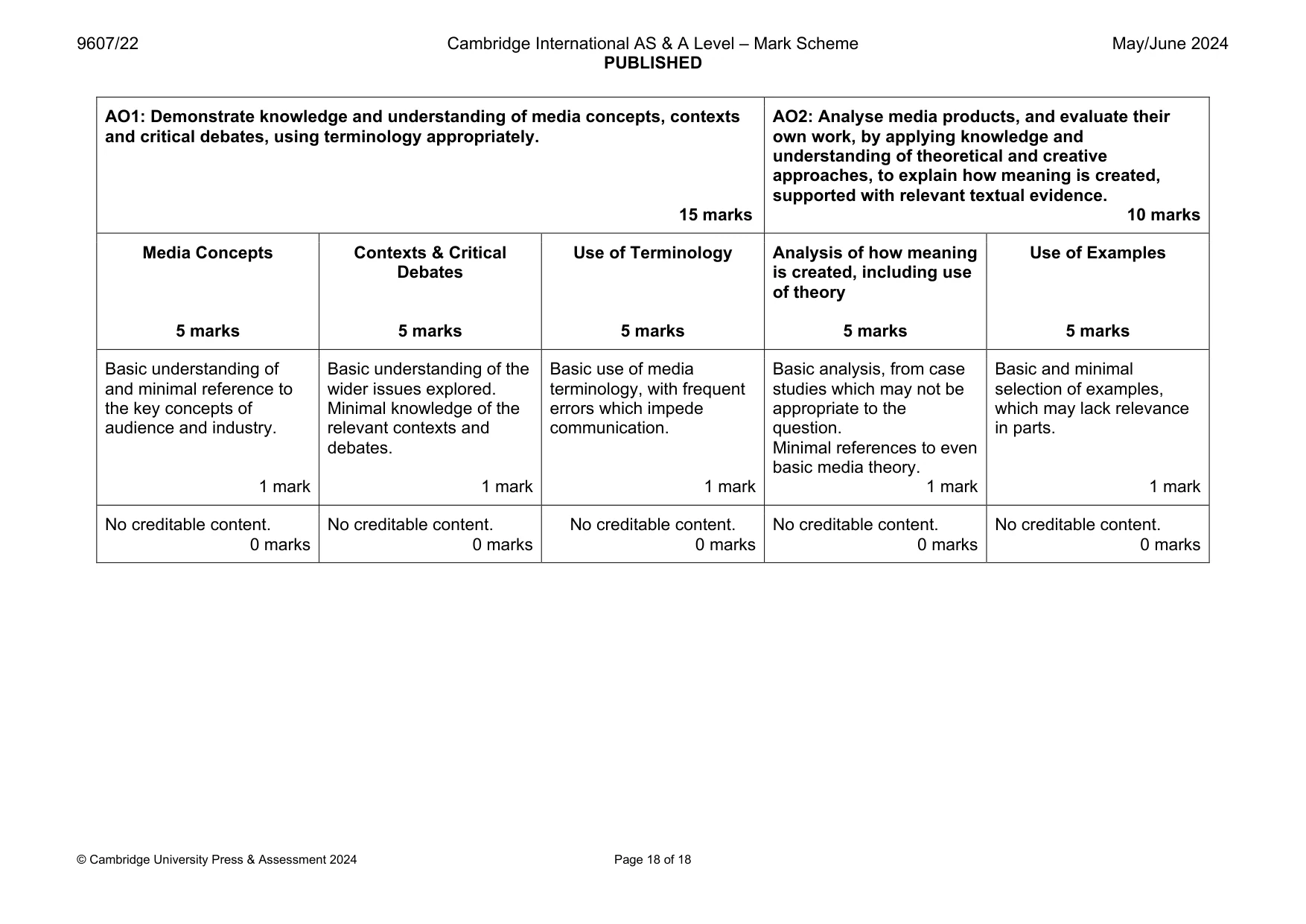
9607/22 Cambridge International AS & A Level – Mark Scheme PUBLISHED May/June 2024 © Cambridge University Press & Assessment 2024 Page 18 of 18 AO1: Demonstrate knowledge and understanding of media concepts, contexts and critical debates, using terminology appropriately. 15 marks AO2: Analyse media products, and evaluate their own work, by applying knowledge and understanding of theoretical and creative approaches, to explain how meaning is created, supported with relevant textual evidence. 10 marks Media Concepts 5 marks Contexts & Critical Debates 5 marks Use of Terminology 5 marks Analysis of how meaning is created, including use of theory 5 marks Use of Examples 5 marks Basic understanding of and minimal reference to the key concepts of audience and industry. 1 mark Basic understanding of the wider issues explored. Minimal knowledge of the relevant contexts and debates. 1 mark Basic use of media terminology, with frequent errors which impede communication. 1 mark Basic analysis, from case studies which may not be appropriate to the question. Minimal references to even basic media theory. 1 mark Basic and minimal selection of examples, which may lack relevance in parts. 1 mark No creditable content. 0 marks No creditable content. 0 marks No creditable content. 0 marks No creditable content. 0 marks No creditable content. 0 marks
What you needed in this session
Cambridge’s own grade thresholds for 2024 May/June, Paper 2 · Variant 2. A higher threshold means an easier paper — the bar moves with how the cohort did.