Cambridge A Level Media Studies 9607 — 2020 May/June Paper 2 · Variant 2
9607/22/M/J/20
The question paper and its mark scheme, free to read here and free to download. This is Cambridge’s own paper, exactly as it was sat.
Question paper4 pages

Mark scheme9 pages
Answers below. Sit the paper first if you are practising.
Paper as text
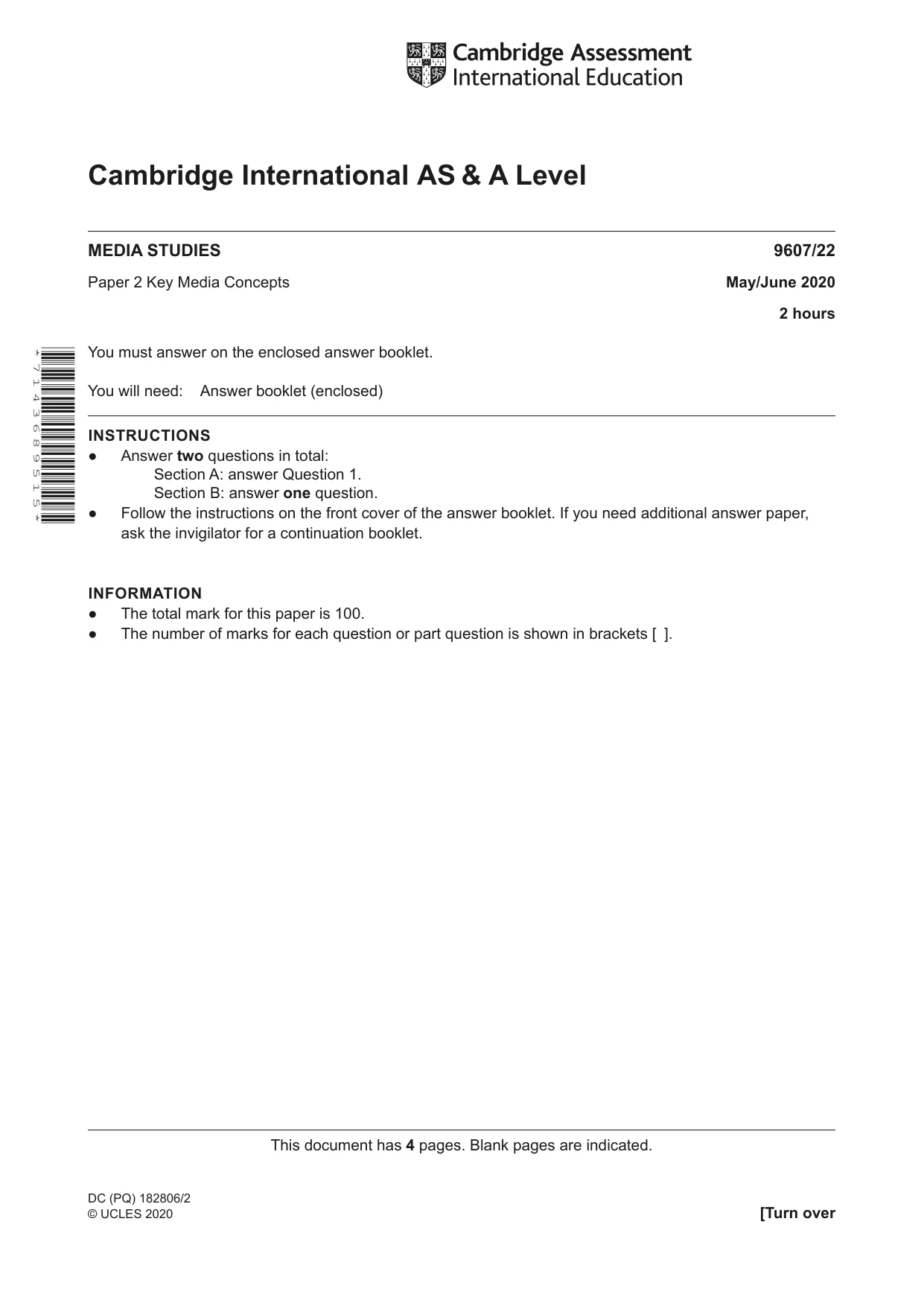
Question paper, page 1
Cambridge International AS & A Level * 7 1 4 3 6 8 9 5 1 5 * DC (PQ) 182806/2 © UCLES 2020 [Turn over This document has 4 pages. Blank pages are indicated. MEDIA STUDIES 9607/22 Paper 2 Key Media Concepts May/June 2020 2 hours You must answer on the enclosed answer booklet. You will need: Answer booklet (enclosed) INSTRUCTIONS ● Answer two questions in total: Section A: answer Question 1. Section B: answer one question. ● Follow the instructions on the front cover of the answer booklet. If you need additional answer paper, ask the invigilator for a continuation booklet. INFORMATION ● The total mark for this paper is 100. ● The number of marks for each question or part question is shown in brackets [ ].
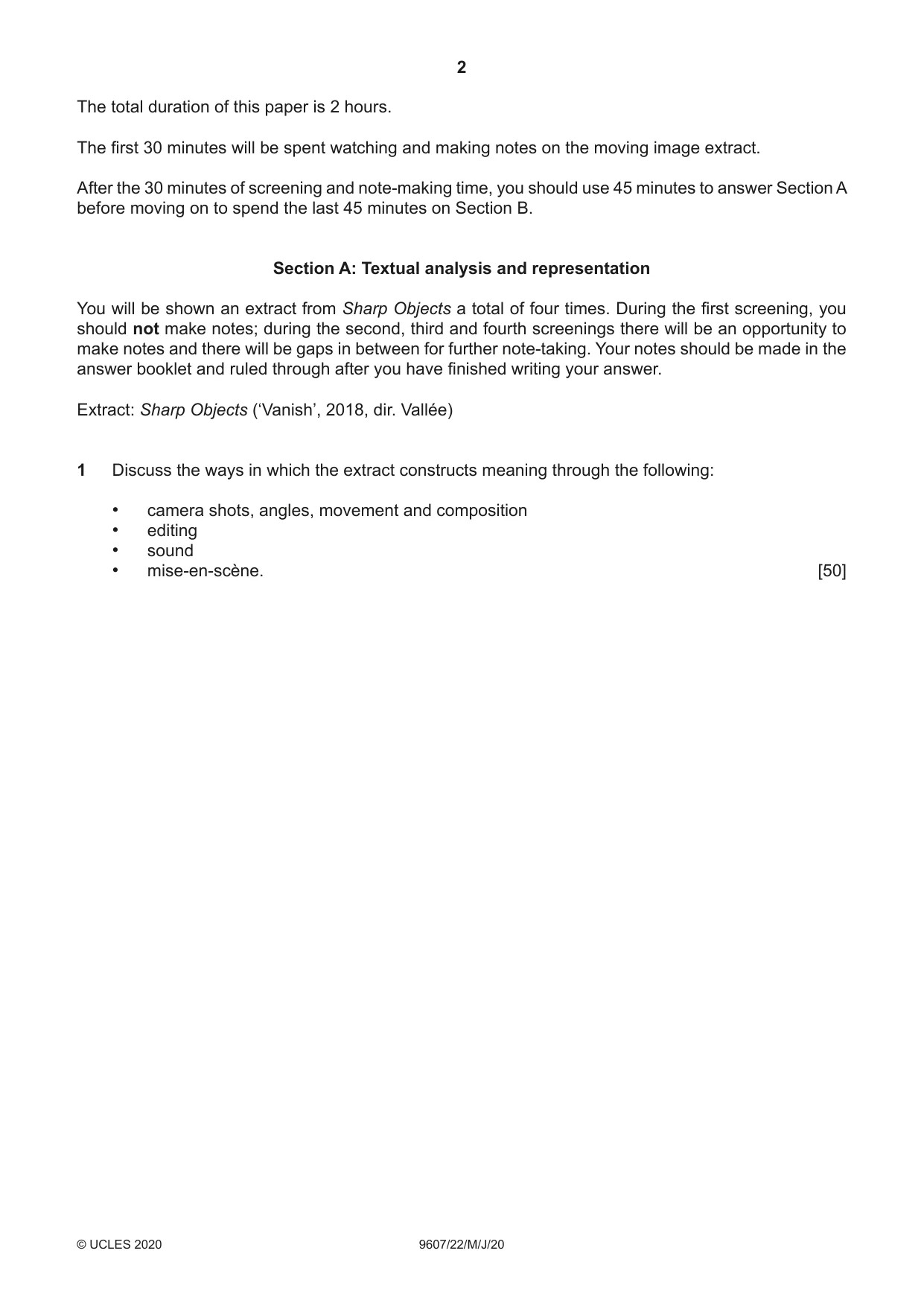
Question paper, page 2
2 9607/22/M/J/20 © UCLES 2020 The total duration of this paper is 2 hours. The first 30 minutes will be spent watching and making notes on the moving image extract. After the 30 minutes of screening and note-making time, you should use 45 minutes to answer Section A before moving on to spend the last 45 minutes on Section B. Section A: Textual analysis and representation You will be shown an extract from Sharp Objects a total of four times. During the first screening, you should not make notes; during the second, third and fourth screenings there will be an opportunity to make notes and there will be gaps in between for further note-taking. Your notes should be made in the answer booklet and ruled through after you have finished writing your answer. Extract: Sharp Objects (‘Vanish’, 2018, dir. Vallée) 1 Discuss the ways in which the extract constructs meaning through the following: • camera shots, angles, movement and composition • editing • sound • mise-en-scène. [50]
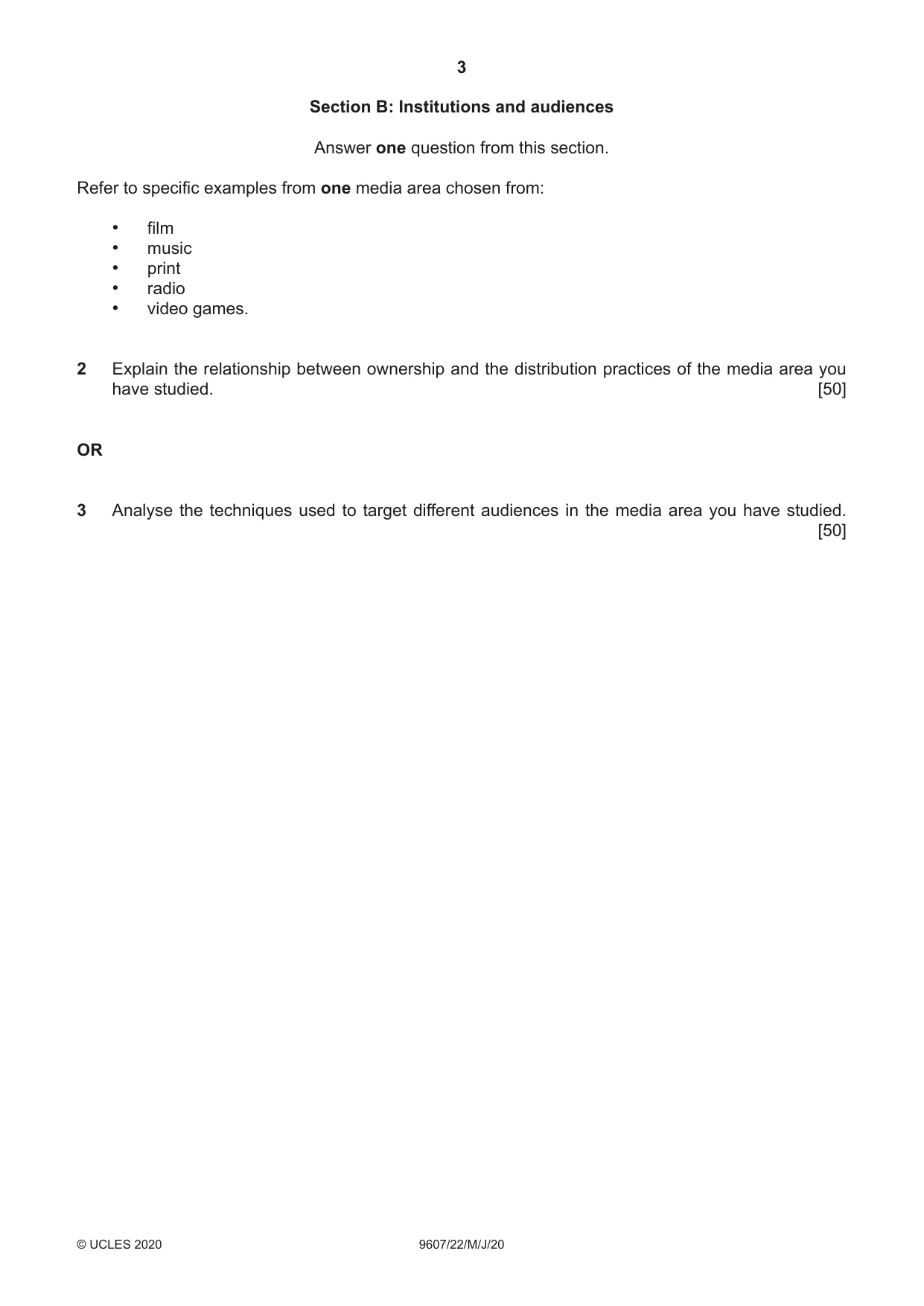
Question paper, page 3
3 9607/22/M/J/20 © UCLES 2020 Section B: Institutions and audiences Answer one question from this section. Refer to specific examples from one media area chosen from: • film • music • print • radio • video games. 2 Explain the relationship between ownership and the distribution practices of the media area you have studied. [50] OR 3 Analyse the techniques used to target different audiences in the media area you have studied. [50]
Question paper, page 4
4 9607/22/M/J/20 © UCLES 2020 Permission to reproduce items where third-party owned material protected by copyright is included has been sought and cleared where possible. Every reasonable effort has been made by the publisher (UCLES) to trace copyright holders, but if any items requiring clearance have unwittingly been included, the publisher will be pleased to make amends at the earliest possible opportunity. To avoid the issue of disclosure of answer-related information to candidates, all copyright acknowledgements are reproduced online in the Cambridge Assessment International Education Copyright Acknowledgements Booklet. This is produced for each series of examinations and is freely available to download at www.cambridgeinternational.org after the live examination series. Cambridge Assessment International Education is part of the Cambridge Assessment Group. Cambridge Assessment is the brand name of the University of Cambridge Local Examinations Syndicate (UCLES), which itself is a department of the University of Cambridge. BLANK PAGE
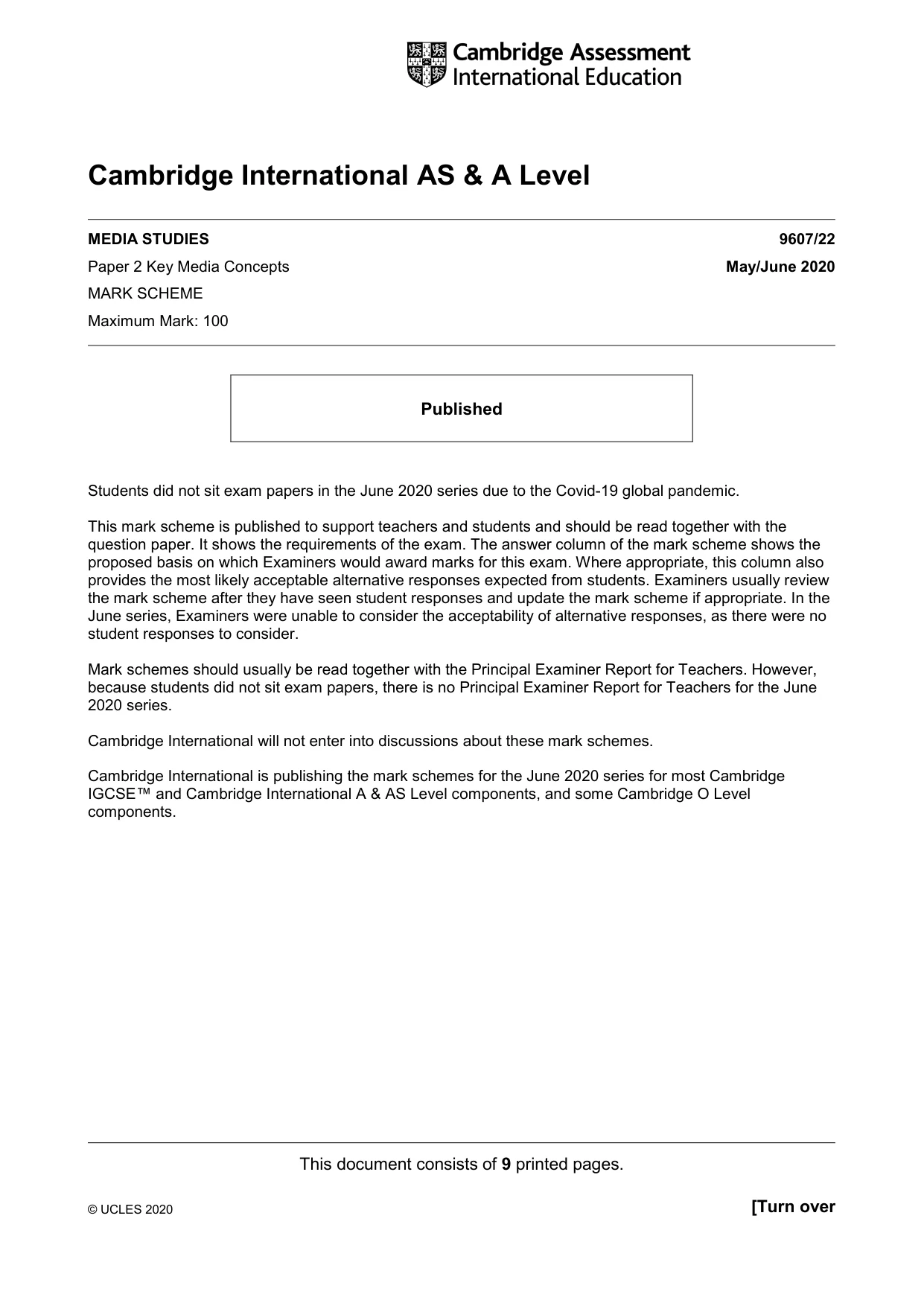
Mark scheme, page 1
This document consists of 9 printed pages. © UCLES 2020 [Turn over Cambridge International AS & A Level MEDIA STUDIES 9607/22 Paper 2 Key Media Concepts May/June 2020 MARK SCHEME Maximum Mark: 100 Published Students did not sit exam papers in the June 2020 series due to the Covid-19 global pandemic. This mark scheme is published to support teachers and students and should be read together with the question paper. It shows the requirements of the exam. The answer column of the mark scheme shows the proposed basis on which Examiners would award marks for this exam. Where appropriate, this column also provides the most likely acceptable alternative responses expected from students. Examiners usually review the mark scheme after they have seen student responses and update the mark scheme if appropriate. In the June series, Examiners were unable to consider the acceptability of alternative responses, as there were no student responses to consider. Mark schemes should usually be read together with the Principal Examiner Report for Teachers. However, because students did not sit exam papers, there is no Principal Examiner Report for Teachers for the June 2020 series. Cambridge International will not enter into discussions about these mark schemes. Cambridge International is publishing the mark schemes for the June 2020 series for most Cambridge IGCSE™ and Cambridge International A & AS Level components, and some Cambridge O Level components.
Mark scheme, page 2
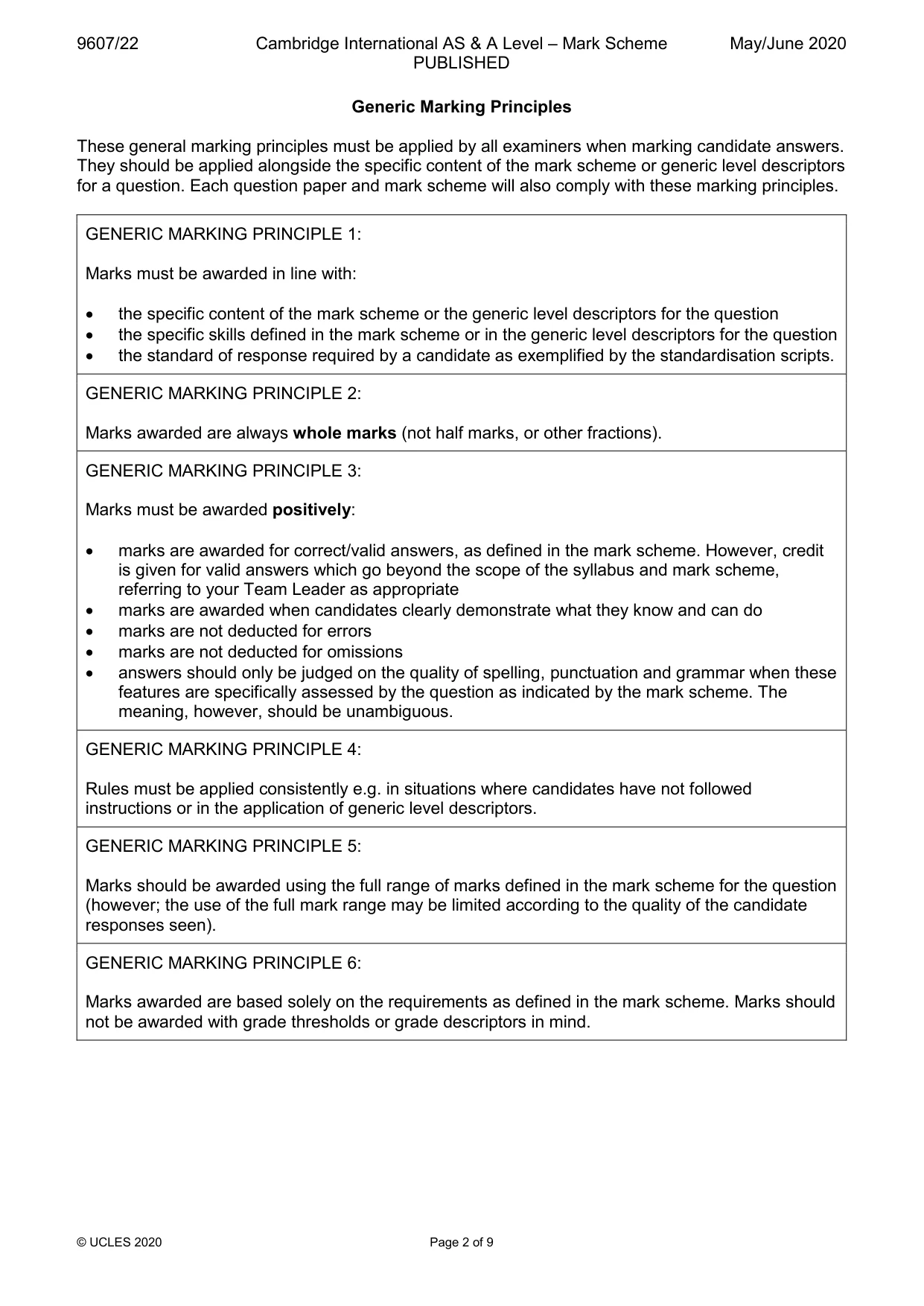
9607/22 Cambridge International AS & A Level – Mark Scheme PUBLISHED May/June 2020 © UCLES 2020 Page 2 of 9 Generic Marking Principles These general marking principles must be applied by all examiners when marking candidate answers. They should be applied alongside the specific content of the mark scheme or generic level descriptors for a question. Each question paper and mark scheme will also comply with these marking principles. GENERIC MARKING PRINCIPLE 1: Marks must be awarded in line with: • the specific content of the mark scheme or the generic level descriptors for the question • the specific skills defined in the mark scheme or in the generic level descriptors for the question • the standard of response required by a candidate as exemplified by the standardisation scripts. GENERIC MARKING PRINCIPLE 2: Marks awarded are always whole marks (not half marks, or other fractions). GENERIC MARKING PRINCIPLE 3: Marks must be awarded positively: • marks are awarded for correct/valid answers, as defined in the mark scheme. However, credit is given for valid answers which go beyond the scope of the syllabus and mark scheme, referring to your Team Leader as appropriate • marks are awarded when candidates clearly demonstrate what they know and can do • marks are not deducted for errors • marks are not deducted for omissions • answers should only be judged on the quality of spelling, punctuation and grammar when these features are specifically assessed by the question as indicated by the mark scheme. The meaning, however, should be unambiguous. GENERIC MARKING PRINCIPLE 4: Rules must be applied consistently e.g. in situations where candidates have not followed instructions or in the application of generic level descriptors. GENERIC MARKING PRINCIPLE 5: Marks should be awarded using the full range of marks defined in the mark scheme for the question (however; the use of the full mark range may be limited according to the quality of the candidate responses seen). GENERIC MARKING PRINCIPLE 6: Marks awarded are based solely on the requirements as defined in the mark scheme. Marks should not be awarded with grade thresholds or grade descriptors in mind.
Mark scheme, page 3
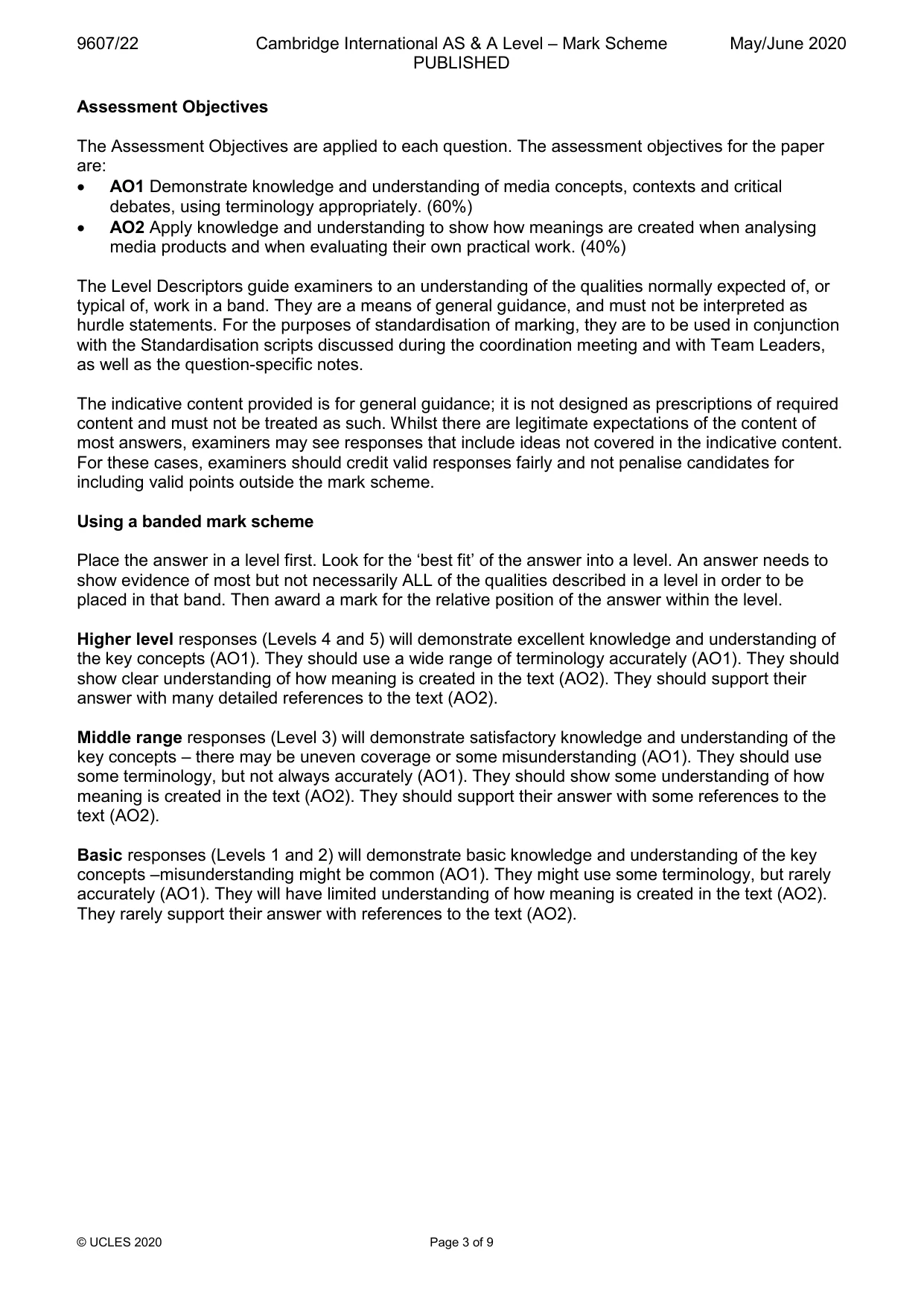
9607/22 Cambridge International AS & A Level – Mark Scheme PUBLISHED May/June 2020 © UCLES 2020 Page 3 of 9 Assessment Objectives The Assessment Objectives are applied to each question. The assessment objectives for the paper are: • AO1 Demonstrate knowledge and understanding of media concepts, contexts and critical debates, using terminology appropriately. (60%) • AO2 Apply knowledge and understanding to show how meanings are created when analysing media products and when evaluating their own practical work. (40%) The Level Descriptors guide examiners to an understanding of the qualities normally expected of, or typical of, work in a band. They are a means of general guidance, and must not be interpreted as hurdle statements. For the purposes of standardisation of marking, they are to be used in conjunction with the Standardisation scripts discussed during the coordination meeting and with Team Leaders, as well as the question-specific notes. The indicative content provided is for general guidance; it is not designed as prescriptions of required content and must not be treated as such. Whilst there are legitimate expectations of the content of most answers, examiners may see responses that include ideas not covered in the indicative content. For these cases, examiners should credit valid responses fairly and not penalise candidates for including valid points outside the mark scheme. Using a banded mark scheme Place the answer in a level first. Look for the ‘best fit’ of the answer into a level. An answer needs to show evidence of most but not necessarily ALL of the qualities described in a level in order to be placed in that band. Then award a mark for the relative position of the answer within the level. Higher level responses (Levels 4 and 5) will demonstrate excellent knowledge and understanding of the key concepts (AO1). They should use a wide range of terminology accurately (AO1). They should show clear understanding of how meaning is created in the text (AO2). They should support their answer with many detailed references to the text (AO2). Middle range responses (Level 3) will demonstrate satisfactory knowledge and understanding of the key concepts – there may be uneven coverage or some misunderstanding (AO1). They should use some terminology, but not always accurately (AO1). They should show some understanding of how meaning is created in the text (AO2). They should support their answer with some references to the text (AO2). Basic responses (Levels 1 and 2) will demonstrate basic knowledge and understanding of the key concepts –misunderstanding might be common (AO1). They might use some terminology, but rarely accurately (AO1). They will have limited understanding of how meaning is created in the text (AO2). They rarely support their answer with references to the text (AO2).
Mark scheme, page 4
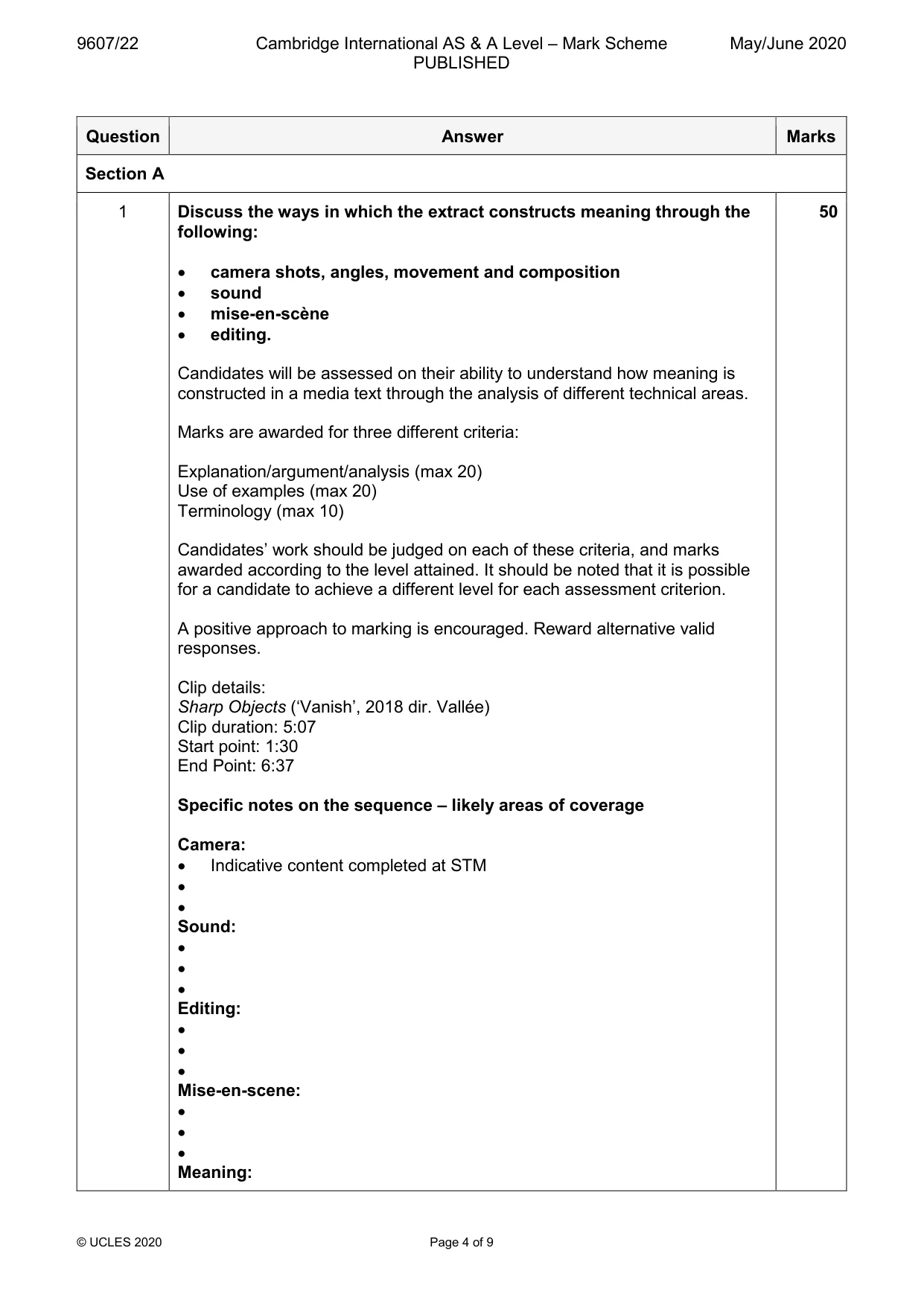
9607/22 Cambridge International AS & A Level – Mark Scheme PUBLISHED May/June 2020 © UCLES 2020 Page 4 of 9 Question Answer Marks Section A 1 Discuss the ways in which the extract constructs meaning through the following: • camera shots, angles, movement and composition • sound • mise-en-scène • editing. Candidates will be assessed on their ability to understand how meaning is constructed in a media text through the analysis of different technical areas. Marks are awarded for three different criteria: Explanation/argument/analysis (max 20) Use of examples (max 20) Terminology (max 10) Candidates’ work should be judged on each of these criteria, and marks awarded according to the level attained. It should be noted that it is possible for a candidate to achieve a different level for each assessment criterion. A positive approach to marking is encouraged. Reward alternative valid responses. Clip details: Sharp Objects (‘Vanish’, 2018 dir. Vallée) Clip duration: 5:07 Start point: 1:30 End Point: 6:37 Specific notes on the sequence – likely areas of coverage Camera: • Indicative content completed at STM • • Sound: • • • Editing: • • • Mise-en-scene: • • • Meaning: 50
Mark scheme, page 5
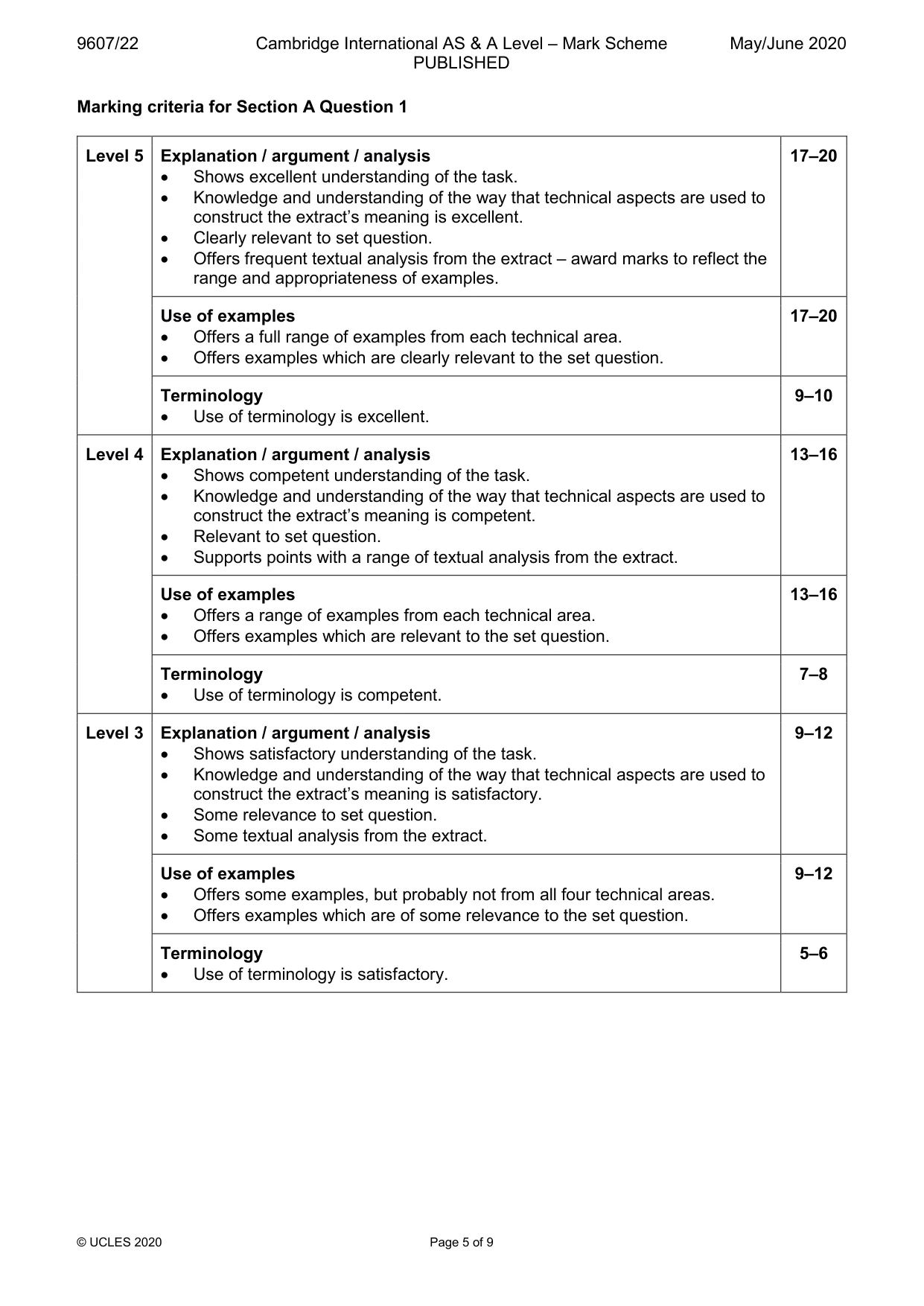
9607/22 Cambridge International AS & A Level – Mark Scheme PUBLISHED May/June 2020 © UCLES 2020 Page 5 of 9 Marking criteria for Section A Question 1 Level 5 Explanation / argument / analysis • Shows excellent understanding of the task. • Knowledge and understanding of the way that technical aspects are used to construct the extract’s meaning is excellent. • Clearly relevant to set question. • Offers frequent textual analysis from the extract – award marks to reflect the range and appropriateness of examples. 17–20 Use of examples • Offers a full range of examples from each technical area. • Offers examples which are clearly relevant to the set question. 17–20 Terminology • Use of terminology is excellent. 9–10 Level 4 Explanation / argument / analysis • Shows competent understanding of the task. • Knowledge and understanding of the way that technical aspects are used to construct the extract’s meaning is competent. • Relevant to set question. • Supports points with a range of textual analysis from the extract. 13–16 Use of examples • Offers a range of examples from each technical area. • Offers examples which are relevant to the set question. 13–16 Terminology • Use of terminology is competent. 7–8 Level 3 Explanation / argument / analysis • Shows satisfactory understanding of the task. • Knowledge and understanding of the way that technical aspects are used to construct the extract’s meaning is satisfactory. • Some relevance to set question. • Some textual analysis from the extract. 9–12 Use of examples • Offers some examples, but probably not from all four technical areas. • Offers examples which are of some relevance to the set question. 9–12 Terminology • Use of terminology is satisfactory. 5–6
Mark scheme, page 6
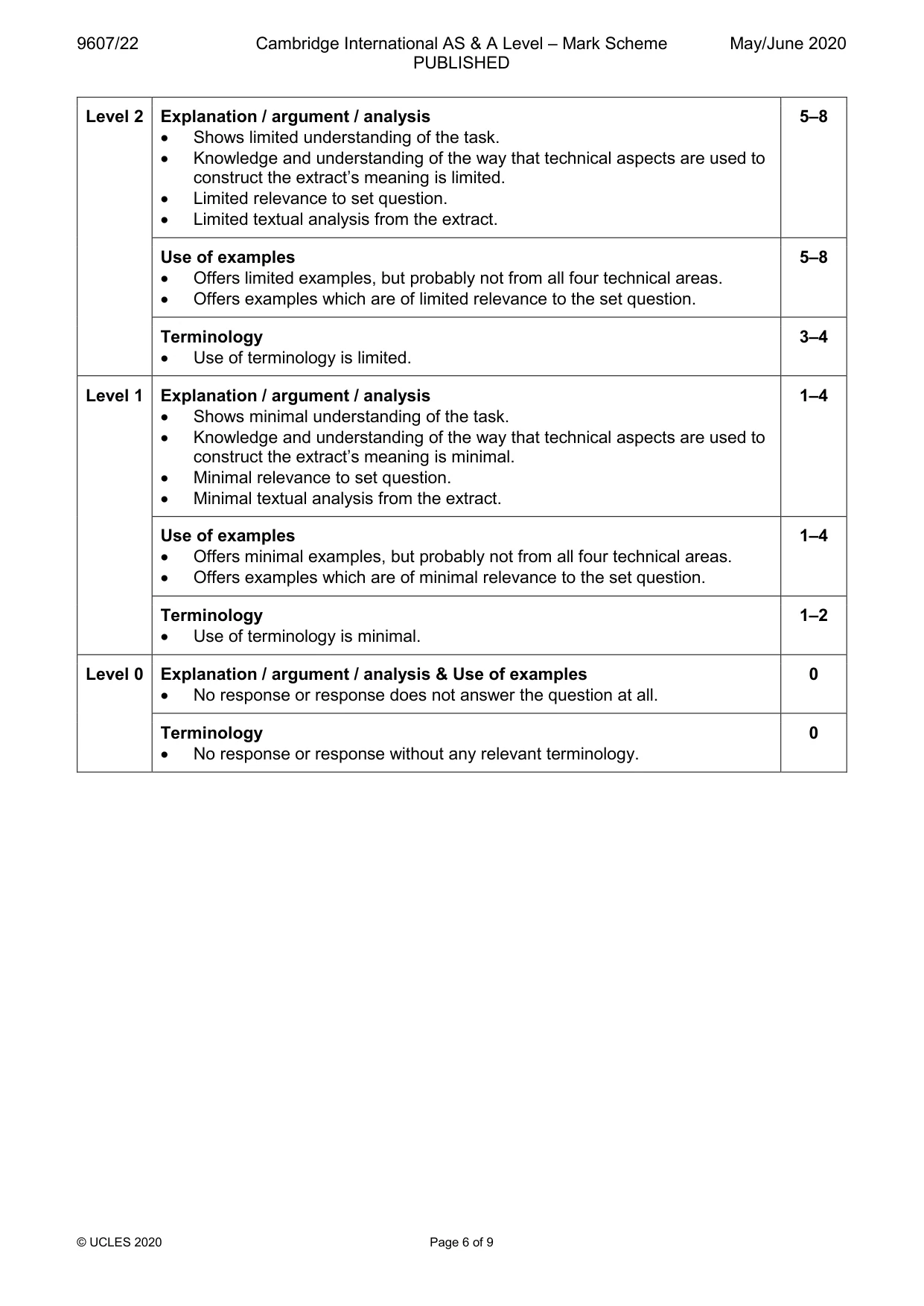
9607/22 Cambridge International AS & A Level – Mark Scheme PUBLISHED May/June 2020 © UCLES 2020 Page 6 of 9 Level 2 Explanation / argument / analysis • Shows limited understanding of the task. • Knowledge and understanding of the way that technical aspects are used to construct the extract’s meaning is limited. • Limited relevance to set question. • Limited textual analysis from the extract. 5–8 Use of examples • Offers limited examples, but probably not from all four technical areas. • Offers examples which are of limited relevance to the set question. 5–8 Terminology • Use of terminology is limited. 3–4 Level 1 Explanation / argument / analysis • Shows minimal understanding of the task. • Knowledge and understanding of the way that technical aspects are used to construct the extract’s meaning is minimal. • Minimal relevance to set question. • Minimal textual analysis from the extract. 1–4 Use of examples • Offers minimal examples, but probably not from all four technical areas. • Offers examples which are of minimal relevance to the set question. 1–4 Terminology • Use of terminology is minimal. 1–2 Level 0 Explanation / argument / analysis & Use of examples • No response or response does not answer the question at all. 0 Terminology • No response or response without any relevant terminology. 0
Mark scheme, page 7
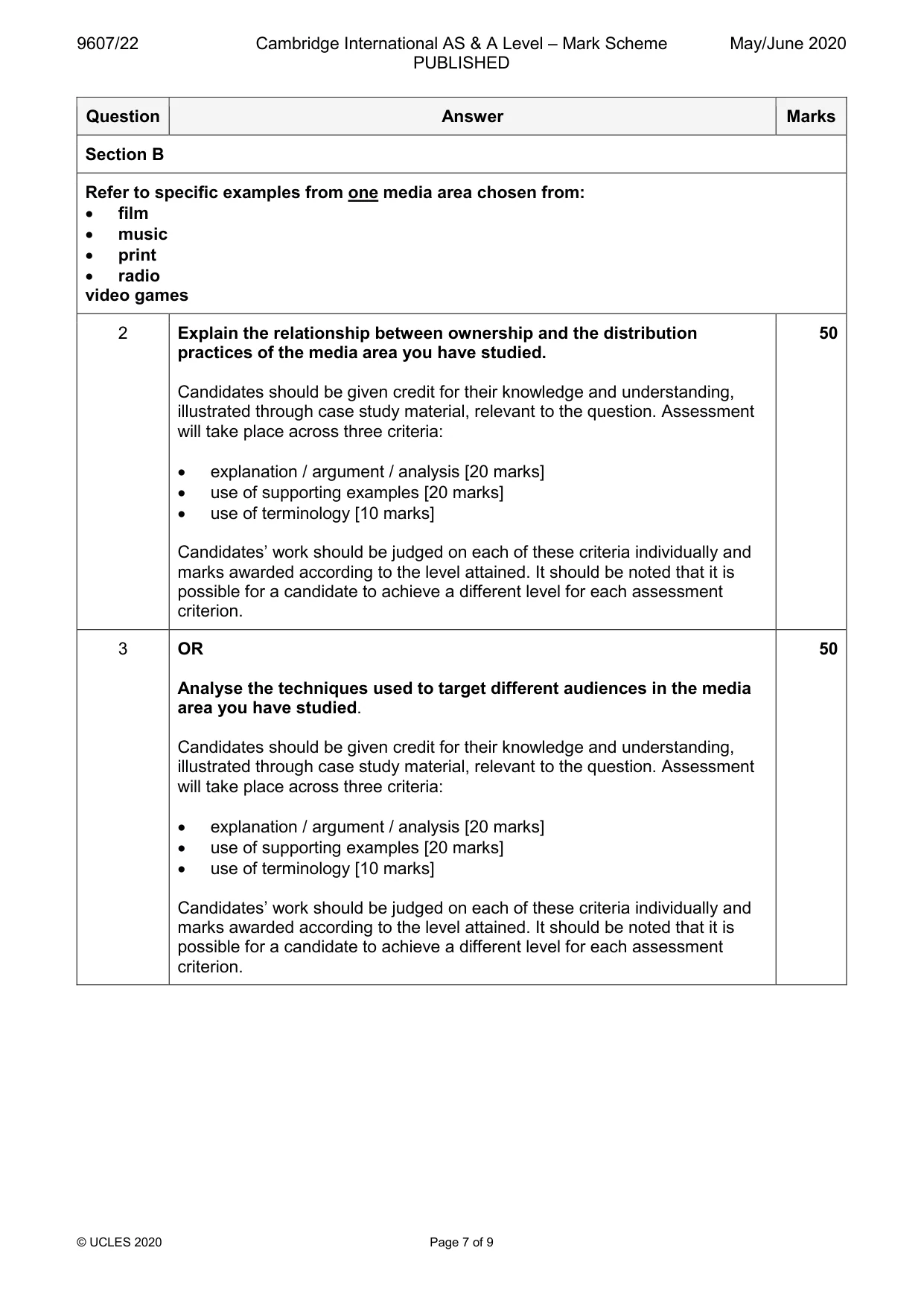
9607/22 Cambridge International AS & A Level – Mark Scheme PUBLISHED May/June 2020 © UCLES 2020 Page 7 of 9 Question Answer Marks Section B Refer to specific examples from one media area chosen from: • film • music • print • radio video games 2 Explain the relationship between ownership and the distribution practices of the media area you have studied. Candidates should be given credit for their knowledge and understanding, illustrated through case study material, relevant to the question. Assessment will take place across three criteria: • explanation / argument / analysis [20 marks] • use of supporting examples [20 marks] • use of terminology [10 marks] Candidates’ work should be judged on each of these criteria individually and marks awarded according to the level attained. It should be noted that it is possible for a candidate to achieve a different level for each assessment criterion. 50 3 OR Analyse the techniques used to target different audiences in the media area you have studied. Candidates should be given credit for their knowledge and understanding, illustrated through case study material, relevant to the question. Assessment will take place across three criteria: • explanation / argument / analysis [20 marks] • use of supporting examples [20 marks] • use of terminology [10 marks] Candidates’ work should be judged on each of these criteria individually and marks awarded according to the level attained. It should be noted that it is possible for a candidate to achieve a different level for each assessment criterion. 50
Mark scheme, page 8
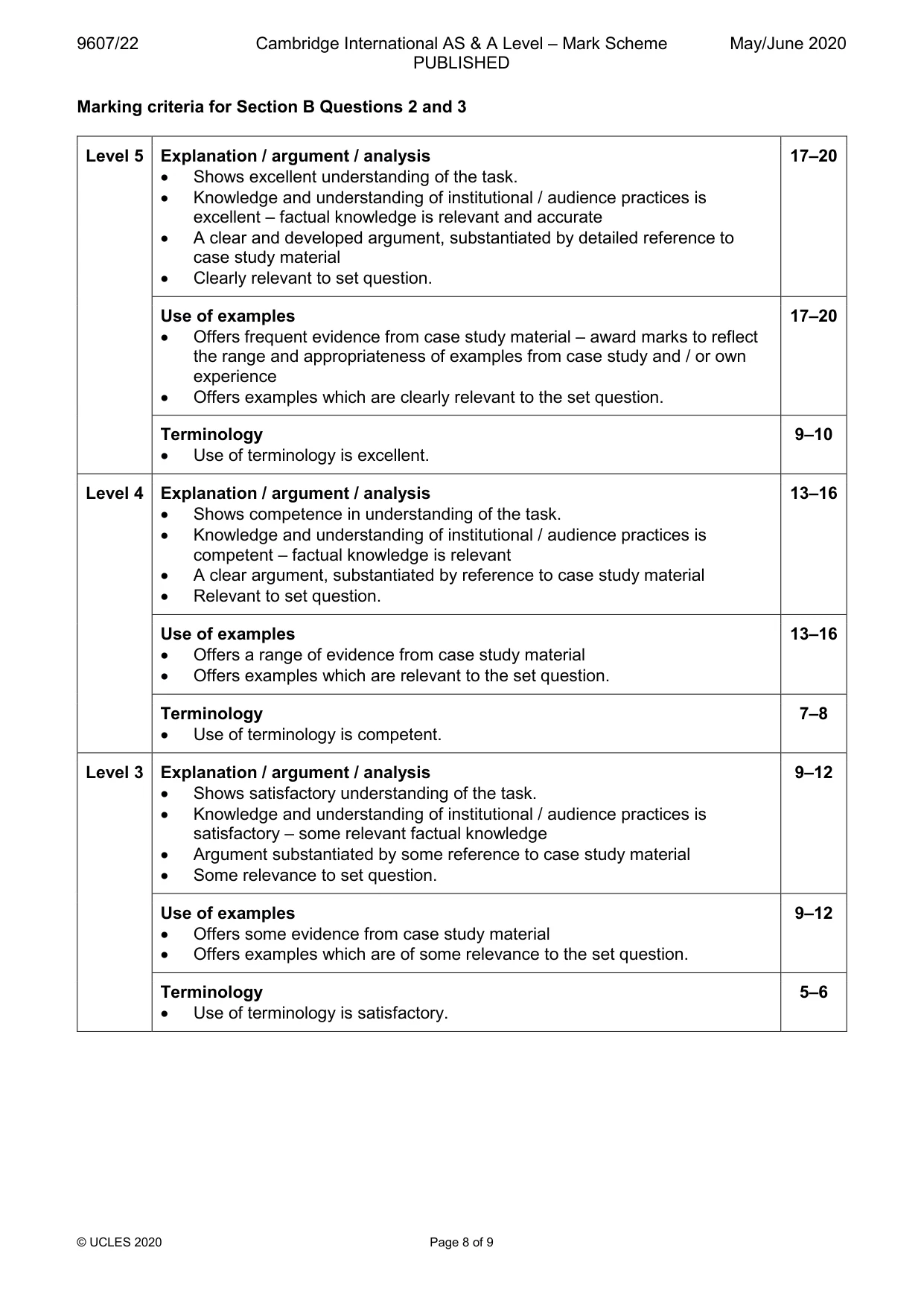
9607/22 Cambridge International AS & A Level – Mark Scheme PUBLISHED May/June 2020 © UCLES 2020 Page 8 of 9 Marking criteria for Section B Questions 2 and 3 Level 5 Explanation / argument / analysis • Shows excellent understanding of the task. • Knowledge and understanding of institutional / audience practices is excellent – factual knowledge is relevant and accurate • A clear and developed argument, substantiated by detailed reference to case study material • Clearly relevant to set question. 17–20 Use of examples • Offers frequent evidence from case study material – award marks to reflect the range and appropriateness of examples from case study and / or own experience • Offers examples which are clearly relevant to the set question. 17–20 Terminology • Use of terminology is excellent. 9–10 Level 4 Explanation / argument / analysis • Shows competence in understanding of the task. • Knowledge and understanding of institutional / audience practices is competent – factual knowledge is relevant • A clear argument, substantiated by reference to case study material • Relevant to set question. 13–16 Use of examples • Offers a range of evidence from case study material • Offers examples which are relevant to the set question. 13–16 Terminology • Use of terminology is competent. 7–8 Level 3 Explanation / argument / analysis • Shows satisfactory understanding of the task. • Knowledge and understanding of institutional / audience practices is satisfactory – some relevant factual knowledge • Argument substantiated by some reference to case study material • Some relevance to set question. 9–12 Use of examples • Offers some evidence from case study material • Offers examples which are of some relevance to the set question. 9–12 Terminology • Use of terminology is satisfactory. 5–6
Mark scheme, page 9
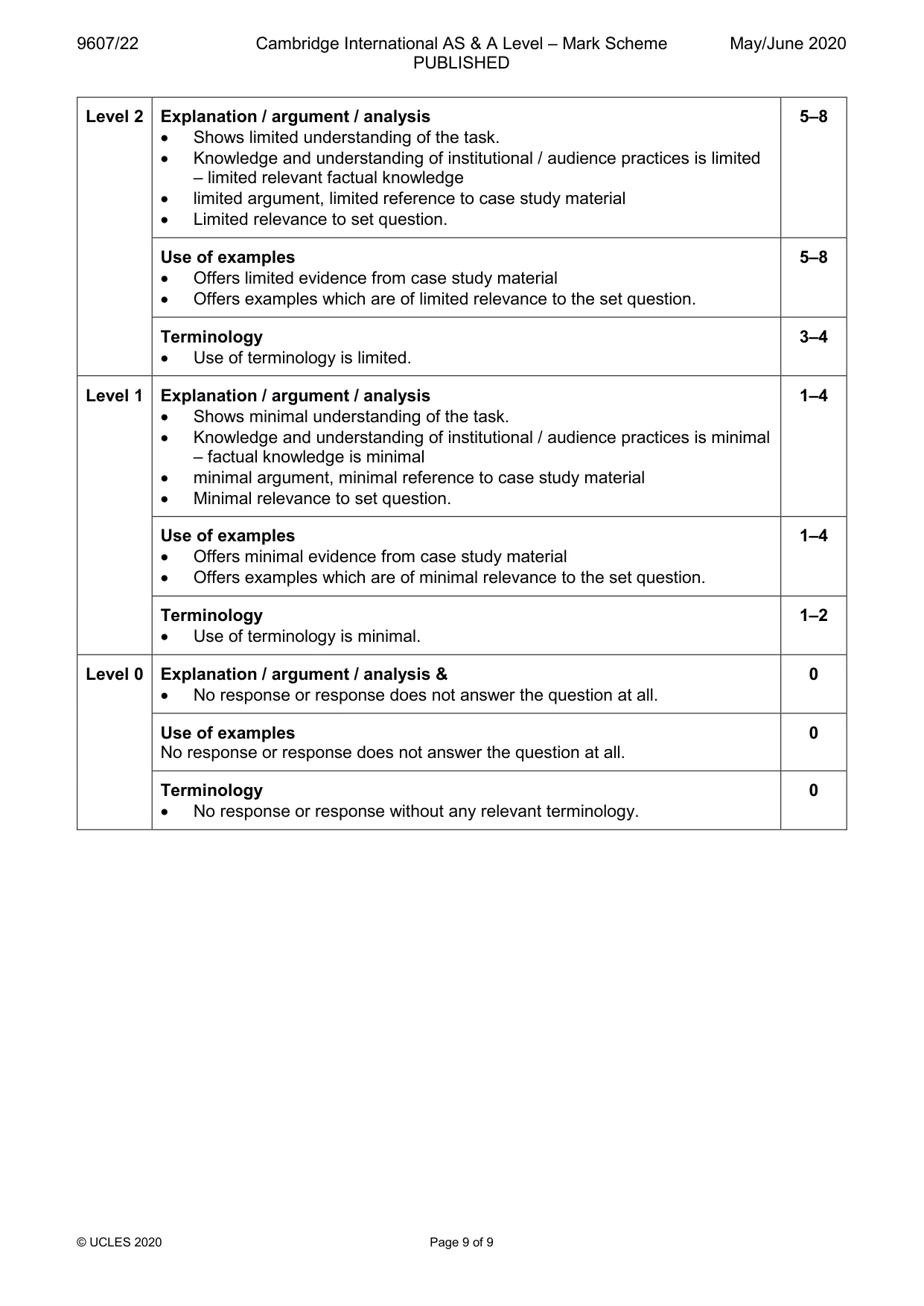
9607/22 Cambridge International AS & A Level – Mark Scheme PUBLISHED May/June 2020 © UCLES 2020 Page 9 of 9 Level 2 Explanation / argument / analysis • Shows limited understanding of the task. • Knowledge and understanding of institutional / audience practices is limited – limited relevant factual knowledge • limited argument, limited reference to case study material • Limited relevance to set question. 5–8 Use of examples • Offers limited evidence from case study material • Offers examples which are of limited relevance to the set question. 5–8 Terminology • Use of terminology is limited. 3–4 Level 1 Explanation / argument / analysis • Shows minimal understanding of the task. • Knowledge and understanding of institutional / audience practices is minimal – factual knowledge is minimal • minimal argument, minimal reference to case study material • Minimal relevance to set question. 1–4 Use of examples • Offers minimal evidence from case study material • Offers examples which are of minimal relevance to the set question. 1–4 Terminology • Use of terminology is minimal. 1–2 Level 0 Explanation / argument / analysis & • No response or response does not answer the question at all. 0 Use of examples No response or response does not answer the question at all. 0 Terminology • No response or response without any relevant terminology. 0