Cambridge A Level Mathematics 9709 — 2016 Oct/Nov Paper 6 · Variant 3
9709/63/O/N/16 · 7 questions · 50 marks · ≈56 min
The question paper and its mark scheme, free to read here and free to download. This is Cambridge’s own paper, exactly as it was sat.
Question paper4 pages
Mark scheme6 pages
Answers below. Sit the paper first if you are practising.
Questions as text
Q1 · A committee of 5 people is to be chosen from 4 men and 6 women
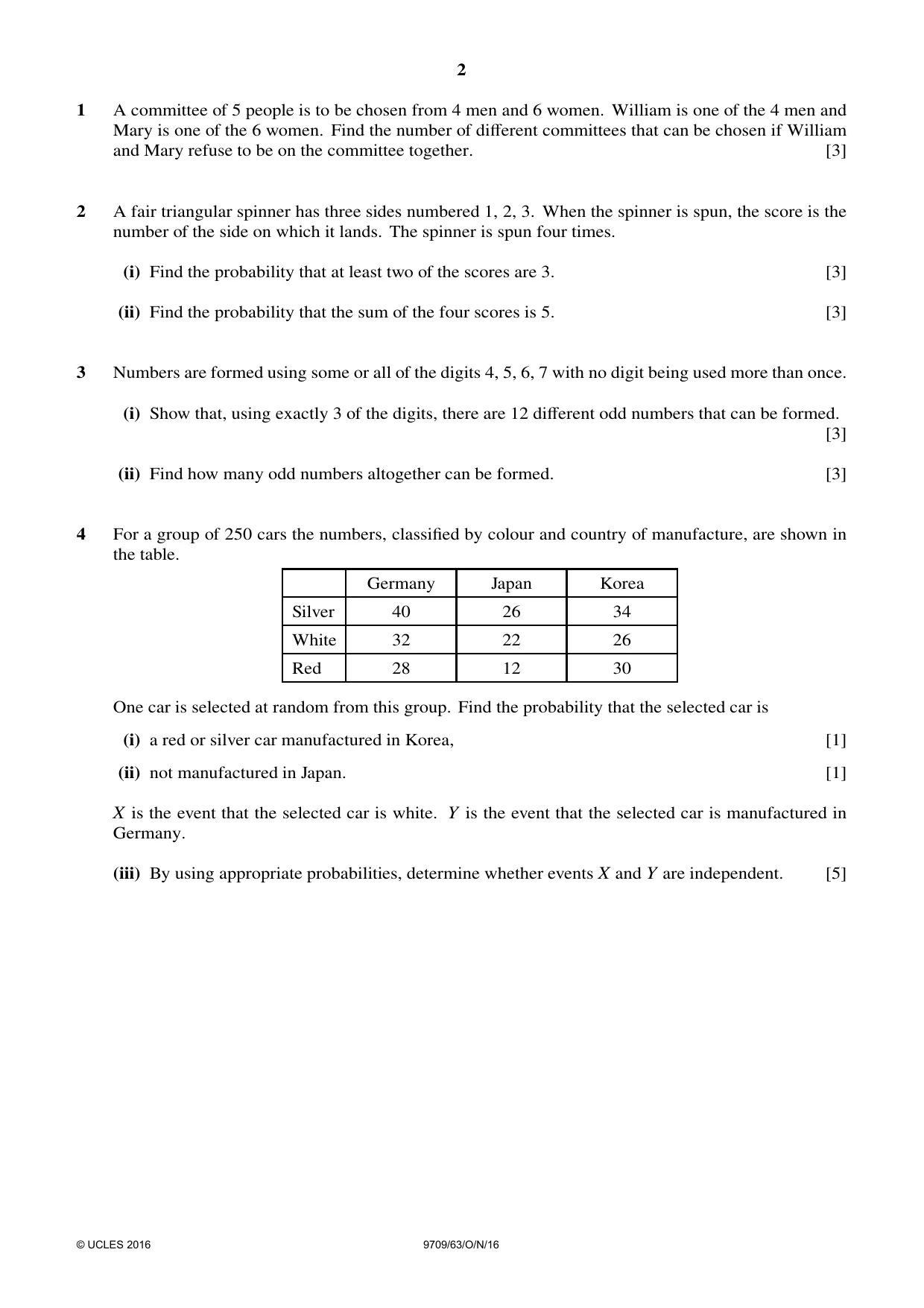
1 A committee of 5 people is to be chosen from 4 men and 6 women. William is one of the 4 men and Mary is one of the 6 women. Find the number of different committees that can be chosen if William and Mary refuse to be on the committee together. [3]
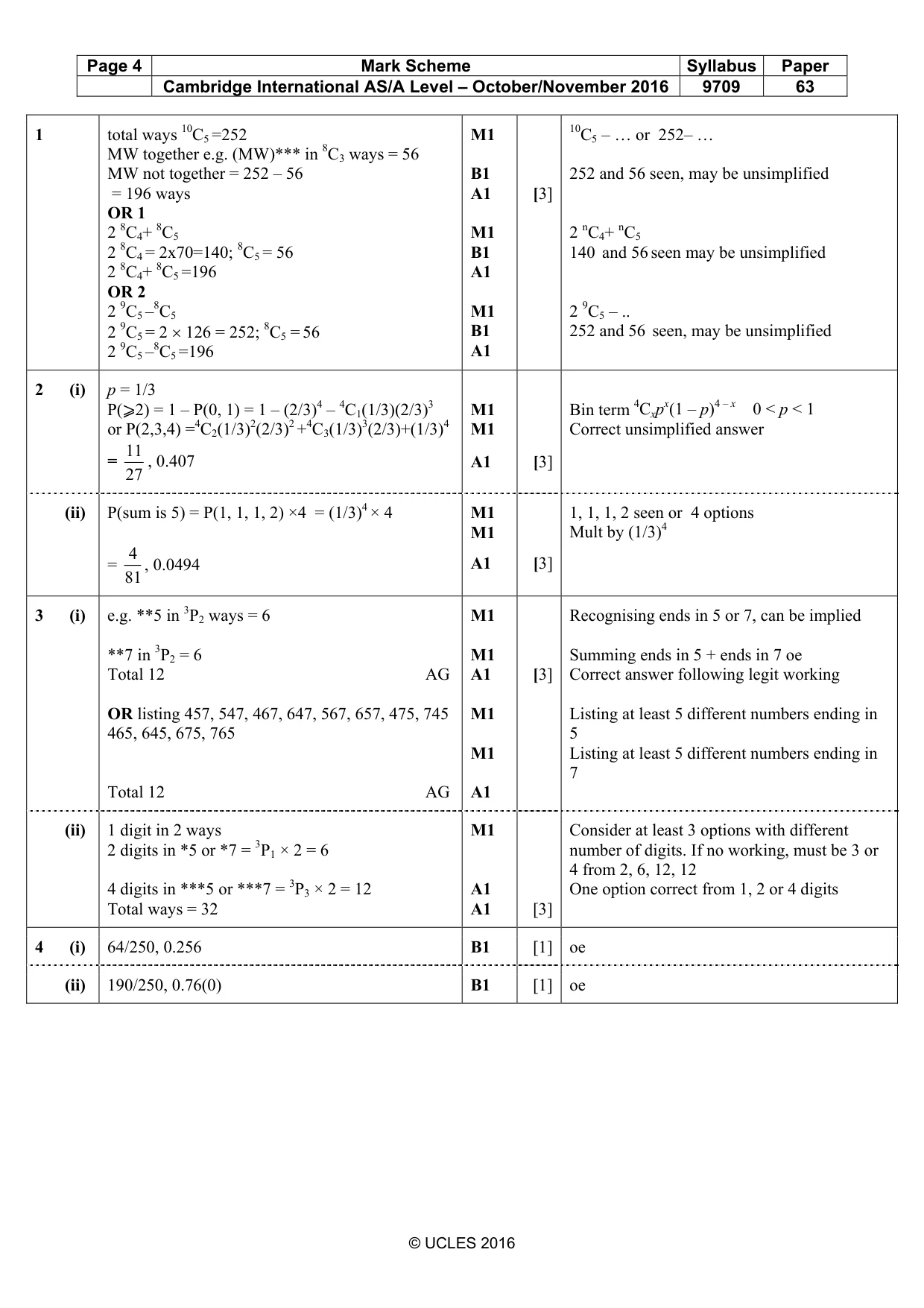
Mark scheme: 1 total ways 10C5 =252 M1 10C5 – … or 252– … MW together e.g. (MW)*** in 8C3 ways = 56 MW not together = 252 – 56 B1 252 and 56 seen, may be unsimplified = 196 ways A1 [3] OR 1 2 8C4+ 8C5 M1 2 nC4+ nC5 2 8C4 = 2x70=140; 8C5 = 56 B1 140 and 56 seen may be unsimplified 2 8C4+ 8C5 =196 A1 OR 2 2 9C5 –8C5 M1 2 9C5 – .. 2 9C5 = 2 × 126 = 252; 8C5 = 56 B1 252 and 56 seen, may be unsimplified 2 9C5 –8C5 =196 A1
Q2 · A fair triangular spinner has three sides numbered 1, 2, 3
2 A fair triangular spinner has three sides numbered 1, 2, 3. When the spinner is spun, the score is the number of the side on which it lands. The spinner is spun four times. (i) Find the probability that at least two of the scores are 3. [3] (ii) Find the probability that the sum of the four scores is 5. [3]
Mark scheme: 2 (i) p = 1/3 P(⩾2) = 1 – P(0, 1) = 1 – (2/3)4 – 4C1(1/3)(2/3)3 M1 Bin term 4Cxpx(1 – p)4 – x 0 < p < 1 or P(2,3,4) =4C2(1/3)2(2/3)2 +4C3(1/3)3(2/3)+(1/3)4 M1 Correct unsimplified answer 11 = , 0.407 A1 [3] 27 (ii) P(sum is 5) = P(1, 1, 1, 2) ×4 = (1/3)4 × 4 M1 1, 1, 1, 2 seen or 4 options M1 Mult by (1/3)4 4 = , 0.0494 A1 [3] 81 3
Q3 · Numbers are formed using some or all of the digits 4, 5, 6, 7 with no digit being used…
3 Numbers are formed using some or all of the digits 4, 5, 6, 7 with no digit being used more than once. (i) Show that, using exactly 3 of the digits, there are 12 different odd numbers that can be formed. [3] (ii) Find how many odd numbers altogether can be formed. [3]
Mark scheme: 3 (i) e.g. **5 in 3P2 ways = 6 M1 Recognising ends in 5 or 7, can be implied **7 in 3P2 = 6 M1 Summing ends in 5 + ends in 7 oe Total 12 AG A1 [3] Correct answer following legit working OR listing 457, 547, 467, 647, 567, 657, 475, 745 M1 Listing at least 5 different numbers ending in 465, 645, 675, 765 5 M1 Listing at least 5 different numbers ending in 7 Total 12 AG A1 (ii) 1 digit in 2 ways M1 Consider at least 3 options with different 2 digits in *5 or *7 = 3P1 × 2 = 6 number of digits. If no working, must be 3 or 4 from 2, 6, 12, 12 4 digits in ***5 or ***7 = 3P3 × 2 = 12 A1 One option correct from 1, 2 or 4 digits Total ways = 32 A1 [3]
Q4 · For a group of 250 cars the numbers, classified by colour and country of manufacture, are…
4 For a group of 250 cars the numbers, classified by colour and country of manufacture, are shown in the table. Germany Japan Korea Silver 40 26 34 White 32 22 26 Red 28 12 30 One car is selected at random from this group. Find the probability that the selected car is (i) a red or silver car manufactured in Korea, [1] (ii) not manufactured in Japan. [1] X is the event that the selected car is white. Y is the event that the selected car is manufactured in Germany. (iii) By using appropriate probabilities, determine whether events X and Y are independent. [5]
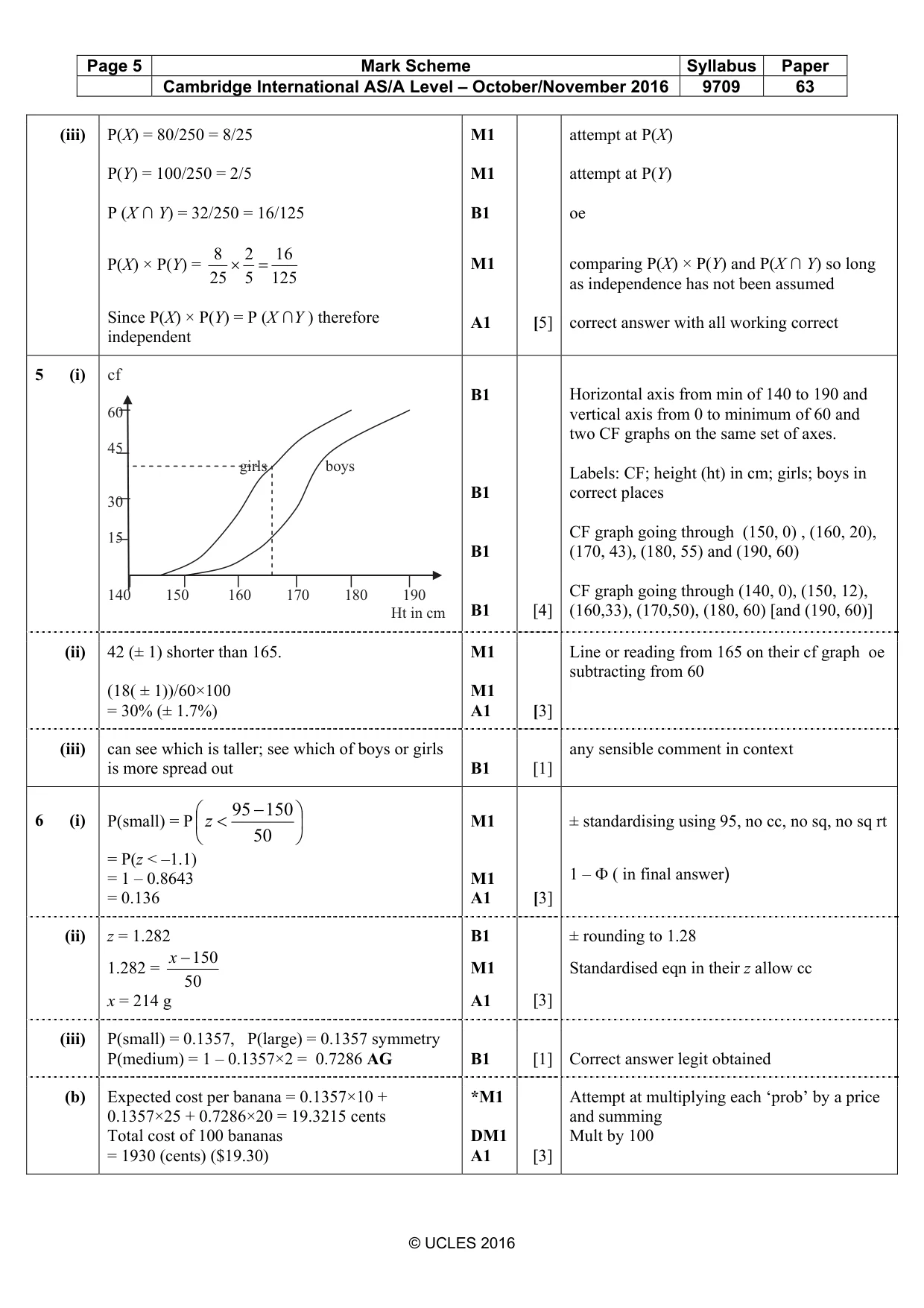
Mark scheme: 4 (i) 64/250, 0.256 B1 [1] oe (ii) 190/250, 0.76(0) B1 [1] oe (iii) P(X) = 80/250 = 8/25 M1 attempt at P(X) P(Y) = 100/250 = 2/5 M1 attempt at P(Y) P (X ∩ Y) = 32/250 = 16/125 B1 oe 8 2 16 P(X) × P(Y) = × = M1 comparing P(X) × P(Y) and P(X ∩ Y) so long 25 5 125 as independence has not been assumed Since P(X) × P(Y) = P (X ∩Y ) therefore A1 [5] correct answer with all working correct independent
Q5 · The tables summarise the heights, h cm, of 60 girls and 60 boys
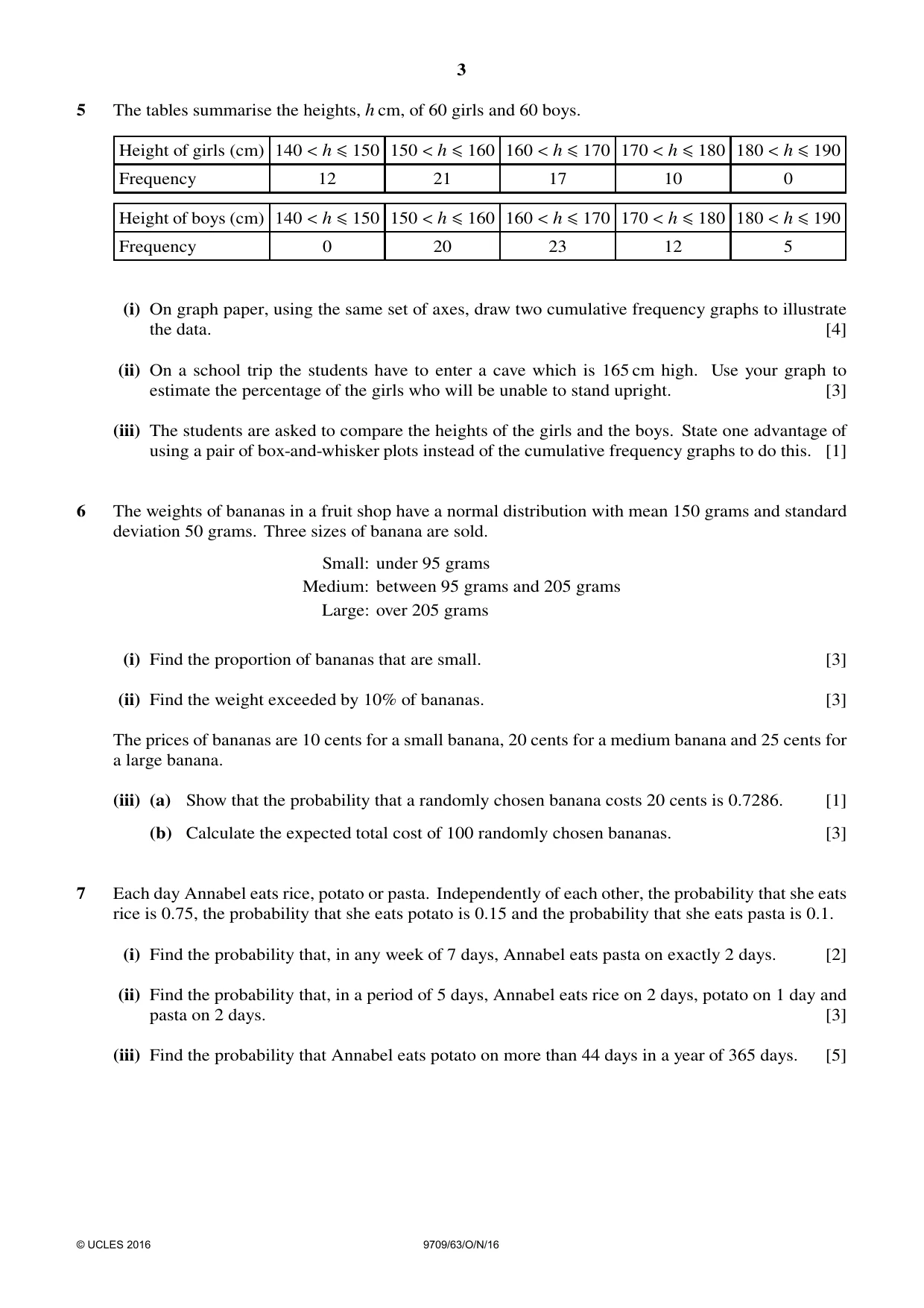
5 The tables summarise the heights, h cm, of 60 girls and 60 boys. Height of girls (cm) 140 < h ≤150 150 < h ≤160 160 < h ≤170 170 < h ≤180 180 < h ≤190 Frequency 12 21 17 10 0 Height of boys (cm) 140 < h ≤150 150 < h ≤160 160 < h ≤170 170 < h ≤180 180 < h ≤190 Frequency 0 20 23 12 5 (i) On graph paper, using the same set of axes, draw two cumulative frequency graphs to illustrate the data. [4] (ii) On a school trip the students have to enter a cave which is 165 cm high. Use your graph to estimate the percentage of the girls who will be unable to stand upright. [3] (iii) The students are asked to compare the heights of the girls and the boys. State one advantage of using a pair of box-and-whisker plots instead of the cumulative frequency graphs to do this. [1]
Mark scheme: 5 (i) cf B1 Horizontal axis from min of 140 to 190 and 60 vertical axis from 0 to minimum of 60 and two CF graphs on the same set of axes. 45 girls boys Labels: CF; height (ht) in cm; girls; boys in B1 correct places 30 15 CF graph going through (150, 0) , (160, 20), B1 (170, 43), (180, 55) and (190, 60) 140 150 160 170 180 190 CF graph going through (140, 0), (150, 12), Ht in cm B1 [4] (160,33), (170,50), (180, 60) [and (190, 60)] (ii) 42 (± 1) shorter than 165. M1 Line or reading from 165 on their cf graph oe subtracting from 60 (18( ± 1))/60×100 M1 = 30% (± 1.7%) A1 [3] (iii) can see which is taller; see which of boys or girls any sensible comment in context is more spread out B1 [1] 95 −150
Q6 · The weights of bananas in a fruit shop have a normal distribution with mean 150 grams and…
6 The weights of bananas in a fruit shop have a normal distribution with mean 150 grams and standard deviation 50 grams. Three sizes of banana are sold. Small: under 95 grams Medium: between 95 grams and 205 grams Large: over 205 grams (i) Find the proportion of bananas that are small. [3] (ii) Find the weight exceeded by 10% of bananas. [3] The prices of bananas are 10 cents for a small banana, 20 cents for a medium banana and 25 cents for a large banana. (iii) (a) Show that the probability that a randomly chosen banana costs 20 cents is 0.7286. [1] (b) Calculate the expected total cost of 100 randomly chosen bananas. [3]
Mark scheme: 95 150 6 (i) P(small) = P < z M1 ± standardising using 95, no cc, no sq, no sq rt 50 = P(z < –1.1) = 1 – 0.8643 M1 1 – Φ ( in final answer) = 0.136 A1 [3] (ii) z = 1.282 B1 ± rounding to 1.28 x − 150 1.282 = M1 Standardised eqn in their z allow cc 50 x = 214 g A1 [3] (iii) P(small) = 0.1357, P(large) = 0.1357 symmetry P(medium) = 1 – 0.1357×2 = 0.7286 AG B1 [1] Correct answer legit obtained (b) Expected cost per banana = 0.1357×10 + *M1 Attempt at multiplying each ‘prob’ by a price 0.1357×25 + 0.7286×20 = 19.3215 cents and summing Total cost of 100 bananas DM1 Mult by 100 = 1930 (cents) ($19.30) A1 [3] 2 2
Q7 · Each day Annabel eats rice, potato or pasta
7 Each day Annabel eats rice, potato or pasta. Independently of each other, the probability that she eats rice is 0.75, the probability that she eats potato is 0.15 and the probability that she eats pasta is 0.1. (i) Find the probability that, in any week of 7 days, Annabel eats pasta on exactly 2 days. [2] (ii) Find the probability that, in a period of 5 days, Annabel eats rice on 2 days, potato on 1 day and pasta on 2 days. [3] (iii) Find the probability that Annabel eats potato on more than 44 days in a year of 365 days. [5]
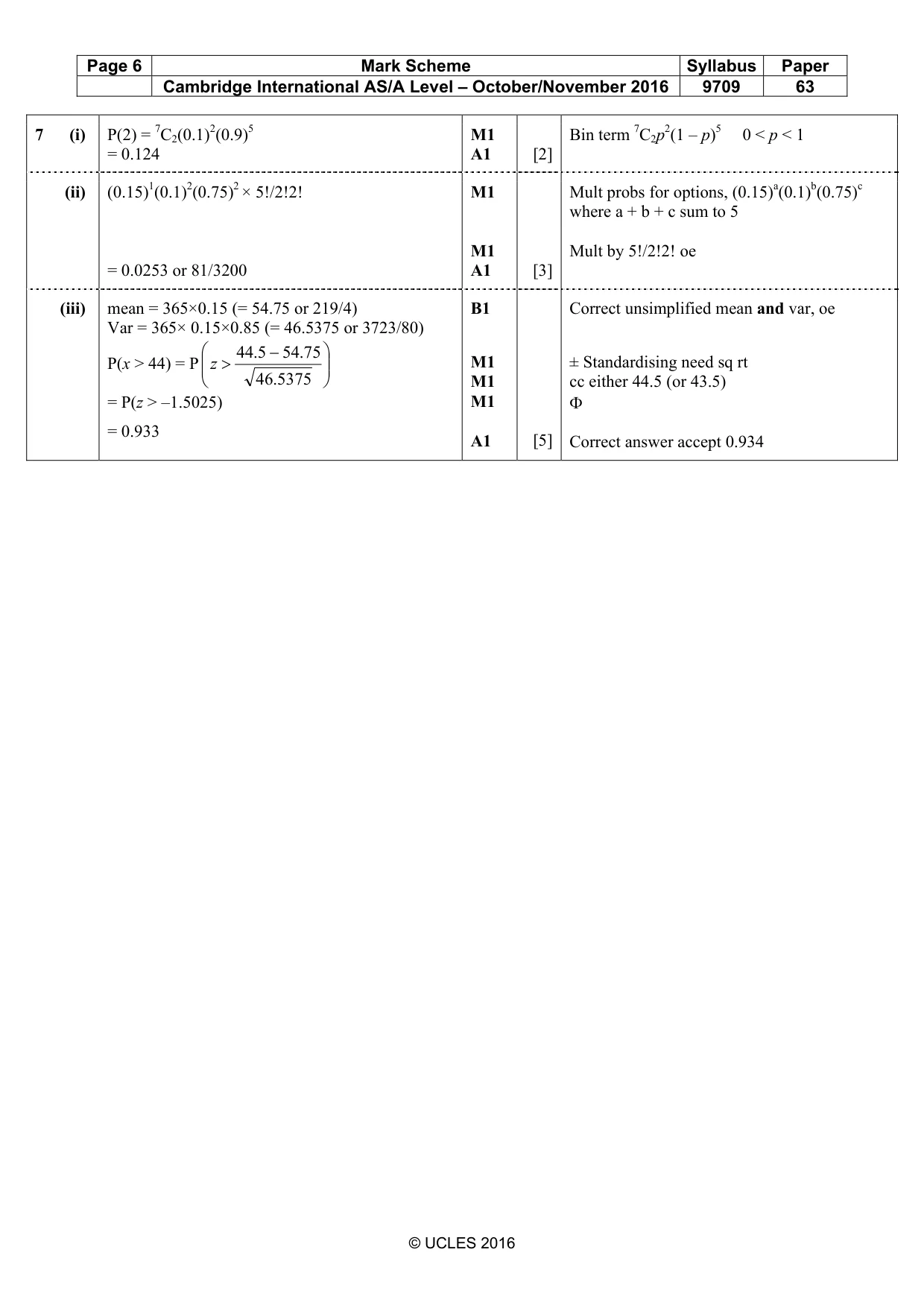
Mark scheme: 7 (i) P(2) = 7C2(0.1)2(0.9)5 M1 Bin term 7C2p2(1 – p)5 0 < p < 1 = 0.124 A1 [2] (ii) (0.15)1(0.1)2(0.75)2 × 5!/2!2! M1 Mult probs for options, (0.15)a(0.1)b(0.75)c where a + b + c sum to 5 M1 Mult by 5!/2!2! oe = 0.0253 or 81/3200 A1 [3] (iii) mean = 365×0.15 (= 54.75 or 219/4) B1 Correct unsimplified mean and var, oe Var = 365× 0.15×0.85 (= 46.5375 or 3723/80) 445. − 54.75 P(x > 44) = P z > M1 ± Standardising need sq rt 46.5375 M1 cc either 44.5 (or 43.5) = P(z > –1.5025) M1 Φ = 0.933 A1 [5] Correct answer accept 0.934
What was in this paper
The subtopics covered by these 7 questions, and how many questions each got. Open one in a new tab to see every Cambridge question on it.
What you needed in this session
Cambridge’s own grade thresholds for 2016 Oct/Nov, Paper 6 · Variant 3. A higher threshold means an easier paper — the bar moves with how the cohort did.