Cambridge A Level Mathematics 9709 — 2015 May/June Paper 7 · Variant 1
9709/71/M/J/15 · 5 questions · 50 marks · ≈56 min
The question paper and its mark scheme, free to read here and free to download. This is Cambridge’s own paper, exactly as it was sat.
Question paper4 pages
Mark scheme7 pages
Answers below. Sit the paper first if you are practising.
Questions as text
Q2 · Sami claims that he can read minds
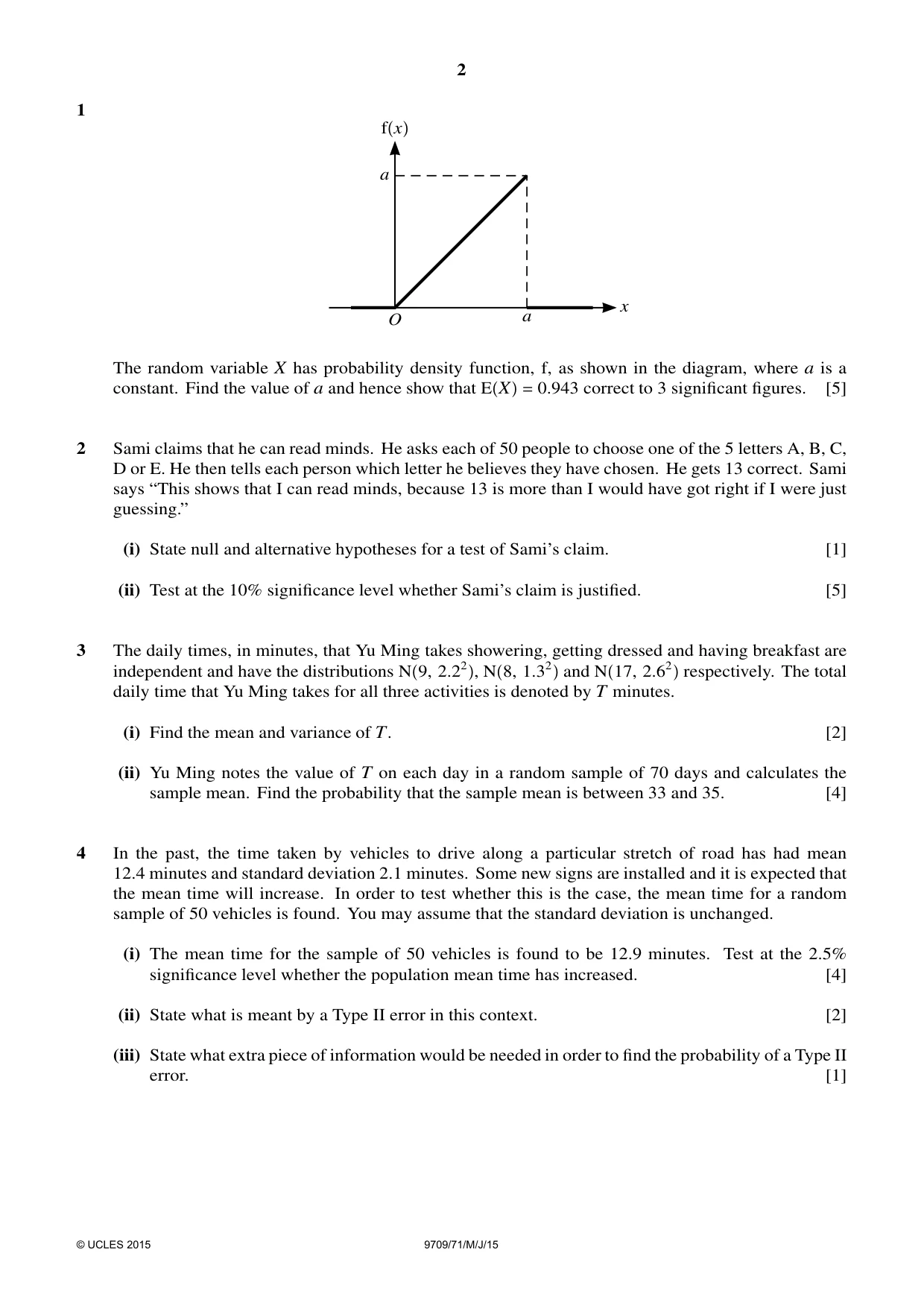
2 Sami claims that he can read minds. He asks each of 50 people to choose one of the 5 letters A, B, C, D or E. He then tells each person which letter he believes they have chosen. He gets 13 correct. Sami says “This shows that I can read minds, because 13 is more than I would have got right if I were just guessing.” (i) State null and alternative hypotheses for a test of Sami’s claim. [1] (ii) Test at the 10% significance level whether Sami’s claim is justified. [5]
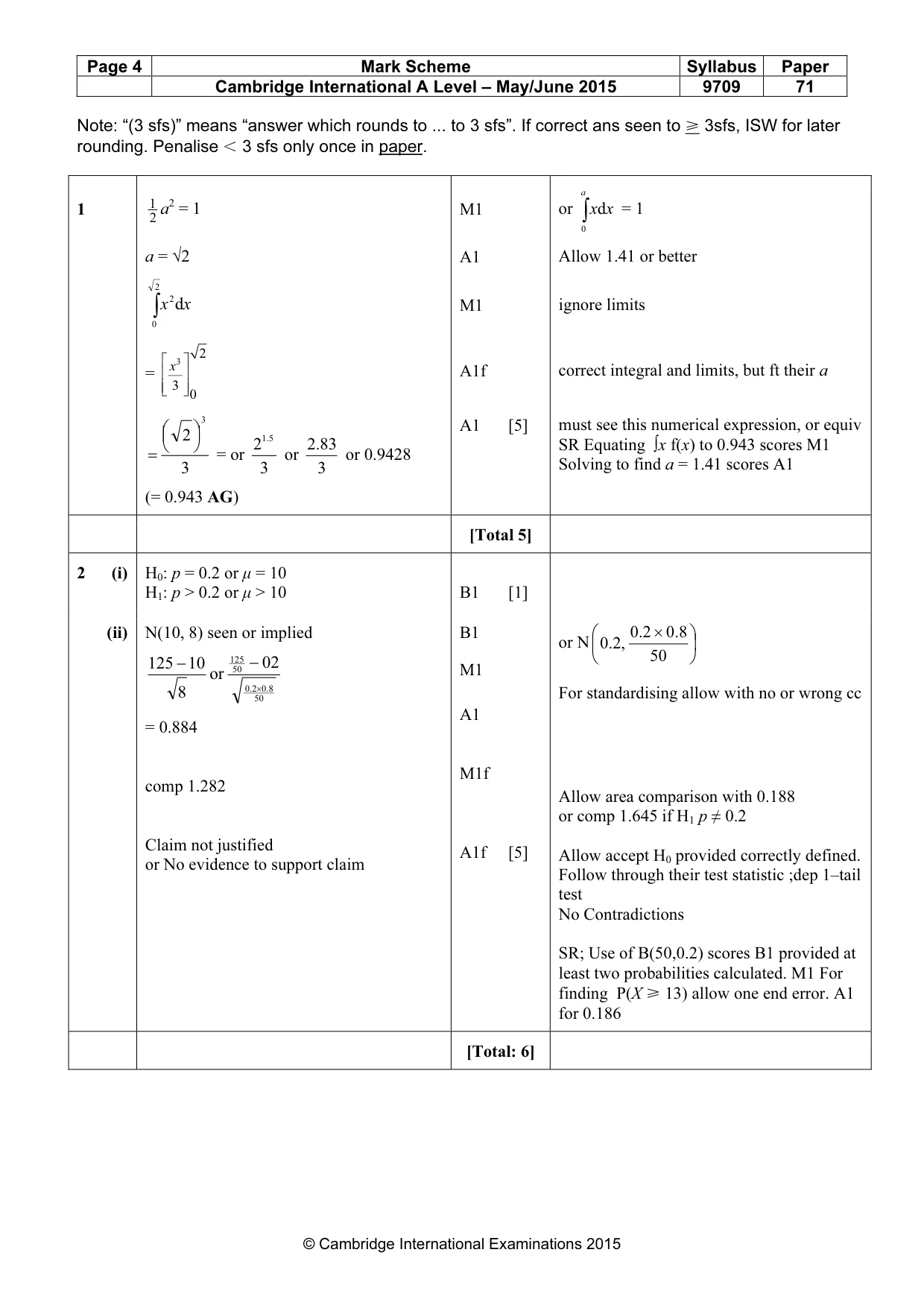
Mark scheme: 2 3 x A1f correct integral and limits, but ft their a= 3 0
Q3 · The daily times, in minutes, that Yu Ming takes showering, getting dressed and having…
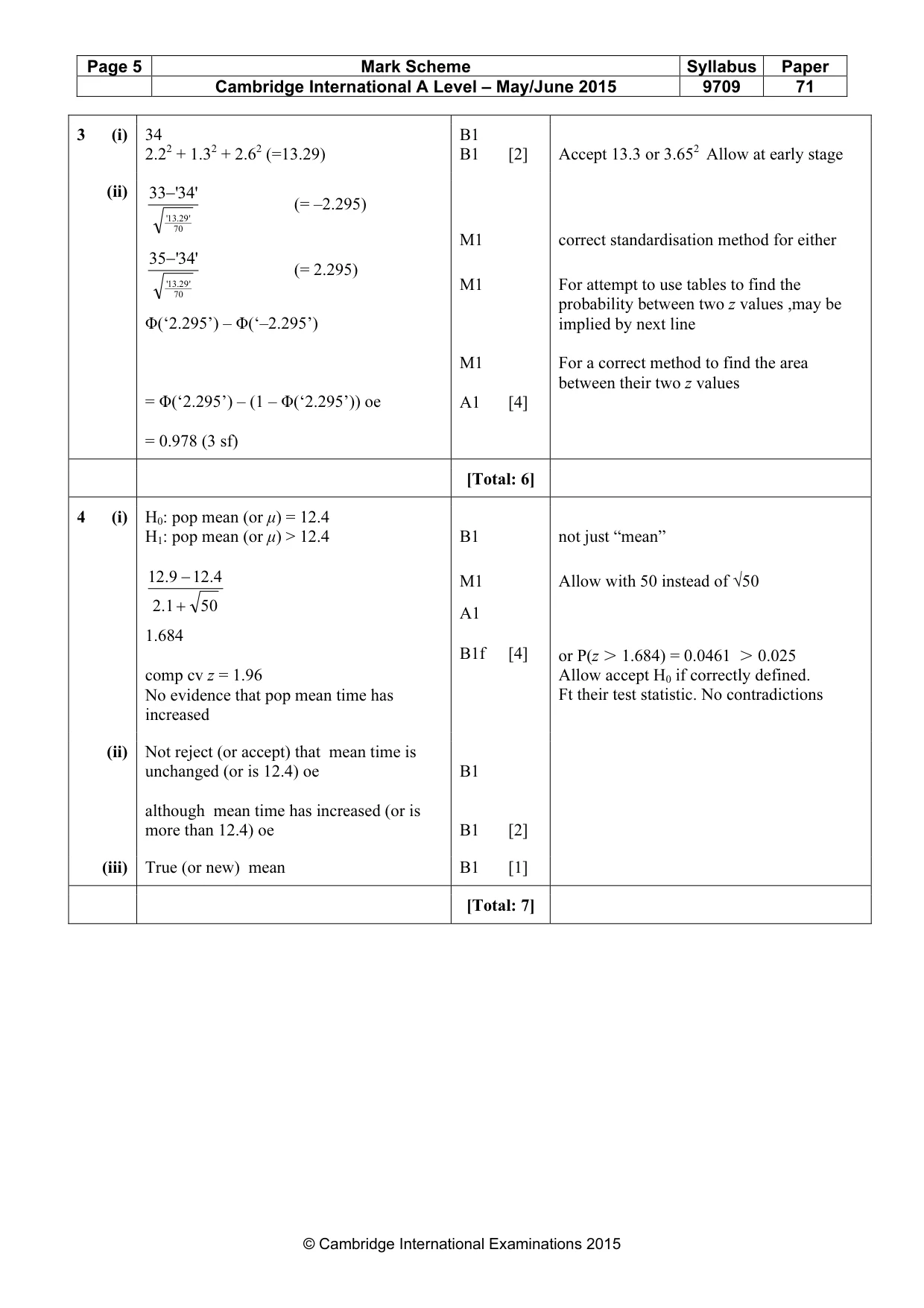
3 The daily times, in minutes, that Yu Ming takes showering, getting dressed and having breakfast are independent and have the distributions N 9, 2.22 , N 8, 1.32 and N 17, 2.62 respectively. The total daily time that Yu Ming takes for all three activities is denoted by T minutes. (i) Find the mean and variance of T. [2] (ii) Yu Ming notes the value of T on each day in a random sample of 70 days and calculates the sample mean. Find the probability that the sample mean is between 33 and 35. [4]
Mark scheme: 3 A1 [5] must see this numerical expression, or equiv 2 25.1 .2 83 SR Equating ∫x f(x) to 0.943 scores M1 = = or or or 0.9428 3 3 3 Solving to find a = 1.41 scores A1 (= 0.943 AG) [Total 5] 2 (i) H0: p = 0.2 or µ = 10 H1: p > 0.2 or µ > 10 B1 [1] (ii) N(10, 8) seen or implied B1 2.0 × 8.0 or N ,2.0 125 50 125 − 10 50 − 02 or M1 8 2.050× 8.0 For standardising allow with no or wrong cc A1 = 0.884 M1f comp 1.282 Allow area comparison with 0.188 or comp 1.645 if H1 p ≠ 0.2 Claim not justified A1f [5] Allow accept H0 provided correctly defined. or No evidence to support claim Follow through their test statistic ;dep 1–tail test No Contradictions SR; Use of B(50,0.2) scores B1 provided at least two probabilities calculated. M1 For finding P(X [ 13) allow one end error. A1 for 0.186 [Total: 6] 3 (i) 34 B1 2.22 + 1.32 + 2.62 (=13.29) B1 [2] Accept 13.3 or 3.652 Allow at early stage (ii) 33− '34' (= –2.295) '13.29 ' 70 M1 correct standardisation method for either 35− '34' (= 2.295) '13.29 ' M1 For attempt to use tables to find the 70 probability between two z values ,may be Φ(‘2.295’) – Φ(‘–2.295’) implied by next line M1 For a correct method to find the area between their two z values = Φ(‘2.295’) – (1 – Φ(‘2.295’)) oe A1 [4] = 0.978 (3 sf) [Total: 6]
Q4 · In the past, the time taken by vehicles to drive along a particular stretch of road has…
4 In the past, the time taken by vehicles to drive along a particular stretch of road has had mean 12.4 minutes and standard deviation 2.1 minutes. Some new signs are installed and it is expected that the mean time will increase. In order to test whether this is the case, the mean time for a random sample of 50 vehicles is found. You may assume that the standard deviation is unchanged. (i) The mean time for the sample of 50 vehicles is found to be 12.9 minutes. Test at the 2.5% significance level whether the population mean time has increased. [4] (ii) State what is meant by a Type II error in this context. [2] (iii) State what extra piece of information would be needed in order to find the probability of a Type II error. [1]
Mark scheme: 4 (i) H0: pop mean (or µ) = 12.4 H1: pop mean (or µ) > 12.4 B1 not just “mean” 12 9. − 12 4. M1 Allow with 50 instead of √50 1.2 + 50 A1 1.684 B1f [4] or P(z K 1.684) = 0.0461 K 0.025 comp cv z = 1.96 Allow accept H0 if correctly defined. No evidence that pop mean time has Ft their test statistic. No contradictions increased (ii) Not reject (or accept) that mean time is unchanged (or is 12.4) oe B1 although mean time has increased (or is more than 12.4) oe B1 [2] (iii) True (or new) mean B1 [1] [Total: 7]
Q5 · The masses, m grams, of a random sample of 80 strawberries of a certain type were…
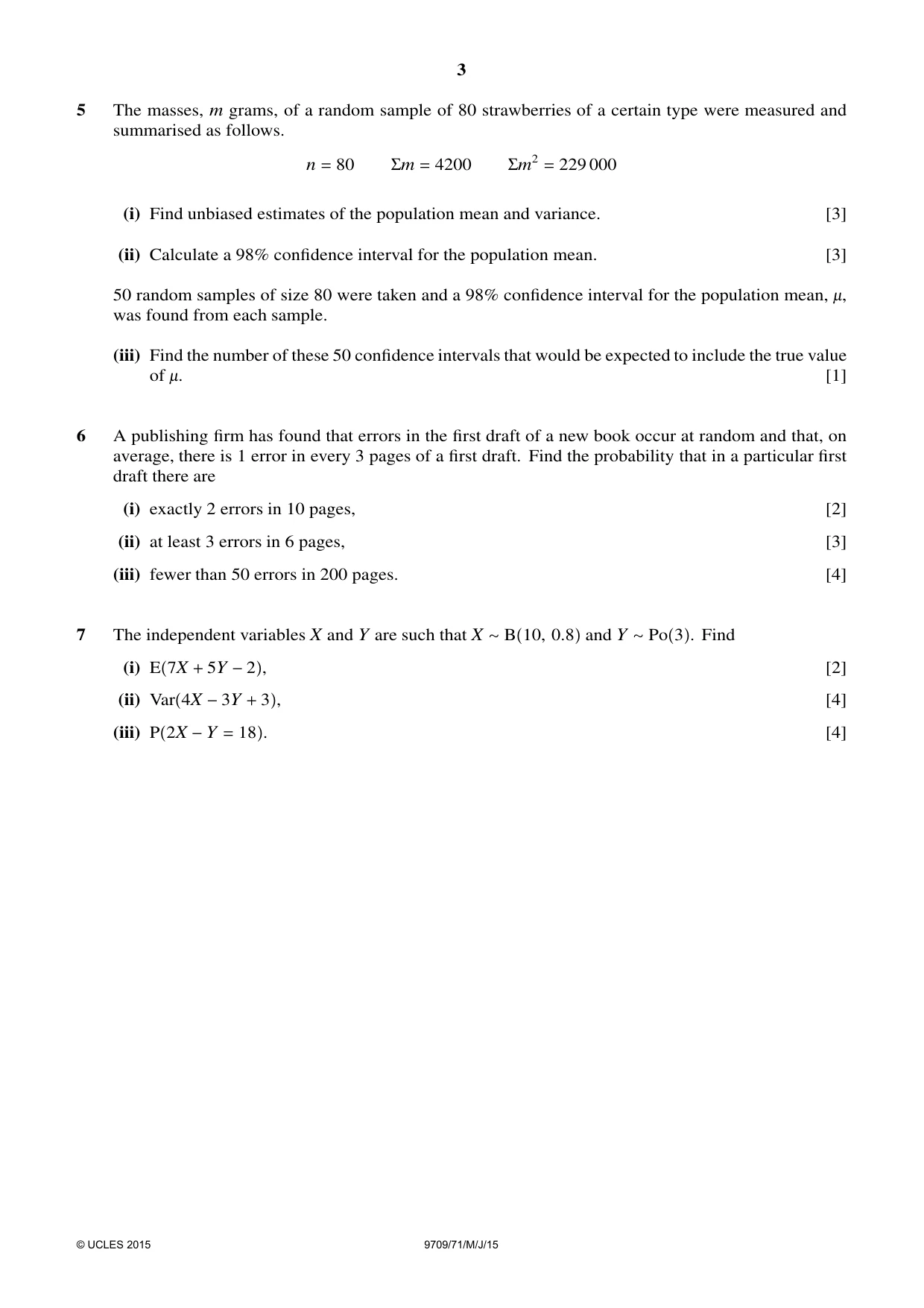
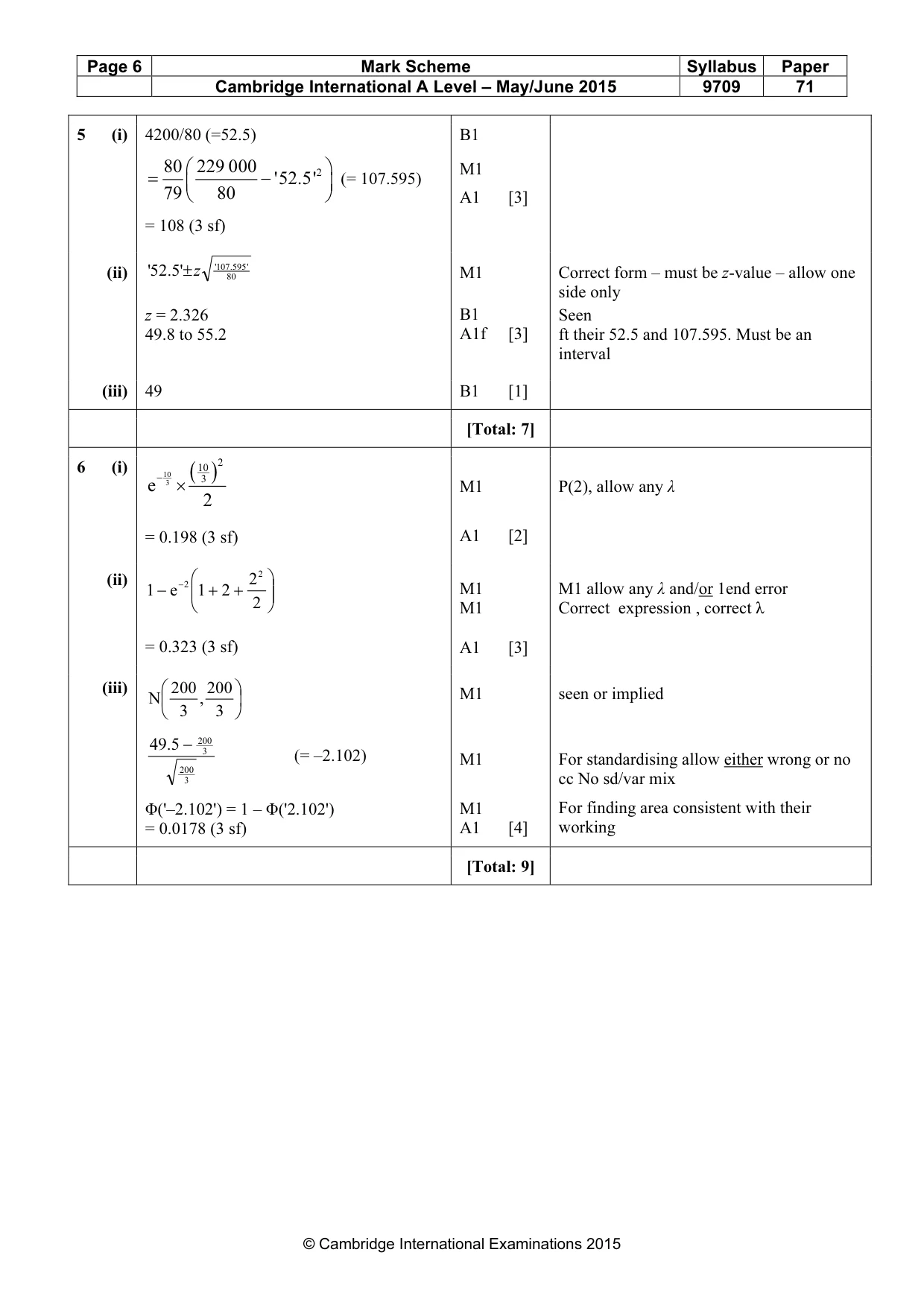
5 The masses, m grams, of a random sample of 80 strawberries of a certain type were measured and summarised as follows. n = 80 Σm = 4200 Σm2 = 229 000 (i) Find unbiased estimates of the population mean and variance. [3] (ii) Calculate a 98% confidence interval for the population mean. [3] 50 random samples of size 80 were taken and a 98% confidence interval for the population mean, -, was found from each sample. (iii) Find the number of these 50 confidence intervals that would be expected to include the true value of -. [1]
Mark scheme: 5 (i) 4200/80 (=52.5) B1 80 229 000 2 M1 = − '52.5' (= 107.595) 79 80 A1 [3] = 108 (3 sf) (ii) '52 '5.± z '10780. 595 ' M1 Correct form – must be z-value – allow one side only z = 2.326 B1 Seen 49.8 to 55.2 A1f [3] ft their 52.5 and 107.595. Must be an interval (iii) 49 B1 [1] [Total: 7] 2
Q6 · A publishing firm has found that errors in the first draft of a new book occur at random…
6 A publishing firm has found that errors in the first draft of a new book occur at random and that, on average, there is 1 error in every 3 pages of a first draft. Find the probability that in a particular first draft there are (i) exactly 2 errors in 10 pages, [2] (ii) at least 3 errors in 6 pages, [3] (iii) fewer than 50 errors in 200 pages. [4]
Mark scheme: 6 (i) 10 2 3 ( 103 ) e −× M1 P(2), allow any λ 2 = 0.198 (3 sf) A1 [2] (ii) − 2 2 2 1 − e 1 + 2 + M1 M1 allow any λ and/or 1end error 2 M1 Correct expression , correct λ = 0.323 (3 sf) A1 [3] (iii) 200 200 N , M1 seen or implied 3 3 495. − 2003 (= –2.102) M1 For standardising allow either wrong or no 200 3 cc No sd/var mix Φ('–2.102') = 1 – Φ('2.102') M1 For finding area consistent with their = 0.0178 (3 sf) A1 [4] working [Total: 9]
What was in this paper
The subtopics covered by these 5 questions, and how many questions each got. Open one in a new tab to see every Cambridge question on it.
What you needed in this session
Cambridge’s own grade thresholds for 2015 May/June, Paper 7 · Variant 1. A higher threshold means an easier paper — the bar moves with how the cohort did.