Cambridge A Level Mathematics 9709 — 2015 May/June Paper 6 · Variant 1
9709/61/M/J/15 · 7 questions · 50 marks · ≈56 min
The question paper and its mark scheme, free to read here and free to download. This is Cambridge’s own paper, exactly as it was sat.
Question paper4 pages
Mark scheme6 pages
Answers below. Sit the paper first if you are practising.
Questions as text
Q1 · The lengths, in metres, of cars in a city are normally distributed with mean - and…
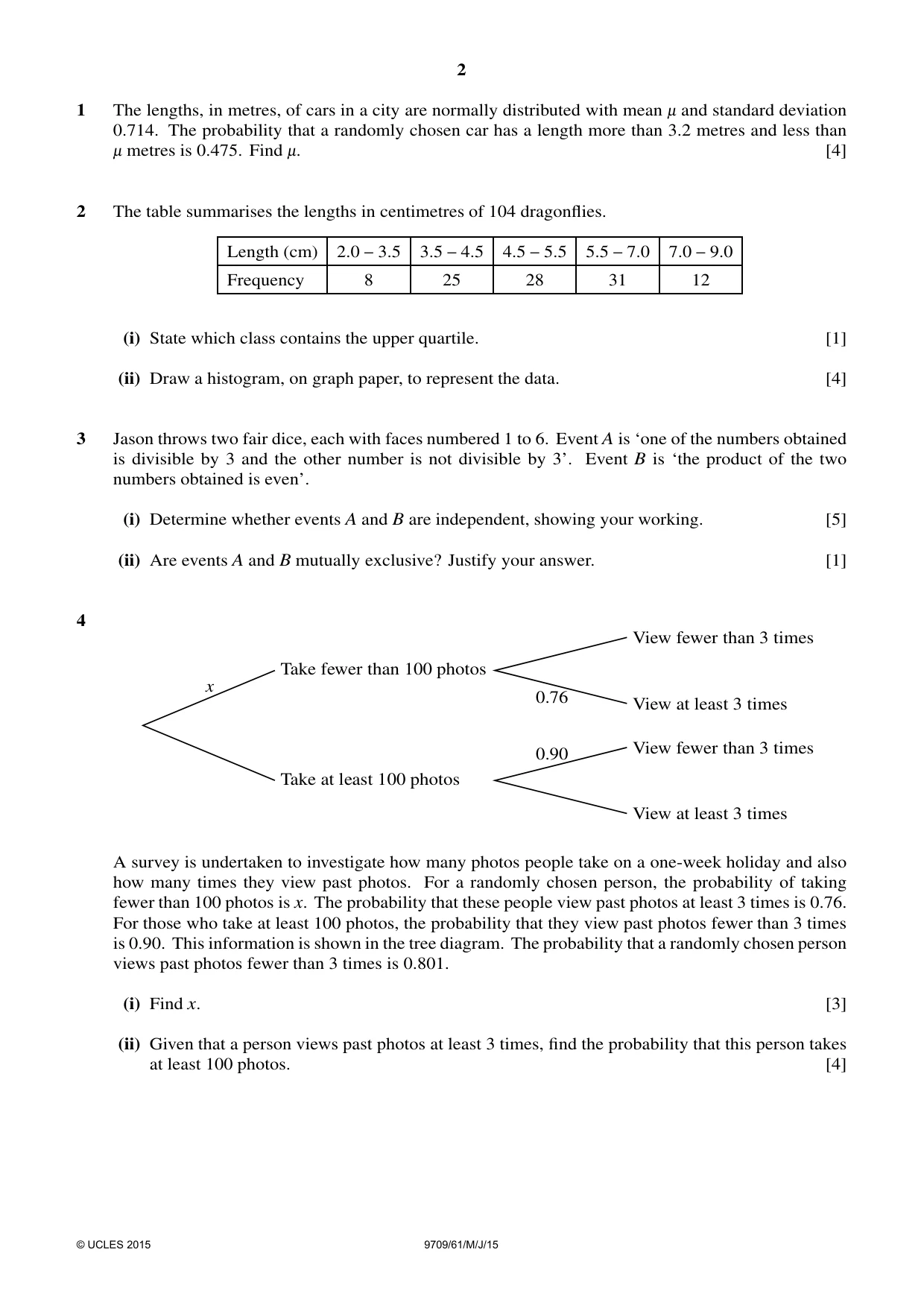
1 The lengths, in metres, of cars in a city are normally distributed with mean - and standard deviation 0.714. The probability that a randomly chosen car has a length more than 3.2 metres and less than - metres is 0.475. Find -. [4]
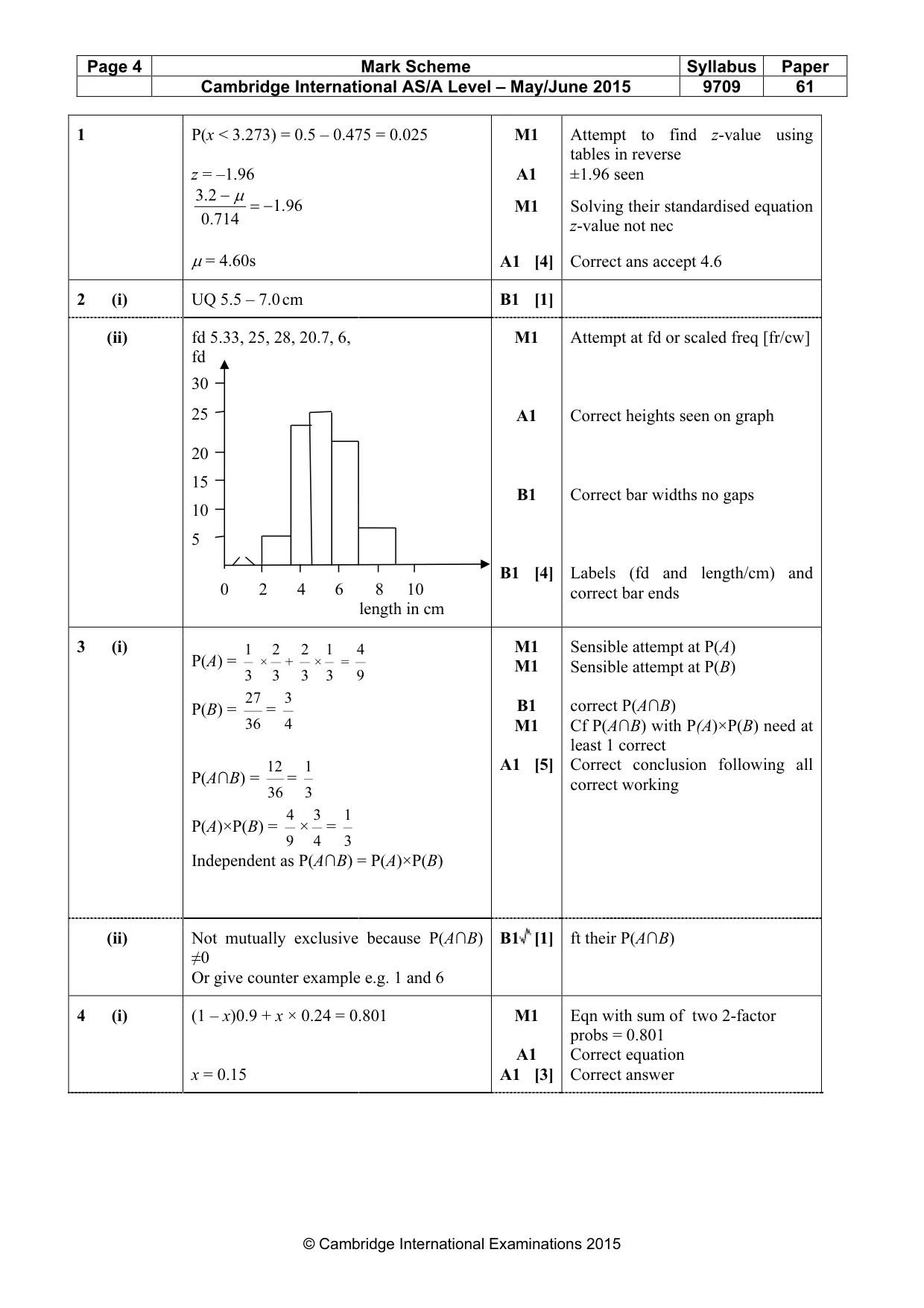
Mark scheme: 1 P(x < 3.273) = 0.5 – 0.475 = 0.025 M1 Attempt to find z-value using tables in reverse z = –1.96 A1 ±1.96 seen 2.3 −µ = − .1 96 M1 Solving their standardised equation .0 714 z-value not nec µ = 4.60s A1 [4] Correct ans accept 4.6
Q2 · The table summarises the lengths in centimetres of 104 dragonflies
2 The table summarises the lengths in centimetres of 104 dragonflies. Length (cm) 2.0 −3.5 3.5 −4.5 4.5 −5.5 5.5 −7.0 7.0 −9.0 Frequency 8 25 28 31 12 (i) State which class contains the upper quartile. [1] (ii) Draw a histogram, on graph paper, to represent the data. [4]
Mark scheme: 2 (i) UQ 5.5 – 7.0 cm B1 [1] (ii) fd 5.33, 25, 28, 20.7, 6, M1 Attempt at fd or scaled freq [fr/cw] fd 30 25 A1 Correct heights seen on graph 20 15 B1 Correct bar widths no gaps 10 5 B1 [4] Labels (fd and length/cm) and 0 2 4 6 8 10 correct bar ends length in cm
Q3 · Jason throws two fair dice, each with faces numbered 1 to 6
3 Jason throws two fair dice, each with faces numbered 1 to 6. Event A is ‘one of the numbers obtained is divisible by 3 and the other number is not divisible by 3’. Event B is ‘the product of the two numbers obtained is even’. (i) Determine whether events A and B are independent, showing your working. [5] (ii) Are events A and B mutually exclusive? Justify your answer. [1]
Mark scheme: 3 (i) 1 2 2 1 4 M1 Sensible attempt at P(A) P(A) = × + × = M1 Sensible attempt at P(B) 3 3 3 3 9 27 3 P(B) = = B1 correct P(A∩B) 36 4 M1 Cf P(A∩B) with P(A)×P(B) need at least 1 correct 12 1 A1 [5] Correct conclusion following all P(A∩B) = = correct working 36 3 4 3 1 P(A)×P(B) = × = 9 4 3 Independent as P(A∩B) = P(A)×P(B) (ii) Not mutually exclusive because P(A∩B) B1 [1] ft their P(A∩B) ≠0 Or give counter example e.g. 1 and 6
Q4 · View fewer than 3 times Take fewer than 100 photos x 0.76 View at least 3 times View…
4 View fewer than 3 times Take fewer than 100 photos x 0.76 View at least 3 times View fewer than 3 times 0.90 Take at least 100 photos View at least 3 times A survey is undertaken to investigate how many photos people take on a one-week holiday and also how many times they view past photos. For a randomly chosen person, the probability of taking fewer than 100 photos is x. The probability that these people view past photos at least 3 times is 0.76. For those who take at least 100 photos, the probability that they view past photos fewer than 3 times is 0.90. This information is shown in the tree diagram. The probability that a randomly chosen person views past photos fewer than 3 times is 0.801. (i) Find x. [3] (ii) Given that a person views past photos at least 3 times, find the probability that this person takes at least 100 photos. [4]
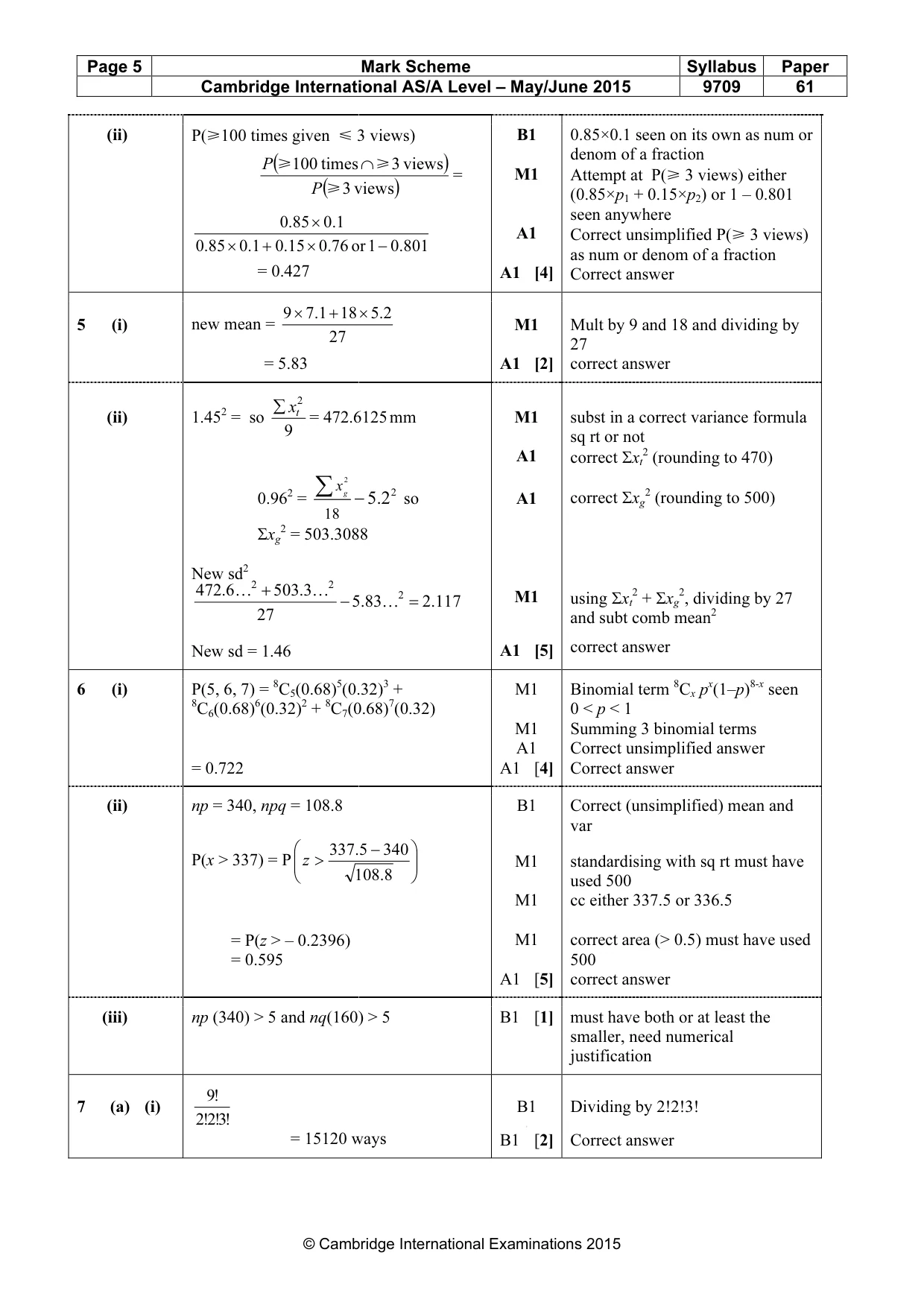
Mark scheme: 4 (i) (1 – x)0.9 + x × 0.24 = 0.801 M1 Eqn with sum of two 2-factor probs = 0.801 A1 Correct equation x = 0.15 A1 [3] Correct answer (ii) P([100 times given =Y=3 views) B1 0.85×0.1 seen on its own as num or denom of a fraction P ([ 100 times ∩ [ 3 views) = M1 Attempt at P([ 3 views) either P ([ 3 views) (0.85×p1 + 0.15×p2) or 1 – 0.801 seen anywhere .0 85 × 1.0 A1 Correct unsimplified P([ 3 views) .0 85 × 1.0 + .0 15 × .0 76 or 1 − .0 801 as num or denom of a fraction = 0.427 A1 [4] Correct answer 9 × 7 1 + 18 × 5 2
Q5 · The table shows the mean and standard deviation of the weights of some turkeys and geese
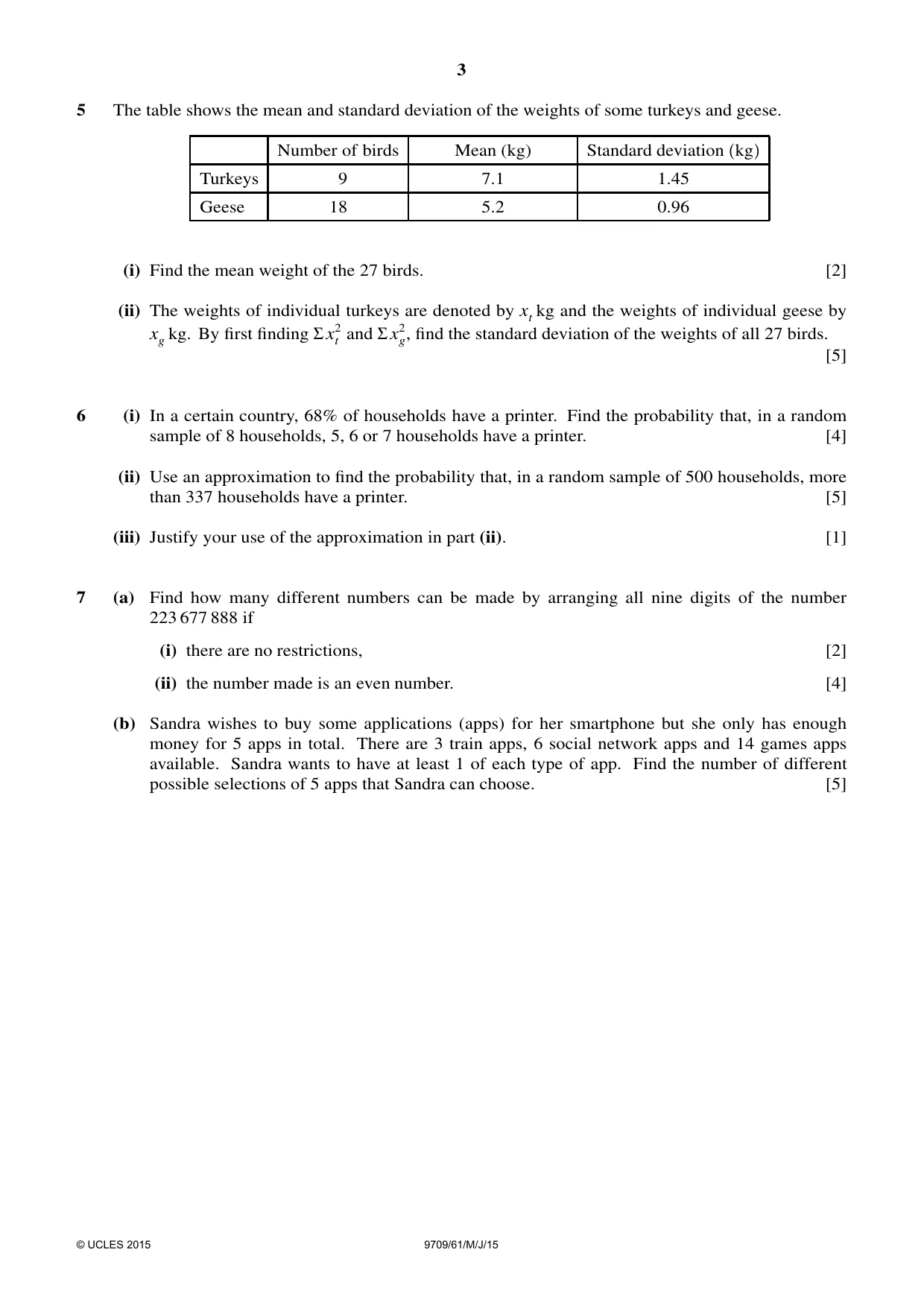
5 The table shows the mean and standard deviation of the weights of some turkeys and geese. Number of birds Mean (kg) Standard deviation kg Turkeys 9 7.1 1.45 Geese 18 5.2 0.96 (i) Find the mean weight of the 27 birds. [2] (ii) The weights of individual turkeys are denoted by xt kg and the weights of individual geese by xg kg. By first finding Σx2t and Σx2g, find the standard deviation of the weights of all 27 birds. [5]
Mark scheme: 9 × 1.7 + 18 × 2.5 5 (i) new mean = M1 Mult by 9 and 18 and dividing by 27 27 = 5.83 A1 [2] correct answer ∑ tx2 (ii) 1.452 = so = 472.6125 mm M1 subst in a correct variance formula 9 sq rt or not A1 correct Σxt 2 (rounding to 470) ∑ gx2 2 2 0.962 = − 5.2 so A1 correct Σxg (rounding to 500) 18 Σxg2 = 503.3088 New sd2 4726. K2 + 5033.K2 2 2 − .583K = .2117 M1 using Σxt + Σxg2, dividing by 27 27 and subt comb mean2 New sd = 1.46 A1 [5] correct answer 8 5 3 8 8
Q6 · In a certain country, 68% of households have a printer
6 (i) In a certain country, 68% of households have a printer. Find the probability that, in a random sample of 8 households, 5, 6 or 7 households have a printer. [4] (ii) Use an approximation to find the probability that, in a random sample of 500 households, more than 337 households have a printer. [5] (iii) Justify your use of the approximation in part (ii). [1]
Mark scheme: 6 (i) P(5, 6, 7) = 8C5(0.68)5(0.32)3 + M1 Binomial term 8Cx px(1–p)8-x seen 8C6(0.68)6(0.32)2 + 8C7(0.68)7(0.32) 0 < p < 1 M1 Summing 3 binomial terms A1 Correct unsimplified answer = 0.722 A1 [4] Correct answer (ii) np = 340, npq = 108.8 B1 Correct (unsimplified) mean and var 337 5. − 340 P(x > 337) = P z > M1 standardising with sq rt must have 108 8. used 500 M1 cc either 337.5 or 336.5 = P(z > – 0.2396) M1 correct area (> 0.5) must have used = 0.595 500 A1 [5] correct answer (iii) np (340) > 5 and nq(160) > 5 B1 [1] must have both or at least the smaller, need numerical justification !9
Q7 · Find how many different numbers can be made by arranging all nine digits of the number…
7 (a) Find how many different numbers can be made by arranging all nine digits of the number 223 677 888 if (i) there are no restrictions, [2] (ii) the number made is an even number. [4] (b) Sandra wishes to buy some applications (apps) for her smartphone but she only has enough money for 5 apps in total. There are 3 train apps, 6 social network apps and 14 games apps available. Sandra wants to have at least 1 of each type of app. Find the number of different possible selections of 5 apps that Sandra can choose. [5]
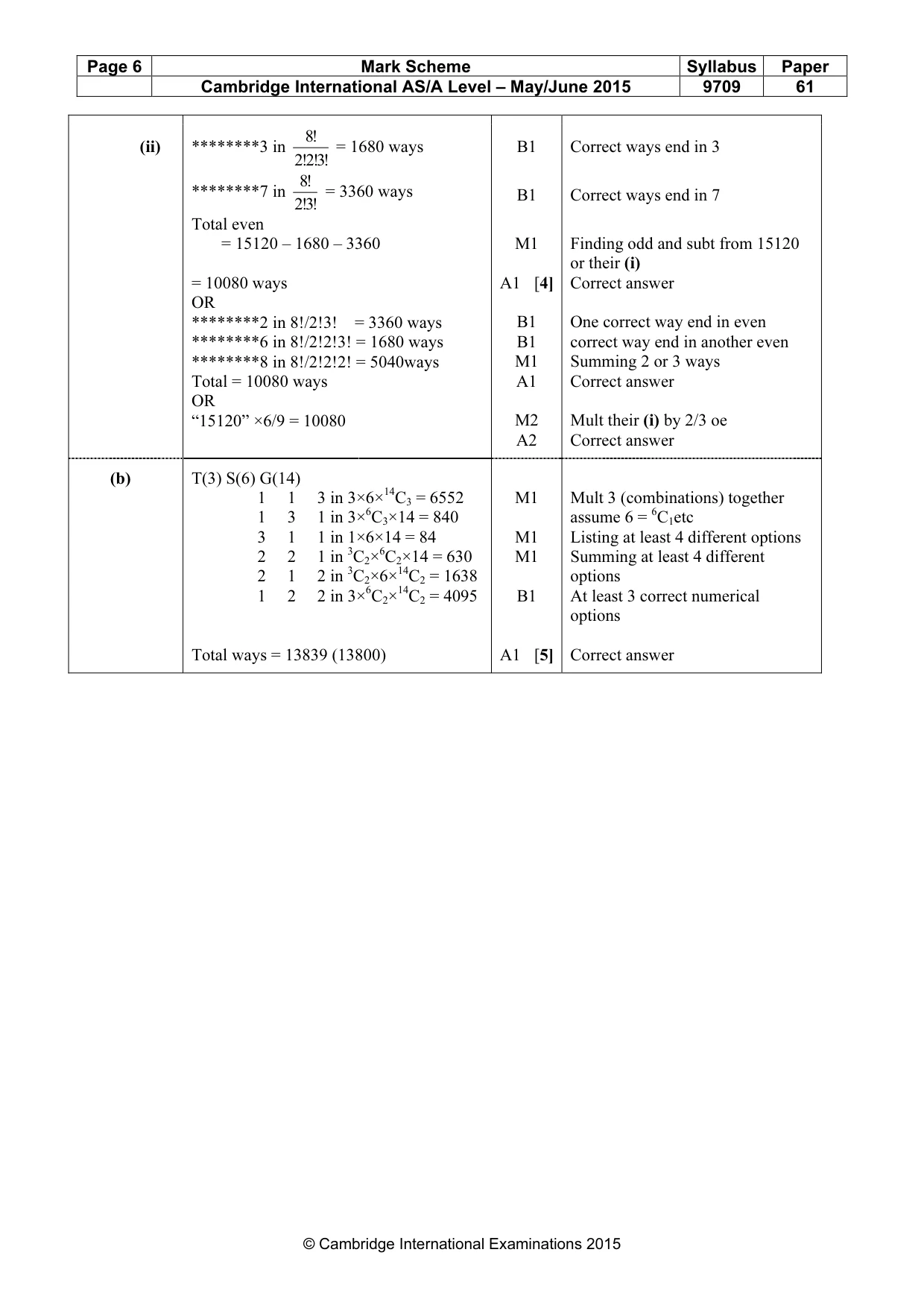
Mark scheme: !9 7 (a) (i) B1 Dividing by 2!2!3! !3!2!2 2 = 15120 ways B1 [2] Correct answer !8 (ii) ********3 in = 1680 ways B1 Correct ways end in 3 !3!2!2 !8 ********7 in = 3360 ways B1 Correct ways end in 7 !3!2 Total even = 15120 – 1680 – 3360 M1 Finding odd and subt from 15120 or their (i) = 10080 ways A1 [4] Correct answer OR ********2 in 8!/2!3! = 3360 ways B1 One correct way end in even ********6 in 8!/2!2!3! = 1680 ways B1 correct way end in another even ********8 in 8!/2!2!2! = 5040ways M1 Summing 2 or 3 ways Total = 10080 ways A1 Correct answer OR “15120” ×6/9 = 10080 M2 Mult their (i) by 2/3 oe A2 Correct answer (b) T(3) S(6) G(14) 1 1 3 in 3×6×14C3 = 6552 M1 Mult 3 (combinations) together 1 3 1 in 3×6C3×14 = 840 assume 6 = 6C1etc 3 1 1 in 1×6×14 = 84 M1 Listing at least 4 different options 2 2 1 in 3C2×6C2×14 = 630 M1 Summing at least 4 different 2 1 2 in 3C2×6×14C2 = 1638 options 1 2 2 in 3×6C2×14C2 = 4095 B1 At least 3 correct numerical options Total ways = 13839 (13800) A1 [5] Correct answer
What was in this paper
The subtopics covered by these 7 questions, and how many questions each got. Open one in a new tab to see every Cambridge question on it.
What you needed in this session
Cambridge’s own grade thresholds for 2015 May/June, Paper 6 · Variant 1. A higher threshold means an easier paper — the bar moves with how the cohort did.