Cambridge A Level Mathematics 9709 — 2015 May/June Paper 5 · Variant 3
9709/53/M/J/15 · 2 questions · 50 marks · ≈56 min
The question paper and its mark scheme, free to read here and free to download. This is Cambridge’s own paper, exactly as it was sat.
Question paper4 pages
Mark scheme5 pages
Answers below. Sit the paper first if you are practising.
Questions as text
Q6 · A cyclist and her bicycle have a total mass of 60 kg
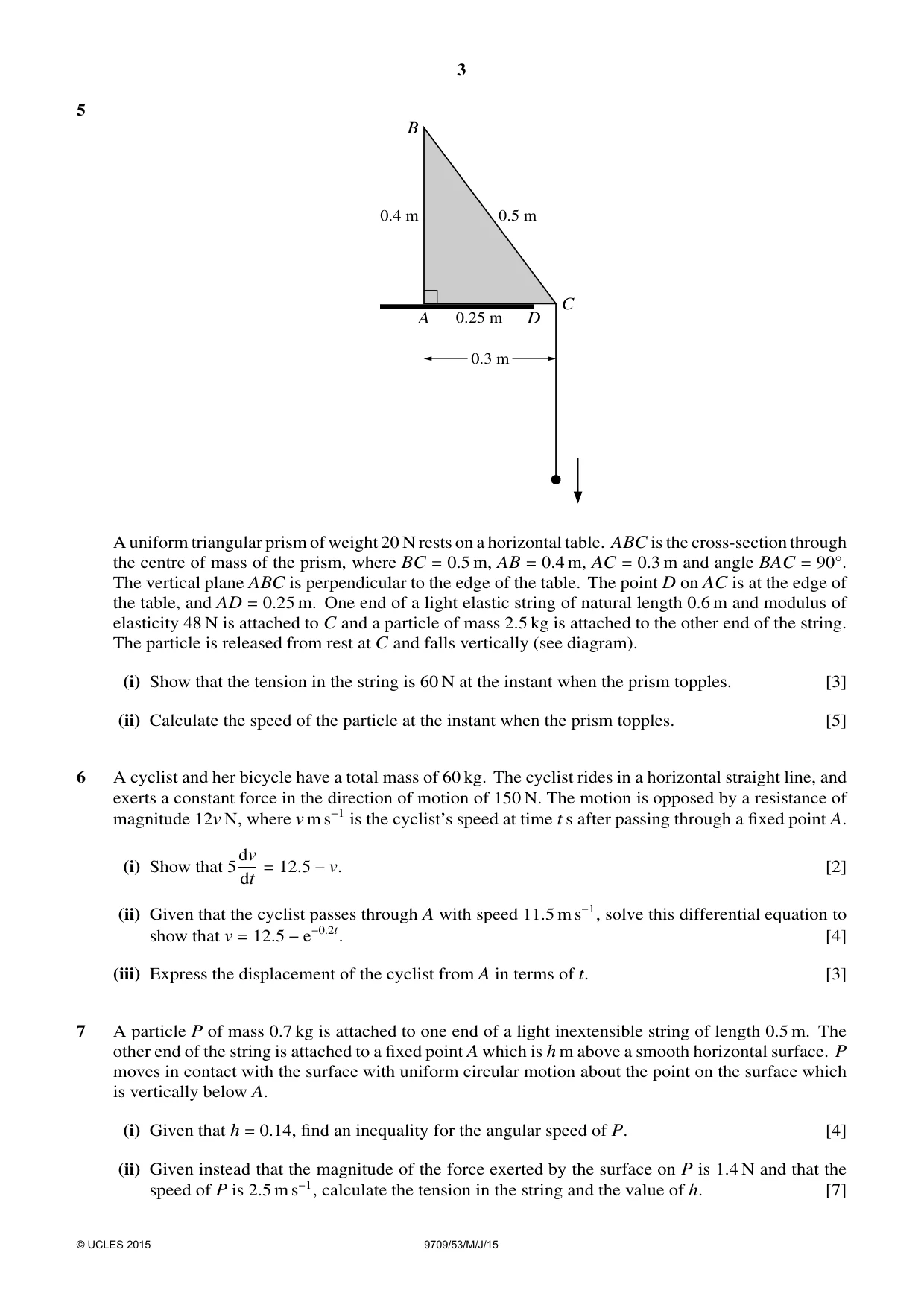
6 A cyclist and her bicycle have a total mass of 60 kg. The cyclist rides in a horizontal straight line, and exerts a constant force in the direction of motion of 150 N. The motion is opposed by a resistance of magnitude 12v N, where v m s−1 is the cyclist’s speed at time t s after passing through a fixed point A. (i) Show that 5dv = 12.5 −v. [2] dt (ii) Given that the cyclist passes through A with speed 11.5 m s−1, solve this differential equation to show that v = 12.5 −e−0.2t. [4] (iii) Express the displacement of the cyclist from A in terms of t. [3]
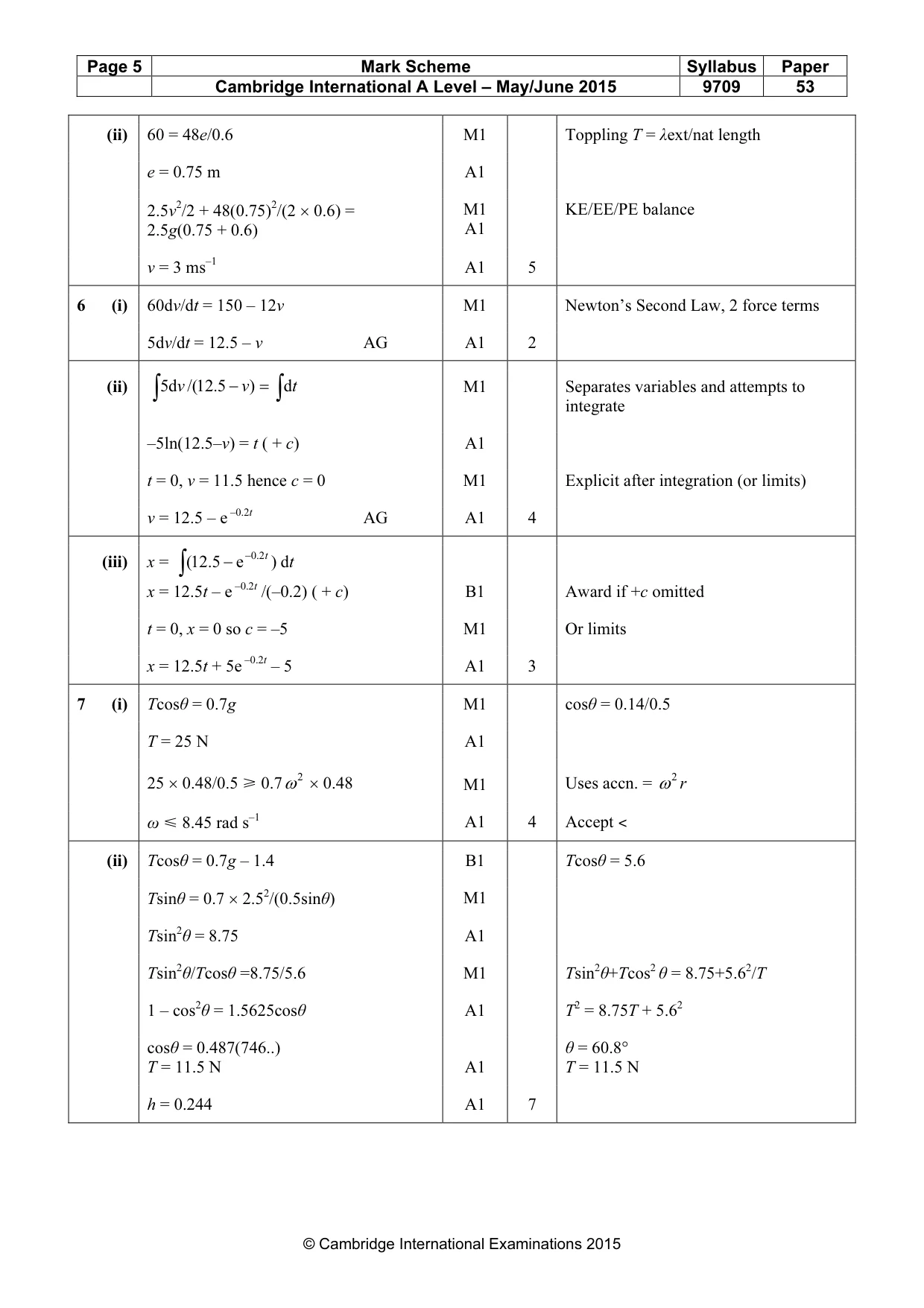
Mark scheme: 6 (i) 60dv/dt = 150 – 12v M1 Newton’s Second Law, 2 force terms 5dv/dt = 12.5 – v AG A1 2 (ii) ∫ 5dv /(125. − v ) = ∫ dt M1 Separates variables and attempts to integrate –5ln(12.5–v) = t ( + c) A1 t = 0, v = 11.5 hence c = 0 M1 Explicit after integration (or limits) v = 12.5 – e –0.2t AG A1 4 (iii) x = ∫ (12 5. − e −2.0 t ) dt x = 12.5t – e –0.2t /(–0.2) ( + c) B1 Award if +c omitted t = 0, x = 0 so c = –5 M1 Or limits x = 12.5t + 5e –0.2t – 5 A1 3
Q7 · A particle P of mass 0.7 kg is attached to one end of a light inextensible string of…
7 A particle P of mass 0.7 kg is attached to one end of a light inextensible string of length 0.5 m. The other end of the string is attached to a fixed point A which is h m above a smooth horizontal surface. P moves in contact with the surface with uniform circular motion about the point on the surface which is vertically below A. (i) Given that h = 0.14, find an inequality for the angular speed of P. [4] (ii) Given instead that the magnitude of the force exerted by the surface on P is 1.4 N and that the speed of P is 2.5 m s−1, calculate the tension in the string and the value of h. [7]
Mark scheme: 7 (i) Tcosθ = 0.7g M1 cosθ = 0.14/0.5 T = 25 N A1 25 × 0.48/0.5 [ 0.7 ω 2 × 0.48 M1 Uses accn. = ω 2 r ω Y 8.45 rad s–1 A1 4 Accept ˂ (ii) Tcosθ = 0.7g – 1.4 B1 Tcosθ = 5.6 Tsinθ = 0.7 × 2.52/(0.5sinθ) M1 Tsin2θ = 8.75 A1 Tsin2θ/Tcosθ =8.75/5.6 M1 Tsin2θ+Tcos2 θ = 8.75+5.62/T 1 – cos2θ = 1.5625cosθ A1 T2 = 8.75T + 5.62 cosθ = 0.487(746..) θ = 60.8° T = 11.5 N A1 T = 11.5 N h = 0.244 A1 7
What was in this paper
The subtopics covered by these 2 questions, and how many questions each got. Open one in a new tab to see every Cambridge question on it.
What you needed in this session
Cambridge’s own grade thresholds for 2015 May/June, Paper 5 · Variant 3. A higher threshold means an easier paper — the bar moves with how the cohort did.