Cambridge A Level Mathematics 9709 — 2015 May/June Paper 5 · Variant 2
9709/52/M/J/15 · 7 questions · 50 marks · ≈56 min
The question paper and its mark scheme, free to read here and free to download. This is Cambridge’s own paper, exactly as it was sat.
Question paper4 pages
Mark scheme6 pages
Answers below. Sit the paper first if you are practising.
Questions as text
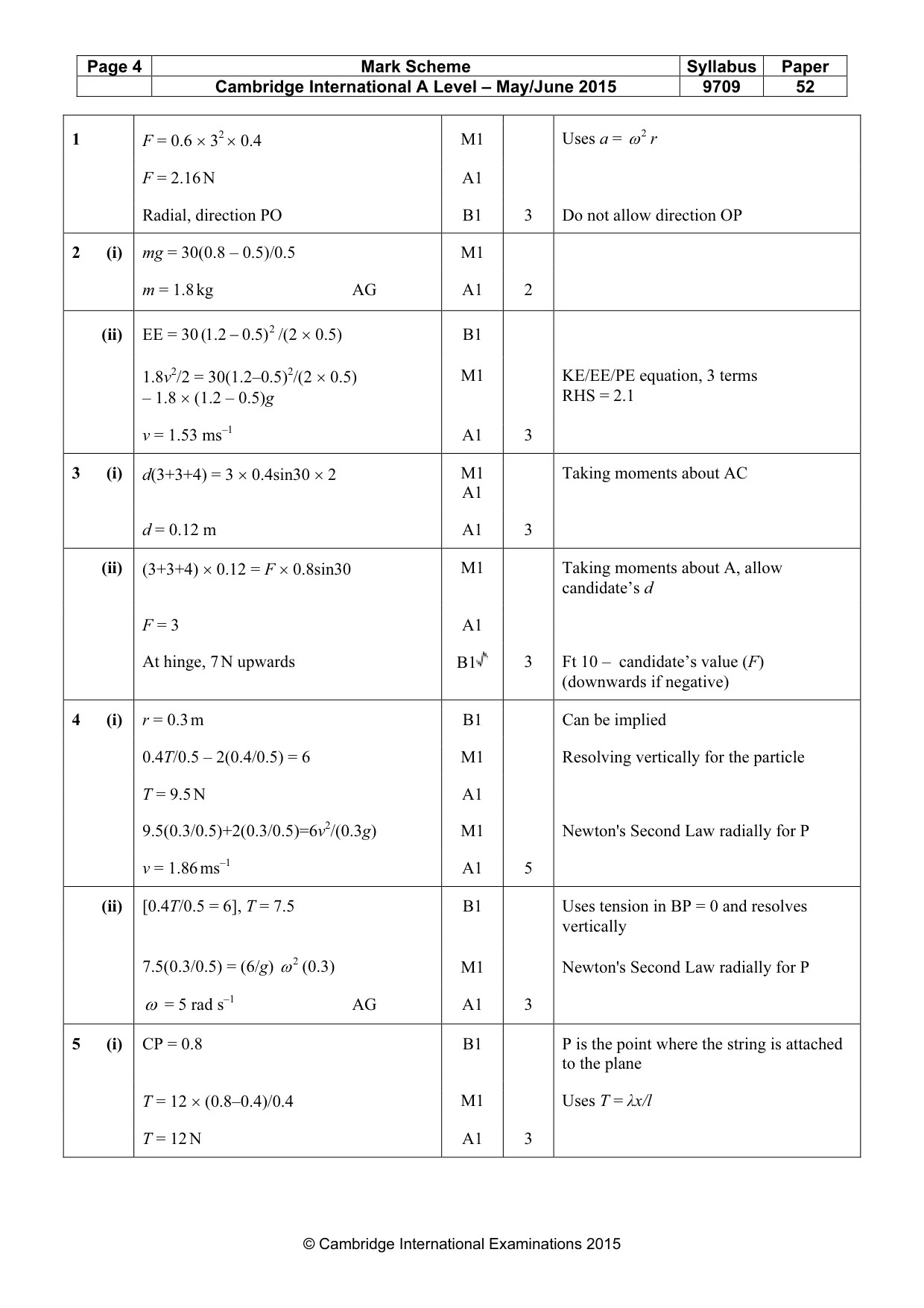
Q1 · A particle P of mass 0.6 kg is on the rough surface of a horizontal disc with centre O
1 A particle P of mass 0.6 kg is on the rough surface of a horizontal disc with centre O. The distance OP is 0.4 m. The disc and P rotate with angular speed 3 rad s−1 about a vertical axis which passes through O. Find the magnitude of the frictional force which the disc exerts on the particle, and state the direction of this force. [3]
Mark scheme: 1 F = 0.6 × 32 × 0.4 M1 Uses a = ω 2 r F = 2.16 N A1 Radial, direction PO B1 3 Do not allow direction OP
Q2 · One end of a light elastic string of natural length 0.5 m and modulus of elasticity 30 N…
2 One end of a light elastic string of natural length 0.5 m and modulus of elasticity 30 N is attached to a fixed point O. The other end of the string is attached to a particle P which hangs in equilibrium vertically below O, with OP = 0.8 m. (i) Show that the mass of P is 1.8 kg. [2] The particle is pulled vertically downwards and released from rest from the point where OP = 1.2 m. (ii) Find the speed of P at the instant when the string first becomes slack. [3]
Mark scheme: 2 (i) mg = 30(0.8 – 0.5)/0.5 M1 m = 1.8 kg AG A1 2 (ii) EE = 30 2.1( − 5.02) /(2 × 0.5) B1 1.8v2/2 = 30(1.2–0.5)2/(2 × 0.5) M1 KE/EE/PE equation, 3 terms – 1.8 × (1.2 – 0.5)g RHS = 2.1 v = 1.53 ms–1 A1 3
Q3 · A triangular frame ABC consists of two uniform rigid rods each of length 0.8 m and weight…
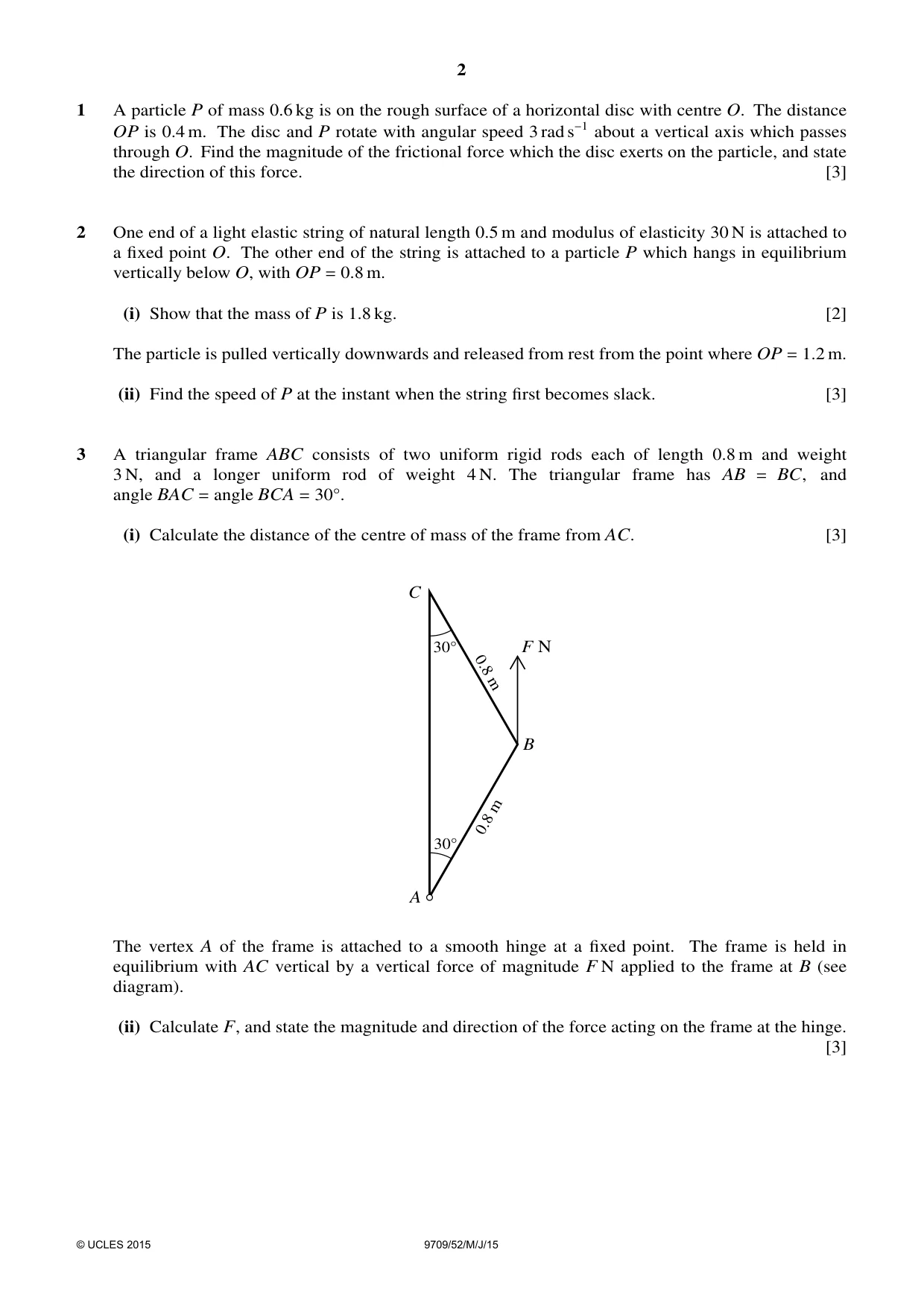
3 A triangular frame ABC consists of two uniform rigid rods each of length 0.8 m and weight 3 N, and a longer uniform rod of weight 4 N. The triangular frame has AB = BC, and angle BAC = angle BCA = 30Å. (i) Calculate the distance of the centre of mass of the frame from AC. [3] C 30Å F N 0.8 m B m 0.8 30Å A The vertex A of the frame is attached to a smooth hinge at a fixed point. The frame is held in equilibrium with AC vertical by a vertical force of magnitude F N applied to the frame at B (see diagram). (ii) Calculate F, and state the magnitude and direction of the force acting on the frame at the hinge. [3]
Mark scheme: 3 (i) d(3+3+4) = 3 × 0.4sin30 × 2 M1 Taking moments about AC A1 d = 0.12 m A1 3 (ii) (3+3+4) × 0.12 = F × 0.8sin30 M1 Taking moments about A, allow candidate’s d F = 3 A1 At hinge, 7 N upwards B1 3 Ft 10 – candidate’s value (F) (downwards if negative)
Q4 · One end of a light inextensible string of length 0.5 m is attached to a fixed point A
4 One end of a light inextensible string of length 0.5 m is attached to a fixed point A. The other end of the string is attached to a particle P of weight 6 N. Another light inextensible string of length 0.5 m connects P to a fixed point B which is 0.8 m vertically below A. The particle P moves with constant speed in a horizontal circle with centre at the mid-point of AB. Both strings are taut. (i) Calculate the speed of P when the tension in the string BP is 2 N. [5] (ii) Show that the angular speed of P must exceed 5 rad s−1. [3]
Mark scheme: 4 (i) r = 0.3 m B1 Can be implied 0.4T/0.5 – 2(0.4/0.5) = 6 M1 Resolving vertically for the particle T = 9.5 N A1 9.5(0.3/0.5)+2(0.3/0.5)=6v2/(0.3g) M1 Newton's Second Law radially for P v = 1.86 ms–1 A1 5 (ii) [0.4T/0.5 = 6], T = 7.5 B1 Uses tension in BP = 0 and resolves vertically 7.5(0.3/0.5) = (6/g) ω 2 (0.3) M1 Newton's Second Law radially for P ω = 5 rad s–1 AG A1 3
Q5 · D m 0.4 m C 0.4 A B 30Å 30Å A uniform solid cube with edges of length 0.4 m rests in…
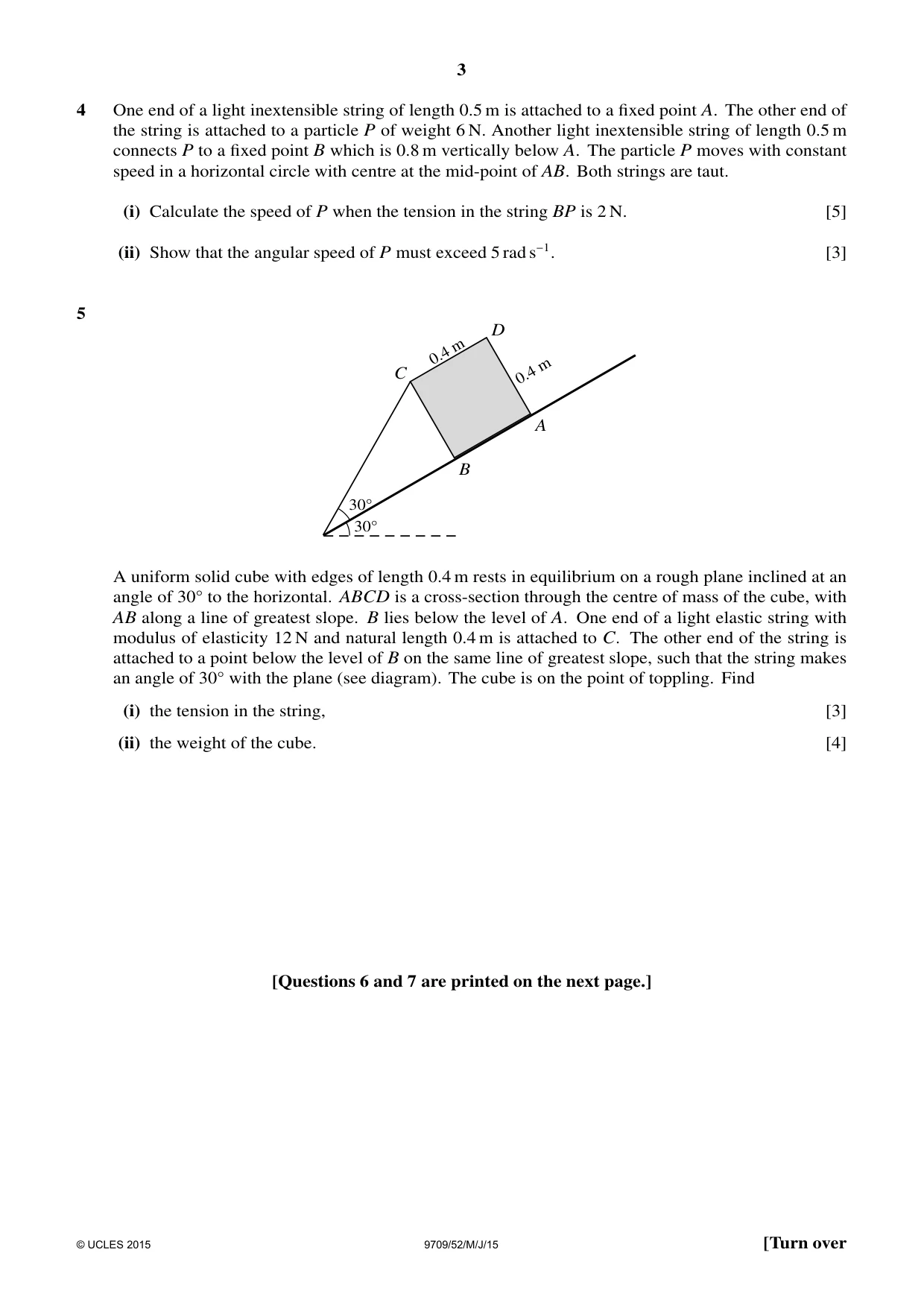
5 D m 0.4 m C 0.4 A B 30Å 30Å A uniform solid cube with edges of length 0.4 m rests in equilibrium on a rough plane inclined at an angle of 30Å to the horizontal. ABCD is a cross-section through the centre of mass of the cube, with AB along a line of greatest slope. B lies below the level of A. One end of a light elastic string with modulus of elasticity 12 N and natural length 0.4 m is attached to C. The other end of the string is attached to a point below the level of B on the same line of greatest slope, such that the string makes an angle of 30Å with the plane (see diagram). The cube is on the point of toppling. Find (i) the tension in the string, [3] (ii) the weight of the cube. [4] [Questions 6 and 7 are printed on the next page.]
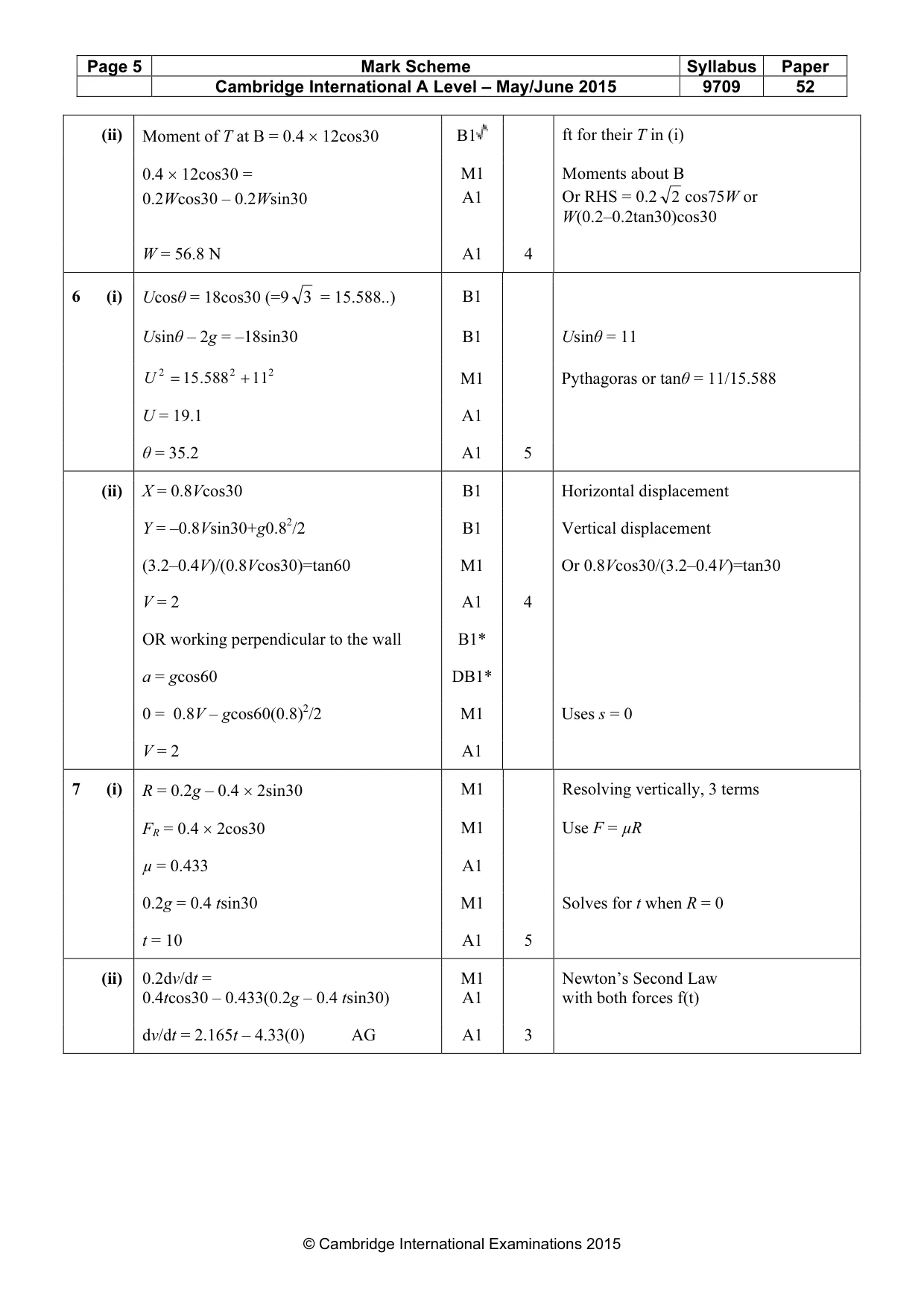
Mark scheme: 5 (i) CP = 0.8 B1 P is the point where the string is attached to the plane T = 12 × (0.8–0.4)/0.4 M1 Uses T = λx/l T = 12 N A1 3 (ii) Moment of T at B = 0.4 × 12cos30 B1 ft for their T in (i) 0.4 × 12cos30 = M1 Moments about B 0.2Wcos30 – 0.2Wsin30 A1 Or RHS = 0.2 2 cos75W or W(0.2–0.2tan30)cos30 W = 56.8 N A1 4
Q6 · 18 m s−1 U m s−1 V m s−1 B B 1Å O A 60Å 60Å Fig
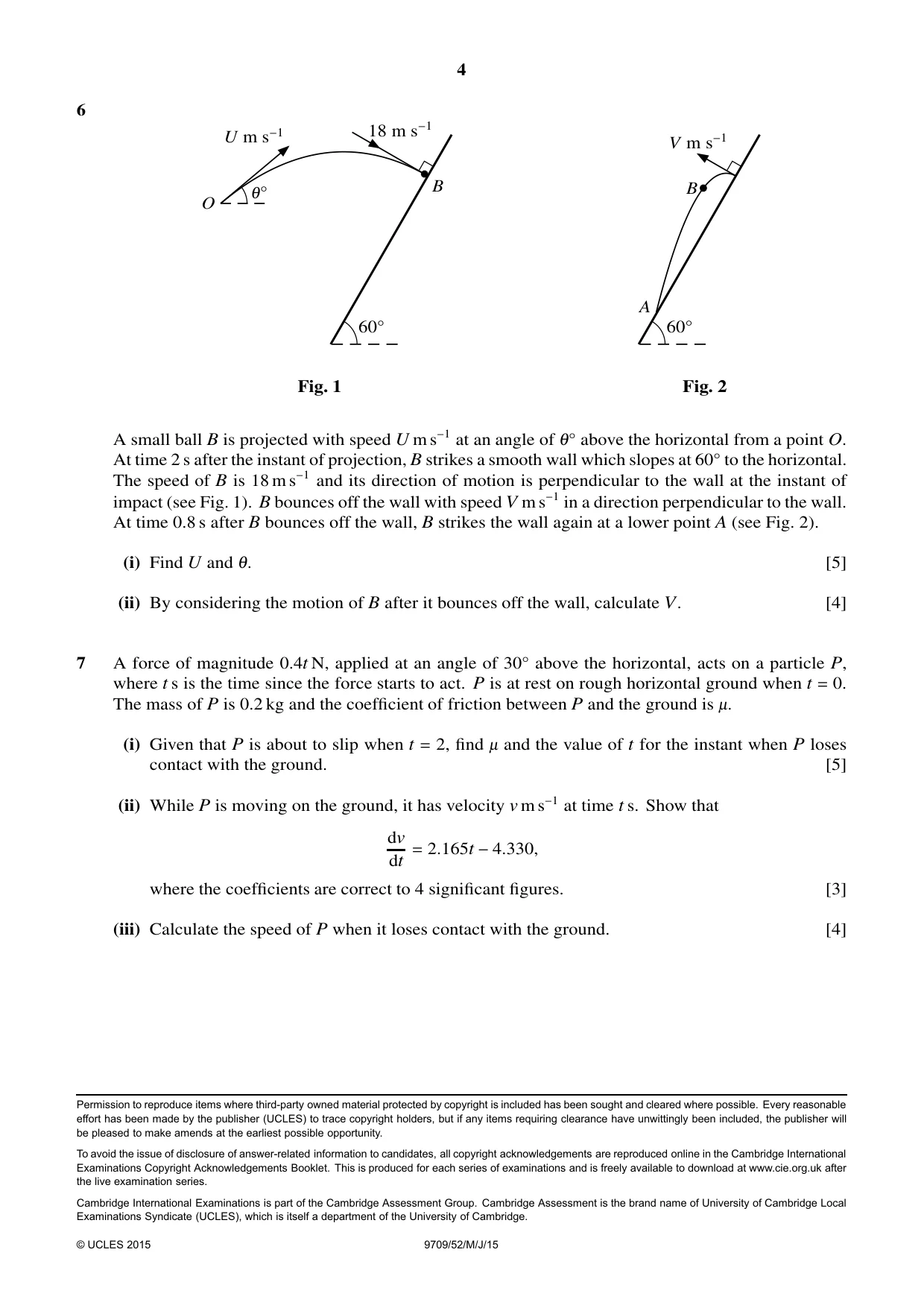
6 18 m s−1 U m s−1 V m s−1 B B 1Å O A 60Å 60Å Fig. 1 Fig. 2 A small ball B is projected with speed U m s−1 at an angle of 1Å above the horizontal from a point O. At time 2 s after the instant of projection, B strikes a smooth wall which slopes at 60Å to the horizontal. The speed of B is 18 m s−1 and its direction of motion is perpendicular to the wall at the instant of impact (see Fig. 1). B bounces off the wall with speed V m s−1 in a direction perpendicular to the wall. At time 0.8 s after B bounces off the wall, B strikes the wall again at a lower point A (see Fig. 2). (i) Find U and 1. [5] (ii) By considering the motion of B after it bounces off the wall, calculate V. [4]
Mark scheme: 6 (i) Ucosθ = 18cos30 (=9 3 = 15.588..) B1 Usinθ – 2g = –18sin30 B1 Usinθ = 11 U 2 = 15 . 588 2 + 112 M1 Pythagoras or tanθ = 11/15.588 U = 19.1 A1 θ = 35.2 A1 5 (ii) X = 0.8Vcos30 B1 Horizontal displacement Y = –0.8Vsin30+g0.82/2 B1 Vertical displacement (3.2–0.4V)/(0.8Vcos30)=tan60 M1 Or 0.8Vcos30/(3.2–0.4V)=tan30 V = 2 A1 4 OR working perpendicular to the wall B1* a = gcos60 DB1* 0 = 0.8V – gcos60(0.8)2/2 M1 Uses s = 0 V = 2 A1
Q7 · A force of magnitude 0.4t N, applied at an angle of 30Å above the horizontal, acts on a…
7 A force of magnitude 0.4t N, applied at an angle of 30Å above the horizontal, acts on a particle P, where t s is the time since the force starts to act. P is at rest on rough horizontal ground when t = 0. The mass of P is 0.2 kg and the coefficient of friction between P and the ground is -. (i) Given that P is about to slip when t = 2, find - and the value of t for the instant when P loses contact with the ground. [5] (ii) While P is moving on the ground, it has velocity v m s−1 at time t s. Show that dv = 2.165t −4.330, dt where the coefficients are correct to 4 significant figures. [3] (iii) Calculate the speed of P when it loses contact with the ground. [4]
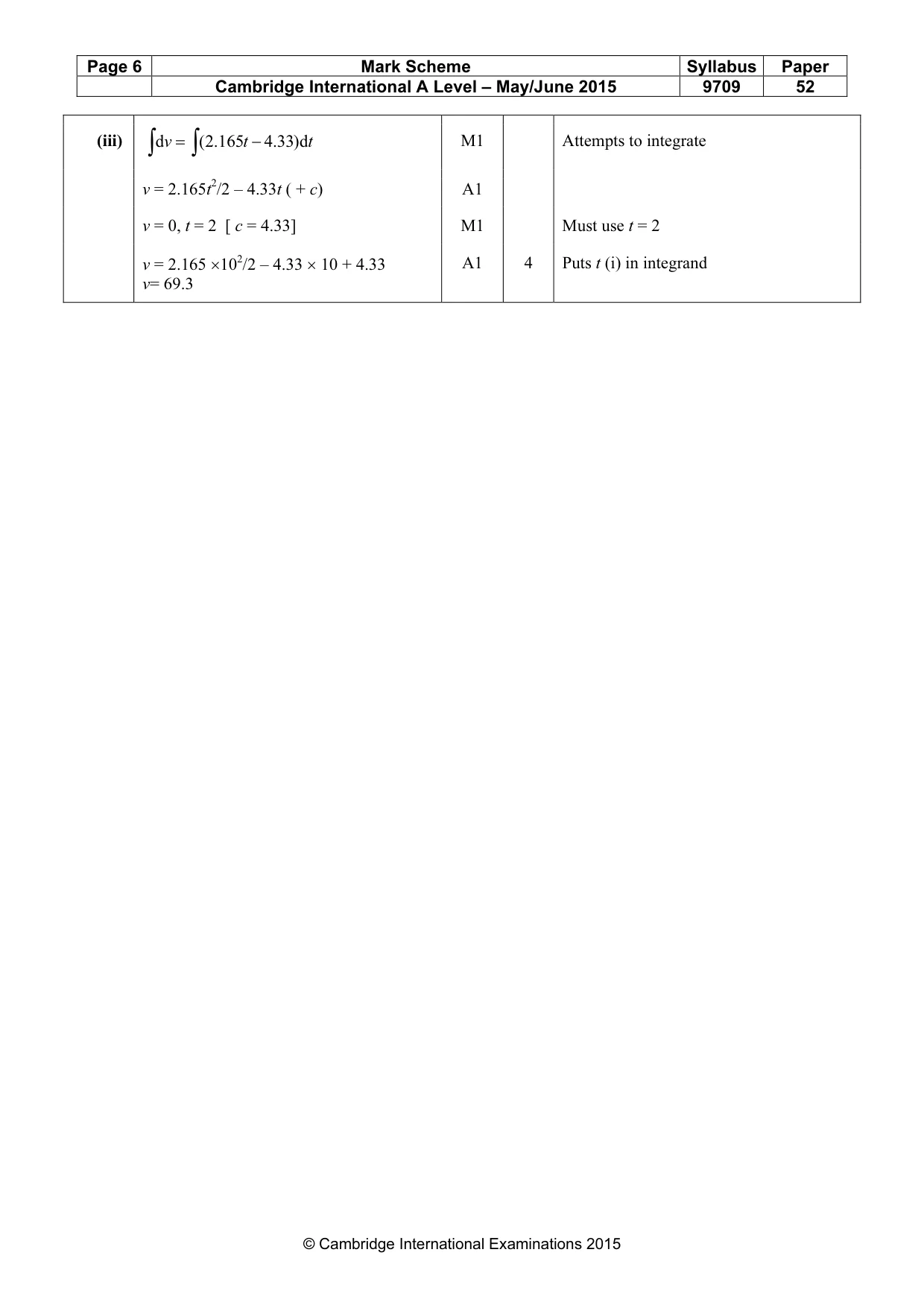
Mark scheme: 7 (i) R = 0.2g – 0.4 × 2sin30 M1 Resolving vertically, 3 terms FR = 0.4 × 2cos30 M1 Use F = µR µ = 0.433 A1 0.2g = 0.4 tsin30 M1 Solves for t when R = 0 t = 10 A1 5 (ii) 0.2dv/dt = M1 Newton’s Second Law 0.4tcos30 – 0.433(0.2g – 0.4 tsin30) A1 with both forces f(t) dv/dt = 2.165t – 4.33(0) AG A1 3 (iii) ∫ dv = ∫ ( .2165t − .433) dt M1 Attempts to integrate v = 2.165t2/2 – 4.33t ( + c) A1 v = 0, t = 2 [ c = 4.33] M1 Must use t = 2 v = 2.165 ×10²/2 – 4.33 × 10 + 4.33 A1 4 Puts t (i) in integrand v= 69.3
What was in this paper
The subtopics covered by these 7 questions, and how many questions each got. Open one in a new tab to see every Cambridge question on it.
What you needed in this session
Cambridge’s own grade thresholds for 2015 May/June, Paper 5 · Variant 2. A higher threshold means an easier paper — the bar moves with how the cohort did.