Cambridge A Level Mathematics 9709 — 2014 May/June Paper 7 · Variant 1
9709/71/M/J/14 · 4 questions · 50 marks · ≈56 min
The question paper and its mark scheme, free to read here and free to download. This is Cambridge’s own paper, exactly as it was sat.
Question paper4 pages
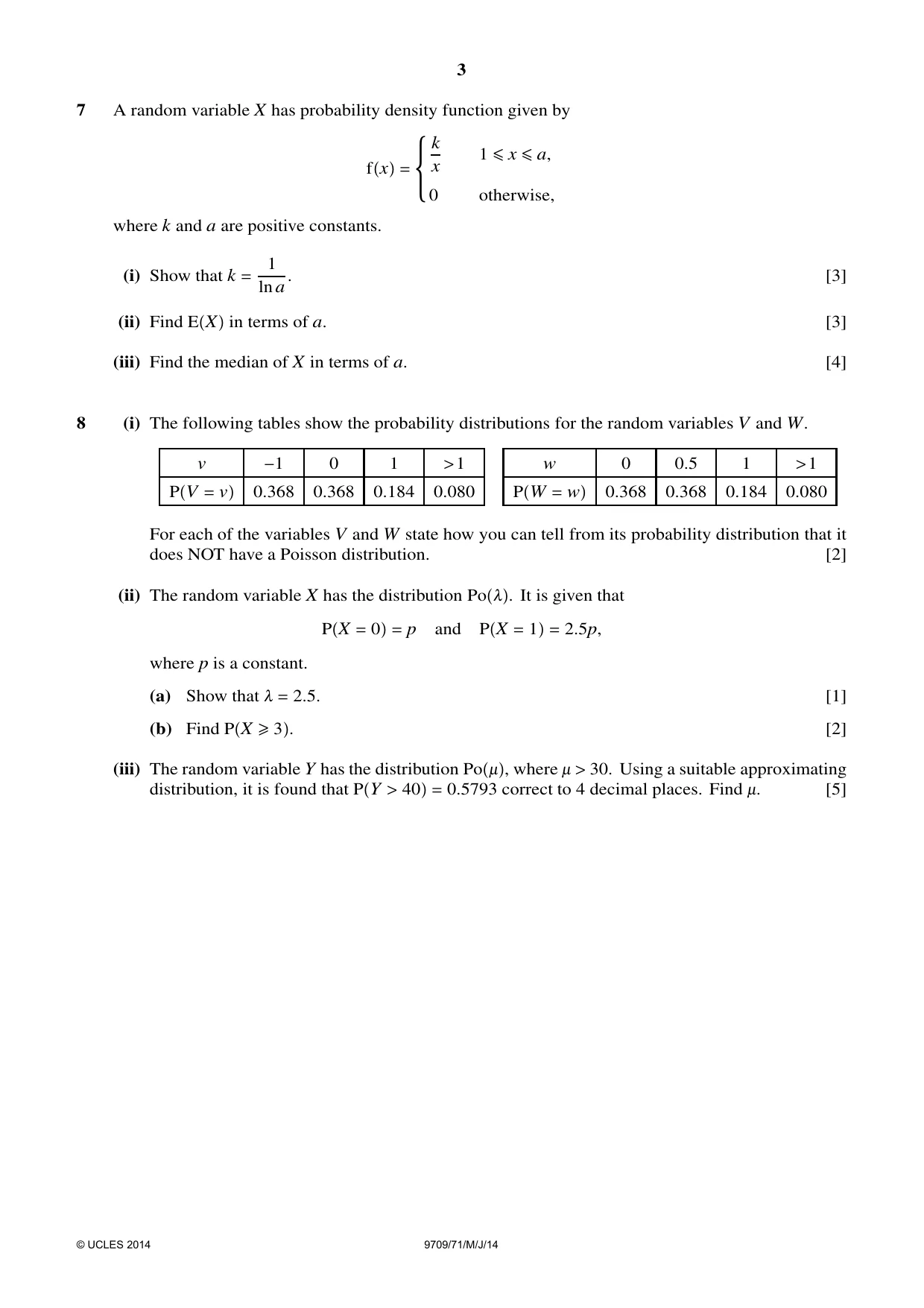
Mark scheme6 pages
Answers below. Sit the paper first if you are practising.
Questions as text
Q1 · The masses, in grams, of apples of a certain type are normally distributed with mean 60.4…
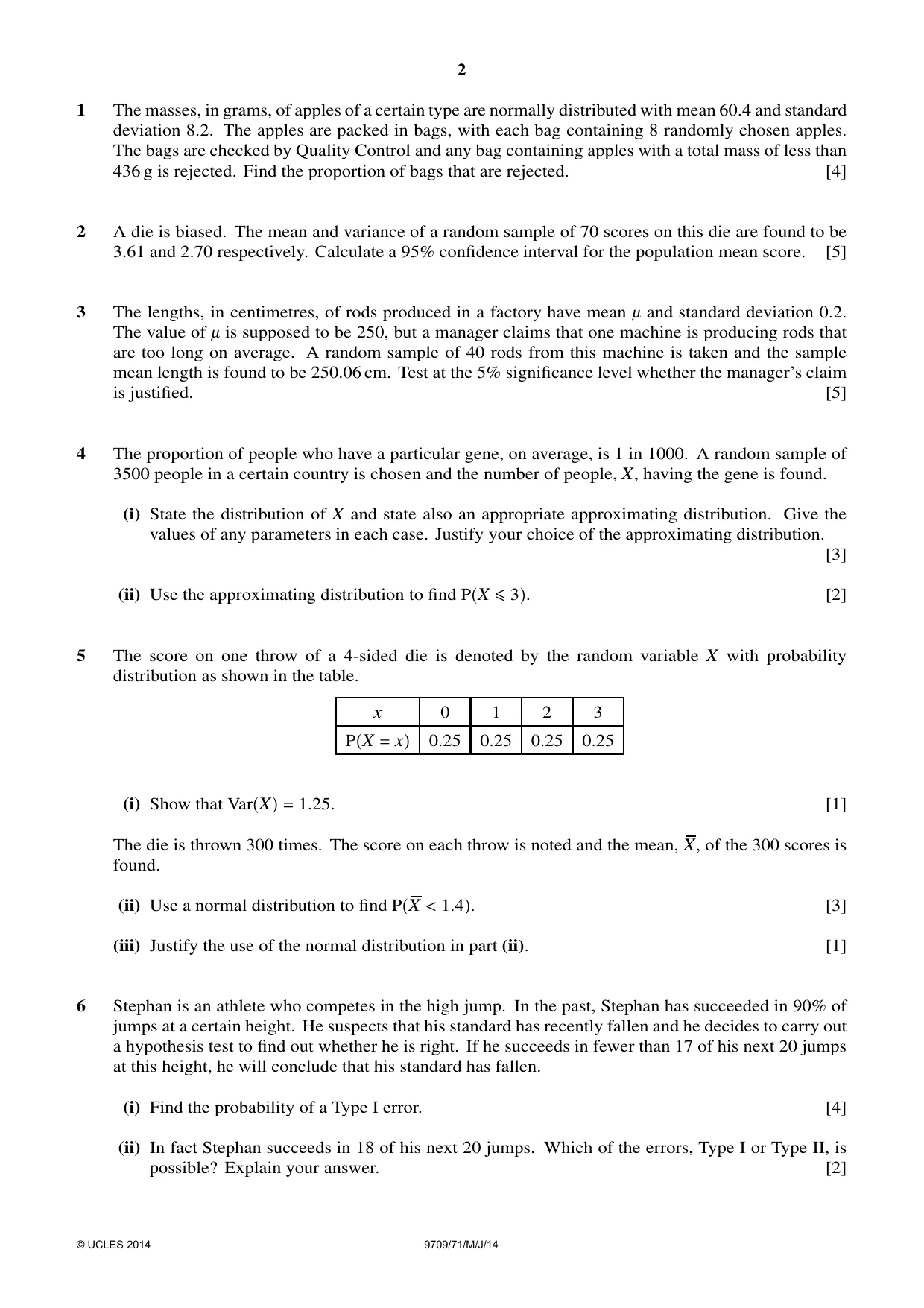
1 The masses, in grams, of apples of a certain type are normally distributed with mean 60.4 and standard deviation 8.2. The apples are packed in bags, with each bag containing 8 randomly chosen apples. The bags are checked by Quality Control and any bag containing apples with a total mass of less than 436 g is rejected. Find the proportion of bags that are rejected. [4]
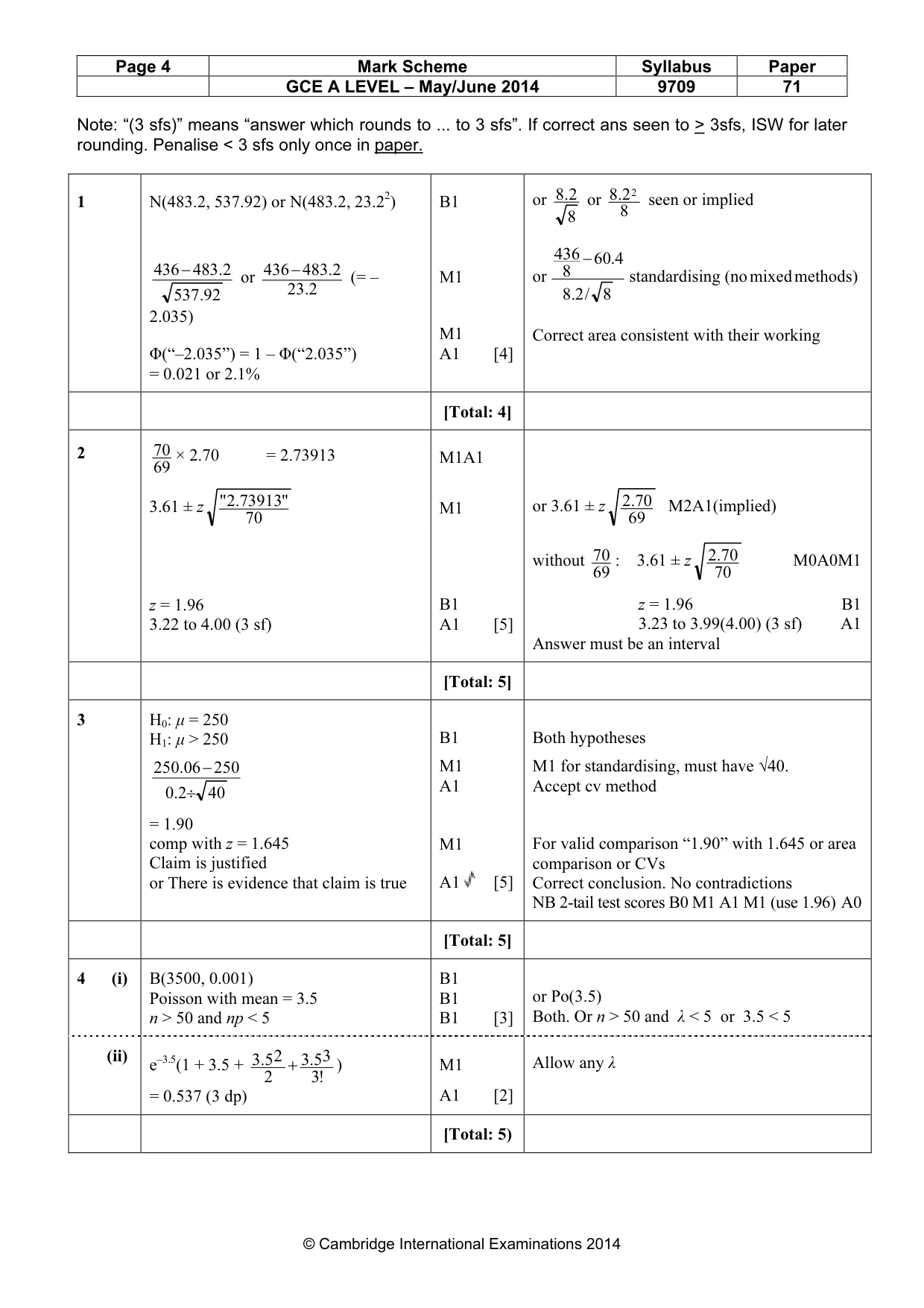
Mark scheme: 2.8 2.8 21 N(483.2, 537.92) or N(483.2, 23.22) B1 or or seen or implied 8 8 436 − 604. 436− 483 2. 436− 483 2. 8 or (= – M1 or standardising (no mixed methods) 23 2. 537 .92 2.8 / 8 2.035) M1 Correct area consistent with their working Φ(“–2.035”) = 1 – Φ(“2.035”) A1 [4] = 0.021 or 2.1% [Total: 4] 70
Q2 · A die is biased
2 A die is biased. The mean and variance of a random sample of 70 scores on this die are found to be 3.61 and 2.70 respectively. Calculate a 95% confidence interval for the population mean score. [5]
Mark scheme: 2 70 × 2.70 = 2.73913 M1A1 69 " 2.73913" .270 3.61 ± z M1 or 3.61 ± z M2A1(implied) 70 69 70 .270 without : 3.61 ± z M0A0M1 69 70 z = 1.96 B1 z = 1.96 B1 3.22 to 4.00 (3 sf) A1 [5] 3.23 to 3.99(4.00) (3 sf) A1 Answer must be an interval [Total: 5]
Q3 · The lengths, in centimetres, of rods produced in a factory have mean - and standard…
3 The lengths, in centimetres, of rods produced in a factory have mean - and standard deviation 0.2. The value of - is supposed to be 250, but a manager claims that one machine is producing rods that are too long on average. A random sample of 40 rods from this machine is taken and the sample mean length is found to be 250.06 cm. Test at the 5% significance level whether the manager’s claim is justified. [5]
Mark scheme: 3 H0: µ = 250 H1: µ > 250 B1 Both hypotheses 250.06 − 250 M1 M1 for standardising, must have √40. A1 Accept cv method 2.0÷ 40 = 1.90 comp with z = 1.645 M1 For valid comparison “1.90” with 1.645 or area Claim is justified comparison or CVs or There is evidence that claim is true A1 [5] Correct conclusion. No contradictions NB 2-tail test scores B0 M1 A1 M1 (use 1.96) A0 [Total: 5]
Q6 · Stephan is an athlete who competes in the high jump
6 Stephan is an athlete who competes in the high jump. In the past, Stephan has succeeded in 90% of jumps at a certain height. He suspects that his standard has recently fallen and he decides to carry out a hypothesis test to find out whether he is right. If he succeeds in fewer than 17 of his next 20 jumps at this height, he will conclude that his standard has fallen. (i) Find the probability of a Type I error. [4] (ii) In fact Stephan succeeds in 18 of his next 20 jumps. Which of the errors, Type I or Type II, is possible? Explain your answer. [2]
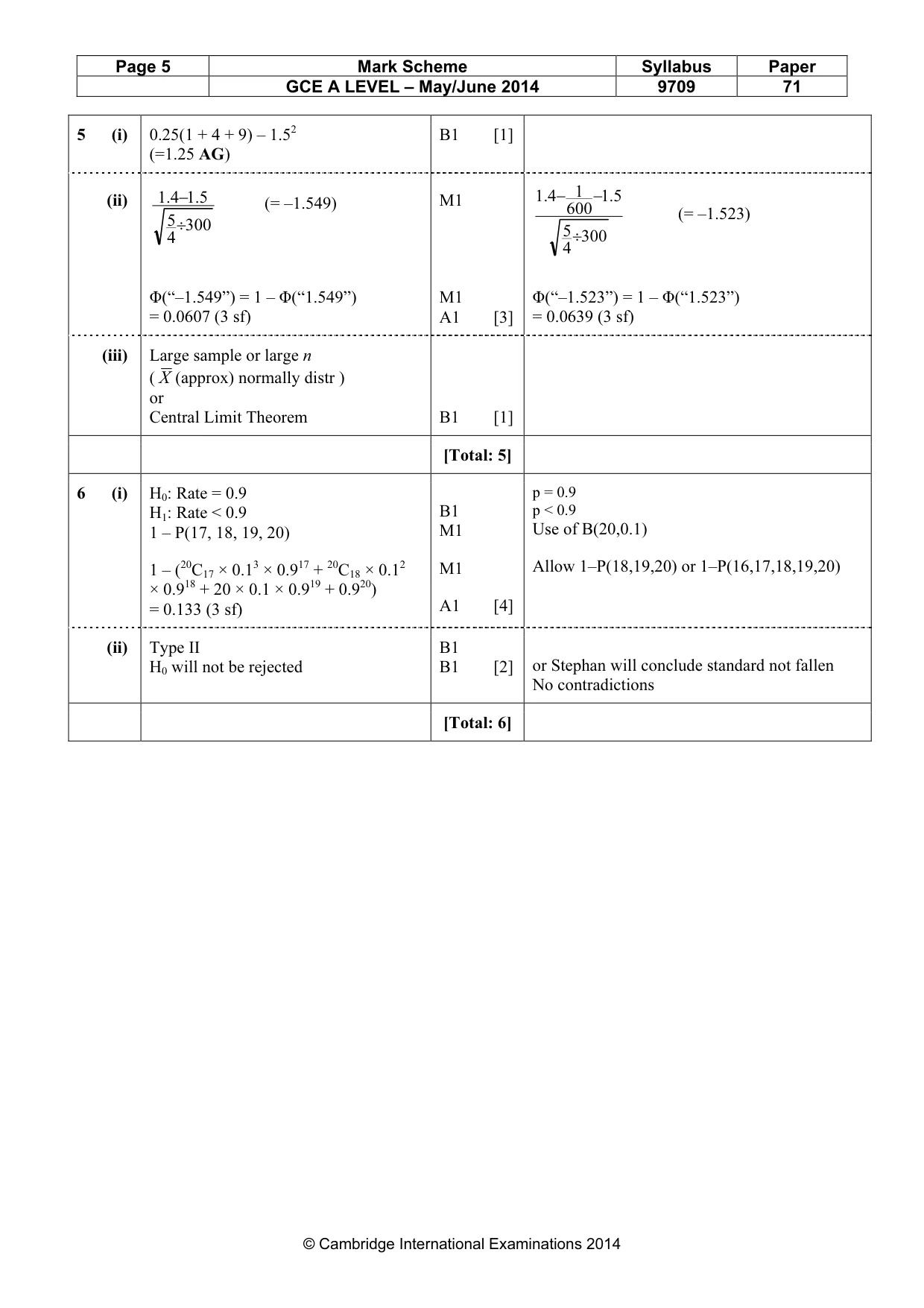
Mark scheme: 6 (i) H0: Rate = 0.9 p = 0.9 H1: Rate < 0.9 B1 p < 0.9 1 – P(17, 18, 19, 20) M1 Use of B(20,0.1) 1 – (20C17 × 0.13 × 0.917 + 20C18 × 0.12 M1 Allow 1–P(18,19,20) or 1–P(16,17,18,19,20) × 0.918 + 20 × 0.1 × 0.919 + 0.920) = 0.133 (3 sf) A1 [4] (ii) Type II B1 H0 will not be rejected B1 [2] or Stephan will conclude standard not fallen No contradictions [Total: 6] GCE A LEVEL – May/June 2014 9709 71 ak d 1 ∫
What was in this paper
The subtopics covered by these 4 questions, and how many questions each got. Open one in a new tab to see every Cambridge question on it.
What you needed in this session
Cambridge’s own grade thresholds for 2014 May/June, Paper 7 · Variant 1. A higher threshold means an easier paper — the bar moves with how the cohort did.