Cambridge A Level Mathematics 9709 — 2014 May/June Paper 7 · Variant 3
9709/73/M/J/14 · 7 questions · 50 marks · ≈56 min
The question paper and its mark scheme, free to read here and free to download. This is Cambridge’s own paper, exactly as it was sat.
Question paper4 pages
Mark scheme6 pages
Answers below. Sit the paper first if you are practising.
Questions as text
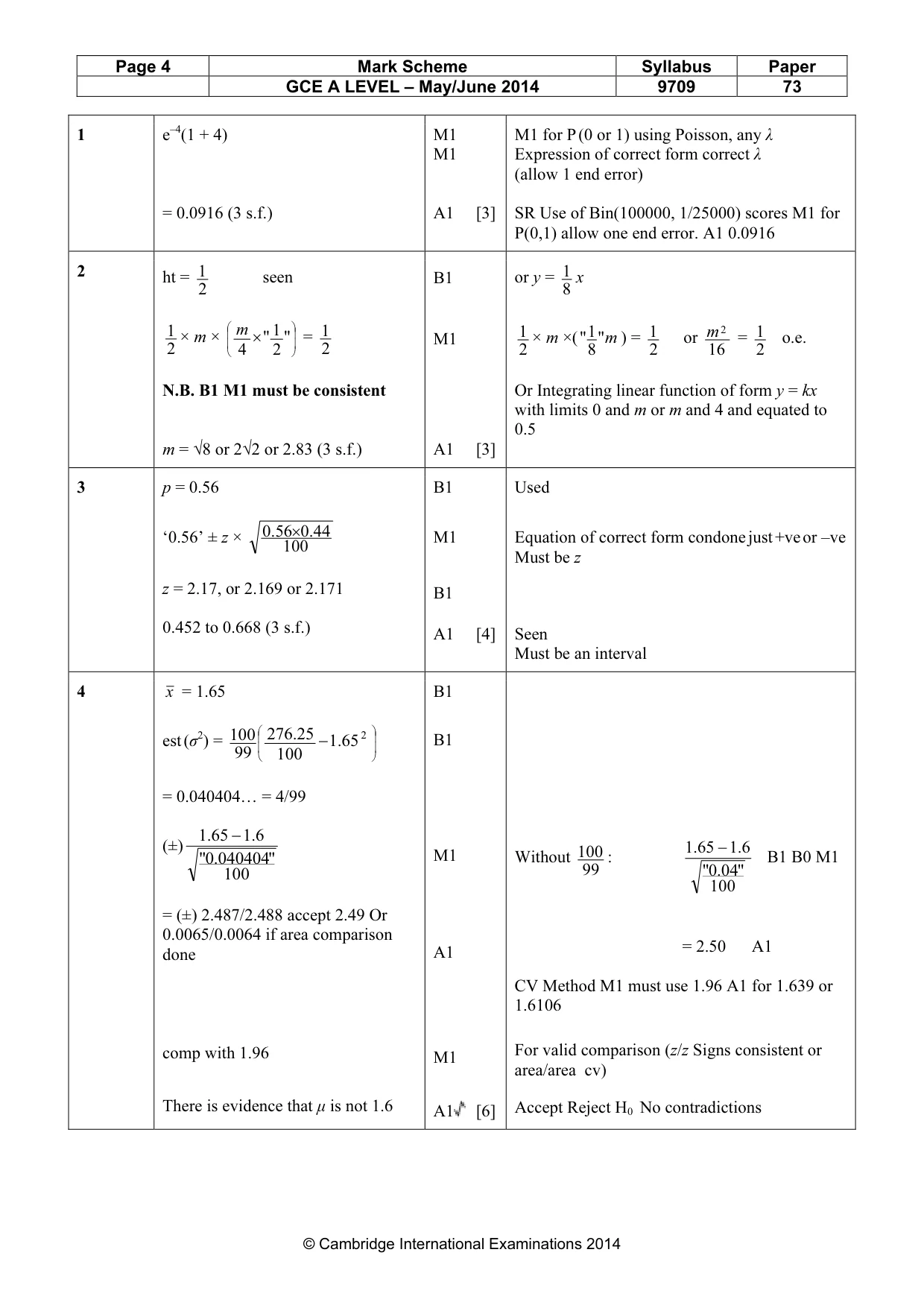
Q1 · On average 1 in 25 000 people have a rare blood condition
1 On average 1 in 25 000 people have a rare blood condition. Use a suitable approximating distribution to find the probability that fewer than 2 people in a random sample of 100 000 have the condition. [3]
Mark scheme: 1 e–4(1 + 4) M1 M1 for P (0 or 1) using Poisson, any λ M1 Expression of correct form correct λ (allow 1 end error) = 0.0916 (3 s.f.) A1 [3] SR Use of Bin(100000, 1/25000) scores M1 for P(0,1) allow one end error. A1 0.0916
Q2 · X −1 0 1 2 3 4 5 A random variable X takes values between 0 and 4 only and has…
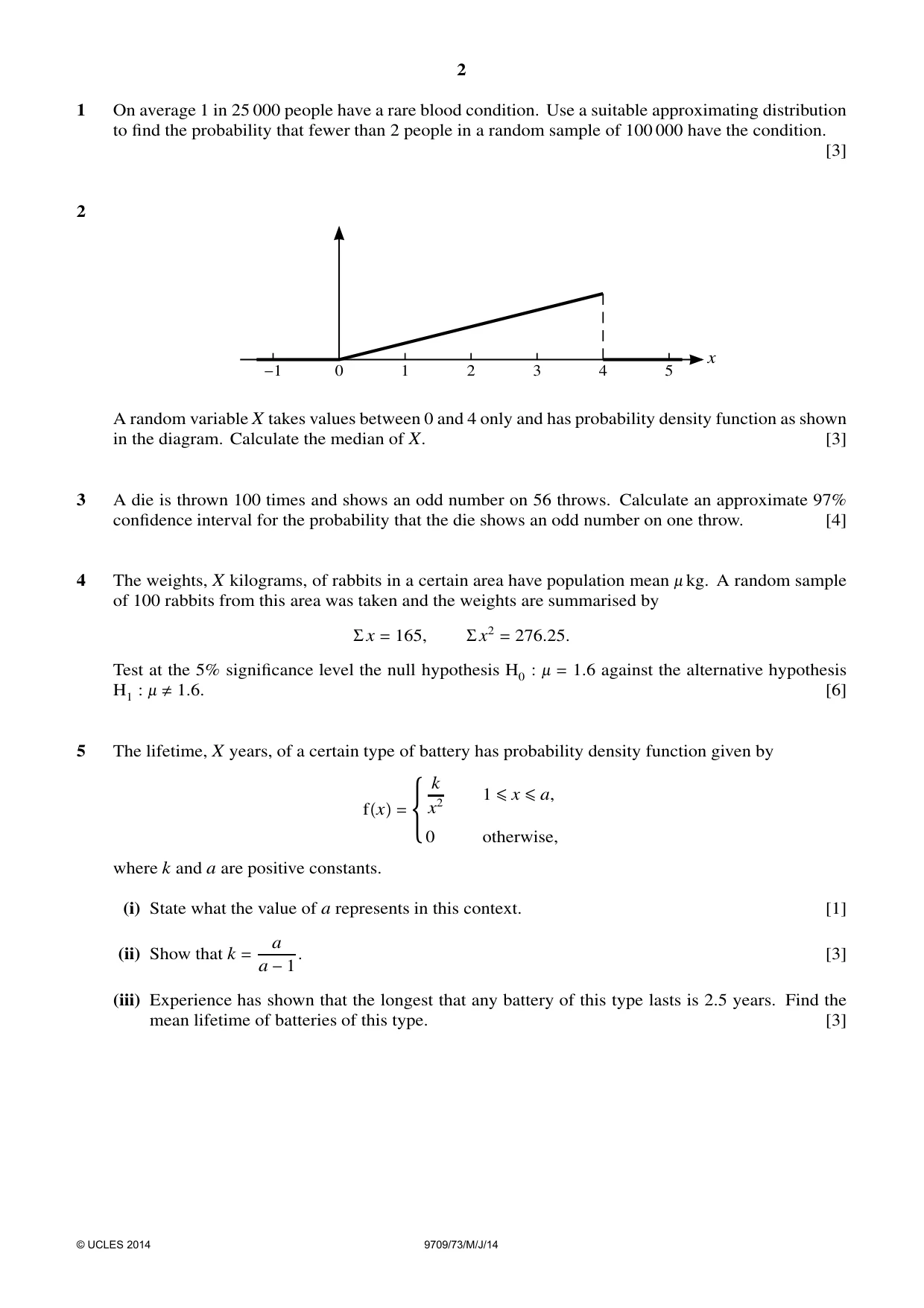
2 x −1 0 1 2 3 4 5 A random variable X takes values between 0 and 4 only and has probability density function as shown in the diagram. Calculate the median of X. [3]
Mark scheme: 2 1 1 ht = seen B1 or y = x 2 8 1 m 1 1 1 1 1 m 2 1 × m × × " " = M1 × m ×( " " m ) = or = o.e. 2 4 2 2 2 8 2 16 2 N.B. B1 M1 must be consistent Or Integrating linear function of form y = kx with limits 0 and m or m and 4 and equated to 0.5 m = √8 or 2√2 or 2.83 (3 s.f.) A1 [3]
Q3 · A die is thrown 100 times and shows an odd number on 56 throws
3 A die is thrown 100 times and shows an odd number on 56 throws. Calculate an approximate 97% confidence interval for the probability that the die shows an odd number on one throw. [4]
Mark scheme: 3 p = 0.56 B1 Used .0 56×.0 44 ‘0.56’ ± z × M1 Equation of correct form condone just +ve or –ve 100 Must be z z = 2.17, or 2.169 or 2.171 B1 0.452 to 0.668 (3 s.f.) A1 [4] Seen Must be an interval
Q4 · The weights, X kilograms, of rabbits in a certain area have population mean - kg
4 The weights, X kilograms, of rabbits in a certain area have population mean - kg. A random sample of 100 rabbits from this area was taken and the weights are summarised by Σx = 165, Σx2 = 276.25. Test at the 5% significance level the null hypothesis H0 : - = 1.6 against the alternative hypothesis H1 : - ≠1.6. [6]
Mark scheme: 4 x = 1.65 B1 100 276.25 2 est (σ2) = − .165 B1 99 100 = 0.040404… = 4/99 .165 − 6.1 (±) 100 .165 − 6.1 ".0040404" M1 Without : B1 B0 M1 100 99 ".004" 100 = (±) 2.487/2.488 accept 2.49 Or 0.0065/0.0064 if area comparison = 2.50 A1 done A1 CV Method M1 must use 1.96 A1 for 1.639 or 1.6106 comp with 1.96 For valid comparison (z/z Signs consistent or M1 area/area cv) There is evidence that µ is not 1.6 A1 [6] Accept Reject H0 No contradictions GCE A LEVEL – May/June 2014 9709 73
Q5 · The lifetime, X years, of a certain type of battery has probability density function…
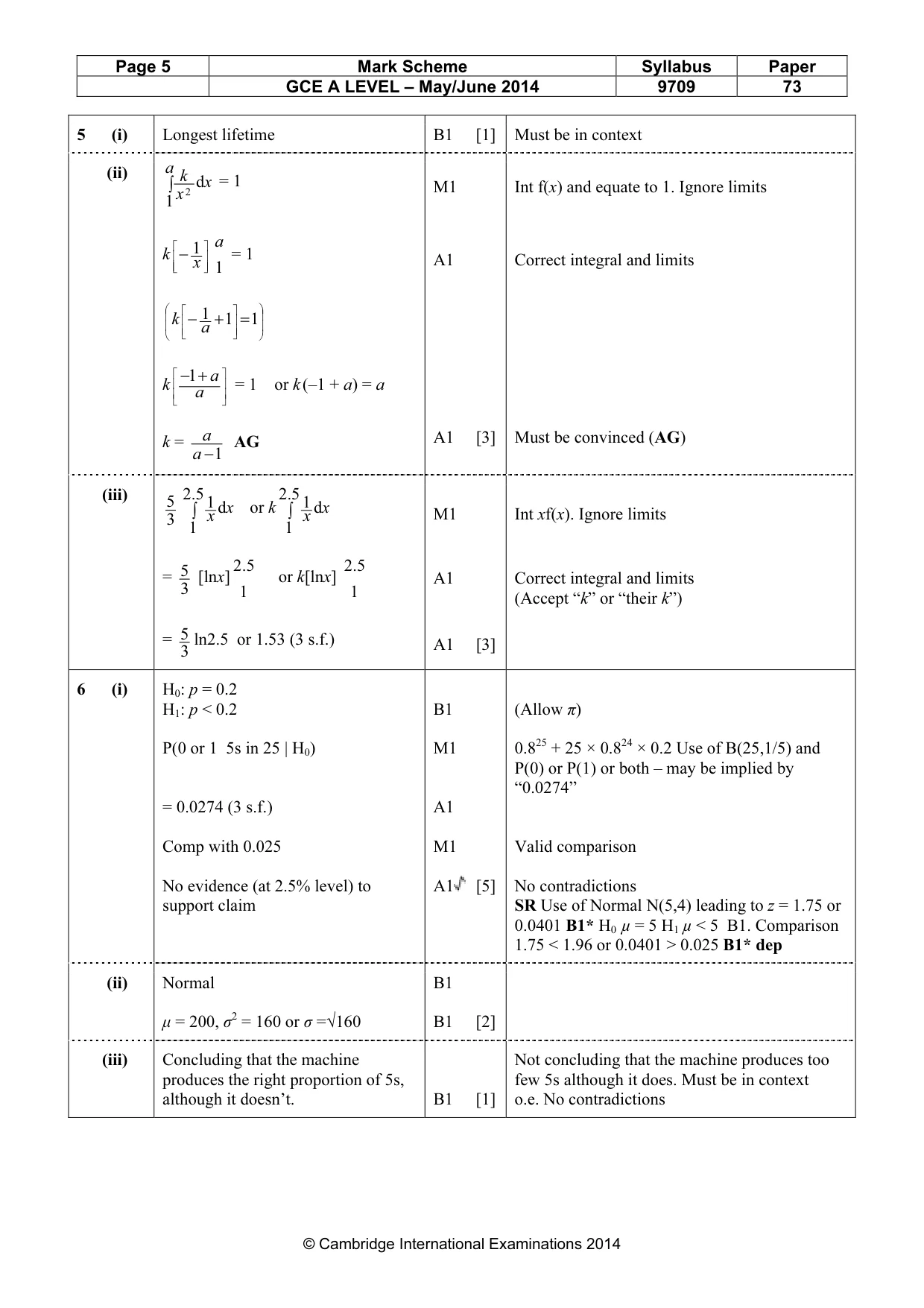
5 The lifetime, X years, of a certain type of battery has probability density function given by t k 1 ≤x ≤a, f x = x2 0 otherwise, where k and a are positive constants. (i) State what the value of a represents in this context. [1] a (ii) Show that k = [3] a −1. (iii) Experience has shown that the longest that any battery of this type lasts is 2.5 years. Find the mean lifetime of batteries of this type. [3]
Mark scheme: 5 (i) Longest lifetime B1 [1] Must be in context (ii) a k dx = 1 ∫ M1 Int f(x) and equate to 1. Ignore limits 2 1 x a k = 1 A1 Correct integral and limits −x1 1 k − + 1 = 1 1a −1 + a k = 1 or k (–1 + a) = a a a AG A1 [3] Must be convinced (AG) k = a − 1 (iii) 5.2 5.2 1 1 5 d x d x or k ∫ ∫ M1 Int xf(x). Ignore limits x x 3 1 1 5 5.2 5.2 = [lnx] or k[lnx] A1 Correct integral and limits 3 1 1 (Accept “k” or “their k”) 5 = ln2.5 or 1.53 (3 s.f.) A1 [3] 3
Q6 · A machine is designed to generate random digits between 1 and 5 inclusive
6 A machine is designed to generate random digits between 1 and 5 inclusive. Each digit is supposed to appear with the same probability as the others, but Max claims that the digit 5 is appearing less often than it should. In order to test this claim the manufacturer uses the machine to generate 25 digits and finds that exactly 1 of these digits is a 5. (i) Carry out a test of Max’s claim at the 2.5% significance level. [5] (ii) Max carried out a similar hypothesis test by generating 1000 digits between 1 and 5 inclusive. The digit 5 appeared 180 times. Without carrying out the test, state the distribution that Max should use, including the values of any parameters. [2] (iii) State what is meant by a Type II error in this context. [1]
Mark scheme: 6 (i) H0: p = 0.2 H1: p < 0.2 B1 (Allow π) P(0 or 1 5s in 25 | H0) M1 0.825 + 25 × 0.824 × 0.2 Use of B(25,1/5) and P(0) or P(1) or both – may be implied by “0.0274” = 0.0274 (3 s.f.) A1 Comp with 0.025 M1 Valid comparison No evidence (at 2.5% level) to A1 [5] No contradictions support claim SR Use of Normal N(5,4) leading to z = 1.75 or 0.0401 B1* H0 µ = 5 H1 µ < 5 B1. Comparison 1.75 < 1.96 or 0.0401 > 0.025 B1* dep (ii) Normal B1 µ = 200, σ2 = 160 or σ =√160 B1 [2] (iii) Concluding that the machine Not concluding that the machine produces too produces the right proportion of 5s, few 5s although it does. Must be in context although it doesn’t. B1 [1] o.e. No contradictions GCE A LEVEL – May/June 2014 9709 73
Q8 · In an examination, the marks in the theory paper and the marks in the practical paper are…
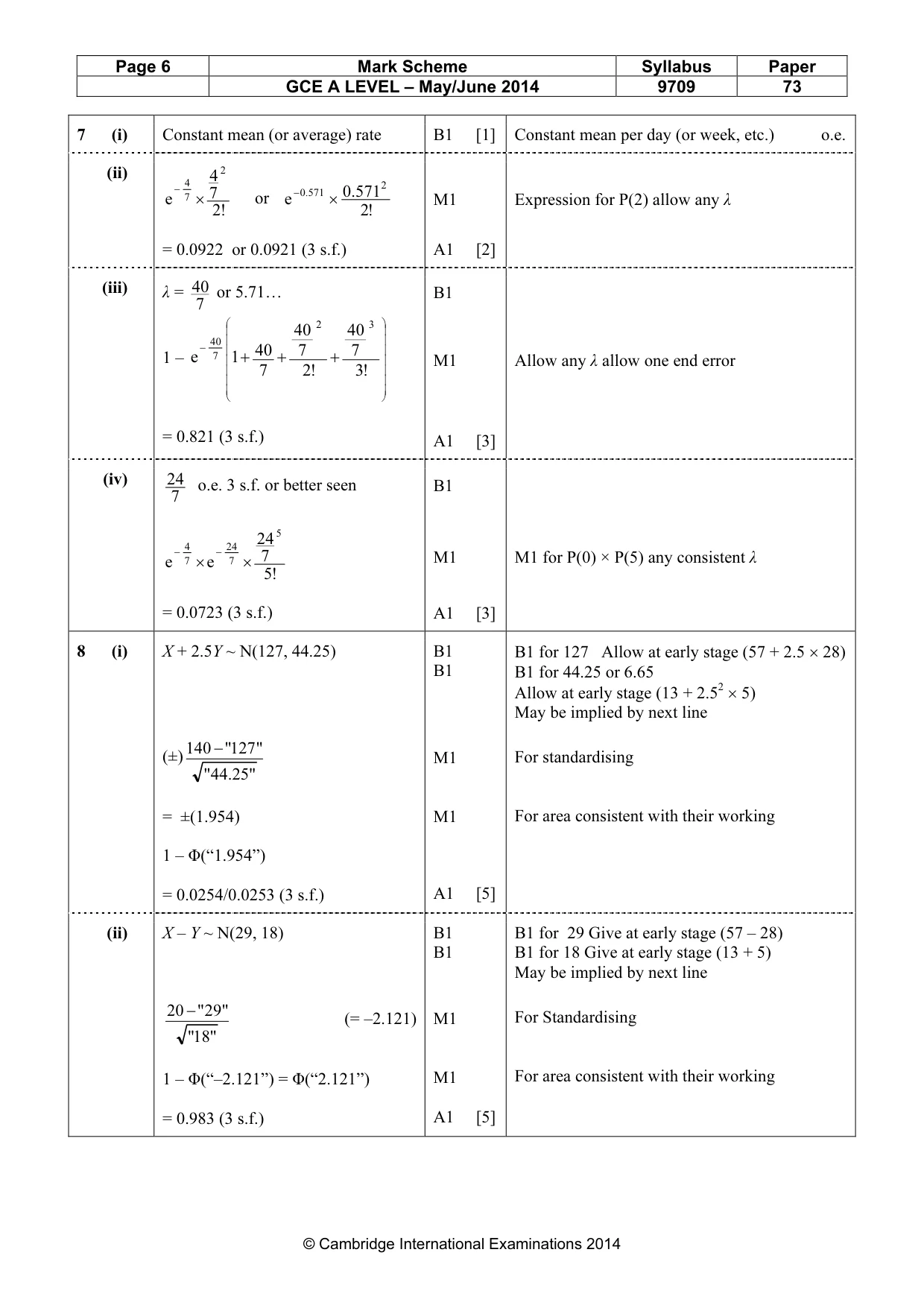
8 In an examination, the marks in the theory paper and the marks in the practical paper are denoted by the random variables X and Y respectively, where X ∼N 57, 13 and Y ∼N 28, 5 . You may assume that each candidate’s marks in the two papers are independent. The final score of each candidate is found by calculating X + 2.5Y. A candidate is chosen at random. Without using a continuity correction, find the probability that this candidate (i) has a final score that is greater than 140, [5] (ii) obtains at least 20 more marks in the theory paper than in the practical paper. [5]
Mark scheme: 8 (i) X + 2.5Y ~ N(127, 44.25) B1 B1 for 127 Allow at early stage (57 + 2.5 × 28) B1 B1 for 44.25 or 6.65 Allow at early stage (13 + 2.52 × 5) May be implied by next line 140 − "127 " (±) M1 For standardising " 44 . 25" = ±(1.954) M1 For area consistent with their working 1 – Φ(“1.954”) = 0.0254/0.0253 (3 s.f.) A1 [5] (ii) X – Y ~ N(29, 18) B1 B1 for 29 Give at early stage (57 – 28) B1 B1 for 18 Give at early stage (13 + 5) May be implied by next line 20 − " 29 " (= –2.121) M1 For Standardising "18" 1 – Φ(“–2.121”) = Φ(“2.121”) M1 For area consistent with their working = 0.983 (3 s.f.) A1 [5]
What was in this paper
The subtopics covered by these 7 questions, and how many questions each got. Open one in a new tab to see every Cambridge question on it.
What you needed in this session
Cambridge’s own grade thresholds for 2014 May/June, Paper 7 · Variant 3. A higher threshold means an easier paper — the bar moves with how the cohort did.