Cambridge A Level Mathematics 9709 — 2013 May/June Paper 7 · Variant 1
9709/71/M/J/13 · 5 questions · 50 marks · ≈56 min
The question paper and its mark scheme, free to read here and free to download. This is Cambridge’s own paper, exactly as it was sat.
Question paper4 pages
Mark scheme6 pages
Answers below. Sit the paper first if you are practising.
Questions as text
Q1 · Marie wants to choose one student at random from Anthea, Bill and Charlie
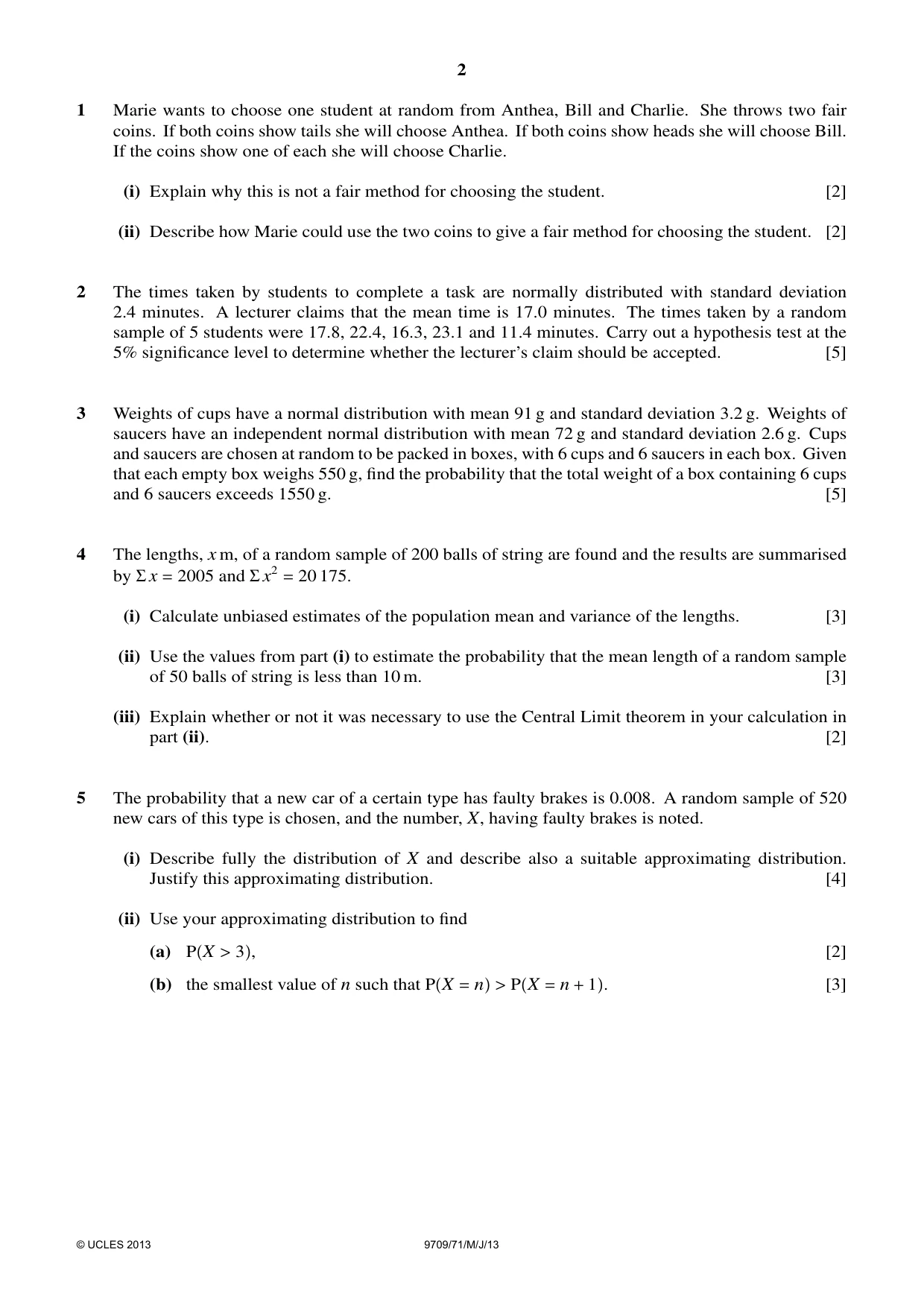
1 Marie wants to choose one student at random from Anthea, Bill and Charlie. She throws two fair coins. If both coins show tails she will choose Anthea. If both coins show heads she will choose Bill. If the coins show one of each she will choose Charlie. (i) Explain why this is not a fair method for choosing the student. [2] (ii) Describe how Marie could use the two coins to give a fair method for choosing the student. [2]
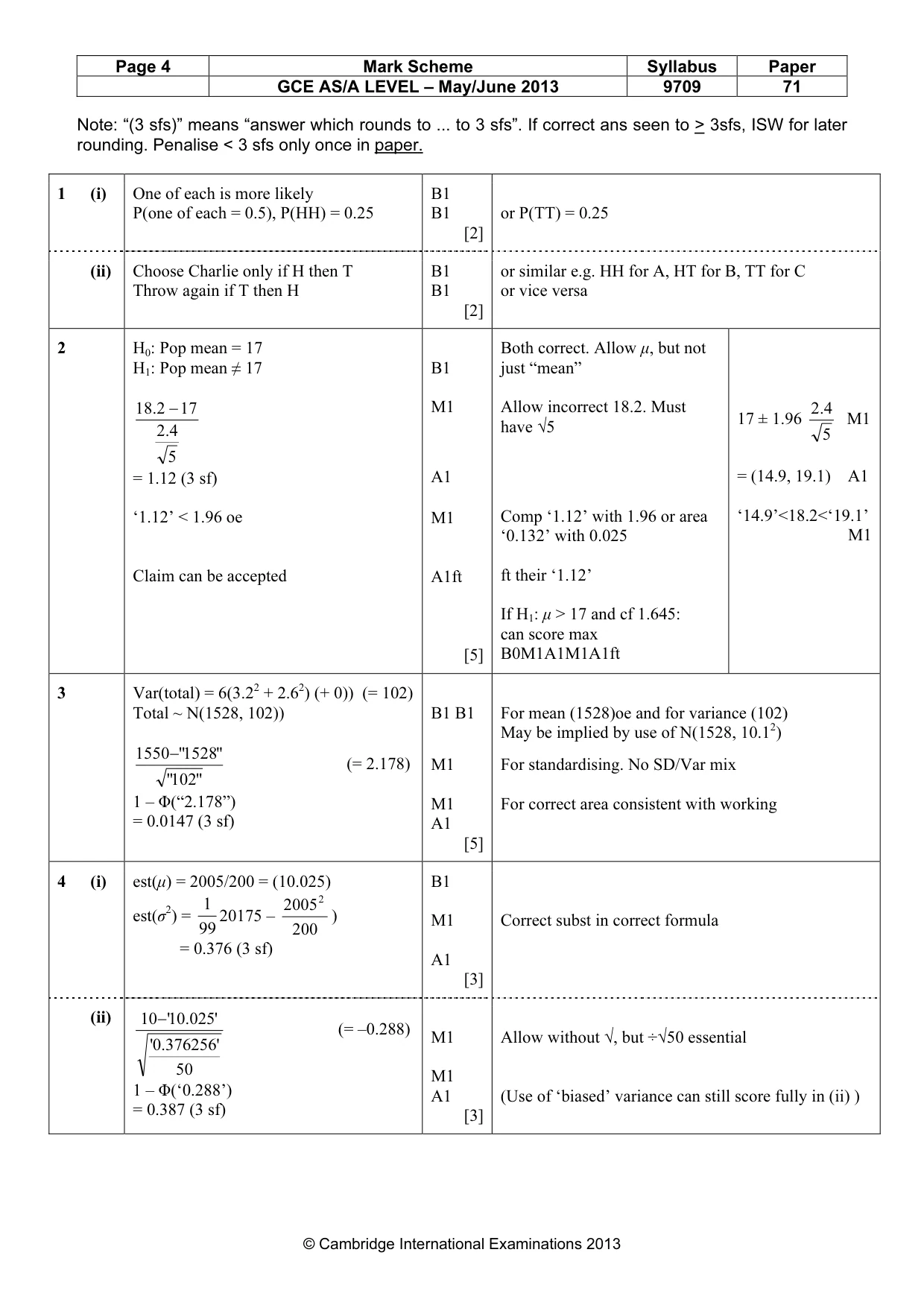
Mark scheme: 1 (i) One of each is more likely B1 P(one of each = 0.5), P(HH) = 0.25 B1 or P(TT) = 0.25 [2] (ii) Choose Charlie only if H then T B1 or similar e.g. HH for A, HT for B, TT for C Throw again if T then H B1 or vice versa [2]
Q2 · The times taken by students to complete a task are normally distributed with standard…
2 The times taken by students to complete a task are normally distributed with standard deviation 2.4 minutes. A lecturer claims that the mean time is 17.0 minutes. The times taken by a random sample of 5 students were 17.8, 22.4, 16.3, 23.1 and 11.4 minutes. Carry out a hypothesis test at the 5% significance level to determine whether the lecturer’s claim should be accepted. [5]
Mark scheme: 2 H0: Pop mean = 17 Both correct. Allow µ, but not H1: Pop mean ≠ 17 B1 just “mean” 18 2. − 17 M1 Allow incorrect 18.2. Must 4.2 17 ± 1.96 M1 4.2 have √5 5 5 = 1.12 (3 sf) A1 = (14.9, 19.1) A1 ‘1.12’ < 1.96 oe M1 Comp ‘1.12’ with 1.96 or area ‘14.9’<18.2<‘19.1’ ‘0.132’ with 0.025 M1 Claim can be accepted A1ft ft their ‘1.12’ If H1: µ > 17 and cf 1.645: can score max [5] B0M1A1M1A1ft 2 2
Q3 · Weights of cups have a normal distribution with mean 91 g and standard deviation 3.2 g
3 Weights of cups have a normal distribution with mean 91 g and standard deviation 3.2 g. Weights of saucers have an independent normal distribution with mean 72 g and standard deviation 2.6 g. Cups and saucers are chosen at random to be packed in boxes, with 6 cups and 6 saucers in each box. Given that each empty box weighs 550 g, find the probability that the total weight of a box containing 6 cups and 6 saucers exceeds 1550 g. [5]
Mark scheme: 3 Var(total) = 6(3.22 + 2.62) (+ 0)) (= 102) Total ~ N(1528, 102)) B1 B1 For mean (1528)oe and for variance (102) May be implied by use of N(1528, 10.12) 1550−"1528" (= 2.178) M1 For standardising. No SD/Var mix "102" 1 – Φ(“2.178”) M1 For correct area consistent with working = 0.0147 (3 sf) A1 [5]
Q4 · The lengths, x m, of a random sample of 200 balls of string are found and the results are…
4 The lengths, x m, of a random sample of 200 balls of string are found and the results are summarised by Σ x = 2005 and Σ x2 = 20 175. (i) Calculate unbiased estimates of the population mean and variance of the lengths. [3] (ii) Use the values from part (i) to estimate the probability that the mean length of a random sample of 50 balls of string is less than 10 m. [3] (iii) Explain whether or not it was necessary to use the Central Limit theorem in your calculation in part (ii). [2]
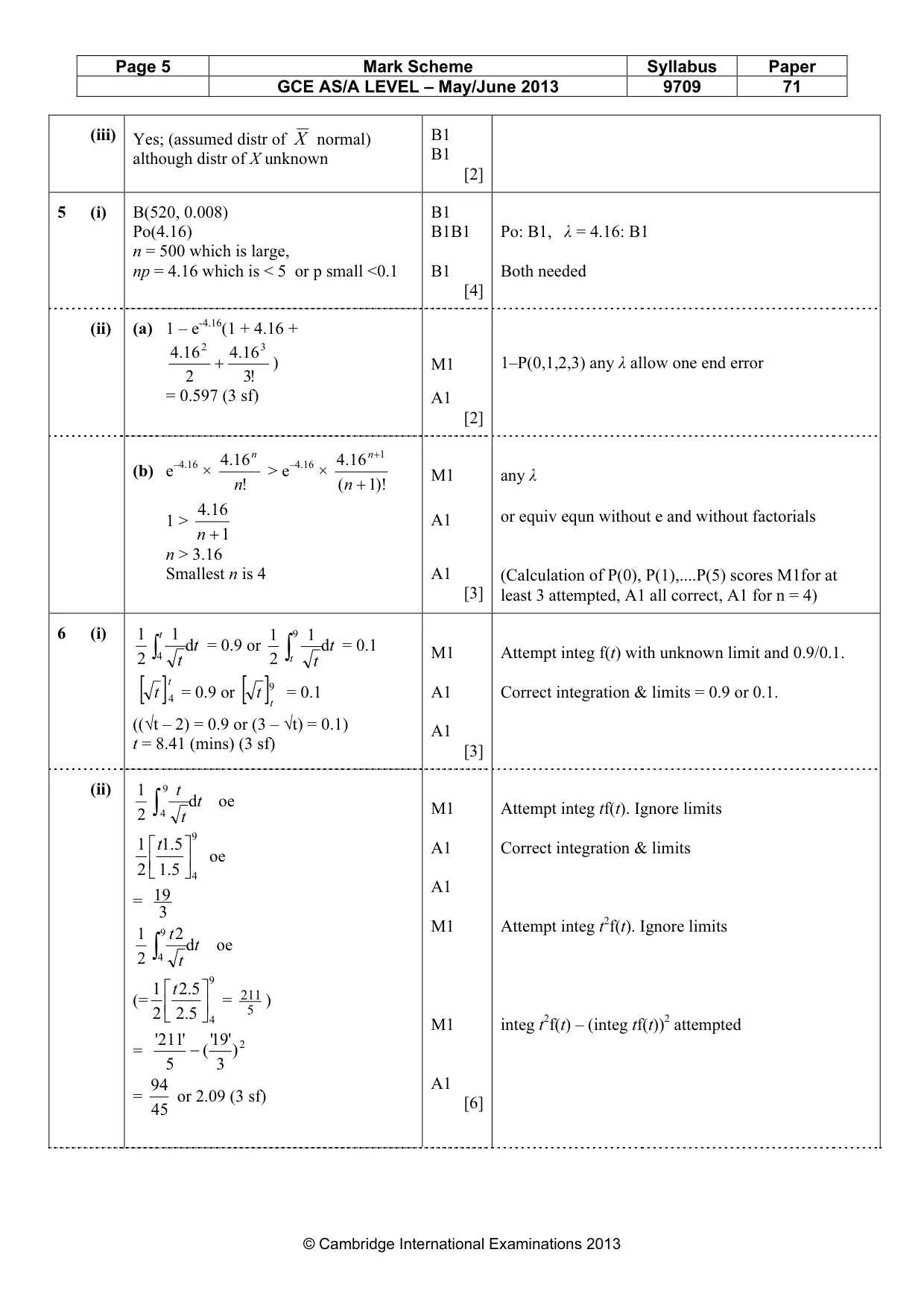
Mark scheme: 4 (i) est(µ) = 2005/200 = (10.025) B1 1 20052 est(σ2) = 20175 – ) M1 Correct subst in correct formula 99 200 = 0.376 (3 sf) A1 [3] (ii) 10− '10. 025' (= –0.288) M1 Allow without √, but ÷√50 essential .0' 376256' 50 M1 1 – Φ(‘0.288’) A1 (Use of ‘biased’ variance can still score fully in (ii) ) = 0.387 (3 sf) [3] GCE AS/A LEVEL – May/June 2013 9709 71 (iii) Yes; (assumed distr of X normal) B1 although distr of X unknown B1 [2]
Q7 · Leila suspects that a particular six-sided die is biased so that the probability, p, that…
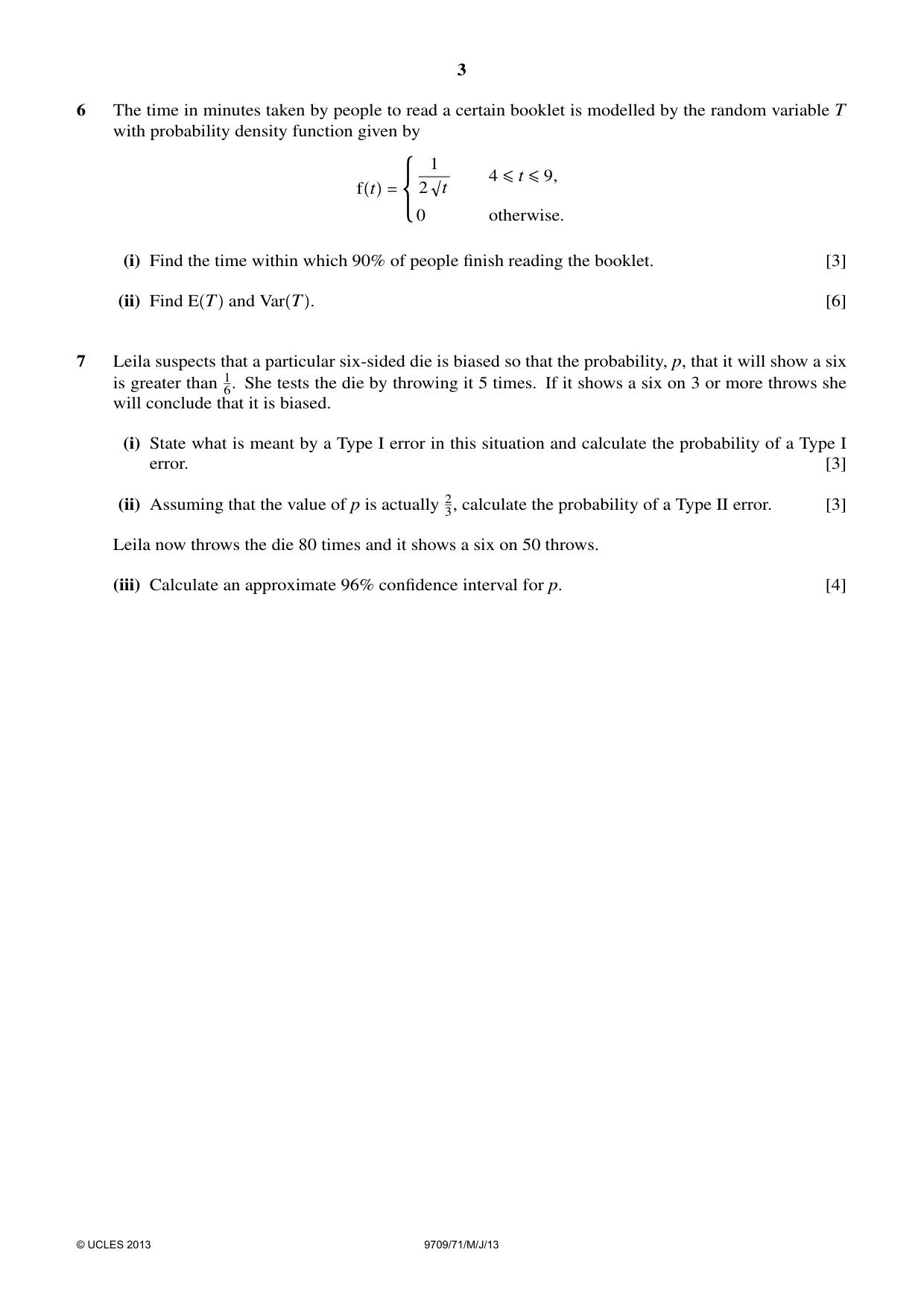
7 Leila suspects that a particular six-sided die is biased so that the probability, p, that it will show a six is greater than 6.1 She tests the die by throwing it 5 times. If it shows a six on 3 or more throws she will conclude that it is biased. (i) State what is meant by a Type I error in this situation and calculate the probability of a Type I error. [3] (ii) Assuming that the value of p is actually 23, calculate the probability of a Type II error. [3] Leila now throws the die 80 times and it shows a six on 50 throws. (iii) Calculate an approximate 96% confidence interval for p. [4]
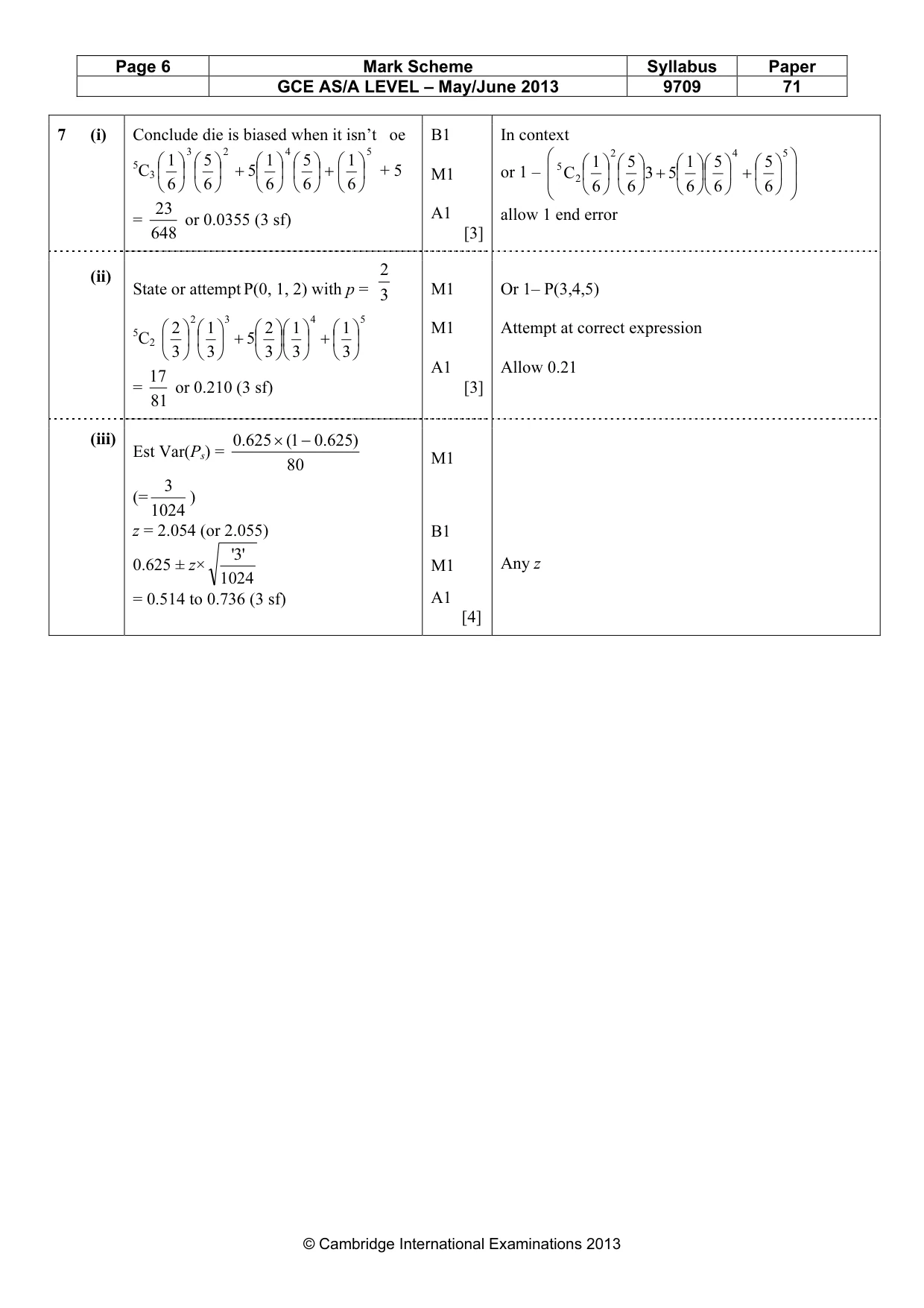
Mark scheme: 7 (i) Conclude die is biased when it isn’t oe B1 In context 3 2 4 5 2 4 5 1 5 1 5 1 1 5 5 + 5 5C3 + + 3 + 5 1 5 + 5 M1 or 1 – 5 C 2 6 6 6 6 6 6 6 6 6 6 23 A1 allow 1 end error = or 0.0355 (3 sf) 648 [3] 2 (ii) State or attempt P(0, 1, 2) with p = M1 Or 1– P(3,4,5) 3 2 3 4 5 2 1 2 1 1 M1 Attempt at correct expression 5C2 + 5 + 3 3 3 3 3 A1 Allow 0.21 17 = or 0.210 (3 sf) [3] 81 (iii) .0625 × 1( − .0625) Est Var(Ps) = M1 80 3 (=1024 ) z = 2.054 (or 2.055) B1 '3' 0.625 ± z× M1 Any z 1024 = 0.514 to 0.736 (3 sf) A1 [4]
What was in this paper
The subtopics covered by these 5 questions, and how many questions each got. Open one in a new tab to see every Cambridge question on it.
What you needed in this session
Cambridge’s own grade thresholds for 2013 May/June, Paper 7 · Variant 1. A higher threshold means an easier paper — the bar moves with how the cohort did.