Cambridge A Level Mathematics 9709 — 2013 May/June Paper 3 · Variant 1
9709/31/M/J/13 · 5 questions · 75 marks · ≈84 min
The question paper and its mark scheme, free to read here and free to download. This is Cambridge’s own paper, exactly as it was sat.
Question paper4 pages
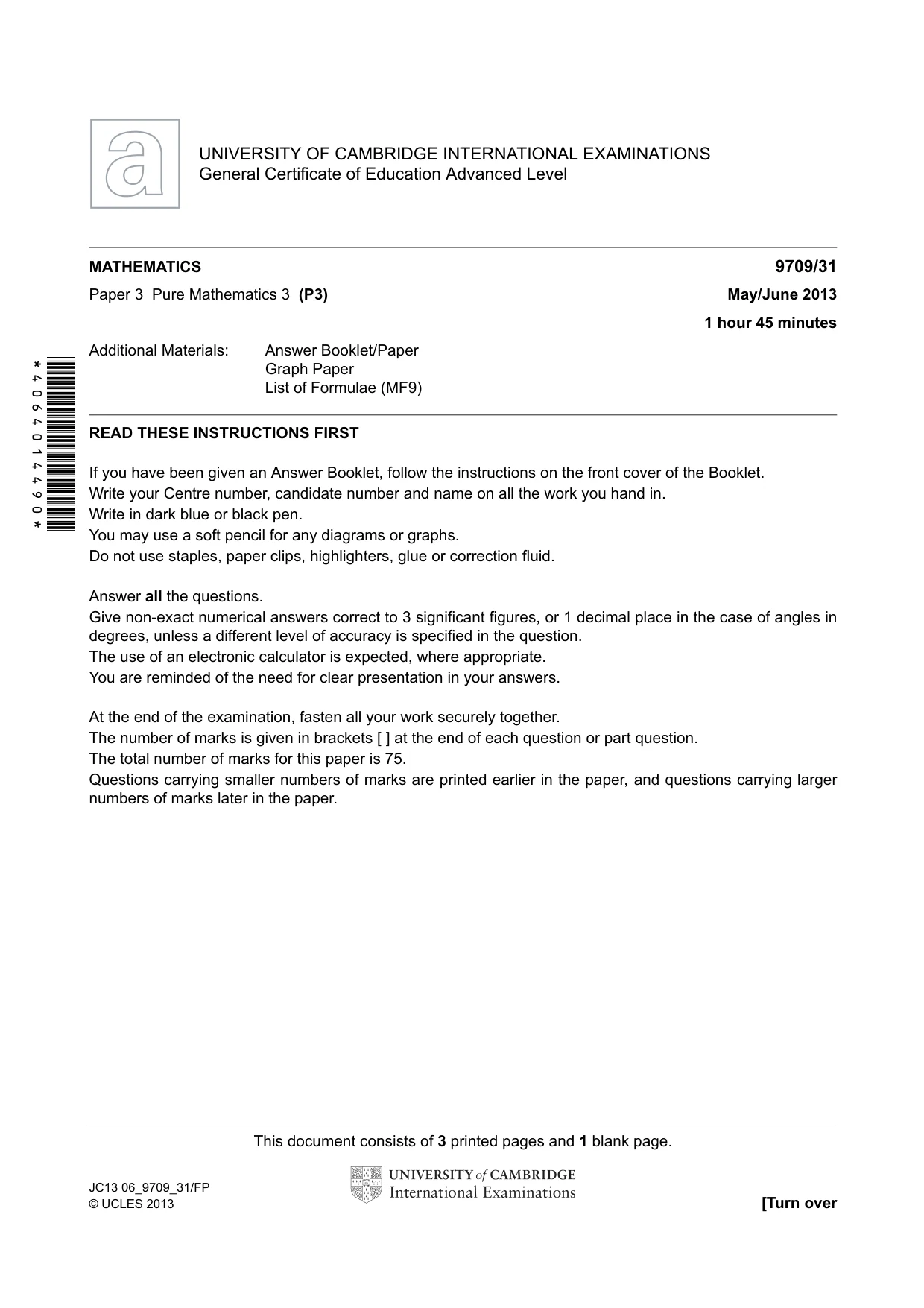
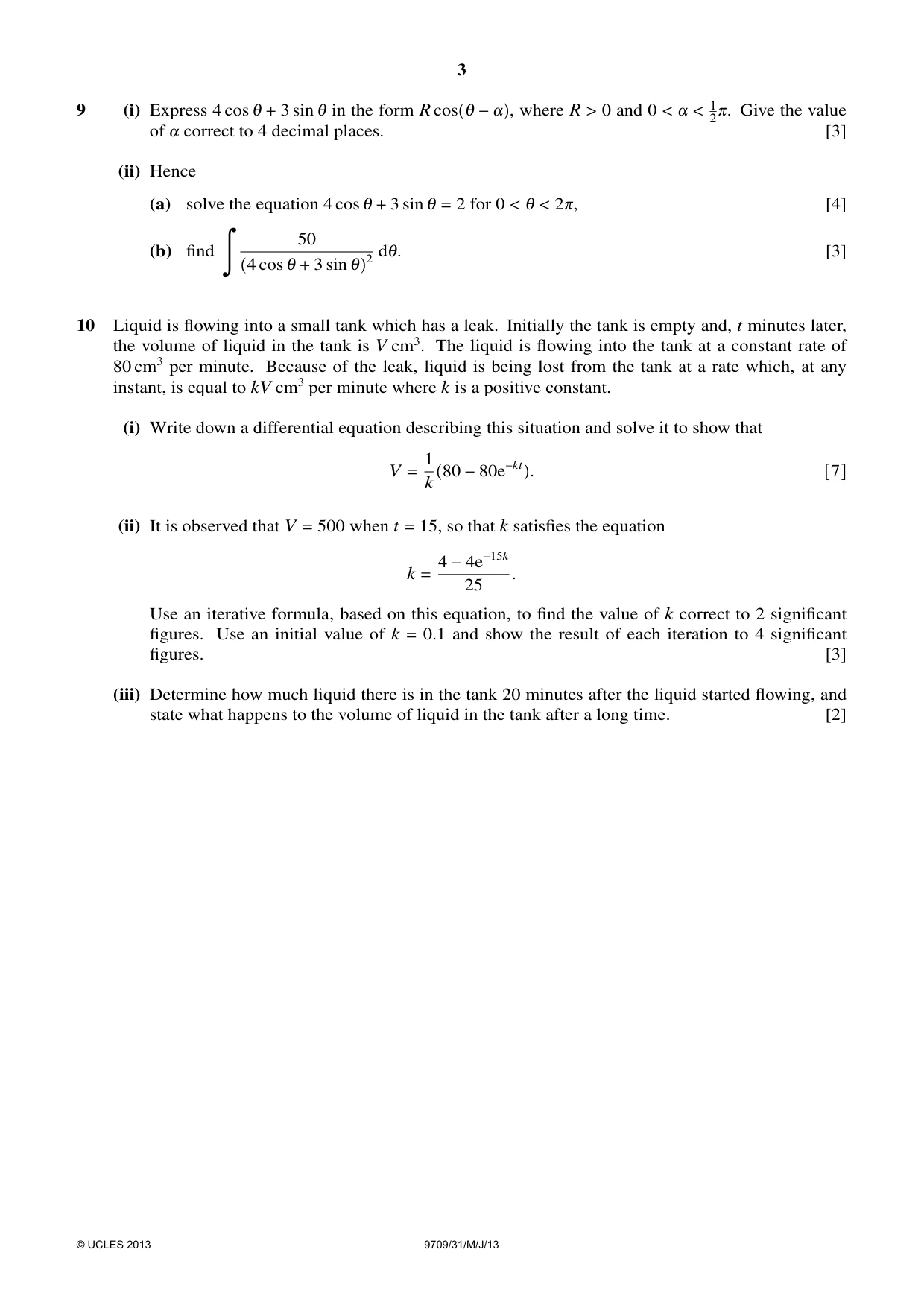
Mark scheme6 pages
Answers below. Sit the paper first if you are practising.
Questions as text
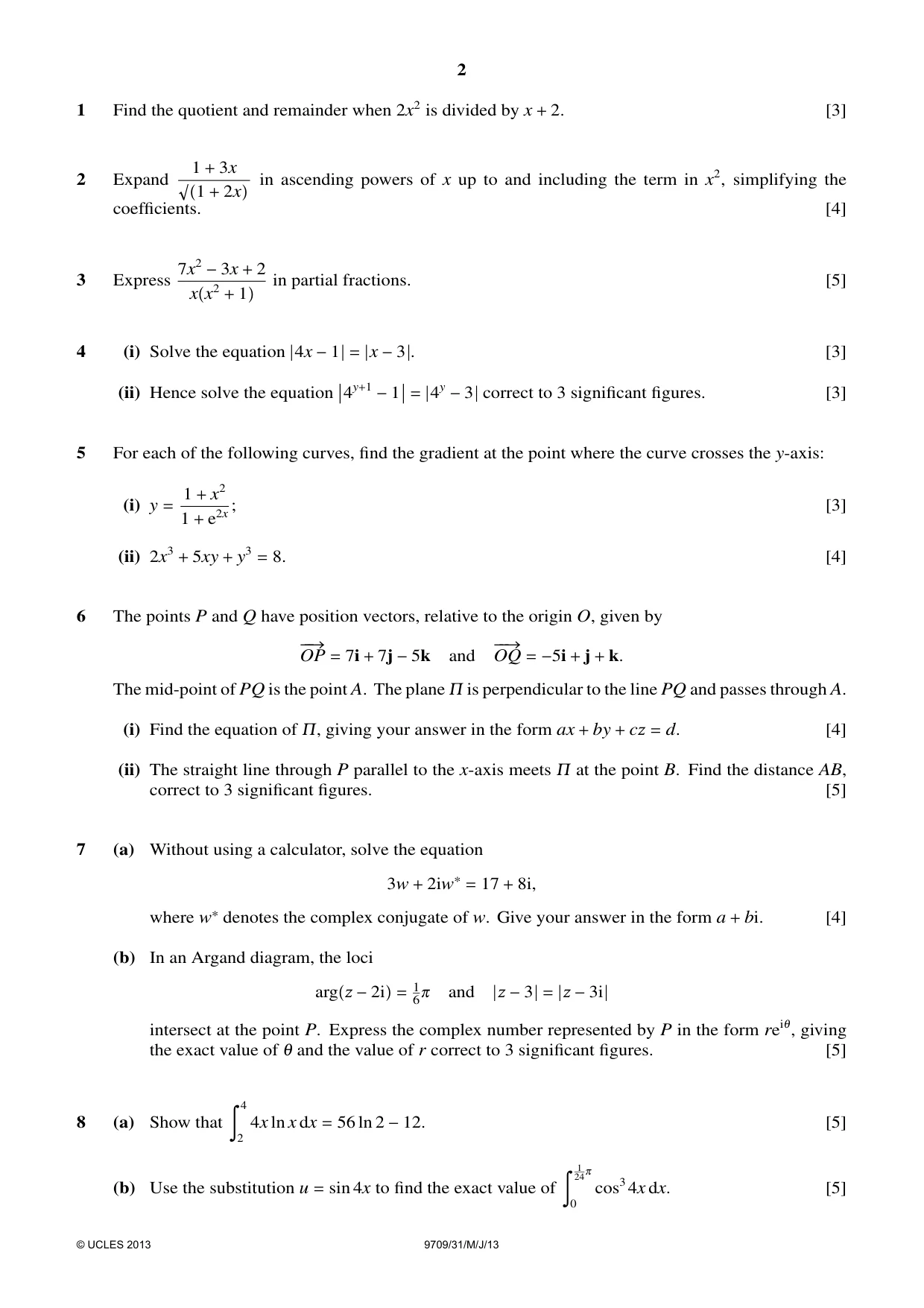
Q1 · Find the quotient and remainder when 2x2 is divided by x 2
1 Find the quotient and remainder when 2x2 is divided by x 2. [3] +
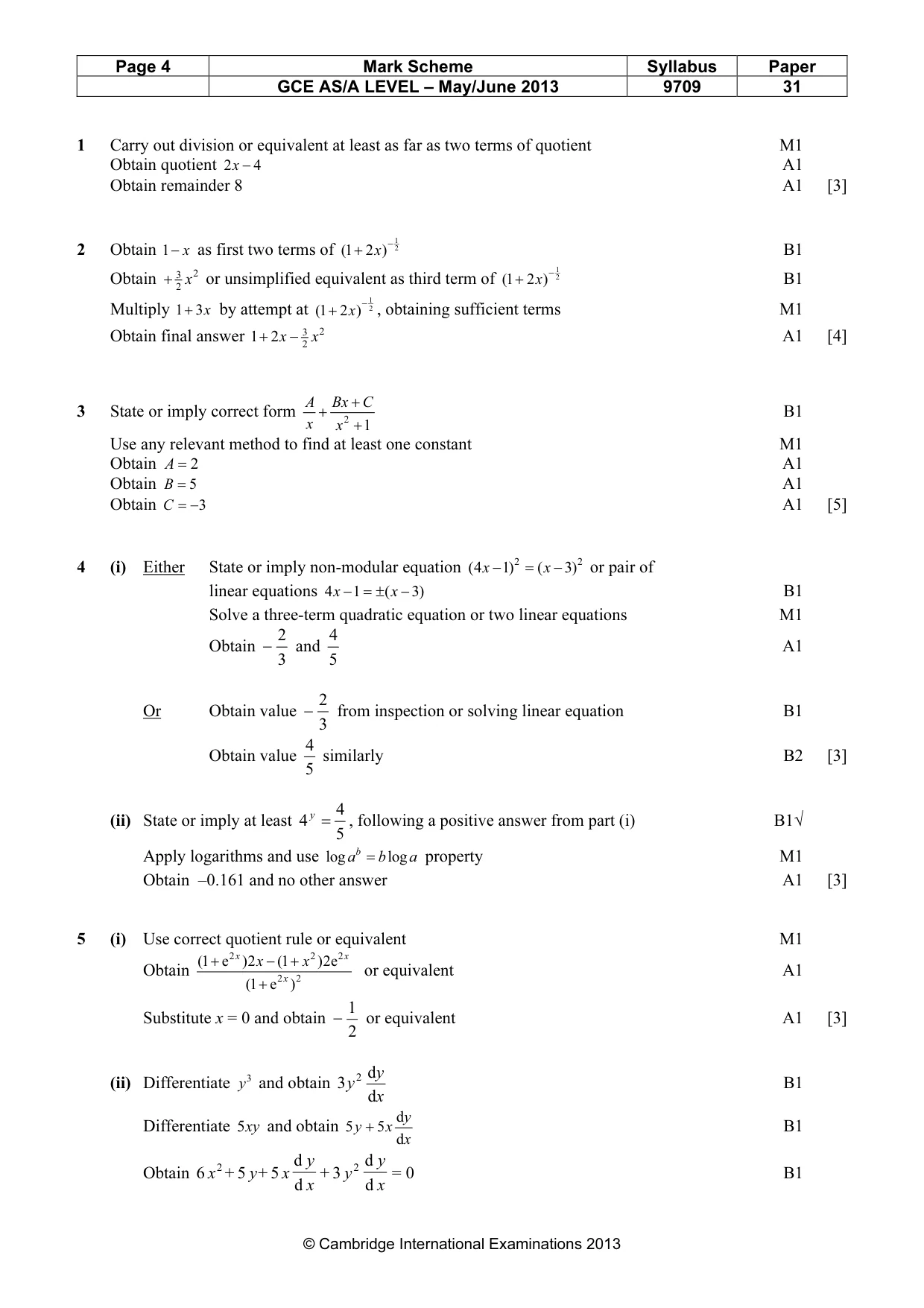
Mark scheme: 1 Carry out division or equivalent at least as far as two terms of quotient M1 Obtain quotient 2 x − 4 A1 Obtain remainder 8 A1 [3] 1
Q4 · Solve the equation 4x x
4 (i) Solve the equation 4x x . [3] −1 = −3 4y correct to 3 significant figures. [3] −3 (ii) Hence solve the equation 4y+1 −1 =
Mark scheme: 4 (i) Either State or imply non-modular equation (4 x − 1) 2 = ( x − 3) 2 or pair of linear equations 4 x −=1 ± ( x − 3) B1 Solve a three-term quadratic equation or two linear equations M1 2 4 Obtain − and A1 3 5 2 Or Obtain value − from inspection or solving linear equation B1 3 4 Obtain value similarly B2 [3] 5 y 4 (ii) State or imply at least 4 = , following a positive answer from part (i) B1√ 5 Apply logarithms and use log a b = b log a property M1 Obtain –0.161 and no other answer A1 [3]
Q5 · For each of the following curves, find the gradient at the point where the curve crosses…
5 For each of the following curves, find the gradient at the point where the curve crosses the y-axis: 1 x2 (i) y ; [3] + = 1 e2x + (ii) 2x3 5xy y3 8. [4] + + =
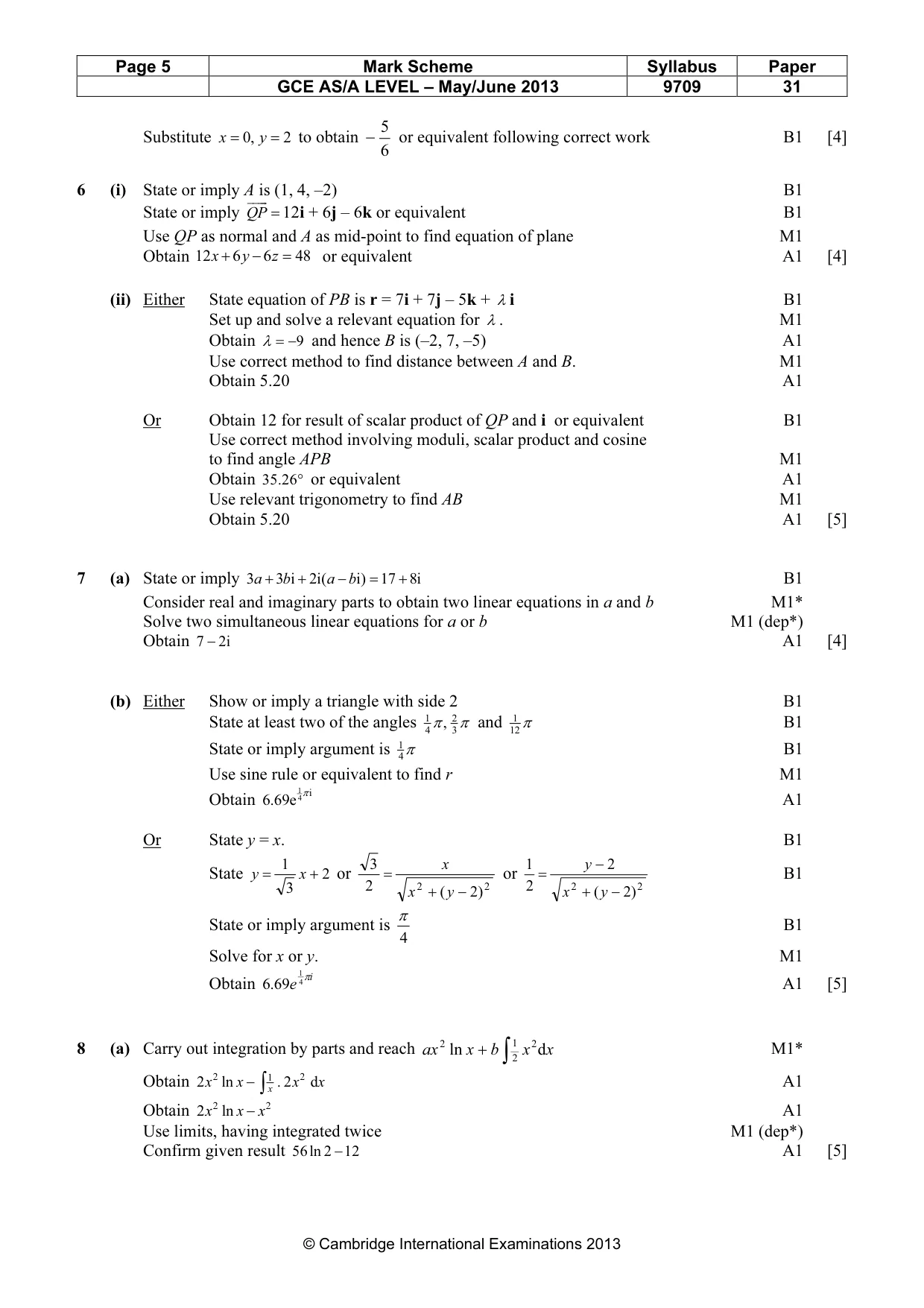
Mark scheme: 5 (i) Use correct quotient rule or equivalent M1 (1 + e 2 x )2 x − (1 + x 2 )2e 2 x Obtain 2 x 2 or equivalent A1 (1 + e ) 1 Substitute x = 0 and obtain − or equivalent A1 [3] 2 d y 3 2 (ii) Differentiate y and obtain 3 y B1 d x d y Differentiate 5xy and obtain 5 y + 5 x B1 d x 2 d y 2 d y Obtain 6 x + 5 y + 5 x + 3 y = 0 B1 d x d x GCE AS/A LEVEL – May/June 2013 9709 31 5 Substitute x = 0, y = 2 to obtain − or equivalent following correct work B1 [4] 6
Q6 · The points P and Q have position vectors, relative to the origin O, given by OP 7i 7j and…
6 The points P and Q have position vectors, relative to the origin O, given by OP 7i 7j and OQ j k. −−→ −−→ = + −5k = −5i + + The mid-point of PQ is the point A. The plane is perpendicular to the line PQ and passes through A. (i) Find the equation of , giving your answer in the form ax by d. [4] + + cÏ = (ii) The straight line through P parallel to the x-axis meets at the point B. Find the distance AB, correct to 3 significant figures. [5]
Mark scheme: 6 (i) State or imply A is (1, 4, –2) B1 uuur State or imply QP = 12i + 6j – 6k or equivalent B1 Use QP as normal and A as mid-point to find equation of plane M1 Obtain 12 x + 6 y − 6 z = 48 or equivalent A1 [4] (ii) Either State equation of PB is r = 7i + 7j – 5k + λ i B1 Set up and solve a relevant equation for λ . M1 Obtain λ = −9 and hence B is (–2, 7, –5) A1 Use correct method to find distance between A and B. M1 Obtain 5.20 A1 Or Obtain 12 for result of scalar product of QP and i or equivalent B1 Use correct method involving moduli, scalar product and cosine to find angle APB M1 Obtain 35.26° or equivalent A1 Use relevant trigonometry to find AB M1 Obtain 5.20 A1 [5]
Q8 · 8 (a) Show that 4x ln x dx 56 ln 2 [5] Ó2 = −12
4 8 (a) Show that 4x ln x dx 56 ln 2 [5] Ó2 = −12. 1 240 (b) Use the substitution u sin 4x to find the exact value of cos34x dx. [5] = Ó 0
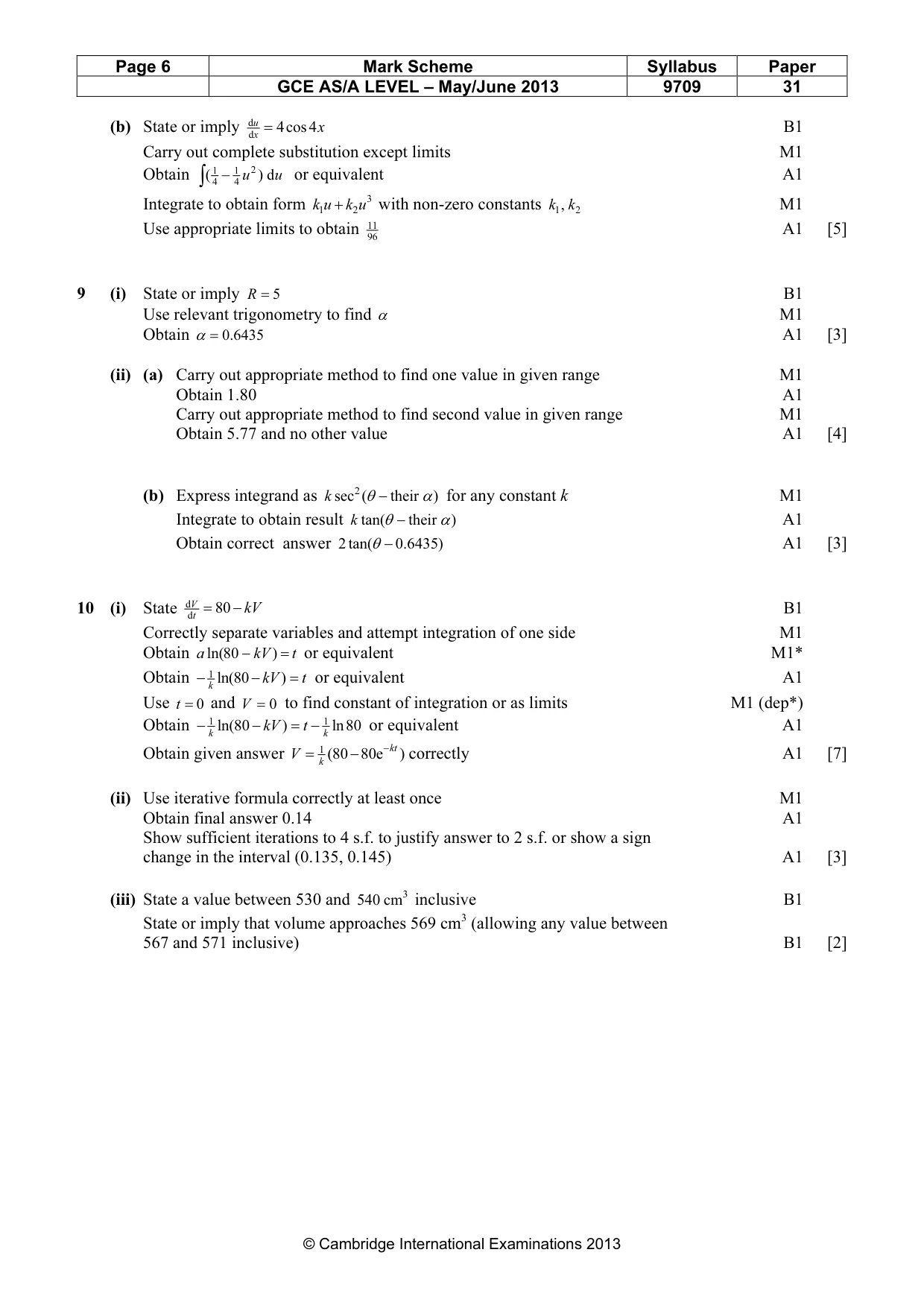
Mark scheme: 8 (a) Carry out integration by parts and reach ax 2 ln x + b ∫ 12 x 2 d x M1* Obtain 2 x 2 ln x −∫ 1x . 2 x 2 d x A1 Obtain 2 x 2 ln x − x 2 A1 Use limits, having integrated twice M1 (dep*) Confirm given result 56ln 2 − 12 A1 [5] GCE AS/A LEVEL – May/June 2013 9709 31 (b) State or imply ddux = 4cos4 x B1 Carry out complete substitution except limits M1 Obtain ∫ ( 14 − 14 u 2 ) d u or equivalent A1 Integrate to obtain form k1u + k 2 u 3 with non-zero constants k1 , k 2 M1 Use appropriate limits to obtain 1196 A1 [5]
What was in this paper
The subtopics covered by these 5 questions, and how many questions each got. Open one in a new tab to see every Cambridge question on it.
What you needed in this session
Cambridge’s own grade thresholds for 2013 May/June, Paper 3 · Variant 1. A higher threshold means an easier paper — the bar moves with how the cohort did.