Cambridge A Level Mathematics 9709 — 2009 Oct/Nov Paper 6 · Variant 2
9709/62/O/N/09 · 7 questions · 50 marks · ≈56 min
The question paper and its mark scheme, free to read here and free to download. This is Cambridge’s own paper, exactly as it was sat.
Question paper4 pages
Mark scheme5 pages
Answers below. Sit the paper first if you are practising.
Questions as text
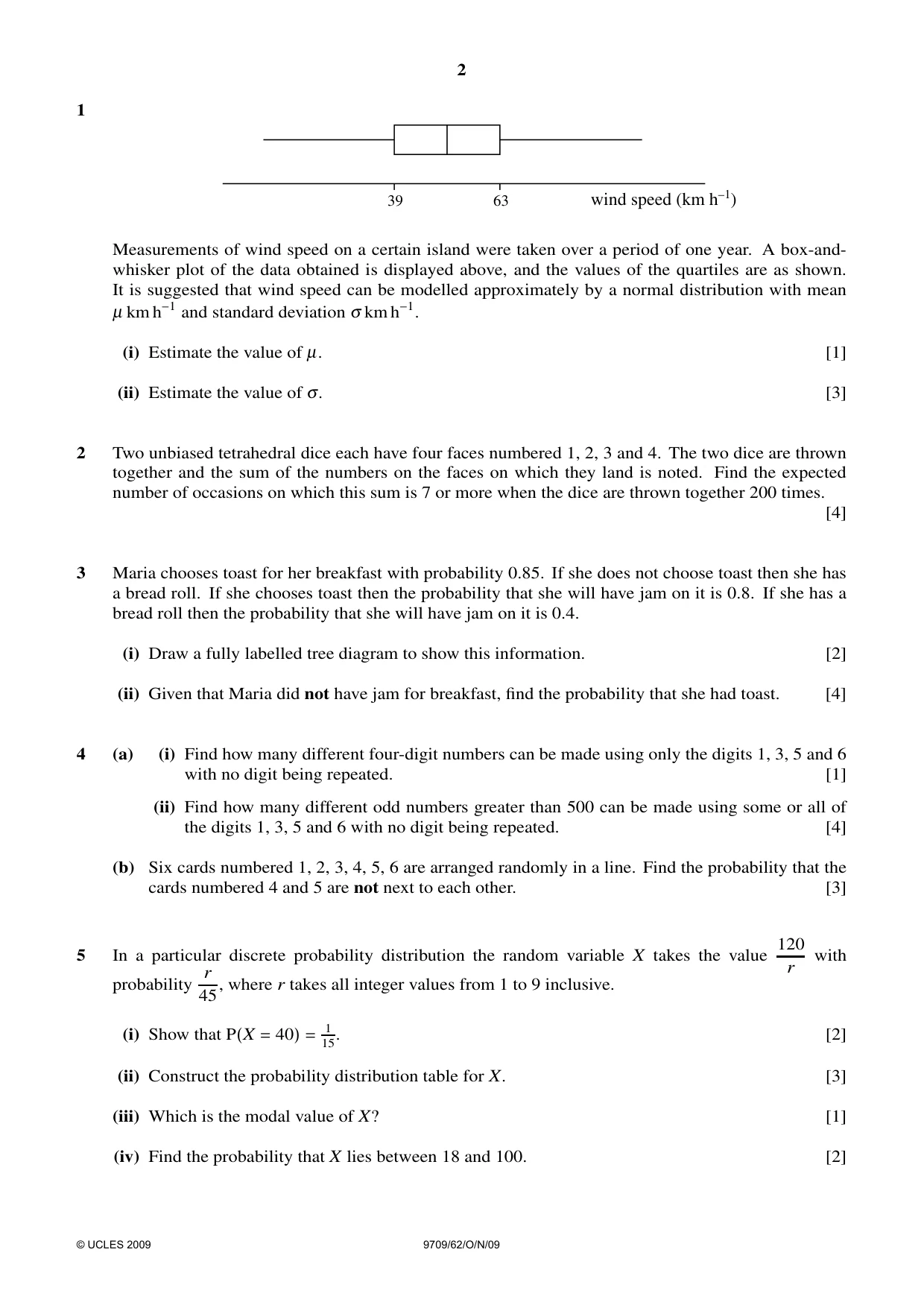
Q1 · 39 63 wind speed (km h–1) Measurements of wind speed on a certain island were taken over…
1 39 63 wind speed (km h–1) Measurements of wind speed on a certain island were taken over a period of one year. A box-and- whisker plot of the data obtained is displayed above, and the values of the quartiles are as shown. It is suggested that wind speed can be modelled approximately by a normal distribution with mean µ km h−1 and standard deviation σ km h−1. (i) Estimate the value of µ. [1] (ii) Estimate the value of σ. [3]
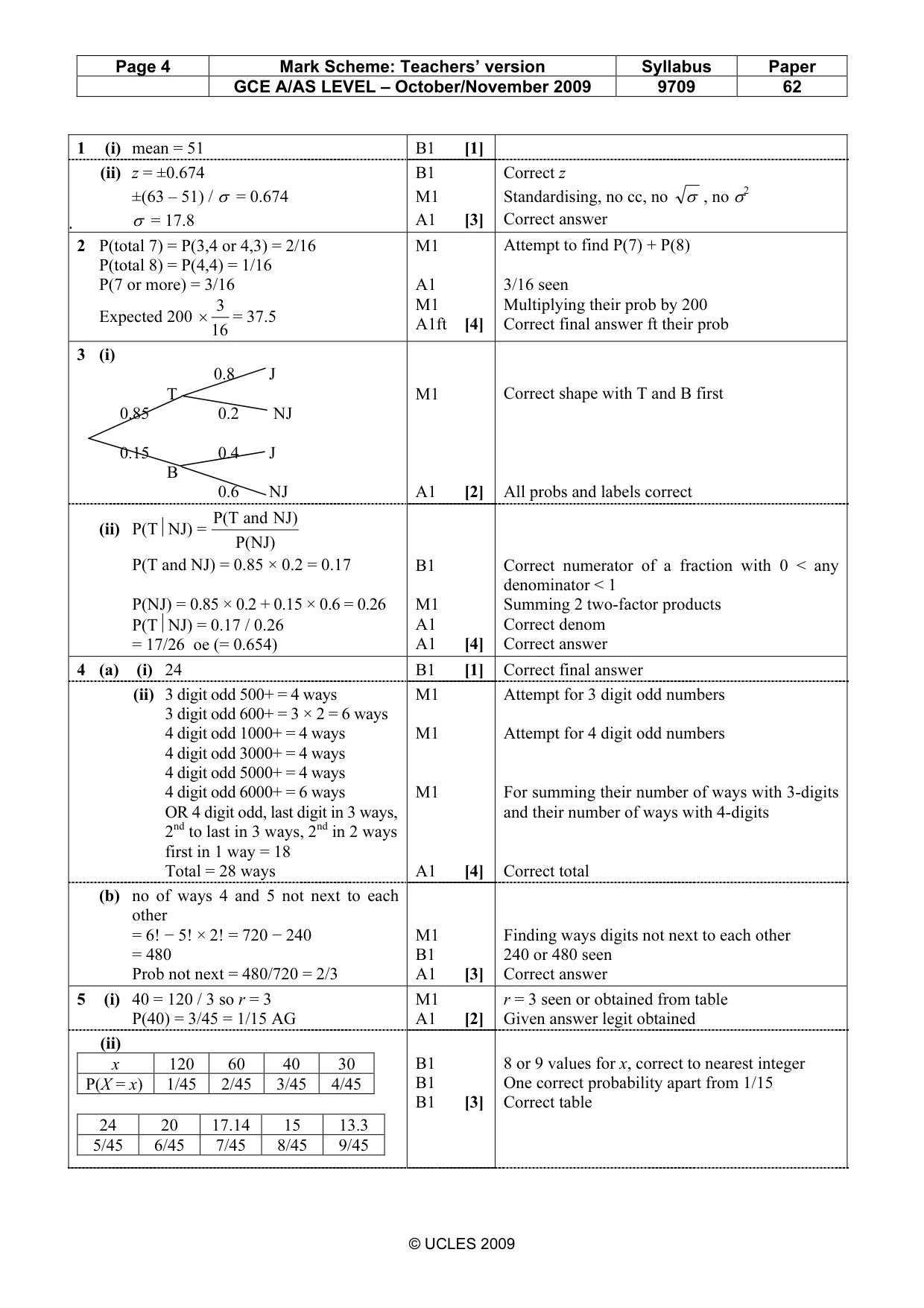
Mark scheme: 1 (i) mean = 51 B1 [1] (ii) z = ±0.674 B1 Correct z ±(63 – 51) / σ = 0.674 M1 Standardising, no cc, no σ , no σ2 σ = 17.8 A1 [3] Correct answer
Q2 · Two unbiased tetrahedral dice each have four faces numbered 1, 2, 3 and 4
2 Two unbiased tetrahedral dice each have four faces numbered 1, 2, 3 and 4. The two dice are thrown together and the sum of the numbers on the faces on which they land is noted. Find the expected number of occasions on which this sum is 7 or more when the dice are thrown together 200 times. [4]
Mark scheme: 2 P(total 7) = P(3,4 or 4,3) = 2/16 M1 Attempt to find P(7) + P(8) P(total 8) = P(4,4) = 1/16 P(7 or more) = 3/16 A1 3/16 seen 3 M1 Multiplying their prob by 200 Expected 200 × = 37.5 A1ft [4] Correct final answer ft their prob 16
Q3 · Maria chooses toast for her breakfast with probability 0.85
3 Maria chooses toast for her breakfast with probability 0.85. If she does not choose toast then she has a bread roll. If she chooses toast then the probability that she will have jam on it is 0.8. If she has a bread roll then the probability that she will have jam on it is 0.4. (i) Draw a fully labelled tree diagram to show this information. [2] (ii) Given that Maria did not have jam for breakfast, find the probability that she had toast. [4]
Mark scheme: 3 (i) 0.8 J T M1 Correct shape with T and B first 0.85 0.2 NJ 0.15 0.4 J B 0.6 NJ A1 [2] All probs and labels correct P(T and NJ) (ii) P(TNJ) = P(NJ) P(T and NJ) = 0.85 × 0.2 = 0.17 B1 Correct numerator of a fraction with 0 < any denominator < 1 P(NJ) = 0.85 × 0.2 + 0.15 × 0.6 = 0.26 M1 Summing 2 two-factor products P(TNJ) = 0.17 / 0.26 A1 Correct denom = 17/26 oe (= 0.654) A1 [4] Correct answer
Q4 · Find how many different four-digit numbers can be made using only the digits 1, 3, 5 and…
4 (a) (i) Find how many different four-digit numbers can be made using only the digits 1, 3, 5 and 6 with no digit being repeated. [1] (ii) Find how many different odd numbers greater than 500 can be made using some or all of the digits 1, 3, 5 and 6 with no digit being repeated. [4] (b) Six cards numbered 1, 2, 3, 4, 5, 6 are arranged randomly in a line. Find the probability that the cards numbered 4 and 5 are not next to each other. [3]
Mark scheme: 4 (a) (i) 24 B1 [1] Correct final answer (ii) 3 digit odd 500+ = 4 ways M1 Attempt for 3 digit odd numbers 3 digit odd 600+ = 3 × 2 = 6 ways 4 digit odd 1000+ = 4 ways M1 Attempt for 4 digit odd numbers 4 digit odd 3000+ = 4 ways 4 digit odd 5000+ = 4 ways 4 digit odd 6000+ = 6 ways M1 For summing their number of ways with 3-digits OR 4 digit odd, last digit in 3 ways, and their number of ways with 4-digits 2nd to last in 3 ways, 2nd in 2 ways first in 1 way = 18 Total = 28 ways A1 [4] Correct total (b) no of ways 4 and 5 not next to each other = 6! − 5! × 2! = 720 − 240 M1 Finding ways digits not next to each other = 480 B1 240 or 480 seen Prob not next = 480/720 = 2/3 A1 [3] Correct answer
Q5 · 0 5 In a particular discrete probability distribution the random variable X takes the…
120 5 In a particular discrete probability distribution the random variable X takes the value with r r probability where r takes all integer values from 1 to 9 inclusive. 45, (i) Show that P(X = 40) = 1 [2] 15. (ii) Construct the probability distribution table for X. [3] (iii) Which is the modal value of X? [1] (iv) Find the probability that X lies between 18 and 100. [2]
Mark scheme: 5 (i) 40 = 120 / 3 so r = 3 M1 r = 3 seen or obtained from table P(40) = 3/45 = 1/15 AG A1 [2] Given answer legit obtained (ii) x 120 60 40 30 B1 8 or 9 values for x, correct to nearest integer P(X = x) 1/45 2/45 3/45 4/45 B1 One correct probability apart from 1/15 B1 [3] Correct table
Q6 · The following table gives the marks, out of 75, in a pure mathematics examination taken…
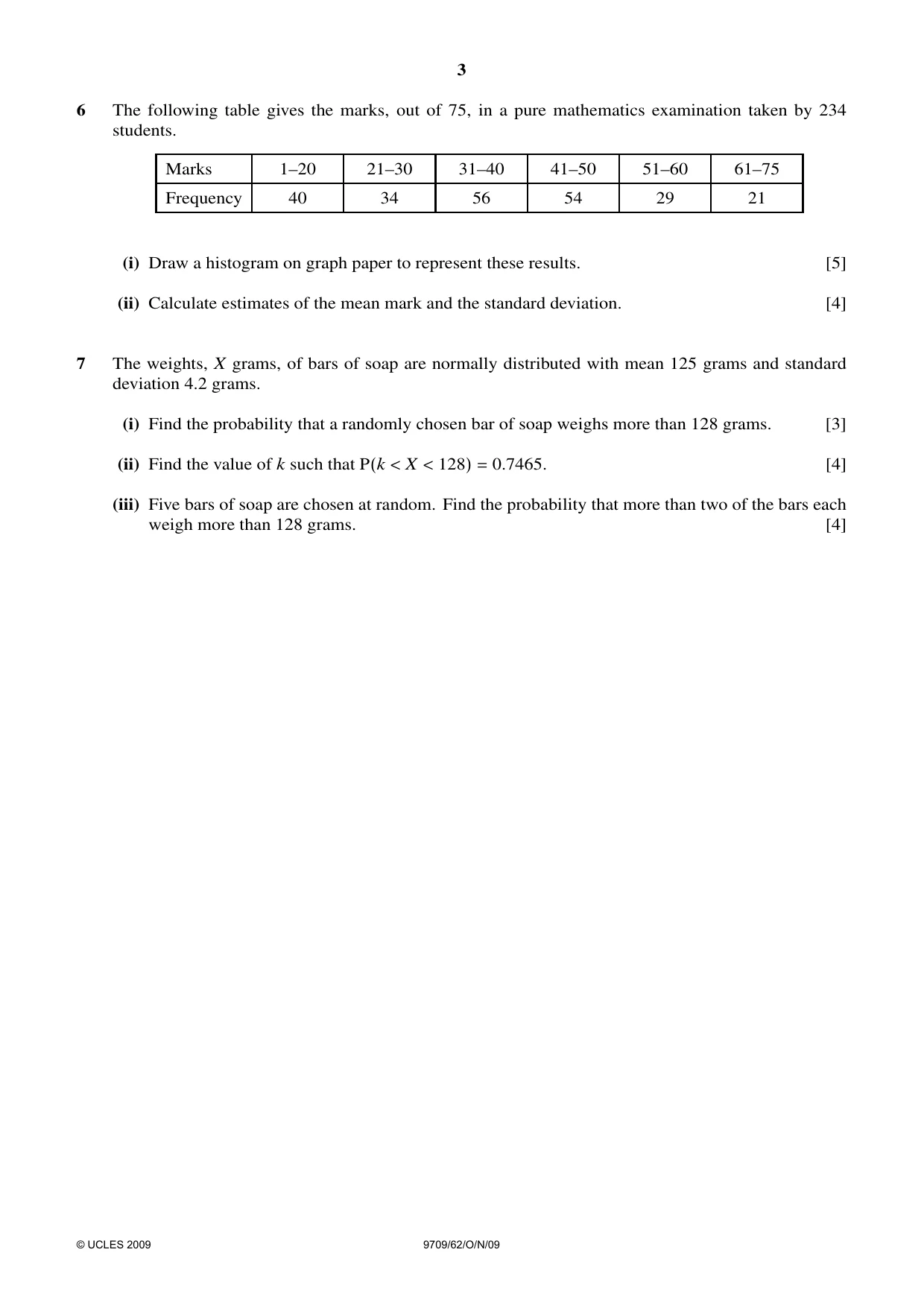
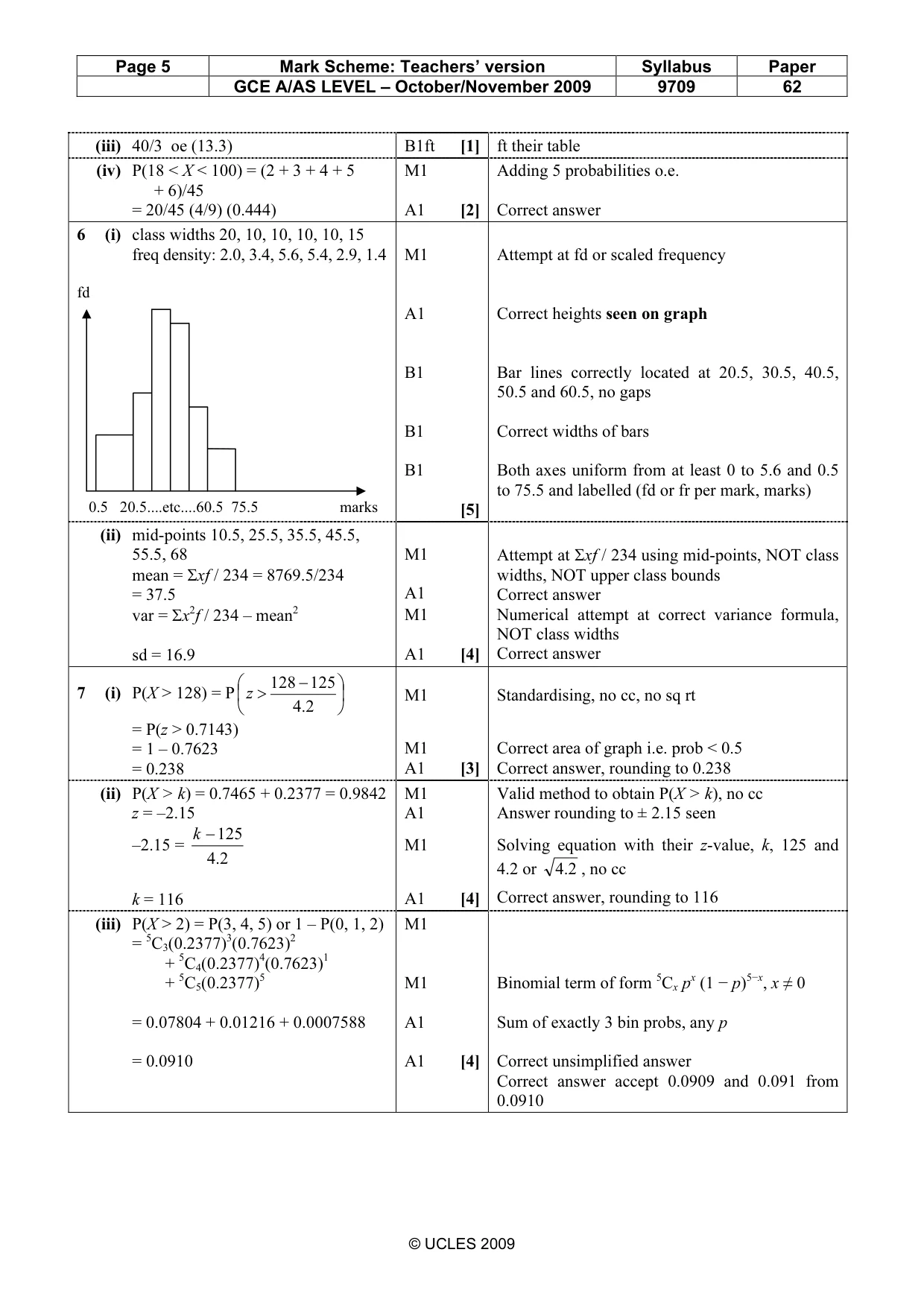
6 The following table gives the marks, out of 75, in a pure mathematics examination taken by 234 students. Marks 1–20 21–30 31–40 41–50 51–60 61–75 Frequency 40 34 56 54 29 21 (i) Draw a histogram on graph paper to represent these results. [5] (ii) Calculate estimates of the mean mark and the standard deviation. [4]
Mark scheme: 6 (i) class widths 20, 10, 10, 10, 10, 15 freq density: 2.0, 3.4, 5.6, 5.4, 2.9, 1.4 M1 Attempt at fd or scaled frequency fd A1 Correct heights seen on graph B1 Bar lines correctly located at 20.5, 30.5, 40.5, 50.5 and 60.5, no gaps B1 Correct widths of bars B1 Both axes uniform from at least 0 to 5.6 and 0.5 to 75.5 and labelled (fd or fr per mark, marks) 0.5 20.5....etc....60.5 75.5 marks [5] (ii) mid-points 10.5, 25.5, 35.5, 45.5, 55.5, 68 M1 Attempt at Σxf / 234 using mid-points, NOT class mean = Σxf / 234 = 8769.5/234 widths, NOT upper class bounds = 37.5 A1 Correct answer var = Σx2f / 234 – mean2 M1 Numerical attempt at correct variance formula, NOT class widths sd = 16.9 A1 [4] Correct answer 128 −125
Q7 · The weights, X grams, of bars of soap are normally distributed with mean 125 grams and…
7 The weights, X grams, of bars of soap are normally distributed with mean 125 grams and standard deviation 4.2 grams. (i) Find the probability that a randomly chosen bar of soap weighs more than 128 grams. [3] (ii) Find the value of k such that P(k < X < 128) = 0.7465. [4] (iii) Five bars of soap are chosen at random. Find the probability that more than two of the bars each weigh more than 128 grams. [4]
Mark scheme: 128 125 7 (i) P(X > 128) = P z > M1 Standardising, no cc, no sq rt 2.4 = P(z > 0.7143) = 1 – 0.7623 M1 Correct area of graph i.e. prob < 0.5 = 0.238 A1 [3] Correct answer, rounding to 0.238 (ii) P(X > k) = 0.7465 + 0.2377 = 0.9842 M1 Valid method to obtain P(X > k), no cc z = –2.15 A1 Answer rounding to ± 2.15 seen k − 125 –2.15 = M1 Solving equation with their z-value, k, 125 and 2.4 4.2 or 2.4 , no cc k = 116 A1 [4] Correct answer, rounding to 116 (iii) P(X > 2) = P(3, 4, 5) or 1 – P(0, 1, 2) M1 = 5C3(0.2377)3(0.7623)2 + 5C4(0.2377)4(0.7623)1 + 5C5(0.2377)5 M1 Binomial term of form 5Cx px (1 − p)5−x, x ≠ 0 = 0.07804 + 0.01216 + 0.0007588 A1 Sum of exactly 3 bin probs, any p = 0.0910 A1 [4] Correct unsimplified answer Correct answer accept 0.0909 and 0.091 from 0.0910
What was in this paper
The subtopics covered by these 7 questions, and how many questions each got. Open one in a new tab to see every Cambridge question on it.
What you needed in this session
Cambridge’s own grade thresholds for 2009 Oct/Nov, Paper 6 · Variant 2. A higher threshold means an easier paper — the bar moves with how the cohort did.