Cambridge A Level Marine Science 9693 — 2023 May/June Paper 1 · Variant 3
9693/13/M/J/23 · 75 marks · ≈84 min
The question paper and its mark scheme, free to read here and free to download. This is Cambridge’s own paper, exactly as it was sat.
Question paper16 pages



Mark scheme13 pages
Answers below. Sit the paper first if you are practising.
Paper as text
Question paper, page 1
This document has 16 pages. Any blank pages are indicated. [Turn over Cambridge International AS & A Level MARINE SCIENCE 9693/13 Paper 1 AS Level Theory May/June 2023 1 hour 45 minutes You must answer on the question paper. No additional materials are needed. INSTRUCTIONS ● Answer all questions. ● Use a black or dark blue pen. You may use an HB pencil for any diagrams or graphs. ● Write your name, centre number and candidate number in the boxes at the top of the page. ● Write your answer to each question in the space provided. ● Do not use an erasable pen or correction fluid. ● Do not write on any bar codes. ● You may use a calculator. ● You should show all your working and use appropriate units. INFORMATION ● The total mark for this paper is 75. ● The number of marks for each question or part question is shown in brackets [ ]. * 9 6 3 0 3 3 1 9 7 2 * DC (LK) 326753 © UCLES 2023
Question paper, page 2
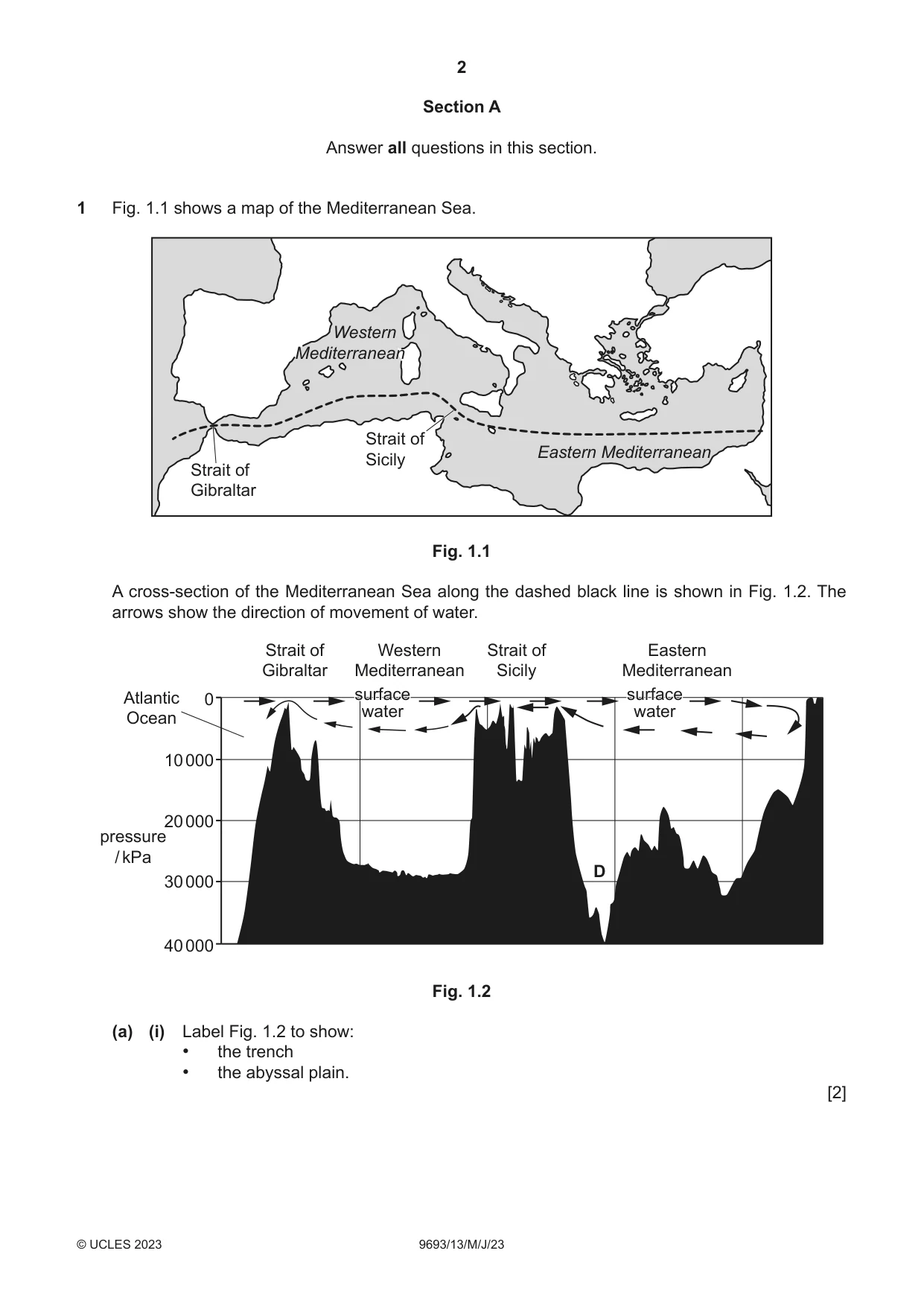
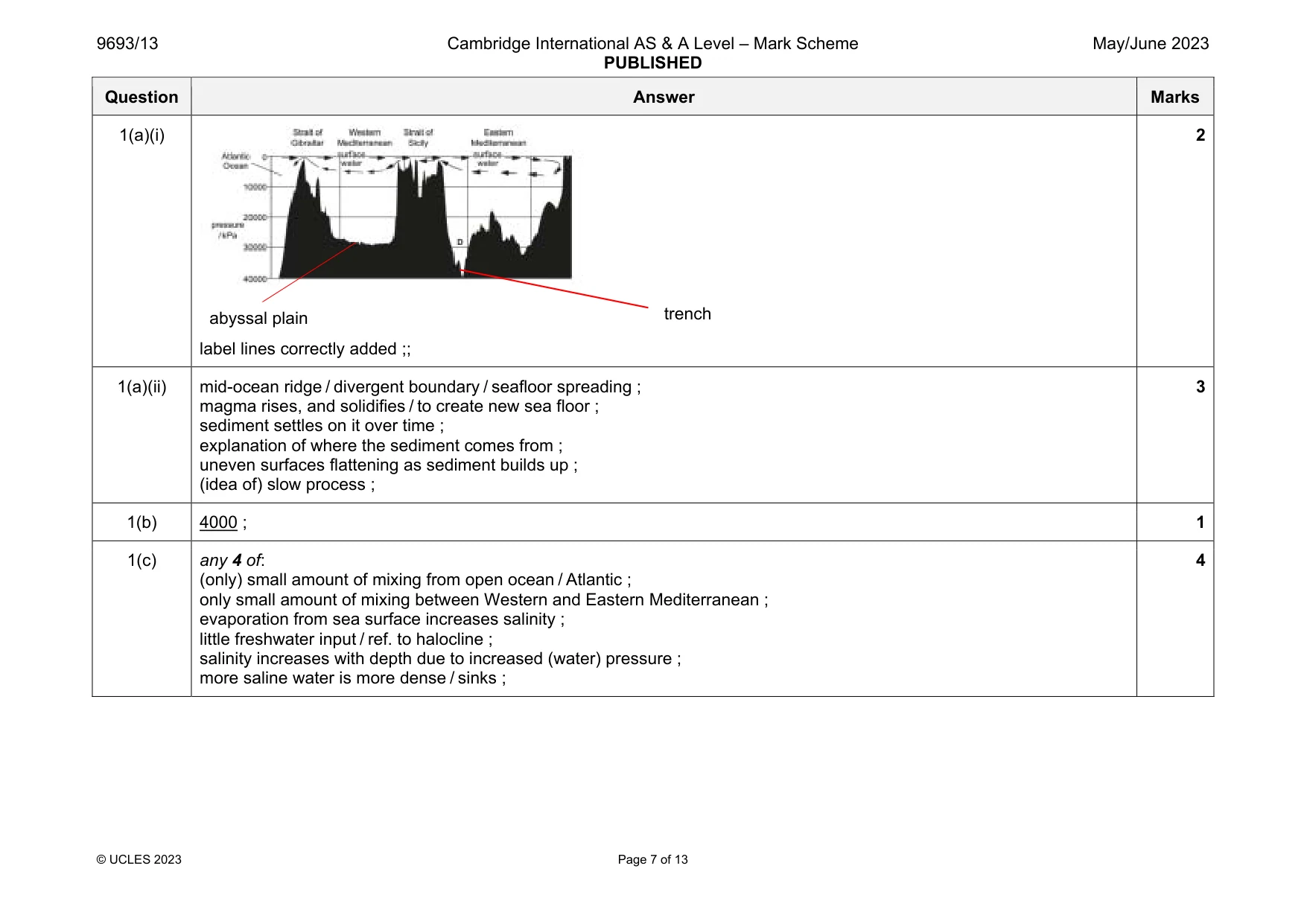
2 9693/13/M/J/23 © UCLES 2023 Section A Answer all questions in this section. 1 Fig. 1.1 shows a map of the Mediterranean Sea. Eastern Mediterranean Western Mediterranean Strait of Gibraltar Strait of Sicily Fig. 1.1 A cross-section of the Mediterranean Sea along the dashed black line is shown in Fig. 1.2. The arrows show the direction of movement of water. 40 000 30 000 20 000 pressure / kPa 10 000 0 Strait of Gibraltar Western Mediterranean surface water surface water surface water surface water Eastern Mediterranean Atlantic Ocean Strait of Sicily D Fig. 1.2 (a) (i) Label Fig. 1.2 to show: • the trench • the abyssal plain. [2]
Question paper, page 3
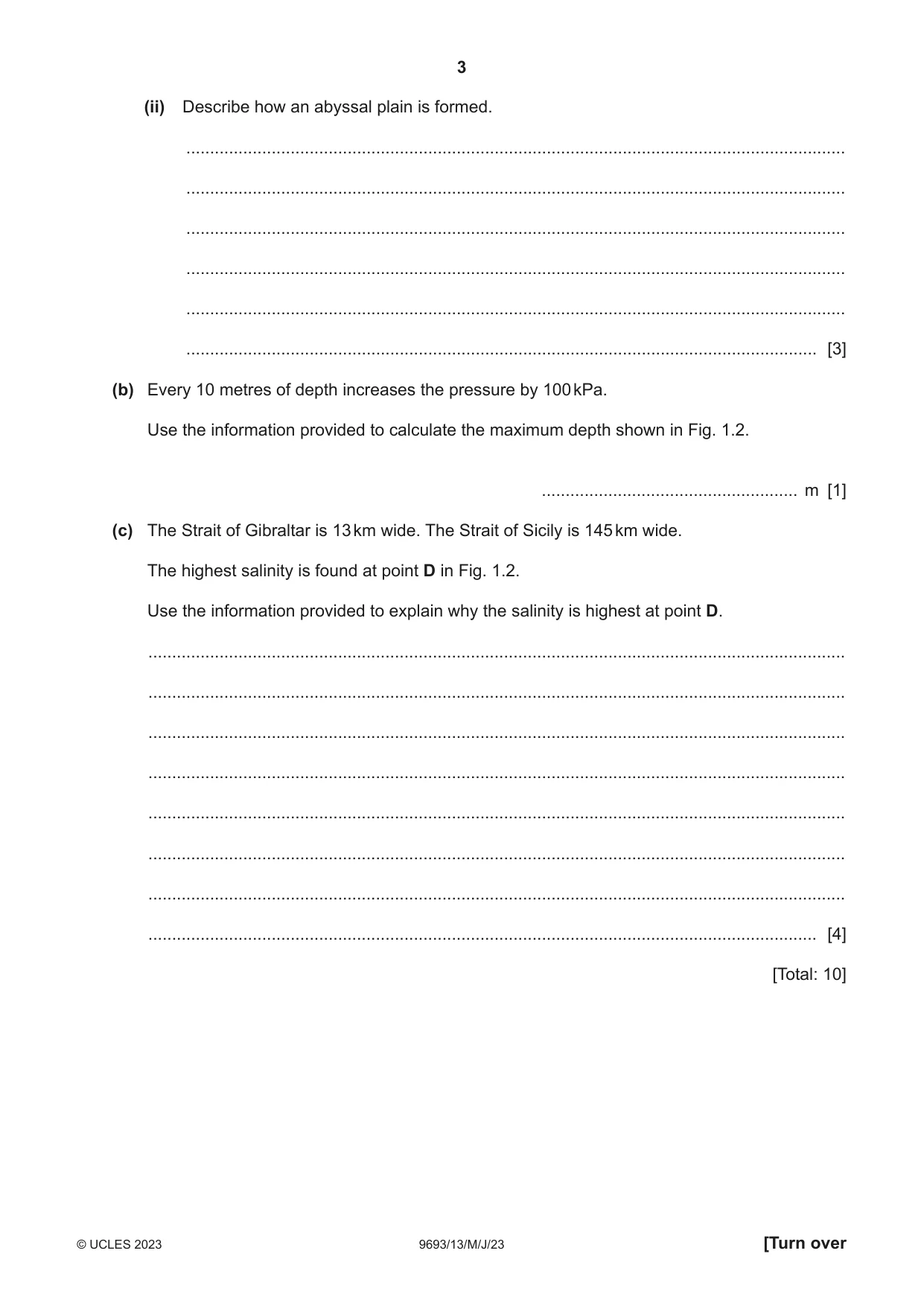
3 9693/13/M/J/23 © UCLES 2023 [Turn over (ii) Describe how an abyssal plain is formed. … … … … … … [3] (b) Every 10 metres of depth increases the pressure by 100 kPa. Use the information provided to calculate the maximum depth shown in Fig. 1.2. … m [1] (c) The Strait of Gibraltar is 13 km wide. The Strait of Sicily is 145 km wide. The highest salinity is found at point D in Fig. 1.2. Use the information provided to explain why the salinity is highest at point D. … … … … … … … … [4] [Total: 10]
Question paper, page 4
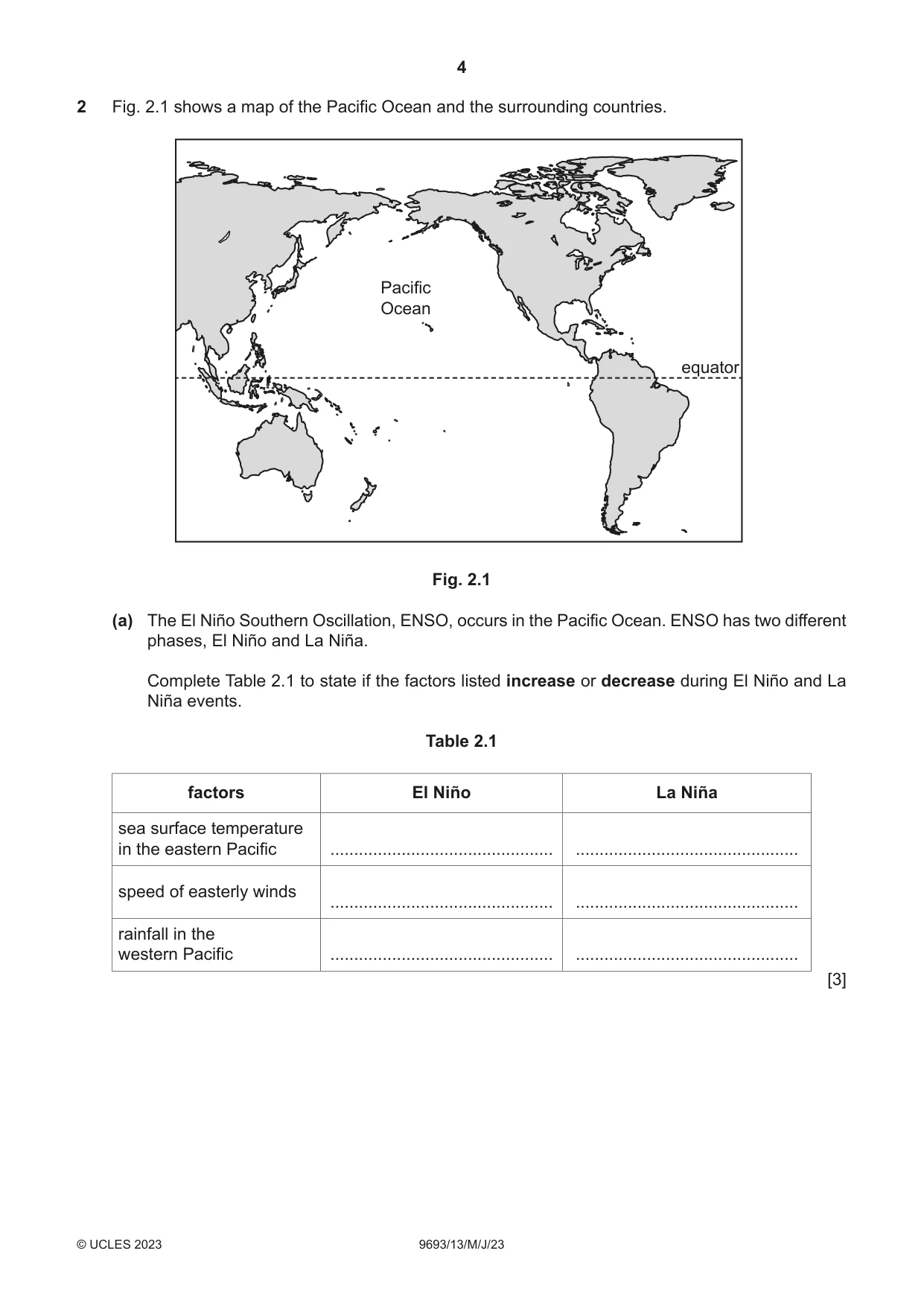
4 9693/13/M/J/23 © UCLES 2023 2 Fig. 2.1 shows a map of the Pacific Ocean and the surrounding countries. equator Pacific Ocean Fig. 2.1 (a) The El Niño Southern Oscillation, ENSO, occurs in the Pacific Ocean. ENSO has two different phases, El Niño and La Niña. Complete Table 2.1 to state if the factors listed increase or decrease during El Niño and La Niña events. Table 2.1 factors El Niño La Niña sea surface temperature in the eastern Pacific … … speed of easterly winds … … rainfall in the western Pacific … … [3]
Question paper, page 5
5 9693/13/M/J/23 © UCLES 2023 [Turn over (b) During the 2016 El Niño event, tidal ranges were higher than expected in some coastal areas of western South America. This was because higher than predicted high tides were experienced. (i) Explain what is meant by tidal range. … … [1] (ii) Suggest reasons for higher than predicted tides during an El Niño event in western South America. … … … … [2] (c) (i) Suggest why increased fish populations are observed in the eastern Pacific during La Niña event years. … … … … … … [3] (ii) Tuna are predators of anchoveta. Suggest one method that can be used to monitor tuna population sizes during La Niña events. … [1] [Total: 10]
Question paper, page 6
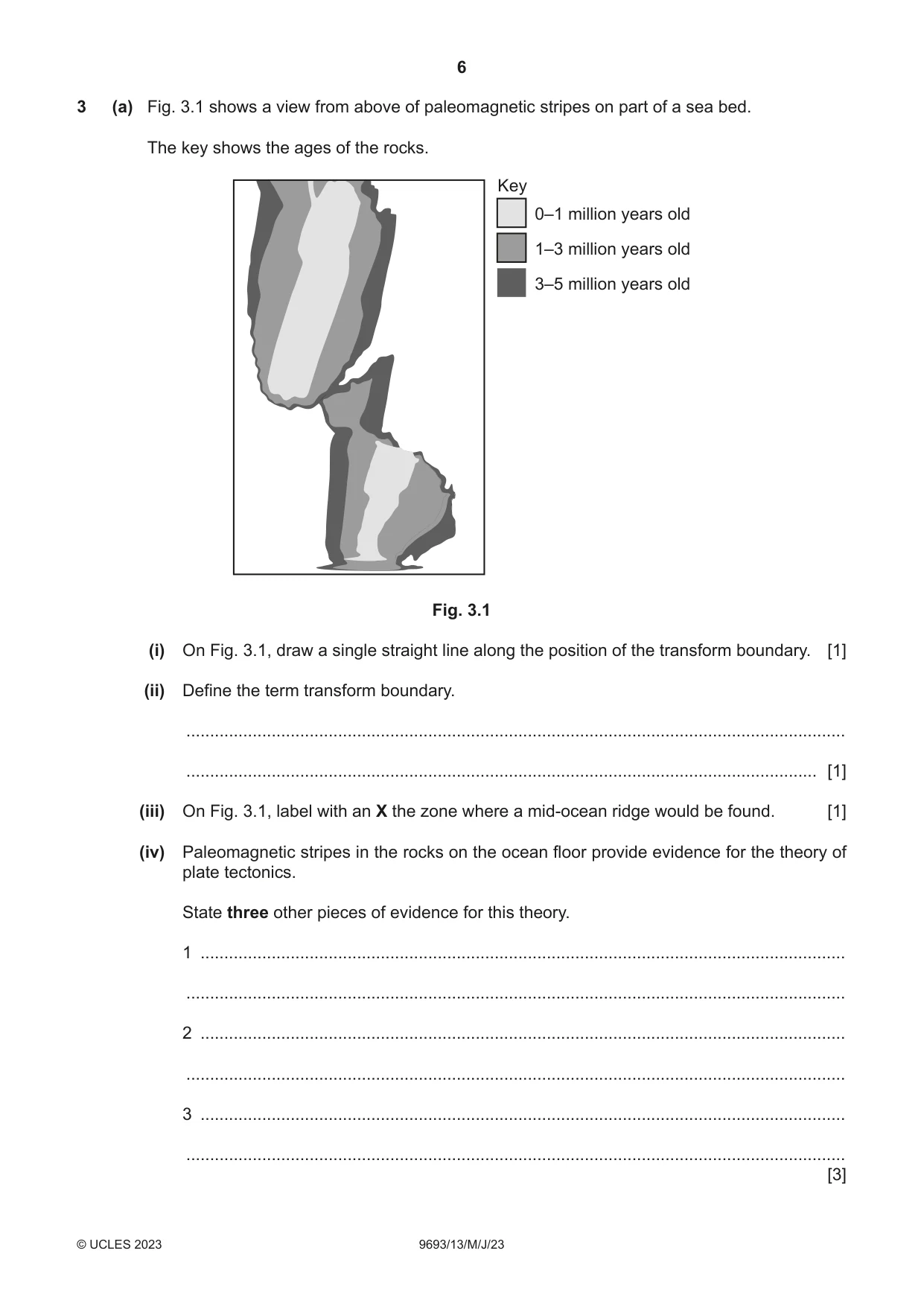
6 9693/13/M/J/23 © UCLES 2023 3 (a) Fig. 3.1 shows a view from above of paleomagnetic stripes on part of a sea bed. The key shows the ages of the rocks. Key 0–1 million years old 1–3 million years old 3–5 million years old Fig. 3.1 (i) On Fig. 3.1, draw a single straight line along the position of the transform boundary. [1] (ii) Define the term transform boundary. … … [1] (iii) On Fig. 3.1, label with an X the zone where a mid-ocean ridge would be found. [1] (iv) Paleomagnetic stripes in the rocks on the ocean floor provide evidence for the theory of plate tectonics. State three other pieces of evidence for this theory. 1 … … 2 … … 3 … … [3]
Question paper, page 7
7 9693/13/M/J/23 © UCLES 2023 [Turn over (b) (i) Underwater volcanoes are found at plate boundaries. These volcanoes may release argon gas, which has a low solubility in water. Bubbles of argon gas then rise to the surface. Use kinetic particle theory to explain why changing temperature and pressure affects the volume of the bubbles as they rise. … … … … … … … … [4] (ii) Explain how an erupting underwater volcano may affect the density of the surrounding water. … … … … [2] (iii) The ability of water to act as a solvent is related to the structure of its molecules. Draw a diagram to show the structure of a water molecule, including the electron arrangement within the molecule. [2] [Total: 14]
Question paper, page 8
8 9693/13/M/J/23 © UCLES 2023 4 (a) Manta rays live in a close relationship with remora fish. Describe the relationship between manta rays and remora fish. … … … … … … [3] (b) (i) Manta rays are cartilaginous fish. Remora fish are bony fish. State two features of remora fish that are not found in manta rays. 1 … 2 … [2] (ii) Both species belong to the same phylum. State two features that would be seen in the development of all species of this phylum. 1 … 2 … [2] (c) Killer whales prey on manta rays. Manta rays feed on zooplankton. (i) Explain the term zooplankton. … … … … [2]
Question paper, page 9
9 9693/13/M/J/23 © UCLES 2023 [Turn over (ii) Draw a food chain with four trophic levels, using the information given in (b) and (c), to show how the killer whale obtains energy. [2] [Total: 11]
Question paper, page 10
10 9693/13/M/J/23 © UCLES 2023 Section B Answer all questions in this section. 5 Mangrove forests grow on the shores of many tropical and subtropical countries. (a) Discuss the ecological and economic importance of mangrove forests. … … … … … … … … … … … … … … [7]
Question paper, page 11
11 9693/13/M/J/23 © UCLES 2023 [Turn over (b) The red mangrove tree, Rhizophora mangle, has many adaptations that enable it to survive. Explain how the red mangrove tree is adapted to the abiotic factors found in the mangrove ecosystem. … … … … … … … … … … … … … … … [8] [Total: 15]
Question paper, page 12
12 9693/13/M/J/23 © UCLES 2023 6 Describe the carbon cycle in a marine ecosystem. … … … … … … … … … … … … … … … … … … [9]
Question paper, page 13
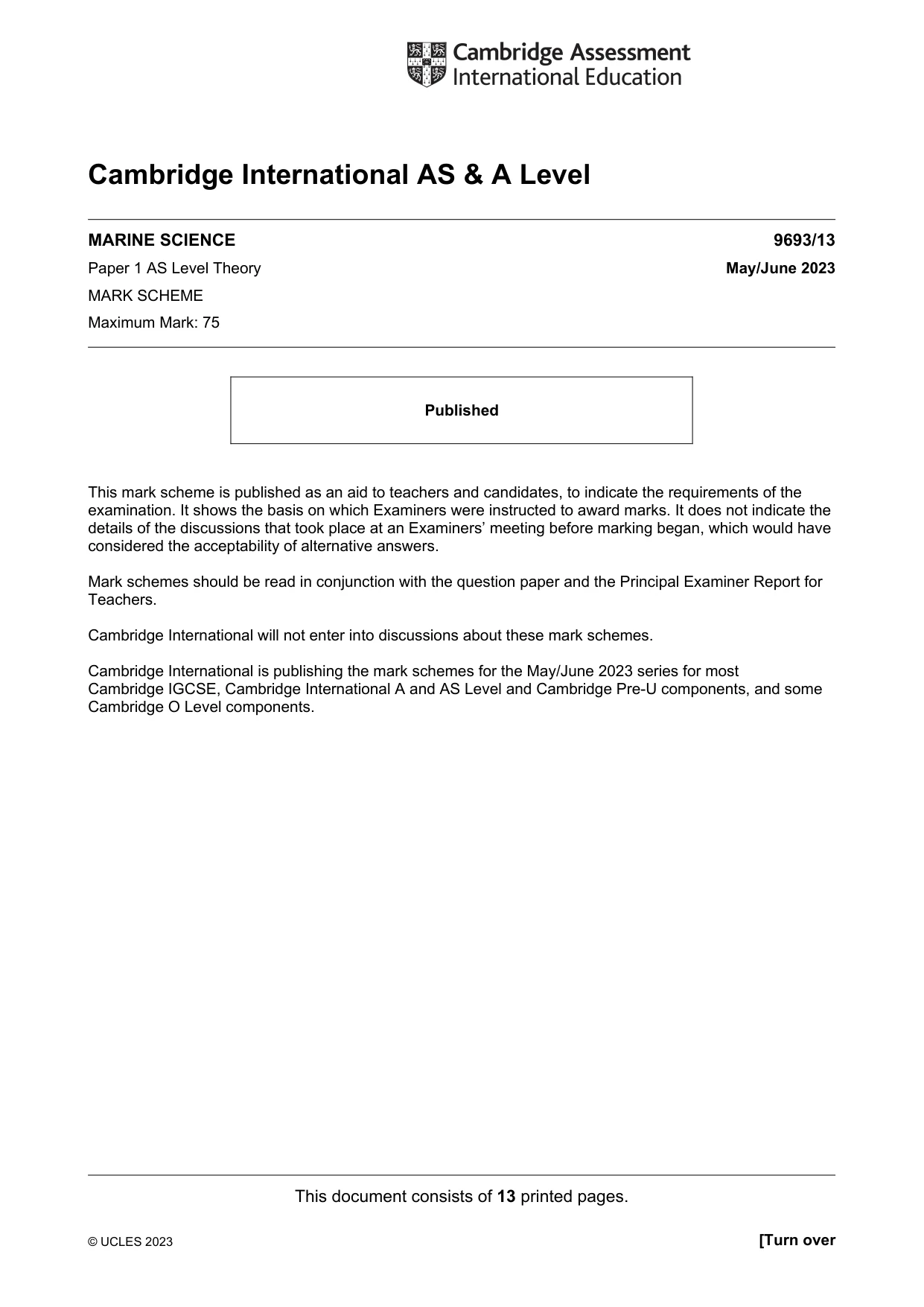
13 9693/13/M/J/23 © UCLES 2023 7 Species from the open ocean and organisms living on coral reefs have different types of niche. Explain the meaning of the term niche using examples from coral reefs and the open ocean. … … … … … … … … … … … … [6]
Question paper, page 14
14 9693/13/M/J/23 © UCLES 2023 BLANK PAGE
Question paper, page 15
15 9693/13/M/J/23 © UCLES 2023 BLANK PAGE
Question paper, page 16
16 9693/13/M/J/23 © UCLES 2023 The boundaries and names shown, the designations used and the presentation of material on any maps contained in this question paper/insert do not imply official endorsement or acceptance by Cambridge Assessment International Education concerning the legal status of any country, territory, or area or any of its authorities, or of the delimitation of its frontiers or boundaries. Permission to reproduce items where third-party owned material protected by copyright is included has been sought and cleared where possible. Every reasonable effort has been made by the publisher (UCLES) to trace copyright holders, but if any items requiring clearance have unwittingly been included, the publisher will be pleased to make amends at the earliest possible opportunity. To avoid the issue of disclosure of answer-related information to candidates, all copyright acknowledgements are reproduced online in the Cambridge Assessment International Education Copyright Acknowledgements Booklet. This is produced for each series of examinations and is freely available to download at www.cambridgeinternational.org after the live examination series. Cambridge Assessment International Education is part of Cambridge Assessment. Cambridge Assessment is the brand name of the University of Cambridge Local Examinations Syndicate (UCLES), which is a department of the University of Cambridge. BLANK PAGE
Mark scheme, page 1
This document consists of 13 printed pages. © UCLES 2023 [Turn over Cambridge International AS & A Level MARINE SCIENCE 9693/13 Paper 1 AS Level Theory May/June 2023 MARK SCHEME Maximum Mark: 75 Published This mark scheme is published as an aid to teachers and candidates, to indicate the requirements of the examination. It shows the basis on which Examiners were instructed to award marks. It does not indicate the details of the discussions that took place at an Examiners’ meeting before marking began, which would have considered the acceptability of alternative answers. Mark schemes should be read in conjunction with the question paper and the Principal Examiner Report for Teachers. Cambridge International will not enter into discussions about these mark schemes. Cambridge International is publishing the mark schemes for the May/June 2023 series for most Cambridge IGCSE, Cambridge International A and AS Level and Cambridge Pre-U components, and some Cambridge O Level components.
Mark scheme, page 2
9693/13 Cambridge International AS & A Level – Mark Scheme PUBLISHED May/June 2023 © UCLES 2023 Page 2 of 13 Generic Marking Principles These general marking principles must be applied by all examiners when marking candidate answers. They should be applied alongside the specific content of the mark scheme or generic level descriptors for a question. Each question paper and mark scheme will also comply with these marking principles. GENERIC MARKING PRINCIPLE 1: Marks must be awarded in line with: the specific content of the mark scheme or the generic level descriptors for the question the specific skills defined in the mark scheme or in the generic level descriptors for the question the standard of response required by a candidate as exemplified by the standardisation scripts. GENERIC MARKING PRINCIPLE 2: Marks awarded are always whole marks (not half marks, or other fractions). GENERIC MARKING PRINCIPLE 3: Marks must be awarded positively: marks are awarded for correct/valid answers, as defined in the mark scheme. However, credit is given for valid answers which go beyond the scope of the syllabus and mark scheme, referring to your Team Leader as appropriate marks are awarded when candidates clearly demonstrate what they know and can do marks are not deducted for errors marks are not deducted for omissions answers should only be judged on the quality of spelling, punctuation and grammar when these features are specifically assessed by the question as indicated by the mark scheme. The meaning, however, should be unambiguous. GENERIC MARKING PRINCIPLE 4: Rules must be applied consistently, e.g. in situations where candidates have not followed instructions or in the application of generic level descriptors.
Mark scheme, page 3
9693/13 Cambridge International AS & A Level – Mark Scheme PUBLISHED May/June 2023 © UCLES 2023 Page 3 of 13 GENERIC MARKING PRINCIPLE 5: Marks should be awarded using the full range of marks defined in the mark scheme for the question (however; the use of the full mark range may be limited according to the quality of the candidate responses seen). GENERIC MARKING PRINCIPLE 6: Marks awarded are based solely on the requirements as defined in the mark scheme. Marks should not be awarded with grade thresholds or grade descriptors in mind.
Mark scheme, page 4
9693/13 Cambridge International AS & A Level – Mark Scheme PUBLISHED May/June 2023 © UCLES 2023 Page 4 of 13 Science-Specific Marking Principles 1 Examiners should consider the context and scientific use of any keywords when awarding marks. Although keywords may be present, marks should not be awarded if the keywords are used incorrectly. 2 The examiner should not choose between contradictory statements given in the same question part, and credit should not be awarded for any correct statement that is contradicted within the same question part. Wrong science that is irrelevant to the question should be ignored. 3 Although spellings do not have to be correct, spellings of syllabus terms must allow for clear and unambiguous separation from other syllabus terms with which they may be confused (e.g. ethane / ethene, glucagon / glycogen, refraction / reflection). 4 The error carried forward (ecf) principle should be applied, where appropriate. If an incorrect answer is subsequently used in a scientifically correct way, the candidate should be awarded these subsequent marking points. Further guidance will be included in the mark scheme where necessary and any exceptions to this general principle will be noted. 5 ‘List rule’ guidance For questions that require n responses (e.g. State two reasons …): The response should be read as continuous prose, even when numbered answer spaces are provided. Any response marked ignore in the mark scheme should not count towards n. Incorrect responses should not be awarded credit but will still count towards n. Read the entire response to check for any responses that contradict those that would otherwise be credited. Credit should not be awarded for any responses that are contradicted within the rest of the response. Where two responses contradict one another, this should be treated as a single incorrect response. Non-contradictory responses after the first n responses may be ignored even if they include incorrect science.
Mark scheme, page 5
9693/13 Cambridge International AS & A Level – Mark Scheme PUBLISHED May/June 2023 © UCLES 2023 Page 5 of 13 6 Calculation specific guidance Correct answers to calculations should be given full credit even if there is no working or incorrect working, unless the question states ‘show your working’. For questions in which the number of significant figures required is not stated, credit should be awarded for correct answers when rounded by the examiner to the number of significant figures given in the mark scheme. This may not apply to measured values. For answers given in standard form (e.g. a 10n) in which the convention of restricting the value of the coefficient (a) to a value between 1 and 10 is not followed, credit may still be awarded if the answer can be converted to the answer given in the mark scheme. Unless a separate mark is given for a unit, a missing or incorrect unit will normally mean that the final calculation mark is not awarded. Exceptions to this general principle will be noted in the mark scheme. 7 Guidance for chemical equations Multiples / fractions of coefficients used in chemical equations are acceptable unless stated otherwise in the mark scheme. State symbols given in an equation should be ignored unless asked for in the question or stated otherwise in the mark scheme.
Mark scheme, page 6
9693/13 Cambridge International AS & A Level – Mark Scheme PUBLISHED May/June 2023 © UCLES 2023 Page 6 of 13 This mark scheme will use the following abbreviations: ; separates marking points / separates alternatives within a marking point () contents of brackets are not required but should be implied / the contents set the context of the answer R reject A accept (answers that are correctly cued by the question or guidance you have received) I ignore (mark as if this material was not present) AW alternative wording (where responses vary more than usual, accept other ways of expressing the same idea) AVP alternative valid point (where a greater than usual variety of responses is expected) ORA or reverse argument underline actual word underlined must be used by the candidate (grammatical variants excepted) MAX indicates the maximum number of marks that can be awarded + statements on both sides of the + are needed for that mark OR separates two different routes to a mark point and only one should be awarded ECF error carried forward (credit an operation from a previous incorrect response)
Mark scheme, page 7
9693/13 Cambridge International AS & A Level – Mark Scheme PUBLISHED May/June 2023 © UCLES 2023 Page 7 of 13 Question Answer Marks 1(a)(i) label lines correctly added ;; 2 1(a)(ii) mid-ocean ridge / divergent boundary / seafloor spreading ; magma rises, and solidifies / to create new sea floor ; sediment settles on it over time ; explanation of where the sediment comes from ; uneven surfaces flattening as sediment builds up ; (idea of) slow process ; 3 1(b) 4000 ; 1 1(c) any 4 of: (only) small amount of mixing from open ocean / Atlantic ; only small amount of mixing between Western and Eastern Mediterranean ; evaporation from sea surface increases salinity ; little freshwater input / ref. to halocline ; salinity increases with depth due to increased (water) pressure ; more saline water is more dense / sinks ; 4 abyssal plain trench
Mark scheme, page 8
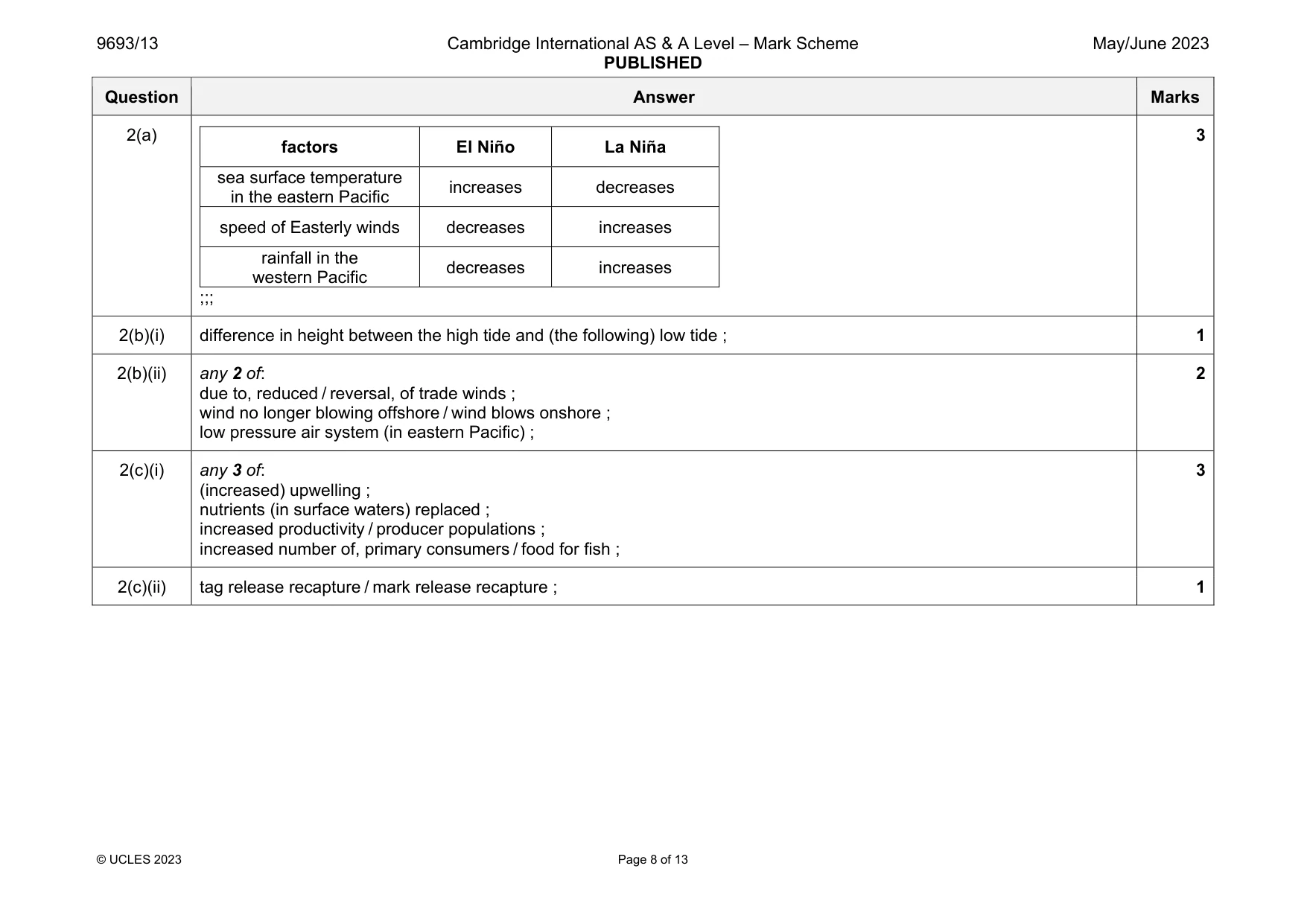
9693/13 Cambridge International AS & A Level – Mark Scheme PUBLISHED May/June 2023 © UCLES 2023 Page 8 of 13 Question Answer Marks 2(a) factors El Niño La Niña sea surface temperature in the eastern Pacific increases decreases speed of Easterly winds decreases increases rainfall in the western Pacific decreases increases ;;; 3 2(b)(i) difference in height between the high tide and (the following) low tide ; 1 2(b)(ii) any 2 of: due to, reduced / reversal, of trade winds ; wind no longer blowing offshore / wind blows onshore ; low pressure air system (in eastern Pacific) ; 2 2(c)(i) any 3 of: (increased) upwelling ; nutrients (in surface waters) replaced ; increased productivity / producer populations ; increased number of, primary consumers / food for fish ; 3 2(c)(ii) tag release recapture / mark release recapture ; 1
Mark scheme, page 9
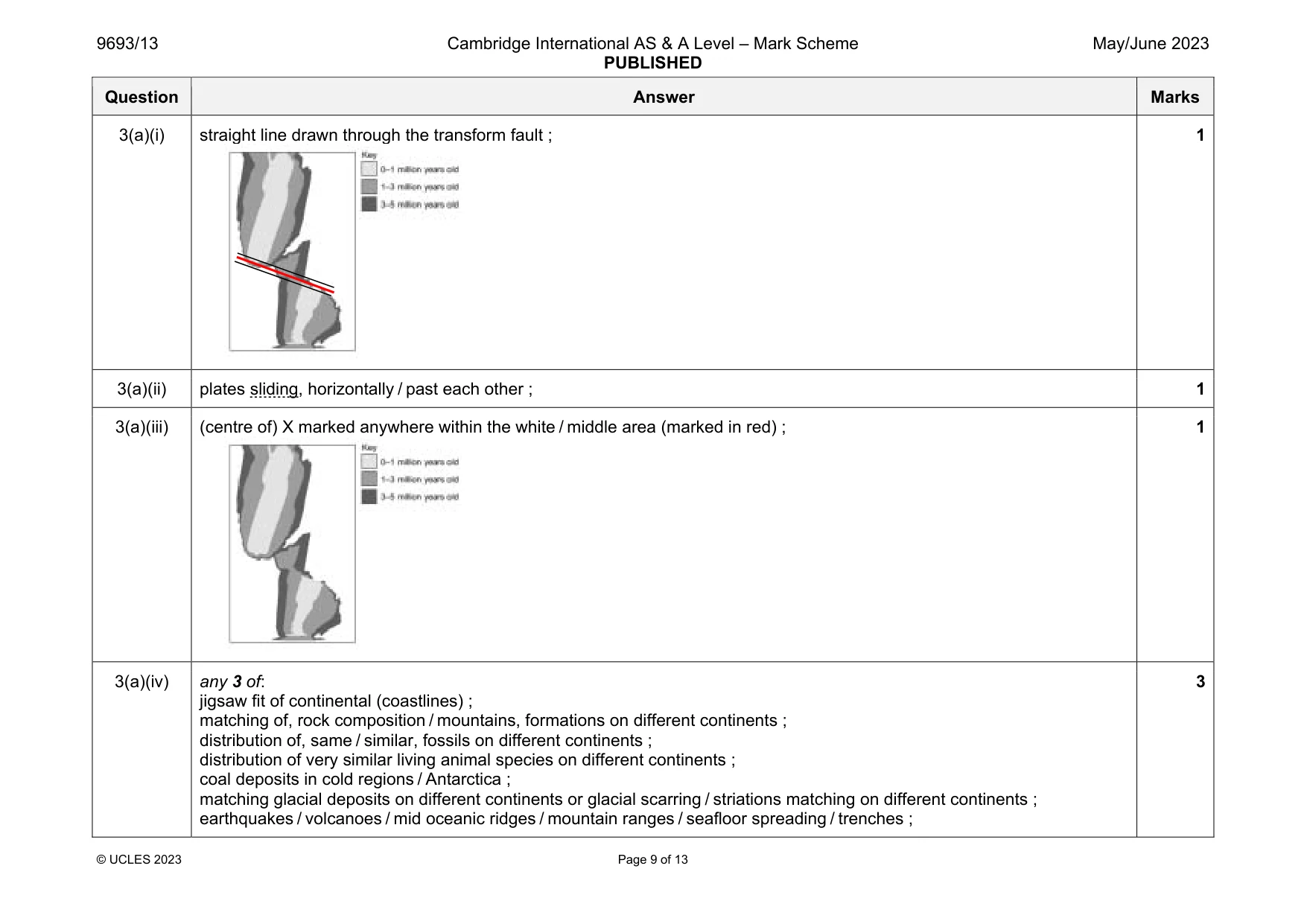
9693/13 Cambridge International AS & A Level – Mark Scheme PUBLISHED May/June 2023 © UCLES 2023 Page 9 of 13 Question Answer Marks 3(a)(i) straight line drawn through the transform fault ; 1 3(a)(ii) plates sliding, horizontally / past each other ; 1 3(a)(iii) (centre of) X marked anywhere within the white / middle area (marked in red) ; 1 3(a)(iv) any 3 of: jigsaw fit of continental (coastlines) ; matching of, rock composition / mountains, formations on different continents ; distribution of, same / similar, fossils on different continents ; distribution of very similar living animal species on different continents ; coal deposits in cold regions / Antarctica ; matching glacial deposits on different continents or glacial scarring / striations matching on different continents ; earthquakes / volcanoes / mid oceanic ridges / mountain ranges / seafloor spreading / trenches ; 3
Mark scheme, page 10
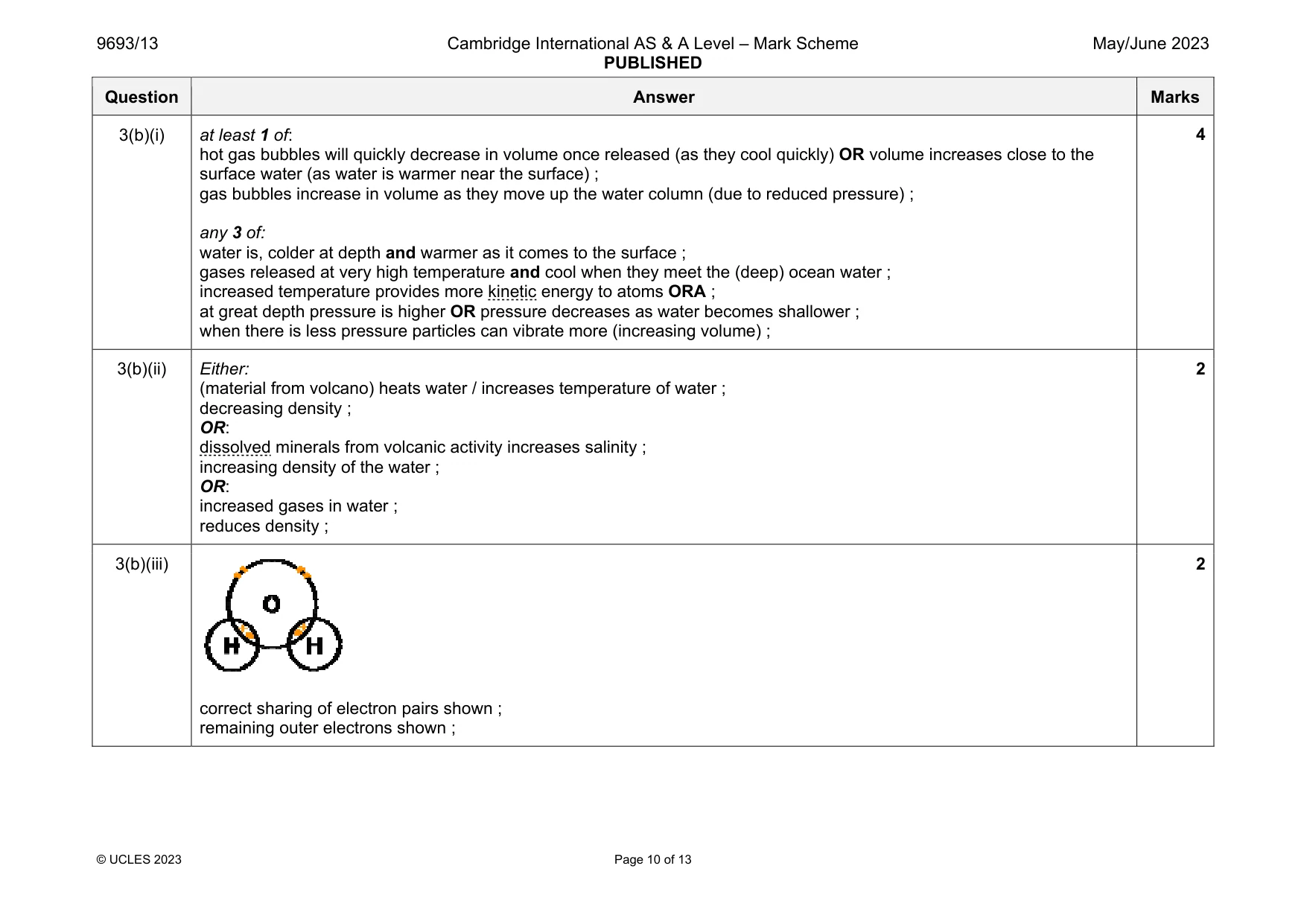
9693/13 Cambridge International AS & A Level – Mark Scheme PUBLISHED May/June 2023 © UCLES 2023 Page 10 of 13 Question Answer Marks 3(b)(i) at least 1 of: hot gas bubbles will quickly decrease in volume once released (as they cool quickly) OR volume increases close to the surface water (as water is warmer near the surface) ; gas bubbles increase in volume as they move up the water column (due to reduced pressure) ; any 3 of: water is, colder at depth and warmer as it comes to the surface ; gases released at very high temperature and cool when they meet the (deep) ocean water ; increased temperature provides more kinetic energy to atoms ORA ; at great depth pressure is higher OR pressure decreases as water becomes shallower ; when there is less pressure particles can vibrate more (increasing volume) ; 4 3(b)(ii) Either: (material from volcano) heats water / increases temperature of water ; decreasing density ; OR: dissolved minerals from volcanic activity increases salinity ; increasing density of the water ; OR: increased gases in water ; reduces density ; 2 3(b)(iii) correct sharing of electron pairs shown ; remaining outer electrons shown ; 2
Mark scheme, page 11
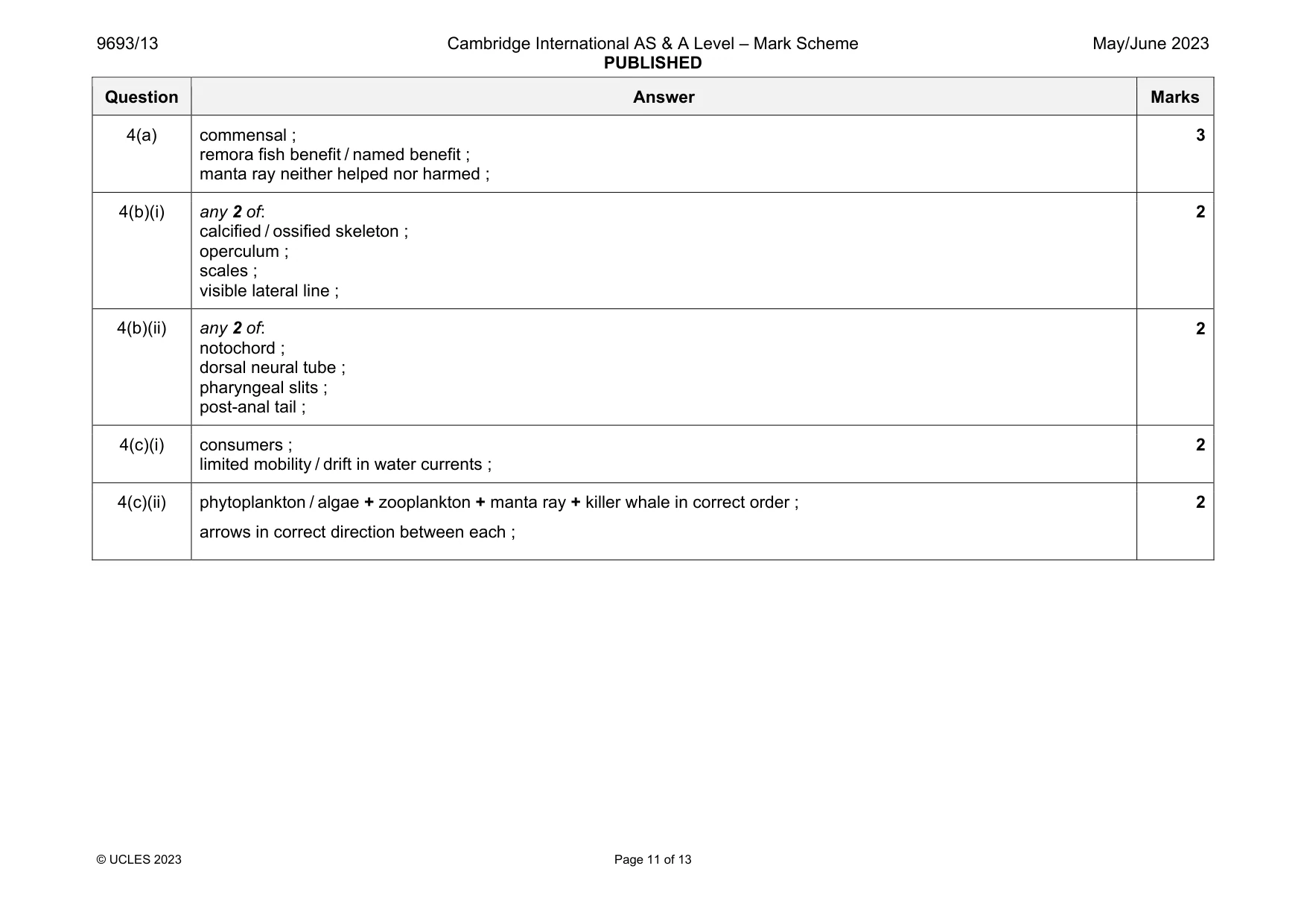
9693/13 Cambridge International AS & A Level – Mark Scheme PUBLISHED May/June 2023 © UCLES 2023 Page 11 of 13 Question Answer Marks 4(a) commensal ; remora fish benefit / named benefit ; manta ray neither helped nor harmed ; 3 4(b)(i) any 2 of: calcified / ossified skeleton ; operculum ; scales ; visible lateral line ; 2 4(b)(ii) any 2 of: notochord ; dorsal neural tube ; pharyngeal slits ; post-anal tail ; 2 4(c)(i) consumers ; limited mobility / drift in water currents ; 2 4(c)(ii) phytoplankton / algae + zooplankton + manta ray + killer whale in correct order ; arrows in correct direction between each ; 2
Mark scheme, page 12
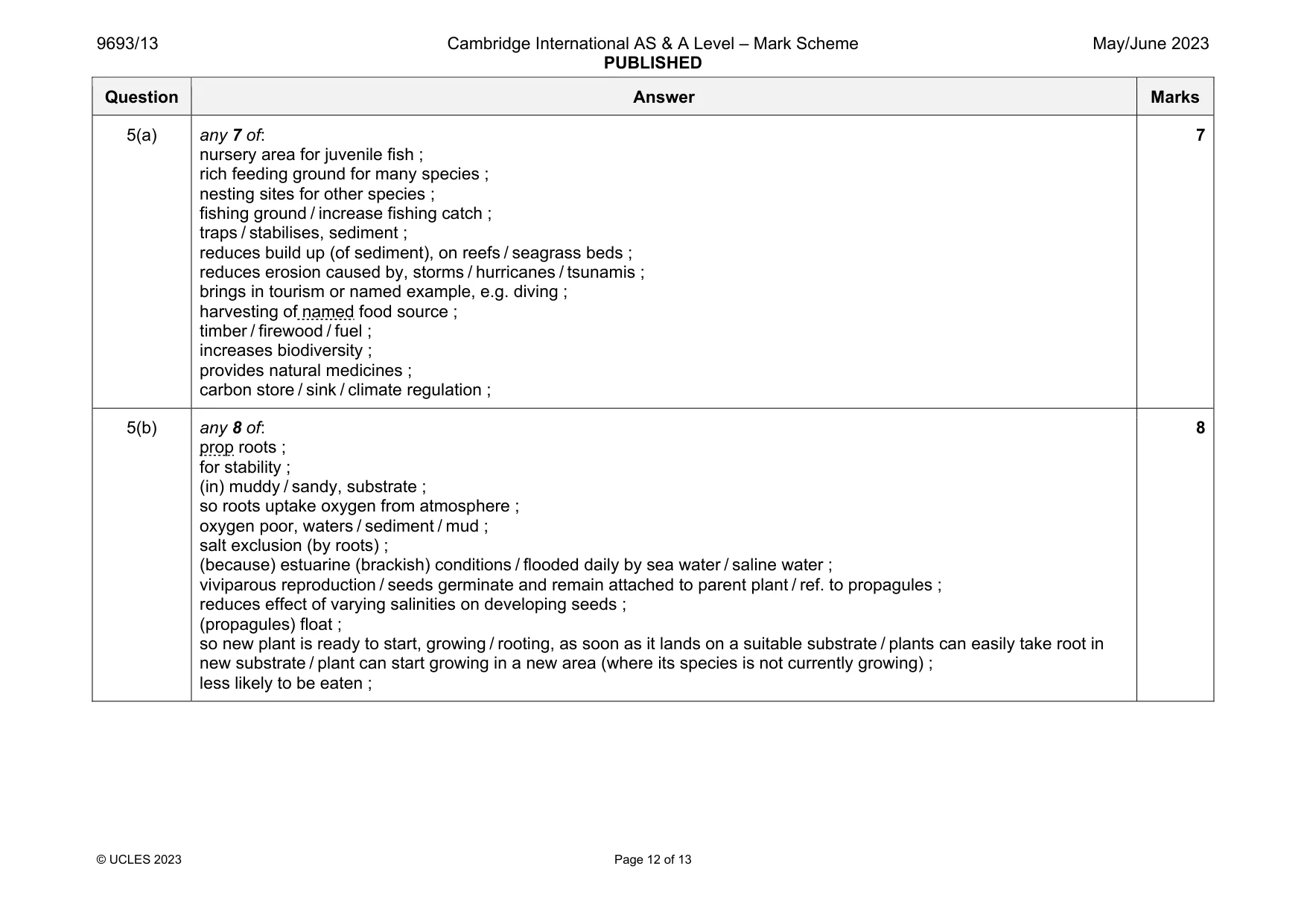
9693/13 Cambridge International AS & A Level – Mark Scheme PUBLISHED May/June 2023 © UCLES 2023 Page 12 of 13 Question Answer Marks 5(a) any 7 of: nursery area for juvenile fish ; rich feeding ground for many species ; nesting sites for other species ; fishing ground / increase fishing catch ; traps / stabilises, sediment ; reduces build up (of sediment), on reefs / seagrass beds ; reduces erosion caused by, storms / hurricanes / tsunamis ; brings in tourism or named example, e.g. diving ; harvesting of named food source ; timber / firewood / fuel ; increases biodiversity ; provides natural medicines ; carbon store / sink / climate regulation ; 7 5(b) any 8 of: prop roots ; for stability ; (in) muddy / sandy, substrate ; so roots uptake oxygen from atmosphere ; oxygen poor, waters / sediment / mud ; salt exclusion (by roots) ; (because) estuarine (brackish) conditions / flooded daily by sea water / saline water ; viviparous reproduction / seeds germinate and remain attached to parent plant / ref. to propagules ; reduces effect of varying salinities on developing seeds ; (propagules) float ; so new plant is ready to start, growing / rooting, as soon as it lands on a suitable substrate / plants can easily take root in new substrate / plant can start growing in a new area (where its species is not currently growing) ; less likely to be eaten ; 8
Mark scheme, page 13
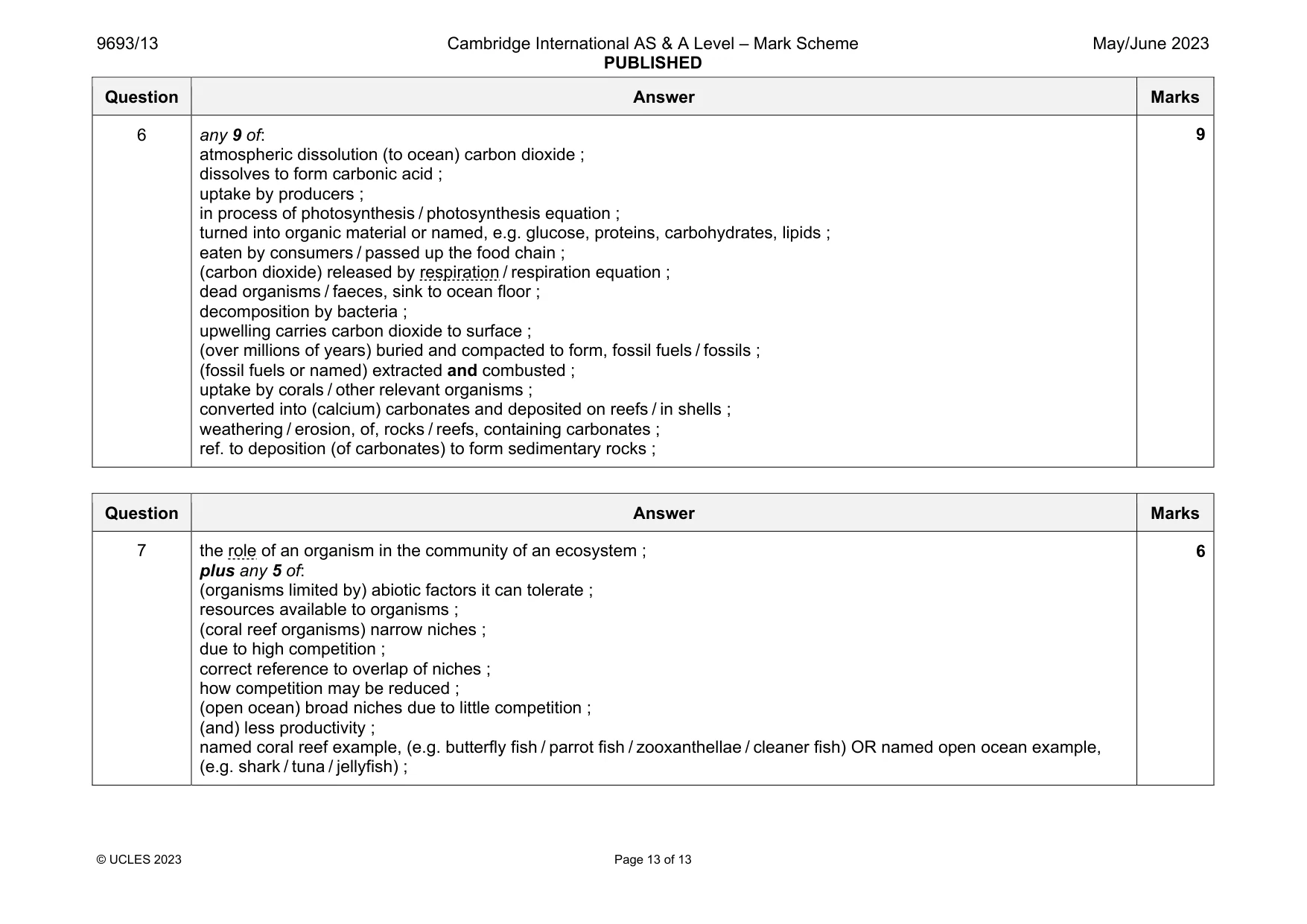
9693/13 Cambridge International AS & A Level – Mark Scheme PUBLISHED May/June 2023 © UCLES 2023 Page 13 of 13 Question Answer Marks 6 any 9 of: atmospheric dissolution (to ocean) carbon dioxide ; dissolves to form carbonic acid ; uptake by producers ; in process of photosynthesis / photosynthesis equation ; turned into organic material or named, e.g. glucose, proteins, carbohydrates, lipids ; eaten by consumers / passed up the food chain ; (carbon dioxide) released by respiration / respiration equation ; dead organisms / faeces, sink to ocean floor ; decomposition by bacteria ; upwelling carries carbon dioxide to surface ; (over millions of years) buried and compacted to form, fossil fuels / fossils ; (fossil fuels or named) extracted and combusted ; uptake by corals / other relevant organisms ; converted into (calcium) carbonates and deposited on reefs / in shells ; weathering / erosion, of, rocks / reefs, containing carbonates ; ref. to deposition (of carbonates) to form sedimentary rocks ; 9 Question Answer Marks 7 the role of an organism in the community of an ecosystem ; plus any 5 of: (organisms limited by) abiotic factors it can tolerate ; resources available to organisms ; (coral reef organisms) narrow niches ; due to high competition ; correct reference to overlap of niches ; how competition may be reduced ; (open ocean) broad niches due to little competition ; (and) less productivity ; named coral reef example, (e.g. butterfly fish / parrot fish / zooxanthellae / cleaner fish) OR named open ocean example, (e.g. shark / tuna / jellyfish) ; 6
What you needed in this session
Cambridge’s own grade thresholds for 2023 May/June, Paper 1 · Variant 3. A higher threshold means an easier paper — the bar moves with how the cohort did.