Cambridge A Level Marine Science 9693 — 2022 May/June Paper 1 · Variant 3
9693/13/M/J/22 · 75 marks · ≈84 min
The question paper and its mark scheme, free to read here and free to download. This is Cambridge’s own paper, exactly as it was sat.
Question paper12 pages
Mark scheme14 pages
Answers below. Sit the paper first if you are practising.
Paper as text
Question paper, page 1
This document has 12 pages. [Turn over Cambridge International AS & A Level DC (CJ) 311396 © UCLES 2022 * 6 1 4 9 7 6 6 7 8 8 * MARINE SCIENCE 9693/13 Paper 1 AS Level Theory May/June 2022 1 hour 45 minutes You must answer on the question paper. No additional materials are needed. INSTRUCTIONS ● Answer all questions. ● Use a black or dark blue pen. You may use an HB pencil for any diagrams or graphs. ● Write your name, centre number and candidate number in the boxes at the top of the page. ● Write your answer to each question in the space provided. ● Do not use an erasable pen or correction fluid. ● Do not write on any bar codes. ● You may use a calculator. ● You should show all your working and use appropriate units. INFORMATION ● The total mark for this paper is 75. ● The number of marks for each question or part question is shown in brackets [ ].
Question paper, page 2
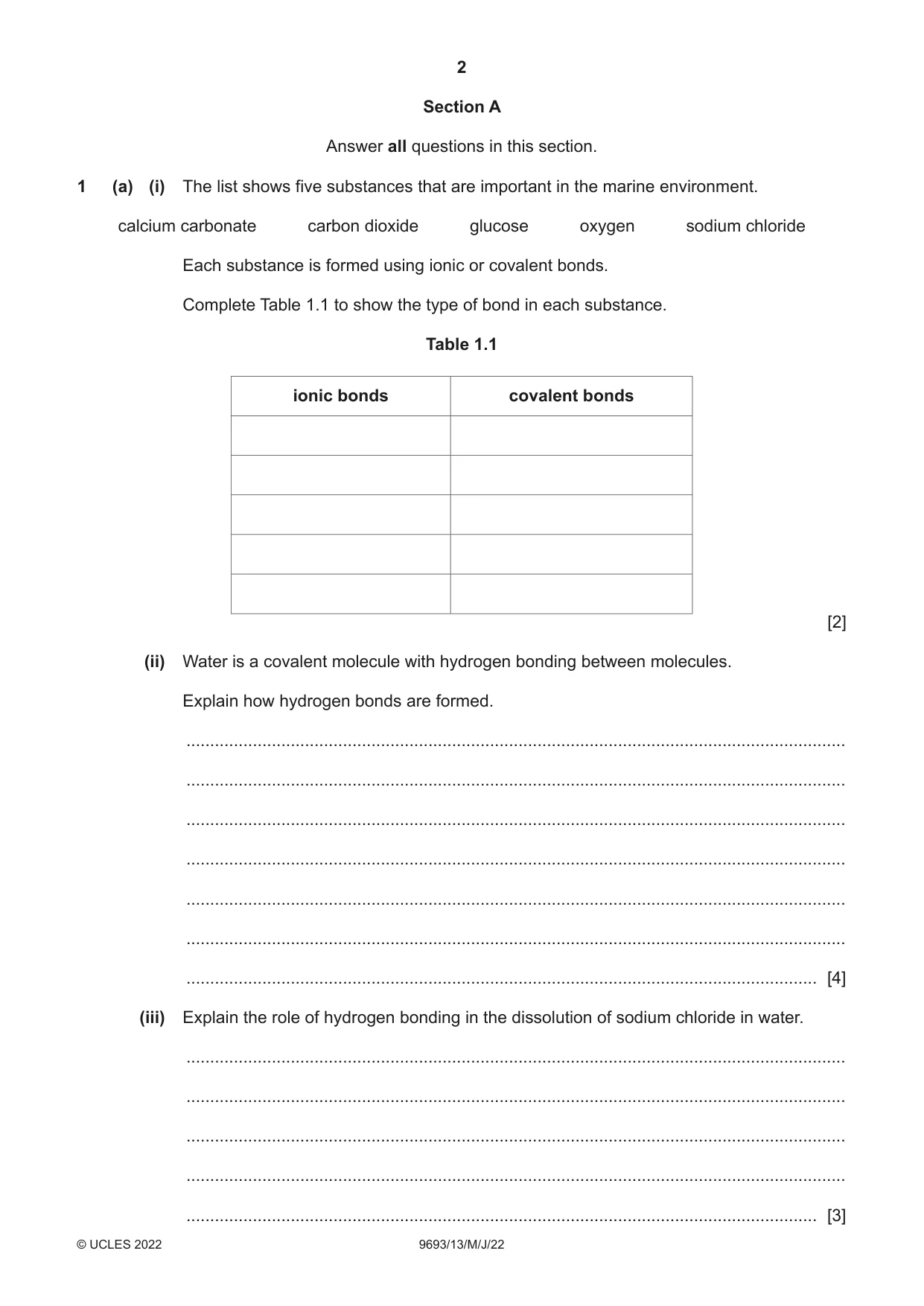
2 9693/13/M/J/22 © UCLES 2022 Section A Answer all questions in this section. 1 (a) (i) The list shows five substances that are important in the marine environment. calcium carbonate carbon dioxide glucose oxygen sodium chloride Each substance is formed using ionic or covalent bonds. Complete Table 1.1 to show the type of bond in each substance. Table 1.1 ionic bonds covalent bonds [2] (ii) Water is a covalent molecule with hydrogen bonding between molecules. Explain how hydrogen bonds are formed. … … … … … … … [4] (iii) Explain the role of hydrogen bonding in the dissolution of sodium chloride in water. … … … … … [3]
Question paper, page 3
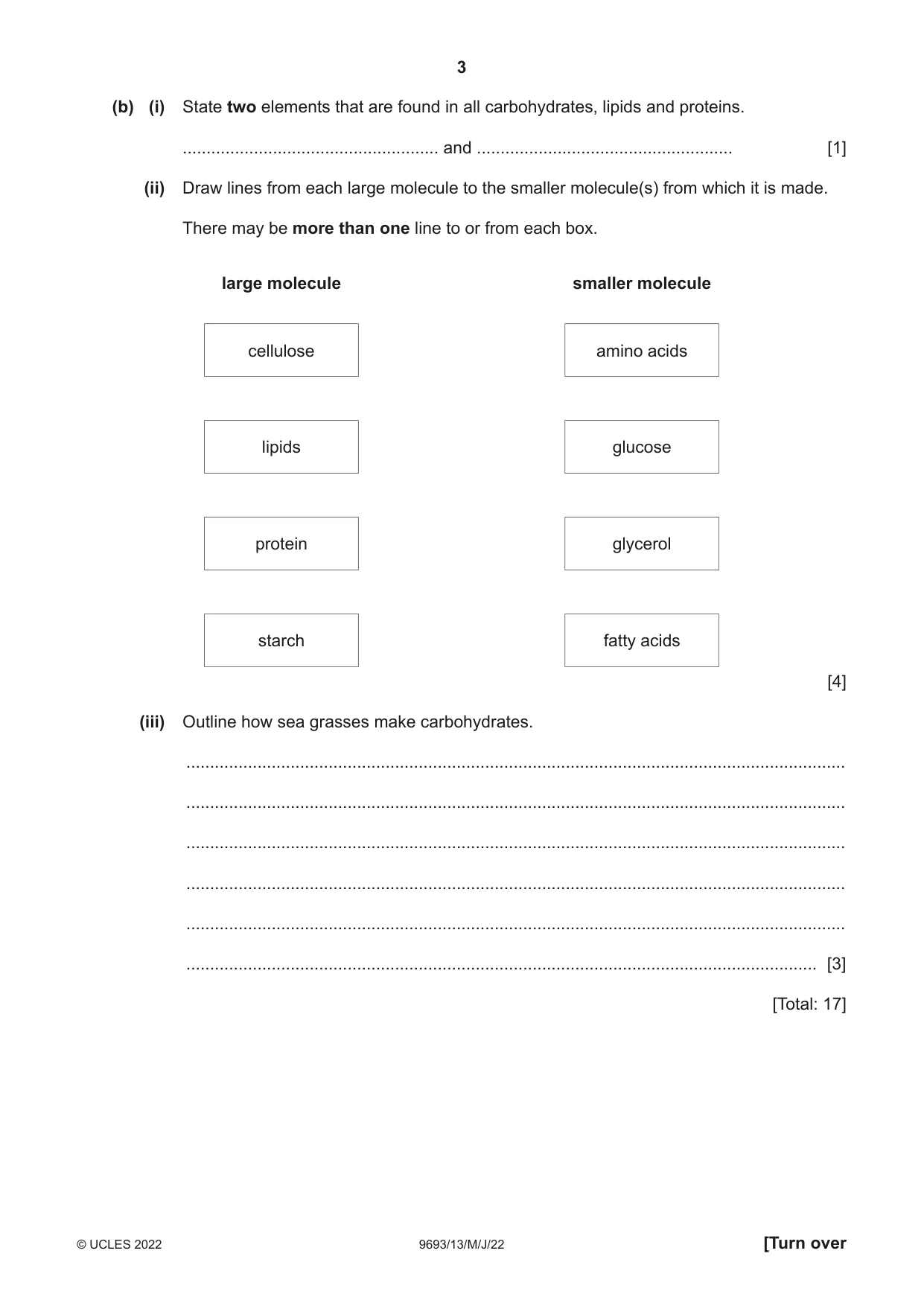
3 9693/13/M/J/22 © UCLES 2022 [Turn over (b) (i) State two elements that are found in all carbohydrates, lipids and proteins. … and … [1] (ii) Draw lines from each large molecule to the smaller molecule(s) from which it is made. There may be more than one line to or from each box. large molecule smaller molecule cellulose amino acids lipids glucose protein glycerol starch fatty acids [4] (iii) Outline how sea grasses make carbohydrates. … … … … … … [3] [Total: 17]
Question paper, page 4
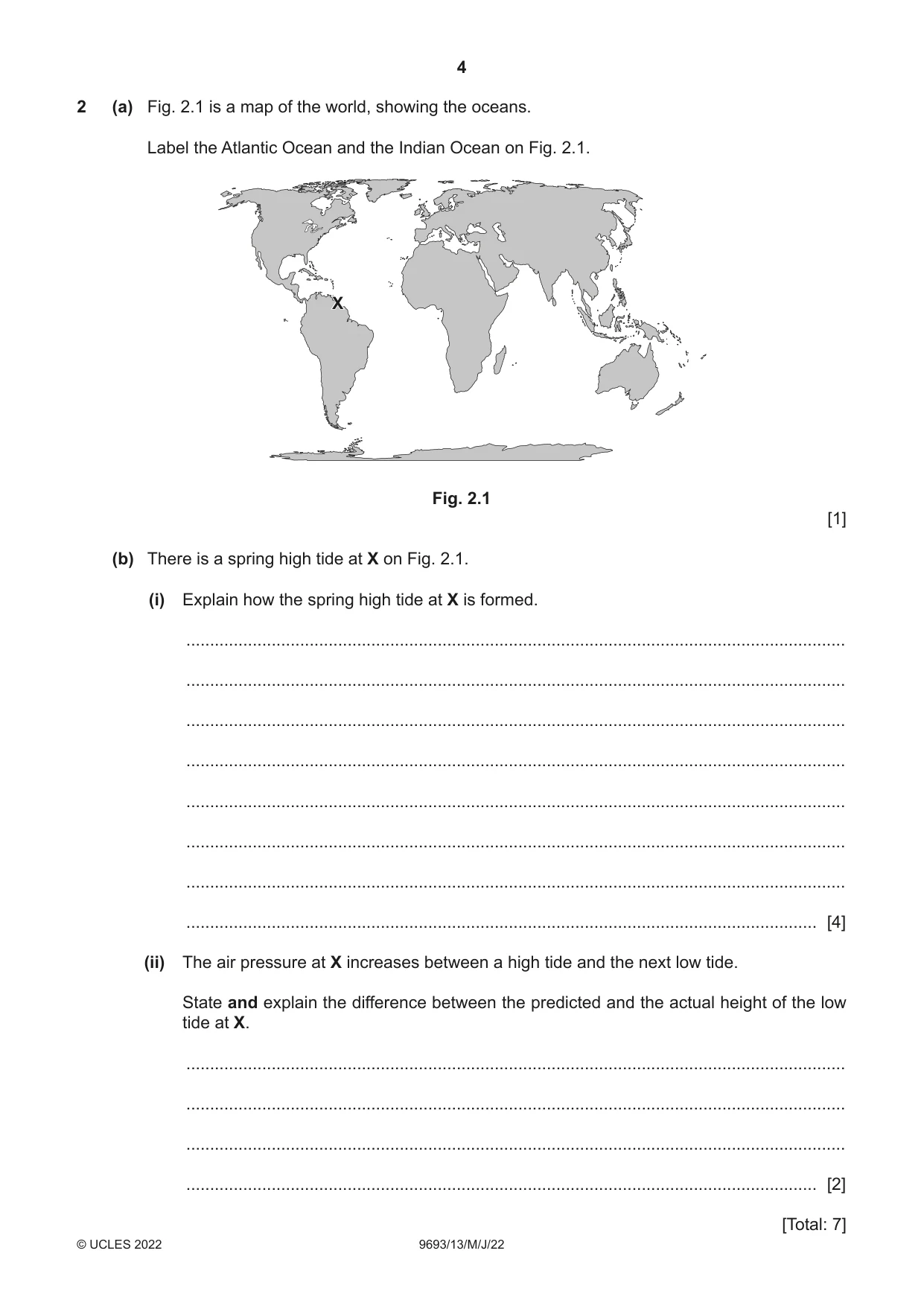
4 9693/13/M/J/22 © UCLES 2022 2 (a) Fig. 2.1 is a map of the world, showing the oceans. Label the Atlantic Ocean and the Indian Ocean on Fig. 2.1. X Fig. 2.1 [1] (b) There is a spring high tide at X on Fig. 2.1. (i) Explain how the spring high tide at X is formed. … … … … … … … … [4] (ii) The air pressure at X increases between a high tide and the next low tide. State and explain the difference between the predicted and the actual height of the low tide at X. … … … … [2] [Total: 7]
Question paper, page 5
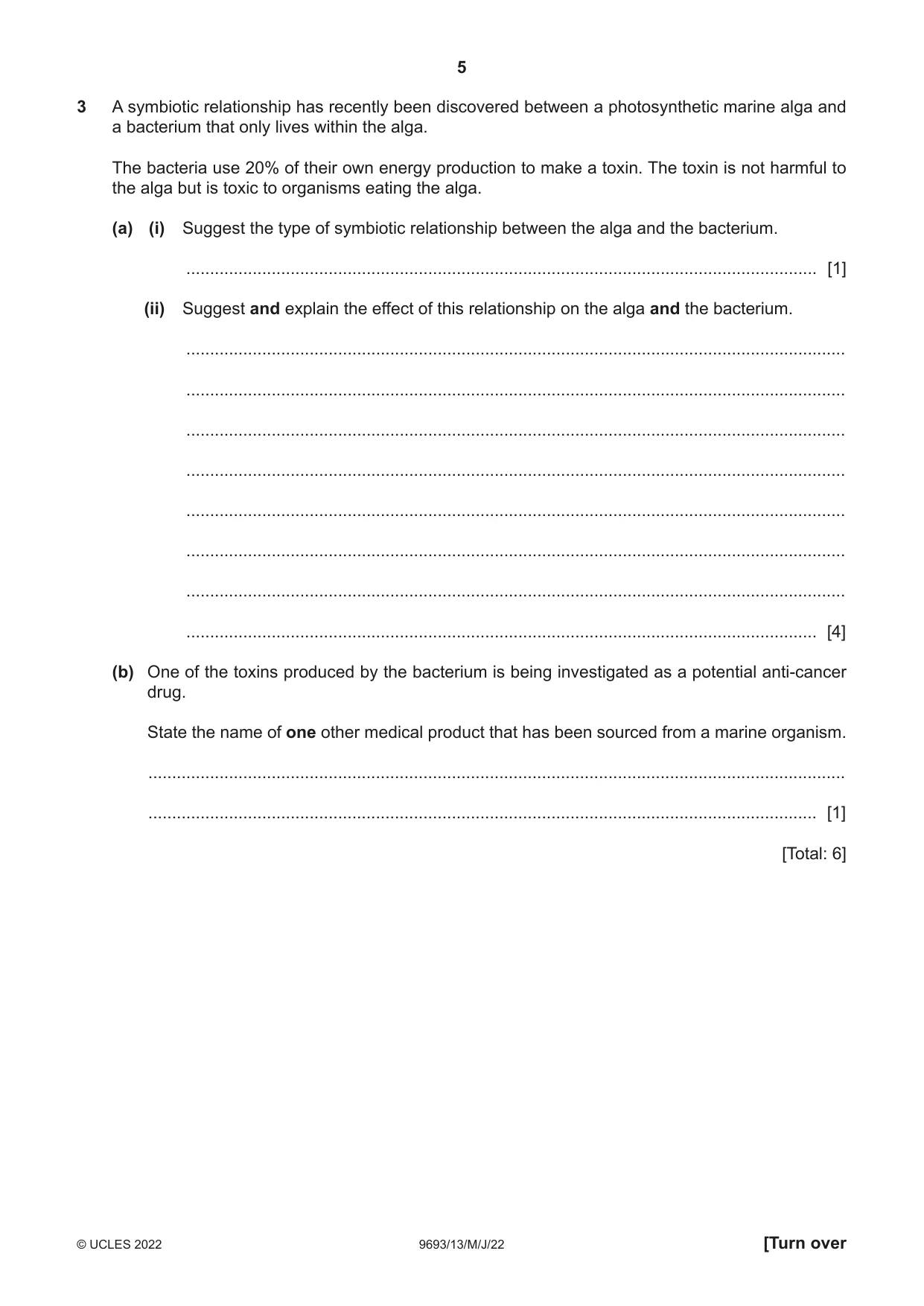
5 9693/13/M/J/22 © UCLES 2022 [Turn over 3 A symbiotic relationship has recently been discovered between a photosynthetic marine alga and a bacterium that only lives within the alga. The bacteria use 20% of their own energy production to make a toxin. The toxin is not harmful to the alga but is toxic to organisms eating the alga. (a) (i) Suggest the type of symbiotic relationship between the alga and the bacterium. … [1] (ii) Suggest and explain the effect of this relationship on the alga and the bacterium. … … … … … … … … [4] (b) One of the toxins produced by the bacterium is being investigated as a potential anti-cancer drug. State the name of one other medical product that has been sourced from a marine organism. … … [1] [Total: 6]
Question paper, page 6
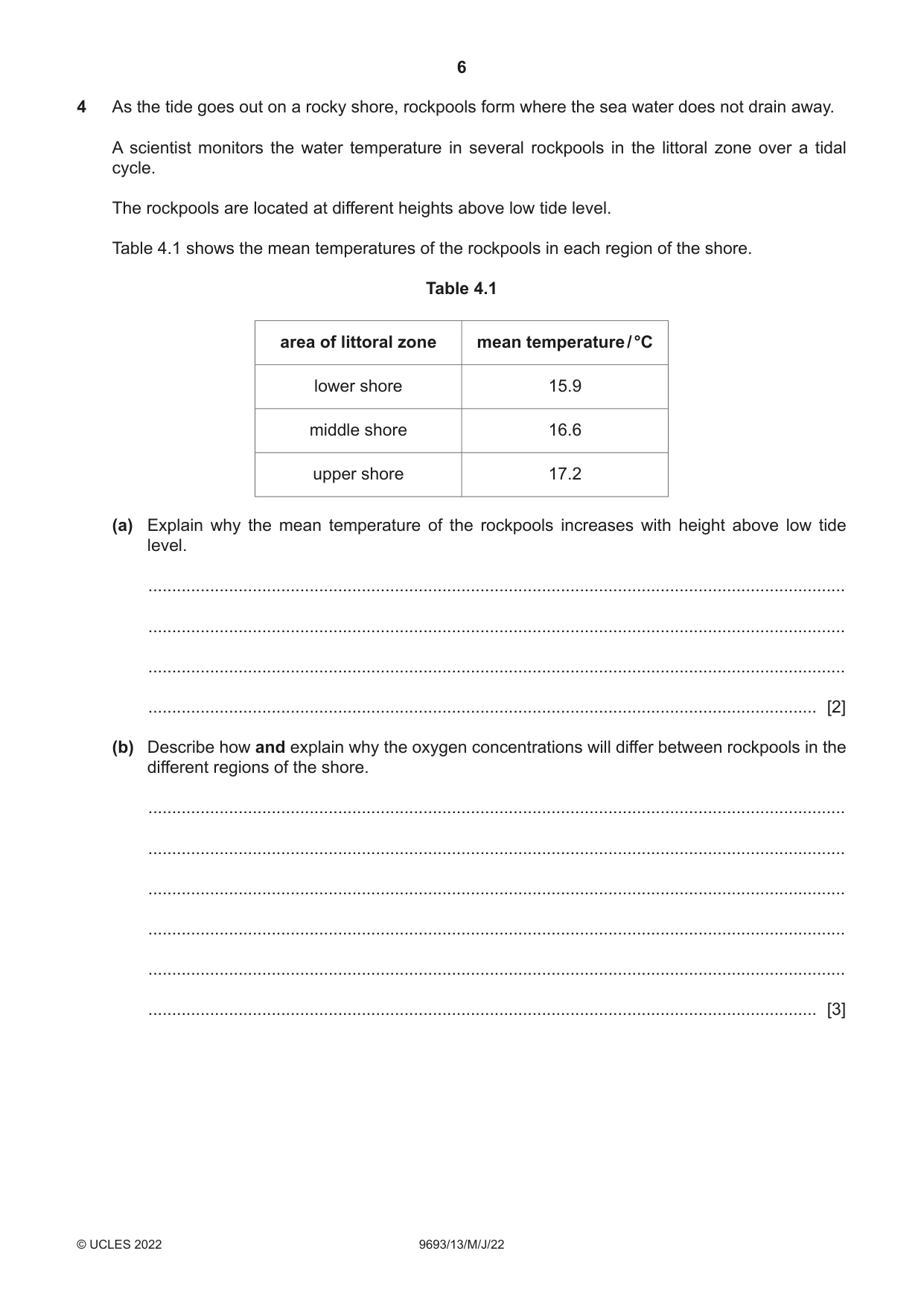
6 9693/13/M/J/22 © UCLES 2022 4 As the tide goes out on a rocky shore, rockpools form where the sea water does not drain away. A scientist monitors the water temperature in several rockpools in the littoral zone over a tidal cycle. The rockpools are located at different heights above low tide level. Table 4.1 shows the mean temperatures of the rockpools in each region of the shore. Table 4.1 area of littoral zone mean temperature / °C lower shore 15.9 middle shore 16.6 upper shore 17.2 (a) Explain why the mean temperature of the rockpools increases with height above low tide level. … … … … [2] (b) Describe how and explain why the oxygen concentrations will differ between rockpools in the different regions of the shore. … … … … … … [3]
Question paper, page 7
7 9693/13/M/J/22 © UCLES 2022 [Turn over (c) State two biotic factors that also affect the distribution of organisms in the lower rockpools. 1 … 2 … [2] (d) Suggest two adaptations that rocky shore organisms have to high wave action. 1 … … 2 … … [2] [Total: 9]
Question paper, page 8
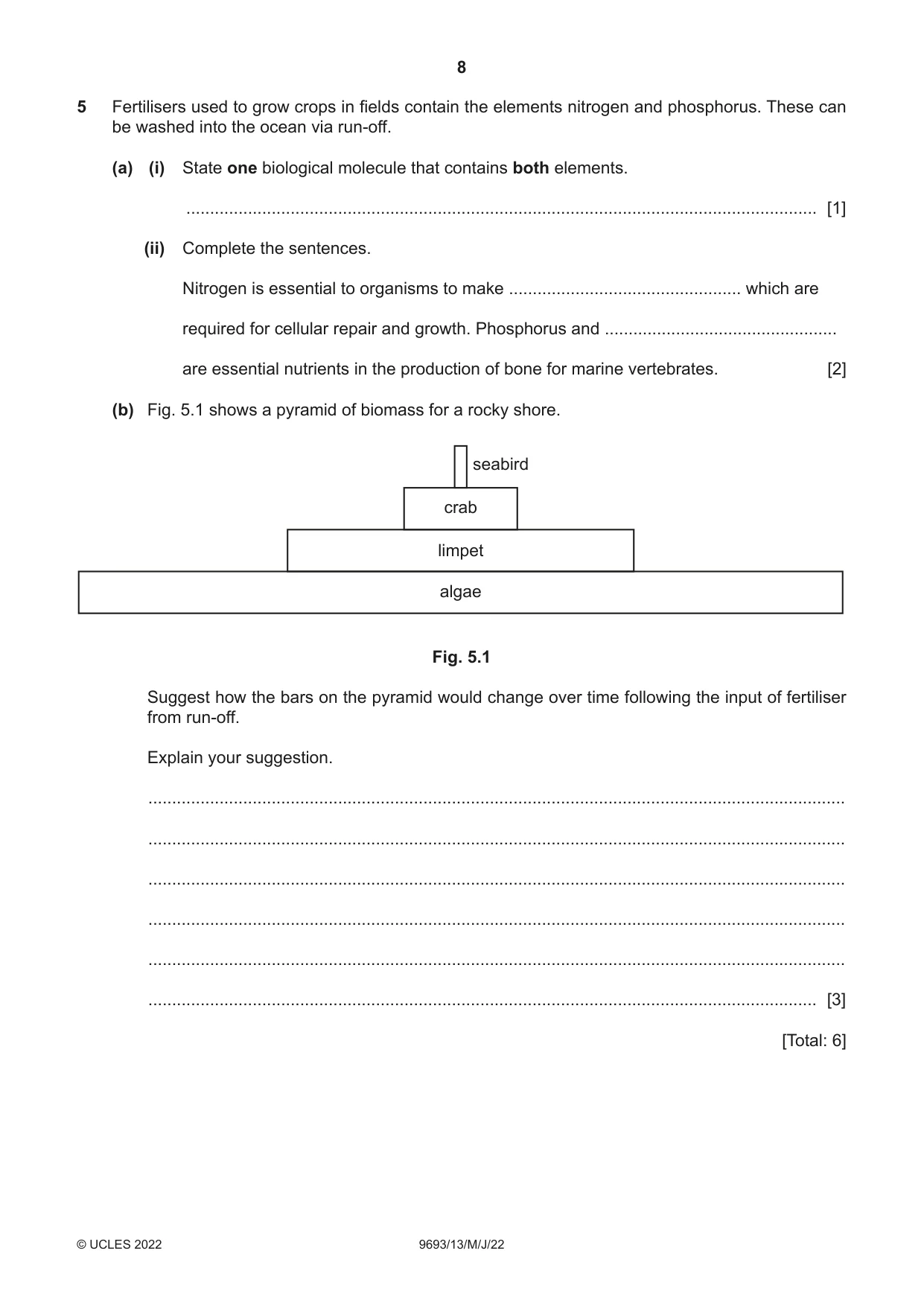
8 9693/13/M/J/22 © UCLES 2022 5 Fertilisers used to grow crops in fields contain the elements nitrogen and phosphorus. These can be washed into the ocean via run-off. (a) (i) State one biological molecule that contains both elements. … [1] (ii) Complete the sentences. Nitrogen is essential to organisms to make … which are required for cellular repair and growth. Phosphorus and … are essential nutrients in the production of bone for marine vertebrates. [2] (b) Fig. 5.1 shows a pyramid of biomass for a rocky shore. seabird crab limpet algae Fig. 5.1 Suggest how the bars on the pyramid would change over time following the input of fertiliser from run-off. Explain your suggestion. … … … … … … [3] [Total: 6]
Question paper, page 9
9 9693/13/M/J/22 © UCLES 2022 [Turn over Section B Answer all questions in this section. 6 (a) Describe the main structural features of a typical coral polyp and state the function of each feature. You may include labelled diagrams. … … … … … … … … … … … … … … … … … … … … [10]
Question paper, page 10
10 9693/13/M/J/22 © UCLES 2022 (b) Biodiversity of a healthy tropical coral reef is very high. Discuss the importance to the local economy of maintaining high biodiversity on tropical coral reefs. … … … … … … … … … … … … [6] [Total: 16]
Question paper, page 11
11 9693/13/M/J/22 © UCLES 2022 [Turn over 7 Describe the role of: • weathering • erosion • sedimentation in the formation of a muddy shore. … … … … … … … … … … … … … … [7]
Question paper, page 12
12 9693/13/M/J/22 © UCLES 2022 8 Describe how temperature and salinity gradients form in sea water and how mixing of these layers can occur. … … … … … … … … … … … … … … [7] The boundaries and names shown, the designations used and the presentation of material on any maps contained in this question paper/insert do not imply official endorsement or acceptance by Cambridge Assessment International Education concerning the legal status of any country, territory, or area or any of its authorities, or of the delimitation of its frontiers or boundaries. Permission to reproduce items where third-party owned material protected by copyright is included has been sought and cleared where possible. Every reasonable effort has been made by the publisher (UCLES) to trace copyright holders, but if any items requiring clearance have unwittingly been included, the publisher will be pleased to make amends at the earliest possible opportunity. To avoid the issue of disclosure of answer-related information to candidates, all copyright acknowledgements are reproduced online in the Cambridge Assessment International Education Copyright Acknowledgements Booklet. This is produced for each series of examinations and is freely available to download at www.cambridgeinternational.org after the live examination series. Cambridge Assessment International Education is part of Cambridge Assessment. Cambridge Assessment is the brand name of the University of Cambridge Local Examinations Syndicate (UCLES), which is a department of the University of Cambridge.
Mark scheme, page 1
This document consists of 14 printed pages. © UCLES 2022 [Turn over Cambridge International AS & A Level MARINE SCIENCE 9693/13 Paper 1 AS Level Theory May/June 2022 MARK SCHEME Maximum Mark: 75 Published This mark scheme is published as an aid to teachers and candidates, to indicate the requirements of the examination. It shows the basis on which Examiners were instructed to award marks. It does not indicate the details of the discussions that took place at an Examiners’ meeting before marking began, which would have considered the acceptability of alternative answers. Mark schemes should be read in conjunction with the question paper and the Principal Examiner Report for Teachers. Cambridge International will not enter into discussions about these mark schemes. Cambridge International is publishing the mark schemes for the May/June 2022 series for most Cambridge IGCSE, Cambridge International A and AS Level and Cambridge Pre-U components, and some Cambridge O Level components.
Mark scheme, page 2
9693/13 Cambridge International AS & A Level – Mark Scheme PUBLISHED May/June 2022 © UCLES 2022 Page 2 of 14 Generic Marking Principles These general marking principles must be applied by all examiners when marking candidate answers. They should be applied alongside the specific content of the mark scheme or generic level descriptors for a question. Each question paper and mark scheme will also comply with these marking principles. GENERIC MARKING PRINCIPLE 1: Marks must be awarded in line with: the specific content of the mark scheme or the generic level descriptors for the question the specific skills defined in the mark scheme or in the generic level descriptors for the question the standard of response required by a candidate as exemplified by the standardisation scripts. GENERIC MARKING PRINCIPLE 2: Marks awarded are always whole marks (not half marks, or other fractions). GENERIC MARKING PRINCIPLE 3: Marks must be awarded positively: marks are awarded for correct/valid answers, as defined in the mark scheme. However, credit is given for valid answers which go beyond the scope of the syllabus and mark scheme, referring to your Team Leader as appropriate marks are awarded when candidates clearly demonstrate what they know and can do marks are not deducted for errors marks are not deducted for omissions answers should only be judged on the quality of spelling, punctuation and grammar when these features are specifically assessed by the question as indicated by the mark scheme. The meaning, however, should be unambiguous. GENERIC MARKING PRINCIPLE 4: Rules must be applied consistently, e.g. in situations where candidates have not followed instructions or in the application of generic level descriptors.
Mark scheme, page 3
9693/13 Cambridge International AS & A Level – Mark Scheme PUBLISHED May/June 2022 © UCLES 2022 Page 3 of 14 GENERIC MARKING PRINCIPLE 5: Marks should be awarded using the full range of marks defined in the mark scheme for the question (however; the use of the full mark range may be limited according to the quality of the candidate responses seen). GENERIC MARKING PRINCIPLE 6: Marks awarded are based solely on the requirements as defined in the mark scheme. Marks should not be awarded with grade thresholds or grade descriptors in mind.
Mark scheme, page 4
9693/13 Cambridge International AS & A Level – Mark Scheme PUBLISHED May/June 2022 © UCLES 2022 Page 4 of 14 Science-Specific Marking Principles 1 Examiners should consider the context and scientific use of any keywords when awarding marks. Although keywords may be present, marks should not be awarded if the keywords are used incorrectly. 2 The examiner should not choose between contradictory statements given in the same question part, and credit should not be awarded for any correct statement that is contradicted within the same question part. Wrong science that is irrelevant to the question should be ignored. 3 Although spellings do not have to be correct, spellings of syllabus terms must allow for clear and unambiguous separation from other syllabus terms with which they may be confused (e.g. ethane / ethene, glucagon / glycogen, refraction / reflection). 4 The error carried forward (ecf) principle should be applied, where appropriate. If an incorrect answer is subsequently used in a scientifically correct way, the candidate should be awarded these subsequent marking points. Further guidance will be included in the mark scheme where necessary and any exceptions to this general principle will be noted. 5 ‘List rule’ guidance For questions that require n responses (e.g. State two reasons …): The response should be read as continuous prose, even when numbered answer spaces are provided. Any response marked ignore in the mark scheme should not count towards n. Incorrect responses should not be awarded credit but will still count towards n. Read the entire response to check for any responses that contradict those that would otherwise be credited. Credit should not be awarded for any responses that are contradicted within the rest of the response. Where two responses contradict one another, this should be treated as a single incorrect response. Non-contradictory responses after the first n responses may be ignored even if they include incorrect science.
Mark scheme, page 5
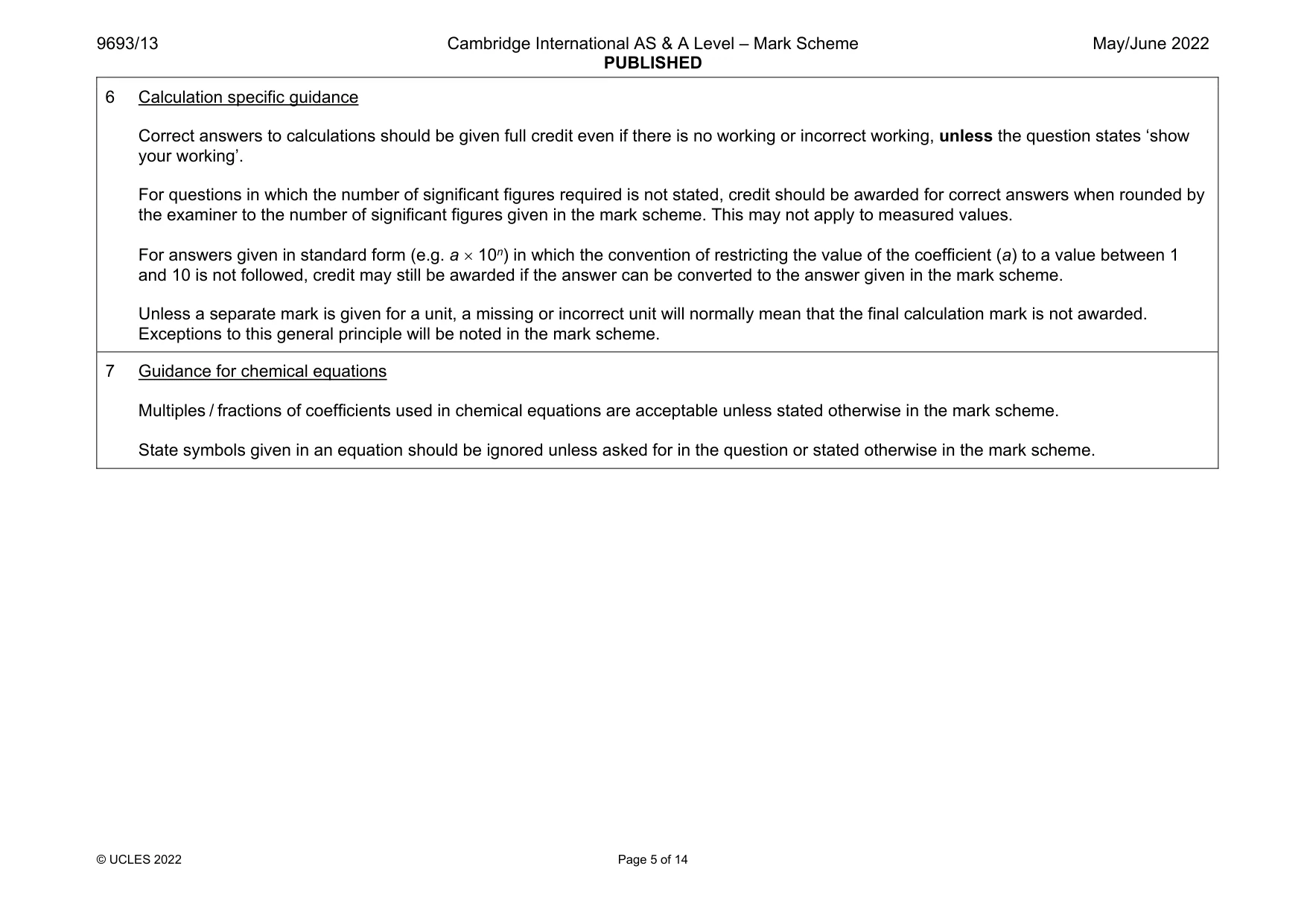
9693/13 Cambridge International AS & A Level – Mark Scheme PUBLISHED May/June 2022 © UCLES 2022 Page 5 of 14 6 Calculation specific guidance Correct answers to calculations should be given full credit even if there is no working or incorrect working, unless the question states ‘show your working’. For questions in which the number of significant figures required is not stated, credit should be awarded for correct answers when rounded by the examiner to the number of significant figures given in the mark scheme. This may not apply to measured values. For answers given in standard form (e.g. a 10n) in which the convention of restricting the value of the coefficient (a) to a value between 1 and 10 is not followed, credit may still be awarded if the answer can be converted to the answer given in the mark scheme. Unless a separate mark is given for a unit, a missing or incorrect unit will normally mean that the final calculation mark is not awarded. Exceptions to this general principle will be noted in the mark scheme. 7 Guidance for chemical equations Multiples / fractions of coefficients used in chemical equations are acceptable unless stated otherwise in the mark scheme. State symbols given in an equation should be ignored unless asked for in the question or stated otherwise in the mark scheme.
Mark scheme, page 6
9693/13 Cambridge International AS & A Level – Mark Scheme PUBLISHED May/June 2022 © UCLES 2022 Page 6 of 14 Key Points Refer to the Instructions for Examiners (marking scripts on-screen) 2021 booklet for details of all procedures. As soon as you are able (usually about two days after the paper set date), please access the question paper and provisional mark scheme from the RM support portal. In conjunction with the provisional mark scheme, browse scripts in RM Assessor (scoris) and feed any issues or comments to your Team Leader. The decisions of the Principal Examiner are final, and the final agreed mark scheme must be applied as intended by the Principal Examiner. If you are in any doubt about applying this mark scheme, consult your Team Leader by telephone or by email. Please report any serious problems during marking to your Team Leader / Principal Examiner (details in the confidential package). If you require technical support, please contact the RM Helpdesk. If you require administrative support relating to the examination process, please contact the CIE Examiner Helpdesk. For all queries relating to payment, please contact Cambridge Assessment Finance Division. Up-to-date contact details for each of these can be found in the Instructions for Examiners (marking scripts on-screen) 2021 booklet. The schedule of dates is very important. It is essential that you meet the Batch 1 and Batch 2 deadlines. If you experience problems, you must contact your Team Leader without delay. Mark strictly to the mark scheme. All marks awarded must relate directly to the mark scheme. However, always credit correct, relevant, science, even if it lies outside of the syllabus content. For answers not provided for in the mark scheme, give as far as possible equivalent marks for equivalent work. If in doubt, consult your Team Leader. Never transfer marks allocated for one question item to another. Where work has been crossed out, mark it when nothing else has been written. Do not penalise grammatical constructions / spelling of words that are not in the syllabus, so long as the meaning is clear. Credit should be given to all the candidate’s correct responses, wherever they have been written (including blank pages, around diagrams, etc.). Additional materials may be attached and must be checked for candidates’ responses. Show that you have checked blank pages for answers by placing an annotation on each blank page. Do not use crosses or ticks for this purpose, unless the points are credited as part of a response to a specific question. In this instance, please use the On Page Comment tool to clearly annotate which question part the marks relate to. If the candidate has left an answer blank, or has left a mark / comment that does not in any way relate to the question (for example ‘my dog is black’ or ‘----’ or ‘can’t do’ or ‘?’) use the NR (No Response, #) option. Award 0 marks for any attempt which does not earn credit. This includes copying out all / part of the question or any working that does not earn any marks (whether crossed out or not).
Mark scheme, page 7
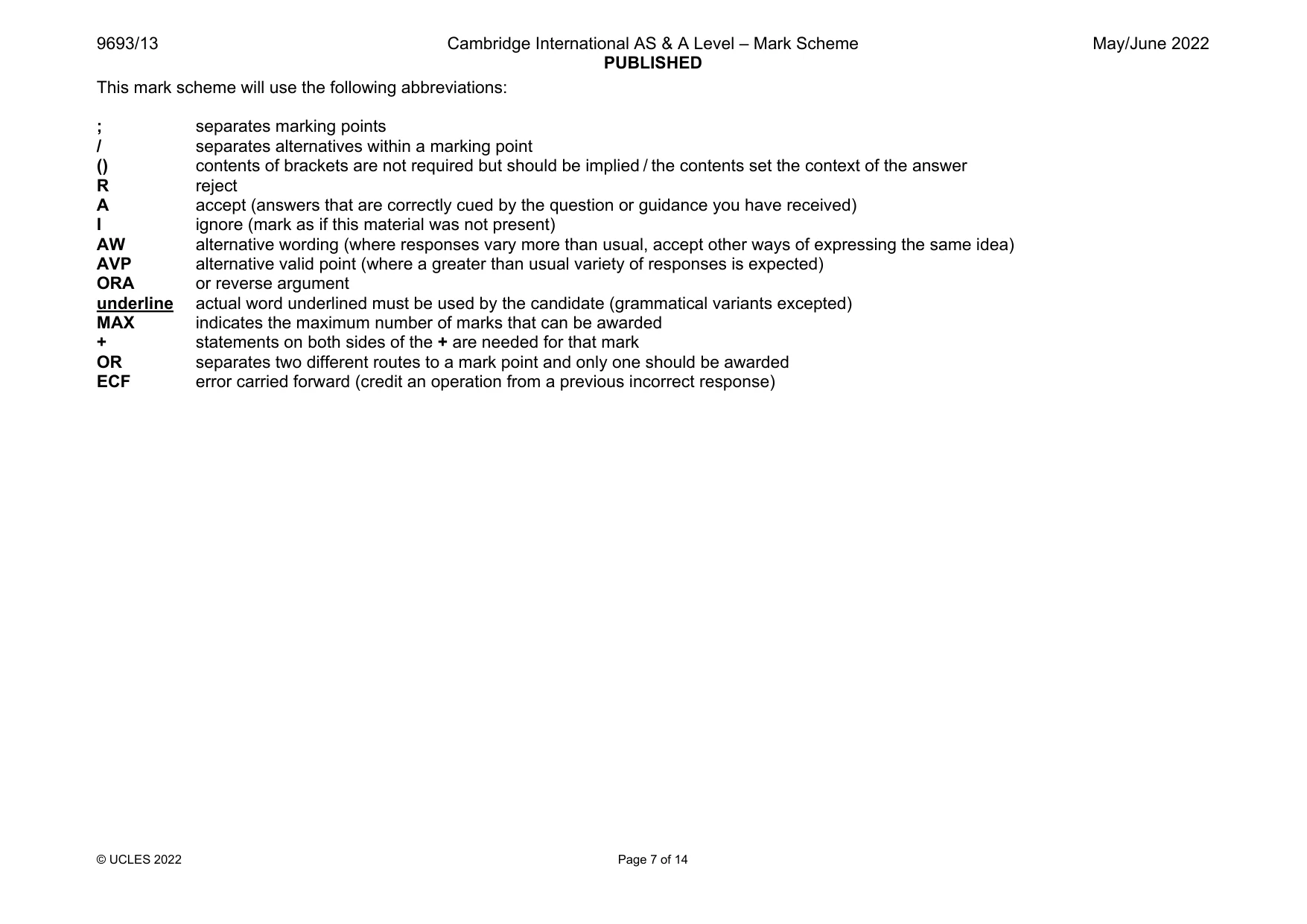
9693/13 Cambridge International AS & A Level – Mark Scheme PUBLISHED May/June 2022 © UCLES 2022 Page 7 of 14 This mark scheme will use the following abbreviations: ; separates marking points / separates alternatives within a marking point () contents of brackets are not required but should be implied / the contents set the context of the answer R reject A accept (answers that are correctly cued by the question or guidance you have received) I ignore (mark as if this material was not present) AW alternative wording (where responses vary more than usual, accept other ways of expressing the same idea) AVP alternative valid point (where a greater than usual variety of responses is expected) ORA or reverse argument underline actual word underlined must be used by the candidate (grammatical variants excepted) MAX indicates the maximum number of marks that can be awarded + statements on both sides of the + are needed for that mark OR separates two different routes to a mark point and only one should be awarded ECF error carried forward (credit an operation from a previous incorrect response)
Mark scheme, page 8
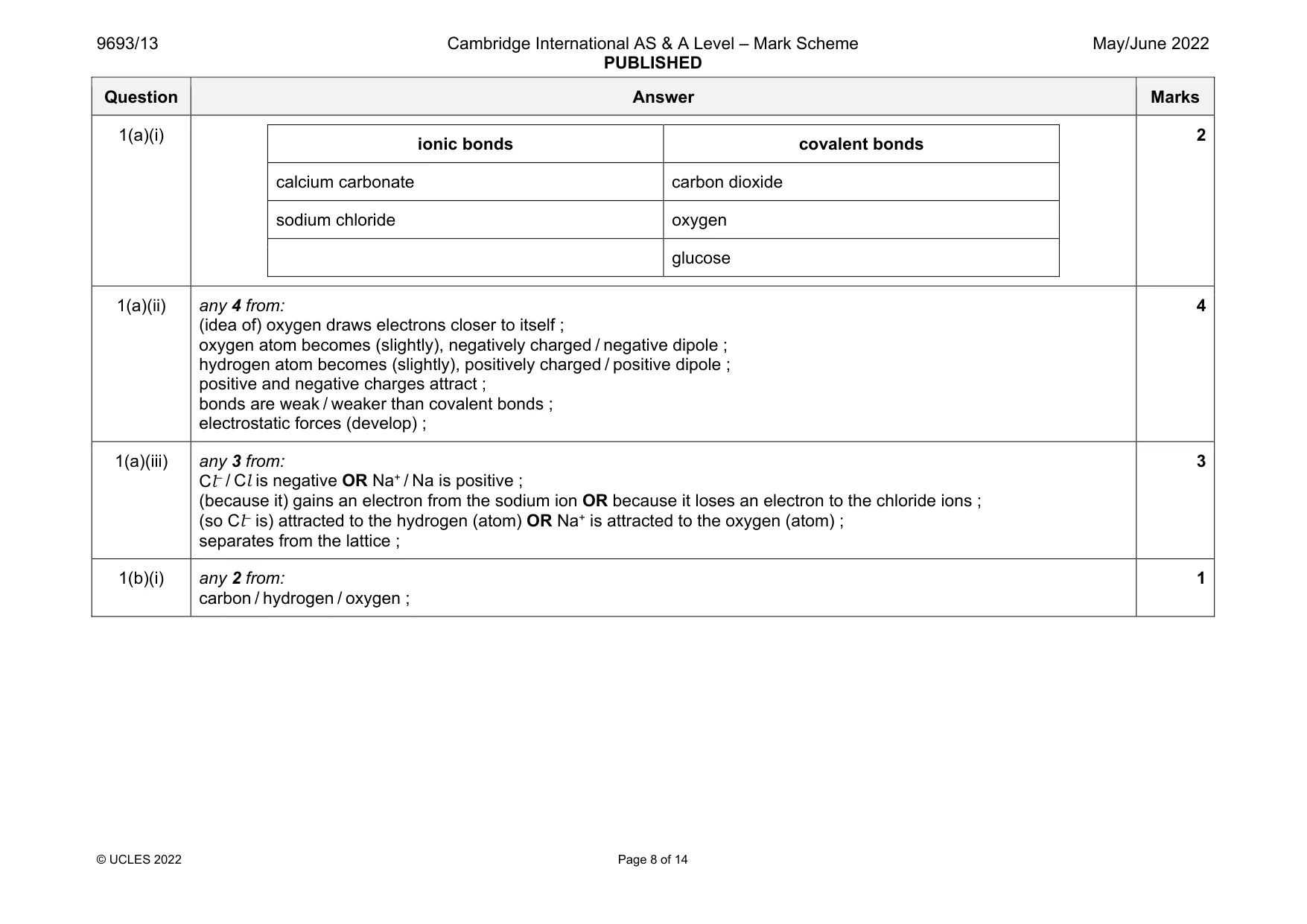
9693/13 Cambridge International AS & A Level – Mark Scheme PUBLISHED May/June 2022 © UCLES 2022 Page 8 of 14 Question Answer Marks 1(a)(i) ionic bonds covalent bonds calcium carbonate carbon dioxide sodium chloride oxygen glucose 2 1(a)(ii) any 4 from: (idea of) oxygen draws electrons closer to itself ; oxygen atom becomes (slightly), negatively charged / negative dipole ; hydrogen atom becomes (slightly), positively charged / positive dipole ; positive and negative charges attract ; bonds are weak / weaker than covalent bonds ; electrostatic forces (develop) ; 4 1(a)(iii) any 3 from: Cl– / Cl is negative OR Na+ / Na is positive ; (because it) gains an electron from the sodium ion OR because it loses an electron to the chloride ions ; (so Cl– is) attracted to the hydrogen (atom) OR Na+ is attracted to the oxygen (atom) ; separates from the lattice ; 3 1(b)(i) any 2 from: carbon / hydrogen / oxygen ; 1
Mark scheme, page 9
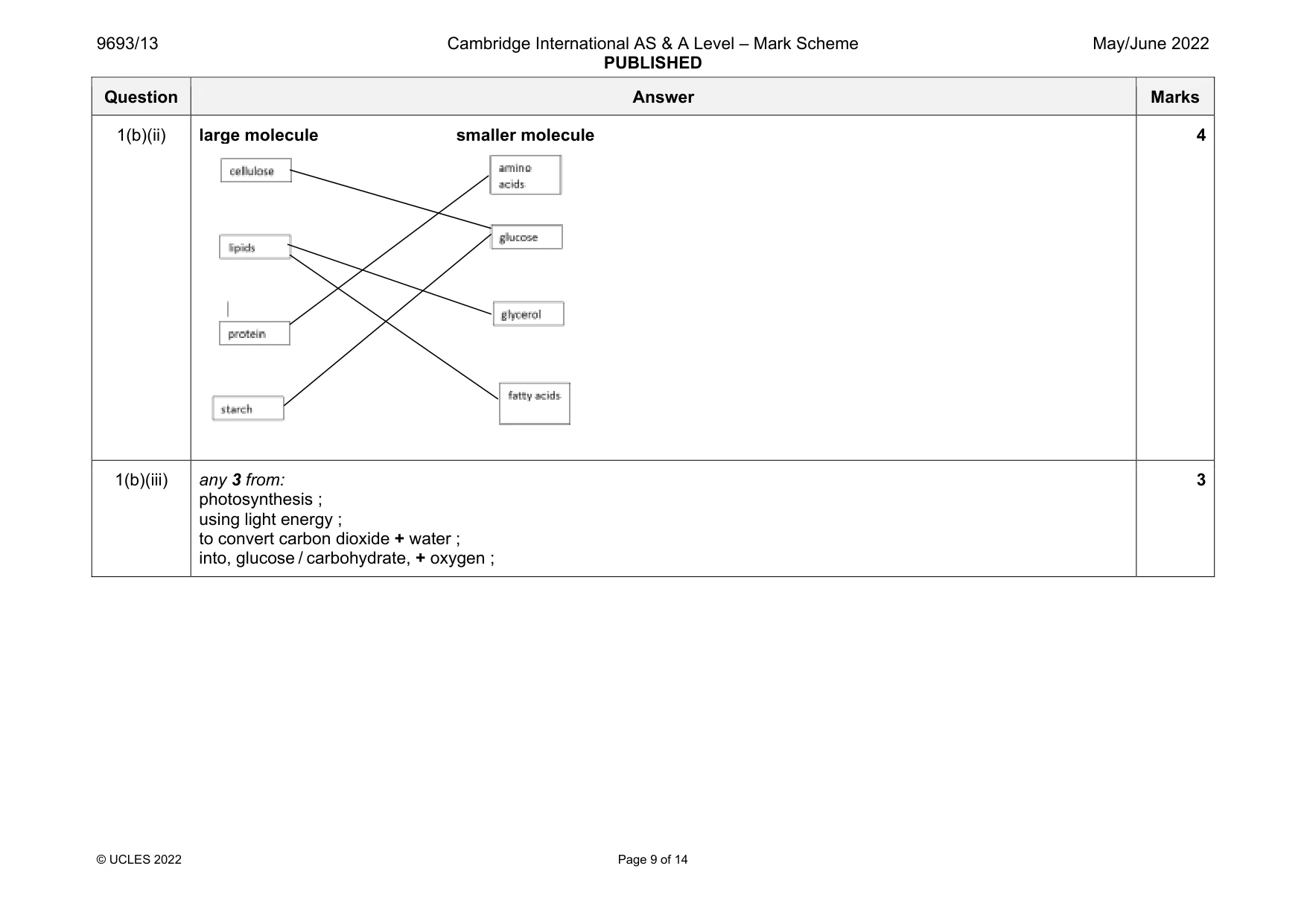
9693/13 Cambridge International AS & A Level – Mark Scheme PUBLISHED May/June 2022 © UCLES 2022 Page 9 of 14 Question Answer Marks 1(b)(ii) large molecule smaller molecule 4 1(b)(iii) any 3 from: photosynthesis ; using light energy ; to convert carbon dioxide + water ; into, glucose / carbohydrate, + oxygen ; 3
Mark scheme, page 10
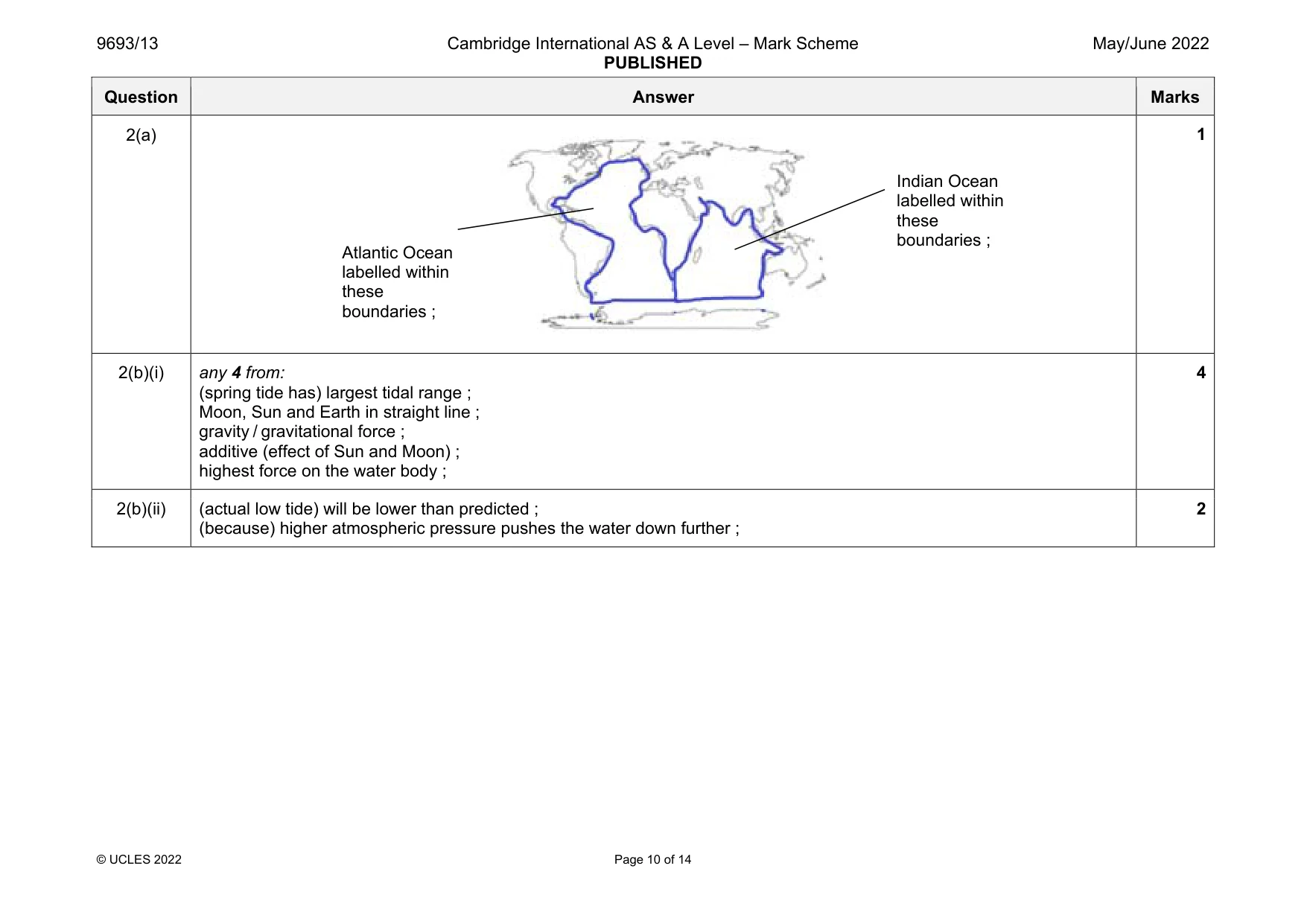
9693/13 Cambridge International AS & A Level – Mark Scheme PUBLISHED May/June 2022 © UCLES 2022 Page 10 of 14 Question Answer Marks 2(a) 1 2(b)(i) any 4 from: (spring tide has) largest tidal range ; Moon, Sun and Earth in straight line ; gravity / gravitational force ; additive (effect of Sun and Moon) ; highest force on the water body ; 4 2(b)(ii) (actual low tide) will be lower than predicted ; (because) higher atmospheric pressure pushes the water down further ; 2 Indian Ocean labelled within these boundaries ; Atlantic Ocean labelled within these boundaries ;
Mark scheme, page 11
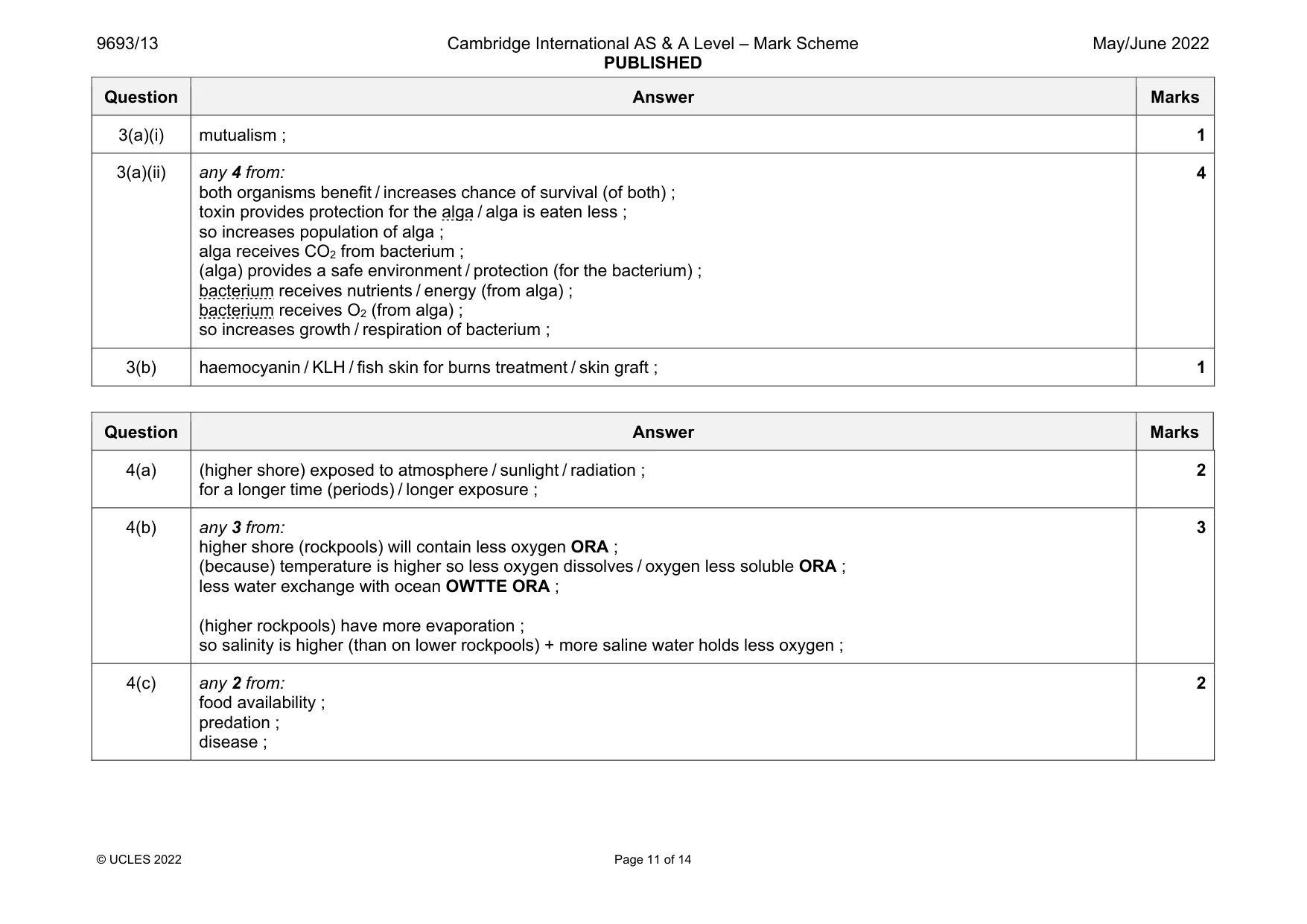
9693/13 Cambridge International AS & A Level – Mark Scheme PUBLISHED May/June 2022 © UCLES 2022 Page 11 of 14 Question Answer Marks 3(a)(i) mutualism ; 1 3(a)(ii) any 4 from: both organisms benefit / increases chance of survival (of both) ; toxin provides protection for the alga / alga is eaten less ; so increases population of alga ; alga receives CO2 from bacterium ; (alga) provides a safe environment / protection (for the bacterium) ; bacterium receives nutrients / energy (from alga) ; bacterium receives O2 (from alga) ; so increases growth / respiration of bacterium ; 4 3(b) haemocyanin / KLH / fish skin for burns treatment / skin graft ; 1 Question Answer Marks 4(a) (higher shore) exposed to atmosphere / sunlight / radiation ; for a longer time (periods) / longer exposure ; 2 4(b) any 3 from: higher shore (rockpools) will contain less oxygen ORA ; (because) temperature is higher so less oxygen dissolves / oxygen less soluble ORA ; less water exchange with ocean OWTTE ORA ; (higher rockpools) have more evaporation ; so salinity is higher (than on lower rockpools) + more saline water holds less oxygen ; 3 4(c) any 2 from: food availability ; predation ; disease ; 2
Mark scheme, page 12
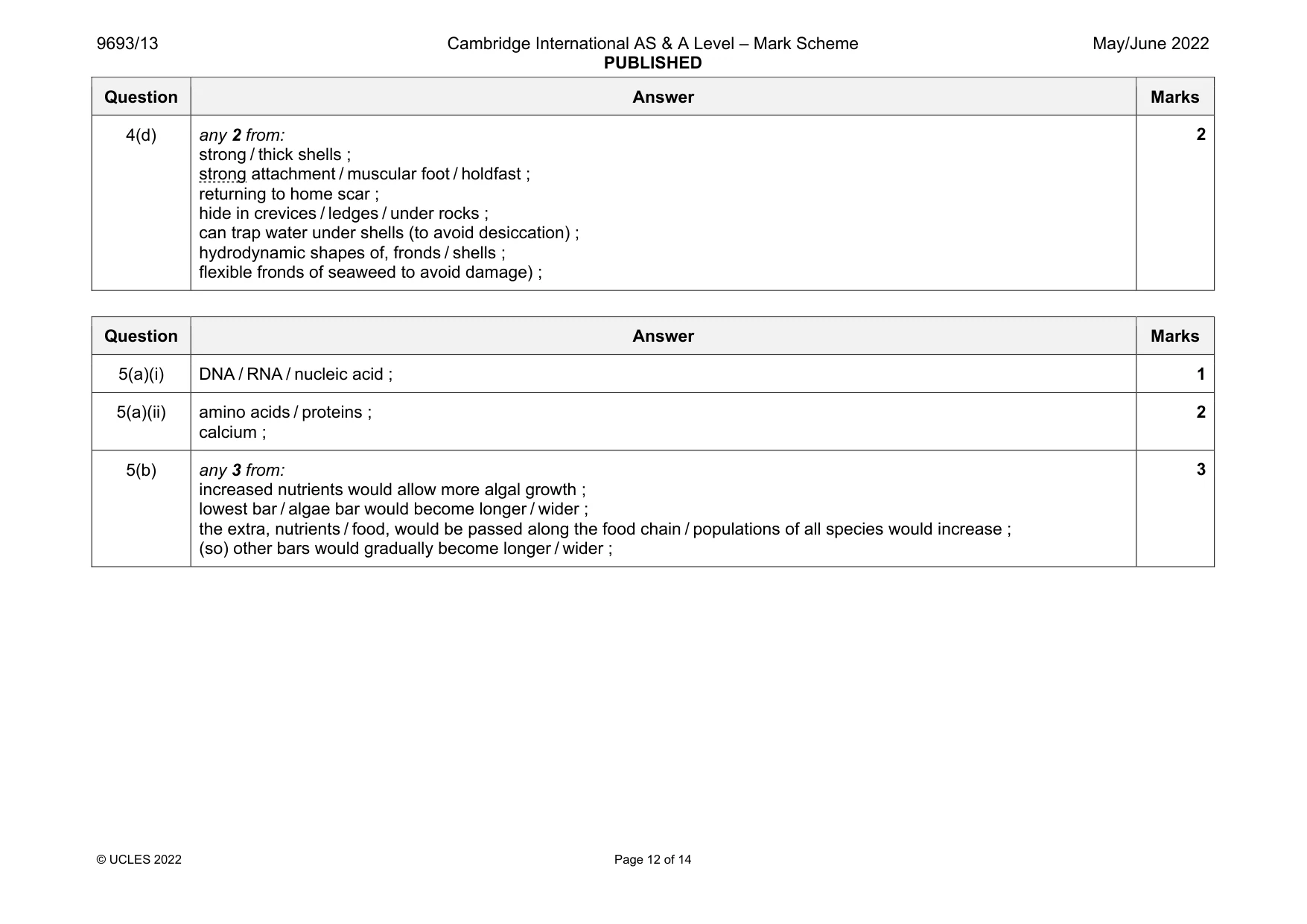
9693/13 Cambridge International AS & A Level – Mark Scheme PUBLISHED May/June 2022 © UCLES 2022 Page 12 of 14 Question Answer Marks 4(d) any 2 from: strong / thick shells ; strong attachment / muscular foot / holdfast ; returning to home scar ; hide in crevices / ledges / under rocks ; can trap water under shells (to avoid desiccation) ; hydrodynamic shapes of, fronds / shells ; flexible fronds of seaweed to avoid damage) ; 2 Question Answer Marks 5(a)(i) DNA / RNA / nucleic acid ; 1 5(a)(ii) amino acids / proteins ; calcium ; 2 5(b) any 3 from: increased nutrients would allow more algal growth ; lowest bar / algae bar would become longer / wider ; the extra, nutrients / food, would be passed along the food chain / populations of all species would increase ; (so) other bars would gradually become longer / wider ; 3
Mark scheme, page 13
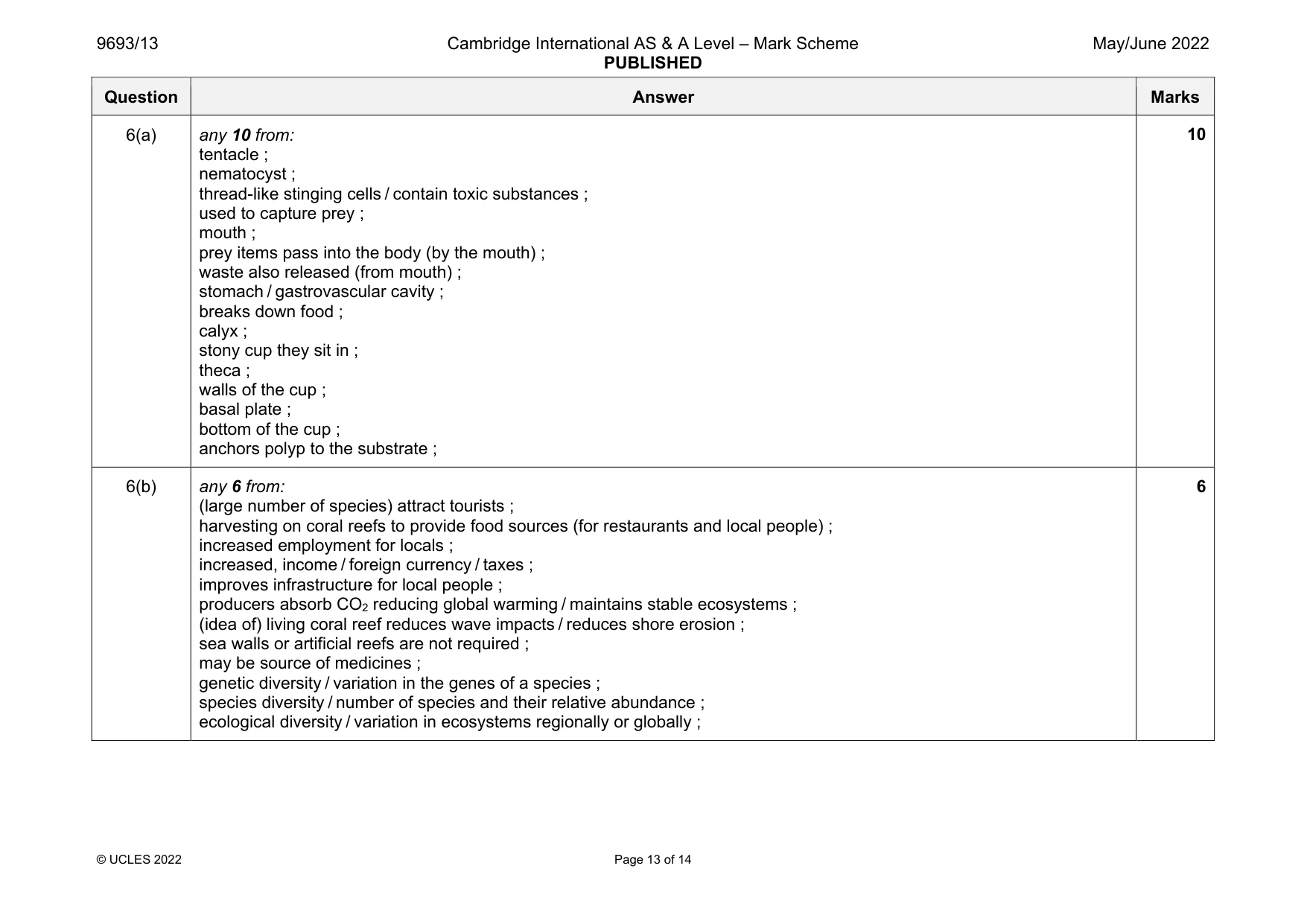
9693/13 Cambridge International AS & A Level – Mark Scheme PUBLISHED May/June 2022 © UCLES 2022 Page 13 of 14 Question Answer Marks 6(a) any 10 from: tentacle ; nematocyst ; thread-like stinging cells / contain toxic substances ; used to capture prey ; mouth ; prey items pass into the body (by the mouth) ; waste also released (from mouth) ; stomach / gastrovascular cavity ; breaks down food ; calyx ; stony cup they sit in ; theca ; walls of the cup ; basal plate ; bottom of the cup ; anchors polyp to the substrate ; 10 6(b) any 6 from: (large number of species) attract tourists ; harvesting on coral reefs to provide food sources (for restaurants and local people) ; increased employment for locals ; increased, income / foreign currency / taxes ; improves infrastructure for local people ; producers absorb CO2 reducing global warming / maintains stable ecosystems ; (idea of) living coral reef reduces wave impacts / reduces shore erosion ; sea walls or artificial reefs are not required ; may be source of medicines ; genetic diversity / variation in the genes of a species ; species diversity / number of species and their relative abundance ; ecological diversity / variation in ecosystems regionally or globally ; 6
Mark scheme, page 14
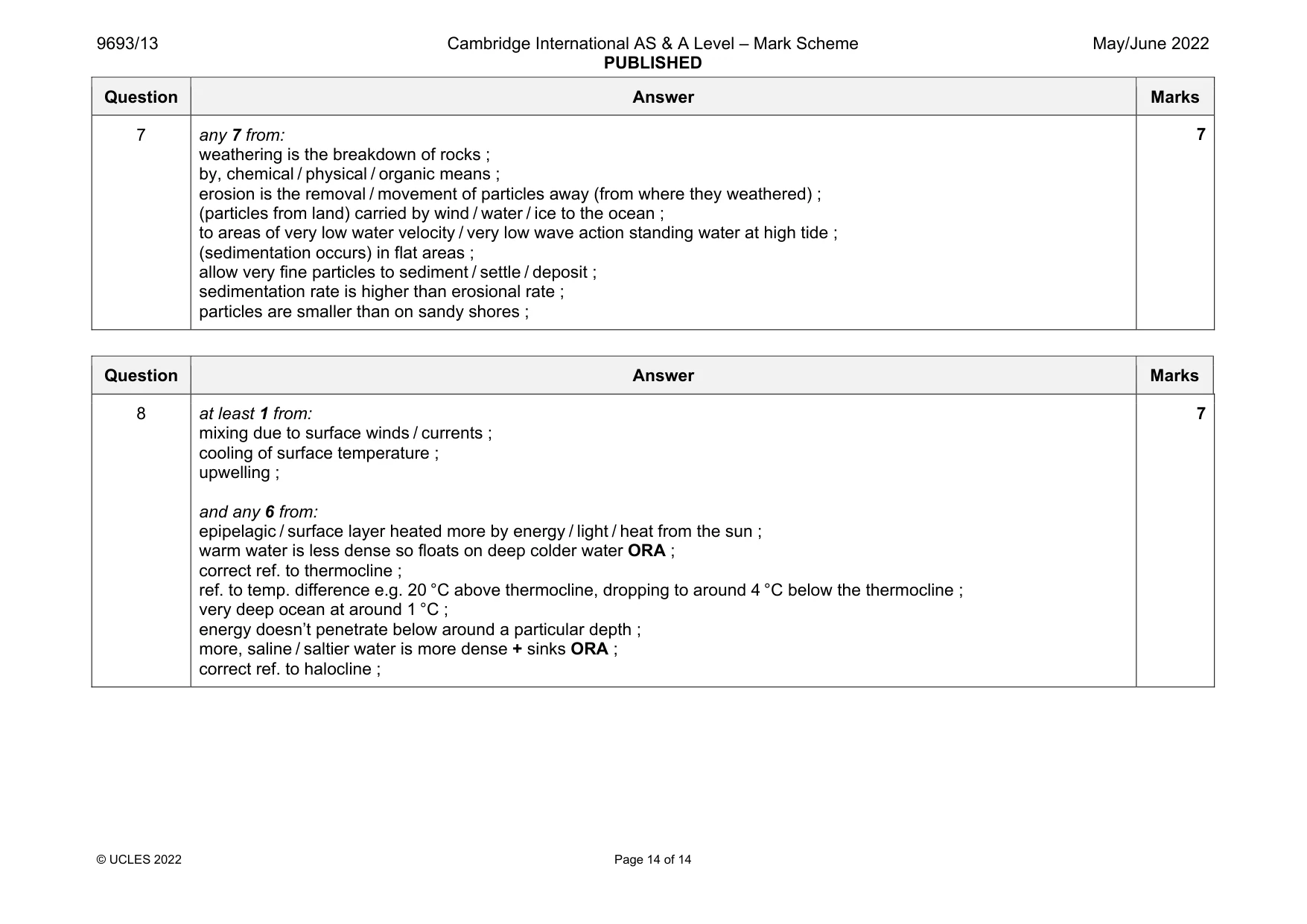
9693/13 Cambridge International AS & A Level – Mark Scheme PUBLISHED May/June 2022 © UCLES 2022 Page 14 of 14 Question Answer Marks 7 any 7 from: weathering is the breakdown of rocks ; by, chemical / physical / organic means ; erosion is the removal / movement of particles away (from where they weathered) ; (particles from land) carried by wind / water / ice to the ocean ; to areas of very low water velocity / very low wave action standing water at high tide ; (sedimentation occurs) in flat areas ; allow very fine particles to sediment / settle / deposit ; sedimentation rate is higher than erosional rate ; particles are smaller than on sandy shores ; 7 Question Answer Marks 8 at least 1 from: mixing due to surface winds / currents ; cooling of surface temperature ; upwelling ; and any 6 from: epipelagic / surface layer heated more by energy / light / heat from the sun ; warm water is less dense so floats on deep colder water ORA ; correct ref. to thermocline ; ref. to temp. difference e.g. 20 °C above thermocline, dropping to around 4 °C below the thermocline ; very deep ocean at around 1 °C ; energy doesn’t penetrate below around a particular depth ; more, saline / saltier water is more dense + sinks ORA ; correct ref. to halocline ; 7
What you needed in this session
Cambridge’s own grade thresholds for 2022 May/June, Paper 1 · Variant 3. A higher threshold means an easier paper — the bar moves with how the cohort did.