Cambridge A Level Marine Science 9693 — 2023 May/June Paper 1 · Variant 1
9693/11/M/J/23 · 75 marks · ≈84 min
The question paper and its mark scheme, free to read here and free to download. This is Cambridge’s own paper, exactly as it was sat.
Question paper16 pages

Mark scheme16 pages
Answers below. Sit the paper first if you are practising.
Paper as text
Question paper, page 1
This document has 16 pages. Any blank pages are indicated. [Turn over Cambridge International AS & A Level MARINE SCIENCE 9693/11 Paper 1 AS Level Theory May/June 2023 1 hour 45 minutes You must answer on the question paper. No additional materials are needed. INSTRUCTIONS ● Answer all questions. ● Use a black or dark blue pen. You may use an HB pencil for any diagrams or graphs. ● Write your name, centre number and candidate number in the boxes at the top of the page. ● Write your answer to each question in the space provided. ● Do not use an erasable pen or correction fluid. ● Do not write on any bar codes. ● You may use a calculator. ● You should show all your working and use appropriate units. INFORMATION ● The total mark for this paper is 75. ● The number of marks for each question or part question is shown in brackets [ ]. * 2 7 9 3 4 2 4 0 6 3 * DC (RW/CGW) 316689/3 © UCLES 2023
Question paper, page 2
2 9693/11/M/J/23 © UCLES 2023 Section A Answer all questions in this section. 1 (a) Complete Fig. 1.1 by sorting the features of seagrass and macroalgae shown in the box below. blade flowers gas bladder holdfast photosynthetic primary producer rhizome stipe features of macroalgae … … … … … features of seagrass … … … … … features of both … … … … … Fig. 1.1 [2]
Question paper, page 3
3 9693/11/M/J/23 © UCLES 2023 [Turn over (b) Describe how seagrasses are of economic importance. … … … … … … … … [4] (c) A scientist states that an ecosystem has a high species diversity of macroalgae. Explain what this statement means. … … … … [2] [Total: 8]
Question paper, page 4
4 9693/11/ M / J /23 © UCLES 2023 2 (a) The Earth’s crust is made up of three types of tectonic plate boundaries. Complete Table 2.1. One row has been completed for you. Do not refer to earthquakes in your answer. Table 2.1 plate boundary type direction of movement of plates one feature or event produced at the plate boundary transform … … … … earthquakes plate plate plate plate mantle mantle plate plate mantle [3] (b) State three pieces of evidence that support the theory of plate tectonics. 1 … … 2 … … 3 … … [3] [Total: 6]
Question paper, page 5
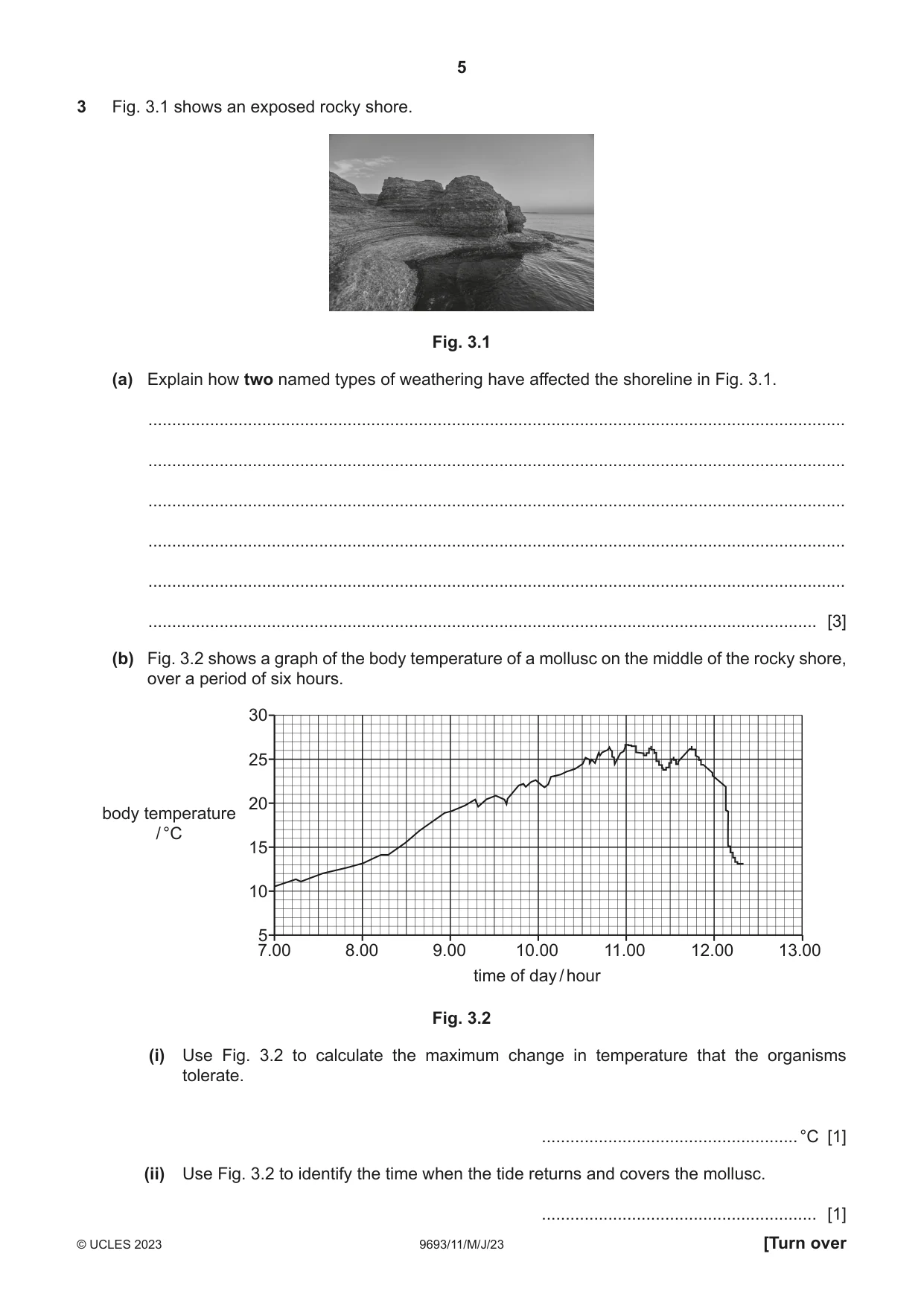
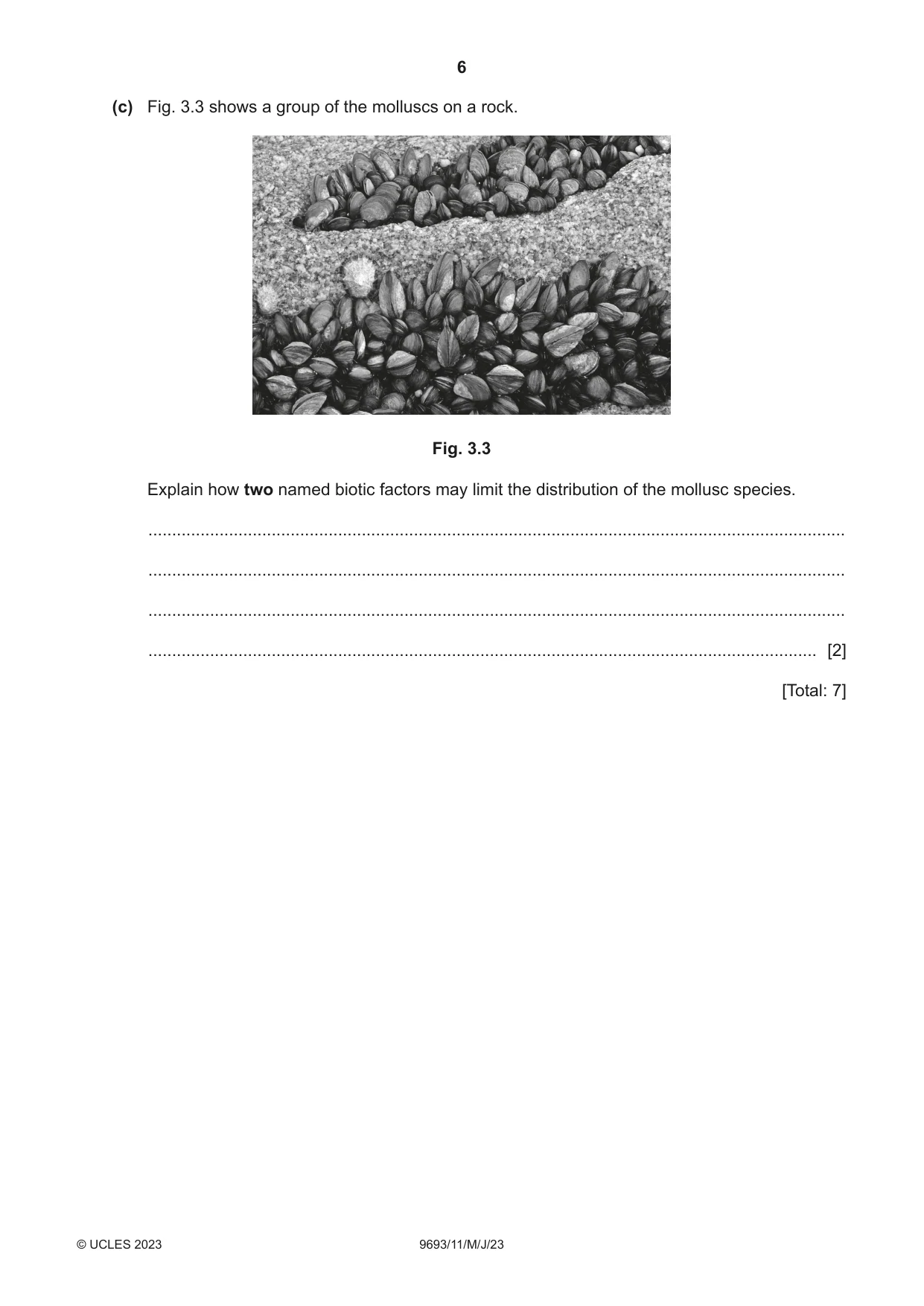
5 9693/11/M/J/23 © UCLES 2023 [Turn over 3 Fig. 3.1 shows an exposed rocky shore. Fig. 3.1 (a) Explain how two named types of weathering have affected the shoreline in Fig. 3.1. … … … … … … [3] (b) Fig. 3.2 shows a graph of the body temperature of a mollusc on the middle of the rocky shore, over a period of six hours. 30 25 20 15 body temperature / °C 10 5 7.00 8.00 9.00 10.00 time of day / hour 11.00 12.00 13.00 Fig. 3.2 (i) Use Fig. 3.2 to calculate the maximum change in temperature that the organisms tolerate. … °C [1] (ii) Use Fig. 3.2 to identify the time when the tide returns and covers the mollusc. … [1]
Question paper, page 6
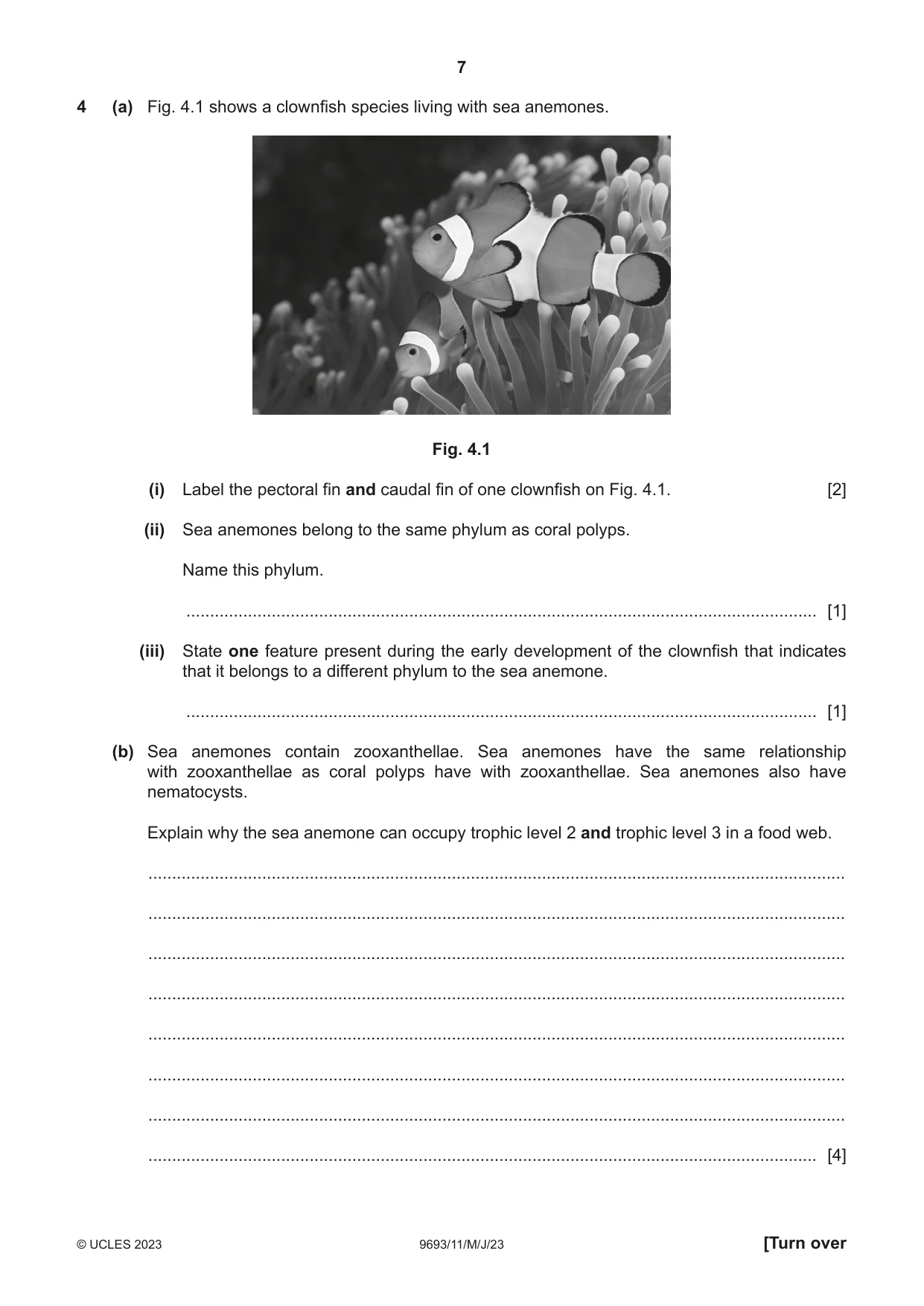
6 9693/11/M/J/23 © UCLES 2023 (c) Fig. 3.3 shows a group of the molluscs on a rock. Fig. 3.3 Explain how two named biotic factors may limit the distribution of the mollusc species. … … … … [2] [Total: 7]
Question paper, page 7
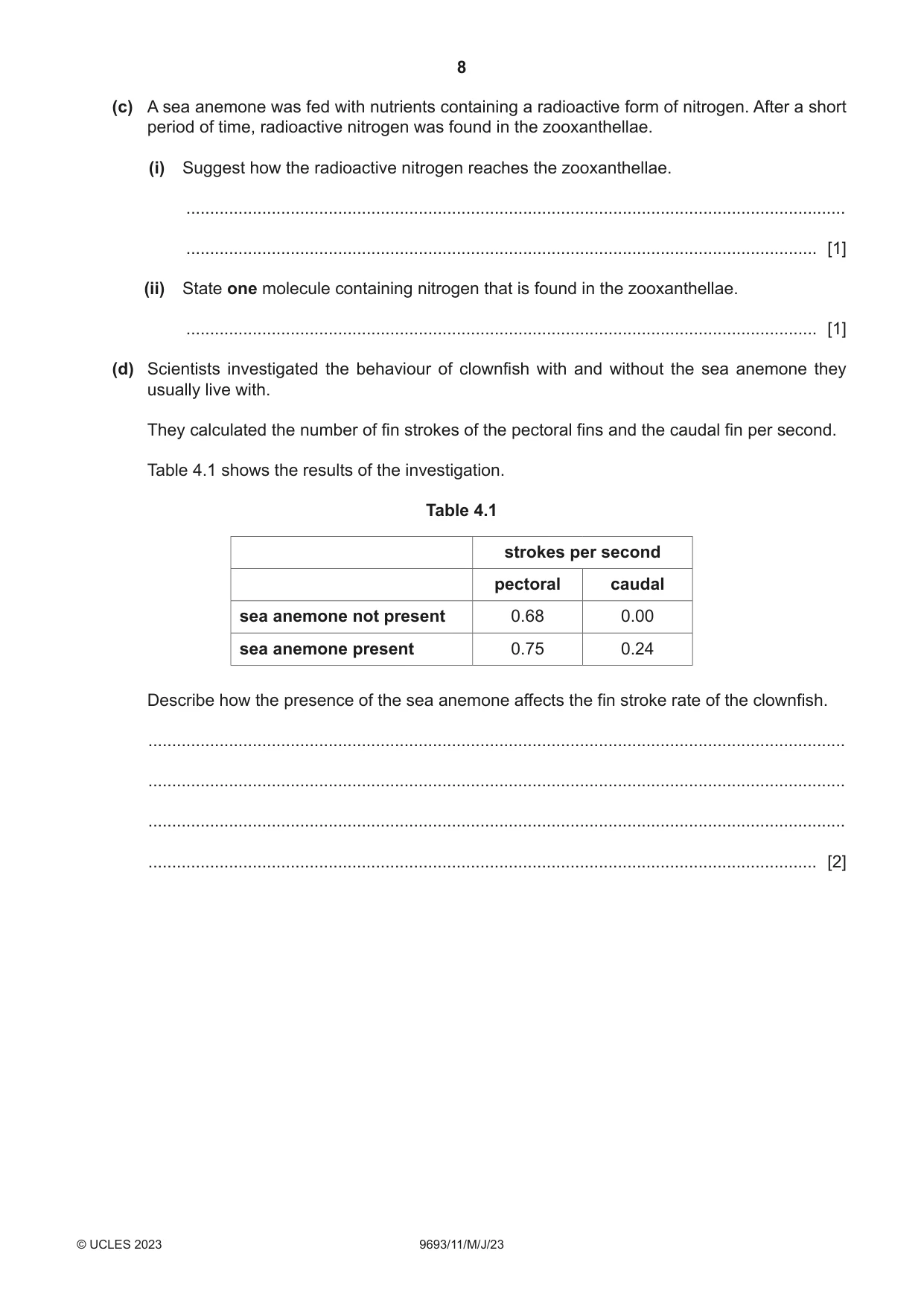
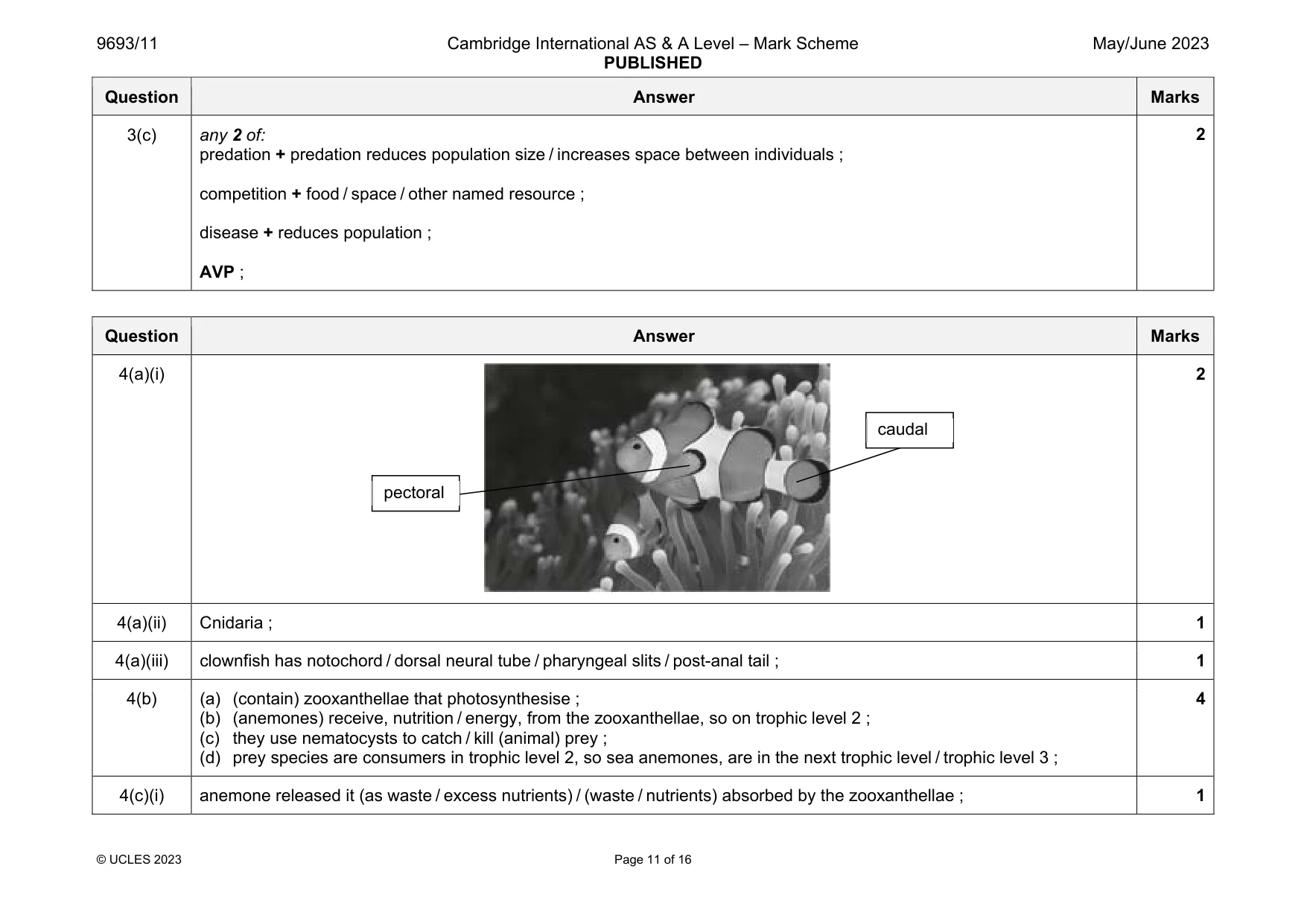
7 9693/11/M/J/23 © UCLES 2023 [Turn over 4 (a) Fig. 4.1 shows a clownfish species living with sea anemones. Fig. 4.1 (i) Label the pectoral fin and caudal fin of one clownfish on Fig. 4.1. [2] (ii) Sea anemones belong to the same phylum as coral polyps. Name this phylum. … [1] (iii) State one feature present during the early development of the clownfish that indicates that it belongs to a different phylum to the sea anemone. … [1] (b) Sea anemones contain zooxanthellae. Sea anemones have the same relationship with zooxanthellae as coral polyps have with zooxanthellae. Sea anemones also have nematocysts. Explain why the sea anemone can occupy trophic level 2 and trophic level 3 in a food web. … … … … … … … … [4]
Question paper, page 8
8 9693/11/M/J/23 © UCLES 2023 (c) A sea anemone was fed with nutrients containing a radioactive form of nitrogen. After a short period of time, radioactive nitrogen was found in the zooxanthellae. (i) Suggest how the radioactive nitrogen reaches the zooxanthellae. … … [1] (ii) State one molecule containing nitrogen that is found in the zooxanthellae. … [1] (d) Scientists investigated the behaviour of clownfish with and without the sea anemone they usually live with. They calculated the number of fin strokes of the pectoral fins and the caudal fin per second. Table 4.1 shows the results of the investigation. Table 4.1 strokes per second pectoral caudal sea anemone not present 0.68 0.00 sea anemone present 0.75 0.24 Describe how the presence of the sea anemone affects the fin stroke rate of the clownfish. … … … … [2]
Question paper, page 9
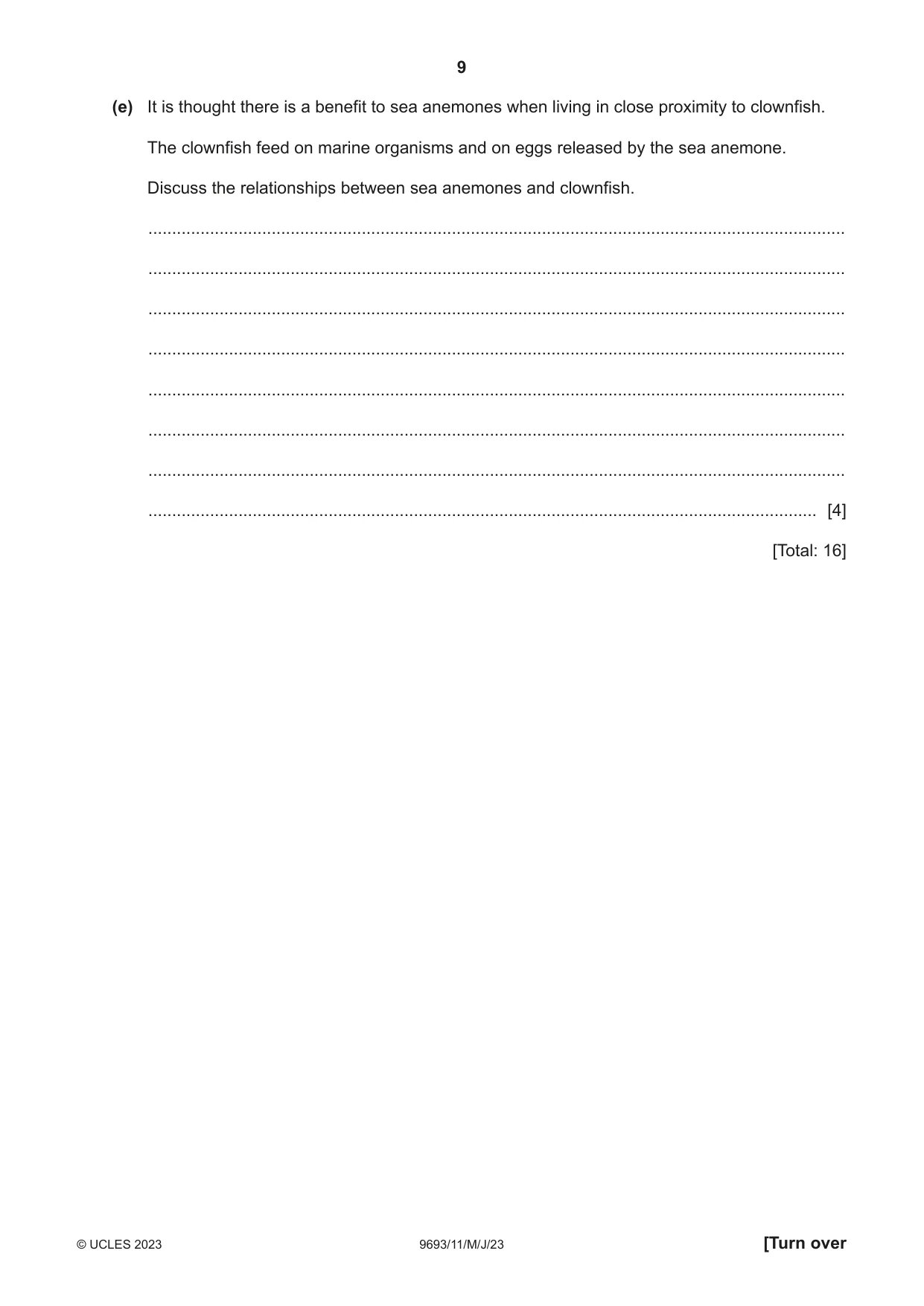
9 9693/11/M/J/23 © UCLES 2023 [Turn over (e) It is thought there is a benefit to sea anemones when living in close proximity to clownfish. The clownfish feed on marine organisms and on eggs released by the sea anemone. Discuss the relationships between sea anemones and clownfish. … … … … … … … … [4] [Total: 16]
Question paper, page 10
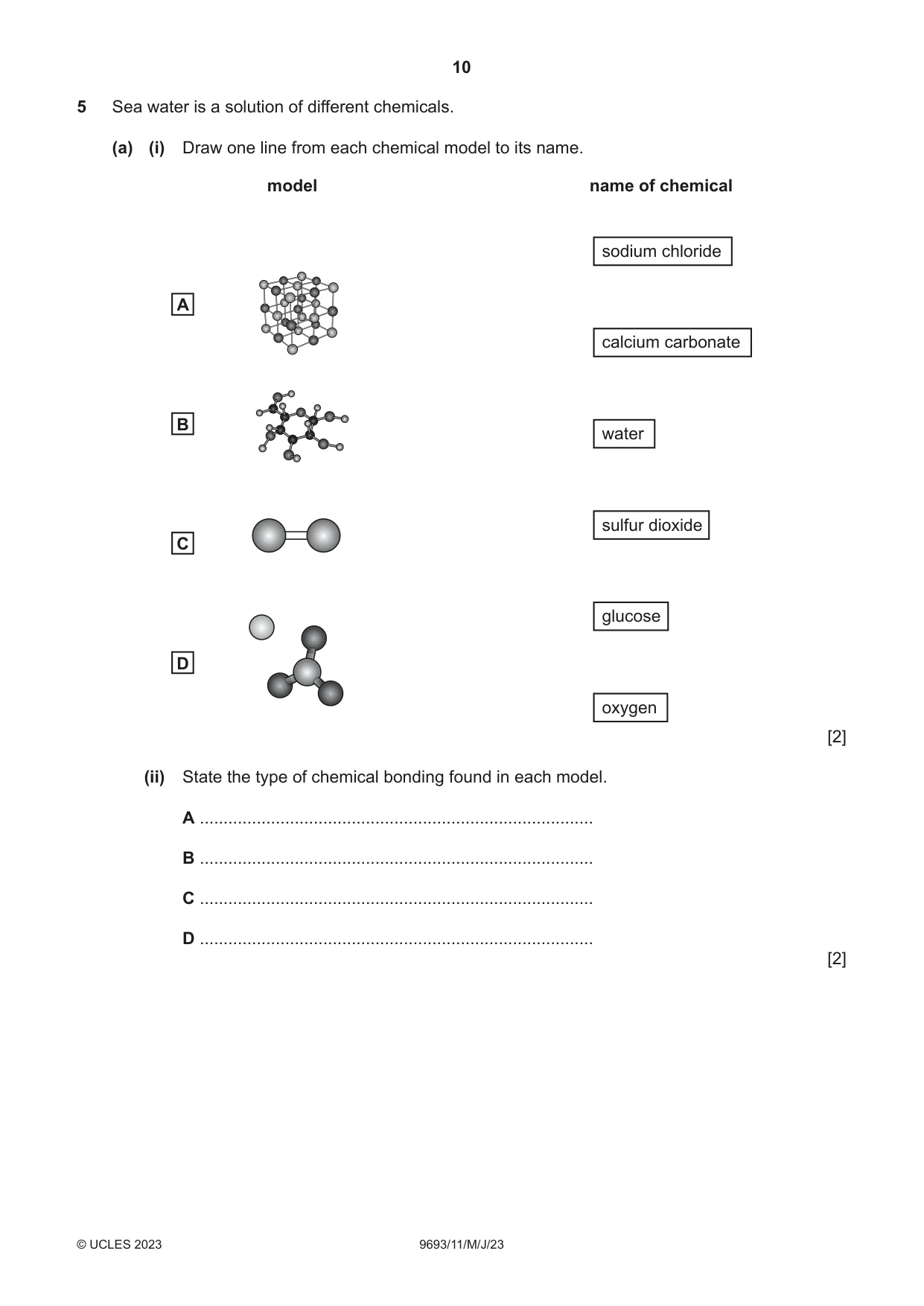
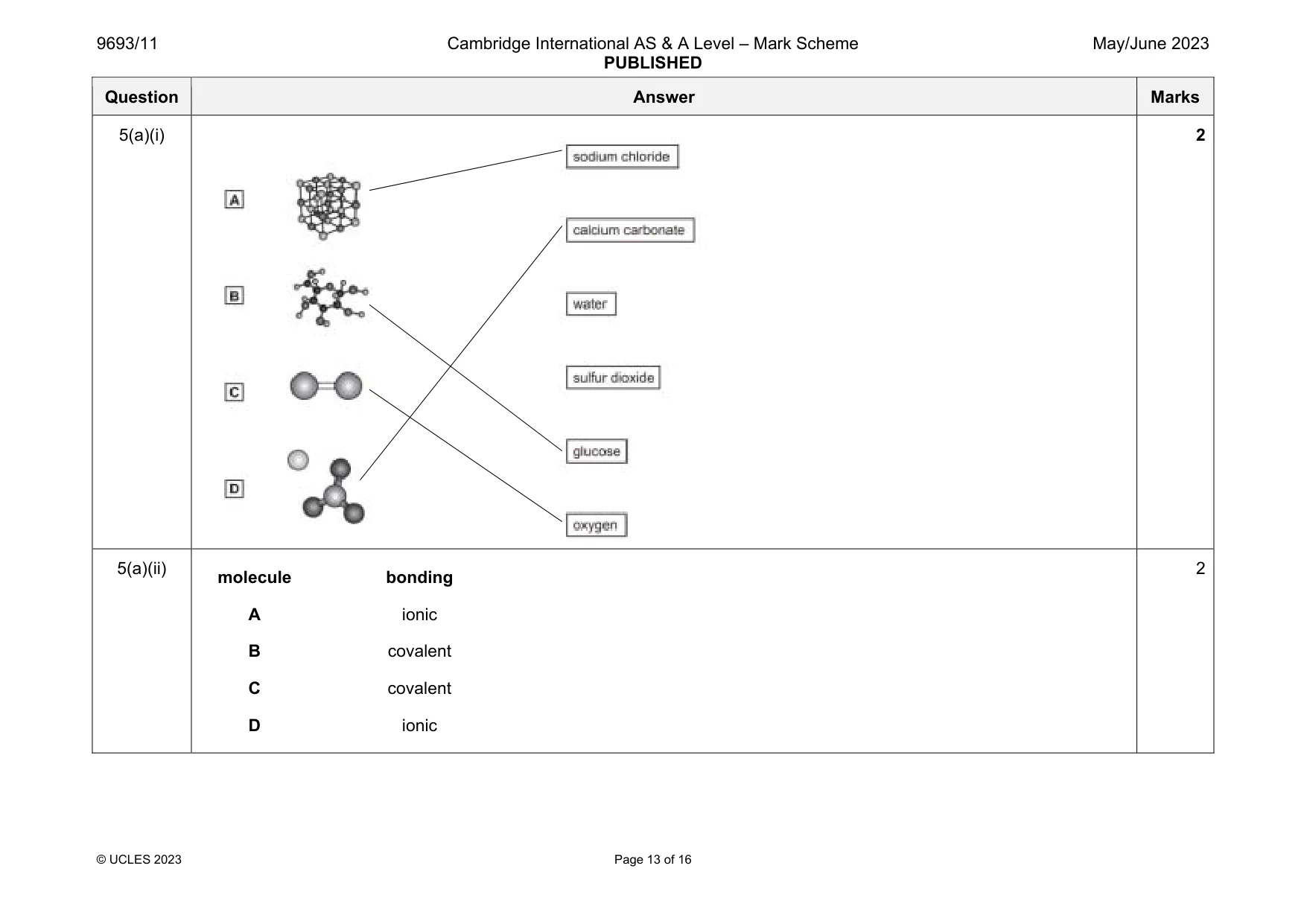
10 9693/11/M/J/23 © UCLES 2023 5 Sea water is a solution of different chemicals. (a) (i) Draw one line from each chemical model to its name. model A name of chemical sodium chloride calcium carbonate water sulfur dioxide glucose oxygen B C D [2] (ii) State the type of chemical bonding found in each model. A … B … C … D … [2]
Question paper, page 11
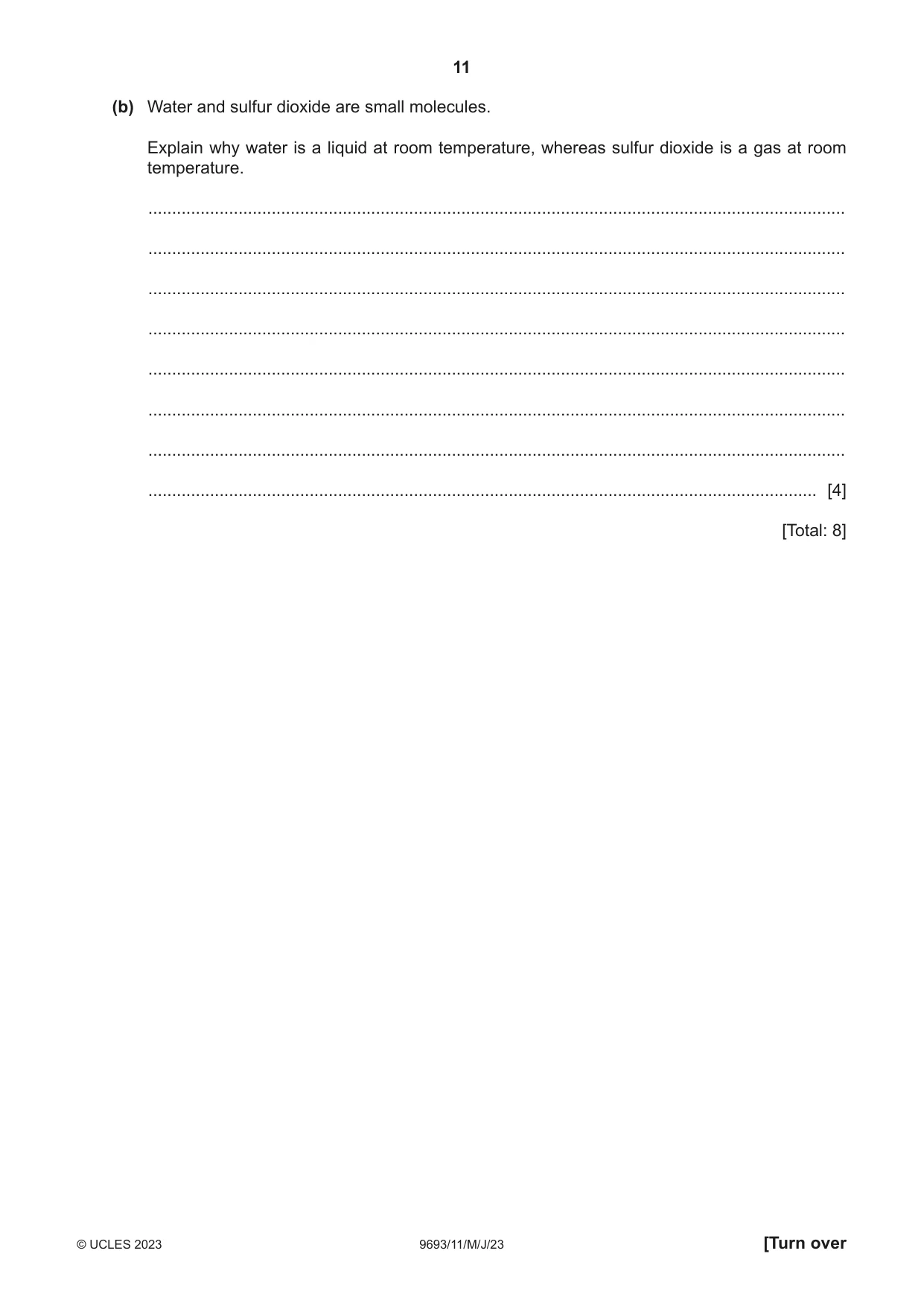
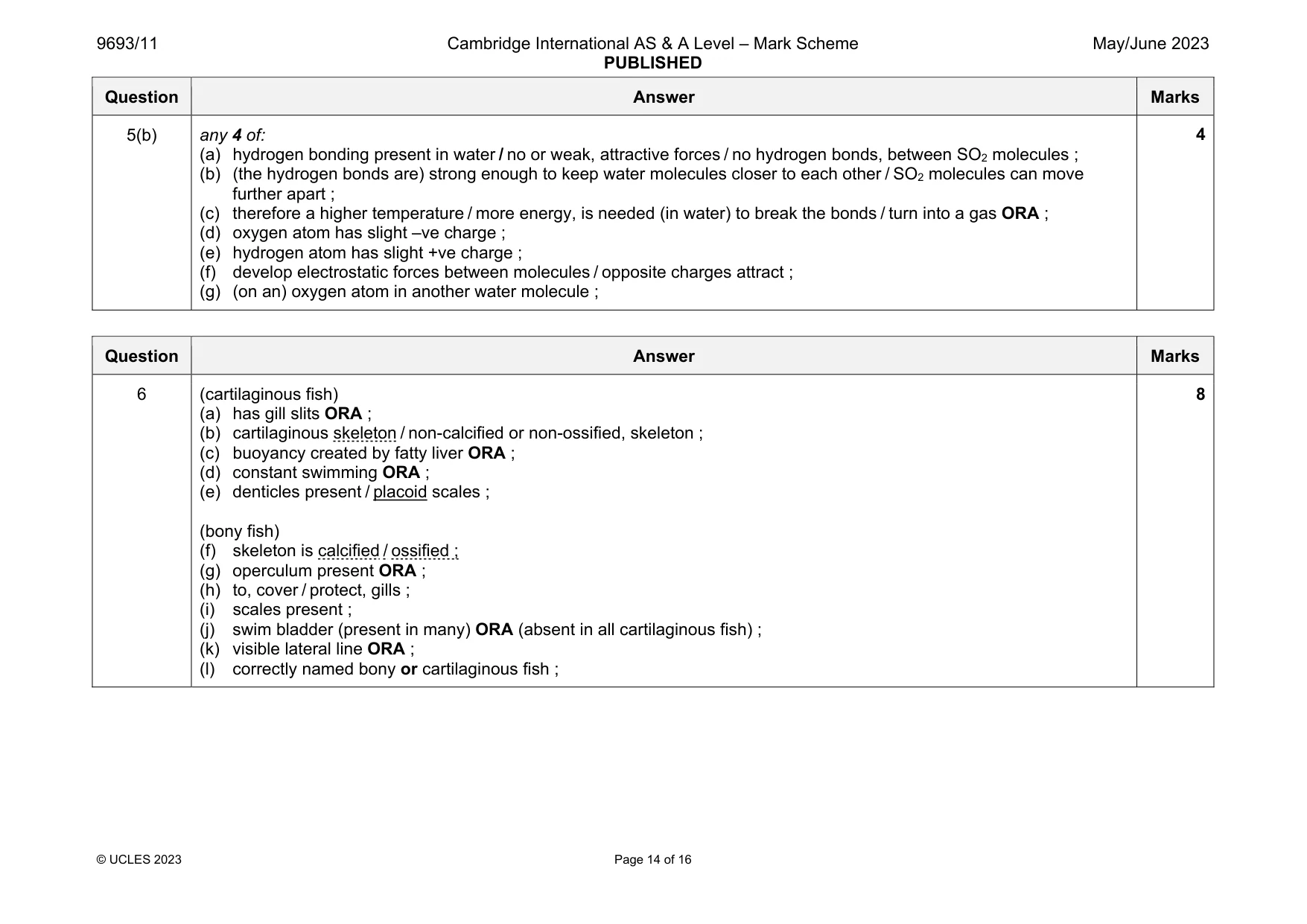
11 9693/11/M/J/23 © UCLES 2023 [Turn over (b) Water and sulfur dioxide are small molecules. Explain why water is a liquid at room temperature, whereas sulfur dioxide is a gas at room temperature. … … … … … … … … [4] [Total: 8]
Question paper, page 12
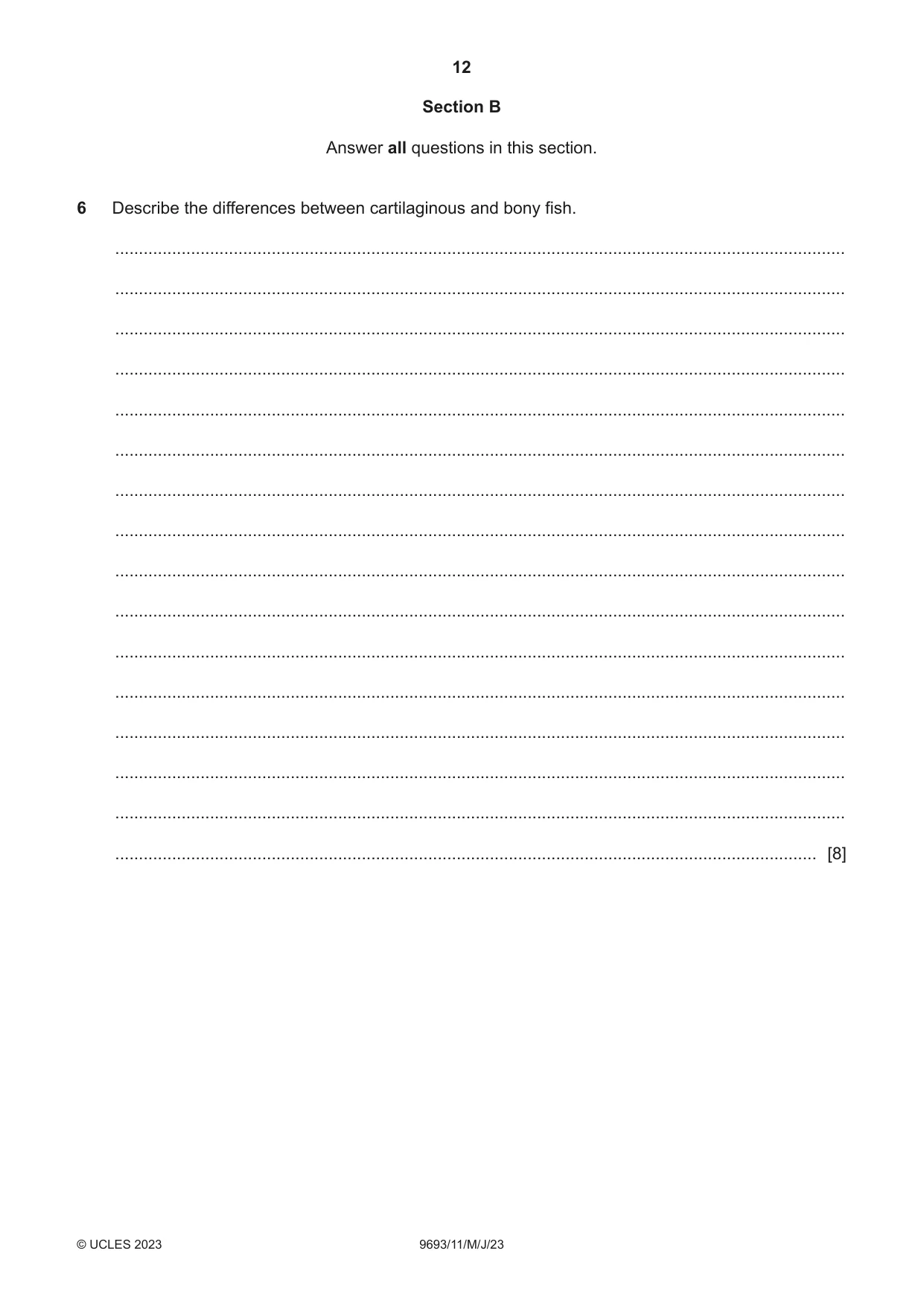
12 9693/11/M/J/23 © UCLES 2023 Section B Answer all questions in this section. 6 Describe the differences between cartilaginous and bony fish. … … … … … … … … … … … … … … … … [8]
Question paper, page 13
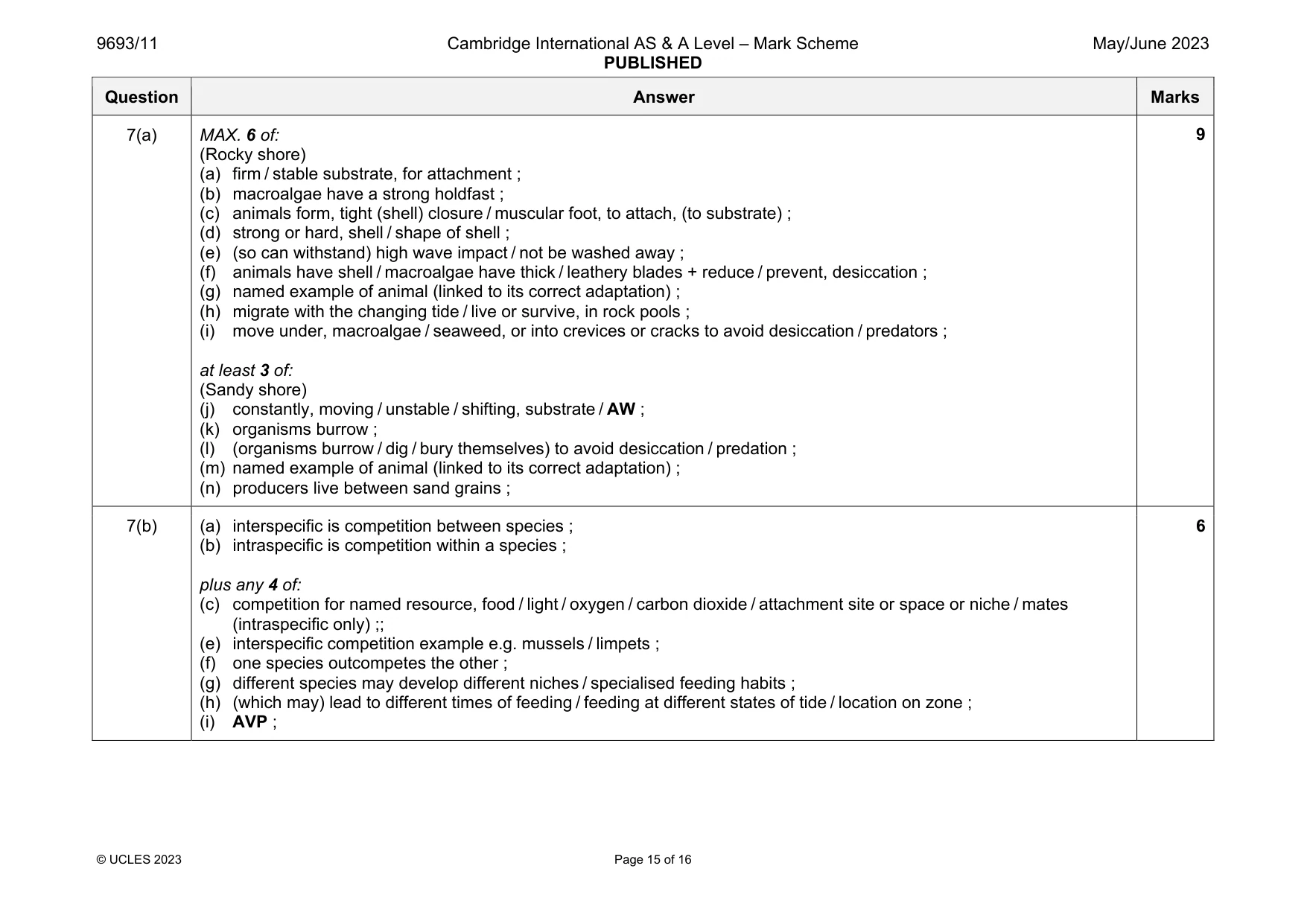
13 9693/11/M/J/23 © UCLES 2023 [Turn over 7 (a) Explain how and suggest why adaptations of littoral zone organisms differ between rocky shores and sandy shores. … … … … … … … … … … … … … … … … … … [9]
Question paper, page 14
14 9693/11/M/J/23 © UCLES 2023 (b) Describe inter-specific and intra-specific competition and how these affect the distribution of organisms on the lower zone of a rocky shore. … … … … … … … … … … … … [6] [Total: 15]
Question paper, page 15
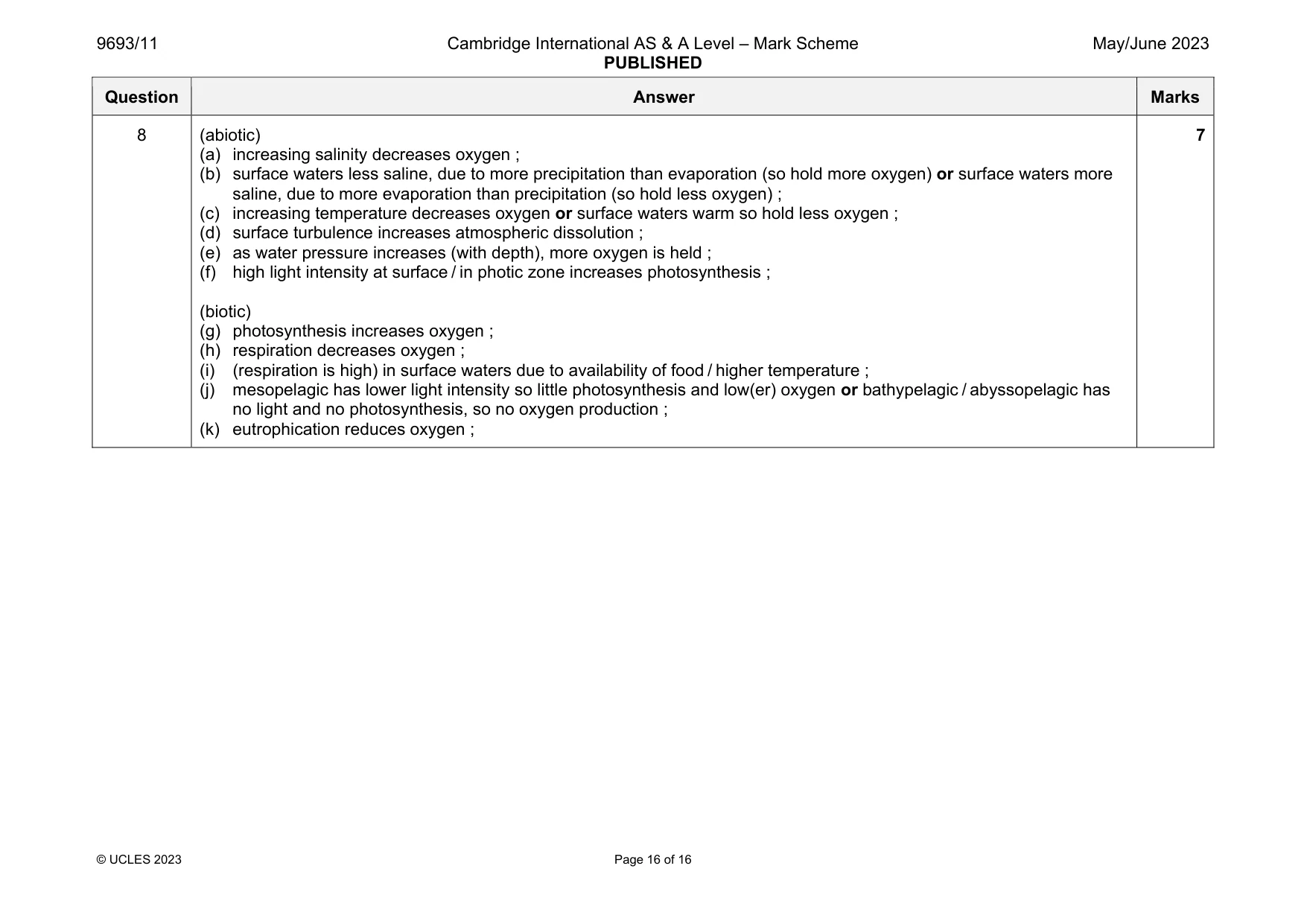
15 9693/11/M/J/23 © UCLES 2023 8 Explain how biotic and abiotic factors affect the dissolved oxygen concentration in the open ocean. … … … … … … … … … … … … … … [7]
Question paper, page 16
16 9693/11/M/J/23 © UCLES 2023 The boundaries and names shown, the designations used and the presentation of material on any maps contained in this question paper/insert do not imply official endorsement or acceptance by Cambridge Assessment International Education concerning the legal status of any country, territory, or area or any of its authorities, or of the delimitation of its frontiers or boundaries. Permission to reproduce items where third-party owned material protected by copyright is included has been sought and cleared where possible. Every reasonable effort has been made by the publisher (UCLES) to trace copyright holders, but if any items requiring clearance have unwittingly been included, the publisher will be pleased to make amends at the earliest possible opportunity. To avoid the issue of disclosure of answer-related information to candidates, all copyright acknowledgements are reproduced online in the Cambridge Assessment International Education Copyright Acknowledgements Booklet. This is produced for each series of examinations and is freely available to download at www.cambridgeinternational.org after the live examination series. Cambridge Assessment International Education is part of Cambridge Assessment. Cambridge Assessment is the brand name of the University of Cambridge Local Examinations Syndicate (UCLES), which is a department of the University of Cambridge. BLANK PAGE
Mark scheme, page 1
This document consists of 16 printed pages. © UCLES 2023 [Turn over Cambridge International AS & A Level MARINE SCIENCE 9693/11 Paper 1 AS Level Theory May/June 2023 MARK SCHEME Maximum Mark: 75 Published This mark scheme is published as an aid to teachers and candidates, to indicate the requirements of the examination. It shows the basis on which Examiners were instructed to award marks. It does not indicate the details of the discussions that took place at an Examiners’ meeting before marking began, which would have considered the acceptability of alternative answers. Mark schemes should be read in conjunction with the question paper and the Principal Examiner Report for Teachers. Cambridge International will not enter into discussions about these mark schemes. Cambridge International is publishing the mark schemes for the May/June 2023 series for most Cambridge IGCSE, Cambridge International A and AS Level and Cambridge Pre-U components, and some Cambridge O Level components.
Mark scheme, page 2
9693/11 Cambridge International AS & A Level – Mark Scheme PUBLISHED May/June 2023 © UCLES 2023 Page 2 of 16 Generic Marking Principles These general marking principles must be applied by all examiners when marking candidate answers. They should be applied alongside the specific content of the mark scheme or generic level descriptors for a question. Each question paper and mark scheme will also comply with these marking principles. GENERIC MARKING PRINCIPLE 1: Marks must be awarded in line with: the specific content of the mark scheme or the generic level descriptors for the question the specific skills defined in the mark scheme or in the generic level descriptors for the question the standard of response required by a candidate as exemplified by the standardisation scripts. GENERIC MARKING PRINCIPLE 2: Marks awarded are always whole marks (not half marks, or other fractions). GENERIC MARKING PRINCIPLE 3: Marks must be awarded positively: marks are awarded for correct/valid answers, as defined in the mark scheme. However, credit is given for valid answers which go beyond the scope of the syllabus and mark scheme, referring to your Team Leader as appropriate marks are awarded when candidates clearly demonstrate what they know and can do marks are not deducted for errors marks are not deducted for omissions answers should only be judged on the quality of spelling, punctuation and grammar when these features are specifically assessed by the question as indicated by the mark scheme. The meaning, however, should be unambiguous. GENERIC MARKING PRINCIPLE 4: Rules must be applied consistently, e.g. in situations where candidates have not followed instructions or in the application of generic level descriptors.
Mark scheme, page 3
9693/11 Cambridge International AS & A Level – Mark Scheme PUBLISHED May/June 2023 © UCLES 2023 Page 3 of 16 GENERIC MARKING PRINCIPLE 5: Marks should be awarded using the full range of marks defined in the mark scheme for the question (however; the use of the full mark range may be limited according to the quality of the candidate responses seen). GENERIC MARKING PRINCIPLE 6: Marks awarded are based solely on the requirements as defined in the mark scheme. Marks should not be awarded with grade thresholds or grade descriptors in mind.
Mark scheme, page 4
9693/11 Cambridge International AS & A Level – Mark Scheme PUBLISHED May/June 2023 © UCLES 2023 Page 4 of 16 Science-Specific Marking Principles 1 Examiners should consider the context and scientific use of any keywords when awarding marks. Although keywords may be present, marks should not be awarded if the keywords are used incorrectly. 2 The examiner should not choose between contradictory statements given in the same question part, and credit should not be awarded for any correct statement that is contradicted within the same question part. Wrong science that is irrelevant to the question should be ignored. 3 Although spellings do not have to be correct, spellings of syllabus terms must allow for clear and unambiguous separation from other syllabus terms with which they may be confused (e.g. ethane / ethene, glucagon / glycogen, refraction / reflection). 4 The error carried forward (ecf) principle should be applied, where appropriate. If an incorrect answer is subsequently used in a scientifically correct way, the candidate should be awarded these subsequent marking points. Further guidance will be included in the mark scheme where necessary and any exceptions to this general principle will be noted. 5 ‘List rule’ guidance For questions that require n responses (e.g. State two reasons …): The response should be read as continuous prose, even when numbered answer spaces are provided. Any response marked ignore in the mark scheme should not count towards n. Incorrect responses should not be awarded credit but will still count towards n. Read the entire response to check for any responses that contradict those that would otherwise be credited. Credit should not be awarded for any responses that are contradicted within the rest of the response. Where two responses contradict one another, this should be treated as a single incorrect response. Non-contradictory responses after the first n responses may be ignored even if they include incorrect science.
Mark scheme, page 5
9693/11 Cambridge International AS & A Level – Mark Scheme PUBLISHED May/June 2023 © UCLES 2023 Page 5 of 16 6 Calculation specific guidance Correct answers to calculations should be given full credit even if there is no working or incorrect working, unless the question states ‘show your working’. For questions in which the number of significant figures required is not stated, credit should be awarded for correct answers when rounded by the examiner to the number of significant figures given in the mark scheme. This may not apply to measured values. For answers given in standard form (e.g. a 10n) in which the convention of restricting the value of the coefficient (a) to a value between 1 and 10 is not followed, credit may still be awarded if the answer can be converted to the answer given in the mark scheme. Unless a separate mark is given for a unit, a missing or incorrect unit will normally mean that the final calculation mark is not awarded. Exceptions to this general principle will be noted in the mark scheme. 7 Guidance for chemical equations Multiples / fractions of coefficients used in chemical equations are acceptable unless stated otherwise in the mark scheme. State symbols given in an equation should be ignored unless asked for in the question or stated otherwise in the mark scheme.
Mark scheme, page 6
9693/11 Cambridge International AS & A Level – Mark Scheme PUBLISHED May/June 2023 © UCLES 2023 Page 6 of 16 This mark scheme will use the following abbreviations: ; separates marking points / separates alternatives within a marking point () contents of brackets are not required but should be implied / the contents set the context of the answer R reject A accept (answers that are correctly cued by the question or guidance you have received) I ignore (mark as if this material was not present) AW alternative wording (where responses vary more than usual, accept other ways of expressing the same idea) AVP alternative valid point (where a greater than usual variety of responses is expected) ORA or reverse argument underline actual word underlined must be used by the candidate (grammatical variants excepted) MAX indicates the maximum number of marks that can be awarded + statements on both sides of the + are needed for that mark OR separates two different routes to a mark point and only one should be awarded ECF error carried forward (credit an operation from a previous incorrect response)
Mark scheme, page 7
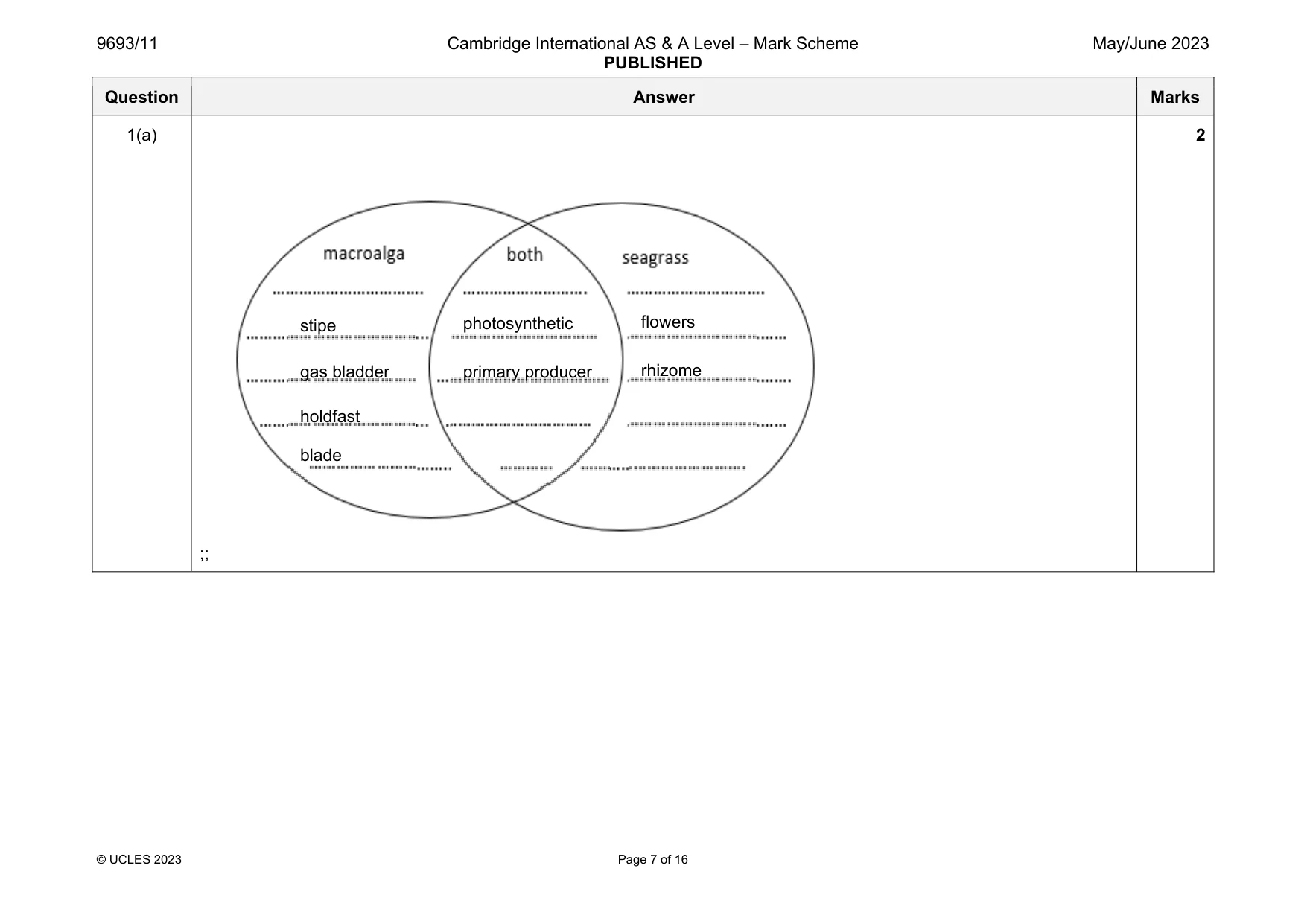
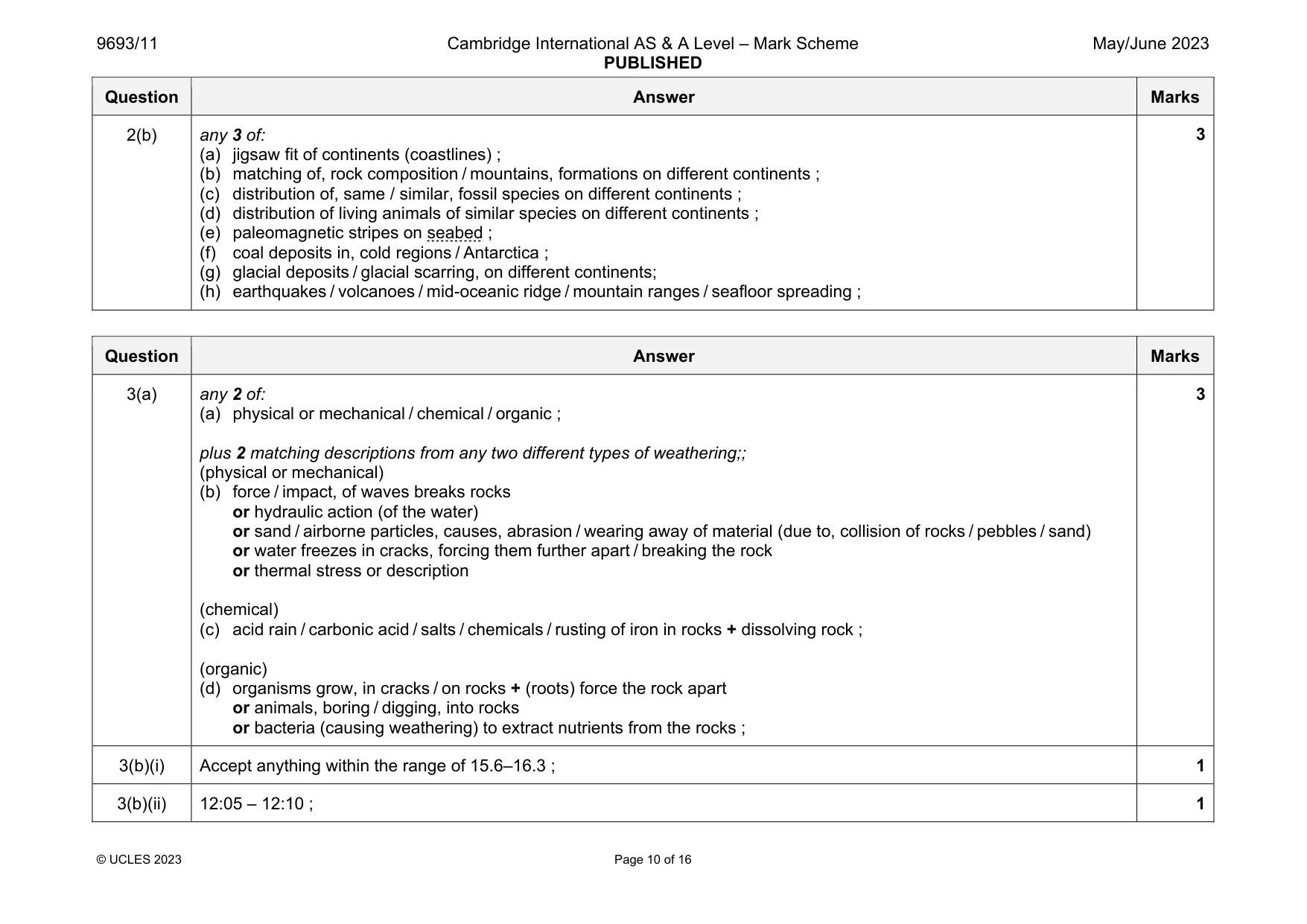
9693/11 Cambridge International AS & A Level – Mark Scheme PUBLISHED May/June 2023 © UCLES 2023 Page 7 of 16 Question Answer Marks 1(a) ;; 2 stipe gas bladder holdfast blade photosynthetic primary producer flowers rhizome
Mark scheme, page 8
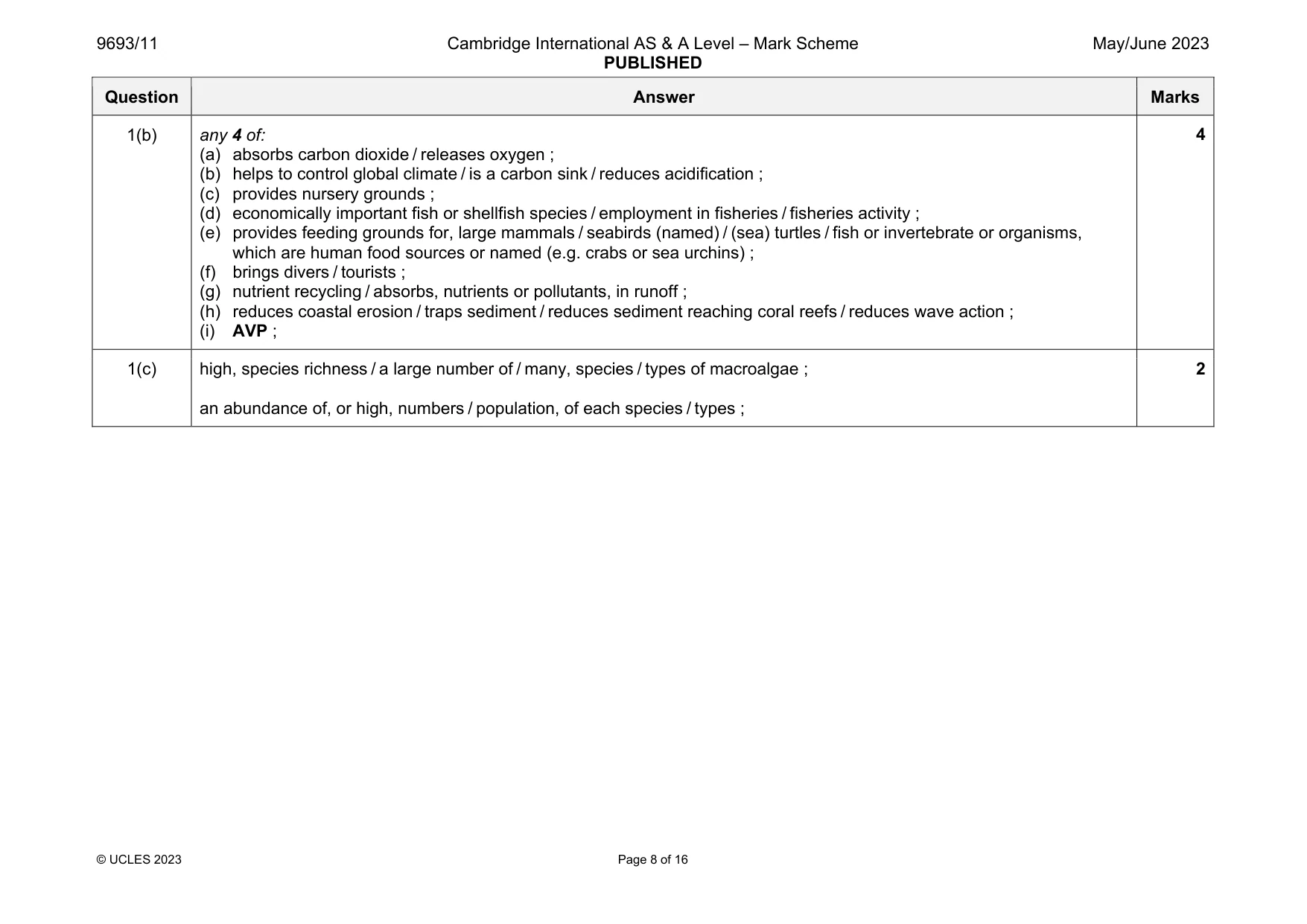
9693/11 Cambridge International AS & A Level – Mark Scheme PUBLISHED May/June 2023 © UCLES 2023 Page 8 of 16 Question Answer Marks 1(b) any 4 of: (a) absorbs carbon dioxide / releases oxygen ; (b) helps to control global climate / is a carbon sink / reduces acidification ; (c) provides nursery grounds ; (d) economically important fish or shellfish species / employment in fisheries / fisheries activity ; (e) provides feeding grounds for, large mammals / seabirds (named) / (sea) turtles / fish or invertebrate or organisms, which are human food sources or named (e.g. crabs or sea urchins) ; (f) brings divers / tourists ; (g) nutrient recycling / absorbs, nutrients or pollutants, in runoff ; (h) reduces coastal erosion / traps sediment / reduces sediment reaching coral reefs / reduces wave action ; (i) AVP ; 4 1(c) high, species richness / a large number of / many, species / types of macroalgae ; an abundance of, or high, numbers / population, of each species / types ; 2
Mark scheme, page 9
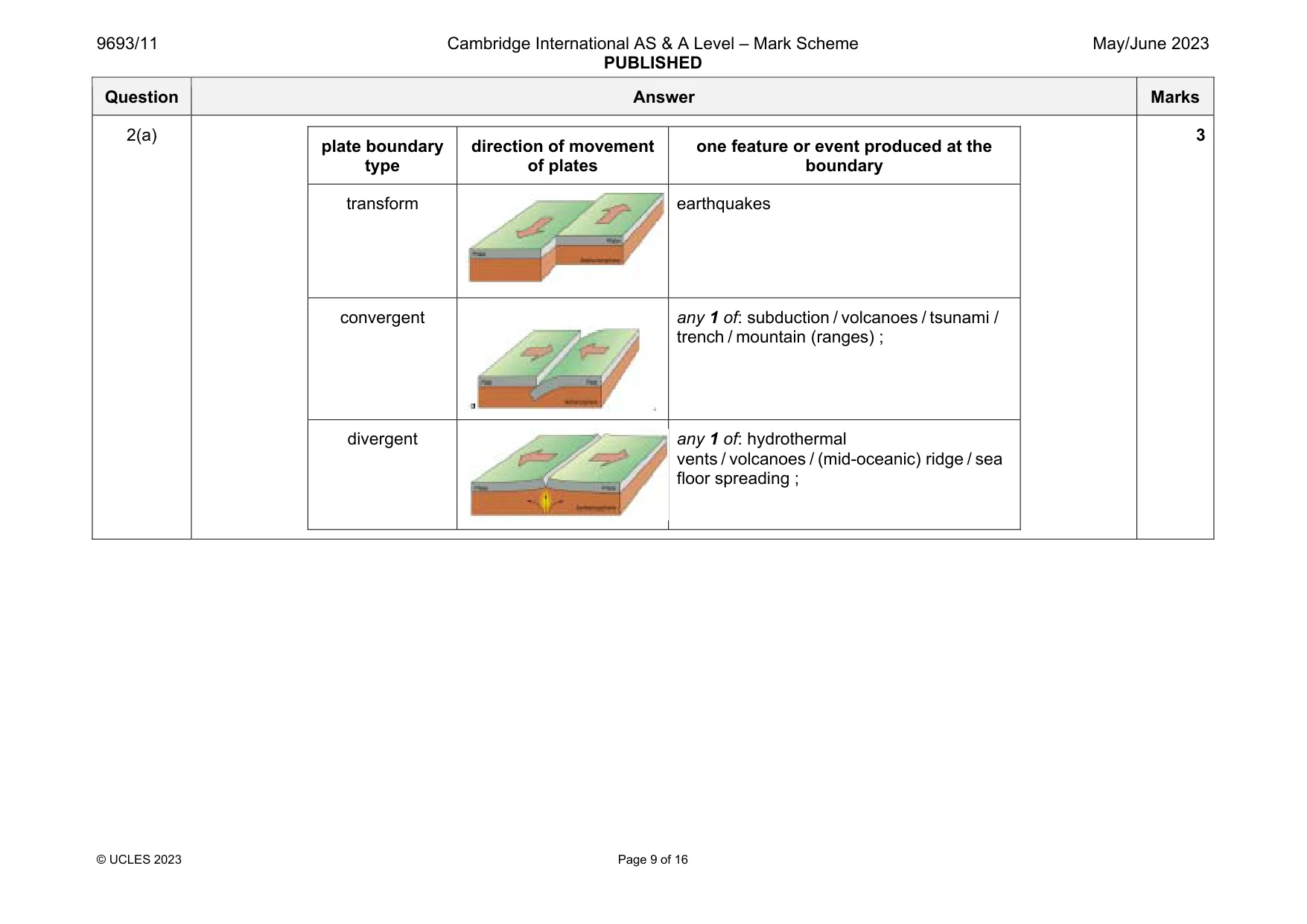
9693/11 Cambridge International AS & A Level – Mark Scheme PUBLISHED May/June 2023 © UCLES 2023 Page 9 of 16 Question Answer Marks 2(a) plate boundary type direction of movement of plates one feature or event produced at the boundary transform earthquakes convergent any 1 of: subduction / volcanoes / tsunami / trench / mountain (ranges) ; divergent any 1 of: hydrothermal vents / volcanoes / (mid-oceanic) ridge / sea floor spreading ; 3
Mark scheme, page 10
9693/11 Cambridge International AS & A Level – Mark Scheme PUBLISHED May/June 2023 © UCLES 2023 Page 10 of 16 Question Answer Marks 2(b) any 3 of: (a) jigsaw fit of continents (coastlines) ; (b) matching of, rock composition / mountains, formations on different continents ; (c) distribution of, same / similar, fossil species on different continents ; (d) distribution of living animals of similar species on different continents ; (e) paleomagnetic stripes on seabed ; (f) coal deposits in, cold regions / Antarctica ; (g) glacial deposits / glacial scarring, on different continents; (h) earthquakes / volcanoes / mid-oceanic ridge / mountain ranges / seafloor spreading ; 3 Question Answer Marks 3(a) any 2 of: (a) physical or mechanical / chemical / organic ; plus 2 matching descriptions from any two different types of weathering;; (physical or mechanical) (b) force / impact, of waves breaks rocks or hydraulic action (of the water) or sand / airborne particles, causes, abrasion / wearing away of material (due to, collision of rocks / pebbles / sand) or water freezes in cracks, forcing them further apart / breaking the rock or thermal stress or description (chemical) (c) acid rain / carbonic acid / salts / chemicals / rusting of iron in rocks + dissolving rock ; (organic) (d) organisms grow, in cracks / on rocks + (roots) force the rock apart or animals, boring / digging, into rocks or bacteria (causing weathering) to extract nutrients from the rocks ; 3 3(b)(i) Accept anything within the range of 15.6–16.3 ; 1 3(b)(ii) 12:05 – 12:10 ; 1
Mark scheme, page 11
9693/11 Cambridge International AS & A Level – Mark Scheme PUBLISHED May/June 2023 © UCLES 2023 Page 11 of 16 Question Answer Marks 3(c) any 2 of: predation + predation reduces population size / increases space between individuals ; competition + food / space / other named resource ; disease + reduces population ; AVP ; 2 Question Answer Marks 4(a)(i) 2 4(a)(ii) Cnidaria ; 1 4(a)(iii) clownfish has notochord / dorsal neural tube / pharyngeal slits / post-anal tail ; 1 4(b) (a) (contain) zooxanthellae that photosynthesise ; (b) (anemones) receive, nutrition / energy, from the zooxanthellae, so on trophic level 2 ; (c) they use nematocysts to catch / kill (animal) prey ; (d) prey species are consumers in trophic level 2, so sea anemones, are in the next trophic level / trophic level 3 ; 4 4(c)(i) anemone released it (as waste / excess nutrients) / (waste / nutrients) absorbed by the zooxanthellae ; 1 pectoral caudal
Mark scheme, page 12
9693/11 Cambridge International AS & A Level – Mark Scheme PUBLISHED May/June 2023 © UCLES 2023 Page 12 of 16 Question Answer Marks 4(c)(ii) amino acids / protein / DNA / enzymes ; 1 4(d) any 2 of: increase in pectoral fin stroke rate ; increase in caudal fin stroke rate ; data manipulation ; 2 4(e) (a) predator-prey because clownfish eat sea anemone eggs ; (b) mutualistic ; (c) (because) clownfish provide food / nutrients / oxygen (to anemone) ; (d) anemone provides protection (for clownfish from predators) / clownfish provides protection (for anemones from predators) ; 4
Mark scheme, page 13
9693/11 Cambridge International AS & A Level – Mark Scheme PUBLISHED May/June 2023 © UCLES 2023 Page 13 of 16 Question Answer Marks 5(a)(i) 2 5(a)(ii) molecule bonding A ionic B covalent C covalent D ionic 2
Mark scheme, page 14
9693/11 Cambridge International AS & A Level – Mark Scheme PUBLISHED May/June 2023 © UCLES 2023 Page 14 of 16 Question Answer Marks 5(b) any 4 of: (a) hydrogen bonding present in water / no or weak, attractive forces / no hydrogen bonds, between SO2 molecules ; (b) (the hydrogen bonds are) strong enough to keep water molecules closer to each other / SO2 molecules can move further apart ; (c) therefore a higher temperature / more energy, is needed (in water) to break the bonds / turn into a gas ORA ; (d) oxygen atom has slight –ve charge ; (e) hydrogen atom has slight +ve charge ; (f) develop electrostatic forces between molecules / opposite charges attract ; (g) (on an) oxygen atom in another water molecule ; 4 Question Answer Marks 6 (cartilaginous fish) (a) has gill slits ORA ; (b) cartilaginous skeleton / non-calcified or non-ossified, skeleton ; (c) buoyancy created by fatty liver ORA ; (d) constant swimming ORA ; (e) denticles present / placoid scales ; (bony fish) (f) skeleton is calcified / ossified ; (g) operculum present ORA ; (h) to, cover / protect, gills ; (i) scales present ; (j) swim bladder (present in many) ORA (absent in all cartilaginous fish) ; (k) visible lateral line ORA ; (l) correctly named bony or cartilaginous fish ; 8
Mark scheme, page 15
9693/11 Cambridge International AS & A Level – Mark Scheme PUBLISHED May/June 2023 © UCLES 2023 Page 15 of 16 Question Answer Marks 7(a) MAX. 6 of: (Rocky shore) (a) firm / stable substrate, for attachment ; (b) macroalgae have a strong holdfast ; (c) animals form, tight (shell) closure / muscular foot, to attach, (to substrate) ; (d) strong or hard, shell / shape of shell ; (e) (so can withstand) high wave impact / not be washed away ; (f) animals have shell / macroalgae have thick / leathery blades + reduce / prevent, desiccation ; (g) named example of animal (linked to its correct adaptation) ; (h) migrate with the changing tide / live or survive, in rock pools ; (i) move under, macroalgae / seaweed, or into crevices or cracks to avoid desiccation / predators ; at least 3 of: (Sandy shore) (j) constantly, moving / unstable / shifting, substrate / AW ; (k) organisms burrow ; (l) (organisms burrow / dig / bury themselves) to avoid desiccation / predation ; (m) named example of animal (linked to its correct adaptation) ; (n) producers live between sand grains ; 9 7(b) (a) interspecific is competition between species ; (b) intraspecific is competition within a species ; plus any 4 of: (c) competition for named resource, food / light / oxygen / carbon dioxide / attachment site or space or niche / mates (intraspecific only) ;; (e) interspecific competition example e.g. mussels / limpets ; (f) one species outcompetes the other ; (g) different species may develop different niches / specialised feeding habits ; (h) (which may) lead to different times of feeding / feeding at different states of tide / location on zone ; (i) AVP ; 6
Mark scheme, page 16
9693/11 Cambridge International AS & A Level – Mark Scheme PUBLISHED May/June 2023 © UCLES 2023 Page 16 of 16 Question Answer Marks 8 (abiotic) (a) increasing salinity decreases oxygen ; (b) surface waters less saline, due to more precipitation than evaporation (so hold more oxygen) or surface waters more saline, due to more evaporation than precipitation (so hold less oxygen) ; (c) increasing temperature decreases oxygen or surface waters warm so hold less oxygen ; (d) surface turbulence increases atmospheric dissolution ; (e) as water pressure increases (with depth), more oxygen is held ; (f) high light intensity at surface / in photic zone increases photosynthesis ; (biotic) (g) photosynthesis increases oxygen ; (h) respiration decreases oxygen ; (i) (respiration is high) in surface waters due to availability of food / higher temperature ; (j) mesopelagic has lower light intensity so little photosynthesis and low(er) oxygen or bathypelagic / abyssopelagic has no light and no photosynthesis, so no oxygen production ; (k) eutrophication reduces oxygen ; 7
What you needed in this session
Cambridge’s own grade thresholds for 2023 May/June, Paper 1 · Variant 1. A higher threshold means an easier paper — the bar moves with how the cohort did.