Cambridge A Level Marine Science 9693 — 2020 May/June Paper 1 · Variant 2
9693/12/M/J/20
The question paper and its mark scheme, free to read here and free to download. This is Cambridge’s own paper, exactly as it was sat.
Question paper20 pages




Mark scheme11 pages
Answers below. Sit the paper first if you are practising.
Paper as text
Question paper, page 1
Cambridge International AS & A Level This document has 20 pages. Blank pages are indicated. DC (SC/CB) 182870/5 © UCLES 2020 [Turn over MARINE SCIENCE 9693/12 Paper 1 AS Structured Questions May/June 2020 1 hour 30 minutes You must answer on the question paper. No additional materials are needed. INSTRUCTIONS ● Answer all questions. ● Use a black or dark blue pen. You may use an HB pencil for any diagrams or graphs. ● Write your name, centre number and candidate number in the boxes at the top of the page. ● Write your answer to each question in the space provided. ● Do not use an erasable pen or correction fluid. ● Do not write on any bar codes. ● You may use a calculator. ● You should show all your working and use appropriate units. INFORMATION ● The total mark for this paper is 75. ● The number of marks for each question or part question is shown in brackets [ ]. * 1 4 3 6 7 2 0 8 1 8 *
Question paper, page 2
2 9693/12/M/J/20 © UCLES 2020 BLANK PAGE
Question paper, page 3
3 9693/12/M/J/20 © UCLES 2020 [Turn over Answer all the questions in the spaces provided. 1 The red alga, Delisea pulchra, is a seaweed that is part of the community on a rocky shore. This alga is eaten by sea urchins and other consumers, including marine snails. (a) (i) Explain the meaning of the term community. … … … … [2] (ii) State the trophic level of consumers that eat red algae. … [1] (iii) Suggest and explain the effect on the population of marine snails if the sea urchin population increases. … … … … [2] (iv) Explain why all of the energy stored within the red algae is not passed to consumers. … … … … … … [3] (b) Some species of alga contain chemicals that deter animals from eating the algae. Suggest the effect of these chemicals on the efficiency of energy transfer between trophic levels. … … [1] [Total: 9]
Question paper, page 4
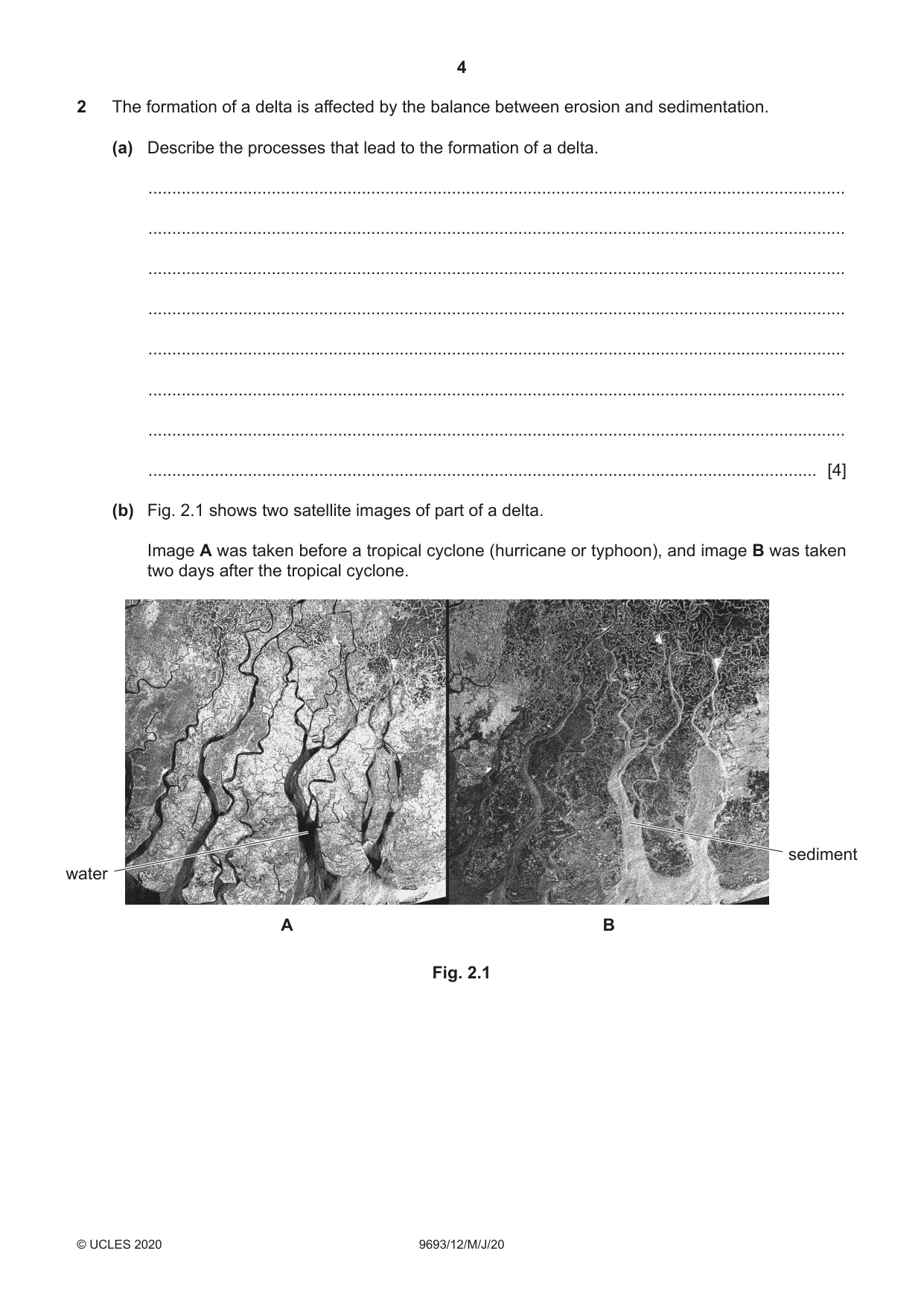
4 9693/12/M/J/20 © UCLES 2020 2 The formation of a delta is affected by the balance between erosion and sedimentation. (a) Describe the processes that lead to the formation of a delta. … … … … … … … … [4] (b) Fig. 2.1 shows two satellite images of part of a delta. Image A was taken before a tropical cyclone (hurricane or typhoon), and image B was taken two days after the tropical cyclone. sediment B A water Fig. 2.1
Question paper, page 5
5 9693/12/M/J/20 © UCLES 2020 [Turn over With reference to Fig. 2.1, suggest the effects of the tropical cyclone on the human coastal communities on the delta. … … … … … … … … [4] (c) Tropical cyclones lead to an increase in precipitation. Explain the effect of precipitation on the salinity of sea water. … … … … [2] [Total: 10]
Question paper, page 6
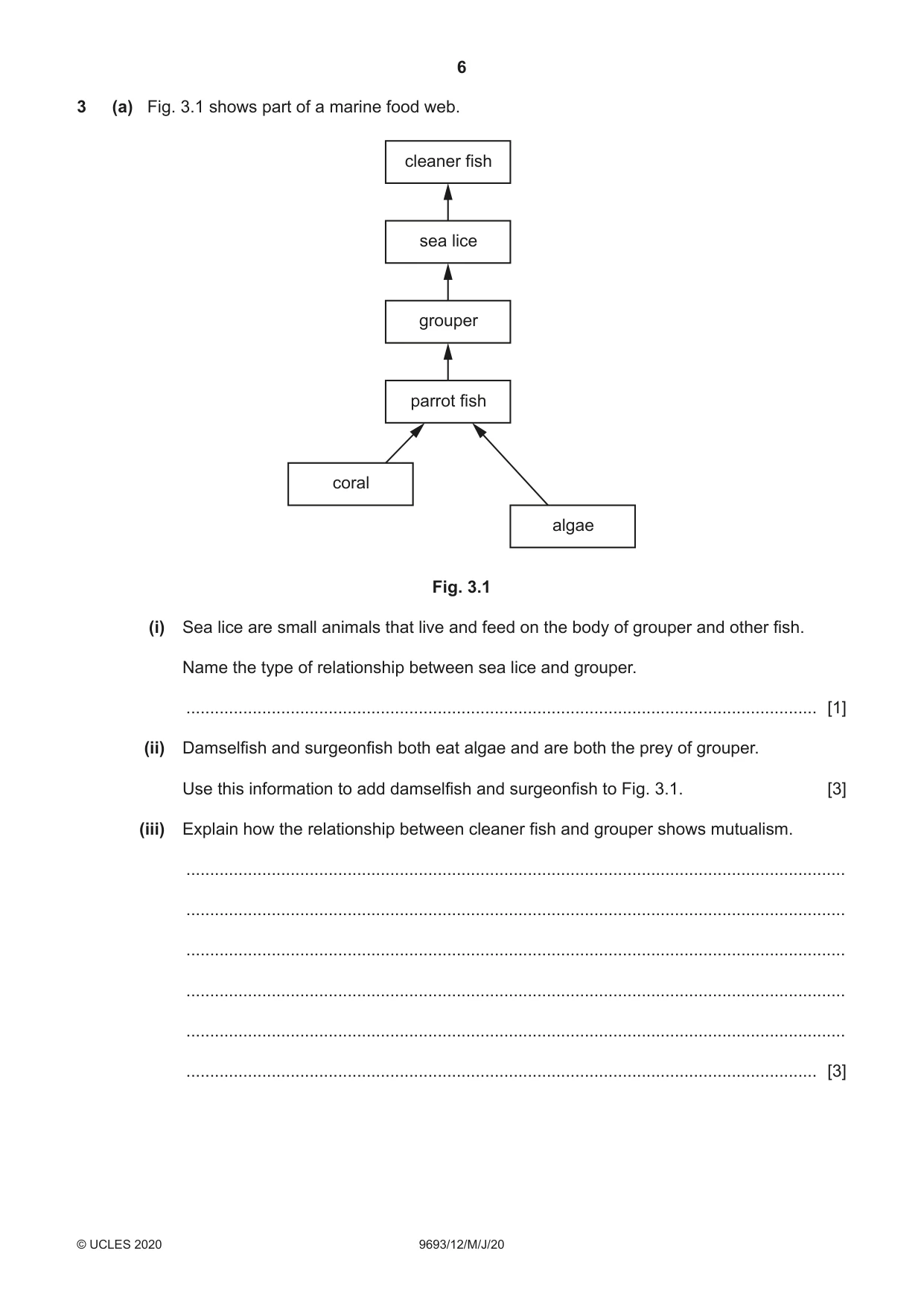
6 9693/12/M/J/20 © UCLES 2020 3 (a) Fig. 3.1 shows part of a marine food web. cleaner fish sea lice grouper parrot fish coral algae Fig. 3.1 (i) Sea lice are small animals that live and feed on the body of grouper and other fish. Name the type of relationship between sea lice and grouper. … [1] (ii) Damselfish and surgeonfish both eat algae and are both the prey of grouper. Use this information to add damselfish and surgeonfish to Fig. 3.1. [3] (iii) Explain how the relationship between cleaner fish and grouper shows mutualism. … … … … … … [3]
Question paper, page 7
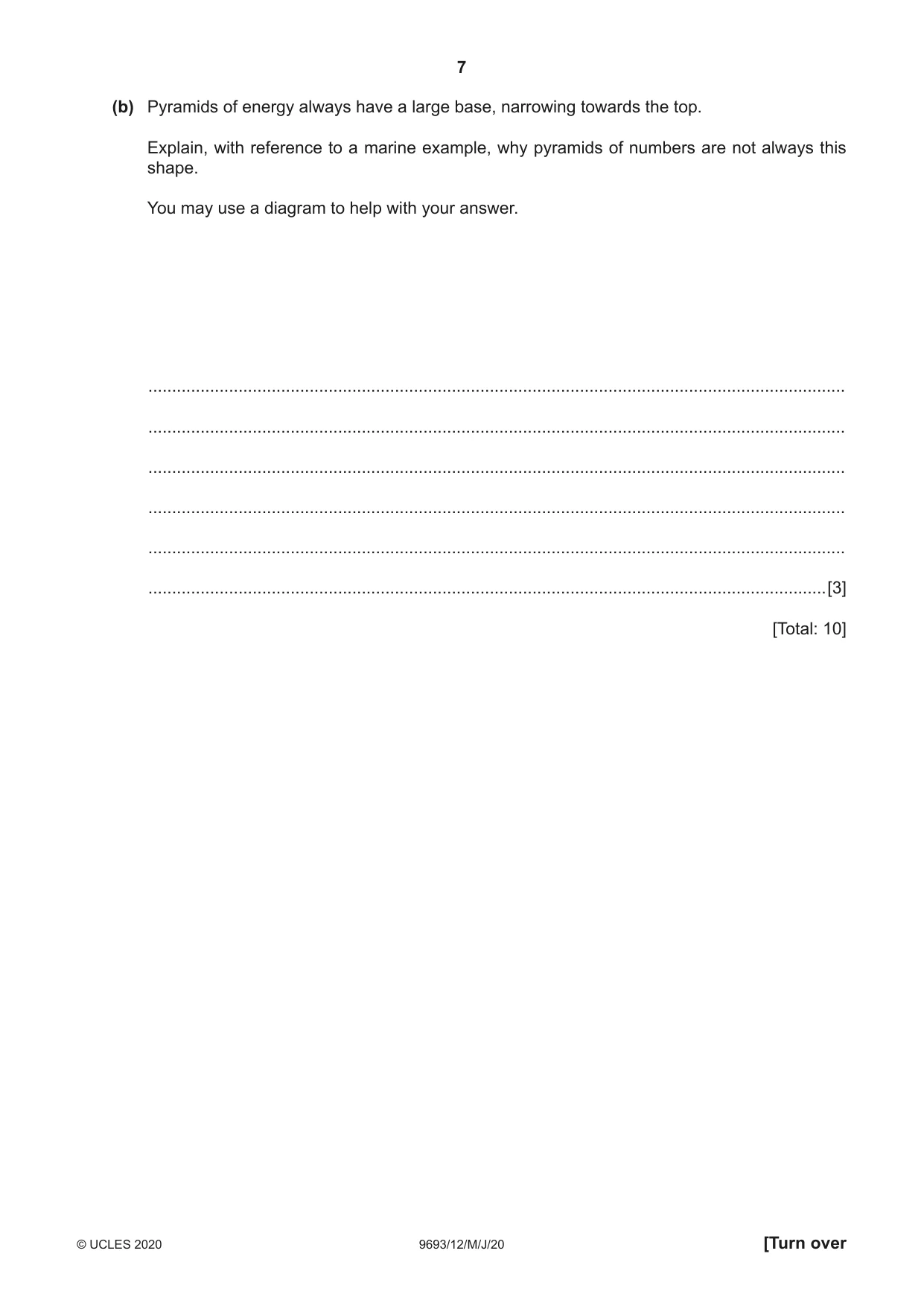
7 9693/12/M/J/20 © UCLES 2020 [Turn over (b) Pyramids of energy always have a large base, narrowing towards the top. Explain, with reference to a marine example, why pyramids of numbers are not always this shape. You may use a diagram to help with your answer. … … … … … …[3] [Total: 10]
Question paper, page 8
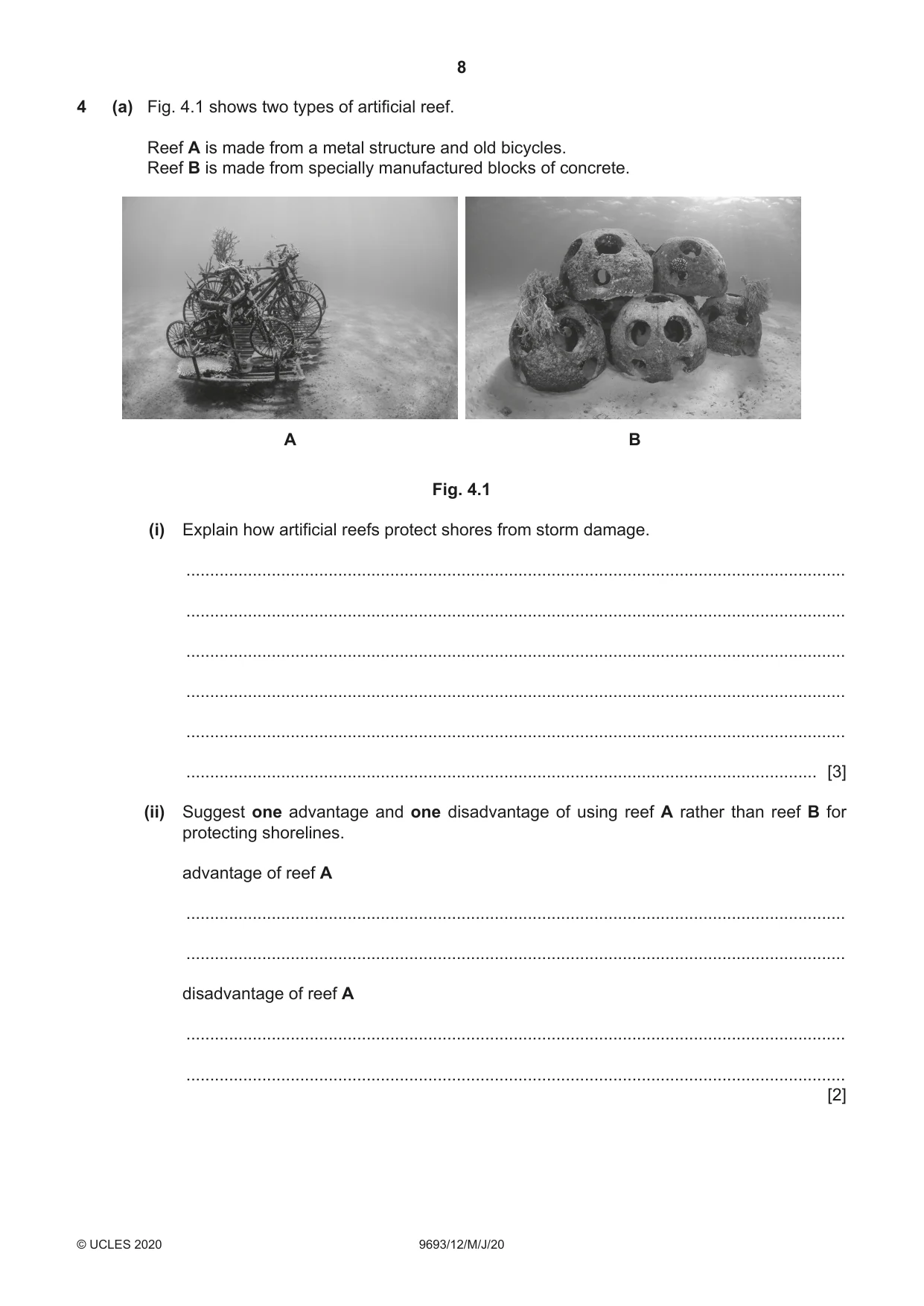
8 9693/12/M/J/20 © UCLES 2020 4 (a) Fig. 4.1 shows two types of artificial reef. Reef A is made from a metal structure and old bicycles. Reef B is made from specially manufactured blocks of concrete. B A Fig. 4.1 (i) Explain how artificial reefs protect shores from storm damage. … … … … … … [3] (ii) Suggest one advantage and one disadvantage of using reef A rather than reef B for protecting shorelines. advantage of reef A … … disadvantage of reef A … … [2]
Question paper, page 9
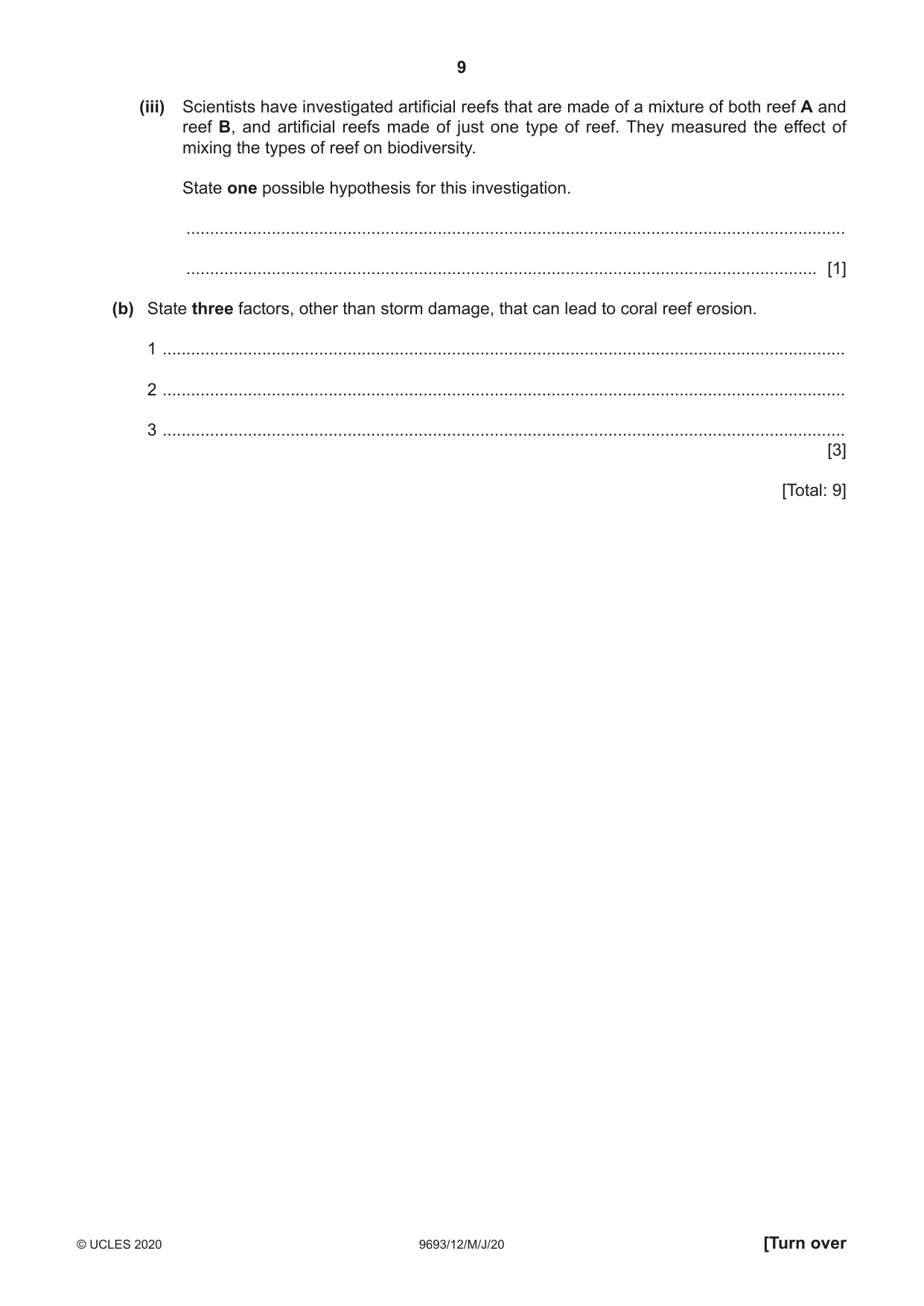
9 9693/12/M/J/20 © UCLES 2020 [Turn over (iii) Scientists have investigated artificial reefs that are made of a mixture of both reef A and reef B, and artificial reefs made of just one type of reef. They measured the effect of mixing the types of reef on biodiversity. State one possible hypothesis for this investigation. … … [1] (b) State three factors, other than storm damage, that can lead to coral reef erosion. 1 … 2 … 3 … [3] [Total: 9]
Question paper, page 10
10 9693/12/M/J/20 © UCLES 2020 5 Producers in food webs at hydrothermal vents use chemosynthesis. (a) Outline one difference and one similarity between chemosynthesis and photosynthesis. difference … … similarity … … [2] (b) Describe how hydrothermal vents form. … … … … … … [3] (c) Marine mining companies are planning to explore hydrothermal vents. (i) Suggest why the conditions at hydrothermal vents make exploration difficult. … … … … [2] (ii) Suggest why mining companies are interested in exploring hydrothermal vents. … … [1]
Question paper, page 11
11 9693/12/M/J/20 © UCLES 2020 [Turn over (iii) Explain how mining at hydrothermal vents could affect productivity in the surrounding food webs. … … … … … … [3] [Total: 11]
Question paper, page 12
12 9693/12/M/J/20 © UCLES 2020 BLANK PAGE
Question paper, page 13
13 9693/12/M/J/20 © UCLES 2020 [Turn over 6 Parts of the Southern Ocean are described as high nitrate low chlorophyll (HNLC) regions. Nitrates contain nitrogen. (a) State a biological use of nitrogen. … … [1] (b) Scientists investigated the effect of volcanic ash on phytoplankton growth. Phytoplankton are small photosynthetic organisms. Scientists collected samples of surface water from a Southern Ocean HNLC region. The samples were divided into two groups. • The samples in group A had nothing added. • The samples in group B had volcanic ash added. The samples were incubated for 48 hours to allow phytoplankton growth. (i) State the function of the samples in group A. … … [1] (ii) The samples in group A and group B were kept at the same light intensity. State one other factor that should have been kept constant. … … [1]
Question paper, page 14
14 9693/12/M/J/20 © UCLES 2020 Fig. 6.1 shows the mean concentration of phytoplankton after 48 hours. A 0.0 0.1 0.2 0.3 0.4 0.5 B group mean concentration of phytoplankton / arbitrary units Fig. 6.1 (iii) Calculate the difference between the mean concentration of phytoplankton in group A and group B. … a.u. [1] (iv) Use your answer from (b)(iii) to calculate the percentage increase in mean concentration of phytoplankton between group A and group B. … % [1]
Question paper, page 15
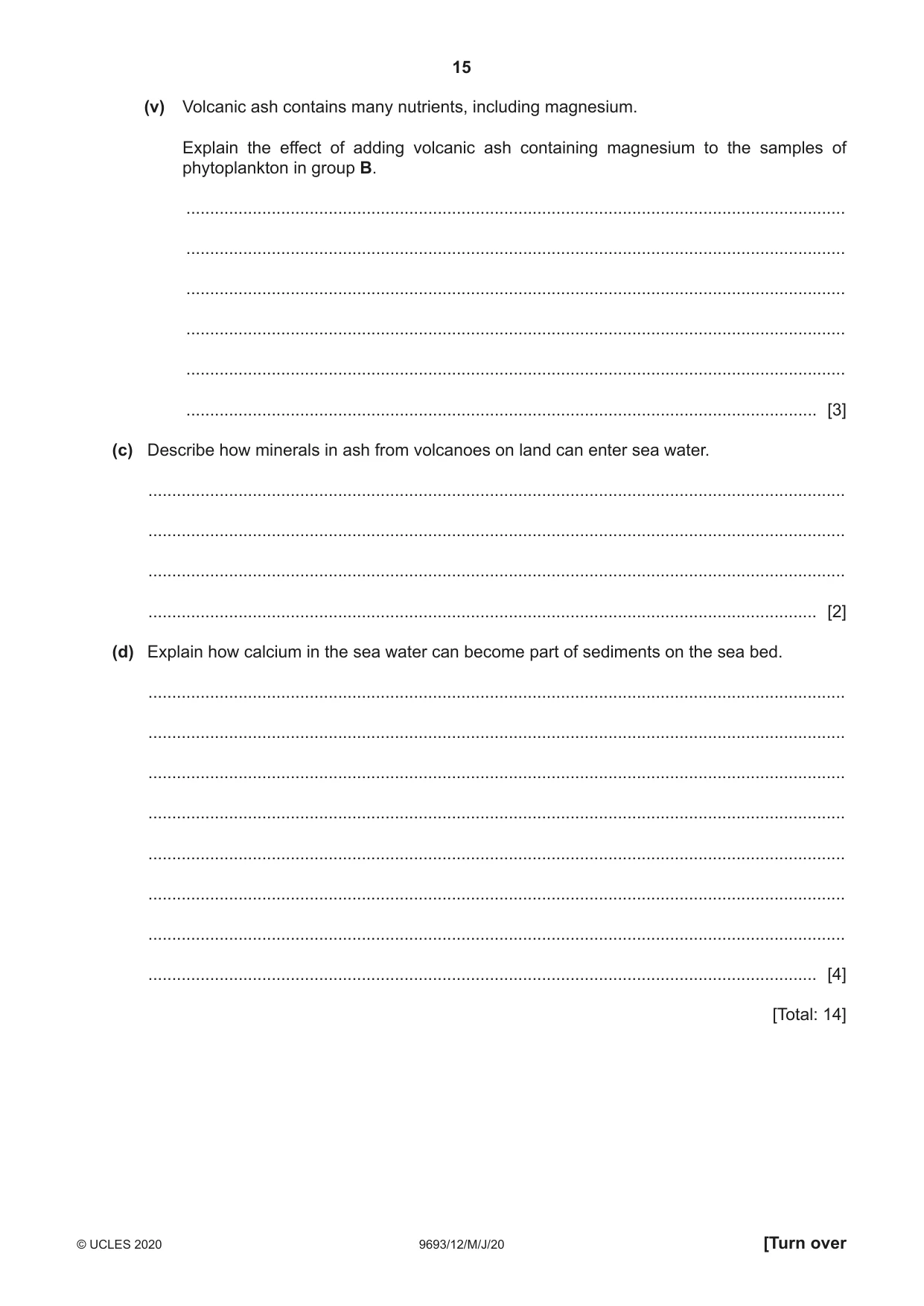
15 9693/12/M/J/20 © UCLES 2020 [Turn over (v) Volcanic ash contains many nutrients, including magnesium. Explain the effect of adding volcanic ash containing magnesium to the samples of phytoplankton in group B. … … … … … … [3] (c) Describe how minerals in ash from volcanoes on land can enter sea water. … … … … [2] (d) Explain how calcium in the sea water can become part of sediments on the sea bed. … … … … … … … … [4] [Total: 14]
Question paper, page 16
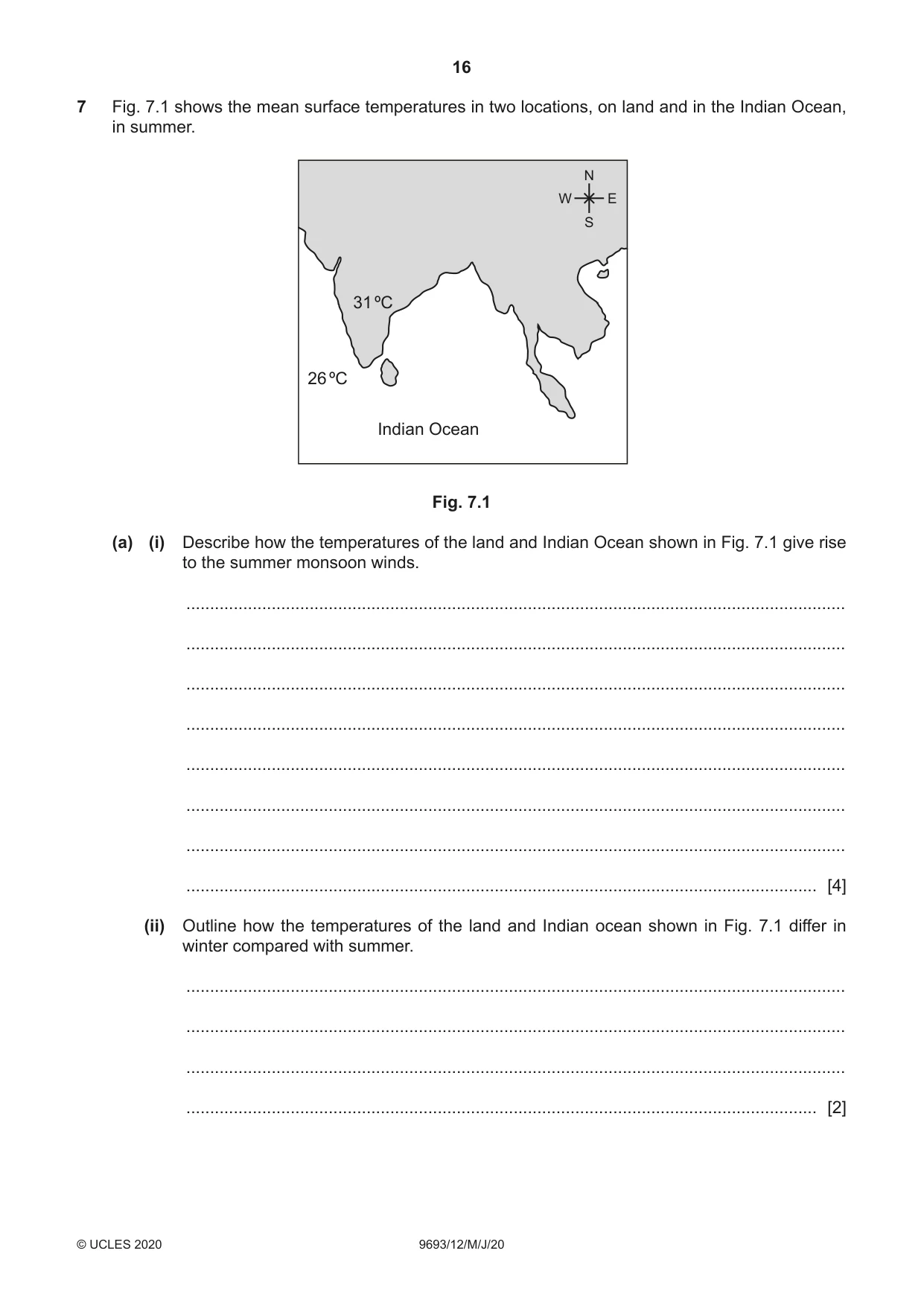
16 9693/12/M/J/20 © UCLES 2020 7 Fig. 7.1 shows the mean surface temperatures in two locations, on land and in the Indian Ocean, in summer. 31 ºC 26 ºC N S W E Indian Ocean Fig. 7.1 (a) (i) Describe how the temperatures of the land and Indian Ocean shown in Fig. 7.1 give rise to the summer monsoon winds. … … … … … … … … [4] (ii) Outline how the temperatures of the land and Indian ocean shown in Fig. 7.1 differ in winter compared with summer. … … … … [2]
Question paper, page 17
17 9693/12/M/J/20 © UCLES 2020 (b) In the Indian Ocean, the depth of the thermocline changes between summer and winter. Suggest two reasons why the depth of the thermocline changes. 1 … … 2 … … [2] (c) Tropical cyclones (hurricanes or typhoons) can form in the Indian Ocean. Describe the role of latent heat in the formation of tropical cyclones. … … … … … … … … [4] [Total: 12]
Question paper, page 18
18 9693/12/M/J/20 © UCLES 2020 BLANK PAGE
Question paper, page 19
19 9693/12/M/J/20 © UCLES 2020 BLANK PAGE
Question paper, page 20
20 9693/12/M/J/20 © UCLES 2020 Permission to reproduce items where third-party owned material protected by copyright is included has been sought and cleared where possible. Every reasonable effort has been made by the publisher (UCLES) to trace copyright holders, but if any items requiring clearance have unwittingly been included, the publisher will be pleased to make amends at the earliest possible opportunity. To avoid the issue of disclosure of answer-related information to candidates, all copyright acknowledgements are reproduced online in the Cambridge Assessment International Education Copyright Acknowledgements Booklet. This is produced for each series of examinations and is freely available to download at www.cambridgeinternational.org after the live examination series. Cambridge Assessment International Education is part of the Cambridge Assessment Group. Cambridge Assessment is the brand name of the University of Cambridge Local Examinations Syndicate (UCLES), which itself is a department of the University of Cambridge. BLANK PAGE
Mark scheme, page 1
This document consists of 11 printed pages. © UCLES 2020 [Turn over Cambridge International AS & A Level MARINE SCIENCE 9693/12 Paper 1 AS Structured Questions May/June 2020 MARK SCHEME Maximum Mark: 75 Published Students did not sit exam papers in the June 2020 series due to the Covid-19 global pandemic. This mark scheme is published to support teachers and students and should be read together with the question paper. It shows the requirements of the exam. The answer column of the mark scheme shows the proposed basis on which Examiners would award marks for this exam. Where appropriate, this column also provides the most likely acceptable alternative responses expected from students. Examiners usually review the mark scheme after they have seen student responses and update the mark scheme if appropriate. In the June series, Examiners were unable to consider the acceptability of alternative responses, as there were no student responses to consider. Mark schemes should usually be read together with the Principal Examiner Report for Teachers. However, because students did not sit exam papers, there is no Principal Examiner Report for Teachers for the June 2020 series. Cambridge International will not enter into discussions about these mark schemes. Cambridge International is publishing the mark schemes for the June 2020 series for most Cambridge IGCSE™ and Cambridge International A & AS Level components, and some Cambridge O Level components.
Mark scheme, page 2
9693/12 Cambridge International AS & A Level – Mark Scheme PUBLISHED May/June 2020 © UCLES 2020 Page 2 of 11 Generic Marking Principles These general marking principles must be applied by all examiners when marking candidate answers. They should be applied alongside the specific content of the mark scheme or generic level descriptors for a question. Each question paper and mark scheme will also comply with these marking principles. GENERIC MARKING PRINCIPLE 1: Marks must be awarded in line with: • the specific content of the mark scheme or the generic level descriptors for the question • the specific skills defined in the mark scheme or in the generic level descriptors for the question • the standard of response required by a candidate as exemplified by the standardisation scripts. GENERIC MARKING PRINCIPLE 2: Marks awarded are always whole marks (not half marks, or other fractions). GENERIC MARKING PRINCIPLE 3: Marks must be awarded positively: • marks are awarded for correct/valid answers, as defined in the mark scheme. However, credit is given for valid answers which go beyond the scope of the syllabus and mark scheme, referring to your Team Leader as appropriate • marks are awarded when candidates clearly demonstrate what they know and can do • marks are not deducted for errors • marks are not deducted for omissions • answers should only be judged on the quality of spelling, punctuation and grammar when these features are specifically assessed by the question as indicated by the mark scheme. The meaning, however, should be unambiguous. GENERIC MARKING PRINCIPLE 4: Rules must be applied consistently e.g. in situations where candidates have not followed instructions or in the application of generic level descriptors.
Mark scheme, page 3
9693/12 Cambridge International AS & A Level – Mark Scheme PUBLISHED May/June 2020 © UCLES 2020 Page 3 of 11 GENERIC MARKING PRINCIPLE 5: Marks should be awarded using the full range of marks defined in the mark scheme for the question (however; the use of the full mark range may be limited according to the quality of the candidate responses seen). GENERIC MARKING PRINCIPLE 6: Marks awarded are based solely on the requirements as defined in the mark scheme. Marks should not be awarded with grade thresholds or grade descriptors in mind. Science-Specific Marking Principles 1 Examiners should consider the context and scientific use of any keywords when awarding marks. Although keywords may be present, marks should not be awarded if the keywords are used incorrectly. 2 The examiner should not choose between contradictory statements given in the same question part, and credit should not be awarded for any correct statement that is contradicted within the same question part. Wrong science that is irrelevant to the question should be ignored. 3 Although spellings do not have to be correct, spellings of syllabus terms must allow for clear and unambiguous separation from other syllabus terms with which they may be confused (e.g. ethane / ethene, glucagon / glycogen, refraction / reflection). 4 The error carried forward (ecf) principle should be applied, where appropriate. If an incorrect answer is subsequently used in a scientifically correct way, the candidate should be awarded these subsequent marking points. Further guidance will be included in the mark scheme where necessary and any exceptions to this general principle will be noted.
Mark scheme, page 4
9693/12 Cambridge International AS & A Level – Mark Scheme PUBLISHED May/June 2020 © UCLES 2020 Page 4 of 11 5 ‘List rule’ guidance (see examples below) For questions that require n responses (e.g. State two reasons …): • The response should be read as continuous prose, even when numbered answer spaces are provided • Any response marked ignore in the mark scheme should not count towards n • Incorrect responses should not be awarded credit but will still count towards n • Read the entire response to check for any responses that contradict those that would otherwise be credited. Credit should not be awarded for any responses that are contradicted within the rest of the response. Where two responses contradict one another, this should be treated as a single incorrect response • Non-contradictory responses after the first n responses may be ignored even if they include incorrect science. 6 Calculation specific guidance Correct answers to calculations should be given full credit even if there is no working or incorrect working, unless the question states ‘show your working’. For questions in which the number of significant figures required is not stated, credit should be awarded for correct answers when rounded by the examiner to the number of significant figures given in the mark scheme. This may not apply to measured values. For answers given in standard form, (e.g. a × 10n) in which the convention of restricting the value of the coefficient (a) to a value between 1 and 10 is not followed, credit may still be awarded if the answer can be converted to the answer given in the mark scheme. Unless a separate mark is given for a unit, a missing or incorrect unit will normally mean that the final calculation mark is not awarded. Exceptions to this general principle will be noted in the mark scheme. 7 Guidance for chemical equations Multiples / fractions of coefficients used in chemical equations are acceptable unless stated otherwise in the mark scheme. State symbols given in an equation should be ignored unless asked for in the question or stated otherwise in the mark scheme.
Mark scheme, page 5
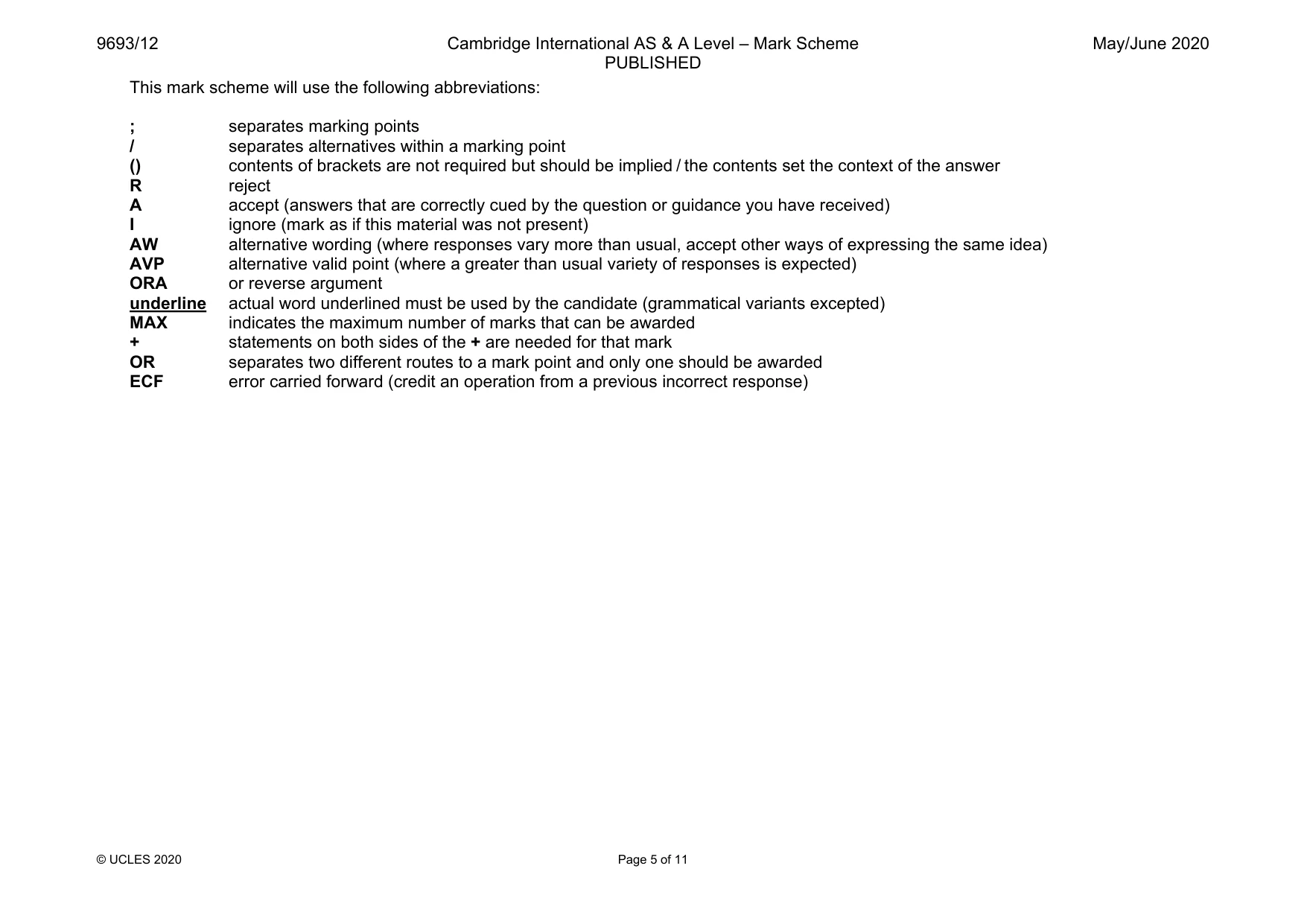
9693/12 Cambridge International AS & A Level – Mark Scheme PUBLISHED May/June 2020 © UCLES 2020 Page 5 of 11 This mark scheme will use the following abbreviations: ; separates marking points / separates alternatives within a marking point () contents of brackets are not required but should be implied / the contents set the context of the answer R reject A accept (answers that are correctly cued by the question or guidance you have received) I ignore (mark as if this material was not present) AW alternative wording (where responses vary more than usual, accept other ways of expressing the same idea) AVP alternative valid point (where a greater than usual variety of responses is expected) ORA or reverse argument underline actual word underlined must be used by the candidate (grammatical variants excepted) MAX indicates the maximum number of marks that can be awarded + statements on both sides of the + are needed for that mark OR separates two different routes to a mark point and only one should be awarded ECF error carried forward (credit an operation from a previous incorrect response)
Mark scheme, page 6
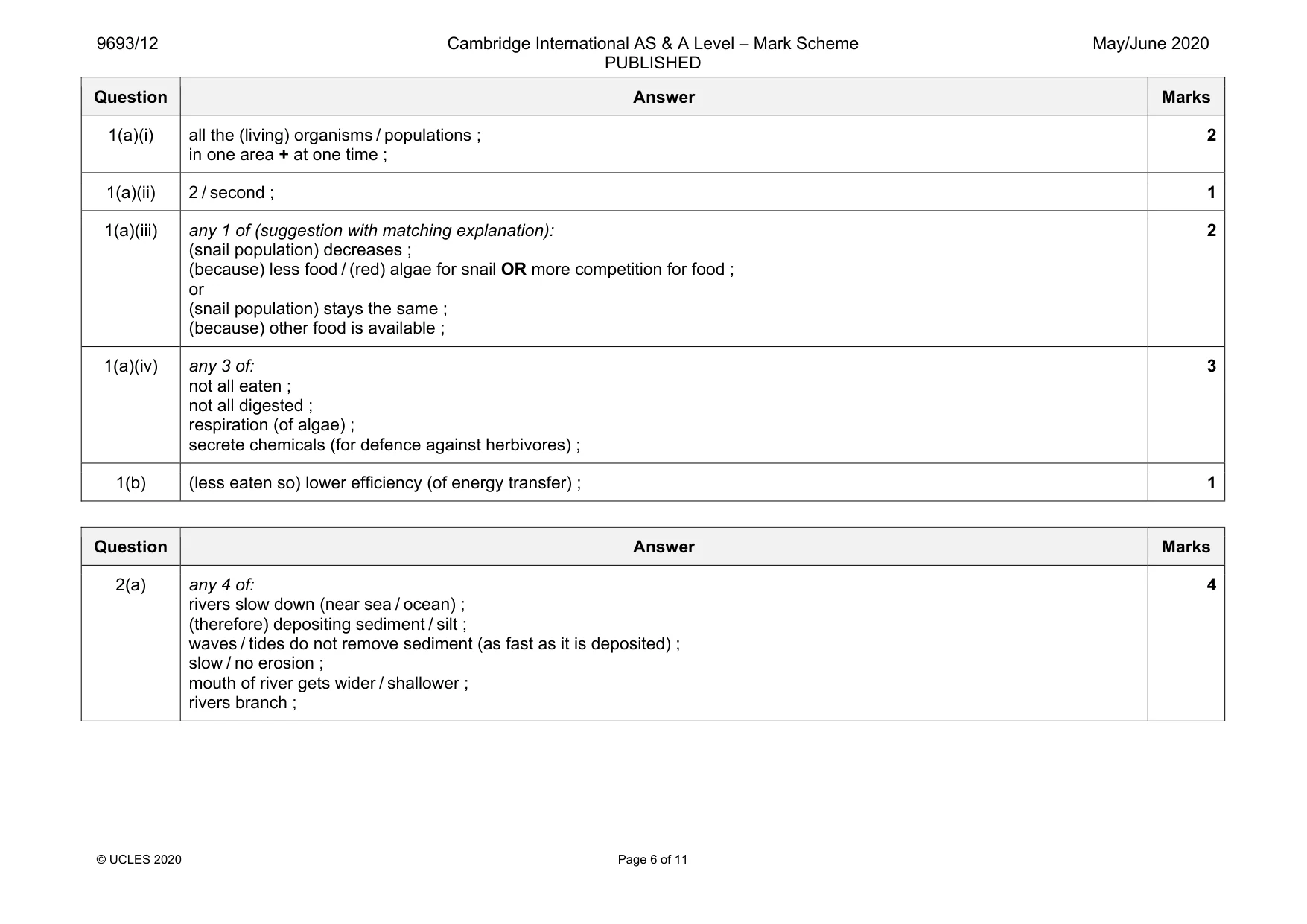
9693/12 Cambridge International AS & A Level – Mark Scheme PUBLISHED May/June 2020 © UCLES 2020 Page 6 of 11 Question Answer Marks 1(a)(i) all the (living) organisms / populations ; in one area + at one time ; 2 1(a)(ii) 2 / second ; 1 1(a)(iii) any 1 of (suggestion with matching explanation): (snail population) decreases ; (because) less food / (red) algae for snail OR more competition for food ; or (snail population) stays the same ; (because) other food is available ; 2 1(a)(iv) any 3 of: not all eaten ; not all digested ; respiration (of algae) ; secrete chemicals (for defence against herbivores) ; 3 1(b) (less eaten so) lower efficiency (of energy transfer) ; 1 Question Answer Marks 2(a) any 4 of: rivers slow down (near sea / ocean) ; (therefore) depositing sediment / silt ; waves / tides do not remove sediment (as fast as it is deposited) ; slow / no erosion ; mouth of river gets wider / shallower ; rivers branch ; 4
Mark scheme, page 7
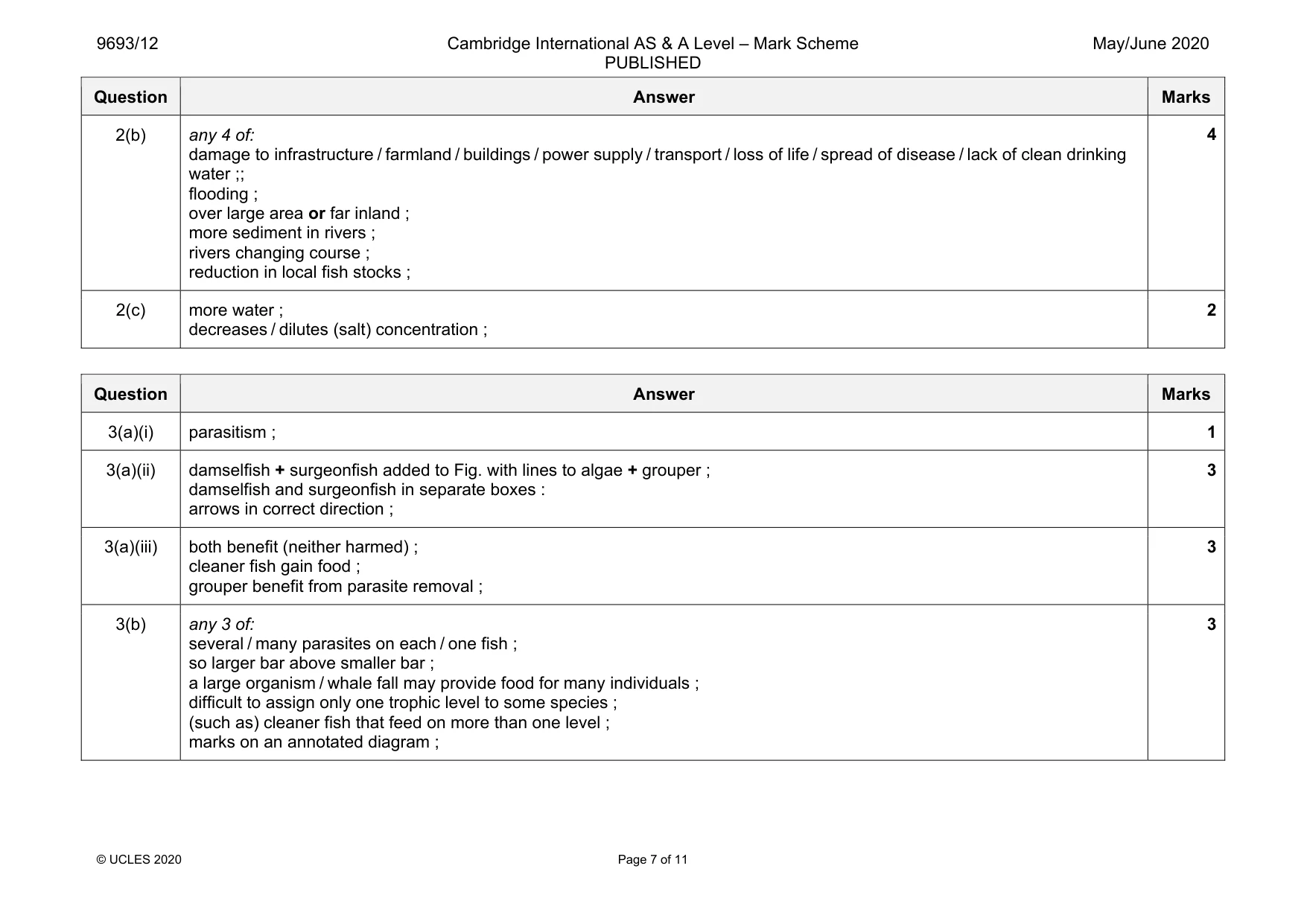
9693/12 Cambridge International AS & A Level – Mark Scheme PUBLISHED May/June 2020 © UCLES 2020 Page 7 of 11 Question Answer Marks 2(b) any 4 of: damage to infrastructure / farmland / buildings / power supply / transport / loss of life / spread of disease / lack of clean drinking water ;; flooding ; over large area or far inland ; more sediment in rivers ; rivers changing course ; reduction in local fish stocks ; 4 2(c) more water ; decreases / dilutes (salt) concentration ; 2 Question Answer Marks 3(a)(i) parasitism ; 1 3(a)(ii) damselfish + surgeonfish added to Fig. with lines to algae + grouper ; damselfish and surgeonfish in separate boxes : arrows in correct direction ; 3 3(a)(iii) both benefit (neither harmed) ; cleaner fish gain food ; grouper benefit from parasite removal ; 3 3(b) any 3 of: several / many parasites on each / one fish ; so larger bar above smaller bar ; a large organism / whale fall may provide food for many individuals ; difficult to assign only one trophic level to some species ; (such as) cleaner fish that feed on more than one level ; marks on an annotated diagram ; 3
Mark scheme, page 8
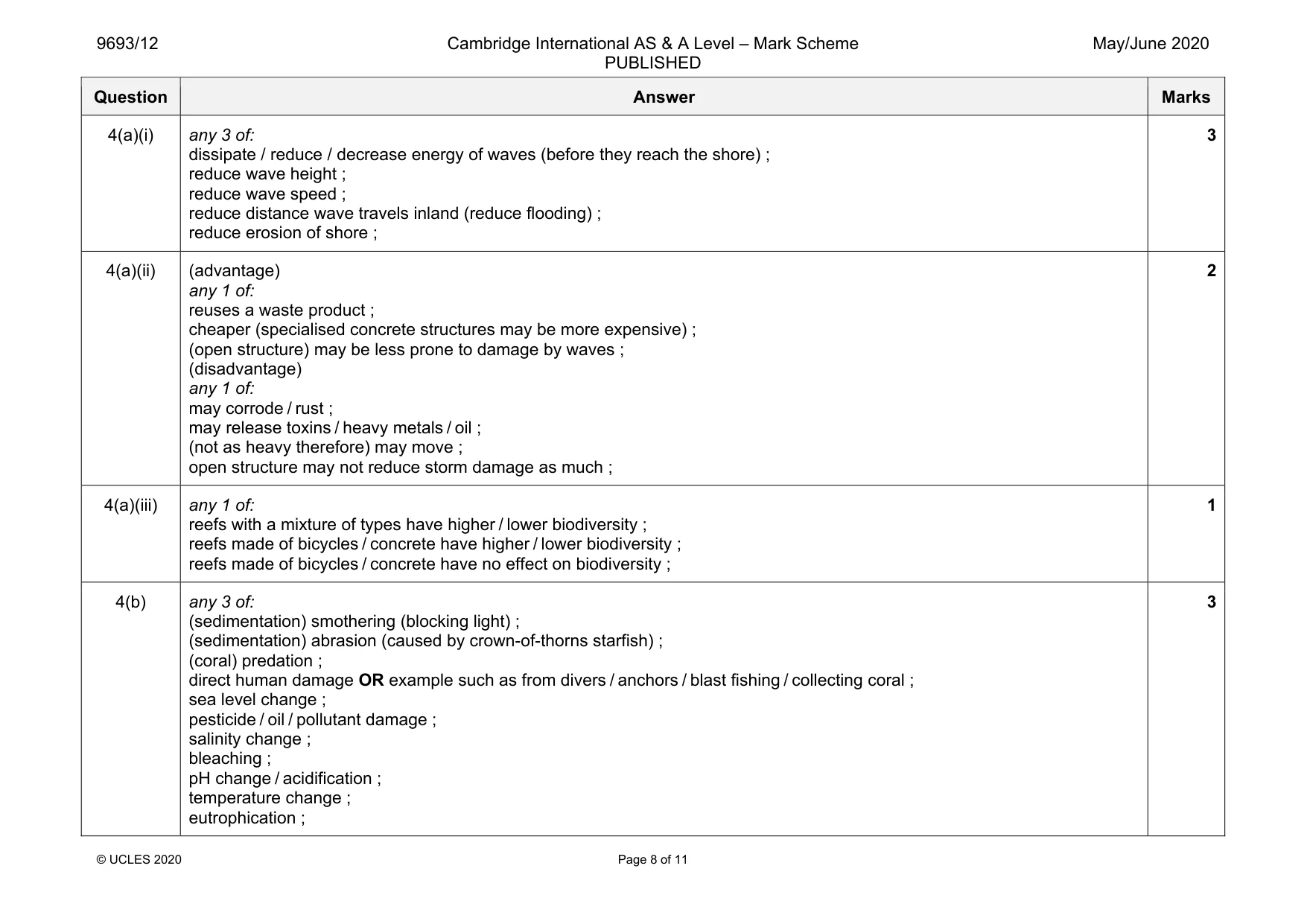
9693/12 Cambridge International AS & A Level – Mark Scheme PUBLISHED May/June 2020 © UCLES 2020 Page 8 of 11 Question Answer Marks 4(a)(i) any 3 of: dissipate / reduce / decrease energy of waves (before they reach the shore) ; reduce wave height ; reduce wave speed ; reduce distance wave travels inland (reduce flooding) ; reduce erosion of shore ; 3 4(a)(ii) (advantage) any 1 of: reuses a waste product ; cheaper (specialised concrete structures may be more expensive) ; (open structure) may be less prone to damage by waves ; (disadvantage) any 1 of: may corrode / rust ; may release toxins / heavy metals / oil ; (not as heavy therefore) may move ; open structure may not reduce storm damage as much ; 2 4(a)(iii) any 1 of: reefs with a mixture of types have higher / lower biodiversity ; reefs made of bicycles / concrete have higher / lower biodiversity ; reefs made of bicycles / concrete have no effect on biodiversity ; 1 4(b) any 3 of: (sedimentation) smothering (blocking light) ; (sedimentation) abrasion (caused by crown-of-thorns starfish) ; (coral) predation ; direct human damage OR example such as from divers / anchors / blast fishing / collecting coral ; sea level change ; pesticide / oil / pollutant damage ; salinity change ; bleaching ; pH change / acidification ; temperature change ; eutrophication ; 3
Mark scheme, page 9
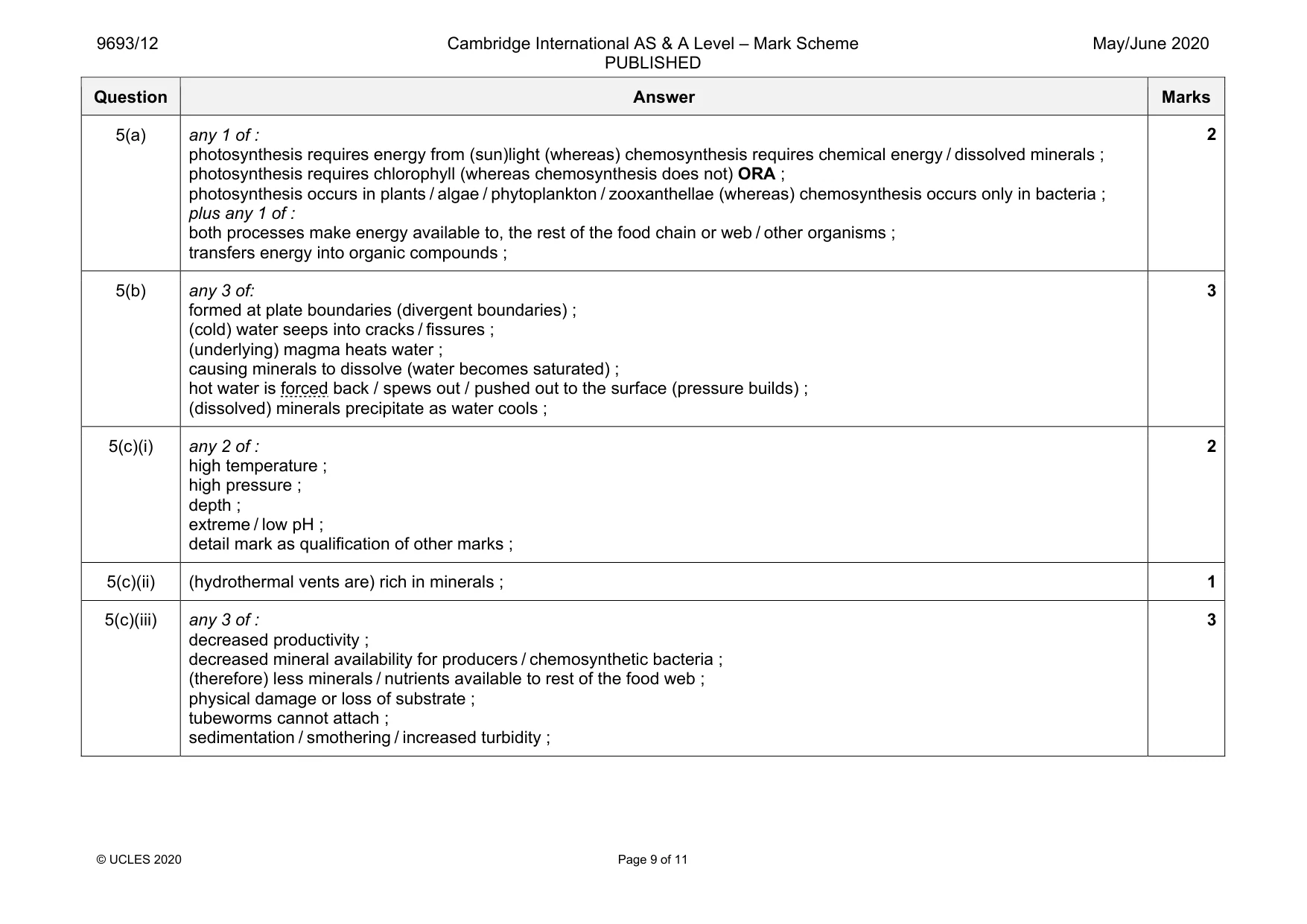
9693/12 Cambridge International AS & A Level – Mark Scheme PUBLISHED May/June 2020 © UCLES 2020 Page 9 of 11 Question Answer Marks 5(a) any 1 of : photosynthesis requires energy from (sun)light (whereas) chemosynthesis requires chemical energy / dissolved minerals ; photosynthesis requires chlorophyll (whereas chemosynthesis does not) ORA ; photosynthesis occurs in plants / algae / phytoplankton / zooxanthellae (whereas) chemosynthesis occurs only in bacteria ; plus any 1 of : both processes make energy available to, the rest of the food chain or web / other organisms ; transfers energy into organic compounds ; 2 5(b) any 3 of: formed at plate boundaries (divergent boundaries) ; (cold) water seeps into cracks / fissures ; (underlying) magma heats water ; causing minerals to dissolve (water becomes saturated) ; hot water is forced back / spews out / pushed out to the surface (pressure builds) ; (dissolved) minerals precipitate as water cools ; 3 5(c)(i) any 2 of : high temperature ; high pressure ; depth ; extreme / low pH ; detail mark as qualification of other marks ; 2 5(c)(ii) (hydrothermal vents are) rich in minerals ; 1 5(c)(iii) any 3 of : decreased productivity ; decreased mineral availability for producers / chemosynthetic bacteria ; (therefore) less minerals / nutrients available to rest of the food web ; physical damage or loss of substrate ; tubeworms cannot attach ; sedimentation / smothering / increased turbidity ; 3
Mark scheme, page 10
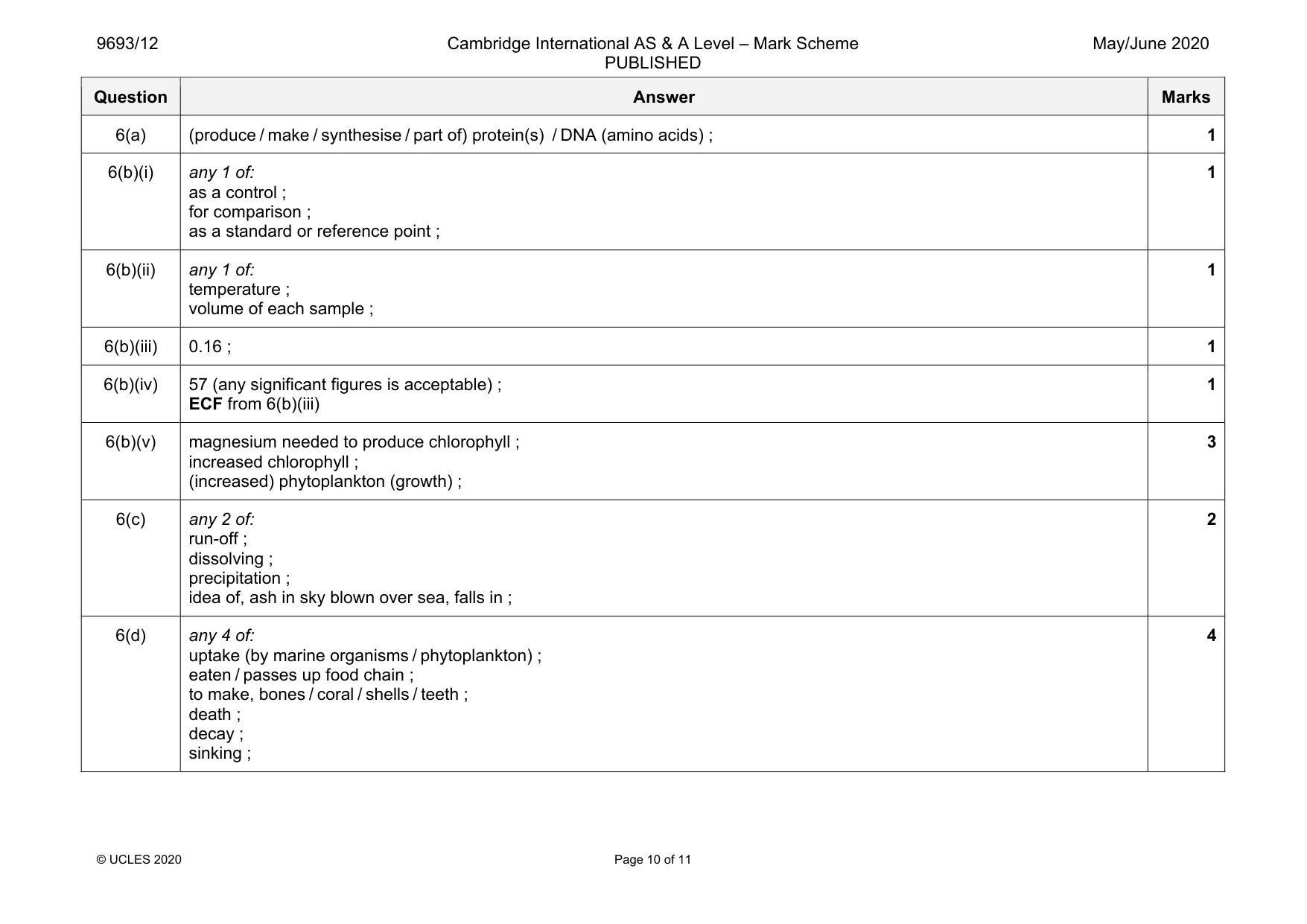
9693/12 Cambridge International AS & A Level – Mark Scheme PUBLISHED May/June 2020 © UCLES 2020 Page 10 of 11 Question Answer Marks 6(a) (produce / make / synthesise / part of) protein(s) / DNA (amino acids) ; 1 6(b)(i) any 1 of: as a control ; for comparison ; as a standard or reference point ; 1 6(b)(ii) any 1 of: temperature ; volume of each sample ; 1 6(b)(iii) 0.16 ; 1 6(b)(iv) 57 (any significant figures is acceptable) ; ECF from 6(b)(iii) 1 6(b)(v) magnesium needed to produce chlorophyll ; increased chlorophyll ; (increased) phytoplankton (growth) ; 3 6(c) any 2 of: run-off ; dissolving ; precipitation ; idea of, ash in sky blown over sea, falls in ; 2 6(d) any 4 of: uptake (by marine organisms / phytoplankton) ; eaten / passes up food chain ; to make, bones / coral / shells / teeth ; death ; decay ; sinking ; 4
Mark scheme, page 11
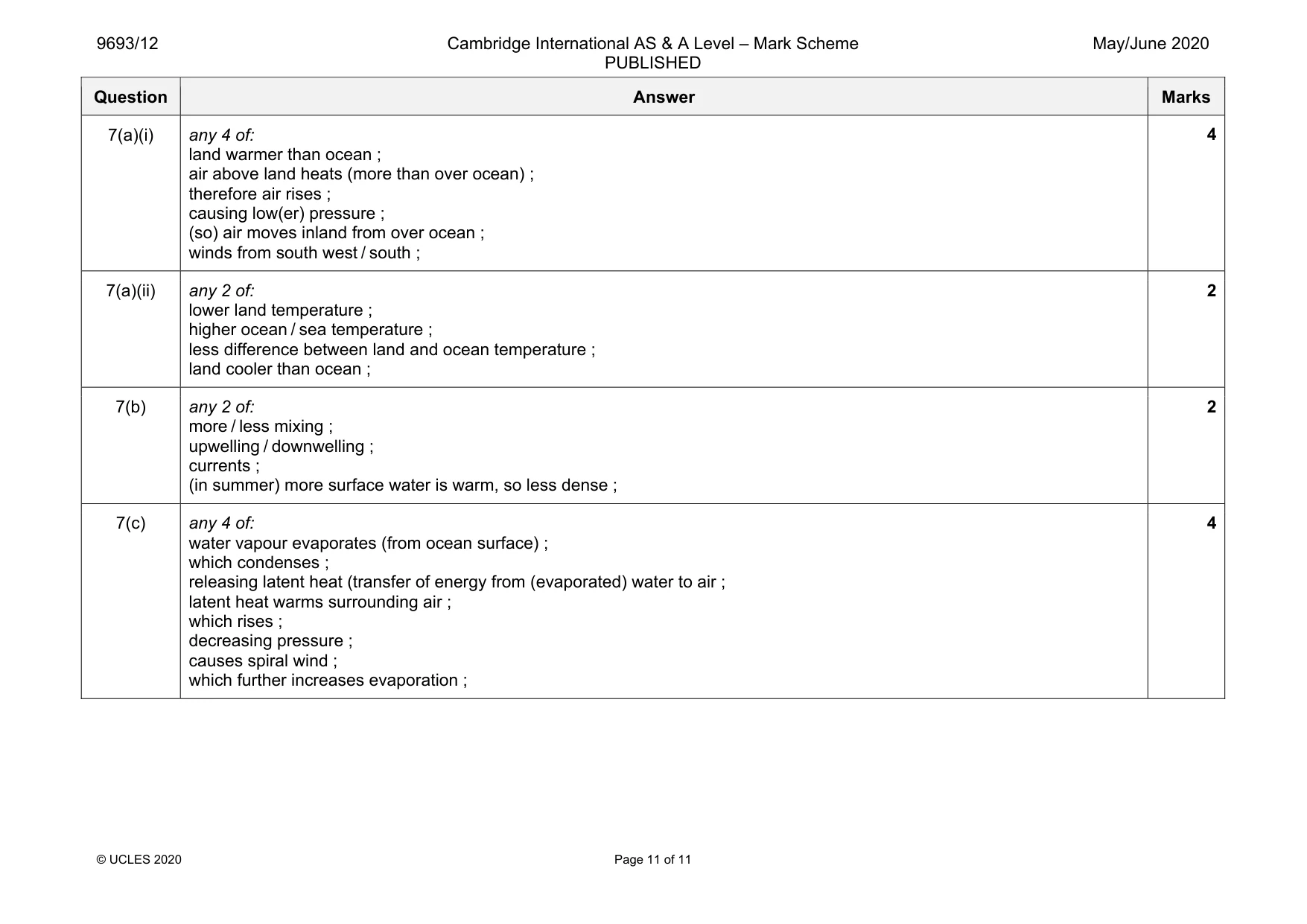
9693/12 Cambridge International AS & A Level – Mark Scheme PUBLISHED May/June 2020 © UCLES 2020 Page 11 of 11 Question Answer Marks 7(a)(i) any 4 of: land warmer than ocean ; air above land heats (more than over ocean) ; therefore air rises ; causing low(er) pressure ; (so) air moves inland from over ocean ; winds from south west / south ; 4 7(a)(ii) any 2 of: lower land temperature ; higher ocean / sea temperature ; less difference between land and ocean temperature ; land cooler than ocean ; 2 7(b) any 2 of: more / less mixing ; upwelling / downwelling ; currents ; (in summer) more surface water is warm, so less dense ; 2 7(c) any 4 of: water vapour evaporates (from ocean surface) ; which condenses ; releasing latent heat (transfer of energy from (evaporated) water to air ; latent heat warms surrounding air ; which rises ; decreasing pressure ; causes spiral wind ; which further increases evaporation ; 4