Cambridge A Level Marine Science 9693 — 2023 Oct/Nov Paper 1 · Variant 2
9693/12/O/N/23 · 75 marks · ≈84 min
The question paper and its mark scheme, free to read here and free to download. This is Cambridge’s own paper, exactly as it was sat.
Question paper16 pages
Mark scheme12 pages
Answers below. Sit the paper first if you are practising.
Paper as text
Question paper, page 1
This document has 16 pages. Any blank pages are indicated. [Turn over Cambridge International AS & A Level * 0 6 0 6 1 1 5 2 9 8 * DC (PQ) 333339 © UCLES 2023 MARINE SCIENCE 9693/12 Paper 1 AS Level Theory October/November 2023 1 hour 45 minutes You must answer on the question paper. No additional materials are needed. INSTRUCTIONS ● Answer all questions. ● Use a black or dark blue pen. You may use an HB pencil for any diagrams or graphs. ● Write your name, centre number and candidate number in the boxes at the top of the page. ● Write your answer to each question in the space provided. ● Do not use an erasable pen or correction fluid. ● Do not write on any bar codes. ● You may use a calculator. ● You should show all your working and use appropriate units. INFORMATION ● The total mark for this paper is 75. ● The number of marks for each question or part question is shown in brackets [ ].
Question paper, page 2
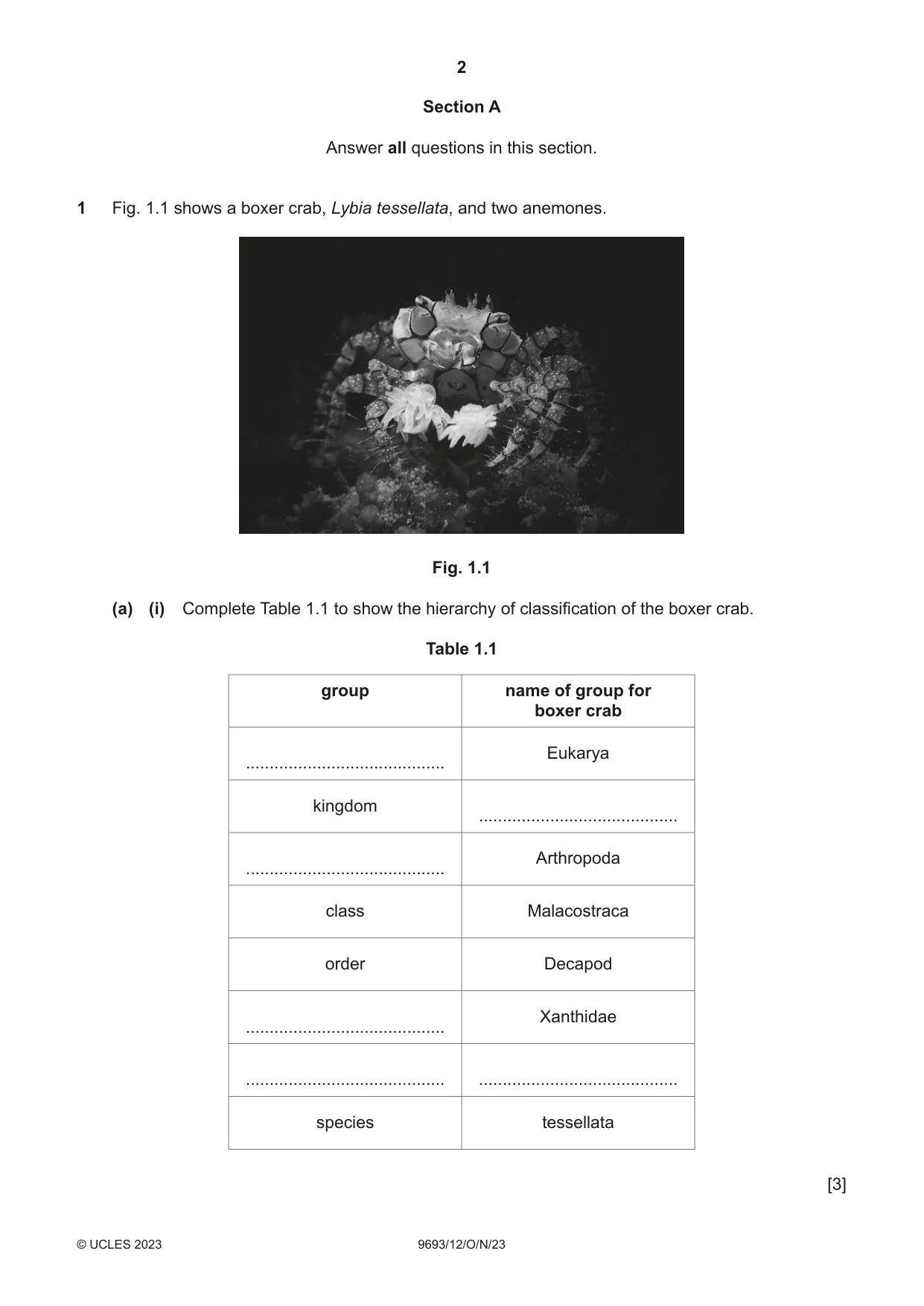
2 9693/12/O/N/23 © UCLES 2023 Section A Answer all questions in this section. 1 Fig. 1.1 shows a boxer crab, Lybia tessellata, and two anemones. Fig. 1.1 (a) (i) Complete Table 1.1 to show the hierarchy of classification of the boxer crab. Table 1.1 group name of group for boxer crab … Eukarya kingdom … … Arthropoda class Malacostraca order Decapod … Xanthidae … … species tessellata [3]
Question paper, page 3
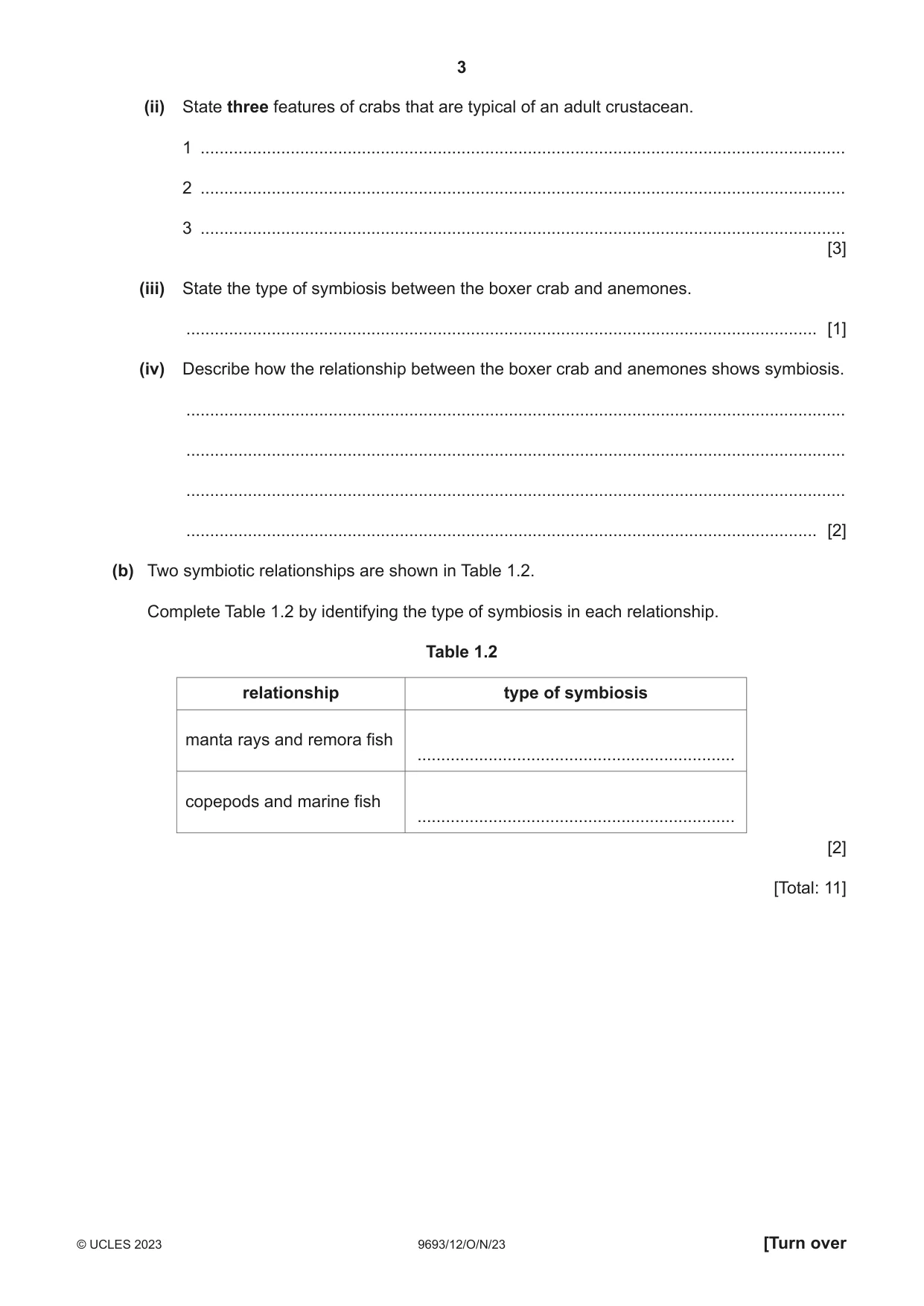
3 9693/12/O/N/23 © UCLES 2023 [Turn over (ii) State three features of crabs that are typical of an adult crustacean. 1 … 2 … 3 … [3] (iii) State the type of symbiosis between the boxer crab and anemones. … [1] (iv) Describe how the relationship between the boxer crab and anemones shows symbiosis. … … … … [2] (b) Two symbiotic relationships are shown in Table 1.2. Complete Table 1.2 by identifying the type of symbiosis in each relationship. Table 1.2 relationship type of symbiosis manta rays and remora fish … copepods and marine fish … [2] [Total: 11]
Question paper, page 4
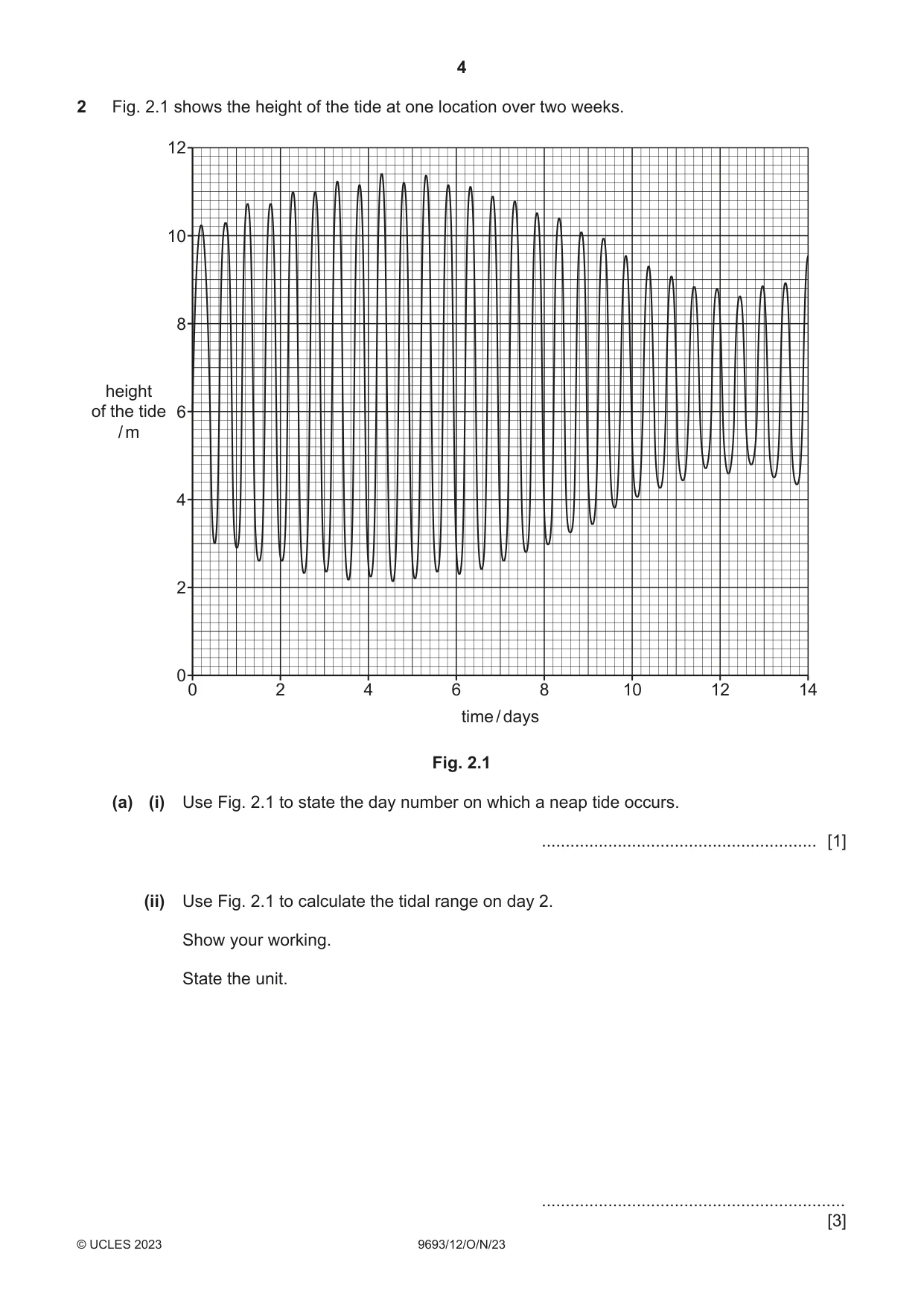
4 9693/12/O/N/23 © UCLES 2023 2 Fig. 2.1 shows the height of the tide at one location over two weeks. 0 0 2 4 6 8 10 12 14 2 4 6 height of the tide / m time / days 8 10 12 Fig. 2.1 (a) (i) Use Fig. 2.1 to state the day number on which a neap tide occurs. … [1] (ii) Use Fig. 2.1 to calculate the tidal range on day 2. Show your working. State the unit. … [3]
Question paper, page 5
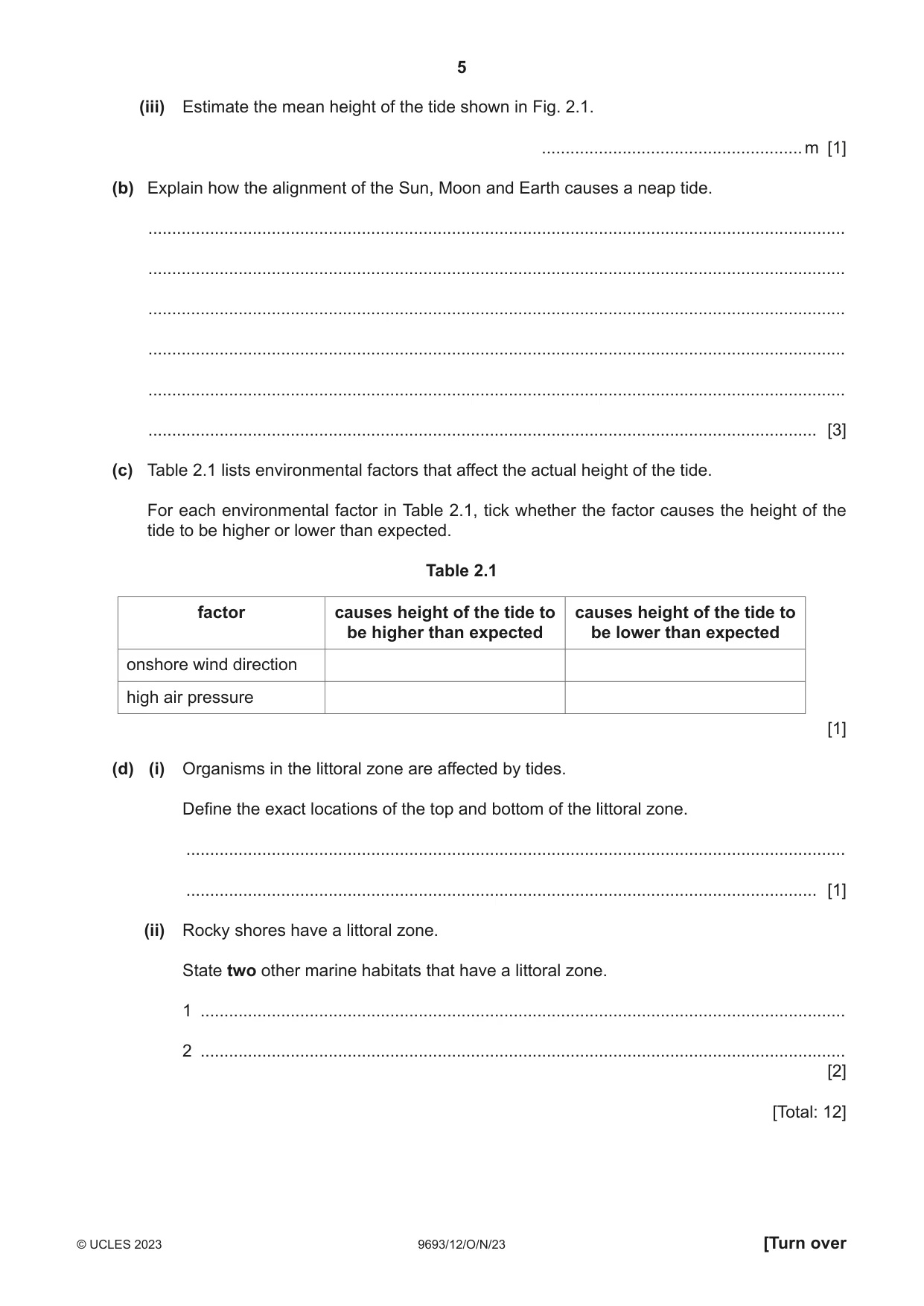
5 9693/12/O/N/23 © UCLES 2023 [Turn over (iii) Estimate the mean height of the tide shown in Fig. 2.1. … m [1] (b) Explain how the alignment of the Sun, Moon and Earth causes a neap tide. … … … … … … [3] (c) Table 2.1 lists environmental factors that affect the actual height of the tide. For each environmental factor in Table 2.1, tick whether the factor causes the height of the tide to be higher or lower than expected. Table 2.1 factor causes height of the tide to be higher than expected causes height of the tide to be lower than expected onshore wind direction high air pressure [1] (d) (i) Organisms in the littoral zone are affected by tides. Define the exact locations of the top and bottom of the littoral zone. … … [1] (ii) Rocky shores have a littoral zone. State two other marine habitats that have a littoral zone. 1 … 2 … [2] [Total: 12]
Question paper, page 6
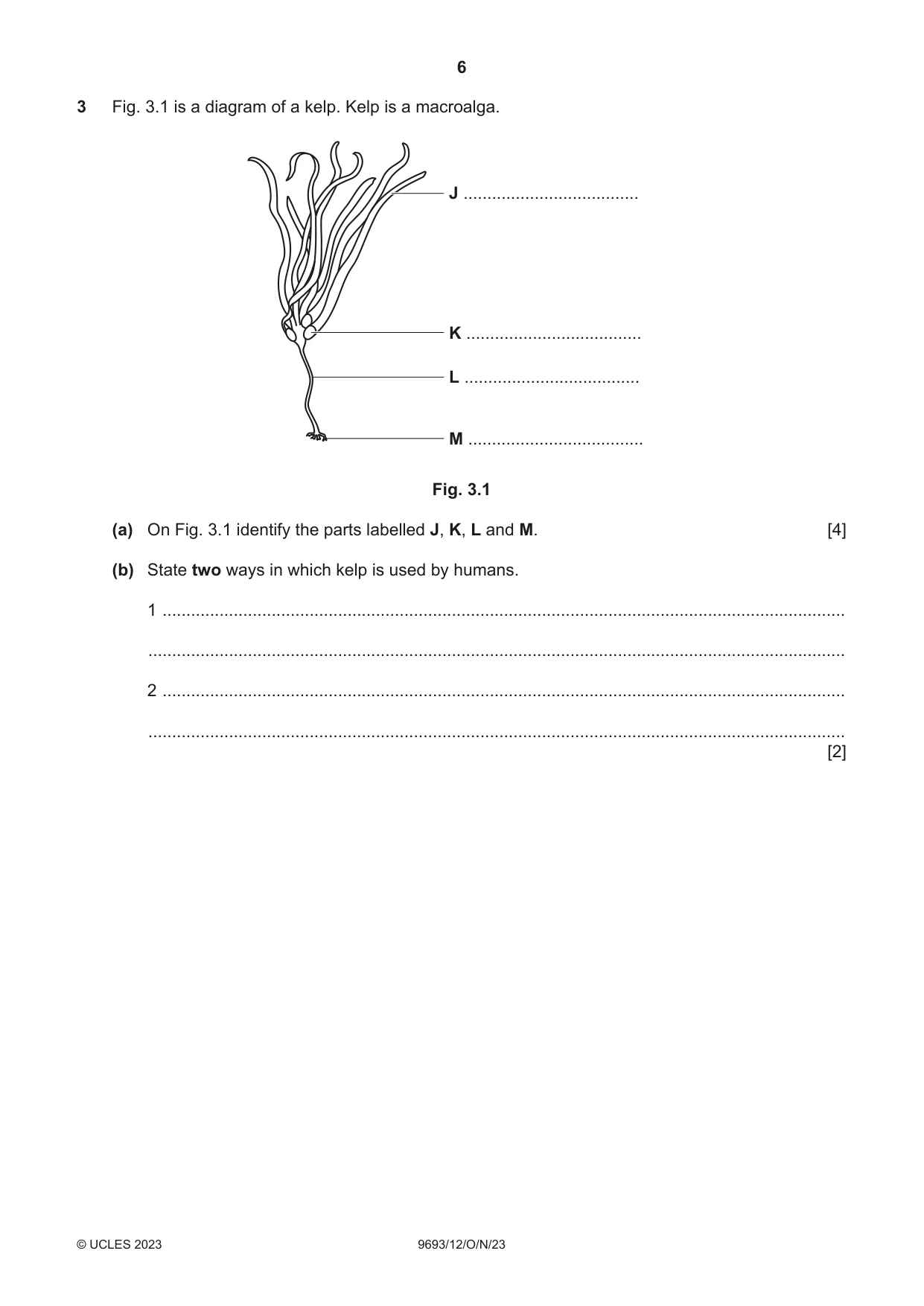
6 9693/12/O/N/23 © UCLES 2023 3 Fig. 3.1 is a diagram of a kelp. Kelp is a macroalga. J … K … L … M … Fig. 3.1 (a) On Fig. 3.1 identify the parts labelled J, K, L and M. [4] (b) State two ways in which kelp is used by humans. 1 … … 2 … … [2]
Question paper, page 7
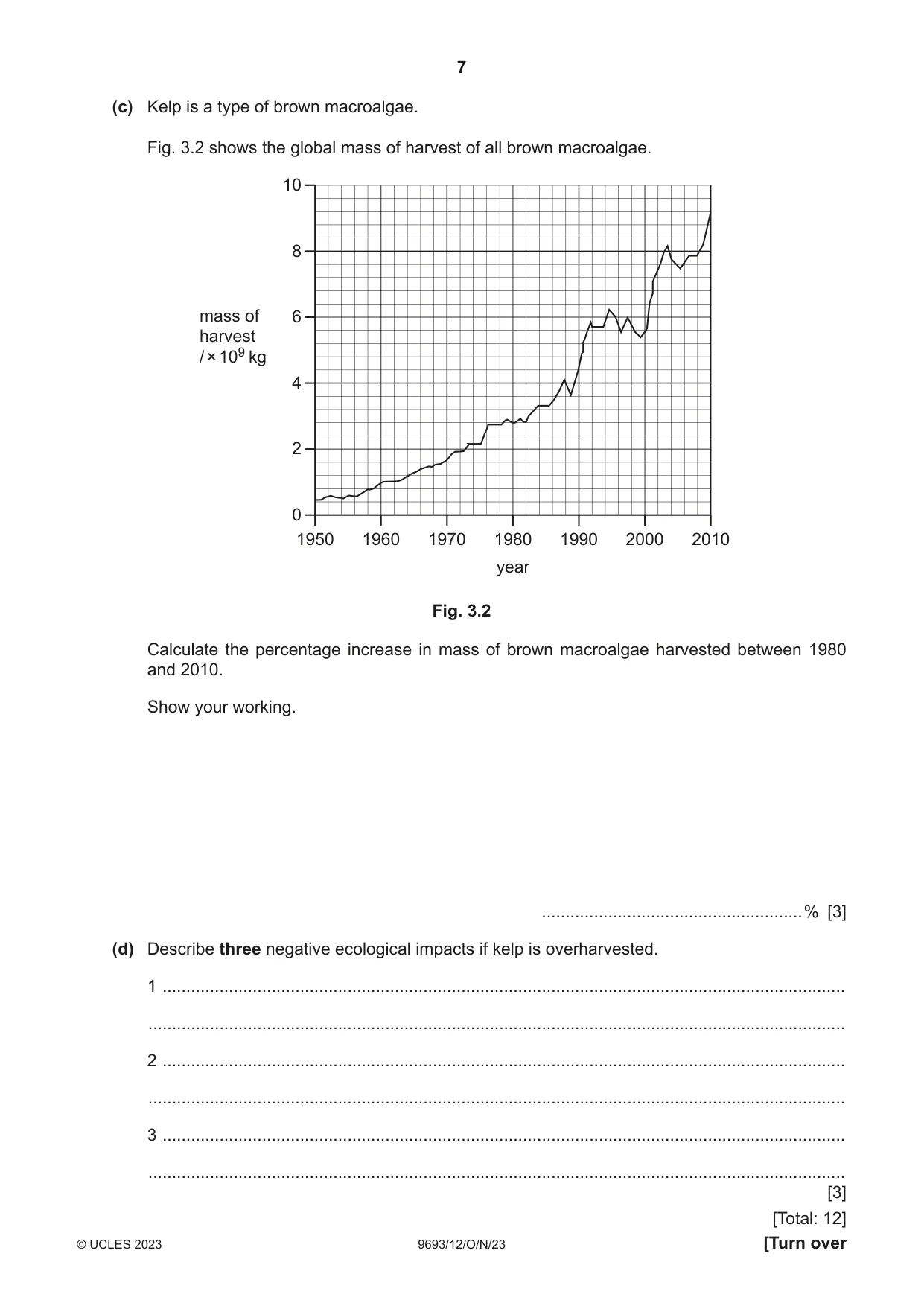
7 9693/12/O/N/23 © UCLES 2023 [Turn over (c) Kelp is a type of brown macroalgae. Fig. 3.2 shows the global mass of harvest of all brown macroalgae. 4 1960 8 2 6 10 1950 1980 year mass of harvest / × 109 kg 2000 1990 1970 2010 0 Fig. 3.2 Calculate the percentage increase in mass of brown macroalgae harvested between 1980 and 2010. Show your working. …% [3] (d) Describe three negative ecological impacts if kelp is overharvested. 1 … … 2 … … 3 … … [3] [Total: 12]
Question paper, page 8
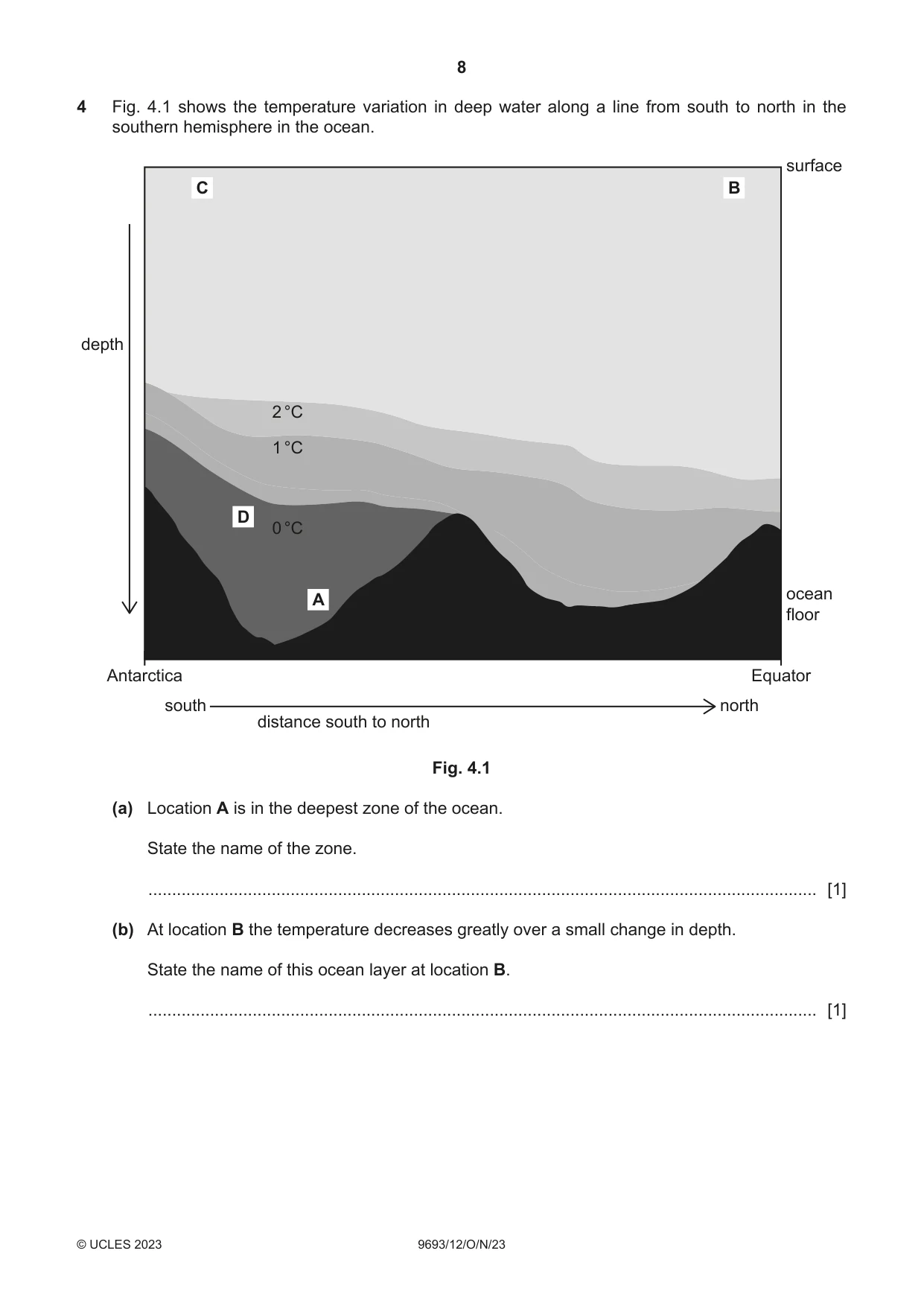
8 9693/12/O/N/23 © UCLES 2023 4 Fig. 4.1 shows the temperature variation in deep water along a line from south to north in the southern hemisphere in the ocean. 2 °C surface ocean floor depth Equator 1 °C 0 °C C B D A Antarctica south distance south to north north Fig. 4.1 (a) Location A is in the deepest zone of the ocean. State the name of the zone. … [1] (b) At location B the temperature decreases greatly over a small change in depth. State the name of this ocean layer at location B. … [1]
Question paper, page 9
9 9693/12/O/N/23 © UCLES 2023 [Turn over (c) Sea water at location C is in the Southern Ocean. Explain why sea water at location C sinks. … … … … [2] (d) Describe how mixing of the sea water in Fig. 4.1 can occur. … … … … … … … … [4] (e) Pure water has a freezing point of 0 °C at the surface. Explain why sea water at location D is not solid. … … … … [2] [Total: 10]
Question paper, page 10
10 9693/12/O/N/23 © UCLES 2023 Section B Answer all questions in this section. 5 (a) Describe the effects of El Niño on human communities along the Eastern Pacific coastline of South America. … … … … … … … … … … … … [6] (b) Describe how abiotic factors during an El Niño event differ from the abiotic factors during a La Niña event. … … … … … … … … … … … … [6] [Total: 12]
Question paper, page 11
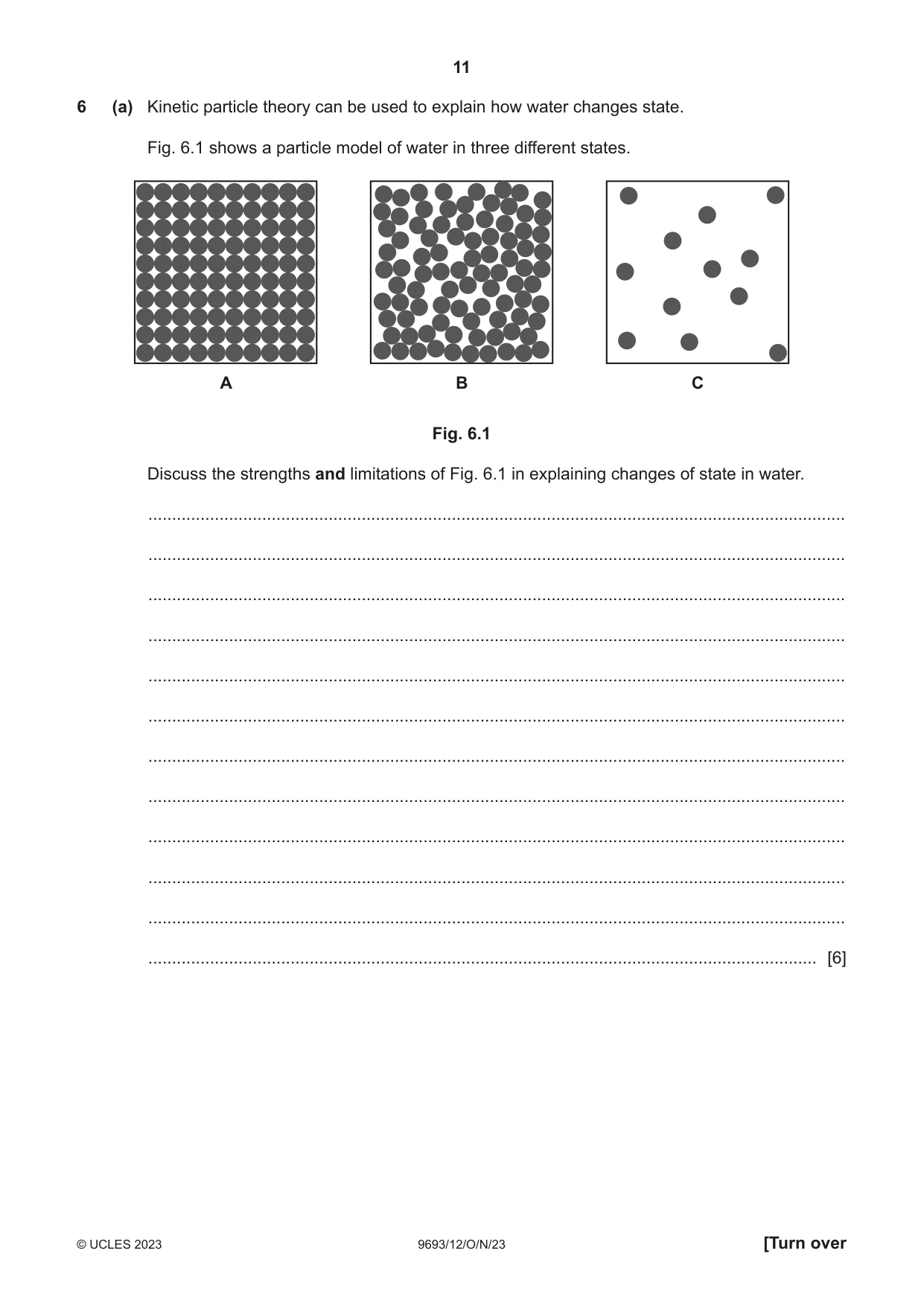
11 9693/12/O/N/23 © UCLES 2023 [Turn over 6 (a) Kinetic particle theory can be used to explain how water changes state. Fig. 6.1 shows a particle model of water in three different states. A B C Fig. 6.1 Discuss the strengths and limitations of Fig. 6.1 in explaining changes of state in water. … … … … … … … … … … … … [6]
Question paper, page 12
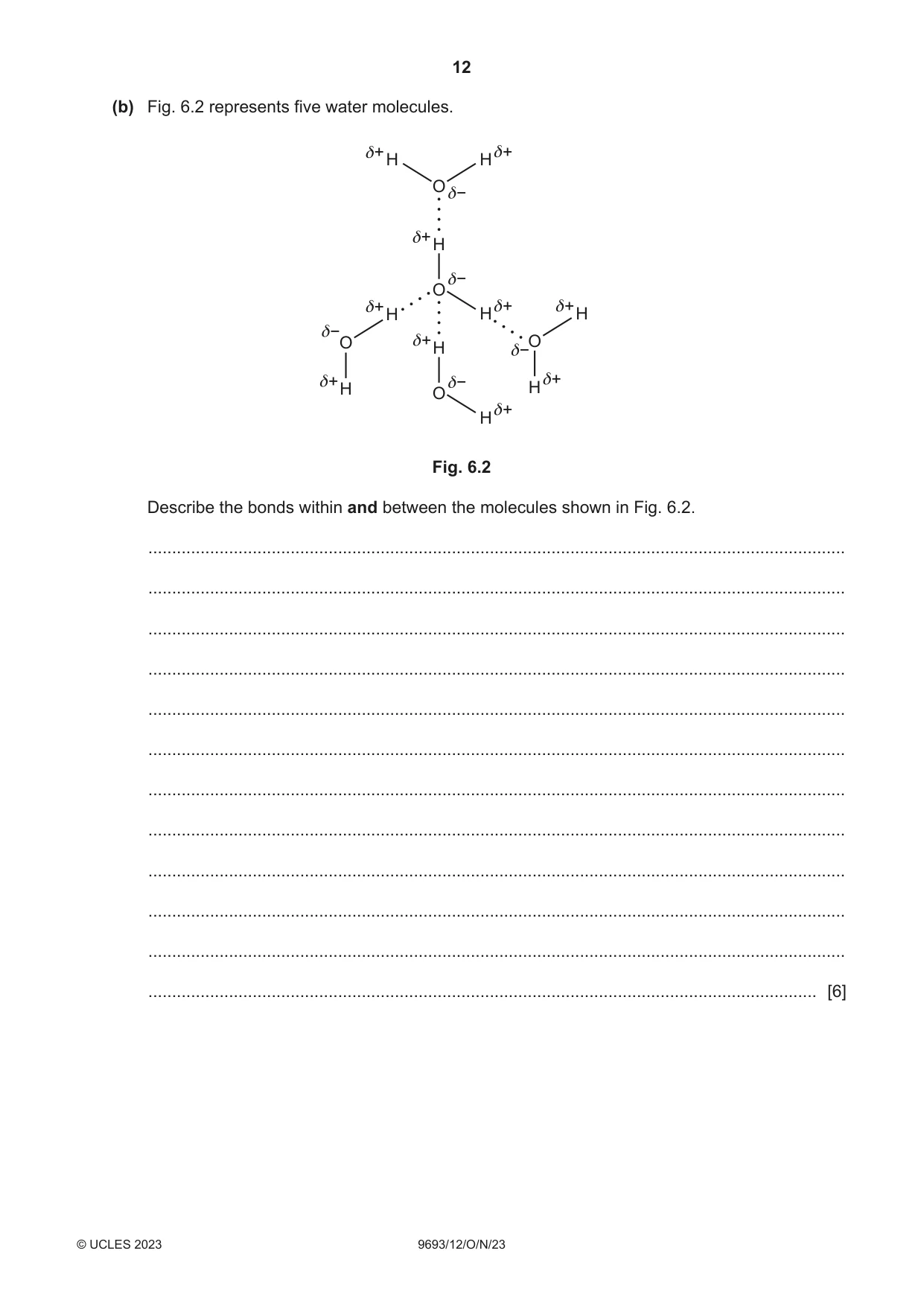
12 9693/12/O/N/23 © UCLES 2023 (b) Fig. 6.2 represents five water molecules. H δ O H O O H O H O + δ + H δ + δ +H δ +H δ +H δ + δ + Hδ + Hδ + δ − δ − δ − δ − δ − Fig. 6.2 Describe the bonds within and between the molecules shown in Fig. 6.2. … … … … … … … … … … … … [6]
Question paper, page 13
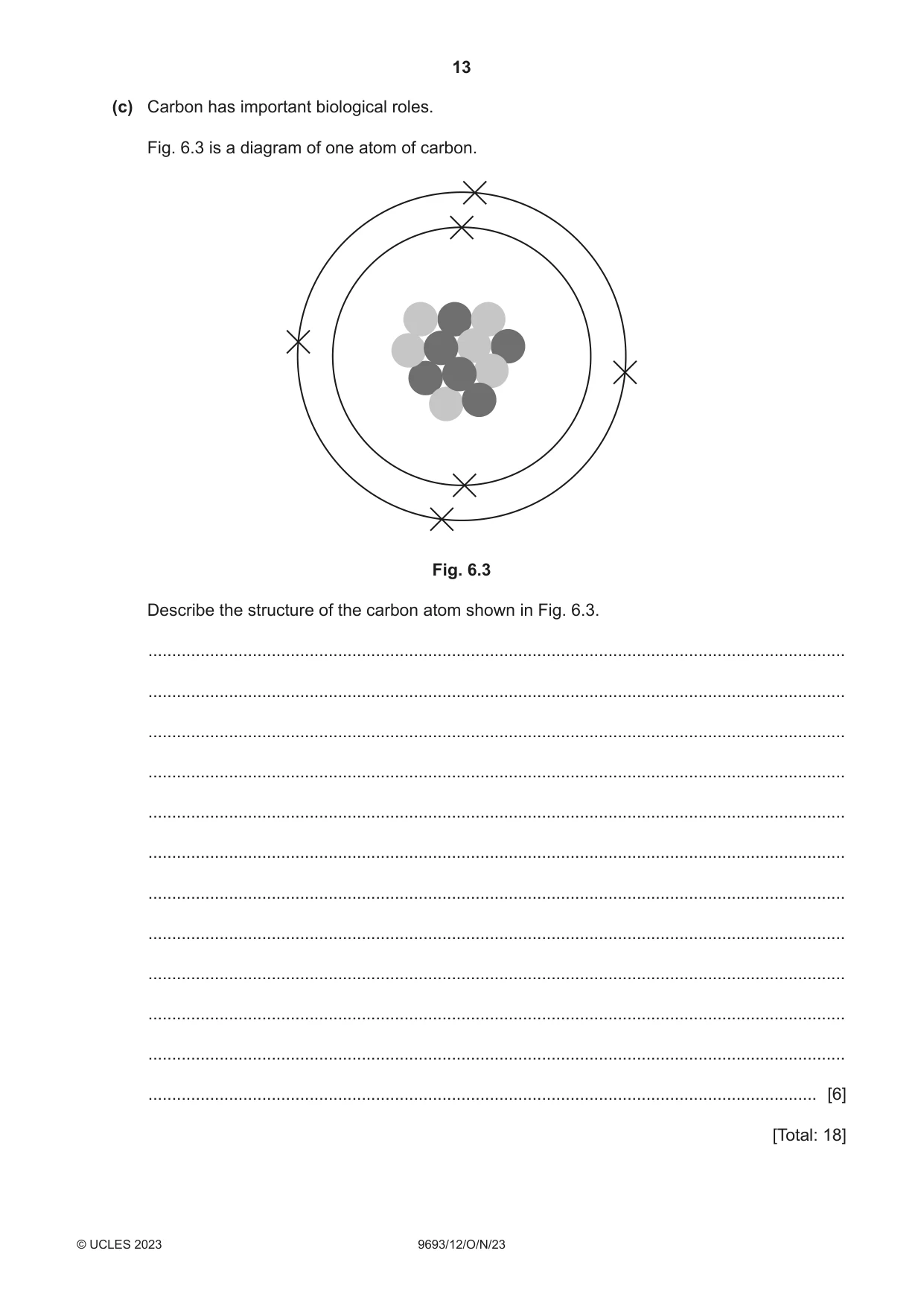
13 9693/12/O/N/23 © UCLES 2023 (c) Carbon has important biological roles. Fig. 6.3 is a diagram of one atom of carbon. Fig. 6.3 Describe the structure of the carbon atom shown in Fig. 6.3. … … … … … … … … … … … … [6] [Total: 18]
Question paper, page 14
14 9693/12/O/N/23 © UCLES 2023 BLANK PAGE
Question paper, page 15
15 9693/12/O/N/23 © UCLES 2023 BLANK PAGE
Question paper, page 16
16 9693/12/O/N/23 © UCLES 2023 The boundaries and names shown, the designations used and the presentation of material on any maps contained in this question paper/insert do not imply official endorsement or acceptance by Cambridge Assessment International Education concerning the legal status of any country, territory, or area or any of its authorities, or of the delimitation of its frontiers or boundaries. Permission to reproduce items where third-party owned material protected by copyright is included has been sought and cleared where possible. Every reasonable effort has been made by the publisher (UCLES) to trace copyright holders, but if any items requiring clearance have unwittingly been included, the publisher will be pleased to make amends at the earliest possible opportunity. To avoid the issue of disclosure of answer-related information to candidates, all copyright acknowledgements are reproduced online in the Cambridge Assessment International Education Copyright Acknowledgements Booklet. This is produced for each series of examinations and is freely available to download at www.cambridgeinternational.org after the live examination series. Cambridge Assessment International Education is part of Cambridge Assessment. Cambridge Assessment is the brand name of the University of Cambridge Local Examinations Syndicate (UCLES), which is a department of the University of Cambridge. BLANK PAGE
Mark scheme, page 1
This document consists of 12 printed pages. © UCLES 2023 [Turn over Cambridge International AS & A Level MARINE SCIENCE 9693/12 Paper 1 AS Level Theory Paper October/November 2023 MARK SCHEME Maximum Mark: 75 Published This mark scheme is published as an aid to teachers and candidates, to indicate the requirements of the examination. It shows the basis on which Examiners were instructed to award marks. It does not indicate the details of the discussions that took place at an Examiners’ meeting before marking began, which would have considered the acceptability of alternative answers. Mark schemes should be read in conjunction with the question paper and the Principal Examiner Report for Teachers. Cambridge International will not enter into discussions about these mark schemes. Cambridge International is publishing the mark schemes for the October/November 2023 series for most Cambridge IGCSE, Cambridge International A and AS Level components, and some Cambridge O Level components.
Mark scheme, page 2
9693/12 Cambridge International AS & A Level – Mark Scheme PUBLISHED October/November 2023 © UCLES 2023 Page 2 of 12 Generic Marking Principles These general marking principles must be applied by all examiners when marking candidate answers. They should be applied alongside the specific content of the mark scheme or generic level descriptors for a question. Each question paper and mark scheme will also comply with these marking principles. GENERIC MARKING PRINCIPLE 1: Marks must be awarded in line with: • the specific content of the mark scheme or the generic level descriptors for the question • the specific skills defined in the mark scheme or in the generic level descriptors for the question • the standard of response required by a candidate as exemplified by the standardisation scripts. GENERIC MARKING PRINCIPLE 2: Marks awarded are always whole marks (not half marks, or other fractions). GENERIC MARKING PRINCIPLE 3: Marks must be awarded positively: • marks are awarded for correct/valid answers, as defined in the mark scheme. However, credit is given for valid answers which go beyond the scope of the syllabus and mark scheme, referring to your Team Leader as appropriate • marks are awarded when candidates clearly demonstrate what they know and can do • marks are not deducted for errors • marks are not deducted for omissions • answers should only be judged on the quality of spelling, punctuation and grammar when these features are specifically assessed by the question as indicated by the mark scheme. The meaning, however, should be unambiguous. GENERIC MARKING PRINCIPLE 4: Rules must be applied consistently, e.g. in situations where candidates have not followed instructions or in the application of generic level descriptors.
Mark scheme, page 3
9693/12 Cambridge International AS & A Level – Mark Scheme PUBLISHED October/November 2023 © UCLES 2023 Page 3 of 12 GENERIC MARKING PRINCIPLE 5: Marks should be awarded using the full range of marks defined in the mark scheme for the question (however; the use of the full mark range may be limited according to the quality of the candidate responses seen). GENERIC MARKING PRINCIPLE 6: Marks awarded are based solely on the requirements as defined in the mark scheme. Marks should not be awarded with grade thresholds or grade descriptors in mind. Science-Specific Marking Principles 1 Examiners should consider the context and scientific use of any keywords when awarding marks. Although keywords may be present, marks should not be awarded if the keywords are used incorrectly. 2 The examiner should not choose between contradictory statements given in the same question part, and credit should not be awarded for any correct statement that is contradicted within the same question part. Wrong science that is irrelevant to the question should be ignored. 3 Although spellings do not have to be correct, spellings of syllabus terms must allow for clear and unambiguous separation from other syllabus terms with which they may be confused (e.g. ethane / ethene, glucagon / glycogen, refraction / reflection). 4 The error carried forward (ecf) principle should be applied, where appropriate. If an incorrect answer is subsequently used in a scientifically correct way, the candidate should be awarded these subsequent marking points. Further guidance will be included in the mark scheme where necessary and any exceptions to this general principle will be noted. 5 ‘List rule’ guidance For questions that require n responses (e.g. State two reasons …): • The response should be read as continuous prose, even when numbered answer spaces are provided. • Any response marked ignore in the mark scheme should not count towards n. • Incorrect responses should not be awarded credit but will still count towards n. • Read the entire response to check for any responses that contradict those that would otherwise be credited. Credit should not be awarded for any responses that are contradicted within the rest of the response. Where two responses contradict one another, this should be treated as a single incorrect response. • Non-contradictory responses after the first n responses may be ignored even if they include incorrect science.
Mark scheme, page 4
9693/12 Cambridge International AS & A Level – Mark Scheme PUBLISHED October/November 2023 © UCLES 2023 Page 4 of 12 6 Calculation specific guidance Correct answers to calculations should be given full credit even if there is no working or incorrect working, unless the question states ‘show your working’. For questions in which the number of significant figures required is not stated, credit should be awarded for correct answers when rounded by the examiner to the number of significant figures given in the mark scheme. This may not apply to measured values. For answers given in standard form (e.g. a 10n) in which the convention of restricting the value of the coefficient (a) to a value between 1 and 10 is not followed, credit may still be awarded if the answer can be converted to the answer given in the mark scheme. Unless a separate mark is given for a unit, a missing or incorrect unit will normally mean that the final calculation mark is not awarded. Exceptions to this general principle will be noted in the mark scheme. 7 Guidance for chemical equations Multiples / fractions of coefficients used in chemical equations are acceptable unless stated otherwise in the mark scheme. State symbols given in an equation should be ignored unless asked for in the question or stated otherwise in the mark scheme.
Mark scheme, page 5
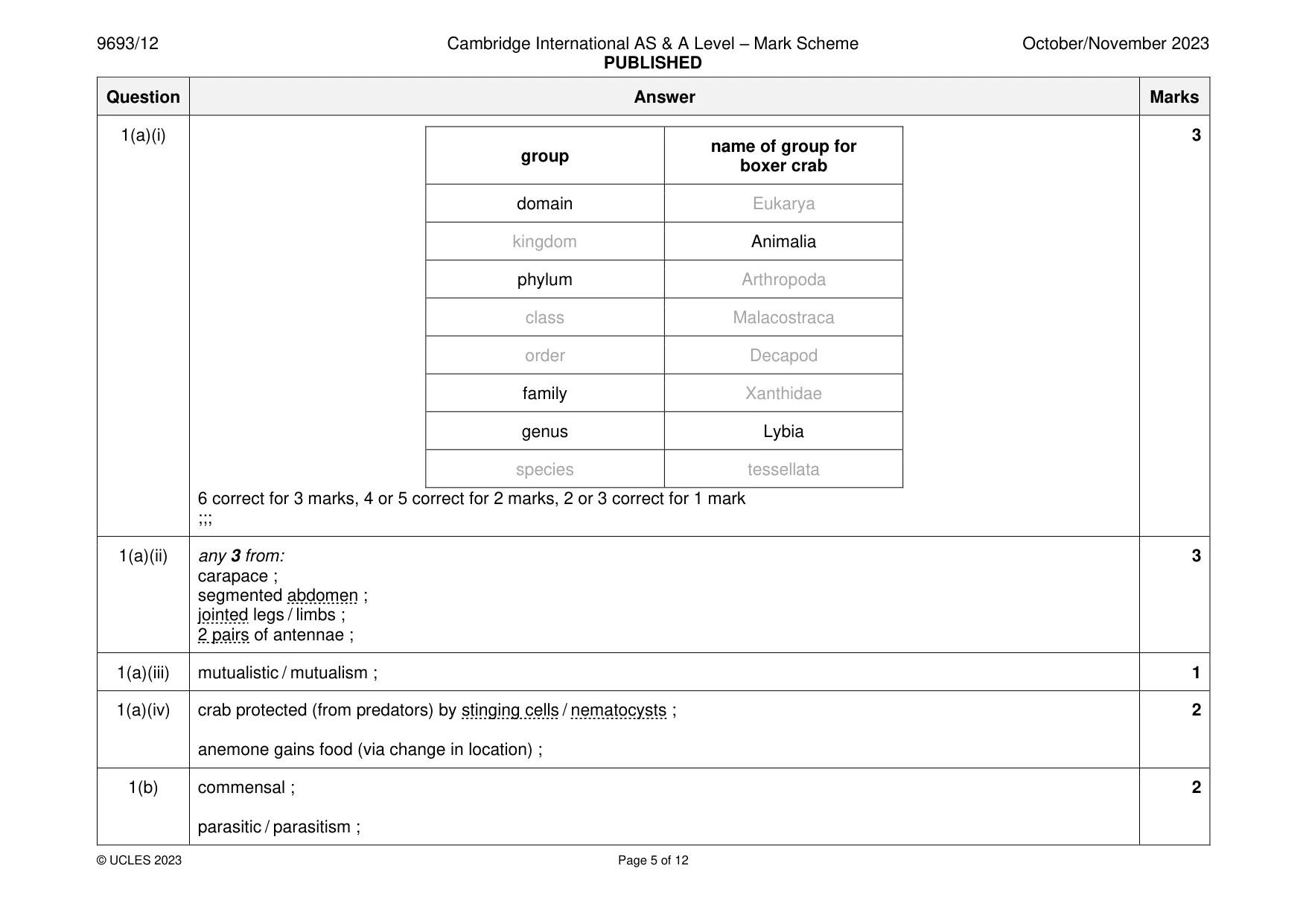
9693/12 Cambridge International AS & A Level – Mark Scheme PUBLISHED October/November 2023 © UCLES 2023 Page 5 of 12 Question Answer Marks 1(a)(i) group name of group for boxer crab domain Eukarya kingdom Animalia phylum Arthropoda class Malacostraca order Decapod family Xanthidae genus Lybia species tessellata 6 correct for 3 marks, 4 or 5 correct for 2 marks, 2 or 3 correct for 1 mark ;;; 3 1(a)(ii) any 3 from: carapace ; segmented abdomen ; jointed legs / limbs ; 2 pairs of antennae ; 3 1(a)(iii) mutualistic / mutualism ; 1 1(a)(iv) crab protected (from predators) by stinging cells / nematocysts ; anemone gains food (via change in location) ; 2 1(b) commensal ; parasitic / parasitism ; 2
Mark scheme, page 6
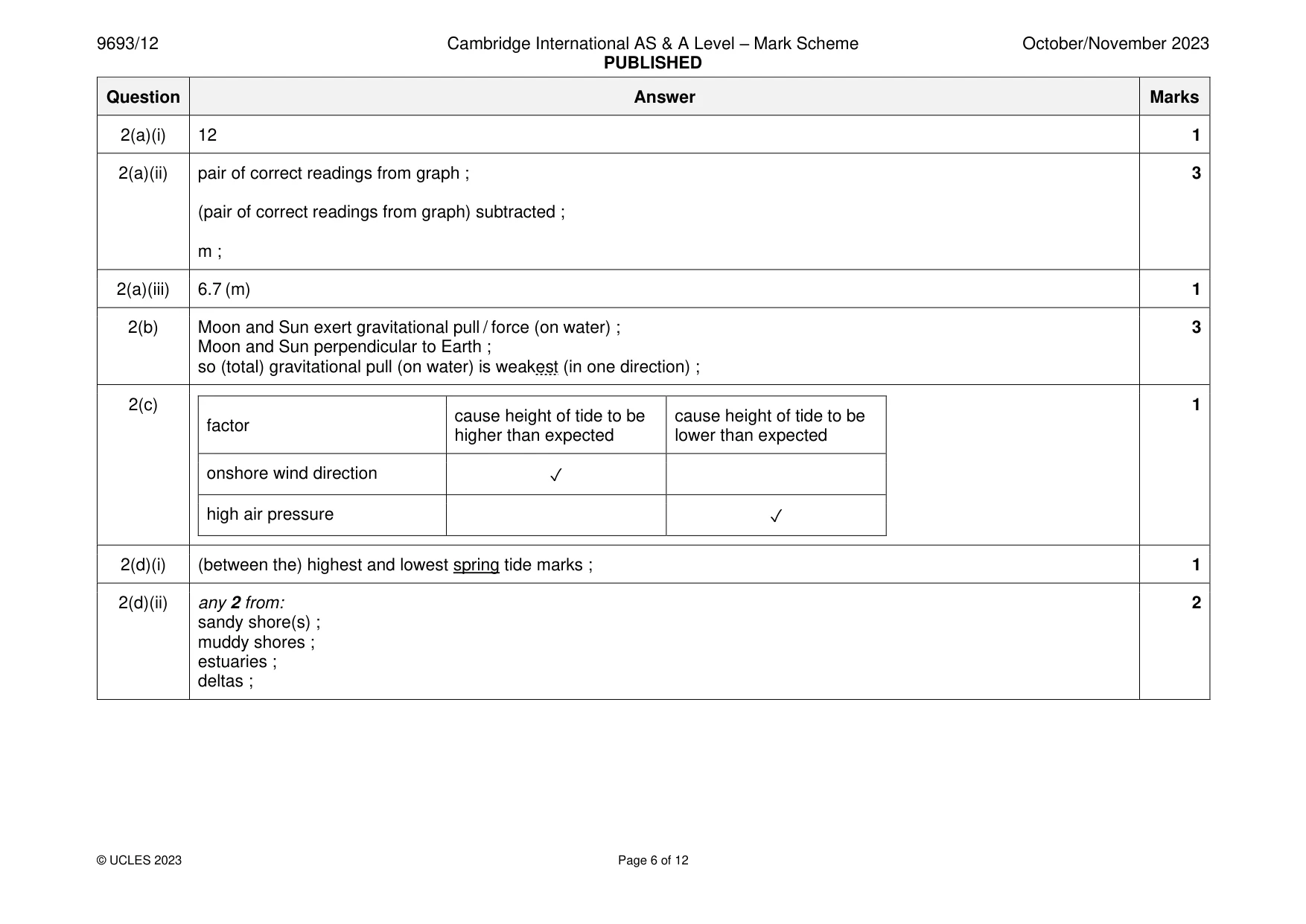
9693/12 Cambridge International AS & A Level – Mark Scheme PUBLISHED October/November 2023 © UCLES 2023 Page 6 of 12 Question Answer Marks 2(a)(i) 12 1 2(a)(ii) pair of correct readings from graph ; (pair of correct readings from graph) subtracted ; m ; 3 2(a)(iii) 6.7 (m) 1 2(b) Moon and Sun exert gravitational pull / force (on water) ; Moon and Sun perpendicular to Earth ; so (total) gravitational pull (on water) is weakest (in one direction) ; 3 2(c) factor cause height of tide to be higher than expected cause height of tide to be lower than expected onshore wind direction ✓ high air pressure ✓ 1 2(d)(i) (between the) highest and lowest spring tide marks ; 1 2(d)(ii) any 2 from: sandy shore(s) ; muddy shores ; estuaries ; deltas ; 2
Mark scheme, page 7
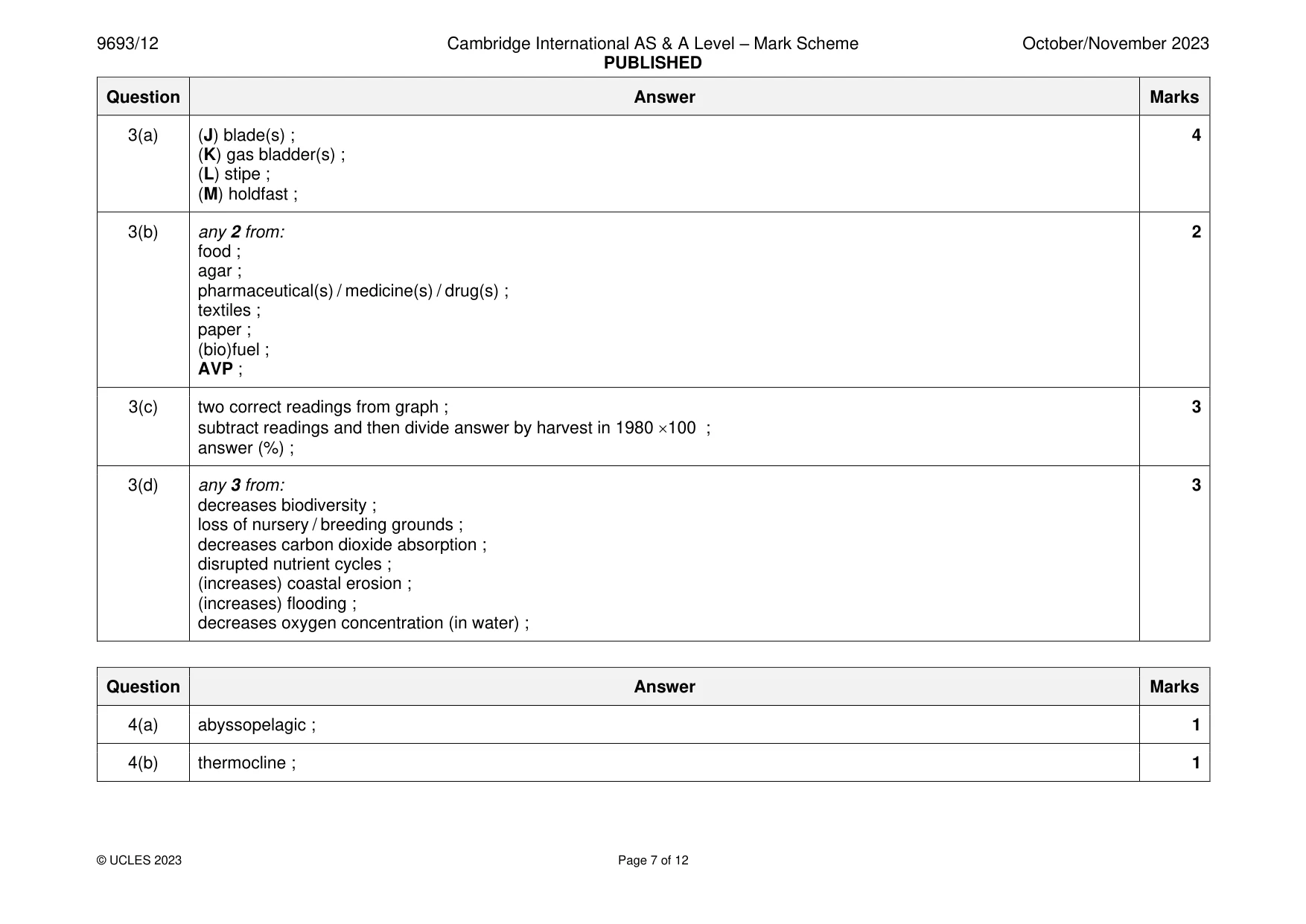
9693/12 Cambridge International AS & A Level – Mark Scheme PUBLISHED October/November 2023 © UCLES 2023 Page 7 of 12 Question Answer Marks 3(a) (J) blade(s) ; (K) gas bladder(s) ; (L) stipe ; (M) holdfast ; 4 3(b) any 2 from: food ; agar ; pharmaceutical(s) / medicine(s) / drug(s) ; textiles ; paper ; (bio)fuel ; AVP ; 2 3(c) two correct readings from graph ; subtract readings and then divide answer by harvest in 1980 100 ; answer (%) ; 3 3(d) any 3 from: decreases biodiversity ; loss of nursery / breeding grounds ; decreases carbon dioxide absorption ; disrupted nutrient cycles ; (increases) coastal erosion ; (increases) flooding ; decreases oxygen concentration (in water) ; 3 Question Answer Marks 4(a) abyssopelagic ; 1 4(b) thermocline ; 1
Mark scheme, page 8
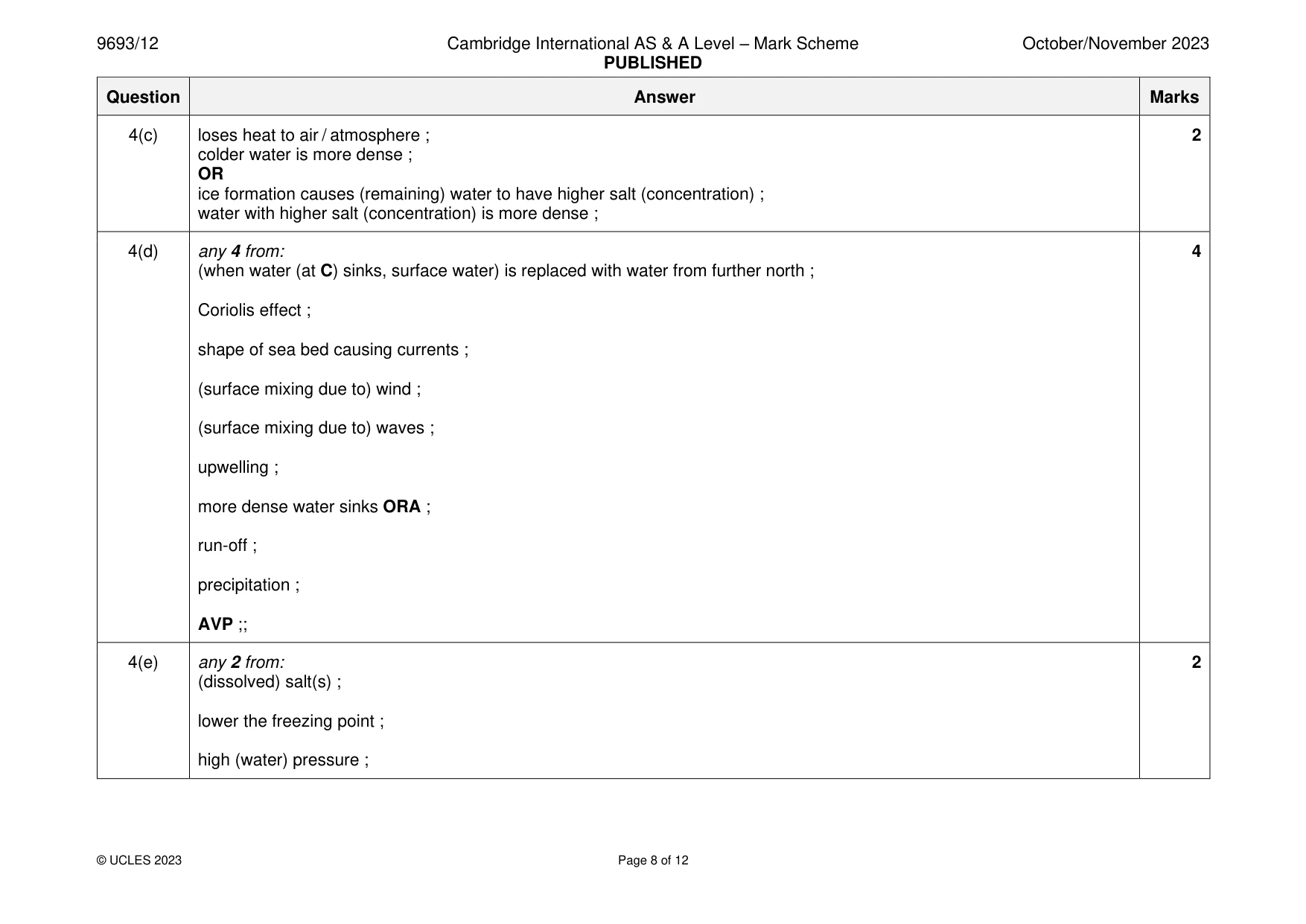
9693/12 Cambridge International AS & A Level – Mark Scheme PUBLISHED October/November 2023 © UCLES 2023 Page 8 of 12 Question Answer Marks 4(c) loses heat to air / atmosphere ; colder water is more dense ; OR ice formation causes (remaining) water to have higher salt (concentration) ; water with higher salt (concentration) is more dense ; 2 4(d) any 4 from: (when water (at C) sinks, surface water) is replaced with water from further north ; Coriolis effect ; shape of sea bed causing currents ; (surface mixing due to) wind ; (surface mixing due to) waves ; upwelling ; more dense water sinks ORA ; run-off ; precipitation ; AVP ;; 4 4(e) any 2 from: (dissolved) salt(s) ; lower the freezing point ; high (water) pressure ; 2
Mark scheme, page 9
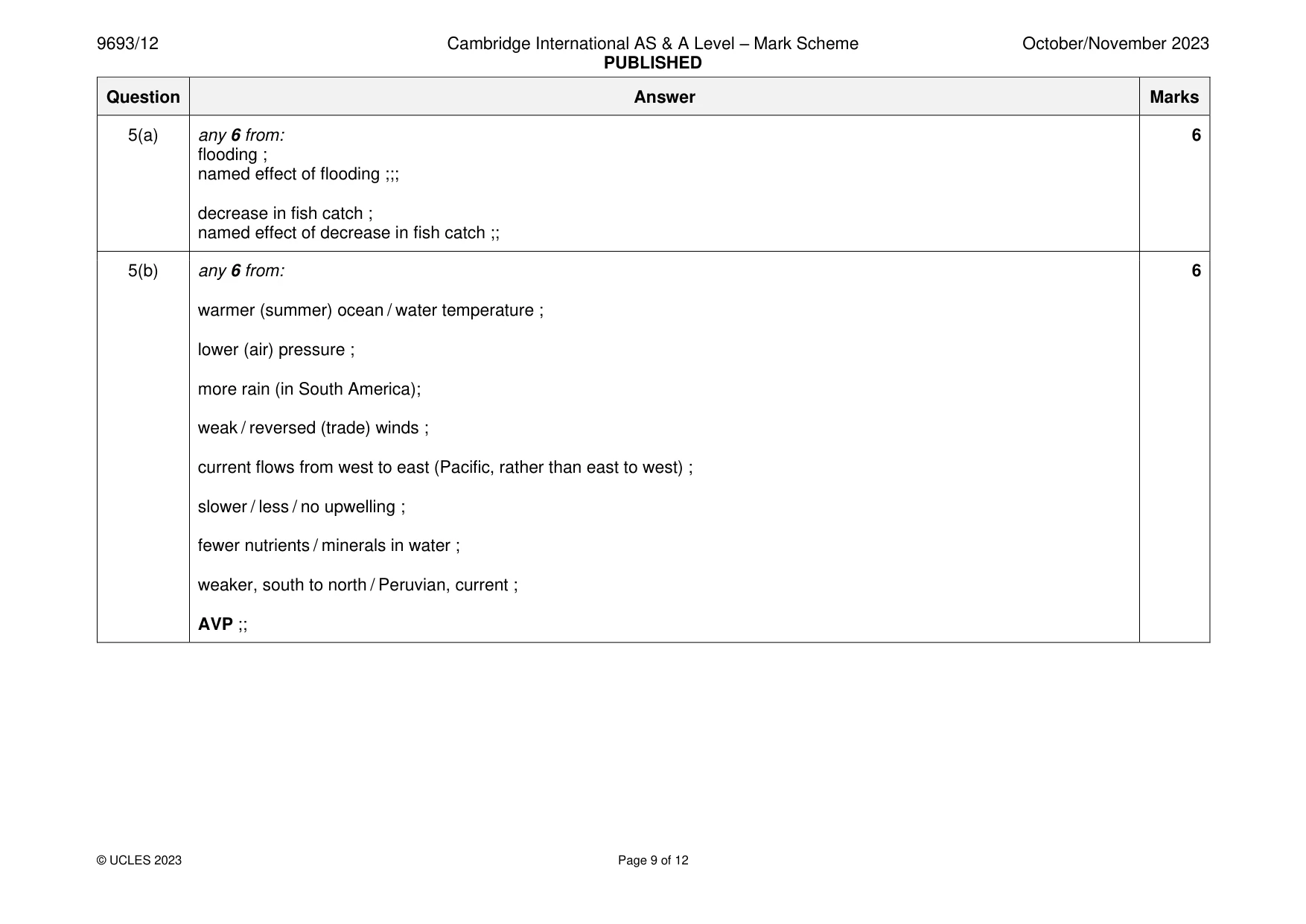
9693/12 Cambridge International AS & A Level – Mark Scheme PUBLISHED October/November 2023 © UCLES 2023 Page 9 of 12 Question Answer Marks 5(a) any 6 from: flooding ; named effect of flooding ;;; decrease in fish catch ; named effect of decrease in fish catch ;; 6 5(b) any 6 from: warmer (summer) ocean / water temperature ; lower (air) pressure ; more rain (in South America); weak / reversed (trade) winds ; current flows from west to east (Pacific, rather than east to west) ; slower / less / no upwelling ; fewer nutrients / minerals in water ; weaker, south to north / Peruvian, current ; AVP ;; 6
Mark scheme, page 10
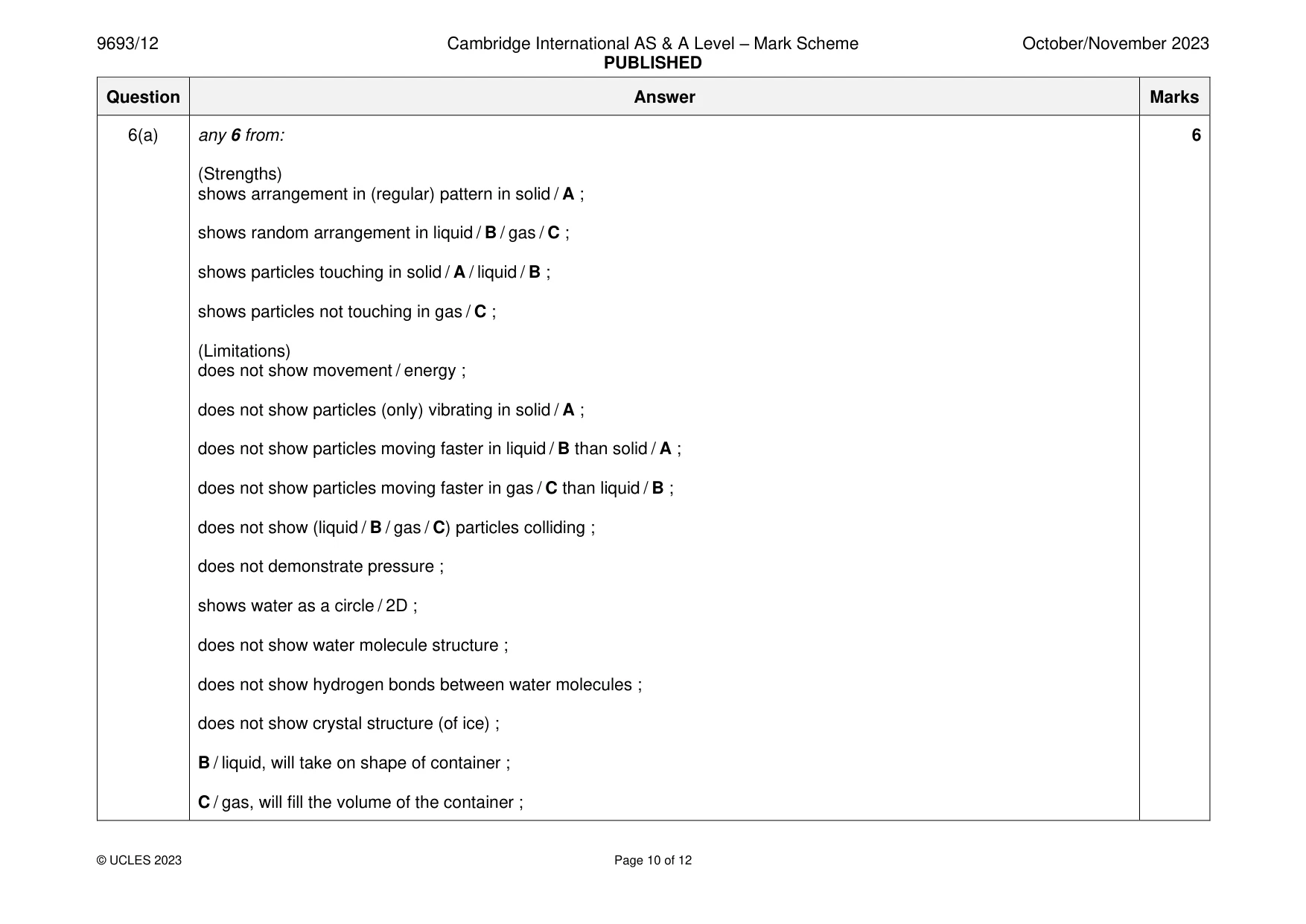
9693/12 Cambridge International AS & A Level – Mark Scheme PUBLISHED October/November 2023 © UCLES 2023 Page 10 of 12 Question Answer Marks 6(a) any 6 from: (Strengths) shows arrangement in (regular) pattern in solid / A ; shows random arrangement in liquid / B / gas / C ; shows particles touching in solid / A / liquid / B ; shows particles not touching in gas / C ; (Limitations) does not show movement / energy ; does not show particles (only) vibrating in solid / A ; does not show particles moving faster in liquid / B than solid / A ; does not show particles moving faster in gas / C than liquid / B ; does not show (liquid / B / gas / C) particles colliding ; does not demonstrate pressure ; shows water as a circle / 2D ; does not show water molecule structure ; does not show hydrogen bonds between water molecules ; does not show crystal structure (of ice) ; B / liquid, will take on shape of container ; C / gas, will fill the volume of the container ; 6
Mark scheme, page 11
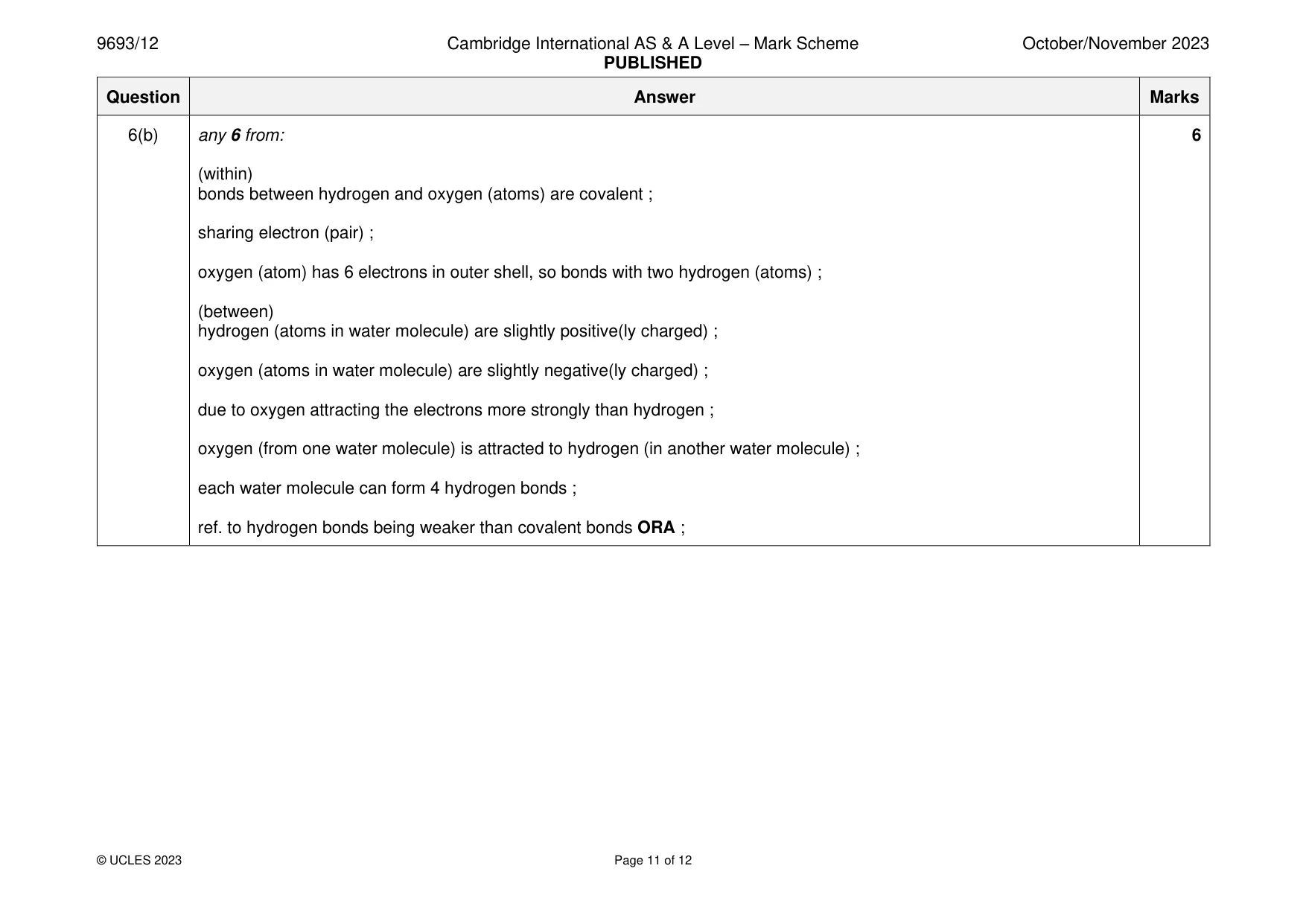
9693/12 Cambridge International AS & A Level – Mark Scheme PUBLISHED October/November 2023 © UCLES 2023 Page 11 of 12 Question Answer Marks 6(b) any 6 from: (within) bonds between hydrogen and oxygen (atoms) are covalent ; sharing electron (pair) ; oxygen (atom) has 6 electrons in outer shell, so bonds with two hydrogen (atoms) ; (between) hydrogen (atoms in water molecule) are slightly positive(ly charged) ; oxygen (atoms in water molecule) are slightly negative(ly charged) ; due to oxygen attracting the electrons more strongly than hydrogen ; oxygen (from one water molecule) is attracted to hydrogen (in another water molecule) ; each water molecule can form 4 hydrogen bonds ; ref. to hydrogen bonds being weaker than covalent bonds ORA ; 6
Mark scheme, page 12
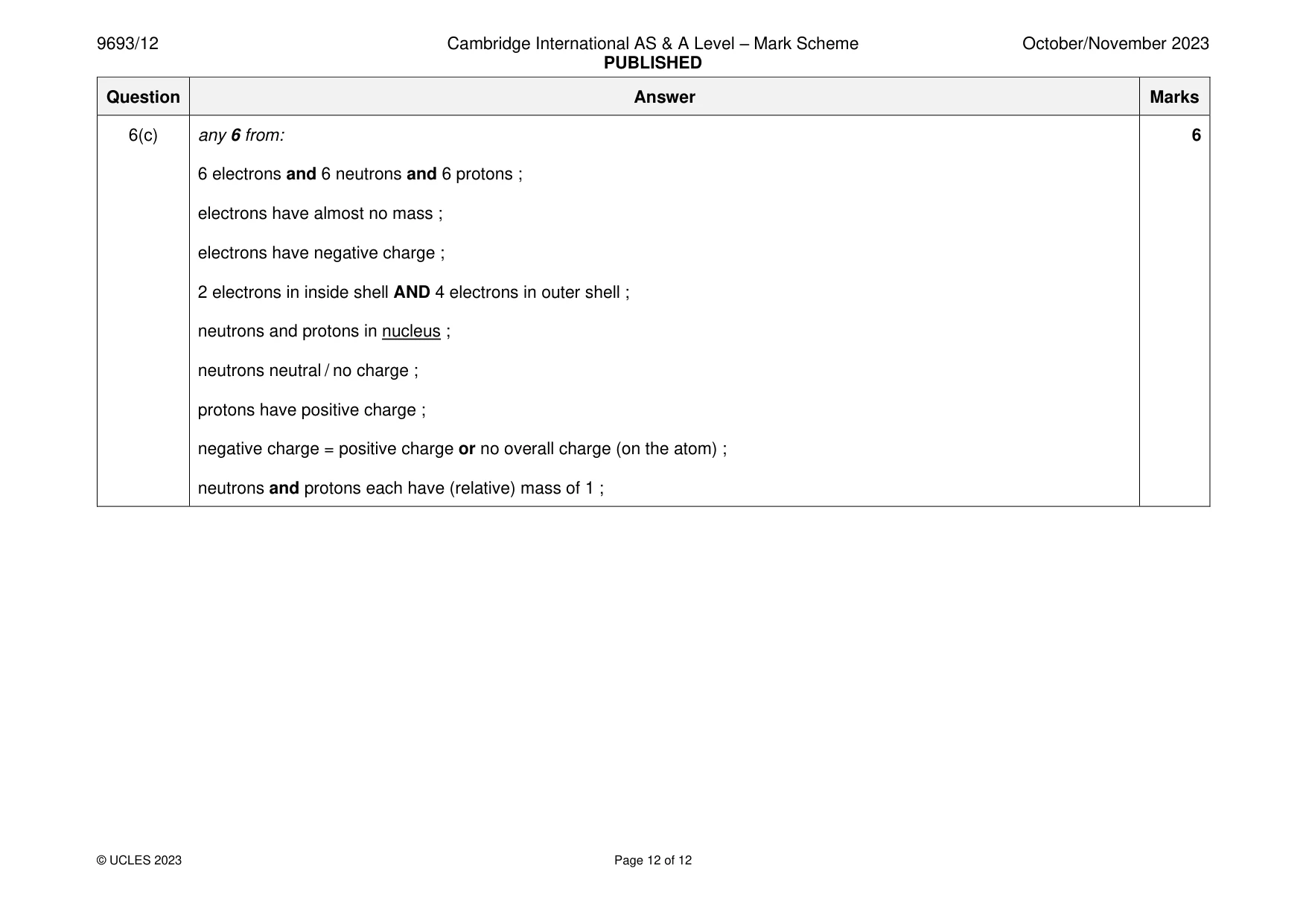
9693/12 Cambridge International AS & A Level – Mark Scheme PUBLISHED October/November 2023 © UCLES 2023 Page 12 of 12 Question Answer Marks 6(c) any 6 from: 6 electrons and 6 neutrons and 6 protons ; electrons have almost no mass ; electrons have negative charge ; 2 electrons in inside shell AND 4 electrons in outer shell ; neutrons and protons in nucleus ; neutrons neutral / no charge ; protons have positive charge ; negative charge = positive charge or no overall charge (on the atom) ; neutrons and protons each have (relative) mass of 1 ; 6
What you needed in this session
Cambridge’s own grade thresholds for 2023 Oct/Nov, Paper 1 · Variant 2. A higher threshold means an easier paper — the bar moves with how the cohort did.