Cambridge A Level Marine Science 9693 — 2020 May/June Paper 1 · Variant 1
9693/11/M/J/20
The question paper and its mark scheme, free to read here and free to download. This is Cambridge’s own paper, exactly as it was sat.
Question paper16 pages

Mark scheme12 pages
Answers below. Sit the paper first if you are practising.
Paper as text
Question paper, page 1
Cambridge International AS & A Level DC (KN/SW) 184721/4 © UCLES 2020 [Turn over This document has 16 pages. Blank pages are indicated. * 2 8 3 0 3 4 5 5 8 1 * MARINE SCIENCE 9693/11 Paper 1 AS Structured Questions May/June 2020 1 hour 30 minutes You must answer on the question paper. No additional materials are needed. INSTRUCTIONS ● Answer all questions. ● Use a black or dark blue pen. You may use an HB pencil for any diagrams or graphs. ● Write your name, centre number and candidate number in the boxes at the top of the page. ● Write your answer to each question in the space provided. ● Do not use an erasable pen or correction fluid. ● Do not write on any bar codes. ● You may use a calculator. ● You should show all your working and use appropriate units. INFORMATION ● The total mark for this paper is 75. ● The number of marks for each question or part question is shown in brackets [ ].
Question paper, page 2
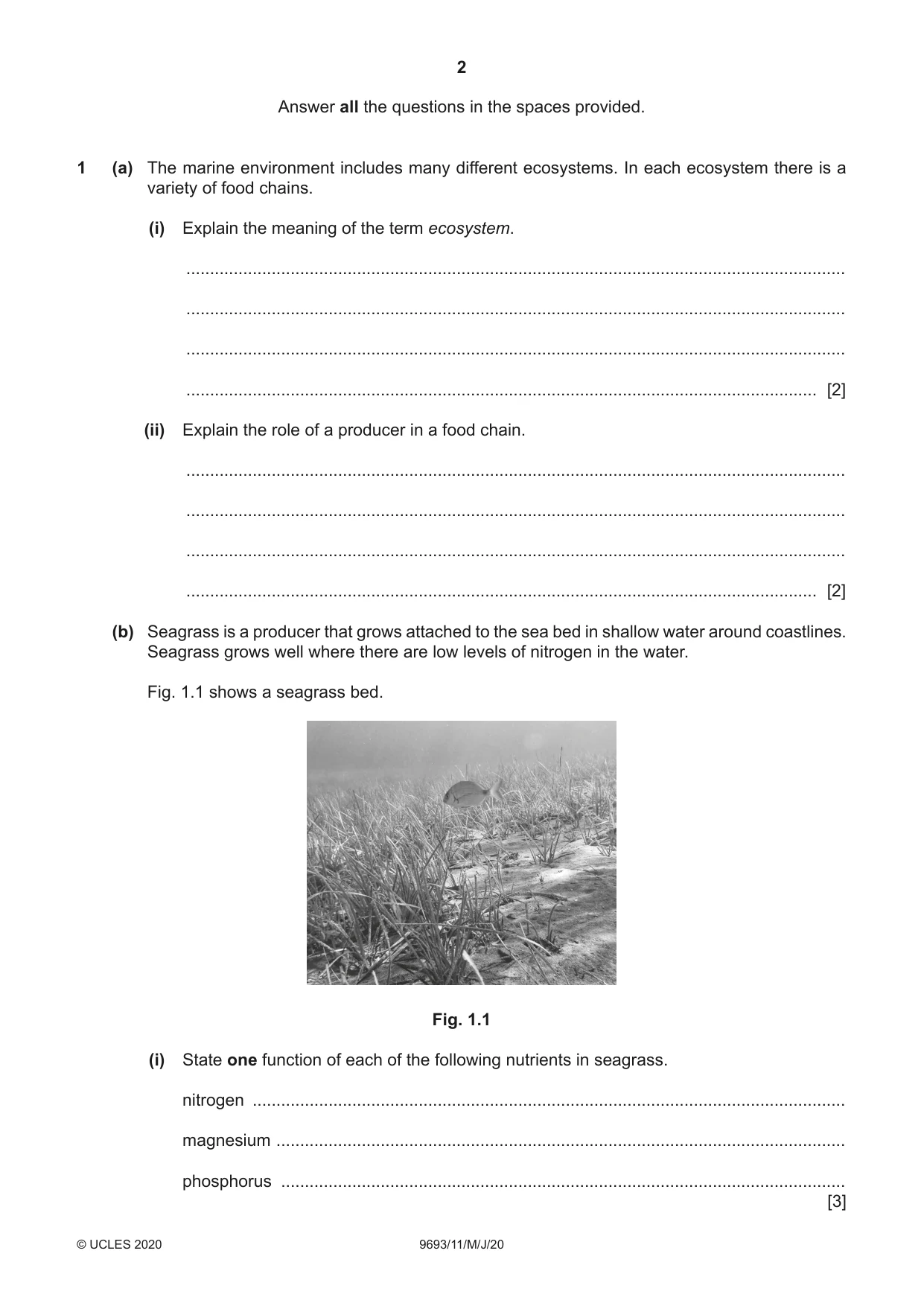
2 9693/11/M/J/20 © UCLES 2020 Answer all the questions in the spaces provided. 1 (a) The marine environment includes many different ecosystems. In each ecosystem there is a variety of food chains. (i) Explain the meaning of the term ecosystem. … … … … [2] (ii) Explain the role of a producer in a food chain. … … … … [2] (b) Seagrass is a producer that grows attached to the sea bed in shallow water around coastlines. Seagrass grows well where there are low levels of nitrogen in the water. Fig. 1.1 shows a seagrass bed. Fig. 1.1 (i) State one function of each of the following nutrients in seagrass. nitrogen … magnesium … phosphorus … [3]
Question paper, page 3
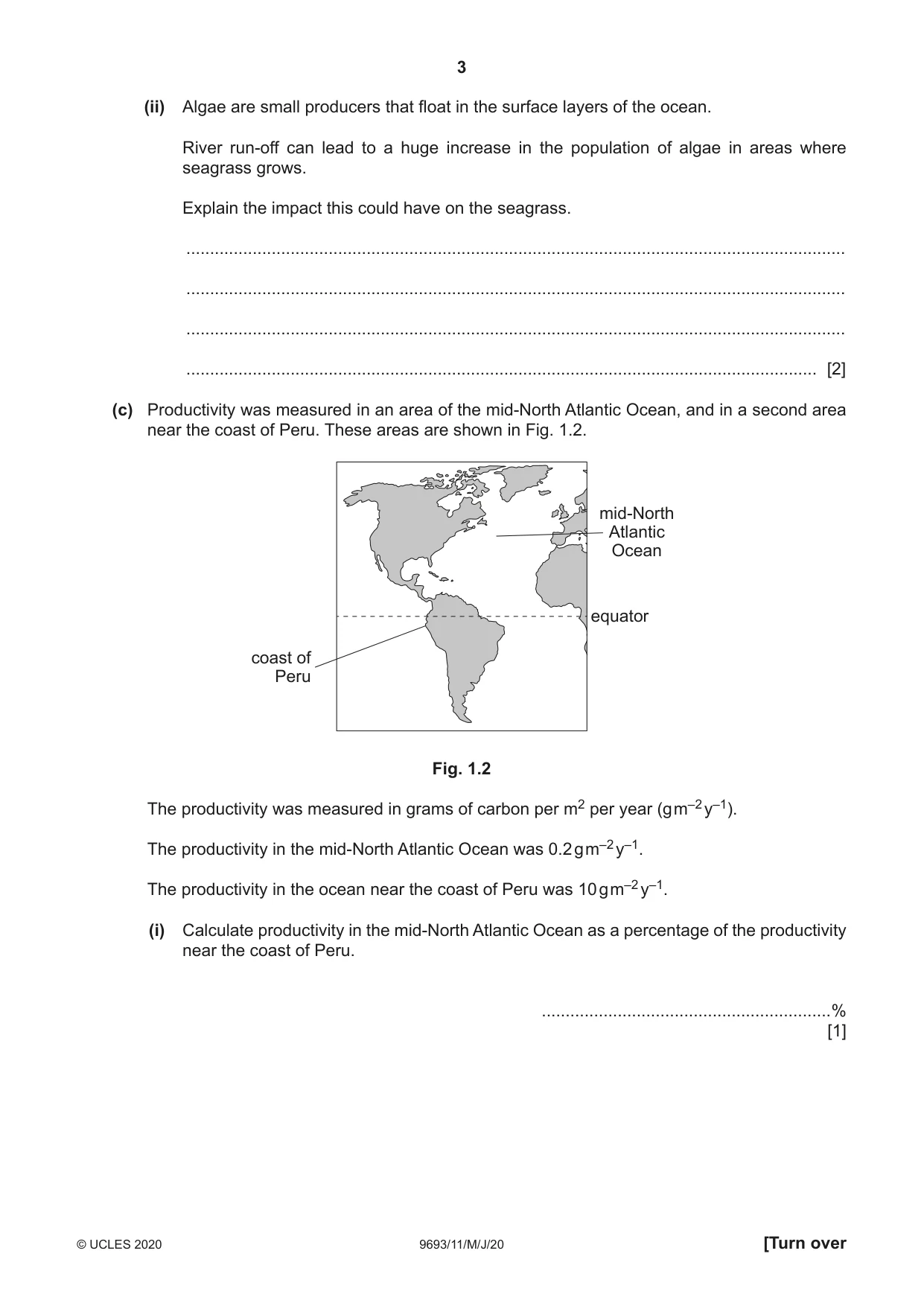
3 9693/11/M/J/20 © UCLES 2020 [Turn over (ii) Algae are small producers that float in the surface layers of the ocean. River run-off can lead to a huge increase in the population of algae in areas where seagrass grows. Explain the impact this could have on the seagrass. … … … … [2] (c) Productivity was measured in an area of the mid-North Atlantic Ocean, and in a second area near the coast of Peru. These areas are shown in Fig. 1.2. mid-North Atlantic Ocean coast of Peru equator Fig. 1.2 The productivity was measured in grams of carbon per m2 per year (g m–2 y–1). The productivity in the mid-North Atlantic Ocean was 0.2 g m–2 y–1. The productivity in the ocean near the coast of Peru was 10 g m–2 y–1. (i) Calculate productivity in the mid-North Atlantic Ocean as a percentage of the productivity near the coast of Peru. …% [1]
Question paper, page 4
4 9693/11/M/J/20 © UCLES 2020 (ii) This research was not carried out during an El-Niño event. Suggest reasons for the high productivity in the ocean near the coast of Peru, compared with the mid-North Atlantic Ocean. … … … … … … … … [4] [Total: 14]
Question paper, page 5
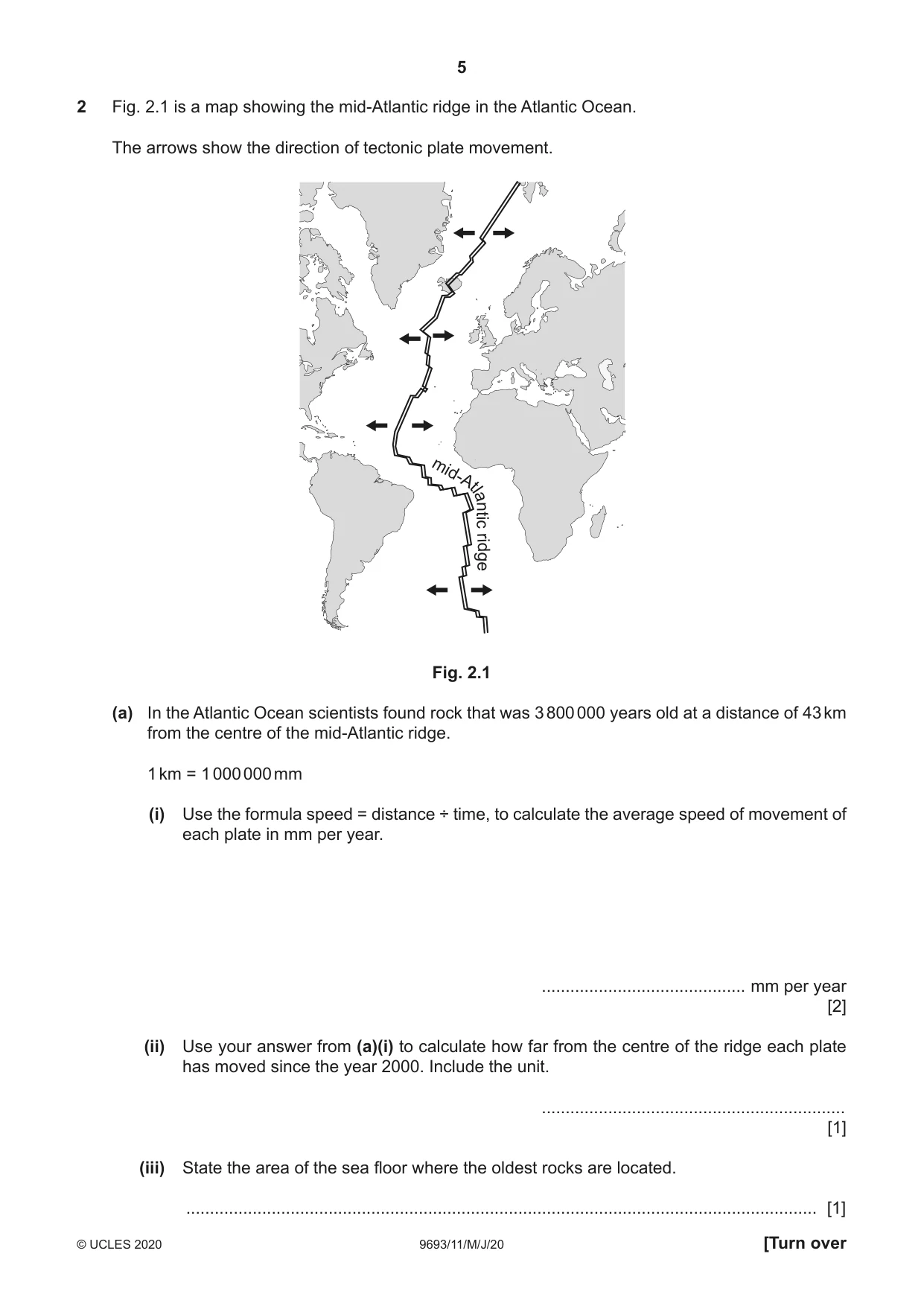
5 9693/11/M/J/20 © UCLES 2020 [Turn over 2 Fig. 2.1 is a map showing the mid-Atlantic ridge in the Atlantic Ocean. The arrows show the direction of tectonic plate movement. mid-A t l a ntic ridge Fig. 2.1 (a) In the Atlantic Ocean scientists found rock that was 3 800 000 years old at a distance of 43 km from the centre of the mid-Atlantic ridge. 1 km = 1 000 000 mm (i) Use the formula speed = distance ÷ time, to calculate the average speed of movement of each plate in mm per year. … mm per year [2] (ii) Use your answer from (a)(i) to calculate how far from the centre of the ridge each plate has moved since the year 2000. Include the unit. … [1] (iii) State the area of the sea floor where the oldest rocks are located. … [1]
Question paper, page 6
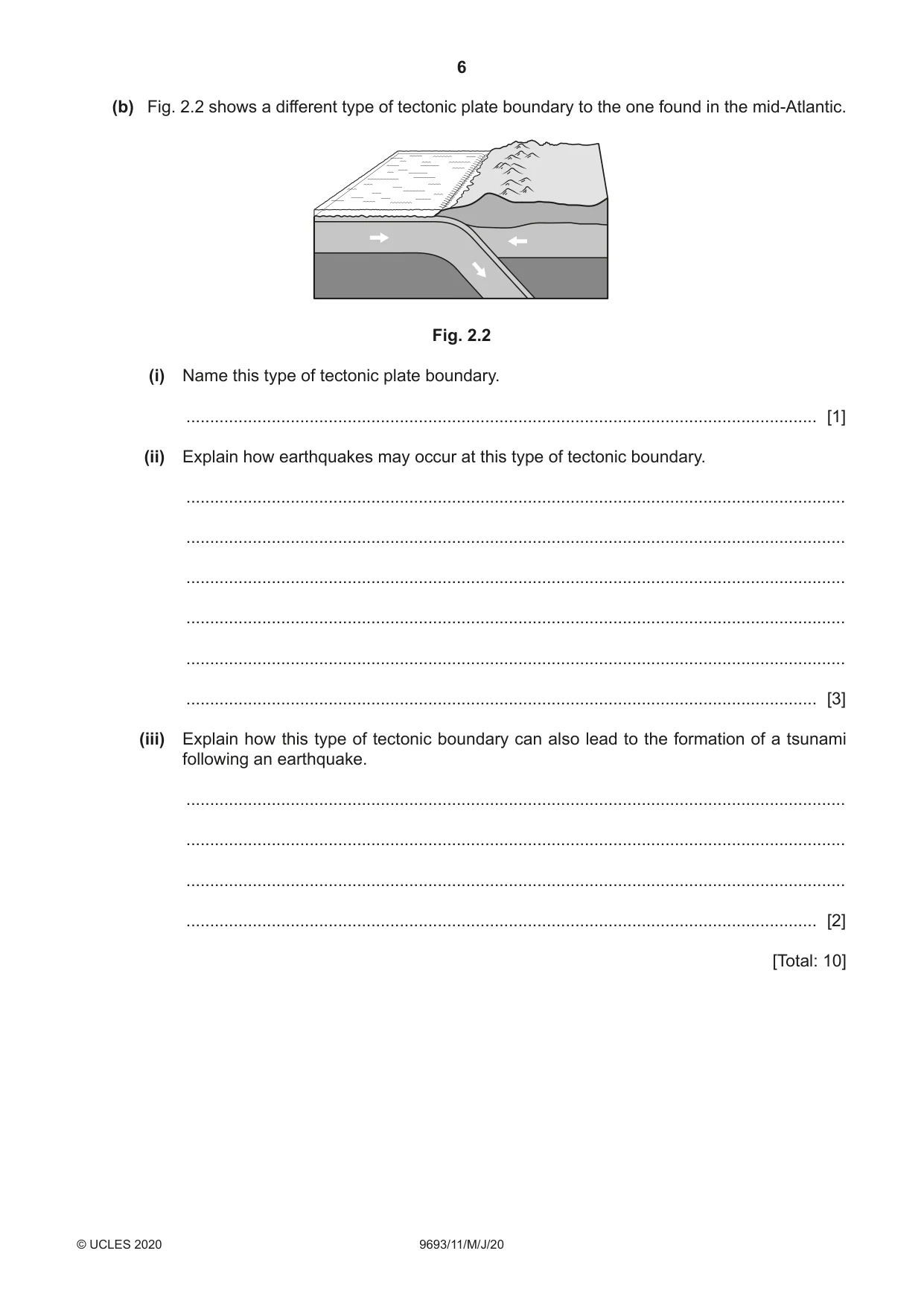
6 9693/11/M/J/20 © UCLES 2020 (b) Fig. 2.2 shows a different type of tectonic plate boundary to the one found in the mid-Atlantic. Fig. 2.2 (i) Name this type of tectonic plate boundary. … [1] (ii) Explain how earthquakes may occur at this type of tectonic boundary. … … … … … … [3] (iii) Explain how this type of tectonic boundary can also lead to the formation of a tsunami following an earthquake. … … … … [2] [Total: 10]
Question paper, page 7
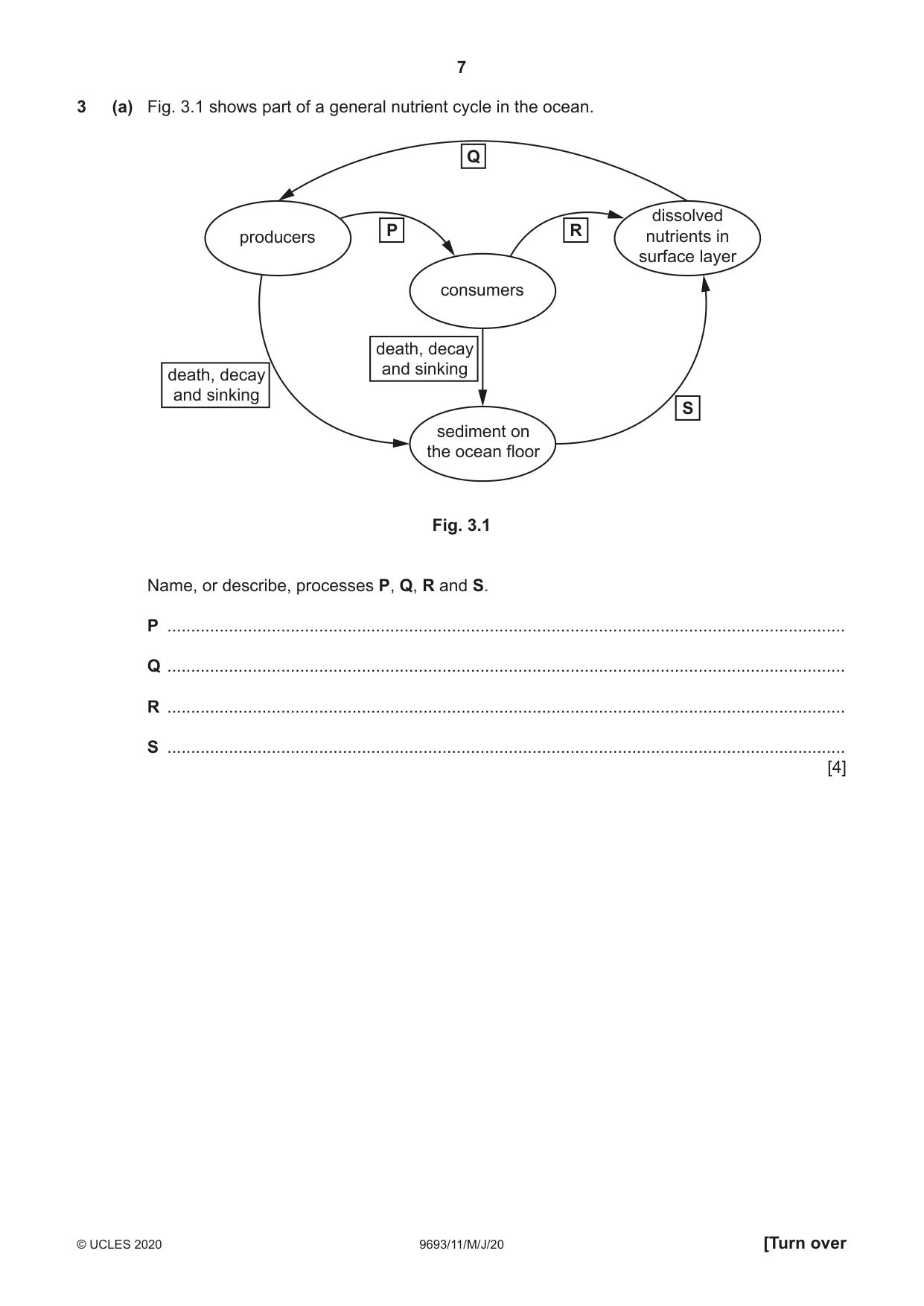
7 9693/11/M/J/20 © UCLES 2020 [Turn over 3 (a) Fig. 3.1 shows part of a general nutrient cycle in the ocean. consumers death, decay and sinking producers dissolved nutrients in surface layer sediment on the ocean floor death, decay and sinking P R S Q Fig. 3.1 Name, or describe, processes P, Q, R and S. P … Q … R … S … [4]
Question paper, page 8
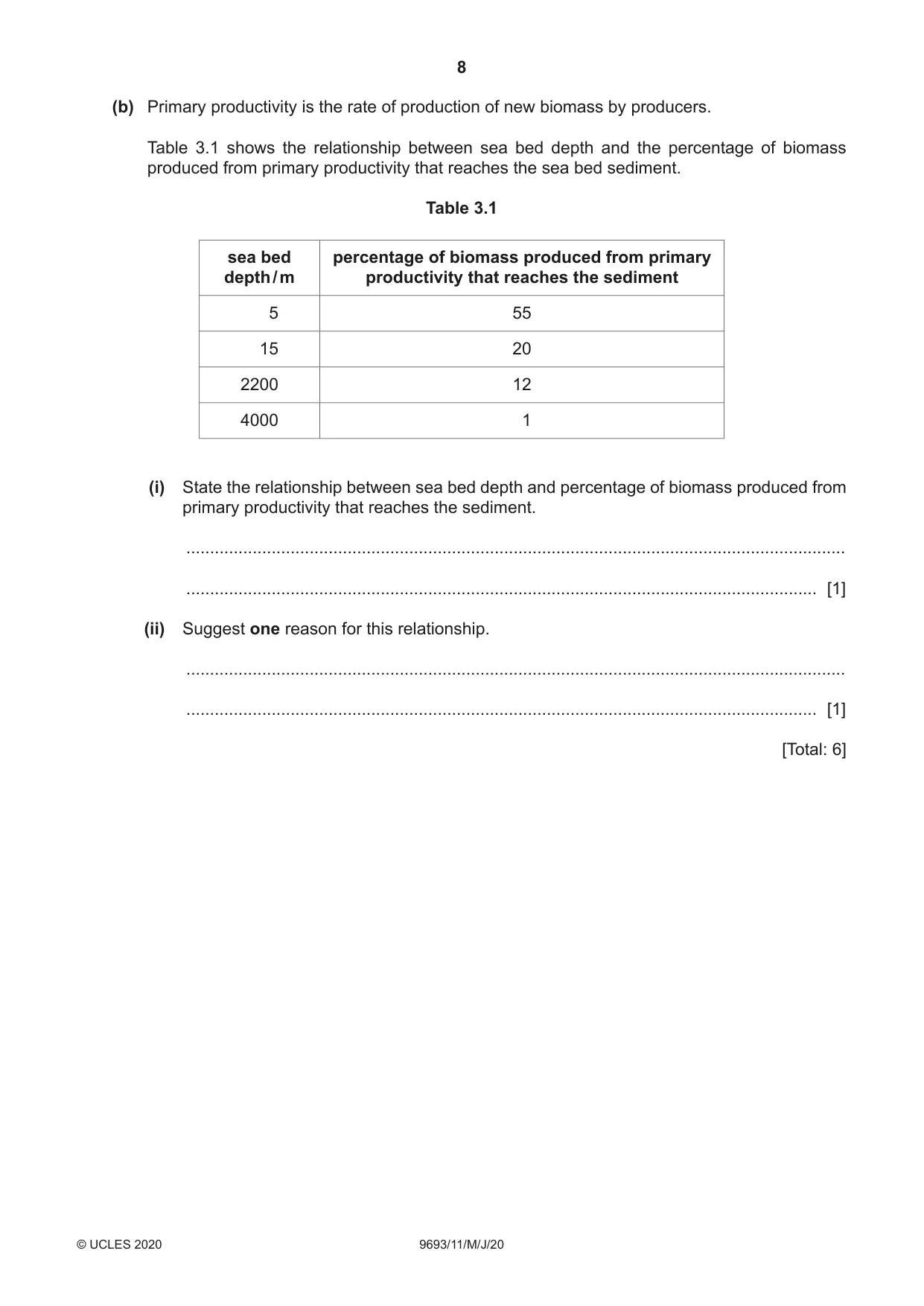
8 9693/11/M/J/20 © UCLES 2020 (b) Primary productivity is the rate of production of new biomass by producers. Table 3.1 shows the relationship between sea bed depth and the percentage of biomass produced from primary productivity that reaches the sea bed sediment. Table 3.1 sea bed depth / m percentage of biomass produced from primary productivity that reaches the sediment 5 55 15 20 2200 12 4000 1 (i) State the relationship between sea bed depth and percentage of biomass produced from primary productivity that reaches the sediment. … … [1] (ii) Suggest one reason for this relationship. … … [1] [Total: 6]
Question paper, page 9
9 9693/11/M/J/20 © UCLES 2020 [Turn over 4 Tropical cyclones require specific factors to be present in order to form and be sustained. (a) State another term used for tropical cyclones. … [1] (b) Describe the role played by each of the following in the formation of a tropical cyclone. (i) sea water temperature of at least 26.5 °C … … … … [2] (ii) Coriolis effect … … [1] (iii) low wind shear … … [1] [Total: 5]
Question paper, page 10
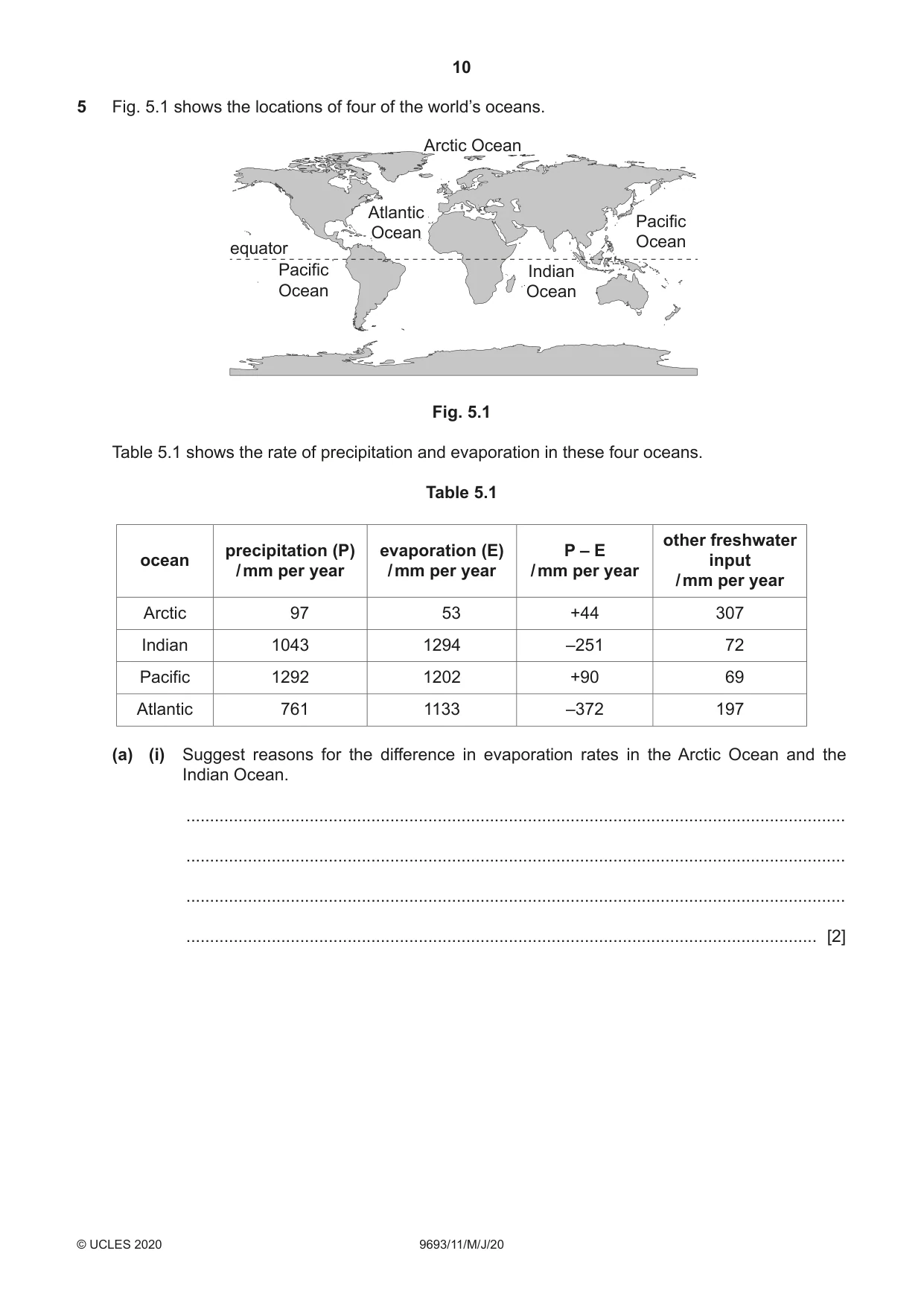
10 9693/11/M/J/20 © UCLES 2020 5 Fig. 5.1 shows the locations of four of the world’s oceans. Pacific Ocean equator Pacific Ocean Indian Ocean Arctic Ocean Atlantic Ocean Fig. 5.1 Table 5.1 shows the rate of precipitation and evaporation in these four oceans. Table 5.1 ocean precipitation (P) / mm per year evaporation (E) / mm per year P – E / mm per year other freshwater input / mm per year Arctic 97 53 +44 307 Indian 1043 1294 –251 72 Pacific 1292 1202 +90 69 Atlantic 761 1133 –372 197 (a) (i) Suggest reasons for the difference in evaporation rates in the Arctic Ocean and the Indian Ocean. … … … … [2]
Question paper, page 11
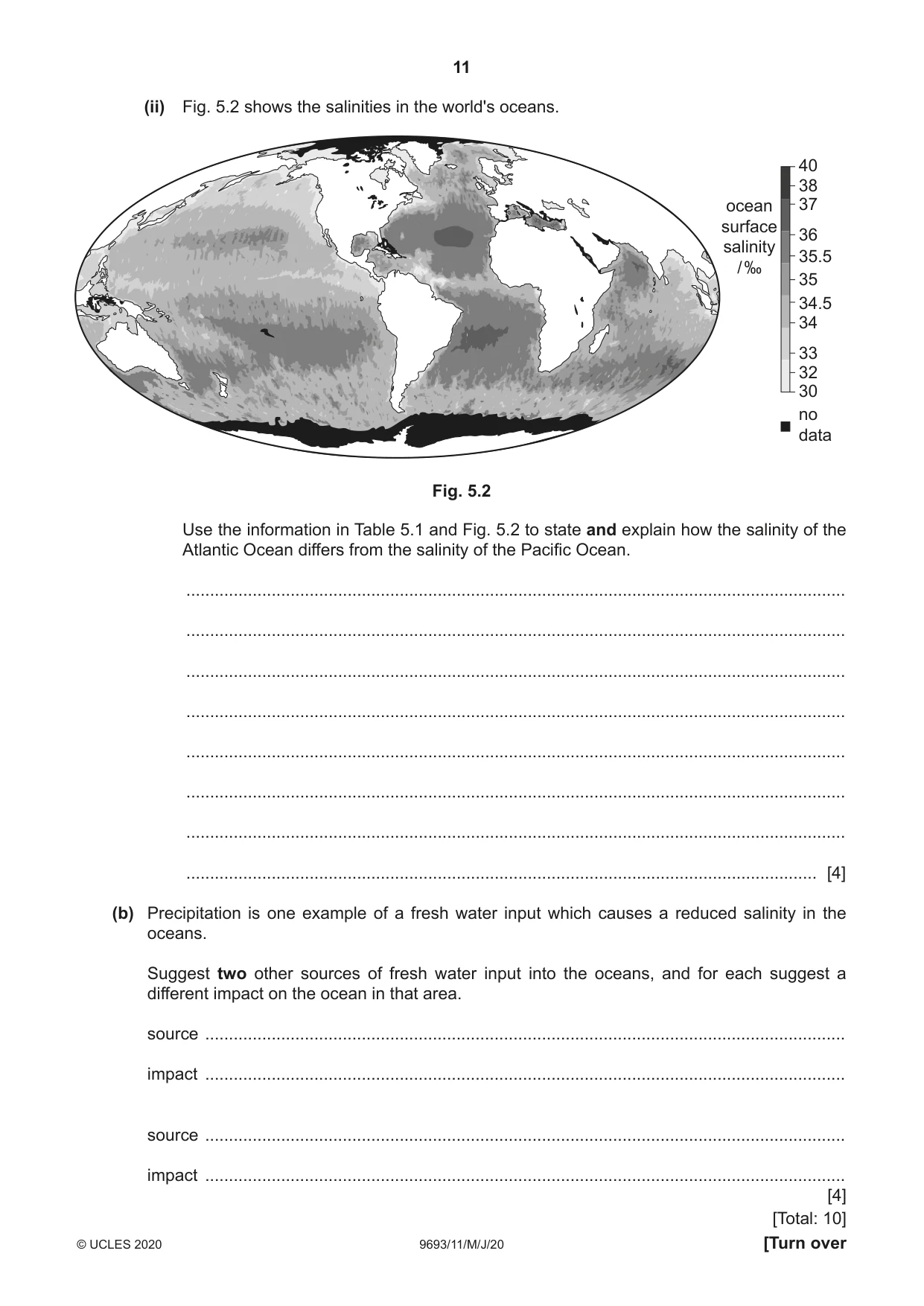
11 9693/11/M/J/20 © UCLES 2020 [Turn over (ii) Fig. 5.2 shows the salinities in the world's oceans. 40 38 37 36 35.5 ocean surface salinity / ‰ 35 34.5 34 33 32 30 no data Fig. 5.2 Use the information in Table 5.1 and Fig. 5.2 to state and explain how the salinity of the Atlantic Ocean differs from the salinity of the Pacific Ocean. … … … … … … … … [4] (b) Precipitation is one example of a fresh water input which causes a reduced salinity in the oceans. Suggest two other sources of fresh water input into the oceans, and for each suggest a different impact on the ocean in that area. source … impact … source … impact … [4] [Total: 10]
Question paper, page 12
12 9693/11/M/J/20 © UCLES 2020 6 (a) Tropical coral polyps live in a close relationship with photosynthetic organisms. (i) Name the photosynthetic organisms that live within tropical coral polyps. … [1] (ii) Describe the relationship between the tropical coral polyp and these photosynthetic organisms. … … … … … … [3] (iii) Suggest two reasons why tropical coral polyps rarely grow at an ocean depth below 50 m. 1 … … 2 … … [2] (b) Tropical coral polyps can be killed by: ● temperature change ● storms. (i) Name two other environmental conditions that can kill tropical coral polyps and lead to coral reef erosion. 1 … … 2 … … [2]
Question paper, page 13
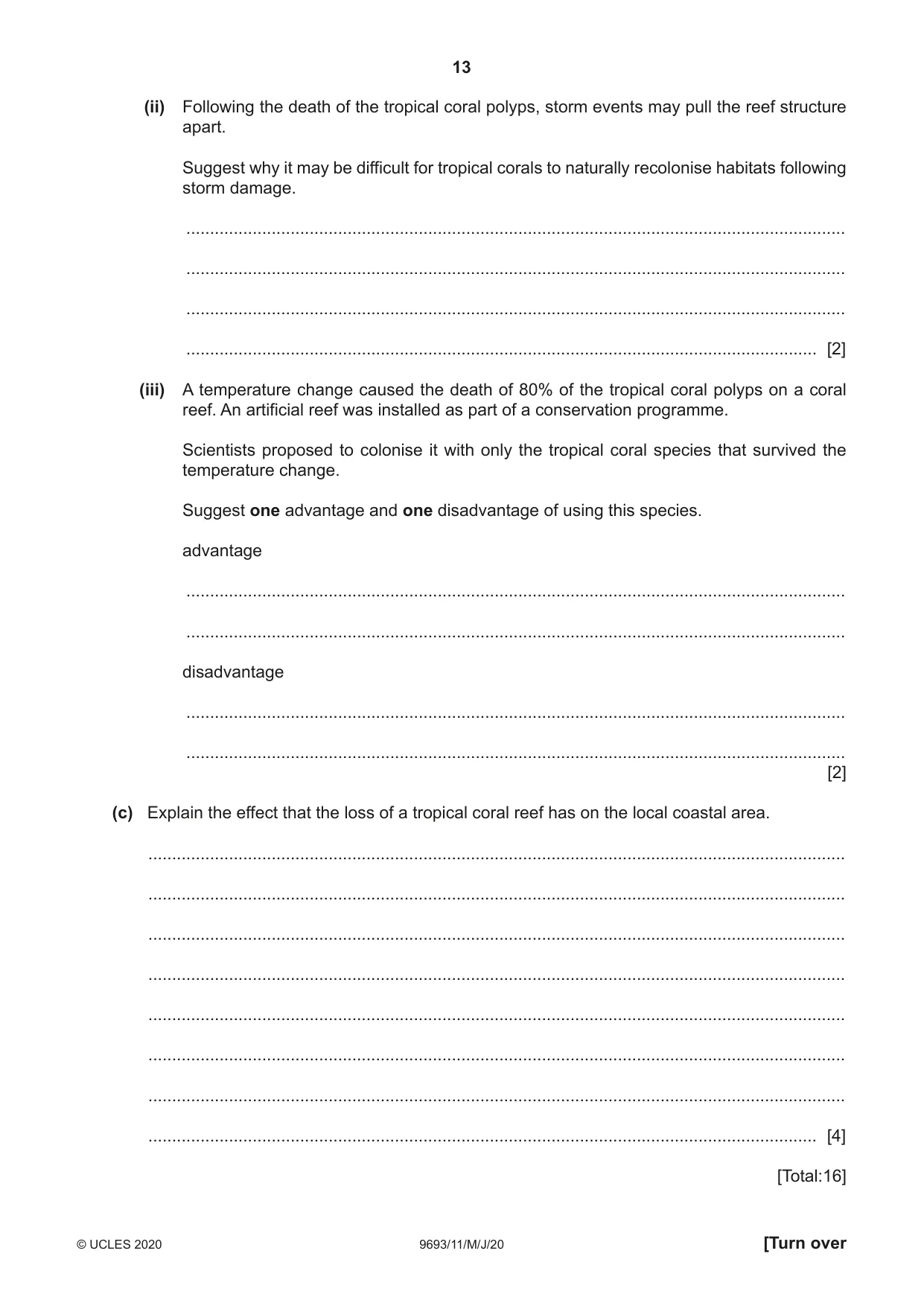
13 9693/11/M/J/20 © UCLES 2020 [Turn over (ii) Following the death of the tropical coral polyps, storm events may pull the reef structure apart. Suggest why it may be difficult for tropical corals to naturally recolonise habitats following storm damage. … … … … [2] (iii) A temperature change caused the death of 80% of the tropical coral polyps on a coral reef. An artificial reef was installed as part of a conservation programme. Scientists proposed to colonise it with only the tropical coral species that survived the temperature change. Suggest one advantage and one disadvantage of using this species. advantage … … disadvantage … … [2] (c) Explain the effect that the loss of a tropical coral reef has on the local coastal area. … … … … … … … … [4] [Total:16]
Question paper, page 14
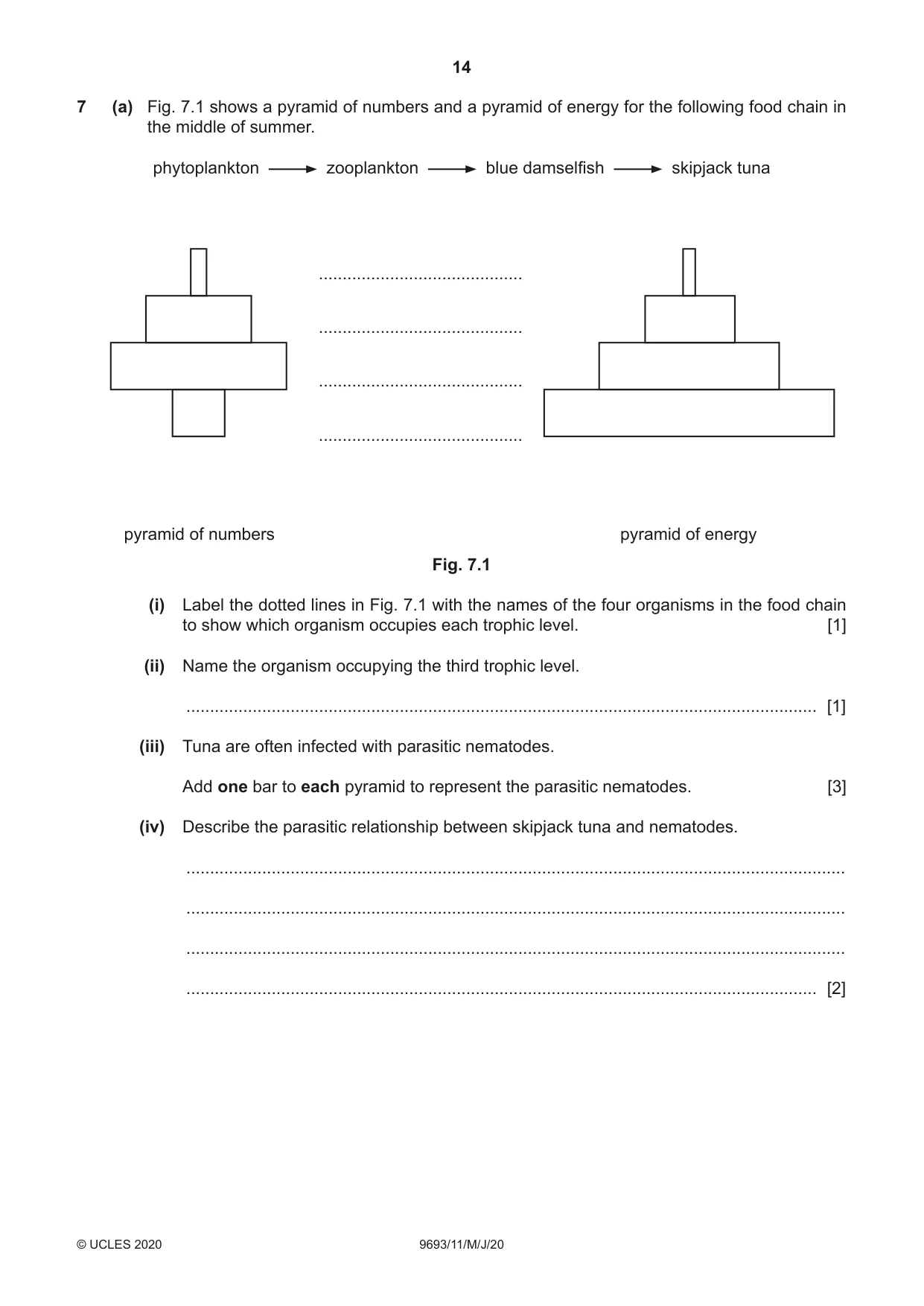
14 9693/11/M/J/20 © UCLES 2020 7 (a) Fig. 7.1 shows a pyramid of numbers and a pyramid of energy for the following food chain in the middle of summer. phytoplankton zooplankton blue damselfish skipjack tuna … … … … pyramid of numbers pyramid of energy Fig. 7.1 (i) Label the dotted lines in Fig. 7.1 with the names of the four organisms in the food chain to show which organism occupies each trophic level. [1] (ii) Name the organism occupying the third trophic level. … [1] (iii) Tuna are often infected with parasitic nematodes. Add one bar to each pyramid to represent the parasitic nematodes. [3] (iv) Describe the parasitic relationship between skipjack tuna and nematodes. … … … … [2]
Question paper, page 15
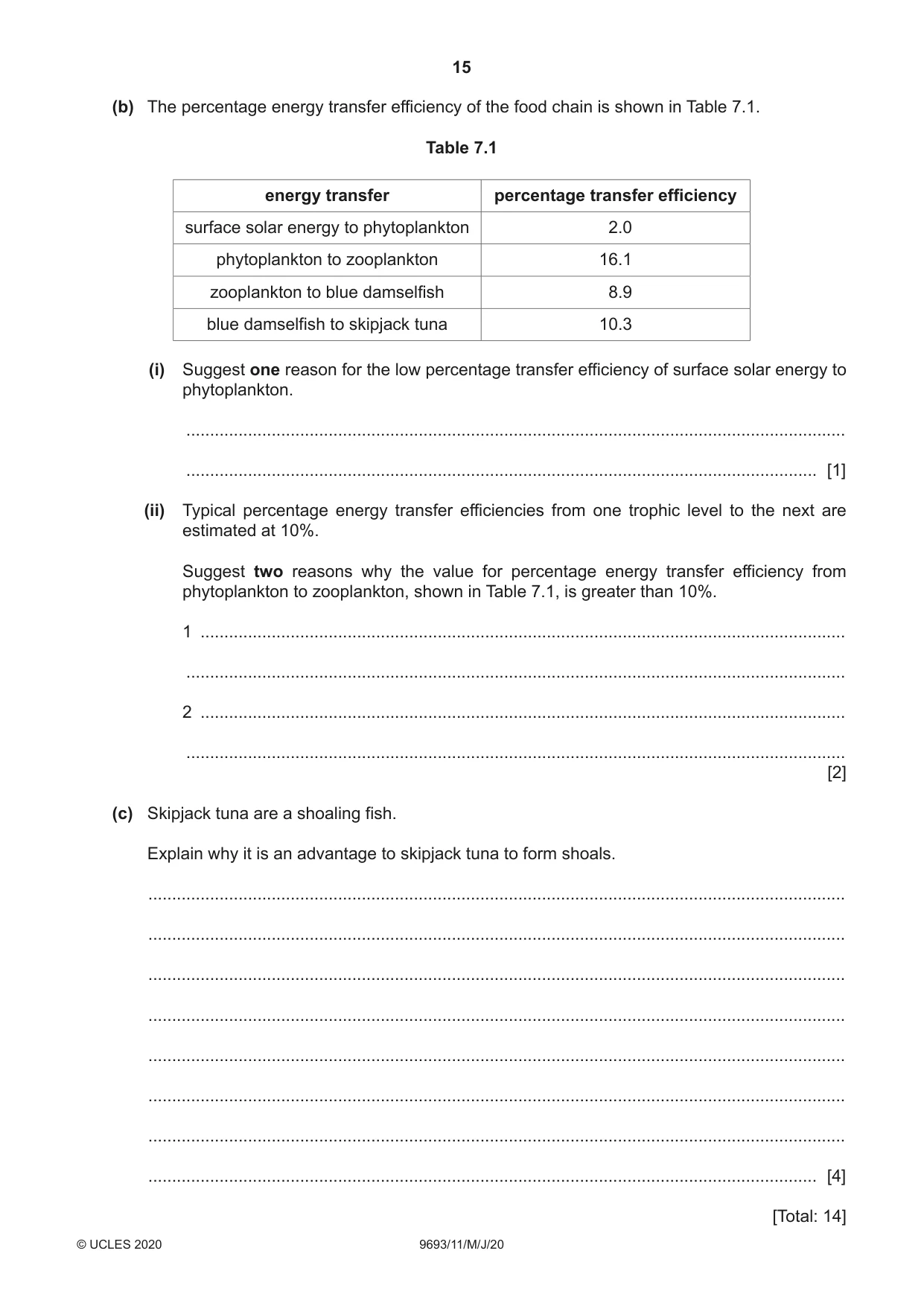
15 9693/11/M/J/20 © UCLES 2020 (b) The percentage energy transfer efficiency of the food chain is shown in Table 7.1. Table 7.1 energy transfer percentage transfer efficiency surface solar energy to phytoplankton 2.0 phytoplankton to zooplankton 16.1 zooplankton to blue damselfish 8.9 blue damselfish to skipjack tuna 10.3 (i) Suggest one reason for the low percentage transfer efficiency of surface solar energy to phytoplankton. … … [1] (ii) Typical percentage energy transfer efficiencies from one trophic level to the next are estimated at 10%. Suggest two reasons why the value for percentage energy transfer efficiency from phytoplankton to zooplankton, shown in Table 7.1, is greater than 10%. 1 … … 2 … … [2] (c) Skipjack tuna are a shoaling fish. Explain why it is an advantage to skipjack tuna to form shoals. … … … … … … … … [4] [Total: 14]
Question paper, page 16
16 9693/11/M/J/20 © UCLES 2020 Permission to reproduce items where third-party owned material protected by copyright is included has been sought and cleared where possible. Every reasonable effort has been made by the publisher (UCLES) to trace copyright holders, but if any items requiring clearance have unwittingly been included, the publisher will be pleased to make amends at the earliest possible opportunity. To avoid the issue of disclosure of answer-related information to candidates, all copyright acknowledgements are reproduced online in the Cambridge Assessment International Education Copyright Acknowledgements Booklet. This is produced for each series of examinations and is freely available to download at www.cambridgeinternational.org after the live examination series. Cambridge Assessment International Education is part of the Cambridge Assessment Group. Cambridge Assessment is the brand name of the University of Cambridge Local Examinations Syndicate (UCLES), which itself is a department of the University of Cambridge. BLANK PAGE
Mark scheme, page 1
This document consists of 12 printed pages. © UCLES 2020 [Turn over Cambridge International AS & A Level MARINE SCIENCE 9693/11 Paper 1 AS Structured Questions May/June 2020 MARK SCHEME Maximum Mark: 75 Published Students did not sit exam papers in the June 2020 series due to the Covid-19 global pandemic. This mark scheme is published to support teachers and students and should be read together with the question paper. It shows the requirements of the exam. The answer column of the mark scheme shows the proposed basis on which Examiners would award marks for this exam. Where appropriate, this column also provides the most likely acceptable alternative responses expected from students. Examiners usually review the mark scheme after they have seen student responses and update the mark scheme if appropriate. In the June series, Examiners were unable to consider the acceptability of alternative responses, as there were no student responses to consider. Mark schemes should usually be read together with the Principal Examiner Report for Teachers. However, because students did not sit exam papers, there is no Principal Examiner Report for Teachers for the June 2020 series. Cambridge International will not enter into discussions about these mark schemes. Cambridge International is publishing the mark schemes for the June 2020 series for most Cambridge IGCSE™ and Cambridge International A & AS Level components, and some Cambridge O Level components.
Mark scheme, page 2
9693/11 Cambridge International AS & A Level – Mark Scheme PUBLISHED May/June 2020 © UCLES 2020 Page 2 of 12 Generic Marking Principles These general marking principles must be applied by all examiners when marking candidate answers. They should be applied alongside the specific content of the mark scheme or generic level descriptors for a question. Each question paper and mark scheme will also comply with these marking principles. GENERIC MARKING PRINCIPLE 1: Marks must be awarded in line with: • the specific content of the mark scheme or the generic level descriptors for the question • the specific skills defined in the mark scheme or in the generic level descriptors for the question • the standard of response required by a candidate as exemplified by the standardisation scripts. GENERIC MARKING PRINCIPLE 2: Marks awarded are always whole marks (not half marks, or other fractions). GENERIC MARKING PRINCIPLE 3: Marks must be awarded positively: • marks are awarded for correct/valid answers, as defined in the mark scheme. However, credit is given for valid answers which go beyond the scope of the syllabus and mark scheme, referring to your Team Leader as appropriate • marks are awarded when candidates clearly demonstrate what they know and can do • marks are not deducted for errors • marks are not deducted for omissions • answers should only be judged on the quality of spelling, punctuation and grammar when these features are specifically assessed by the question as indicated by the mark scheme. The meaning, however, should be unambiguous. GENERIC MARKING PRINCIPLE 4: Rules must be applied consistently e.g. in situations where candidates have not followed instructions or in the application of generic level descriptors.
Mark scheme, page 3
9693/11 Cambridge International AS & A Level – Mark Scheme PUBLISHED May/June 2020 © UCLES 2020 Page 3 of 12 GENERIC MARKING PRINCIPLE 5: Marks should be awarded using the full range of marks defined in the mark scheme for the question (however; the use of the full mark range may be limited according to the quality of the candidate responses seen). GENERIC MARKING PRINCIPLE 6: Marks awarded are based solely on the requirements as defined in the mark scheme. Marks should not be awarded with grade thresholds or grade descriptors in mind. Science-Specific Marking Principles 1 Examiners should consider the context and scientific use of any keywords when awarding marks. Although keywords may be present, marks should not be awarded if the keywords are used incorrectly. 2 The examiner should not choose between contradictory statements given in the same question part, and credit should not be awarded for any correct statement that is contradicted within the same question part. Wrong science that is irrelevant to the question should be ignored. 3 Although spellings do not have to be correct, spellings of syllabus terms must allow for clear and unambiguous separation from other syllabus terms with which they may be confused (e.g. ethane / ethene, glucagon / glycogen, refraction / reflection). 4 The error carried forward (ecf) principle should be applied, where appropriate. If an incorrect answer is subsequently used in a scientifically correct way, the candidate should be awarded these subsequent marking points. Further guidance will be included in the mark scheme where necessary and any exceptions to this general principle will be noted.
Mark scheme, page 4
9693/11 Cambridge International AS & A Level – Mark Scheme PUBLISHED May/June 2020 © UCLES 2020 Page 4 of 12 5 ‘List rule’ guidance (see examples below) For questions that require n responses (e.g. State two reasons …): • The response should be read as continuous prose, even when numbered answer spaces are provided • Any response marked ignore in the mark scheme should not count towards n • Incorrect responses should not be awarded credit but will still count towards n • Read the entire response to check for any responses that contradict those that would otherwise be credited. Credit should not be awarded for any responses that are contradicted within the rest of the response. Where two responses contradict one another, this should be treated as a single incorrect response • Non-contradictory responses after the first n responses may be ignored even if they include incorrect science. 6 Calculation specific guidance Correct answers to calculations should be given full credit even if there is no working or incorrect working, unless the question states ‘show your working’. For questions in which the number of significant figures required is not stated, credit should be awarded for correct answers when rounded by the examiner to the number of significant figures given in the mark scheme. This may not apply to measured values. For answers given in standard form, (e.g. a × 10n) in which the convention of restricting the value of the coefficient (a) to a value between 1 and 10 is not followed, credit may still be awarded if the answer can be converted to the answer given in the mark scheme. Unless a separate mark is given for a unit, a missing or incorrect unit will normally mean that the final calculation mark is not awarded. Exceptions to this general principle will be noted in the mark scheme. 7 Guidance for chemical equations Multiples / fractions of coefficients used in chemical equations are acceptable unless stated otherwise in the mark scheme. State symbols given in an equation should be ignored unless asked for in the question or stated otherwise in the mark scheme.
Mark scheme, page 5
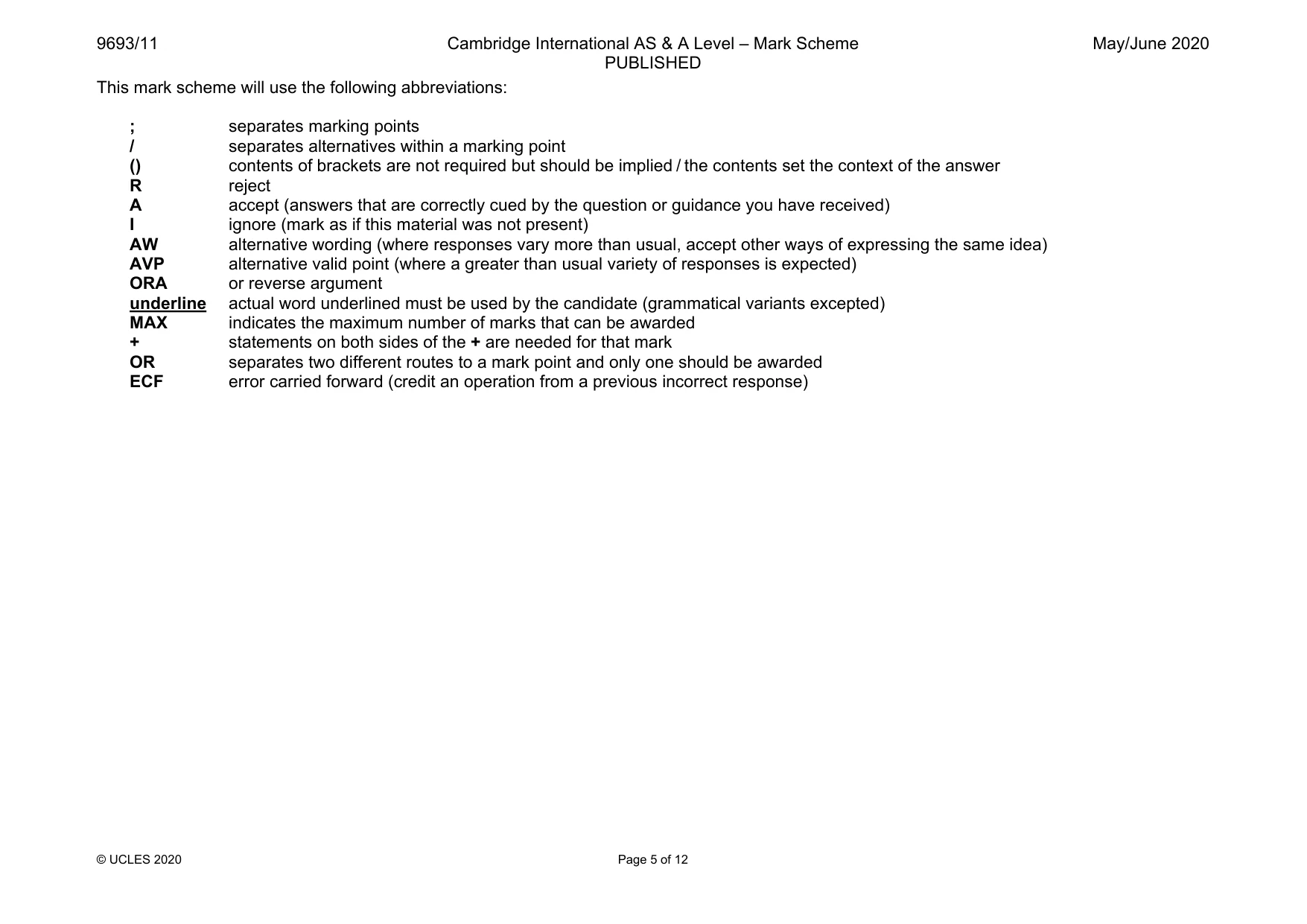
9693/11 Cambridge International AS & A Level – Mark Scheme PUBLISHED May/June 2020 © UCLES 2020 Page 5 of 12 This mark scheme will use the following abbreviations: ; separates marking points / separates alternatives within a marking point () contents of brackets are not required but should be implied / the contents set the context of the answer R reject A accept (answers that are correctly cued by the question or guidance you have received) I ignore (mark as if this material was not present) AW alternative wording (where responses vary more than usual, accept other ways of expressing the same idea) AVP alternative valid point (where a greater than usual variety of responses is expected) ORA or reverse argument underline actual word underlined must be used by the candidate (grammatical variants excepted) MAX indicates the maximum number of marks that can be awarded + statements on both sides of the + are needed for that mark OR separates two different routes to a mark point and only one should be awarded ECF error carried forward (credit an operation from a previous incorrect response)
Mark scheme, page 6
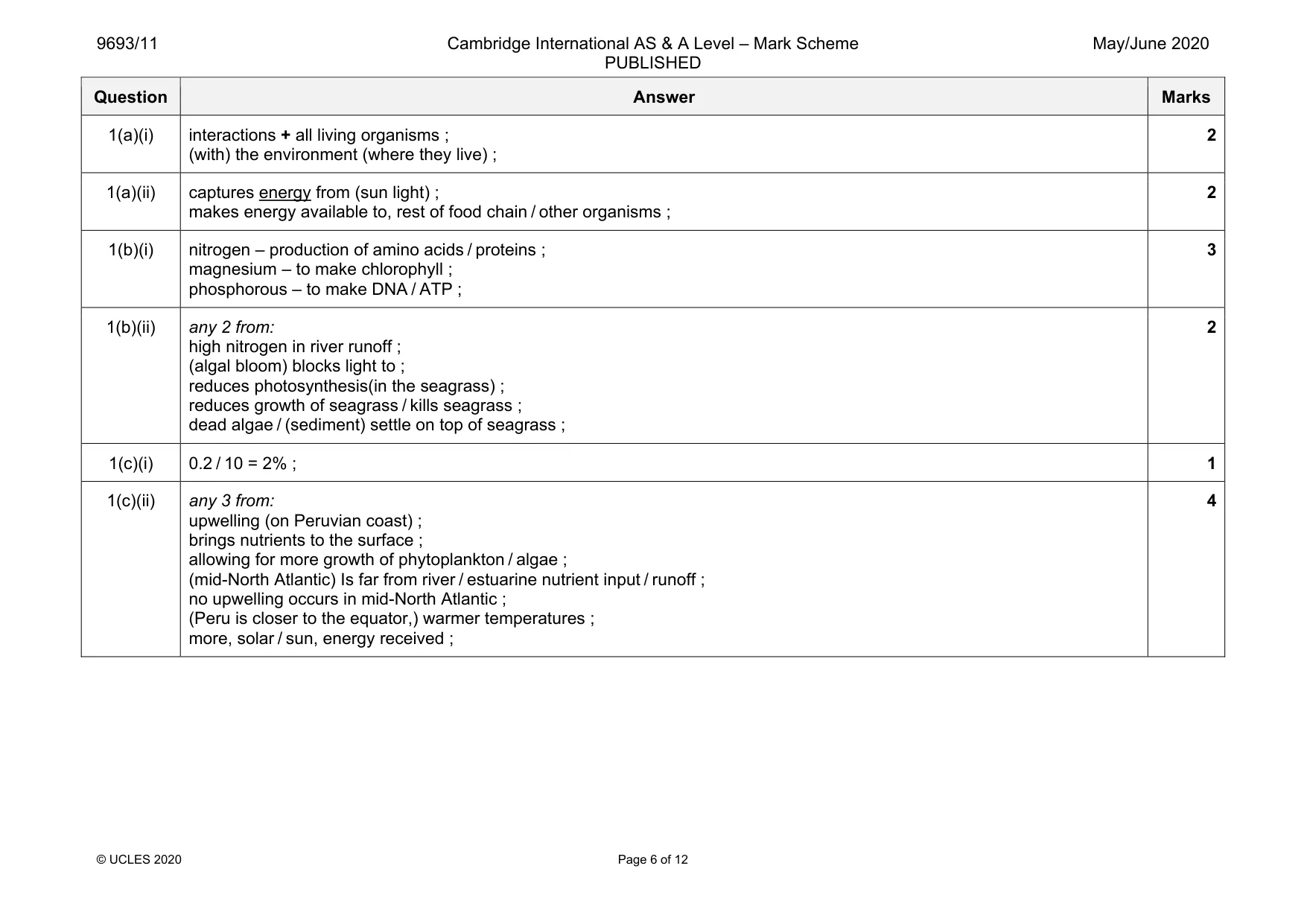
9693/11 Cambridge International AS & A Level – Mark Scheme PUBLISHED May/June 2020 © UCLES 2020 Page 6 of 12 Question Answer Marks 1(a)(i) interactions + all living organisms ; (with) the environment (where they live) ; 2 1(a)(ii) captures energy from (sun light) ; makes energy available to, rest of food chain / other organisms ; 2 1(b)(i) nitrogen – production of amino acids / proteins ; magnesium – to make chlorophyll ; phosphorous – to make DNA / ATP ; 3 1(b)(ii) any 2 from: high nitrogen in river runoff ; (algal bloom) blocks light to ; reduces photosynthesis(in the seagrass) ; reduces growth of seagrass / kills seagrass ; dead algae / (sediment) settle on top of seagrass ; 2 1(c)(i) 0.2 / 10 = 2% ; 1 1(c)(ii) any 3 from: upwelling (on Peruvian coast) ; brings nutrients to the surface ; allowing for more growth of phytoplankton / algae ; (mid-North Atlantic) Is far from river / estuarine nutrient input / runoff ; no upwelling occurs in mid-North Atlantic ; (Peru is closer to the equator,) warmer temperatures ; more, solar / sun, energy received ; 4
Mark scheme, page 7
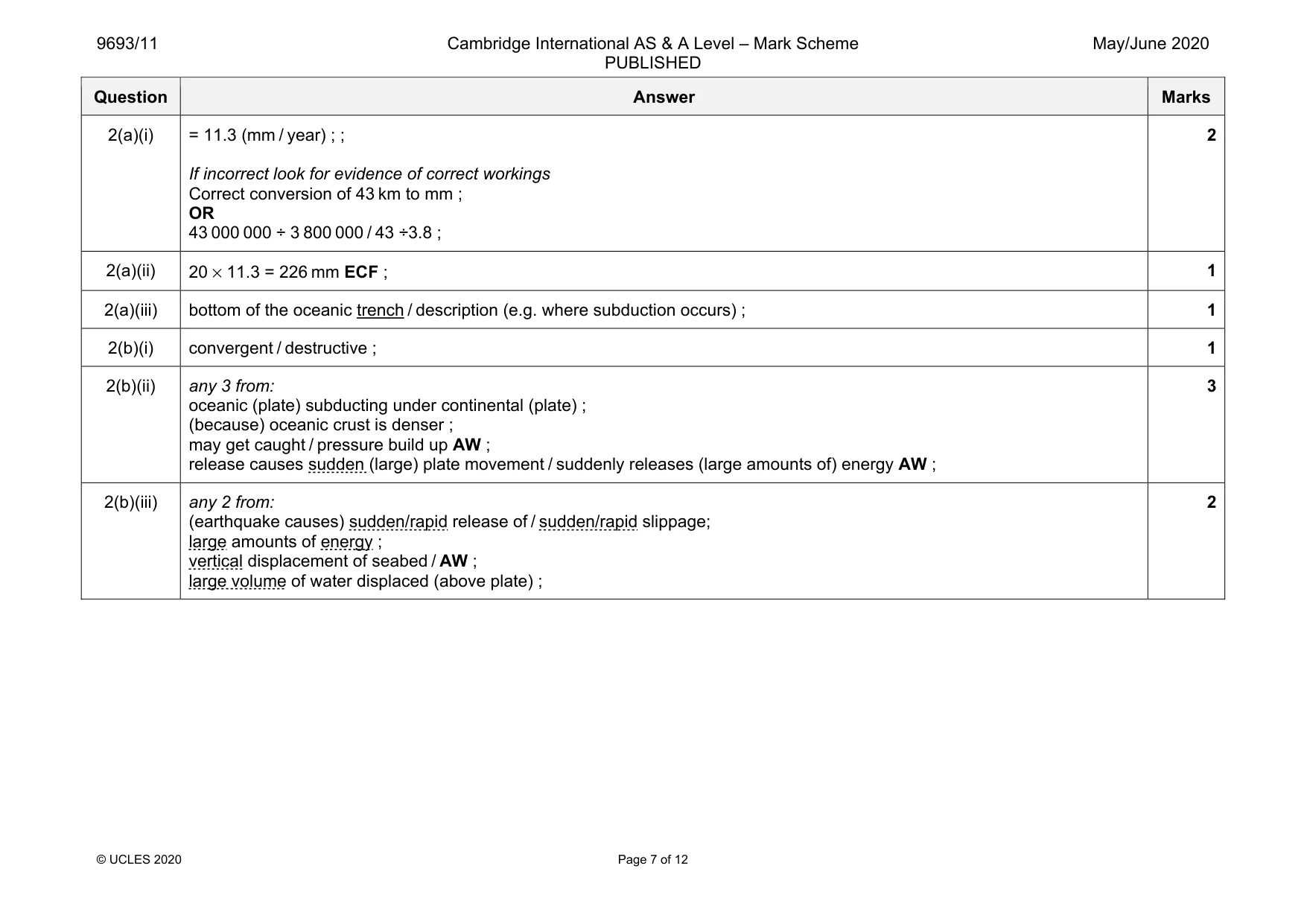
9693/11 Cambridge International AS & A Level – Mark Scheme PUBLISHED May/June 2020 © UCLES 2020 Page 7 of 12 Question Answer Marks 2(a)(i) = 11.3 (mm / year) ; ; If incorrect look for evidence of correct workings Correct conversion of 43 km to mm ; OR 43 000 000 ÷ 3 800 000 / 43 ÷3.8 ; 2 2(a)(ii) 20 × 11.3 = 226 mm ECF ; 1 2(a)(iii) bottom of the oceanic trench / description (e.g. where subduction occurs) ; 1 2(b)(i) convergent / destructive ; 1 2(b)(ii) any 3 from: oceanic (plate) subducting under continental (plate) ; (because) oceanic crust is denser ; may get caught / pressure build up AW ; release causes sudden (large) plate movement / suddenly releases (large amounts of) energy AW ; 3 2(b)(iii) any 2 from: (earthquake causes) sudden/rapid release of / sudden/rapid slippage; large amounts of energy ; vertical displacement of seabed / AW ; large volume of water displaced (above plate) ; 2
Mark scheme, page 8
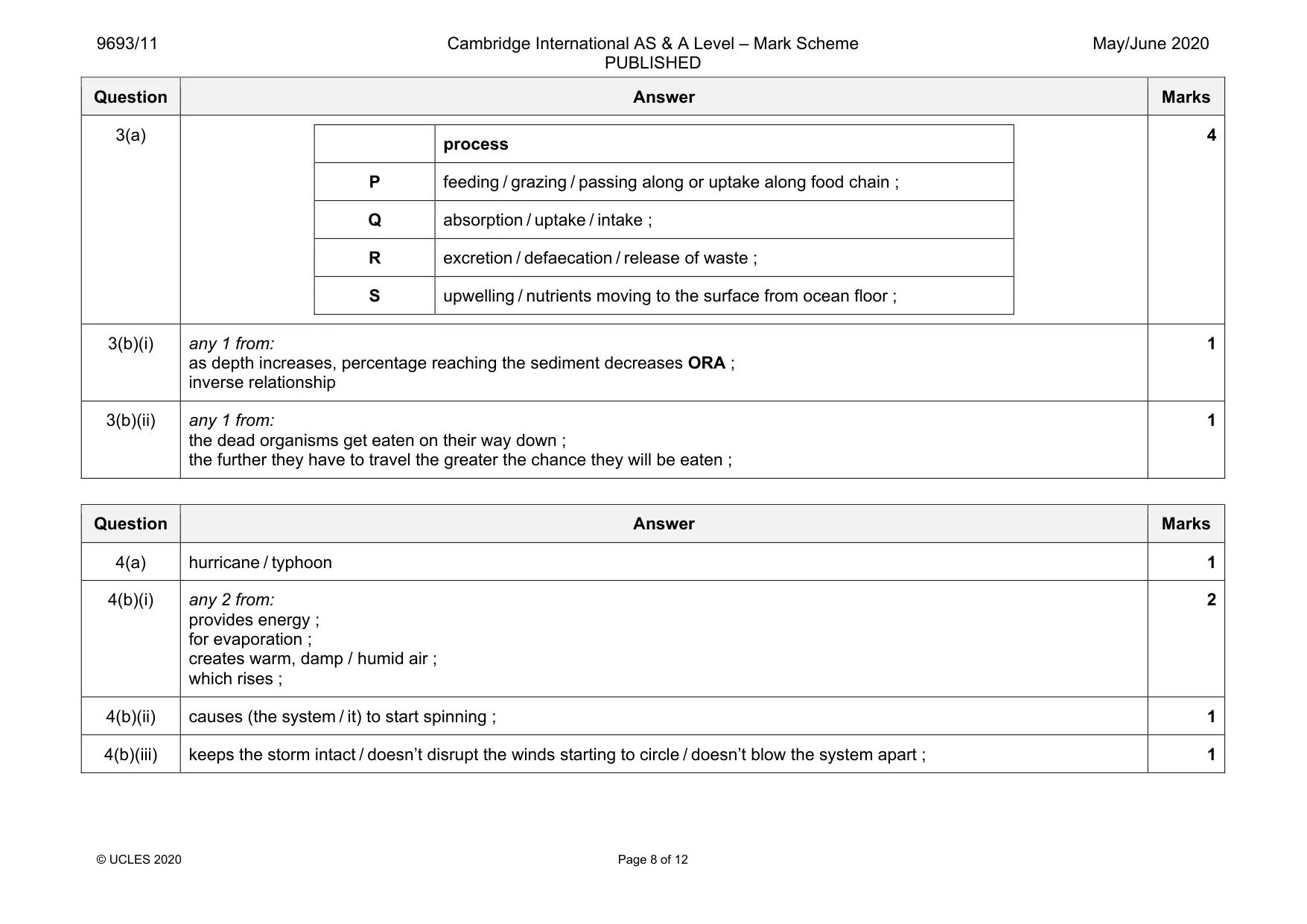
9693/11 Cambridge International AS & A Level – Mark Scheme PUBLISHED May/June 2020 © UCLES 2020 Page 8 of 12 Question Answer Marks 3(a) process P feeding / grazing / passing along or uptake along food chain ; Q absorption / uptake / intake ; R excretion / defaecation / release of waste ; S upwelling / nutrients moving to the surface from ocean floor ; 4 3(b)(i) any 1 from: as depth increases, percentage reaching the sediment decreases ORA ; inverse relationship 1 3(b)(ii) any 1 from: the dead organisms get eaten on their way down ; the further they have to travel the greater the chance they will be eaten ; 1 Question Answer Marks 4(a) hurricane / typhoon 1 4(b)(i) any 2 from: provides energy ; for evaporation ; creates warm, damp / humid air ; which rises ; 2 4(b)(ii) causes (the system / it) to start spinning ; 1 4(b)(iii) keeps the storm intact / doesn’t disrupt the winds starting to circle / doesn’t blow the system apart ; 1
Mark scheme, page 9
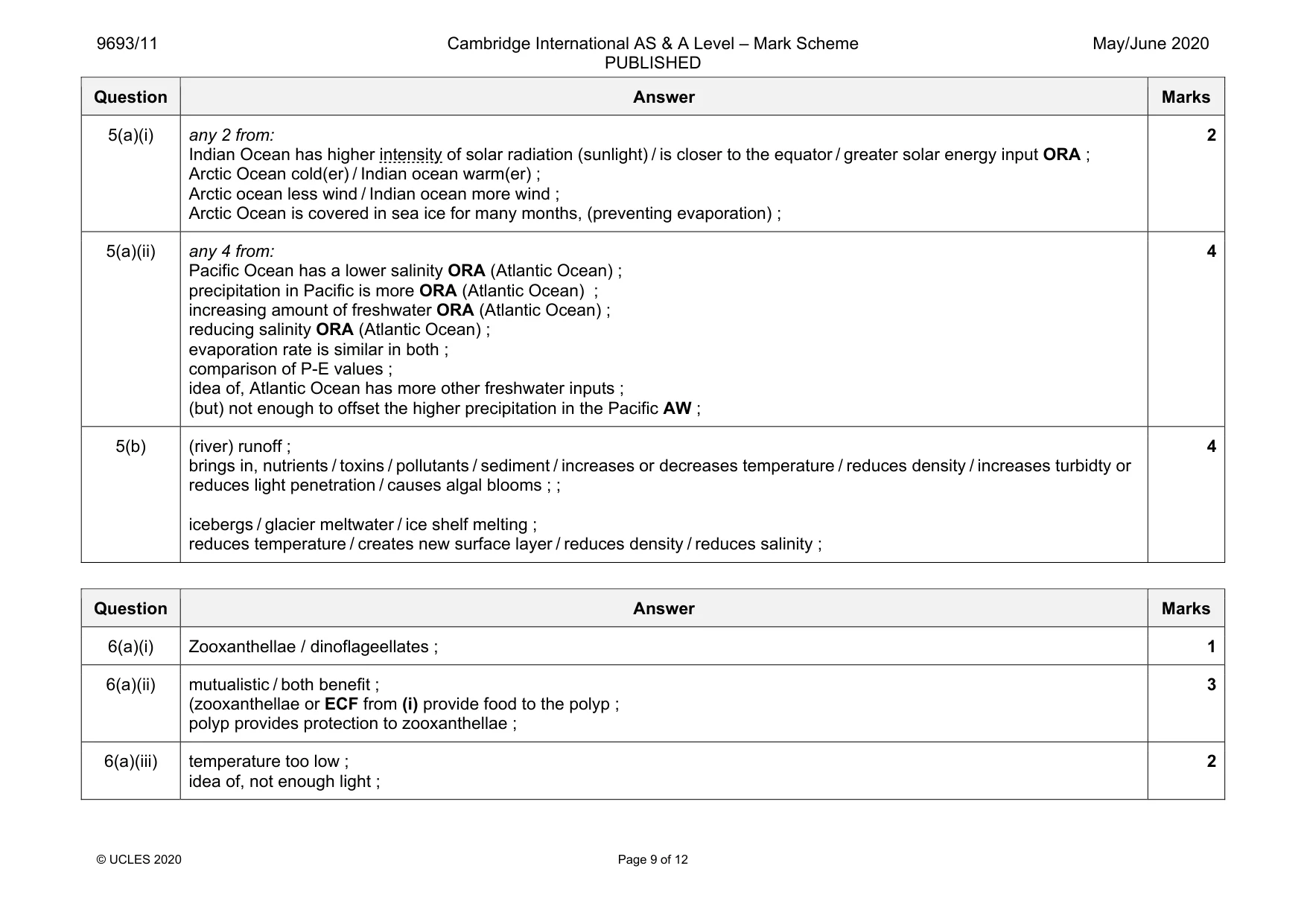
9693/11 Cambridge International AS & A Level – Mark Scheme PUBLISHED May/June 2020 © UCLES 2020 Page 9 of 12 Question Answer Marks 5(a)(i) any 2 from: Indian Ocean has higher intensity of solar radiation (sunlight) / is closer to the equator / greater solar energy input ORA ; Arctic Ocean cold(er) / Indian ocean warm(er) ; Arctic ocean less wind / Indian ocean more wind ; Arctic Ocean is covered in sea ice for many months, (preventing evaporation) ; 2 5(a)(ii) any 4 from: Pacific Ocean has a lower salinity ORA (Atlantic Ocean) ; precipitation in Pacific is more ORA (Atlantic Ocean) ; increasing amount of freshwater ORA (Atlantic Ocean) ; reducing salinity ORA (Atlantic Ocean) ; evaporation rate is similar in both ; comparison of P-E values ; idea of, Atlantic Ocean has more other freshwater inputs ; (but) not enough to offset the higher precipitation in the Pacific AW ; 4 5(b) (river) runoff ; brings in, nutrients / toxins / pollutants / sediment / increases or decreases temperature / reduces density / increases turbidty or reduces light penetration / causes algal blooms ; ; icebergs / glacier meltwater / ice shelf melting ; reduces temperature / creates new surface layer / reduces density / reduces salinity ; 4 Question Answer Marks 6(a)(i) Zooxanthellae / dinoflageellates ; 1 6(a)(ii) mutualistic / both benefit ; (zooxanthellae or ECF from (i) provide food to the polyp ; polyp provides protection to zooxanthellae ; 3 6(a)(iii) temperature too low ; idea of, not enough light ; 2
Mark scheme, page 10
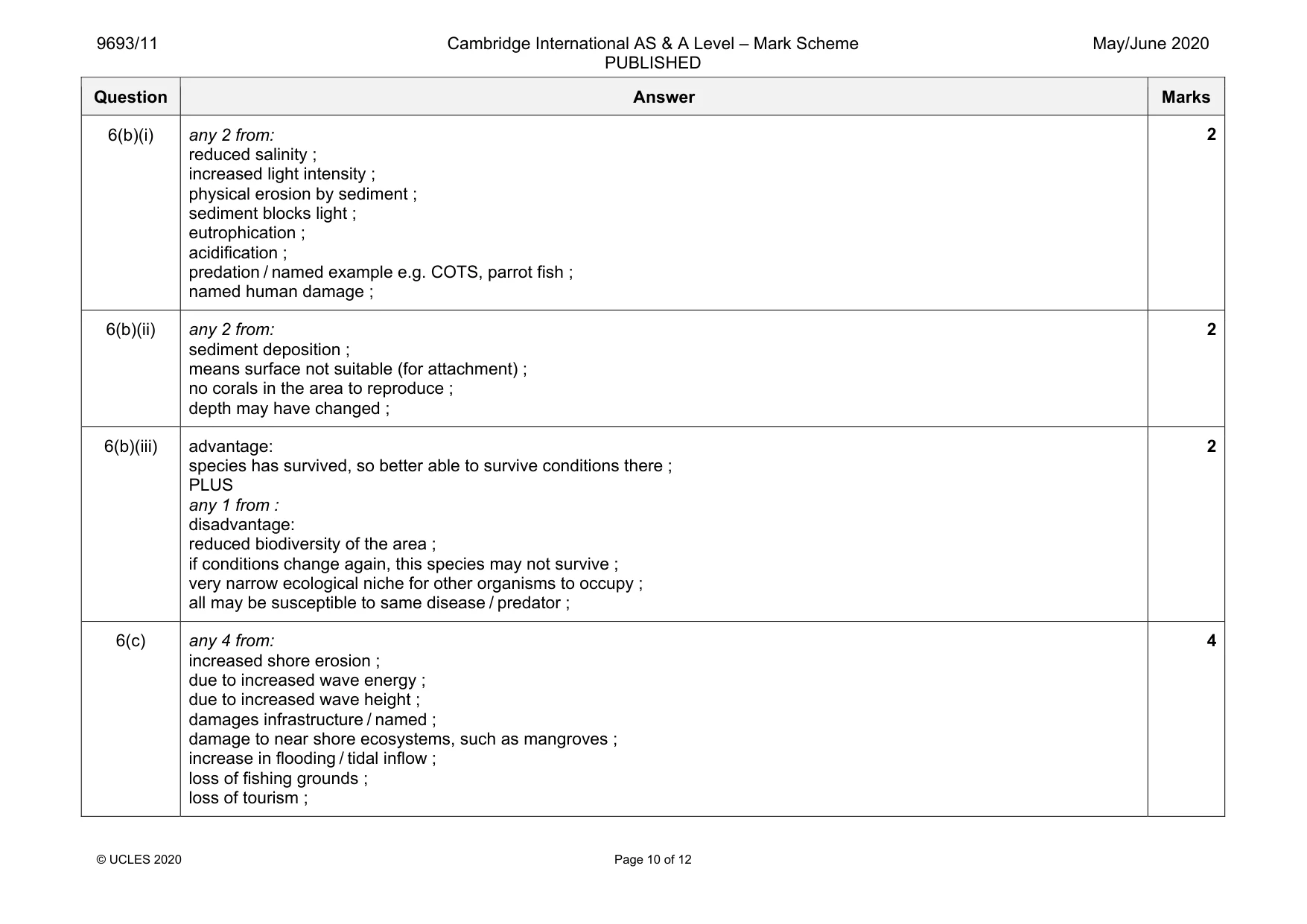
9693/11 Cambridge International AS & A Level – Mark Scheme PUBLISHED May/June 2020 © UCLES 2020 Page 10 of 12 Question Answer Marks 6(b)(i) any 2 from: reduced salinity ; increased light intensity ; physical erosion by sediment ; sediment blocks light ; eutrophication ; acidification ; predation / named example e.g. COTS, parrot fish ; named human damage ; 2 6(b)(ii) any 2 from: sediment deposition ; means surface not suitable (for attachment) ; no corals in the area to reproduce ; depth may have changed ; 2 6(b)(iii) advantage: species has survived, so better able to survive conditions there ; PLUS any 1 from : disadvantage: reduced biodiversity of the area ; if conditions change again, this species may not survive ; very narrow ecological niche for other organisms to occupy ; all may be susceptible to same disease / predator ; 2 6(c) any 4 from: increased shore erosion ; due to increased wave energy ; due to increased wave height ; damages infrastructure / named ; damage to near shore ecosystems, such as mangroves ; increase in flooding / tidal inflow ; loss of fishing grounds ; loss of tourism ; 4
Mark scheme, page 11
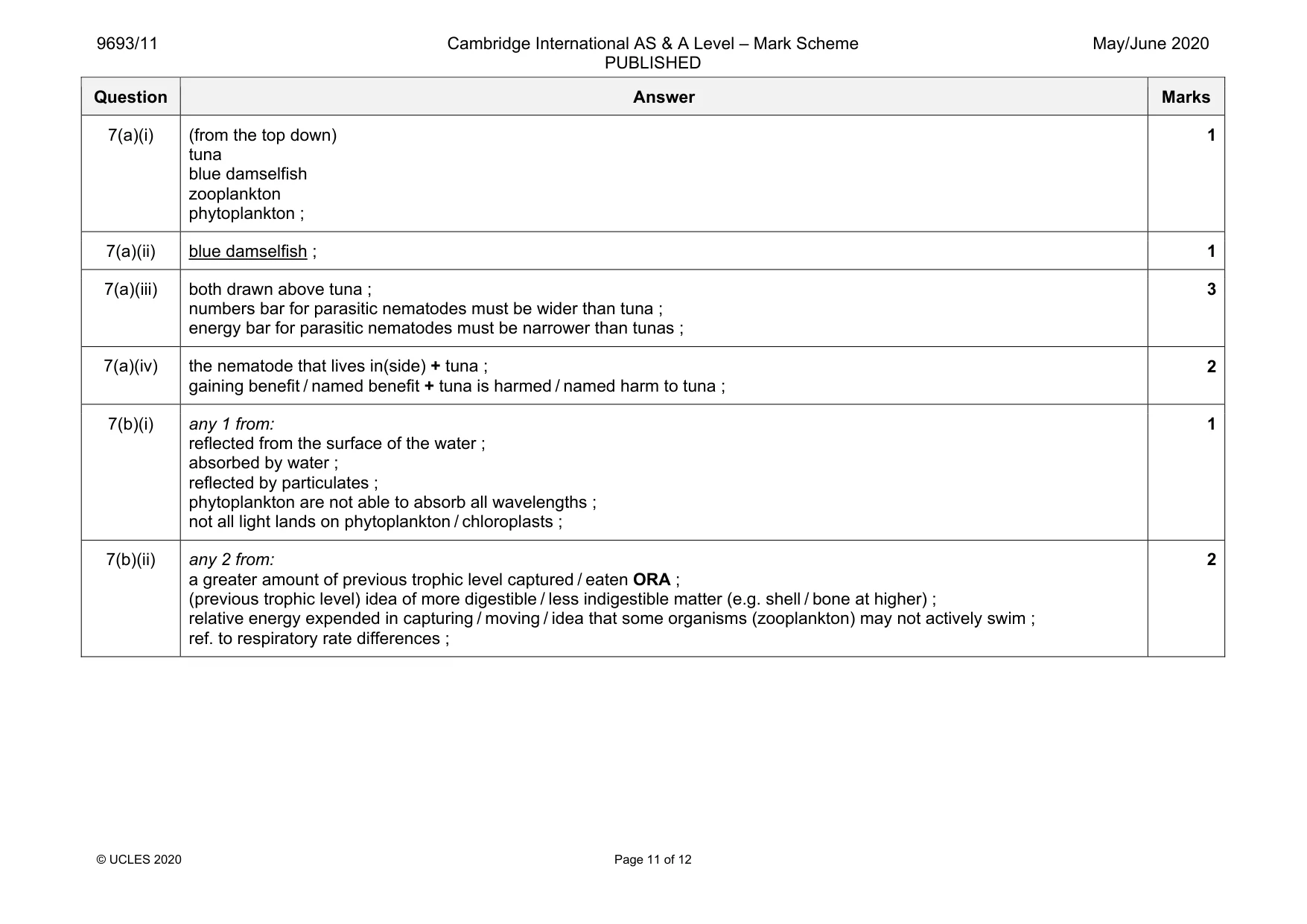
9693/11 Cambridge International AS & A Level – Mark Scheme PUBLISHED May/June 2020 © UCLES 2020 Page 11 of 12 Question Answer Marks 7(a)(i) (from the top down) tuna blue damselfish zooplankton phytoplankton ; 1 7(a)(ii) blue damselfish ; 1 7(a)(iii) both drawn above tuna ; numbers bar for parasitic nematodes must be wider than tuna ; energy bar for parasitic nematodes must be narrower than tunas ; 3 7(a)(iv) the nematode that lives in(side) + tuna ; gaining benefit / named benefit + tuna is harmed / named harm to tuna ; 2 7(b)(i) any 1 from: reflected from the surface of the water ; absorbed by water ; reflected by particulates ; phytoplankton are not able to absorb all wavelengths ; not all light lands on phytoplankton / chloroplasts ; 1 7(b)(ii) any 2 from: a greater amount of previous trophic level captured / eaten ORA ; (previous trophic level) idea of more digestible / less indigestible matter (e.g. shell / bone at higher) ; relative energy expended in capturing / moving / idea that some organisms (zooplankton) may not actively swim ; ref. to respiratory rate differences ; 2
Mark scheme, page 12
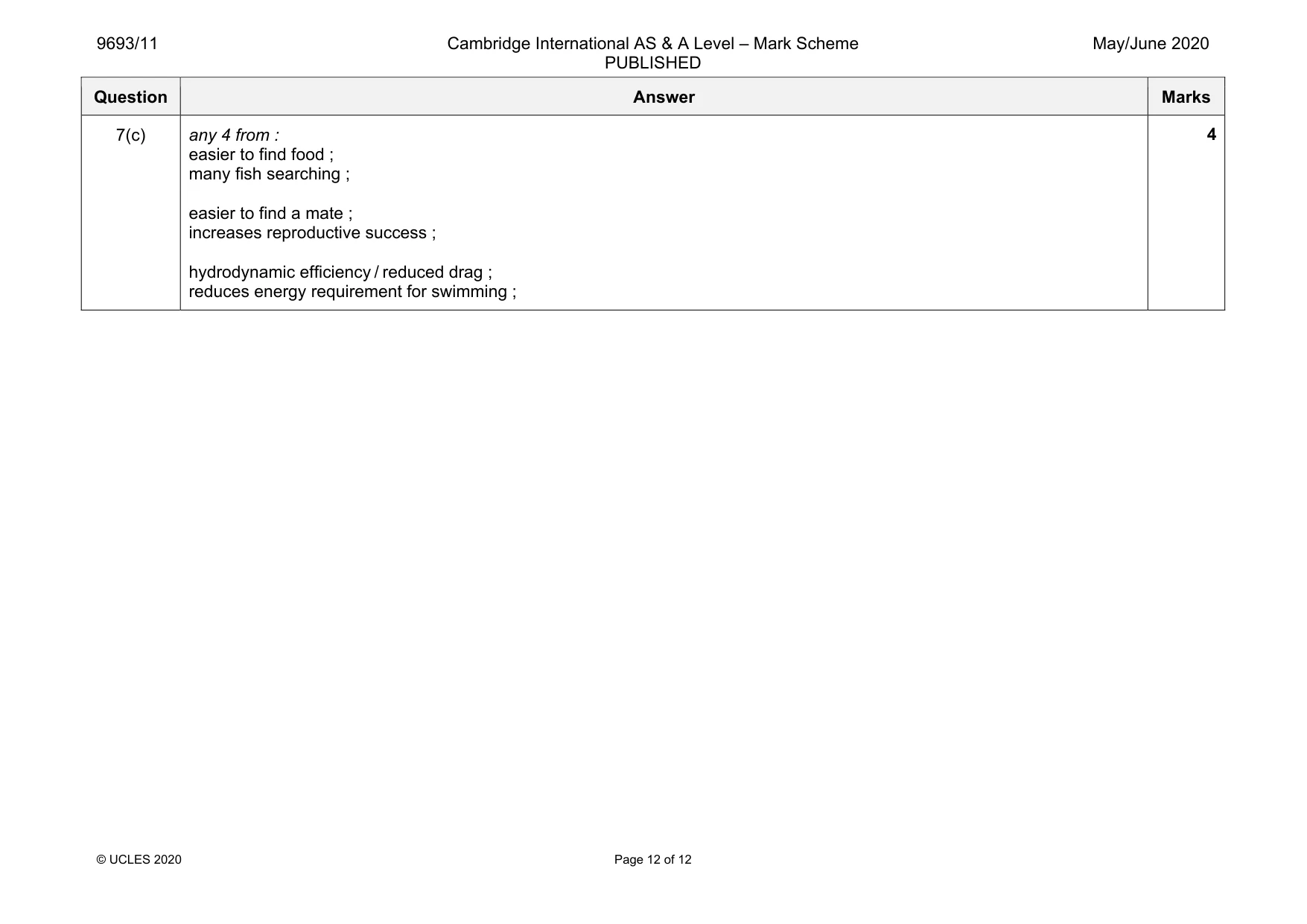
9693/11 Cambridge International AS & A Level – Mark Scheme PUBLISHED May/June 2020 © UCLES 2020 Page 12 of 12 Question Answer Marks 7(c) any 4 from : easier to find food ; many fish searching ; easier to find a mate ; increases reproductive success ; hydrodynamic efficiency / reduced drag ; reduces energy requirement for swimming ; 4