Cambridge A Level Marine Science 9693 — 2019 May/June Paper 1 · Variant 2
9693/12/M/J/19 · 75 marks · ≈84 min
The question paper and its mark scheme, free to read here and free to download. This is Cambridge’s own paper, exactly as it was sat.
Question paper20 pages
Mark scheme17 pages
Answers below. Sit the paper first if you are practising.
Paper as text
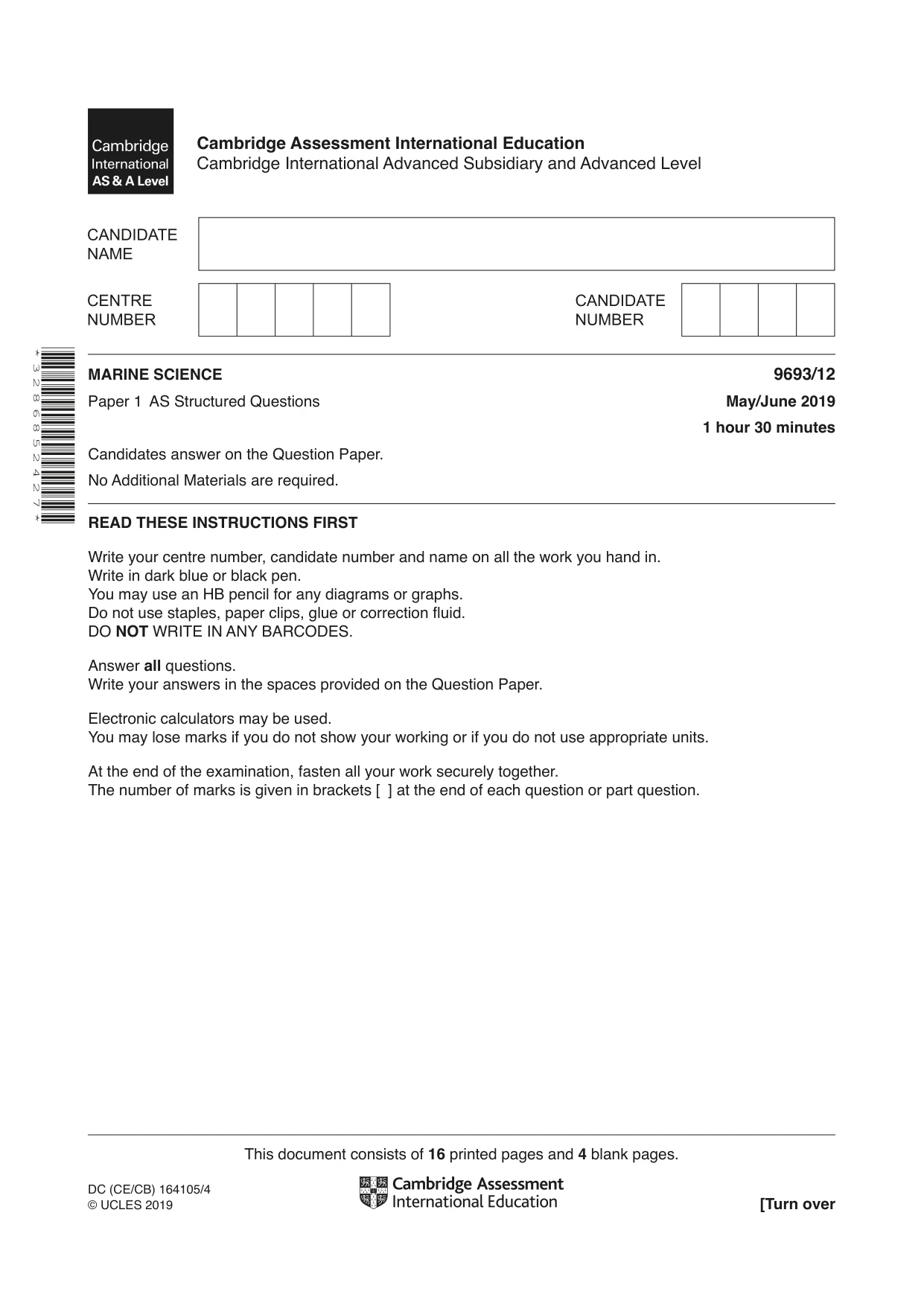
Question paper, page 1
This document consists of 16 printed pages and 4 blank pages. DC (CE/CB) 164105/4 © UCLES 2019 [Turn over * 3 2 8 6 8 5 2 4 2 7 * Cambridge Assessment International Education Cambridge International Advanced Subsidiary and Advanced Level MARINE SCIENCE 9693/12 Paper 1 AS Structured Questions May/June 2019 1 hour 30 minutes Candidates answer on the Question Paper. No Additional Materials are required. READ THESE INSTRUCTIONS FIRST Write your centre number, candidate number and name on all the work you hand in. Write in dark blue or black pen. You may use an HB pencil for any diagrams or graphs. Do not use staples, paper clips, glue or correction fluid. DO NOT WRITE IN ANY BARCODES. Answer all questions. Write your answers in the spaces provided on the Question Paper. Electronic calculators may be used. You may lose marks if you do not show your working or if you do not use appropriate units. At the end of the examination, fasten all your work securely together. The number of marks is given in brackets [ ] at the end of each question or part question.
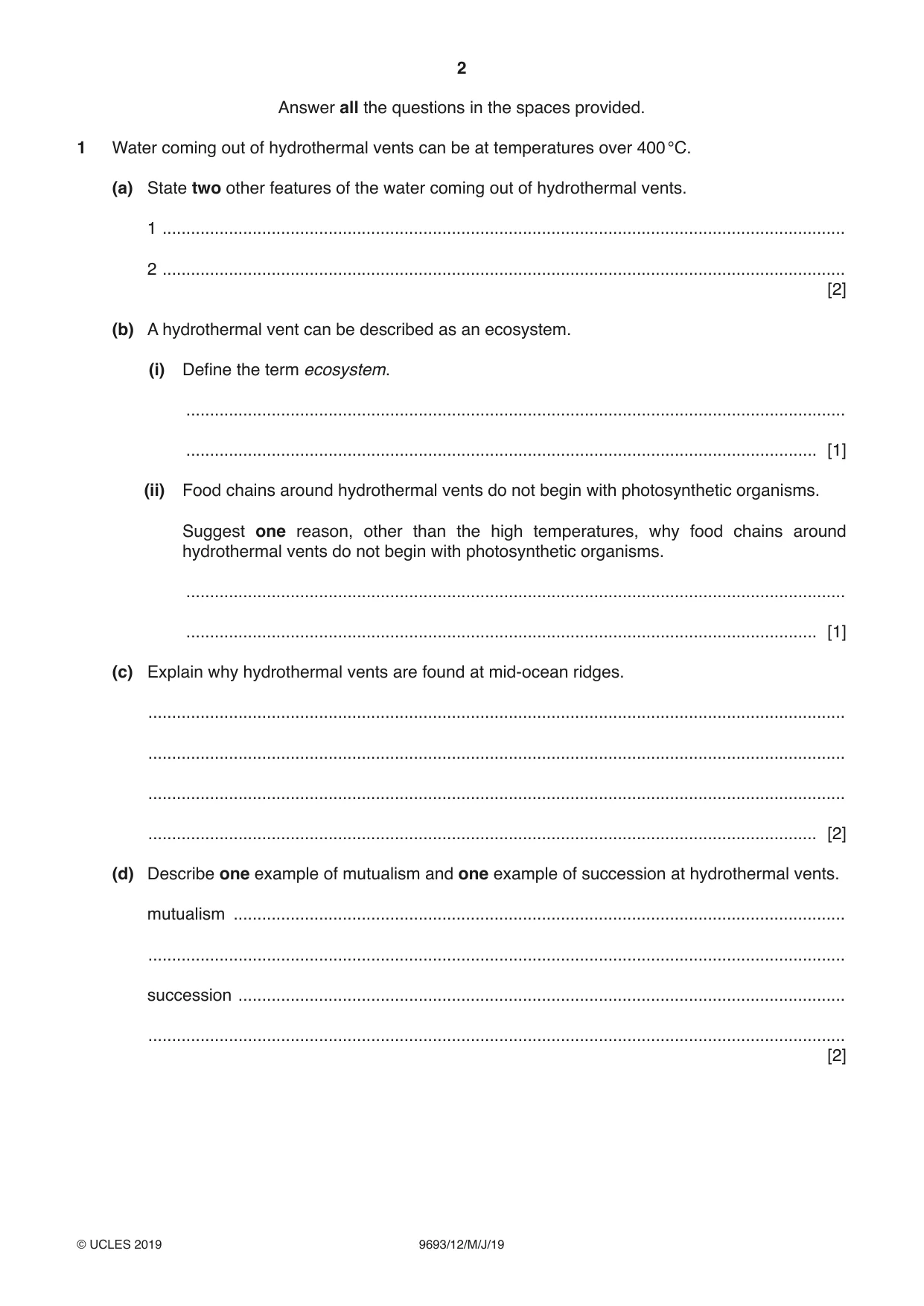
Question paper, page 2
2 9693/12/M/J/19 © UCLES 2019 Answer all the questions in the spaces provided. 1 Water coming out of hydrothermal vents can be at temperatures over 400 °C. (a) State two other features of the water coming out of hydrothermal vents. 1 … 2 … [2] (b) A hydrothermal vent can be described as an ecosystem. (i) Define the term ecosystem. … … [1] (ii) Food chains around hydrothermal vents do not begin with photosynthetic organisms. Suggest one reason, other than the high temperatures, why food chains around hydrothermal vents do not begin with photosynthetic organisms. … … [1] (c) Explain why hydrothermal vents are found at mid-ocean ridges. … … … … [2] (d) Describe one example of mutualism and one example of succession at hydrothermal vents. mutualism … … succession … … [2]
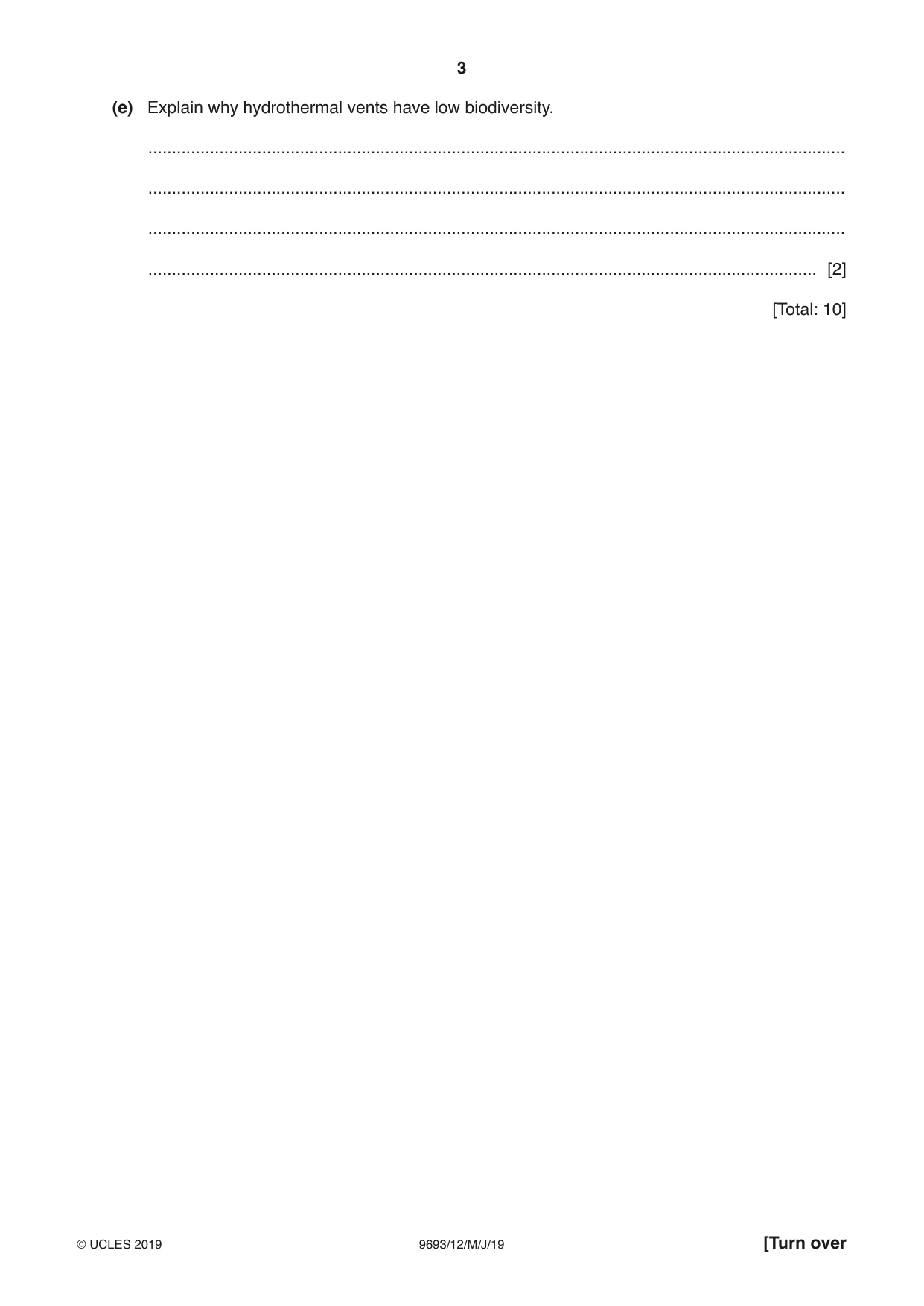
Question paper, page 3
3 9693/12/M/J/19 © UCLES 2019 [Turn over (e) Explain why hydrothermal vents have low biodiversity. … … … … [2] [Total: 10]
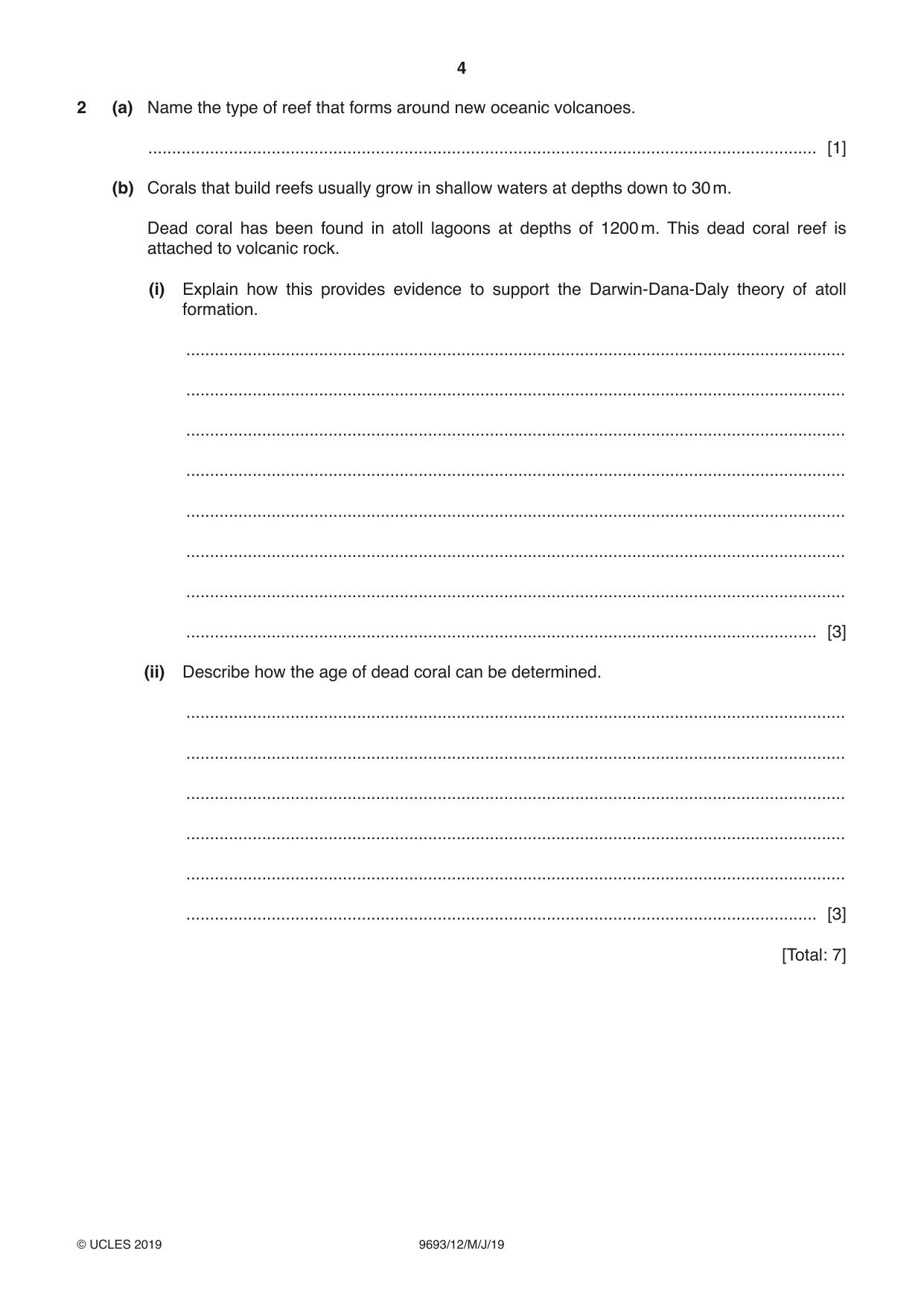
Question paper, page 4
4 9693/12/M/J/19 © UCLES 2019 2 (a) Name the type of reef that forms around new oceanic volcanoes. … [1] (b) Corals that build reefs usually grow in shallow waters at depths down to 30 m. Dead coral has been found in atoll lagoons at depths of 1200 m. This dead coral reef is attached to volcanic rock. (i) Explain how this provides evidence to support the Darwin-Dana-Daly theory of atoll formation. … … … … … … … … [3] (ii) Describe how the age of dead coral can be determined. … … … … … … [3] [Total: 7]
Question paper, page 5
5 9693/12/M/J/19 © UCLES 2019 [Turn over BLANK PAGE
Question paper, page 6
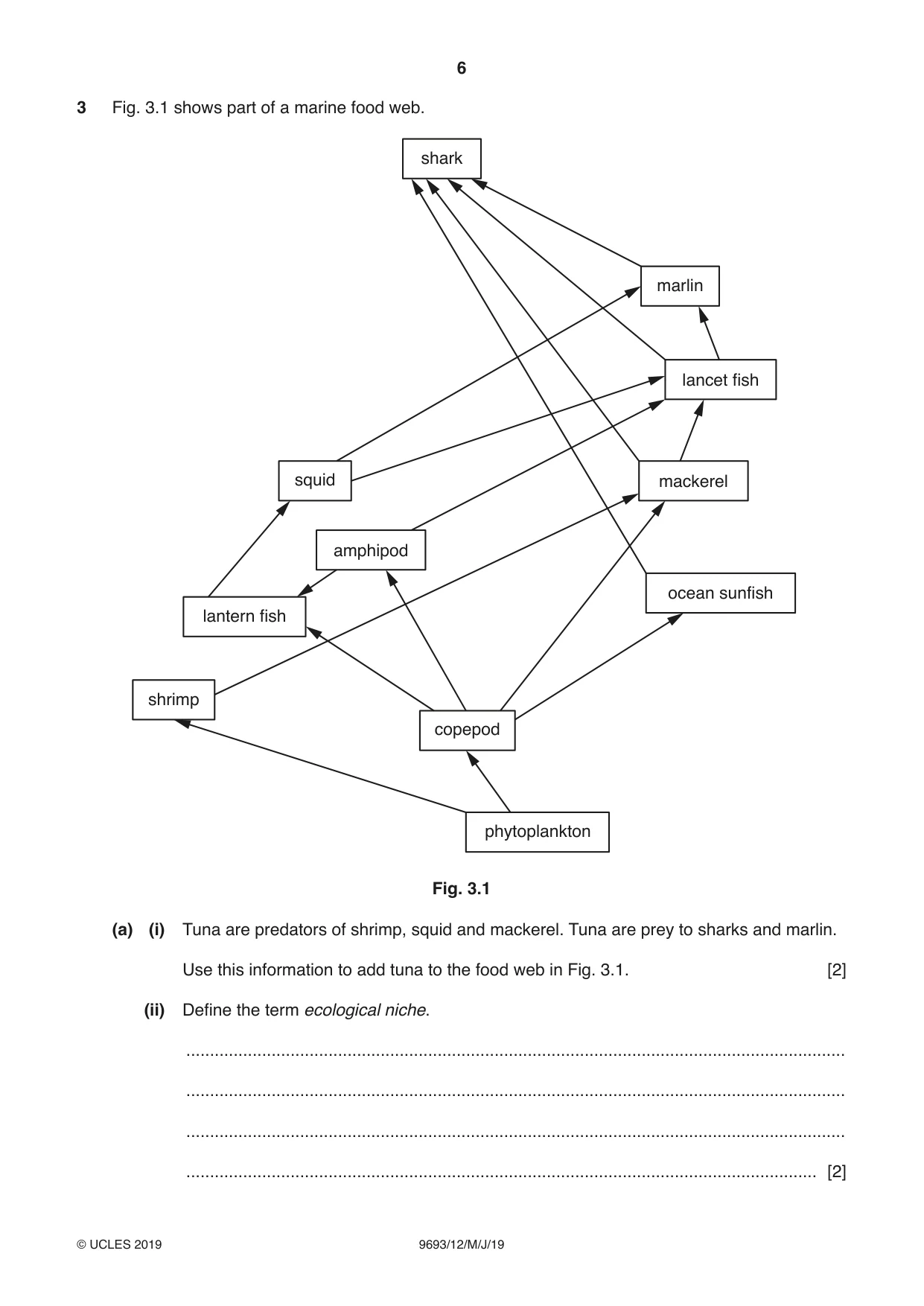
6 9693/12/M/J/19 © UCLES 2019 3 Fig. 3.1 shows part of a marine food web. phytoplankton copepod shrimp lantern fish amphipod squid ocean sunfish mackerel lancet fish marlin shark Fig. 3.1 (a) (i) Tuna are predators of shrimp, squid and mackerel. Tuna are prey to sharks and marlin. Use this information to add tuna to the food web in Fig. 3.1. [2] (ii) Define the term ecological niche. … … … … [2]
Question paper, page 7
7 9693/12/M/J/19 © UCLES 2019 [Turn over (iii) Use the information in Fig. 3.1 to explain why sharks can be described as occupying a general ecological niche. … … [1] (b) Nematodes are found in the digestive system of mackerel. The nematodes obtain energy from undigested food that the mackerel have eaten. (i) Name this type of species interrelationship. … [1] (ii) State the trophic level of these nematodes. … [1] (iii) Suggest why nematodes are not normally included in food webs, such as the one shown in Fig. 3.1. … … [1]
Question paper, page 8
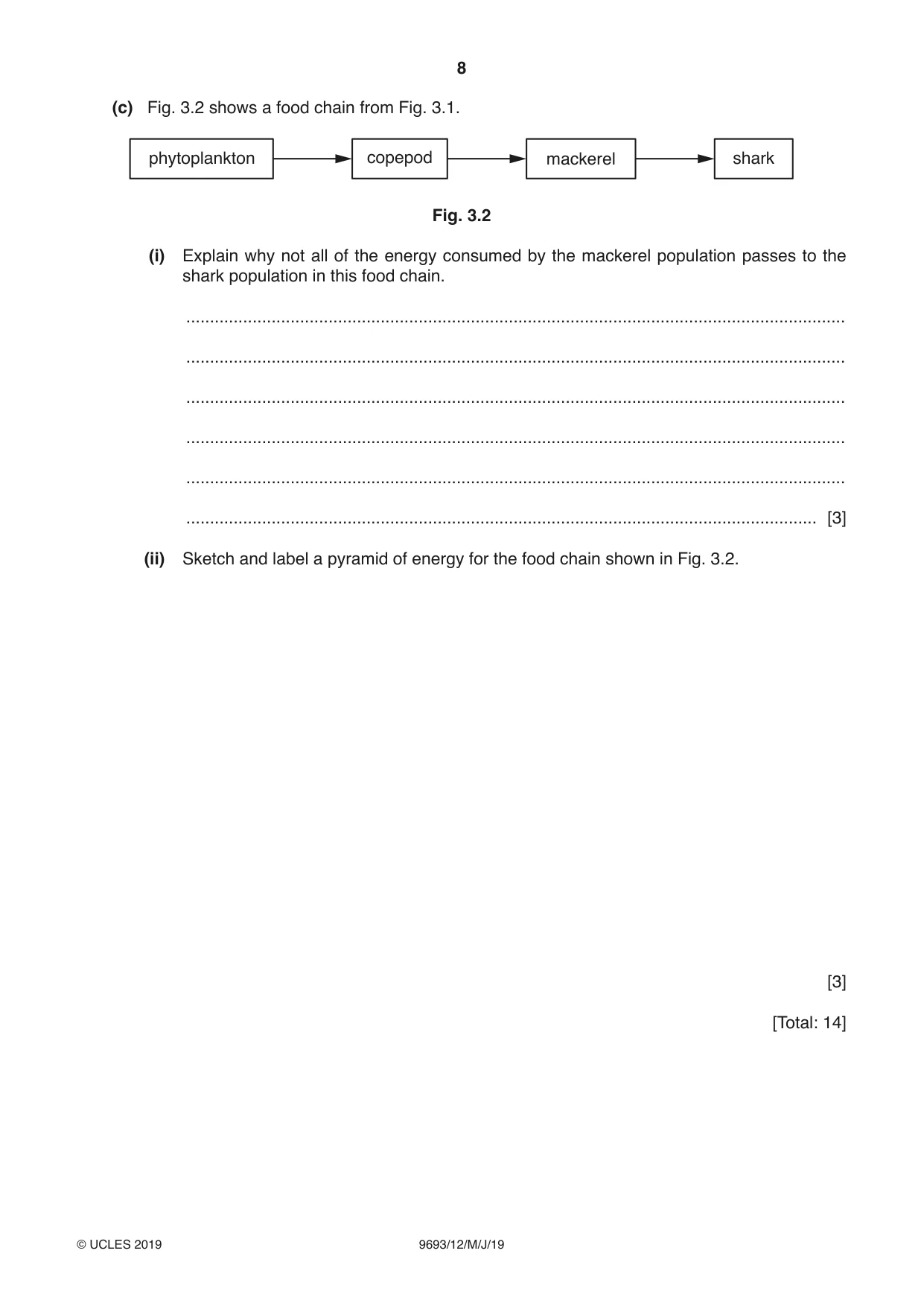
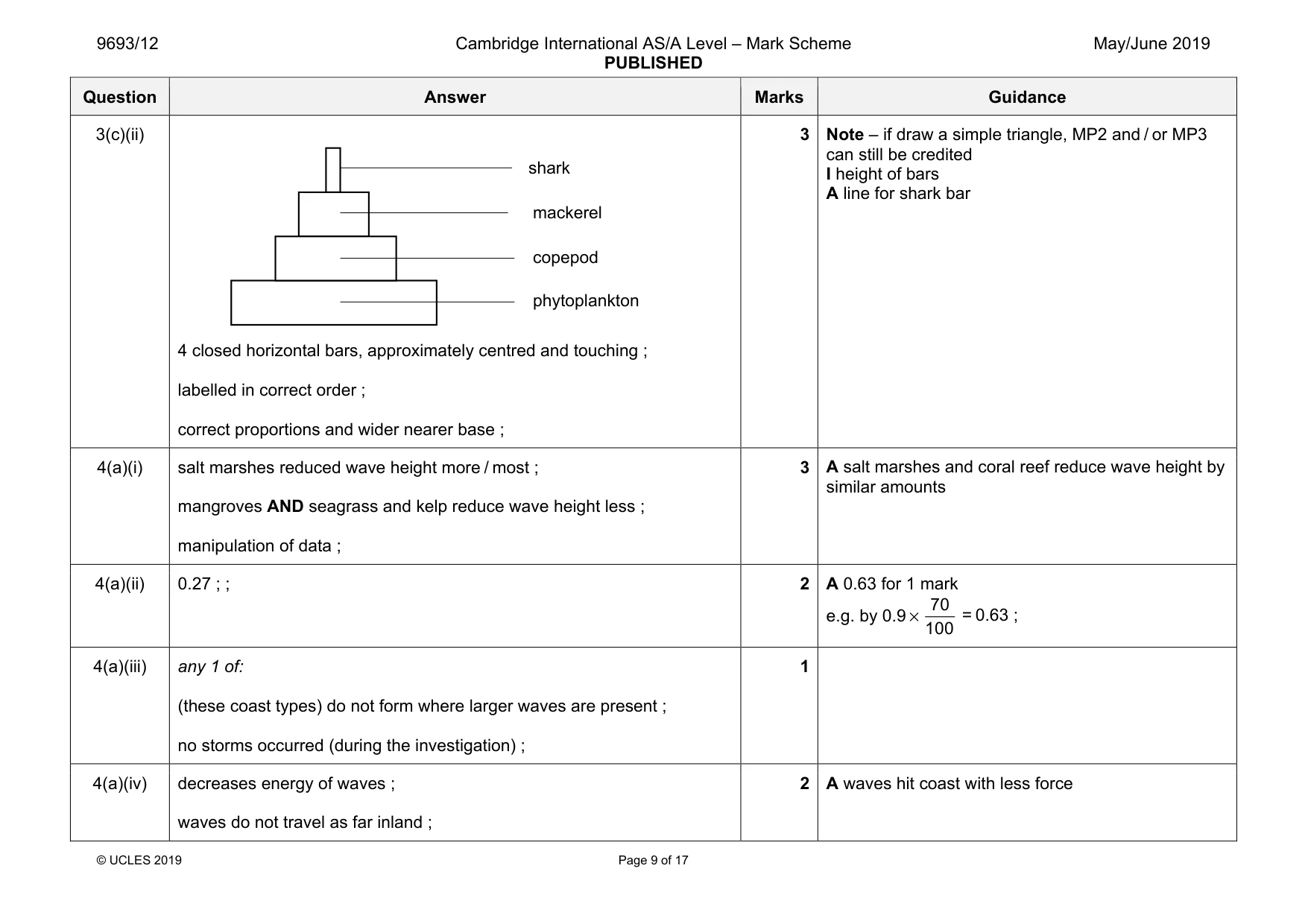
8 9693/12/M/J/19 © UCLES 2019 (c) Fig. 3.2 shows a food chain from Fig. 3.1. phytoplankton copepod mackerel shark Fig. 3.2 (i) Explain why not all of the energy consumed by the mackerel population passes to the shark population in this food chain. … … … … … … [3] (ii) Sketch and label a pyramid of energy for the food chain shown in Fig. 3.2. [3] [Total: 14]
Question paper, page 9
9 9693/12/M/J/19 © UCLES 2019 [Turn over BLANK PAGE
Question paper, page 10
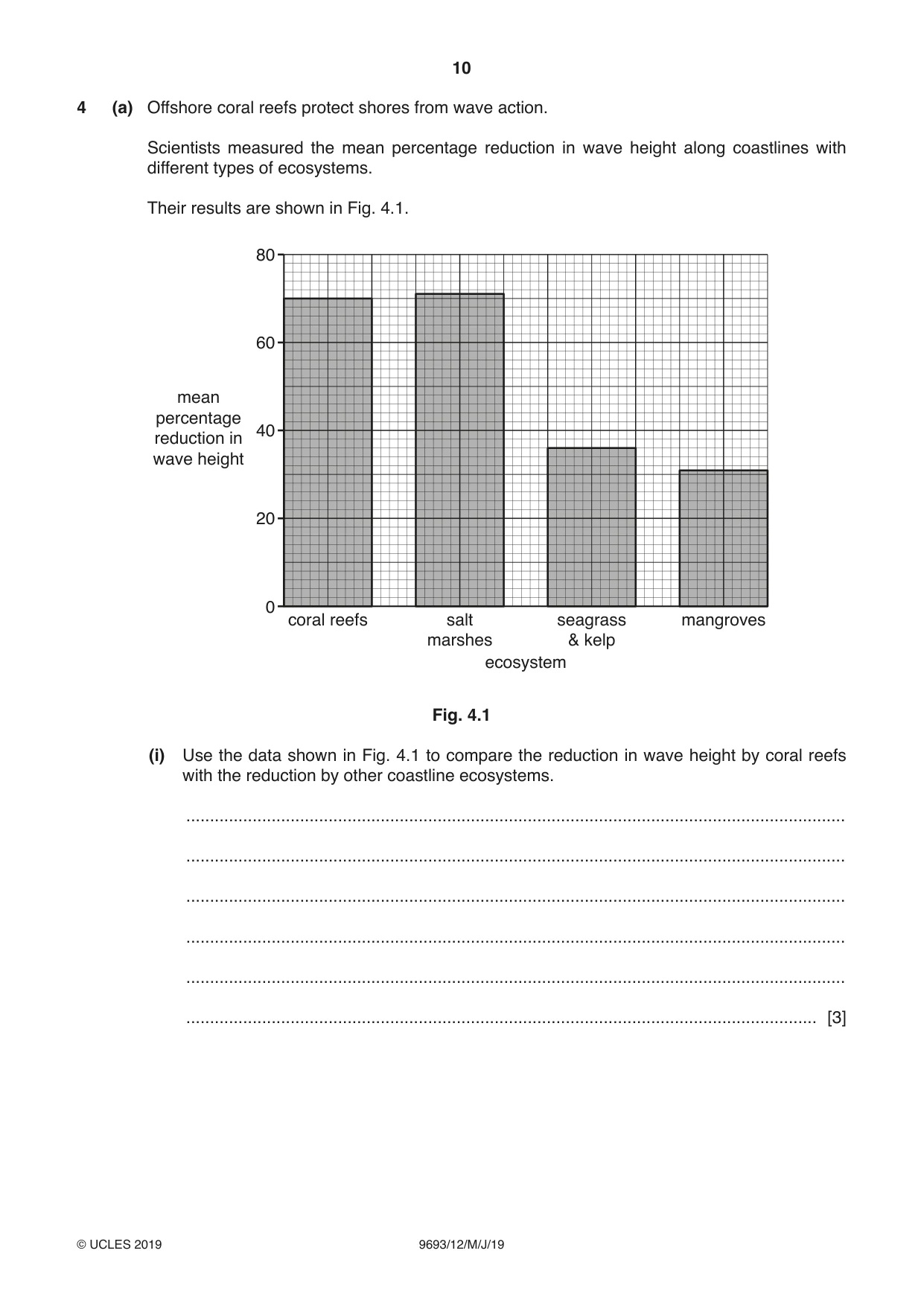
10 9693/12/M/J/19 © UCLES 2019 4 (a) Offshore coral reefs protect shores from wave action. Scientists measured the mean percentage reduction in wave height along coastlines with different types of ecosystems. Their results are shown in Fig. 4.1. coral reefs 0 20 40 60 80 salt marshes mean percentage reduction in wave height ecosystem seagrass & kelp mangroves Fig. 4.1 (i) Use the data shown in Fig. 4.1 to compare the reduction in wave height by coral reefs with the reduction by other coastline ecosystems. … … … … … … [3]
Question paper, page 11
11 9693/12/M/J/19 © UCLES 2019 [Turn over (ii) A wave has a height of 0.9 m before it reaches a coral reef. Use Fig. 4.1 to predict the height of the wave when it reaches the shore. Show your working. … m [2] (iii) Some of the waves arriving at coral reefs were over 2 m in height. No data were collected for the other coastline ecosystems for waves greater than 1 m. Suggest why data about larger waves could not be collected for other ecosystems. … … [1] (iv) Explain why a reduction in the height of waves reduces the damage to shores. … … … … [2] (v) Describe two effects on coastal communities if coral reefs are destroyed. 1 … … 2 … … [2]
Question paper, page 12
12 9693/12/M/J/19 © UCLES 2019 (b) A large area of reef in the Indian Ocean died in 1997. The reef death was caused by a combination of factors, including smoke from forest fires and an unusual upwelling of nitrogen and phosphorus. (i) Suggest how forest fires could lead to coral death. … … [1] (ii) Explain how upwelling of nitrogen and phosphorus could lead to coral death. … … … … … … … … [3] [Total: 14]
Question paper, page 13
13 9693/12/M/J/19 © UCLES 2019 [Turn over BLANK PAGE
Question paper, page 14
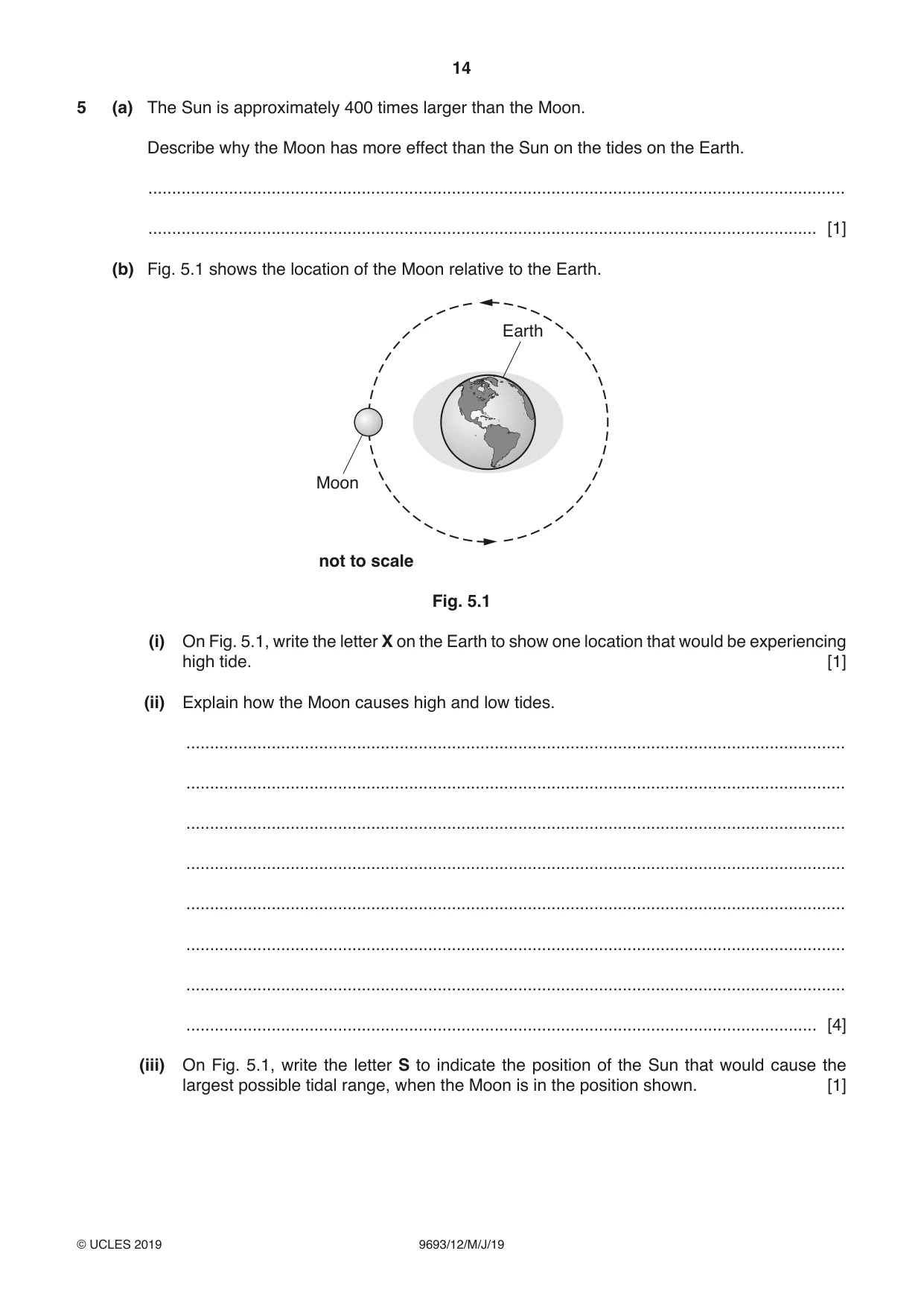
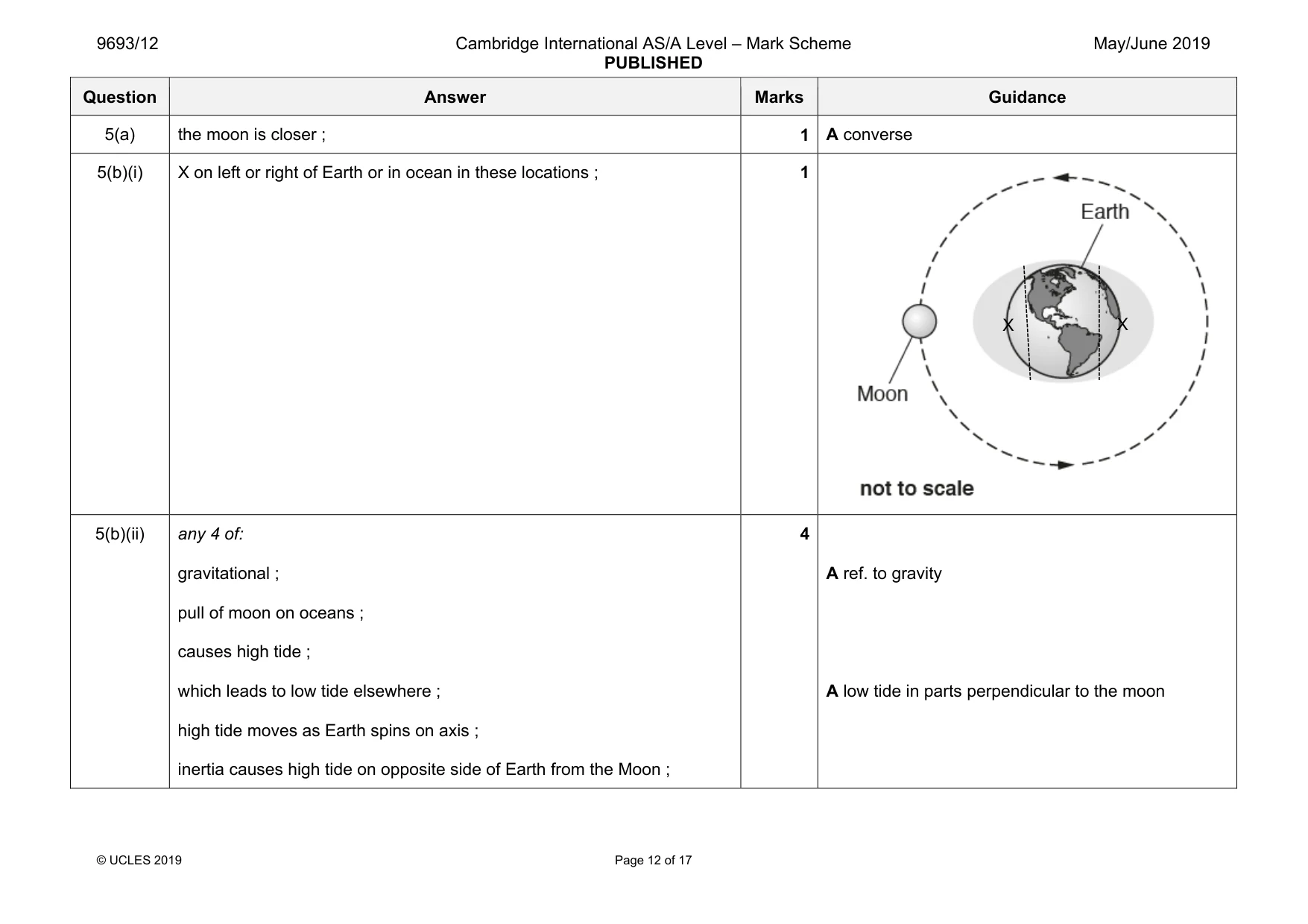
14 9693/12/M/J/19 © UCLES 2019 5 (a) The Sun is approximately 400 times larger than the Moon. Describe why the Moon has more effect than the Sun on the tides on the Earth. … … [1] (b) Fig. 5.1 shows the location of the Moon relative to the Earth. Earth Moon not to scale Fig. 5.1 (i) On Fig. 5.1, write the letter X on the Earth to show one location that would be experiencing high tide. [1] (ii) Explain how the Moon causes high and low tides. … … … … … … … … [4] (iii) On Fig. 5.1, write the letter S to indicate the position of the Sun that would cause the largest possible tidal range, when the Moon is in the position shown. [1]
Question paper, page 15
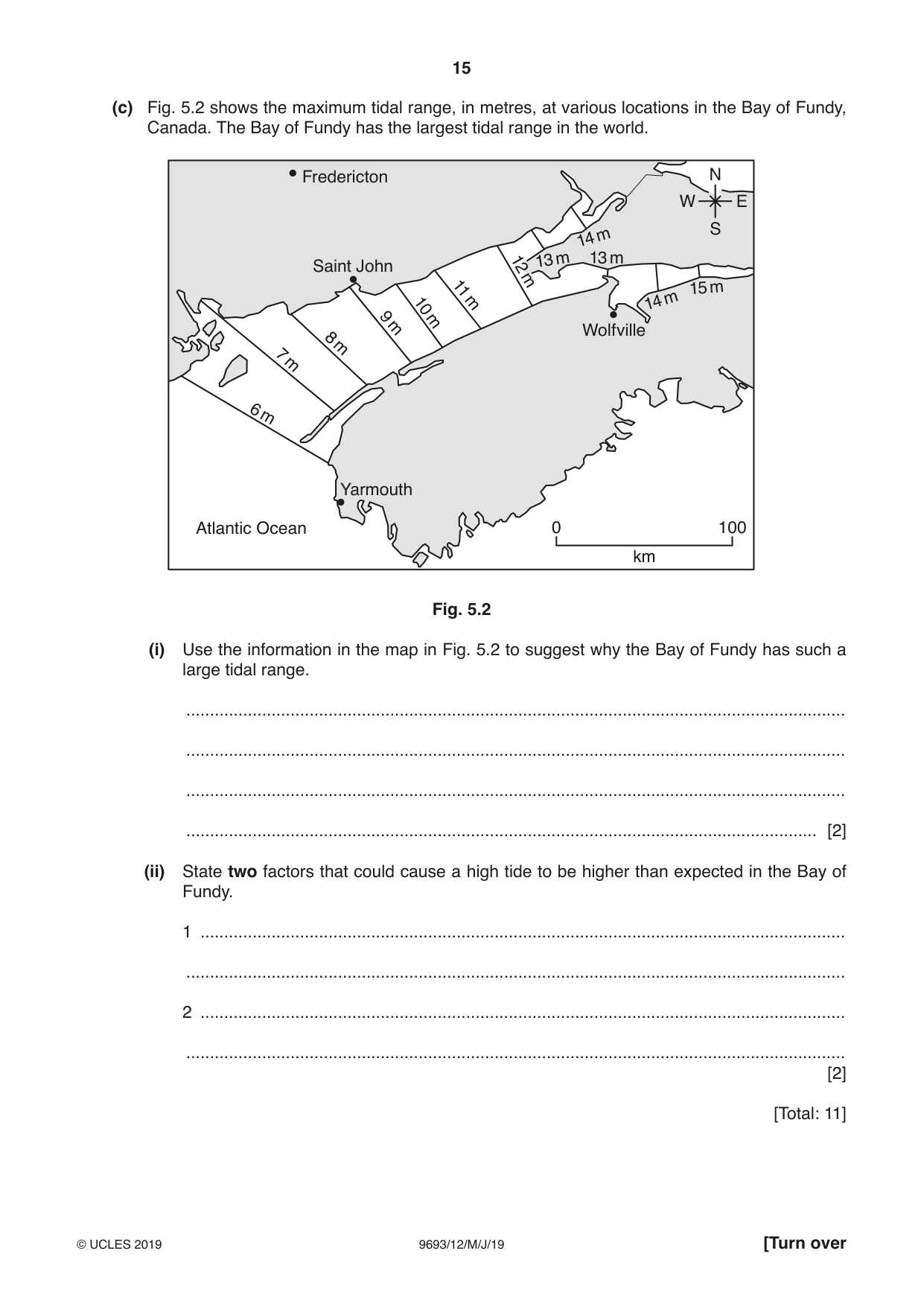
15 9693/12/M/J/19 © UCLES 2019 [Turn over (c) Fig. 5.2 shows the maximum tidal range, in metres, at various locations in the Bay of Fundy, Canada. The Bay of Fundy has the largest tidal range in the world. 6 m 7 m 8 m 9 m 10 m 11 m 12 m 13 m 13 m 14 m 14 m 15 m Atlantic Ocean Yarmouth Wolfville Saint John Fredericton N S W E 0 100 km Fig. 5.2 (i) Use the information in the map in Fig. 5.2 to suggest why the Bay of Fundy has such a large tidal range. … … … … [2] (ii) State two factors that could cause a high tide to be higher than expected in the Bay of Fundy. 1 … … 2 … … [2] [Total: 11]
Question paper, page 16
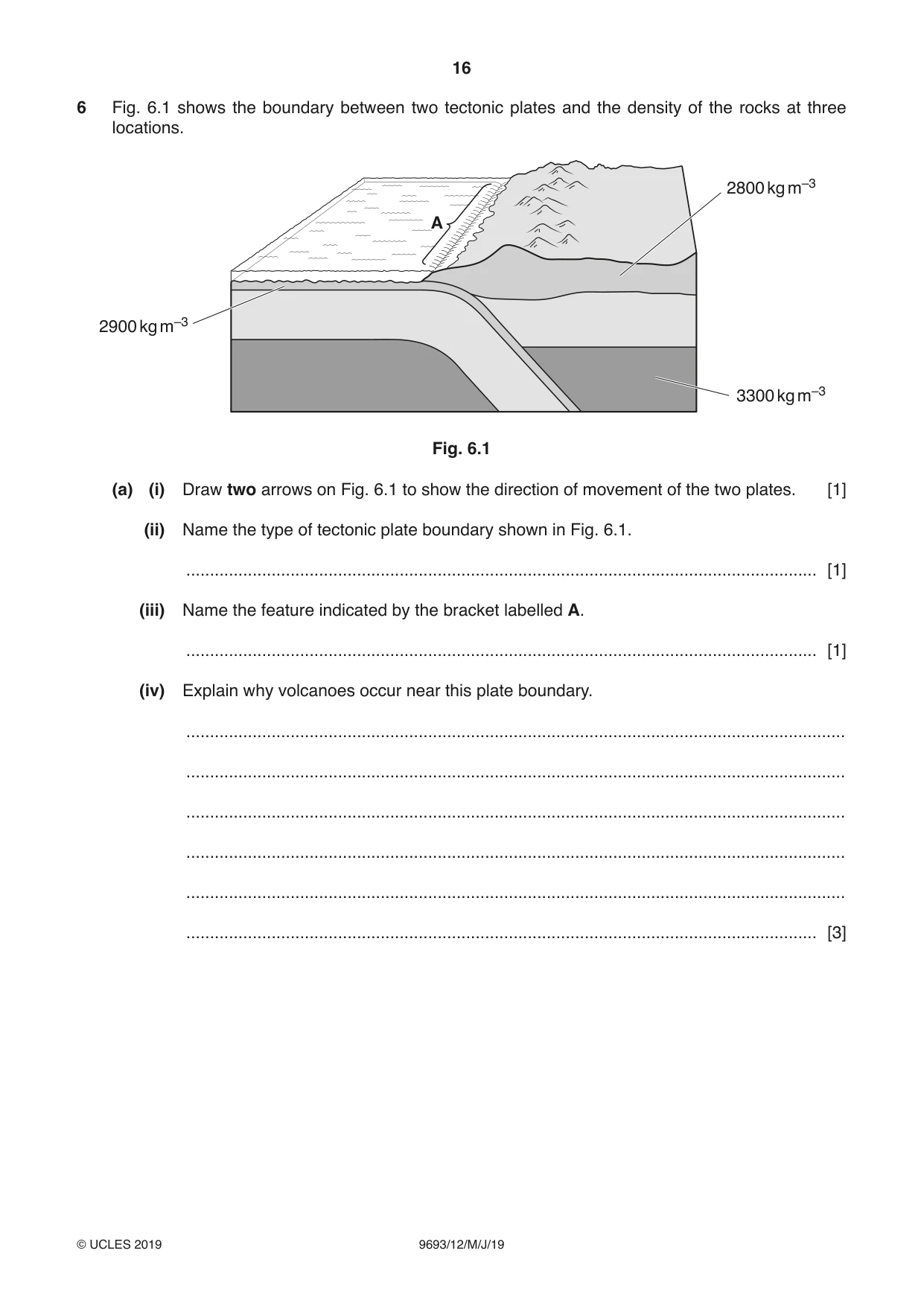
16 9693/12/M/J/19 © UCLES 2019 6 Fig. 6.1 shows the boundary between two tectonic plates and the density of the rocks at three locations. A 2900 kg m–3 3300 kg m–3 2800 kg m–3 Fig. 6.1 (a) (i) Draw two arrows on Fig. 6.1 to show the direction of movement of the two plates. [1] (ii) Name the type of tectonic plate boundary shown in Fig. 6.1. … [1] (iii) Name the feature indicated by the bracket labelled A. … [1] (iv) Explain why volcanoes occur near this plate boundary. … … … … … … [3]
Question paper, page 17
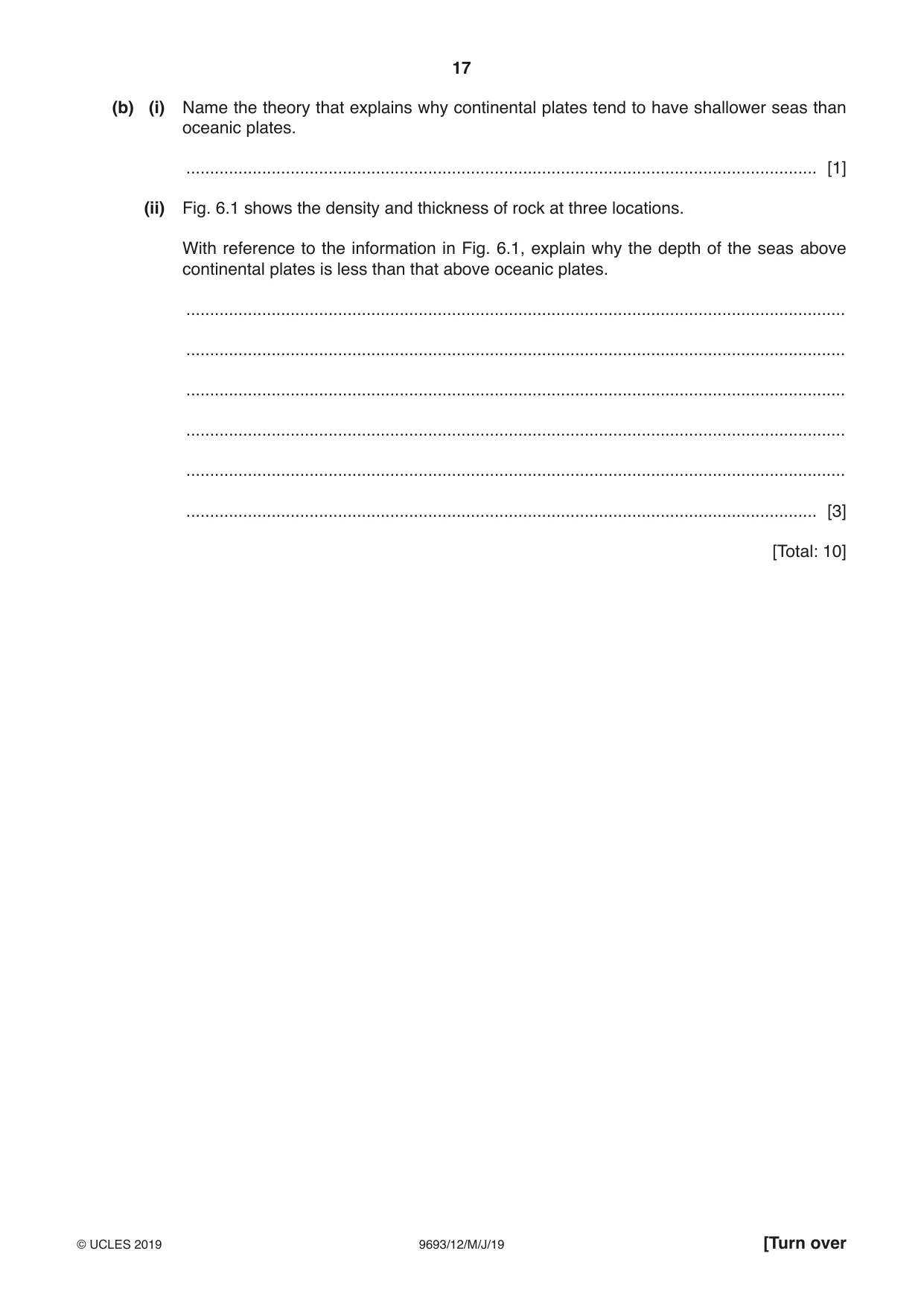
17 9693/12/M/J/19 © UCLES 2019 [Turn over (b) (i) Name the theory that explains why continental plates tend to have shallower seas than oceanic plates. … [1] (ii) Fig. 6.1 shows the density and thickness of rock at three locations. With reference to the information in Fig. 6.1, explain why the depth of the seas above continental plates is less than that above oceanic plates. … … … … … … [3] [Total: 10]
Question paper, page 18
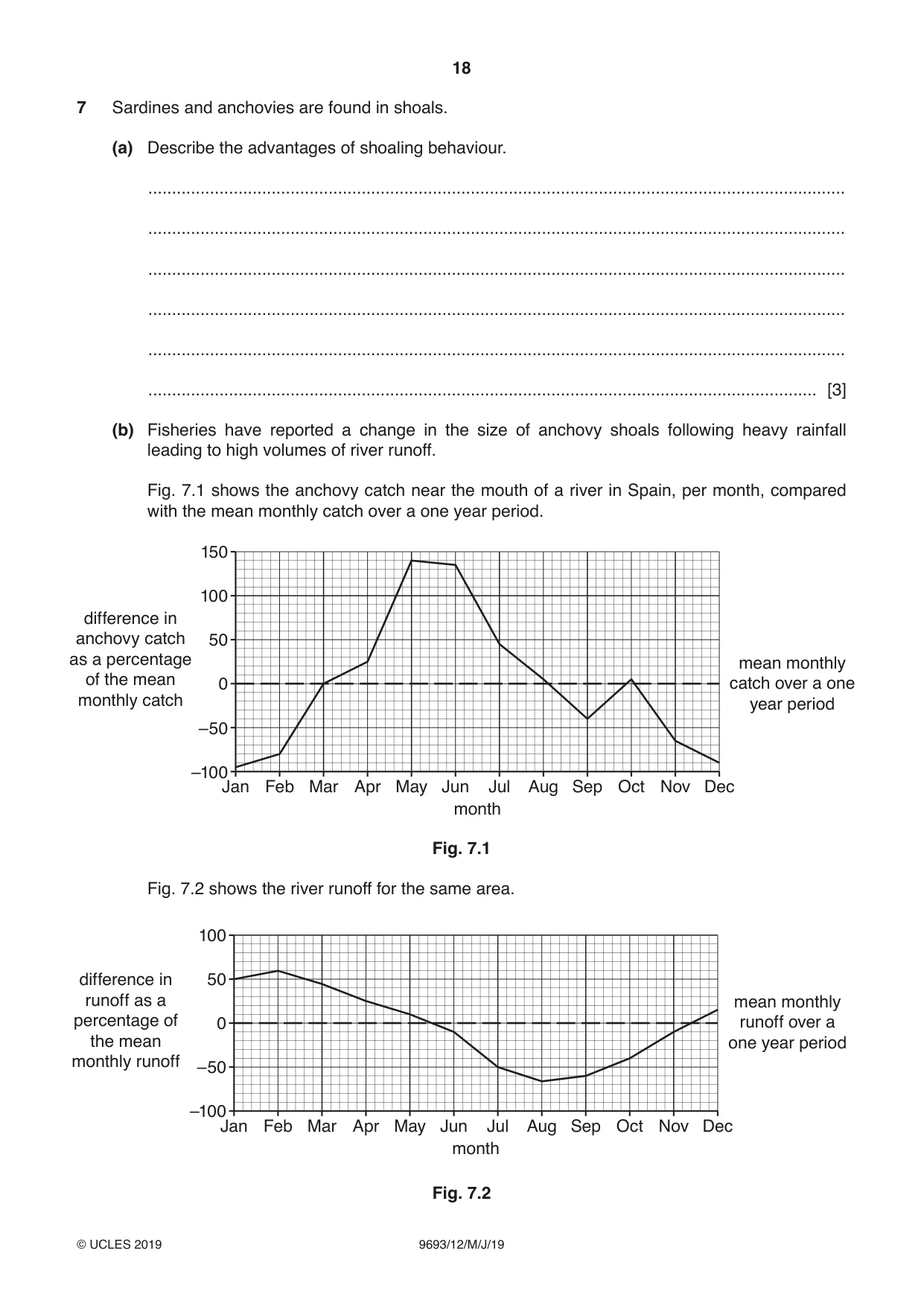
18 9693/12/M/J/19 © UCLES 2019 7 Sardines and anchovies are found in shoals. (a) Describe the advantages of shoaling behaviour. … … … … … … [3] (b) Fisheries have reported a change in the size of anchovy shoals following heavy rainfall leading to high volumes of river runoff. Fig. 7.1 shows the anchovy catch near the mouth of a river in Spain, per month, compared with the mean monthly catch over a one year period. –100 –50 0 Jan Feb Mar Apr May difference in anchovy catch as a percentage of the mean monthly catch mean monthly catch over a one year period Jun month Jul Aug Sep Oct Nov Dec 50 100 150 Fig. 7.1 Fig. 7.2 shows the river runoff for the same area. –100 –50 0 Jan Feb Mar Apr May Jun month Jul Aug Sep Oct Nov Dec 50 100 difference in runoff as a percentage of the mean monthly runoff mean monthly runoff over a one year period Fig. 7.2
Question paper, page 19
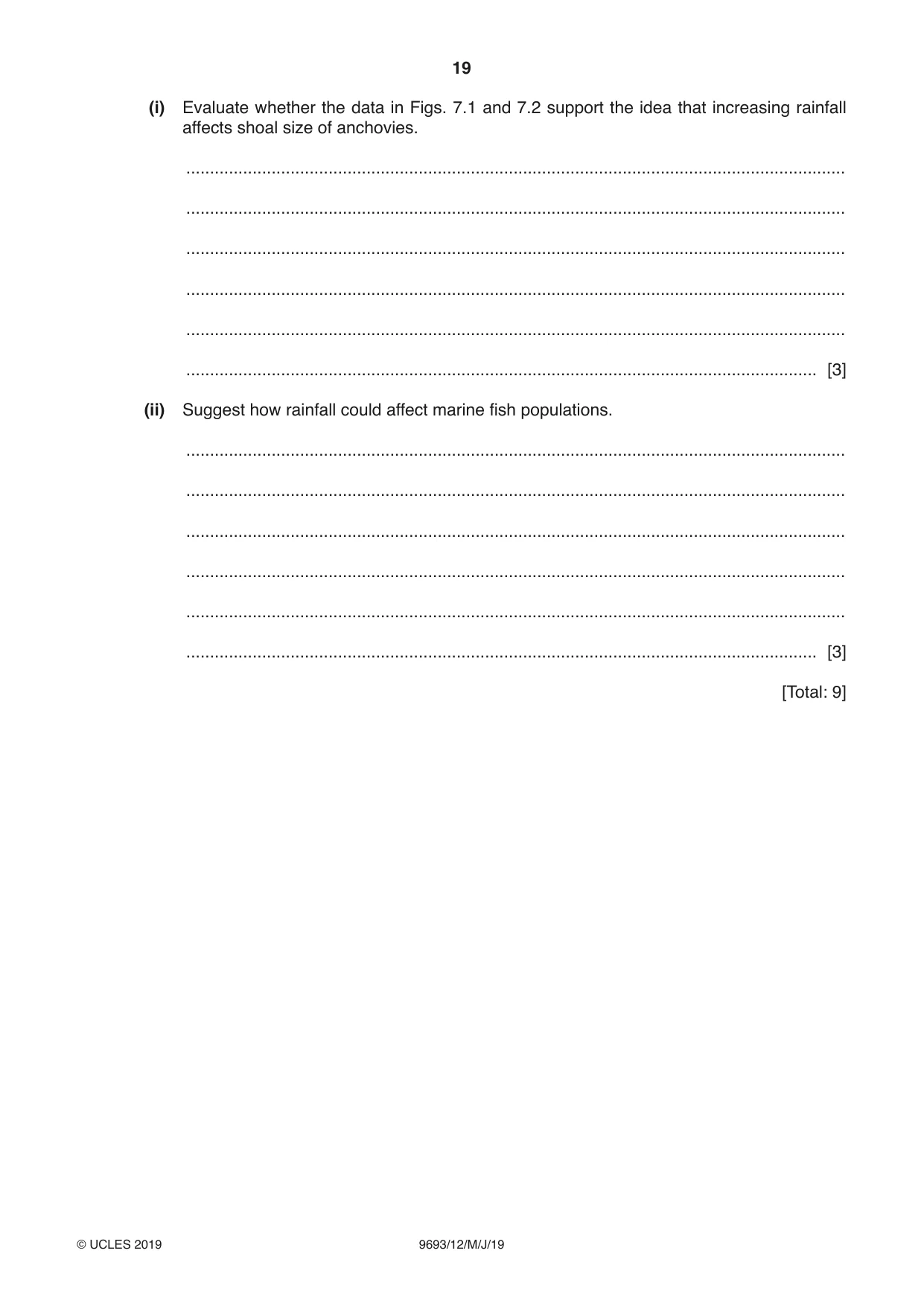
19 9693/12/M/J/19 © UCLES 2019 (i) Evaluate whether the data in Figs. 7.1 and 7.2 support the idea that increasing rainfall affects shoal size of anchovies. … … … … … … [3] (ii) Suggest how rainfall could affect marine fish populations. … … … … … … [3] [Total: 9]
Question paper, page 20
20 9693/12/M/J/19 © UCLES 2019 BLANK PAGE Permission to reproduce items where third-party owned material protected by copyright is included has been sought and cleared where possible. Every reasonable effort has been made by the publisher (UCLES) to trace copyright holders, but if any items requiring clearance have unwittingly been included, the publisher will be pleased to make amends at the earliest possible opportunity. To avoid the issue of disclosure of answer-related information to candidates, all copyright acknowledgements are reproduced online in the Cambridge Assessment International Education Copyright Acknowledgements Booklet. This is produced for each series of examinations and is freely available to download at www.cambridgeinternational.org after the live examination series. Cambridge Assessment International Education is part of the Cambridge Assessment Group. Cambridge Assessment is the brand name of the University of Cambridge Local Examinations Syndicate (UCLES), which itself is a department of the University of Cambridge.
Mark scheme, page 1
This document consists of 17 printed pages. © UCLES 2019 [Turn over Cambridge Assessment International Education Cambridge International Advanced Subsidiary and Advanced Level MARINE SCIENCE 9693/12 Paper 1 AS Structured Questions May/June 2019 MARK SCHEME Maximum Mark: 75 Published This mark scheme is published as an aid to teachers and candidates, to indicate the requirements of the examination. It shows the basis on which Examiners were instructed to award marks. It does not indicate the details of the discussions that took place at an Examiners’ meeting before marking began, which would have considered the acceptability of alternative answers. Mark schemes should be read in conjunction with the question paper and the Principal Examiner Report for Teachers. Cambridge International will not enter into discussions about these mark schemes. Cambridge International is publishing the mark schemes for the May/June 2019 series for most Cambridge IGCSE™, Cambridge International A and AS Level and Cambridge Pre-U components, and some Cambridge O Level components.
Mark scheme, page 2
9693/12 Cambridge International AS/A Level – Mark Scheme PUBLISHED May/June 2019 © UCLES 2019 Page 2 of 17 Generic Marking Principles These general marking principles must be applied by all examiners when marking candidate answers. They should be applied alongside the specific content of the mark scheme or generic level descriptors for a question. Each question paper and mark scheme will also comply with these marking principles. GENERIC MARKING PRINCIPLE 1: Marks must be awarded in line with: • the specific content of the mark scheme or the generic level descriptors for the question • the specific skills defined in the mark scheme or in the generic level descriptors for the question • the standard of response required by a candidate as exemplified by the standardisation scripts. GENERIC MARKING PRINCIPLE 2: Marks awarded are always whole marks (not half marks, or other fractions). GENERIC MARKING PRINCIPLE 3: Marks must be awarded positively: • marks are awarded for correct/valid answers, as defined in the mark scheme. However, credit is given for valid answers which go beyond the scope of the syllabus and mark scheme, referring to your Team Leader as appropriate • marks are awarded when candidates clearly demonstrate what they know and can do • marks are not deducted for errors • marks are not deducted for omissions • answers should only be judged on the quality of spelling, punctuation and grammar when these features are specifically assessed by the question as indicated by the mark scheme. The meaning, however, should be unambiguous. GENERIC MARKING PRINCIPLE 4: Rules must be applied consistently e.g. in situations where candidates have not followed instructions or in the application of generic level descriptors.
Mark scheme, page 3
9693/12 Cambridge International AS/A Level – Mark Scheme PUBLISHED May/June 2019 © UCLES 2019 Page 3 of 17 GENERIC MARKING PRINCIPLE 5: Marks should be awarded using the full range of marks defined in the mark scheme for the question (however; the use of the full mark range may be limited according to the quality of the candidate responses seen). GENERIC MARKING PRINCIPLE 6: Marks awarded are based solely on the requirements as defined in the mark scheme. Marks should not be awarded with grade thresholds or grade descriptors in mind.
Mark scheme, page 4
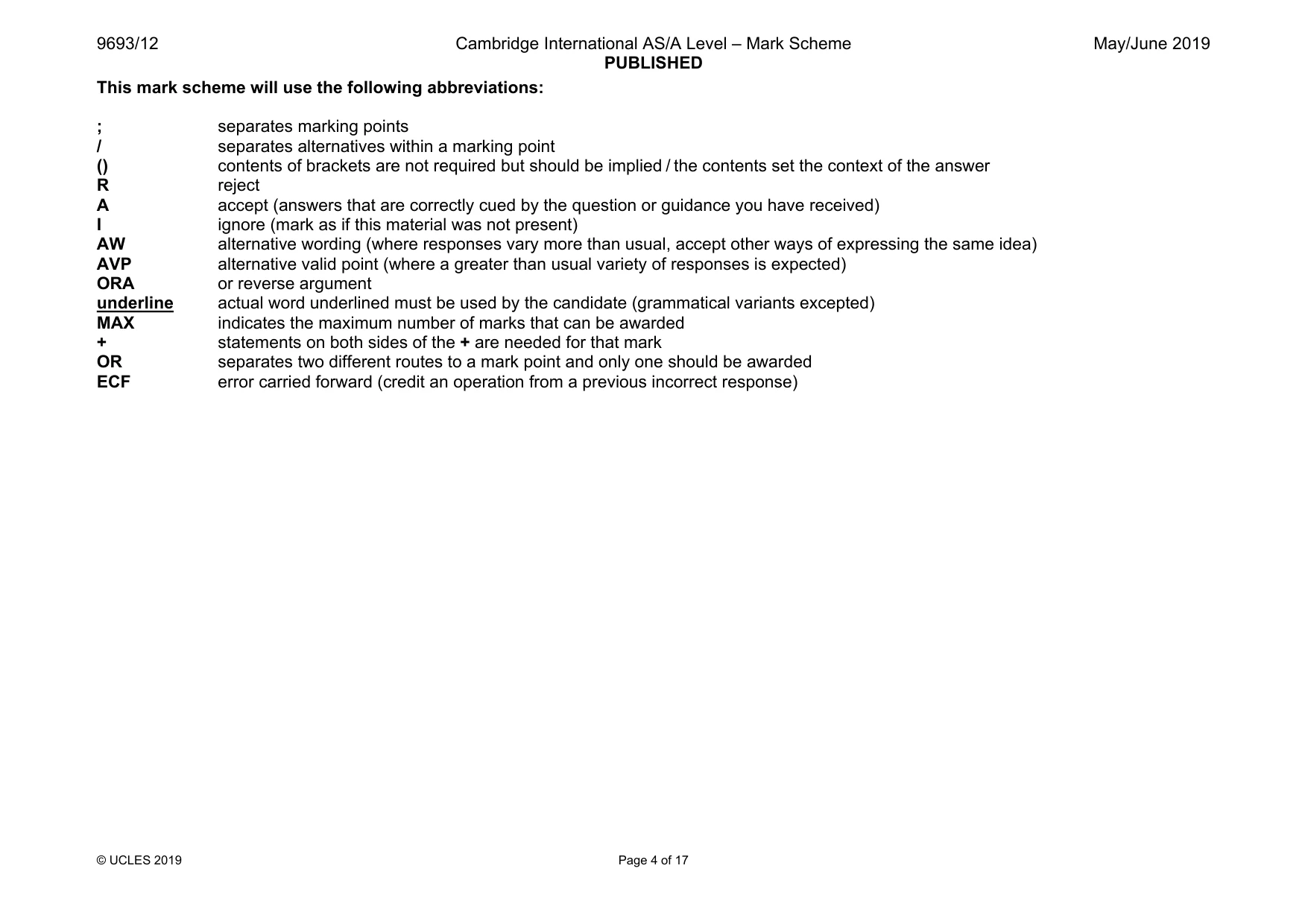
9693/12 Cambridge International AS/A Level – Mark Scheme PUBLISHED May/June 2019 © UCLES 2019 Page 4 of 17 This mark scheme will use the following abbreviations: ; separates marking points / separates alternatives within a marking point () contents of brackets are not required but should be implied / the contents set the context of the answer R reject A accept (answers that are correctly cued by the question or guidance you have received) I ignore (mark as if this material was not present) AW alternative wording (where responses vary more than usual, accept other ways of expressing the same idea) AVP alternative valid point (where a greater than usual variety of responses is expected) ORA or reverse argument underline actual word underlined must be used by the candidate (grammatical variants excepted) MAX indicates the maximum number of marks that can be awarded + statements on both sides of the + are needed for that mark OR separates two different routes to a mark point and only one should be awarded ECF error carried forward (credit an operation from a previous incorrect response)
Mark scheme, page 5
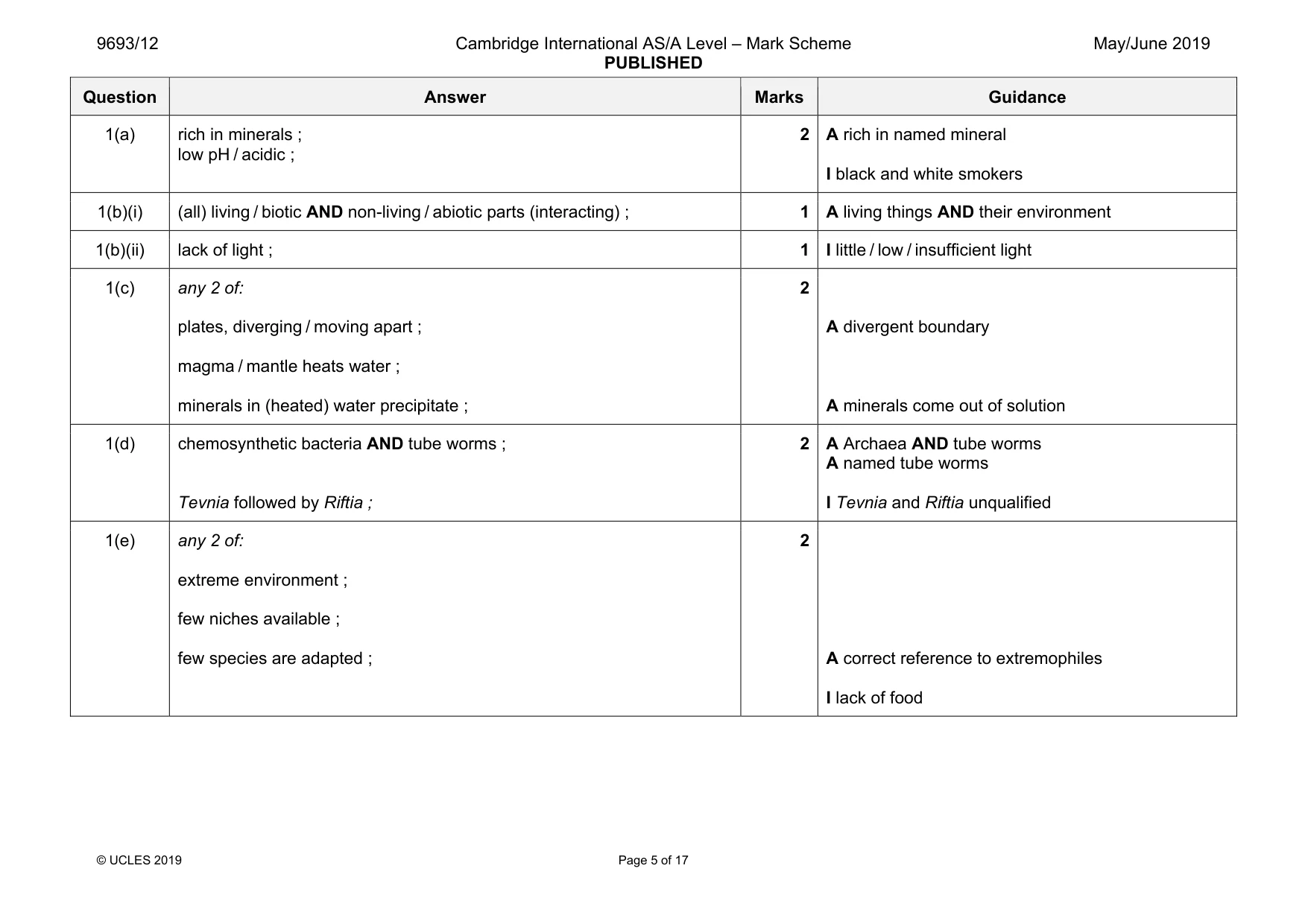
9693/12 Cambridge International AS/A Level – Mark Scheme PUBLISHED May/June 2019 © UCLES 2019 Page 5 of 17 Question Answer Marks Guidance 1(a) rich in minerals ; low pH / acidic ; 2 A rich in named mineral I black and white smokers 1(b)(i) (all) living / biotic AND non-living / abiotic parts (interacting) ; 1 A living things AND their environment 1(b)(ii) lack of light ; 1 I little / low / insufficient light 1(c) any 2 of: plates, diverging / moving apart ; magma / mantle heats water ; minerals in (heated) water precipitate ; 2 A divergent boundary A minerals come out of solution 1(d) chemosynthetic bacteria AND tube worms ; Tevnia followed by Riftia ; 2 A Archaea AND tube worms A named tube worms I Tevnia and Riftia unqualified 1(e) any 2 of: extreme environment ; few niches available ; few species are adapted ; 2 A correct reference to extremophiles I lack of food
Mark scheme, page 6
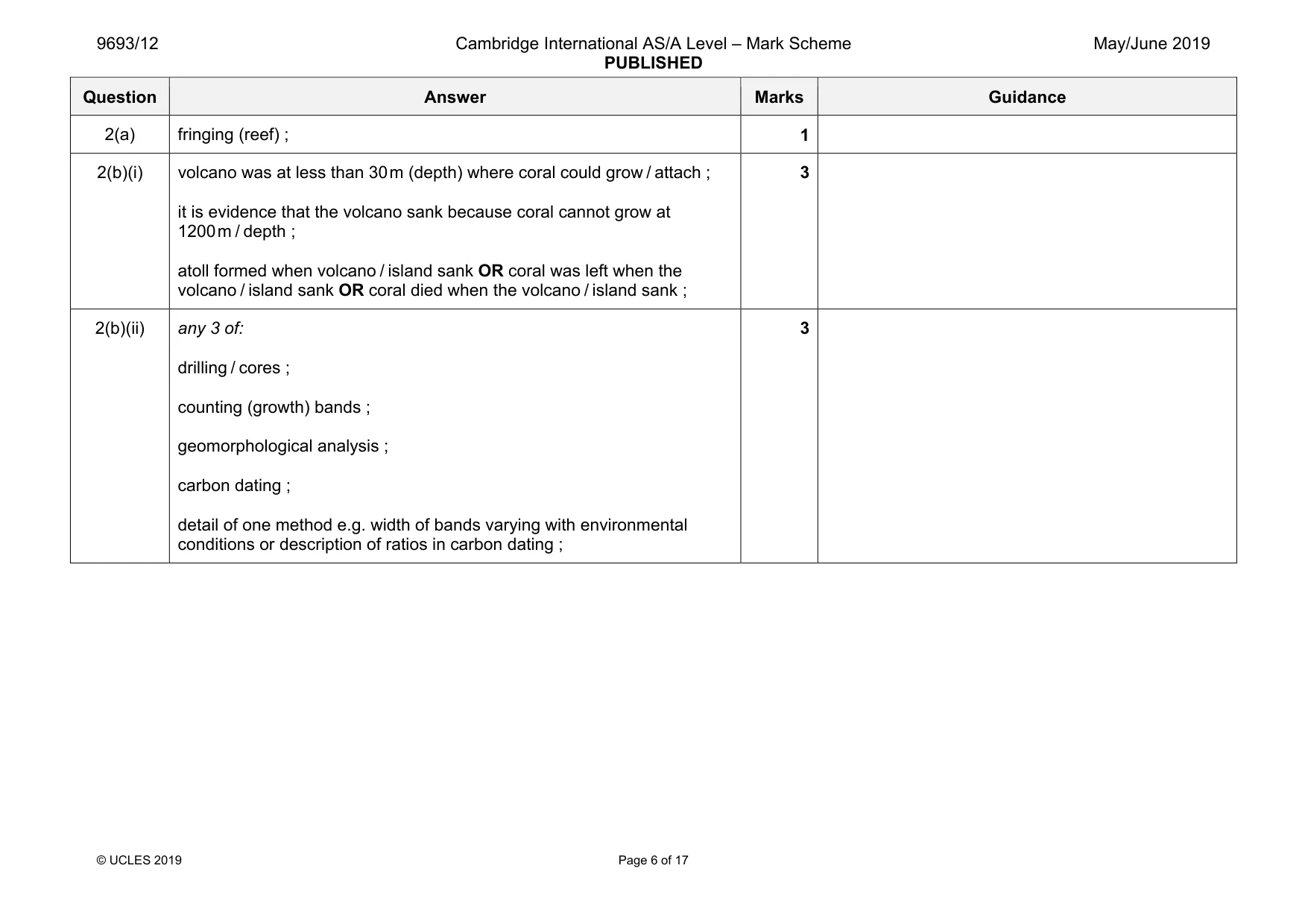
9693/12 Cambridge International AS/A Level – Mark Scheme PUBLISHED May/June 2019 © UCLES 2019 Page 6 of 17 Question Answer Marks Guidance 2(a) fringing (reef) ; 1 2(b)(i) volcano was at less than 30 m (depth) where coral could grow / attach ; it is evidence that the volcano sank because coral cannot grow at 1200 m / depth ; atoll formed when volcano / island sank OR coral was left when the volcano / island sank OR coral died when the volcano / island sank ; 3 2(b)(ii) any 3 of: drilling / cores ; counting (growth) bands ; geomorphological analysis ; carbon dating ; detail of one method e.g. width of bands varying with environmental conditions or description of ratios in carbon dating ; 3
Mark scheme, page 7
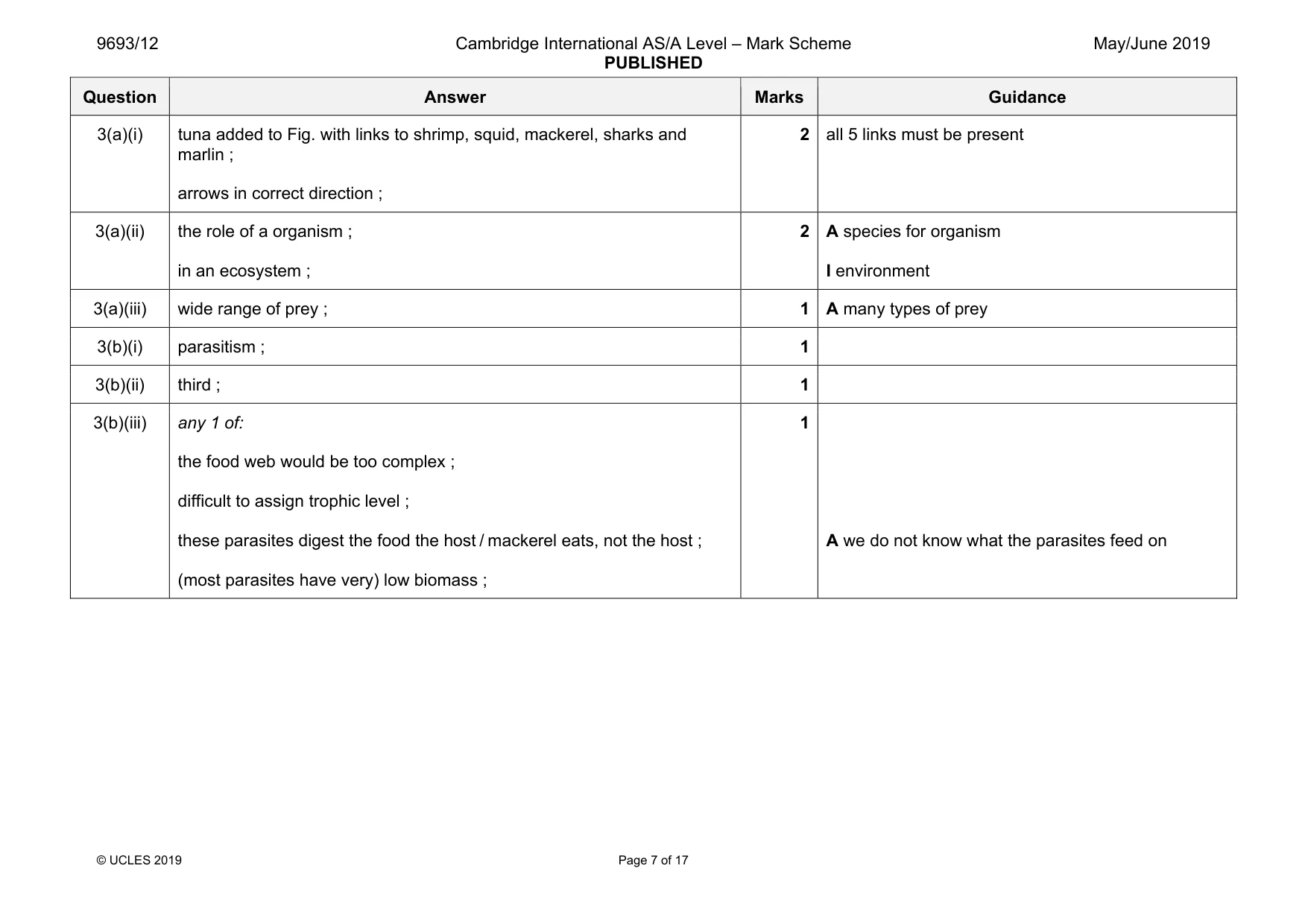
9693/12 Cambridge International AS/A Level – Mark Scheme PUBLISHED May/June 2019 © UCLES 2019 Page 7 of 17 Question Answer Marks Guidance 3(a)(i) tuna added to Fig. with links to shrimp, squid, mackerel, sharks and marlin ; arrows in correct direction ; 2 all 5 links must be present 3(a)(ii) the role of a organism ; in an ecosystem ; 2 A species for organism I environment 3(a)(iii) wide range of prey ; 1 A many types of prey 3(b)(i) parasitism ; 1 3(b)(ii) third ; 1 3(b)(iii) any 1 of: the food web would be too complex ; difficult to assign trophic level ; these parasites digest the food the host / mackerel eats, not the host ; (most parasites have very) low biomass ; 1 A we do not know what the parasites feed on
Mark scheme, page 8
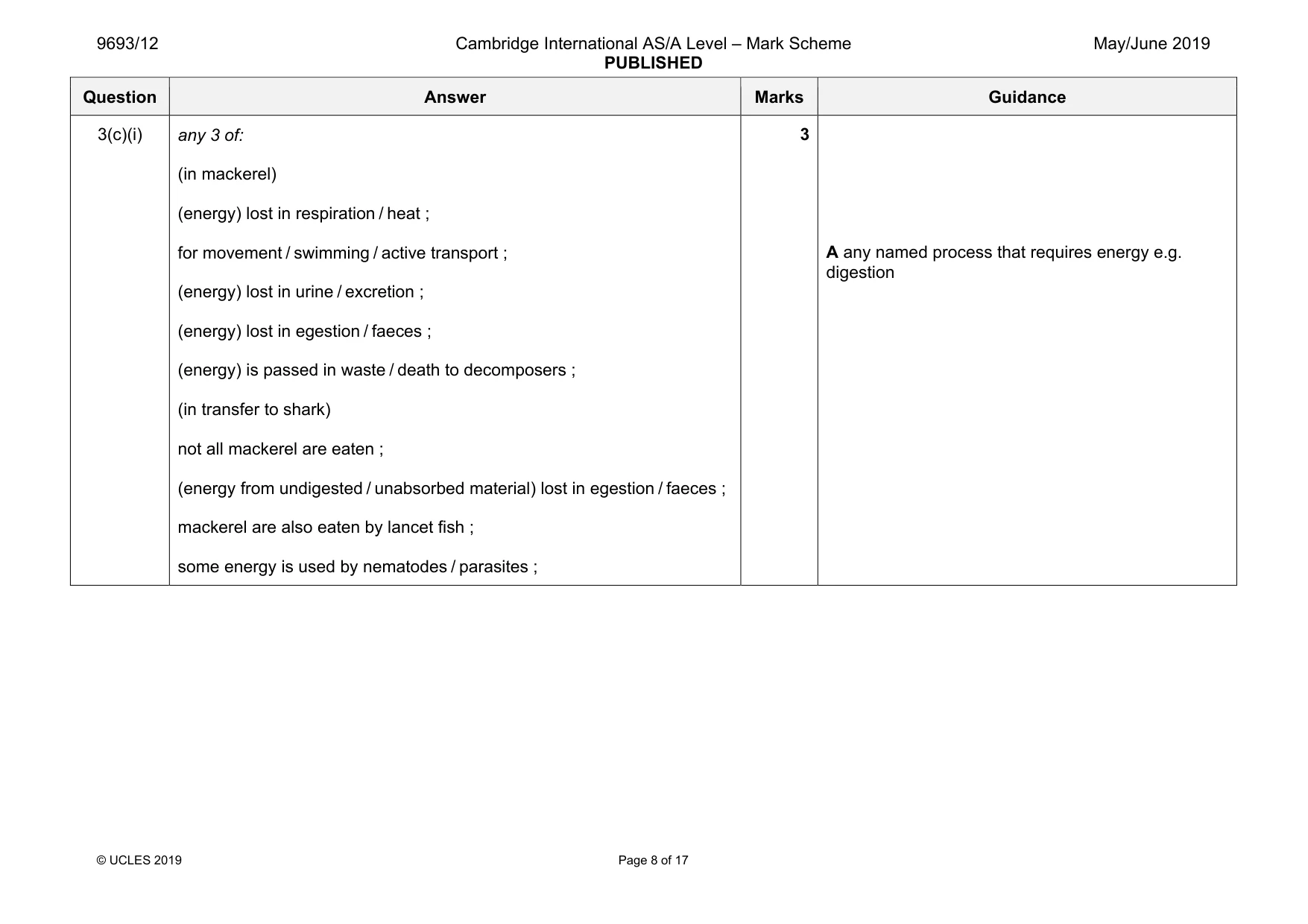
9693/12 Cambridge International AS/A Level – Mark Scheme PUBLISHED May/June 2019 © UCLES 2019 Page 8 of 17 Question Answer Marks Guidance 3(c)(i) any 3 of: (in mackerel) (energy) lost in respiration / heat ; for movement / swimming / active transport ; (energy) lost in urine / excretion ; (energy) lost in egestion / faeces ; (energy) is passed in waste / death to decomposers ; (in transfer to shark) not all mackerel are eaten ; (energy from undigested / unabsorbed material) lost in egestion / faeces ; mackerel are also eaten by lancet fish ; some energy is used by nematodes / parasites ; 3 A any named process that requires energy e.g. digestion
Mark scheme, page 9
9693/12 Cambridge International AS/A Level – Mark Scheme PUBLISHED May/June 2019 © UCLES 2019 Page 9 of 17 Question Answer Marks Guidance 3(c)(ii) 4 closed horizontal bars, approximately centred and touching ; labelled in correct order ; correct proportions and wider nearer base ; 3 Note – if draw a simple triangle, MP2 and / or MP3 can still be credited I height of bars A line for shark bar 4(a)(i) salt marshes reduced wave height more / most ; mangroves AND seagrass and kelp reduce wave height less ; manipulation of data ; 3 A salt marshes and coral reef reduce wave height by similar amounts 4(a)(ii) 0.27 ; ; 2 A 0.63 for 1 mark e.g. by 0.9 × 70 100 = 0.63 ; 4(a)(iii) any 1 of: (these coast types) do not form where larger waves are present ; no storms occurred (during the investigation) ; 1 4(a)(iv) decreases energy of waves ; waves do not travel as far inland ; 2 A waves hit coast with less force shark mackerel copepod phytoplankton
Mark scheme, page 10
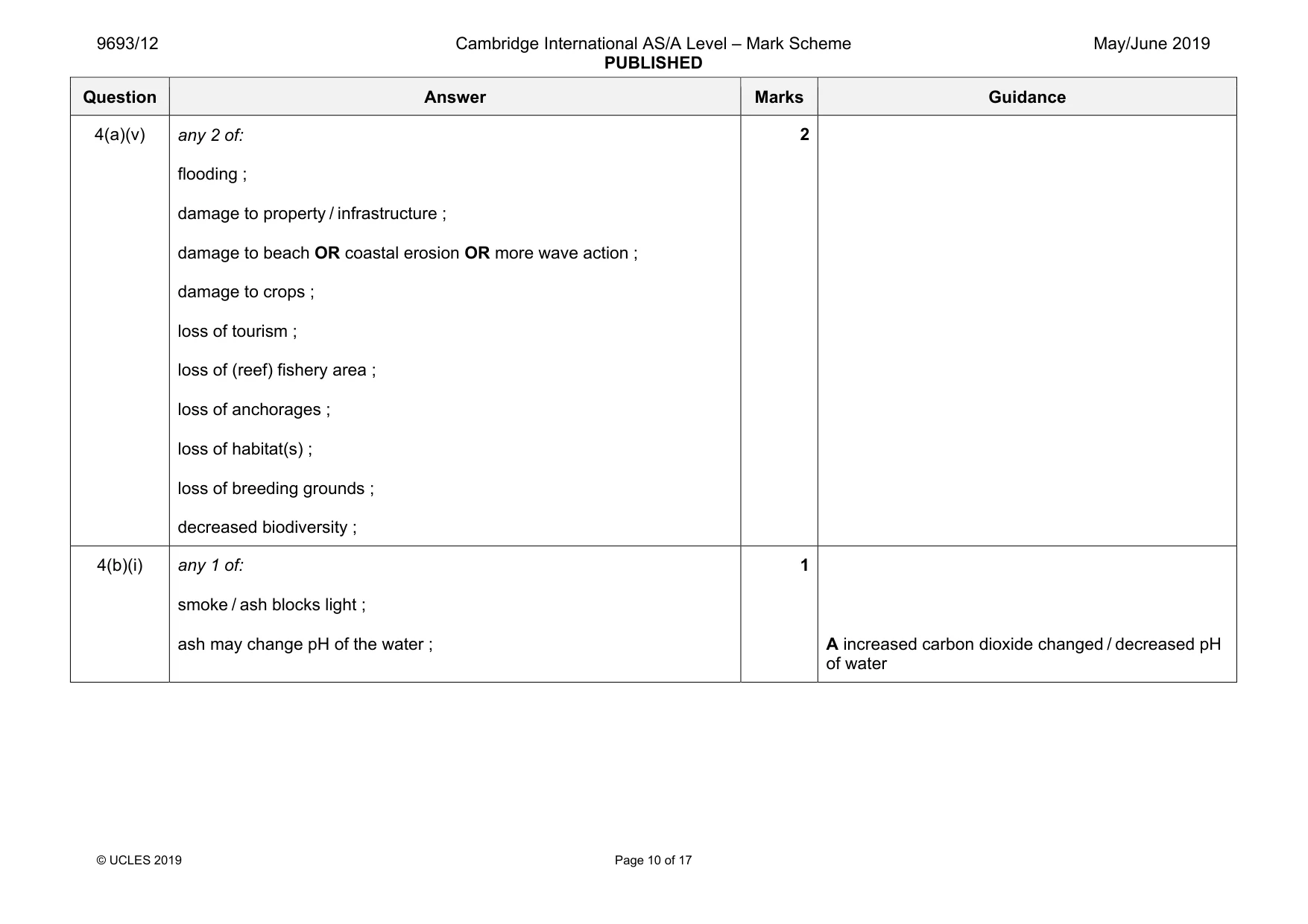
9693/12 Cambridge International AS/A Level – Mark Scheme PUBLISHED May/June 2019 © UCLES 2019 Page 10 of 17 Question Answer Marks Guidance 4(a)(v) any 2 of: flooding ; damage to property / infrastructure ; damage to beach OR coastal erosion OR more wave action ; damage to crops ; loss of tourism ; loss of (reef) fishery area ; loss of anchorages ; loss of habitat(s) ; loss of breeding grounds ; decreased biodiversity ; 2 4(b)(i) any 1 of: smoke / ash blocks light ; ash may change pH of the water ; 1 A increased carbon dioxide changed / decreased pH of water
Mark scheme, page 11
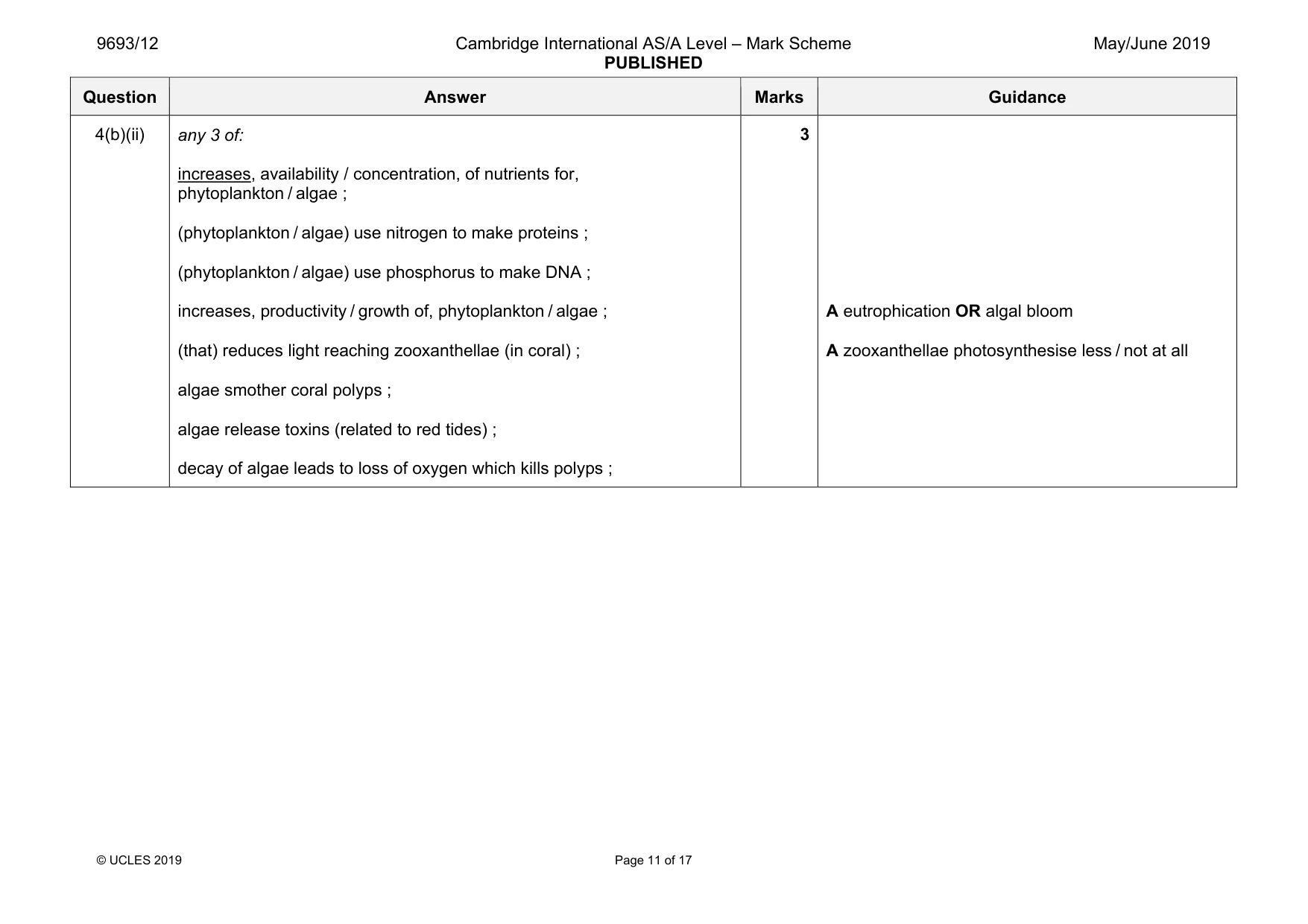
9693/12 Cambridge International AS/A Level – Mark Scheme PUBLISHED May/June 2019 © UCLES 2019 Page 11 of 17 Question Answer Marks Guidance 4(b)(ii) any 3 of: increases, availability / concentration, of nutrients for, phytoplankton / algae ; (phytoplankton / algae) use nitrogen to make proteins ; (phytoplankton / algae) use phosphorus to make DNA ; increases, productivity / growth of, phytoplankton / algae ; (that) reduces light reaching zooxanthellae (in coral) ; algae smother coral polyps ; algae release toxins (related to red tides) ; decay of algae leads to loss of oxygen which kills polyps ; 3 A eutrophication OR algal bloom A zooxanthellae photosynthesise less / not at all
Mark scheme, page 12
9693/12 Cambridge International AS/A Level – Mark Scheme PUBLISHED May/June 2019 © UCLES 2019 Page 12 of 17 Question Answer Marks Guidance 5(a) the moon is closer ; 1 A converse 5(b)(i) X on left or right of Earth or in ocean in these locations ; 1 5(b)(ii) any 4 of: gravitational ; pull of moon on oceans ; causes high tide ; which leads to low tide elsewhere ; high tide moves as Earth spins on axis ; inertia causes high tide on opposite side of Earth from the Moon ; 4 A ref. to gravity A low tide in parts perpendicular to the moon X X
Mark scheme, page 13
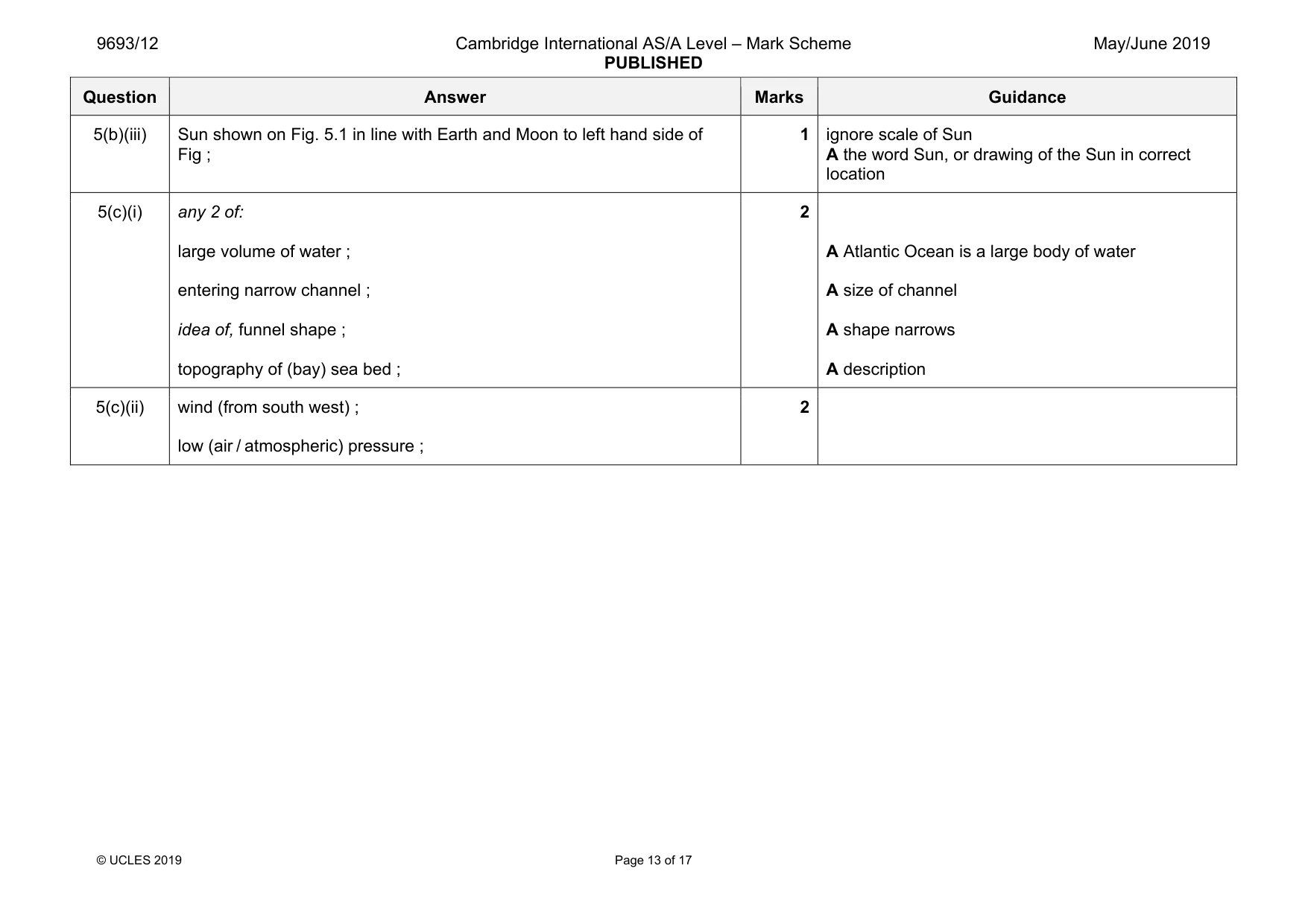
9693/12 Cambridge International AS/A Level – Mark Scheme PUBLISHED May/June 2019 © UCLES 2019 Page 13 of 17 Question Answer Marks Guidance 5(b)(iii) Sun shown on Fig. 5.1 in line with Earth and Moon to left hand side of Fig ; 1 ignore scale of Sun A the word Sun, or drawing of the Sun in correct location 5(c)(i) any 2 of: large volume of water ; entering narrow channel ; idea of, funnel shape ; topography of (bay) sea bed ; 2 A Atlantic Ocean is a large body of water A size of channel A shape narrows A description 5(c)(ii) wind (from south west) ; low (air / atmospheric) pressure ; 2
Mark scheme, page 14
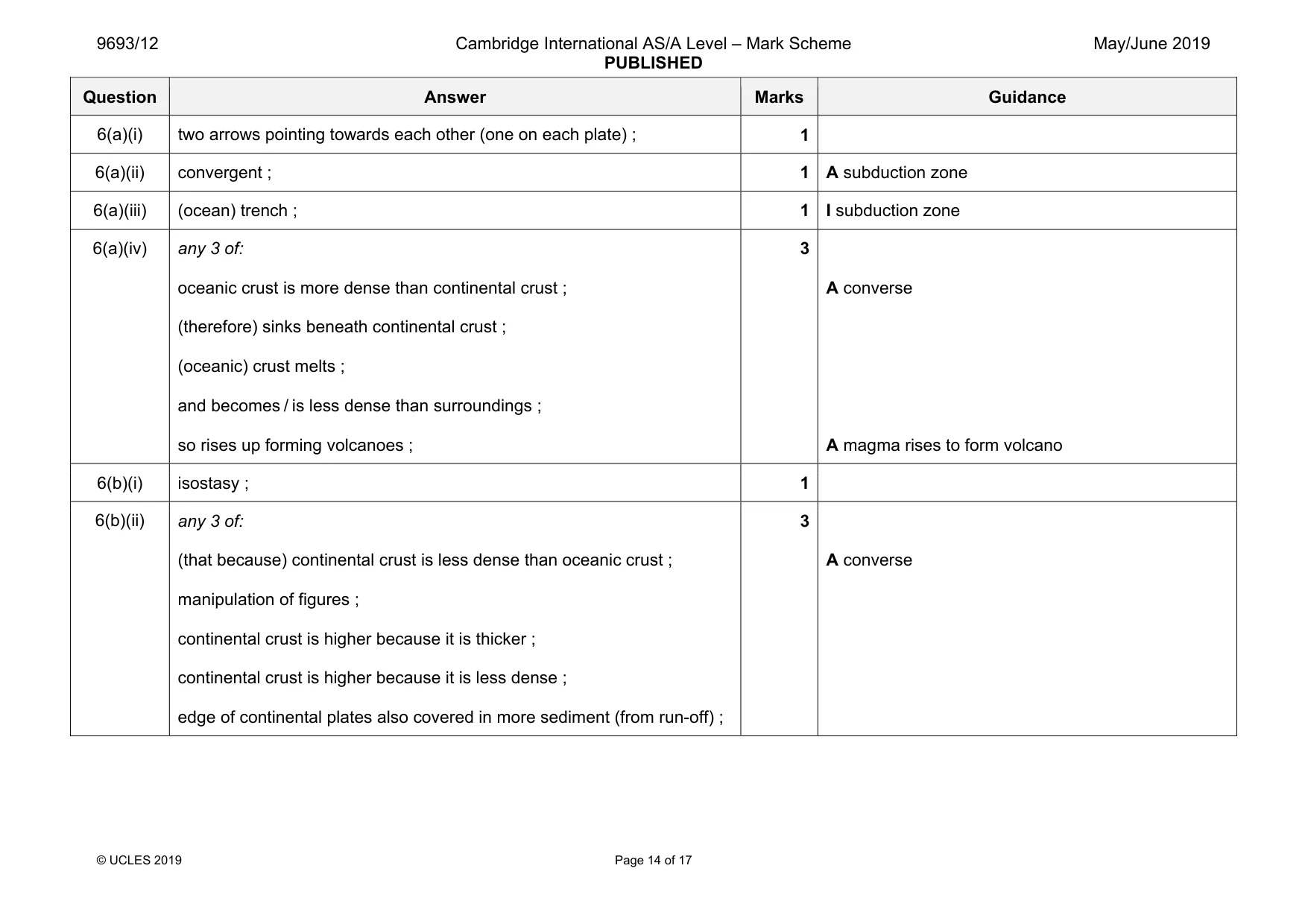
9693/12 Cambridge International AS/A Level – Mark Scheme PUBLISHED May/June 2019 © UCLES 2019 Page 14 of 17 Question Answer Marks Guidance 6(a)(i) two arrows pointing towards each other (one on each plate) ; 1 6(a)(ii) convergent ; 1 A subduction zone 6(a)(iii) (ocean) trench ; 1 I subduction zone 6(a)(iv) any 3 of: oceanic crust is more dense than continental crust ; (therefore) sinks beneath continental crust ; (oceanic) crust melts ; and becomes / is less dense than surroundings ; so rises up forming volcanoes ; 3 A converse A magma rises to form volcano 6(b)(i) isostasy ; 1 6(b)(ii) any 3 of: (that because) continental crust is less dense than oceanic crust ; manipulation of figures ; continental crust is higher because it is thicker ; continental crust is higher because it is less dense ; edge of continental plates also covered in more sediment (from run-off) ; 3 A converse
Mark scheme, page 15
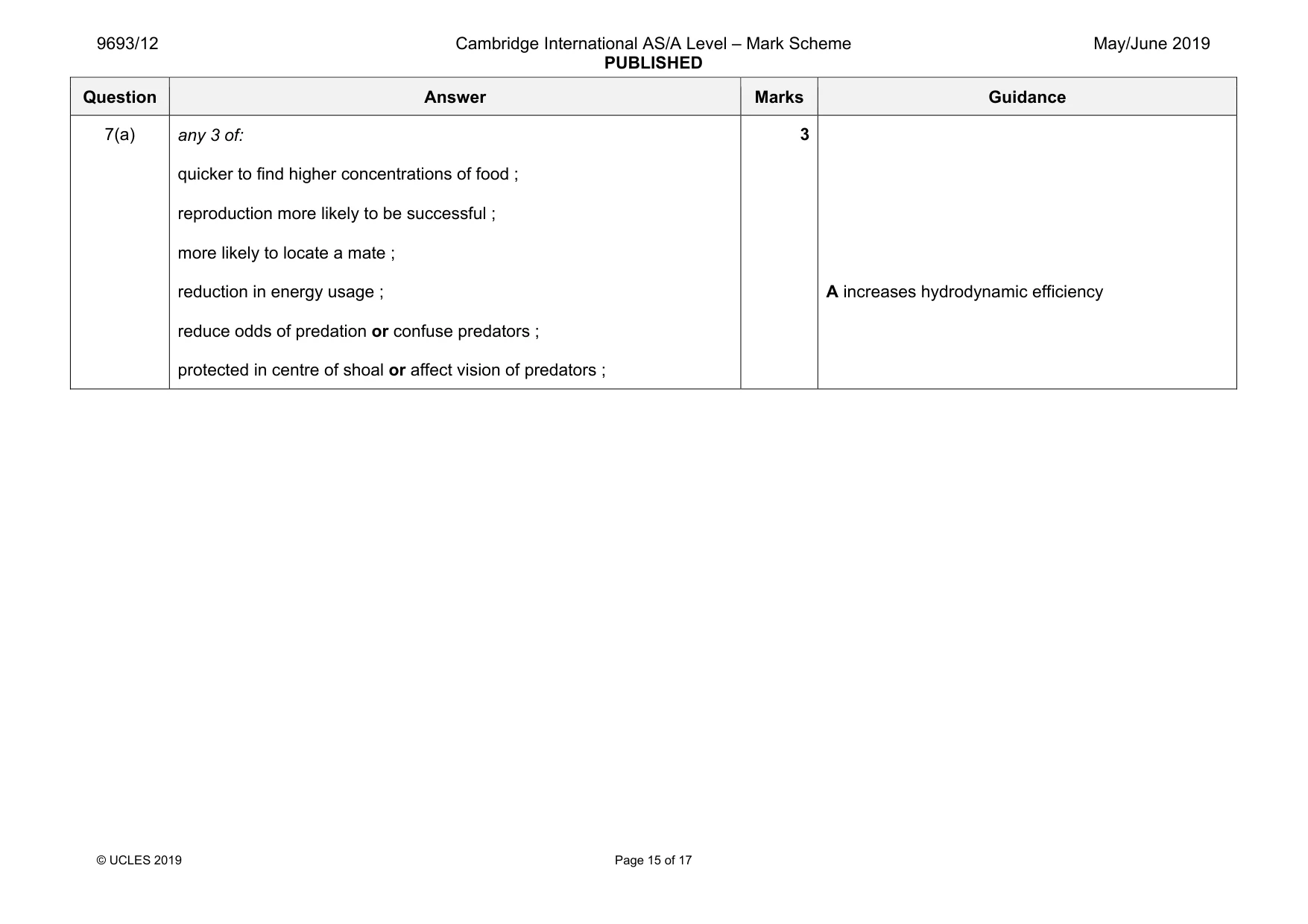
9693/12 Cambridge International AS/A Level – Mark Scheme PUBLISHED May/June 2019 © UCLES 2019 Page 15 of 17 Question Answer Marks Guidance 7(a) any 3 of: quicker to find higher concentrations of food ; reproduction more likely to be successful ; more likely to locate a mate ; reduction in energy usage ; reduce odds of predation or confuse predators ; protected in centre of shoal or affect vision of predators ; 3 A increases hydrodynamic efficiency
Mark scheme, page 16
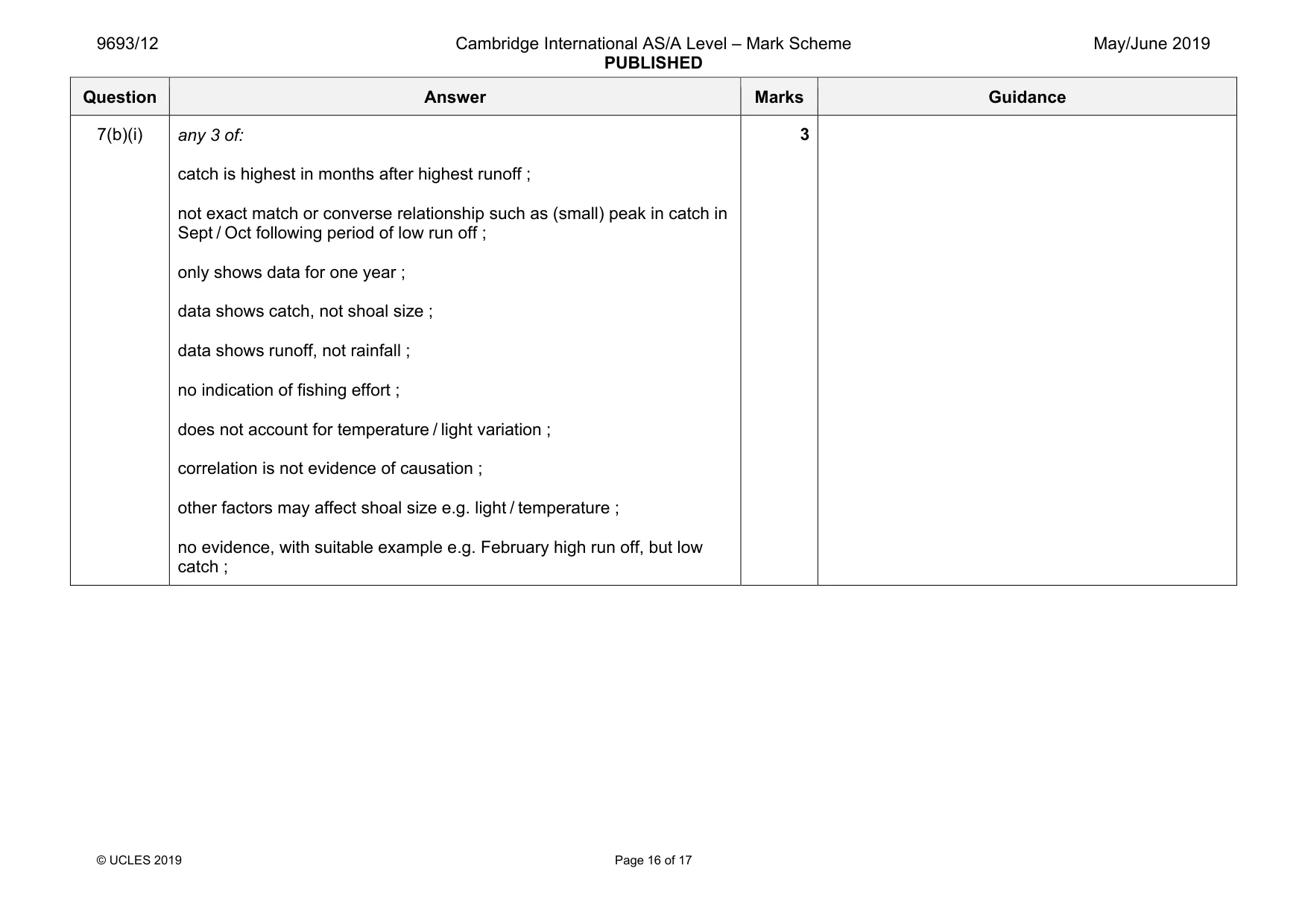
9693/12 Cambridge International AS/A Level – Mark Scheme PUBLISHED May/June 2019 © UCLES 2019 Page 16 of 17 Question Answer Marks Guidance 7(b)(i) any 3 of: catch is highest in months after highest runoff ; not exact match or converse relationship such as (small) peak in catch in Sept / Oct following period of low run off ; only shows data for one year ; data shows catch, not shoal size ; data shows runoff, not rainfall ; no indication of fishing effort ; does not account for temperature / light variation ; correlation is not evidence of causation ; other factors may affect shoal size e.g. light / temperature ; no evidence, with suitable example e.g. February high run off, but low catch ; 3
Mark scheme, page 17
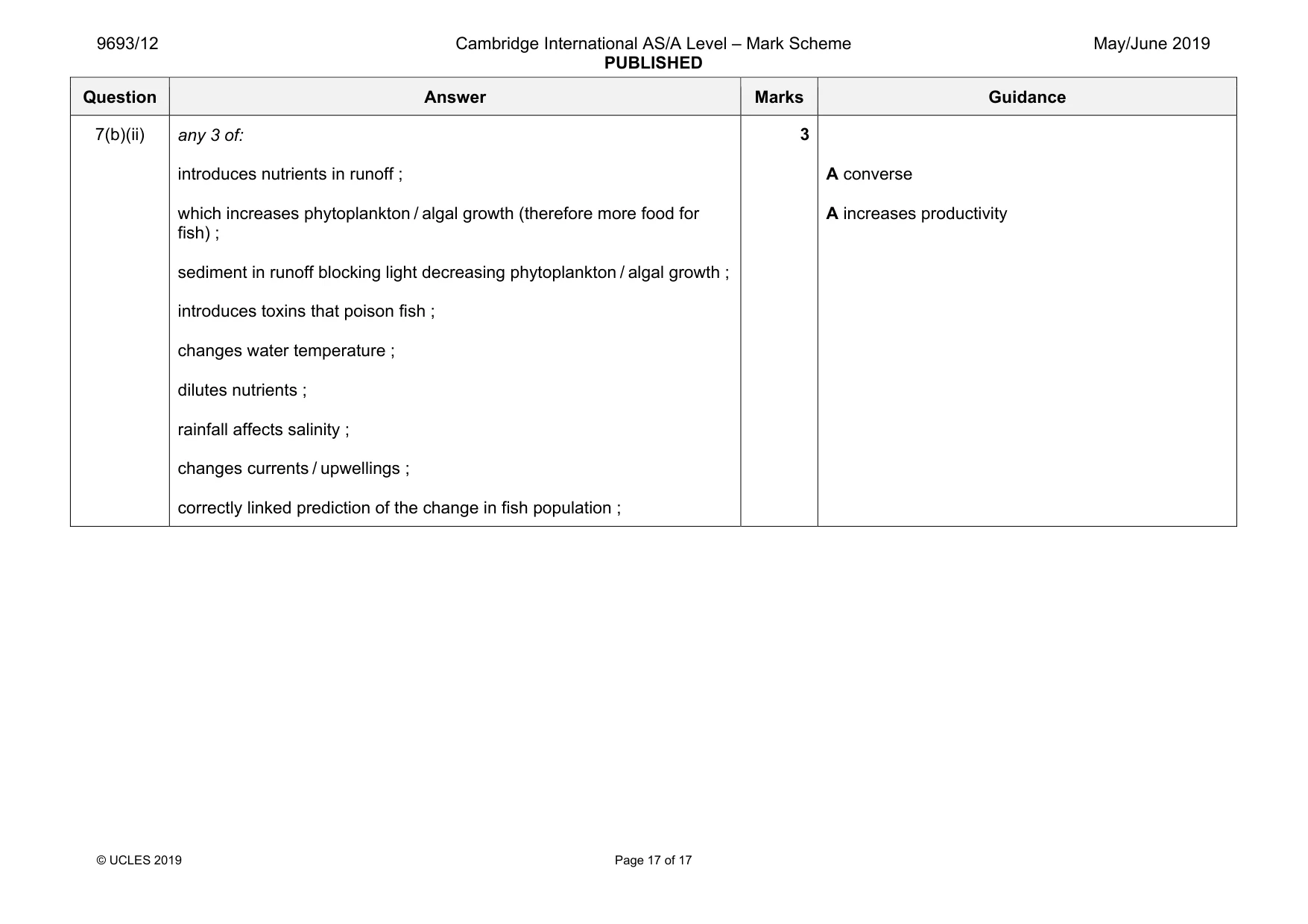
9693/12 Cambridge International AS/A Level – Mark Scheme PUBLISHED May/June 2019 © UCLES 2019 Page 17 of 17 Question Answer Marks Guidance 7(b)(ii) any 3 of: introduces nutrients in runoff ; which increases phytoplankton / algal growth (therefore more food for fish) ; sediment in runoff blocking light decreasing phytoplankton / algal growth ; introduces toxins that poison fish ; changes water temperature ; dilutes nutrients ; rainfall affects salinity ; changes currents / upwellings ; correctly linked prediction of the change in fish population ; 3 A converse A increases productivity
What you needed in this session
Cambridge’s own grade thresholds for 2019 May/June, Paper 1 · Variant 2. A higher threshold means an easier paper — the bar moves with how the cohort did.