Cambridge A Level Marine Science 9693 — 2019 May/June Paper 1 · Variant 1
9693/11/M/J/19 · 75 marks · ≈84 min
The question paper and its mark scheme, free to read here and free to download. This is Cambridge’s own paper, exactly as it was sat.
Question paper16 pages


Mark scheme12 pages
Answers below. Sit the paper first if you are practising.
Paper as text
Question paper, page 1
This document consists of 14 printed pages and 2 blank pages. DC (CE/SW) 164277/3 © UCLES 2019 [Turn over * 9 4 7 3 0 0 6 1 1 7 * Cambridge Assessment International Education Cambridge International Advanced Subsidiary and Advanced Level MARINE SCIENCE 9693/11 Paper 1 AS Structured Questions May/June 2019 1 hour 30 minutes Candidates answer on the Question Paper. No Additional Materials are required. READ THESE INSTRUCTIONS FIRST Write your centre number, candidate number and name on all the work you hand in. Write in dark blue or black pen. You may use an HB pencil for any diagrams or graphs. Do not use staples, paper clips, glue or correction fluid. DO NOT WRITE IN ANY BARCODES. Answer all questions. Write your answers in the spaces provided on the Question Paper. Electronic calculators may be used. You may lose marks if you do not show your working or if you do not use appropriate units. At the end of the examination, fasten all your work securely together. The number of marks is given in brackets [ ] at the end of each question or part question.
Question paper, page 2
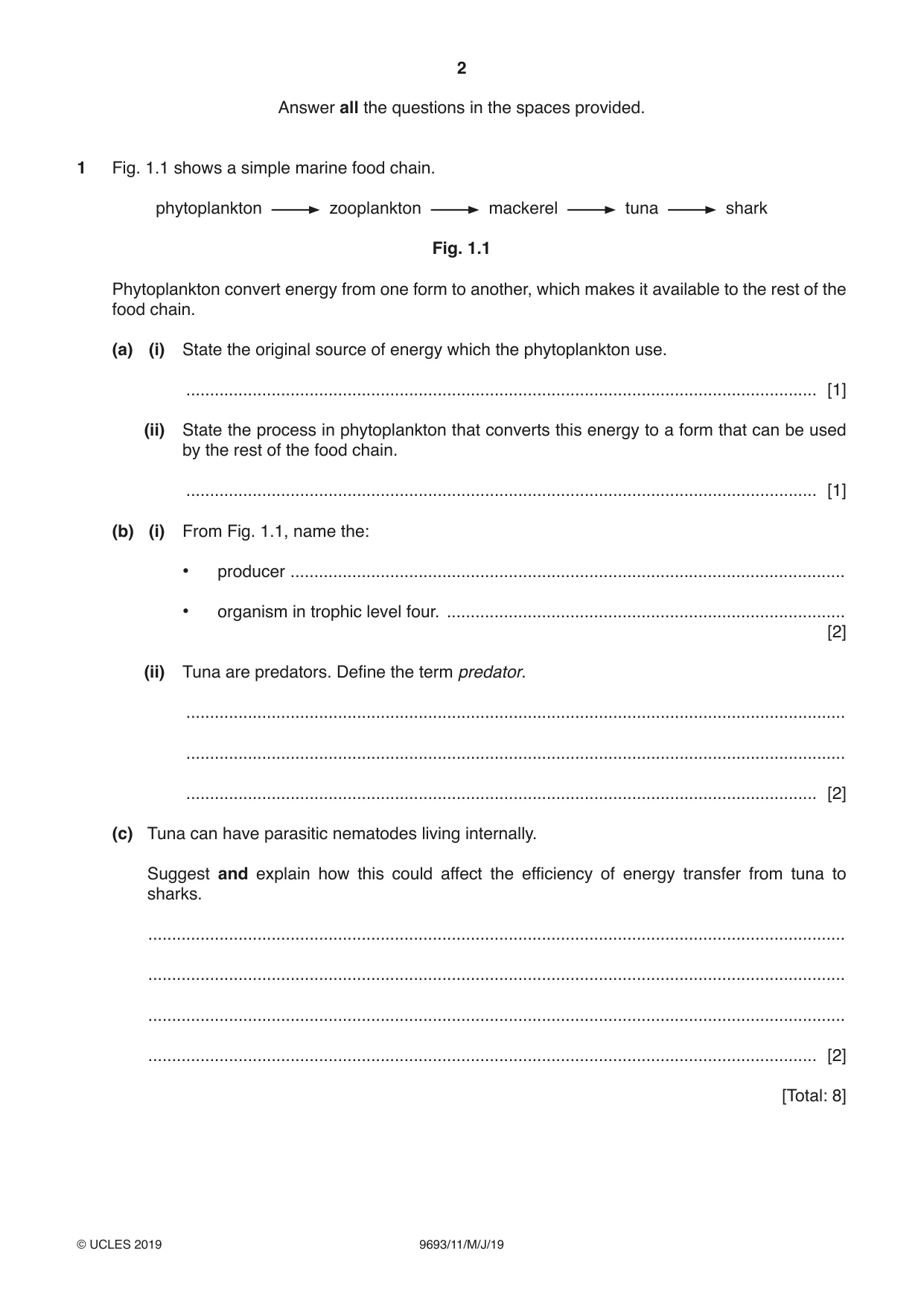
2 9693/11/M/J/19 © UCLES 2019 Answer all the questions in the spaces provided. 1 Fig. 1.1 shows a simple marine food chain. phytoplankton zooplankton mackerel tuna shark Fig. 1.1 Phytoplankton convert energy from one form to another, which makes it available to the rest of the food chain. (a) (i) State the original source of energy which the phytoplankton use. … [1] (ii) State the process in phytoplankton that converts this energy to a form that can be used by the rest of the food chain. … [1] (b) (i) From Fig. 1.1, name the: • producer … • organism in trophic level four. … [2] (ii) Tuna are predators. Define the term predator. … … … [2] (c) Tuna can have parasitic nematodes living internally. Suggest and explain how this could affect the efficiency of energy transfer from tuna to sharks. … … … … [2] [Total: 8]
Question paper, page 3
3 9693/11/M/J/19 © UCLES 2019 [Turn over BLANK PAGE
Question paper, page 4
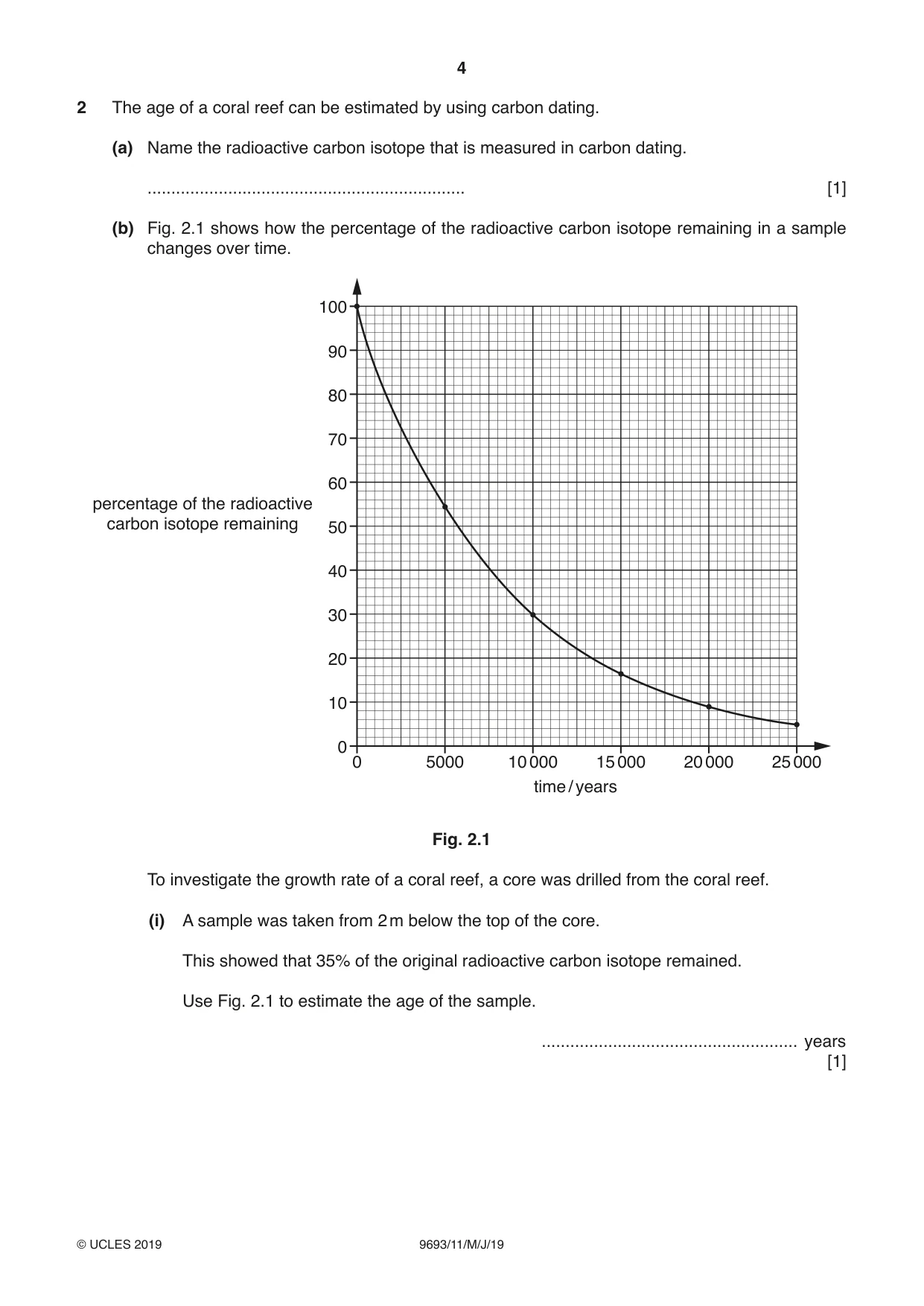
4 9693/11/M/J/19 © UCLES 2019 2 The age of a coral reef can be estimated by using carbon dating. (a) Name the radioactive carbon isotope that is measured in carbon dating. … [1] (b) Fig. 2.1 shows how the percentage of the radioactive carbon isotope remaining in a sample changes over time. 0 0 10 20 30 40 50 60 70 80 90 100 5000 10 000 15 000 time / years percentage of the radioactive carbon isotope remaining 20 000 25 000 Fig. 2.1 To investigate the growth rate of a coral reef, a core was drilled from the coral reef. (i) A sample was taken from 2 m below the top of the core. This showed that 35% of the original radioactive carbon isotope remained. Use Fig. 2.1 to estimate the age of the sample. … years [1]
Question paper, page 5
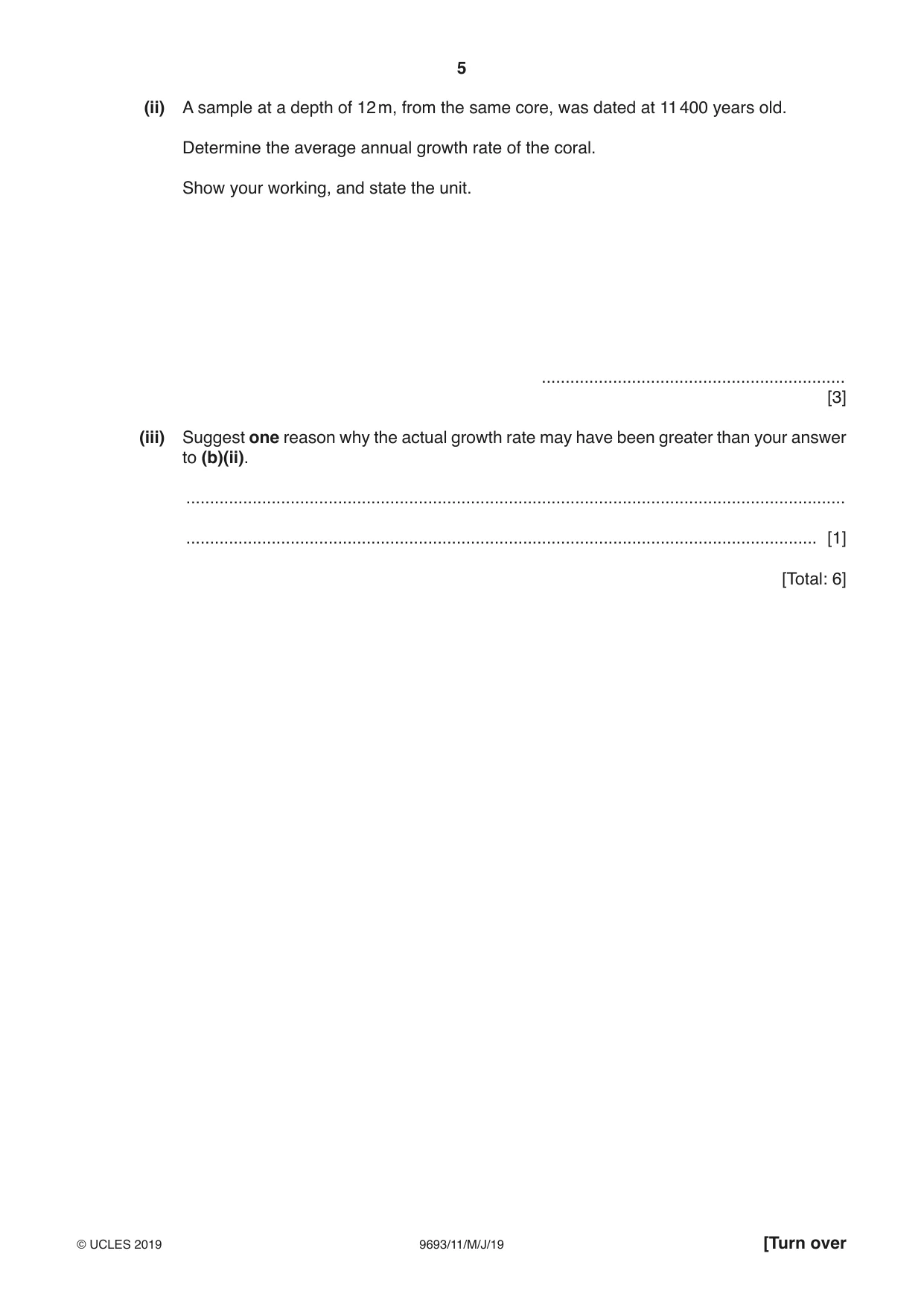
5 9693/11/M/J/19 © UCLES 2019 [Turn over (ii) A sample at a depth of 12 m, from the same core, was dated at 11 400 years old. Determine the average annual growth rate of the coral. Show your working, and state the unit. … [3] (iii) Suggest one reason why the actual growth rate may have been greater than your answer to (b)(ii). … … [1] [Total: 6]
Question paper, page 6
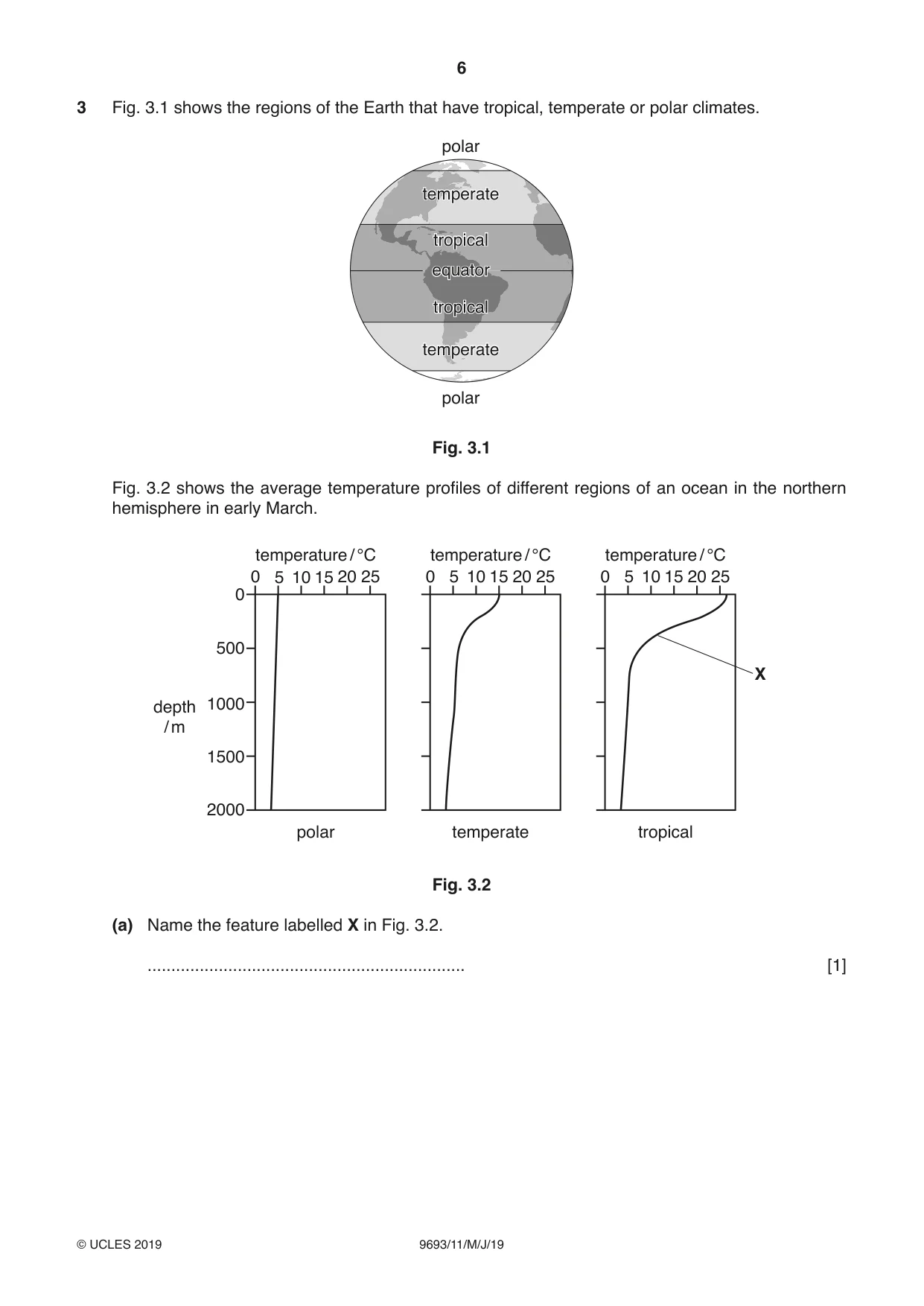
6 9693/11/M/J/19 © UCLES 2019 3 Fig. 3.1 shows the regions of the Earth that have tropical, temperate or polar climates. polar polar equator temperate temperate tropical tropical Fig. 3.1 Fig. 3.2 shows the average temperature profiles of different regions of an ocean in the northern hemisphere in early March. 0 0 500 1000 1500 2000 5 10 15 temperature / °C depth / m 20 25 0 5 10 15 temperature / °C 20 25 0 5 10 15 temperature / °C polar temperate tropical 20 25 X Fig. 3.2 (a) Name the feature labelled X in Fig. 3.2. … [1]
Question paper, page 7
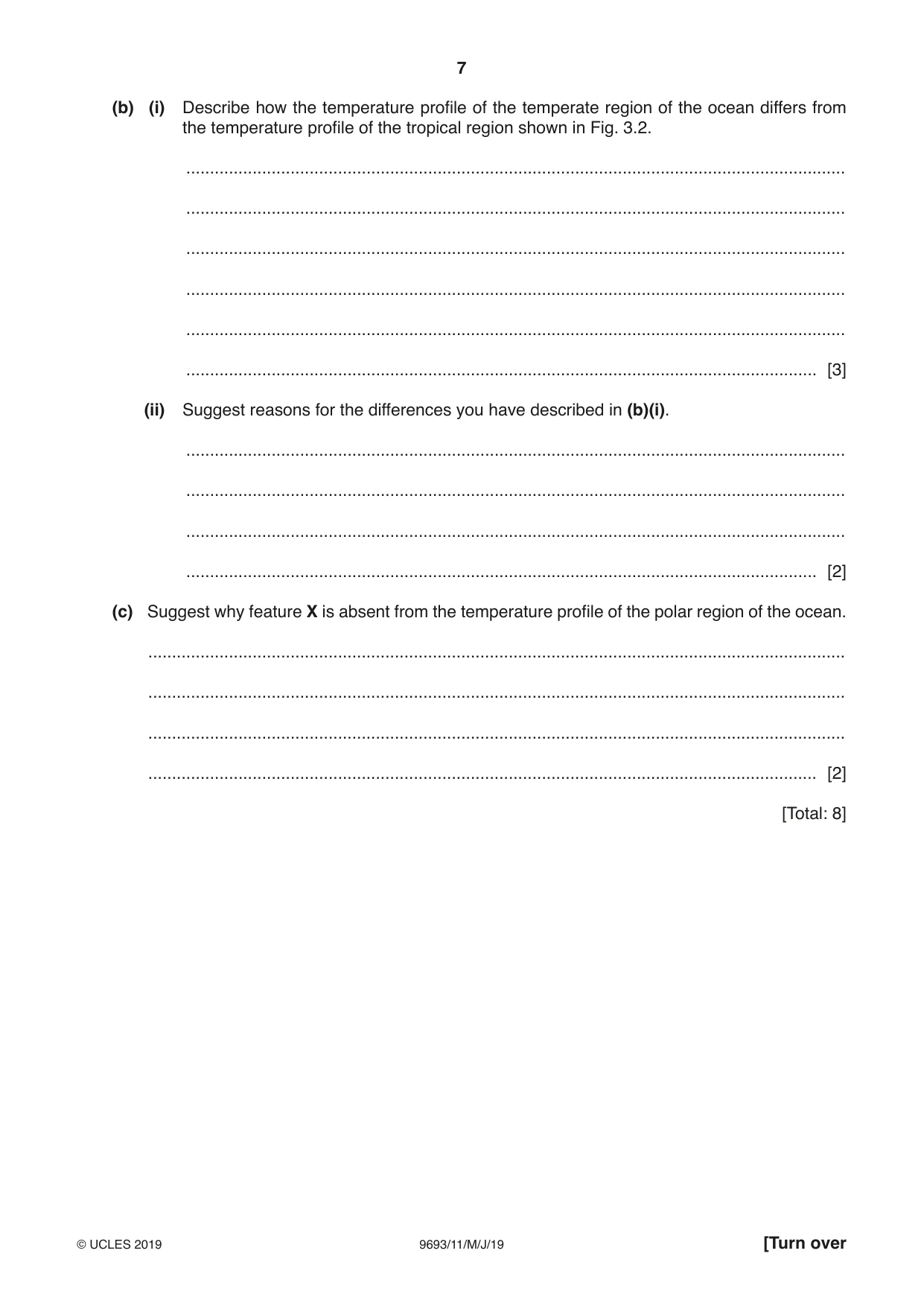
7 9693/11/M/J/19 © UCLES 2019 [Turn over (b) (i) Describe how the temperature profile of the temperate region of the ocean differs from the temperature profile of the tropical region shown in Fig. 3.2. … … … … … … [3] (ii) Suggest reasons for the differences you have described in (b)(i). … … … … [2] (c) Suggest why feature X is absent from the temperature profile of the polar region of the ocean. … … … … [2] [Total: 8]
Question paper, page 8
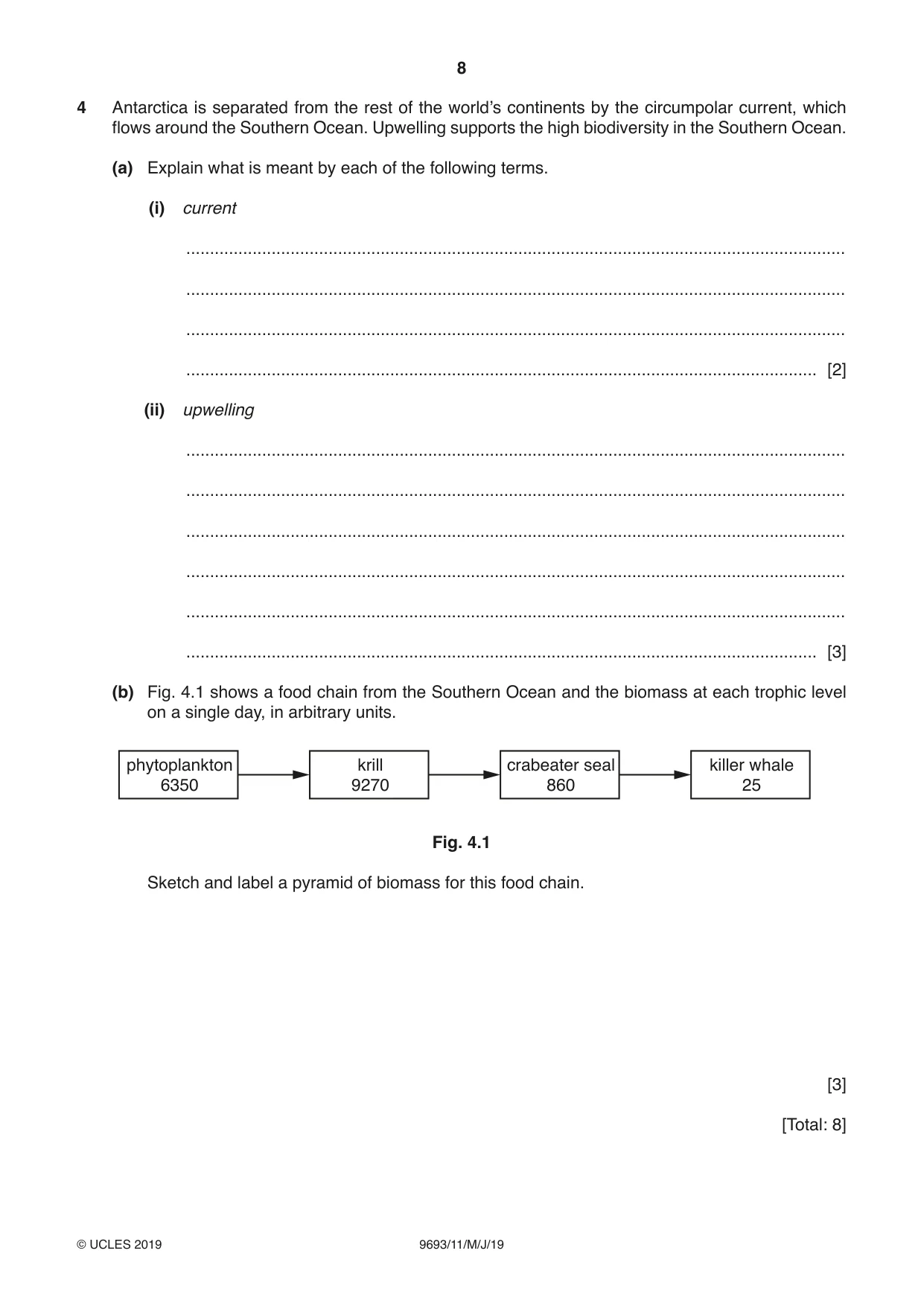
8 9693/11/M/J/19 © UCLES 2019 4 Antarctica is separated from the rest of the world’s continents by the circumpolar current, which flows around the Southern Ocean. Upwelling supports the high biodiversity in the Southern Ocean. (a) Explain what is meant by each of the following terms. (i) current … … … … [2] (ii) upwelling … … … … … … [3] (b) Fig. 4.1 shows a food chain from the Southern Ocean and the biomass at each trophic level on a single day, in arbitrary units. phytoplankton 6350 krill 9270 crabeater seal 860 killer whale 25 Fig. 4.1 Sketch and label a pyramid of biomass for this food chain. [3] [Total: 8]
Question paper, page 9
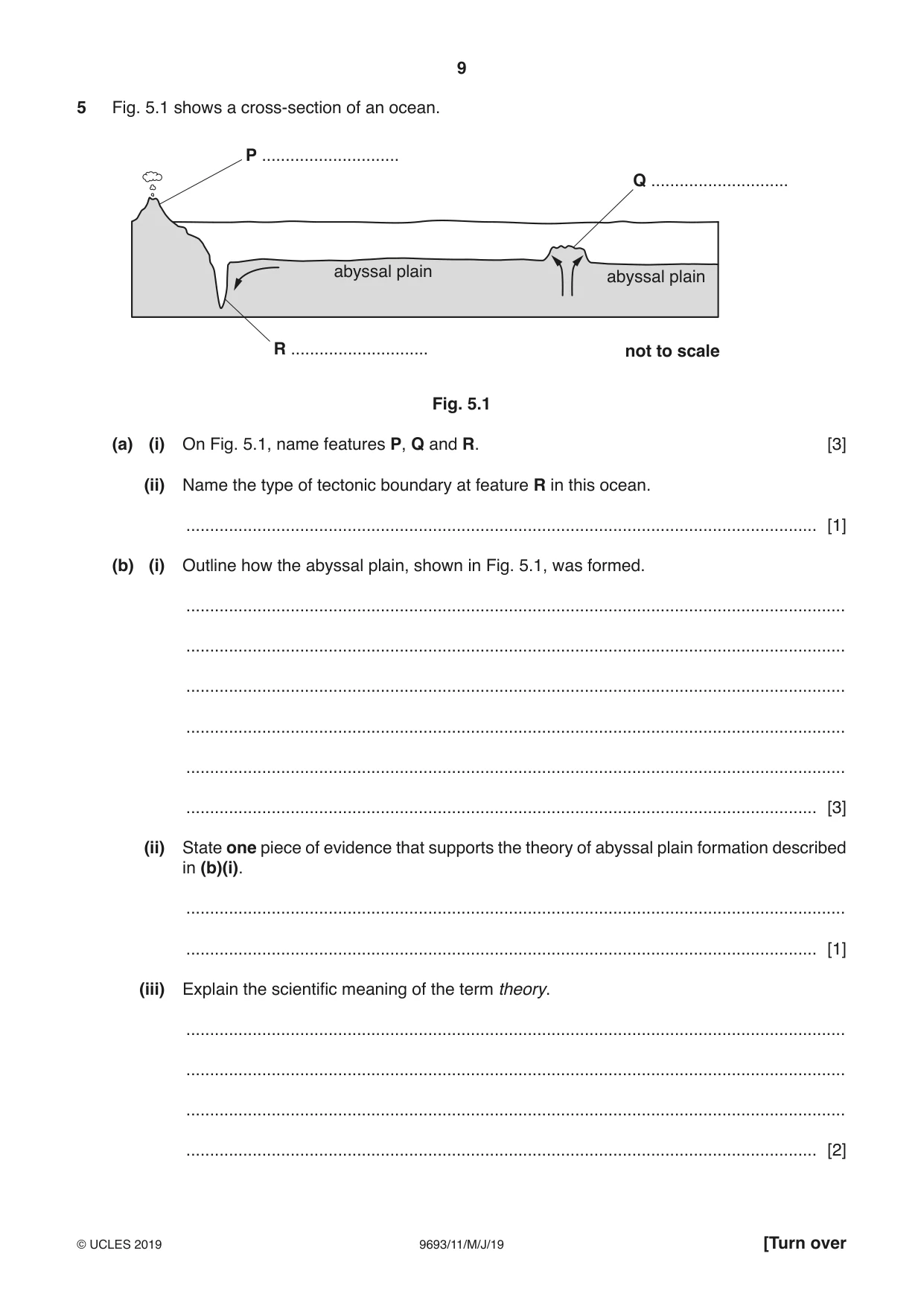
9 9693/11/M/J/19 © UCLES 2019 [Turn over 5 Fig. 5.1 shows a cross-section of an ocean. abyssal plain abyssal plain not to scale P … R … Q … Fig. 5.1 (a) (i) On Fig. 5.1, name features P, Q and R. [3] (ii) Name the type of tectonic boundary at feature R in this ocean. … [1] (b) (i) Outline how the abyssal plain, shown in Fig. 5.1, was formed. … … … … … … [3] (ii) State one piece of evidence that supports the theory of abyssal plain formation described in (b)(i). … … [1] (iii) Explain the scientific meaning of the term theory. … … … … [2]
Question paper, page 10
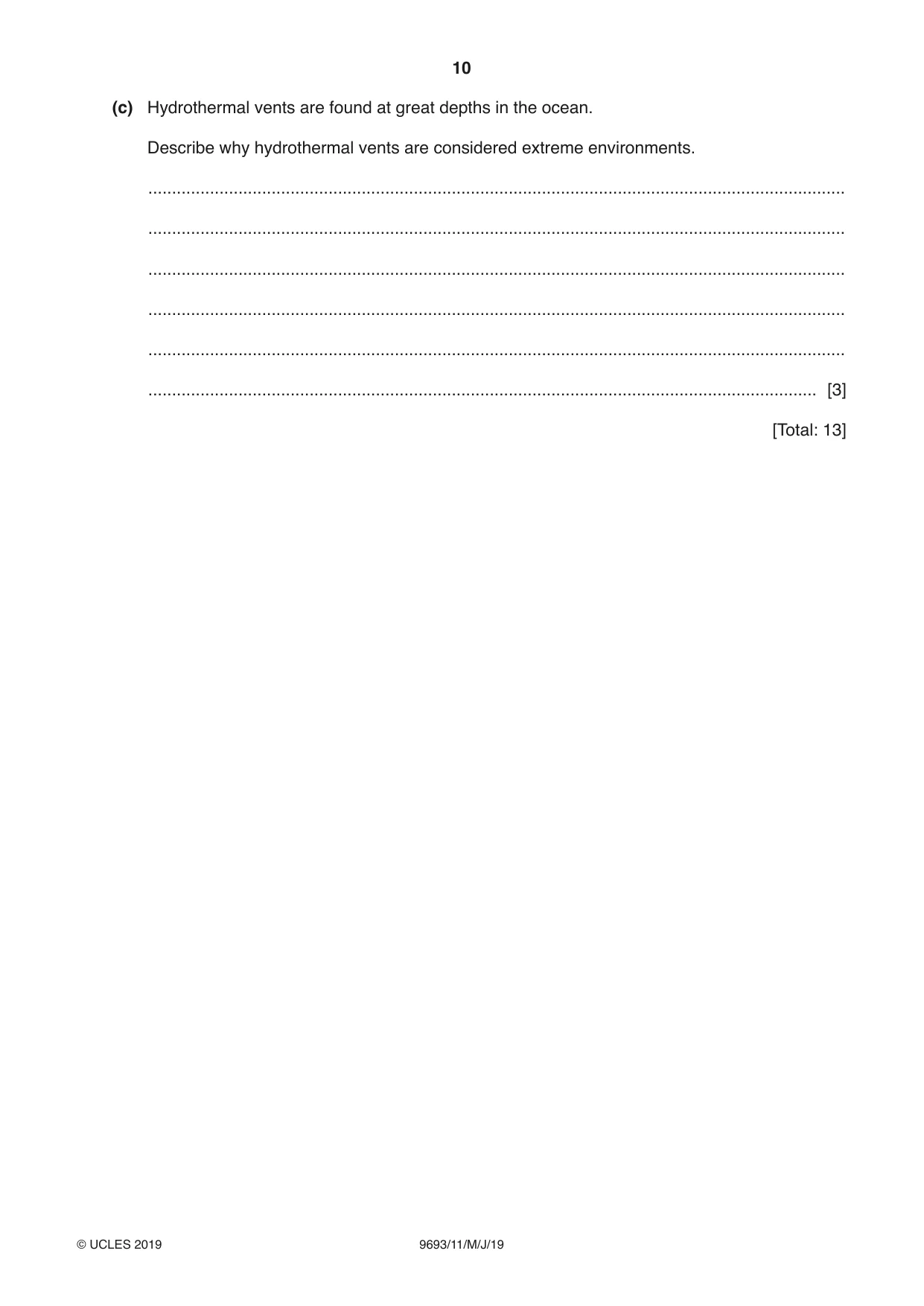
10 9693/11/M/J/19 © UCLES 2019 (c) Hydrothermal vents are found at great depths in the ocean. Describe why hydrothermal vents are considered extreme environments. … … … … … … [3] [Total: 13]
Question paper, page 11
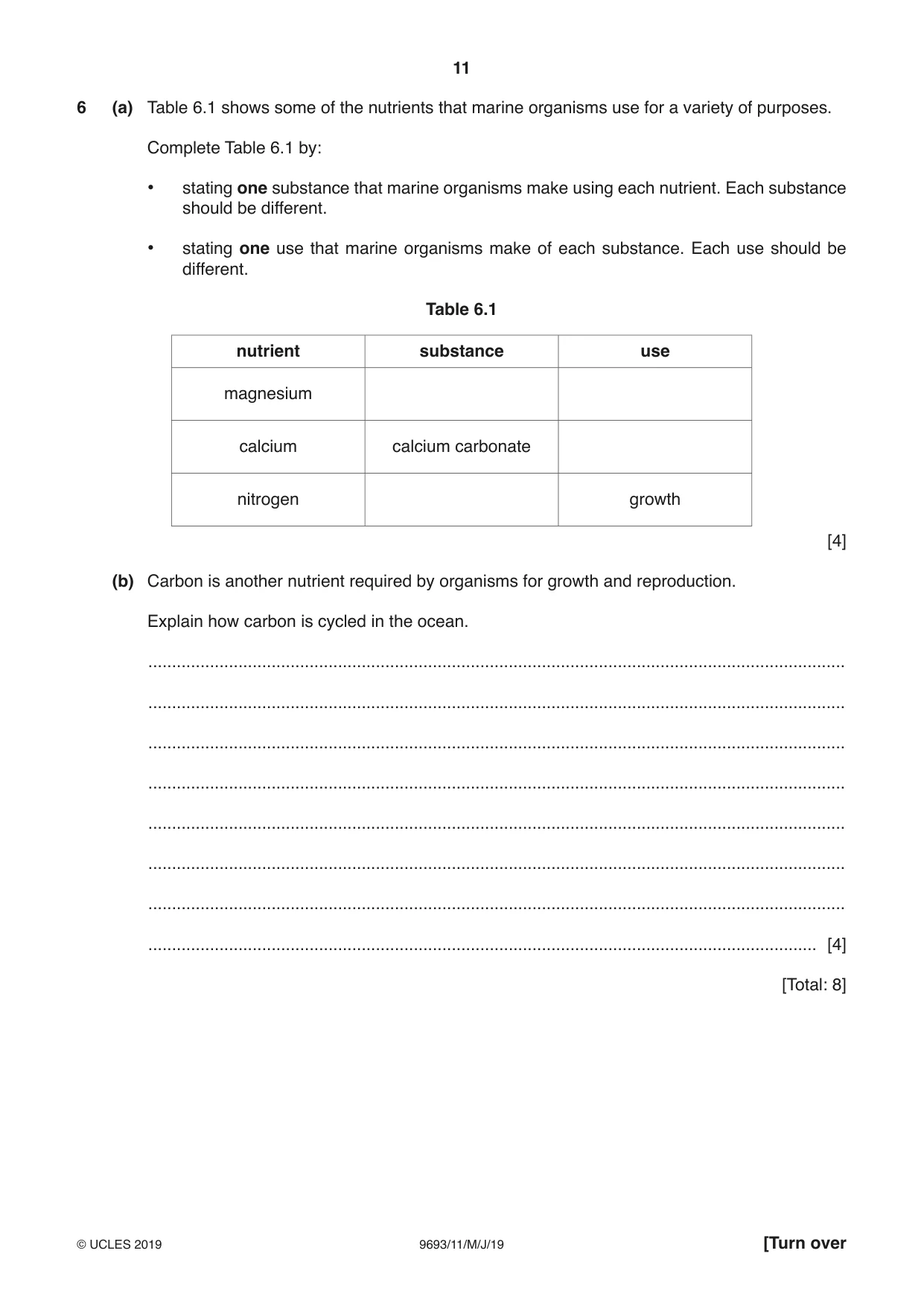
11 9693/11/M/J/19 © UCLES 2019 [Turn over 6 (a) Table 6.1 shows some of the nutrients that marine organisms use for a variety of purposes. Complete Table 6.1 by: • stating one substance that marine organisms make using each nutrient. Each substance should be different. • stating one use that marine organisms make of each substance. Each use should be different. Table 6.1 nutrient substance use magnesium calcium calcium carbonate nitrogen growth [4] (b) Carbon is another nutrient required by organisms for growth and reproduction. Explain how carbon is cycled in the ocean. … … … … … … … … [4] [Total: 8]
Question paper, page 12
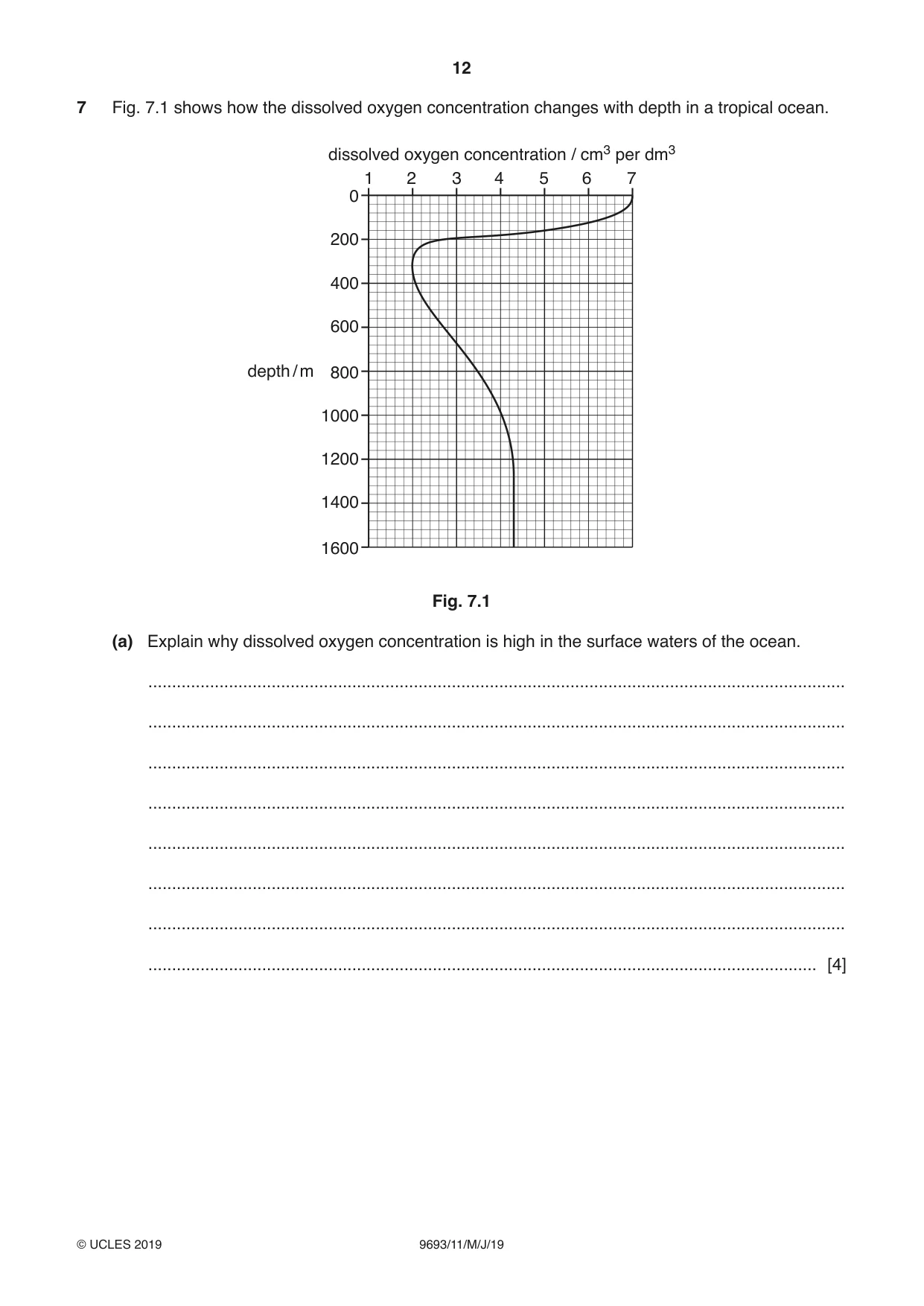
12 9693/11/M/J/19 © UCLES 2019 7 Fig. 7.1 shows how the dissolved oxygen concentration changes with depth in a tropical ocean. 0 1 2 3 4 5 6 7 200 400 600 800 depth / m dissolved oxygen concentration / cm3 per dm3 1000 1200 1400 1600 Fig. 7.1 (a) Explain why dissolved oxygen concentration is high in the surface waters of the ocean. … … … … … … … … [4]
Question paper, page 13
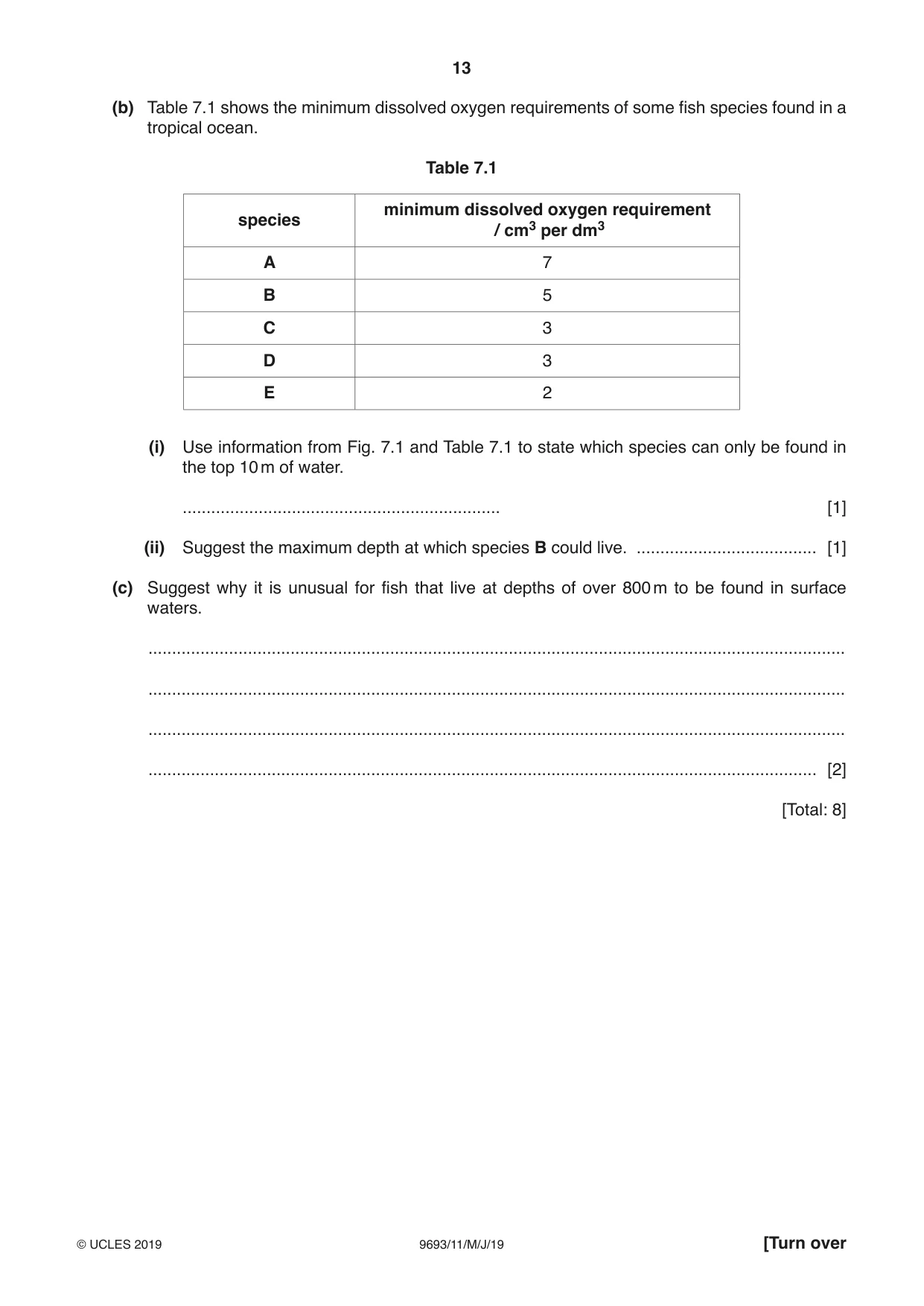
13 9693/11/M/J/19 © UCLES 2019 [Turn over (b) Table 7.1 shows the minimum dissolved oxygen requirements of some fish species found in a tropical ocean. Table 7.1 species minimum dissolved oxygen requirement / cm3 per dm3 A 7 B 5 C 3 D 3 E 2 (i) Use information from Fig. 7.1 and Table 7.1 to state which species can only be found in the top 10 m of water. … [1] (ii) Suggest the maximum depth at which species B could live. … [1] (c) Suggest why it is unusual for fish that live at depths of over 800 m to be found in surface waters. … … … … [2] [Total: 8]
Question paper, page 14
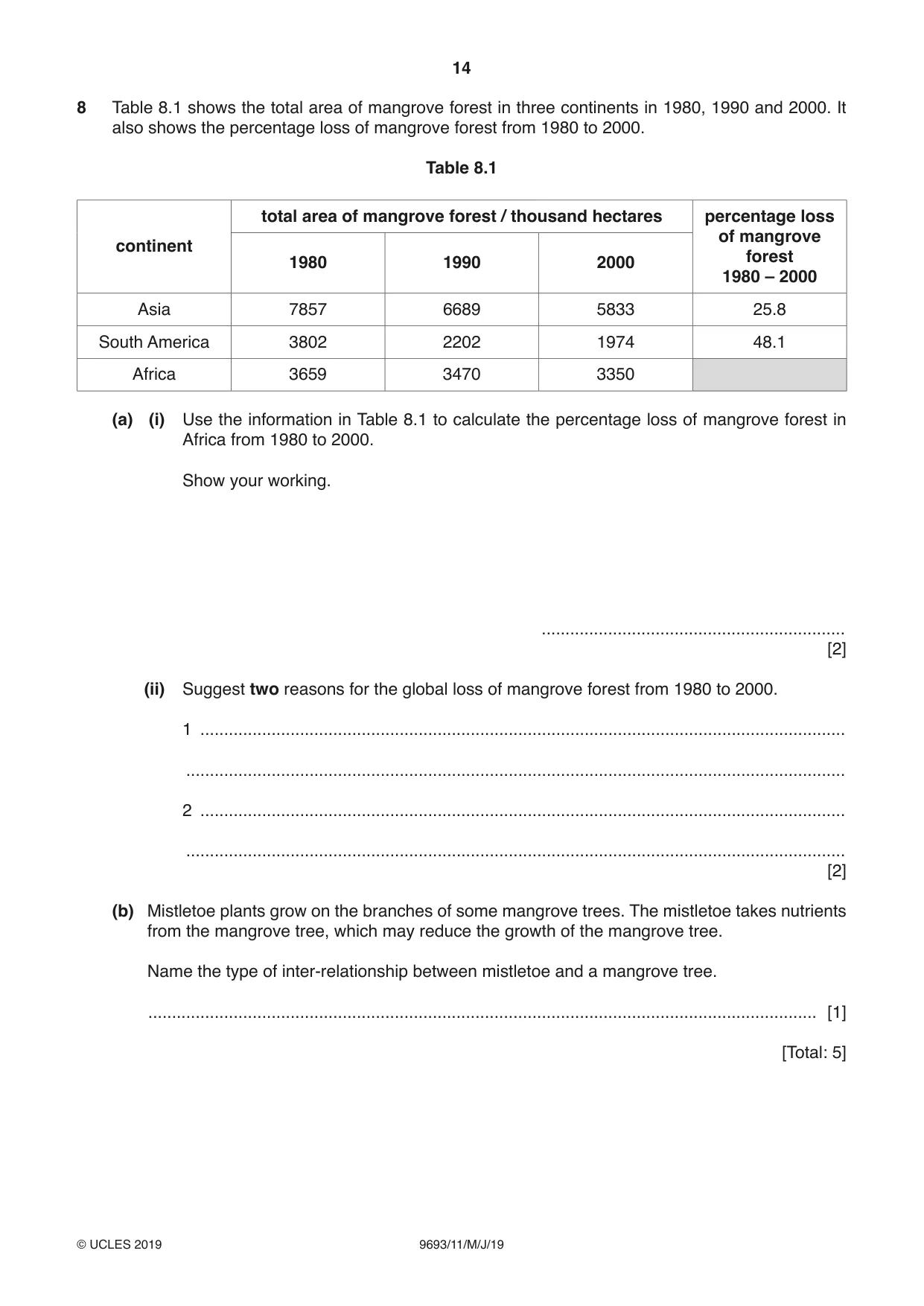
14 9693/11/M/J/19 © UCLES 2019 8 Table 8.1 shows the total area of mangrove forest in three continents in 1980, 1990 and 2000. It also shows the percentage loss of mangrove forest from 1980 to 2000. Table 8.1 continent total area of mangrove forest / thousand hectares percentage loss of mangrove forest 1980 – 2000 1980 1990 2000 Asia 7857 6689 5833 25.8 South America 3802 2202 1974 48.1 Africa 3659 3470 3350 (a) (i) Use the information in Table 8.1 to calculate the percentage loss of mangrove forest in Africa from 1980 to 2000. Show your working. … [2] (ii) Suggest two reasons for the global loss of mangrove forest from 1980 to 2000. 1 … … 2 … … [2] (b) Mistletoe plants grow on the branches of some mangrove trees. The mistletoe takes nutrients from the mangrove tree, which may reduce the growth of the mangrove tree. Name the type of inter-relationship between mistletoe and a mangrove tree. … [1] [Total: 5]
Question paper, page 15
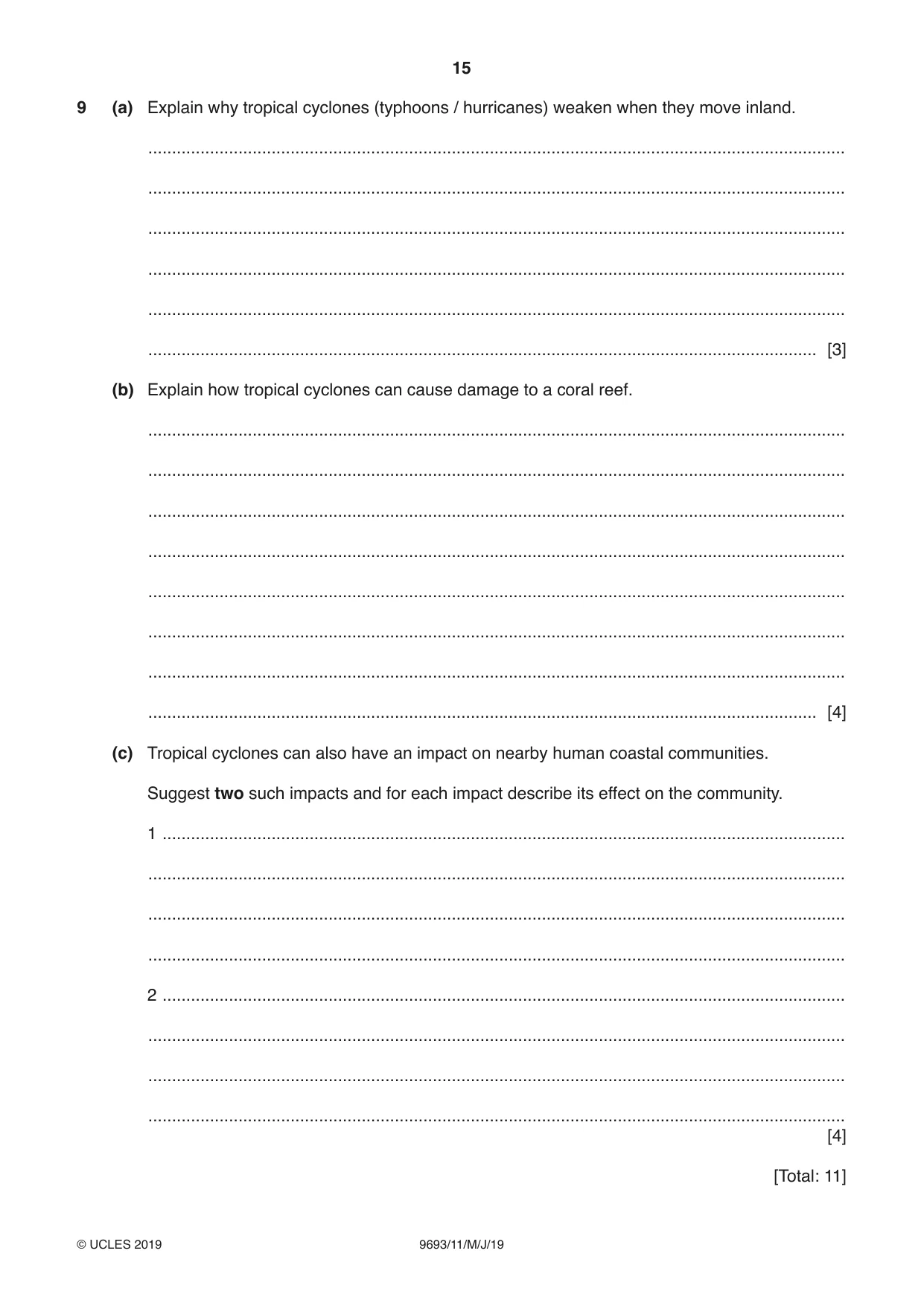
15 9693/11/M/J/19 © UCLES 2019 9 (a) Explain why tropical cyclones (typhoons / hurricanes) weaken when they move inland. … … … … … … [3] (b) Explain how tropical cyclones can cause damage to a coral reef. … … … … … … … … [4] (c) Tropical cyclones can also have an impact on nearby human coastal communities. Suggest two such impacts and for each impact describe its effect on the community. 1 … … … … 2 … … … … [4] [Total: 11]
Question paper, page 16
16 9693/11/M/J/19 © UCLES 2019 BLANK PAGE Permission to reproduce items where third-party owned material protected by copyright is included has been sought and cleared where possible. Every reasonable effort has been made by the publisher (UCLES) to trace copyright holders, but if any items requiring clearance have unwittingly been included, the publisher will be pleased to make amends at the earliest possible opportunity. To avoid the issue of disclosure of answer-related information to candidates, all copyright acknowledgements are reproduced online in the Cambridge Assessment International Education Copyright Acknowledgements Booklet. This is produced for each series of examinations and is freely available to download at www.cambridgeinternational.org after the live examination series. Cambridge Assessment International Education is part of the Cambridge Assessment Group. Cambridge Assessment is the brand name of the University of Cambridge Local Examinations Syndicate (UCLES), which itself is a department of the University of Cambridge.
Mark scheme, page 1
This document consists of 12 printed pages. © UCLES 2019 [Turn over Cambridge Assessment International Education Cambridge International Advanced Subsidiary and Advanced Level MARINE SCIENCE 9693/11 Paper 1 AS Structured Questions May/June 2019 MARK SCHEME Maximum Mark: 75 Published This mark scheme is published as an aid to teachers and candidates, to indicate the requirements of the examination. It shows the basis on which Examiners were instructed to award marks. It does not indicate the details of the discussions that took place at an Examiners’ meeting before marking began, which would have considered the acceptability of alternative answers. Mark schemes should be read in conjunction with the question paper and the Principal Examiner Report for Teachers. Cambridge International will not enter into discussions about these mark schemes. Cambridge International is publishing the mark schemes for the May/June 2019 series for most Cambridge IGCSE™, Cambridge International A and AS Level and Cambridge Pre-U components, and some Cambridge O Level components.
Mark scheme, page 2
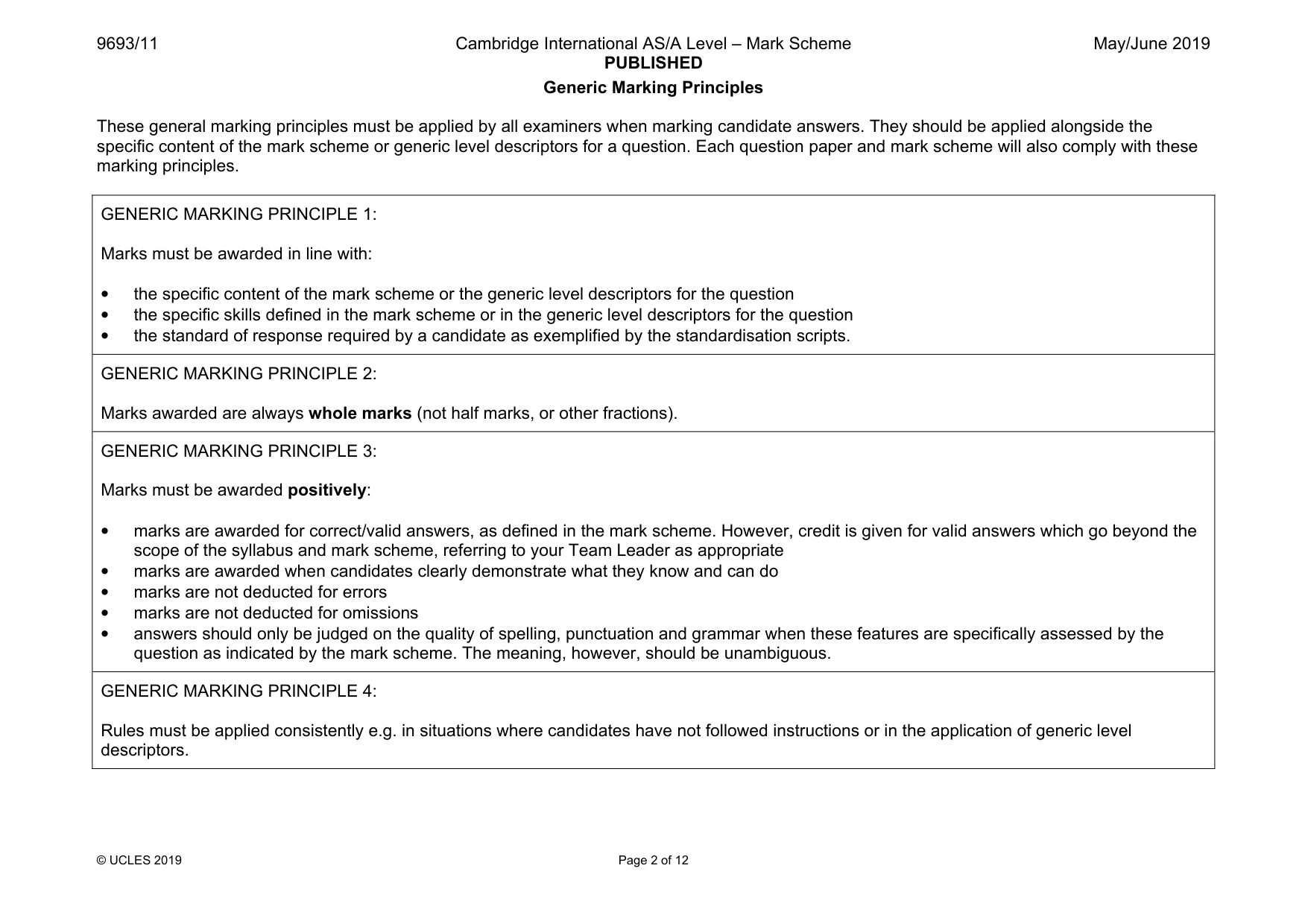
9693/11 Cambridge International AS/A Level – Mark Scheme PUBLISHED May/June 2019 © UCLES 2019 Page 2 of 12 Generic Marking Principles These general marking principles must be applied by all examiners when marking candidate answers. They should be applied alongside the specific content of the mark scheme or generic level descriptors for a question. Each question paper and mark scheme will also comply with these marking principles. GENERIC MARKING PRINCIPLE 1: Marks must be awarded in line with: • the specific content of the mark scheme or the generic level descriptors for the question • the specific skills defined in the mark scheme or in the generic level descriptors for the question • the standard of response required by a candidate as exemplified by the standardisation scripts. GENERIC MARKING PRINCIPLE 2: Marks awarded are always whole marks (not half marks, or other fractions). GENERIC MARKING PRINCIPLE 3: Marks must be awarded positively: • marks are awarded for correct/valid answers, as defined in the mark scheme. However, credit is given for valid answers which go beyond the scope of the syllabus and mark scheme, referring to your Team Leader as appropriate • marks are awarded when candidates clearly demonstrate what they know and can do • marks are not deducted for errors • marks are not deducted for omissions • answers should only be judged on the quality of spelling, punctuation and grammar when these features are specifically assessed by the question as indicated by the mark scheme. The meaning, however, should be unambiguous. GENERIC MARKING PRINCIPLE 4: Rules must be applied consistently e.g. in situations where candidates have not followed instructions or in the application of generic level descriptors.
Mark scheme, page 3
9693/11 Cambridge International AS/A Level – Mark Scheme PUBLISHED May/June 2019 © UCLES 2019 Page 3 of 12 GENERIC MARKING PRINCIPLE 5: Marks should be awarded using the full range of marks defined in the mark scheme for the question (however; the use of the full mark range may be limited according to the quality of the candidate responses seen). GENERIC MARKING PRINCIPLE 6: Marks awarded are based solely on the requirements as defined in the mark scheme. Marks should not be awarded with grade thresholds or grade descriptors in mind.
Mark scheme, page 4
9693/11 Cambridge International AS/A Level – Mark Scheme PUBLISHED May/June 2019 © UCLES 2019 Page 4 of 12 This mark scheme will use the following abbreviations: ; separates marking points / separates alternatives within a marking point () contents of brackets are not required but should be implied / the contents set the context of the answer R reject A accept (answers that are correctly cued by the question or guidance you have received) I ignore (mark as if this material was not present) AW alternative wording (where responses vary more than usual, accept other ways of expressing the same idea) AVP alternative valid point (where a greater than usual variety of responses is expected) OR or reverse argument underline actual word underlined must be used by the candidate (grammatical variants excepted) MAX indicates the maximum number of marks that can be awarded + statements on both sides of the + are needed for that mark OR separates two different routes to a mark point and only one should be awarded ECF error carried forward (credit an operation from a previous incorrect response)
Mark scheme, page 5
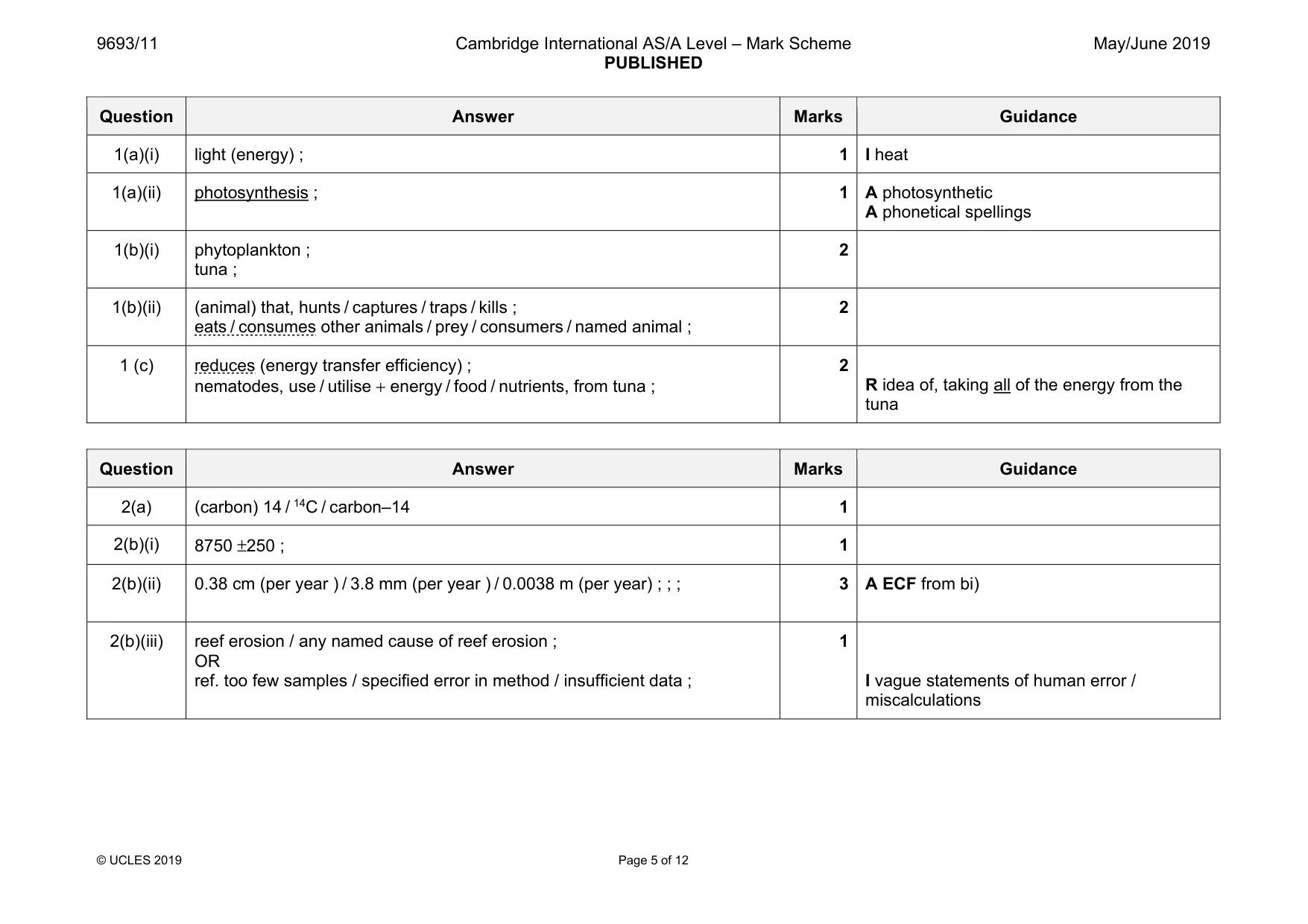
9693/11 Cambridge International AS/A Level – Mark Scheme PUBLISHED May/June 2019 © UCLES 2019 Page 5 of 12 Question Answer Marks Guidance 1(a)(i) light (energy) ; 1 I heat 1(a)(ii) photosynthesis ; 1 A photosynthetic A phonetical spellings 1(b)(i) phytoplankton ; tuna ; 2 1(b)(ii) (animal) that, hunts / captures / traps / kills ; eats / consumes other animals / prey / consumers / named animal ; 2 1 (c) reduces (energy transfer efficiency) ; nematodes, use / utilise + energy / food / nutrients, from tuna ; 2 R idea of, taking all of the energy from the tuna Question Answer Marks Guidance 2(a) (carbon) 14 / 14C / carbon–14 1 2(b)(i) 8750 ±250 ; 1 2(b)(ii) 0.38 cm (per year ) / 3.8 mm (per year ) / 0.0038 m (per year) ; ; ; 3 A ECF from bi) 2(b)(iii) reef erosion / any named cause of reef erosion ; OR ref. too few samples / specified error in method / insufficient data ; 1 I vague statements of human error / miscalculations
Mark scheme, page 6
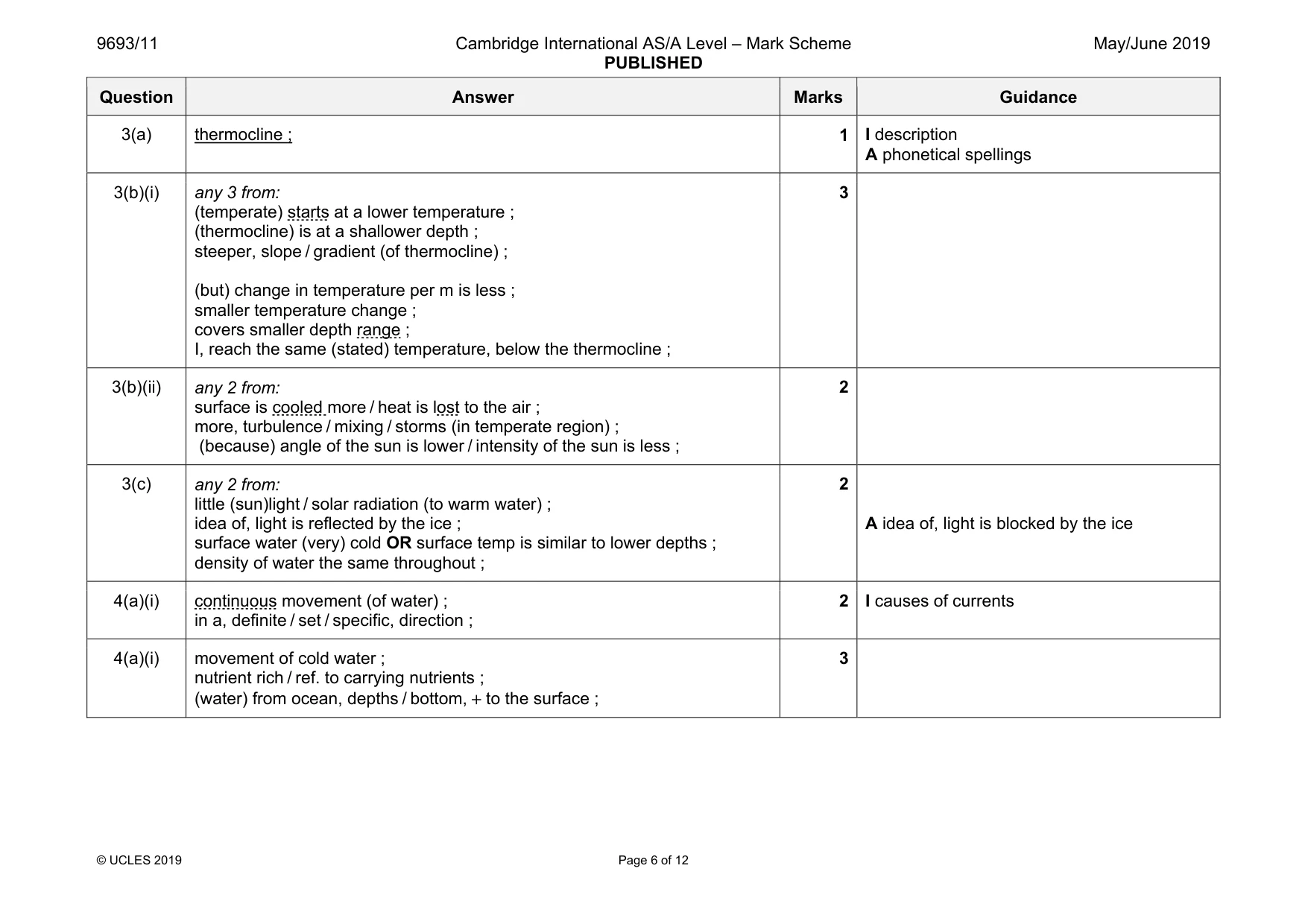
9693/11 Cambridge International AS/A Level – Mark Scheme PUBLISHED May/June 2019 © UCLES 2019 Page 6 of 12 Question Answer Marks Guidance 3(a) thermocline ; 1 I description A phonetical spellings 3(b)(i) any 3 from: (temperate) starts at a lower temperature ; (thermocline) is at a shallower depth ; steeper, slope / gradient (of thermocline) ; (but) change in temperature per m is less ; smaller temperature change ; covers smaller depth range ; I, reach the same (stated) temperature, below the thermocline ; 3 3(b)(ii) any 2 from: surface is cooled more / heat is lost to the air ; more, turbulence / mixing / storms (in temperate region) ; (because) angle of the sun is lower / intensity of the sun is less ; 2 3(c) any 2 from: little (sun)light / solar radiation (to warm water) ; idea of, light is reflected by the ice ; surface water (very) cold OR surface temp is similar to lower depths ; density of water the same throughout ; 2 A idea of, light is blocked by the ice 4(a)(i) continuous movement (of water) ; in a, definite / set / specific, direction ; 2 I causes of currents 4(a)(i) movement of cold water ; nutrient rich / ref. to carrying nutrients ; (water) from ocean, depths / bottom, + to the surface ; 3
Mark scheme, page 7
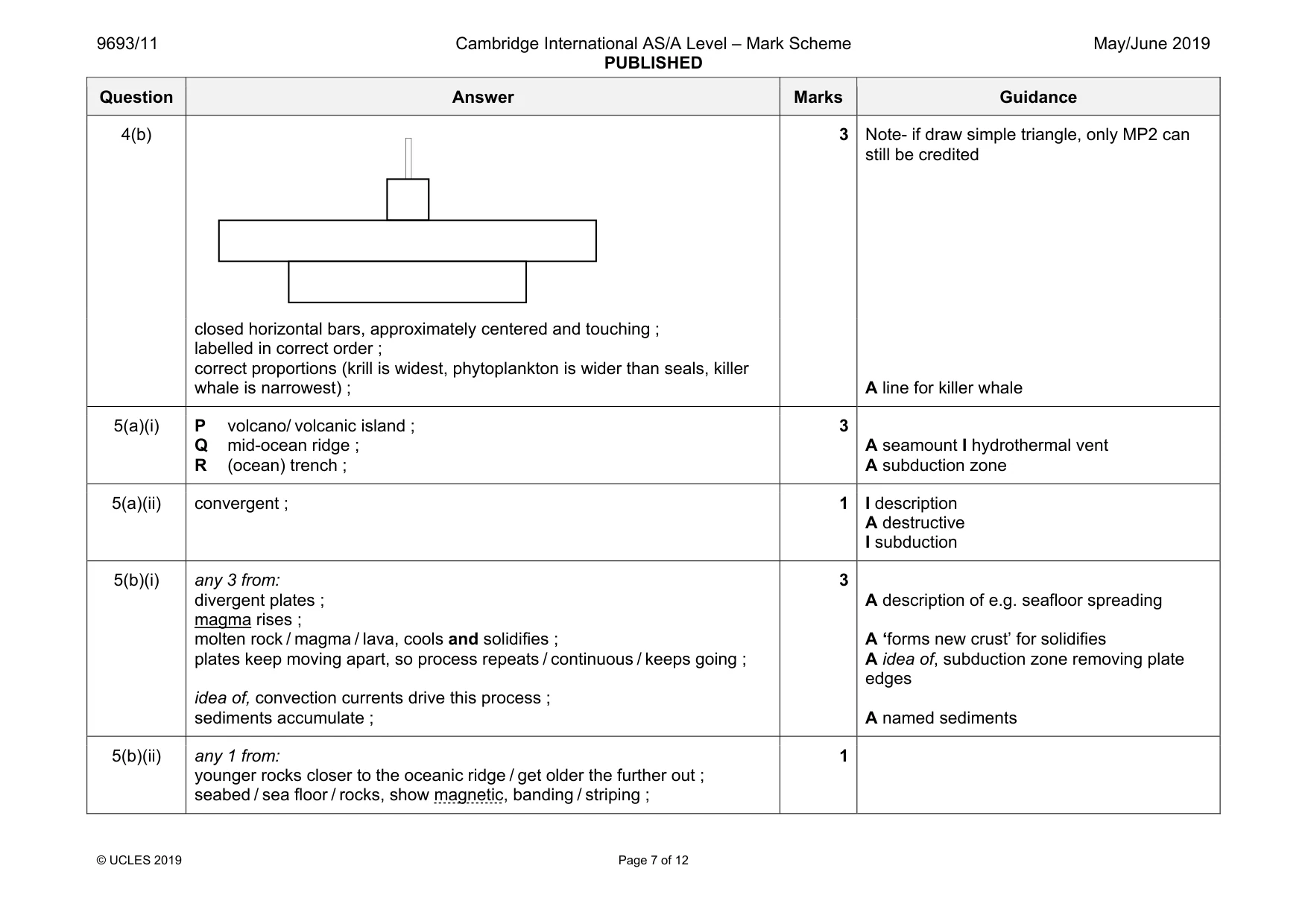
9693/11 Cambridge International AS/A Level – Mark Scheme PUBLISHED May/June 2019 © UCLES 2019 Page 7 of 12 Question Answer Marks Guidance 4(b) 3 Note- if draw simple triangle, only MP2 can still be credited closed horizontal bars, approximately centered and touching ; labelled in correct order ; correct proportions (krill is widest, phytoplankton is wider than seals, killer whale is narrowest) ; A line for killer whale 5(a)(i) P volcano/ volcanic island ; Q mid-ocean ridge ; R (ocean) trench ; 3 A seamount I hydrothermal vent A subduction zone 5(a)(ii) convergent ; 1 I description A destructive I subduction 5(b)(i) any 3 from: divergent plates ; magma rises ; molten rock / magma / lava, cools and solidifies ; plates keep moving apart, so process repeats / continuous / keeps going ; idea of, convection currents drive this process ; sediments accumulate ; 3 A description of e.g. seafloor spreading A ‘forms new crust’ for solidifies A idea of, subduction zone removing plate edges A named sediments 5(b)(ii) any 1 from: younger rocks closer to the oceanic ridge / get older the further out ; seabed / sea floor / rocks, show magnetic, banding / striping ; 1
Mark scheme, page 8
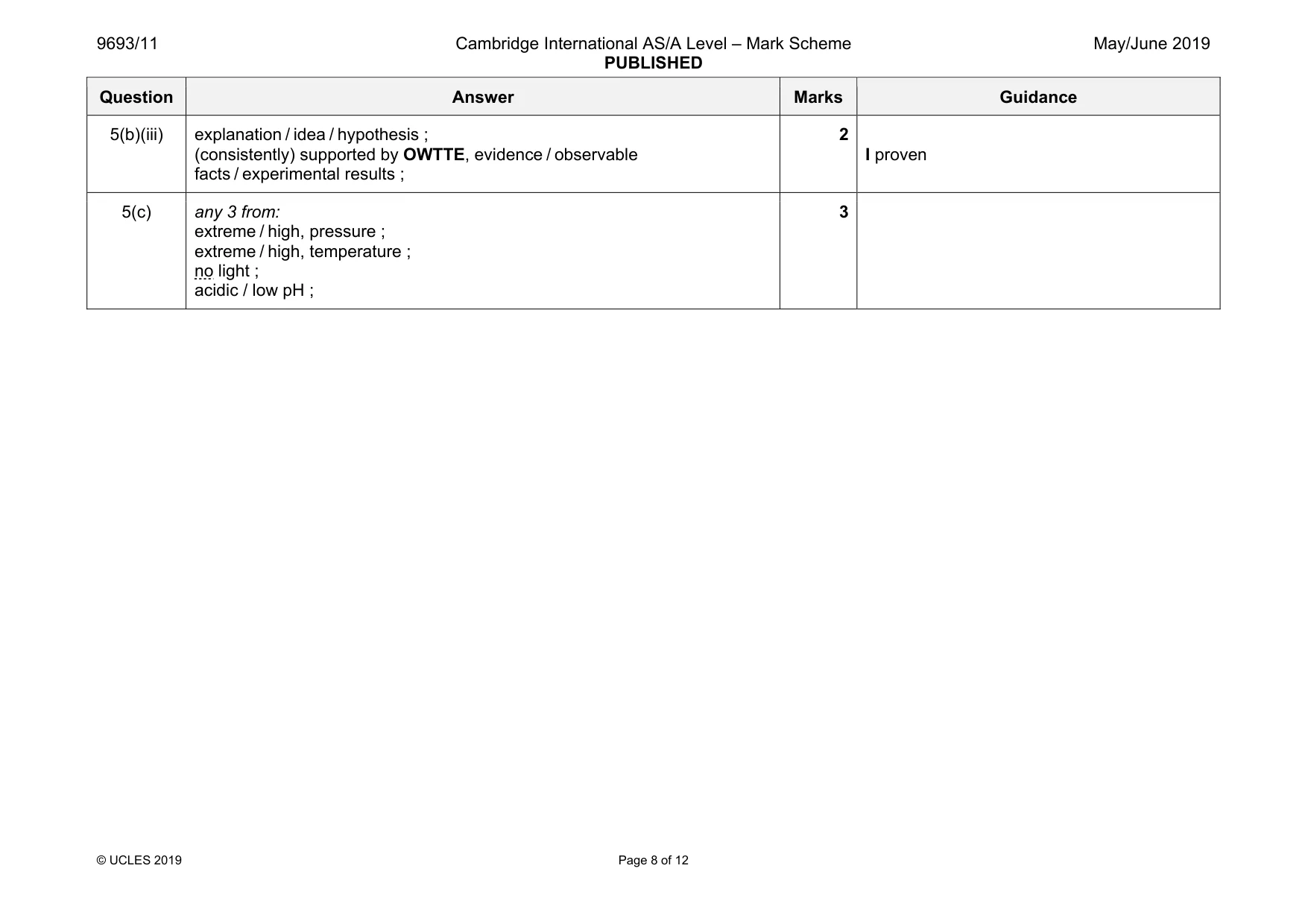
9693/11 Cambridge International AS/A Level – Mark Scheme PUBLISHED May/June 2019 © UCLES 2019 Page 8 of 12 Question Answer Marks Guidance 5(b)(iii) explanation / idea / hypothesis ; (consistently) supported by OWTTE, evidence / observable facts / experimental results ; 2 I proven 5(c) any 3 from: extreme / high, pressure ; extreme / high, temperature ; no light ; acidic / low pH ; 3
Mark scheme, page 9
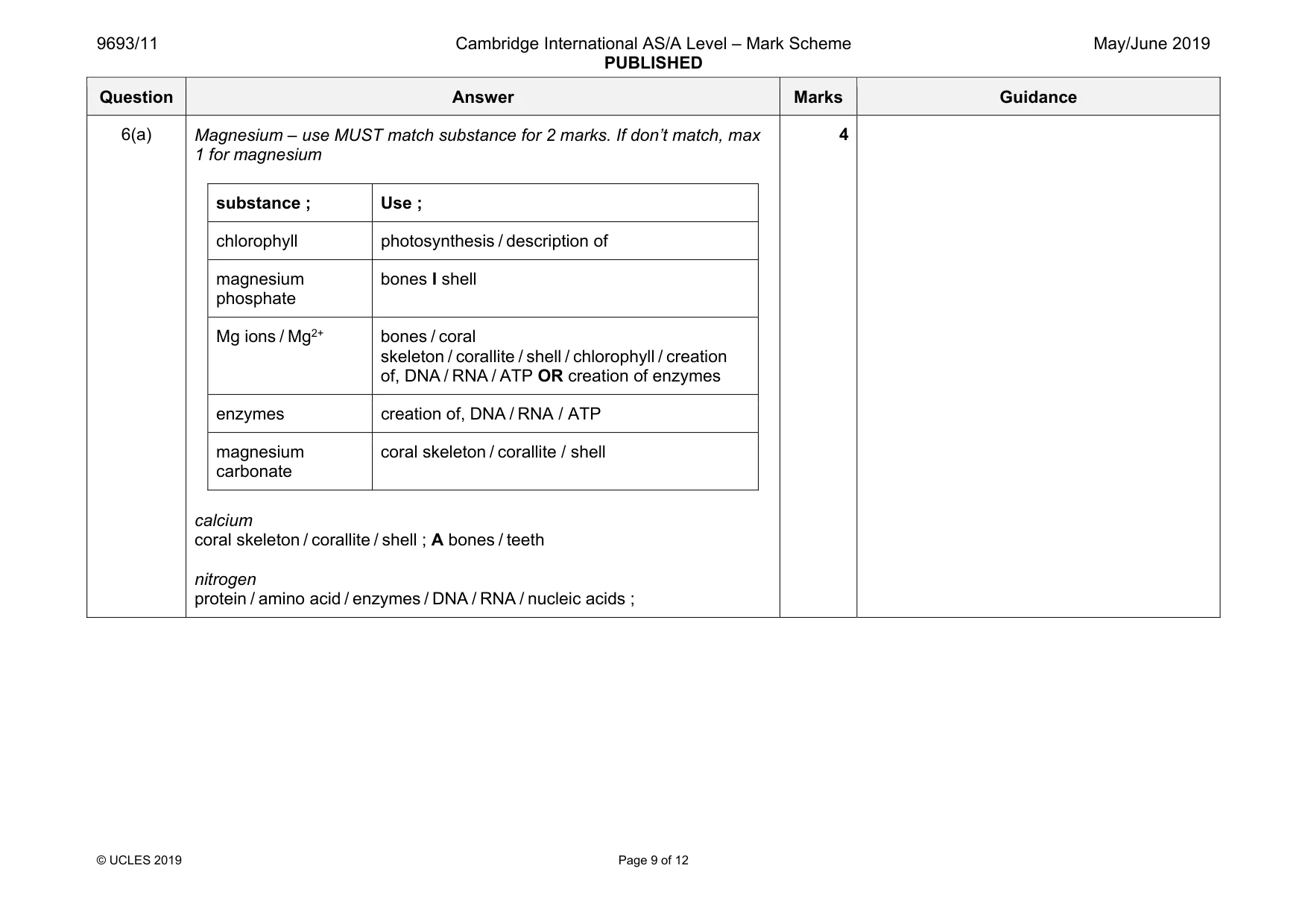
9693/11 Cambridge International AS/A Level – Mark Scheme PUBLISHED May/June 2019 © UCLES 2019 Page 9 of 12 Question Answer Marks Guidance 6(a) Magnesium – use MUST match substance for 2 marks. If don’t match, max 1 for magnesium substance ; Use ; chlorophyll photosynthesis / description of magnesium phosphate bones I shell Mg ions / Mg2+ bones / coral skeleton / corallite / shell / chlorophyll / creation of, DNA / RNA / ATP OR creation of enzymes enzymes creation of, DNA / RNA / ATP magnesium carbonate coral skeleton / corallite / shell calcium coral skeleton / corallite / shell ; A bones / teeth nitrogen protein / amino acid / enzymes / DNA / RNA / nucleic acids ; 4
Mark scheme, page 10
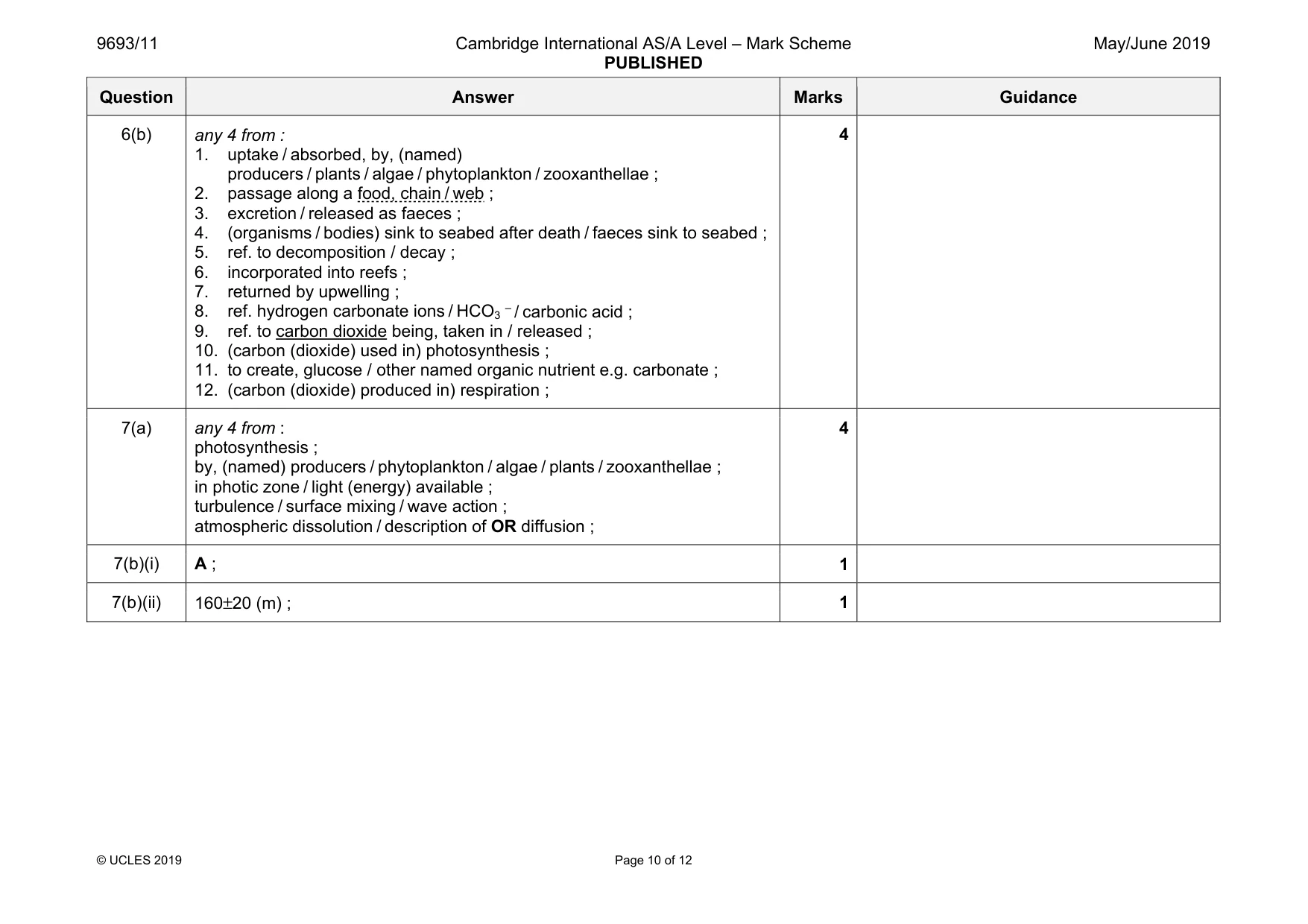
9693/11 Cambridge International AS/A Level – Mark Scheme PUBLISHED May/June 2019 © UCLES 2019 Page 10 of 12 Question Answer Marks Guidance 6(b) any 4 from : 1. uptake / absorbed, by, (named) producers / plants / algae / phytoplankton / zooxanthellae ; 2. passage along a food, chain / web ; 3. excretion / released as faeces ; 4. (organisms / bodies) sink to seabed after death / faeces sink to seabed ; 5. ref. to decomposition / decay ; 6. incorporated into reefs ; 7. returned by upwelling ; 8. ref. hydrogen carbonate ions / HCO3 – / carbonic acid ; 9. ref. to carbon dioxide being, taken in / released ; 10. (carbon (dioxide) used in) photosynthesis ; 11. to create, glucose / other named organic nutrient e.g. carbonate ; 12. (carbon (dioxide) produced in) respiration ; 4 7(a) any 4 from : photosynthesis ; by, (named) producers / phytoplankton / algae / plants / zooxanthellae ; in photic zone / light (energy) available ; turbulence / surface mixing / wave action ; atmospheric dissolution / description of OR diffusion ; 4 7(b)(i) A ; 1 7(b)(ii) 160±20 (m) ; 1
Mark scheme, page 11
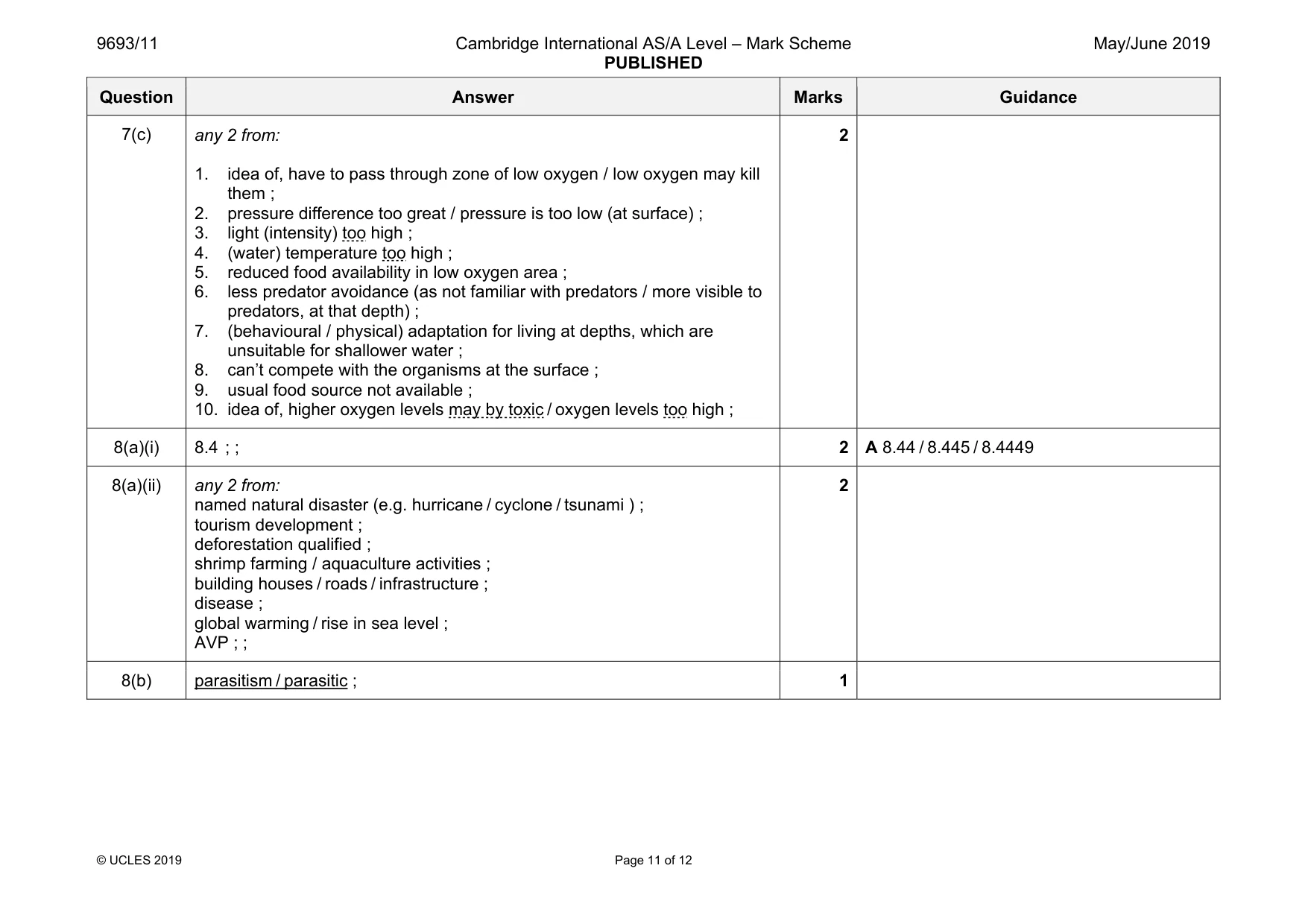
9693/11 Cambridge International AS/A Level – Mark Scheme PUBLISHED May/June 2019 © UCLES 2019 Page 11 of 12 Question Answer Marks Guidance 7(c) any 2 from: 1. idea of, have to pass through zone of low oxygen / low oxygen may kill them ; 2. pressure difference too great / pressure is too low (at surface) ; 3. light (intensity) too high ; 4. (water) temperature too high ; 5. reduced food availability in low oxygen area ; 6. less predator avoidance (as not familiar with predators / more visible to predators, at that depth) ; 7. (behavioural / physical) adaptation for living at depths, which are unsuitable for shallower water ; 8. can’t compete with the organisms at the surface ; 9. usual food source not available ; 10. idea of, higher oxygen levels may by toxic / oxygen levels too high ; 2 8(a)(i) 8.4 ; ; 2 A 8.44 / 8.445 / 8.4449 8(a)(ii) any 2 from: named natural disaster (e.g. hurricane / cyclone / tsunami ) ; tourism development ; deforestation qualified ; shrimp farming / aquaculture activities ; building houses / roads / infrastructure ; disease ; global warming / rise in sea level ; AVP ; ; 2 8(b) parasitism / parasitic ; 1
Mark scheme, page 12
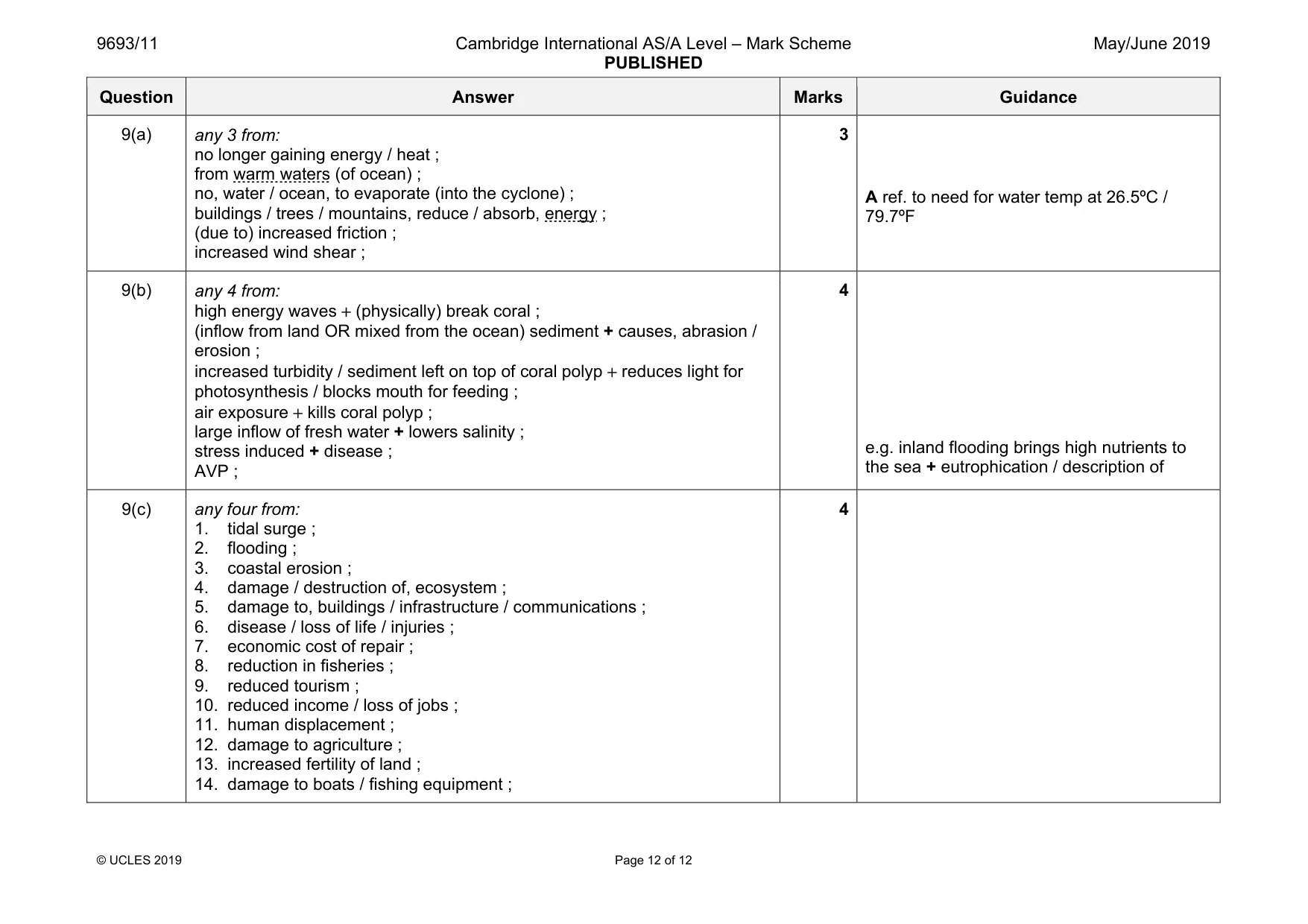
9693/11 Cambridge International AS/A Level – Mark Scheme PUBLISHED May/June 2019 © UCLES 2019 Page 12 of 12 Question Answer Marks Guidance 9(a) any 3 from: no longer gaining energy / heat ; from warm waters (of ocean) ; no, water / ocean, to evaporate (into the cyclone) ; buildings / trees / mountains, reduce / absorb, energy ; (due to) increased friction ; increased wind shear ; 3 A ref. to need for water temp at 26.5ºC / 79.7ºF 9(b) any 4 from: high energy waves + (physically) break coral ; (inflow from land OR mixed from the ocean) sediment + causes, abrasion / erosion ; increased turbidity / sediment left on top of coral polyp + reduces light for photosynthesis / blocks mouth for feeding ; air exposure + kills coral polyp ; large inflow of fresh water + lowers salinity ; stress induced + disease ; AVP ; 4 e.g. inland flooding brings high nutrients to the sea + eutrophication / description of 9(c) any four from: 1. tidal surge ; 2. flooding ; 3. coastal erosion ; 4. damage / destruction of, ecosystem ; 5. damage to, buildings / infrastructure / communications ; 6. disease / loss of life / injuries ; 7. economic cost of repair ; 8. reduction in fisheries ; 9. reduced tourism ; 10. reduced income / loss of jobs ; 11. human displacement ; 12. damage to agriculture ; 13. increased fertility of land ; 14. damage to boats / fishing equipment ; 4
What you needed in this session
Cambridge’s own grade thresholds for 2019 May/June, Paper 1 · Variant 1. A higher threshold means an easier paper — the bar moves with how the cohort did.