Cambridge A Level Marine Science 9693 — 2018 Oct/Nov Paper 1 · Variant 0
9693/10/O/N/18
The question paper and its mark scheme, free to read here and free to download. This is Cambridge’s own paper, exactly as it was sat.
Question paper20 pages


Mark scheme
No mark scheme is in the library for this paper.
Paper as text
Question paper, page 1
* 0 9 1 4 1 1 0 3 1 0 * This document consists of 17 printed pages and 3 blank pages. DC (SC/SW) 150370/4 © UCLES 2018 [Turn over Cambridge International Examinations Cambridge International Advanced Subsidiary and Advanced Level MARINE SCIENCE 9693/01 Paper 1 AS Structured Questions October/November 2018 1 hour 30 minutes Candidates answer on the Question Paper. No Additional Materials are required. READ THESE INSTRUCTIONS FIRST Write your Centre number, candidate number and name on all the work you hand in. Write in dark blue or black pen. You may use an HB pencil for any diagrams or graphs. Do not use staples, paper clips, glue or correction fluid. DO NOT WRITE IN ANY BARCODES. Answer all questions. Write your answers in the spaces provided on the Question Paper. Electronic calculators may be used. You may lose marks if you do not show your working or if you do not use appropriate units. At the end of the examination, fasten all your work securely together. The number of marks is given in brackets [ ] at the end of each question or part question.
Question paper, page 2
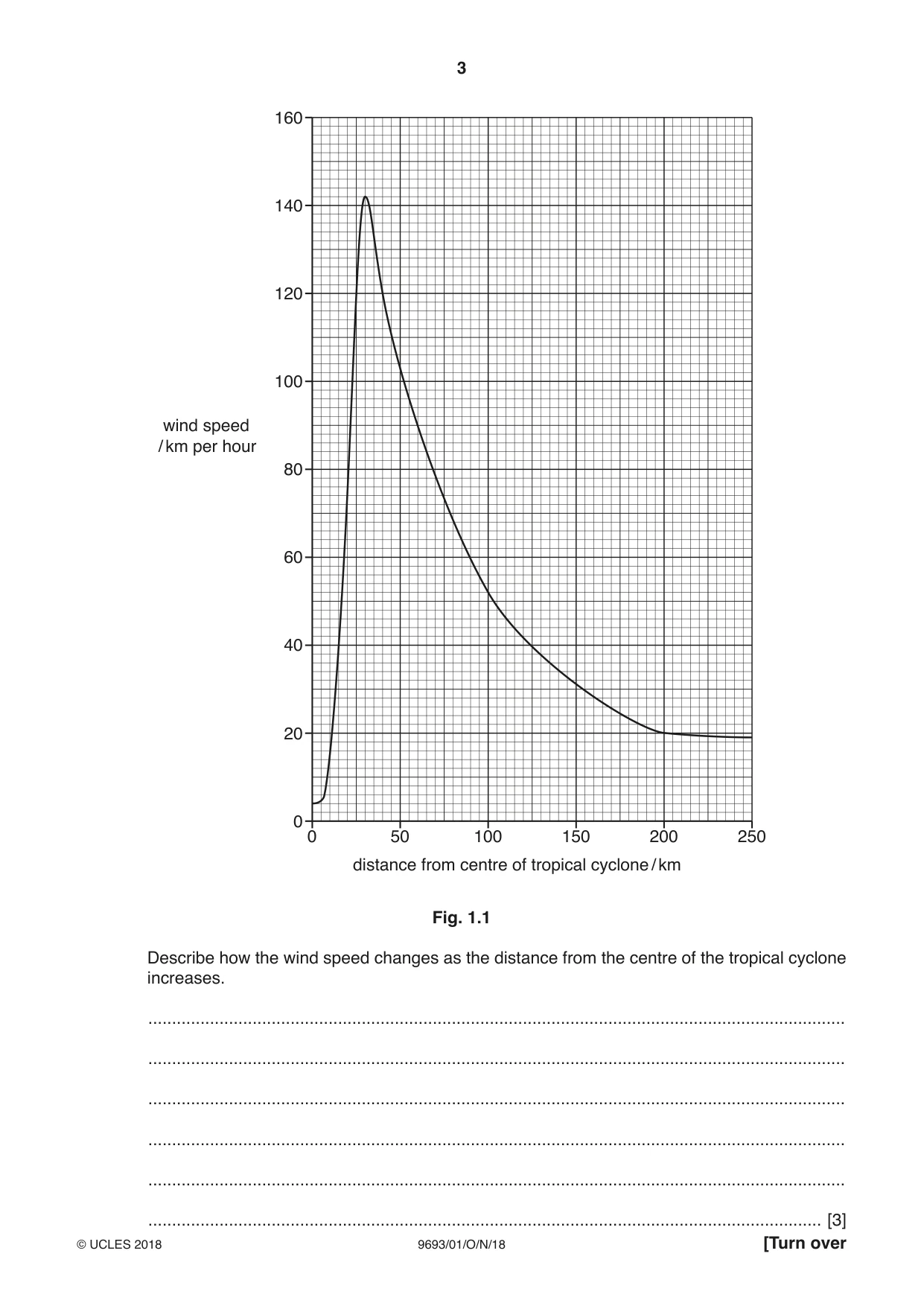
2 9693/01/O/N/18 © UCLES 2018 Answer all the questions in the spaces provided. 1 (a) Describe the conditions necessary for a tropical cyclone to develop and be maintained. … … … … … … [3] (b) Fig. 1.1 shows how the wind speed changes with the distance from the centre of a tropical cyclone.
Question paper, page 3
3 9693/01/O/N/18 © UCLES 2018 [Turn over 0 0 20 40 60 80 100 120 140 160 50 100 150 distance from centre of tropical cyclone / km wind speed / km per hour 200 250 Fig. 1.1 Describe how the wind speed changes as the distance from the centre of the tropical cyclone increases. … … … … … … [3]
Question paper, page 4
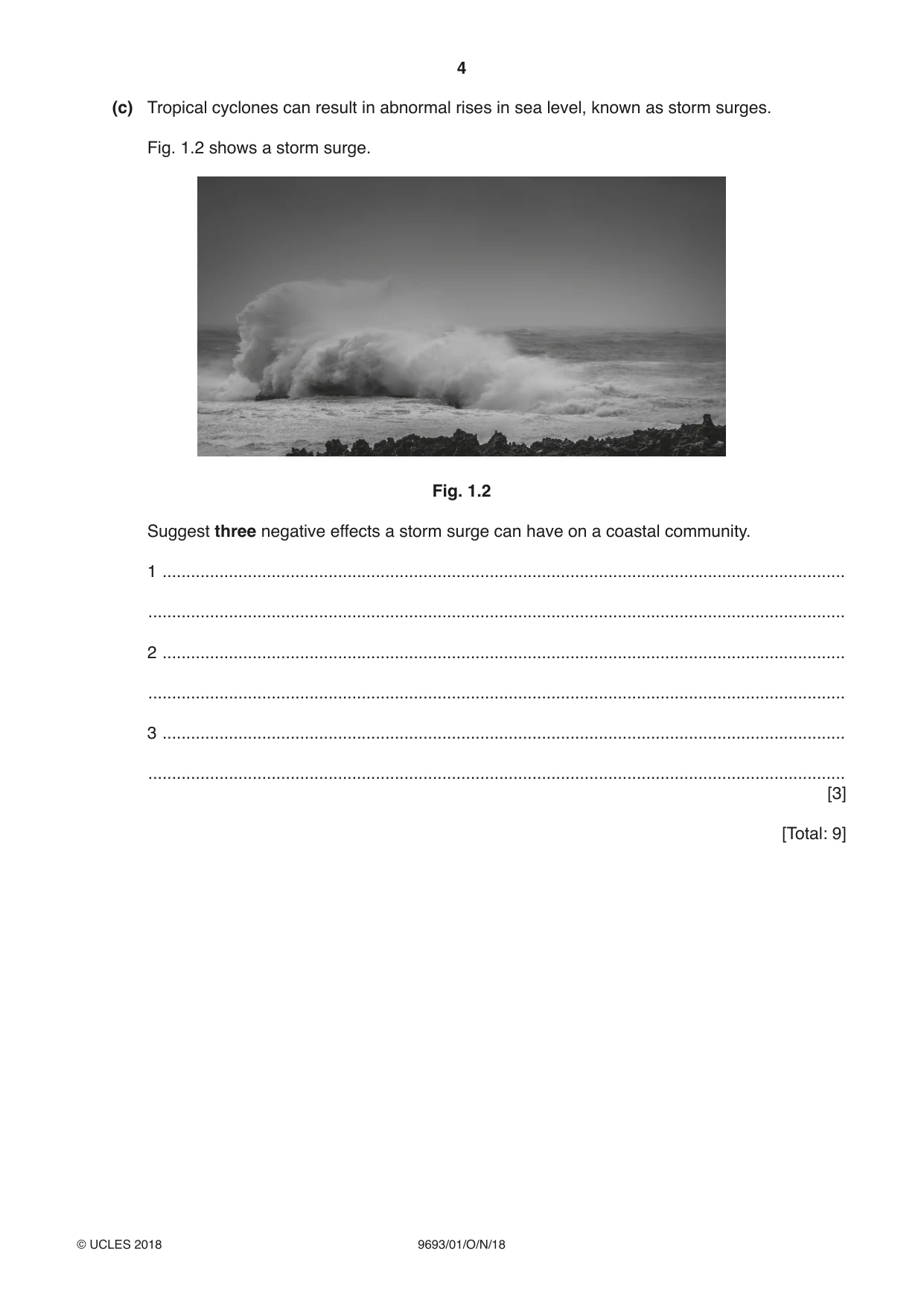
4 9693/01/O/N/18 © UCLES 2018 (c) Tropical cyclones can result in abnormal rises in sea level, known as storm surges. Fig. 1.2 shows a storm surge. Fig. 1.2 Suggest three negative effects a storm surge can have on a coastal community. 1 … … 2 … … 3 … … [3] [Total: 9]
Question paper, page 5
5 9693/01/O/N/18 © UCLES 2018 [Turn over BLANK PAGE
Question paper, page 6
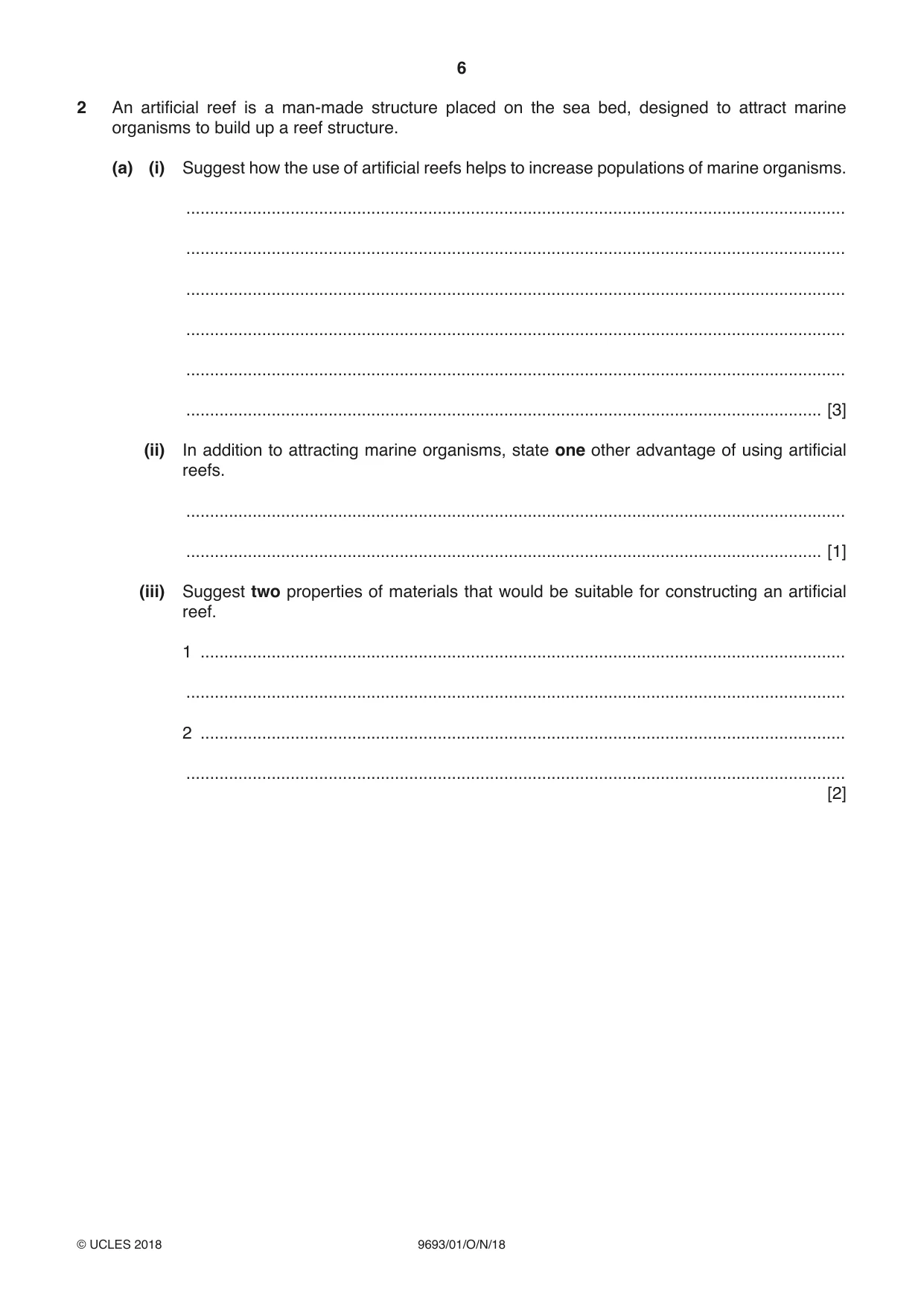
6 9693/01/O/N/18 © UCLES 2018 2 An artificial reef is a man-made structure placed on the sea bed, designed to attract marine organisms to build up a reef structure. (a) (i) Suggest how the use of artificial reefs helps to increase populations of marine organisms. … … … … … … [3] (ii) In addition to attracting marine organisms, state one other advantage of using artificial reefs. … … [1] (iii) Suggest two properties of materials that would be suitable for constructing an artificial reef. 1 … … 2 … … [2]
Question paper, page 7
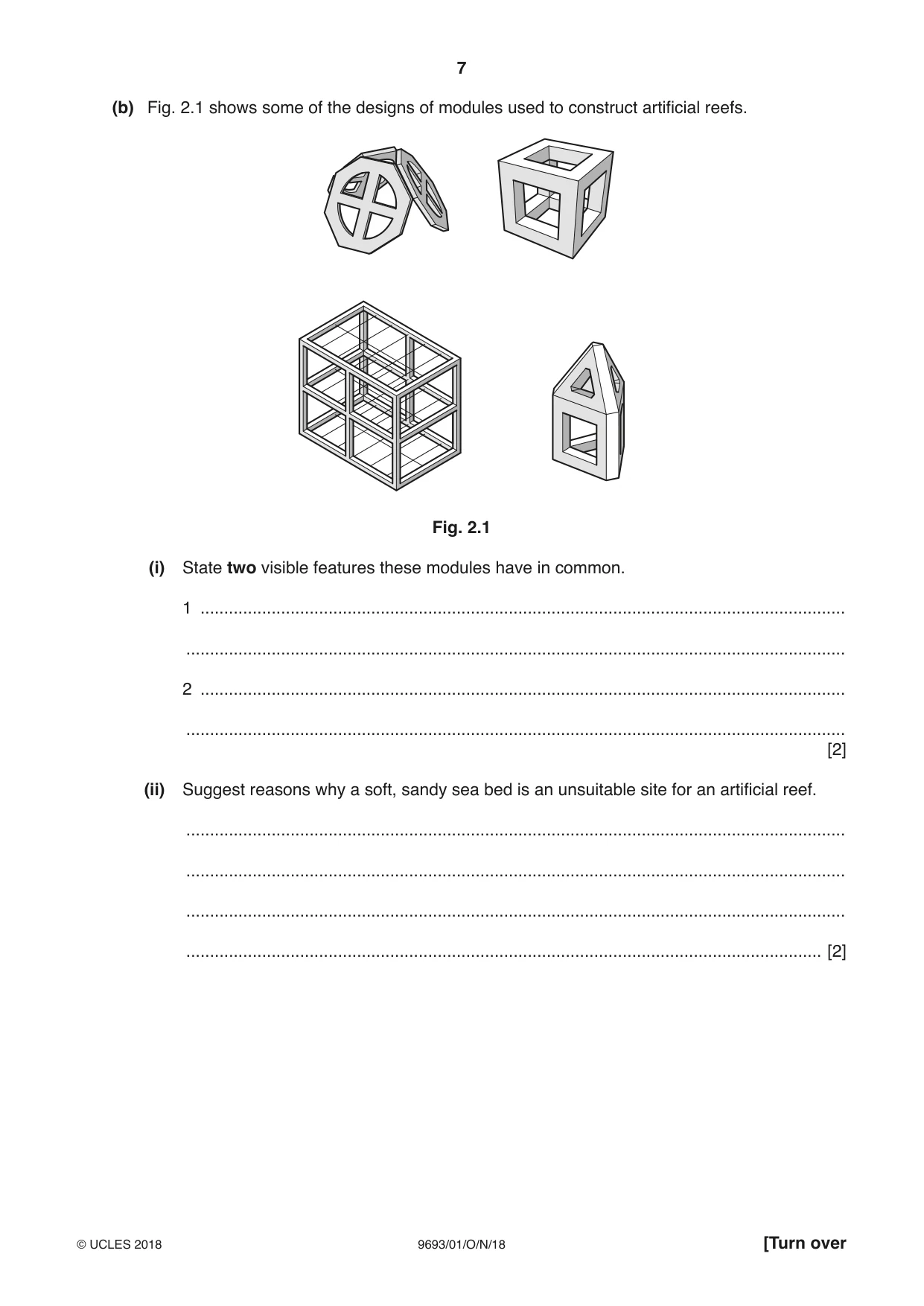
7 9693/01/O/N/18 © UCLES 2018 [Turn over (b) Fig. 2.1 shows some of the designs of modules used to construct artificial reefs. Fig. 2.1 (i) State two visible features these modules have in common. 1 … … 2 … … [2] (ii) Suggest reasons why a soft, sandy sea bed is an unsuitable site for an artificial reef. … … … … [2]
Question paper, page 8
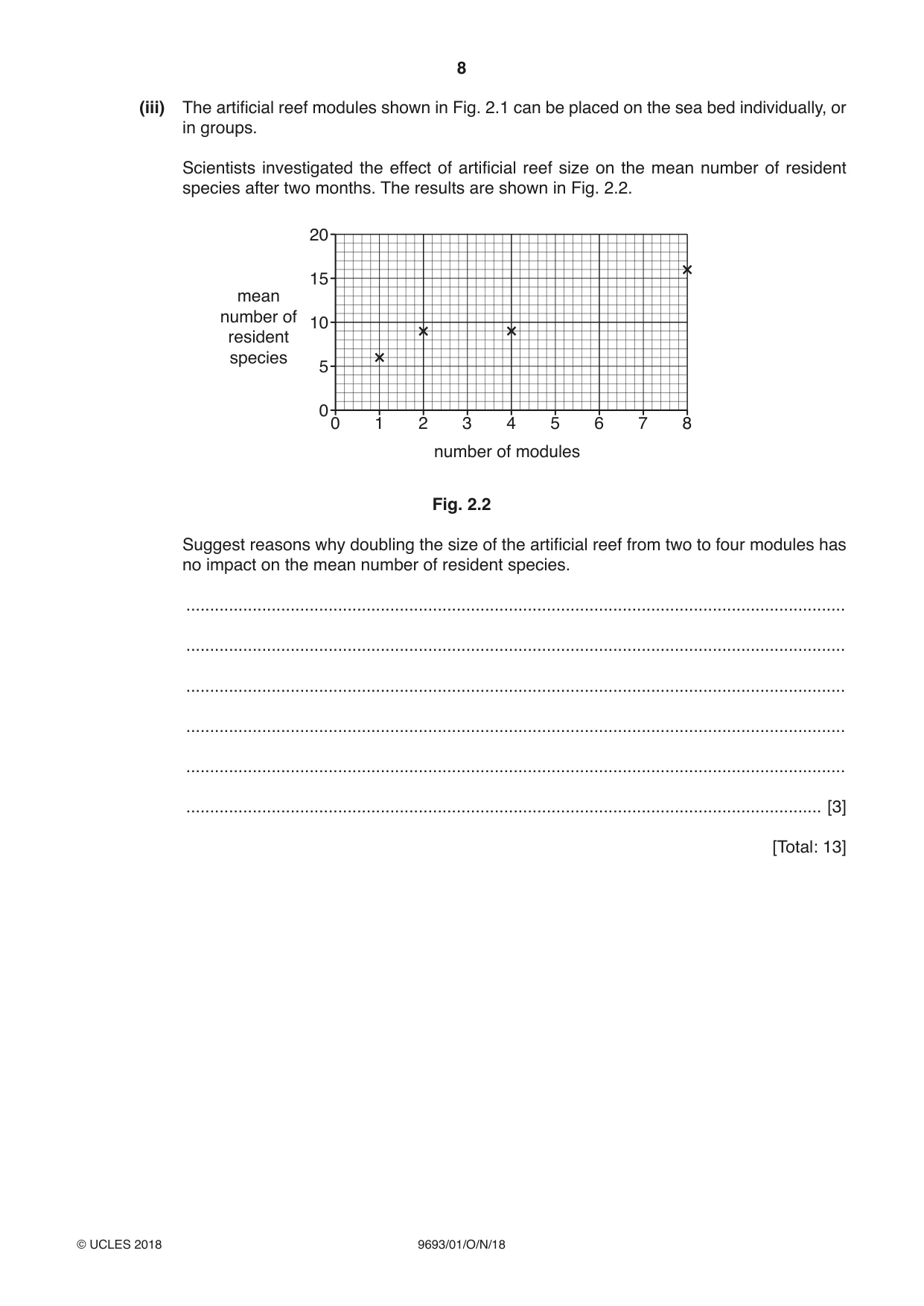
8 9693/01/O/N/18 © UCLES 2018 (iii) The artificial reef modules shown in Fig. 2.1 can be placed on the sea bed individually, or in groups. Scientists investigated the effect of artificial reef size on the mean number of resident species after two months. The results are shown in Fig. 2.2. 0 0 5 10 mean number of resident species number of modules 15 20 1 2 3 4 5 6 7 8 Fig. 2.2 Suggest reasons why doubling the size of the artificial reef from two to four modules has no impact on the mean number of resident species. … … … … … … [3] [Total: 13]
Question paper, page 9
9 9693/01/O/N/18 © UCLES 2018 [Turn over BLANK PAGE
Question paper, page 10
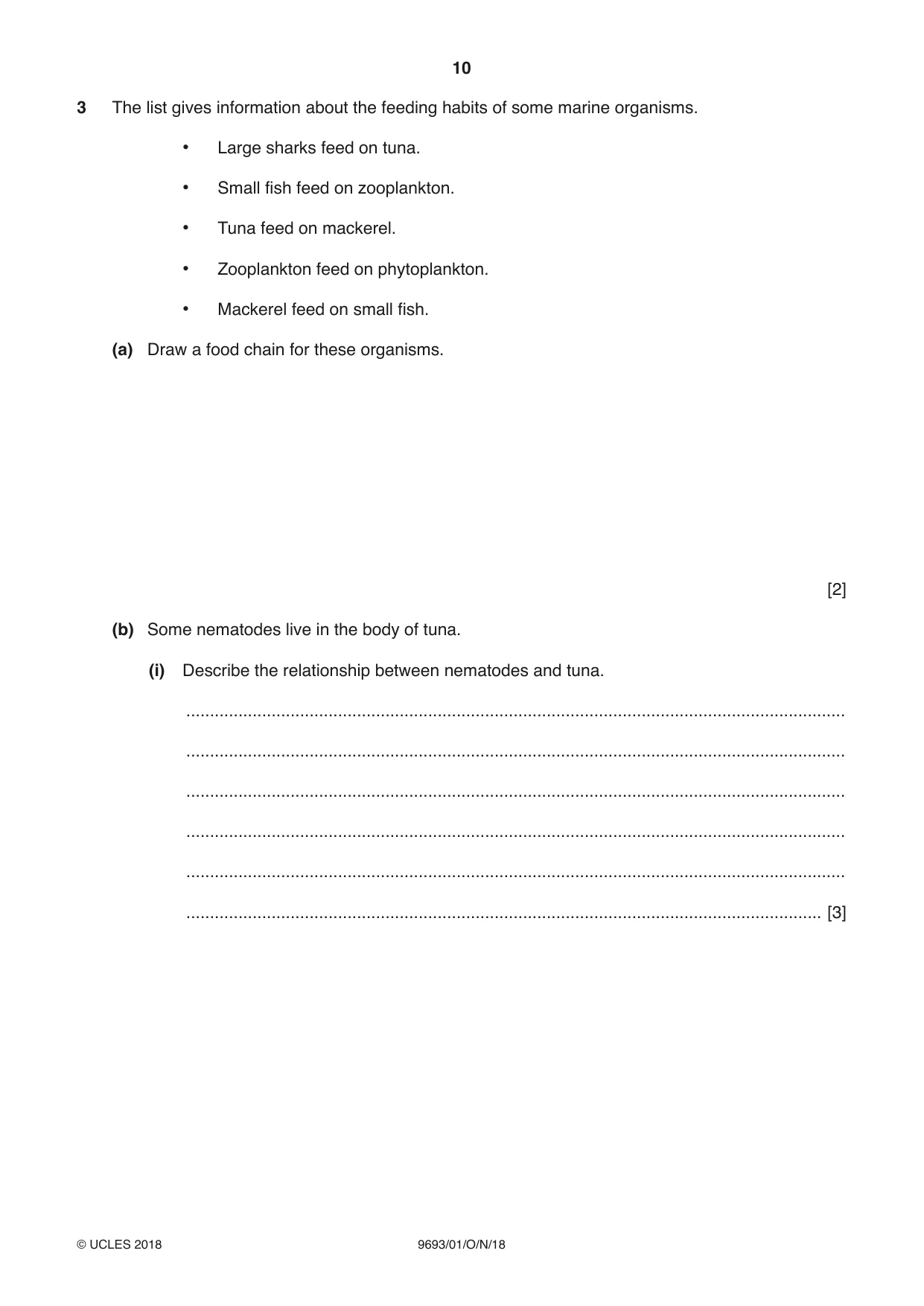
10 9693/01/O/N/18 © UCLES 2018 3 The list gives information about the feeding habits of some marine organisms. • Large sharks feed on tuna. • Small fish feed on zooplankton. • Tuna feed on mackerel. • Zooplankton feed on phytoplankton. • Mackerel feed on small fish. (a) Draw a food chain for these organisms. [2] (b) Some nematodes live in the body of tuna. (i) Describe the relationship between nematodes and tuna. … … … … … … [3]
Question paper, page 11
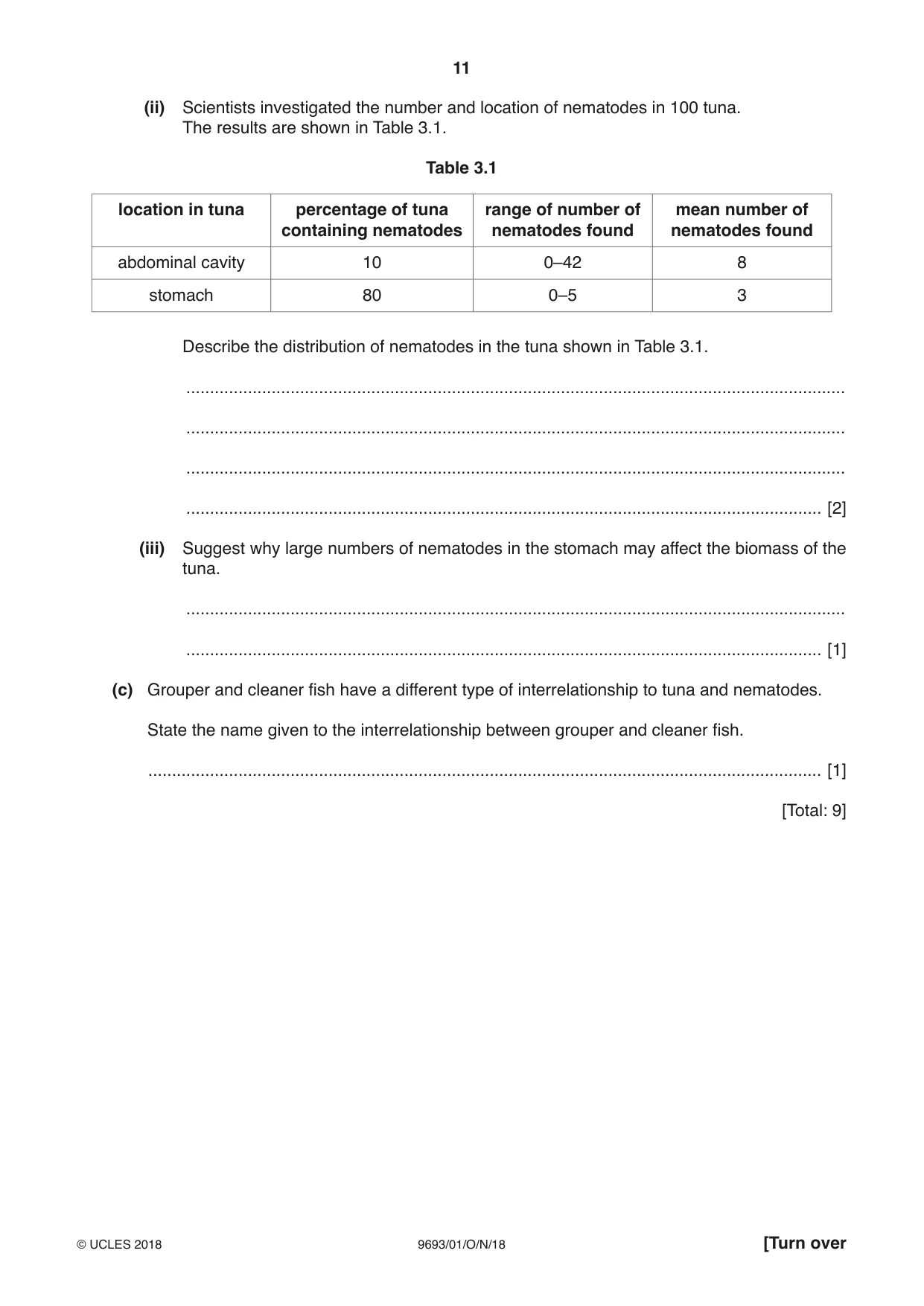
11 9693/01/O/N/18 © UCLES 2018 [Turn over (ii) Scientists investigated the number and location of nematodes in 100 tuna. The results are shown in Table 3.1. Table 3.1 location in tuna percentage of tuna containing nematodes range of number of nematodes found mean number of nematodes found abdominal cavity 10 0–42 8 stomach 80 0–5 3 Describe the distribution of nematodes in the tuna shown in Table 3.1. … … … … [2] (iii) Suggest why large numbers of nematodes in the stomach may affect the biomass of the tuna. … … [1] (c) Grouper and cleaner fish have a different type of interrelationship to tuna and nematodes. State the name given to the interrelationship between grouper and cleaner fish. … [1] [Total: 9]
Question paper, page 12
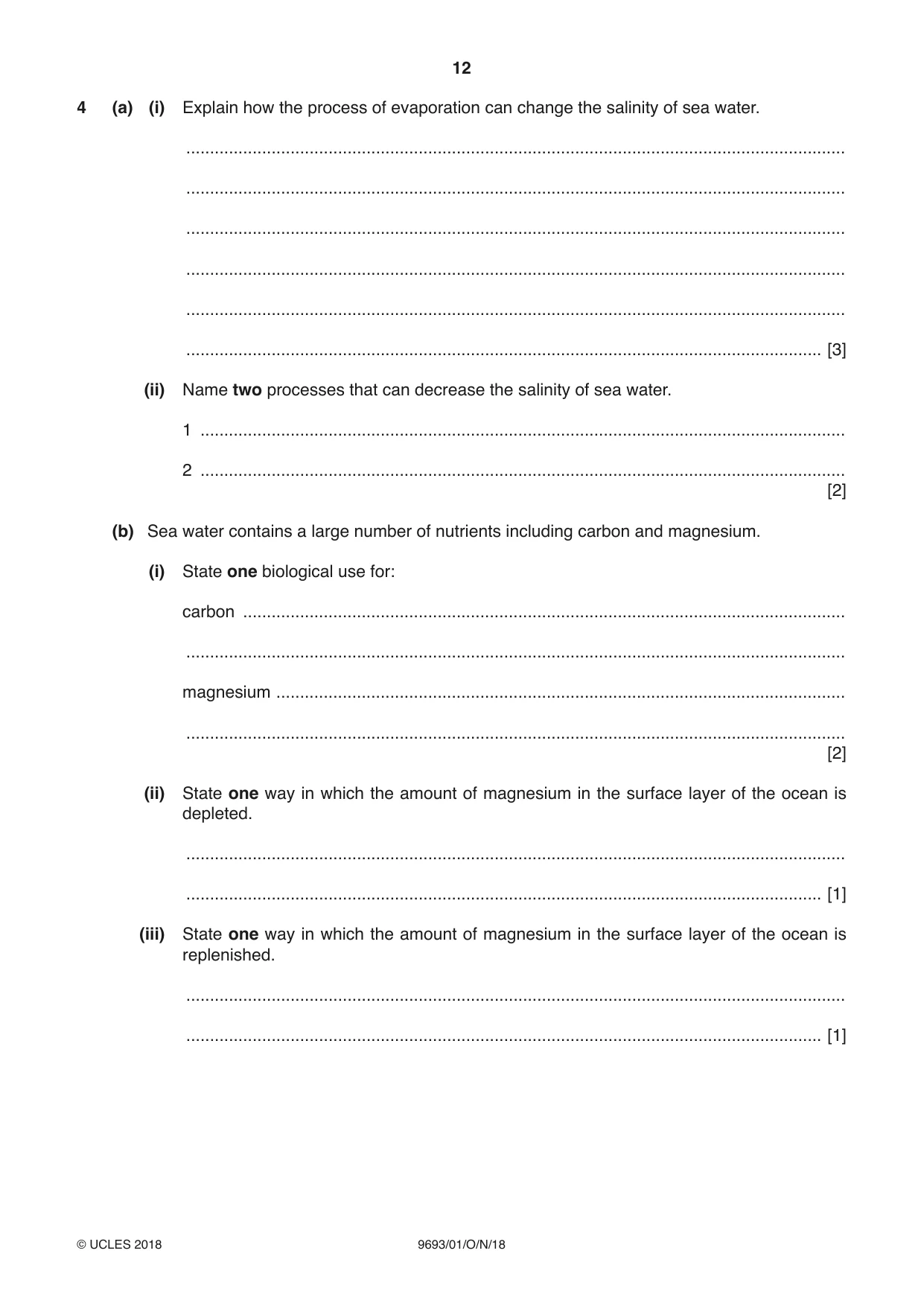
12 9693/01/O/N/18 © UCLES 2018 4 (a) (i) Explain how the process of evaporation can change the salinity of sea water. … … … … … … [3] (ii) Name two processes that can decrease the salinity of sea water. 1 … 2 … [2] (b) Sea water contains a large number of nutrients including carbon and magnesium. (i) State one biological use for: carbon … … magnesium … … [2] (ii) State one way in which the amount of magnesium in the surface layer of the ocean is depleted. … … [1] (iii) State one way in which the amount of magnesium in the surface layer of the ocean is replenished. … … [1]
Question paper, page 13
13 9693/01/O/N/18 © UCLES 2018 [Turn over (c) Sulfur is found in proteins. Like other nutrients, sulfur is cycled through every ecosystem. Suggest how sulfur is cycled through a marine ecosystem. You may include a labelled diagram in your answer. … … … … … … … … … … … [4] [Total: 13]
Question paper, page 14
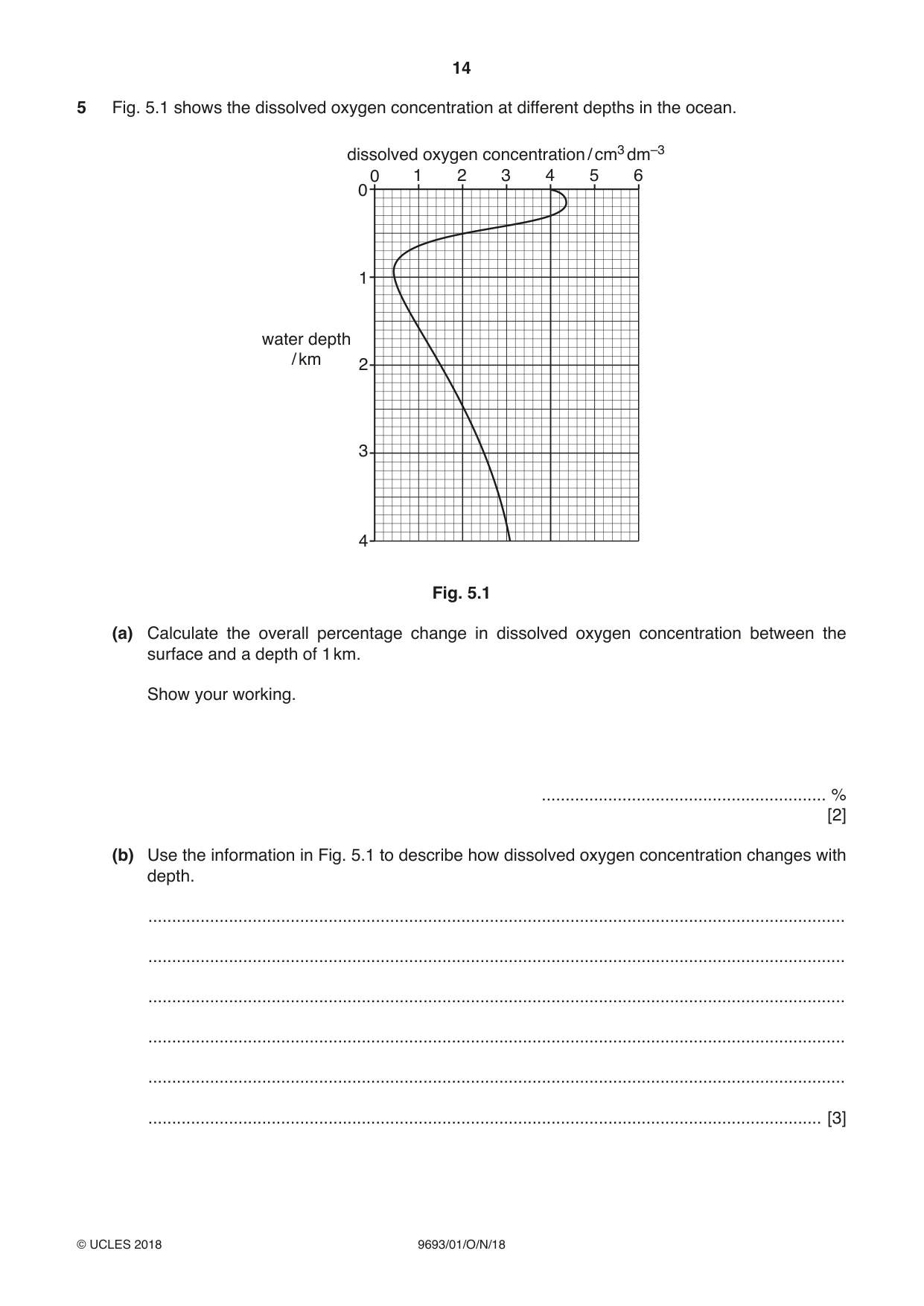
14 9693/01/O/N/18 © UCLES 2018 5 Fig. 5.1 shows the dissolved oxygen concentration at different depths in the ocean. 0 0 1 2 3 4 1 2 3 dissolved oxygen concentration / cm3 dm–3 4 5 6 water depth / km Fig. 5.1 (a) Calculate the overall percentage change in dissolved oxygen concentration between the surface and a depth of 1 km. Show your working. … % [2] (b) Use the information in Fig. 5.1 to describe how dissolved oxygen concentration changes with depth. … … … … … … [3]
Question paper, page 15
15 9693/01/O/N/18 © UCLES 2018 [Turn over (c) Suggest why these changes in dissolved oxygen concentration occur. … … … … … … … … [4] [Total: 9]
Question paper, page 16
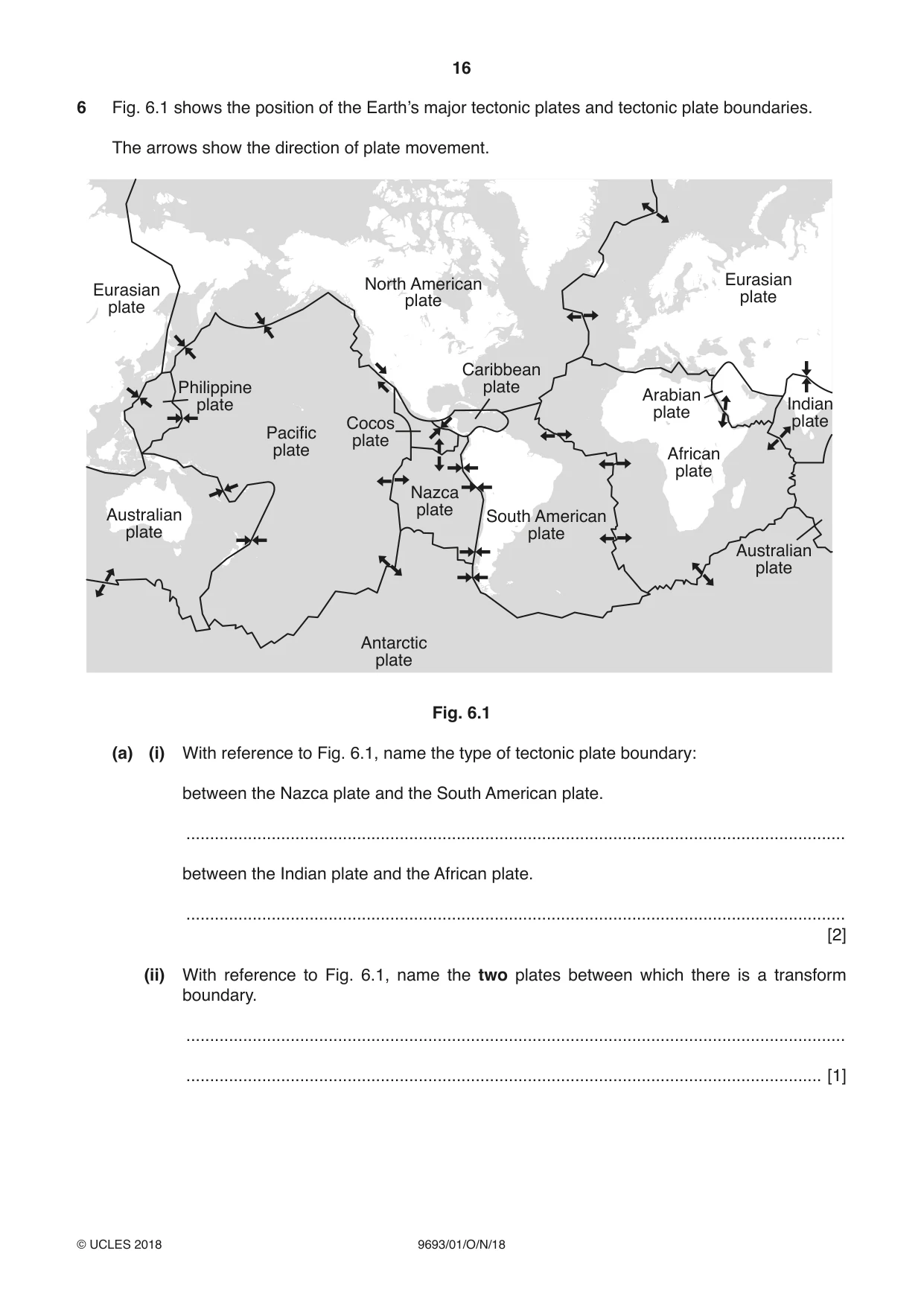
16 9693/01/O/N/18 © UCLES 2018 6 Fig. 6.1 shows the position of the Earth’s major tectonic plates and tectonic plate boundaries. The arrows show the direction of plate movement. Nazca plate African plate Arabian plate Indian plate Pacific plate Australian plate Australian plate Antarctic plate Philippine plate Eurasian plate Eurasian plate Cocos plate North American plate South American plate Caribbean plate Fig. 6.1 (a) (i) With reference to Fig. 6.1, name the type of tectonic plate boundary: between the Nazca plate and the South American plate. … between the Indian plate and the African plate. … [2] (ii) With reference to Fig. 6.1, name the two plates between which there is a transform boundary. … … [1]
Question paper, page 17
17 9693/01/O/N/18 © UCLES 2018 [Turn over (b) (i) Describe how underwater earthquakes are caused by the movement of tectonic plates towards each other. … … … … … … … … [4] (ii) Explain how an underwater earthquake can lead to the formation of a tsunami. … … … … [2] [Total: 9]
Question paper, page 18
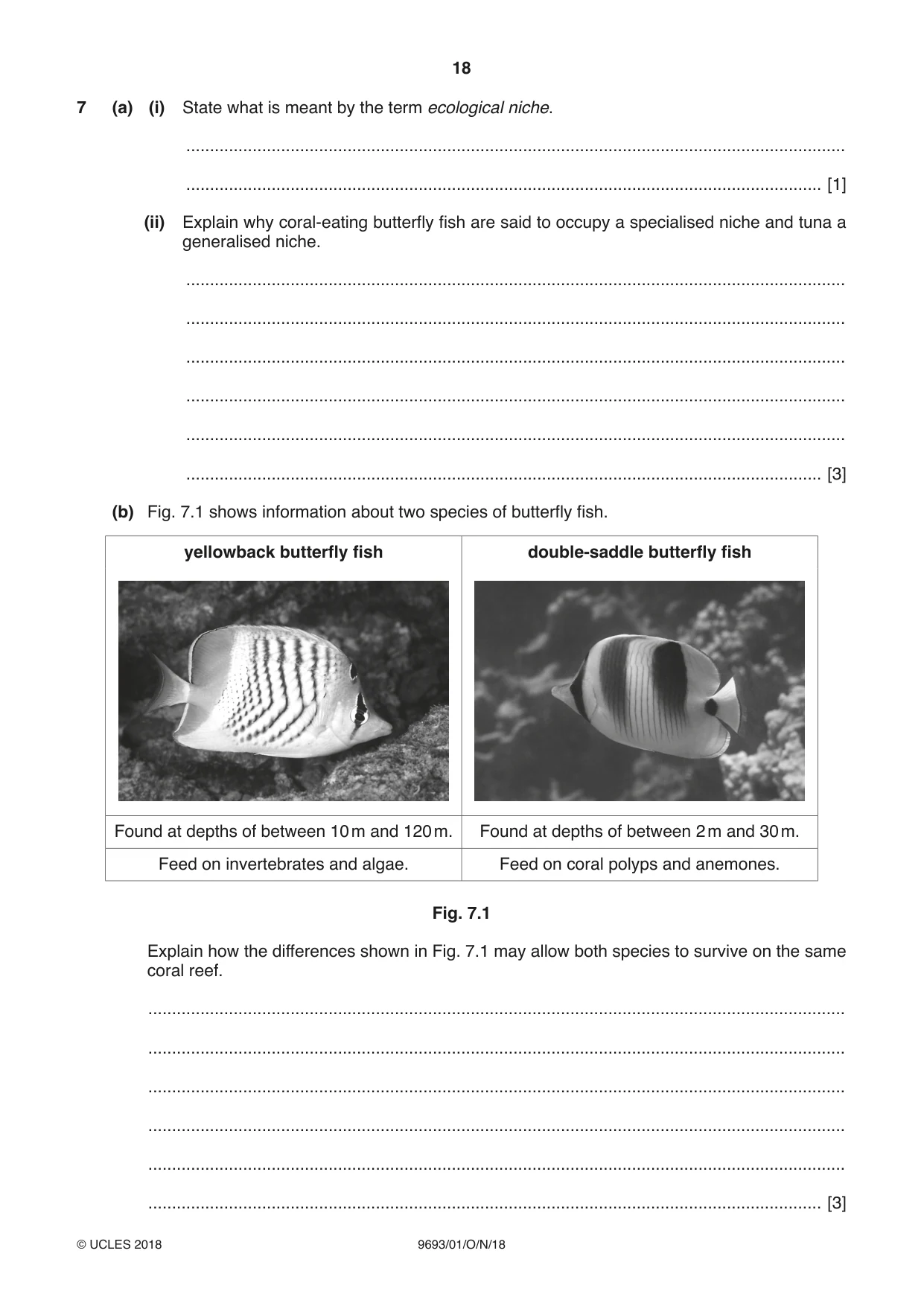
18 9693/01/O/N/18 © UCLES 2018 7 (a) (i) State what is meant by the term ecological niche. … … [1] (ii) Explain why coral-eating butterfly fish are said to occupy a specialised niche and tuna a generalised niche. … … … … … … [3] (b) Fig. 7.1 shows information about two species of butterfly fish. yellowback butterfly fish double-saddle butterfly fish Found at depths of between 10 m and 120 m. Found at depths of between 2 m and 30 m. Feed on invertebrates and algae. Feed on coral polyps and anemones. Fig. 7.1 Explain how the differences shown in Fig. 7.1 may allow both species to survive on the same coral reef. … … … … … … [3]
Question paper, page 19
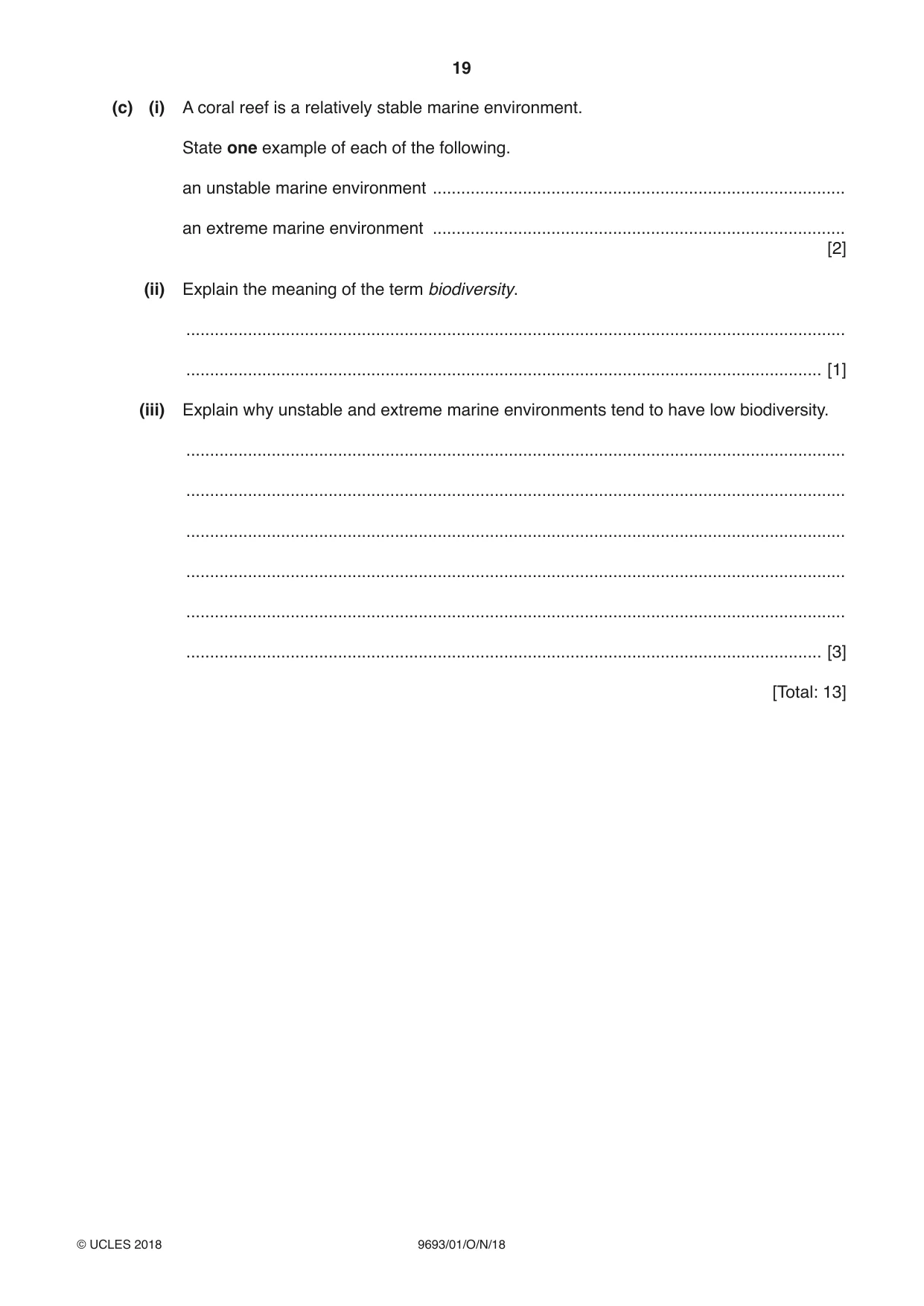
19 9693/01/O/N/18 © UCLES 2018 (c) (i) A coral reef is a relatively stable marine environment. State one example of each of the following. an unstable marine environment … an extreme marine environment … [2] (ii) Explain the meaning of the term biodiversity. … … [1] (iii) Explain why unstable and extreme marine environments tend to have low biodiversity. … … … … … … [3] [Total: 13]
Question paper, page 20
20 9693/01/O/N/18 © UCLES 2018 Permission to reproduce items where third-party owned material protected by copyright is included has been sought and cleared where possible. Every reasonable effort has been made by the publisher (UCLES) to trace copyright holders, but if any items requiring clearance have unwittingly been included, the publisher will be pleased to make amends at the earliest possible opportunity. To avoid the issue of disclosure of answer-related information to candidates, all copyright acknowledgements are reproduced online in the Cambridge International Examinations Copyright Acknowledgements Booklet. This is produced for each series of examinations and is freely available to download at www.cie.org.uk after the live examination series. Cambridge International Examinations is part of the Cambridge Assessment Group. Cambridge Assessment is the brand name of University of Cambridge Local Examinations Syndicate (UCLES), which is itself a department of the University of Cambridge. BLANK PAGE