Cambridge A Level Marine Science 9693 — 2018 May/June Paper 1 · Variant 2
9693/12/M/J/18 · 75 marks · ≈84 min
The question paper and its mark scheme, free to read here and free to download. This is Cambridge’s own paper, exactly as it was sat.
Question paper16 pages

Mark scheme15 pages
Answers below. Sit the paper first if you are practising.
Paper as text
Question paper, page 1
This document consists of 14 printed pages and 2 blank pages. DC (NH/FC) 146216/3 © UCLES 2018 [Turn over * 3 1 6 2 5 9 5 4 3 6 * MARINE SCIENCE 9693/12 Paper 1 AS Structured Questions May/June 2018 1 hour 30 minutes Candidates answer on the Question Paper. No Additional Materials are required. READ THESE INSTRUCTIONS FIRST Write your Centre number, candidate number and name on all the work you hand in. Write in dark blue or black pen. You may use an HB pencil for any diagrams or graphs. Do not use staples, paper clips, glue or correction fluid. DO NOT WRITE IN ANY BARCODES. Answer all questions. Write your answers in the spaces provided on the Question Paper. Electronic calculators may be used. You may lose marks if you do not show your working or if you do not use appropriate units. At the end of the examination, fasten all your work securely together. The number of marks is given in brackets [ ] at the end of each question or part question. Cambridge International Examinations Cambridge International Advanced Subsidiary and Advanced Level
Question paper, page 2
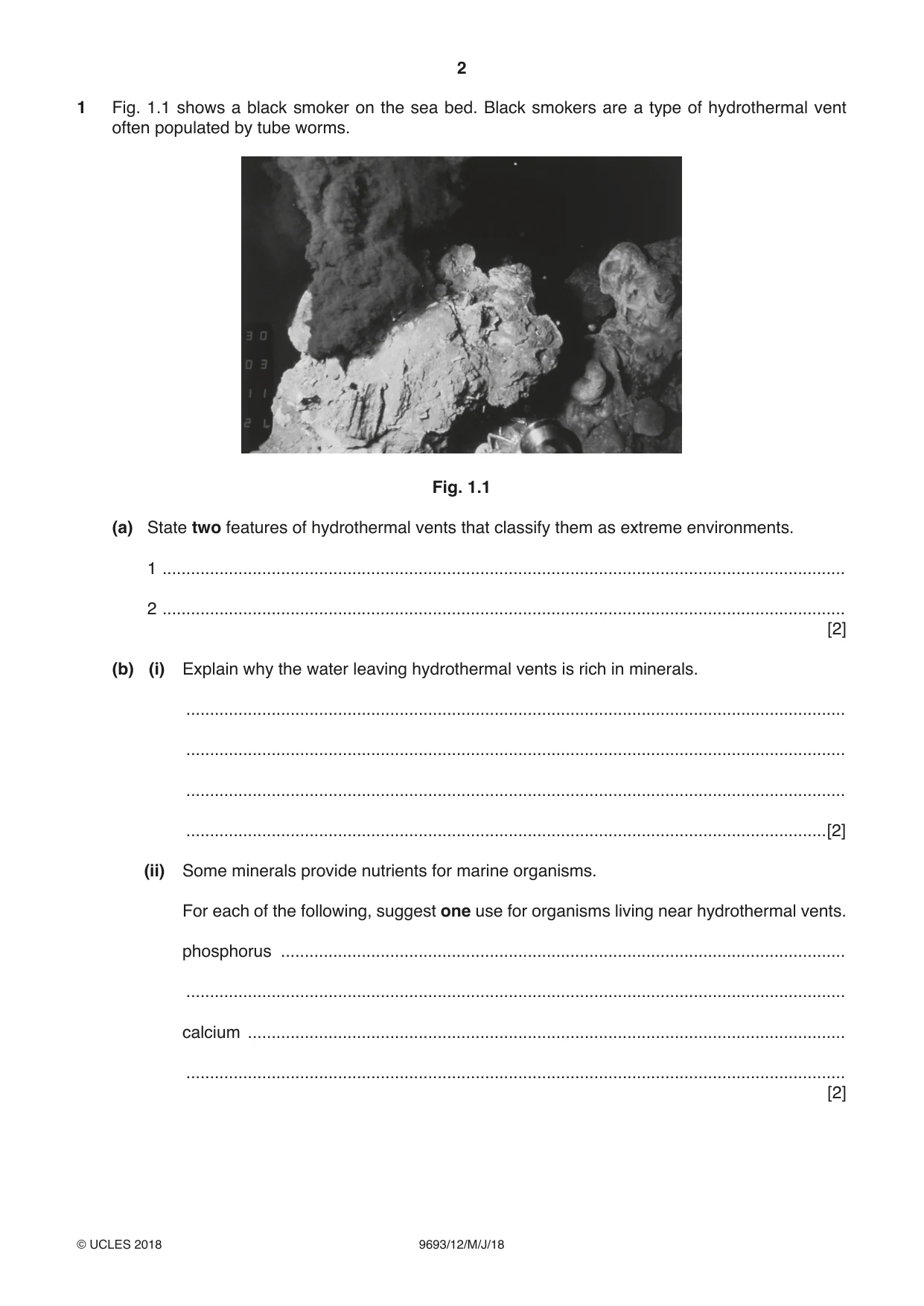
2 9693/12/M/J/18 © UCLES 2018 1 Fig. 1.1 shows a black smoker on the sea bed. Black smokers are a type of hydrothermal vent often populated by tube worms. Fig. 1.1 (a) State two features of hydrothermal vents that classify them as extreme environments. 1 … 2 … [2] (b) (i) Explain why the water leaving hydrothermal vents is rich in minerals. … … … …[2] (ii) Some minerals provide nutrients for marine organisms. For each of the following, suggest one use for organisms living near hydrothermal vents. phosphorus … … calcium … … [2]
Question paper, page 3
3 9693/12/M/J/18 © UCLES 2018 [Turn over (c) Describe the processes involved in hydrothermal vent formation. … … … … … …[3] (d) With reference to the tube worms found at hydrothermal vents, explain the meanings of the following ecological terms. (i) mutualism … … … … … …[3] (ii) succession … … … … … …[3] [Total: 15]
Question paper, page 4
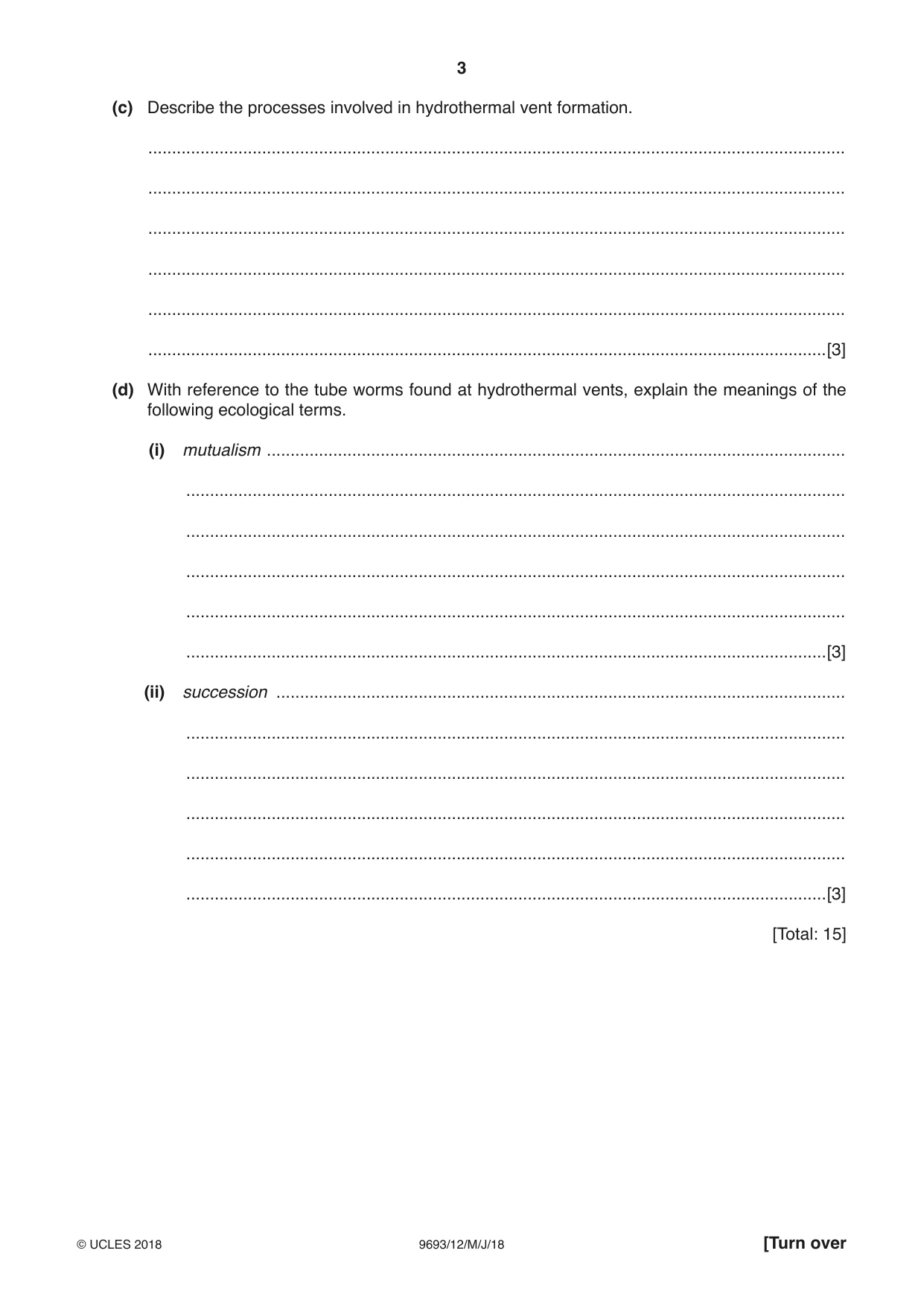
4 9693/12/M/J/18 © UCLES 2018 2 Fig. 2.1 shows the stages involved in the formation of an atoll, according to the Darwin-Dana-Daly theory. 1 2 3 4 Fig. 2.1 (a) Describe the events occurring at stages 1–4 in Fig. 2.1. 1 … … … 2 … … … 3 … … … 4 … … … [4]
Question paper, page 5
5 9693/12/M/J/18 © UCLES 2018 [Turn over (b) The Darwin-Dana-Daly theory relates the distribution of tropical coral to its physiology. Describe the conditions that allow for successful growth of coral reefs. … … … … … …[3] (c) State two factors that can lead to transition from the growth of a coral reef to its erosion. 1 … … 2 … … [2] (d) State two techniques that could be used to help reconstruct the history of a coral reef. 1 … … 2 … … [2] [Total: 11]
Question paper, page 6
6 9693/12/M/J/18 © UCLES 2018 3 Fig. 3.1 shows the total energy in each trophic level in a marine food chain in one year. The figures are given in arbitrary units. orca 12 salmon 115 herring 1280 zooplankton 12 100 phytoplankton 120 000 Fig. 3.1 (a) Explain why phytoplankton can be described as producers for this food chain. … … … …[2] (b) Use the information in Fig. 3.1 to calculate the percentage energy loss between zooplankton and herring. Show your working. …% [2] (c) Suggest reasons for the loss of energy that occurs between zooplankton and herring in this food chain. … … … … … …[3]
Question paper, page 7
7 9693/12/M/J/18 © UCLES 2018 [Turn over (d) Sketch and label a pyramid of energy for this food chain. Your pyramid does not have to be drawn to scale. [3] (e) Suggest the possible impacts of a large reduction in the herring population on the other populations in this food chain. Explain your suggestions. … … … … … …[3] [Total: 13]
Question paper, page 8
8 9693/12/M/J/18 © UCLES 2018 4 Fig. 4.1 shows the typical movement of air between the Indian Ocean and the Asian continent in July. cooler sea warmer land Fig. 4.1 (a) What name is given to winds generated between the Indian Ocean and the Asian continent? …[1] (b) With reference to Fig. 4.1, explain how the wind in July is generated. … … … … … …[3] (c) Explain how the wind pattern would be different in the cooler month of November. … … … …[2] [Total: 6]
Question paper, page 9
9 9693/12/M/J/18 © UCLES 2018 [Turn over BLANK PAGE
Question paper, page 10
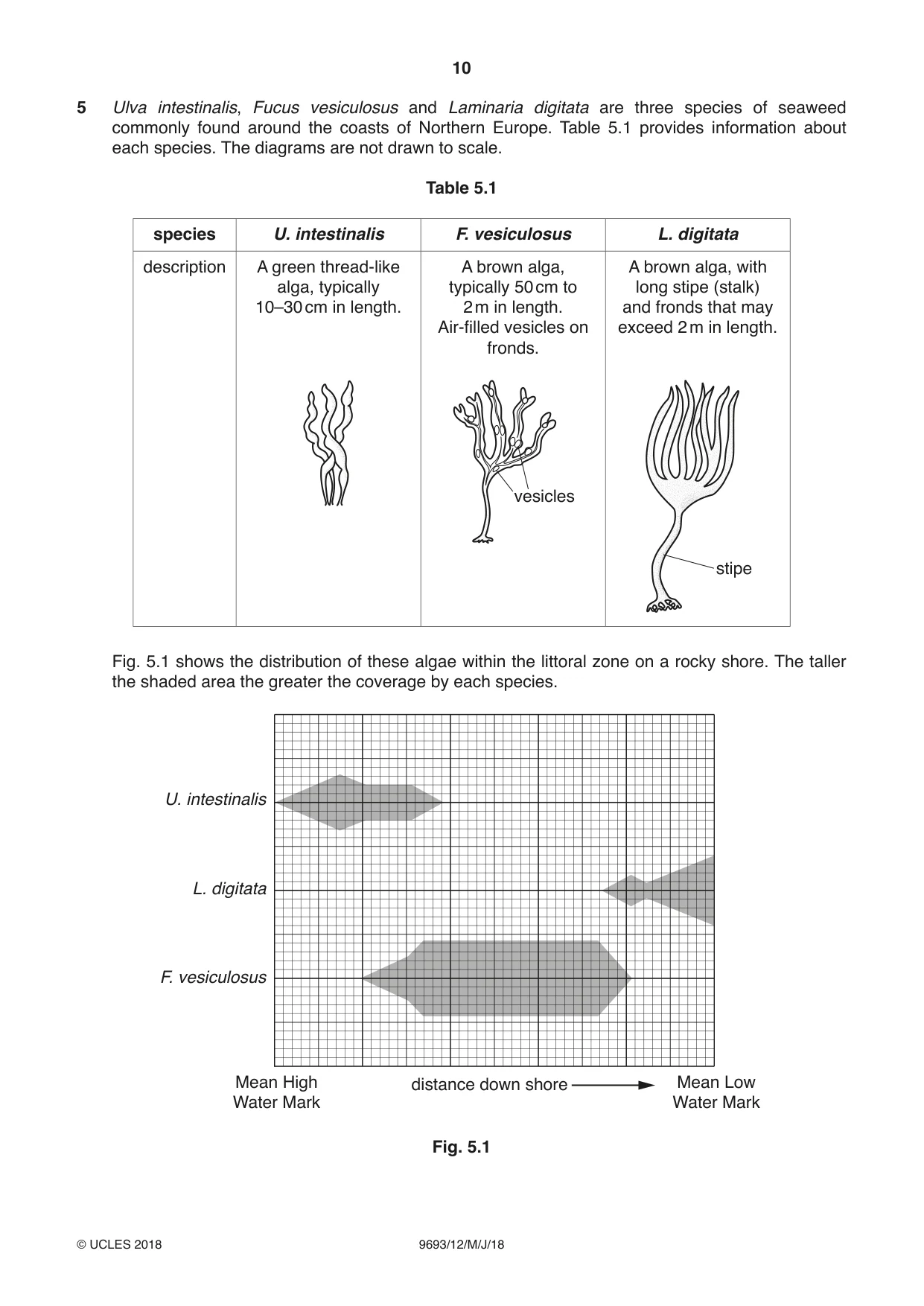
10 9693/12/M/J/18 © UCLES 2018 5 Ulva intestinalis, Fucus vesiculosus and Laminaria digitata are three species of seaweed commonly found around the coasts of Northern Europe. Table 5.1 provides information about each species. The diagrams are not drawn to scale. Table 5.1 species U. intestinalis F. vesiculosus L. digitata description A green thread-like alga, typically 10–30 cm in length. A brown alga, typically 50 cm to 2 m in length. Air-filled vesicles on fronds. vesicles A brown alga, with long stipe (stalk) and fronds that may exceed 2 m in length. stipe Fig. 5.1 shows the distribution of these algae within the littoral zone on a rocky shore. The taller the shaded area the greater the coverage by each species. Mean High Water Mark F. vesiculosus L. digitata U. intestinalis Mean Low Water Mark distance down shore Fig. 5.1
Question paper, page 11
11 9693/12/M/J/18 © UCLES 2018 [Turn over (a) Outline the distribution of each species of alga shown in Fig. 5.1. Use Table 5.1 to help suggest reasons for this distribution. (i) U. intestinalis … … … …[2] (ii) F. vesiculosus … … … …[2] (iii) L. digitata … … … …[2]
Question paper, page 12
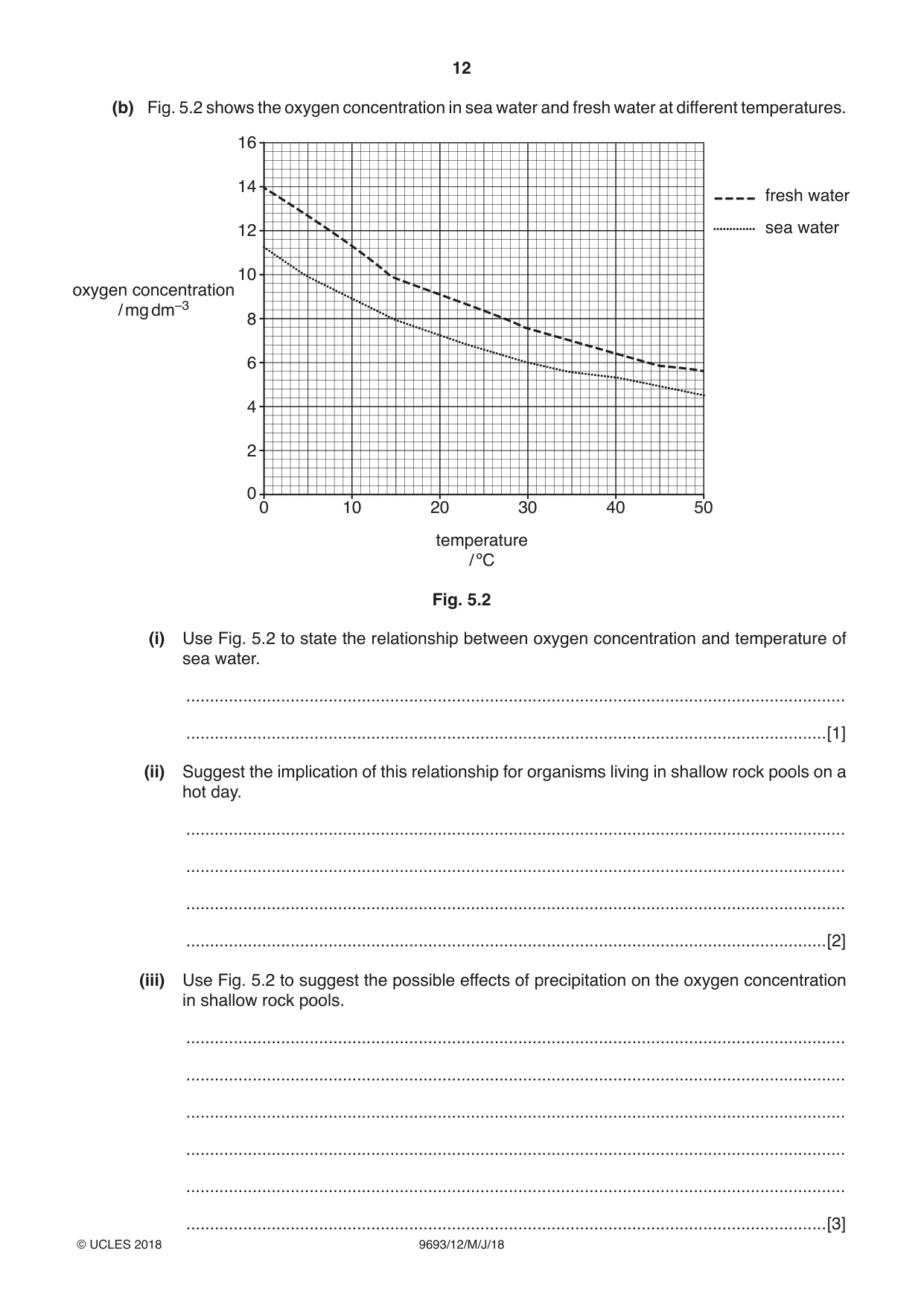
12 9693/12/M/J/18 © UCLES 2018 (b) Fig. 5.2 shows the oxygen concentration in sea water and fresh water at different temperatures. fresh water sea water 0 2 0 4 6 8 10 12 14 16 10 20 temperature / ºC oxygen concentration / mg dm–3 30 40 50 Fig. 5.2 (i) Use Fig. 5.2 to state the relationship between oxygen concentration and temperature of sea water. … …[1] (ii) Suggest the implication of this relationship for organisms living in shallow rock pools on a hot day. … … … …[2] (iii) Use Fig. 5.2 to suggest the possible effects of precipitation on the oxygen concentration in shallow rock pools. … … … … … …[3]
Question paper, page 13
13 9693/12/M/J/18 © UCLES 2018 [Turn over (c) Explain the effect of evaporation on the salinity of a shallow rock pool. … … … …[2] [Total: 14]
Question paper, page 14
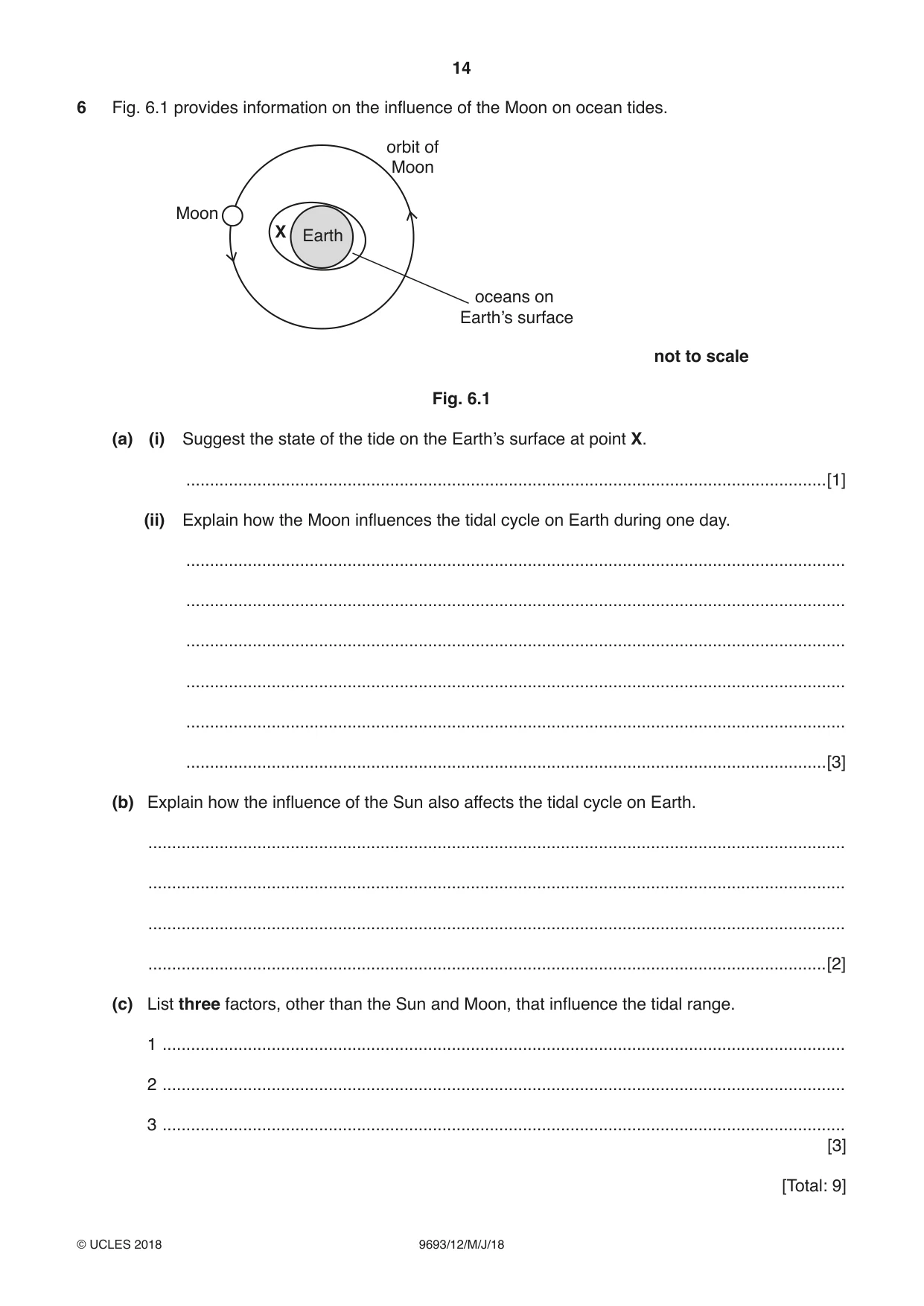
14 9693/12/M/J/18 © UCLES 2018 6 Fig. 6.1 provides information on the influence of the Moon on ocean tides. orbit of Moon oceans on Earth’s surface Moon Earth X not to scale Fig. 6.1 (a) (i) Suggest the state of the tide on the Earth’s surface at point X. …[1] (ii) Explain how the Moon influences the tidal cycle on Earth during one day. … … … … … …[3] (b) Explain how the influence of the Sun also affects the tidal cycle on Earth. … … … …[2] (c) List three factors, other than the Sun and Moon, that influence the tidal range. 1 … 2 … 3 … [3] [Total: 9]
Question paper, page 15
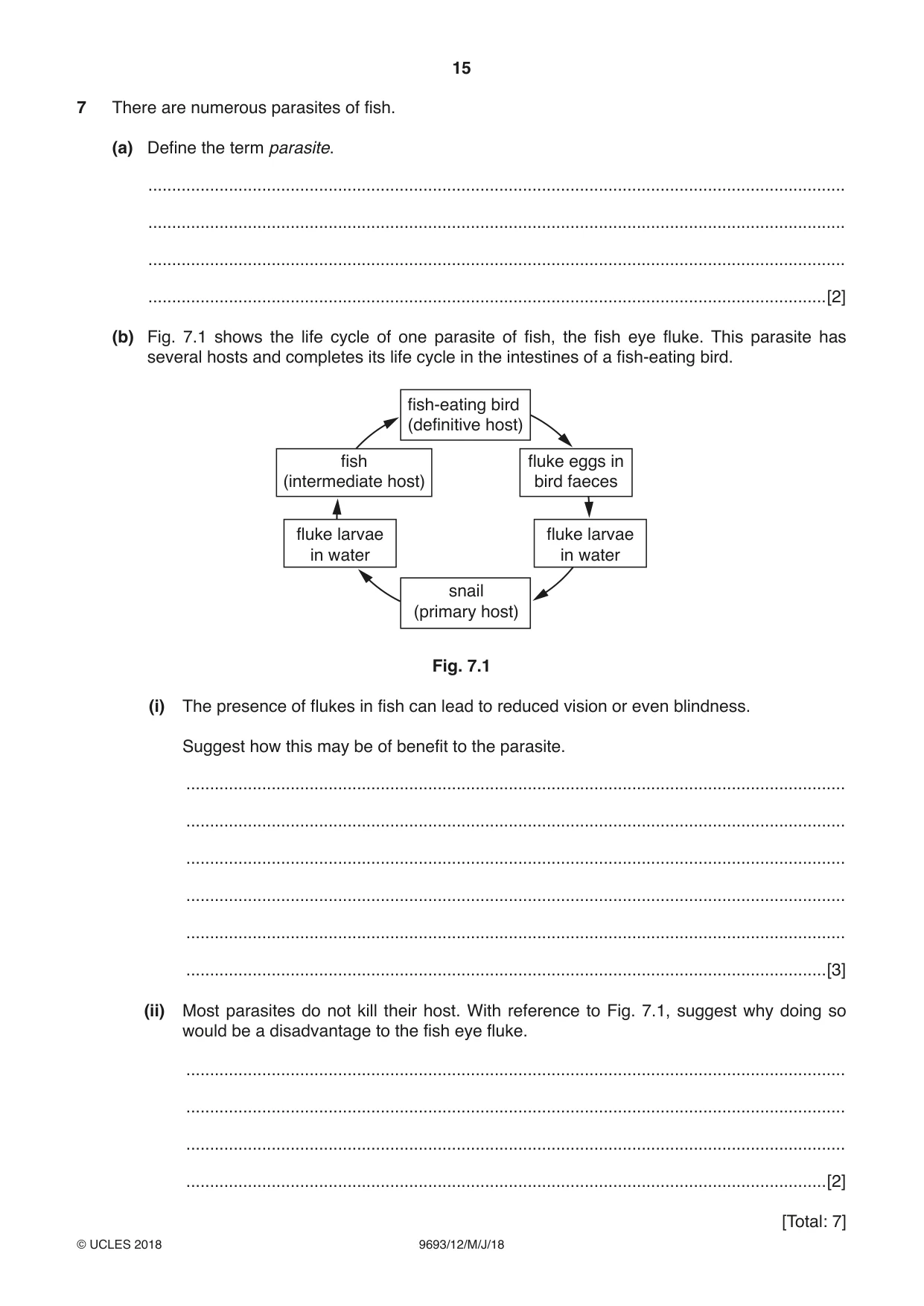
15 9693/12/M/J/18 © UCLES 2018 7 There are numerous parasites of fish. (a) Define the term parasite. … … … …[2] (b) Fig. 7.1 shows the life cycle of one parasite of fish, the fish eye fluke. This parasite has several hosts and completes its life cycle in the intestines of a fish-eating bird. fish-eating bird (definitive host) fluke eggs in bird faeces fish (intermediate host) fluke larvae in water fluke larvae in water snail (primary host) Fig. 7.1 (i) The presence of flukes in fish can lead to reduced vision or even blindness. Suggest how this may be of benefit to the parasite. … … … … … …[3] (ii) Most parasites do not kill their host. With reference to Fig. 7.1, suggest why doing so would be a disadvantage to the fish eye fluke. … … … …[2] [Total: 7]
Question paper, page 16
16 9693/12/M/J/18 © UCLES 2018 Permission to reproduce items where third-party owned material protected by copyright is included has been sought and cleared where possible. Every reasonable effort has been made by the publisher (UCLES) to trace copyright holders, but if any items requiring clearance have unwittingly been included, the publisher will be pleased to make amends at the earliest possible opportunity. To avoid the issue of disclosure of answer-related information to candidates, all copyright acknowledgements are reproduced online in the Cambridge International Examinations Copyright Acknowledgements Booklet. This is produced for each series of examinations and is freely available to download at www.cie.org.uk after the live examination series. Cambridge International Examinations is part of the Cambridge Assessment Group. Cambridge Assessment is the brand name of University of Cambridge Local Examinations Syndicate (UCLES), which is itself a department of the University of Cambridge. BLANK PAGE
Mark scheme, page 1
IGCSE™ is a registered trademark. This document consists of 15 printed pages. © UCLES 2018 [Turn over Cambridge Assessment International Education Cambridge International Advanced Subsidiary and Advanced Level MARINE SCIENCE 9693/12 Paper 1 AS Structured Questions May/June 2018 MARK SCHEME Maximum Mark: 75 Published This mark scheme is published as an aid to teachers and candidates, to indicate the requirements of the examination. It shows the basis on which Examiners were instructed to award marks. It does not indicate the details of the discussions that took place at an Examiners’ meeting before marking began, which would have considered the acceptability of alternative answers. Mark schemes should be read in conjunction with the question paper and the Principal Examiner Report for Teachers. Cambridge International will not enter into discussions about these mark schemes. Cambridge International is publishing the mark schemes for the May/June 2018 series for most Cambridge IGCSE™, Cambridge International A and AS Level and Cambridge Pre-U components, and some Cambridge O Level components.
Mark scheme, page 2
9693/12 Cambridge International AS/A Level – Mark Scheme PUBLISHED May/June 2018 © UCLES 2018 Page 2 of 15 Generic Marking Principles These general marking principles must be applied by all examiners when marking candidate answers. They should be applied alongside the specific content of the mark scheme or generic level descriptors for a question. Each question paper and mark scheme will also comply with these marking principles. GENERIC MARKING PRINCIPLE 1: Marks must be awarded in line with: • the specific content of the mark scheme or the generic level descriptors for the question • the specific skills defined in the mark scheme or in the generic level descriptors for the question • the standard of response required by a candidate as exemplified by the standardisation scripts. GENERIC MARKING PRINCIPLE 2: Marks awarded are always whole marks (not half marks, or other fractions). GENERIC MARKING PRINCIPLE 3: Marks must be awarded positively: • marks are awarded for correct/valid answers, as defined in the mark scheme. However, credit is given for valid answers which go beyond the scope of the syllabus and mark scheme, referring to your Team Leader as appropriate • marks are awarded when candidates clearly demonstrate what they know and can do • marks are not deducted for errors • marks are not deducted for omissions • answers should only be judged on the quality of spelling, punctuation and grammar when these features are specifically assessed by the question as indicated by the mark scheme. The meaning, however, should be unambiguous. GENERIC MARKING PRINCIPLE 4: Rules must be applied consistently e.g. in situations where candidates have not followed instructions or in the application of generic level descriptors.
Mark scheme, page 3
9693/12 Cambridge International AS/A Level – Mark Scheme PUBLISHED May/June 2018 © UCLES 2018 Page 3 of 15 GENERIC MARKING PRINCIPLE 5: Marks should be awarded using the full range of marks defined in the mark scheme for the question (however; the use of the full mark range may be limited according to the quality of the candidate responses seen). GENERIC MARKING PRINCIPLE 6: Marks awarded are based solely on the requirements as defined in the mark scheme. Marks should not be awarded with grade thresholds or grade descriptors in mind.
Mark scheme, page 4
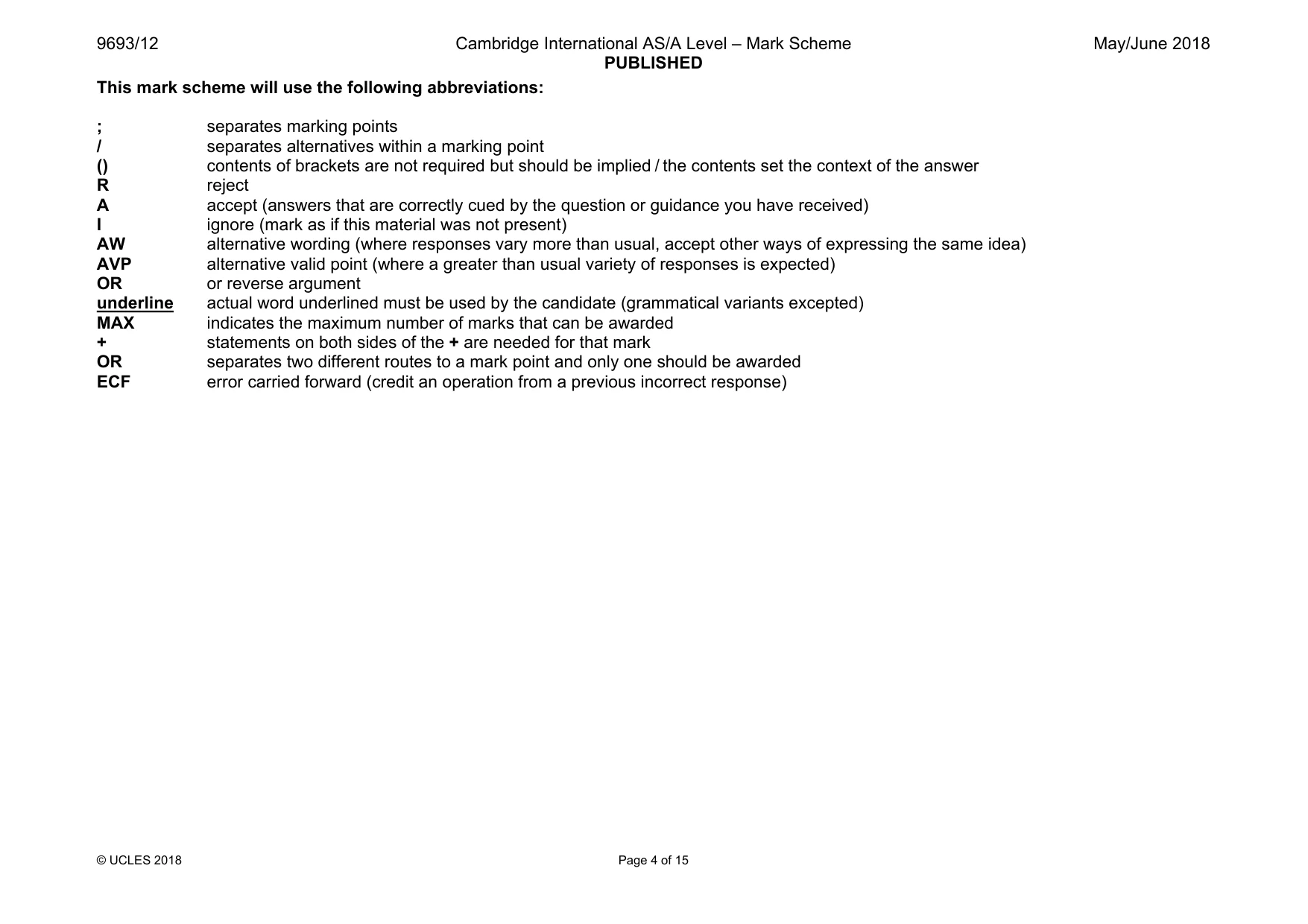
9693/12 Cambridge International AS/A Level – Mark Scheme PUBLISHED May/June 2018 © UCLES 2018 Page 4 of 15 This mark scheme will use the following abbreviations: ; separates marking points / separates alternatives within a marking point () contents of brackets are not required but should be implied / the contents set the context of the answer R reject A accept (answers that are correctly cued by the question or guidance you have received) I ignore (mark as if this material was not present) AW alternative wording (where responses vary more than usual, accept other ways of expressing the same idea) AVP alternative valid point (where a greater than usual variety of responses is expected) OR or reverse argument underline actual word underlined must be used by the candidate (grammatical variants excepted) MAX indicates the maximum number of marks that can be awarded + statements on both sides of the + are needed for that mark OR separates two different routes to a mark point and only one should be awarded ECF error carried forward (credit an operation from a previous incorrect response)
Mark scheme, page 5
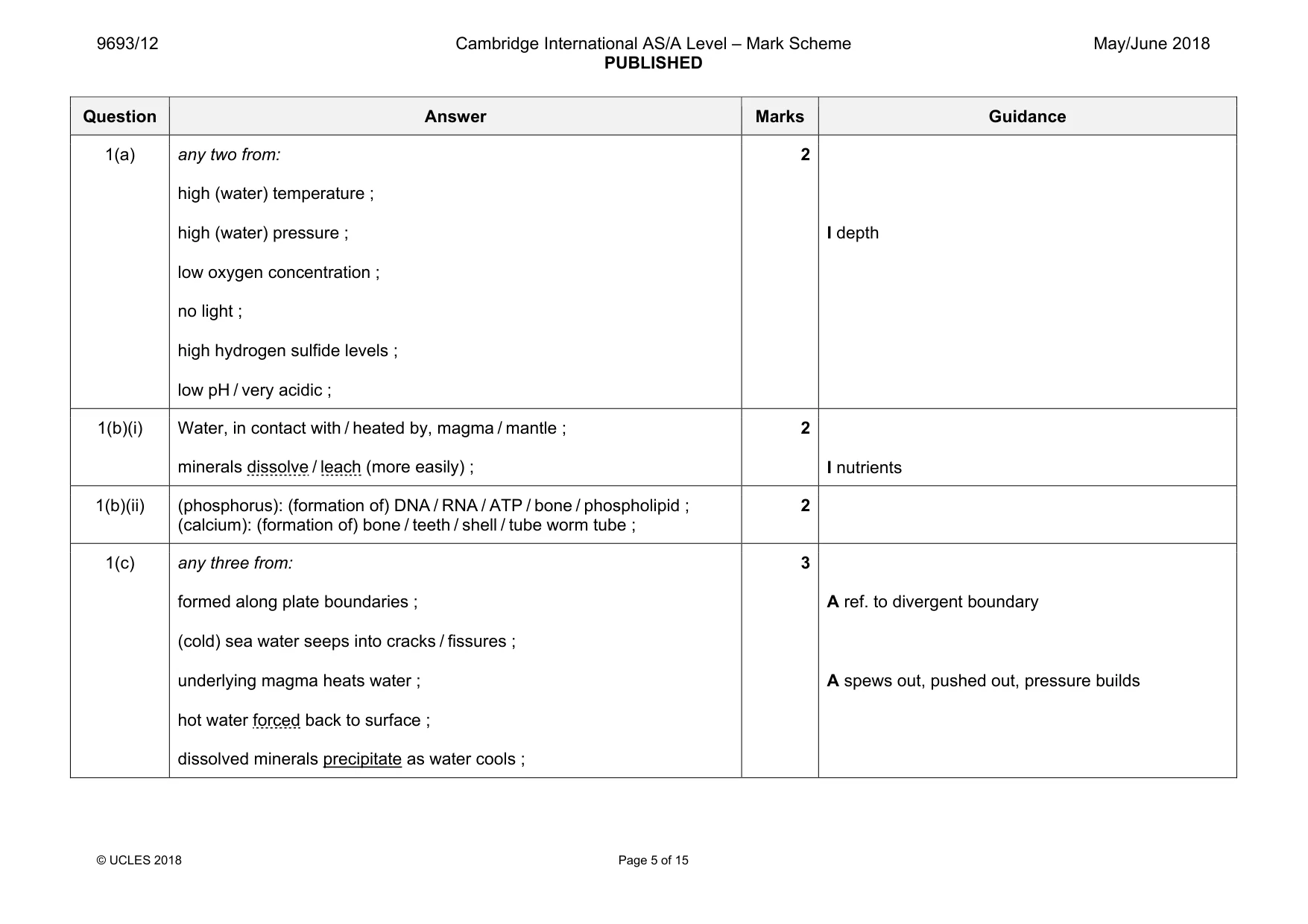
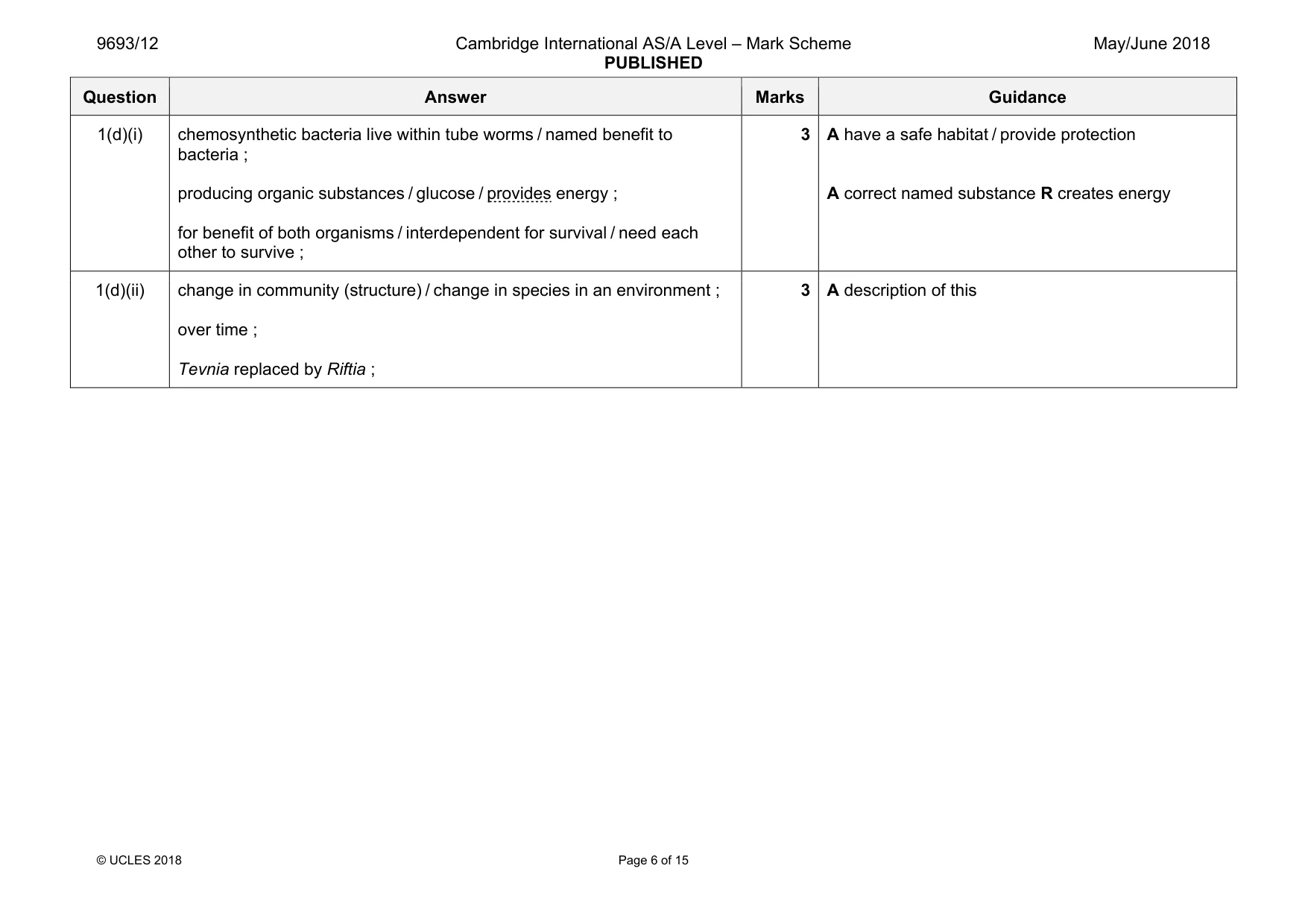
9693/12 Cambridge International AS/A Level – Mark Scheme PUBLISHED May/June 2018 © UCLES 2018 Page 5 of 15 Question Answer Marks Guidance 1(a) any two from: high (water) temperature ; high (water) pressure ; low oxygen concentration ; no light ; high hydrogen sulfide levels ; low pH / very acidic ; 2 I depth 1(b)(i) Water, in contact with / heated by, magma / mantle ; minerals dissolve / leach (more easily) ; 2 I nutrients 1(b)(ii) (phosphorus): (formation of) DNA / RNA / ATP / bone / phospholipid ; (calcium): (formation of) bone / teeth / shell / tube worm tube ; 2 1(c) any three from: formed along plate boundaries ; (cold) sea water seeps into cracks / fissures ; underlying magma heats water ; hot water forced back to surface ; dissolved minerals precipitate as water cools ; 3 A ref. to divergent boundary A spews out, pushed out, pressure builds
Mark scheme, page 6
9693/12 Cambridge International AS/A Level – Mark Scheme PUBLISHED May/June 2018 © UCLES 2018 Page 6 of 15 Question Answer Marks Guidance 1(d)(i) chemosynthetic bacteria live within tube worms / named benefit to bacteria ; producing organic substances / glucose / provides energy ; for benefit of both organisms / interdependent for survival / need each other to survive ; 3 A have a safe habitat / provide protection A correct named substance R creates energy 1(d)(ii) change in community (structure) / change in species in an environment ; over time ; Tevnia replaced by Riftia ; 3 A description of this
Mark scheme, page 7
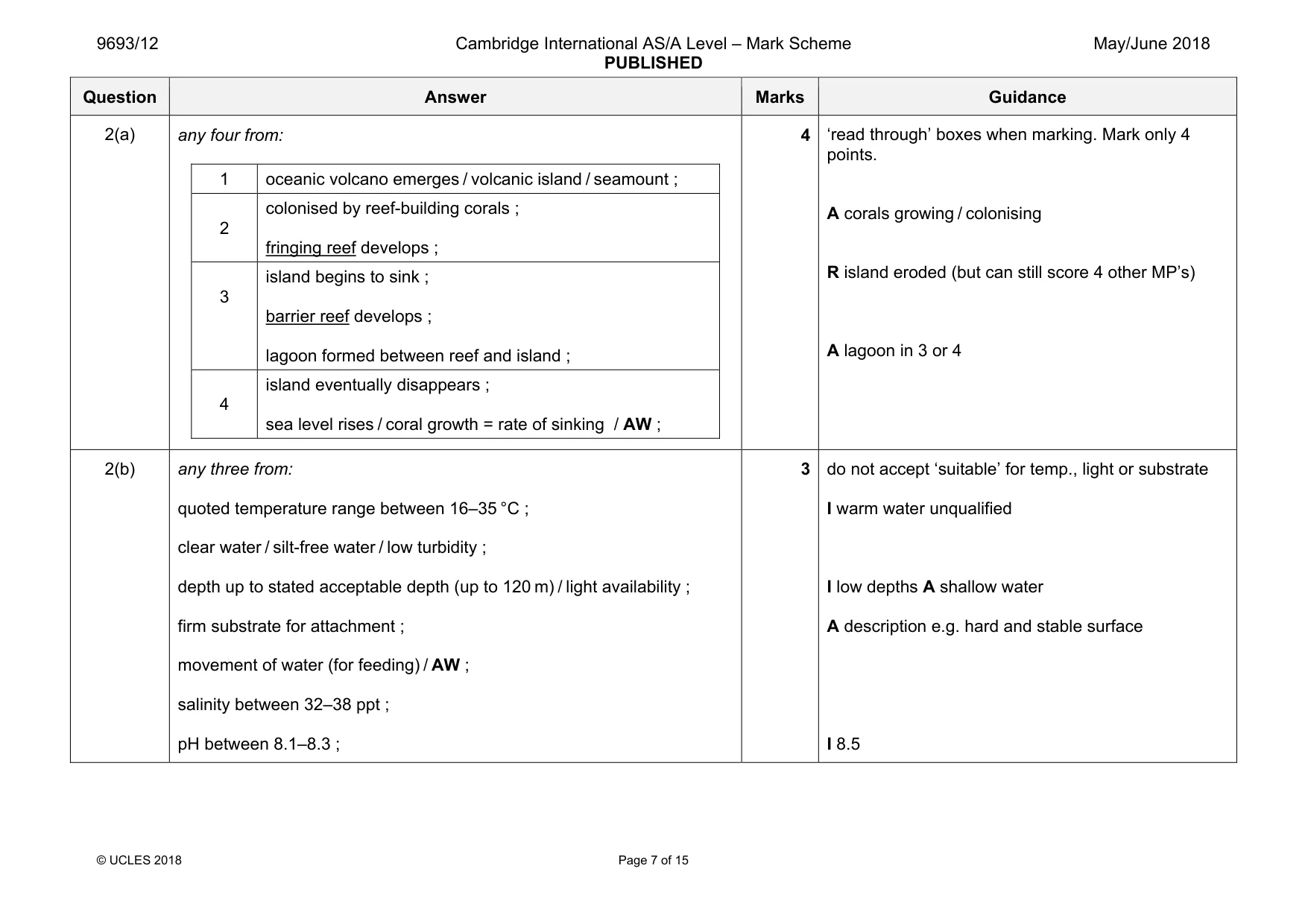
9693/12 Cambridge International AS/A Level – Mark Scheme PUBLISHED May/June 2018 © UCLES 2018 Page 7 of 15 Question Answer Marks Guidance 2(a) any four from: 1 oceanic volcano emerges / volcanic island / seamount ; 2 colonised by reef-building corals ; fringing reef develops ; 3 island begins to sink ; barrier reef develops ; lagoon formed between reef and island ; 4 island eventually disappears ; sea level rises / coral growth = rate of sinking / AW ; 4 ‘read through’ boxes when marking. Mark only 4 points. A corals growing / colonising R island eroded (but can still score 4 other MP’s) A lagoon in 3 or 4 2(b) any three from: quoted temperature range between 16–35 °C ; clear water / silt-free water / low turbidity ; depth up to stated acceptable depth (up to 120 m) / light availability ; firm substrate for attachment ; movement of water (for feeding) / AW ; salinity between 32–38 ppt ; pH between 8.1–8.3 ; 3 do not accept ‘suitable’ for temp., light or substrate I warm water unqualified I low depths A shallow water A description e.g. hard and stable surface I 8.5
Mark scheme, page 8
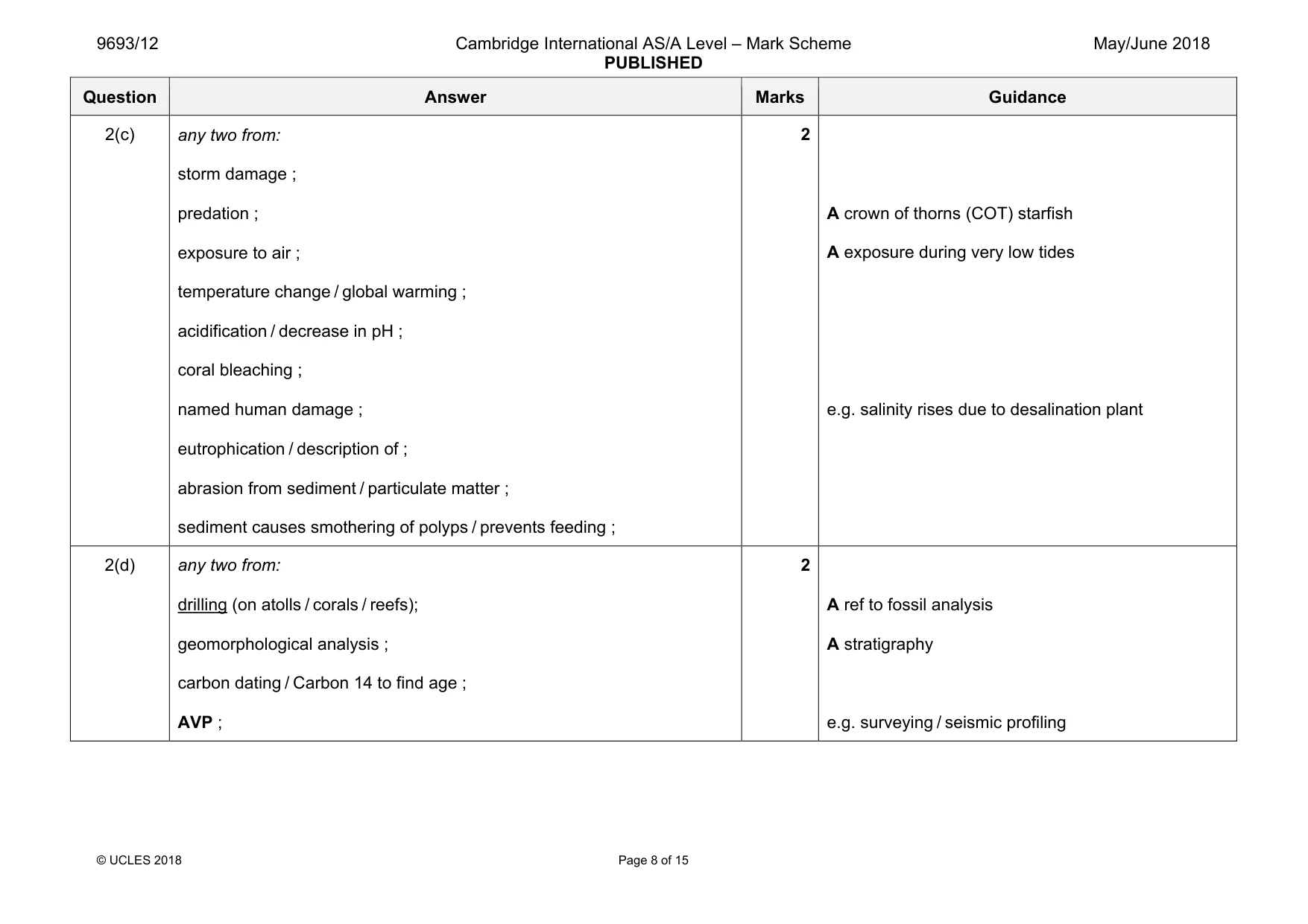
9693/12 Cambridge International AS/A Level – Mark Scheme PUBLISHED May/June 2018 © UCLES 2018 Page 8 of 15 Question Answer Marks Guidance 2(c) any two from: storm damage ; predation ; exposure to air ; temperature change / global warming ; acidification / decrease in pH ; coral bleaching ; named human damage ; eutrophication / description of ; abrasion from sediment / particulate matter ; sediment causes smothering of polyps / prevents feeding ; 2 A crown of thorns (COT) starfish A exposure during very low tides e.g. salinity rises due to desalination plant 2(d) any two from: drilling (on atolls / corals / reefs); geomorphological analysis ; carbon dating / Carbon 14 to find age ; AVP ; 2 A ref to fossil analysis A stratigraphy e.g. surveying / seismic profiling
Mark scheme, page 9
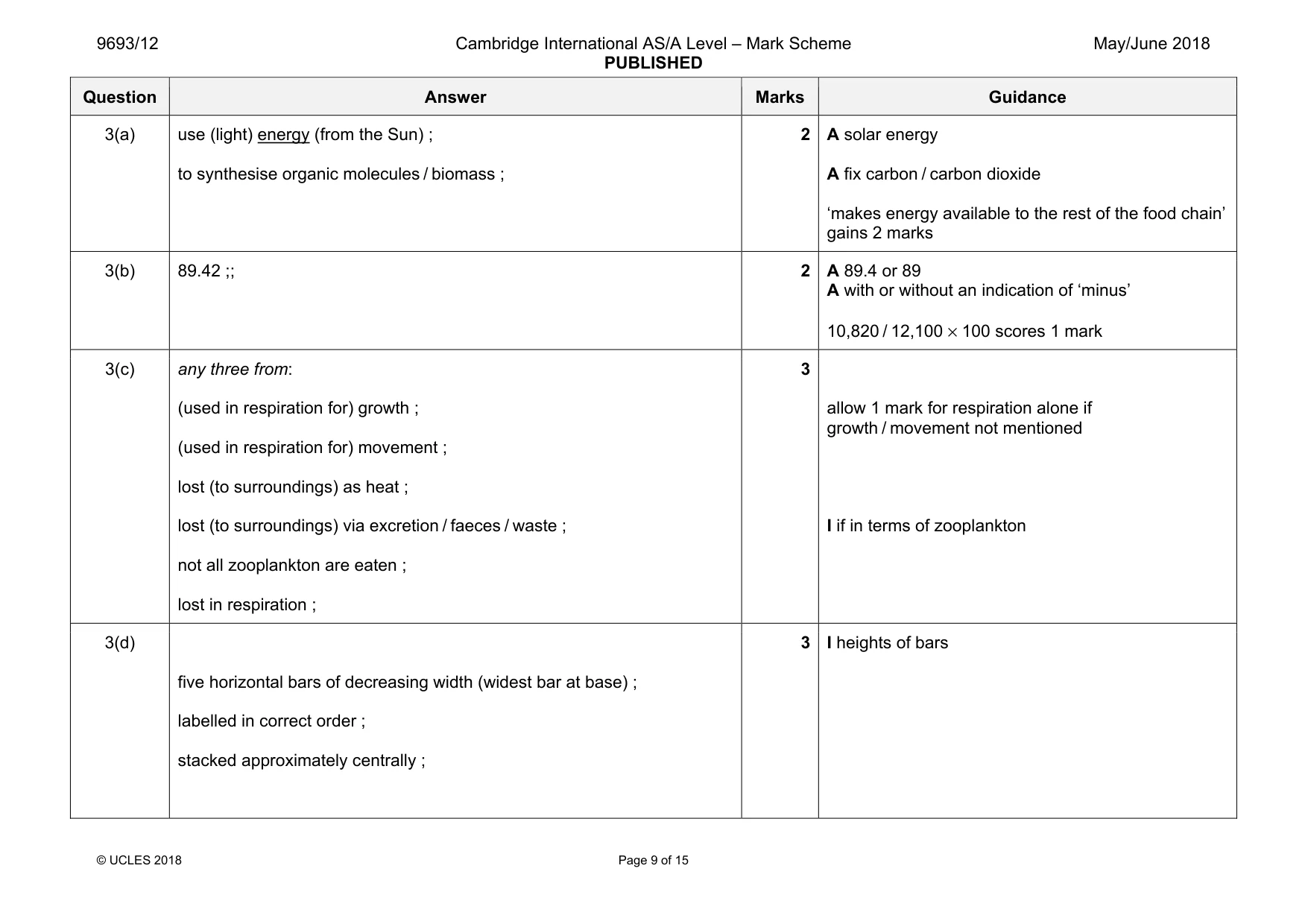
9693/12 Cambridge International AS/A Level – Mark Scheme PUBLISHED May/June 2018 © UCLES 2018 Page 9 of 15 Question Answer Marks Guidance 3(a) use (light) energy (from the Sun) ; to synthesise organic molecules / biomass ; 2 A solar energy A fix carbon / carbon dioxide ‘makes energy available to the rest of the food chain’ gains 2 marks 3(b) 89.42 ;; 2 A 89.4 or 89 A with or without an indication of ‘minus’ 10,820 / 12,100 × 100 scores 1 mark 3(c) any three from: (used in respiration for) growth ; (used in respiration for) movement ; lost (to surroundings) as heat ; lost (to surroundings) via excretion / faeces / waste ; not all zooplankton are eaten ; lost in respiration ; 3 allow 1 mark for respiration alone if growth / movement not mentioned I if in terms of zooplankton 3(d) five horizontal bars of decreasing width (widest bar at base) ; labelled in correct order ; stacked approximately centrally ; 3 I heights of bars
Mark scheme, page 10
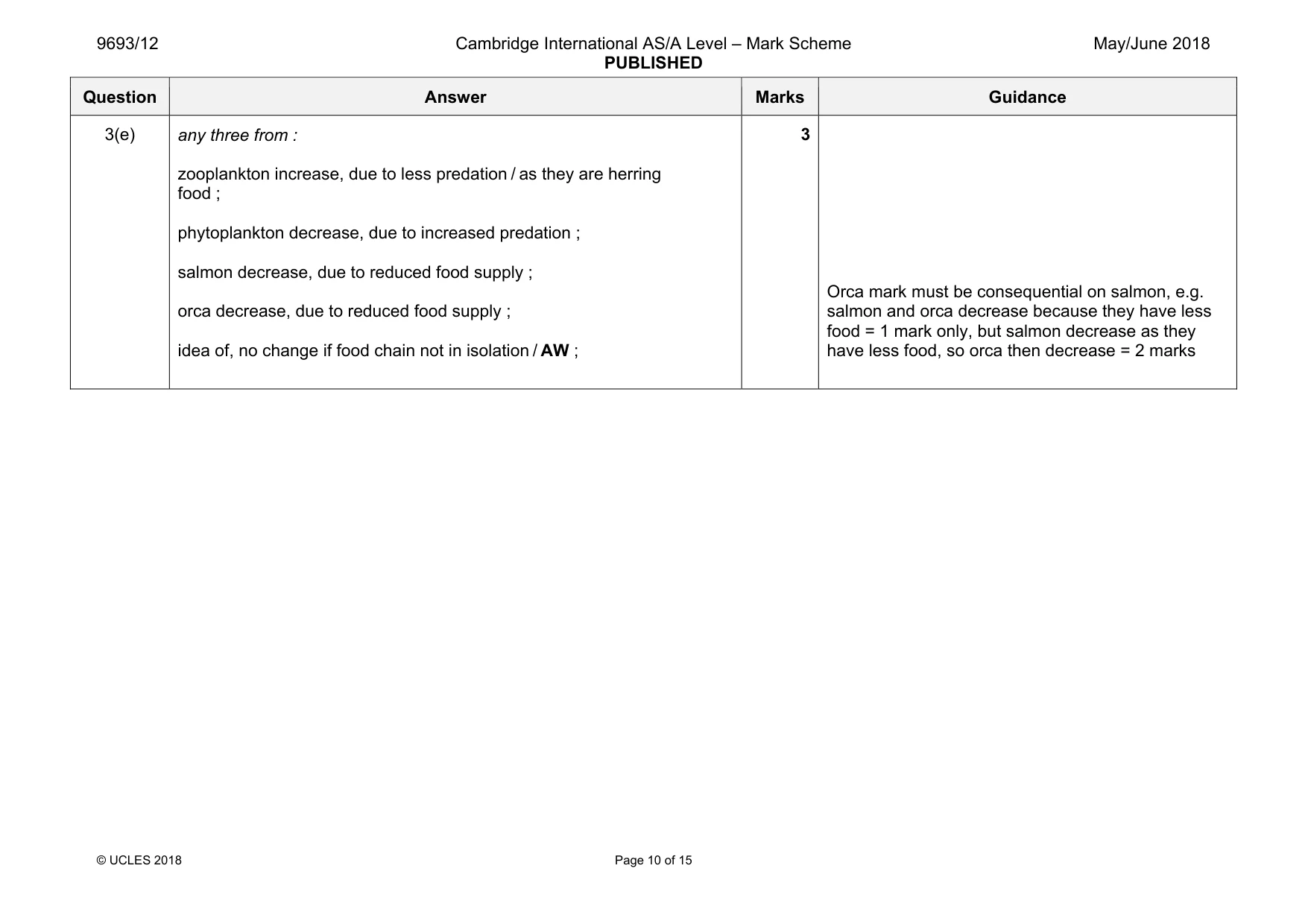
9693/12 Cambridge International AS/A Level – Mark Scheme PUBLISHED May/June 2018 © UCLES 2018 Page 10 of 15 Question Answer Marks Guidance 3(e) any three from : zooplankton increase, due to less predation / as they are herring food ; phytoplankton decrease, due to increased predation ; salmon decrease, due to reduced food supply ; orca decrease, due to reduced food supply ; idea of, no change if food chain not in isolation / AW ; 3 Orca mark must be consequential on salmon, e.g. salmon and orca decrease because they have less food = 1 mark only, but salmon decrease as they have less food, so orca then decrease = 2 marks
Mark scheme, page 11
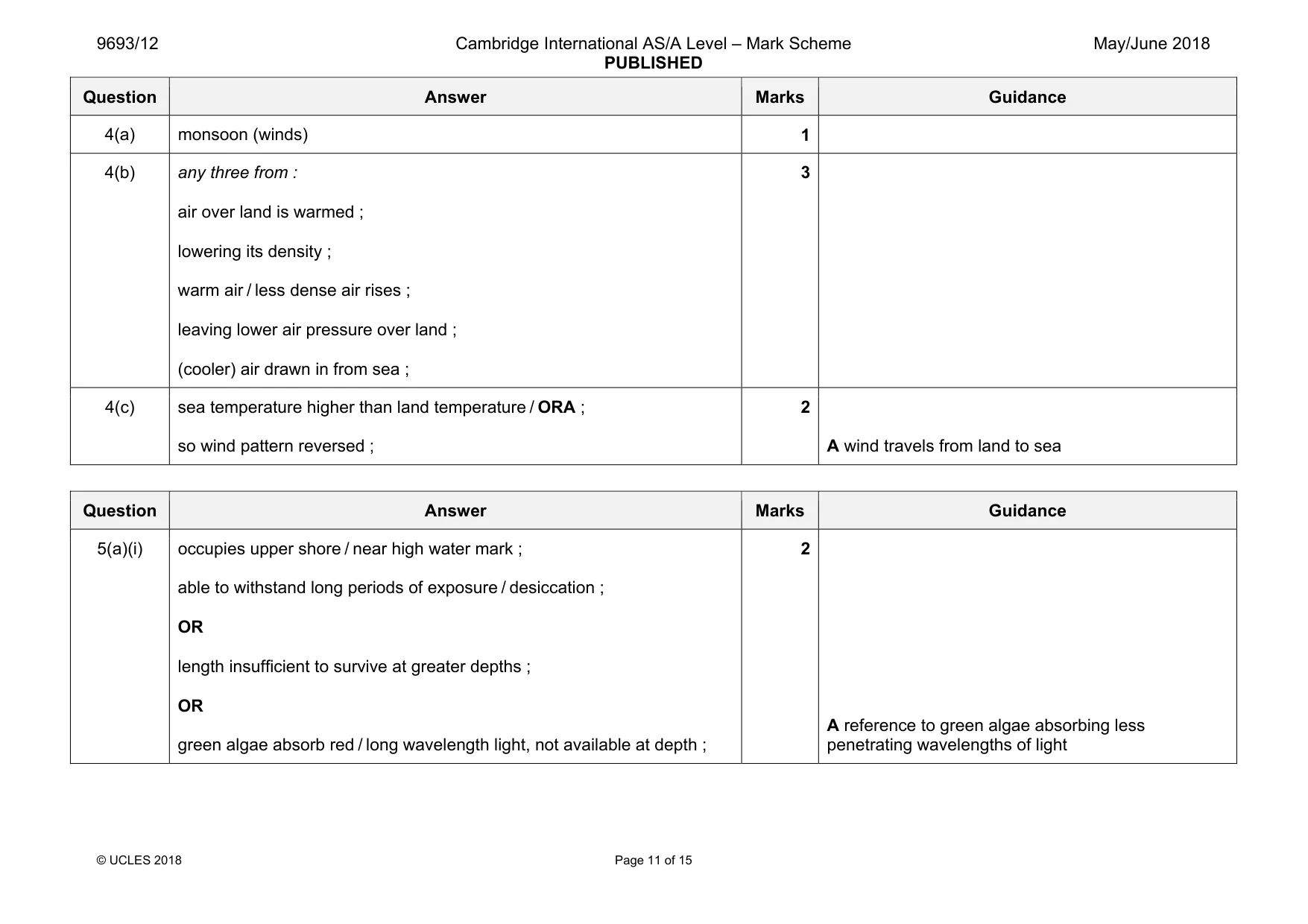
9693/12 Cambridge International AS/A Level – Mark Scheme PUBLISHED May/June 2018 © UCLES 2018 Page 11 of 15 Question Answer Marks Guidance 4(a) monsoon (winds) 1 4(b) any three from : air over land is warmed ; lowering its density ; warm air / less dense air rises ; leaving lower air pressure over land ; (cooler) air drawn in from sea ; 3 4(c) sea temperature higher than land temperature / ORA ; so wind pattern reversed ; 2 A wind travels from land to sea Question Answer Marks Guidance 5(a)(i) occupies upper shore / near high water mark ; able to withstand long periods of exposure / desiccation ; OR length insufficient to survive at greater depths ; OR green algae absorb red / long wavelength light, not available at depth ; 2 A reference to green algae absorbing less penetrating wavelengths of light
Mark scheme, page 12
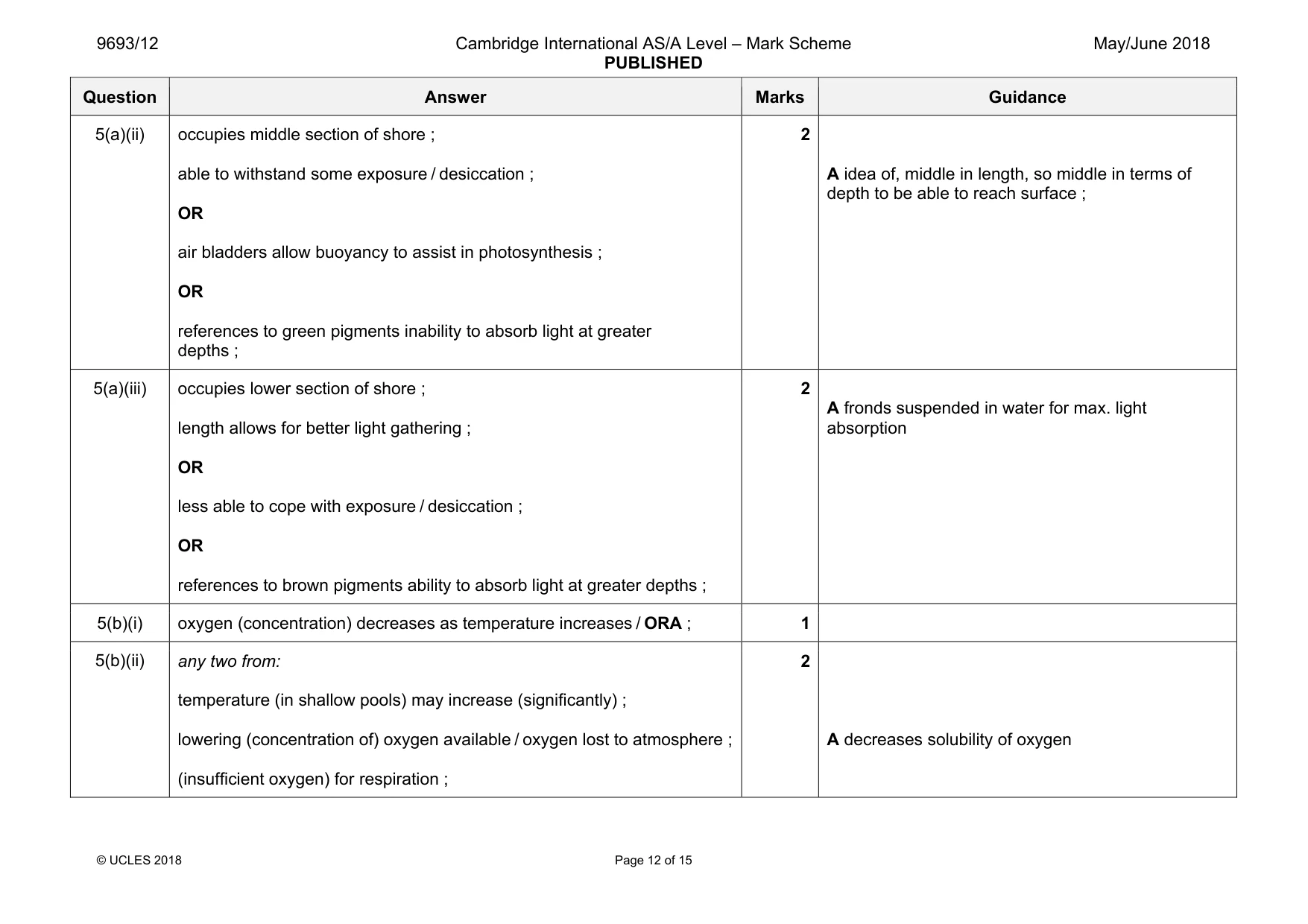
9693/12 Cambridge International AS/A Level – Mark Scheme PUBLISHED May/June 2018 © UCLES 2018 Page 12 of 15 Question Answer Marks Guidance 5(a)(ii) occupies middle section of shore ; able to withstand some exposure / desiccation ; OR air bladders allow buoyancy to assist in photosynthesis ; OR references to green pigments inability to absorb light at greater depths ; 2 A idea of, middle in length, so middle in terms of depth to be able to reach surface ; 5(a)(iii) occupies lower section of shore ; length allows for better light gathering ; OR less able to cope with exposure / desiccation ; OR references to brown pigments ability to absorb light at greater depths ; 2 A fronds suspended in water for max. light absorption 5(b)(i) oxygen (concentration) decreases as temperature increases / ORA ; 1 5(b)(ii) any two from: temperature (in shallow pools) may increase (significantly) ; lowering (concentration of) oxygen available / oxygen lost to atmosphere ; (insufficient oxygen) for respiration ; 2 A decreases solubility of oxygen
Mark scheme, page 13
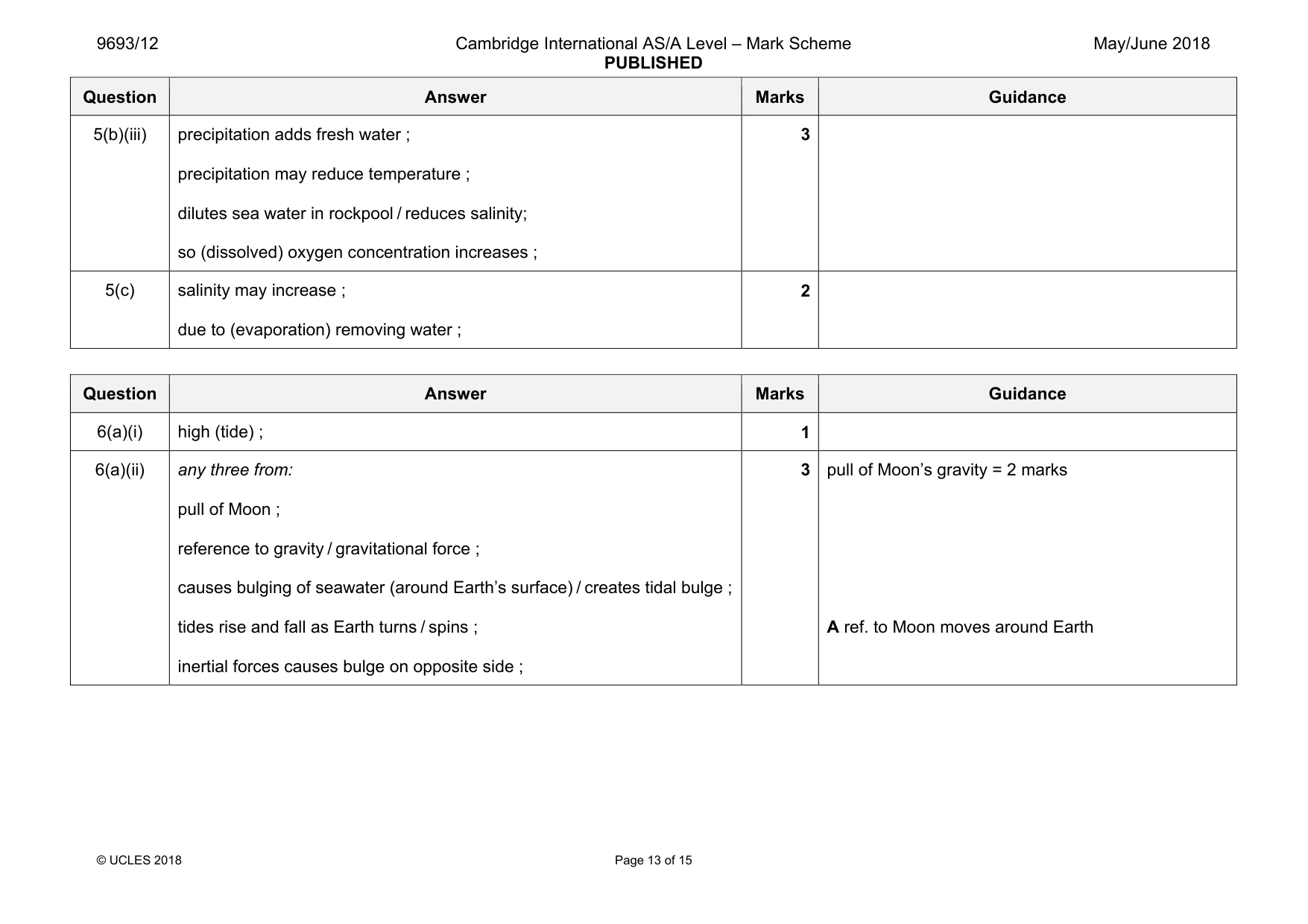
9693/12 Cambridge International AS/A Level – Mark Scheme PUBLISHED May/June 2018 © UCLES 2018 Page 13 of 15 Question Answer Marks Guidance 5(b)(iii) precipitation adds fresh water ; precipitation may reduce temperature ; dilutes sea water in rockpool / reduces salinity; so (dissolved) oxygen concentration increases ; 3 5(c) salinity may increase ; due to (evaporation) removing water ; 2 Question Answer Marks Guidance 6(a)(i) high (tide) ; 1 6(a)(ii) any three from: pull of Moon ; reference to gravity / gravitational force ; causes bulging of seawater (around Earth’s surface) / creates tidal bulge ; tides rise and fall as Earth turns / spins ; inertial forces causes bulge on opposite side ; 3 pull of Moon’s gravity = 2 marks A ref. to Moon moves around Earth
Mark scheme, page 14
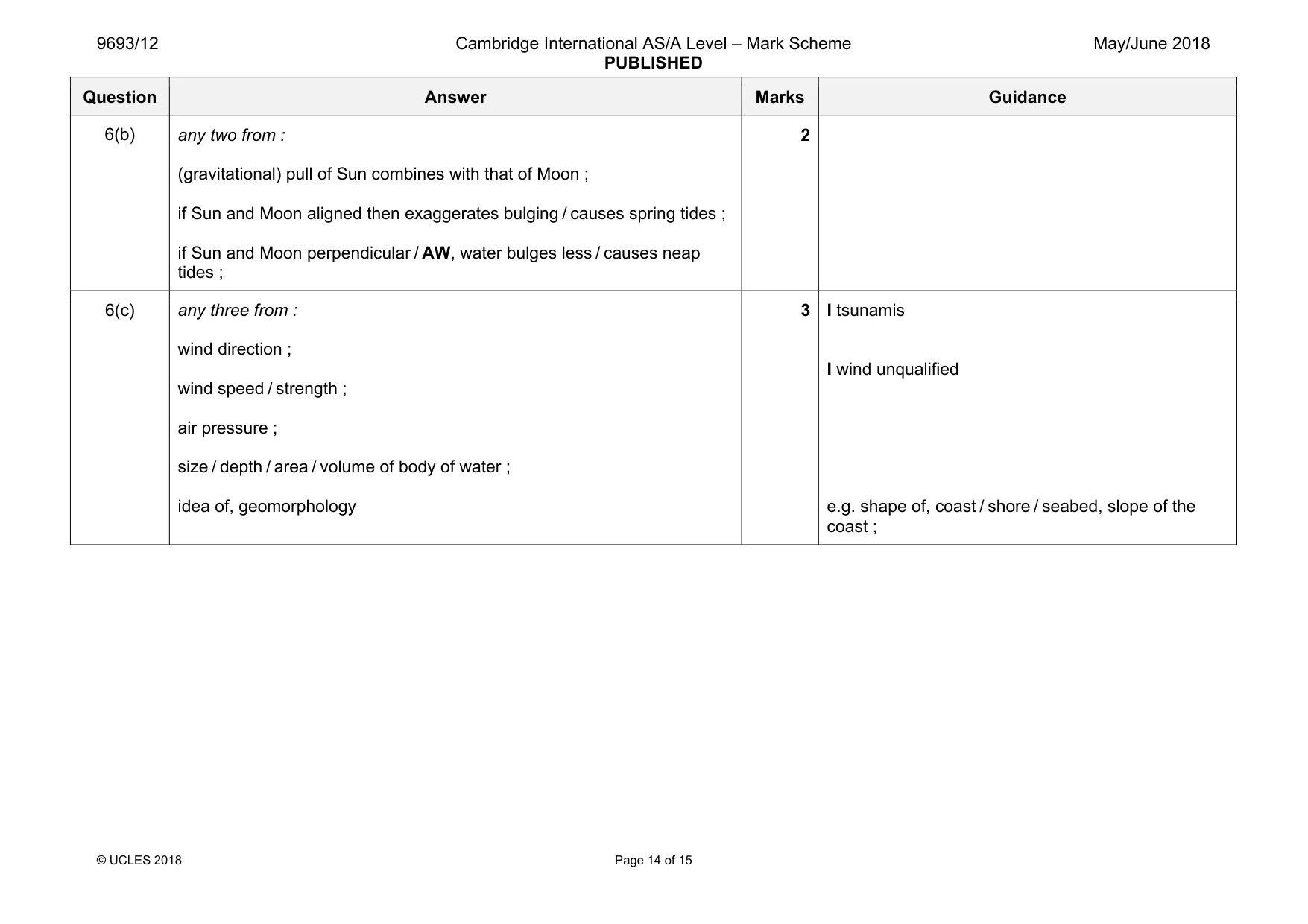
9693/12 Cambridge International AS/A Level – Mark Scheme PUBLISHED May/June 2018 © UCLES 2018 Page 14 of 15 Question Answer Marks Guidance 6(b) any two from : (gravitational) pull of Sun combines with that of Moon ; if Sun and Moon aligned then exaggerates bulging / causes spring tides ; if Sun and Moon perpendicular / AW, water bulges less / causes neap tides ; 2 6(c) any three from : wind direction ; wind speed / strength ; air pressure ; size / depth / area / volume of body of water ; idea of, geomorphology 3 I tsunamis I wind unqualified e.g. shape of, coast / shore / seabed, slope of the coast ;
Mark scheme, page 15
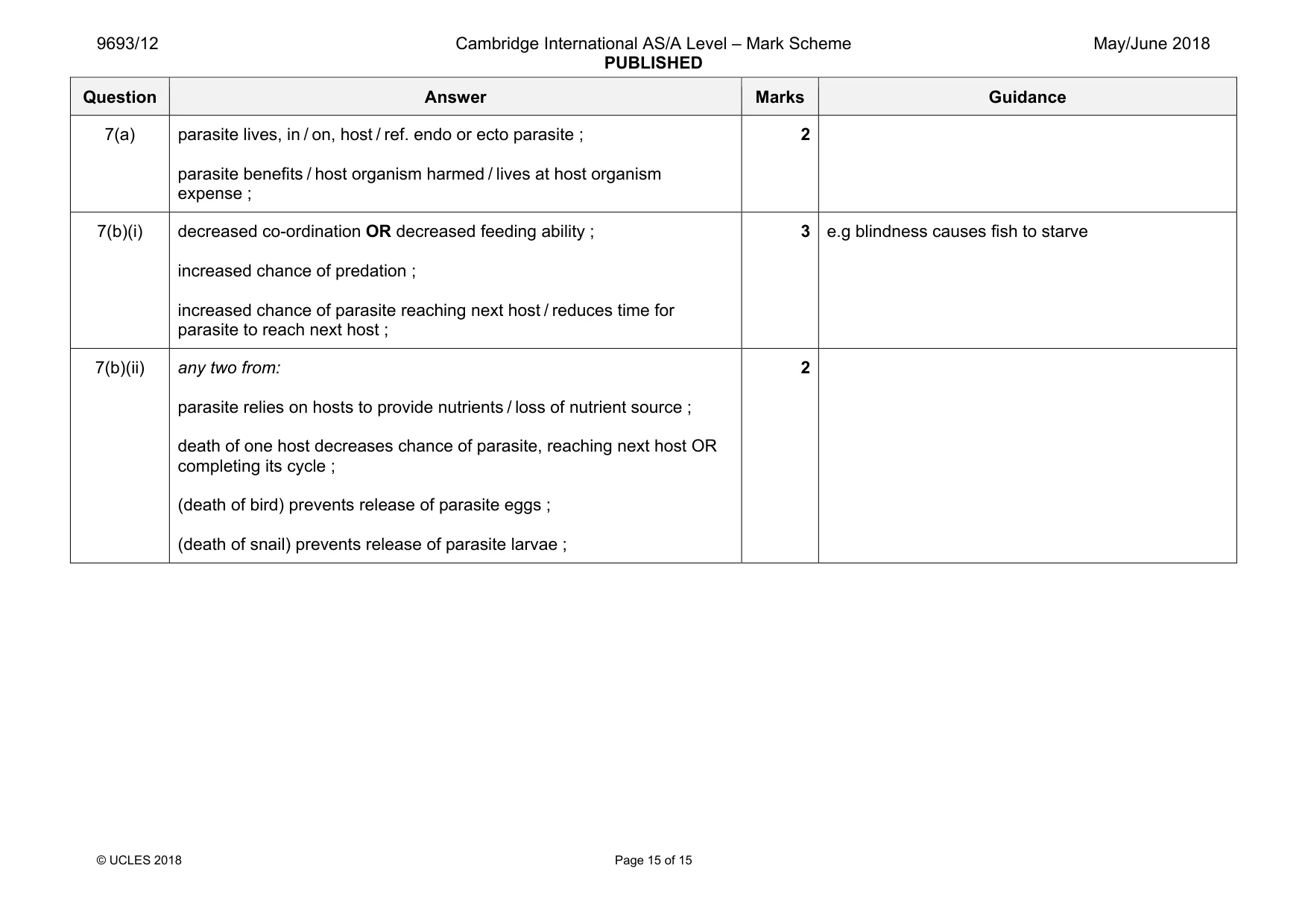
9693/12 Cambridge International AS/A Level – Mark Scheme PUBLISHED May/June 2018 © UCLES 2018 Page 15 of 15 Question Answer Marks Guidance 7(a) parasite lives, in / on, host / ref. endo or ecto parasite ; parasite benefits / host organism harmed / lives at host organism expense ; 2 7(b)(i) decreased co-ordination OR decreased feeding ability ; increased chance of predation ; increased chance of parasite reaching next host / reduces time for parasite to reach next host ; 3 e.g blindness causes fish to starve 7(b)(ii) any two from: parasite relies on hosts to provide nutrients / loss of nutrient source ; death of one host decreases chance of parasite, reaching next host OR completing its cycle ; (death of bird) prevents release of parasite eggs ; (death of snail) prevents release of parasite larvae ; 2
What you needed in this session
Cambridge’s own grade thresholds for 2018 May/June, Paper 1 · Variant 2. A higher threshold means an easier paper — the bar moves with how the cohort did.