Cambridge A Level Marine Science 9693 — 2018 May/June Paper 1 · Variant 1
9693/11/M/J/18 · 75 marks · ≈84 min
The question paper and its mark scheme, free to read here and free to download. This is Cambridge’s own paper, exactly as it was sat.
Question paper20 pages




Mark scheme16 pages
Answers below. Sit the paper first if you are practising.
Paper as text
Question paper, page 1
This document consists of 16 printed pages and 4 blank pages. DC (NH/FC) 146730/3 © UCLES 2018 [Turn over * 1 1 5 2 5 8 6 2 3 6 * MARINE SCIENCE 9693/11 Paper 1 AS Structured Questions May/June 2018 1 hour 30 minutes Candidates answer on the Question Paper. No Additional Materials are required. READ THESE INSTRUCTIONS FIRST Write your Centre number, candidate number and name on all the work you hand in. Write in dark blue or black pen. You may use an HB pencil for any diagrams or graphs. Do not use staples, paper clips, glue or correction fluid. DO NOT WRITE IN ANY BARCODES. Answer all questions. Write your answers in the spaces provided on the Question Paper. Electronic calculators may be used. You may lose marks if you do not show your working or if you do not use appropriate units. At the end of the examination, fasten all your work securely together. The number of marks is given in brackets [ ] at the end of each question or part question. Cambridge International Examinations Cambridge International Advanced Subsidiary and Advanced Level
Question paper, page 2
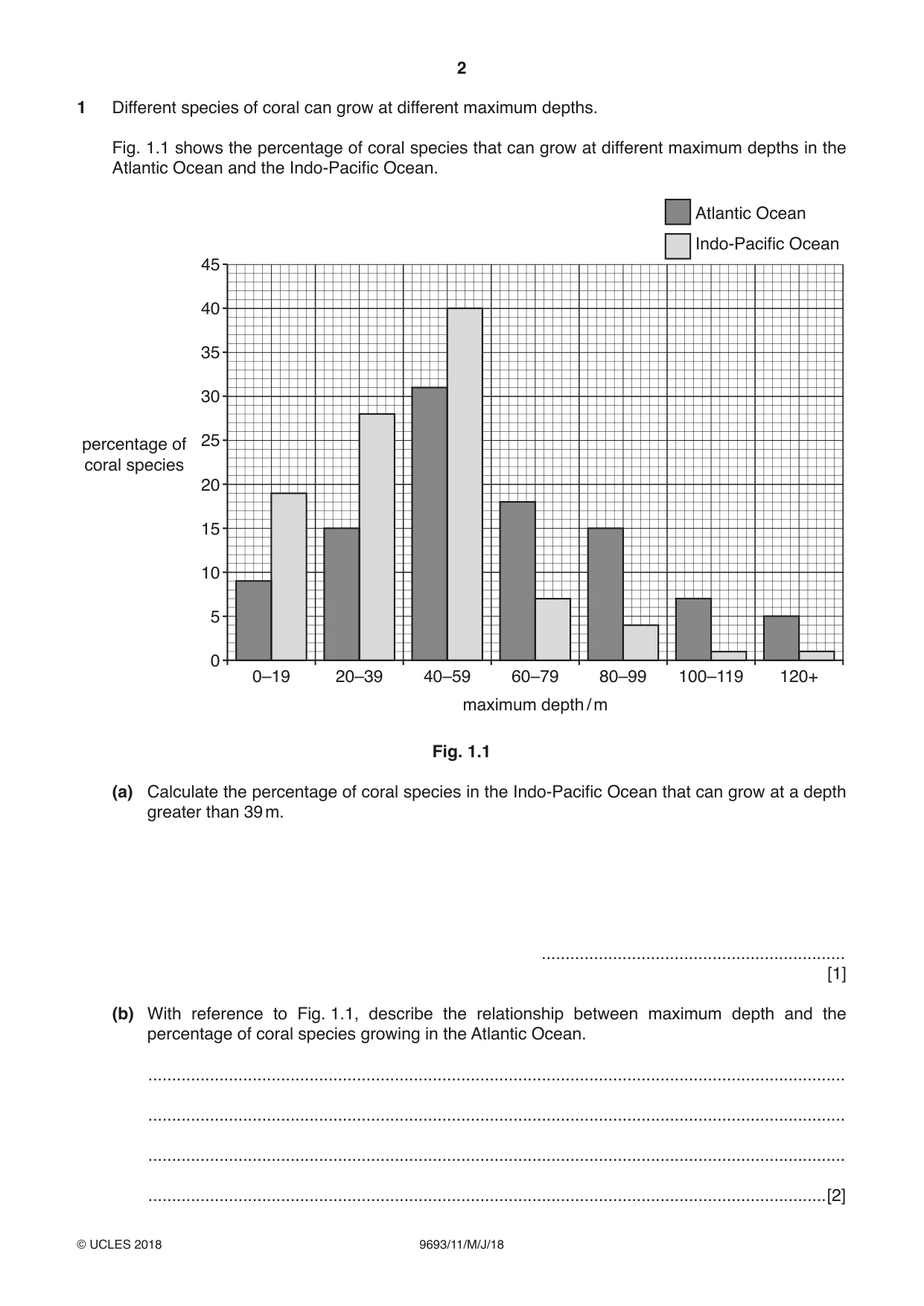
2 9693/11/M/J/18 © UCLES 2018 1 Different species of coral can grow at different maximum depths. Fig. 1.1 shows the percentage of coral species that can grow at different maximum depths in the Atlantic Ocean and the Indo-Pacific Ocean. 0 0–19 20–39 40–59 60–79 maximum depth / m percentage of coral species Atlantic Ocean Indo-Pacific Ocean 80–99 100–119 120+ 5 10 15 20 25 30 35 40 45 Fig. 1.1 (a) Calculate the percentage of coral species in the Indo-Pacific Ocean that can grow at a depth greater than 39 m. … [1] (b) With reference to Fig. 1.1, describe the relationship between maximum depth and the percentage of coral species growing in the Atlantic Ocean. … … … …[2]
Question paper, page 3
3 9693/11/M/J/18 © UCLES 2018 [Turn over (c) Explain why few coral species can grow at a depth greater than 120 m. … … … … … …[3] (d) Coral reef drilling produces cores of material. Bands can be seen in the cores. Explain how these bands can be used to reconstruct the history of a reef. … … … … … …[3] [Total: 9]
Question paper, page 4
4 9693/11/M/J/18 © UCLES 2018 2 (a) (i) State three factors required for the development of a tropical cyclone (hurricane / typhoon). 1 … … 2 … … 3 … … [3] (ii) Describe the role of evaporation and condensation in the formation of a tropical cyclone. evaporation … … … … condensation … … … … [4] (iii) Suggest how upwelling may prevent the formation of a tropical cyclone. … … … …[2]
Question paper, page 5
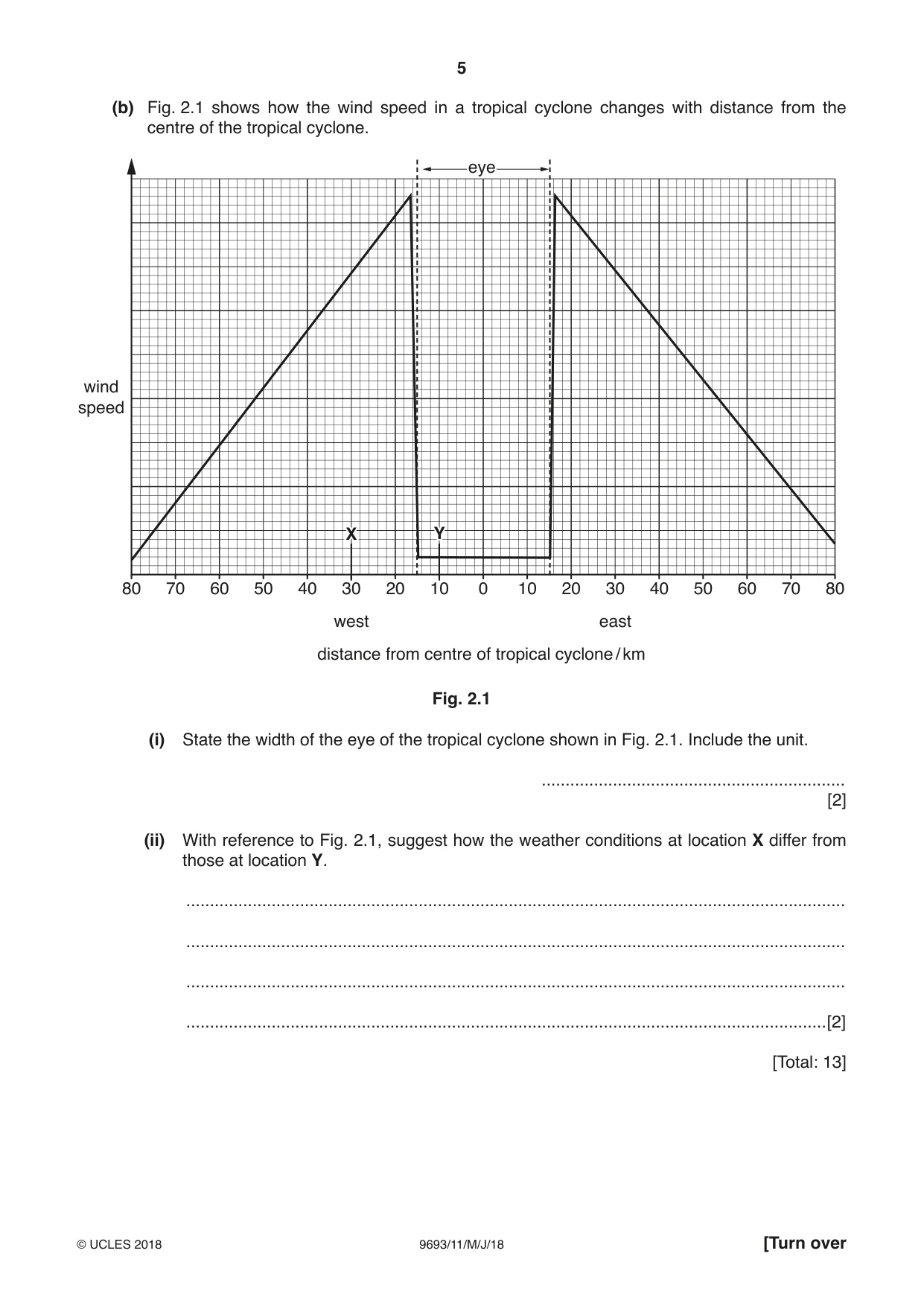
5 9693/11/M/J/18 © UCLES 2018 [Turn over (b) Fig. 2.1 shows how the wind speed in a tropical cyclone changes with distance from the centre of the tropical cyclone. 80 70 60 50 40 30 20 10 0 10 20 30 west wind speed distance from centre of tropical cyclone / km east 40 50 60 70 80 eye X Y Fig. 2.1 (i) State the width of the eye of the tropical cyclone shown in Fig. 2.1. Include the unit. … [2] (ii) With reference to Fig. 2.1, suggest how the weather conditions at location X differ from those at location Y. … … … …[2] [Total: 13]
Question paper, page 6
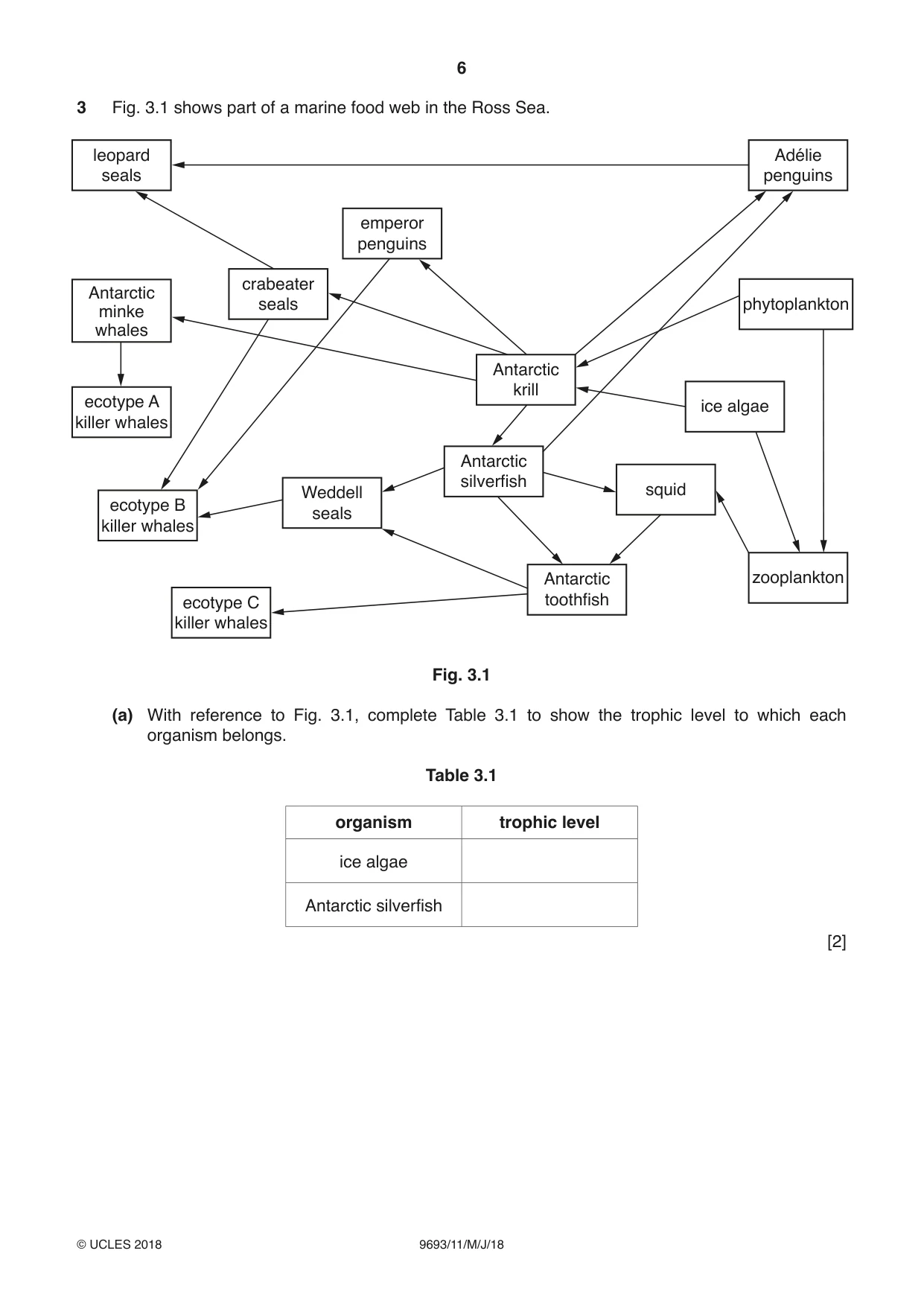
6 9693/11/M/J/18 © UCLES 2018 3 Fig. 3.1 shows part of a marine food web in the Ross Sea. leopard seals Antarctic minke whales ecotype A killer whales ecotype B killer whales ecotype C killer whales emperor penguins Antarctic krill Antarctic silverfish Antarctic toothfish squid ice algae zooplankton phytoplankton Weddell seals crabeater seals Adélie penguins Fig. 3.1 (a) With reference to Fig. 3.1, complete Table 3.1 to show the trophic level to which each organism belongs. Table 3.1 organism trophic level ice algae Antarctic silverfish [2]
Question paper, page 7
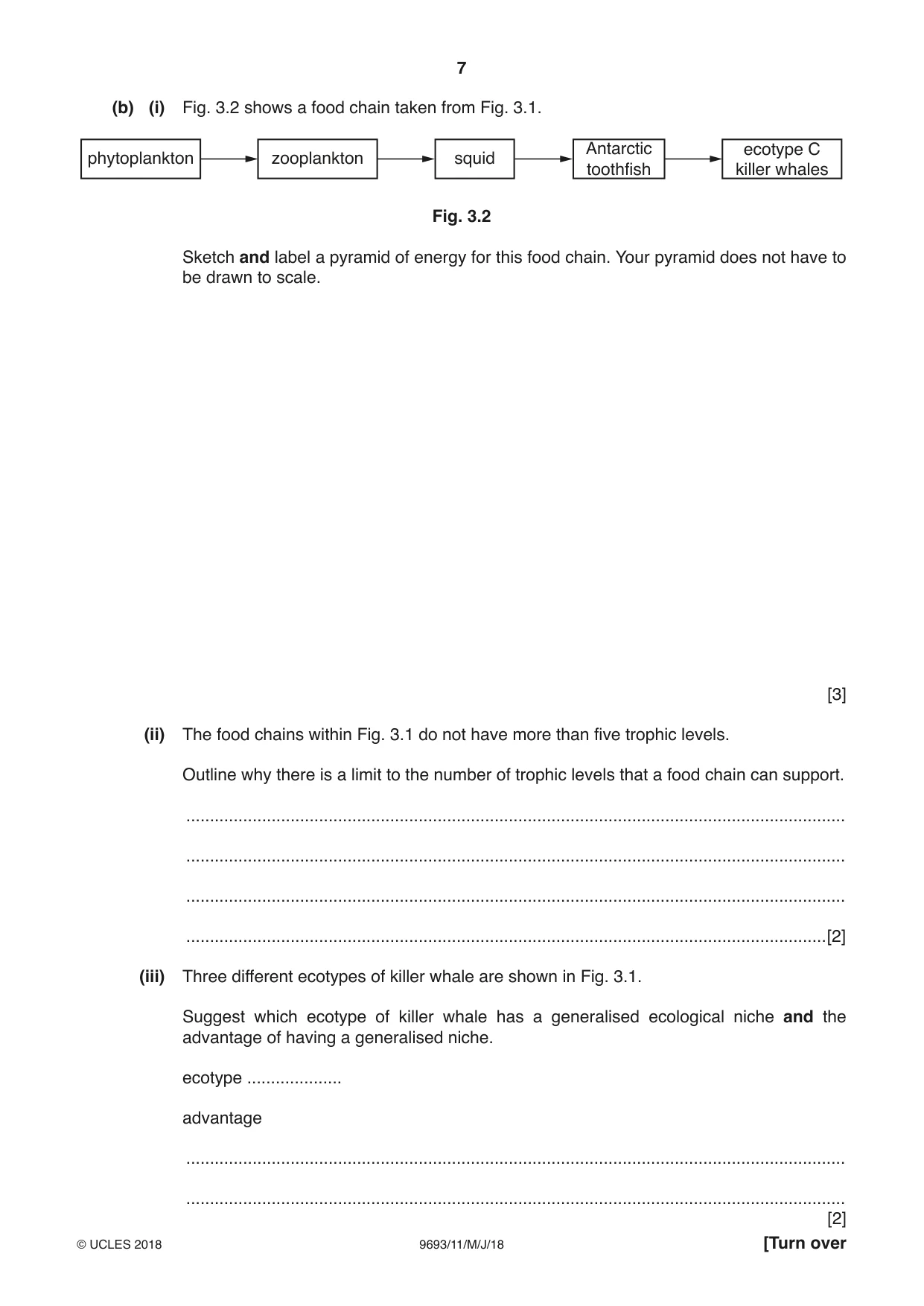
7 9693/11/M/J/18 © UCLES 2018 [Turn over (b) (i) Fig. 3.2 shows a food chain taken from Fig. 3.1. phytoplankton zooplankton squid Antarctic toothfish ecotype C killer whales Fig. 3.2 Sketch and label a pyramid of energy for this food chain. Your pyramid does not have to be drawn to scale. [3] (ii) The food chains within Fig. 3.1 do not have more than five trophic levels. Outline why there is a limit to the number of trophic levels that a food chain can support. … … … …[2] (iii) Three different ecotypes of killer whale are shown in Fig. 3.1. Suggest which ecotype of killer whale has a generalised ecological niche and the advantage of having a generalised niche. ecotype … advantage … … [2]
Question paper, page 8
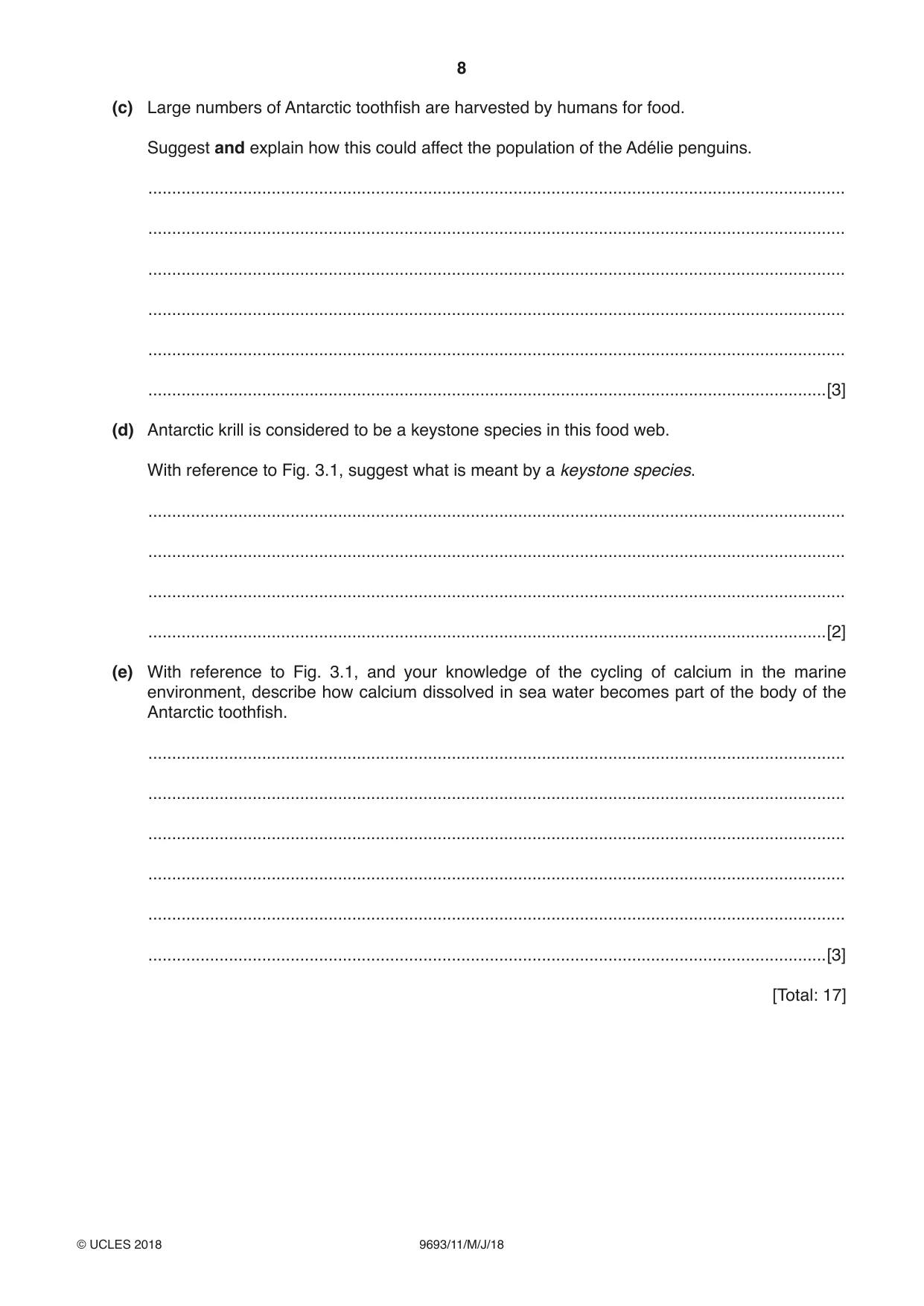
8 9693/11/M/J/18 © UCLES 2018 (c) Large numbers of Antarctic toothfish are harvested by humans for food. Suggest and explain how this could affect the population of the Adélie penguins. … … … … … …[3] (d) Antarctic krill is considered to be a keystone species in this food web. With reference to Fig. 3.1, suggest what is meant by a keystone species. … … … …[2] (e) With reference to Fig. 3.1, and your knowledge of the cycling of calcium in the marine environment, describe how calcium dissolved in sea water becomes part of the body of the Antarctic toothfish. … … … … … …[3] [Total: 17]
Question paper, page 9
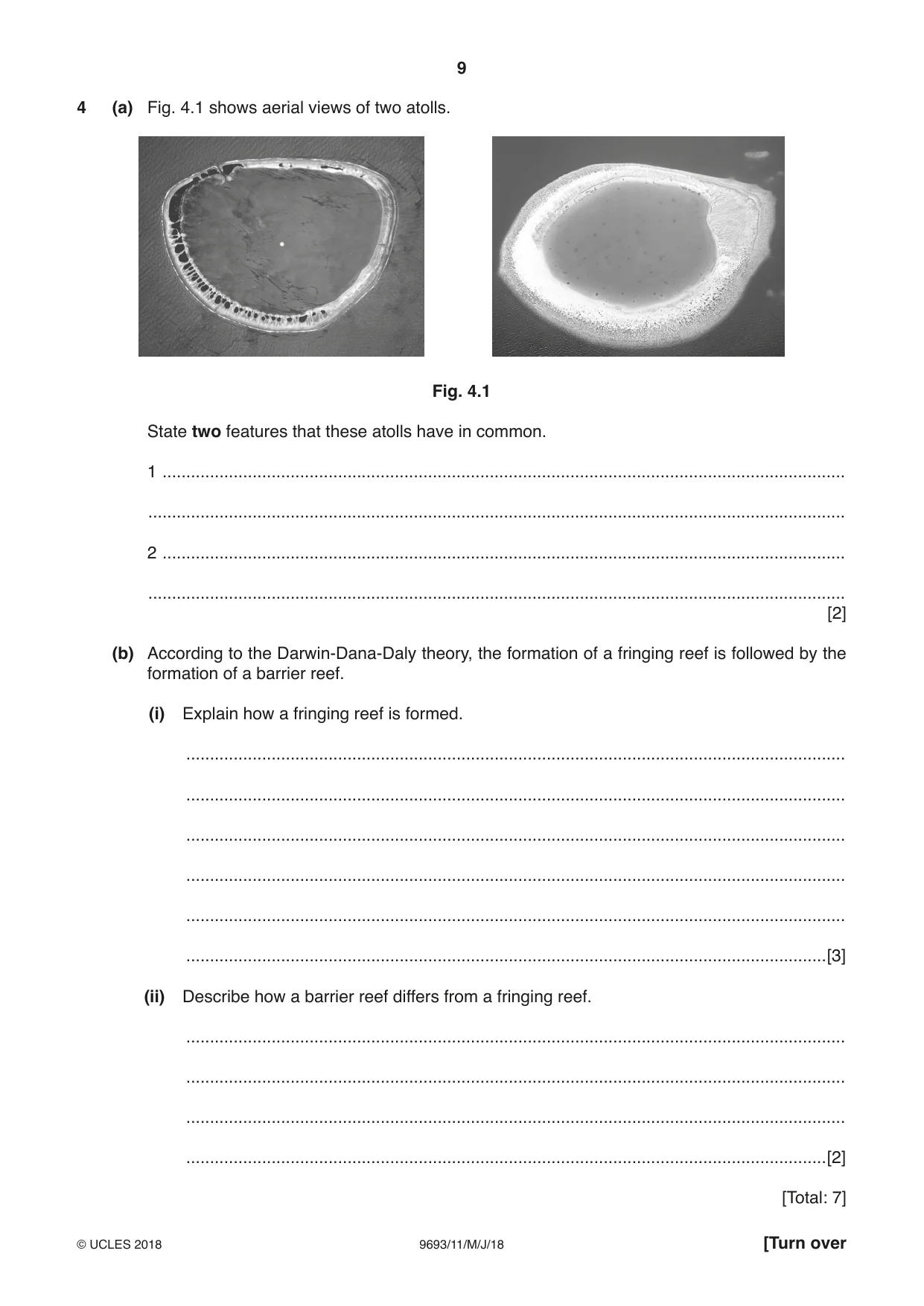
9 9693/11/M/J/18 © UCLES 2018 [Turn over 4 (a) Fig. 4.1 shows aerial views of two atolls. Fig. 4.1 State two features that these atolls have in common. 1 … … 2 … … [2] (b) According to the Darwin-Dana-Daly theory, the formation of a fringing reef is followed by the formation of a barrier reef. (i) Explain how a fringing reef is formed. … … … … … …[3] (ii) Describe how a barrier reef differs from a fringing reef. … … … …[2] [Total: 7]
Question paper, page 10
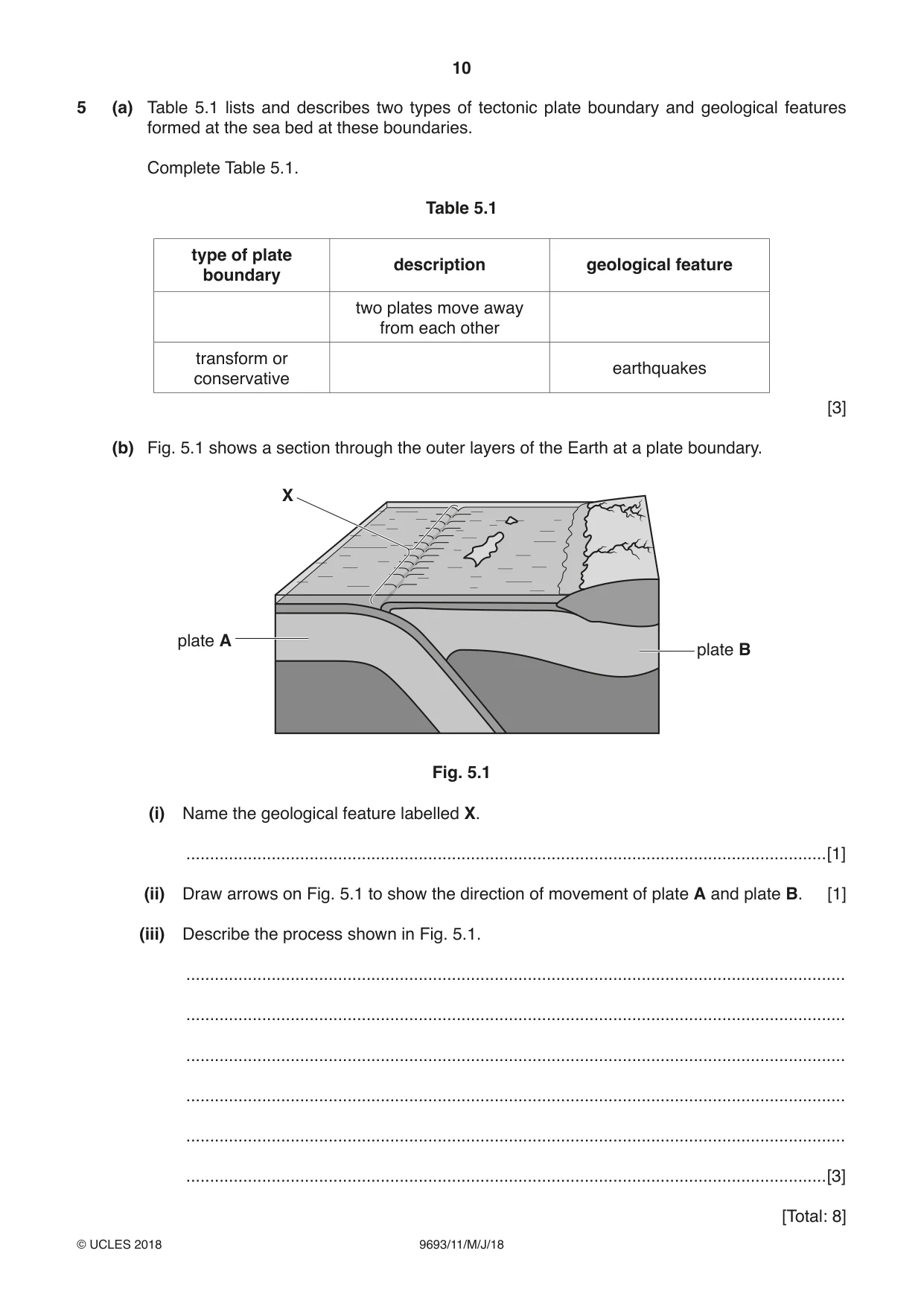
10 9693/11/M/J/18 © UCLES 2018 5 (a) Table 5.1 lists and describes two types of tectonic plate boundary and geological features formed at the sea bed at these boundaries. Complete Table 5.1. Table 5.1 type of plate boundary description geological feature two plates move away from each other transform or conservative earthquakes [3] (b) Fig. 5.1 shows a section through the outer layers of the Earth at a plate boundary. X plate A plate B Fig. 5.1 (i) Name the geological feature labelled X. …[1] (ii) Draw arrows on Fig. 5.1 to show the direction of movement of plate A and plate B. [1] (iii) Describe the process shown in Fig. 5.1. … … … … … …[3] [Total: 8]
Question paper, page 11
11 9693/11/M/J/18 © UCLES 2018 [Turn over BLANK PAGE
Question paper, page 12
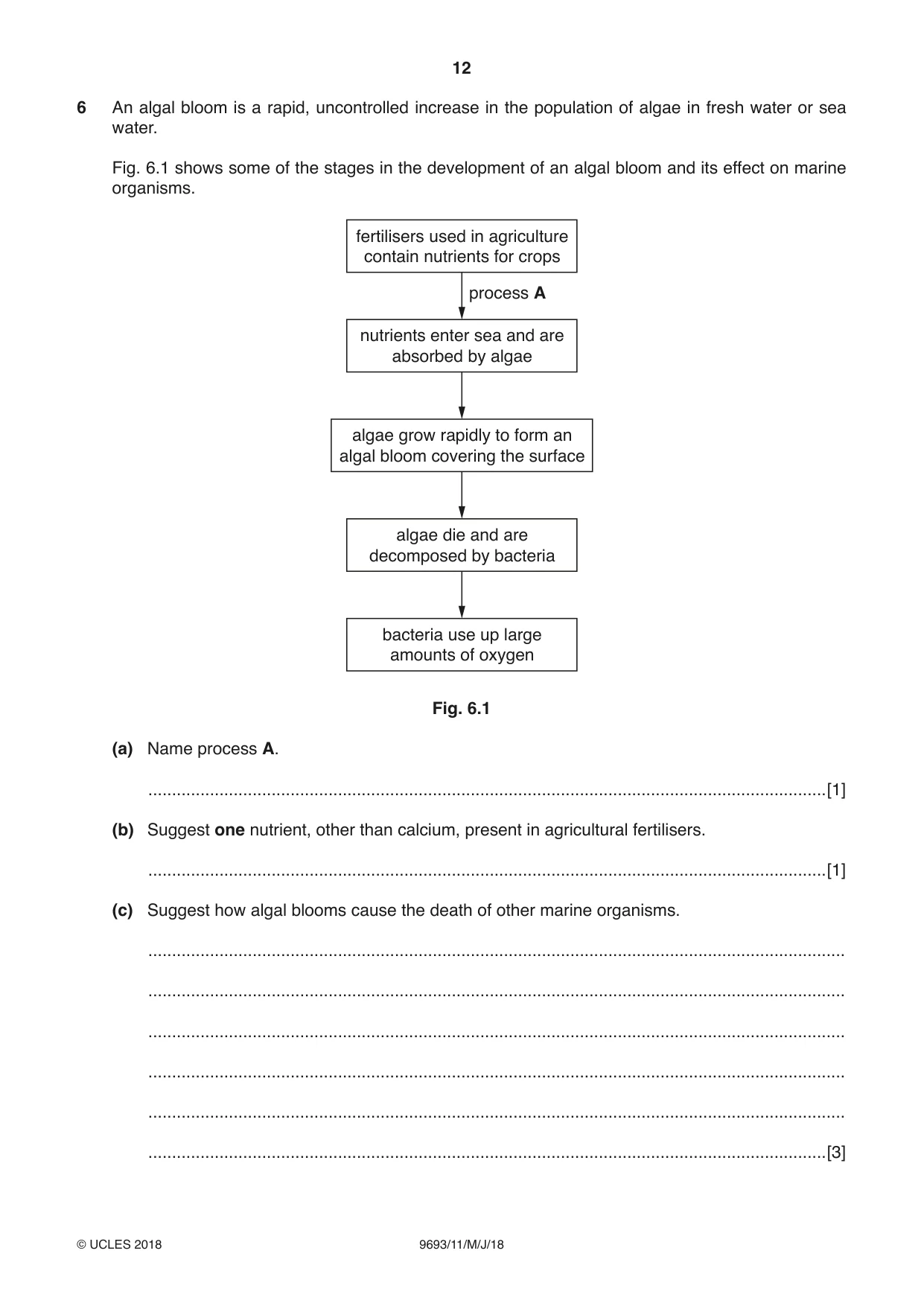
12 9693/11/M/J/18 © UCLES 2018 6 An algal bloom is a rapid, uncontrolled increase in the population of algae in fresh water or sea water. Fig. 6.1 shows some of the stages in the development of an algal bloom and its effect on marine organisms. fertilisers used in agriculture contain nutrients for crops nutrients enter sea and are absorbed by algae process A algae grow rapidly to form an algal bloom covering the surface algae die and are decomposed by bacteria bacteria use up large amounts of oxygen Fig. 6.1 (a) Name process A. …[1] (b) Suggest one nutrient, other than calcium, present in agricultural fertilisers. …[1] (c) Suggest how algal blooms cause the death of other marine organisms. … … … … … …[3]
Question paper, page 13
13 9693/11/M/J/18 © UCLES 2018 [Turn over (d) Use Fig. 6.1 and your own knowledge to predict how increased rainfall could affect the rate at which an algal bloom develops. Explain your prediction. … … … …[2] [Total: 7]
Question paper, page 14
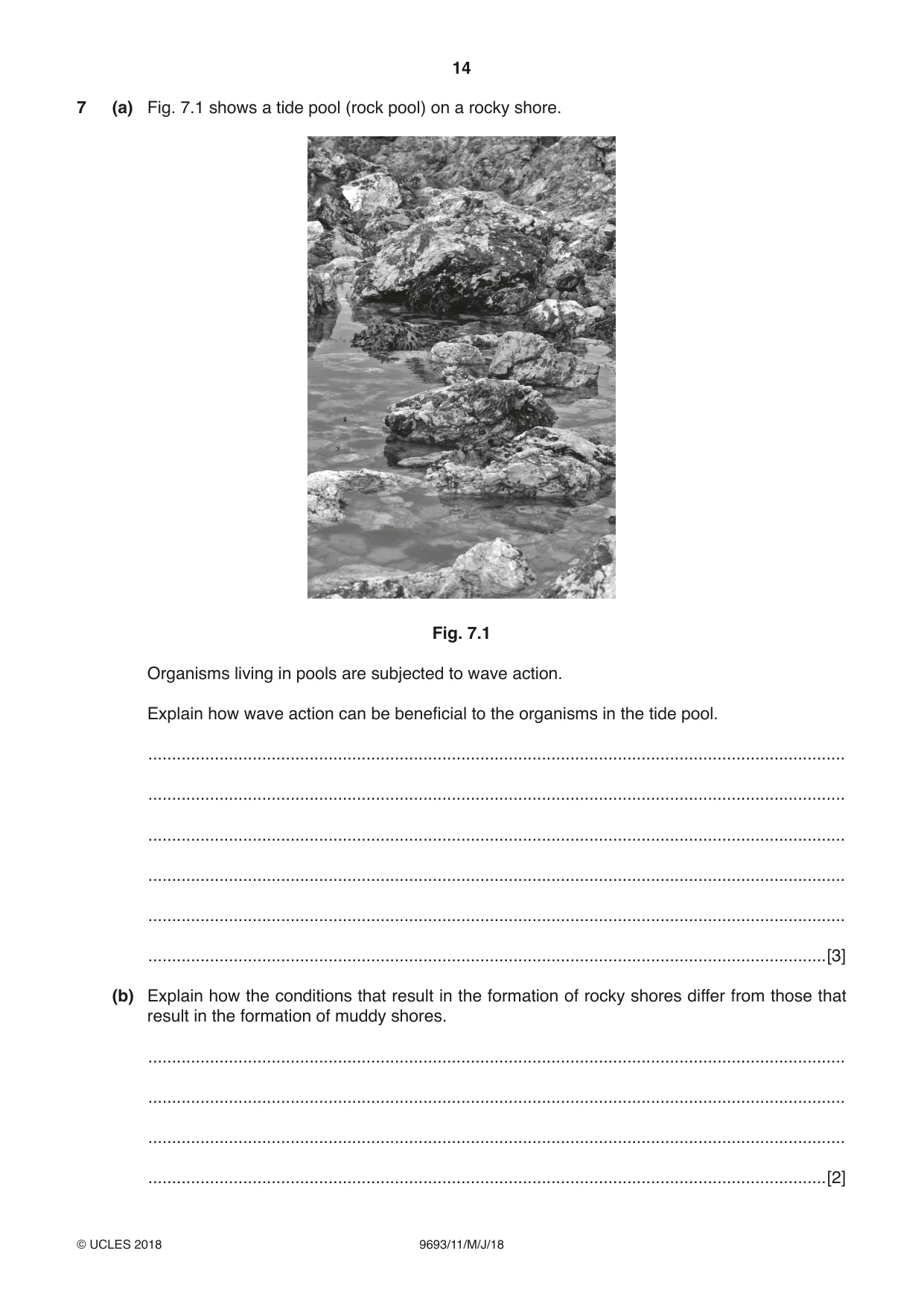
14 9693/11/M/J/18 © UCLES 2018 7 (a) Fig. 7.1 shows a tide pool (rock pool) on a rocky shore. Fig. 7.1 Organisms living in pools are subjected to wave action. Explain how wave action can be beneficial to the organisms in the tide pool. … … … … … …[3] (b) Explain how the conditions that result in the formation of rocky shores differ from those that result in the formation of muddy shores. … … … …[2]
Question paper, page 15
15 9693/11/M/J/18 © UCLES 2018 [Turn over (c) Muddy shores tend to have lower biodiversity than rocky shores. Explain why habitats with low biodiversity tend to contain wide ecological niches. … … … …[2] [Total: 7]
Question paper, page 16
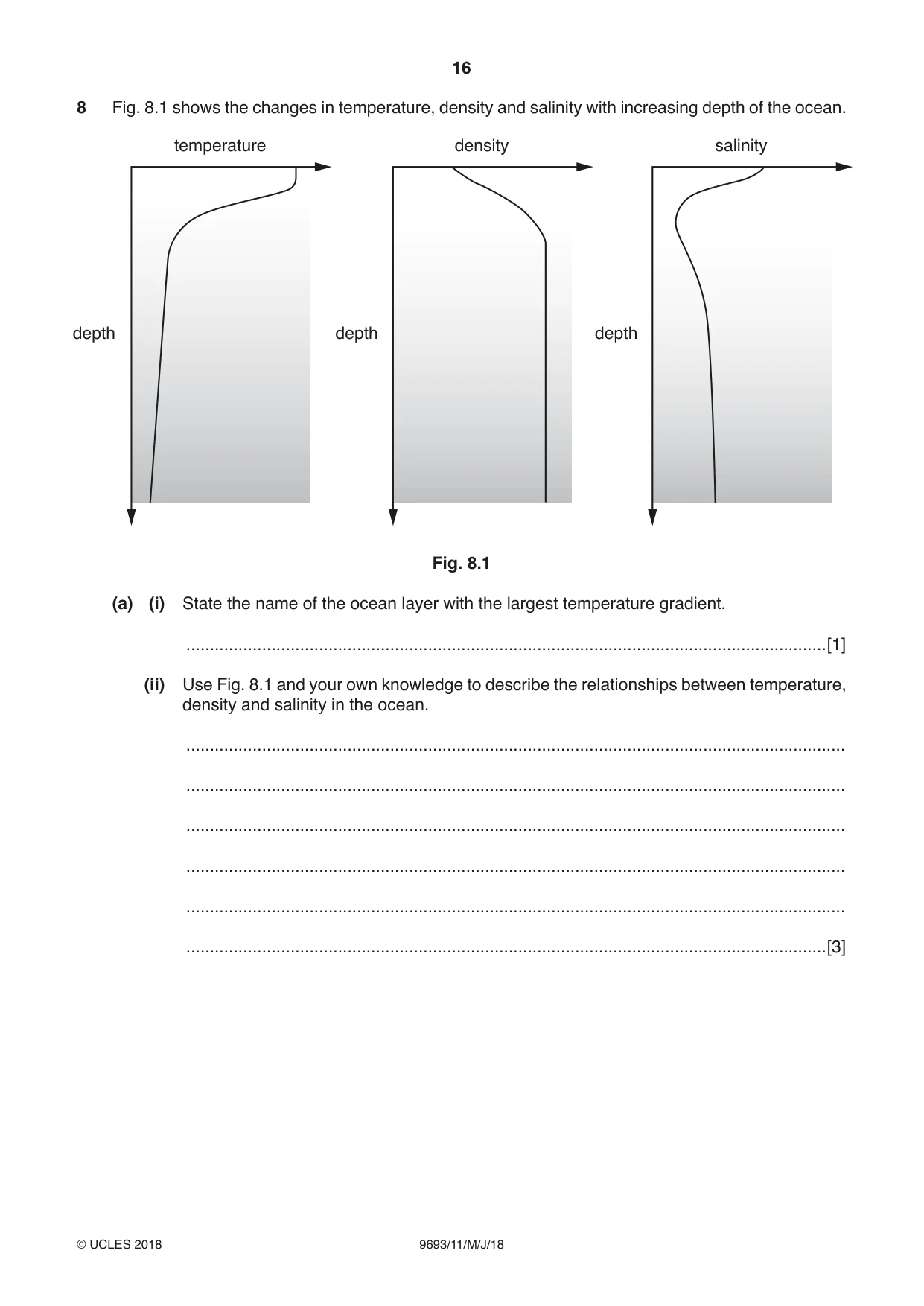
16 9693/11/M/J/18 © UCLES 2018 8 Fig. 8.1 shows the changes in temperature, density and salinity with increasing depth of the ocean. temperature depth depth depth density salinity Fig. 8.1 (a) (i) State the name of the ocean layer with the largest temperature gradient. …[1] (ii) Use Fig. 8.1 and your own knowledge to describe the relationships between temperature, density and salinity in the ocean. … … … … … …[3]
Question paper, page 17
17 9693/11/M/J/18 © UCLES 2018 (b) Explain why oxygen concentration varies with ocean depth. … … … … … …[3] [Total: 7]
Question paper, page 18
18 9693/11/M/J/18 © UCLES 2018 BLANK PAGE
Question paper, page 19
19 9693/11/M/J/18 © UCLES 2018 BLANK PAGE
Question paper, page 20
20 9693/11/M/J/18 © UCLES 2018 Permission to reproduce items where third-party owned material protected by copyright is included has been sought and cleared where possible. Every reasonable effort has been made by the publisher (UCLES) to trace copyright holders, but if any items requiring clearance have unwittingly been included, the publisher will be pleased to make amends at the earliest possible opportunity. To avoid the issue of disclosure of answer-related information to candidates, all copyright acknowledgements are reproduced online in the Cambridge International Examinations Copyright Acknowledgements Booklet. This is produced for each series of examinations and is freely available to download at www.cie.org.uk after the live examination series. Cambridge International Examinations is part of the Cambridge Assessment Group. Cambridge Assessment is the brand name of University of Cambridge Local Examinations Syndicate (UCLES), which is itself a department of the University of Cambridge. BLANK PAGE
Mark scheme, page 1
IGCSE™ is a registered trademark. This document consists of 16 printed pages. © UCLES 2018 [Turn over Cambridge Assessment International Education Cambridge International Advanced Subsidiary and Advanced Level MARINE SCIENCE 9693/11 Paper 1 AS Structured Questions May/June 2018 MARK SCHEME Maximum Mark: 75 Published This mark scheme is published as an aid to teachers and candidates, to indicate the requirements of the examination. It shows the basis on which Examiners were instructed to award marks. It does not indicate the details of the discussions that took place at an Examiners’ meeting before marking began, which would have considered the acceptability of alternative answers. Mark schemes should be read in conjunction with the question paper and the Principal Examiner Report for Teachers. Cambridge International will not enter into discussions about these mark schemes. Cambridge International is publishing the mark schemes for the May/June 2018 series for most Cambridge IGCSE™, Cambridge International A and AS Level and Cambridge Pre-U components, and some Cambridge O Level components.
Mark scheme, page 2
9693/11 Cambridge International AS/A Level – Mark Scheme PUBLISHED May/June 2018 © UCLES 2018 Page 2 of 16 Generic Marking Principles These general marking principles must be applied by all examiners when marking candidate answers. They should be applied alongside the specific content of the mark scheme or generic level descriptors for a question. Each question paper and mark scheme will also comply with these marking principles. GENERIC MARKING PRINCIPLE 1: Marks must be awarded in line with: • the specific content of the mark scheme or the generic level descriptors for the question • the specific skills defined in the mark scheme or in the generic level descriptors for the question • the standard of response required by a candidate as exemplified by the standardisation scripts. GENERIC MARKING PRINCIPLE 2: Marks awarded are always whole marks (not half marks, or other fractions). GENERIC MARKING PRINCIPLE 3: Marks must be awarded positively: • marks are awarded for correct/valid answers, as defined in the mark scheme. However, credit is given for valid answers which go beyond the scope of the syllabus and mark scheme, referring to your Team Leader as appropriate • marks are awarded when candidates clearly demonstrate what they know and can do • marks are not deducted for errors • marks are not deducted for omissions • answers should only be judged on the quality of spelling, punctuation and grammar when these features are specifically assessed by the question as indicated by the mark scheme. The meaning, however, should be unambiguous. GENERIC MARKING PRINCIPLE 4: Rules must be applied consistently e.g. in situations where candidates have not followed instructions or in the application of generic level descriptors.
Mark scheme, page 3
9693/11 Cambridge International AS/A Level – Mark Scheme PUBLISHED May/June 2018 © UCLES 2018 Page 3 of 16 GENERIC MARKING PRINCIPLE 5: Marks should be awarded using the full range of marks defined in the mark scheme for the question (however; the use of the full mark range may be limited according to the quality of the candidate responses seen). GENERIC MARKING PRINCIPLE 6: Marks awarded are based solely on the requirements as defined in the mark scheme. Marks should not be awarded with grade thresholds or grade descriptors in mind.
Mark scheme, page 4
9693/11 Cambridge International AS/A Level – Mark Scheme PUBLISHED May/June 2018 © UCLES 2018 Page 4 of 16 This mark scheme will use the following abbreviations: ; separates marking points / separates alternatives within a marking point () contents of brackets are not required but should be implied / the contents set the context of the answer R reject A accept (answers that are correctly cued by the question or guidance you have received) I ignore (mark as if this material was not present) AW alternative wording (where responses vary more than usual, accept other ways of expressing the same idea) AVP alternative valid point (where a greater than usual variety of responses is expected) OR or reverse argument underline actual word underlined must be used by the candidate (grammatical variants excepted) MAX indicates the maximum number of marks that can be awarded + statements on both sides of the + are needed for that mark OR separates two different routes to a mark point and only one should be awarded ECF error carried forward (credit an operation from a previous incorrect response)
Mark scheme, page 5
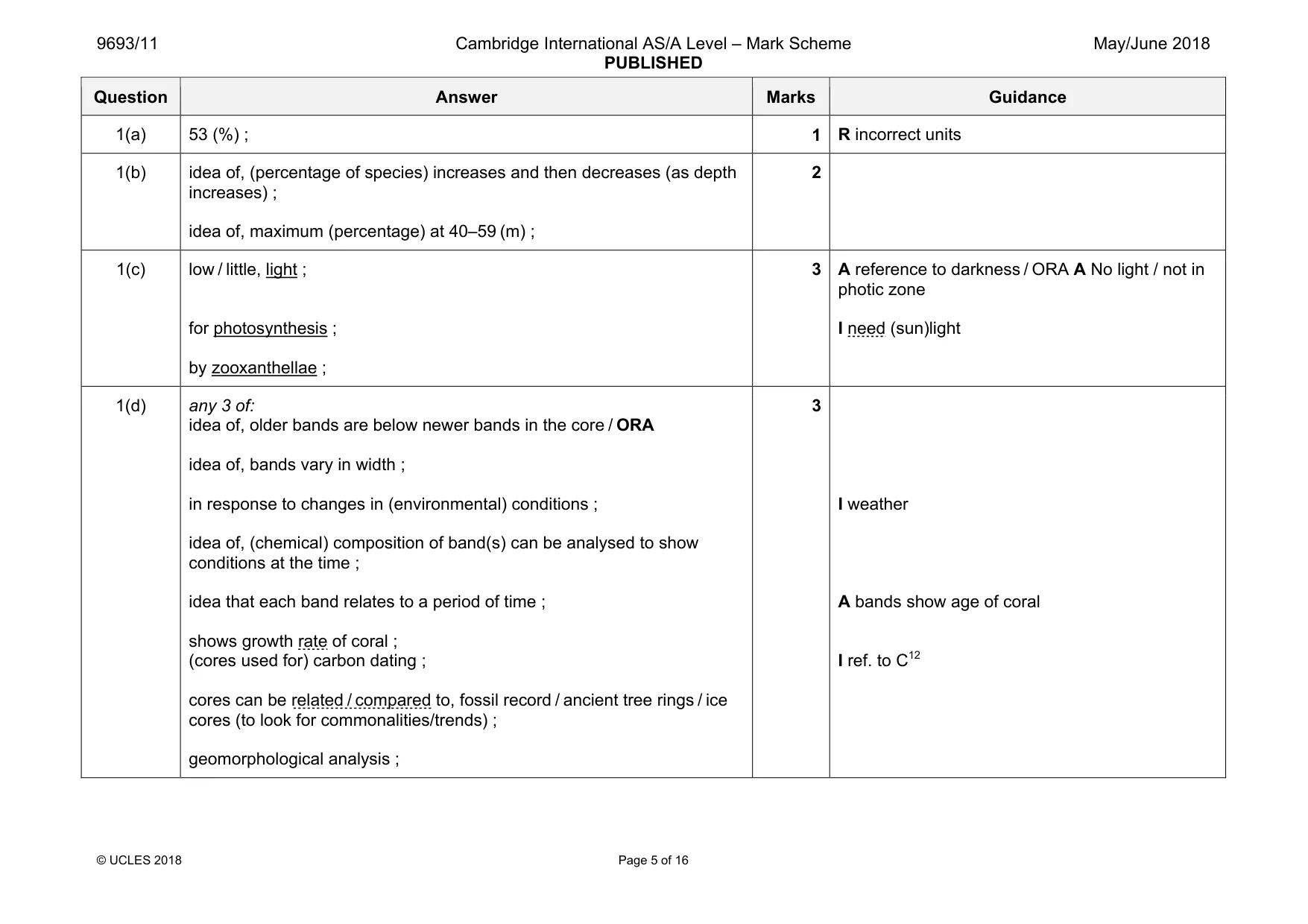
9693/11 Cambridge International AS/A Level – Mark Scheme PUBLISHED May/June 2018 © UCLES 2018 Page 5 of 16 Question Answer Marks Guidance 1(a) 53 (%) ; 1 R incorrect units 1(b) idea of, (percentage of species) increases and then decreases (as depth increases) ; idea of, maximum (percentage) at 40–59 (m) ; 2 1(c) low / little, light ; for photosynthesis ; by zooxanthellae ; 3 A reference to darkness / ORA A No light / not in photic zone I need (sun)light 1(d) any 3 of: idea of, older bands are below newer bands in the core / ORA idea of, bands vary in width ; in response to changes in (environmental) conditions ; idea of, (chemical) composition of band(s) can be analysed to show conditions at the time ; idea that each band relates to a period of time ; shows growth rate of coral ; (cores used for) carbon dating ; cores can be related / compared to, fossil record / ancient tree rings / ice cores (to look for commonalities/trends) ; geomorphological analysis ; 3 I weather A bands show age of coral I ref. to C12
Mark scheme, page 6
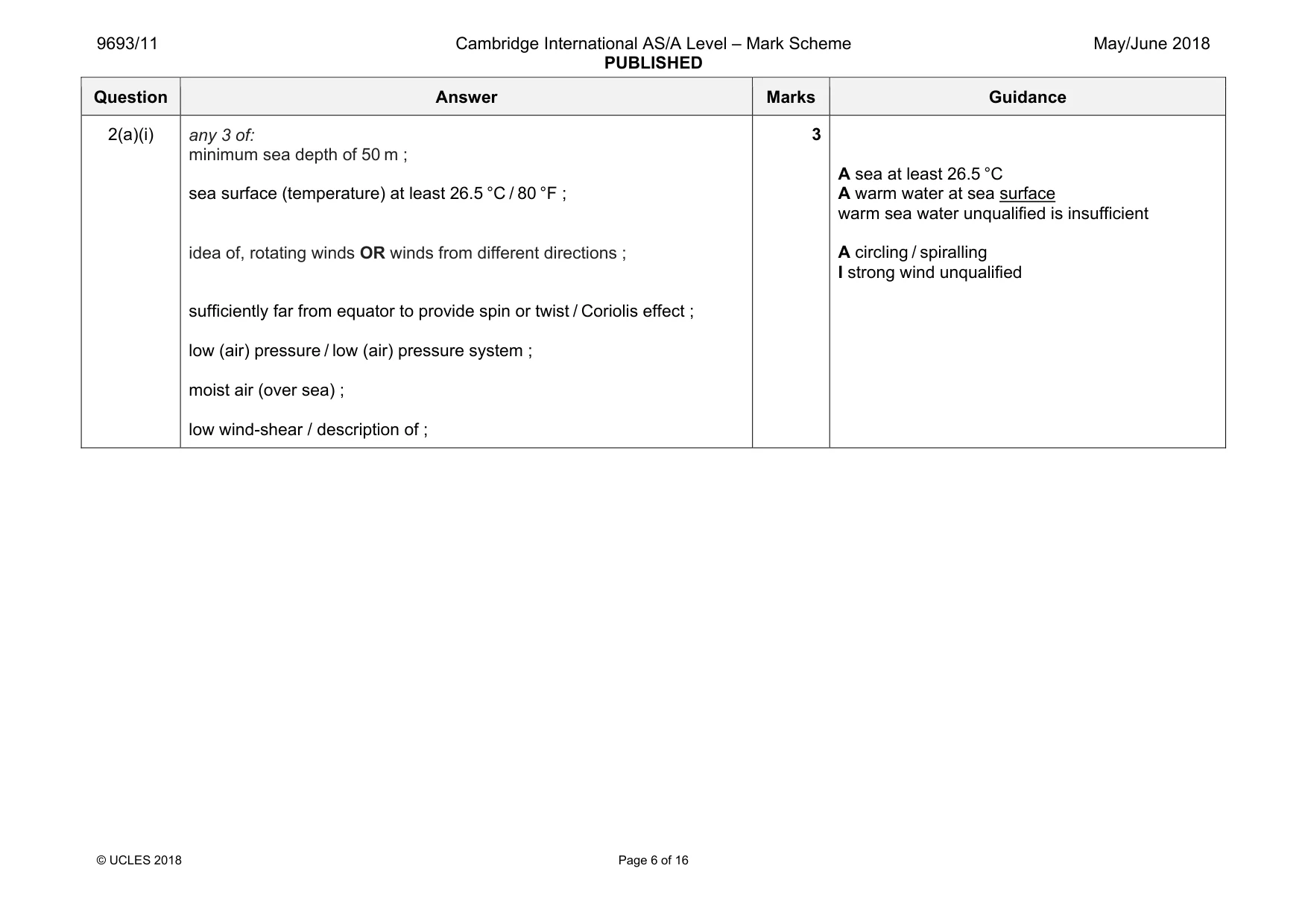
9693/11 Cambridge International AS/A Level – Mark Scheme PUBLISHED May/June 2018 © UCLES 2018 Page 6 of 16 Question Answer Marks Guidance 2(a)(i) any 3 of: minimum sea depth of 50 m ; sea surface (temperature) at least 26.5 °C / 80 °F ; idea of, rotating winds OR winds from different directions ; sufficiently far from equator to provide spin or twist / Coriolis effect ; low (air) pressure / low (air) pressure system ; moist air (over sea) ; low wind-shear / description of ; 3 A sea at least 26.5 °C A warm water at sea surface warm sea water unqualified is insufficient A circling / spiralling I strong wind unqualified
Mark scheme, page 7
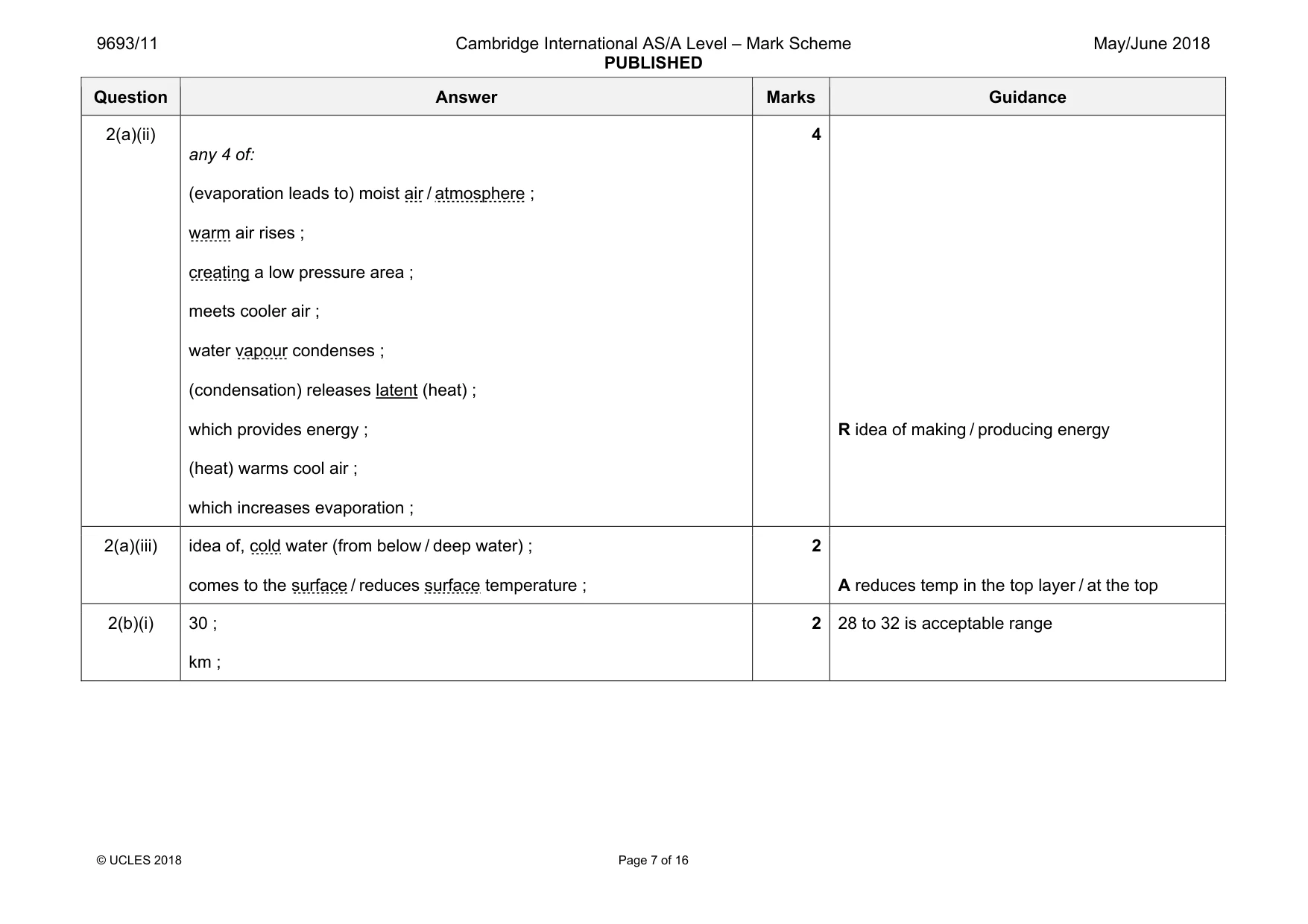
9693/11 Cambridge International AS/A Level – Mark Scheme PUBLISHED May/June 2018 © UCLES 2018 Page 7 of 16 Question Answer Marks Guidance 2(a)(ii) any 4 of: (evaporation leads to) moist air / atmosphere ; warm air rises ; creating a low pressure area ; meets cooler air ; water vapour condenses ; (condensation) releases latent (heat) ; which provides energy ; (heat) warms cool air ; which increases evaporation ; 4 R idea of making / producing energy 2(a)(iii) idea of, cold water (from below / deep water) ; comes to the surface / reduces surface temperature ; 2 A reduces temp in the top layer / at the top 2(b)(i) 30 ; km ; 2 28 to 32 is acceptable range
Mark scheme, page 8
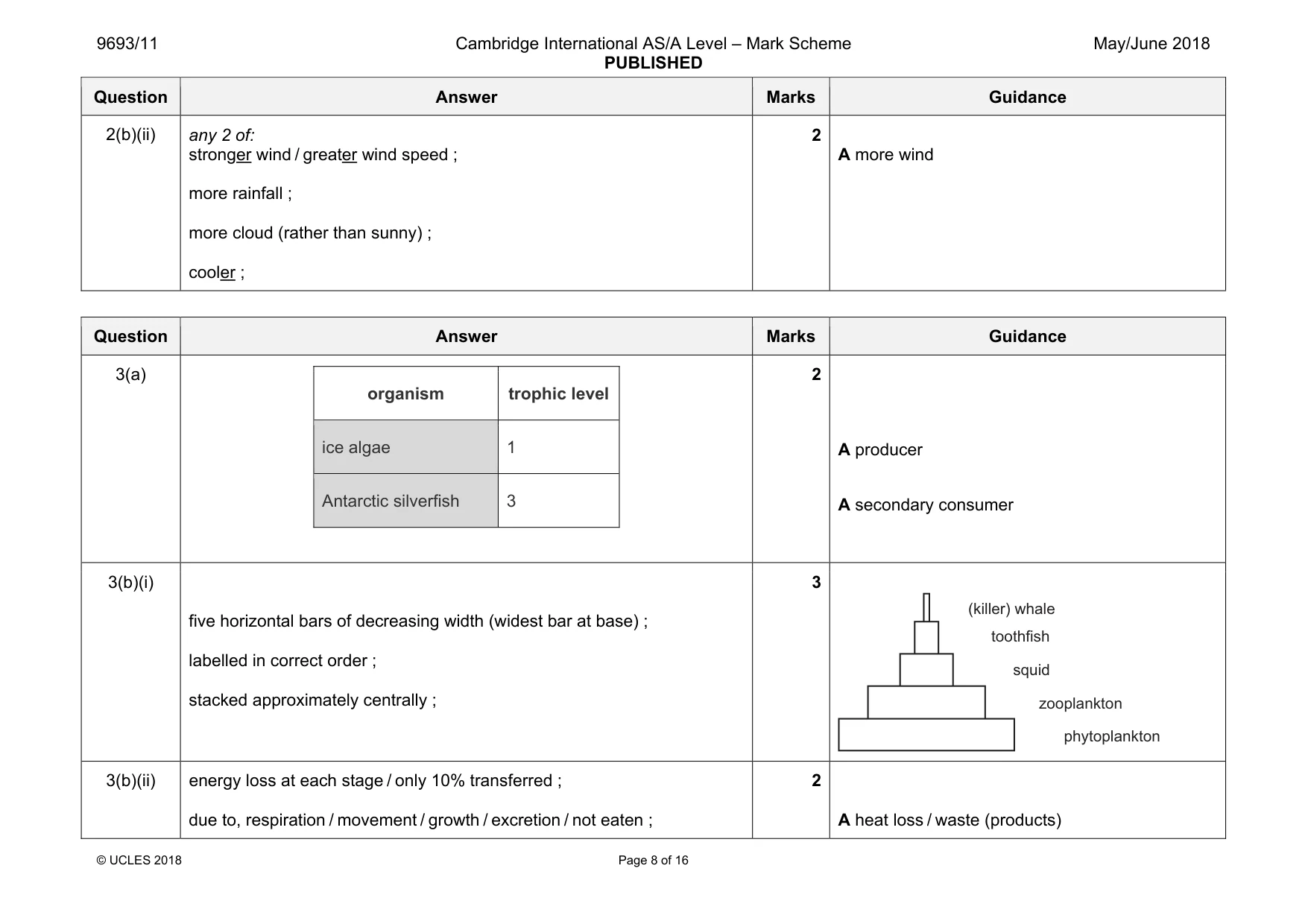
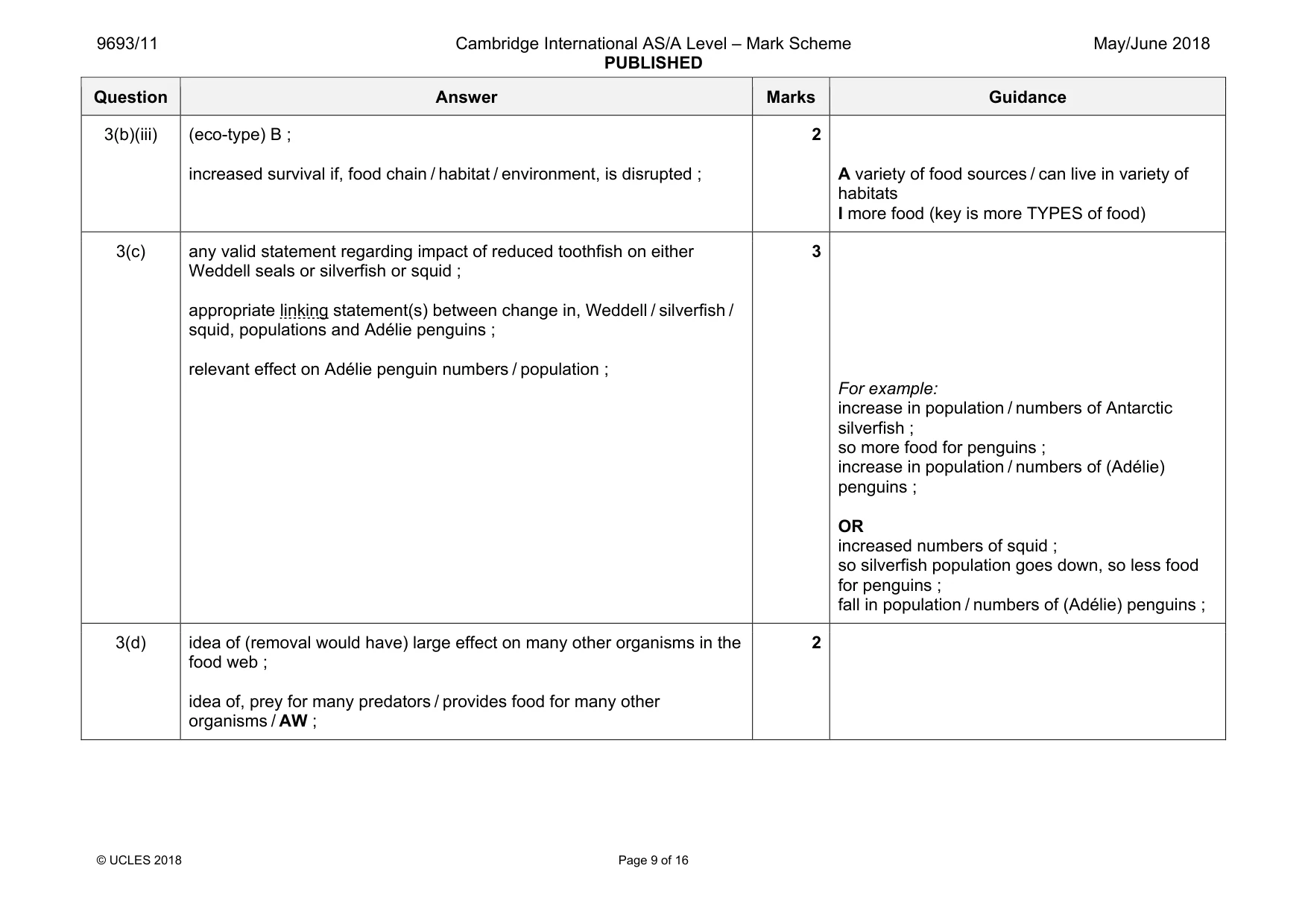
9693/11 Cambridge International AS/A Level – Mark Scheme PUBLISHED May/June 2018 © UCLES 2018 Page 8 of 16 Question Answer Marks Guidance 2(b)(ii) any 2 of: stronger wind / greater wind speed ; more rainfall ; more cloud (rather than sunny) ; cooler ; 2 A more wind Question Answer Marks Guidance 3(a) organism trophic level ice algae 1 Antarctic silverfish 3 2 A producer A secondary consumer 3(b)(i) five horizontal bars of decreasing width (widest bar at base) ; labelled in correct order ; stacked approximately centrally ; 3 3(b)(ii) energy loss at each stage / only 10% transferred ; due to, respiration / movement / growth / excretion / not eaten ; 2 A heat loss / waste (products) (killer) whale toothfish squid zooplankton phytoplankton
Mark scheme, page 9
9693/11 Cambridge International AS/A Level – Mark Scheme PUBLISHED May/June 2018 © UCLES 2018 Page 9 of 16 Question Answer Marks Guidance 3(b)(iii) (eco-type) B ; increased survival if, food chain / habitat / environment, is disrupted ; 2 A variety of food sources / can live in variety of habitats I more food (key is more TYPES of food) 3(c) any valid statement regarding impact of reduced toothfish on either Weddell seals or silverfish or squid ; appropriate linking statement(s) between change in, Weddell / silverfish / squid, populations and Adélie penguins ; relevant effect on Adélie penguin numbers / population ; 3 For example: increase in population / numbers of Antarctic silverfish ; so more food for penguins ; increase in population / numbers of (Adélie) penguins ; OR increased numbers of squid ; so silverfish population goes down, so less food for penguins ; fall in population / numbers of (Adélie) penguins ; 3(d) idea of (removal would have) large effect on many other organisms in the food web ; idea of, prey for many predators / provides food for many other organisms / AW ; 2
Mark scheme, page 10
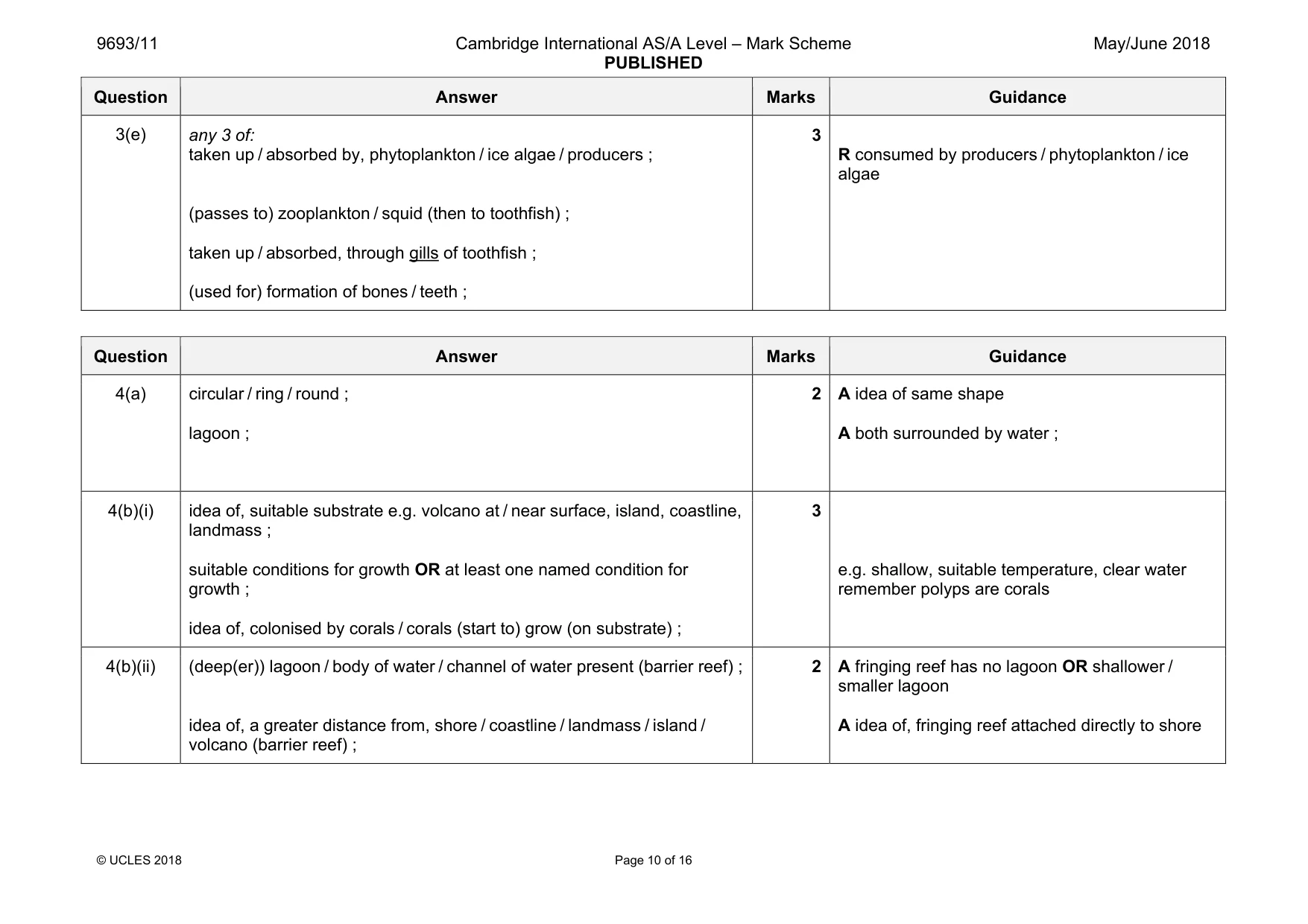
9693/11 Cambridge International AS/A Level – Mark Scheme PUBLISHED May/June 2018 © UCLES 2018 Page 10 of 16 Question Answer Marks Guidance 3(e) any 3 of: taken up / absorbed by, phytoplankton / ice algae / producers ; (passes to) zooplankton / squid (then to toothfish) ; taken up / absorbed, through gills of toothfish ; (used for) formation of bones / teeth ; 3 R consumed by producers / phytoplankton / ice algae Question Answer Marks Guidance 4(a) circular / ring / round ; lagoon ; 2 A idea of same shape A both surrounded by water ; 4(b)(i) idea of, suitable substrate e.g. volcano at / near surface, island, coastline, landmass ; suitable conditions for growth OR at least one named condition for growth ; idea of, colonised by corals / corals (start to) grow (on substrate) ; 3 e.g. shallow, suitable temperature, clear water remember polyps are corals 4(b)(ii) (deep(er)) lagoon / body of water / channel of water present (barrier reef) ; idea of, a greater distance from, shore / coastline / landmass / island / volcano (barrier reef) ; 2 A fringing reef has no lagoon OR shallower / smaller lagoon A idea of, fringing reef attached directly to shore
Mark scheme, page 11
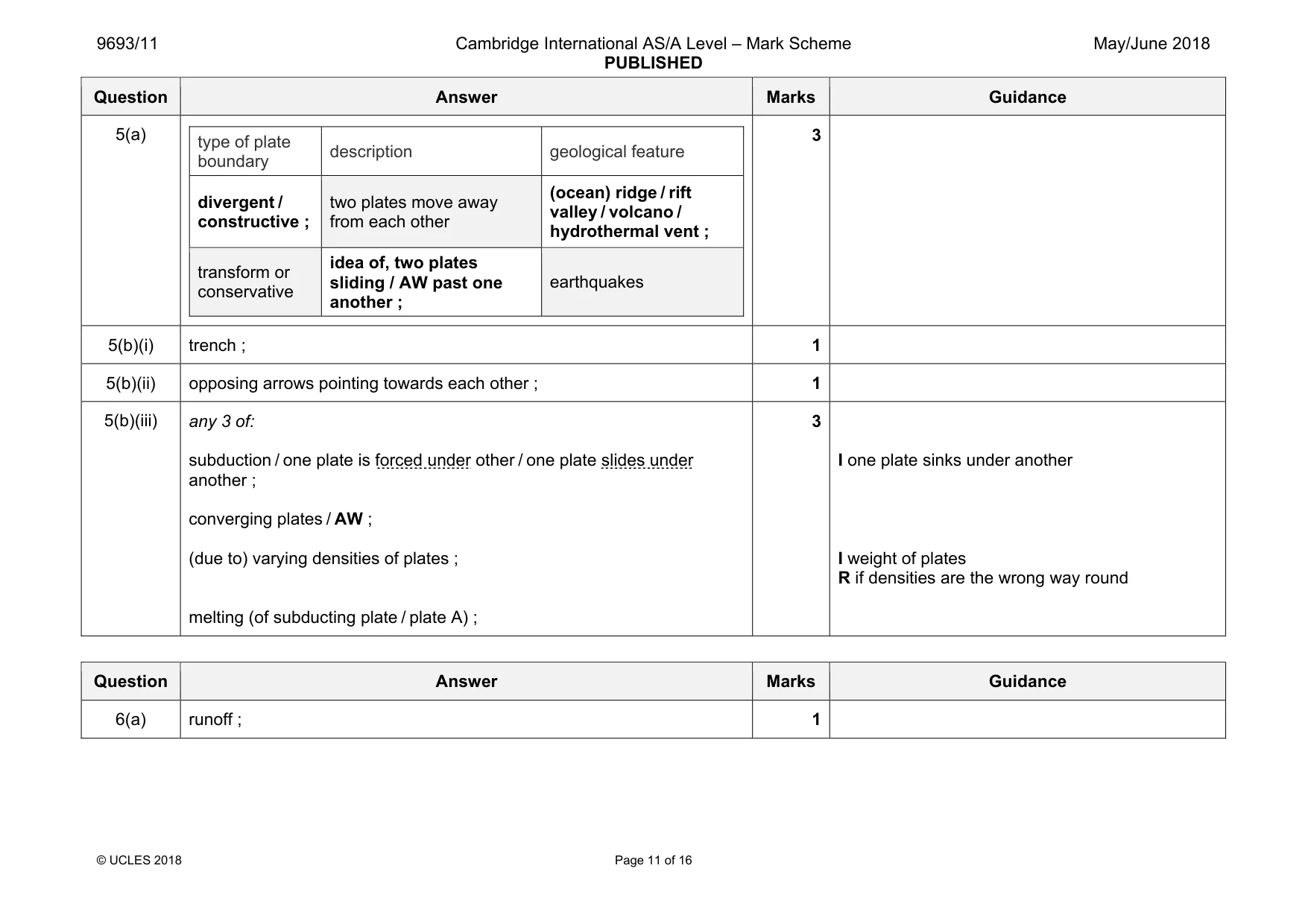
9693/11 Cambridge International AS/A Level – Mark Scheme PUBLISHED May/June 2018 © UCLES 2018 Page 11 of 16 Question Answer Marks Guidance 5(a) type of plate boundary description geological feature divergent / constructive ; two plates move away from each other (ocean) ridge / rift valley / volcano / hydrothermal vent ; transform or conservative idea of, two plates sliding / AW past one another ; earthquakes 3 5(b)(i) trench ; 1 5(b)(ii) opposing arrows pointing towards each other ; 1 5(b)(iii) any 3 of: subduction / one plate is forced under other / one plate slides under another ; converging plates / AW ; (due to) varying densities of plates ; melting (of subducting plate / plate A) ; 3 I one plate sinks under another I weight of plates R if densities are the wrong way round Question Answer Marks Guidance 6(a) runoff ; 1
Mark scheme, page 12
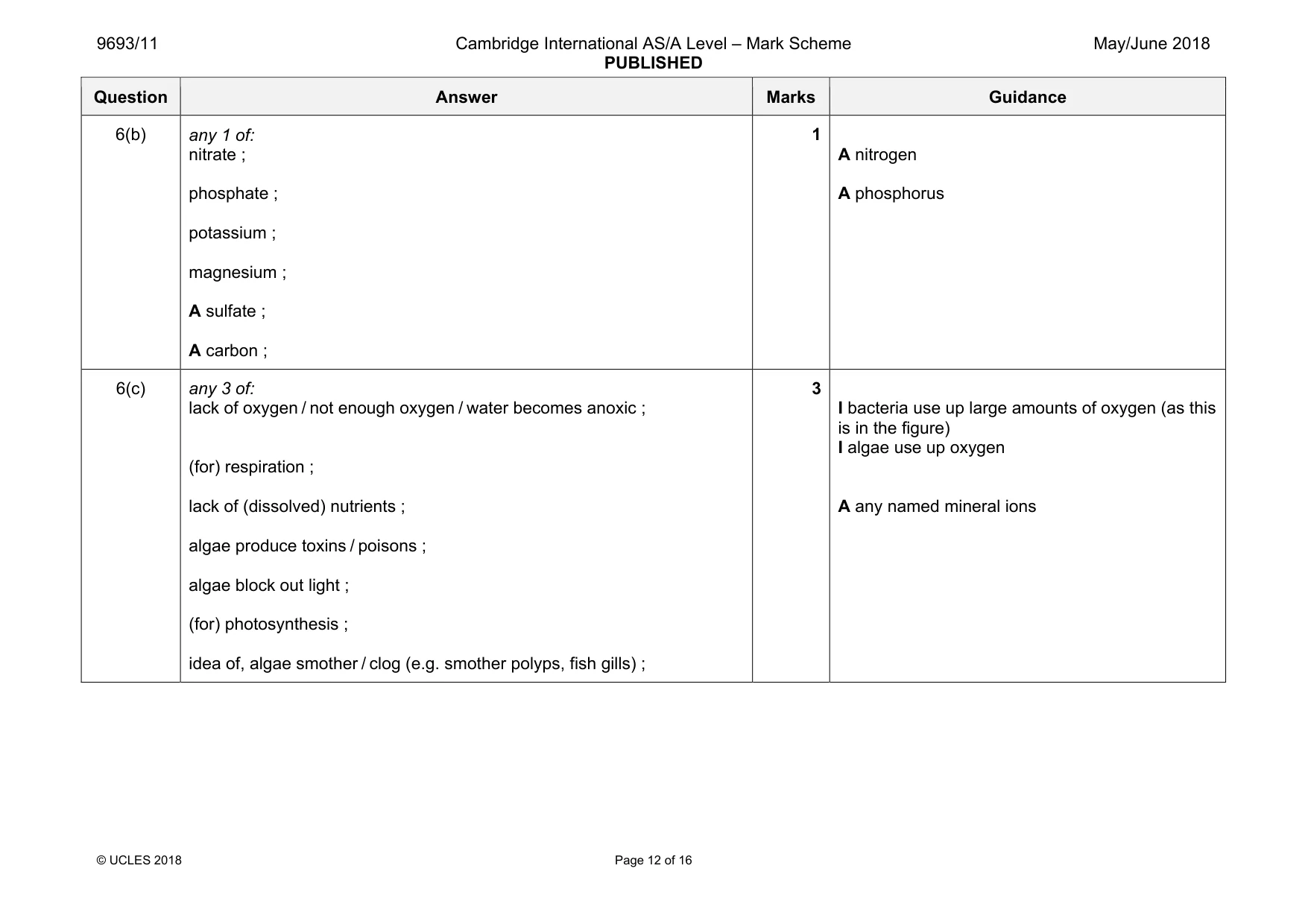
9693/11 Cambridge International AS/A Level – Mark Scheme PUBLISHED May/June 2018 © UCLES 2018 Page 12 of 16 Question Answer Marks Guidance 6(b) any 1 of: nitrate ; phosphate ; potassium ; magnesium ; A sulfate ; A carbon ; 1 A nitrogen A phosphorus 6(c) any 3 of: lack of oxygen / not enough oxygen / water becomes anoxic ; (for) respiration ; lack of (dissolved) nutrients ; algae produce toxins / poisons ; algae block out light ; (for) photosynthesis ; idea of, algae smother / clog (e.g. smother polyps, fish gills) ; 3 I bacteria use up large amounts of oxygen (as this is in the figure) I algae use up oxygen A any named mineral ions
Mark scheme, page 13
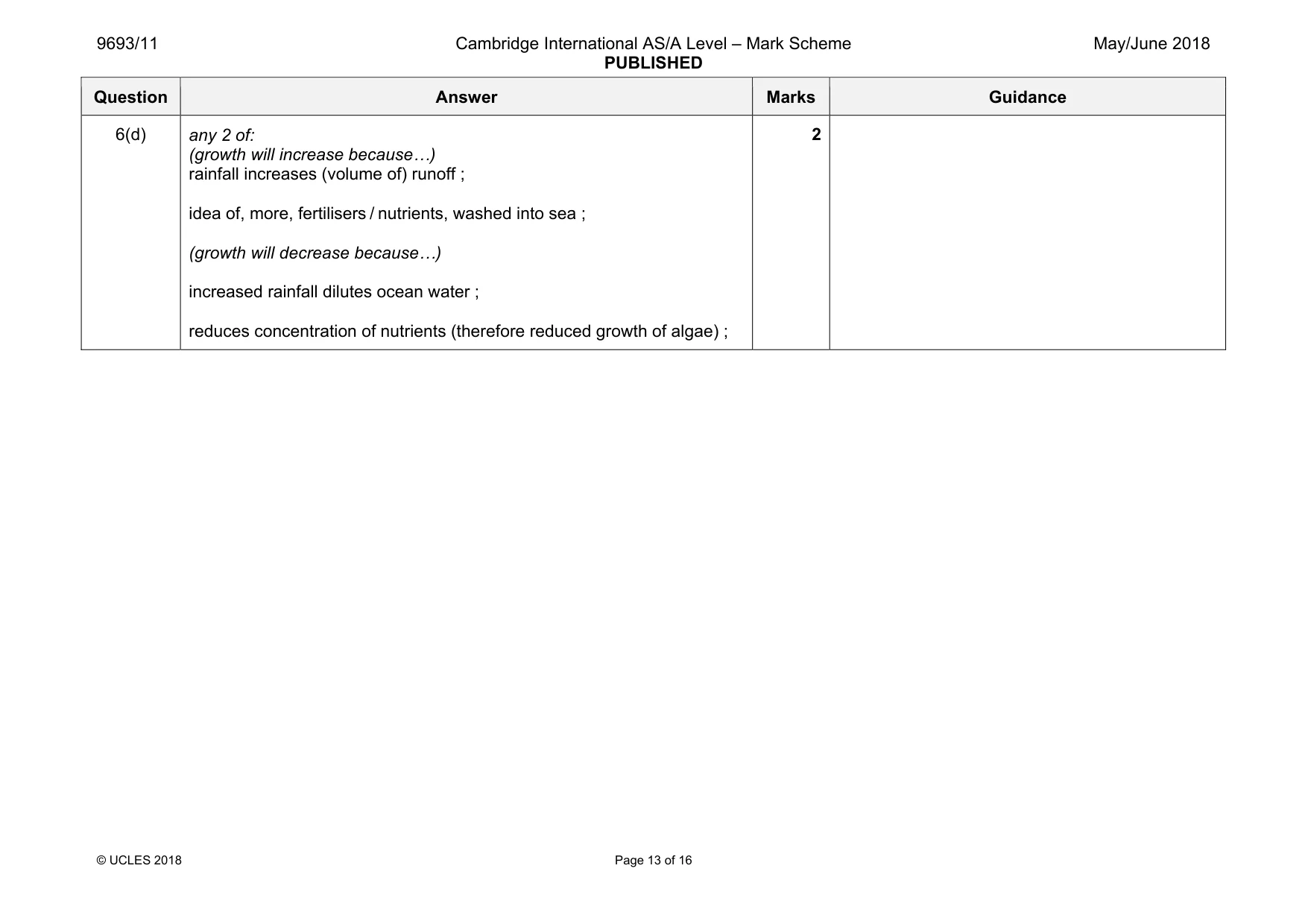
9693/11 Cambridge International AS/A Level – Mark Scheme PUBLISHED May/June 2018 © UCLES 2018 Page 13 of 16 Question Answer Marks Guidance 6(d) any 2 of: (growth will increase because«) rainfall increases (volume of) runoff ; idea of, more, fertilisers / nutrients, washed into sea ; (growth will decrease because«) increased rainfall dilutes ocean water ; reduces concentration of nutrients (therefore reduced growth of algae) ; 2
Mark scheme, page 14
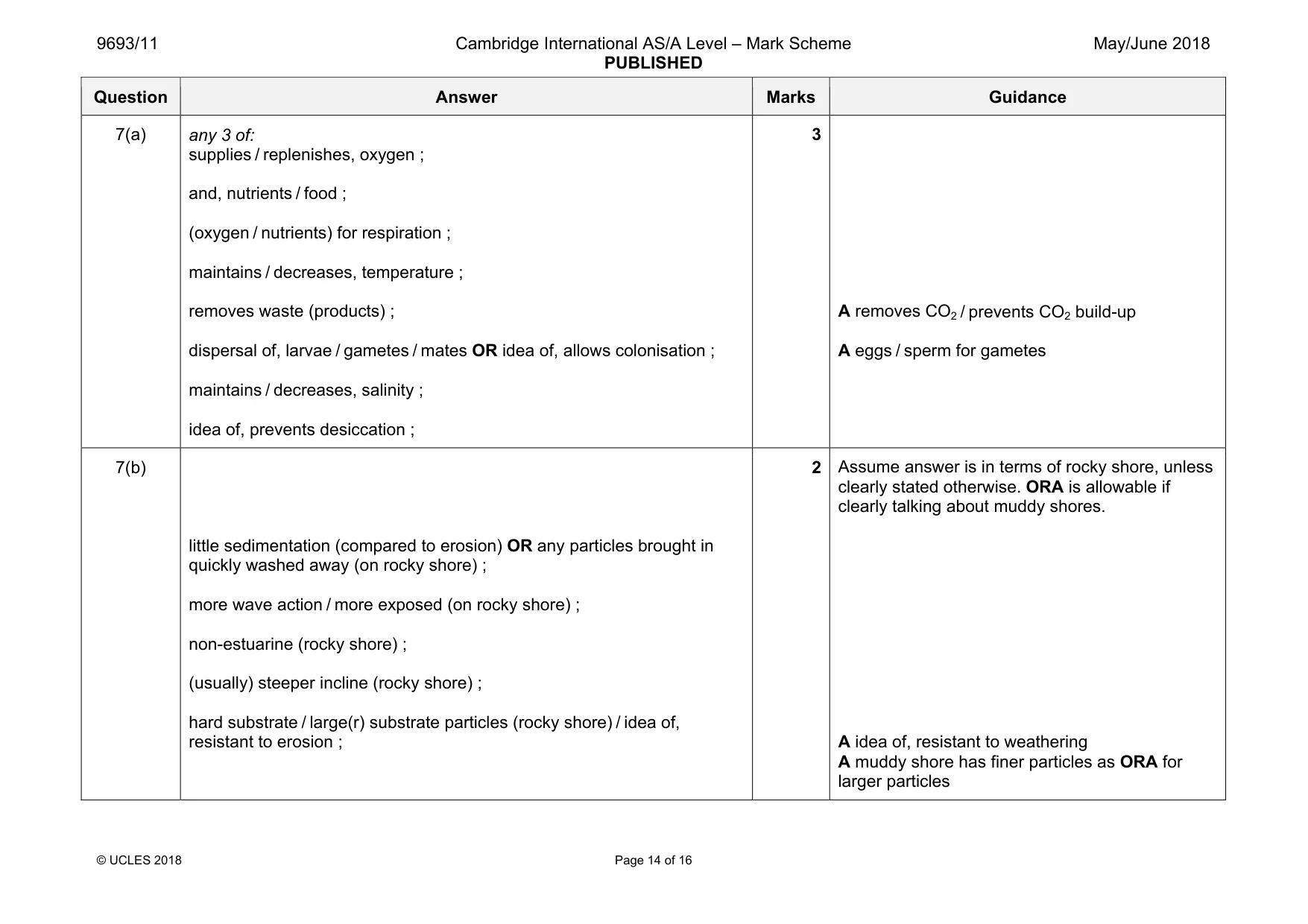
9693/11 Cambridge International AS/A Level – Mark Scheme PUBLISHED May/June 2018 © UCLES 2018 Page 14 of 16 Question Answer Marks Guidance 7(a) any 3 of: supplies / replenishes, oxygen ; and, nutrients / food ; (oxygen / nutrients) for respiration ; maintains / decreases, temperature ; removes waste (products) ; dispersal of, larvae / gametes / mates OR idea of, allows colonisation ; maintains / decreases, salinity ; idea of, prevents desiccation ; 3 A removes CO2 / prevents CO2 build-up A eggs / sperm for gametes 7(b) little sedimentation (compared to erosion) OR any particles brought in quickly washed away (on rocky shore) ; more wave action / more exposed (on rocky shore) ; non-estuarine (rocky shore) ; (usually) steeper incline (rocky shore) ; hard substrate / large(r) substrate particles (rocky shore) / idea of, resistant to erosion ; 2 Assume answer is in terms of rocky shore, unless clearly stated otherwise. ORA is allowable if clearly talking about muddy shores. A idea of, resistant to weathering A muddy shore has finer particles as ORA for larger particles
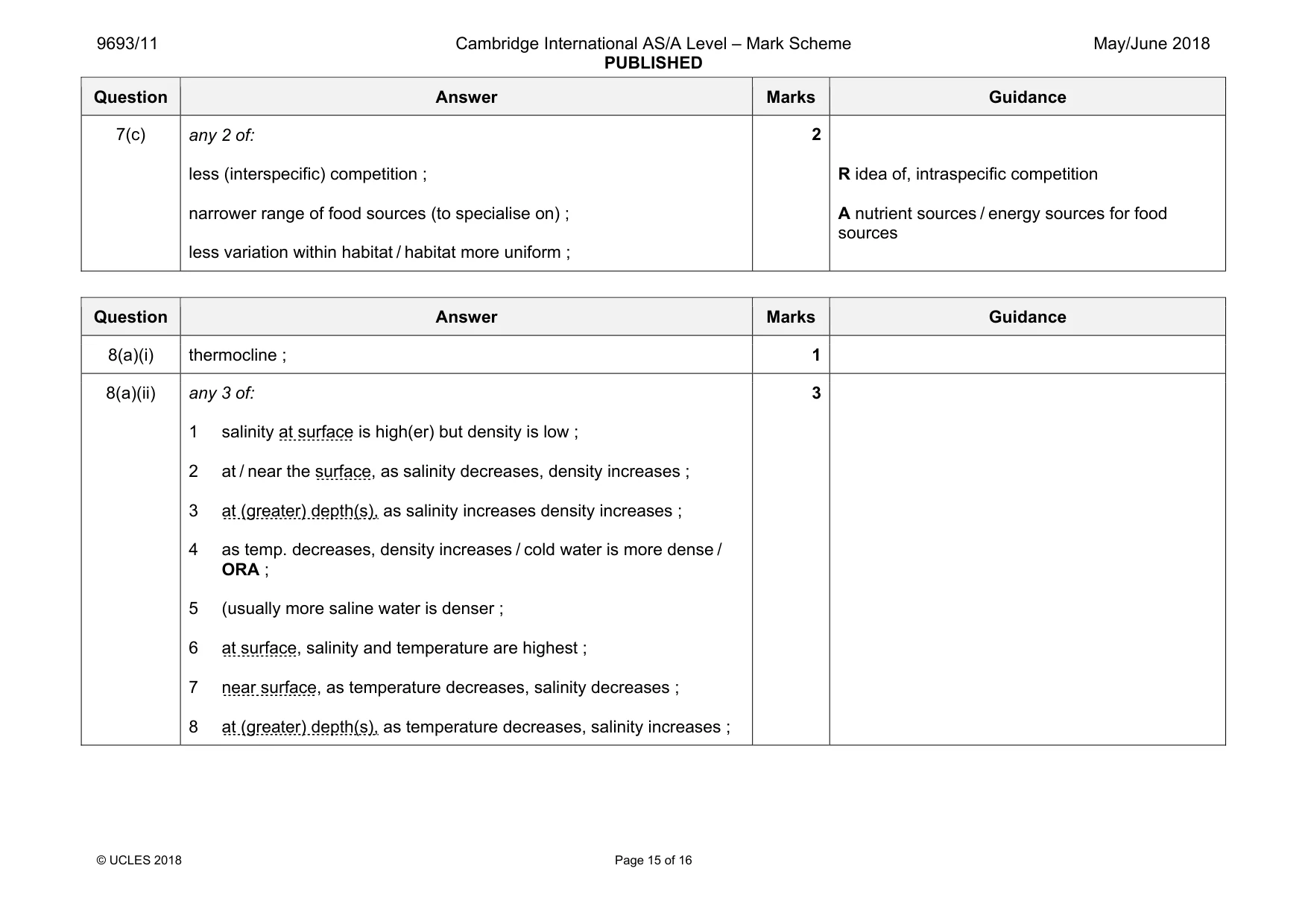
Mark scheme, page 15
9693/11 Cambridge International AS/A Level – Mark Scheme PUBLISHED May/June 2018 © UCLES 2018 Page 15 of 16 Question Answer Marks Guidance 7(c) any 2 of: less (interspecific) competition ; narrower range of food sources (to specialise on) ; less variation within habitat / habitat more uniform ; 2 R idea of, intraspecific competition A nutrient sources / energy sources for food sources Question Answer Marks Guidance 8(a)(i) thermocline ; 1 8(a)(ii) any 3 of: 1 salinity at surface is high(er) but density is low ; 2 at / near the surface, as salinity decreases, density increases ; 3 at (greater) depth(s), as salinity increases density increases ; 4 as temp. decreases, density increases / cold water is more dense / ORA ; 5 (usually more saline water is denser ; 6 at surface, salinity and temperature are highest ; 7 near surface, as temperature decreases, salinity decreases ; 8 at (greater) depth(s), as temperature decreases, salinity increases ; 3
Mark scheme, page 16
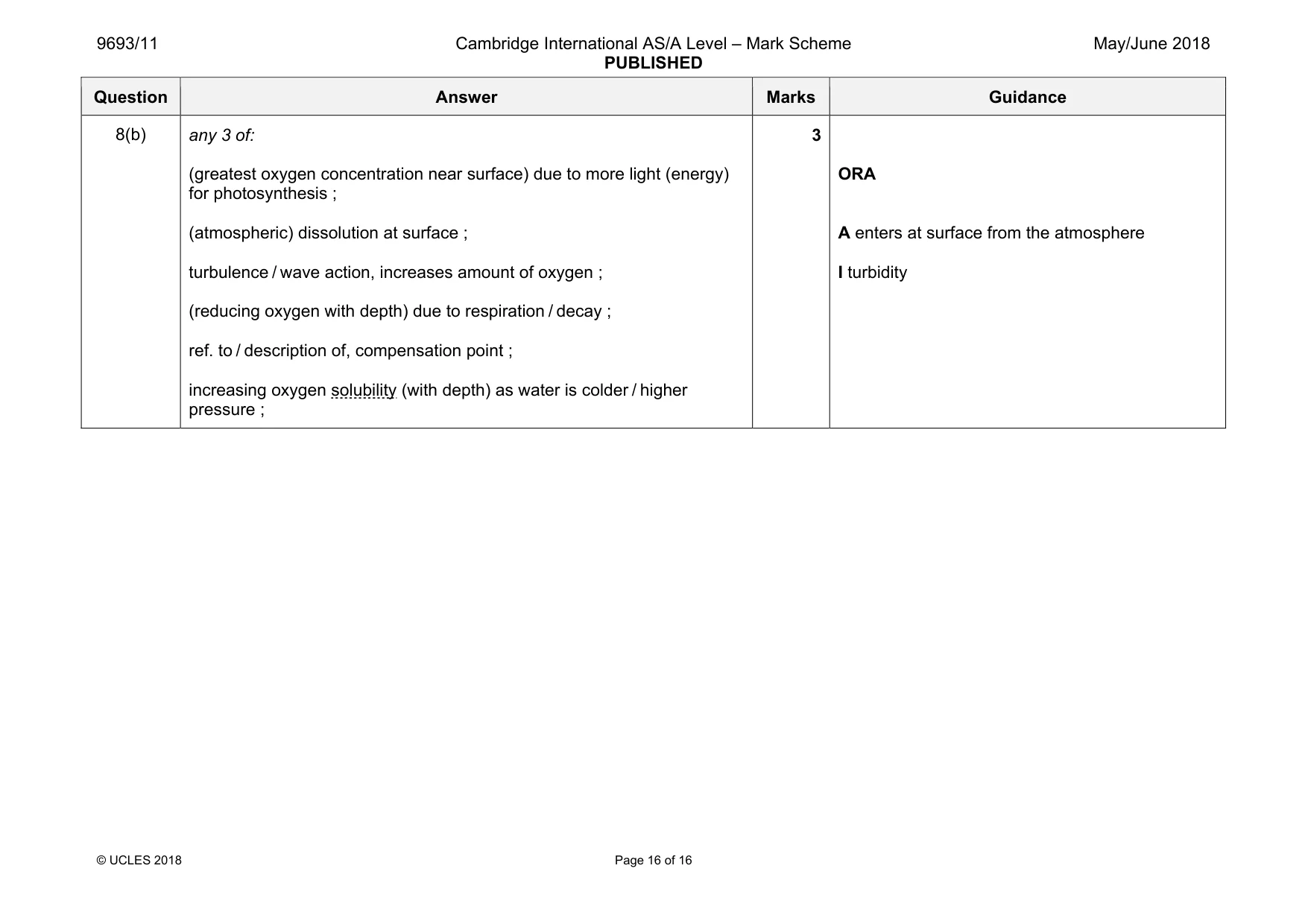
9693/11 Cambridge International AS/A Level – Mark Scheme PUBLISHED May/June 2018 © UCLES 2018 Page 16 of 16 Question Answer Marks Guidance 8(b) any 3 of: (greatest oxygen concentration near surface) due to more light (energy) for photosynthesis ; (atmospheric) dissolution at surface ; turbulence / wave action, increases amount of oxygen ; (reducing oxygen with depth) due to respiration / decay ; ref. to / description of, compensation point ; increasing oxygen solubility (with depth) as water is colder / higher pressure ; 3 ORA A enters at surface from the atmosphere I turbidity
What you needed in this session
Cambridge’s own grade thresholds for 2018 May/June, Paper 1 · Variant 1. A higher threshold means an easier paper — the bar moves with how the cohort did.