Cambridge A Level Law 9084 — 2020 Oct/Nov Paper 1 · Variant 2
9084/12/O/N/20 · 75 marks · ≈84 min
The question paper and its mark scheme, free to read here and free to download. This is Cambridge’s own paper, exactly as it was sat.
Question paper4 pages


Mark scheme9 pages
Answers below. Sit the paper first if you are practising.
Paper as text
Question paper, page 1
Cambridge International AS & A Level * 5 9 5 5 2 6 6 4 2 2 * DC (PQ) 187566/2 © UCLES 2020 [Turn over This document has 4 pages. Blank pages are indicated. LAW 9084/12 Paper 1 Structure and Operation of the English Legal System October/November 2020 1 hour 30 minutes You must answer on the enclosed answer booklet. You will need: Answer booklet (enclosed) INSTRUCTIONS ● Answer three questions. ● Follow the instructions on the front cover of the answer booklet. If you need additional answer paper, ask the invigilator for a continuation booklet. INFORMATION ● The total mark for this paper is 75. ● The number of marks for each question or part question is shown in brackets [ ].
Question paper, page 2
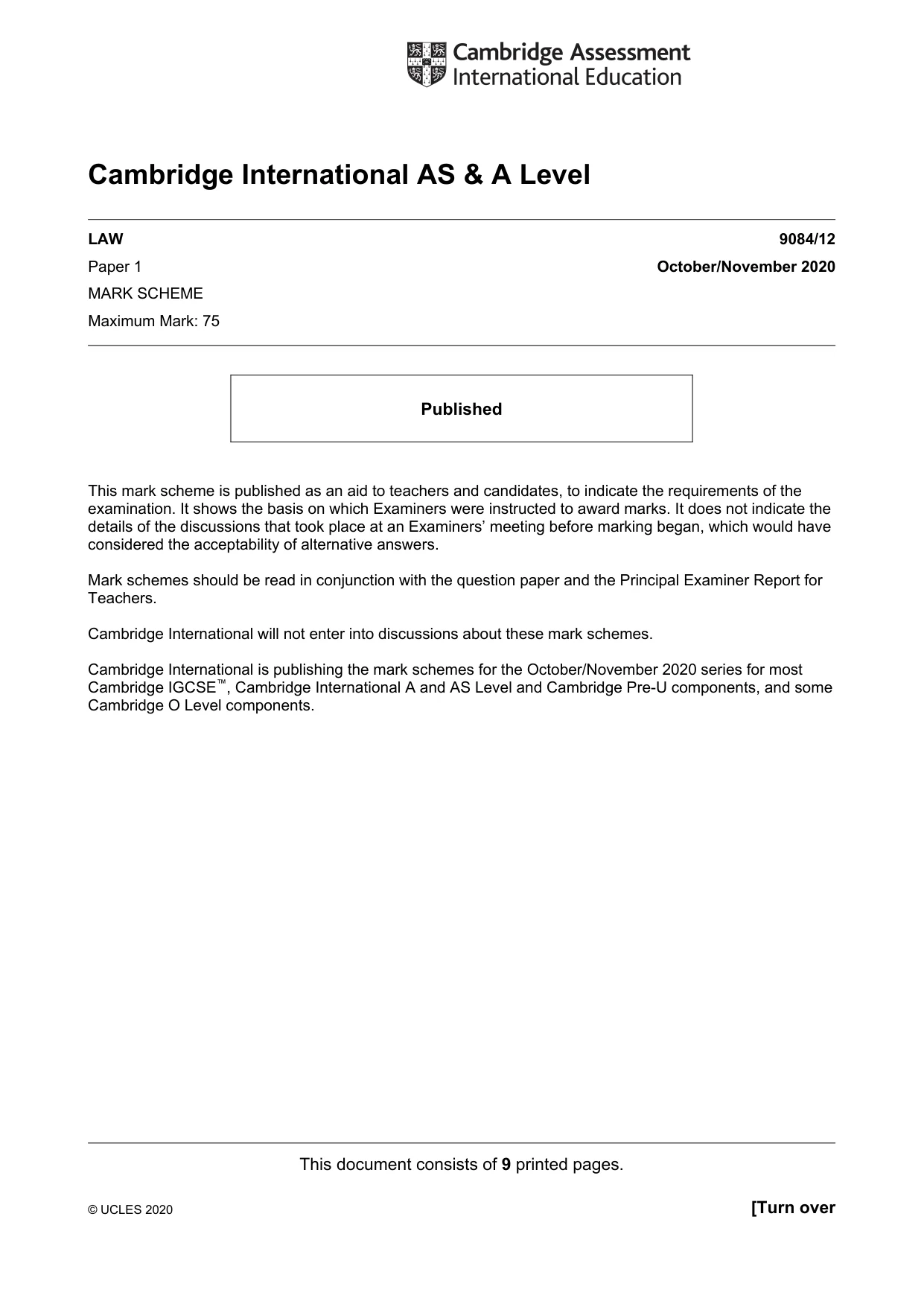
2 9084/12/O/N/20 © UCLES 2020 Answer three questions. 1 Explain how a bill becomes an Act of Parliament. Assess the effectiveness of this process for creating law. [25] 2 Johann has been arrested and charged with three counts of assault. He is 42 and has previously been convicted of theft. He has a wife and three children under the age of eight who live with him in a rented flat. He has a job as a mechanic in a local garage. He also has family in Australia. Explain which factors will be considered when deciding whether or not to grant bail to Johann. Justify whether it is ever appropriate to grant bail to someone charged with an offence. [25] 3 Explain three types of delegated legislation. Discuss the advantages and disadvantages of this form of law-making. [25] 4 In both the Magistrates’ Court and the Crown Court, laypeople are used to make decisions. Explain the role of both the jury and the lay magistrate in criminal cases. Assess the extent to which it is appropriate to use non-qualified people for these roles. [25] 5 Explain the various forms of alternative dispute resolution (ADR). Evaluate the advantages and disadvantages of each. [25] 6 Describe the structure and role of the Crown Prosecution Service. Assess the extent to which it has been successful in preventing miscarriages of justice. [25]
Question paper, page 3
3 9084/12/O/N/20 © UCLES 2020 BLANK PAGE
Question paper, page 4
4 9084/12/O/N/20 © UCLES 2020 Permission to reproduce items where third-party owned material protected by copyright is included has been sought and cleared where possible. Every reasonable effort has been made by the publisher (UCLES) to trace copyright holders, but if any items requiring clearance have unwittingly been included, the publisher will be pleased to make amends at the earliest possible opportunity. To avoid the issue of disclosure of answer-related information to candidates, all copyright acknowledgements are reproduced online in the Cambridge Assessment International Education Copyright Acknowledgements Booklet. This is produced for each series of examinations and is freely available to download at www.cambridgeinternational.org after the live examination series. Cambridge Assessment International Education is part of the Cambridge Assessment Group. Cambridge Assessment is the brand name of the University of Cambridge Local Examinations Syndicate (UCLES), which itself is a department of the University of Cambridge. BLANK PAGE
Mark scheme, page 1
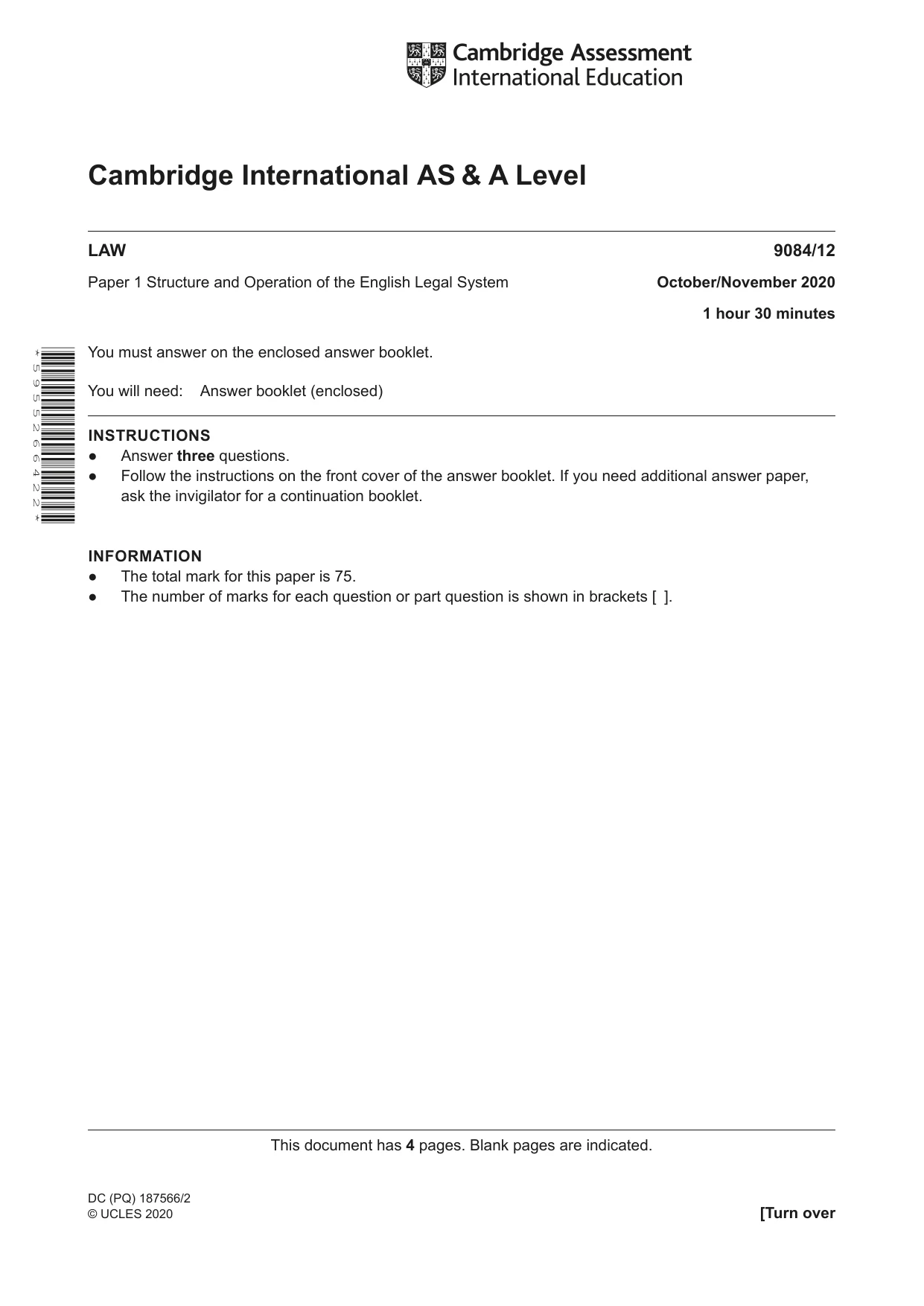
This document consists of 9 printed pages. © UCLES 2020 [Turn over Cambridge International AS & A Level LAW 9084/12 Paper 1 October/November 2020 MARK SCHEME Maximum Mark: 75 Published This mark scheme is published as an aid to teachers and candidates, to indicate the requirements of the examination. It shows the basis on which Examiners were instructed to award marks. It does not indicate the details of the discussions that took place at an Examiners’ meeting before marking began, which would have considered the acceptability of alternative answers. Mark schemes should be read in conjunction with the question paper and the Principal Examiner Report for Teachers. Cambridge International will not enter into discussions about these mark schemes. Cambridge International is publishing the mark schemes for the October/November 2020 series for most Cambridge IGCSE™, Cambridge International A and AS Level and Cambridge Pre-U components, and some Cambridge O Level components.
Mark scheme, page 2
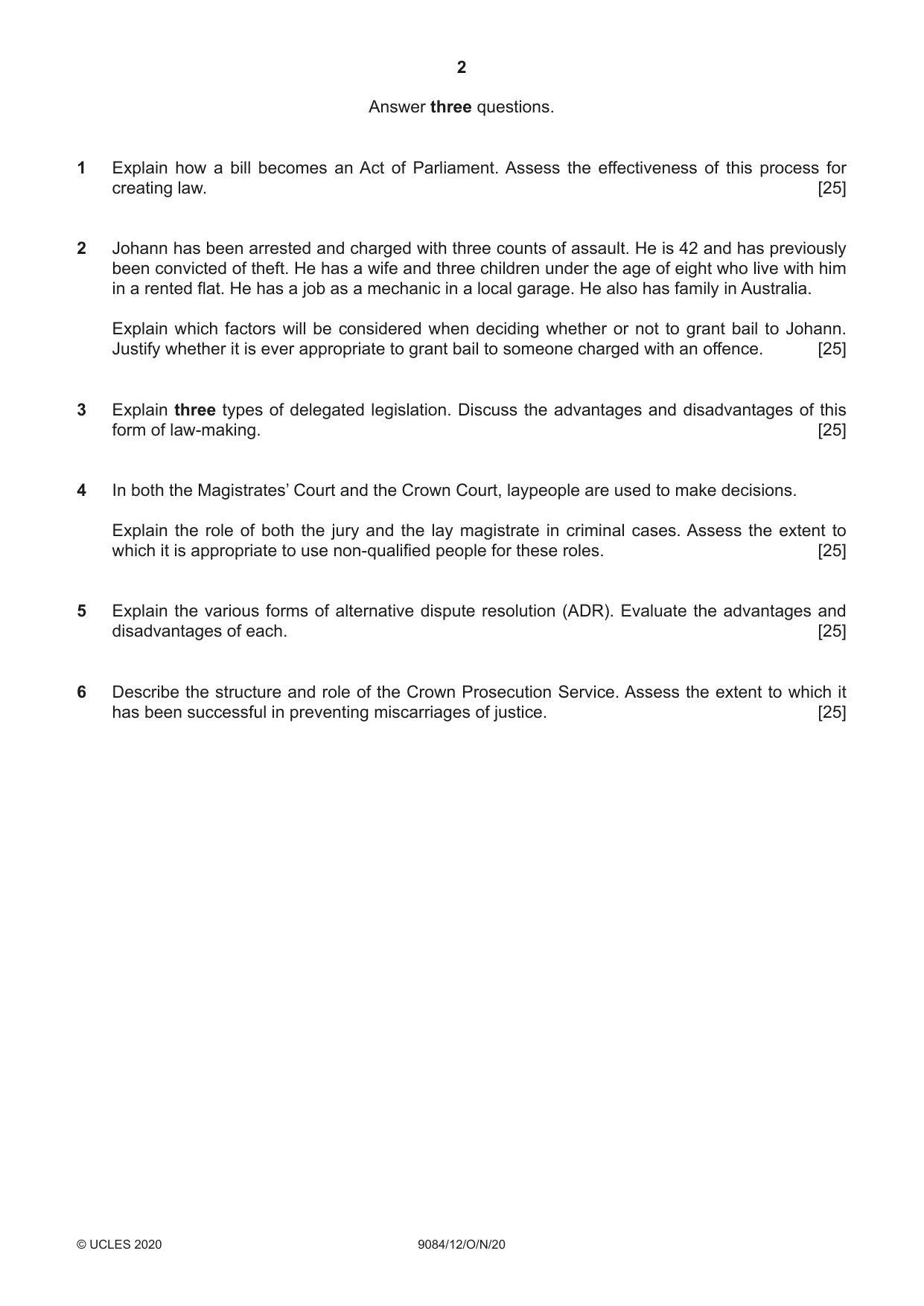
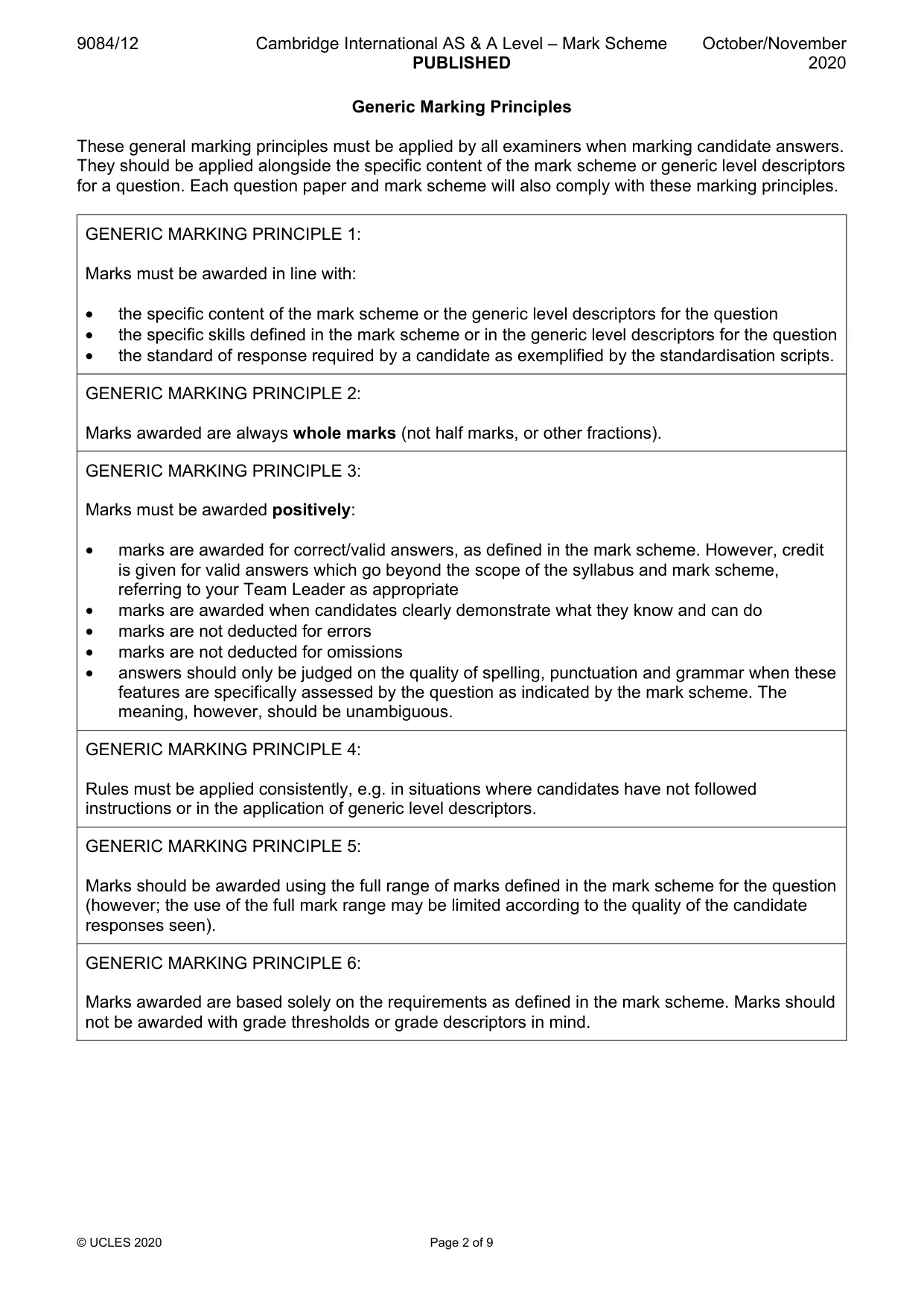
9084/12 Cambridge International AS & A Level – Mark Scheme PUBLISHED October/November 2020 © UCLES 2020 Page 2 of 9 Generic Marking Principles These general marking principles must be applied by all examiners when marking candidate answers. They should be applied alongside the specific content of the mark scheme or generic level descriptors for a question. Each question paper and mark scheme will also comply with these marking principles. GENERIC MARKING PRINCIPLE 1: Marks must be awarded in line with: • the specific content of the mark scheme or the generic level descriptors for the question • the specific skills defined in the mark scheme or in the generic level descriptors for the question • the standard of response required by a candidate as exemplified by the standardisation scripts. GENERIC MARKING PRINCIPLE 2: Marks awarded are always whole marks (not half marks, or other fractions). GENERIC MARKING PRINCIPLE 3: Marks must be awarded positively: • marks are awarded for correct/valid answers, as defined in the mark scheme. However, credit is given for valid answers which go beyond the scope of the syllabus and mark scheme, referring to your Team Leader as appropriate • marks are awarded when candidates clearly demonstrate what they know and can do • marks are not deducted for errors • marks are not deducted for omissions • answers should only be judged on the quality of spelling, punctuation and grammar when these features are specifically assessed by the question as indicated by the mark scheme. The meaning, however, should be unambiguous. GENERIC MARKING PRINCIPLE 4: Rules must be applied consistently, e.g. in situations where candidates have not followed instructions or in the application of generic level descriptors. GENERIC MARKING PRINCIPLE 5: Marks should be awarded using the full range of marks defined in the mark scheme for the question (however; the use of the full mark range may be limited according to the quality of the candidate responses seen). GENERIC MARKING PRINCIPLE 6: Marks awarded are based solely on the requirements as defined in the mark scheme. Marks should not be awarded with grade thresholds or grade descriptors in mind.
Mark scheme, page 3
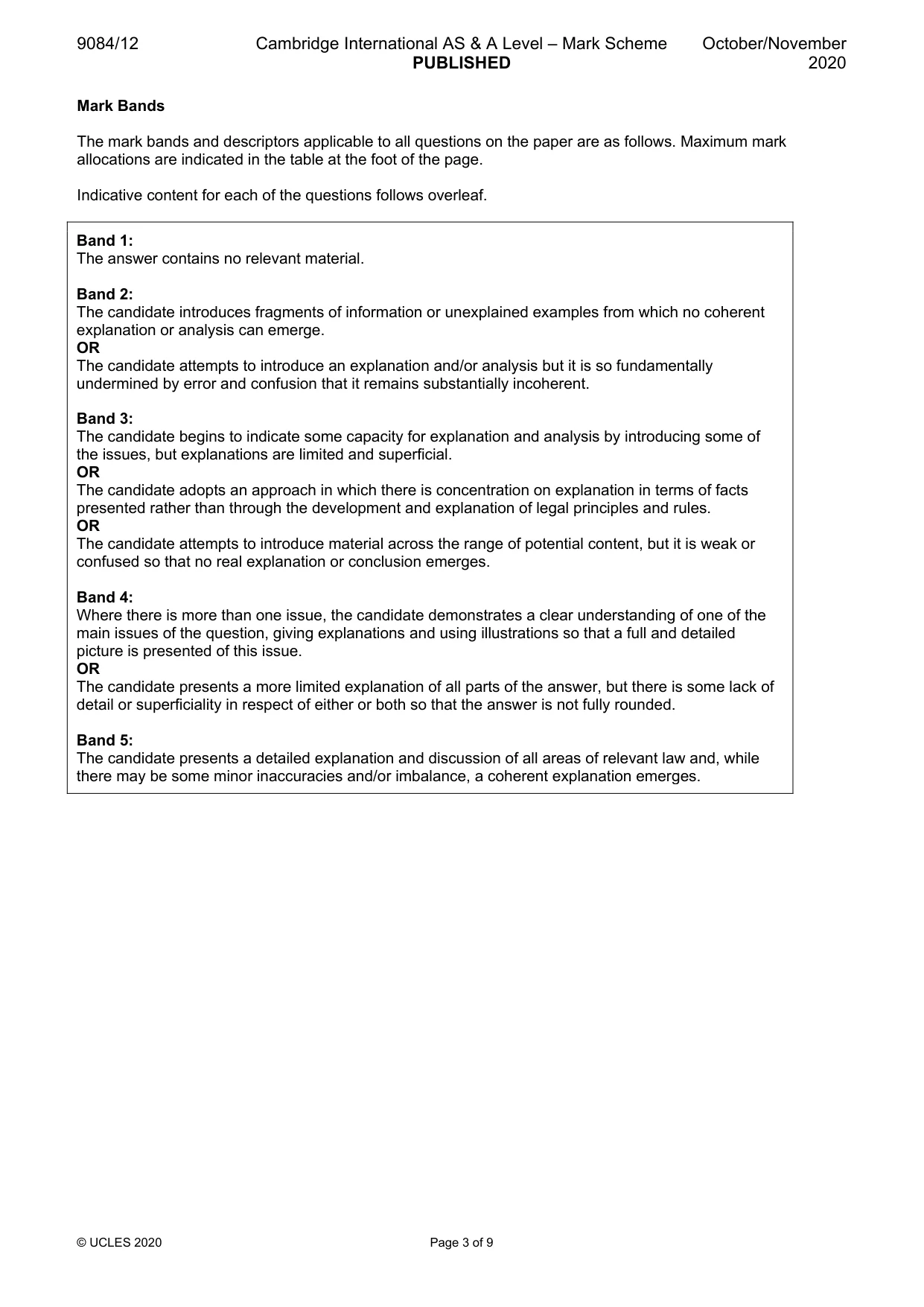
9084/12 Cambridge International AS & A Level – Mark Scheme PUBLISHED October/November 2020 © UCLES 2020 Page 3 of 9 Mark Bands The mark bands and descriptors applicable to all questions on the paper are as follows. Maximum mark allocations are indicated in the table at the foot of the page. Indicative content for each of the questions follows overleaf. Band 1: The answer contains no relevant material. Band 2: The candidate introduces fragments of information or unexplained examples from which no coherent explanation or analysis can emerge. OR The candidate attempts to introduce an explanation and/or analysis but it is so fundamentally undermined by error and confusion that it remains substantially incoherent. Band 3: The candidate begins to indicate some capacity for explanation and analysis by introducing some of the issues, but explanations are limited and superficial. OR The candidate adopts an approach in which there is concentration on explanation in terms of facts presented rather than through the development and explanation of legal principles and rules. OR The candidate attempts to introduce material across the range of potential content, but it is weak or confused so that no real explanation or conclusion emerges. Band 4: Where there is more than one issue, the candidate demonstrates a clear understanding of one of the main issues of the question, giving explanations and using illustrations so that a full and detailed picture is presented of this issue. OR The candidate presents a more limited explanation of all parts of the answer, but there is some lack of detail or superficiality in respect of either or both so that the answer is not fully rounded. Band 5: The candidate presents a detailed explanation and discussion of all areas of relevant law and, while there may be some minor inaccuracies and/or imbalance, a coherent explanation emerges.
Mark scheme, page 4
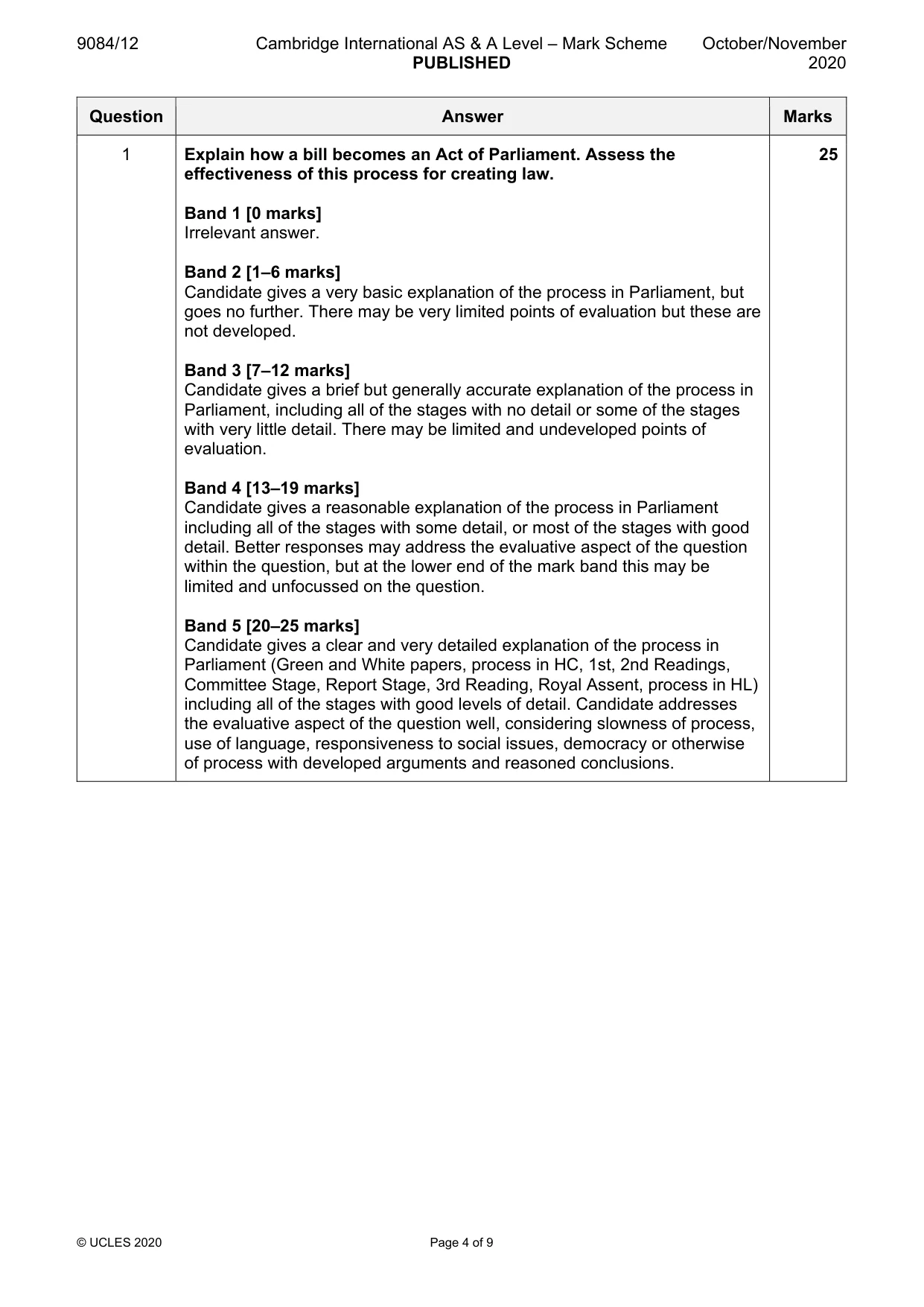
9084/12 Cambridge International AS & A Level – Mark Scheme PUBLISHED October/November 2020 © UCLES 2020 Page 4 of 9 Question Answer Marks 1 Explain how a bill becomes an Act of Parliament. Assess the effectiveness of this process for creating law. Band 1 [0 marks] Irrelevant answer. Band 2 [1–6 marks] Candidate gives a very basic explanation of the process in Parliament, but goes no further. There may be very limited points of evaluation but these are not developed. Band 3 [7–12 marks] Candidate gives a brief but generally accurate explanation of the process in Parliament, including all of the stages with no detail or some of the stages with very little detail. There may be limited and undeveloped points of evaluation. Band 4 [13–19 marks] Candidate gives a reasonable explanation of the process in Parliament including all of the stages with some detail, or most of the stages with good detail. Better responses may address the evaluative aspect of the question within the question, but at the lower end of the mark band this may be limited and unfocussed on the question. Band 5 [20–25 marks] Candidate gives a clear and very detailed explanation of the process in Parliament (Green and White papers, process in HC, 1st, 2nd Readings, Committee Stage, Report Stage, 3rd Reading, Royal Assent, process in HL) including all of the stages with good levels of detail. Candidate addresses the evaluative aspect of the question well, considering slowness of process, use of language, responsiveness to social issues, democracy or otherwise of process with developed arguments and reasoned conclusions. 25
Mark scheme, page 5
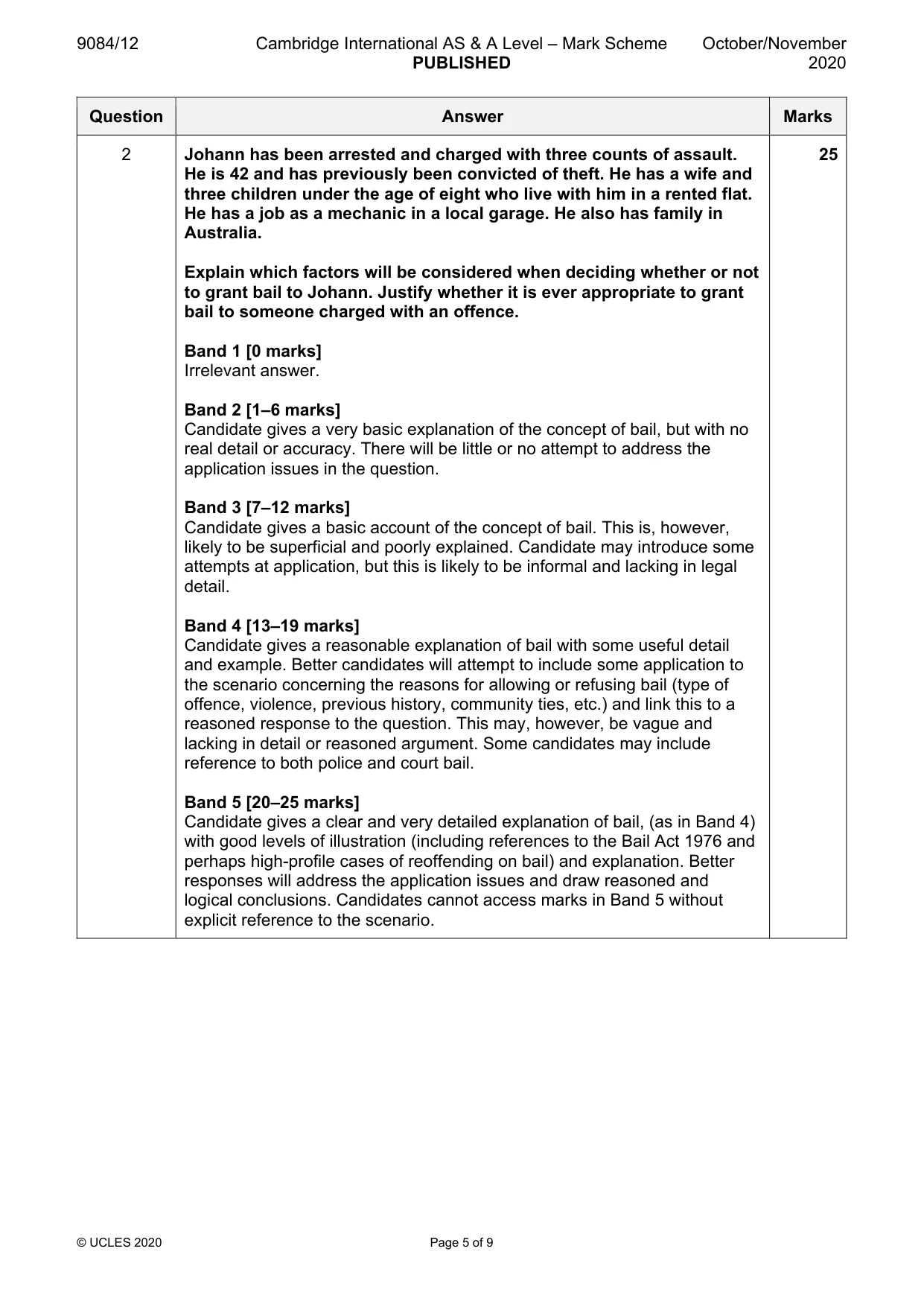
9084/12 Cambridge International AS & A Level – Mark Scheme PUBLISHED October/November 2020 © UCLES 2020 Page 5 of 9 Question Answer Marks 2 Johann has been arrested and charged with three counts of assault. He is 42 and has previously been convicted of theft. He has a wife and three children under the age of eight who live with him in a rented flat. He has a job as a mechanic in a local garage. He also has family in Australia. Explain which factors will be considered when deciding whether or not to grant bail to Johann. Justify whether it is ever appropriate to grant bail to someone charged with an offence. Band 1 [0 marks] Irrelevant answer. Band 2 [1–6 marks] Candidate gives a very basic explanation of the concept of bail, but with no real detail or accuracy. There will be little or no attempt to address the application issues in the question. Band 3 [7–12 marks] Candidate gives a basic account of the concept of bail. This is, however, likely to be superficial and poorly explained. Candidate may introduce some attempts at application, but this is likely to be informal and lacking in legal detail. Band 4 [13–19 marks] Candidate gives a reasonable explanation of bail with some useful detail and example. Better candidates will attempt to include some application to the scenario concerning the reasons for allowing or refusing bail (type of offence, violence, previous history, community ties, etc.) and link this to a reasoned response to the question. This may, however, be vague and lacking in detail or reasoned argument. Some candidates may include reference to both police and court bail. Band 5 [20–25 marks] Candidate gives a clear and very detailed explanation of bail, (as in Band 4) with good levels of illustration (including references to the Bail Act 1976 and perhaps high-profile cases of reoffending on bail) and explanation. Better responses will address the application issues and draw reasoned and logical conclusions. Candidates cannot access marks in Band 5 without explicit reference to the scenario. 25
Mark scheme, page 6
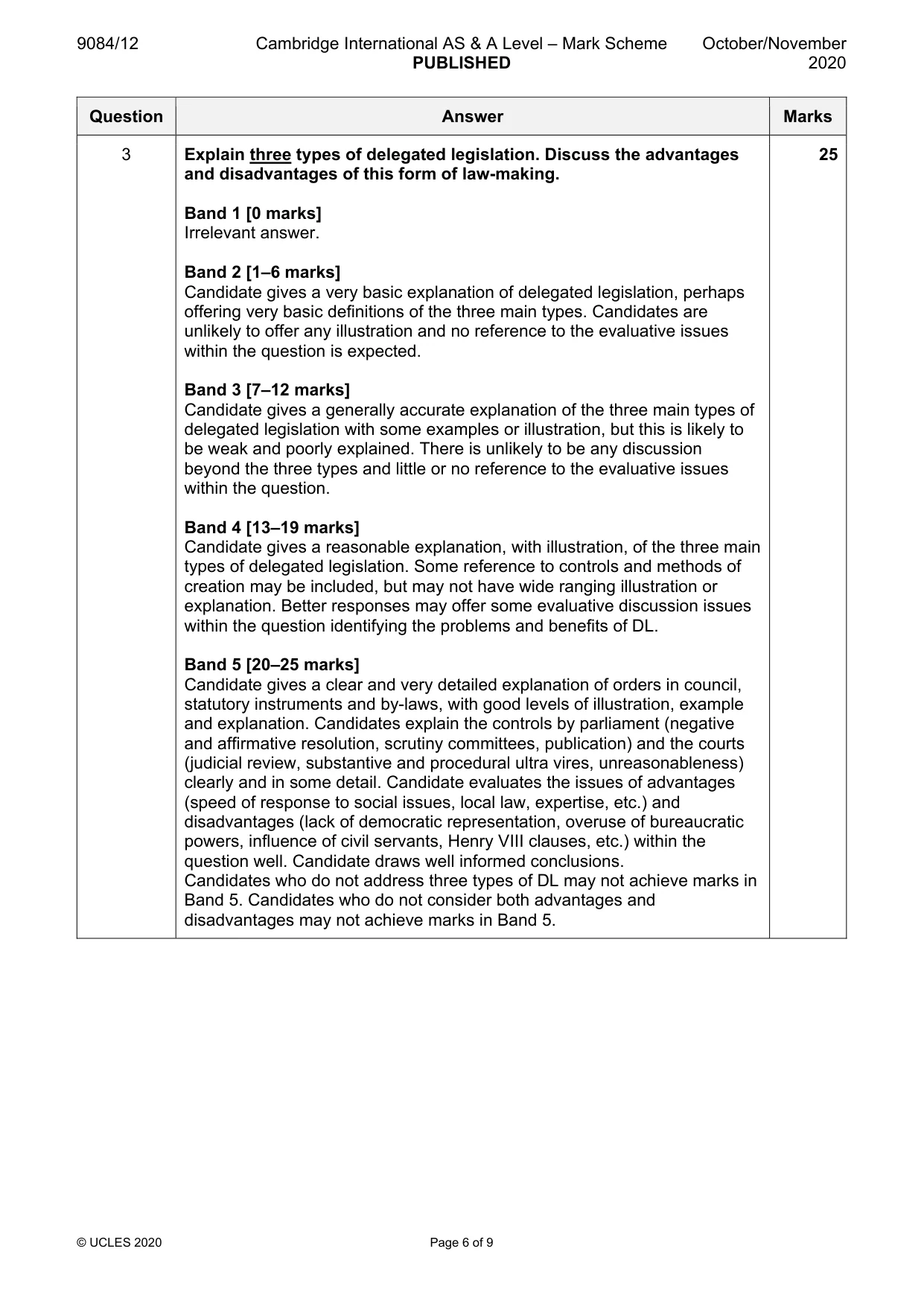
9084/12 Cambridge International AS & A Level – Mark Scheme PUBLISHED October/November 2020 © UCLES 2020 Page 6 of 9 Question Answer Marks 3 Explain three types of delegated legislation. Discuss the advantages and disadvantages of this form of law-making. Band 1 [0 marks] Irrelevant answer. Band 2 [1–6 marks] Candidate gives a very basic explanation of delegated legislation, perhaps offering very basic definitions of the three main types. Candidates are unlikely to offer any illustration and no reference to the evaluative issues within the question is expected. Band 3 [7–12 marks] Candidate gives a generally accurate explanation of the three main types of delegated legislation with some examples or illustration, but this is likely to be weak and poorly explained. There is unlikely to be any discussion beyond the three types and little or no reference to the evaluative issues within the question. Band 4 [13–19 marks] Candidate gives a reasonable explanation, with illustration, of the three main types of delegated legislation. Some reference to controls and methods of creation may be included, but may not have wide ranging illustration or explanation. Better responses may offer some evaluative discussion issues within the question identifying the problems and benefits of DL. Band 5 [20–25 marks] Candidate gives a clear and very detailed explanation of orders in council, statutory instruments and by-laws, with good levels of illustration, example and explanation. Candidates explain the controls by parliament (negative and affirmative resolution, scrutiny committees, publication) and the courts (judicial review, substantive and procedural ultra vires, unreasonableness) clearly and in some detail. Candidate evaluates the issues of advantages (speed of response to social issues, local law, expertise, etc.) and disadvantages (lack of democratic representation, overuse of bureaucratic powers, influence of civil servants, Henry VIII clauses, etc.) within the question well. Candidate draws well informed conclusions. Candidates who do not address three types of DL may not achieve marks in Band 5. Candidates who do not consider both advantages and disadvantages may not achieve marks in Band 5. 25
Mark scheme, page 7
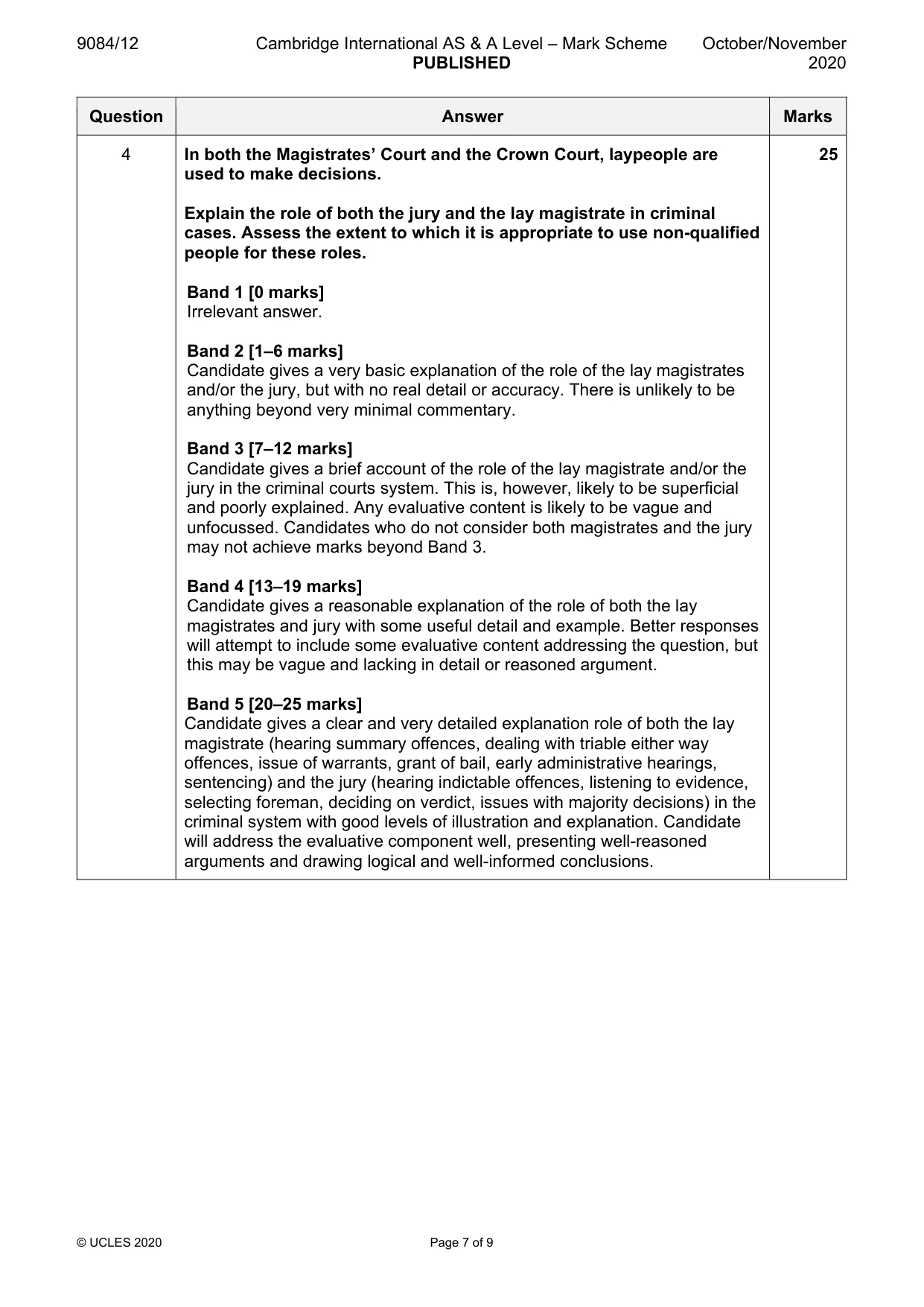
9084/12 Cambridge International AS & A Level – Mark Scheme PUBLISHED October/November 2020 © UCLES 2020 Page 7 of 9 Question Answer Marks 4 In both the Magistrates’ Court and the Crown Court, laypeople are used to make decisions. Explain the role of both the jury and the lay magistrate in criminal cases. Assess the extent to which it is appropriate to use non-qualified people for these roles. Band 1 [0 marks] Irrelevant answer. Band 2 [1–6 marks] Candidate gives a very basic explanation of the role of the lay magistrates and/or the jury, but with no real detail or accuracy. There is unlikely to be anything beyond very minimal commentary. Band 3 [7–12 marks] Candidate gives a brief account of the role of the lay magistrate and/or the jury in the criminal courts system. This is, however, likely to be superficial and poorly explained. Any evaluative content is likely to be vague and unfocussed. Candidates who do not consider both magistrates and the jury may not achieve marks beyond Band 3. Band 4 [13–19 marks] Candidate gives a reasonable explanation of the role of both the lay magistrates and jury with some useful detail and example. Better responses will attempt to include some evaluative content addressing the question, but this may be vague and lacking in detail or reasoned argument. Band 5 [20–25 marks] Candidate gives a clear and very detailed explanation role of both the lay magistrate (hearing summary offences, dealing with triable either way offences, issue of warrants, grant of bail, early administrative hearings, sentencing) and the jury (hearing indictable offences, listening to evidence, selecting foreman, deciding on verdict, issues with majority decisions) in the criminal system with good levels of illustration and explanation. Candidate will address the evaluative component well, presenting well-reasoned arguments and drawing logical and well-informed conclusions. 25
Mark scheme, page 8
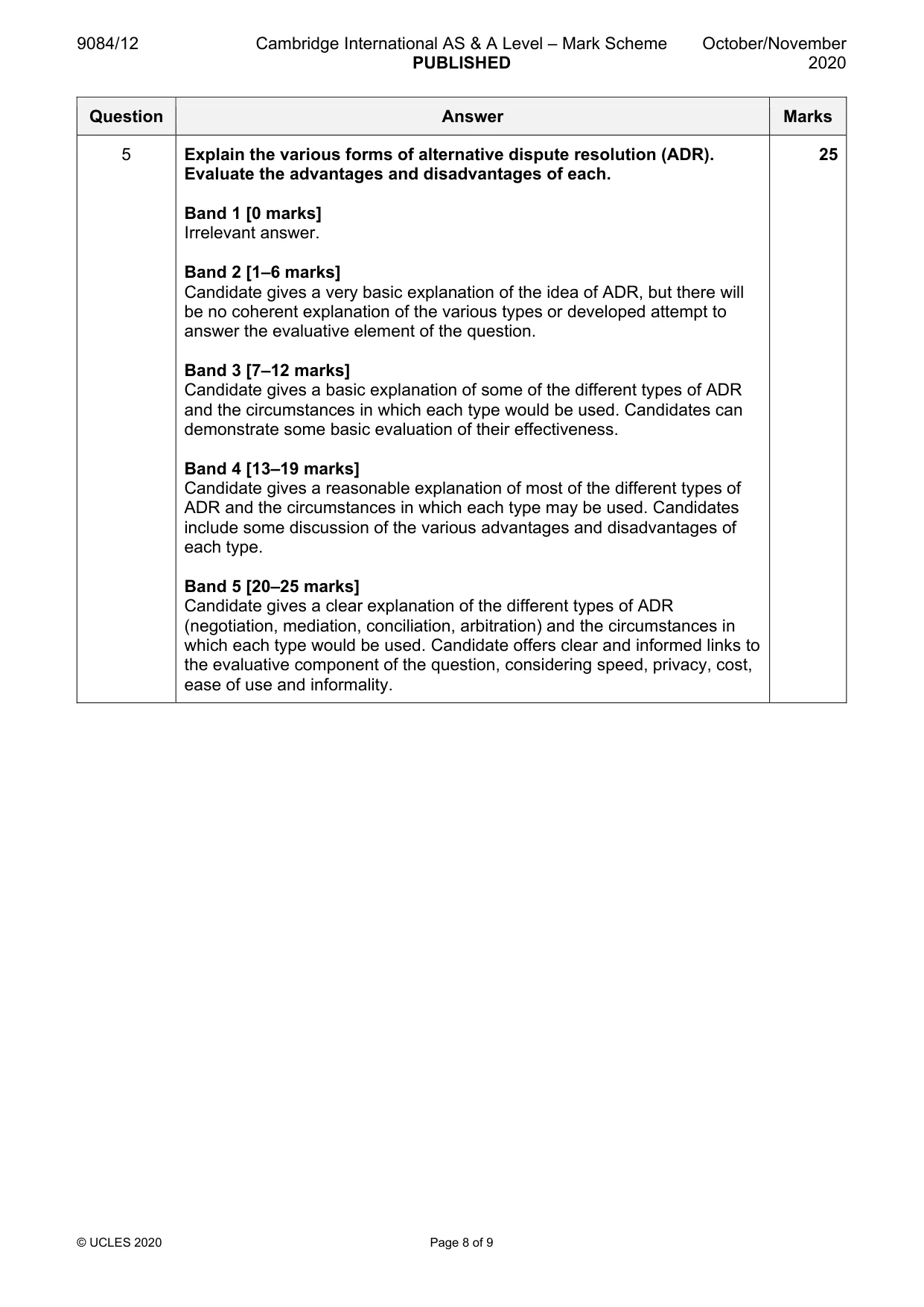
9084/12 Cambridge International AS & A Level – Mark Scheme PUBLISHED October/November 2020 © UCLES 2020 Page 8 of 9 Question Answer Marks 5 Explain the various forms of alternative dispute resolution (ADR). Evaluate the advantages and disadvantages of each. Band 1 [0 marks] Irrelevant answer. Band 2 [1–6 marks] Candidate gives a very basic explanation of the idea of ADR, but there will be no coherent explanation of the various types or developed attempt to answer the evaluative element of the question. Band 3 [7–12 marks] Candidate gives a basic explanation of some of the different types of ADR and the circumstances in which each type would be used. Candidates can demonstrate some basic evaluation of their effectiveness. Band 4 [13–19 marks] Candidate gives a reasonable explanation of most of the different types of ADR and the circumstances in which each type may be used. Candidates include some discussion of the various advantages and disadvantages of each type. Band 5 [20–25 marks] Candidate gives a clear explanation of the different types of ADR (negotiation, mediation, conciliation, arbitration) and the circumstances in which each type would be used. Candidate offers clear and informed links to the evaluative component of the question, considering speed, privacy, cost, ease of use and informality. 25
Mark scheme, page 9
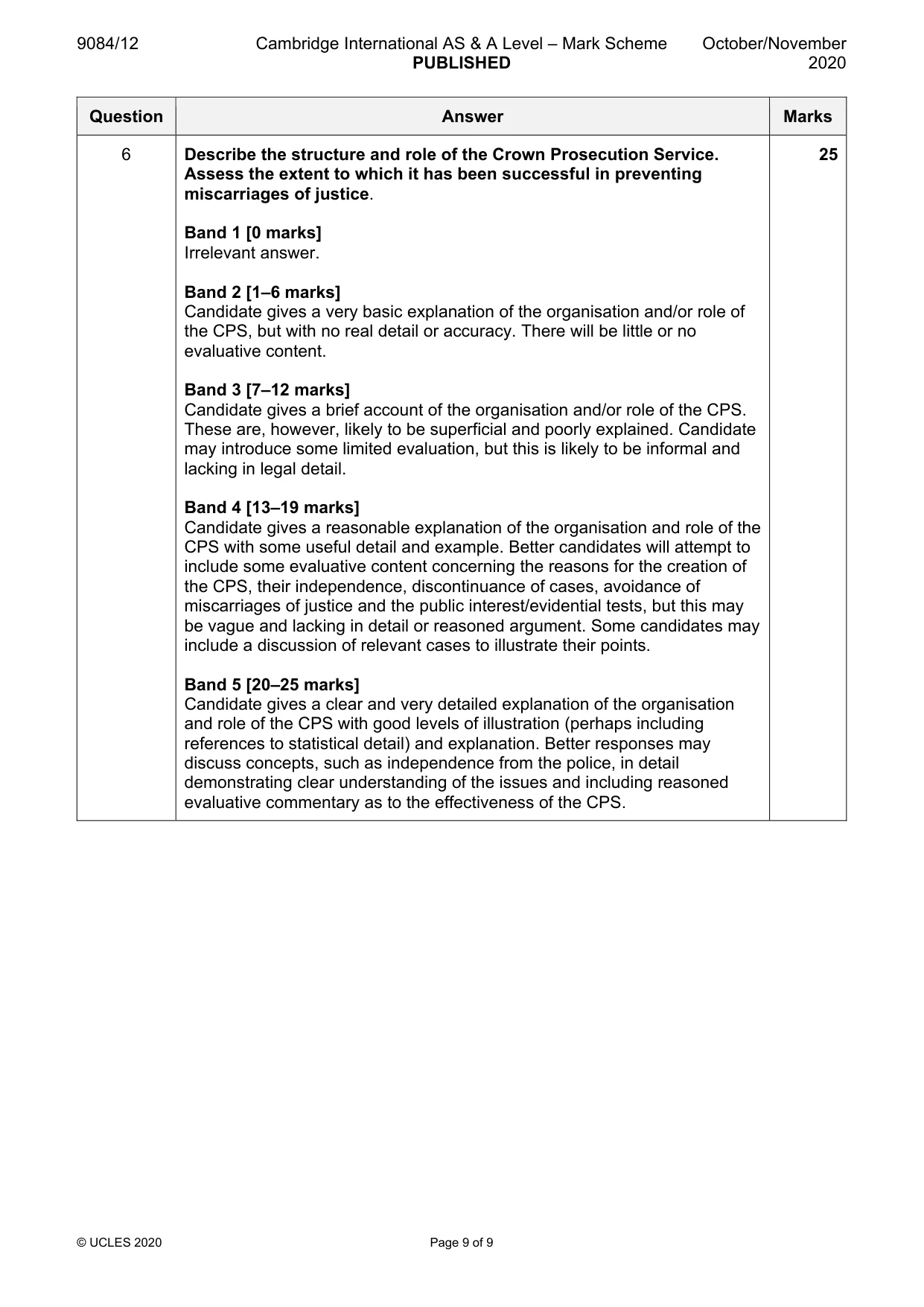
9084/12 Cambridge International AS & A Level – Mark Scheme PUBLISHED October/November 2020 © UCLES 2020 Page 9 of 9 Question Answer Marks 6 Describe the structure and role of the Crown Prosecution Service. Assess the extent to which it has been successful in preventing miscarriages of justice. Band 1 [0 marks] Irrelevant answer. Band 2 [1–6 marks] Candidate gives a very basic explanation of the organisation and/or role of the CPS, but with no real detail or accuracy. There will be little or no evaluative content. Band 3 [7–12 marks] Candidate gives a brief account of the organisation and/or role of the CPS. These are, however, likely to be superficial and poorly explained. Candidate may introduce some limited evaluation, but this is likely to be informal and lacking in legal detail. Band 4 [13–19 marks] Candidate gives a reasonable explanation of the organisation and role of the CPS with some useful detail and example. Better candidates will attempt to include some evaluative content concerning the reasons for the creation of the CPS, their independence, discontinuance of cases, avoidance of miscarriages of justice and the public interest/evidential tests, but this may be vague and lacking in detail or reasoned argument. Some candidates may include a discussion of relevant cases to illustrate their points. Band 5 [20–25 marks] Candidate gives a clear and very detailed explanation of the organisation and role of the CPS with good levels of illustration (perhaps including references to statistical detail) and explanation. Better responses may discuss concepts, such as independence from the police, in detail demonstrating clear understanding of the issues and including reasoned evaluative commentary as to the effectiveness of the CPS. 25
What you needed in this session
Cambridge’s own grade thresholds for 2020 Oct/Nov, Paper 1 · Variant 2. A higher threshold means an easier paper — the bar moves with how the cohort did.