Cambridge A Level Law 9084 — 2020 May/June Paper 4 · Variant 2
9084/42/M/J/20
The question paper and its mark scheme, free to read here and free to download. This is Cambridge’s own paper, exactly as it was sat.
Question paper4 pages
Mark scheme9 pages
Answers below. Sit the paper first if you are practising.
Paper as text
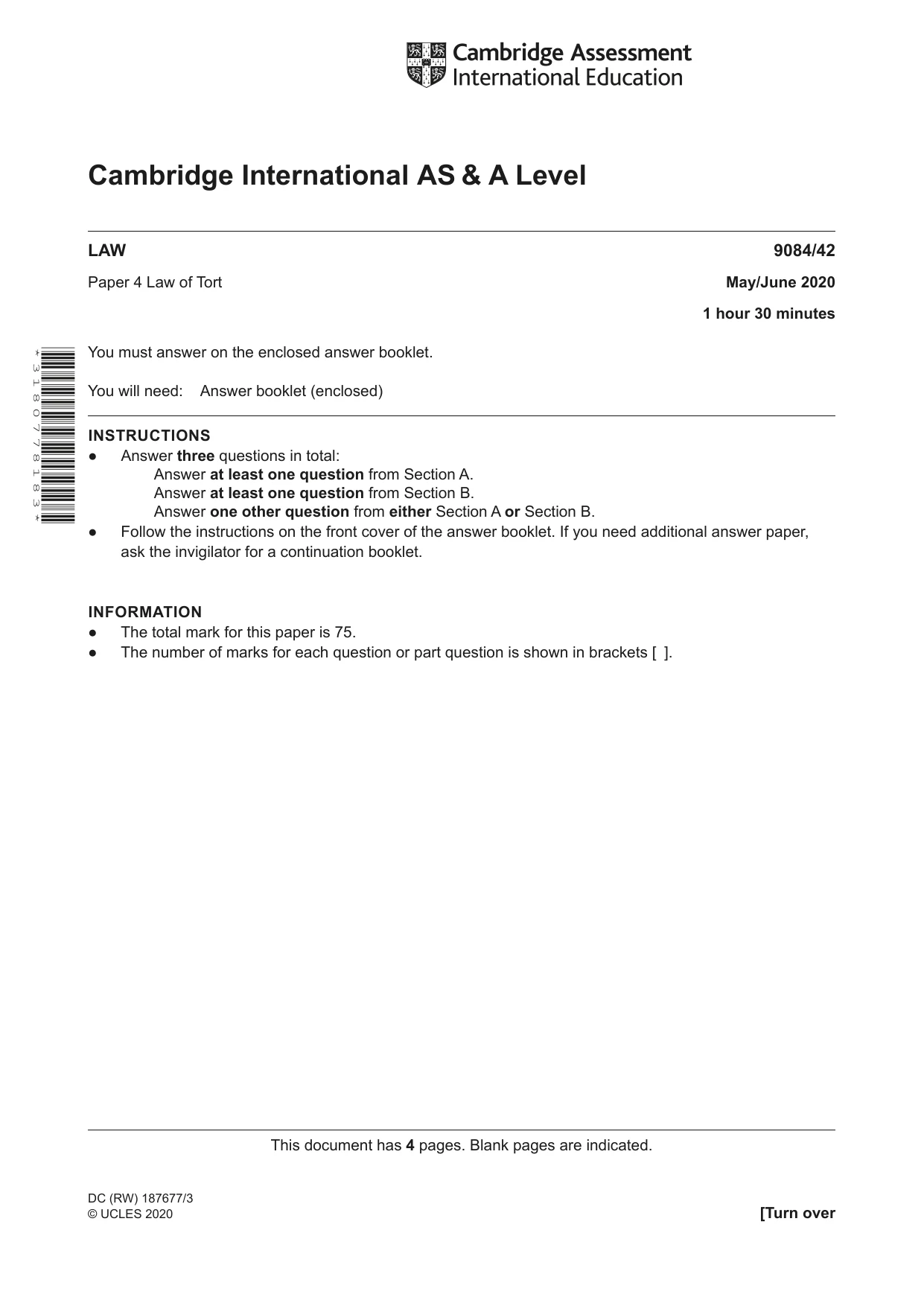
Question paper, page 1
This document has 4 pages. Blank pages are indicated. DC (RW) 187677/3 © UCLES 2020 [Turn over * 3 1 8 0 7 7 8 1 8 3 * Cambridge International AS & A Level LAW 9084/42 Paper 4 Law of Tort May/June 2020 1 hour 30 minutes You must answer on the enclosed answer booklet. You will need: Answer booklet (enclosed) INSTRUCTIONS ● Answer three questions in total: Answer at least one question from Section A. Answer at least one question from Section B. Answer one other question from either Section A or Section B. ● Follow the instructions on the front cover of the answer booklet. If you need additional answer paper, ask the invigilator for a continuation booklet. INFORMATION ● The total mark for this paper is 75. ● The number of marks for each question or part question is shown in brackets [ ].
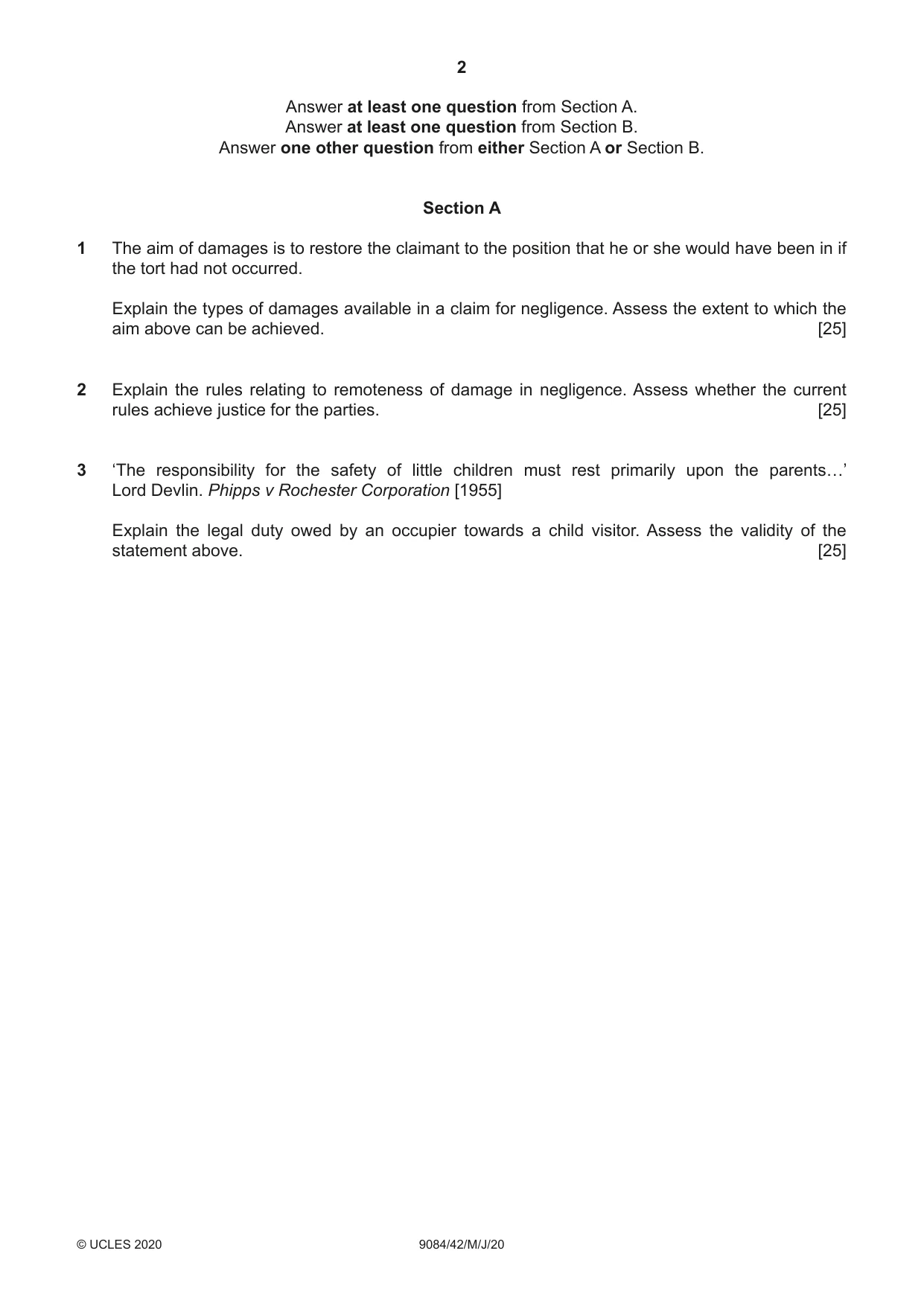
Question paper, page 2
2 9084/42/M/J/20 © UCLES 2020 Answer at least one question from Section A. Answer at least one question from Section B. Answer one other question from either Section A or Section B. Section A 1 The aim of damages is to restore the claimant to the position that he or she would have been in if the tort had not occurred. Explain the types of damages available in a claim for negligence. Assess the extent to which the aim above can be achieved. [25] 2 Explain the rules relating to remoteness of damage in negligence. Assess whether the current rules achieve justice for the parties. [25] 3 ‘The responsibility for the safety of little children must rest primarily upon the parents…’ Lord Devlin. Phipps v Rochester Corporation [1955] Explain the legal duty owed by an occupier towards a child visitor. Assess the validity of the statement above. [25]
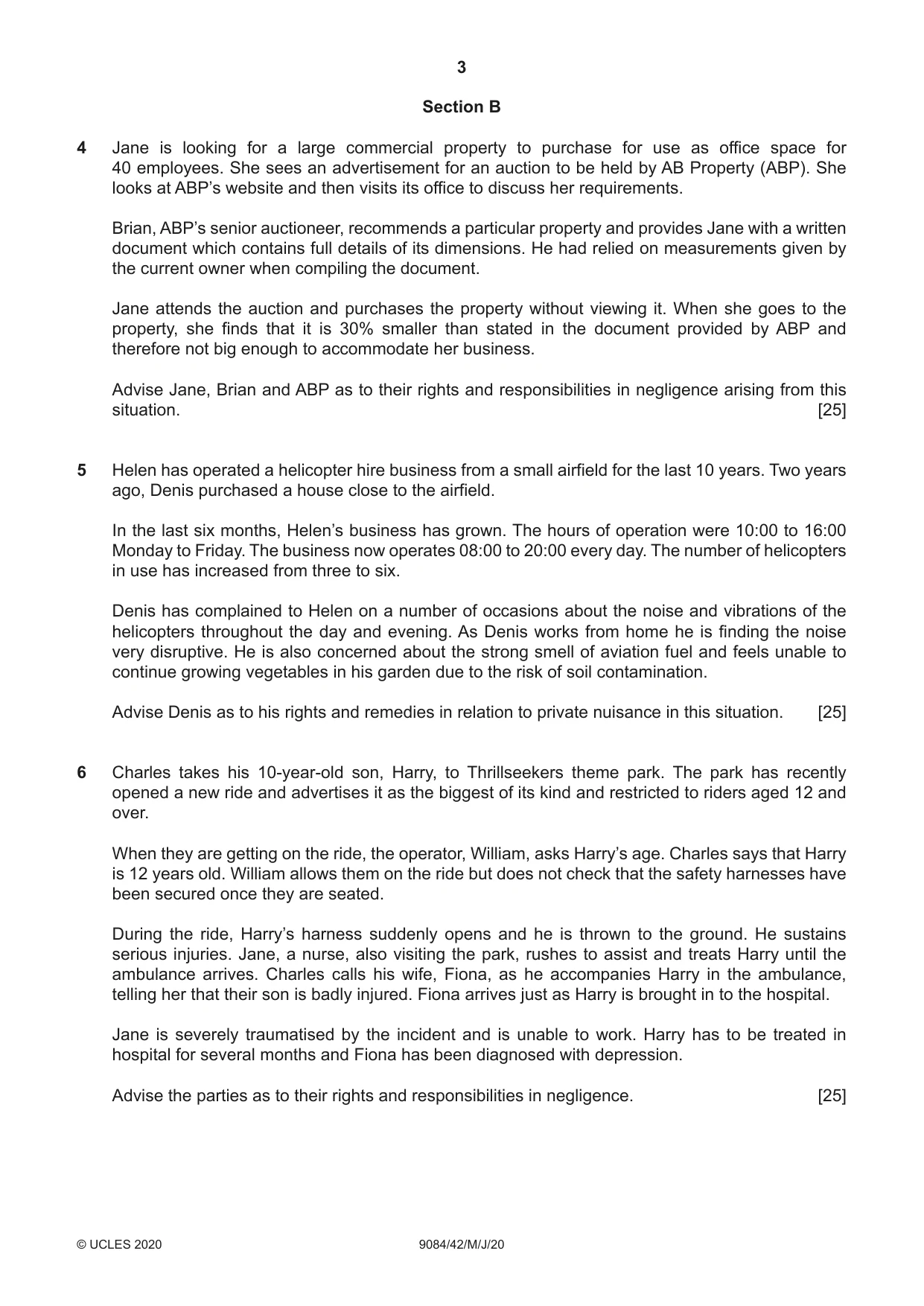
Question paper, page 3
3 9084/42/M/J/20 © UCLES 2020 Section B 4 Jane is looking for a large commercial property to purchase for use as office space for 40 employees. She sees an advertisement for an auction to be held by AB Property (ABP). She looks at ABP’s website and then visits its office to discuss her requirements. Brian, ABP’s senior auctioneer, recommends a particular property and provides Jane with a written document which contains full details of its dimensions. He had relied on measurements given by the current owner when compiling the document. Jane attends the auction and purchases the property without viewing it. When she goes to the property, she finds that it is 30% smaller than stated in the document provided by ABP and therefore not big enough to accommodate her business. Advise Jane, Brian and ABP as to their rights and responsibilities in negligence arising from this situation. [25] 5 Helen has operated a helicopter hire business from a small airfield for the last 10 years. Two years ago, Denis purchased a house close to the airfield. In the last six months, Helen’s business has grown. The hours of operation were 10:00 to 16:00 Monday to Friday. The business now operates 08:00 to 20:00 every day. The number of helicopters in use has increased from three to six. Denis has complained to Helen on a number of occasions about the noise and vibrations of the helicopters throughout the day and evening. As Denis works from home he is finding the noise very disruptive. He is also concerned about the strong smell of aviation fuel and feels unable to continue growing vegetables in his garden due to the risk of soil contamination. Advise Denis as to his rights and remedies in relation to private nuisance in this situation. [25] 6 Charles takes his 10‑year‑old son, Harry, to Thrillseekers theme park. The park has recently opened a new ride and advertises it as the biggest of its kind and restricted to riders aged 12 and over. When they are getting on the ride, the operator, William, asks Harry’s age. Charles says that Harry is 12 years old. William allows them on the ride but does not check that the safety harnesses have been secured once they are seated. During the ride, Harry’s harness suddenly opens and he is thrown to the ground. He sustains serious injuries. Jane, a nurse, also visiting the park, rushes to assist and treats Harry until the ambulance arrives. Charles calls his wife, Fiona, as he accompanies Harry in the ambulance, telling her that their son is badly injured. Fiona arrives just as Harry is brought in to the hospital. Jane is severely traumatised by the incident and is unable to work. Harry has to be treated in hospital for several months and Fiona has been diagnosed with depression. Advise the parties as to their rights and responsibilities in negligence. [25]
Question paper, page 4
4 9084/42/M/J/20 © UCLES 2020 Permission to reproduce items where third‑party owned material protected by copyright is included has been sought and cleared where possible. Every reasonable effort has been made by the publisher (UCLES) to trace copyright holders, but if any items requiring clearance have unwittingly been included, the publisher will be pleased to make amends at the earliest possible opportunity. To avoid the issue of disclosure of answer‑related information to candidates, all copyright acknowledgements are reproduced online in the Cambridge Assessment International Education Copyright Acknowledgements Booklet. This is produced for each series of examinations and is freely available to download at www.cambridgeinternational.org after the live examination series. Cambridge Assessment International Education is part of the Cambridge Assessment Group. Cambridge Assessment is the brand name of the University of Cambridge Local Examinations Syndicate (UCLES), which itself is a department of the University of Cambridge. BLANK PAGE
Mark scheme, page 1
This document consists of 9 printed pages. © UCLES 2020 [Turn over Cambridge International AS & A Level LAW 9084/42 Paper 4 May/June 2020 MARK SCHEME Maximum Mark: 75 Published Students did not sit exam papers in the June 2020 series due to the Covid-19 global pandemic. This mark scheme is published to support teachers and students and should be read together with the question paper. It shows the requirements of the exam. The answer column of the mark scheme shows the proposed basis on which Examiners would award marks for this exam. Where appropriate, this column also provides the most likely acceptable alternative responses expected from students. Examiners usually review the mark scheme after they have seen student responses and update the mark scheme if appropriate. In the June series, Examiners were unable to consider the acceptability of alternative responses, as there were no student responses to consider. Mark schemes should usually be read together with the Principal Examiner Report for Teachers. However, because students did not sit exam papers, there is no Principal Examiner Report for Teachers for the June 2020 series. Cambridge International will not enter into discussions about these mark schemes. Cambridge International is publishing the mark schemes for the June 2020 series for most Cambridge IGCSE™ and Cambridge International A & AS Level components, and some Cambridge O Level components.
Mark scheme, page 2
9084/42 Cambridge International AS & A Level – Mark Scheme PUBLISHED May/June 2020 © UCLES 2020 Page 2 of 9 Generic Marking Principles These general marking principles must be applied by all examiners when marking candidate answers. They should be applied alongside the specific content of the mark scheme or generic level descriptors for a question. Each question paper and mark scheme will also comply with these marking principles. GENERIC MARKING PRINCIPLE 1: Marks must be awarded in line with: • the specific content of the mark scheme or the generic level descriptors for the question • the specific skills defined in the mark scheme or in the generic level descriptors for the question • the standard of response required by a candidate as exemplified by the standardisation scripts. GENERIC MARKING PRINCIPLE 2: Marks awarded are always whole marks (not half marks, or other fractions). GENERIC MARKING PRINCIPLE 3: Marks must be awarded positively: • marks are awarded for correct/valid answers, as defined in the mark scheme. However, credit is given for valid answers which go beyond the scope of the syllabus and mark scheme, referring to your Team Leader as appropriate • marks are awarded when candidates clearly demonstrate what they know and can do • marks are not deducted for errors • marks are not deducted for omissions • answers should only be judged on the quality of spelling, punctuation and grammar when these features are specifically assessed by the question as indicated by the mark scheme. The meaning, however, should be unambiguous. GENERIC MARKING PRINCIPLE 4: Rules must be applied consistently e.g. in situations where candidates have not followed instructions or in the application of generic level descriptors. GENERIC MARKING PRINCIPLE 5: Marks should be awarded using the full range of marks defined in the mark scheme for the question (however; the use of the full mark range may be limited according to the quality of the candidate responses seen). GENERIC MARKING PRINCIPLE 6: Marks awarded are based solely on the requirements as defined in the mark scheme. Marks should not be awarded with grade thresholds or grade descriptors in mind.
Mark scheme, page 3
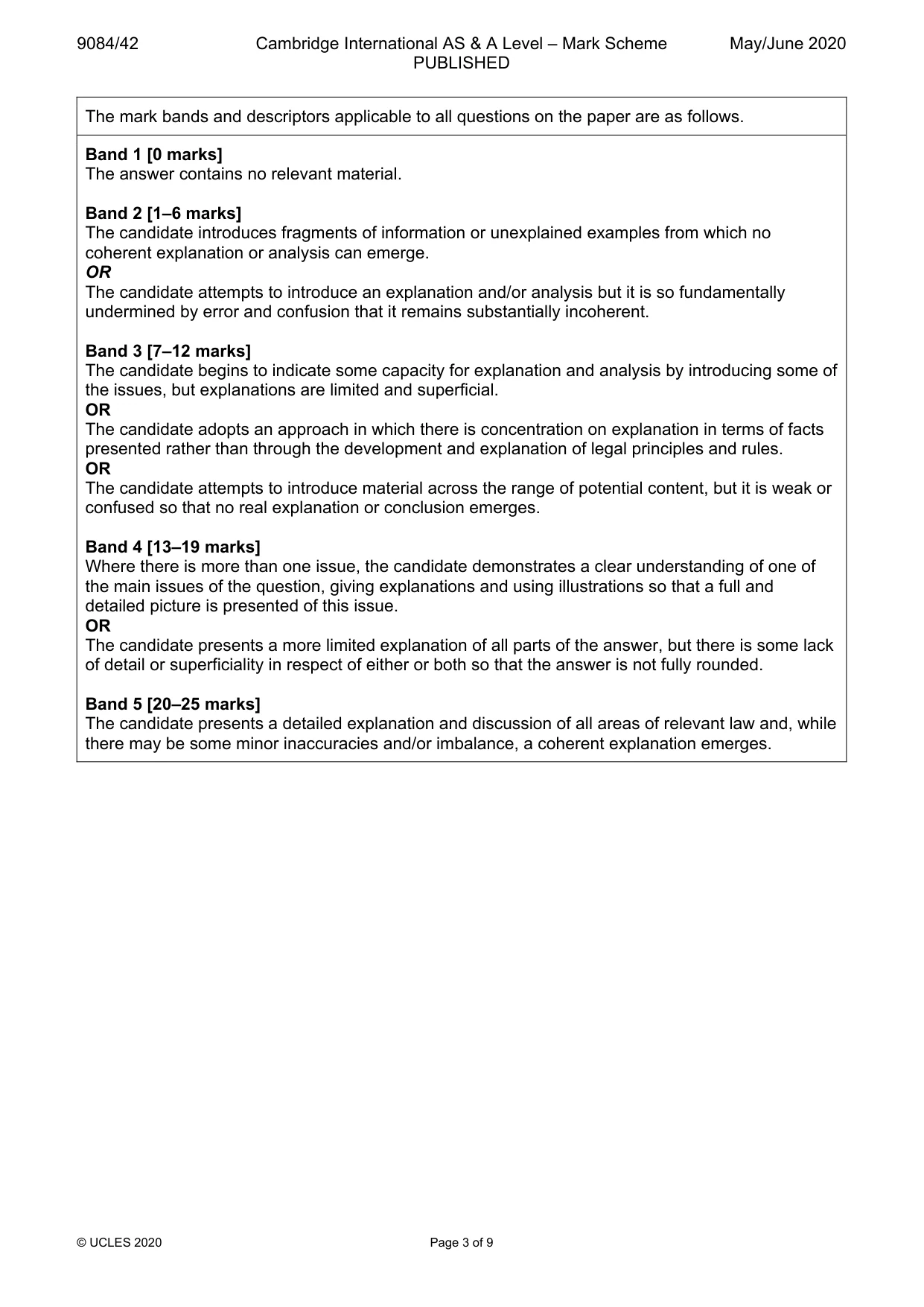
9084/42 Cambridge International AS & A Level – Mark Scheme PUBLISHED May/June 2020 © UCLES 2020 Page 3 of 9 The mark bands and descriptors applicable to all questions on the paper are as follows. Band 1 [0 marks] The answer contains no relevant material. Band 2 [1–6 marks] The candidate introduces fragments of information or unexplained examples from which no coherent explanation or analysis can emerge. OR The candidate attempts to introduce an explanation and/or analysis but it is so fundamentally undermined by error and confusion that it remains substantially incoherent. Band 3 [7–12 marks] The candidate begins to indicate some capacity for explanation and analysis by introducing some of the issues, but explanations are limited and superficial. OR The candidate adopts an approach in which there is concentration on explanation in terms of facts presented rather than through the development and explanation of legal principles and rules. OR The candidate attempts to introduce material across the range of potential content, but it is weak or confused so that no real explanation or conclusion emerges. Band 4 [13–19 marks] Where there is more than one issue, the candidate demonstrates a clear understanding of one of the main issues of the question, giving explanations and using illustrations so that a full and detailed picture is presented of this issue. OR The candidate presents a more limited explanation of all parts of the answer, but there is some lack of detail or superficiality in respect of either or both so that the answer is not fully rounded. Band 5 [20–25 marks] The candidate presents a detailed explanation and discussion of all areas of relevant law and, while there may be some minor inaccuracies and/or imbalance, a coherent explanation emerges.
Mark scheme, page 4
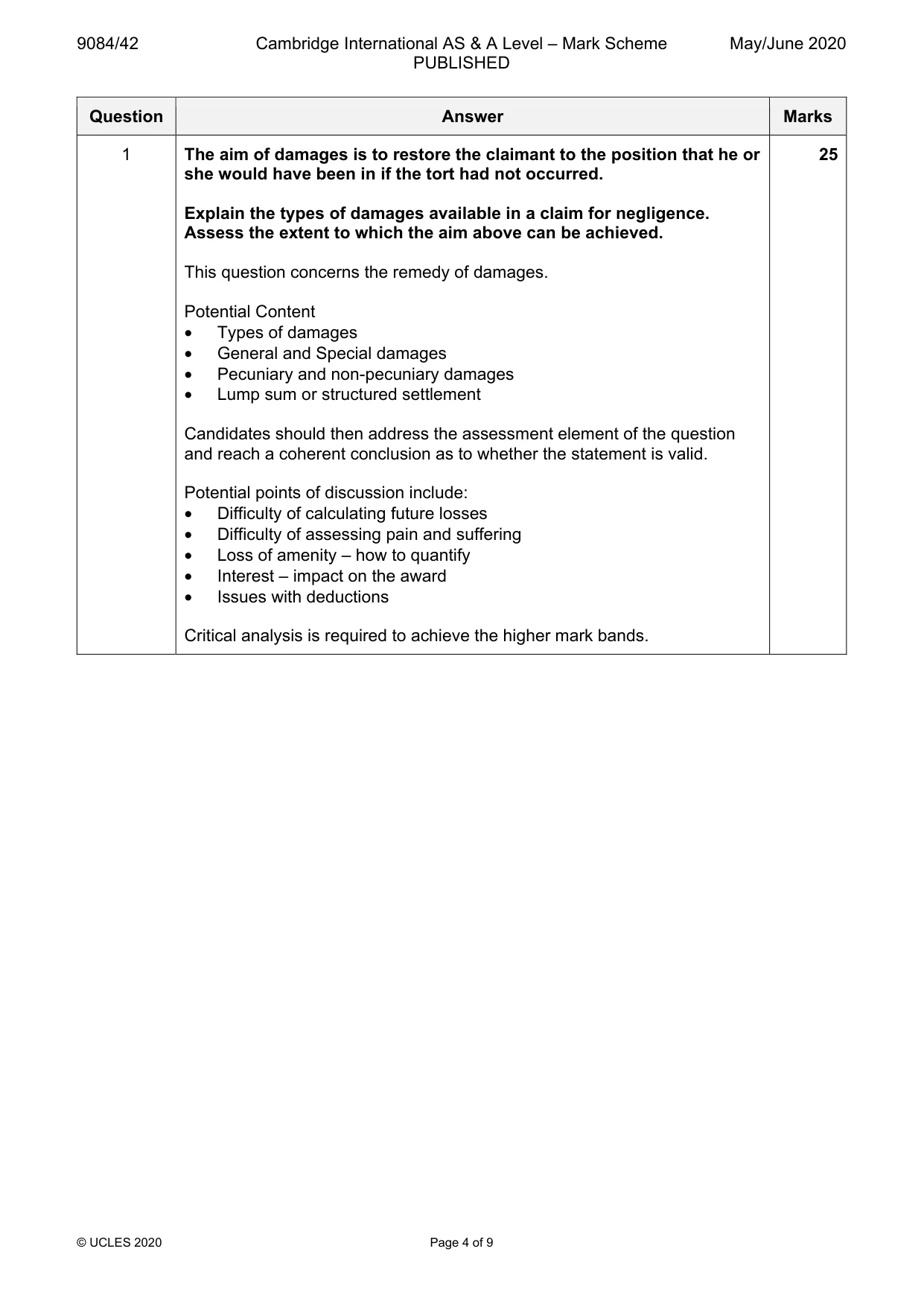
9084/42 Cambridge International AS & A Level – Mark Scheme PUBLISHED May/June 2020 © UCLES 2020 Page 4 of 9 Question Answer Marks 1 The aim of damages is to restore the claimant to the position that he or she would have been in if the tort had not occurred. Explain the types of damages available in a claim for negligence. Assess the extent to which the aim above can be achieved. This question concerns the remedy of damages. Potential Content • Types of damages • General and Special damages • Pecuniary and non-pecuniary damages • Lump sum or structured settlement Candidates should then address the assessment element of the question and reach a coherent conclusion as to whether the statement is valid. Potential points of discussion include: • Difficulty of calculating future losses • Difficulty of assessing pain and suffering • Loss of amenity – how to quantify • Interest – impact on the award • Issues with deductions Critical analysis is required to achieve the higher mark bands. 25
Mark scheme, page 5
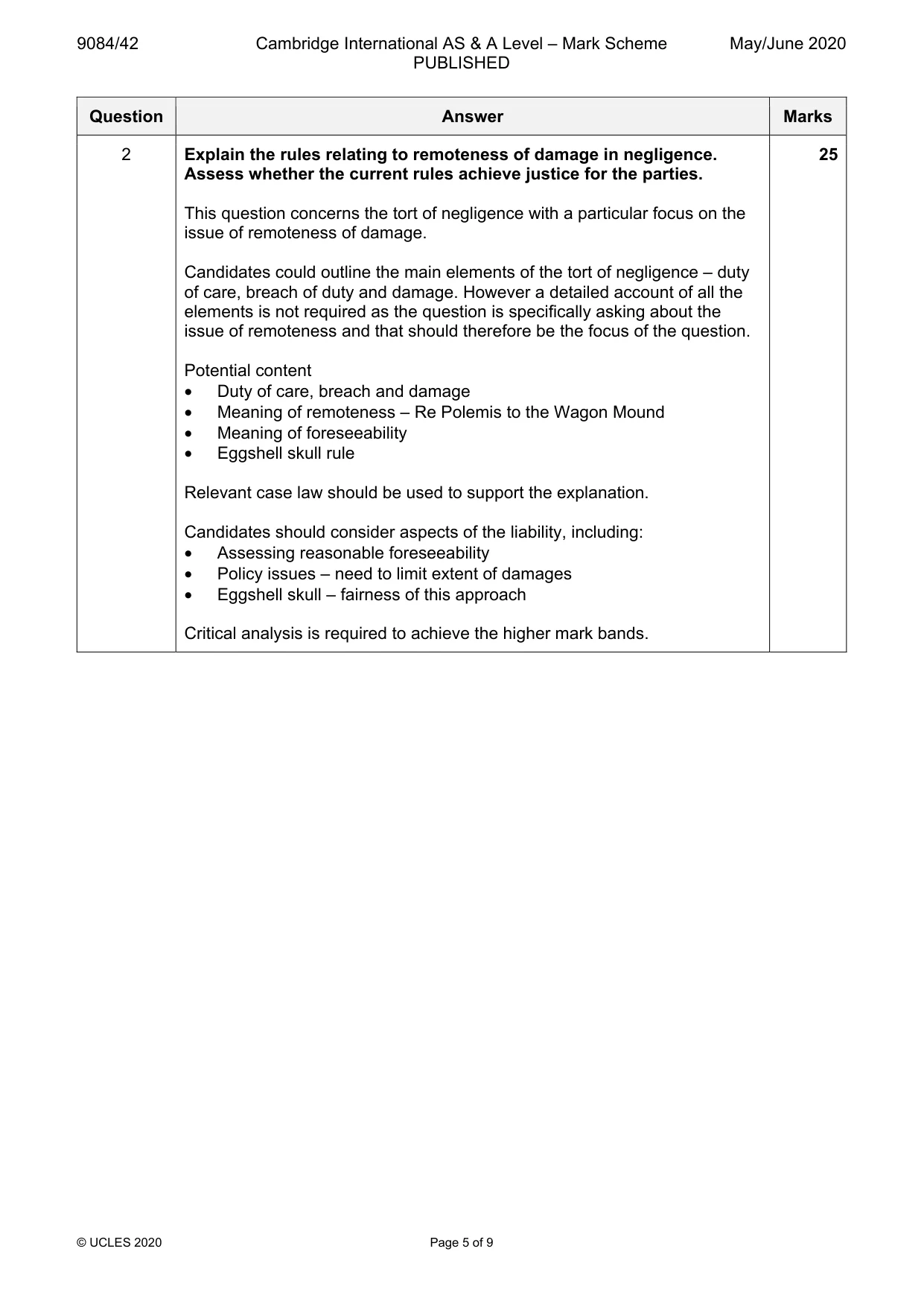
9084/42 Cambridge International AS & A Level – Mark Scheme PUBLISHED May/June 2020 © UCLES 2020 Page 5 of 9 Question Answer Marks 2 Explain the rules relating to remoteness of damage in negligence. Assess whether the current rules achieve justice for the parties. This question concerns the tort of negligence with a particular focus on the issue of remoteness of damage. Candidates could outline the main elements of the tort of negligence – duty of care, breach of duty and damage. However a detailed account of all the elements is not required as the question is specifically asking about the issue of remoteness and that should therefore be the focus of the question. Potential content • Duty of care, breach and damage • Meaning of remoteness – Re Polemis to the Wagon Mound • Meaning of foreseeability • Eggshell skull rule Relevant case law should be used to support the explanation. Candidates should consider aspects of the liability, including: • Assessing reasonable foreseeability • Policy issues – need to limit extent of damages • Eggshell skull – fairness of this approach Critical analysis is required to achieve the higher mark bands. 25
Mark scheme, page 6
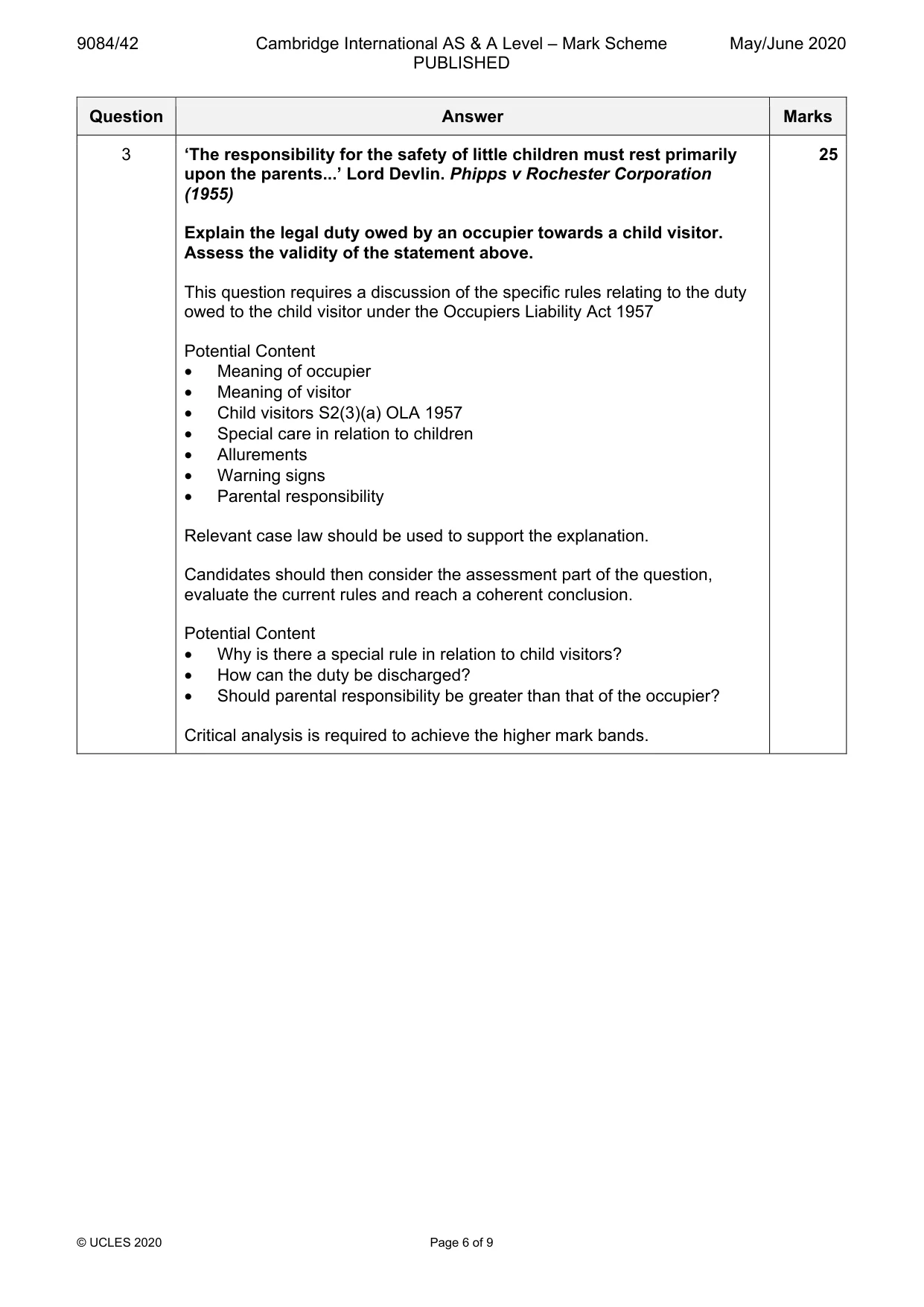
9084/42 Cambridge International AS & A Level – Mark Scheme PUBLISHED May/June 2020 © UCLES 2020 Page 6 of 9 Question Answer Marks 3 ‘The responsibility for the safety of little children must rest primarily upon the parents...’ Lord Devlin. Phipps v Rochester Corporation (1955) Explain the legal duty owed by an occupier towards a child visitor. Assess the validity of the statement above. This question requires a discussion of the specific rules relating to the duty owed to the child visitor under the Occupiers Liability Act 1957 Potential Content • Meaning of occupier • Meaning of visitor • Child visitors S2(3)(a) OLA 1957 • Special care in relation to children • Allurements • Warning signs • Parental responsibility Relevant case law should be used to support the explanation. Candidates should then consider the assessment part of the question, evaluate the current rules and reach a coherent conclusion. Potential Content • Why is there a special rule in relation to child visitors? • How can the duty be discharged? • Should parental responsibility be greater than that of the occupier? Critical analysis is required to achieve the higher mark bands. 25
Mark scheme, page 7
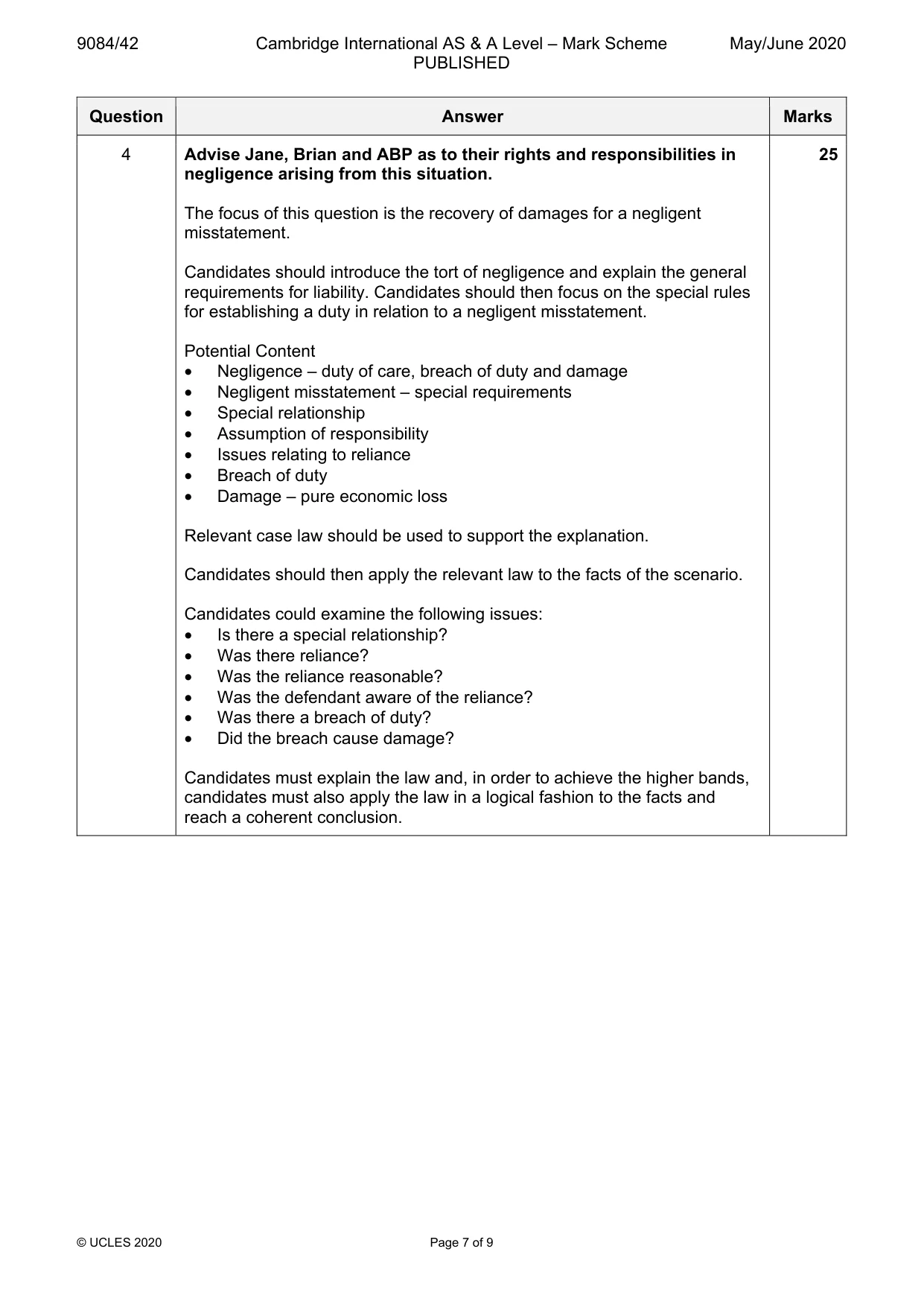
9084/42 Cambridge International AS & A Level – Mark Scheme PUBLISHED May/June 2020 © UCLES 2020 Page 7 of 9 Question Answer Marks 4 Advise Jane, Brian and ABP as to their rights and responsibilities in negligence arising from this situation. The focus of this question is the recovery of damages for a negligent misstatement. Candidates should introduce the tort of negligence and explain the general requirements for liability. Candidates should then focus on the special rules for establishing a duty in relation to a negligent misstatement. Potential Content • Negligence – duty of care, breach of duty and damage • Negligent misstatement – special requirements • Special relationship • Assumption of responsibility • Issues relating to reliance • Breach of duty • Damage – pure economic loss Relevant case law should be used to support the explanation. Candidates should then apply the relevant law to the facts of the scenario. Candidates could examine the following issues: • Is there a special relationship? • Was there reliance? • Was the reliance reasonable? • Was the defendant aware of the reliance? • Was there a breach of duty? • Did the breach cause damage? Candidates must explain the law and, in order to achieve the higher bands, candidates must also apply the law in a logical fashion to the facts and reach a coherent conclusion. 25
Mark scheme, page 8
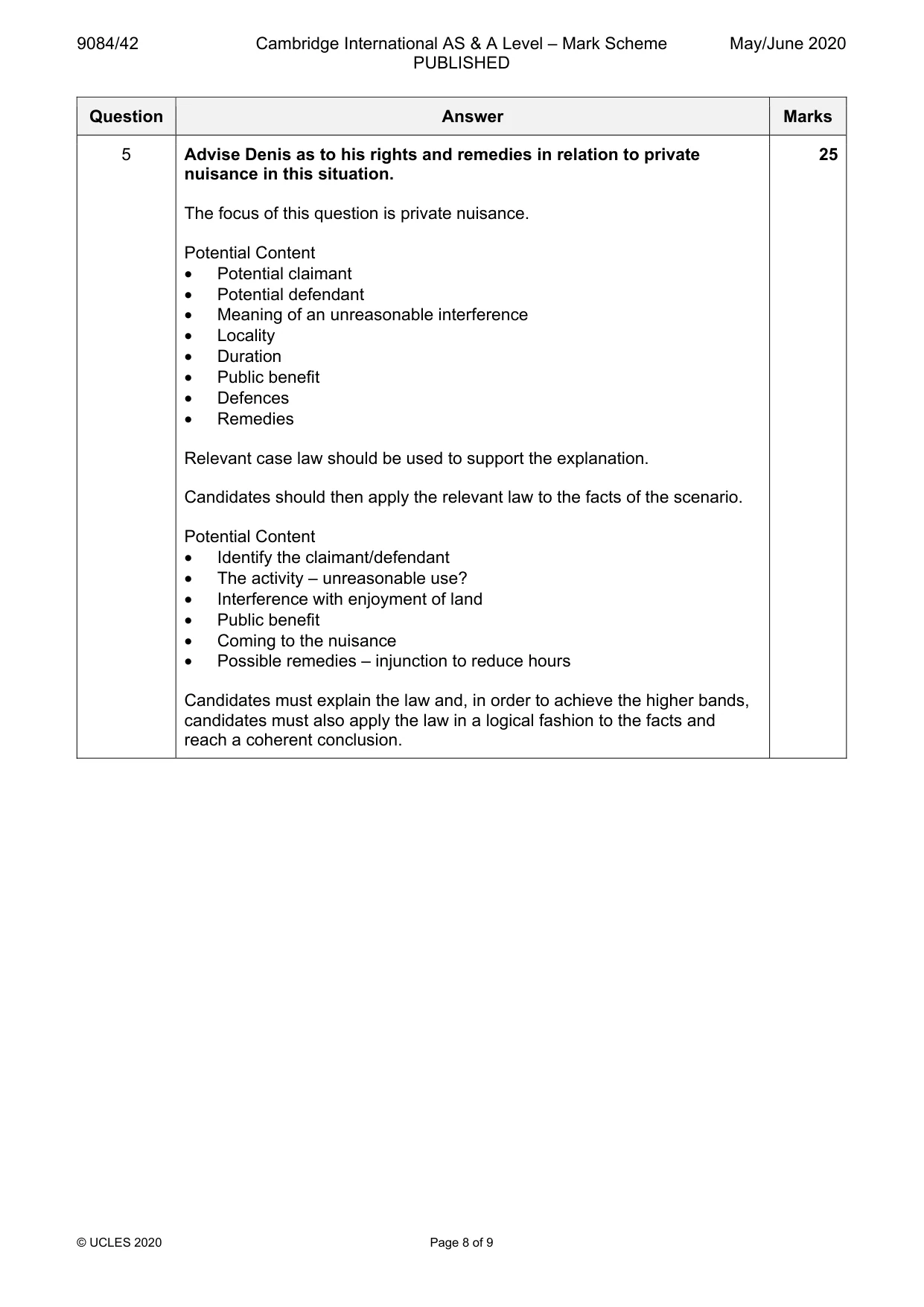
9084/42 Cambridge International AS & A Level – Mark Scheme PUBLISHED May/June 2020 © UCLES 2020 Page 8 of 9 Question Answer Marks 5 Advise Denis as to his rights and remedies in relation to private nuisance in this situation. The focus of this question is private nuisance. Potential Content • Potential claimant • Potential defendant • Meaning of an unreasonable interference • Locality • Duration • Public benefit • Defences • Remedies Relevant case law should be used to support the explanation. Candidates should then apply the relevant law to the facts of the scenario. Potential Content • Identify the claimant/defendant • The activity – unreasonable use? • Interference with enjoyment of land • Public benefit • Coming to the nuisance • Possible remedies – injunction to reduce hours Candidates must explain the law and, in order to achieve the higher bands, candidates must also apply the law in a logical fashion to the facts and reach a coherent conclusion. 25
Mark scheme, page 9
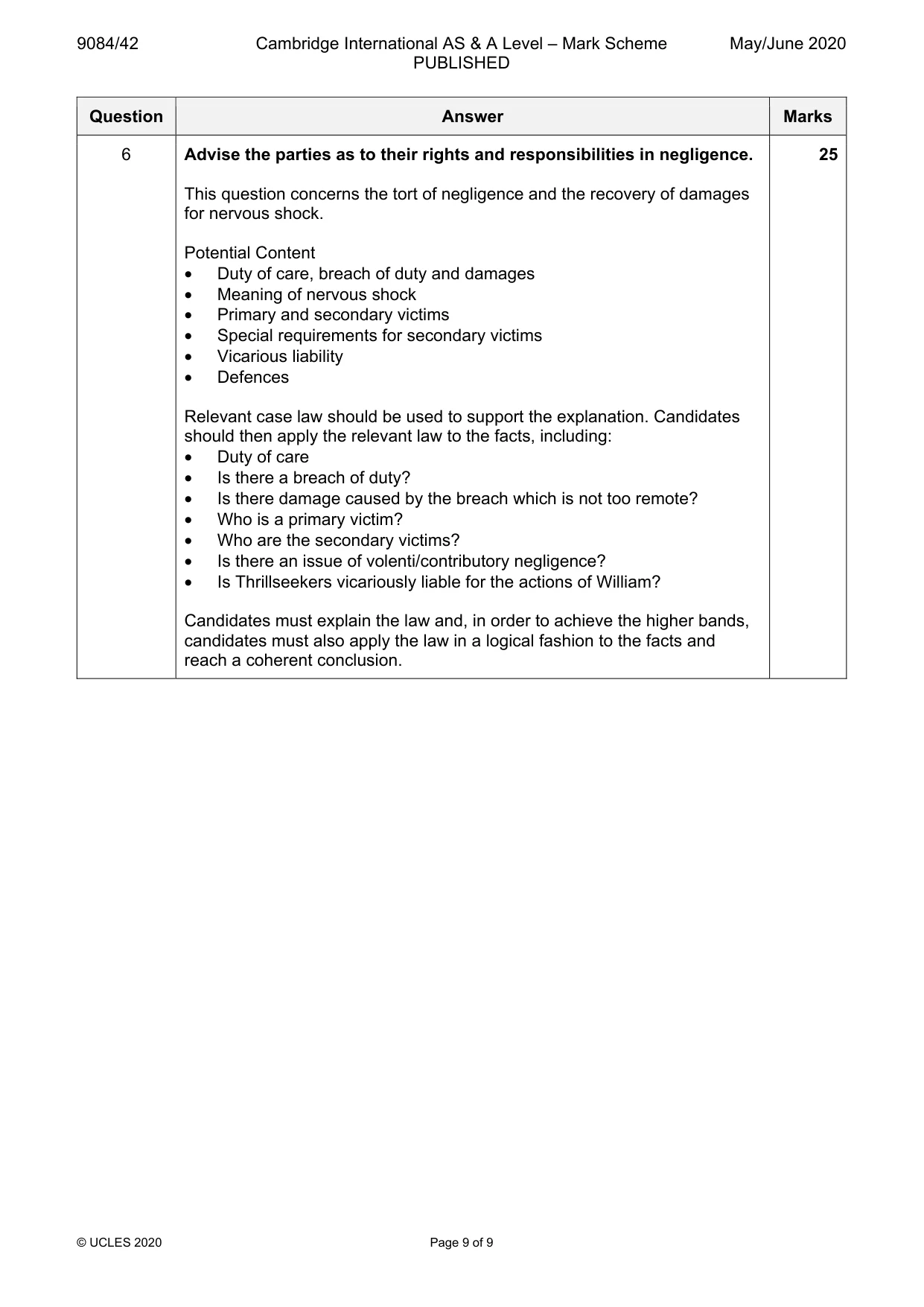
9084/42 Cambridge International AS & A Level – Mark Scheme PUBLISHED May/June 2020 © UCLES 2020 Page 9 of 9 Question Answer Marks 6 Advise the parties as to their rights and responsibilities in negligence. This question concerns the tort of negligence and the recovery of damages for nervous shock. Potential Content • Duty of care, breach of duty and damages • Meaning of nervous shock • Primary and secondary victims • Special requirements for secondary victims • Vicarious liability • Defences Relevant case law should be used to support the explanation. Candidates should then apply the relevant law to the facts, including: • Duty of care • Is there a breach of duty? • Is there damage caused by the breach which is not too remote? • Who is a primary victim? • Who are the secondary victims? • Is there an issue of volenti/contributory negligence? • Is Thrillseekers vicariously liable for the actions of William? Candidates must explain the law and, in order to achieve the higher bands, candidates must also apply the law in a logical fashion to the facts and reach a coherent conclusion. 25