Cambridge A Level Law 9084 — 2020 May/June Paper 4 · Variant 3
9084/43/M/J/20
The question paper and its mark scheme, free to read here and free to download. This is Cambridge’s own paper, exactly as it was sat.
Question paper4 pages

Mark scheme9 pages
Answers below. Sit the paper first if you are practising.
Paper as text
Question paper, page 1
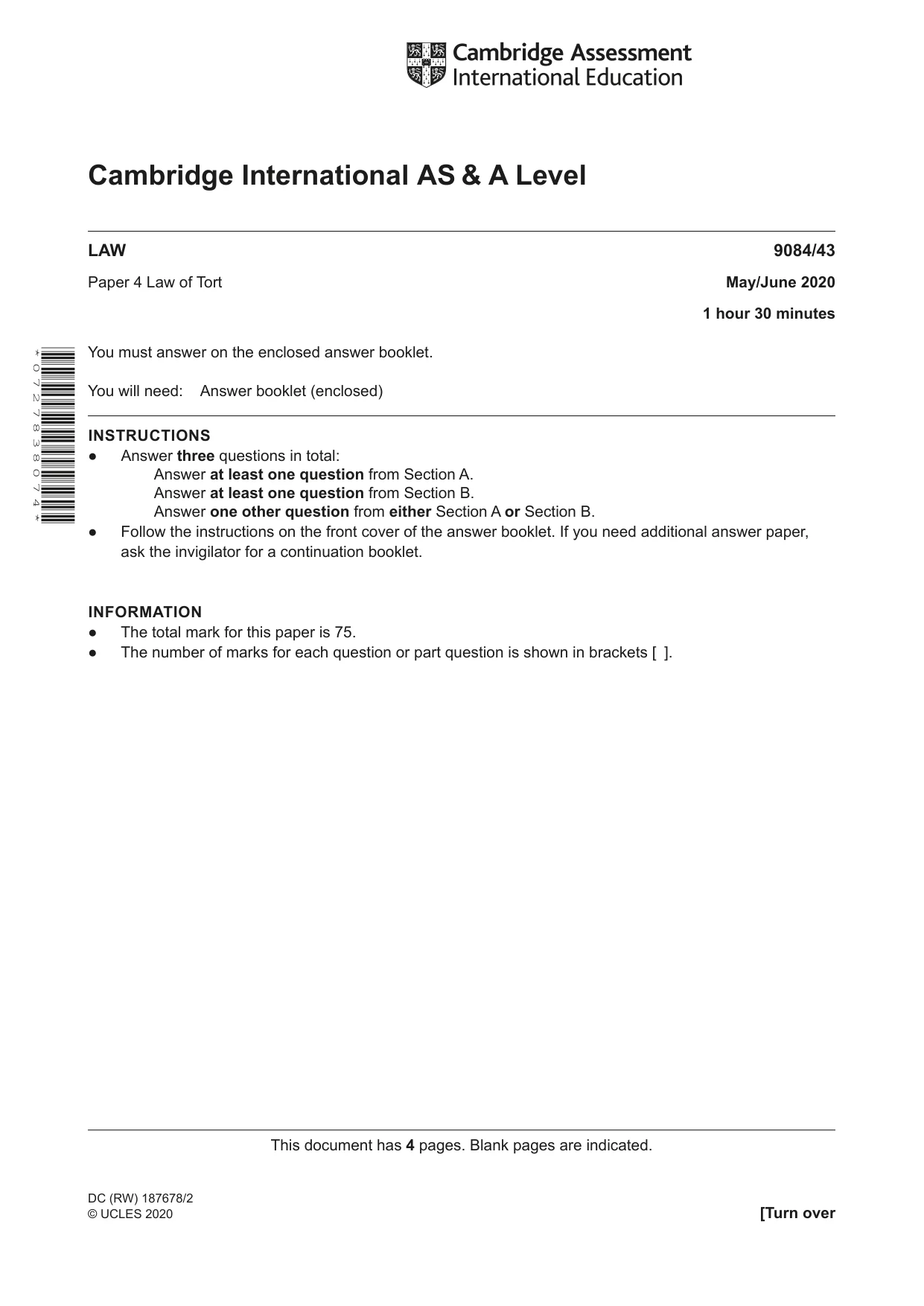
This document has 4 pages. Blank pages are indicated. DC (RW) 187678/2 © UCLES 2020 [Turn over * 0 7 2 7 8 3 8 0 7 4 * Cambridge International AS & A Level LAW 9084/43 Paper 4 Law of Tort May/June 2020 1 hour 30 minutes You must answer on the enclosed answer booklet. You will need: Answer booklet (enclosed) INSTRUCTIONS ● Answer three questions in total: Answer at least one question from Section A. Answer at least one question from Section B. Answer one other question from either Section A or Section B. ● Follow the instructions on the front cover of the answer booklet. If you need additional answer paper, ask the invigilator for a continuation booklet. INFORMATION ● The total mark for this paper is 75. ● The number of marks for each question or part question is shown in brackets [ ].
Question paper, page 2
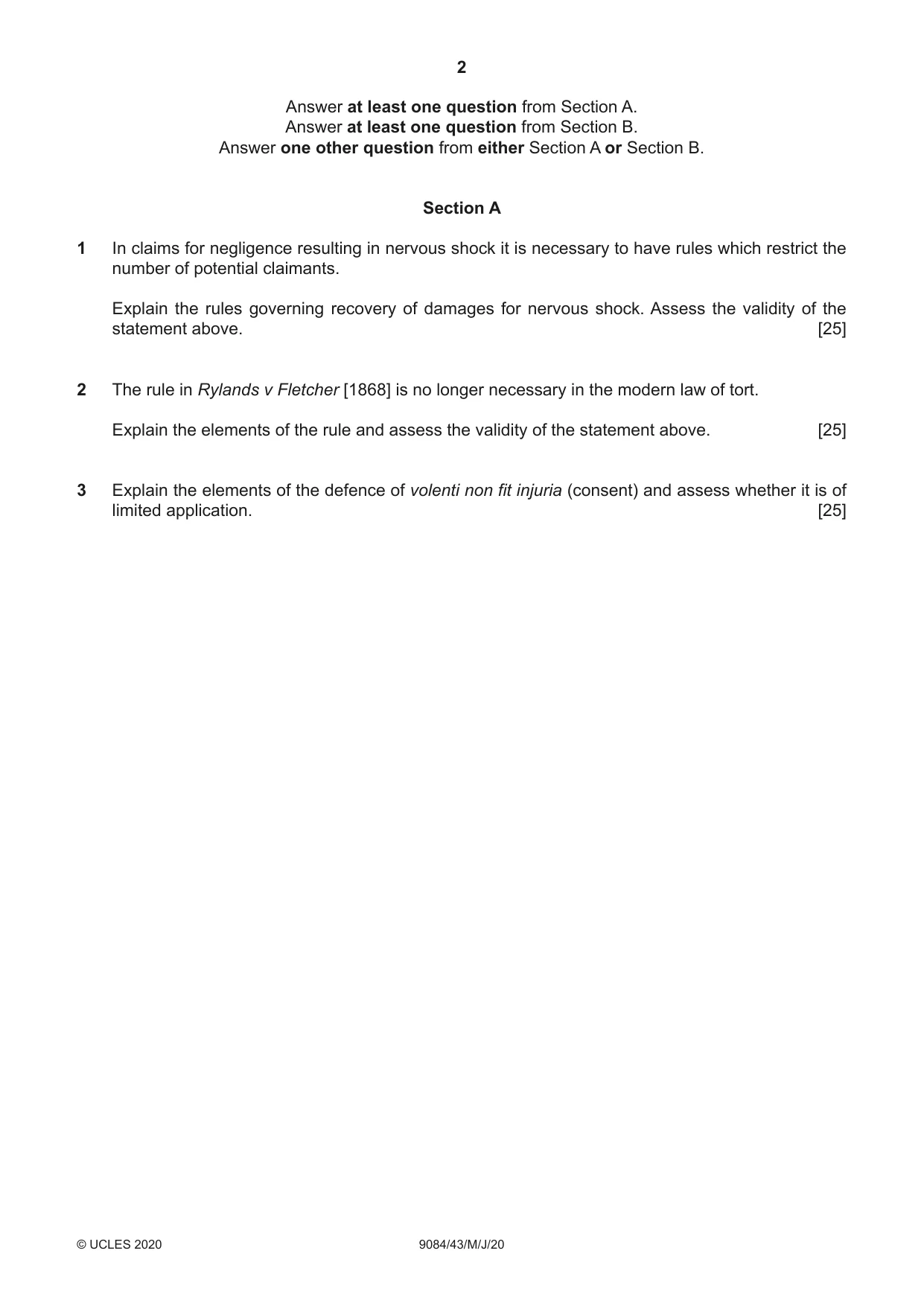
2 9084/43/M/J/20 © UCLES 2020 Answer at least one question from Section A. Answer at least one question from Section B. Answer one other question from either Section A or Section B. Section A 1 In claims for negligence resulting in nervous shock it is necessary to have rules which restrict the number of potential claimants. Explain the rules governing recovery of damages for nervous shock. Assess the validity of the statement above. [25] 2 The rule in Rylands v Fletcher [1868] is no longer necessary in the modern law of tort. Explain the elements of the rule and assess the validity of the statement above. [25] 3 Explain the elements of the defence of volenti non fit injuria (consent) and assess whether it is of limited application. [25]
Question paper, page 3
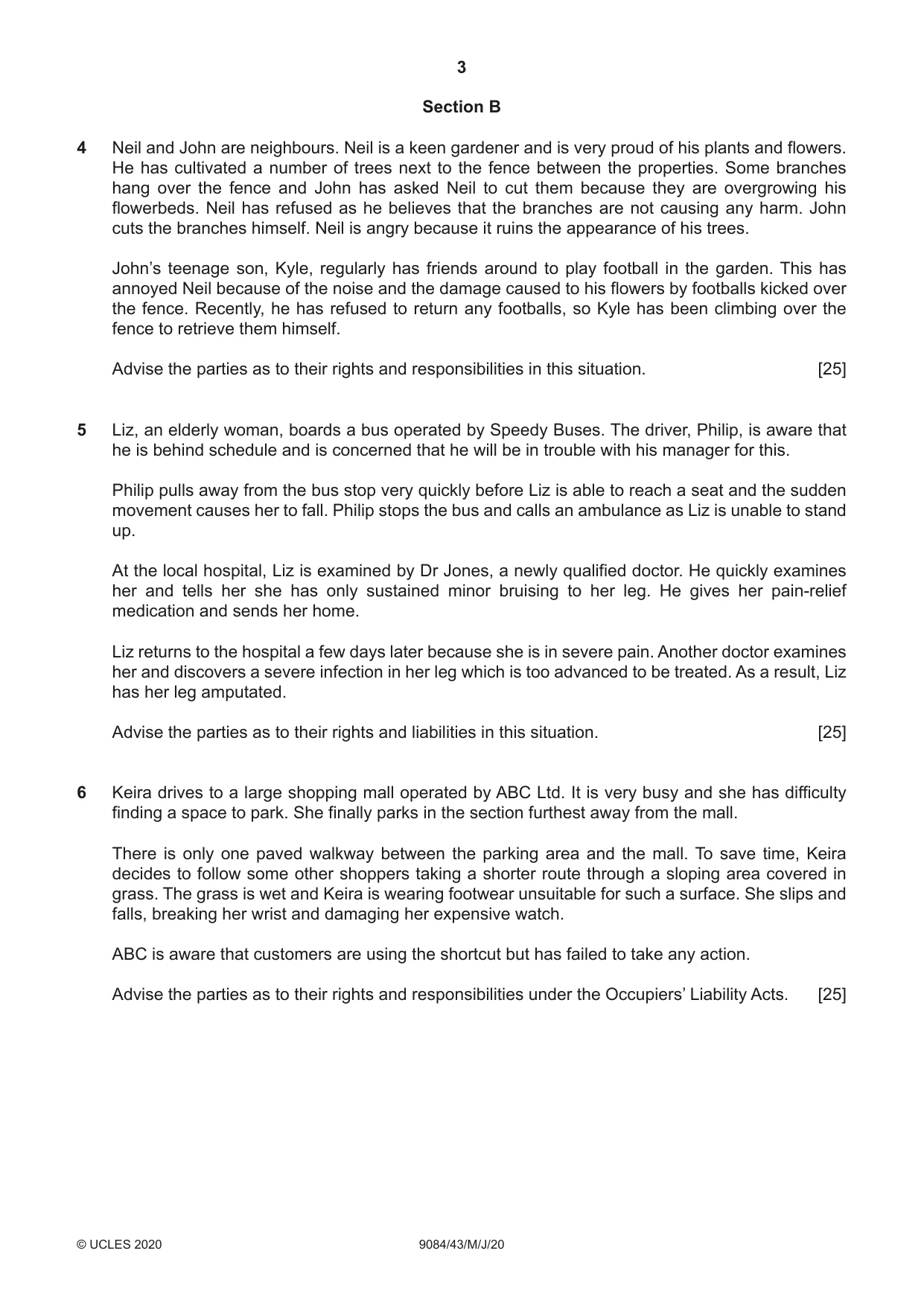
3 9084/43/M/J/20 © UCLES 2020 Section B 4 Neil and John are neighbours. Neil is a keen gardener and is very proud of his plants and flowers. He has cultivated a number of trees next to the fence between the properties. Some branches hang over the fence and John has asked Neil to cut them because they are overgrowing his flowerbeds. Neil has refused as he believes that the branches are not causing any harm. John cuts the branches himself. Neil is angry because it ruins the appearance of his trees. John’s teenage son, Kyle, regularly has friends around to play football in the garden. This has annoyed Neil because of the noise and the damage caused to his flowers by footballs kicked over the fence. Recently, he has refused to return any footballs, so Kyle has been climbing over the fence to retrieve them himself. Advise the parties as to their rights and responsibilities in this situation. [25] 5 Liz, an elderly woman, boards a bus operated by Speedy Buses. The driver, Philip, is aware that he is behind schedule and is concerned that he will be in trouble with his manager for this. Philip pulls away from the bus stop very quickly before Liz is able to reach a seat and the sudden movement causes her to fall. Philip stops the bus and calls an ambulance as Liz is unable to stand up. At the local hospital, Liz is examined by Dr Jones, a newly qualified doctor. He quickly examines her and tells her she has only sustained minor bruising to her leg. He gives her pain-relief medication and sends her home. Liz returns to the hospital a few days later because she is in severe pain. Another doctor examines her and discovers a severe infection in her leg which is too advanced to be treated. As a result, Liz has her leg amputated. Advise the parties as to their rights and liabilities in this situation. [25] 6 Keira drives to a large shopping mall operated by ABC Ltd. It is very busy and she has difficulty finding a space to park. She finally parks in the section furthest away from the mall. There is only one paved walkway between the parking area and the mall. To save time, Keira decides to follow some other shoppers taking a shorter route through a sloping area covered in grass. The grass is wet and Keira is wearing footwear unsuitable for such a surface. She slips and falls, breaking her wrist and damaging her expensive watch. ABC is aware that customers are using the shortcut but has failed to take any action. Advise the parties as to their rights and responsibilities under the Occupiers’ Liability Acts. [25]
Question paper, page 4
4 9084/43/M/J/20 © UCLES 2020 Permission to reproduce items where third-party owned material protected by copyright is included has been sought and cleared where possible. Every reasonable effort has been made by the publisher (UCLES) to trace copyright holders, but if any items requiring clearance have unwittingly been included, the publisher will be pleased to make amends at the earliest possible opportunity. To avoid the issue of disclosure of answer-related information to candidates, all copyright acknowledgements are reproduced online in the Cambridge Assessment International Education Copyright Acknowledgements Booklet. This is produced for each series of examinations and is freely available to download at www.cambridgeinternational.org after the live examination series. Cambridge Assessment International Education is part of the Cambridge Assessment Group. Cambridge Assessment is the brand name of the University of Cambridge Local Examinations Syndicate (UCLES), which itself is a department of the University of Cambridge. BLANK PAGE
Mark scheme, page 1
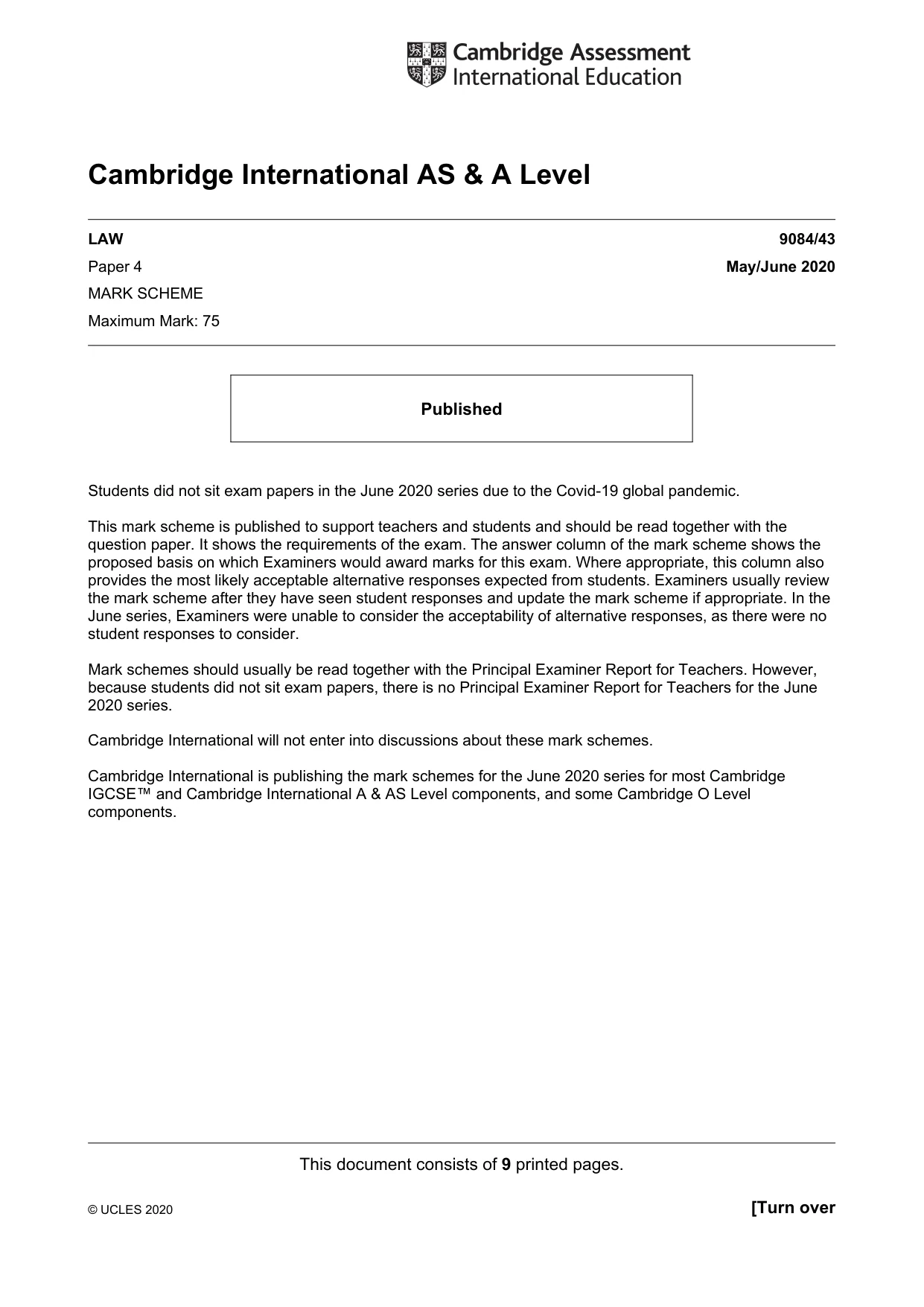
This document consists of 9 printed pages. © UCLES 2020 [Turn over Cambridge International AS & A Level LAW 9084/43 Paper 4 May/June 2020 MARK SCHEME Maximum Mark: 75 Published Students did not sit exam papers in the June 2020 series due to the Covid-19 global pandemic. This mark scheme is published to support teachers and students and should be read together with the question paper. It shows the requirements of the exam. The answer column of the mark scheme shows the proposed basis on which Examiners would award marks for this exam. Where appropriate, this column also provides the most likely acceptable alternative responses expected from students. Examiners usually review the mark scheme after they have seen student responses and update the mark scheme if appropriate. In the June series, Examiners were unable to consider the acceptability of alternative responses, as there were no student responses to consider. Mark schemes should usually be read together with the Principal Examiner Report for Teachers. However, because students did not sit exam papers, there is no Principal Examiner Report for Teachers for the June 2020 series. Cambridge International will not enter into discussions about these mark schemes. Cambridge International is publishing the mark schemes for the June 2020 series for most Cambridge IGCSE™ and Cambridge International A & AS Level components, and some Cambridge O Level components.
Mark scheme, page 2
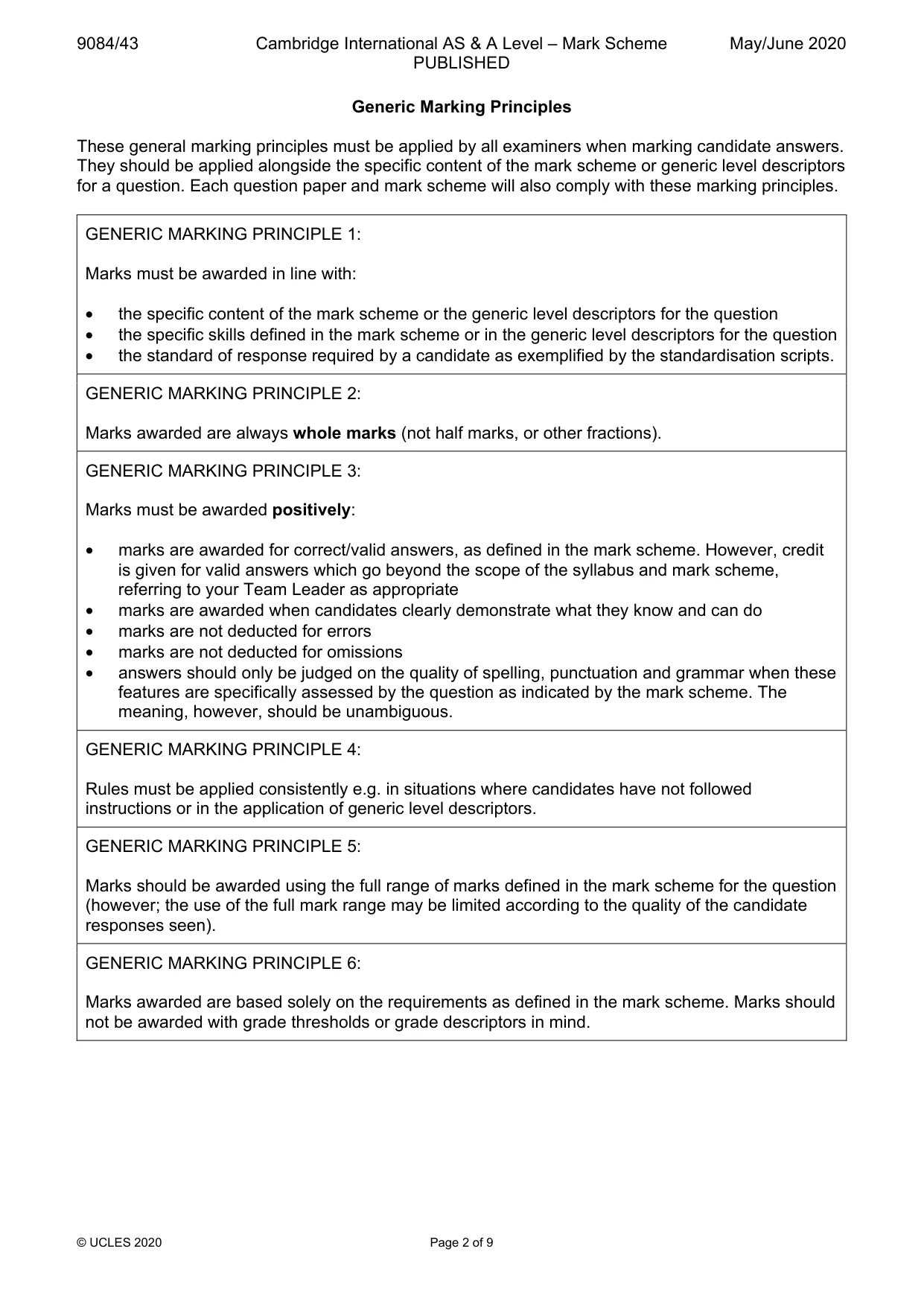
9084/43 Cambridge International AS & A Level – Mark Scheme PUBLISHED May/June 2020 © UCLES 2020 Page 2 of 9 Generic Marking Principles These general marking principles must be applied by all examiners when marking candidate answers. They should be applied alongside the specific content of the mark scheme or generic level descriptors for a question. Each question paper and mark scheme will also comply with these marking principles. GENERIC MARKING PRINCIPLE 1: Marks must be awarded in line with: • the specific content of the mark scheme or the generic level descriptors for the question • the specific skills defined in the mark scheme or in the generic level descriptors for the question • the standard of response required by a candidate as exemplified by the standardisation scripts. GENERIC MARKING PRINCIPLE 2: Marks awarded are always whole marks (not half marks, or other fractions). GENERIC MARKING PRINCIPLE 3: Marks must be awarded positively: • marks are awarded for correct/valid answers, as defined in the mark scheme. However, credit is given for valid answers which go beyond the scope of the syllabus and mark scheme, referring to your Team Leader as appropriate • marks are awarded when candidates clearly demonstrate what they know and can do • marks are not deducted for errors • marks are not deducted for omissions • answers should only be judged on the quality of spelling, punctuation and grammar when these features are specifically assessed by the question as indicated by the mark scheme. The meaning, however, should be unambiguous. GENERIC MARKING PRINCIPLE 4: Rules must be applied consistently e.g. in situations where candidates have not followed instructions or in the application of generic level descriptors. GENERIC MARKING PRINCIPLE 5: Marks should be awarded using the full range of marks defined in the mark scheme for the question (however; the use of the full mark range may be limited according to the quality of the candidate responses seen). GENERIC MARKING PRINCIPLE 6: Marks awarded are based solely on the requirements as defined in the mark scheme. Marks should not be awarded with grade thresholds or grade descriptors in mind.
Mark scheme, page 3
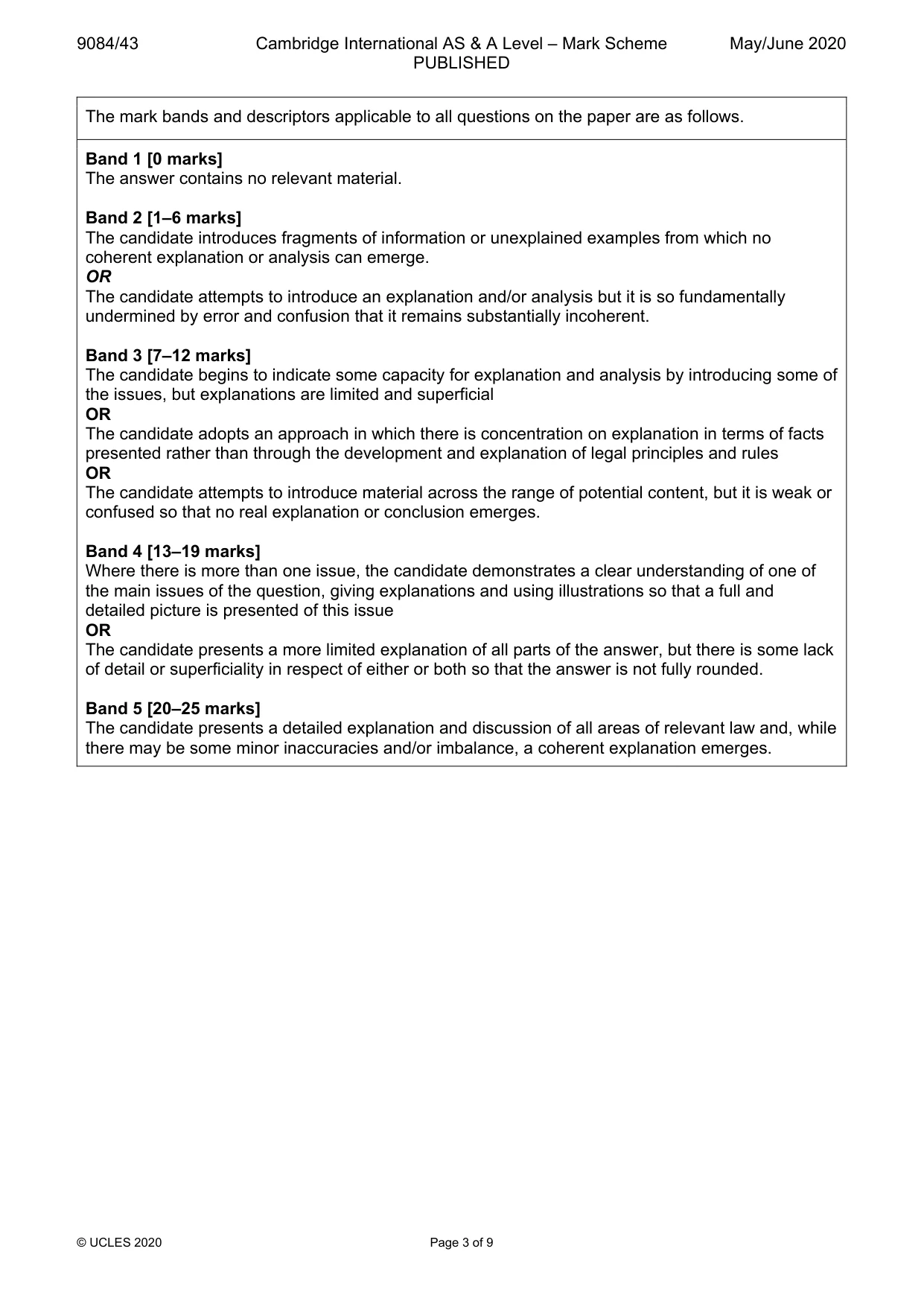
9084/43 Cambridge International AS & A Level – Mark Scheme PUBLISHED May/June 2020 © UCLES 2020 Page 3 of 9 The mark bands and descriptors applicable to all questions on the paper are as follows. Band 1 [0 marks] The answer contains no relevant material. Band 2 [1–6 marks] The candidate introduces fragments of information or unexplained examples from which no coherent explanation or analysis can emerge. OR The candidate attempts to introduce an explanation and/or analysis but it is so fundamentally undermined by error and confusion that it remains substantially incoherent. Band 3 [7–12 marks] The candidate begins to indicate some capacity for explanation and analysis by introducing some of the issues, but explanations are limited and superficial OR The candidate adopts an approach in which there is concentration on explanation in terms of facts presented rather than through the development and explanation of legal principles and rules OR The candidate attempts to introduce material across the range of potential content, but it is weak or confused so that no real explanation or conclusion emerges. Band 4 [13–19 marks] Where there is more than one issue, the candidate demonstrates a clear understanding of one of the main issues of the question, giving explanations and using illustrations so that a full and detailed picture is presented of this issue OR The candidate presents a more limited explanation of all parts of the answer, but there is some lack of detail or superficiality in respect of either or both so that the answer is not fully rounded. Band 5 [20–25 marks] The candidate presents a detailed explanation and discussion of all areas of relevant law and, while there may be some minor inaccuracies and/or imbalance, a coherent explanation emerges.
Mark scheme, page 4
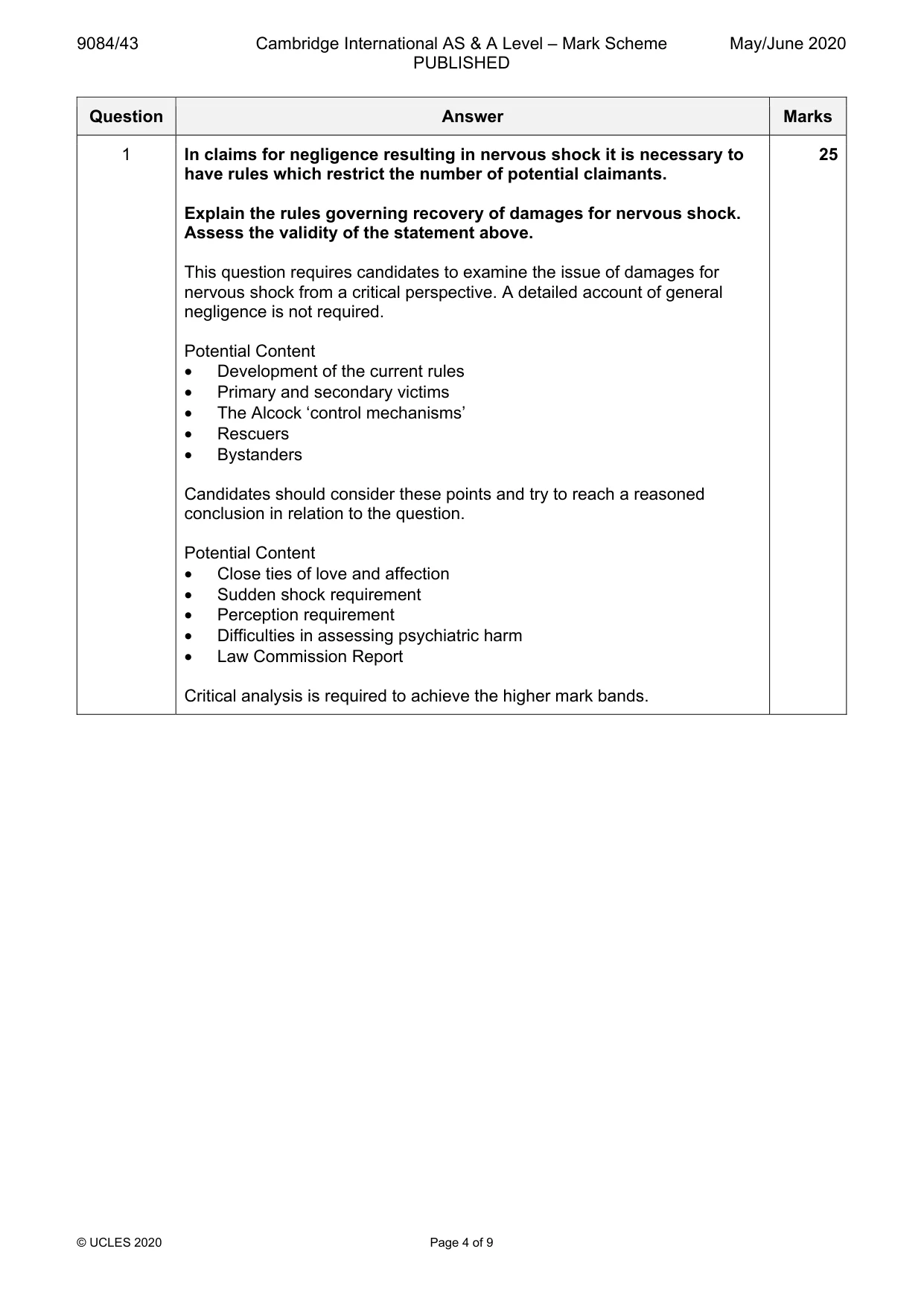
9084/43 Cambridge International AS & A Level – Mark Scheme PUBLISHED May/June 2020 © UCLES 2020 Page 4 of 9 Question Answer Marks 1 In claims for negligence resulting in nervous shock it is necessary to have rules which restrict the number of potential claimants. Explain the rules governing recovery of damages for nervous shock. Assess the validity of the statement above. This question requires candidates to examine the issue of damages for nervous shock from a critical perspective. A detailed account of general negligence is not required. Potential Content • Development of the current rules • Primary and secondary victims • The Alcock ‘control mechanisms’ • Rescuers • Bystanders Candidates should consider these points and try to reach a reasoned conclusion in relation to the question. Potential Content • Close ties of love and affection • Sudden shock requirement • Perception requirement • Difficulties in assessing psychiatric harm • Law Commission Report Critical analysis is required to achieve the higher mark bands. 25
Mark scheme, page 5
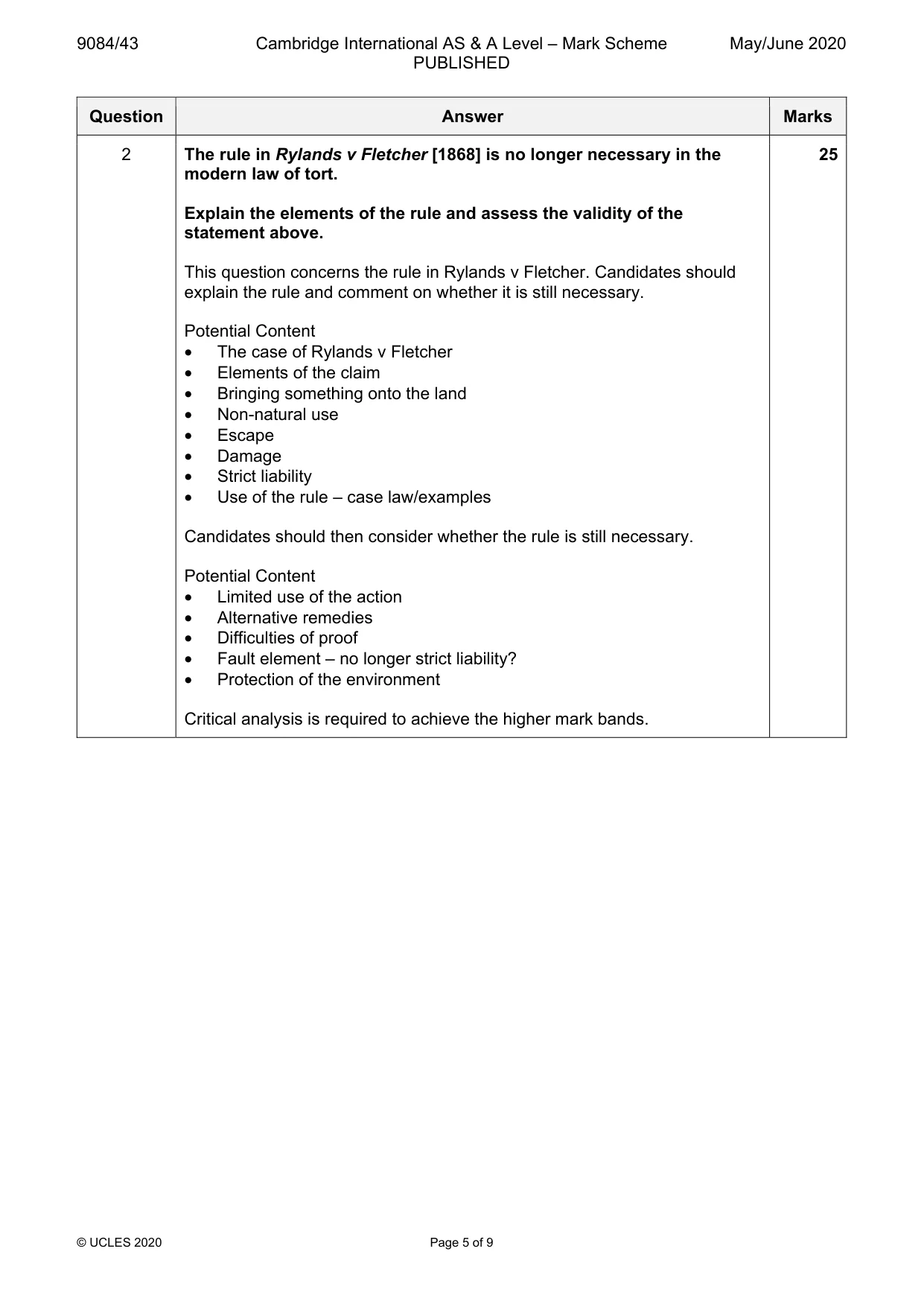
9084/43 Cambridge International AS & A Level – Mark Scheme PUBLISHED May/June 2020 © UCLES 2020 Page 5 of 9 Question Answer Marks 2 The rule in Rylands v Fletcher [1868] is no longer necessary in the modern law of tort. Explain the elements of the rule and assess the validity of the statement above. This question concerns the rule in Rylands v Fletcher. Candidates should explain the rule and comment on whether it is still necessary. Potential Content • The case of Rylands v Fletcher • Elements of the claim • Bringing something onto the land • Non-natural use • Escape • Damage • Strict liability • Use of the rule – case law/examples Candidates should then consider whether the rule is still necessary. Potential Content • Limited use of the action • Alternative remedies • Difficulties of proof • Fault element – no longer strict liability? • Protection of the environment Critical analysis is required to achieve the higher mark bands. 25
Mark scheme, page 6
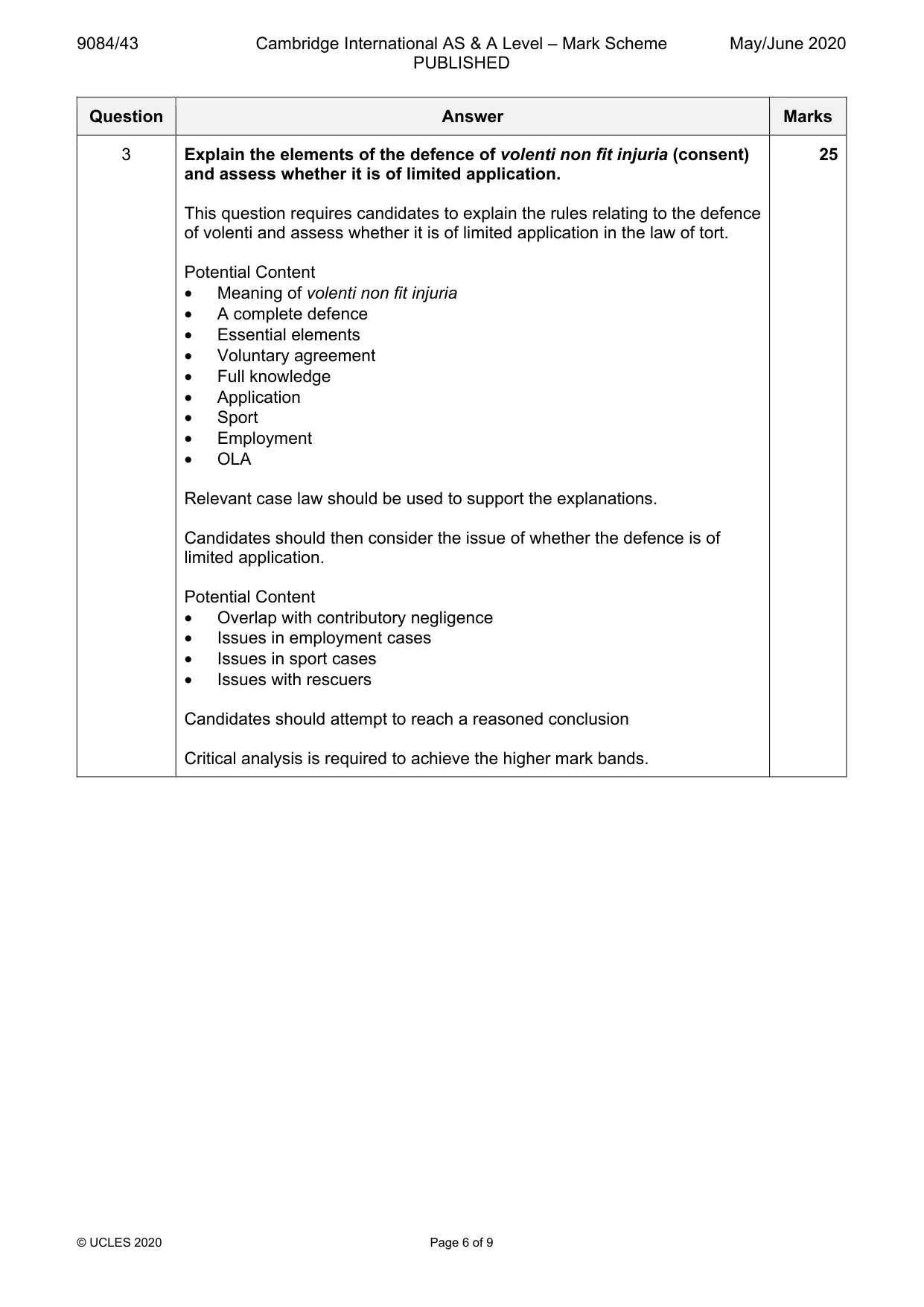
9084/43 Cambridge International AS & A Level – Mark Scheme PUBLISHED May/June 2020 © UCLES 2020 Page 6 of 9 Question Answer Marks 3 Explain the elements of the defence of volenti non fit injuria (consent) and assess whether it is of limited application. This question requires candidates to explain the rules relating to the defence of volenti and assess whether it is of limited application in the law of tort. Potential Content • Meaning of volenti non fit injuria • A complete defence • Essential elements • Voluntary agreement • Full knowledge • Application • Sport • Employment • OLA Relevant case law should be used to support the explanations. Candidates should then consider the issue of whether the defence is of limited application. Potential Content • Overlap with contributory negligence • Issues in employment cases • Issues in sport cases • Issues with rescuers Candidates should attempt to reach a reasoned conclusion Critical analysis is required to achieve the higher mark bands. 25
Mark scheme, page 7
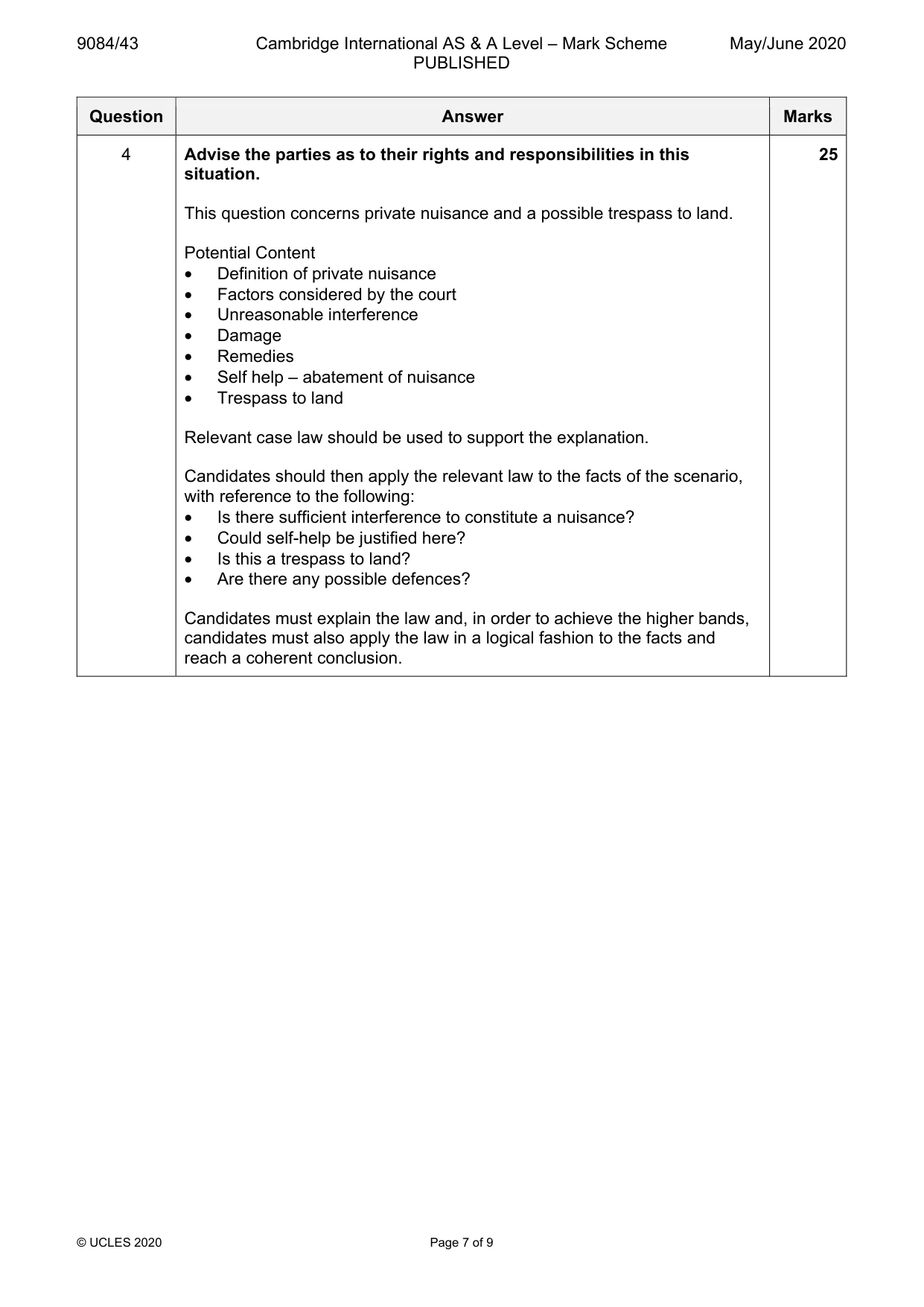
9084/43 Cambridge International AS & A Level – Mark Scheme PUBLISHED May/June 2020 © UCLES 2020 Page 7 of 9 Question Answer Marks 4 Advise the parties as to their rights and responsibilities in this situation. This question concerns private nuisance and a possible trespass to land. Potential Content • Definition of private nuisance • Factors considered by the court • Unreasonable interference • Damage • Remedies • Self help – abatement of nuisance • Trespass to land Relevant case law should be used to support the explanation. Candidates should then apply the relevant law to the facts of the scenario, with reference to the following: • Is there sufficient interference to constitute a nuisance? • Could self-help be justified here? • Is this a trespass to land? • Are there any possible defences? Candidates must explain the law and, in order to achieve the higher bands, candidates must also apply the law in a logical fashion to the facts and reach a coherent conclusion. 25
Mark scheme, page 8
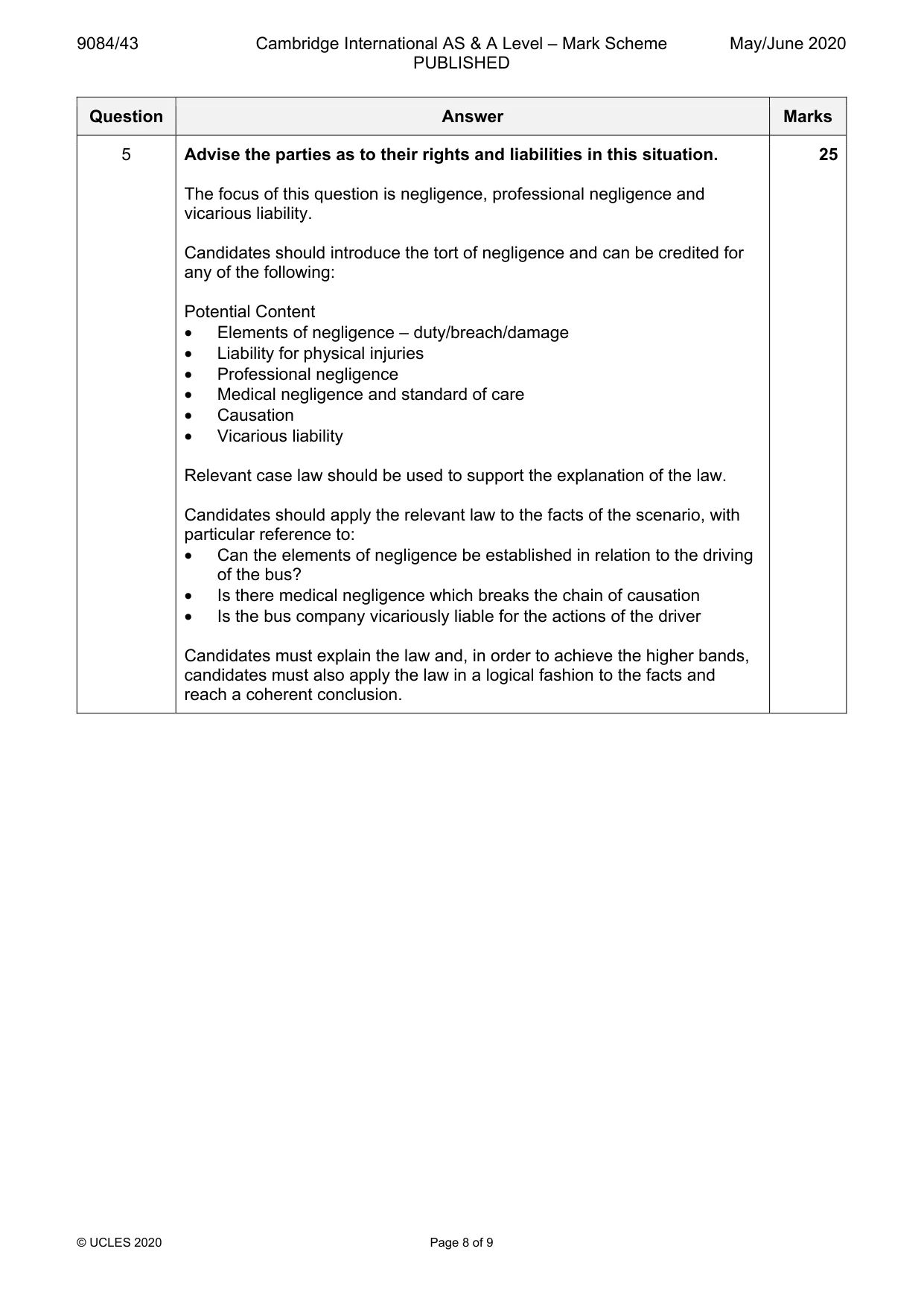
9084/43 Cambridge International AS & A Level – Mark Scheme PUBLISHED May/June 2020 © UCLES 2020 Page 8 of 9 Question Answer Marks 5 Advise the parties as to their rights and liabilities in this situation. The focus of this question is negligence, professional negligence and vicarious liability. Candidates should introduce the tort of negligence and can be credited for any of the following: Potential Content • Elements of negligence – duty/breach/damage • Liability for physical injuries • Professional negligence • Medical negligence and standard of care • Causation • Vicarious liability Relevant case law should be used to support the explanation of the law. Candidates should apply the relevant law to the facts of the scenario, with particular reference to: • Can the elements of negligence be established in relation to the driving of the bus? • Is there medical negligence which breaks the chain of causation • Is the bus company vicariously liable for the actions of the driver Candidates must explain the law and, in order to achieve the higher bands, candidates must also apply the law in a logical fashion to the facts and reach a coherent conclusion. 25
Mark scheme, page 9
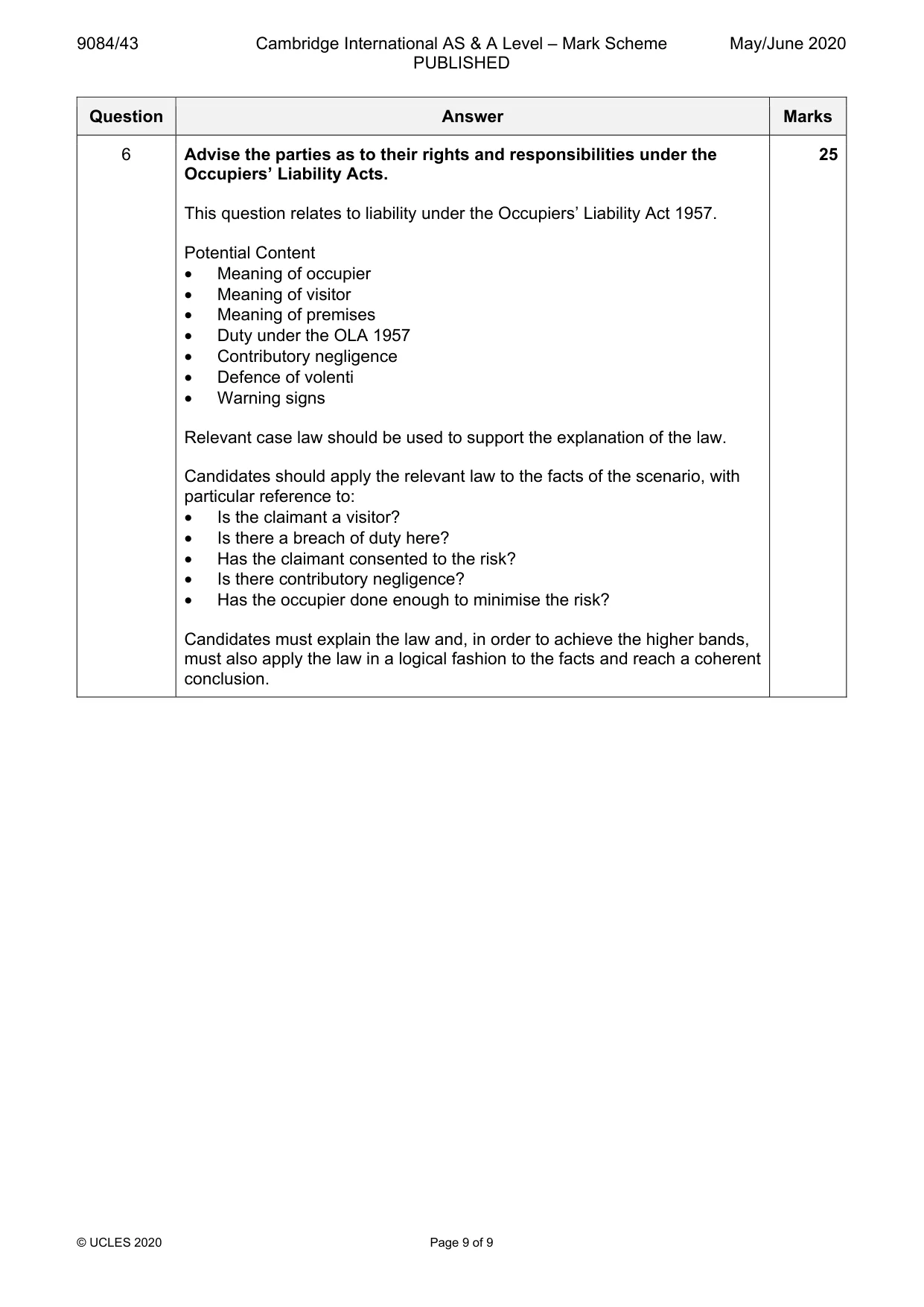
9084/43 Cambridge International AS & A Level – Mark Scheme PUBLISHED May/June 2020 © UCLES 2020 Page 9 of 9 Question Answer Marks 6 Advise the parties as to their rights and responsibilities under the Occupiers’ Liability Acts. This question relates to liability under the Occupiers’ Liability Act 1957. Potential Content • Meaning of occupier • Meaning of visitor • Meaning of premises • Duty under the OLA 1957 • Contributory negligence • Defence of volenti • Warning signs Relevant case law should be used to support the explanation of the law. Candidates should apply the relevant law to the facts of the scenario, with particular reference to: • Is the claimant a visitor? • Is there a breach of duty here? • Has the claimant consented to the risk? • Is there contributory negligence? • Has the occupier done enough to minimise the risk? Candidates must explain the law and, in order to achieve the higher bands, must also apply the law in a logical fashion to the facts and reach a coherent conclusion. 25