Cambridge A Level Law 9084 — 2018 May/June Paper 4 · Variant 1
9084/41/M/J/18 · 75 marks · ≈84 min
The question paper and its mark scheme, free to read here and free to download. This is Cambridge’s own paper, exactly as it was sat.
Question paper4 pages

Mark scheme10 pages
Answers below. Sit the paper first if you are practising.
Paper as text
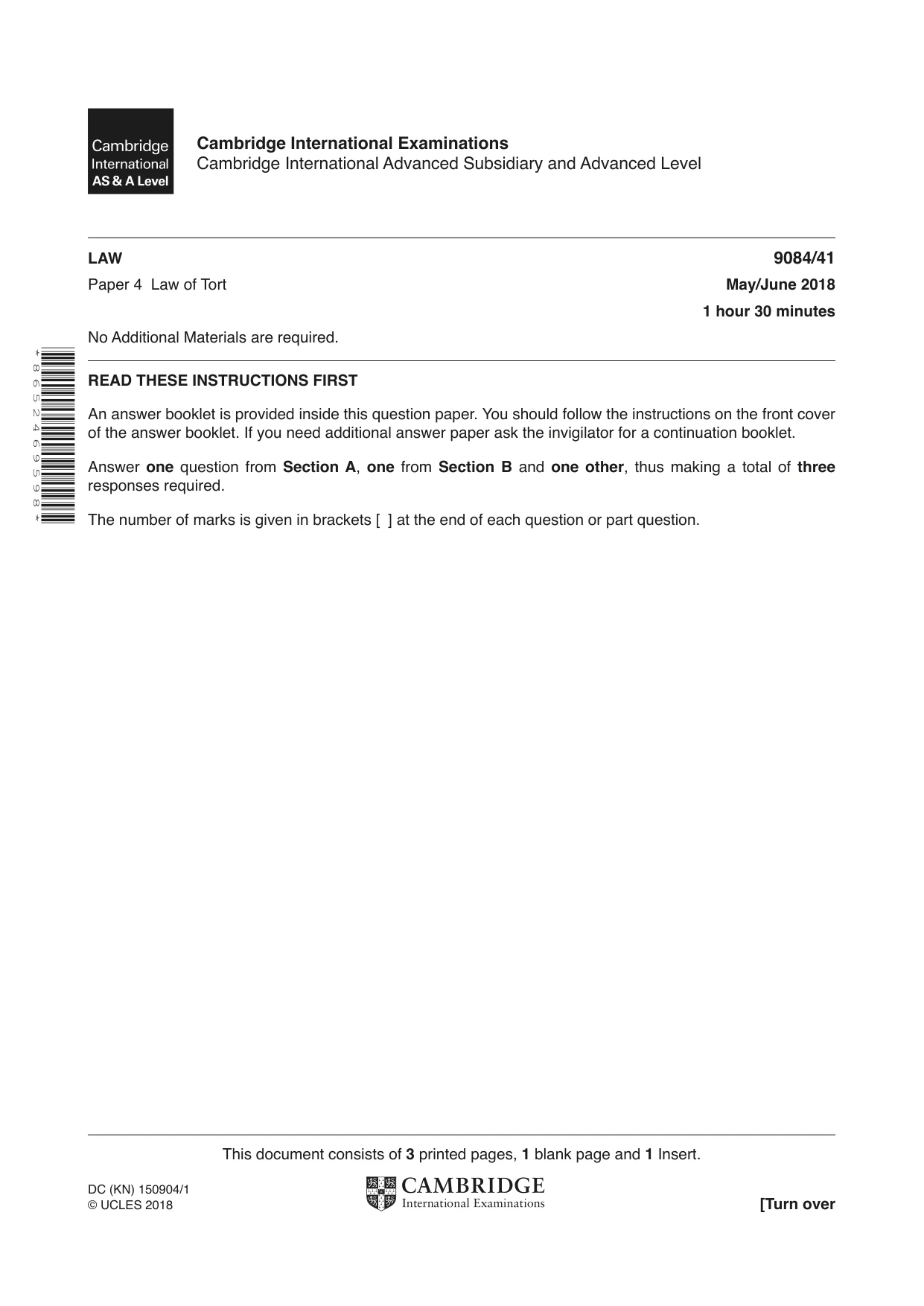
Question paper, page 1
* 8 6 5 2 4 6 9 5 9 8 * This document consists of 3 printed pages, 1 blank page and 1 Insert. DC (KN) 150904/1 © UCLES 2018 [Turn over Cambridge International Examinations Cambridge International Advanced Subsidiary and Advanced Level LAW 9084/41 Paper 4 Law of Tort May/June 2018 1 hour 30 minutes No Additional Materials are required. READ THESE INSTRUCTIONS FIRST An answer booklet is provided inside this question paper. You should follow the instructions on the front cover of the answer booklet. If you need additional answer paper ask the invigilator for a continuation booklet. Answer one question from Section A, one from Section B and one other, thus making a total of three responses required. The number of marks is given in brackets [ ] at the end of each question or part question.
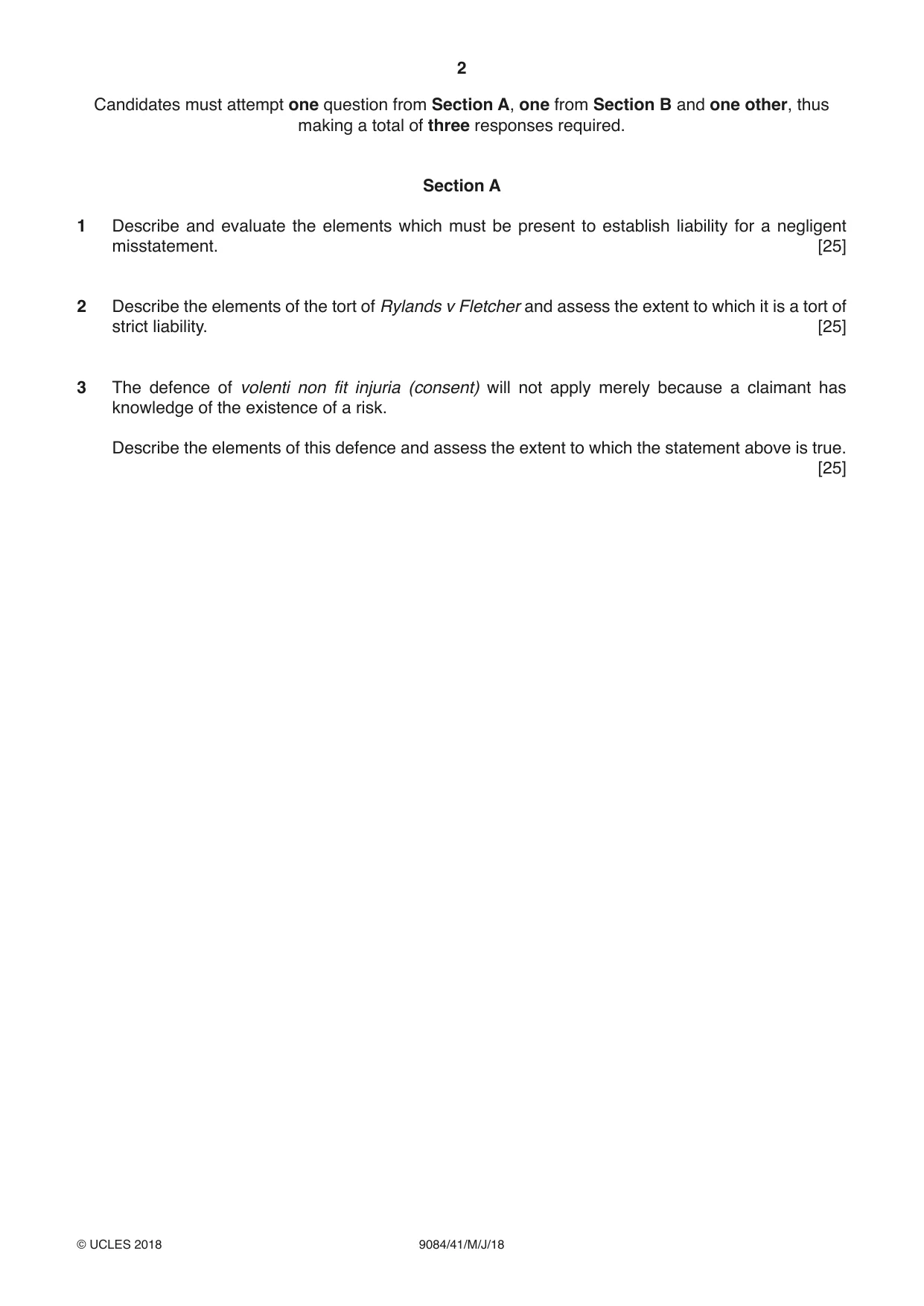
Question paper, page 2
2 9084/41/M/J/18 © UCLES 2018 Candidates must attempt one question from Section A, one from Section B and one other, thus making a total of three responses required. Section A 1 Describe and evaluate the elements which must be present to establish liability for a negligent misstatement. [25] 2 Describe the elements of the tort of Rylands v Fletcher and assess the extent to which it is a tort of strict liability. [25] 3 The defence of volenti non fit injuria (consent) will not apply merely because a claimant has knowledge of the existence of a risk. Describe the elements of this defence and assess the extent to which the statement above is true. [25]
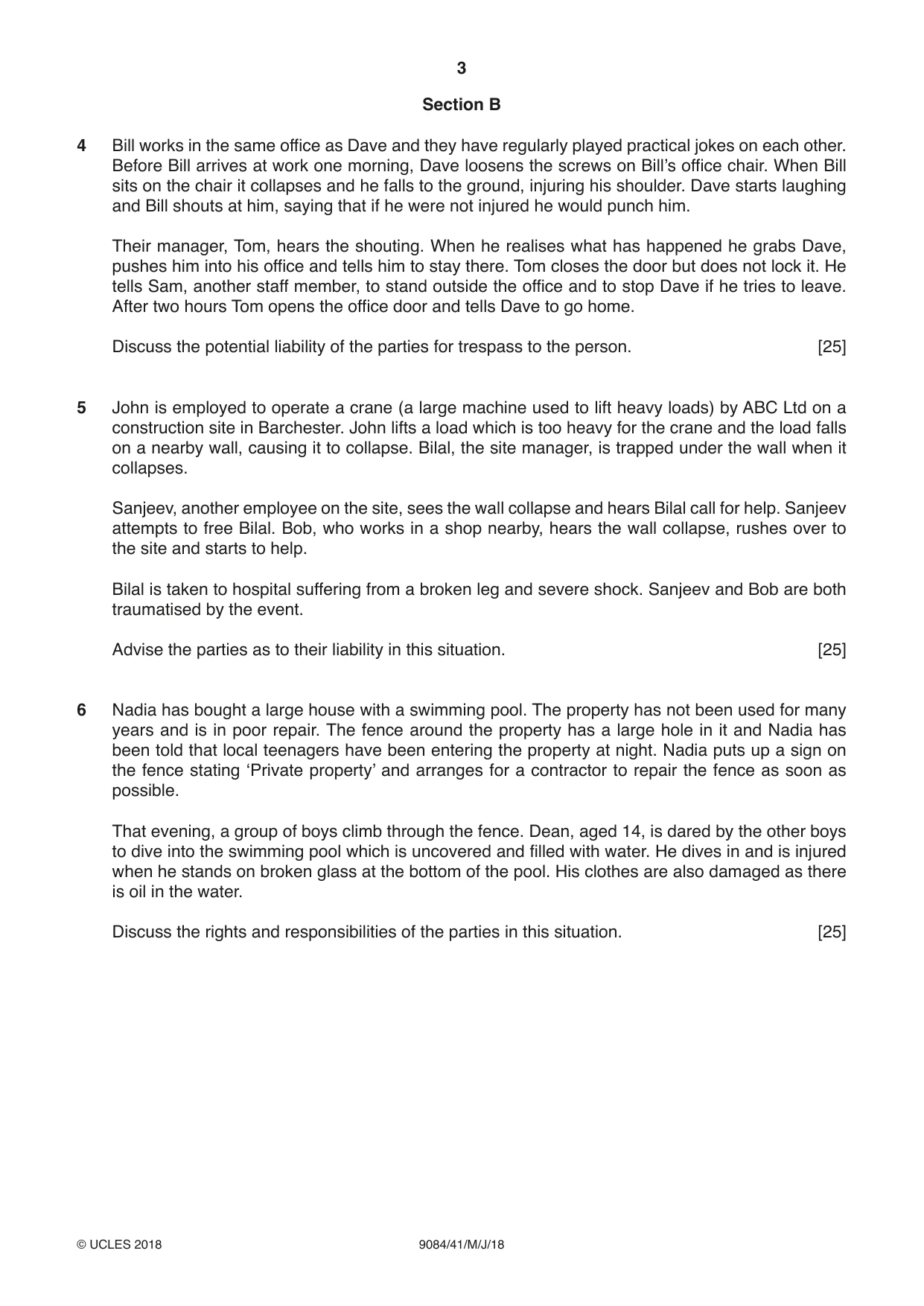
Question paper, page 3
3 9084/41/M/J/18 © UCLES 2018 Section B 4 Bill works in the same office as Dave and they have regularly played practical jokes on each other. Before Bill arrives at work one morning, Dave loosens the screws on Bill’s office chair. When Bill sits on the chair it collapses and he falls to the ground, injuring his shoulder. Dave starts laughing and Bill shouts at him, saying that if he were not injured he would punch him. Their manager, Tom, hears the shouting. When he realises what has happened he grabs Dave, pushes him into his office and tells him to stay there. Tom closes the door but does not lock it. He tells Sam, another staff member, to stand outside the office and to stop Dave if he tries to leave. After two hours Tom opens the office door and tells Dave to go home. Discuss the potential liability of the parties for trespass to the person. [25] 5 John is employed to operate a crane (a large machine used to lift heavy loads) by ABC Ltd on a construction site in Barchester. John lifts a load which is too heavy for the crane and the load falls on a nearby wall, causing it to collapse. Bilal, the site manager, is trapped under the wall when it collapses. Sanjeev, another employee on the site, sees the wall collapse and hears Bilal call for help. Sanjeev attempts to free Bilal. Bob, who works in a shop nearby, hears the wall collapse, rushes over to the site and starts to help. Bilal is taken to hospital suffering from a broken leg and severe shock. Sanjeev and Bob are both traumatised by the event. Advise the parties as to their liability in this situation. [25] 6 Nadia has bought a large house with a swimming pool. The property has not been used for many years and is in poor repair. The fence around the property has a large hole in it and Nadia has been told that local teenagers have been entering the property at night. Nadia puts up a sign on the fence stating ‘Private property’ and arranges for a contractor to repair the fence as soon as possible. That evening, a group of boys climb through the fence. Dean, aged 14, is dared by the other boys to dive into the swimming pool which is uncovered and filled with water. He dives in and is injured when he stands on broken glass at the bottom of the pool. His clothes are also damaged as there is oil in the water. Discuss the rights and responsibilities of the parties in this situation. [25]
Question paper, page 4
4 9084/41/M/J/18 © UCLES 2018 BLANK PAGE Permission to reproduce items where third-party owned material protected by copyright is included has been sought and cleared where possible. Every reasonable effort has been made by the publisher (UCLES) to trace copyright holders, but if any items requiring clearance have unwittingly been included, the publisher will be pleased to make amends at the earliest possible opportunity. To avoid the issue of disclosure of answer-related information to candidates, all copyright acknowledgements are reproduced online in the Cambridge International Examinations Copyright Acknowledgements Booklet. This is produced for each series of examinations and is freely available to download at www.cie.org.uk after the live examination series. Cambridge International Examinations is part of the Cambridge Assessment Group. Cambridge Assessment is the brand name of University of Cambridge Local Examinations Syndicate (UCLES), which is itself a department of the University of Cambridge.
Mark scheme, page 1
IGCSE™ is a registered trademark. This document consists of 10 printed pages. © UCLES 2018 [Turn over Cambridge Assessment International Education Cambridge International Advanced Subsidiary and Advanced Level LAW 9084/41 Paper 4 May/June 2018 MARK SCHEME Maximum Mark: 75 Published This mark scheme is published as an aid to teachers and candidates, to indicate the requirements of the examination. It shows the basis on which Examiners were instructed to award marks. It does not indicate the details of the discussions that took place at an Examiners’ meeting before marking began, which would have considered the acceptability of alternative answers. Mark schemes should be read in conjunction with the question paper and the Principal Examiner Report for Teachers. Cambridge International will not enter into discussions about these mark schemes. Cambridge International is publishing the mark schemes for the May/June 2018 series for most Cambridge IGCSE™, Cambridge International A and AS Level and Cambridge Pre-U components, and some Cambridge O Level components.
Mark scheme, page 2
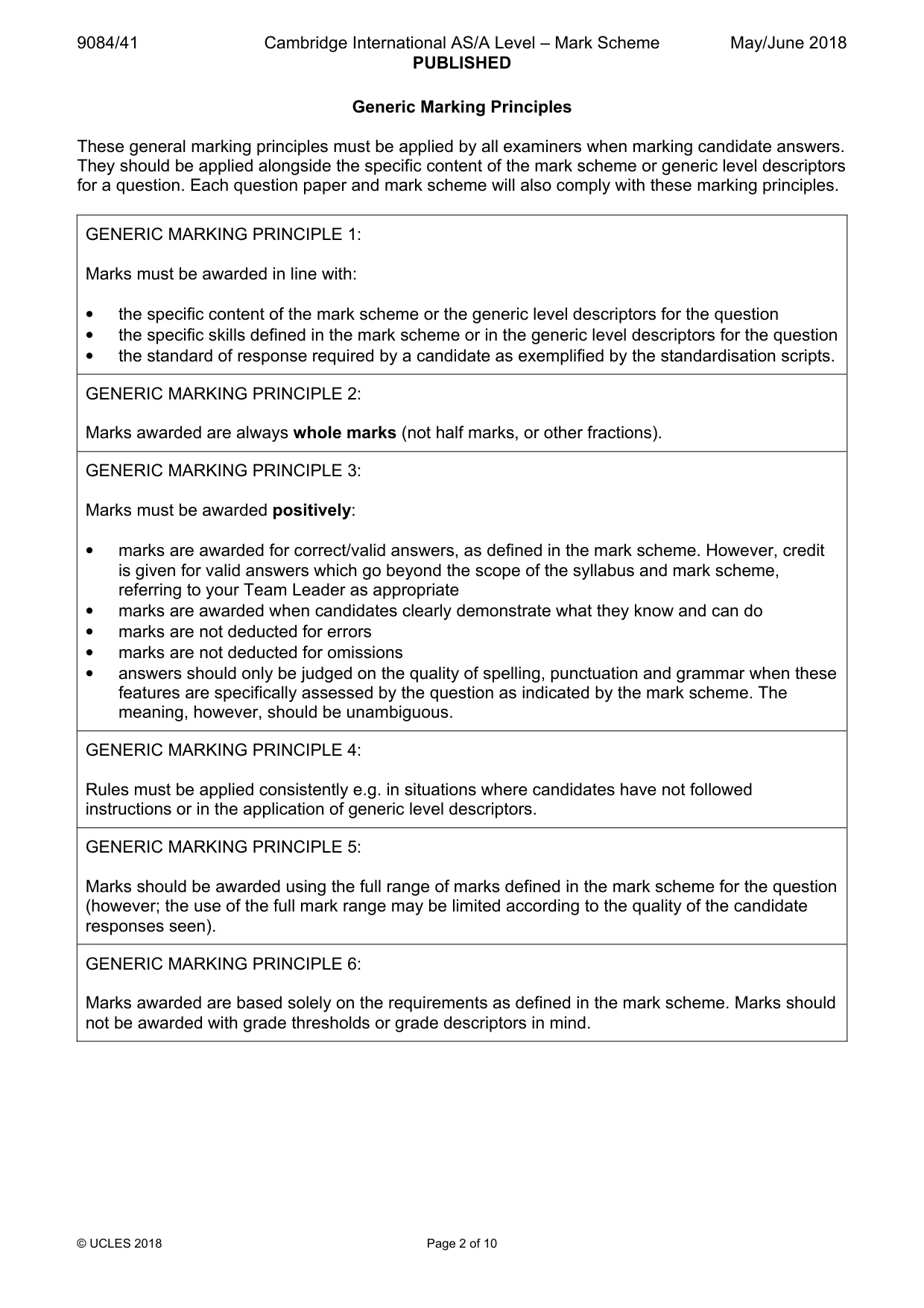
9084/41 Cambridge International AS/A Level – Mark Scheme PUBLISHED May/June 2018 © UCLES 2018 Page 2 of 10 Generic Marking Principles These general marking principles must be applied by all examiners when marking candidate answers. They should be applied alongside the specific content of the mark scheme or generic level descriptors for a question. Each question paper and mark scheme will also comply with these marking principles. GENERIC MARKING PRINCIPLE 1: Marks must be awarded in line with: • the specific content of the mark scheme or the generic level descriptors for the question • the specific skills defined in the mark scheme or in the generic level descriptors for the question • the standard of response required by a candidate as exemplified by the standardisation scripts. GENERIC MARKING PRINCIPLE 2: Marks awarded are always whole marks (not half marks, or other fractions). GENERIC MARKING PRINCIPLE 3: Marks must be awarded positively: • marks are awarded for correct/valid answers, as defined in the mark scheme. However, credit is given for valid answers which go beyond the scope of the syllabus and mark scheme, referring to your Team Leader as appropriate • marks are awarded when candidates clearly demonstrate what they know and can do • marks are not deducted for errors • marks are not deducted for omissions • answers should only be judged on the quality of spelling, punctuation and grammar when these features are specifically assessed by the question as indicated by the mark scheme. The meaning, however, should be unambiguous. GENERIC MARKING PRINCIPLE 4: Rules must be applied consistently e.g. in situations where candidates have not followed instructions or in the application of generic level descriptors. GENERIC MARKING PRINCIPLE 5: Marks should be awarded using the full range of marks defined in the mark scheme for the question (however; the use of the full mark range may be limited according to the quality of the candidate responses seen). GENERIC MARKING PRINCIPLE 6: Marks awarded are based solely on the requirements as defined in the mark scheme. Marks should not be awarded with grade thresholds or grade descriptors in mind.
Mark scheme, page 3
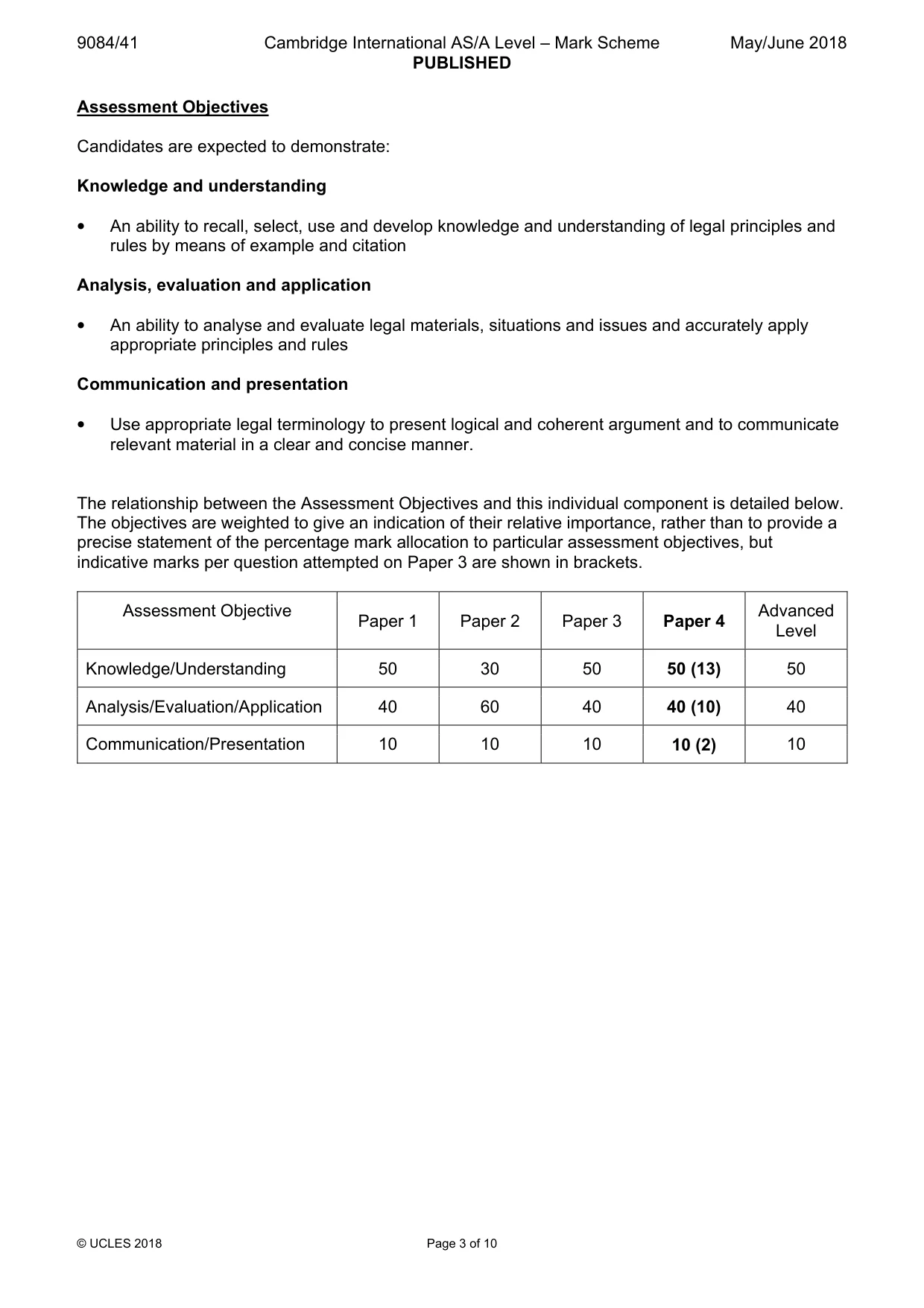
9084/41 Cambridge International AS/A Level – Mark Scheme PUBLISHED May/June 2018 © UCLES 2018 Page 3 of 10 Assessment Objectives Candidates are expected to demonstrate: Knowledge and understanding • An ability to recall, select, use and develop knowledge and understanding of legal principles and rules by means of example and citation Analysis, evaluation and application • An ability to analyse and evaluate legal materials, situations and issues and accurately apply appropriate principles and rules Communication and presentation • Use appropriate legal terminology to present logical and coherent argument and to communicate relevant material in a clear and concise manner. The relationship between the Assessment Objectives and this individual component is detailed below. The objectives are weighted to give an indication of their relative importance, rather than to provide a precise statement of the percentage mark allocation to particular assessment objectives, but indicative marks per question attempted on Paper 3 are shown in brackets. Assessment Objective Paper 1 Paper 2 Paper 3 Paper 4 Advanced Level Knowledge/Understanding 50 30 50 50 (13) 50 Analysis/Evaluation/Application 40 60 40 40 (10) 40 Communication/Presentation 10 10 10 10 (2) 10
Mark scheme, page 4
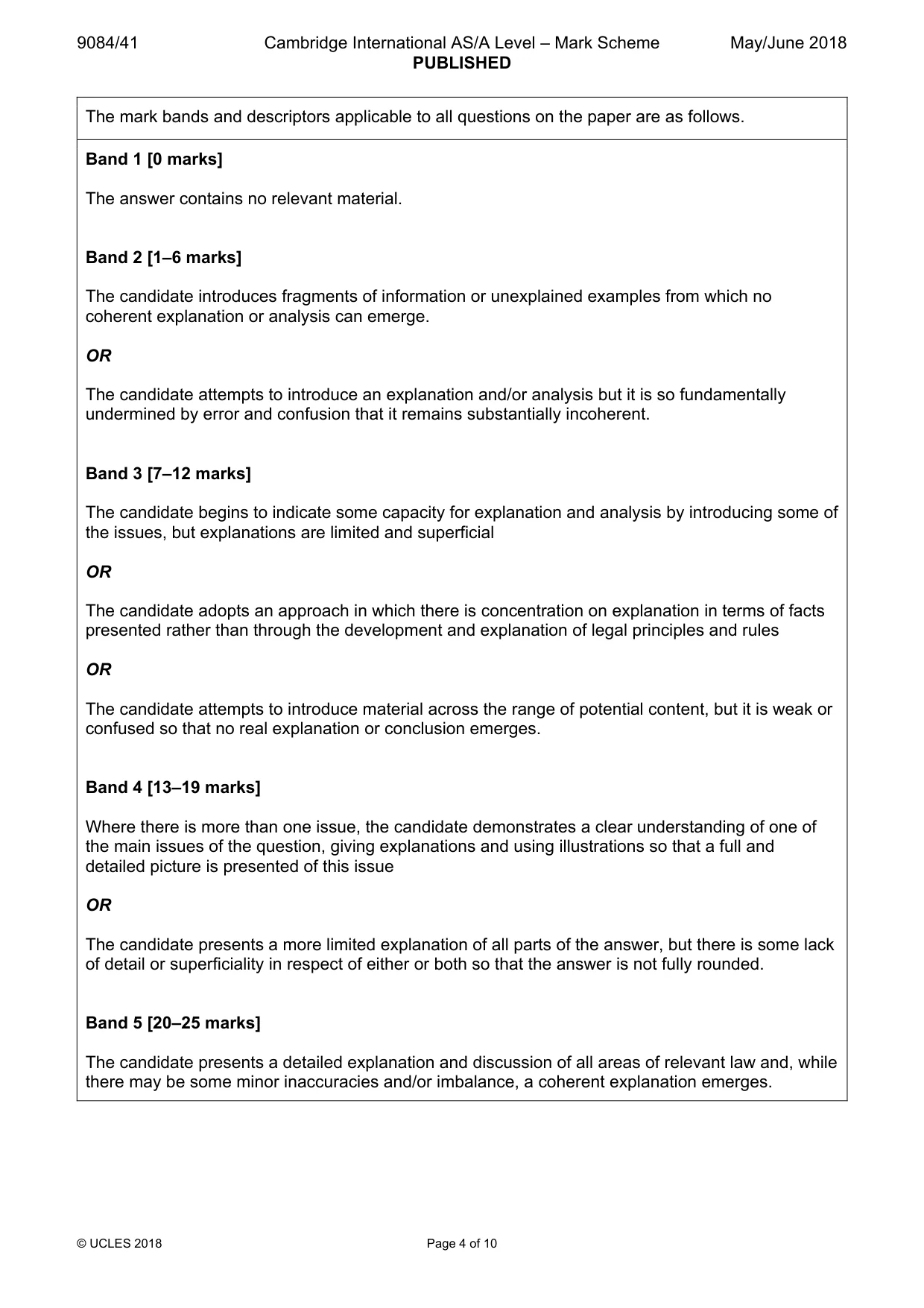
9084/41 Cambridge International AS/A Level – Mark Scheme PUBLISHED May/June 2018 © UCLES 2018 Page 4 of 10 The mark bands and descriptors applicable to all questions on the paper are as follows. Band 1 [0 marks] The answer contains no relevant material. Band 2 [1–6 marks] The candidate introduces fragments of information or unexplained examples from which no coherent explanation or analysis can emerge. OR The candidate attempts to introduce an explanation and/or analysis but it is so fundamentally undermined by error and confusion that it remains substantially incoherent. Band 3 [7–12 marks] The candidate begins to indicate some capacity for explanation and analysis by introducing some of the issues, but explanations are limited and superficial OR The candidate adopts an approach in which there is concentration on explanation in terms of facts presented rather than through the development and explanation of legal principles and rules OR The candidate attempts to introduce material across the range of potential content, but it is weak or confused so that no real explanation or conclusion emerges. Band 4 [13–19 marks] Where there is more than one issue, the candidate demonstrates a clear understanding of one of the main issues of the question, giving explanations and using illustrations so that a full and detailed picture is presented of this issue OR The candidate presents a more limited explanation of all parts of the answer, but there is some lack of detail or superficiality in respect of either or both so that the answer is not fully rounded. Band 5 [20–25 marks] The candidate presents a detailed explanation and discussion of all areas of relevant law and, while there may be some minor inaccuracies and/or imbalance, a coherent explanation emerges.
Mark scheme, page 5
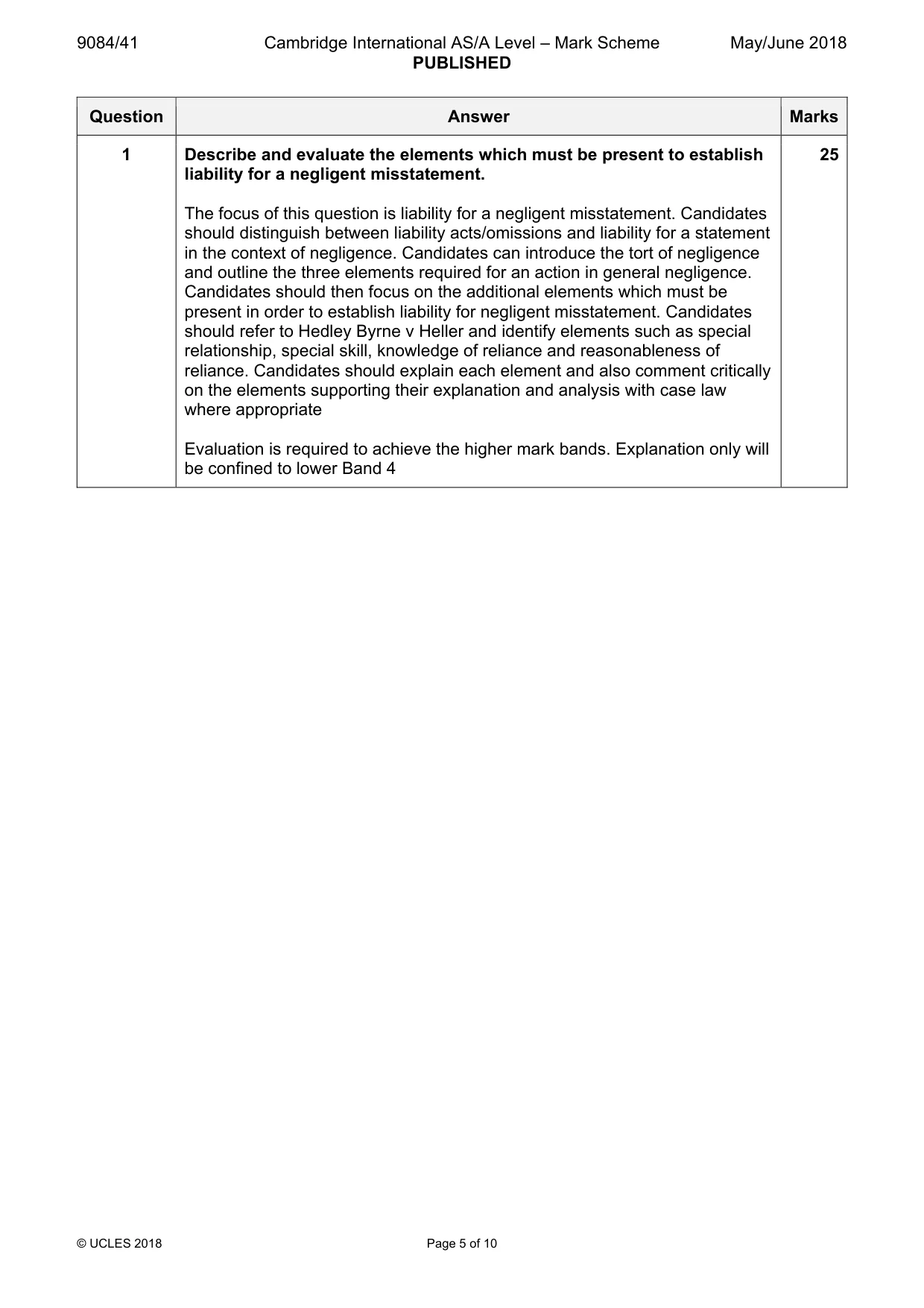
9084/41 Cambridge International AS/A Level – Mark Scheme PUBLISHED May/June 2018 © UCLES 2018 Page 5 of 10 Question Answer Marks 1 Describe and evaluate the elements which must be present to establish liability for a negligent misstatement. The focus of this question is liability for a negligent misstatement. Candidates should distinguish between liability acts/omissions and liability for a statement in the context of negligence. Candidates can introduce the tort of negligence and outline the three elements required for an action in general negligence. Candidates should then focus on the additional elements which must be present in order to establish liability for negligent misstatement. Candidates should refer to Hedley Byrne v Heller and identify elements such as special relationship, special skill, knowledge of reliance and reasonableness of reliance. Candidates should explain each element and also comment critically on the elements supporting their explanation and analysis with case law where appropriate Evaluation is required to achieve the higher mark bands. Explanation only will be confined to lower Band 4 25
Mark scheme, page 6
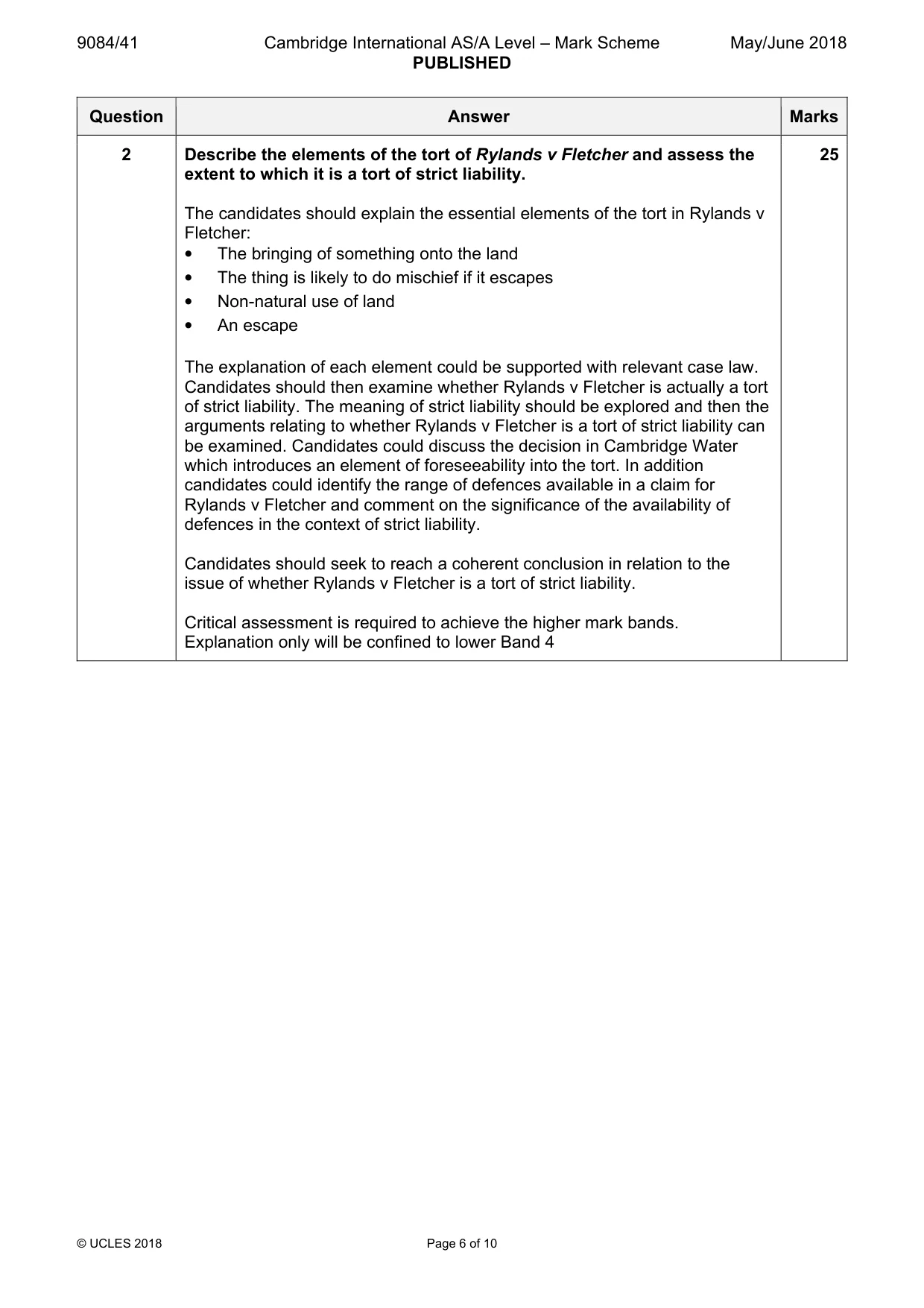
9084/41 Cambridge International AS/A Level – Mark Scheme PUBLISHED May/June 2018 © UCLES 2018 Page 6 of 10 Question Answer Marks 2 Describe the elements of the tort of Rylands v Fletcher and assess the extent to which it is a tort of strict liability. The candidates should explain the essential elements of the tort in Rylands v Fletcher: • The bringing of something onto the land • The thing is likely to do mischief if it escapes • Non-natural use of land • An escape The explanation of each element could be supported with relevant case law. Candidates should then examine whether Rylands v Fletcher is actually a tort of strict liability. The meaning of strict liability should be explored and then the arguments relating to whether Rylands v Fletcher is a tort of strict liability can be examined. Candidates could discuss the decision in Cambridge Water which introduces an element of foreseeability into the tort. In addition candidates could identify the range of defences available in a claim for Rylands v Fletcher and comment on the significance of the availability of defences in the context of strict liability. Candidates should seek to reach a coherent conclusion in relation to the issue of whether Rylands v Fletcher is a tort of strict liability. Critical assessment is required to achieve the higher mark bands. Explanation only will be confined to lower Band 4 25
Mark scheme, page 7
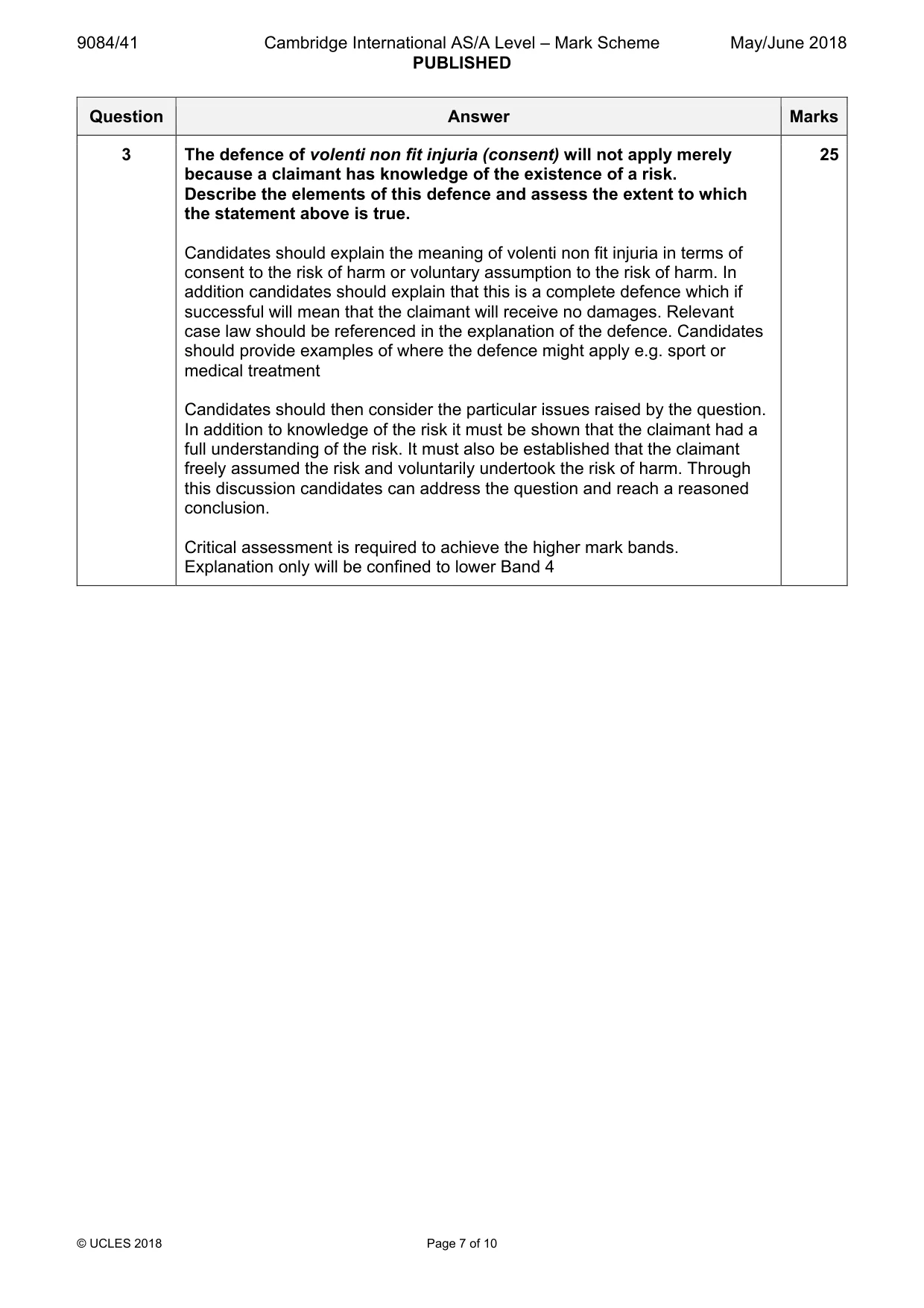
9084/41 Cambridge International AS/A Level – Mark Scheme PUBLISHED May/June 2018 © UCLES 2018 Page 7 of 10 Question Answer Marks 3 The defence of volenti non fit injuria (consent) will not apply merely because a claimant has knowledge of the existence of a risk. Describe the elements of this defence and assess the extent to which the statement above is true. Candidates should explain the meaning of volenti non fit injuria in terms of consent to the risk of harm or voluntary assumption to the risk of harm. In addition candidates should explain that this is a complete defence which if successful will mean that the claimant will receive no damages. Relevant case law should be referenced in the explanation of the defence. Candidates should provide examples of where the defence might apply e.g. sport or medical treatment Candidates should then consider the particular issues raised by the question. In addition to knowledge of the risk it must be shown that the claimant had a full understanding of the risk. It must also be established that the claimant freely assumed the risk and voluntarily undertook the risk of harm. Through this discussion candidates can address the question and reach a reasoned conclusion. Critical assessment is required to achieve the higher mark bands. Explanation only will be confined to lower Band 4 25
Mark scheme, page 8
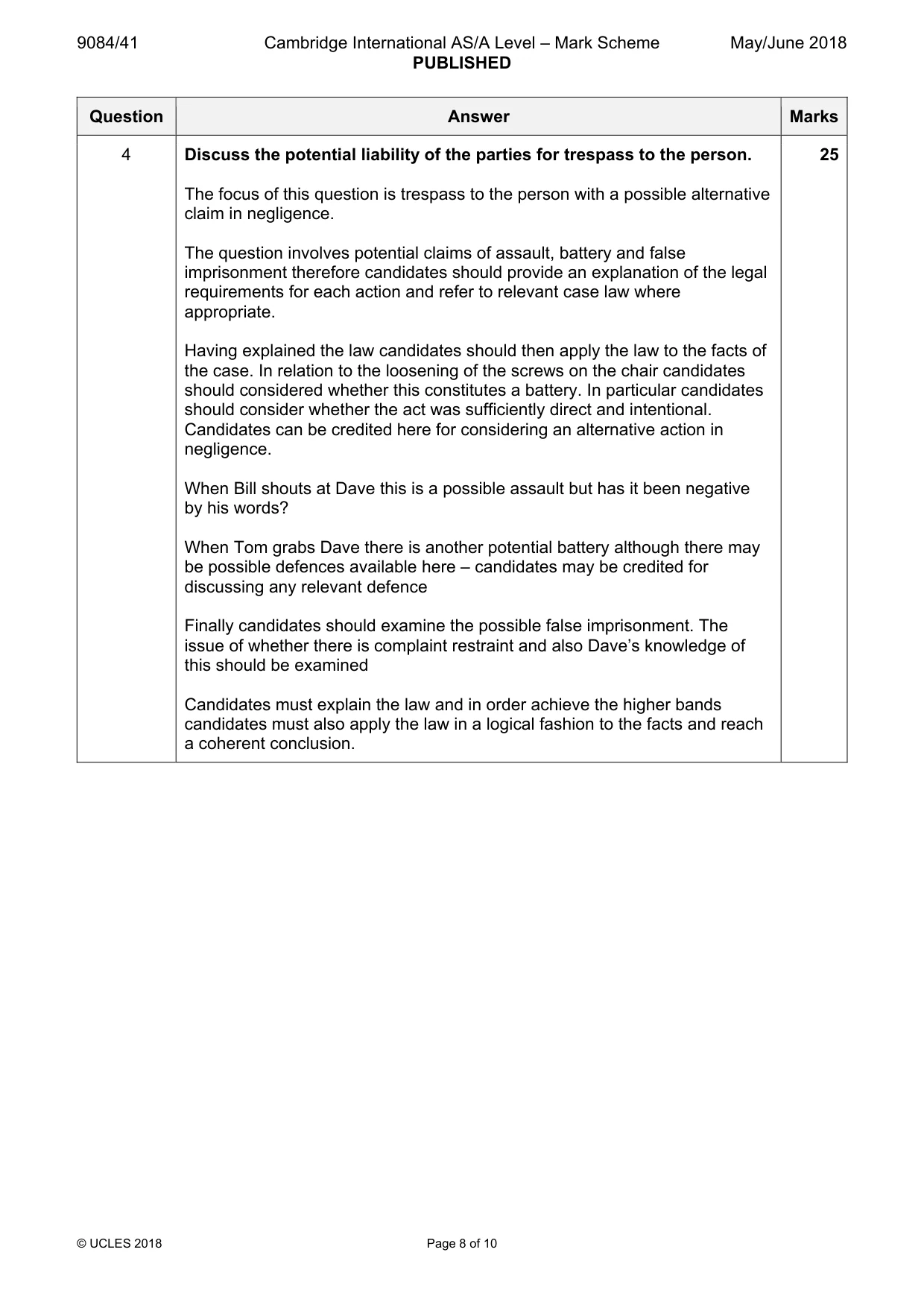
9084/41 Cambridge International AS/A Level – Mark Scheme PUBLISHED May/June 2018 © UCLES 2018 Page 8 of 10 Question Answer Marks 4 Discuss the potential liability of the parties for trespass to the person. The focus of this question is trespass to the person with a possible alternative claim in negligence. The question involves potential claims of assault, battery and false imprisonment therefore candidates should provide an explanation of the legal requirements for each action and refer to relevant case law where appropriate. Having explained the law candidates should then apply the law to the facts of the case. In relation to the loosening of the screws on the chair candidates should considered whether this constitutes a battery. In particular candidates should consider whether the act was sufficiently direct and intentional. Candidates can be credited here for considering an alternative action in negligence. When Bill shouts at Dave this is a possible assault but has it been negative by his words? When Tom grabs Dave there is another potential battery although there may be possible defences available here – candidates may be credited for discussing any relevant defence Finally candidates should examine the possible false imprisonment. The issue of whether there is complaint restraint and also Dave’s knowledge of this should be examined Candidates must explain the law and in order achieve the higher bands candidates must also apply the law in a logical fashion to the facts and reach a coherent conclusion. 25
Mark scheme, page 9
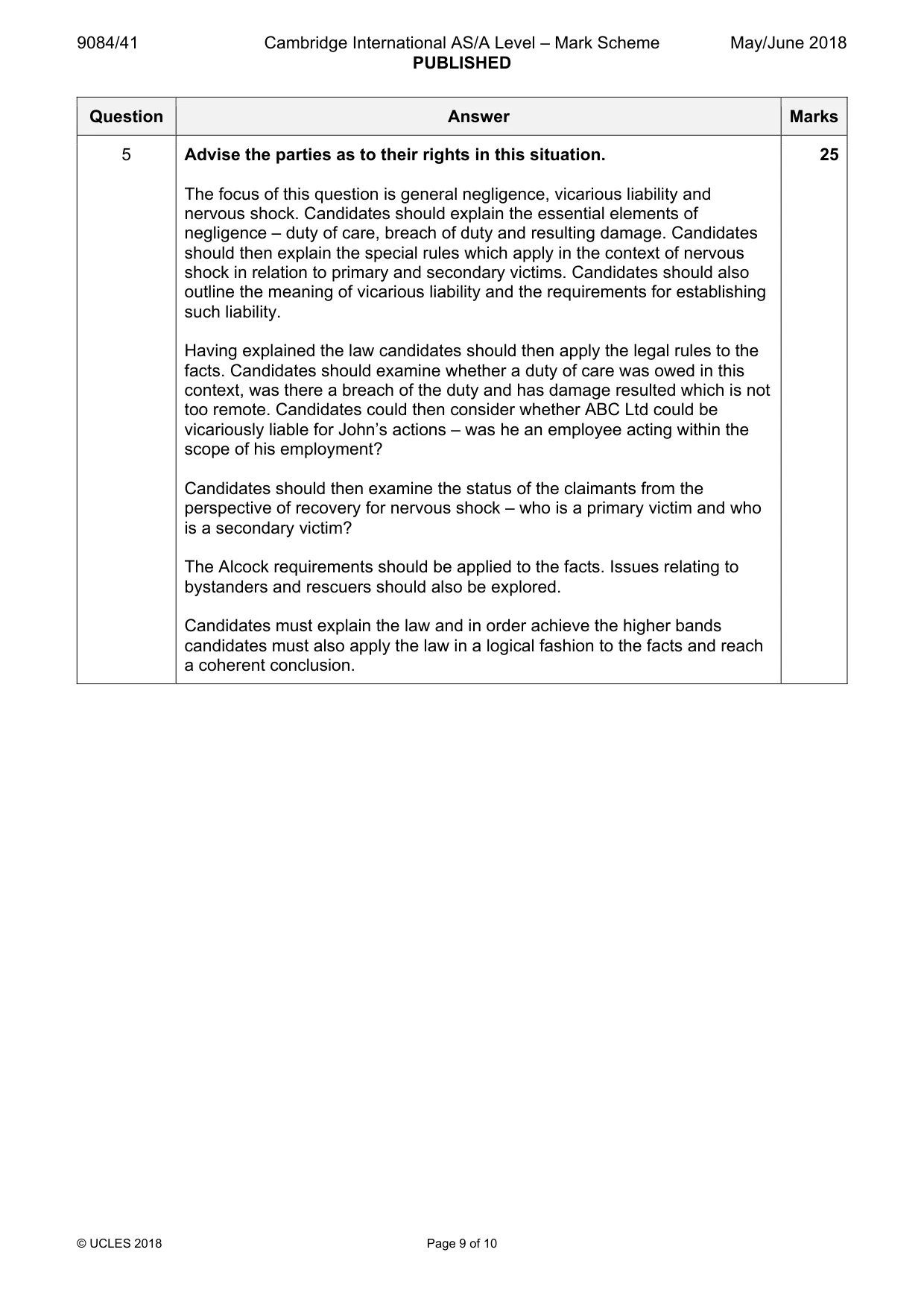
9084/41 Cambridge International AS/A Level – Mark Scheme PUBLISHED May/June 2018 © UCLES 2018 Page 9 of 10 Question Answer Marks 5 Advise the parties as to their rights in this situation. The focus of this question is general negligence, vicarious liability and nervous shock. Candidates should explain the essential elements of negligence – duty of care, breach of duty and resulting damage. Candidates should then explain the special rules which apply in the context of nervous shock in relation to primary and secondary victims. Candidates should also outline the meaning of vicarious liability and the requirements for establishing such liability. Having explained the law candidates should then apply the legal rules to the facts. Candidates should examine whether a duty of care was owed in this context, was there a breach of the duty and has damage resulted which is not too remote. Candidates could then consider whether ABC Ltd could be vicariously liable for John’s actions – was he an employee acting within the scope of his employment? Candidates should then examine the status of the claimants from the perspective of recovery for nervous shock – who is a primary victim and who is a secondary victim? The Alcock requirements should be applied to the facts. Issues relating to bystanders and rescuers should also be explored. Candidates must explain the law and in order achieve the higher bands candidates must also apply the law in a logical fashion to the facts and reach a coherent conclusion. 25
Mark scheme, page 10
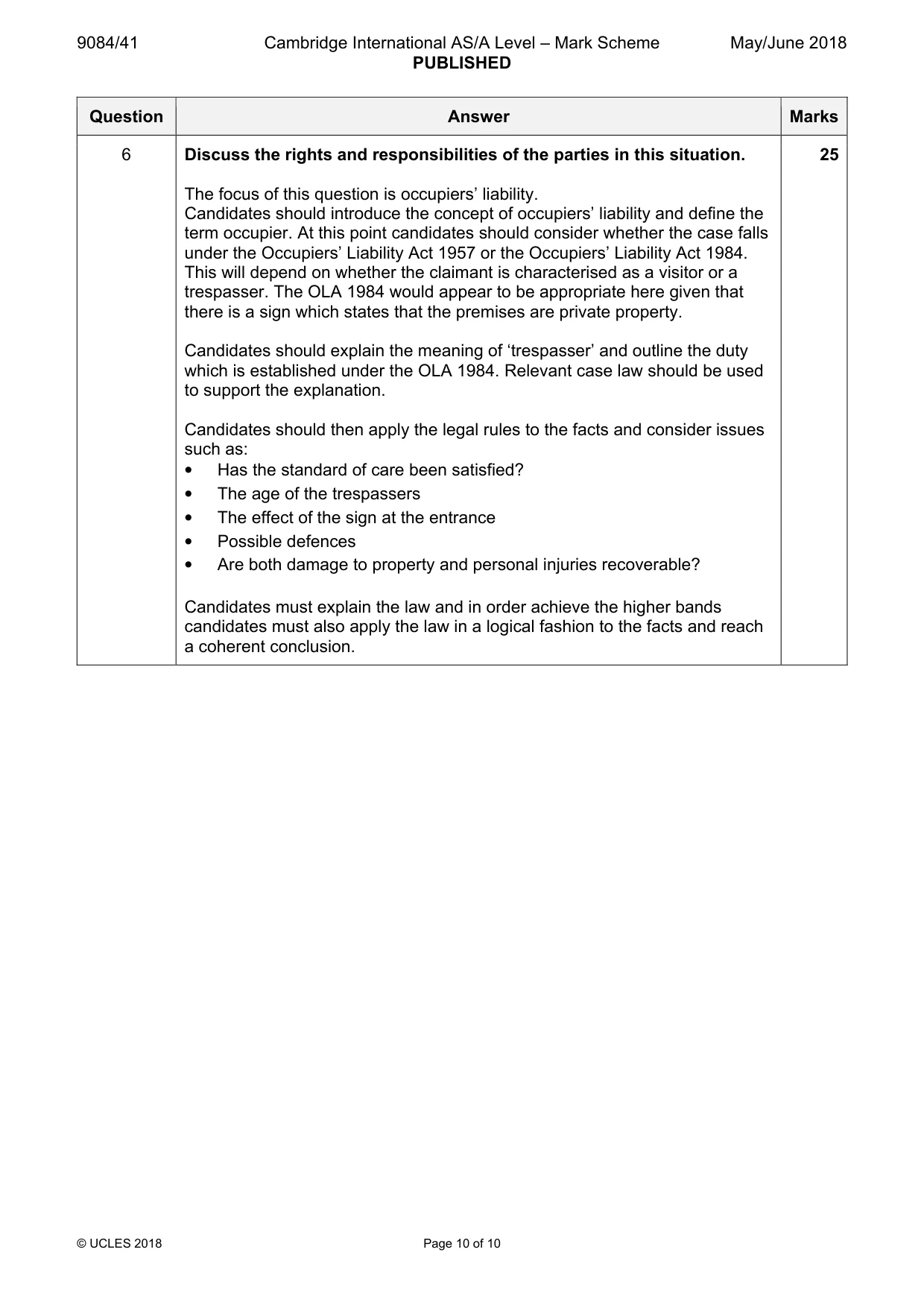
9084/41 Cambridge International AS/A Level – Mark Scheme PUBLISHED May/June 2018 © UCLES 2018 Page 10 of 10 Question Answer Marks 6 Discuss the rights and responsibilities of the parties in this situation. The focus of this question is occupiers’ liability. Candidates should introduce the concept of occupiers’ liability and define the term occupier. At this point candidates should consider whether the case falls under the Occupiers’ Liability Act 1957 or the Occupiers’ Liability Act 1984. This will depend on whether the claimant is characterised as a visitor or a trespasser. The OLA 1984 would appear to be appropriate here given that there is a sign which states that the premises are private property. Candidates should explain the meaning of ‘trespasser’ and outline the duty which is established under the OLA 1984. Relevant case law should be used to support the explanation. Candidates should then apply the legal rules to the facts and consider issues such as: • Has the standard of care been satisfied? • The age of the trespassers • The effect of the sign at the entrance • Possible defences • Are both damage to property and personal injuries recoverable? Candidates must explain the law and in order achieve the higher bands candidates must also apply the law in a logical fashion to the facts and reach a coherent conclusion. 25
What you needed in this session
Cambridge’s own grade thresholds for 2018 May/June, Paper 4 · Variant 1. A higher threshold means an easier paper — the bar moves with how the cohort did.