Cambridge A Level Law 9084 — 2014 Oct/Nov Paper 4 · Variant 1
9084/41/O/N/14 · 75 marks · ≈84 min
The question paper and its mark scheme, free to read here and free to download. This is Cambridge’s own paper, exactly as it was sat.
Question paper4 pages

Mark scheme8 pages
Answers below. Sit the paper first if you are practising.
Paper as text
Question paper, page 1
This document consists of 3 printed pages and 1 blank page. DC (NF) 81547/1 © UCLES 2014 [Turn over Cambridge International Examinations Cambridge International Advanced Level * 5 4 5 9 7 1 3 4 5 4 * LAW 9084/41 Paper 4 Law of Tort October/November 2014 1 hour 30 minutes Additional Materials: Answer Booklet/Paper READ THESE INSTRUCTIONS FIRST If you have been given an Answer Booklet, follow the instructions on the front cover of the Booklet. Write your Centre number, candidate number and name on all the work you hand in. Write in dark blue or black pen. Do not use staples, paper clips, glue or correction fluid. Answer one question from Section A, one from Section B and one other, thus making a total of three responses required. At the end of the examination, fasten all your work securely together. The number of marks is given in brackets [ ] at the end of each question or part question.
Question paper, page 2
2 9084/41/O/N/14 © UCLES 2014 Answer three questions, at least one of which must be from Section A and one from Section B. Section A 1 The distinction drawn between the primary and secondary victims suffering nervous shock as a consequence of negligence is unnecessary and unfair. Explain the distinction between the two types of victim and assess the validity of this statement. [25] 2 People are responsible for the consequences of their carelessness towards others. Examine the development and application of the remoteness of damage principle through case law. Discuss the extent to which you agree with this statement. [25] 3 Contributory negligence and volenti non fit injuria are so similar in nature and effect that it is unnecessary for both defences to exist. Critically analyse the defences and discuss the extent to which you agree with this statement. [25]
Question paper, page 3
3 9084/41/O/N/14 © UCLES 2014 Section B 4 Kennedy suffers from serious back problems and, having paid a visit to his local hospital, he is advised by Nicholls, a consultant surgeon, that it will require corrective surgery. He decides to undergo the operation. As a consequence of the operation carried out by Nicholls, Kennedy suffers paralysis in both legs and is unable to walk again; he consequently loses his job as a lorry driver which is his only source of income. Kennedy later discovers that paralysis was a known, slight risk with such operations to the back. He claims that Nicholls should have told him about the risk before he decided to undergo the surgery. Assess Nicholls’ potential liability in tort for the losses sustained by Kennedy. [25] 5 Petra builds a house on land that she owns. It is next to a lake which is used for recreational purposes. Petra is aware that the lake is used by the Quasar Water- and Jet-Ski Club (QC), but she believes that she will not be disturbed by the boats using the lake once she moves into the completed house. By the time the house is finished, QC’s activities have increased. The club now uses the lake on a daily basis, often up until ten o’clock at night. It has also started to use more powerful and noisier boats and jet-skis. Petra claims that these activities cause her severe headaches on a regular basis and she is unable to enjoy her garden at weekends. Petra has spoken to QC several times about the effects of the noise now that she lives in the new house, but her complaints have not been acted upon by the club. Assess QC’s liability towards Petra in the tort of private nuisance and consider any remedies that might be awarded against it should she decide to sue the club. [25] 6 While her children are at school, Sukhwinder visits the local nature reserve which is owned by Newtown Council. It is a very warm day and Sukhwinder decides to go for a swim in the ornamental pond located in the nature reserve. The Council has erected signs around it saying that swimming is prohibited and has planted lots of bushes around the water’s edge to make access difficult. Sukhwinder injures her head and neck badly when she dives into the shallow water. Assess the Council’s potential liability under the Occupier’s Liability Acts 1957 and 1984 for Sukhwinder’s injuries. Analyse whether or not any action that she might bring could be successfully defended. [25]
Question paper, page 4
4 9084/41/O/N/14 © UCLES 2014 BLANK PAGE Permission to reproduce items where third-party owned material protected by copyright is included has been sought and cleared where possible. Every reasonable effort has been made by the publisher (UCLES) to trace copyright holders, but if any items requiring clearance have unwittingly been included, the publisher will be pleased to make amends at the earliest possible opportunity. Cambridge International Examinations is part of the Cambridge Assessment Group. Cambridge Assessment is the brand name of University of Cambridge Local Examinations Syndicate (UCLES), which is itself a department of the University of Cambridge.
Mark scheme, page 1
® IGCSE is the registered trademark of Cambridge International Examinations. CAMBRIDGE INTERNATIONAL EXAMINATIONS Cambridge International Advanced Level MARK SCHEME for the October/November 2014 series 9084 LAW 9084/41 Paper 4, maximum raw mark 75 This mark scheme is published as an aid to teachers and candidates, to indicate the requirements of the examination. It shows the basis on which Examiners were instructed to award marks. It does not indicate the details of the discussions that took place at an Examiners’ meeting before marking began, which would have considered the acceptability of alternative answers. Mark schemes should be read in conjunction with the question paper and the Principal Examiner Report for Teachers. Cambridge will not enter into discussions about these mark schemes. Cambridge is publishing the mark schemes for the October/November 2014 series for most Cambridge IGCSE®, Cambridge International A and AS Level components and some Cambridge O Level components.
Mark scheme, page 2
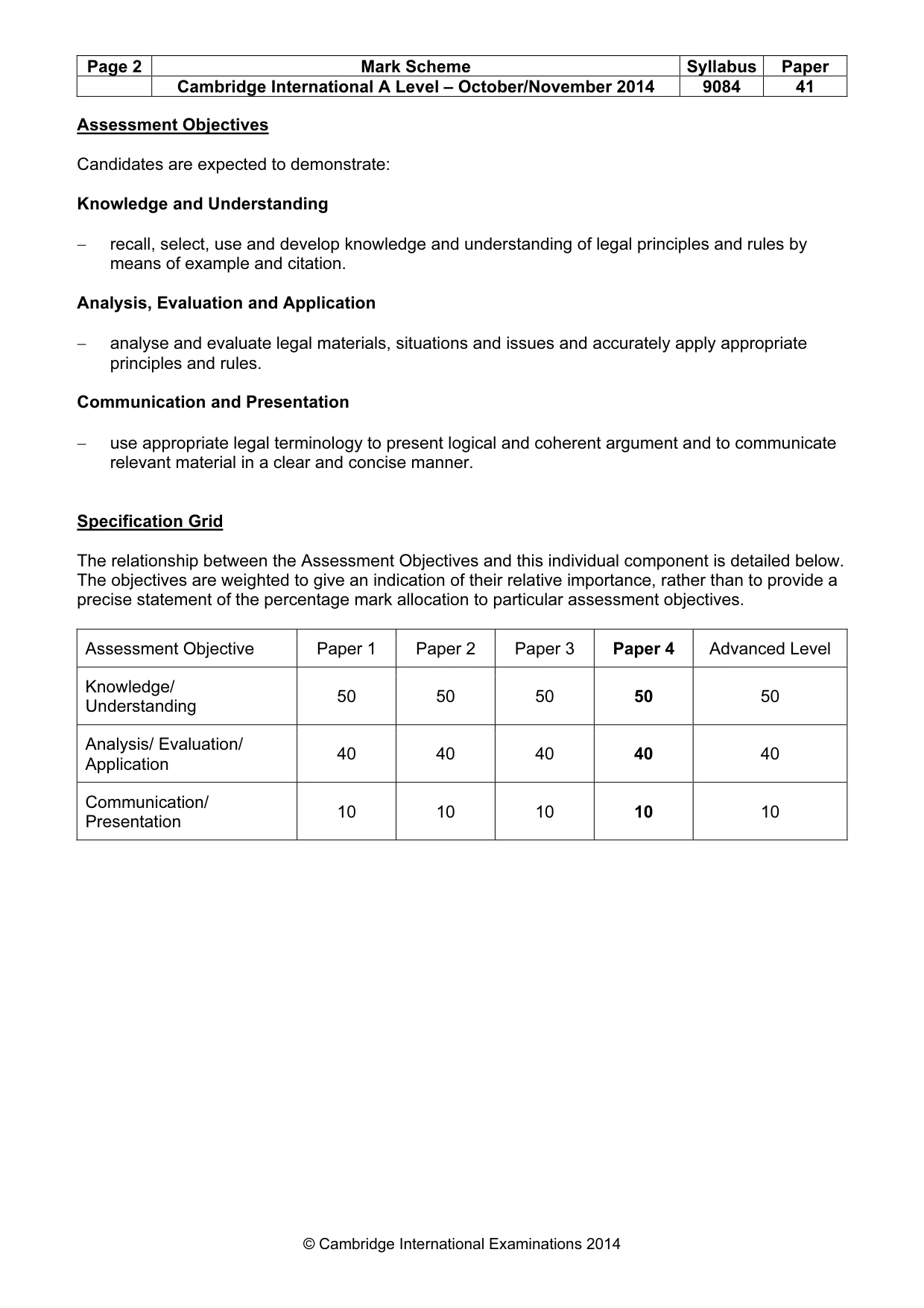
Page 2 Mark Scheme Syllabus Paper Cambridge International A Level – October/November 2014 9084 41 © Cambridge International Examinations 2014 Assessment Objectives Candidates are expected to demonstrate: Knowledge and Understanding − recall, select, use and develop knowledge and understanding of legal principles and rules by means of example and citation. Analysis, Evaluation and Application − analyse and evaluate legal materials, situations and issues and accurately apply appropriate principles and rules. Communication and Presentation − use appropriate legal terminology to present logical and coherent argument and to communicate relevant material in a clear and concise manner. Specification Grid The relationship between the Assessment Objectives and this individual component is detailed below. The objectives are weighted to give an indication of their relative importance, rather than to provide a precise statement of the percentage mark allocation to particular assessment objectives. Assessment Objective Paper 1 Paper 2 Paper 3 Paper 4 Advanced Level Knowledge/ Understanding 50 50 50 50 50 Analysis/ Evaluation/ Application 40 40 40 40 40 Communication/ Presentation 10 10 10 10 10
Mark scheme, page 3
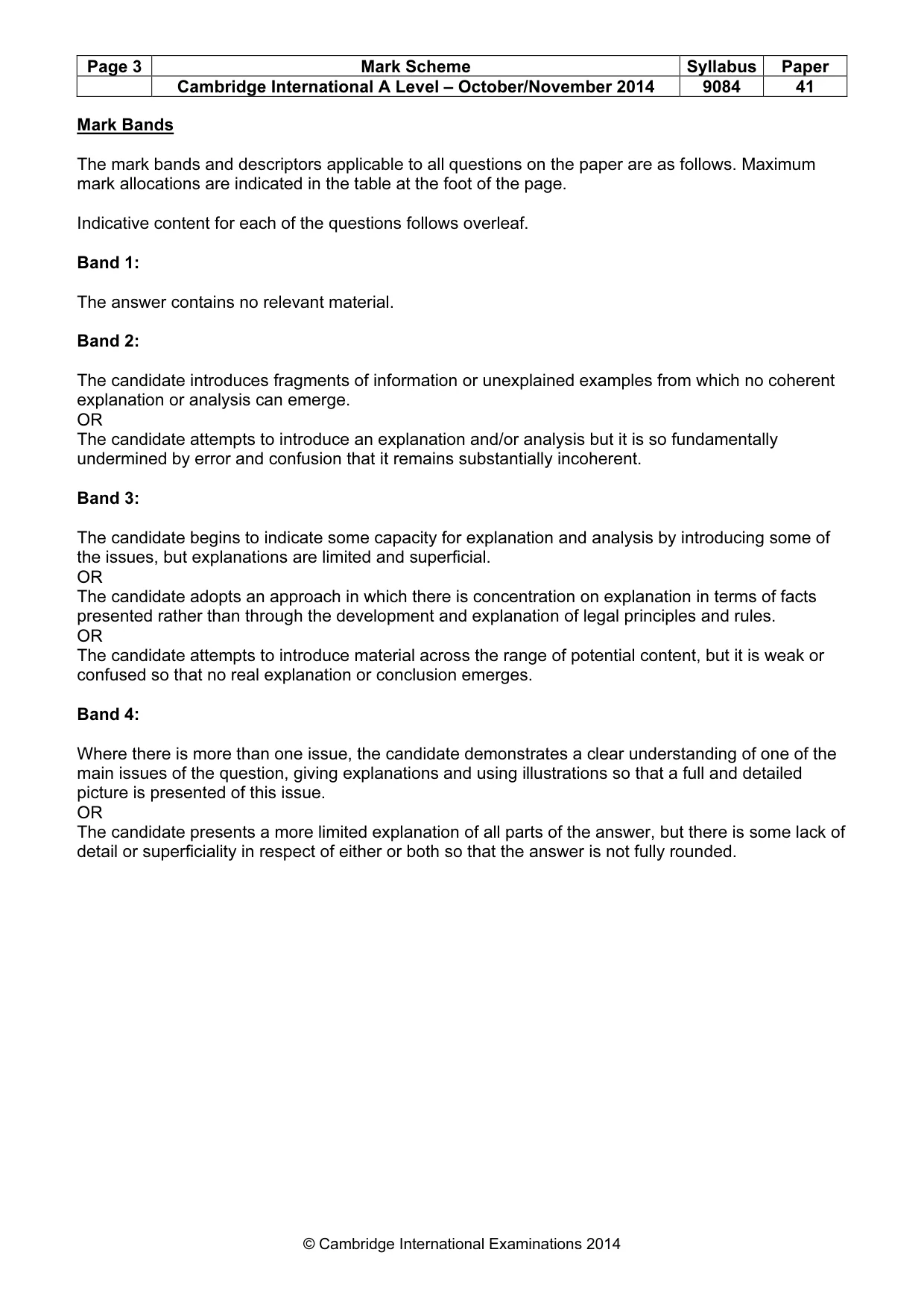
Page 3 Mark Scheme Syllabus Paper Cambridge International A Level – October/November 2014 9084 41 © Cambridge International Examinations 2014 Mark Bands The mark bands and descriptors applicable to all questions on the paper are as follows. Maximum mark allocations are indicated in the table at the foot of the page. Indicative content for each of the questions follows overleaf. Band 1: The answer contains no relevant material. Band 2: The candidate introduces fragments of information or unexplained examples from which no coherent explanation or analysis can emerge. OR The candidate attempts to introduce an explanation and/or analysis but it is so fundamentally undermined by error and confusion that it remains substantially incoherent. Band 3: The candidate begins to indicate some capacity for explanation and analysis by introducing some of the issues, but explanations are limited and superficial. OR The candidate adopts an approach in which there is concentration on explanation in terms of facts presented rather than through the development and explanation of legal principles and rules. OR The candidate attempts to introduce material across the range of potential content, but it is weak or confused so that no real explanation or conclusion emerges. Band 4: Where there is more than one issue, the candidate demonstrates a clear understanding of one of the main issues of the question, giving explanations and using illustrations so that a full and detailed picture is presented of this issue. OR The candidate presents a more limited explanation of all parts of the answer, but there is some lack of detail or superficiality in respect of either or both so that the answer is not fully rounded.
Mark scheme, page 4
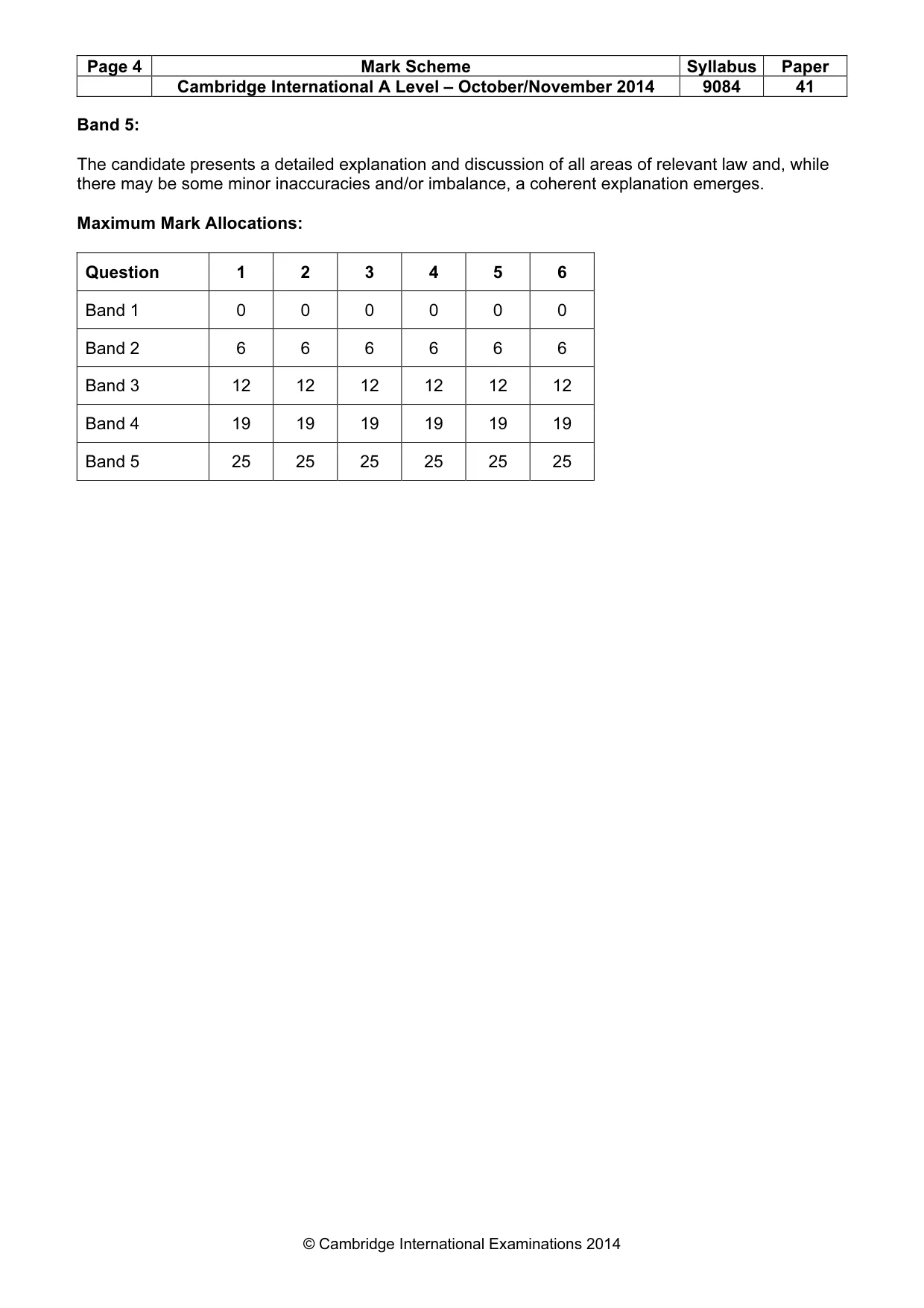
Page 4 Mark Scheme Syllabus Paper Cambridge International A Level – October/November 2014 9084 41 © Cambridge International Examinations 2014 Band 5: The candidate presents a detailed explanation and discussion of all areas of relevant law and, while there may be some minor inaccuracies and/or imbalance, a coherent explanation emerges. Maximum Mark Allocations: Question 1 2 3 4 5 6 Band 1 0 0 0 0 0 0 Band 2 6 6 6 6 6 6 Band 3 12 12 12 12 12 12 Band 4 19 19 19 19 19 19 Band 5 25 25 25 25 25 25
Mark scheme, page 5
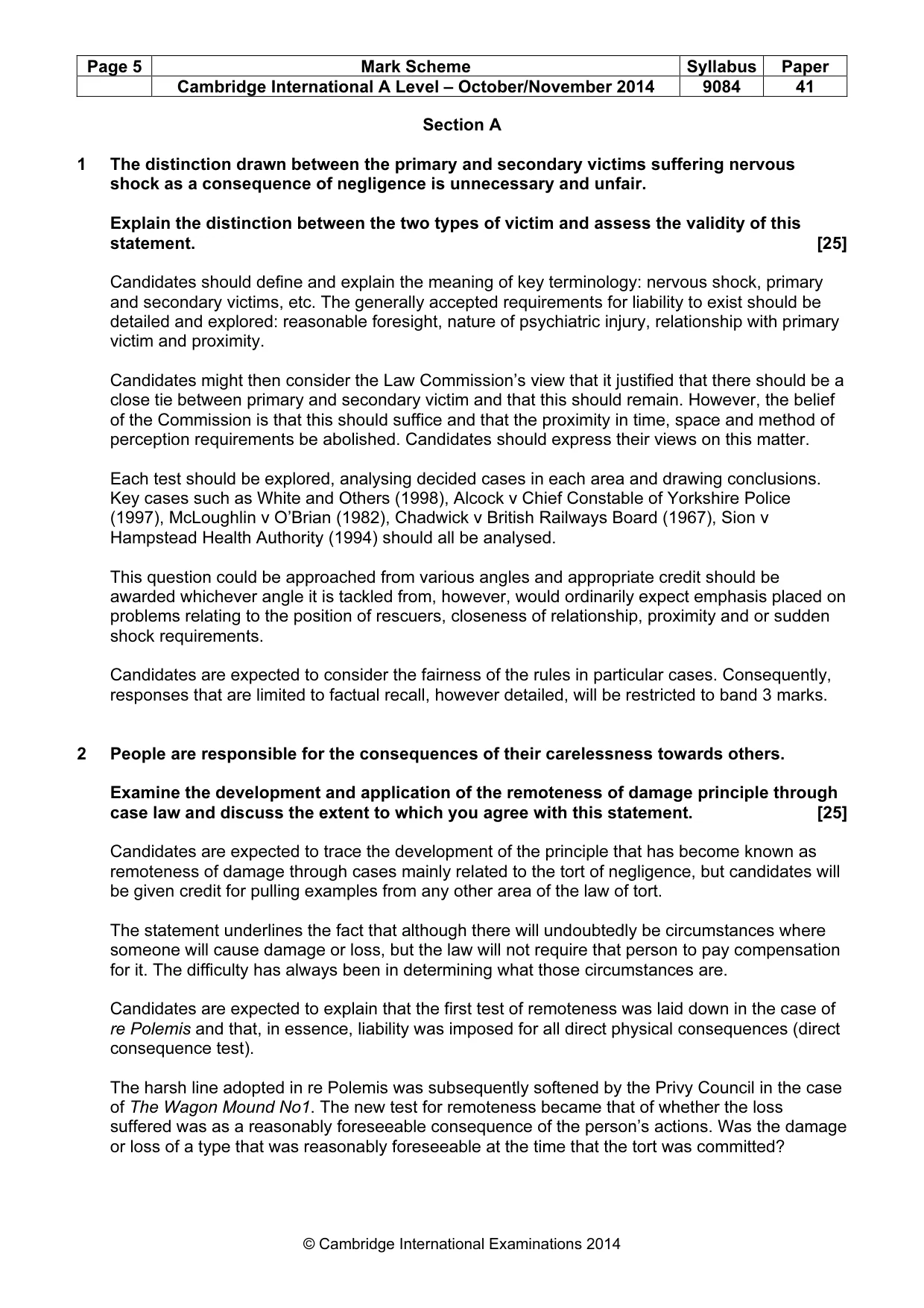
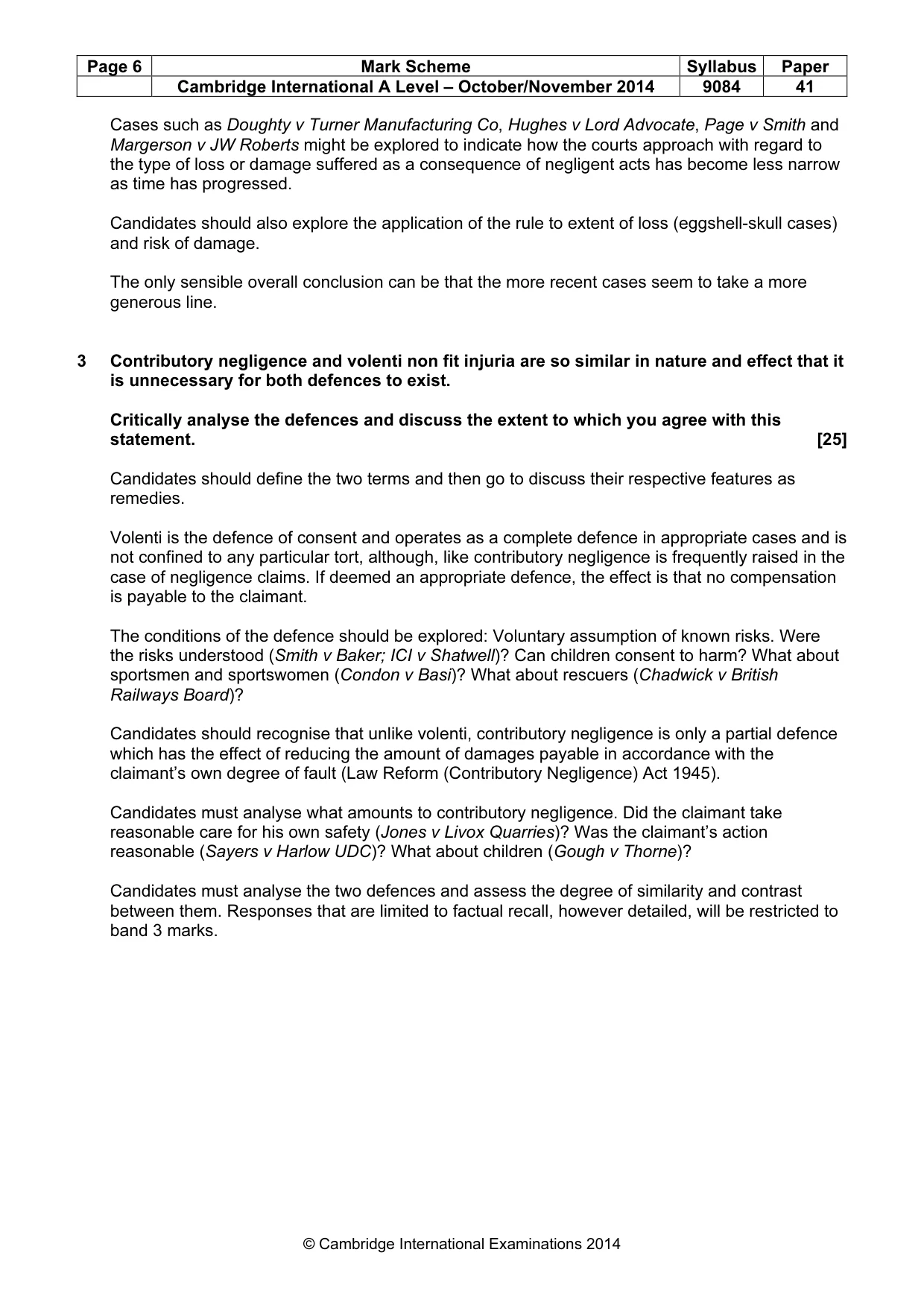
Page 5 Mark Scheme Syllabus Paper Cambridge International A Level – October/November 2014 9084 41 © Cambridge International Examinations 2014 Section A 1 The distinction drawn between the primary and secondary victims suffering nervous shock as a consequence of negligence is unnecessary and unfair. Explain the distinction between the two types of victim and assess the validity of this statement. [25] Candidates should define and explain the meaning of key terminology: nervous shock, primary and secondary victims, etc. The generally accepted requirements for liability to exist should be detailed and explored: reasonable foresight, nature of psychiatric injury, relationship with primary victim and proximity. Candidates might then consider the Law Commission’s view that it justified that there should be a close tie between primary and secondary victim and that this should remain. However, the belief of the Commission is that this should suffice and that the proximity in time, space and method of perception requirements be abolished. Candidates should express their views on this matter. Each test should be explored, analysing decided cases in each area and drawing conclusions. Key cases such as White and Others (1998), Alcock v Chief Constable of Yorkshire Police (1997), McLoughlin v O’Brian (1982), Chadwick v British Railways Board (1967), Sion v Hampstead Health Authority (1994) should all be analysed. This question could be approached from various angles and appropriate credit should be awarded whichever angle it is tackled from, however, would ordinarily expect emphasis placed on problems relating to the position of rescuers, closeness of relationship, proximity and or sudden shock requirements. Candidates are expected to consider the fairness of the rules in particular cases. Consequently, responses that are limited to factual recall, however detailed, will be restricted to band 3 marks. 2 People are responsible for the consequences of their carelessness towards others. Examine the development and application of the remoteness of damage principle through case law and discuss the extent to which you agree with this statement. [25] Candidates are expected to trace the development of the principle that has become known as remoteness of damage through cases mainly related to the tort of negligence, but candidates will be given credit for pulling examples from any other area of the law of tort. The statement underlines the fact that although there will undoubtedly be circumstances where someone will cause damage or loss, but the law will not require that person to pay compensation for it. The difficulty has always been in determining what those circumstances are. Candidates are expected to explain that the first test of remoteness was laid down in the case of re Polemis and that, in essence, liability was imposed for all direct physical consequences (direct consequence test). The harsh line adopted in re Polemis was subsequently softened by the Privy Council in the case of The Wagon Mound No1. The new test for remoteness became that of whether the loss suffered was as a reasonably foreseeable consequence of the person’s actions. Was the damage or loss of a type that was reasonably foreseeable at the time that the tort was committed?
Mark scheme, page 6
Page 6 Mark Scheme Syllabus Paper Cambridge International A Level – October/November 2014 9084 41 © Cambridge International Examinations 2014 Cases such as Doughty v Turner Manufacturing Co, Hughes v Lord Advocate, Page v Smith and Margerson v JW Roberts might be explored to indicate how the courts approach with regard to the type of loss or damage suffered as a consequence of negligent acts has become less narrow as time has progressed. Candidates should also explore the application of the rule to extent of loss (eggshell-skull cases) and risk of damage. The only sensible overall conclusion can be that the more recent cases seem to take a more generous line. 3 Contributory negligence and volenti non fit injuria are so similar in nature and effect that it is unnecessary for both defences to exist. Critically analyse the defences and discuss the extent to which you agree with this statement. [25] Candidates should define the two terms and then go to discuss their respective features as remedies. Volenti is the defence of consent and operates as a complete defence in appropriate cases and is not confined to any particular tort, although, like contributory negligence is frequently raised in the case of negligence claims. If deemed an appropriate defence, the effect is that no compensation is payable to the claimant. The conditions of the defence should be explored: Voluntary assumption of known risks. Were the risks understood (Smith v Baker; ICI v Shatwell)? Can children consent to harm? What about sportsmen and sportswomen (Condon v Basi)? What about rescuers (Chadwick v British Railways Board)? Candidates should recognise that unlike volenti, contributory negligence is only a partial defence which has the effect of reducing the amount of damages payable in accordance with the claimant’s own degree of fault (Law Reform (Contributory Negligence) Act 1945). Candidates must analyse what amounts to contributory negligence. Did the claimant take reasonable care for his own safety (Jones v Livox Quarries)? Was the claimant’s action reasonable (Sayers v Harlow UDC)? What about children (Gough v Thorne)? Candidates must analyse the two defences and assess the degree of similarity and contrast between them. Responses that are limited to factual recall, however detailed, will be restricted to band 3 marks.
Mark scheme, page 7
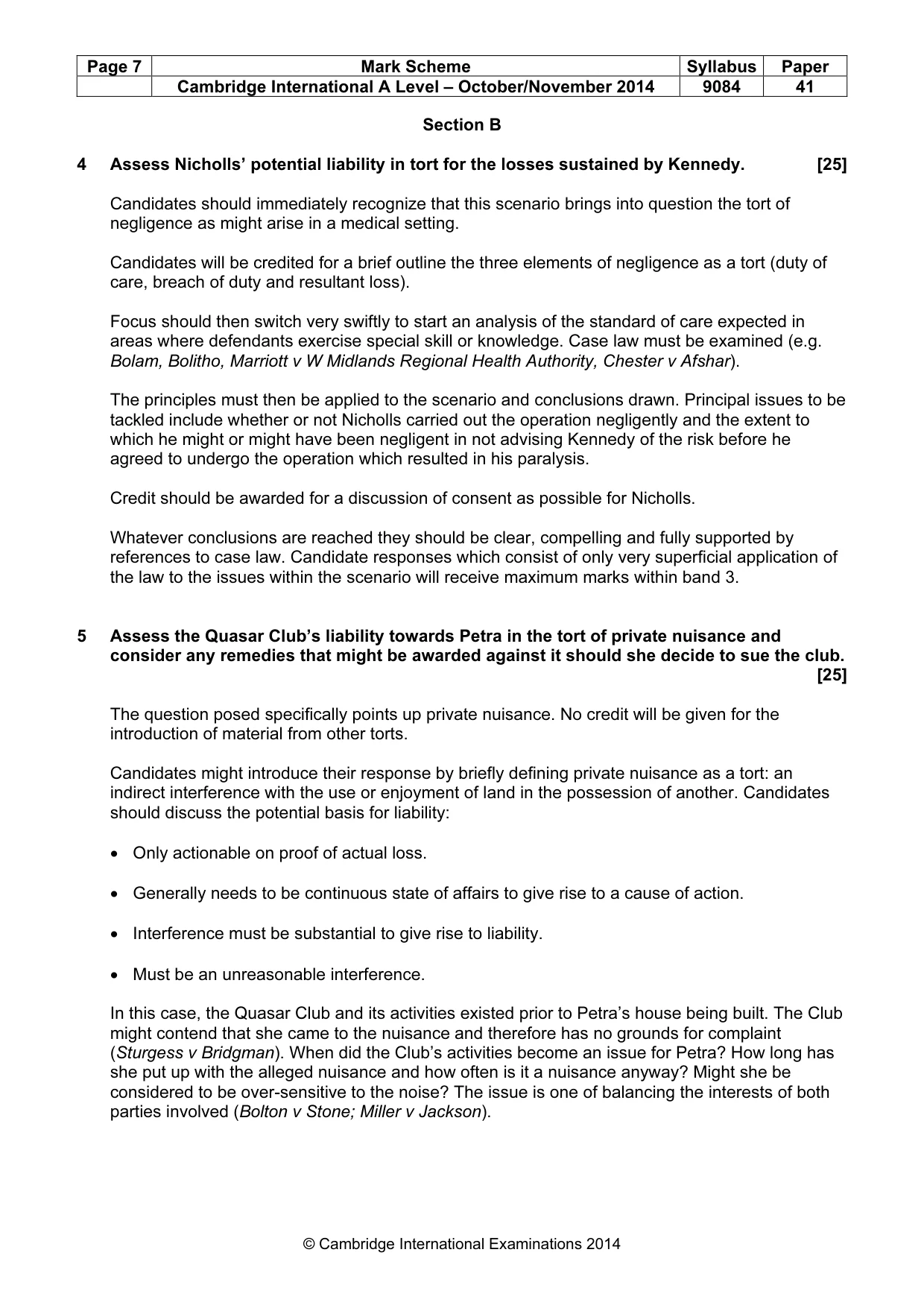
Page 7 Mark Scheme Syllabus Paper Cambridge International A Level – October/November 2014 9084 41 © Cambridge International Examinations 2014 Section B 4 Assess Nicholls’ potential liability in tort for the losses sustained by Kennedy. [25] Candidates should immediately recognize that this scenario brings into question the tort of negligence as might arise in a medical setting. Candidates will be credited for a brief outline the three elements of negligence as a tort (duty of care, breach of duty and resultant loss). Focus should then switch very swiftly to start an analysis of the standard of care expected in areas where defendants exercise special skill or knowledge. Case law must be examined (e.g. Bolam, Bolitho, Marriott v W Midlands Regional Health Authority, Chester v Afshar). The principles must then be applied to the scenario and conclusions drawn. Principal issues to be tackled include whether or not Nicholls carried out the operation negligently and the extent to which he might or might have been negligent in not advising Kennedy of the risk before he agreed to undergo the operation which resulted in his paralysis. Credit should be awarded for a discussion of consent as possible for Nicholls. Whatever conclusions are reached they should be clear, compelling and fully supported by references to case law. Candidate responses which consist of only very superficial application of the law to the issues within the scenario will receive maximum marks within band 3. 5 Assess the Quasar Club’s liability towards Petra in the tort of private nuisance and consider any remedies that might be awarded against it should she decide to sue the club. [25] The question posed specifically points up private nuisance. No credit will be given for the introduction of material from other torts. Candidates might introduce their response by briefly defining private nuisance as a tort: an indirect interference with the use or enjoyment of land in the possession of another. Candidates should discuss the potential basis for liability: • Only actionable on proof of actual loss. • Generally needs to be continuous state of affairs to give rise to a cause of action. • Interference must be substantial to give rise to liability. • Must be an unreasonable interference. In this case, the Quasar Club and its activities existed prior to Petra’s house being built. The Club might contend that she came to the nuisance and therefore has no grounds for complaint (Sturgess v Bridgman). When did the Club’s activities become an issue for Petra? How long has she put up with the alleged nuisance and how often is it a nuisance anyway? Might she be considered to be over-sensitive to the noise? The issue is one of balancing the interests of both parties involved (Bolton v Stone; Miller v Jackson).
Mark scheme, page 8
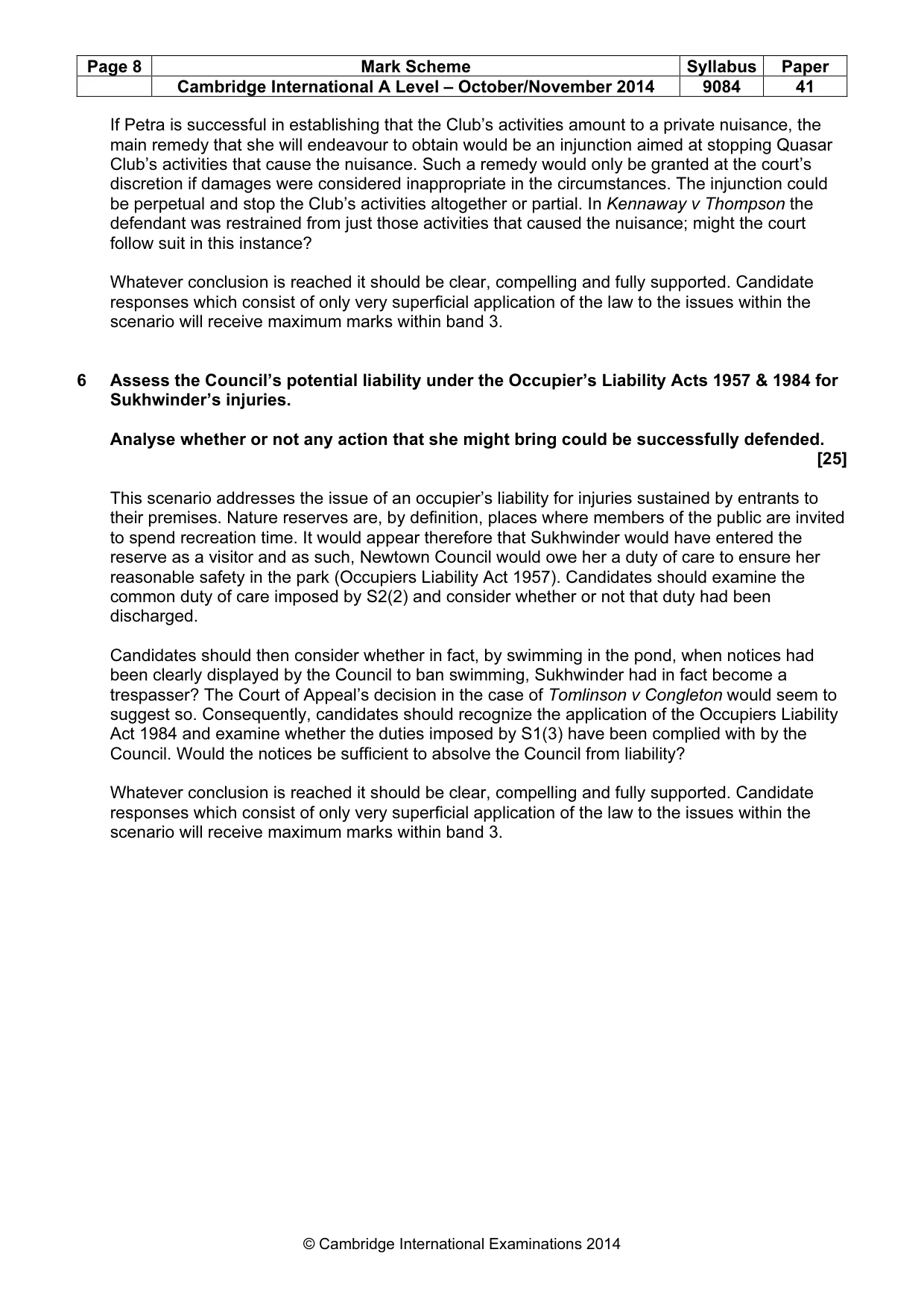
Page 8 Mark Scheme Syllabus Paper Cambridge International A Level – October/November 2014 9084 41 © Cambridge International Examinations 2014 If Petra is successful in establishing that the Club’s activities amount to a private nuisance, the main remedy that she will endeavour to obtain would be an injunction aimed at stopping Quasar Club’s activities that cause the nuisance. Such a remedy would only be granted at the court’s discretion if damages were considered inappropriate in the circumstances. The injunction could be perpetual and stop the Club’s activities altogether or partial. In Kennaway v Thompson the defendant was restrained from just those activities that caused the nuisance; might the court follow suit in this instance? Whatever conclusion is reached it should be clear, compelling and fully supported. Candidate responses which consist of only very superficial application of the law to the issues within the scenario will receive maximum marks within band 3. 6 Assess the Council’s potential liability under the Occupier’s Liability Acts 1957 & 1984 for Sukhwinder’s injuries. Analyse whether or not any action that she might bring could be successfully defended. [25] This scenario addresses the issue of an occupier’s liability for injuries sustained by entrants to their premises. Nature reserves are, by definition, places where members of the public are invited to spend recreation time. It would appear therefore that Sukhwinder would have entered the reserve as a visitor and as such, Newtown Council would owe her a duty of care to ensure her reasonable safety in the park (Occupiers Liability Act 1957). Candidates should examine the common duty of care imposed by S2(2) and consider whether or not that duty had been discharged. Candidates should then consider whether in fact, by swimming in the pond, when notices had been clearly displayed by the Council to ban swimming, Sukhwinder had in fact become a trespasser? The Court of Appeal’s decision in the case of Tomlinson v Congleton would seem to suggest so. Consequently, candidates should recognize the application of the Occupiers Liability Act 1984 and examine whether the duties imposed by S1(3) have been complied with by the Council. Would the notices be sufficient to absolve the Council from liability? Whatever conclusion is reached it should be clear, compelling and fully supported. Candidate responses which consist of only very superficial application of the law to the issues within the scenario will receive maximum marks within band 3.
What you needed in this session
Cambridge’s own grade thresholds for 2014 Oct/Nov, Paper 4 · Variant 1. A higher threshold means an easier paper — the bar moves with how the cohort did.