Cambridge A Level Law 9084 — 2013 May/June Paper 4 · Variant 2
9084/42/M/J/13 · 75 marks · ≈84 min
The question paper and its mark scheme, free to read here and free to download. This is Cambridge’s own paper, exactly as it was sat.
Question paper4 pages
Mark scheme8 pages
Answers below. Sit the paper first if you are practising.
Paper as text
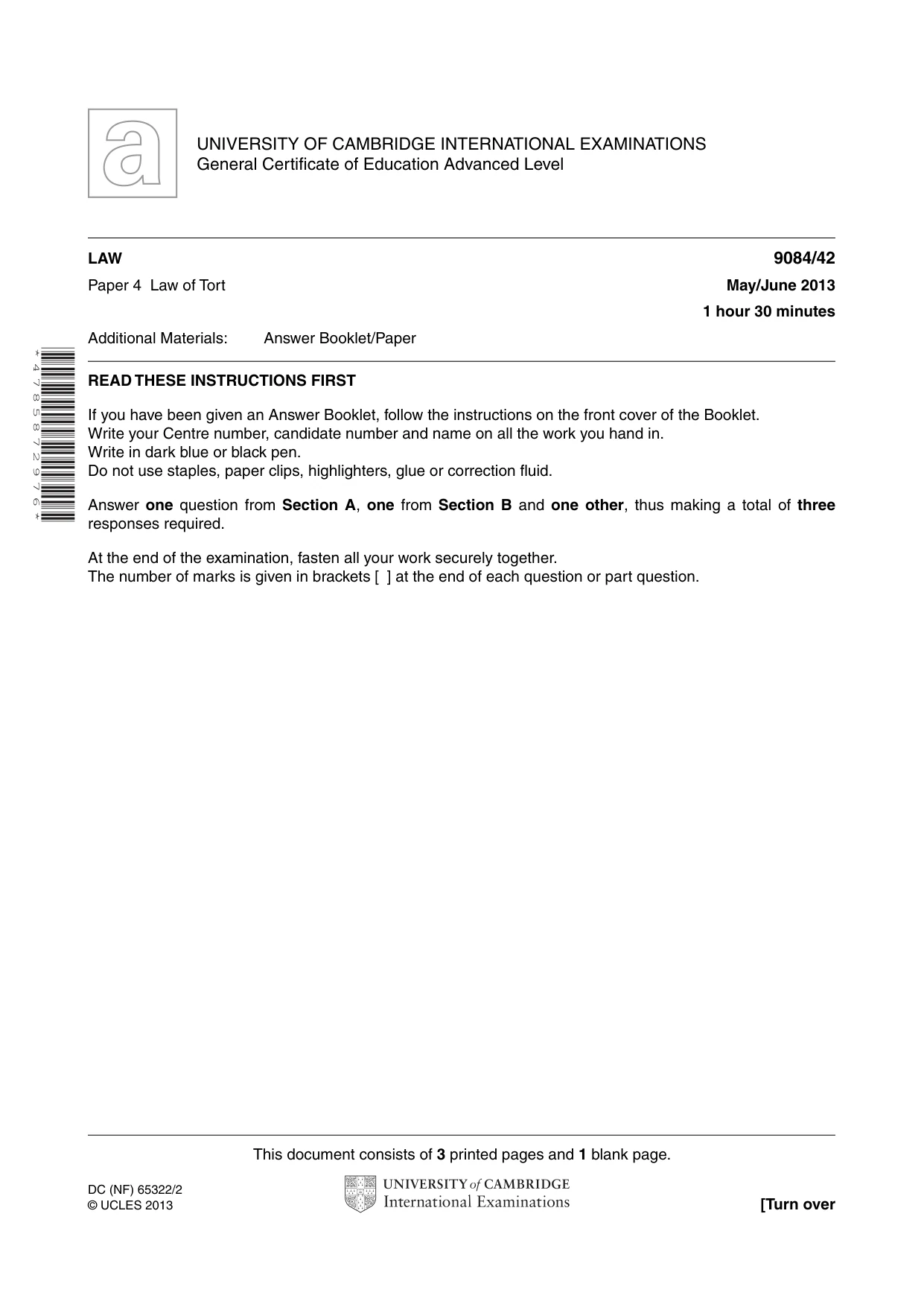
Question paper, page 1
This document consists of 3 printed pages and 1 blank page. DC (NF) 65322/2 © UCLES 2013 [Turn over UNIVERSITY OF CAMBRIDGE INTERNATIONAL EXAMINATIONS General Certificate of Education Advanced Level * 4 7 8 5 8 7 2 9 7 6 * LAW 9084/42 Paper 4 Law of Tort May/June 2013 1 hour 30 minutes Additional Materials: Answer Booklet/Paper READ THESE INSTRUCTIONS FIRST If you have been given an Answer Booklet, follow the instructions on the front cover of the Booklet. Write your Centre number, candidate number and name on all the work you hand in. Write in dark blue or black pen. Do not use staples, paper clips, highlighters, glue or correction fluid. Answer one question from Section A, one from Section B and one other, thus making a total of three responses required. At the end of the examination, fasten all your work securely together. The number of marks is given in brackets [ ] at the end of each question or part question.
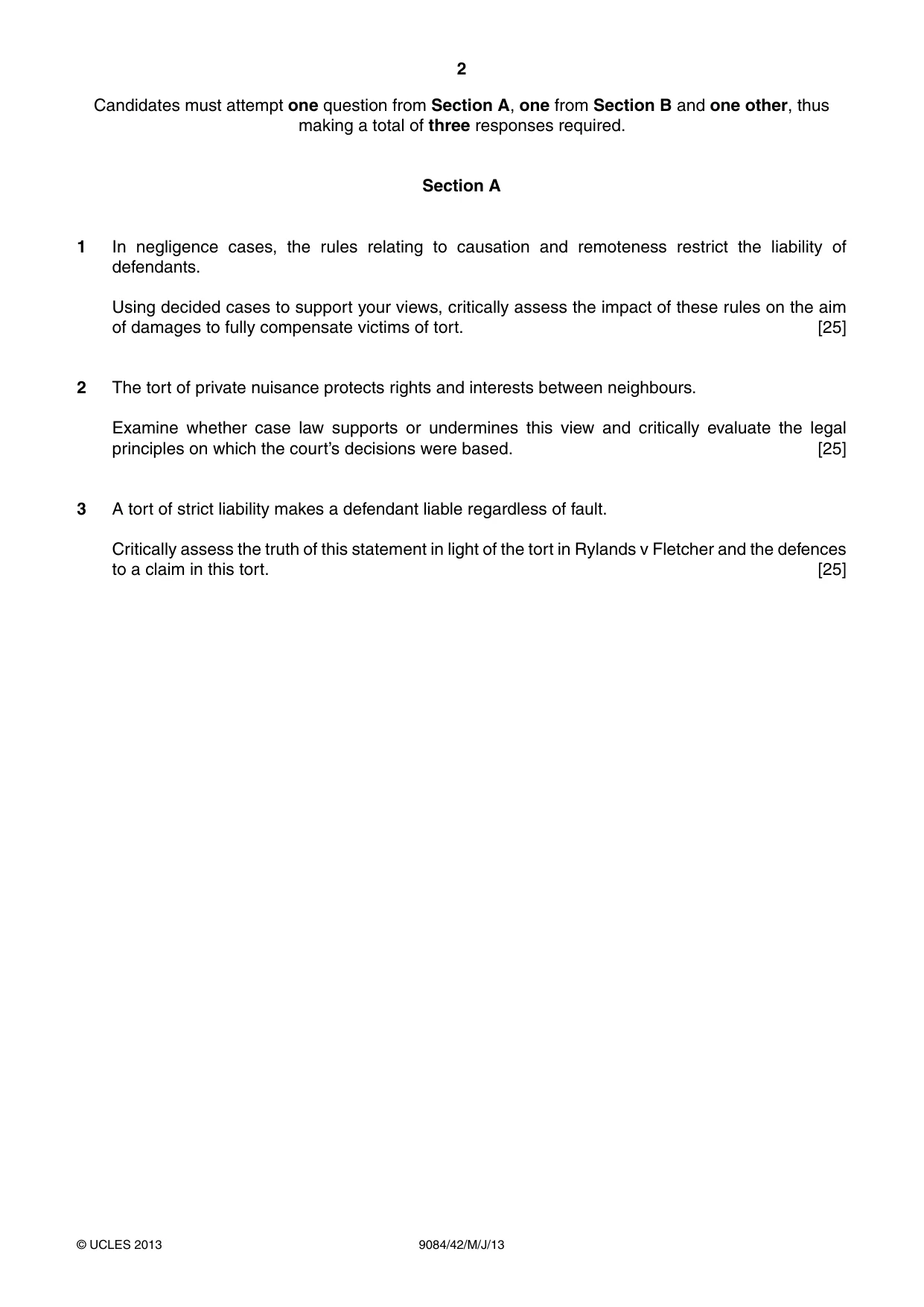
Question paper, page 2
2 9084/42/M/J/13 © UCLES 2013 Candidates must attempt one question from Section A, one from Section B and one other, thus making a total of three responses required. Section A 1 In negligence cases, the rules relating to causation and remoteness restrict the liability of defendants. Using decided cases to support your views, critically assess the impact of these rules on the aim of damages to fully compensate victims of tort. [25] 2 The tort of private nuisance protects rights and interests between neighbours. Examine whether case law supports or undermines this view and critically evaluate the legal principles on which the court’s decisions were based. [25] 3 A tort of strict liability makes a defendant liable regardless of fault. Critically assess the truth of this statement in light of the tort in Rylands v Fletcher and the defences to a claim in this tort. [25]
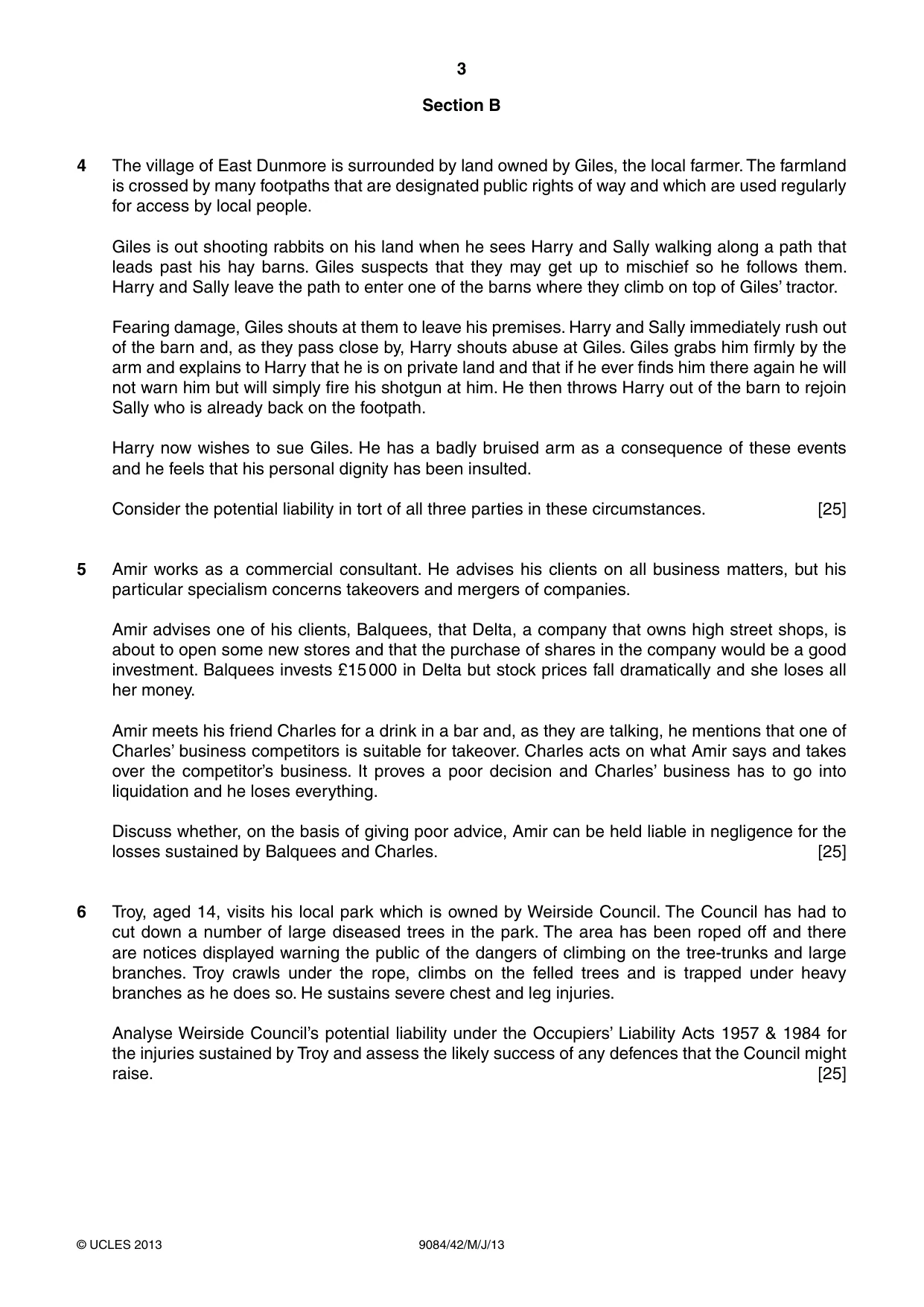
Question paper, page 3
3 9084/42/M/J/13 © UCLES 2013 Section B 4 The village of East Dunmore is surrounded by land owned by Giles, the local farmer. The farmland is crossed by many footpaths that are designated public rights of way and which are used regularly for access by local people. Giles is out shooting rabbits on his land when he sees Harry and Sally walking along a path that leads past his hay barns. Giles suspects that they may get up to mischief so he follows them. Harry and Sally leave the path to enter one of the barns where they climb on top of Giles’ tractor. Fearing damage, Giles shouts at them to leave his premises. Harry and Sally immediately rush out of the barn and, as they pass close by, Harry shouts abuse at Giles. Giles grabs him firmly by the arm and explains to Harry that he is on private land and that if he ever finds him there again he will not warn him but will simply fire his shotgun at him. He then throws Harry out of the barn to rejoin Sally who is already back on the footpath. Harry now wishes to sue Giles. He has a badly bruised arm as a consequence of these events and he feels that his personal dignity has been insulted. Consider the potential liability in tort of all three parties in these circumstances. [25] 5 Amir works as a commercial consultant. He advises his clients on all business matters, but his particular specialism concerns takeovers and mergers of companies. Amir advises one of his clients, Balquees, that Delta, a company that owns high street shops, is about to open some new stores and that the purchase of shares in the company would be a good investment. Balquees invests £15 000 in Delta but stock prices fall dramatically and she loses all her money. Amir meets his friend Charles for a drink in a bar and, as they are talking, he mentions that one of Charles’ business competitors is suitable for takeover. Charles acts on what Amir says and takes over the competitor’s business. It proves a poor decision and Charles’ business has to go into liquidation and he loses everything. Discuss whether, on the basis of giving poor advice, Amir can be held liable in negligence for the losses sustained by Balquees and Charles. [25] 6 Troy, aged 14, visits his local park which is owned by Weirside Council. The Council has had to cut down a number of large diseased trees in the park. The area has been roped off and there are notices displayed warning the public of the dangers of climbing on the tree-trunks and large branches. Troy crawls under the rope, climbs on the felled trees and is trapped under heavy branches as he does so. He sustains severe chest and leg injuries. Analyse Weirside Council’s potential liability under the Occupiers’ Liability Acts 1957 & 1984 for the injuries sustained by Troy and assess the likely success of any defences that the Council might raise. [25]
Question paper, page 4
4 9084/42/M/J/13 © UCLES 2013 BLANK PAGE Permission to reproduce items where third-party owned material protected by copyright is included has been sought and cleared where possible. Every reasonable effort has been made by the publisher (UCLES) to trace copyright holders, but if any items requiring clearance have unwittingly been included, the publisher will be pleased to make amends at the earliest possible opportunity. University of Cambridge International Examinations is part of the Cambridge Assessment Group. Cambridge Assessment is the brand name of University of Cambridge Local Examinations Syndicate (UCLES), which is itself a department of the University of Cambridge.
Mark scheme, page 1
CAMBRIDGE INTERNATIONAL EXAMINATIONS GCE Advanced Level MARK SCHEME for the May/June 2013 series 9084 LAW 9084/42 Paper 4, maximum raw mark 75 This mark scheme is published as an aid to teachers and candidates, to indicate the requirements of the examination. It shows the basis on which Examiners were instructed to award marks. It does not indicate the details of the discussions that took place at an Examiners’ meeting before marking began, which would have considered the acceptability of alternative answers. Mark schemes should be read in conjunction with the question paper and the Principal Examiner Report for Teachers. Cambridge will not enter into discussions about these mark schemes. Cambridge is publishing the mark schemes for the May/June 2013 series for most IGCSE, GCE Advanced Level and Advanced Subsidiary Level components and some Ordinary Level components.
Mark scheme, page 2
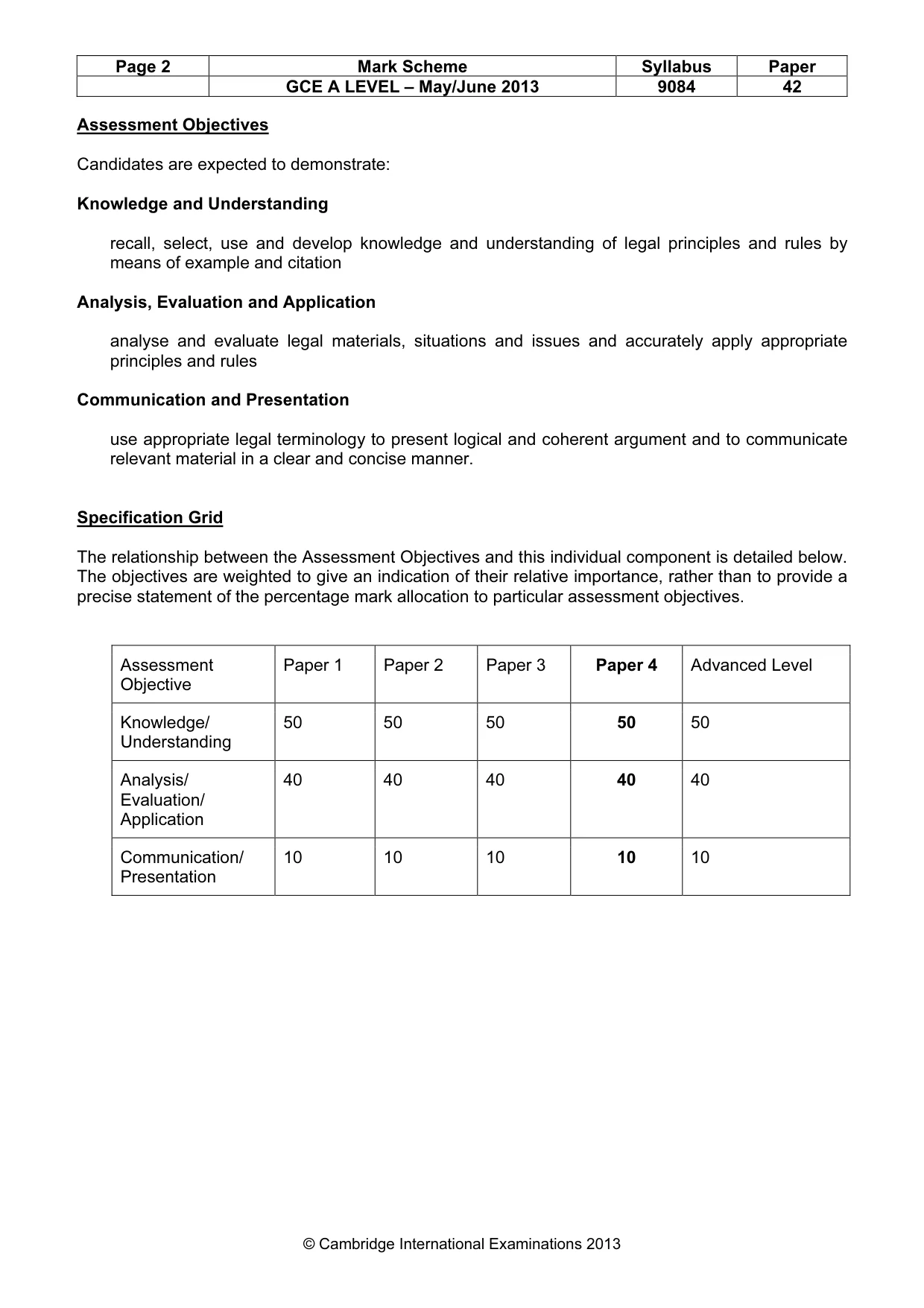
Page 2 Mark Scheme Syllabus Paper GCE A LEVEL – May/June 2013 9084 42 © Cambridge International Examinations 2013 Assessment Objectives Candidates are expected to demonstrate: Knowledge and Understanding recall, select, use and develop knowledge and understanding of legal principles and rules by means of example and citation Analysis, Evaluation and Application analyse and evaluate legal materials, situations and issues and accurately apply appropriate principles and rules Communication and Presentation use appropriate legal terminology to present logical and coherent argument and to communicate relevant material in a clear and concise manner. Specification Grid The relationship between the Assessment Objectives and this individual component is detailed below. The objectives are weighted to give an indication of their relative importance, rather than to provide a precise statement of the percentage mark allocation to particular assessment objectives. Assessment Objective Paper 1 Paper 2 Paper 3 Paper 4 Advanced Level Knowledge/ Understanding 50 50 50 50 50 Analysis/ Evaluation/ Application 40 40 40 40 40 Communication/ Presentation 10 10 10 10 10
Mark scheme, page 3
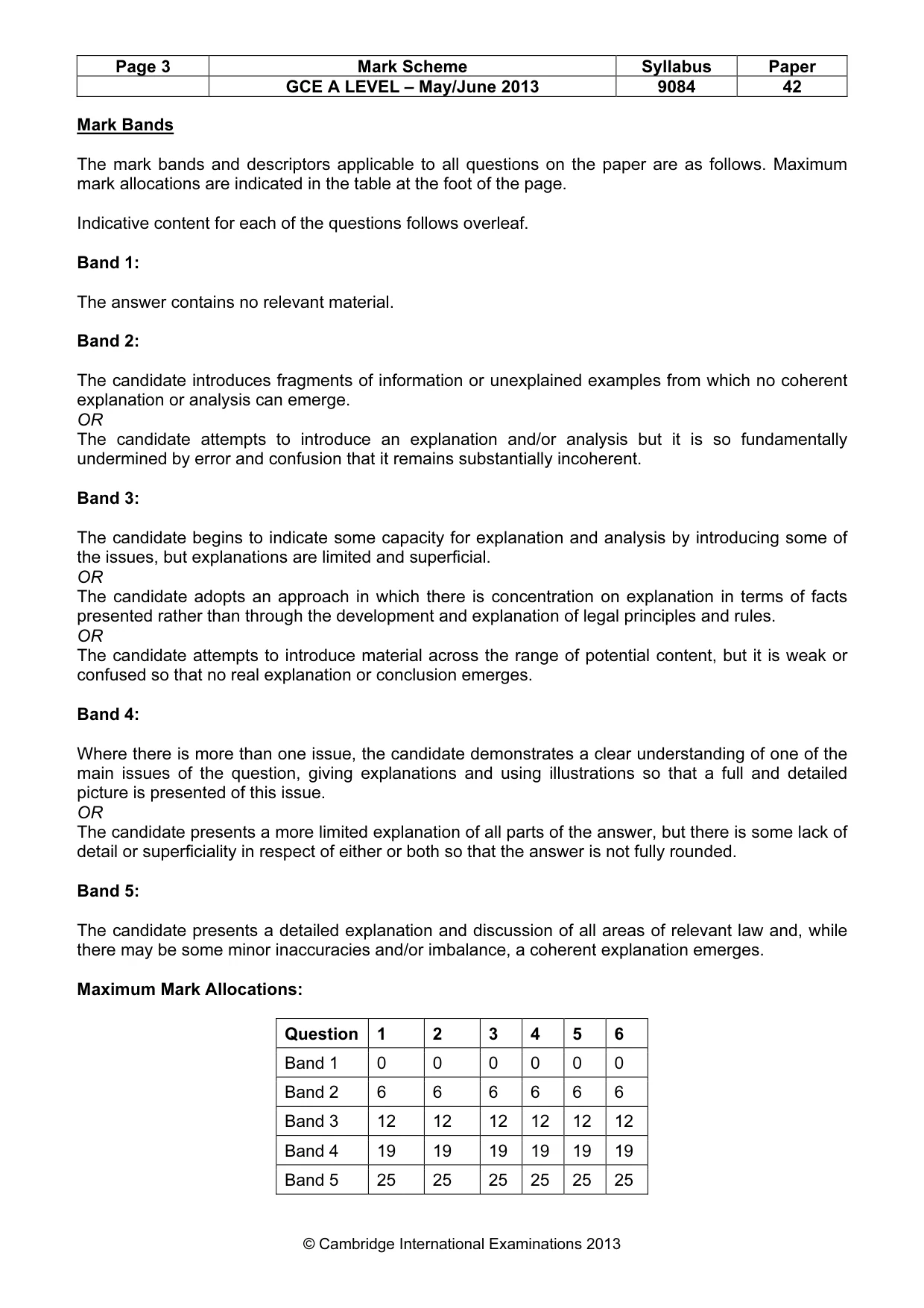
Page 3 Mark Scheme Syllabus Paper GCE A LEVEL – May/June 2013 9084 42 © Cambridge International Examinations 2013 Mark Bands The mark bands and descriptors applicable to all questions on the paper are as follows. Maximum mark allocations are indicated in the table at the foot of the page. Indicative content for each of the questions follows overleaf. Band 1: The answer contains no relevant material. Band 2: The candidate introduces fragments of information or unexplained examples from which no coherent explanation or analysis can emerge. OR The candidate attempts to introduce an explanation and/or analysis but it is so fundamentally undermined by error and confusion that it remains substantially incoherent. Band 3: The candidate begins to indicate some capacity for explanation and analysis by introducing some of the issues, but explanations are limited and superficial. OR The candidate adopts an approach in which there is concentration on explanation in terms of facts presented rather than through the development and explanation of legal principles and rules. OR The candidate attempts to introduce material across the range of potential content, but it is weak or confused so that no real explanation or conclusion emerges. Band 4: Where there is more than one issue, the candidate demonstrates a clear understanding of one of the main issues of the question, giving explanations and using illustrations so that a full and detailed picture is presented of this issue. OR The candidate presents a more limited explanation of all parts of the answer, but there is some lack of detail or superficiality in respect of either or both so that the answer is not fully rounded. Band 5: The candidate presents a detailed explanation and discussion of all areas of relevant law and, while there may be some minor inaccuracies and/or imbalance, a coherent explanation emerges. Maximum Mark Allocations: Question 1 2 3 4 5 6 Band 1 0 0 0 0 0 0 Band 2 6 6 6 6 6 6 Band 3 12 12 12 12 12 12 Band 4 19 19 19 19 19 19 Band 5 25 25 25 25 25 25
Mark scheme, page 4
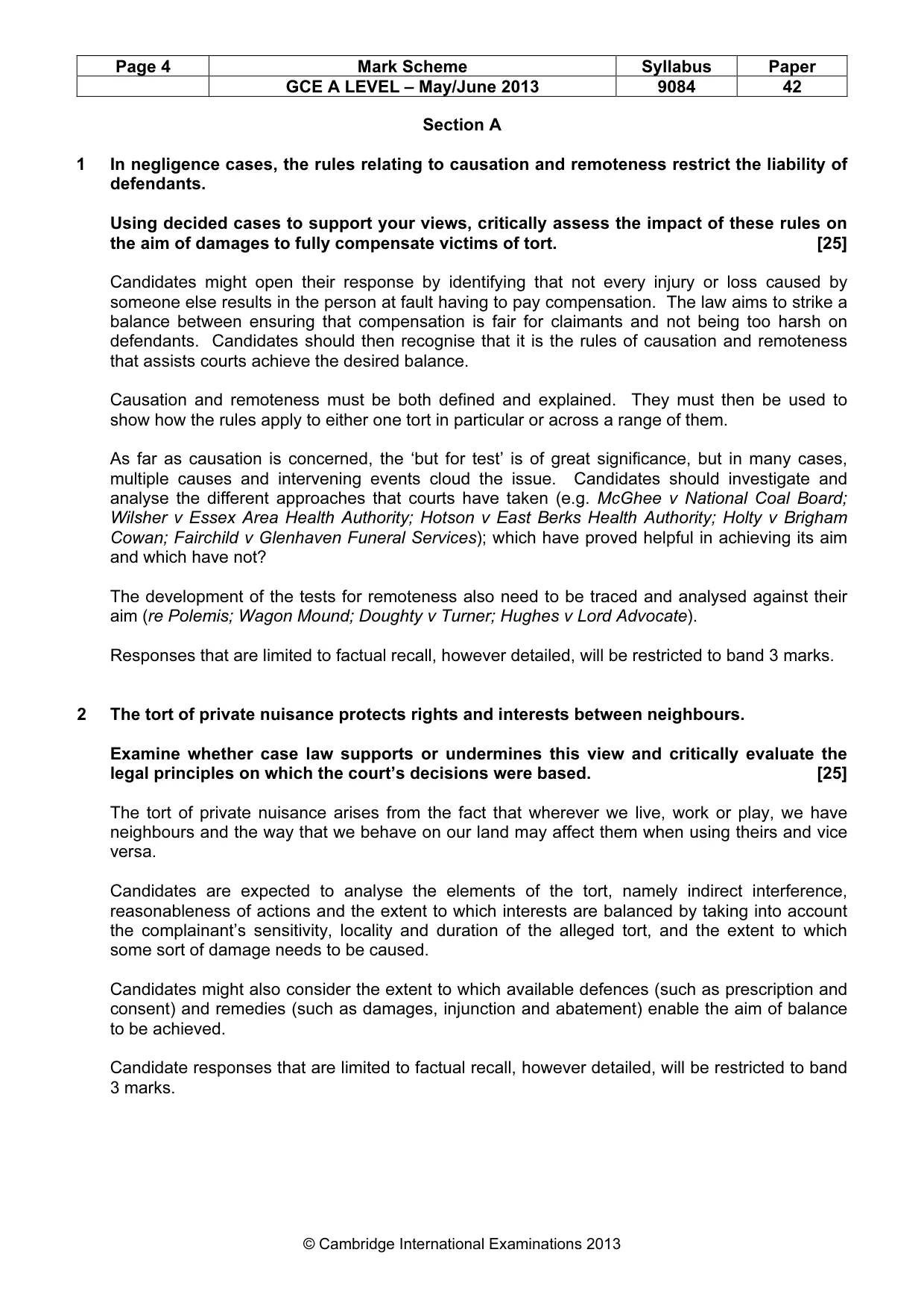
Page 4 Mark Scheme Syllabus Paper GCE A LEVEL – May/June 2013 9084 42 © Cambridge International Examinations 2013 Section A 1 In negligence cases, the rules relating to causation and remoteness restrict the liability of defendants. Using decided cases to support your views, critically assess the impact of these rules on the aim of damages to fully compensate victims of tort. [25] Candidates might open their response by identifying that not every injury or loss caused by someone else results in the person at fault having to pay compensation. The law aims to strike a balance between ensuring that compensation is fair for claimants and not being too harsh on defendants. Candidates should then recognise that it is the rules of causation and remoteness that assists courts achieve the desired balance. Causation and remoteness must be both defined and explained. They must then be used to show how the rules apply to either one tort in particular or across a range of them. As far as causation is concerned, the ‘but for test’ is of great significance, but in many cases, multiple causes and intervening events cloud the issue. Candidates should investigate and analyse the different approaches that courts have taken (e.g. McGhee v National Coal Board; Wilsher v Essex Area Health Authority; Hotson v East Berks Health Authority; Holty v Brigham Cowan; Fairchild v Glenhaven Funeral Services); which have proved helpful in achieving its aim and which have not? The development of the tests for remoteness also need to be traced and analysed against their aim (re Polemis; Wagon Mound; Doughty v Turner; Hughes v Lord Advocate). Responses that are limited to factual recall, however detailed, will be restricted to band 3 marks. 2 The tort of private nuisance protects rights and interests between neighbours. Examine whether case law supports or undermines this view and critically evaluate the legal principles on which the court’s decisions were based. [25] The tort of private nuisance arises from the fact that wherever we live, work or play, we have neighbours and the way that we behave on our land may affect them when using theirs and vice versa. Candidates are expected to analyse the elements of the tort, namely indirect interference, reasonableness of actions and the extent to which interests are balanced by taking into account the complainant’s sensitivity, locality and duration of the alleged tort, and the extent to which some sort of damage needs to be caused. Candidates might also consider the extent to which available defences (such as prescription and consent) and remedies (such as damages, injunction and abatement) enable the aim of balance to be achieved. Candidate responses that are limited to factual recall, however detailed, will be restricted to band 3 marks.
Mark scheme, page 5
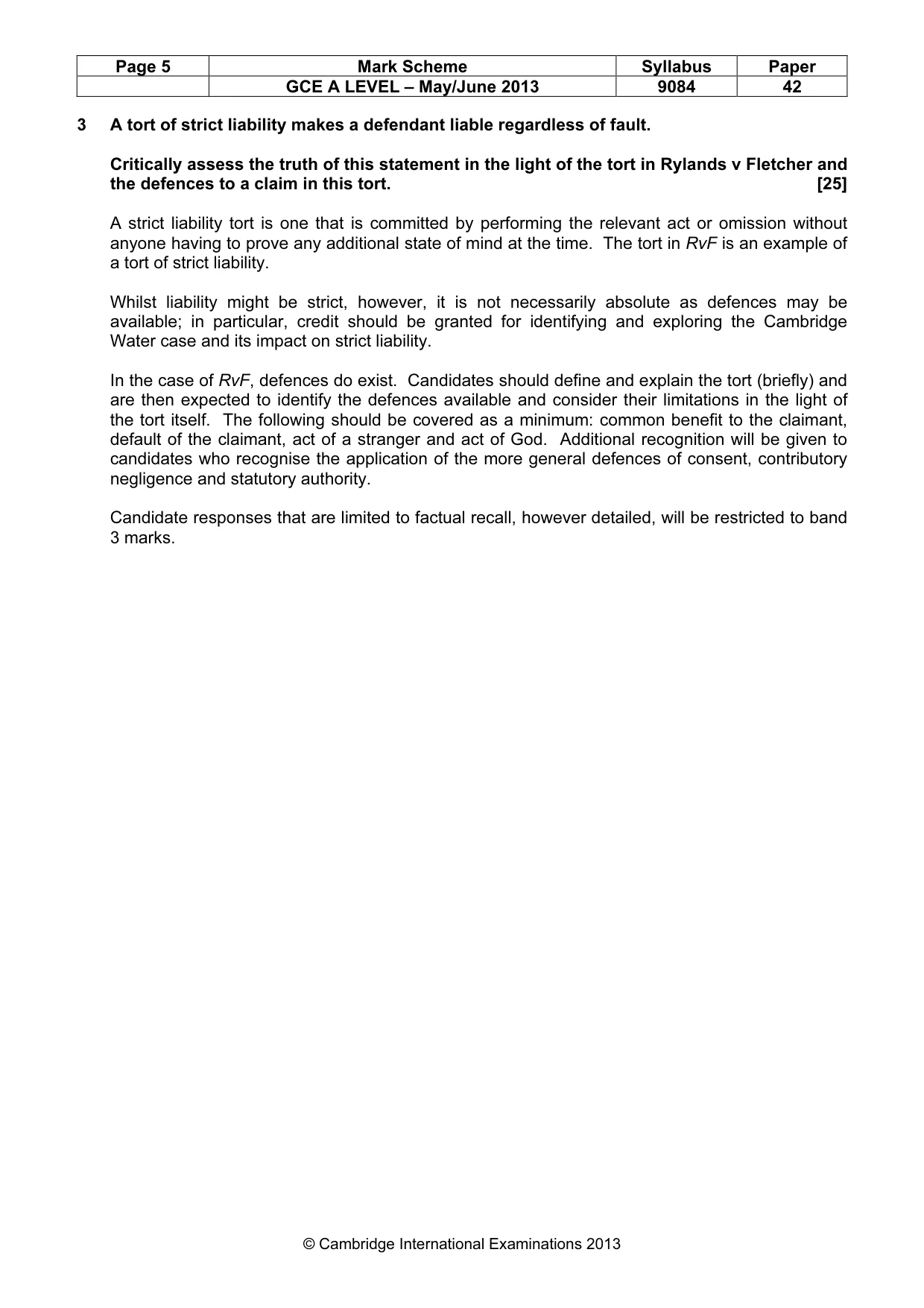
Page 5 Mark Scheme Syllabus Paper GCE A LEVEL – May/June 2013 9084 42 © Cambridge International Examinations 2013 3 A tort of strict liability makes a defendant liable regardless of fault. Critically assess the truth of this statement in the light of the tort in Rylands v Fletcher and the defences to a claim in this tort. [25] A strict liability tort is one that is committed by performing the relevant act or omission without anyone having to prove any additional state of mind at the time. The tort in RvF is an example of a tort of strict liability. Whilst liability might be strict, however, it is not necessarily absolute as defences may be available; in particular, credit should be granted for identifying and exploring the Cambridge Water case and its impact on strict liability. In the case of RvF, defences do exist. Candidates should define and explain the tort (briefly) and are then expected to identify the defences available and consider their limitations in the light of the tort itself. The following should be covered as a minimum: common benefit to the claimant, default of the claimant, act of a stranger and act of God. Additional recognition will be given to candidates who recognise the application of the more general defences of consent, contributory negligence and statutory authority. Candidate responses that are limited to factual recall, however detailed, will be restricted to band 3 marks.
Mark scheme, page 6
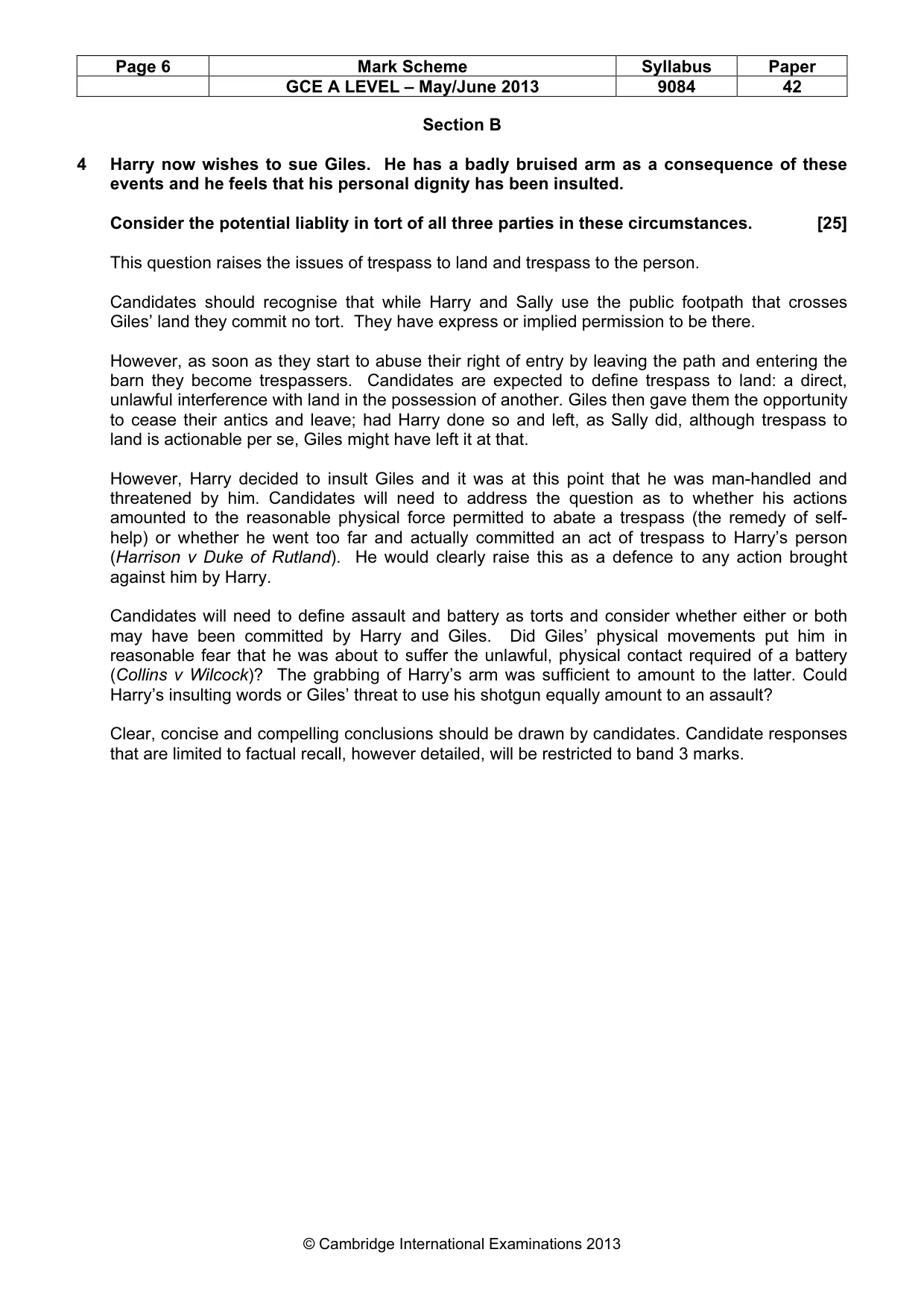
Page 6 Mark Scheme Syllabus Paper GCE A LEVEL – May/June 2013 9084 42 © Cambridge International Examinations 2013 Section B 4 Harry now wishes to sue Giles. He has a badly bruised arm as a consequence of these events and he feels that his personal dignity has been insulted. Consider the potential liablity in tort of all three parties in these circumstances. [25] This question raises the issues of trespass to land and trespass to the person. Candidates should recognise that while Harry and Sally use the public footpath that crosses Giles’ land they commit no tort. They have express or implied permission to be there. However, as soon as they start to abuse their right of entry by leaving the path and entering the barn they become trespassers. Candidates are expected to define trespass to land: a direct, unlawful interference with land in the possession of another. Giles then gave them the opportunity to cease their antics and leave; had Harry done so and left, as Sally did, although trespass to land is actionable per se, Giles might have left it at that. However, Harry decided to insult Giles and it was at this point that he was man-handled and threatened by him. Candidates will need to address the question as to whether his actions amounted to the reasonable physical force permitted to abate a trespass (the remedy of self- help) or whether he went too far and actually committed an act of trespass to Harry’s person (Harrison v Duke of Rutland). He would clearly raise this as a defence to any action brought against him by Harry. Candidates will need to define assault and battery as torts and consider whether either or both may have been committed by Harry and Giles. Did Giles’ physical movements put him in reasonable fear that he was about to suffer the unlawful, physical contact required of a battery (Collins v Wilcock)? The grabbing of Harry’s arm was sufficient to amount to the latter. Could Harry’s insulting words or Giles’ threat to use his shotgun equally amount to an assault? Clear, concise and compelling conclusions should be drawn by candidates. Candidate responses that are limited to factual recall, however detailed, will be restricted to band 3 marks.
Mark scheme, page 7
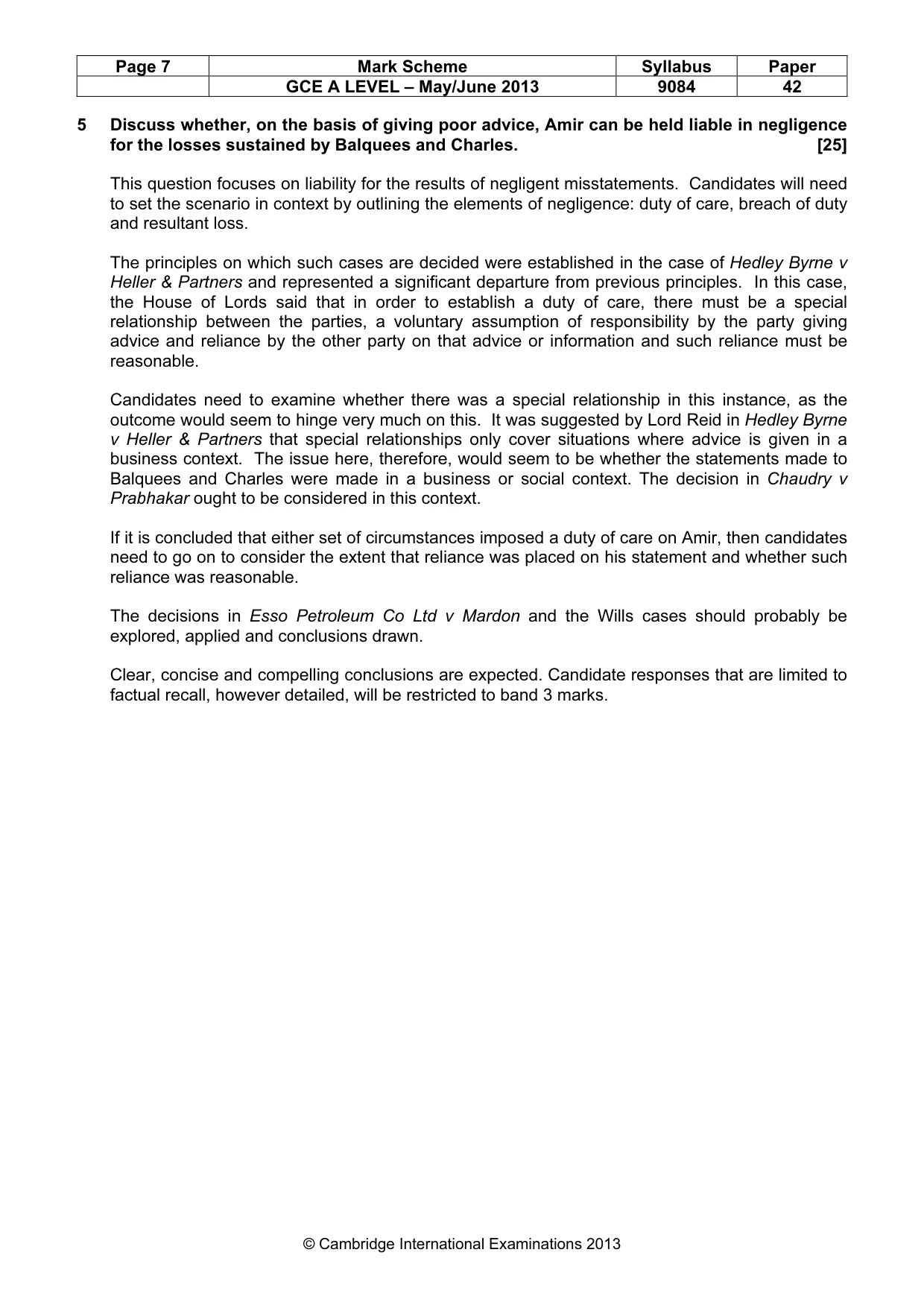
Page 7 Mark Scheme Syllabus Paper GCE A LEVEL – May/June 2013 9084 42 © Cambridge International Examinations 2013 5 Discuss whether, on the basis of giving poor advice, Amir can be held liable in negligence for the losses sustained by Balquees and Charles. [25] This question focuses on liability for the results of negligent misstatements. Candidates will need to set the scenario in context by outlining the elements of negligence: duty of care, breach of duty and resultant loss. The principles on which such cases are decided were established in the case of Hedley Byrne v Heller & Partners and represented a significant departure from previous principles. In this case, the House of Lords said that in order to establish a duty of care, there must be a special relationship between the parties, a voluntary assumption of responsibility by the party giving advice and reliance by the other party on that advice or information and such reliance must be reasonable. Candidates need to examine whether there was a special relationship in this instance, as the outcome would seem to hinge very much on this. It was suggested by Lord Reid in Hedley Byrne v Heller & Partners that special relationships only cover situations where advice is given in a business context. The issue here, therefore, would seem to be whether the statements made to Balquees and Charles were made in a business or social context. The decision in Chaudry v Prabhakar ought to be considered in this context. If it is concluded that either set of circumstances imposed a duty of care on Amir, then candidates need to go on to consider the extent that reliance was placed on his statement and whether such reliance was reasonable. The decisions in Esso Petroleum Co Ltd v Mardon and the Wills cases should probably be explored, applied and conclusions drawn. Clear, concise and compelling conclusions are expected. Candidate responses that are limited to factual recall, however detailed, will be restricted to band 3 marks.
Mark scheme, page 8
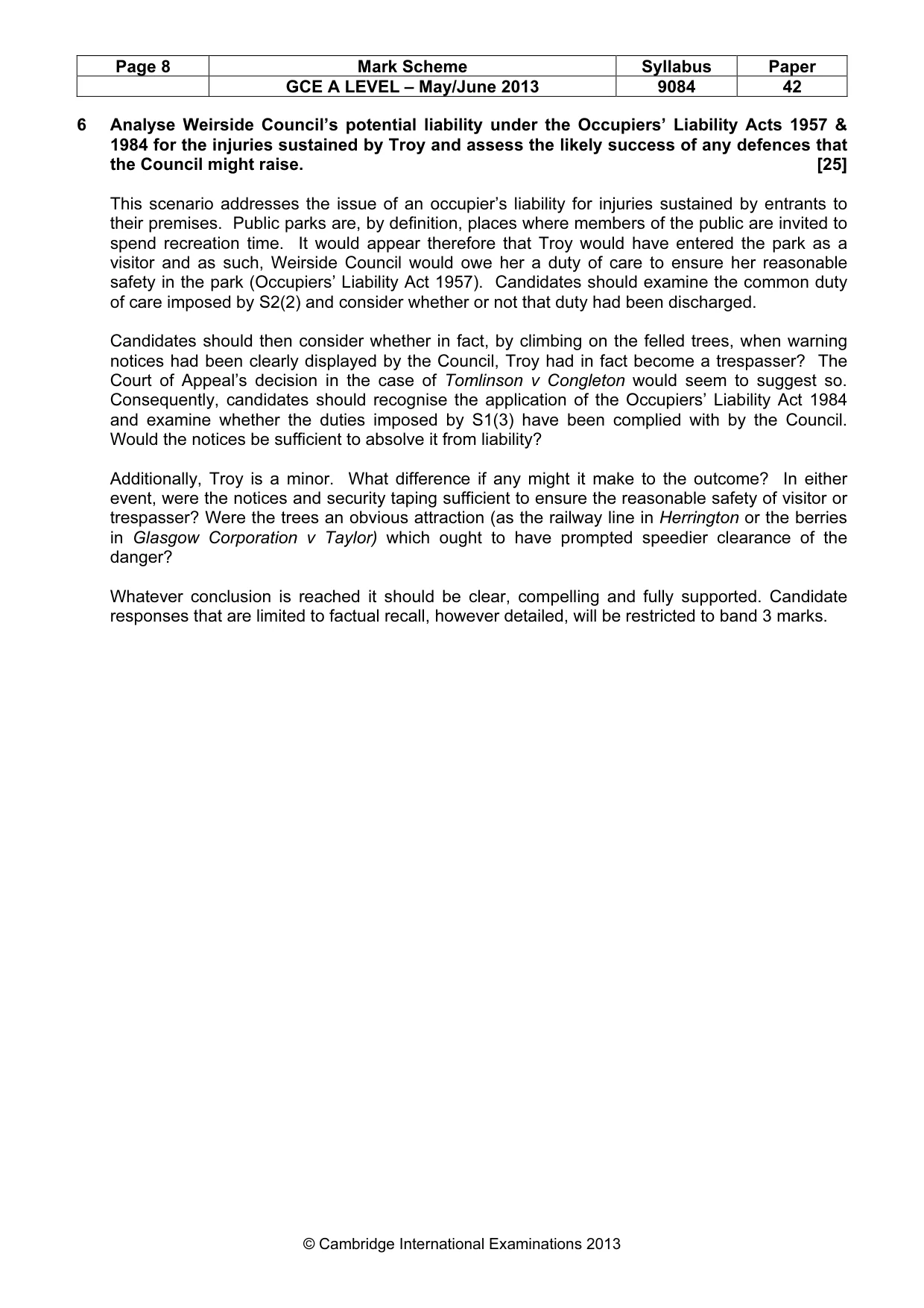
Page 8 Mark Scheme Syllabus Paper GCE A LEVEL – May/June 2013 9084 42 © Cambridge International Examinations 2013 6 Analyse Weirside Council’s potential liability under the Occupiers’ Liability Acts 1957 & 1984 for the injuries sustained by Troy and assess the likely success of any defences that the Council might raise. [25] This scenario addresses the issue of an occupier’s liability for injuries sustained by entrants to their premises. Public parks are, by definition, places where members of the public are invited to spend recreation time. It would appear therefore that Troy would have entered the park as a visitor and as such, Weirside Council would owe her a duty of care to ensure her reasonable safety in the park (Occupiers’ Liability Act 1957). Candidates should examine the common duty of care imposed by S2(2) and consider whether or not that duty had been discharged. Candidates should then consider whether in fact, by climbing on the felled trees, when warning notices had been clearly displayed by the Council, Troy had in fact become a trespasser? The Court of Appeal’s decision in the case of Tomlinson v Congleton would seem to suggest so. Consequently, candidates should recognise the application of the Occupiers’ Liability Act 1984 and examine whether the duties imposed by S1(3) have been complied with by the Council. Would the notices be sufficient to absolve it from liability? Additionally, Troy is a minor. What difference if any might it make to the outcome? In either event, were the notices and security taping sufficient to ensure the reasonable safety of visitor or trespasser? Were the trees an obvious attraction (as the railway line in Herrington or the berries in Glasgow Corporation v Taylor) which ought to have prompted speedier clearance of the danger? Whatever conclusion is reached it should be clear, compelling and fully supported. Candidate responses that are limited to factual recall, however detailed, will be restricted to band 3 marks.
What you needed in this session
Cambridge’s own grade thresholds for 2013 May/June, Paper 4 · Variant 2. A higher threshold means an easier paper — the bar moves with how the cohort did.