Cambridge A Level Law 9084 — 2013 May/June Paper 4 · Variant 3
9084/43/M/J/13 · 75 marks · ≈84 min
The question paper and its mark scheme, free to read here and free to download. This is Cambridge’s own paper, exactly as it was sat.
Question paper4 pages

Mark scheme8 pages
Answers below. Sit the paper first if you are practising.
Paper as text
Question paper, page 1
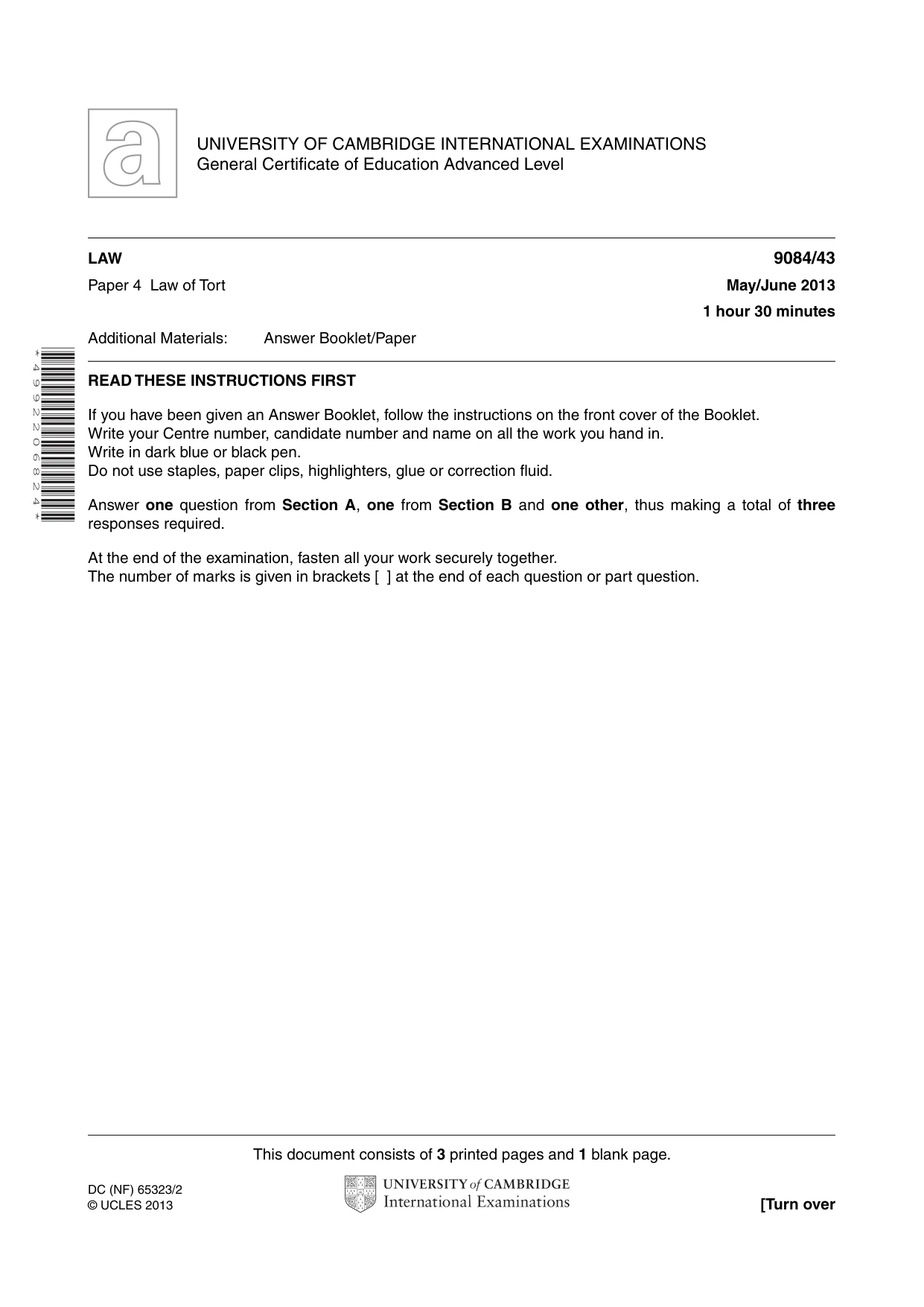
This document consists of 3 printed pages and 1 blank page. DC (NF) 65323/2 © UCLES 2013 [Turn over UNIVERSITY OF CAMBRIDGE INTERNATIONAL EXAMINATIONS General Certificate of Education Advanced Level * 4 9 9 2 2 0 6 8 2 4 * LAW 9084/43 Paper 4 Law of Tort May/June 2013 1 hour 30 minutes Additional Materials: Answer Booklet/Paper READ THESE INSTRUCTIONS FIRST If you have been given an Answer Booklet, follow the instructions on the front cover of the Booklet. Write your Centre number, candidate number and name on all the work you hand in. Write in dark blue or black pen. Do not use staples, paper clips, highlighters, glue or correction fluid. Answer one question from Section A, one from Section B and one other, thus making a total of three responses required. At the end of the examination, fasten all your work securely together. The number of marks is given in brackets [ ] at the end of each question or part question.
Question paper, page 2
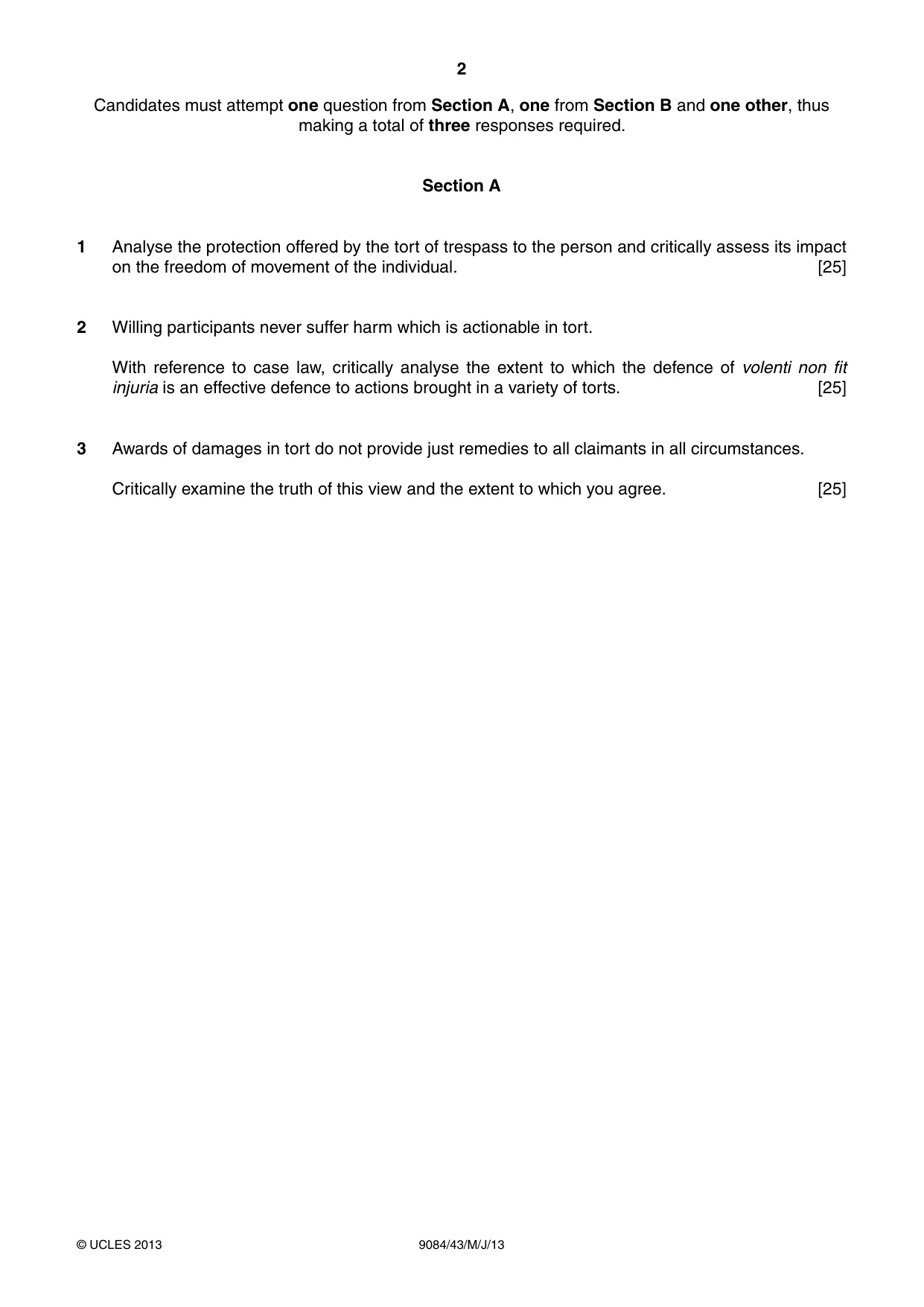
2 9084/43/M/J/13 © UCLES 2013 Candidates must attempt one question from Section A, one from Section B and one other, thus making a total of three responses required. Section A 1 Analyse the protection offered by the tort of trespass to the person and critically assess its impact on the freedom of movement of the individual. [25] 2 Willing participants never suffer harm which is actionable in tort. With reference to case law, critically analyse the extent to which the defence of volenti non fit injuria is an effective defence to actions brought in a variety of torts. [25] 3 Awards of damages in tort do not provide just remedies to all claimants in all circumstances. Critically examine the truth of this view and the extent to which you agree. [25]
Question paper, page 3
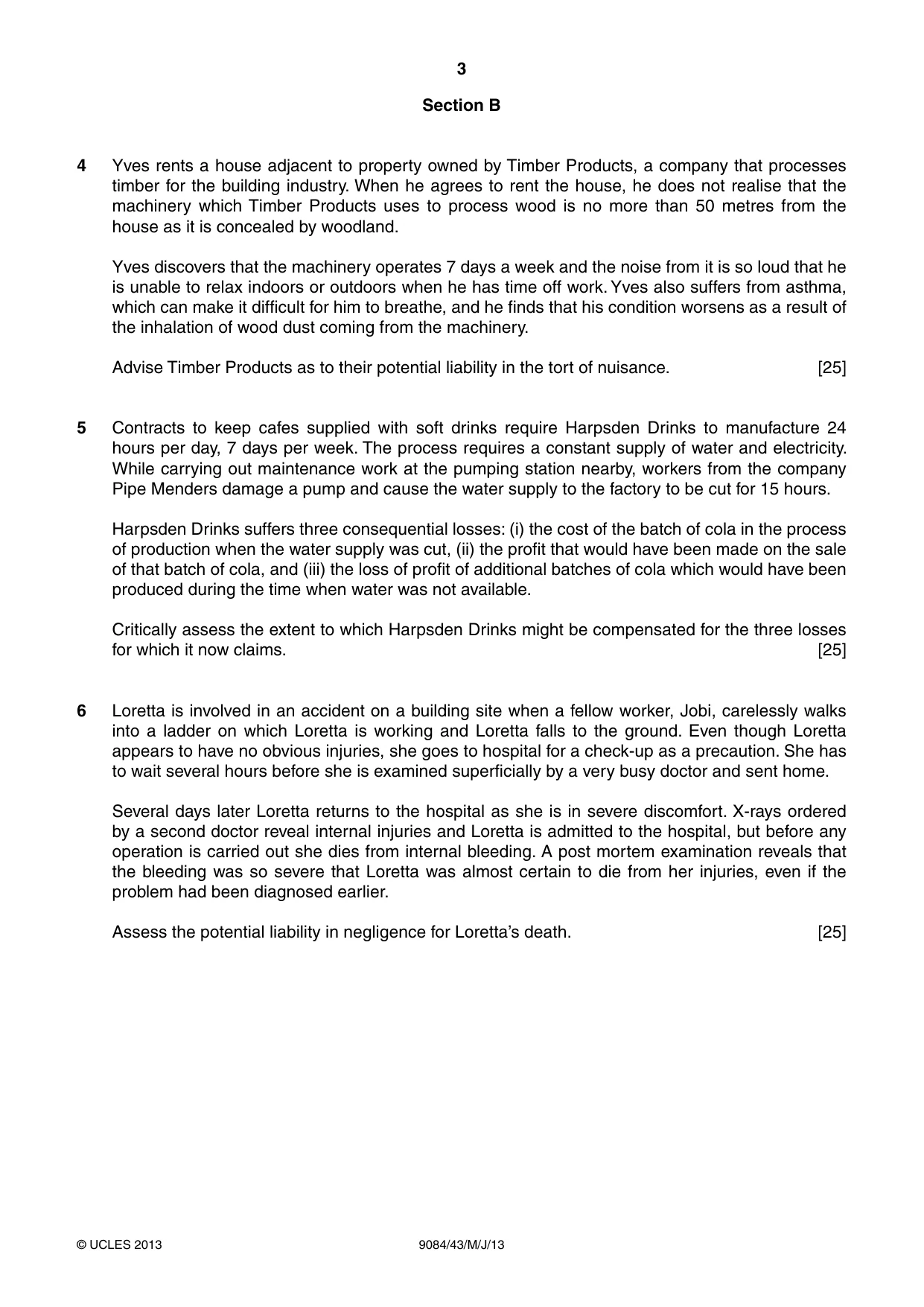
3 9084/43/M/J/13 © UCLES 2013 Section B 4 Yves rents a house adjacent to property owned by Timber Products, a company that processes timber for the building industry. When he agrees to rent the house, he does not realise that the machinery which Timber Products uses to process wood is no more than 50 metres from the house as it is concealed by woodland. Yves discovers that the machinery operates 7 days a week and the noise from it is so loud that he is unable to relax indoors or outdoors when he has time off work. Yves also suffers from asthma, which can make it difficult for him to breathe, and he finds that his condition worsens as a result of the inhalation of wood dust coming from the machinery. Advise Timber Products as to their potential liability in the tort of nuisance. [25] 5 Contracts to keep cafes supplied with soft drinks require Harpsden Drinks to manufacture 24 hours per day, 7 days per week. The process requires a constant supply of water and electricity. While carrying out maintenance work at the pumping station nearby, workers from the company Pipe Menders damage a pump and cause the water supply to the factory to be cut for 15 hours. Harpsden Drinks suffers three consequential losses: (i) the cost of the batch of cola in the process of production when the water supply was cut, (ii) the profit that would have been made on the sale of that batch of cola, and (iii) the loss of profit of additional batches of cola which would have been produced during the time when water was not available. Critically assess the extent to which Harpsden Drinks might be compensated for the three losses for which it now claims. [25] 6 Loretta is involved in an accident on a building site when a fellow worker, Jobi, carelessly walks into a ladder on which Loretta is working and Loretta falls to the ground. Even though Loretta appears to have no obvious injuries, she goes to hospital for a check-up as a precaution. She has to wait several hours before she is examined superficially by a very busy doctor and sent home. Several days later Loretta returns to the hospital as she is in severe discomfort. X-rays ordered by a second doctor reveal internal injuries and Loretta is admitted to the hospital, but before any operation is carried out she dies from internal bleeding. A post mortem examination reveals that the bleeding was so severe that Loretta was almost certain to die from her injuries, even if the problem had been diagnosed earlier. Assess the potential liability in negligence for Loretta’s death. [25]
Question paper, page 4
4 9084/43/M/J/13 © UCLES 2013 BLANK PAGE Permission to reproduce items where third-party owned material protected by copyright is included has been sought and cleared where possible. Every reasonable effort has been made by the publisher (UCLES) to trace copyright holders, but if any items requiring clearance have unwittingly been included, the publisher will be pleased to make amends at the earliest possible opportunity. University of Cambridge International Examinations is part of the Cambridge Assessment Group. Cambridge Assessment is the brand name of University of Cambridge Local Examinations Syndicate (UCLES), which is itself a department of the University of Cambridge.
Mark scheme, page 1
CAMBRIDGE INTERNATIONAL EXAMINATIONS GCE Advanced Level MARK SCHEME for the May/June 2013 series 9084 LAW 9084/43 Paper 4, maximum raw mark 75 This mark scheme is published as an aid to teachers and candidates, to indicate the requirements of the examination. It shows the basis on which Examiners were instructed to award marks. It does not indicate the details of the discussions that took place at an Examiners’ meeting before marking began, which would have considered the acceptability of alternative answers. Mark schemes should be read in conjunction with the question paper and the Principal Examiner Report for Teachers. Cambridge will not enter into discussions about these mark schemes. Cambridge is publishing the mark schemes for the May/June 2013 series for most IGCSE, GCE Advanced Level and Advanced Subsidiary Level components and some Ordinary Level components.
Mark scheme, page 2
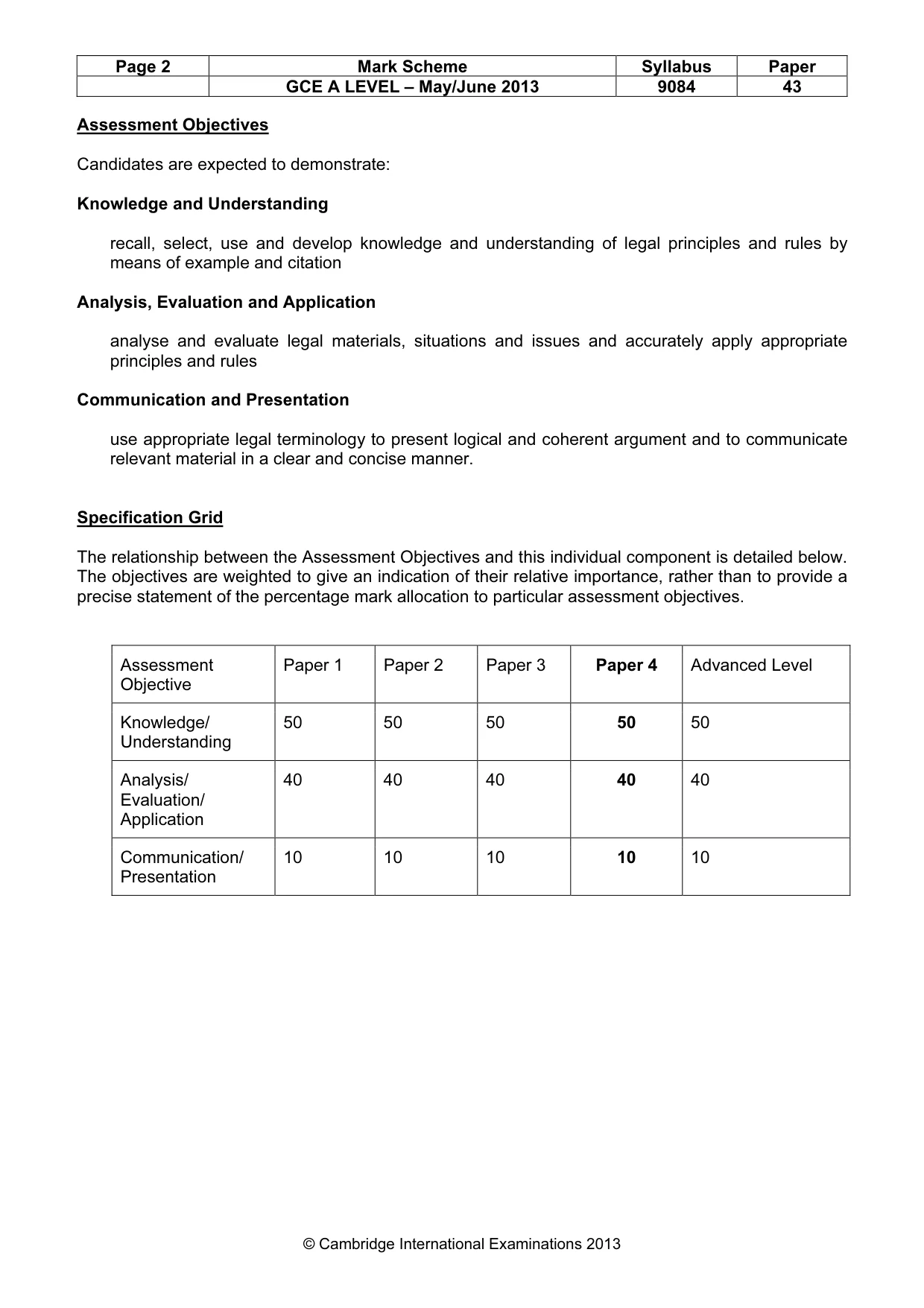
Page 2 Mark Scheme Syllabus Paper GCE A LEVEL – May/June 2013 9084 43 © Cambridge International Examinations 2013 Assessment Objectives Candidates are expected to demonstrate: Knowledge and Understanding recall, select, use and develop knowledge and understanding of legal principles and rules by means of example and citation Analysis, Evaluation and Application analyse and evaluate legal materials, situations and issues and accurately apply appropriate principles and rules Communication and Presentation use appropriate legal terminology to present logical and coherent argument and to communicate relevant material in a clear and concise manner. Specification Grid The relationship between the Assessment Objectives and this individual component is detailed below. The objectives are weighted to give an indication of their relative importance, rather than to provide a precise statement of the percentage mark allocation to particular assessment objectives. Assessment Objective Paper 1 Paper 2 Paper 3 Paper 4 Advanced Level Knowledge/ Understanding 50 50 50 50 50 Analysis/ Evaluation/ Application 40 40 40 40 40 Communication/ Presentation 10 10 10 10 10
Mark scheme, page 3
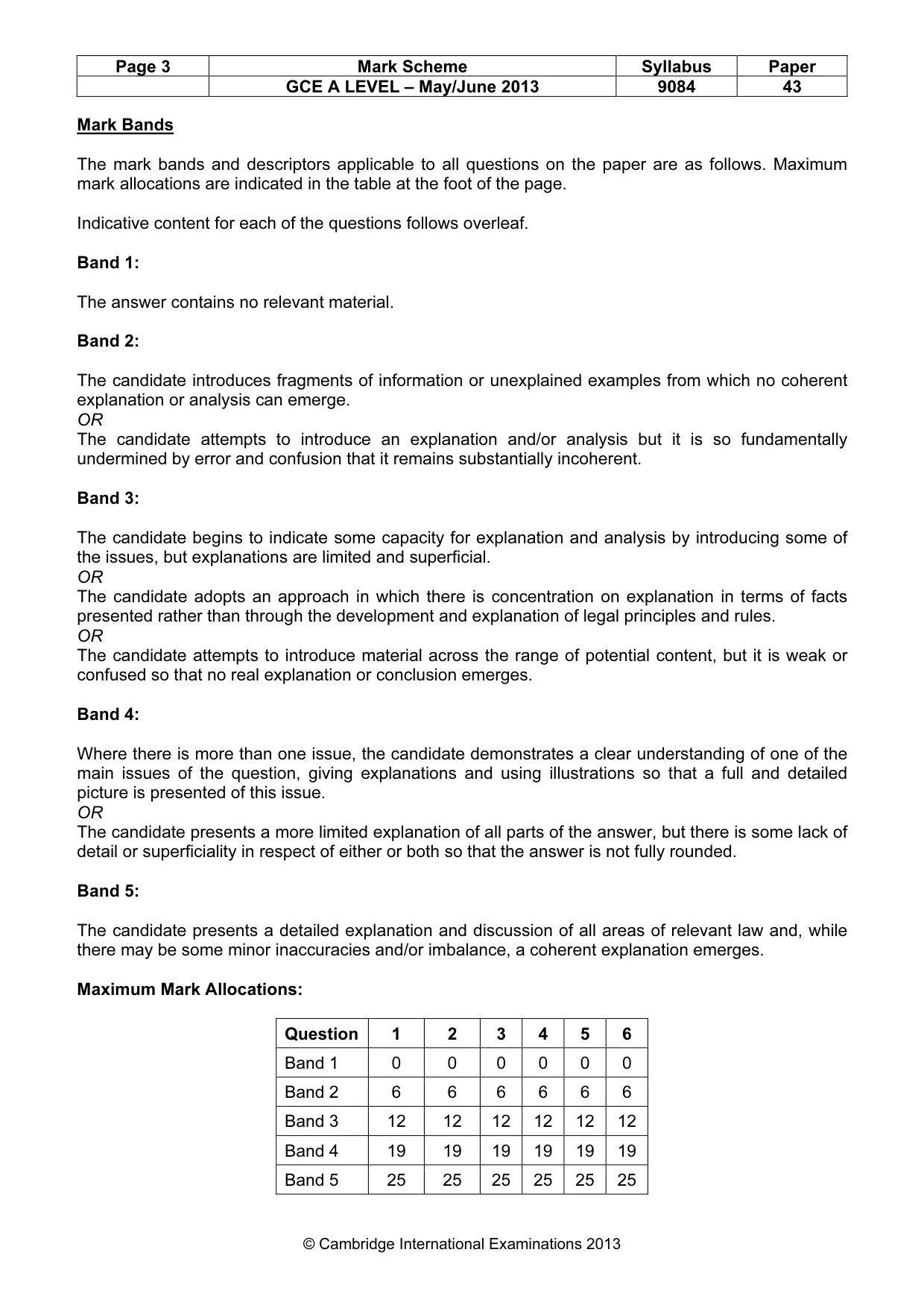
Page 3 Mark Scheme Syllabus Paper GCE A LEVEL – May/June 2013 9084 43 © Cambridge International Examinations 2013 Mark Bands The mark bands and descriptors applicable to all questions on the paper are as follows. Maximum mark allocations are indicated in the table at the foot of the page. Indicative content for each of the questions follows overleaf. Band 1: The answer contains no relevant material. Band 2: The candidate introduces fragments of information or unexplained examples from which no coherent explanation or analysis can emerge. OR The candidate attempts to introduce an explanation and/or analysis but it is so fundamentally undermined by error and confusion that it remains substantially incoherent. Band 3: The candidate begins to indicate some capacity for explanation and analysis by introducing some of the issues, but explanations are limited and superficial. OR The candidate adopts an approach in which there is concentration on explanation in terms of facts presented rather than through the development and explanation of legal principles and rules. OR The candidate attempts to introduce material across the range of potential content, but it is weak or confused so that no real explanation or conclusion emerges. Band 4: Where there is more than one issue, the candidate demonstrates a clear understanding of one of the main issues of the question, giving explanations and using illustrations so that a full and detailed picture is presented of this issue. OR The candidate presents a more limited explanation of all parts of the answer, but there is some lack of detail or superficiality in respect of either or both so that the answer is not fully rounded. Band 5: The candidate presents a detailed explanation and discussion of all areas of relevant law and, while there may be some minor inaccuracies and/or imbalance, a coherent explanation emerges. Maximum Mark Allocations: Question 1 2 3 4 5 6 Band 1 0 0 0 0 0 0 Band 2 6 6 6 6 6 6 Band 3 12 12 12 12 12 12 Band 4 19 19 19 19 19 19 Band 5 25 25 25 25 25 25
Mark scheme, page 4
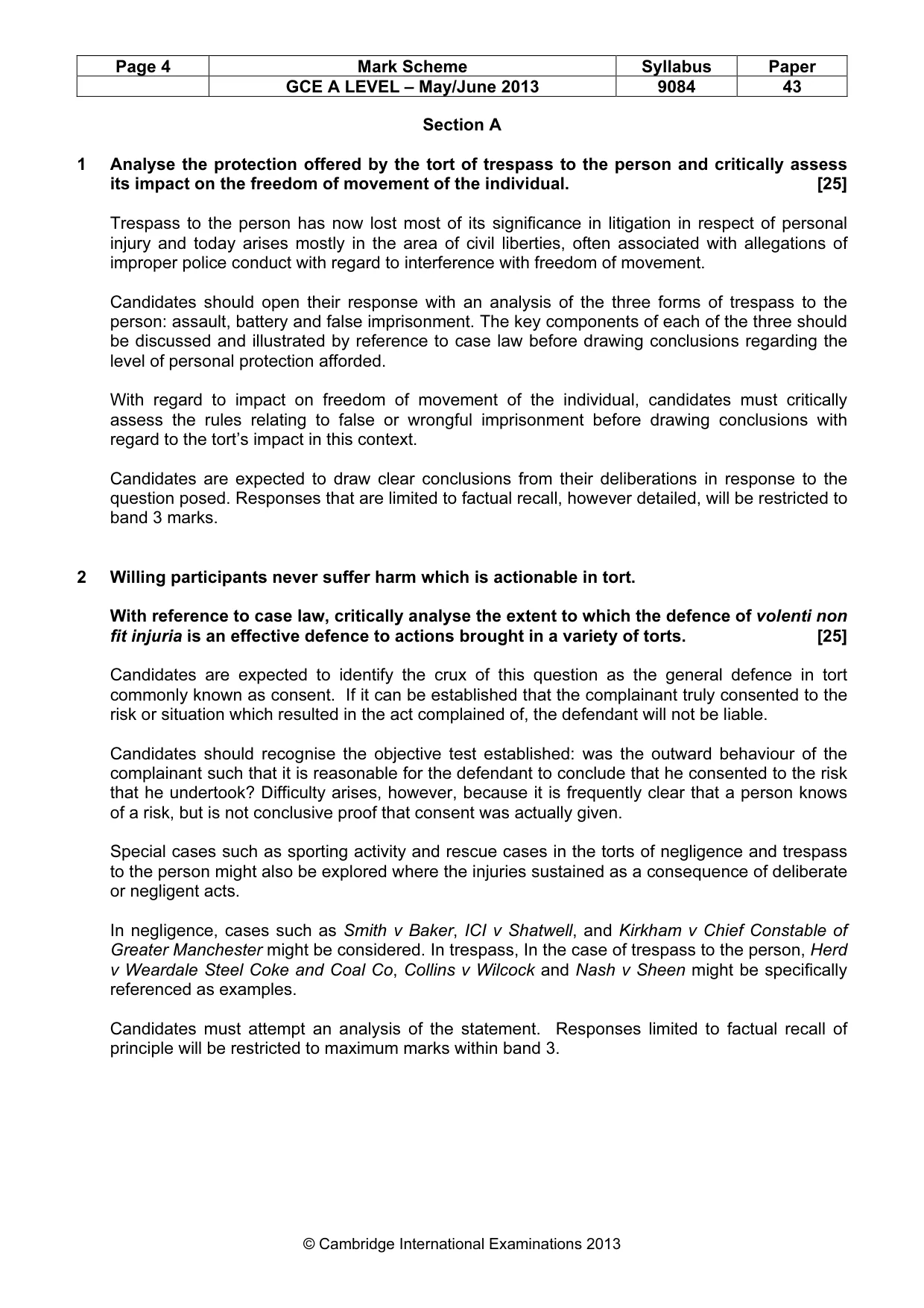
Page 4 Mark Scheme Syllabus Paper GCE A LEVEL – May/June 2013 9084 43 © Cambridge International Examinations 2013 Section A 1 Analyse the protection offered by the tort of trespass to the person and critically assess its impact on the freedom of movement of the individual. [25] Trespass to the person has now lost most of its significance in litigation in respect of personal injury and today arises mostly in the area of civil liberties, often associated with allegations of improper police conduct with regard to interference with freedom of movement. Candidates should open their response with an analysis of the three forms of trespass to the person: assault, battery and false imprisonment. The key components of each of the three should be discussed and illustrated by reference to case law before drawing conclusions regarding the level of personal protection afforded. With regard to impact on freedom of movement of the individual, candidates must critically assess the rules relating to false or wrongful imprisonment before drawing conclusions with regard to the tort’s impact in this context. Candidates are expected to draw clear conclusions from their deliberations in response to the question posed. Responses that are limited to factual recall, however detailed, will be restricted to band 3 marks. 2 Willing participants never suffer harm which is actionable in tort. With reference to case law, critically analyse the extent to which the defence of volenti non fit injuria is an effective defence to actions brought in a variety of torts. [25] Candidates are expected to identify the crux of this question as the general defence in tort commonly known as consent. If it can be established that the complainant truly consented to the risk or situation which resulted in the act complained of, the defendant will not be liable. Candidates should recognise the objective test established: was the outward behaviour of the complainant such that it is reasonable for the defendant to conclude that he consented to the risk that he undertook? Difficulty arises, however, because it is frequently clear that a person knows of a risk, but is not conclusive proof that consent was actually given. Special cases such as sporting activity and rescue cases in the torts of negligence and trespass to the person might also be explored where the injuries sustained as a consequence of deliberate or negligent acts. In negligence, cases such as Smith v Baker, ICI v Shatwell, and Kirkham v Chief Constable of Greater Manchester might be considered. In trespass, In the case of trespass to the person, Herd v Weardale Steel Coke and Coal Co, Collins v Wilcock and Nash v Sheen might be specifically referenced as examples. Candidates must attempt an analysis of the statement. Responses limited to factual recall of principle will be restricted to maximum marks within band 3.
Mark scheme, page 5
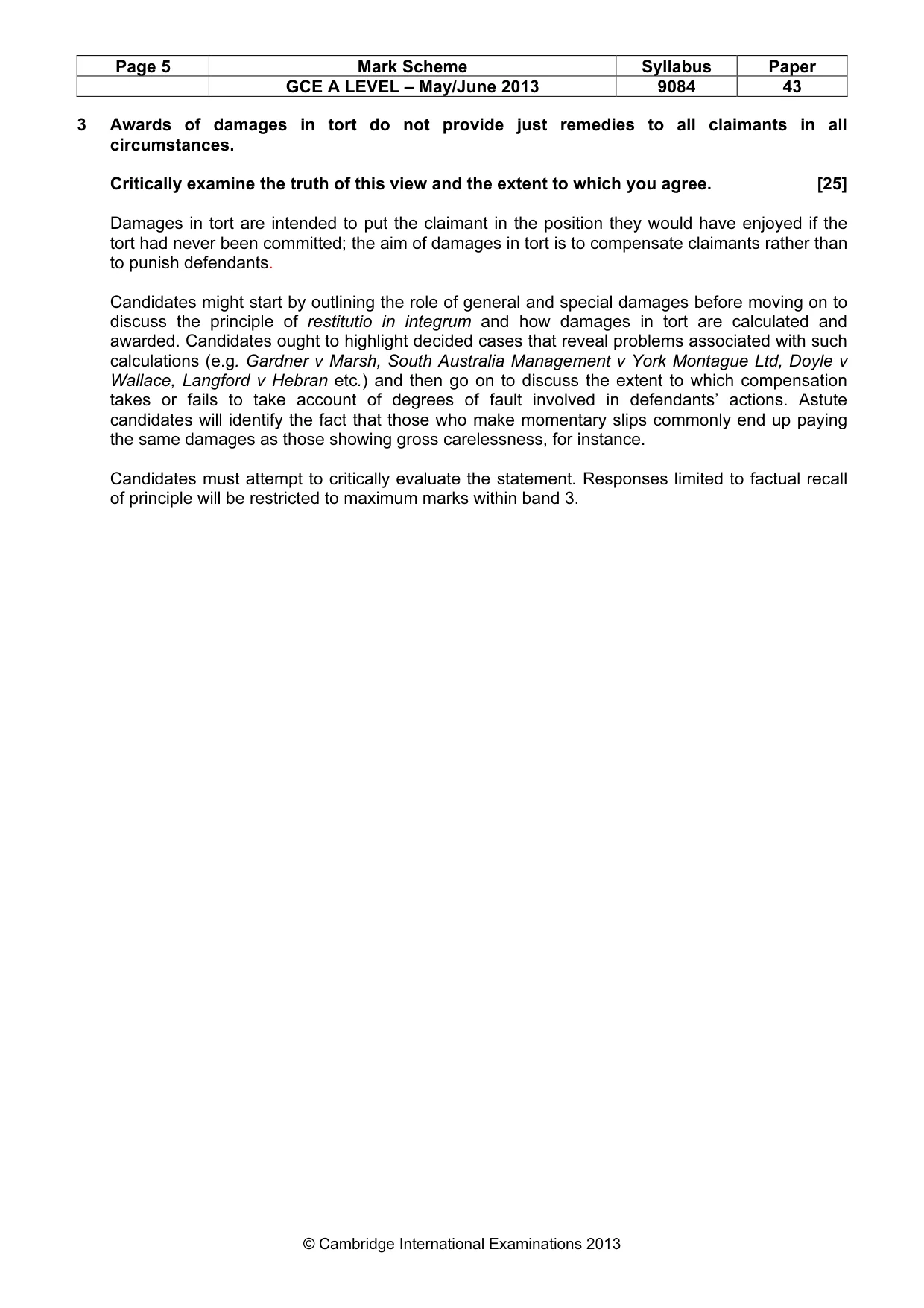
Page 5 Mark Scheme Syllabus Paper GCE A LEVEL – May/June 2013 9084 43 © Cambridge International Examinations 2013 3 Awards of damages in tort do not provide just remedies to all claimants in all circumstances. Critically examine the truth of this view and the extent to which you agree. [25] Damages in tort are intended to put the claimant in the position they would have enjoyed if the tort had never been committed; the aim of damages in tort is to compensate claimants rather than to punish defendants. Candidates might start by outlining the role of general and special damages before moving on to discuss the principle of restitutio in integrum and how damages in tort are calculated and awarded. Candidates ought to highlight decided cases that reveal problems associated with such calculations (e.g. Gardner v Marsh, South Australia Management v York Montague Ltd, Doyle v Wallace, Langford v Hebran etc.) and then go on to discuss the extent to which compensation takes or fails to take account of degrees of fault involved in defendants’ actions. Astute candidates will identify the fact that those who make momentary slips commonly end up paying the same damages as those showing gross carelessness, for instance. Candidates must attempt to critically evaluate the statement. Responses limited to factual recall of principle will be restricted to maximum marks within band 3.
Mark scheme, page 6
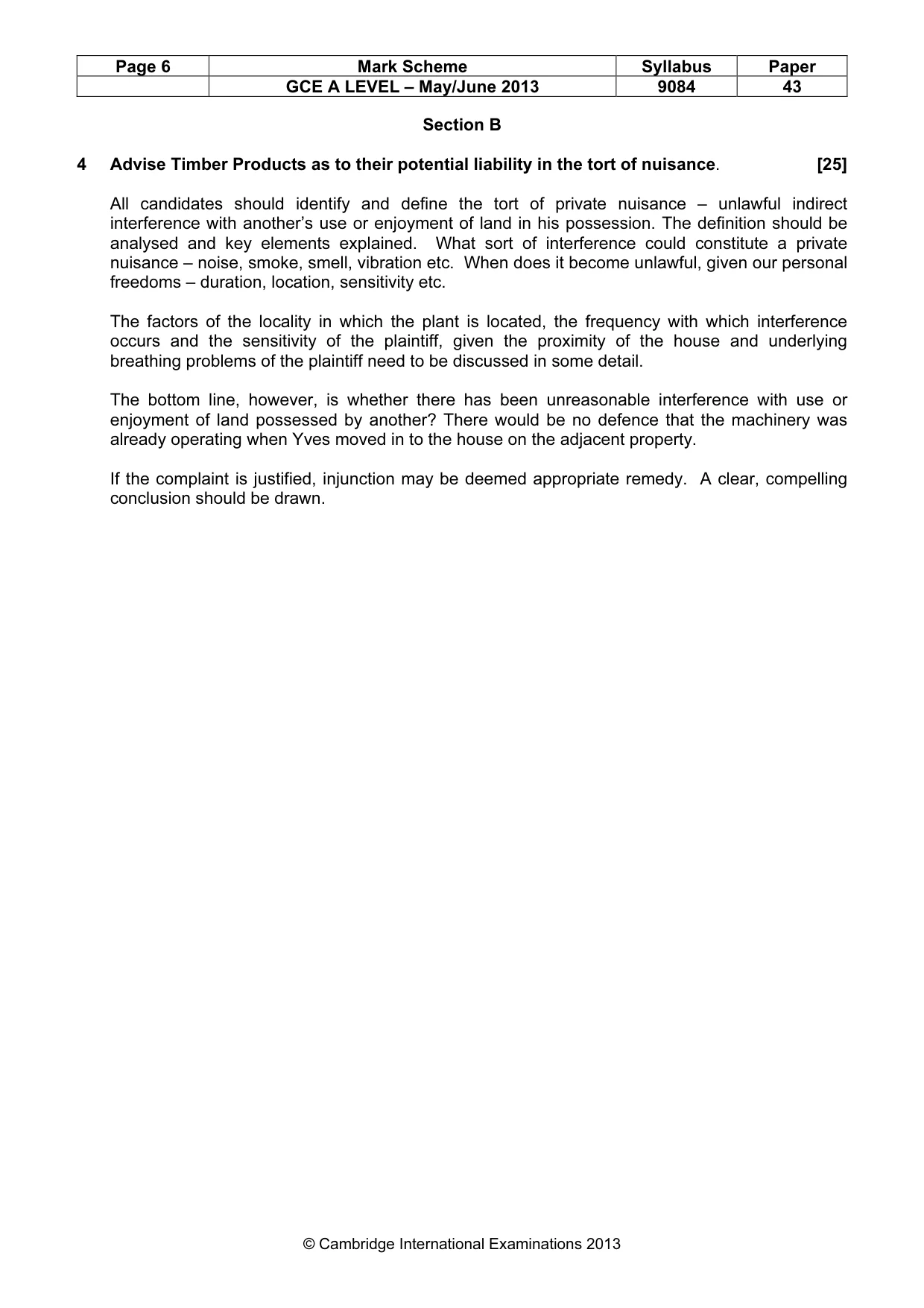
Page 6 Mark Scheme Syllabus Paper GCE A LEVEL – May/June 2013 9084 43 © Cambridge International Examinations 2013 Section B 4 Advise Timber Products as to their potential liability in the tort of nuisance. [25] All candidates should identify and define the tort of private nuisance – unlawful indirect interference with another’s use or enjoyment of land in his possession. The definition should be analysed and key elements explained. What sort of interference could constitute a private nuisance – noise, smoke, smell, vibration etc. When does it become unlawful, given our personal freedoms – duration, location, sensitivity etc. The factors of the locality in which the plant is located, the frequency with which interference occurs and the sensitivity of the plaintiff, given the proximity of the house and underlying breathing problems of the plaintiff need to be discussed in some detail. The bottom line, however, is whether there has been unreasonable interference with use or enjoyment of land possessed by another? There would be no defence that the machinery was already operating when Yves moved in to the house on the adjacent property. If the complaint is justified, injunction may be deemed appropriate remedy. A clear, compelling conclusion should be drawn.
Mark scheme, page 7
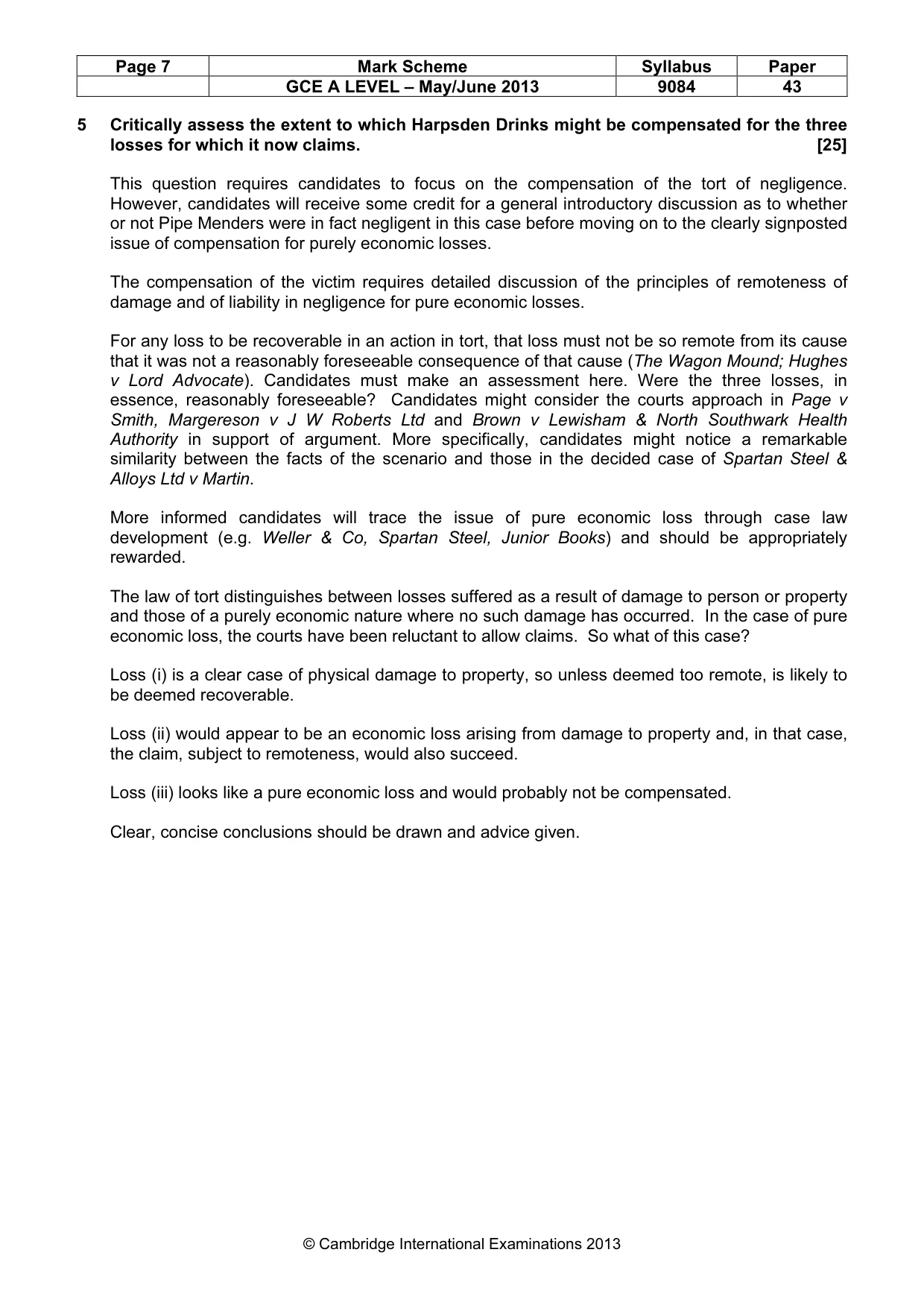
Page 7 Mark Scheme Syllabus Paper GCE A LEVEL – May/June 2013 9084 43 © Cambridge International Examinations 2013 5 Critically assess the extent to which Harpsden Drinks might be compensated for the three losses for which it now claims. [25] This question requires candidates to focus on the compensation of the tort of negligence. However, candidates will receive some credit for a general introductory discussion as to whether or not Pipe Menders were in fact negligent in this case before moving on to the clearly signposted issue of compensation for purely economic losses. The compensation of the victim requires detailed discussion of the principles of remoteness of damage and of liability in negligence for pure economic losses. For any loss to be recoverable in an action in tort, that loss must not be so remote from its cause that it was not a reasonably foreseeable consequence of that cause (The Wagon Mound; Hughes v Lord Advocate). Candidates must make an assessment here. Were the three losses, in essence, reasonably foreseeable? Candidates might consider the courts approach in Page v Smith, Margereson v J W Roberts Ltd and Brown v Lewisham & North Southwark Health Authority in support of argument. More specifically, candidates might notice a remarkable similarity between the facts of the scenario and those in the decided case of Spartan Steel & Alloys Ltd v Martin. More informed candidates will trace the issue of pure economic loss through case law development (e.g. Weller & Co, Spartan Steel, Junior Books) and should be appropriately rewarded. The law of tort distinguishes between losses suffered as a result of damage to person or property and those of a purely economic nature where no such damage has occurred. In the case of pure economic loss, the courts have been reluctant to allow claims. So what of this case? Loss (i) is a clear case of physical damage to property, so unless deemed too remote, is likely to be deemed recoverable. Loss (ii) would appear to be an economic loss arising from damage to property and, in that case, the claim, subject to remoteness, would also succeed. Loss (iii) looks like a pure economic loss and would probably not be compensated. Clear, concise conclusions should be drawn and advice given.
Mark scheme, page 8
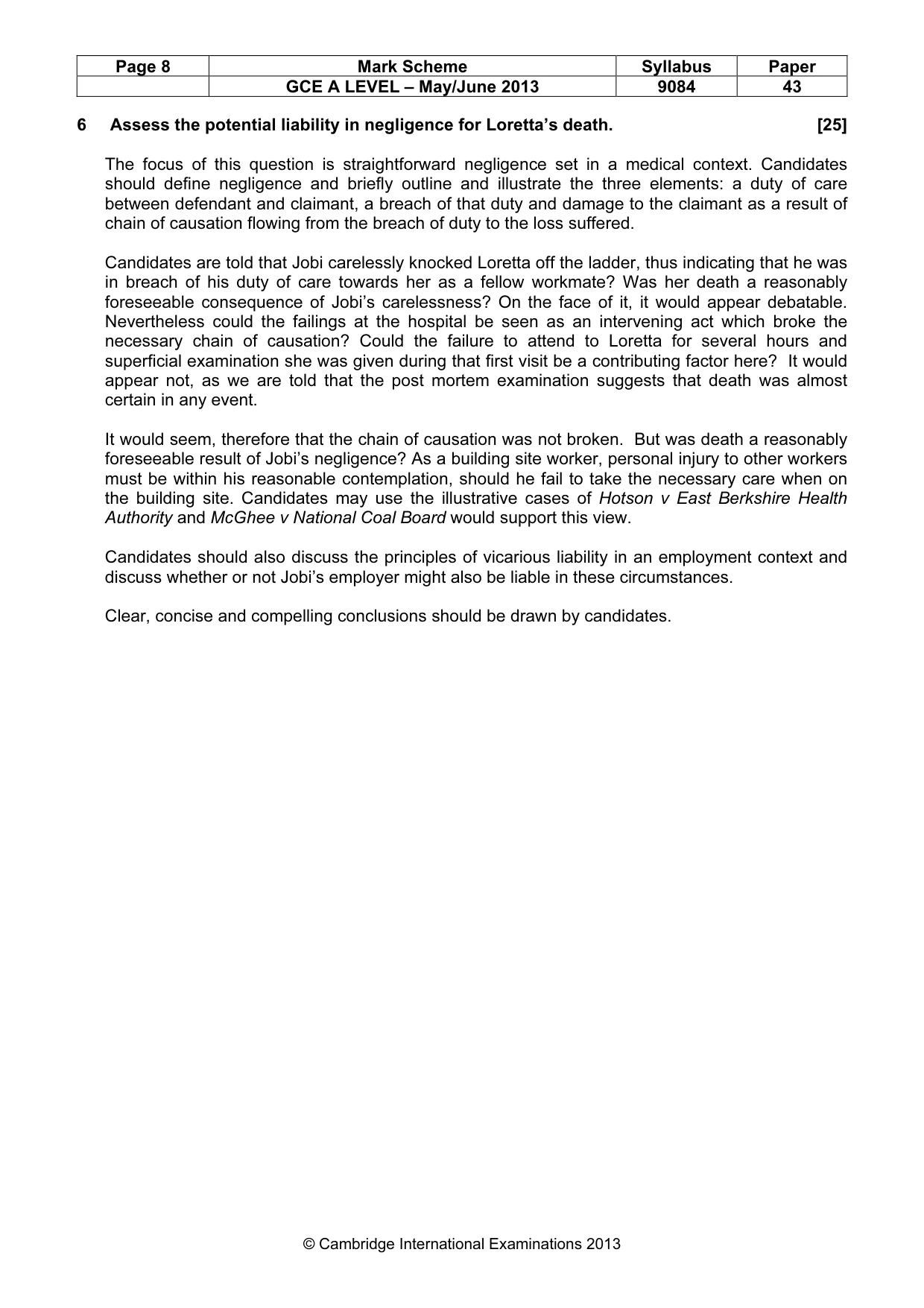
Page 8 Mark Scheme Syllabus Paper GCE A LEVEL – May/June 2013 9084 43 © Cambridge International Examinations 2013 6 Assess the potential liability in negligence for Loretta’s death. [25] The focus of this question is straightforward negligence set in a medical context. Candidates should define negligence and briefly outline and illustrate the three elements: a duty of care between defendant and claimant, a breach of that duty and damage to the claimant as a result of chain of causation flowing from the breach of duty to the loss suffered. Candidates are told that Jobi carelessly knocked Loretta off the ladder, thus indicating that he was in breach of his duty of care towards her as a fellow workmate? Was her death a reasonably foreseeable consequence of Jobi’s carelessness? On the face of it, it would appear debatable. Nevertheless could the failings at the hospital be seen as an intervening act which broke the necessary chain of causation? Could the failure to attend to Loretta for several hours and superficial examination she was given during that first visit be a contributing factor here? It would appear not, as we are told that the post mortem examination suggests that death was almost certain in any event. It would seem, therefore that the chain of causation was not broken. But was death a reasonably foreseeable result of Jobi’s negligence? As a building site worker, personal injury to other workers must be within his reasonable contemplation, should he fail to take the necessary care when on the building site. Candidates may use the illustrative cases of Hotson v East Berkshire Health Authority and McGhee v National Coal Board would support this view. Candidates should also discuss the principles of vicarious liability in an employment context and discuss whether or not Jobi’s employer might also be liable in these circumstances. Clear, concise and compelling conclusions should be drawn by candidates.
What you needed in this session
Cambridge’s own grade thresholds for 2013 May/June, Paper 4 · Variant 3. A higher threshold means an easier paper — the bar moves with how the cohort did.