Cambridge A Level Law 9084 — 2011 May/June Paper 4 · Variant 1
9084/41/M/J/11 · 75 marks · ≈84 min
The question paper and its mark scheme, free to read here and free to download. This is Cambridge’s own paper, exactly as it was sat.
Question paper4 pages

Mark scheme7 pages
Answers below. Sit the paper first if you are practising.
Paper as text
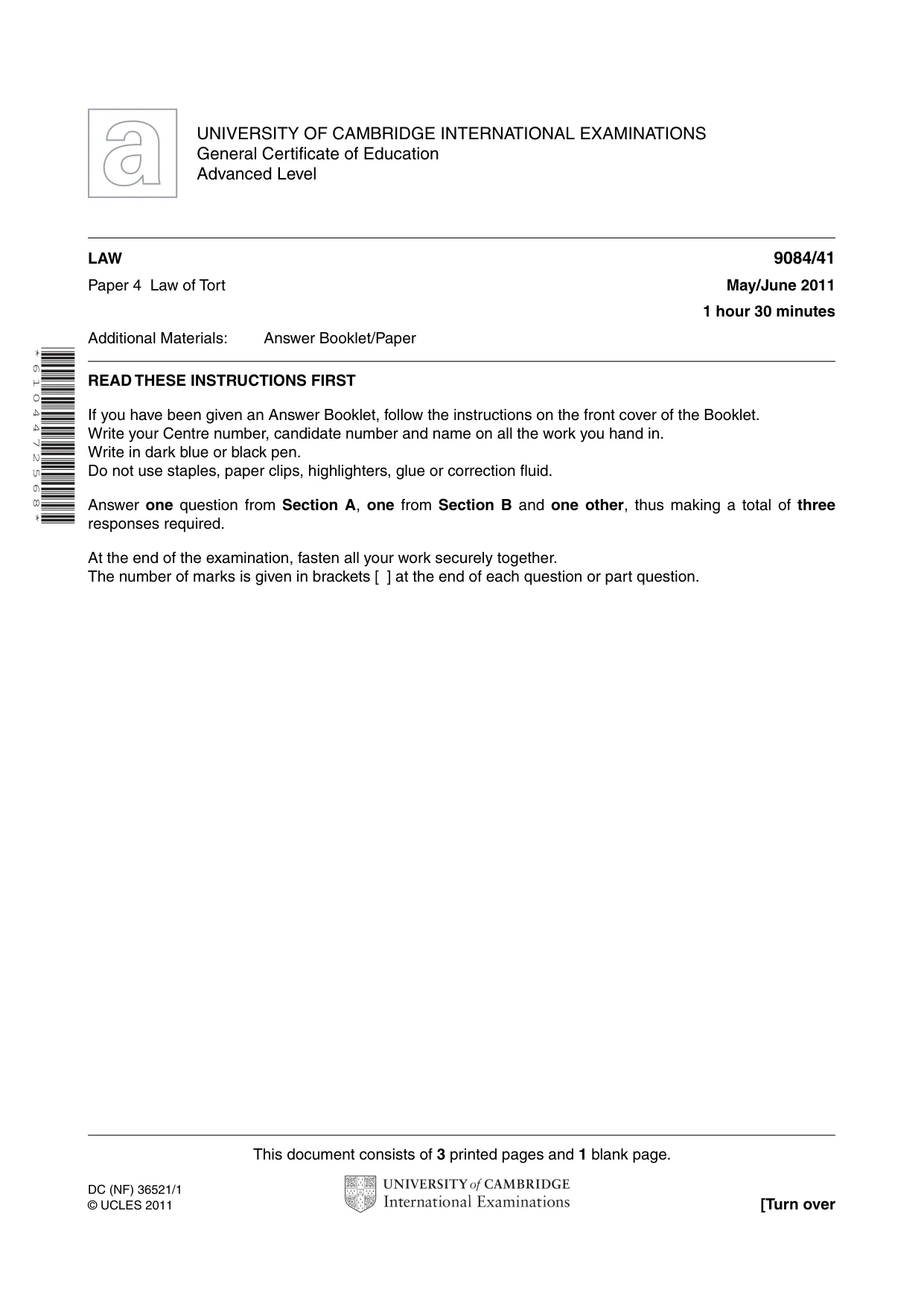
Question paper, page 1
This document consists of 3 printed pages and 1 blank page. DC (NF) 36521/1 © UCLES 2011 [Turn over UNIVERSITY OF CAMBRIDGE INTERNATIONAL EXAMINATIONS General Certificate of Education Advanced Level * 6 1 0 4 4 7 2 5 6 8 * LAW 9084/41 Paper 4 Law of Tort May/June 2011 1 hour 30 minutes Additional Materials: Answer Booklet/Paper READ THESE INSTRUCTIONS FIRST If you have been given an Answer Booklet, follow the instructions on the front cover of the Booklet. Write your Centre number, candidate number and name on all the work you hand in. Write in dark blue or black pen. Do not use staples, paper clips, highlighters, glue or correction fluid. Answer one question from Section A, one from Section B and one other, thus making a total of three responses required. At the end of the examination, fasten all your work securely together. The number of marks is given in brackets [ ] at the end of each question or part question.
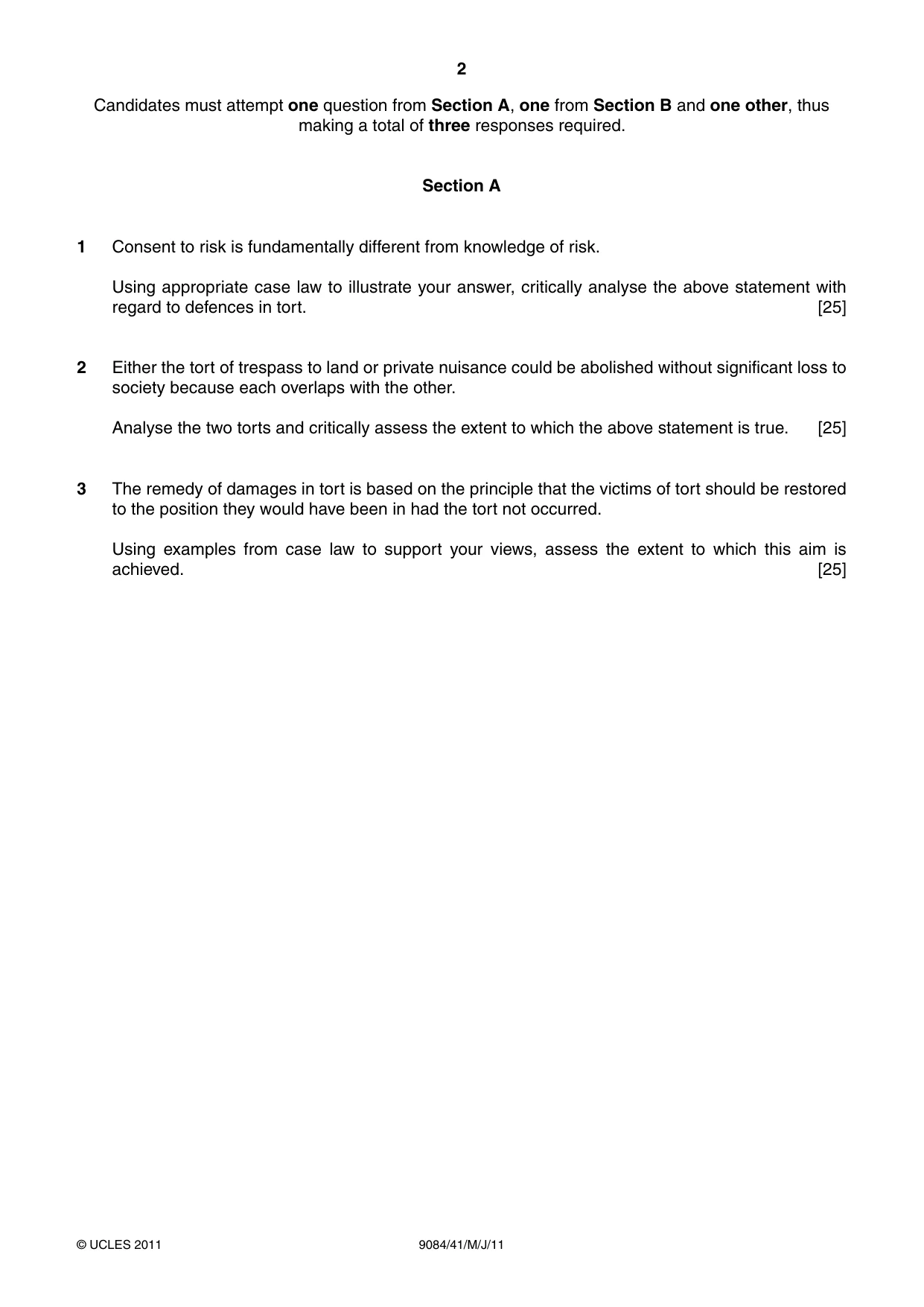
Question paper, page 2
2 9084/41/M/J/11 © UCLES 2011 Candidates must attempt one question from Section A, one from Section B and one other, thus making a total of three responses required. Section A 1 Consent to risk is fundamentally different from knowledge of risk. Using appropriate case law to illustrate your answer, critically analyse the above statement with regard to defences in tort. [25] 2 Either the tort of trespass to land or private nuisance could be abolished without significant loss to society because each overlaps with the other. Analyse the two torts and critically assess the extent to which the above statement is true. [25] 3 The remedy of damages in tort is based on the principle that the victims of tort should be restored to the position they would have been in had the tort not occurred. Using examples from case law to support your views, assess the extent to which this aim is achieved. [25]
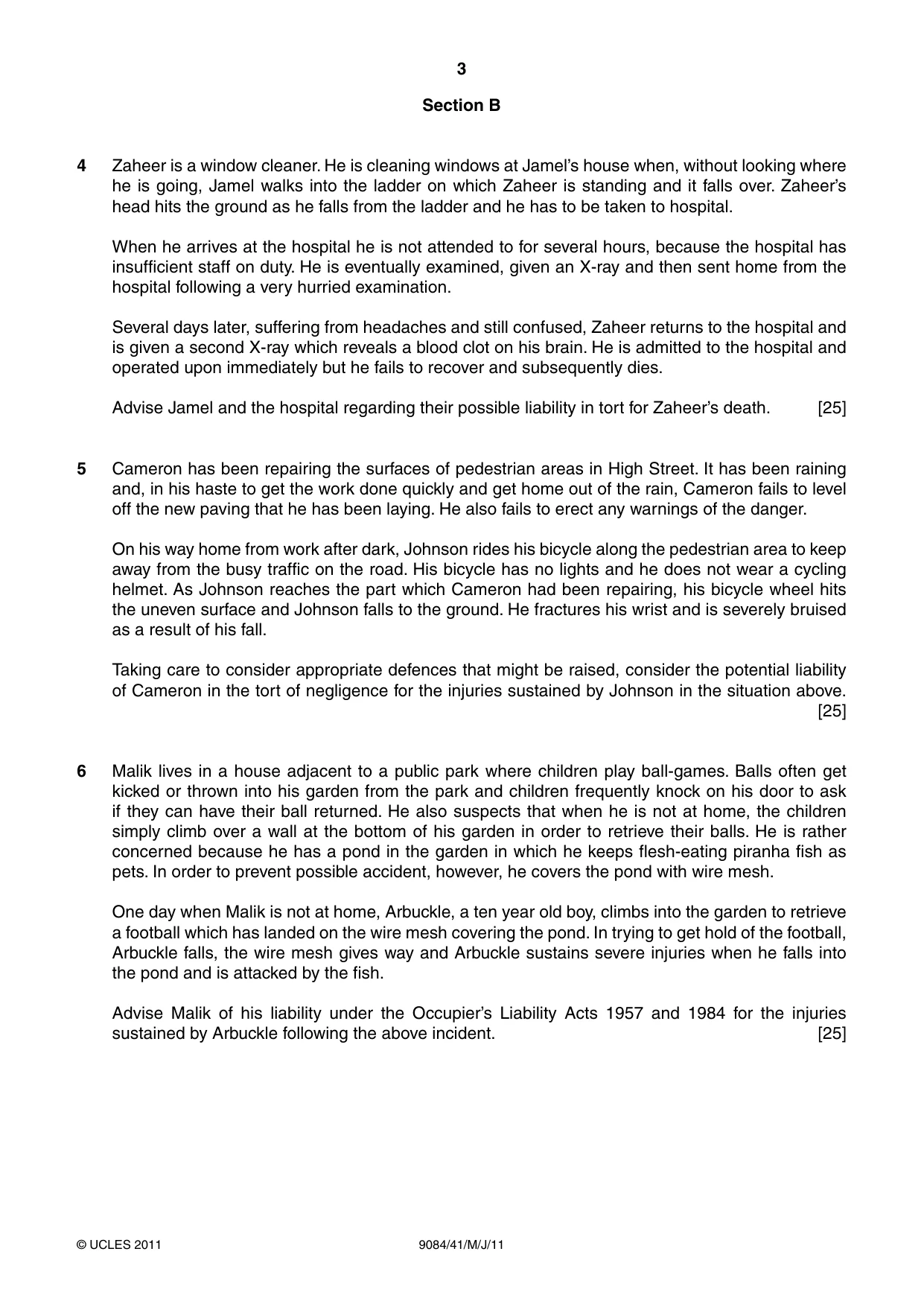
Question paper, page 3
3 9084/41/M/J/11 © UCLES 2011 Section B 4 Zaheer is a window cleaner. He is cleaning windows at Jamel’s house when, without looking where he is going, Jamel walks into the ladder on which Zaheer is standing and it falls over. Zaheer’s head hits the ground as he falls from the ladder and he has to be taken to hospital. When he arrives at the hospital he is not attended to for several hours, because the hospital has insufficient staff on duty. He is eventually examined, given an X-ray and then sent home from the hospital following a very hurried examination. Several days later, suffering from headaches and still confused, Zaheer returns to the hospital and is given a second X-ray which reveals a blood clot on his brain. He is admitted to the hospital and operated upon immediately but he fails to recover and subsequently dies. Advise Jamel and the hospital regarding their possible liability in tort for Zaheer’s death. [25] 5 Cameron has been repairing the surfaces of pedestrian areas in High Street. It has been raining and, in his haste to get the work done quickly and get home out of the rain, Cameron fails to level off the new paving that he has been laying. He also fails to erect any warnings of the danger. On his way home from work after dark, Johnson rides his bicycle along the pedestrian area to keep away from the busy traffic on the road. His bicycle has no lights and he does not wear a cycling helmet. As Johnson reaches the part which Cameron had been repairing, his bicycle wheel hits the uneven surface and Johnson falls to the ground. He fractures his wrist and is severely bruised as a result of his fall. Taking care to consider appropriate defences that might be raised, consider the potential liability of Cameron in the tort of negligence for the injuries sustained by Johnson in the situation above. [25] 6 Malik lives in a house adjacent to a public park where children play ball-games. Balls often get kicked or thrown into his garden from the park and children frequently knock on his door to ask if they can have their ball returned. He also suspects that when he is not at home, the children simply climb over a wall at the bottom of his garden in order to retrieve their balls. He is rather concerned because he has a pond in the garden in which he keeps flesh-eating piranha fish as pets. In order to prevent possible accident, however, he covers the pond with wire mesh. One day when Malik is not at home, Arbuckle, a ten year old boy, climbs into the garden to retrieve a football which has landed on the wire mesh covering the pond. In trying to get hold of the football, Arbuckle falls, the wire mesh gives way and Arbuckle sustains severe injuries when he falls into the pond and is attacked by the fish. Advise Malik of his liability under the Occupier’s Liability Acts 1957 and 1984 for the injuries sustained by Arbuckle following the above incident. [25]
Question paper, page 4
4 9084/41/M/J/11 © UCLES 2011 Permission to reproduce items where third-party owned material protected by copyright is included has been sought and cleared where possible. Every reasonable effort has been made by the publisher (UCLES) to trace copyright holders, but if any items requiring clearance have unwittingly been included, the publisher will be pleased to make amends at the earliest possible opportunity. University of Cambridge International Examinations is part of the Cambridge Assessment Group. Cambridge Assessment is the brand name of University of Cambridge Local Examinations Syndicate (UCLES), which is itself a department of the University of Cambridge. BLANK PAGE
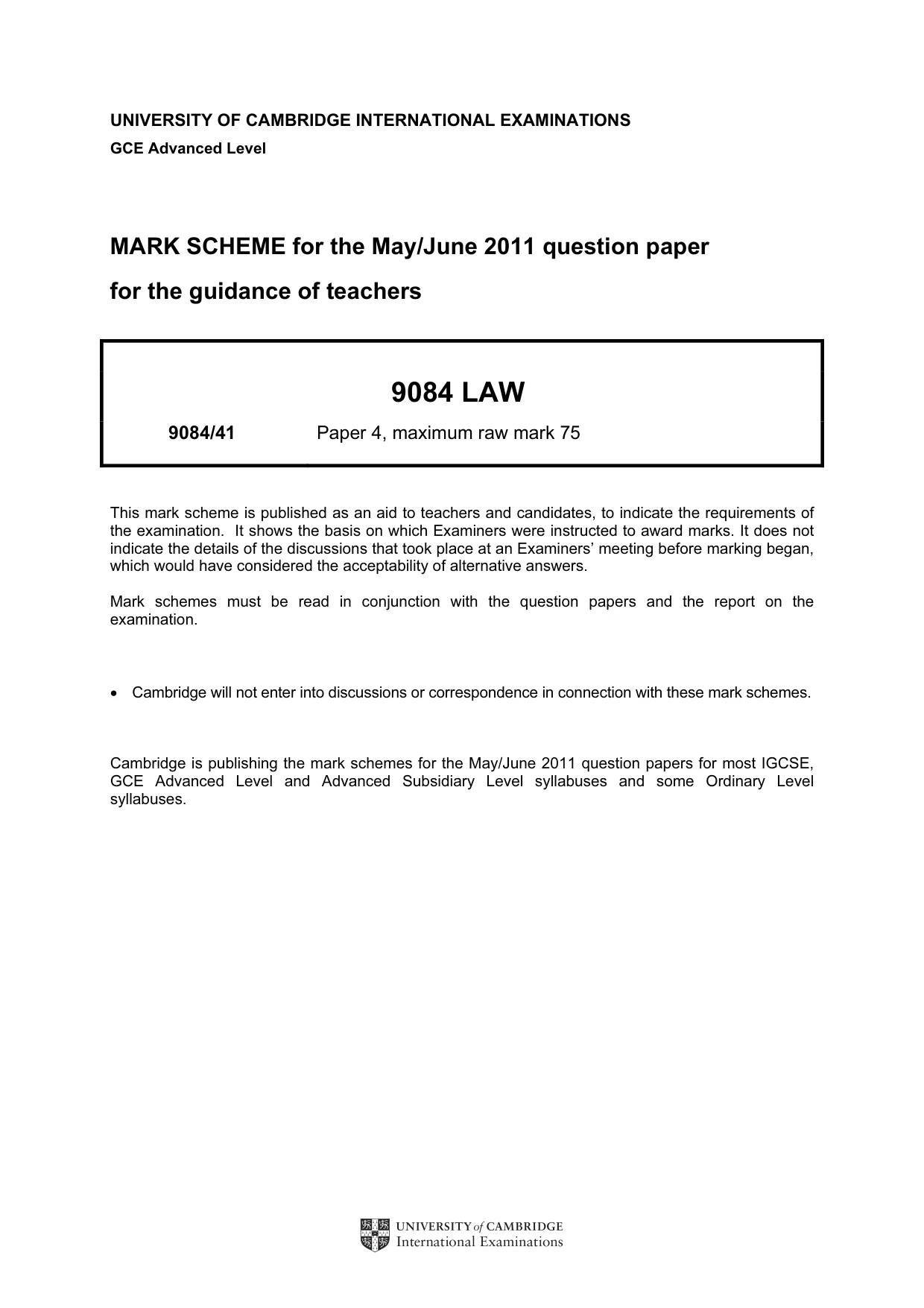
Mark scheme, page 1
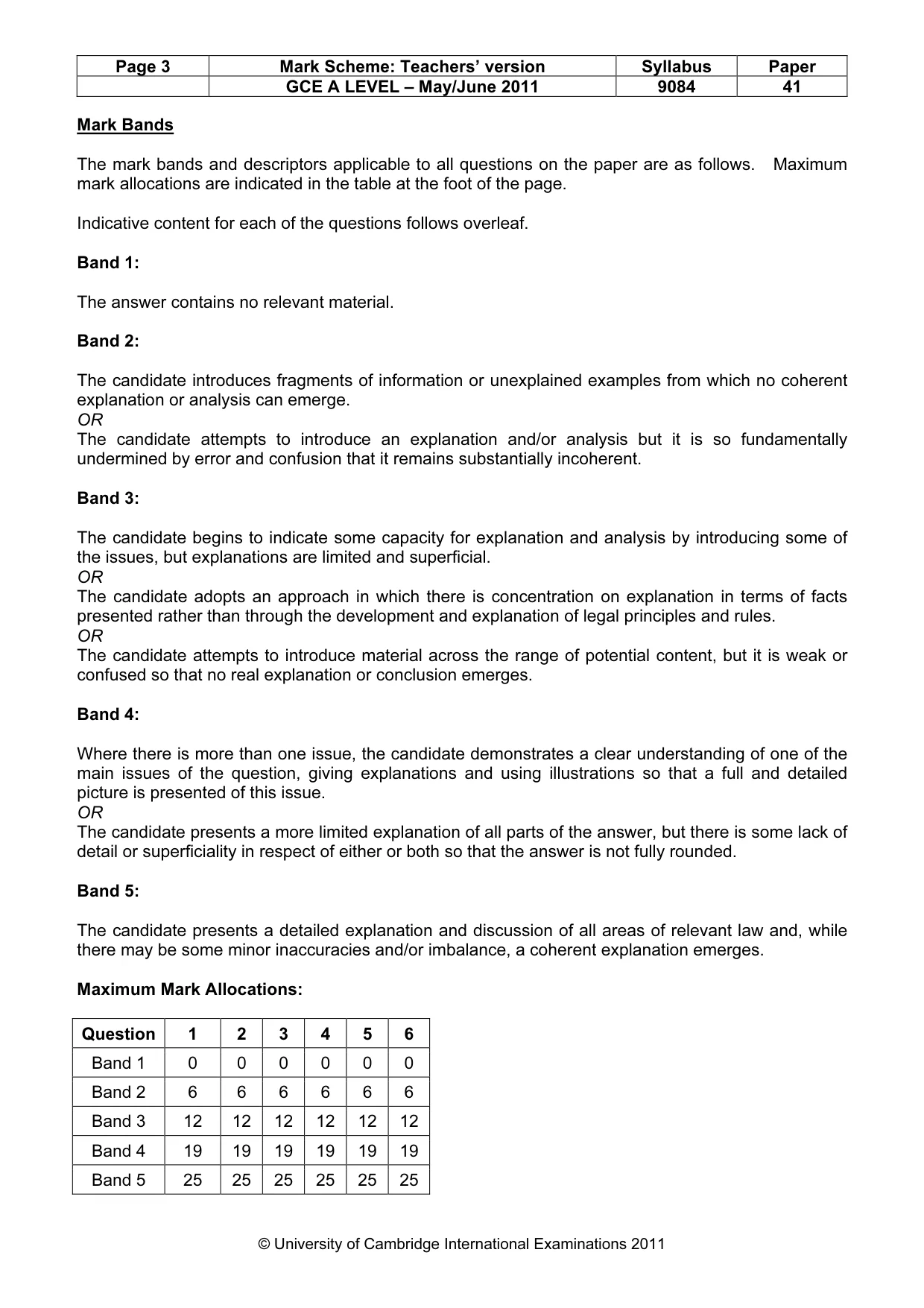
UNIVERSITY OF CAMBRIDGE INTERNATIONAL EXAMINATIONS GCE Advanced Level MARK SCHEME for the May/June 2011 question paper for the guidance of teachers 9084 LAW 9084/41 Paper 4, maximum raw mark 75 This mark scheme is published as an aid to teachers and candidates, to indicate the requirements of the examination. It shows the basis on which Examiners were instructed to award marks. It does not indicate the details of the discussions that took place at an Examiners’ meeting before marking began, which would have considered the acceptability of alternative answers. Mark schemes must be read in conjunction with the question papers and the report on the examination. • Cambridge will not enter into discussions or correspondence in connection with these mark schemes. Cambridge is publishing the mark schemes for the May/June 2011 question papers for most IGCSE, GCE Advanced Level and Advanced Subsidiary Level syllabuses and some Ordinary Level syllabuses.
Mark scheme, page 2
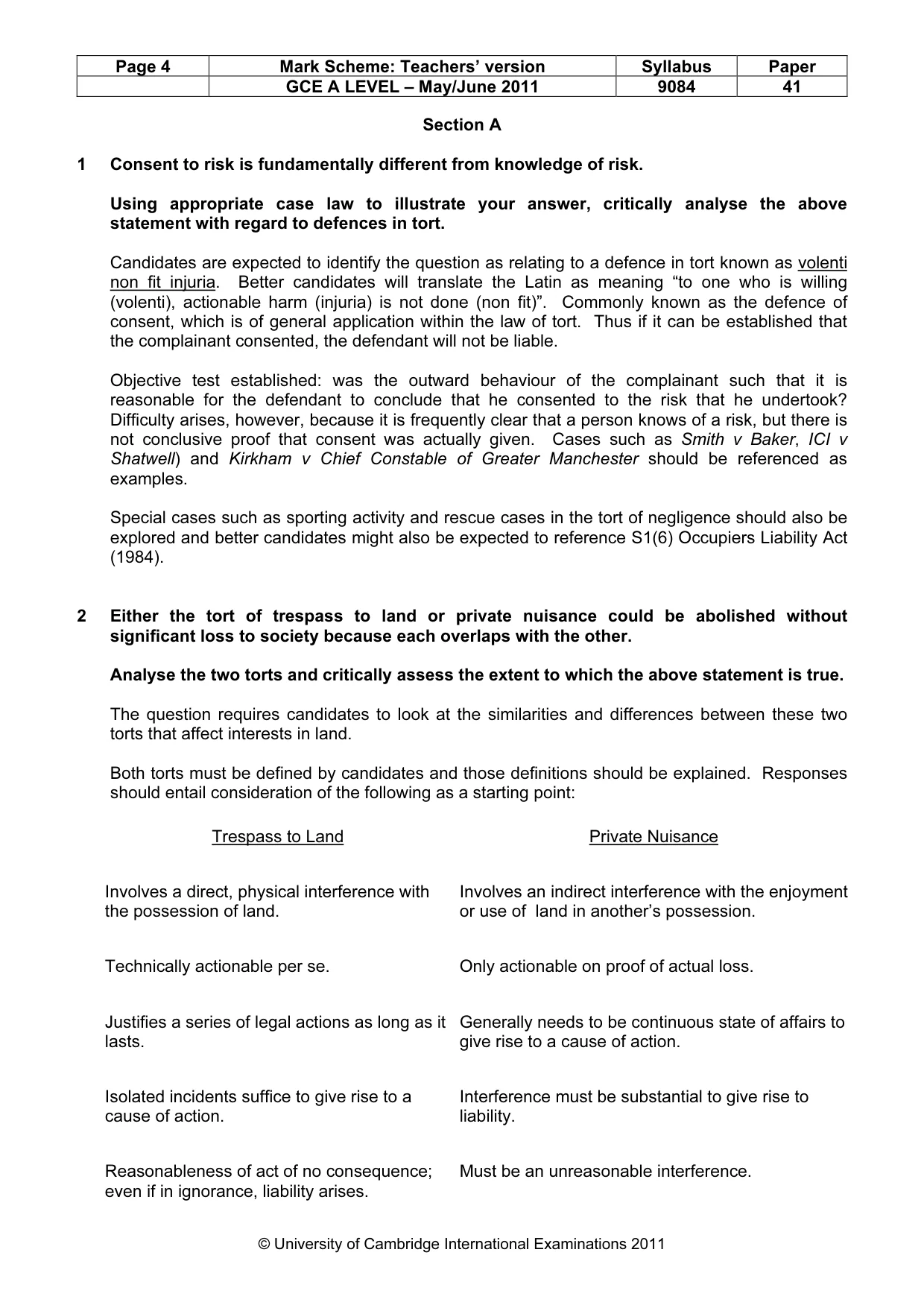
Page 2 Mark Scheme: Teachers’ version Syllabus Paper GCE A LEVEL – May/June 2011 9084 41 © University of Cambridge International Examinations 2011 Assessment Objectives Candidates are expected to demonstrate: Knowledge and Understanding – recall, select, use and develop knowledge and understanding of legal principles and rules by means of example and citation Analysis, Evaluation and Application – analyse and evaluate legal materials, situations and issues and accurately apply appropriate principles and rules Communication and Presentation – use appropriate legal terminology to present logical and coherent argument and to communicate relevant material in a clear and concise manner. Specification Grid The relationship between the Assessment Objectives and this individual component is detailed below. The objectives are weighted to give an indication of their relative importance, rather than to provide a precise statement of the percentage mark allocation to particular assessment objectives. Assessment Objective Paper 1 Paper 2 Paper 3 Paper 4 Advanced Level Knowledge/Understanding 50 50 50 50 50 Analysis/Evaluation/Application 40 40 40 40 40 Communication/Presentation 10 10 10 10 10
Mark scheme, page 3
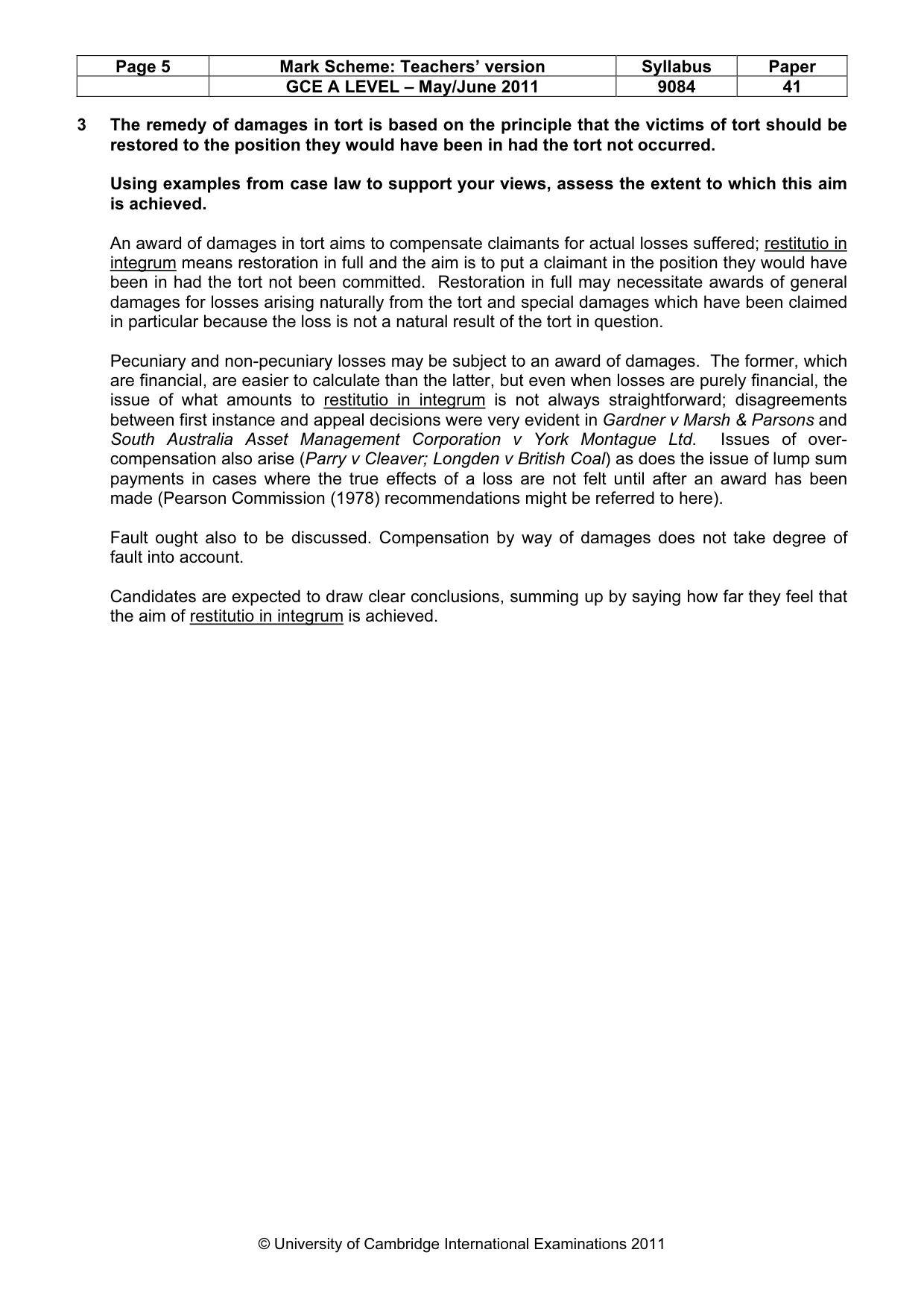
Page 3 Mark Scheme: Teachers’ version Syllabus Paper GCE A LEVEL – May/June 2011 9084 41 © University of Cambridge International Examinations 2011 Mark Bands The mark bands and descriptors applicable to all questions on the paper are as follows. Maximum mark allocations are indicated in the table at the foot of the page. Indicative content for each of the questions follows overleaf. Band 1: The answer contains no relevant material. Band 2: The candidate introduces fragments of information or unexplained examples from which no coherent explanation or analysis can emerge. OR The candidate attempts to introduce an explanation and/or analysis but it is so fundamentally undermined by error and confusion that it remains substantially incoherent. Band 3: The candidate begins to indicate some capacity for explanation and analysis by introducing some of the issues, but explanations are limited and superficial. OR The candidate adopts an approach in which there is concentration on explanation in terms of facts presented rather than through the development and explanation of legal principles and rules. OR The candidate attempts to introduce material across the range of potential content, but it is weak or confused so that no real explanation or conclusion emerges. Band 4: Where there is more than one issue, the candidate demonstrates a clear understanding of one of the main issues of the question, giving explanations and using illustrations so that a full and detailed picture is presented of this issue. OR The candidate presents a more limited explanation of all parts of the answer, but there is some lack of detail or superficiality in respect of either or both so that the answer is not fully rounded. Band 5: The candidate presents a detailed explanation and discussion of all areas of relevant law and, while there may be some minor inaccuracies and/or imbalance, a coherent explanation emerges. Maximum Mark Allocations: Question 1 2 3 4 5 6 Band 1 0 0 0 0 0 0 Band 2 6 6 6 6 6 6 Band 3 12 12 12 12 12 12 Band 4 19 19 19 19 19 19 Band 5 25 25 25 25 25 25
Mark scheme, page 4
Page 4 Mark Scheme: Teachers’ version Syllabus Paper GCE A LEVEL – May/June 2011 9084 41 © University of Cambridge International Examinations 2011 Section A 1 Consent to risk is fundamentally different from knowledge of risk. Using appropriate case law to illustrate your answer, critically analyse the above statement with regard to defences in tort. Candidates are expected to identify the question as relating to a defence in tort known as volenti non fit injuria. Better candidates will translate the Latin as meaning “to one who is willing (volenti), actionable harm (injuria) is not done (non fit)”. Commonly known as the defence of consent, which is of general application within the law of tort. Thus if it can be established that the complainant consented, the defendant will not be liable. Objective test established: was the outward behaviour of the complainant such that it is reasonable for the defendant to conclude that he consented to the risk that he undertook? Difficulty arises, however, because it is frequently clear that a person knows of a risk, but there is not conclusive proof that consent was actually given. Cases such as Smith v Baker, ICI v Shatwell) and Kirkham v Chief Constable of Greater Manchester should be referenced as examples. Special cases such as sporting activity and rescue cases in the tort of negligence should also be explored and better candidates might also be expected to reference S1(6) Occupiers Liability Act (1984). 2 Either the tort of trespass to land or private nuisance could be abolished without significant loss to society because each overlaps with the other. Analyse the two torts and critically assess the extent to which the above statement is true. The question requires candidates to look at the similarities and differences between these two torts that affect interests in land. Both torts must be defined by candidates and those definitions should be explained. Responses should entail consideration of the following as a starting point: Trespass to Land Private Nuisance Involves a direct, physical interference with the possession of land. Involves an indirect interference with the enjoyment or use of land in another’s possession. Technically actionable per se. Only actionable on proof of actual loss. Justifies a series of legal actions as long as it lasts. Generally needs to be continuous state of affairs to give rise to a cause of action. Isolated incidents suffice to give rise to a cause of action. Interference must be substantial to give rise to liability. Reasonableness of act of no consequence; even if in ignorance, liability arises. Must be an unreasonable interference.
Mark scheme, page 5
Page 5 Mark Scheme: Teachers’ version Syllabus Paper GCE A LEVEL – May/June 2011 9084 41 © University of Cambridge International Examinations 2011 3 The remedy of damages in tort is based on the principle that the victims of tort should be restored to the position they would have been in had the tort not occurred. Using examples from case law to support your views, assess the extent to which this aim is achieved. An award of damages in tort aims to compensate claimants for actual losses suffered; restitutio in integrum means restoration in full and the aim is to put a claimant in the position they would have been in had the tort not been committed. Restoration in full may necessitate awards of general damages for losses arising naturally from the tort and special damages which have been claimed in particular because the loss is not a natural result of the tort in question. Pecuniary and non-pecuniary losses may be subject to an award of damages. The former, which are financial, are easier to calculate than the latter, but even when losses are purely financial, the issue of what amounts to restitutio in integrum is not always straightforward; disagreements between first instance and appeal decisions were very evident in Gardner v Marsh & Parsons and South Australia Asset Management Corporation v York Montague Ltd. Issues of over- compensation also arise (Parry v Cleaver; Longden v British Coal) as does the issue of lump sum payments in cases where the true effects of a loss are not felt until after an award has been made (Pearson Commission (1978) recommendations might be referred to here). Fault ought also to be discussed. Compensation by way of damages does not take degree of fault into account. Candidates are expected to draw clear conclusions, summing up by saying how far they feel that the aim of restitutio in integrum is achieved.
Mark scheme, page 6
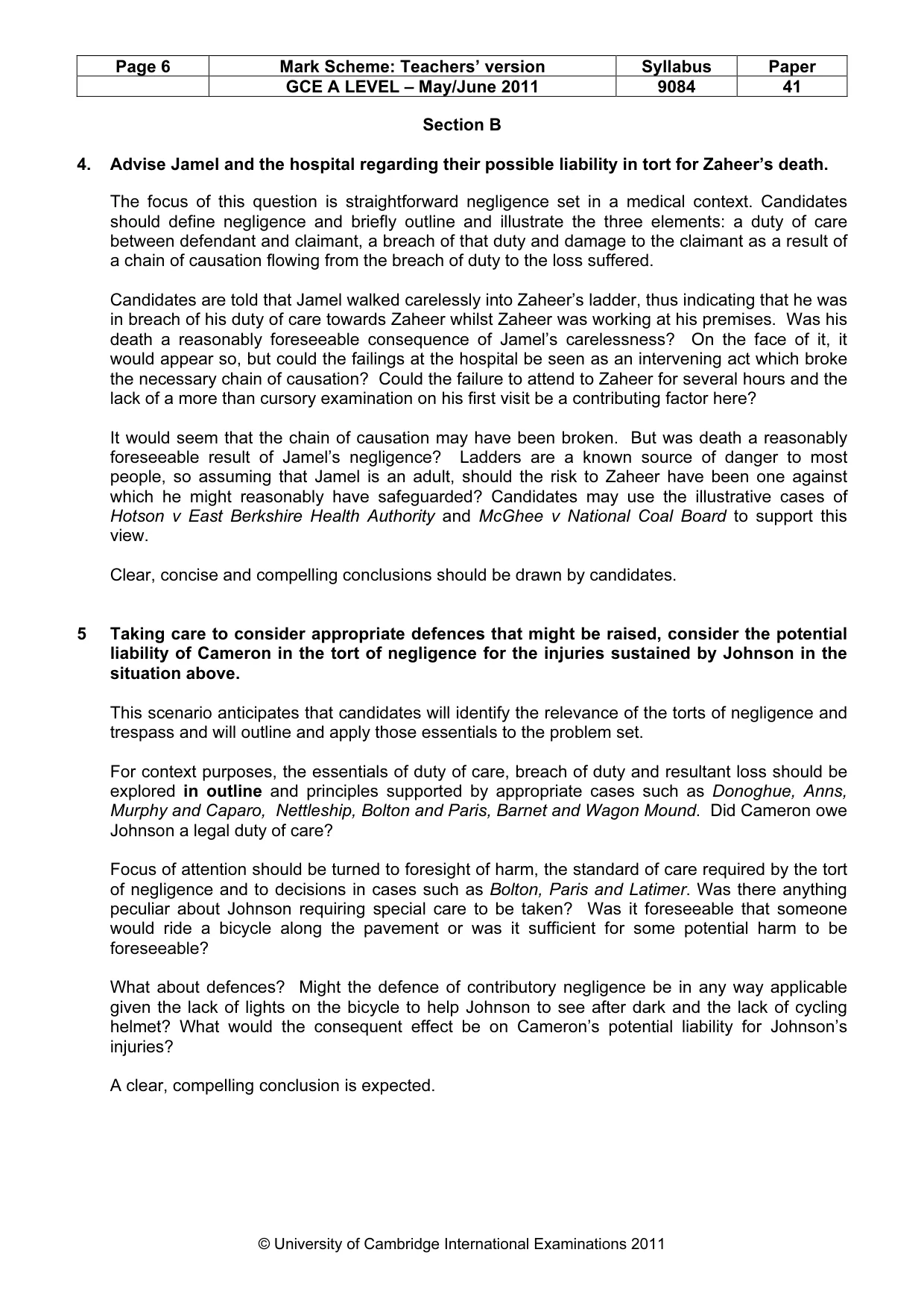
Page 6 Mark Scheme: Teachers’ version Syllabus Paper GCE A LEVEL – May/June 2011 9084 41 © University of Cambridge International Examinations 2011 Section B 4. Advise Jamel and the hospital regarding their possible liability in tort for Zaheer’s death. The focus of this question is straightforward negligence set in a medical context. Candidates should define negligence and briefly outline and illustrate the three elements: a duty of care between defendant and claimant, a breach of that duty and damage to the claimant as a result of a chain of causation flowing from the breach of duty to the loss suffered. Candidates are told that Jamel walked carelessly into Zaheer’s ladder, thus indicating that he was in breach of his duty of care towards Zaheer whilst Zaheer was working at his premises. Was his death a reasonably foreseeable consequence of Jamel’s carelessness? On the face of it, it would appear so, but could the failings at the hospital be seen as an intervening act which broke the necessary chain of causation? Could the failure to attend to Zaheer for several hours and the lack of a more than cursory examination on his first visit be a contributing factor here? It would seem that the chain of causation may have been broken. But was death a reasonably foreseeable result of Jamel’s negligence? Ladders are a known source of danger to most people, so assuming that Jamel is an adult, should the risk to Zaheer have been one against which he might reasonably have safeguarded? Candidates may use the illustrative cases of Hotson v East Berkshire Health Authority and McGhee v National Coal Board to support this view. Clear, concise and compelling conclusions should be drawn by candidates. 5 Taking care to consider appropriate defences that might be raised, consider the potential liability of Cameron in the tort of negligence for the injuries sustained by Johnson in the situation above. This scenario anticipates that candidates will identify the relevance of the torts of negligence and trespass and will outline and apply those essentials to the problem set. For context purposes, the essentials of duty of care, breach of duty and resultant loss should be explored in outline and principles supported by appropriate cases such as Donoghue, Anns, Murphy and Caparo, Nettleship, Bolton and Paris, Barnet and Wagon Mound. Did Cameron owe Johnson a legal duty of care? Focus of attention should be turned to foresight of harm, the standard of care required by the tort of negligence and to decisions in cases such as Bolton, Paris and Latimer. Was there anything peculiar about Johnson requiring special care to be taken? Was it foreseeable that someone would ride a bicycle along the pavement or was it sufficient for some potential harm to be foreseeable? What about defences? Might the defence of contributory negligence be in any way applicable given the lack of lights on the bicycle to help Johnson to see after dark and the lack of cycling helmet? What would the consequent effect be on Cameron’s potential liability for Johnson’s injuries? A clear, compelling conclusion is expected.
Mark scheme, page 7
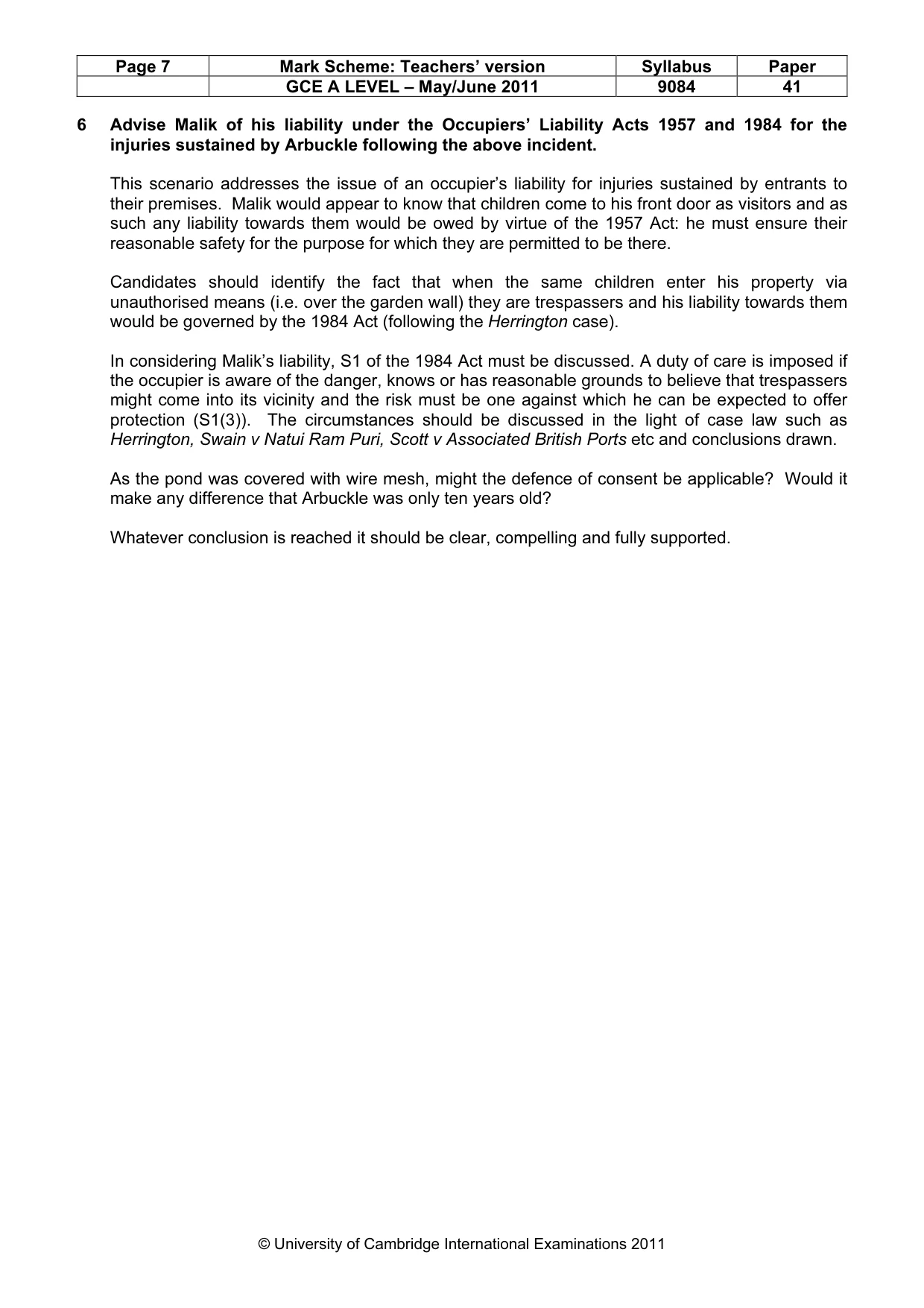
Page 7 Mark Scheme: Teachers’ version Syllabus Paper GCE A LEVEL – May/June 2011 9084 41 © University of Cambridge International Examinations 2011 6 Advise Malik of his liability under the Occupiers’ Liability Acts 1957 and 1984 for the injuries sustained by Arbuckle following the above incident. This scenario addresses the issue of an occupier’s liability for injuries sustained by entrants to their premises. Malik would appear to know that children come to his front door as visitors and as such any liability towards them would be owed by virtue of the 1957 Act: he must ensure their reasonable safety for the purpose for which they are permitted to be there. Candidates should identify the fact that when the same children enter his property via unauthorised means (i.e. over the garden wall) they are trespassers and his liability towards them would be governed by the 1984 Act (following the Herrington case). In considering Malik’s liability, S1 of the 1984 Act must be discussed. A duty of care is imposed if the occupier is aware of the danger, knows or has reasonable grounds to believe that trespassers might come into its vicinity and the risk must be one against which he can be expected to offer protection (S1(3)). The circumstances should be discussed in the light of case law such as Herrington, Swain v Natui Ram Puri, Scott v Associated British Ports etc and conclusions drawn. As the pond was covered with wire mesh, might the defence of consent be applicable? Would it make any difference that Arbuckle was only ten years old? Whatever conclusion is reached it should be clear, compelling and fully supported.
What you needed in this session
Cambridge’s own grade thresholds for 2011 May/June, Paper 4 · Variant 1. A higher threshold means an easier paper — the bar moves with how the cohort did.