Cambridge A Level Law 9084 — 2010 Oct/Nov Paper 4 · Variant 1
9084/41/O/N/10 · 75 marks · ≈84 min
The question paper and its mark scheme, free to read here and free to download. This is Cambridge’s own paper, exactly as it was sat.
Question paper4 pages

Mark scheme7 pages
Answers below. Sit the paper first if you are practising.
Paper as text
Question paper, page 1
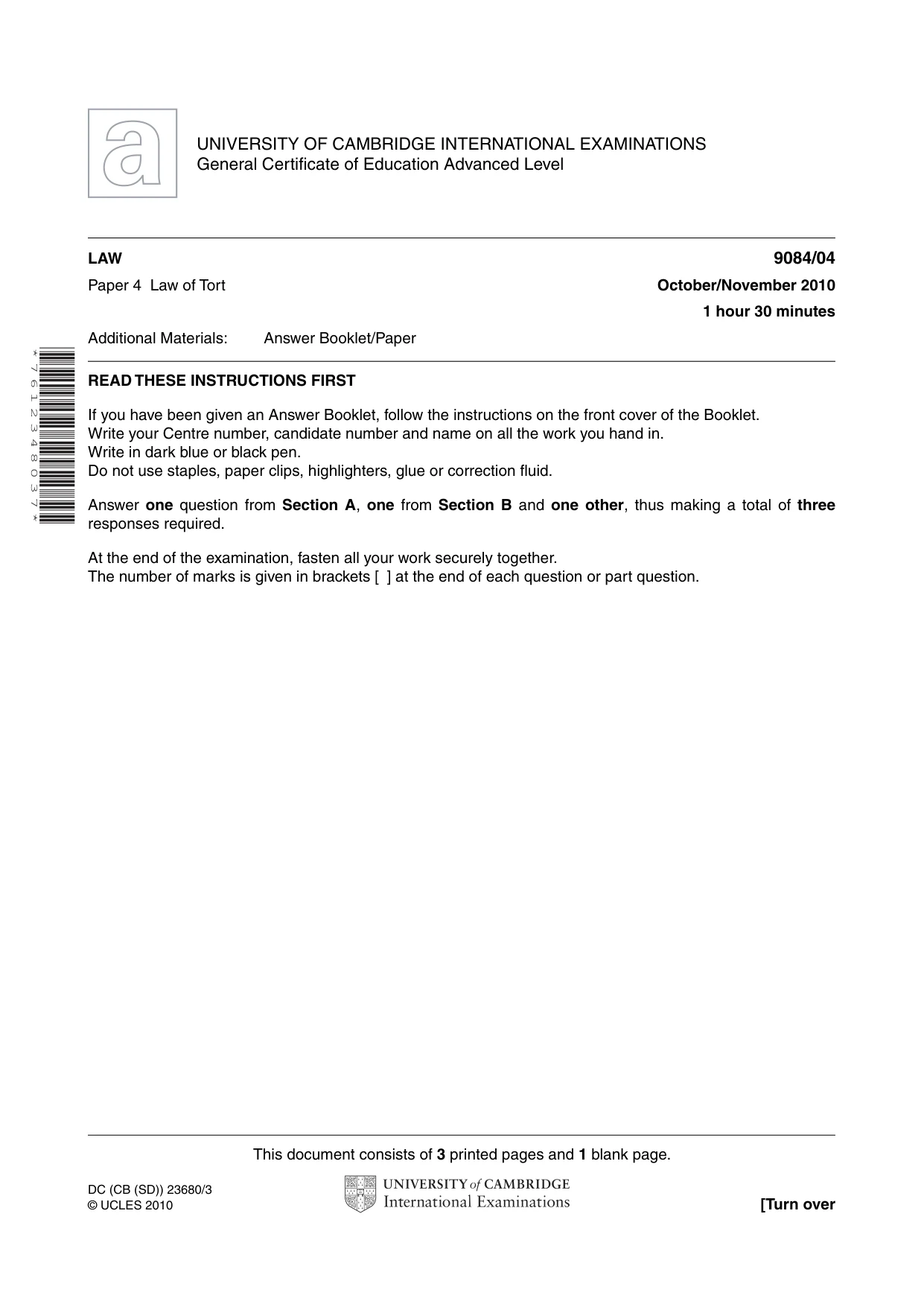
This document consists of 3 printed pages and 1 blank page. DC (CB (SD)) 23680/3 © UCLES 2010 [Turn over UNIVERSITY OF CAMBRIDGE INTERNATIONAL EXAMINATIONS General Certificate of Education Advanced Level * 7 6 1 2 3 4 8 0 3 7 * LAW 9084/04 Paper 4 Law of Tort October/November 2010 1 hour 30 minutes Additional Materials: Answer Booklet/Paper READ THESE INSTRUCTIONS FIRST If you have been given an Answer Booklet, follow the instructions on the front cover of the Booklet. Write your Centre number, candidate number and name on all the work you hand in. Write in dark blue or black pen. Do not use staples, paper clips, highlighters, glue or correction fluid. Answer one question from Section A, one from Section B and one other, thus making a total of three responses required. At the end of the examination, fasten all your work securely together. The number of marks is given in brackets [ ] at the end of each question or part question.
Question paper, page 2
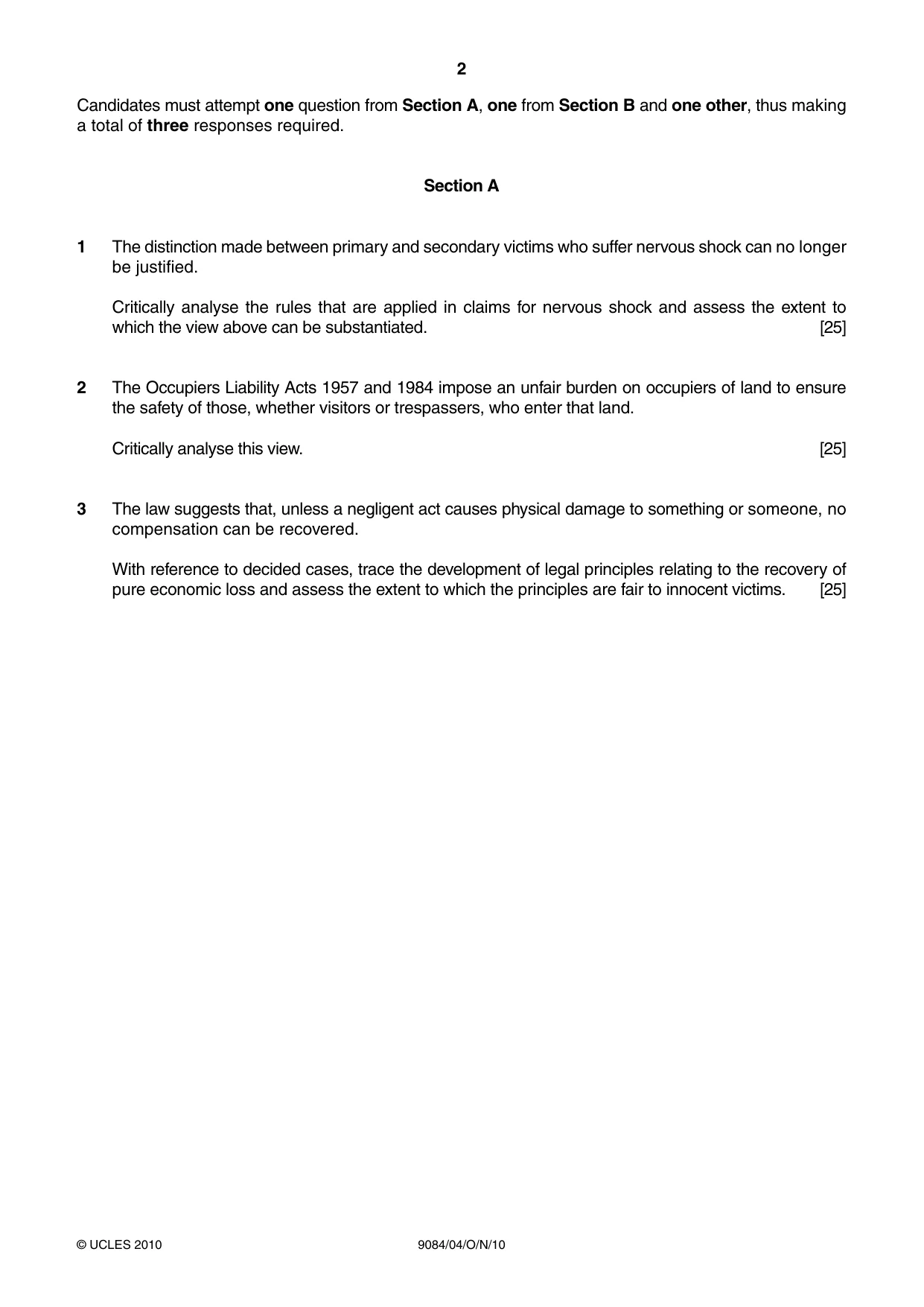
2 9084/04/O/N/10 © UCLES 2010 Candidates must attempt one question from Section A, one from Section B and one other, thus making a total of three responses required. Section A 1 The distinction made between primary and secondary victims who suffer nervous shock can no longer be justified. Critically analyse the rules that are applied in claims for nervous shock and assess the extent to which the view above can be substantiated. [25] 2 The Occupiers Liability Acts 1957 and 1984 impose an unfair burden on occupiers of land to ensure the safety of those, whether visitors or trespassers, who enter that land. Critically analyse this view. [25] 3 The law suggests that, unless a negligent act causes physical damage to something or someone, no compensation can be recovered. With reference to decided cases, trace the development of legal principles relating to the recovery of pure economic loss and assess the extent to which the principles are fair to innocent victims. [25]
Question paper, page 3
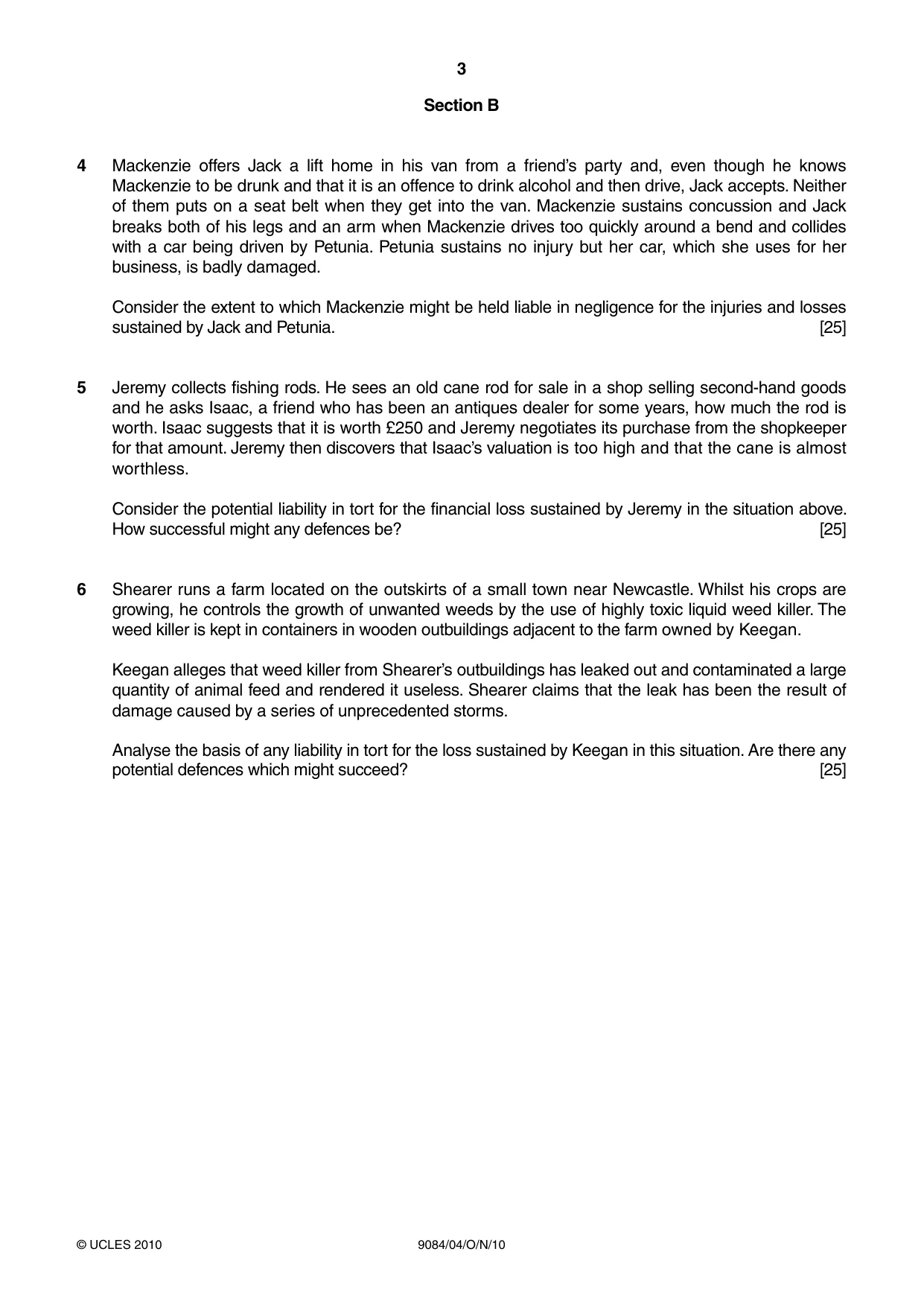
3 9084/04/O/N/10 © UCLES 2010 Section B 4 Mackenzie offers Jack a lift home in his van from a friend’s party and, even though he knows Mackenzie to be drunk and that it is an offence to drink alcohol and then drive, Jack accepts. Neither of them puts on a seat belt when they get into the van. Mackenzie sustains concussion and Jack breaks both of his legs and an arm when Mackenzie drives too quickly around a bend and collides with a car being driven by Petunia. Petunia sustains no injury but her car, which she uses for her business, is badly damaged. Consider the extent to which Mackenzie might be held liable in negligence for the injuries and losses sustained by Jack and Petunia. [25] 5 Jeremy collects fishing rods. He sees an old cane rod for sale in a shop selling second-hand goods and he asks Isaac, a friend who has been an antiques dealer for some years, how much the rod is worth. Isaac suggests that it is worth £250 and Jeremy negotiates its purchase from the shopkeeper for that amount. Jeremy then discovers that Isaac’s valuation is too high and that the cane is almost worthless. Consider the potential liability in tort for the financial loss sustained by Jeremy in the situation above. How successful might any defences be? [25] 6 Shearer runs a farm located on the outskirts of a small town near Newcastle. Whilst his crops are growing, he controls the growth of unwanted weeds by the use of highly toxic liquid weed killer. The weed killer is kept in containers in wooden outbuildings adjacent to the farm owned by Keegan. Keegan alleges that weed killer from Shearer’s outbuildings has leaked out and contaminated a large quantity of animal feed and rendered it useless. Shearer claims that the leak has been the result of damage caused by a series of unprecedented storms. Analyse the basis of any liability in tort for the loss sustained by Keegan in this situation. Are there any potential defences which might succeed? [25]
Question paper, page 4
4 9084/04/O/N/10 © UCLES 2010 Permission to reproduce items where third-party owned material protected by copyright is included has been sought and cleared where possible. Every reasonable effort has been made by the publisher (UCLES) to trace copyright holders, but if any items requiring clearance have unwittingly been included, the publisher will be pleased to make amends at the earliest possible opportunity. University of Cambridge International Examinations is part of the Cambridge Assessment Group. Cambridge Assessment is the brand name of University of Cambridge Local Examinations Syndicate (UCLES), which is itself a department of the University of Cambridge. BLANK PAGE
Mark scheme, page 1
UNIVERSITY OF CAMBRIDGE INTERNATIONAL EXAMINATIONS GCE Advanced Subsidiary Level and GCE Advanced Level MARK SCHEME for the October/November 2010 question paper for the guidance of teachers 9084 LAW 9084/04 Paper 4, maximum raw mark 75 This mark scheme is published as an aid to teachers and candidates, to indicate the requirements of the examination. It shows the basis on which Examiners were instructed to award marks. It does not indicate the details of the discussions that took place at an Examiners’ meeting before marking began, which would have considered the acceptability of alternative answers. Mark schemes must be read in conjunction with the question papers and the report on the examination. • CIE will not enter into discussions or correspondence in connection with these mark schemes. CIE is publishing the mark schemes for the October/November 2010 question papers for most IGCSE, GCE Advanced Level and Advanced Subsidiary Level syllabuses and some Ordinary Level syllabuses.
Mark scheme, page 2
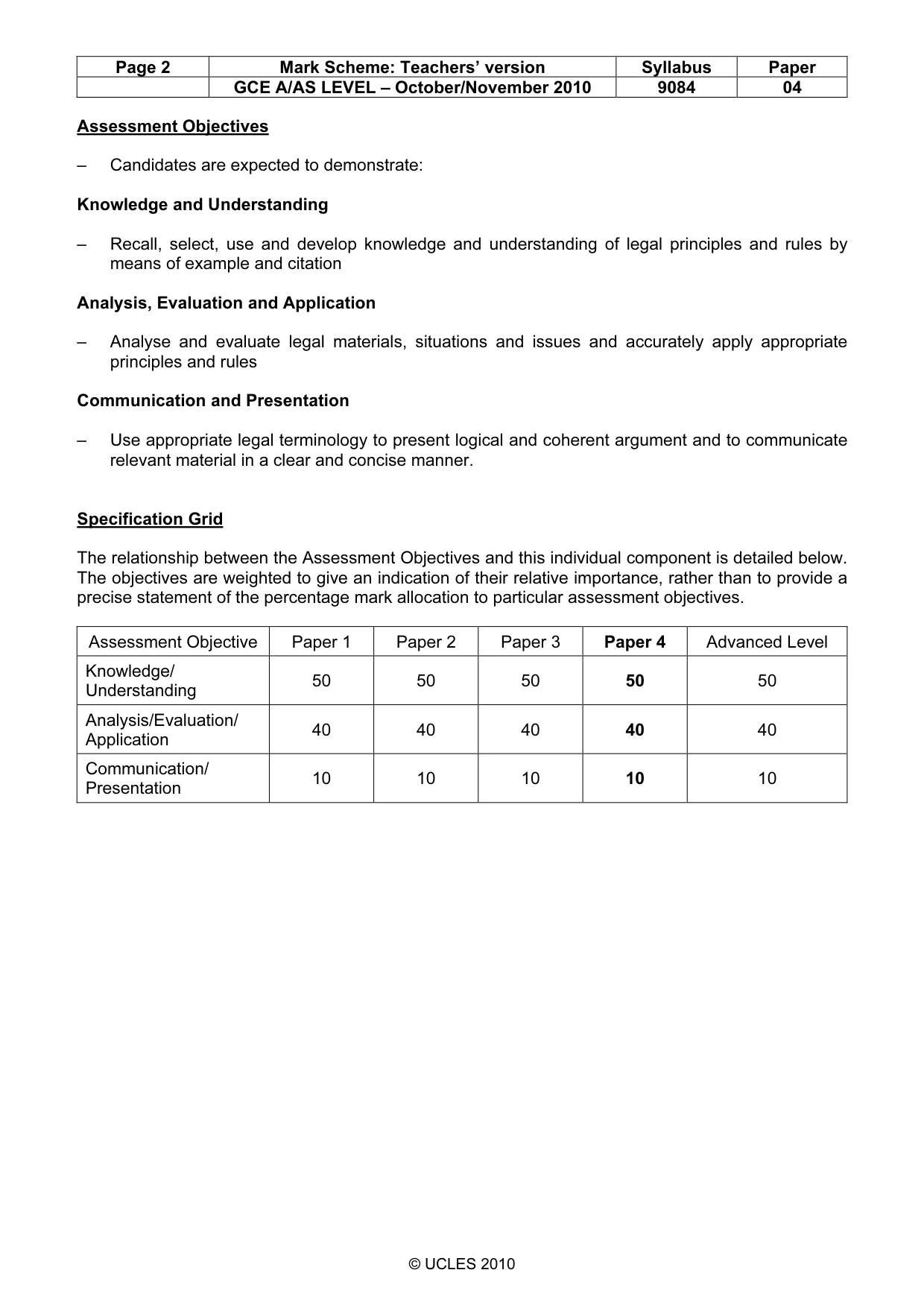
Page 2 Mark Scheme: Teachers’ version Syllabus Paper GCE A/AS LEVEL – October/November 2010 9084 04 © UCLES 2010 Assessment Objectives – Candidates are expected to demonstrate: Knowledge and Understanding – Recall, select, use and develop knowledge and understanding of legal principles and rules by means of example and citation Analysis, Evaluation and Application – Analyse and evaluate legal materials, situations and issues and accurately apply appropriate principles and rules Communication and Presentation – Use appropriate legal terminology to present logical and coherent argument and to communicate relevant material in a clear and concise manner. Specification Grid The relationship between the Assessment Objectives and this individual component is detailed below. The objectives are weighted to give an indication of their relative importance, rather than to provide a precise statement of the percentage mark allocation to particular assessment objectives. Assessment Objective Paper 1 Paper 2 Paper 3 Paper 4 Advanced Level Knowledge/ Understanding 50 50 50 50 50 Analysis/Evaluation/ Application 40 40 40 40 40 Communication/ Presentation 10 10 10 10 10
Mark scheme, page 3
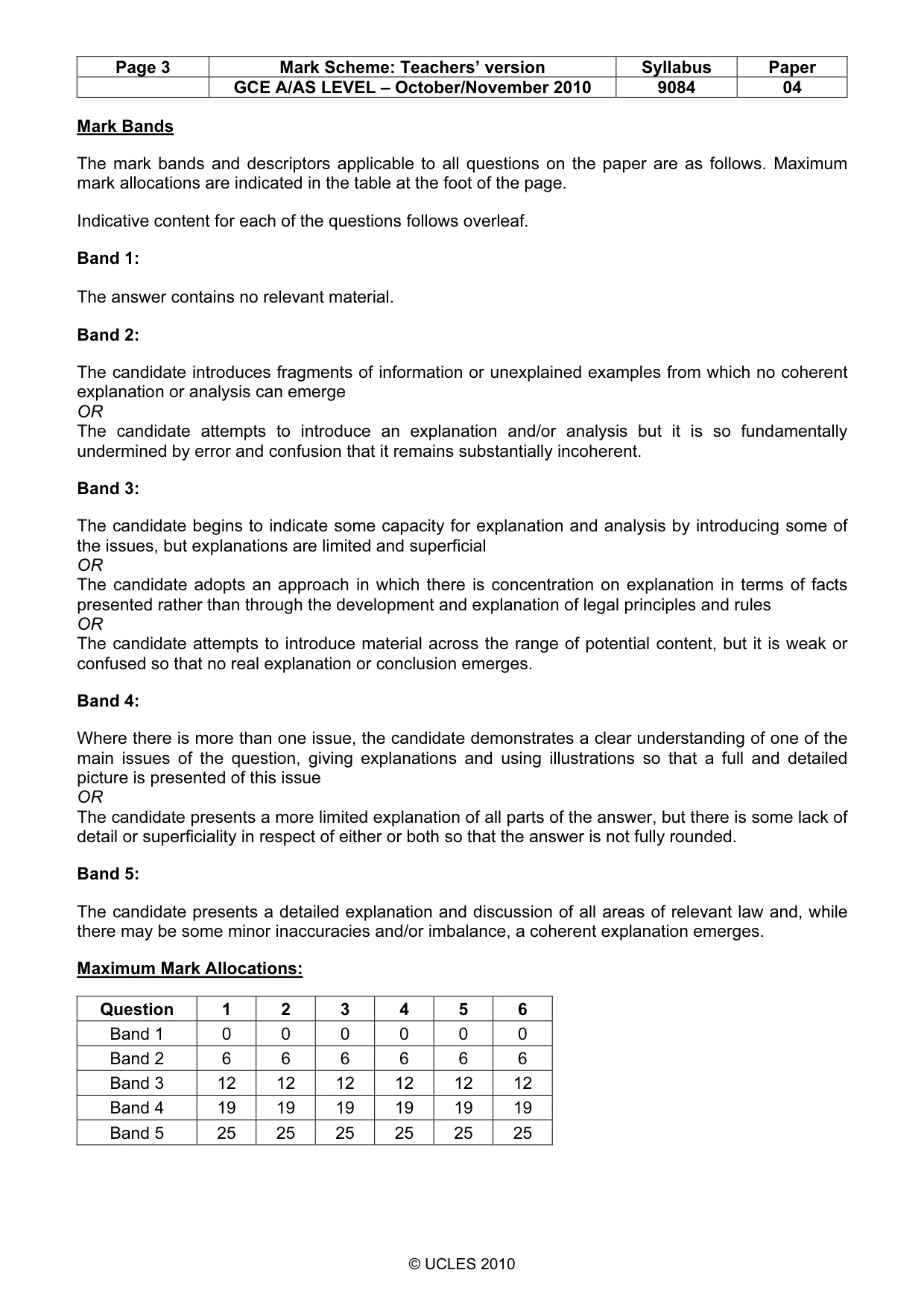
Page 3 Mark Scheme: Teachers’ version Syllabus Paper GCE A/AS LEVEL – October/November 2010 9084 04 © UCLES 2010 Mark Bands The mark bands and descriptors applicable to all questions on the paper are as follows. Maximum mark allocations are indicated in the table at the foot of the page. Indicative content for each of the questions follows overleaf. Band 1: The answer contains no relevant material. Band 2: The candidate introduces fragments of information or unexplained examples from which no coherent explanation or analysis can emerge OR The candidate attempts to introduce an explanation and/or analysis but it is so fundamentally undermined by error and confusion that it remains substantially incoherent. Band 3: The candidate begins to indicate some capacity for explanation and analysis by introducing some of the issues, but explanations are limited and superficial OR The candidate adopts an approach in which there is concentration on explanation in terms of facts presented rather than through the development and explanation of legal principles and rules OR The candidate attempts to introduce material across the range of potential content, but it is weak or confused so that no real explanation or conclusion emerges. Band 4: Where there is more than one issue, the candidate demonstrates a clear understanding of one of the main issues of the question, giving explanations and using illustrations so that a full and detailed picture is presented of this issue OR The candidate presents a more limited explanation of all parts of the answer, but there is some lack of detail or superficiality in respect of either or both so that the answer is not fully rounded. Band 5: The candidate presents a detailed explanation and discussion of all areas of relevant law and, while there may be some minor inaccuracies and/or imbalance, a coherent explanation emerges. Maximum Mark Allocations: Question 1 2 3 4 5 6 Band 1 0 0 0 0 0 0 Band 2 6 6 6 6 6 6 Band 3 12 12 12 12 12 12 Band 4 19 19 19 19 19 19 Band 5 25 25 25 25 25 25
Mark scheme, page 4
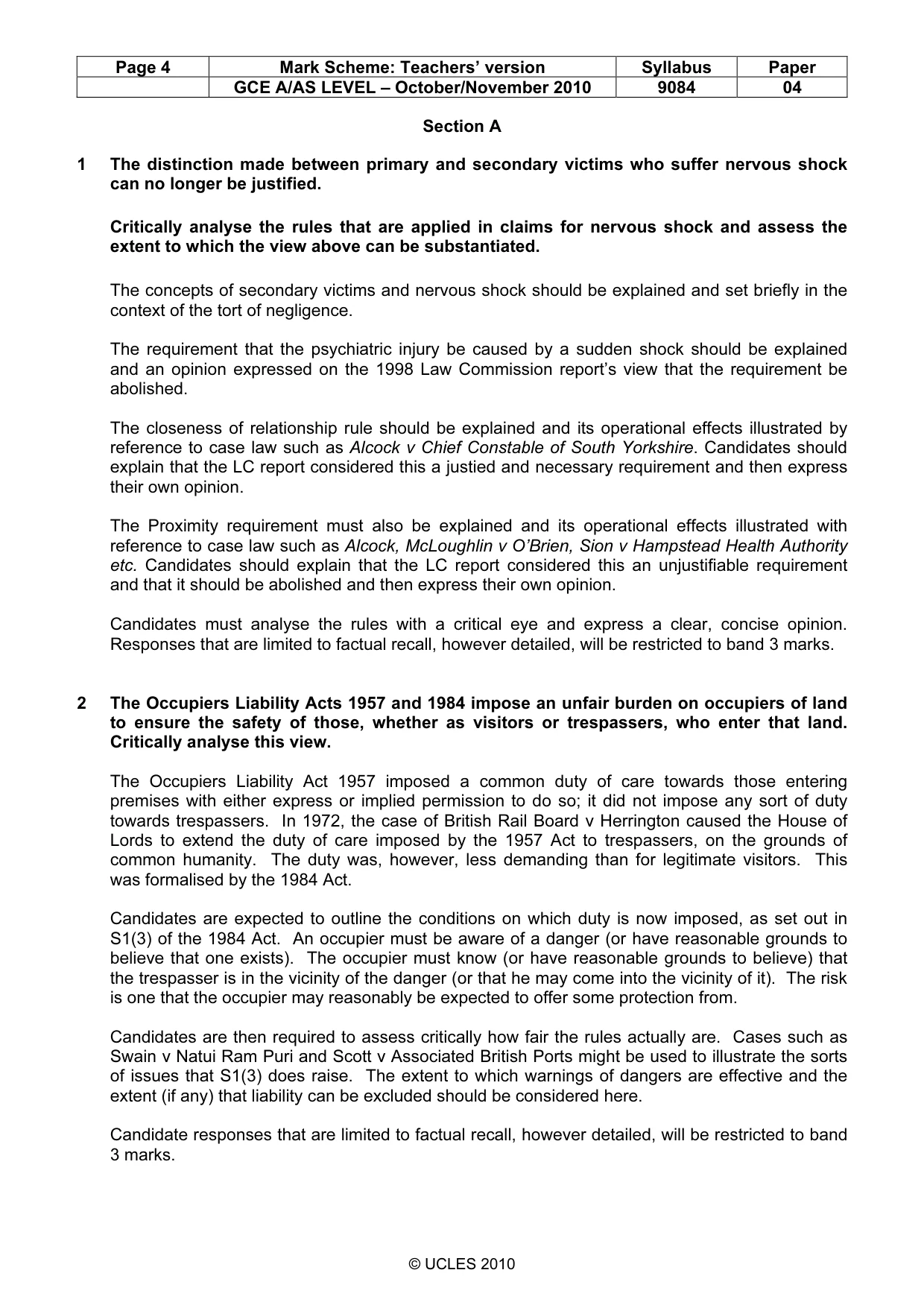
Page 4 Mark Scheme: Teachers’ version Syllabus Paper GCE A/AS LEVEL – October/November 2010 9084 04 © UCLES 2010 Section A 1 The distinction made between primary and secondary victims who suffer nervous shock can no longer be justified. Critically analyse the rules that are applied in claims for nervous shock and assess the extent to which the view above can be substantiated. The concepts of secondary victims and nervous shock should be explained and set briefly in the context of the tort of negligence. The requirement that the psychiatric injury be caused by a sudden shock should be explained and an opinion expressed on the 1998 Law Commission report’s view that the requirement be abolished. The closeness of relationship rule should be explained and its operational effects illustrated by reference to case law such as Alcock v Chief Constable of South Yorkshire. Candidates should explain that the LC report considered this a justied and necessary requirement and then express their own opinion. The Proximity requirement must also be explained and its operational effects illustrated with reference to case law such as Alcock, McLoughlin v O’Brien, Sion v Hampstead Health Authority etc. Candidates should explain that the LC report considered this an unjustifiable requirement and that it should be abolished and then express their own opinion. Candidates must analyse the rules with a critical eye and express a clear, concise opinion. Responses that are limited to factual recall, however detailed, will be restricted to band 3 marks. 2 The Occupiers Liability Acts 1957 and 1984 impose an unfair burden on occupiers of land to ensure the safety of those, whether as visitors or trespassers, who enter that land. Critically analyse this view. The Occupiers Liability Act 1957 imposed a common duty of care towards those entering premises with either express or implied permission to do so; it did not impose any sort of duty towards trespassers. In 1972, the case of British Rail Board v Herrington caused the House of Lords to extend the duty of care imposed by the 1957 Act to trespassers, on the grounds of common humanity. The duty was, however, less demanding than for legitimate visitors. This was formalised by the 1984 Act. Candidates are expected to outline the conditions on which duty is now imposed, as set out in S1(3) of the 1984 Act. An occupier must be aware of a danger (or have reasonable grounds to believe that one exists). The occupier must know (or have reasonable grounds to believe) that the trespasser is in the vicinity of the danger (or that he may come into the vicinity of it). The risk is one that the occupier may reasonably be expected to offer some protection from. Candidates are then required to assess critically how fair the rules actually are. Cases such as Swain v Natui Ram Puri and Scott v Associated British Ports might be used to illustrate the sorts of issues that S1(3) does raise. The extent to which warnings of dangers are effective and the extent (if any) that liability can be excluded should be considered here. Candidate responses that are limited to factual recall, however detailed, will be restricted to band 3 marks.
Mark scheme, page 5
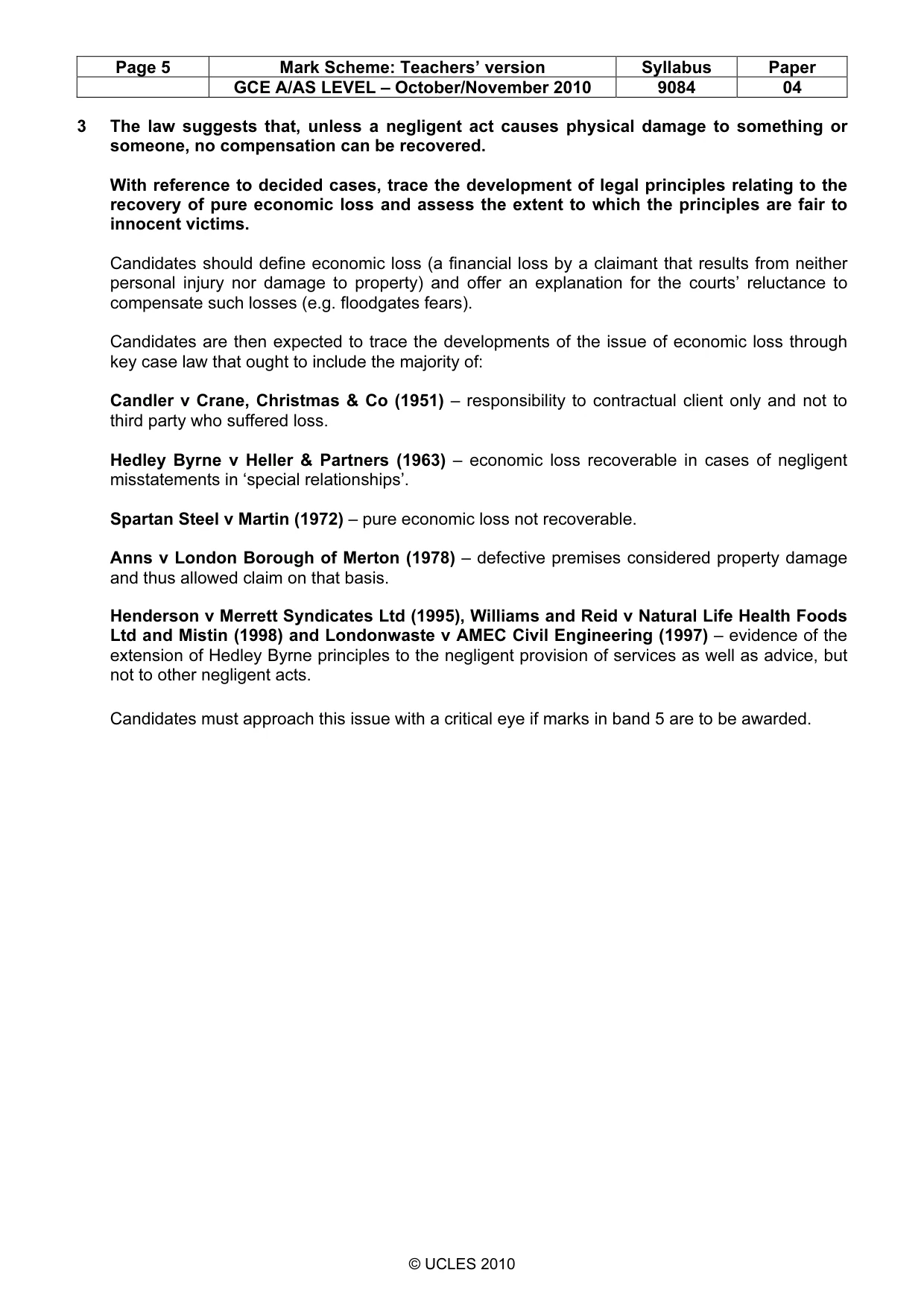
Page 5 Mark Scheme: Teachers’ version Syllabus Paper GCE A/AS LEVEL – October/November 2010 9084 04 © UCLES 2010 3 The law suggests that, unless a negligent act causes physical damage to something or someone, no compensation can be recovered. With reference to decided cases, trace the development of legal principles relating to the recovery of pure economic loss and assess the extent to which the principles are fair to innocent victims. Candidates should define economic loss (a financial loss by a claimant that results from neither personal injury nor damage to property) and offer an explanation for the courts’ reluctance to compensate such losses (e.g. floodgates fears). Candidates are then expected to trace the developments of the issue of economic loss through key case law that ought to include the majority of: Candler v Crane, Christmas & Co (1951) – responsibility to contractual client only and not to third party who suffered loss. Hedley Byrne v Heller & Partners (1963) – economic loss recoverable in cases of negligent misstatements in ‘special relationships’. Spartan Steel v Martin (1972) – pure economic loss not recoverable. Anns v London Borough of Merton (1978) – defective premises considered property damage and thus allowed claim on that basis. Henderson v Merrett Syndicates Ltd (1995), Williams and Reid v Natural Life Health Foods Ltd and Mistin (1998) and Londonwaste v AMEC Civil Engineering (1997) – evidence of the extension of Hedley Byrne principles to the negligent provision of services as well as advice, but not to other negligent acts. Candidates must approach this issue with a critical eye if marks in band 5 are to be awarded.
Mark scheme, page 6
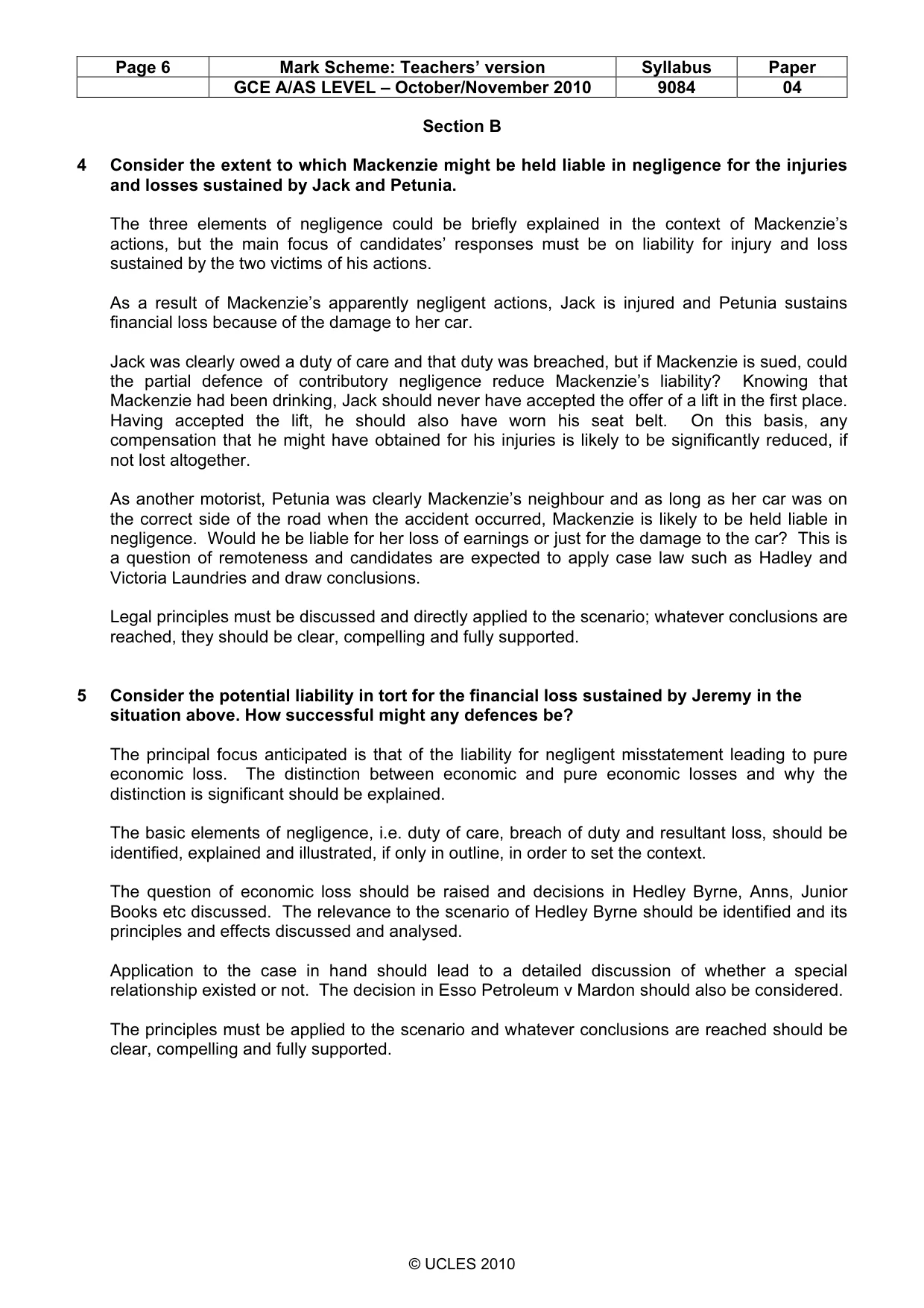
Page 6 Mark Scheme: Teachers’ version Syllabus Paper GCE A/AS LEVEL – October/November 2010 9084 04 © UCLES 2010 Section B 4 Consider the extent to which Mackenzie might be held liable in negligence for the injuries and losses sustained by Jack and Petunia. The three elements of negligence could be briefly explained in the context of Mackenzie’s actions, but the main focus of candidates’ responses must be on liability for injury and loss sustained by the two victims of his actions. As a result of Mackenzie’s apparently negligent actions, Jack is injured and Petunia sustains financial loss because of the damage to her car. Jack was clearly owed a duty of care and that duty was breached, but if Mackenzie is sued, could the partial defence of contributory negligence reduce Mackenzie’s liability? Knowing that Mackenzie had been drinking, Jack should never have accepted the offer of a lift in the first place. Having accepted the lift, he should also have worn his seat belt. On this basis, any compensation that he might have obtained for his injuries is likely to be significantly reduced, if not lost altogether. As another motorist, Petunia was clearly Mackenzie’s neighbour and as long as her car was on the correct side of the road when the accident occurred, Mackenzie is likely to be held liable in negligence. Would he be liable for her loss of earnings or just for the damage to the car? This is a question of remoteness and candidates are expected to apply case law such as Hadley and Victoria Laundries and draw conclusions. Legal principles must be discussed and directly applied to the scenario; whatever conclusions are reached, they should be clear, compelling and fully supported. 5 Consider the potential liability in tort for the financial loss sustained by Jeremy in the situation above. How successful might any defences be? The principal focus anticipated is that of the liability for negligent misstatement leading to pure economic loss. The distinction between economic and pure economic losses and why the distinction is significant should be explained. The basic elements of negligence, i.e. duty of care, breach of duty and resultant loss, should be identified, explained and illustrated, if only in outline, in order to set the context. The question of economic loss should be raised and decisions in Hedley Byrne, Anns, Junior Books etc discussed. The relevance to the scenario of Hedley Byrne should be identified and its principles and effects discussed and analysed. Application to the case in hand should lead to a detailed discussion of whether a special relationship existed or not. The decision in Esso Petroleum v Mardon should also be considered. The principles must be applied to the scenario and whatever conclusions are reached should be clear, compelling and fully supported.
Mark scheme, page 7
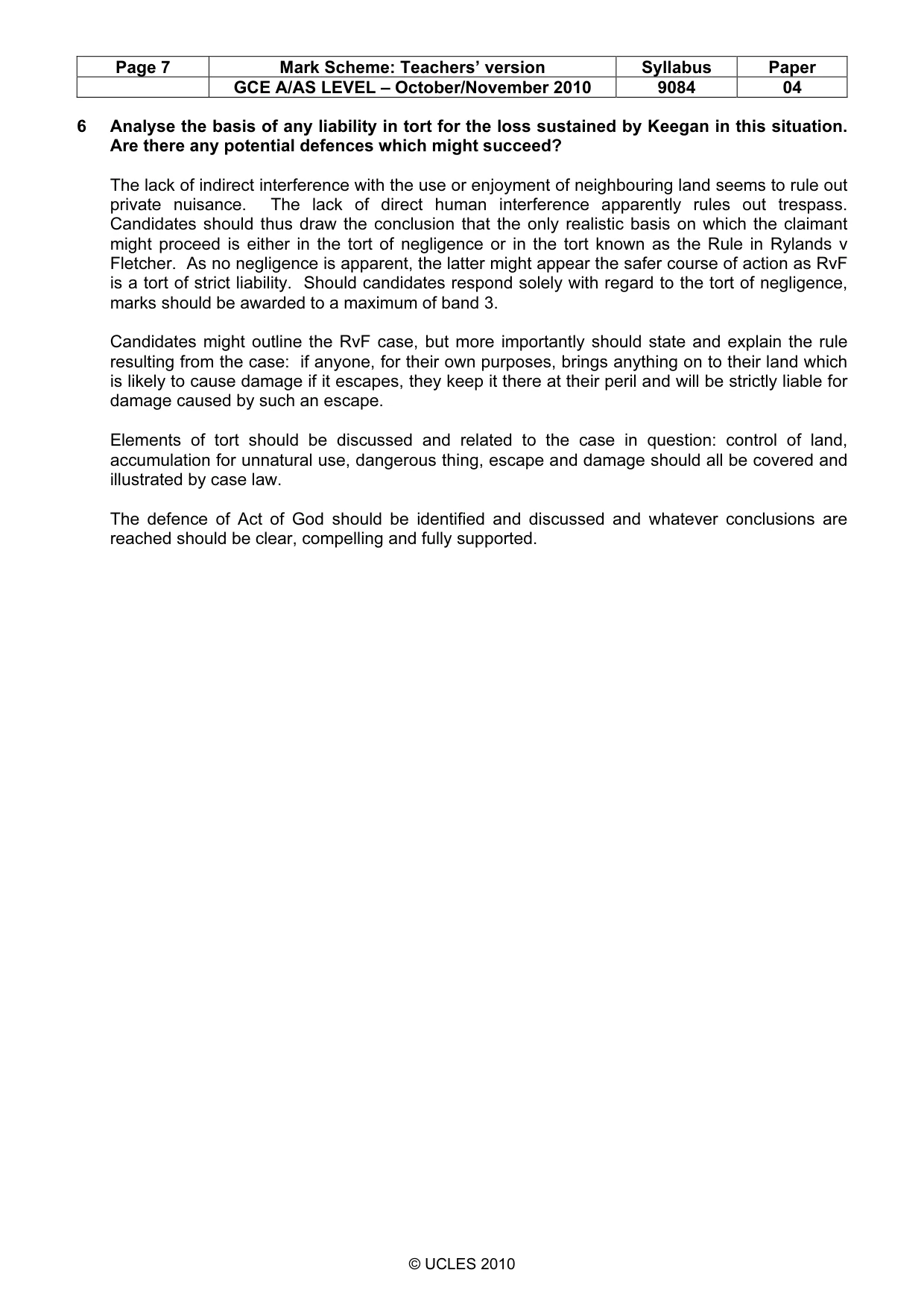
Page 7 Mark Scheme: Teachers’ version Syllabus Paper GCE A/AS LEVEL – October/November 2010 9084 04 © UCLES 2010 6 Analyse the basis of any liability in tort for the loss sustained by Keegan in this situation. Are there any potential defences which might succeed? The lack of indirect interference with the use or enjoyment of neighbouring land seems to rule out private nuisance. The lack of direct human interference apparently rules out trespass. Candidates should thus draw the conclusion that the only realistic basis on which the claimant might proceed is either in the tort of negligence or in the tort known as the Rule in Rylands v Fletcher. As no negligence is apparent, the latter might appear the safer course of action as RvF is a tort of strict liability. Should candidates respond solely with regard to the tort of negligence, marks should be awarded to a maximum of band 3. Candidates might outline the RvF case, but more importantly should state and explain the rule resulting from the case: if anyone, for their own purposes, brings anything on to their land which is likely to cause damage if it escapes, they keep it there at their peril and will be strictly liable for damage caused by such an escape. Elements of tort should be discussed and related to the case in question: control of land, accumulation for unnatural use, dangerous thing, escape and damage should all be covered and illustrated by case law. The defence of Act of God should be identified and discussed and whatever conclusions are reached should be clear, compelling and fully supported.
What you needed in this session
Cambridge’s own grade thresholds for 2010 Oct/Nov, Paper 4 · Variant 1. A higher threshold means an easier paper — the bar moves with how the cohort did.