Cambridge A Level Islamic Studies 9013 — 2015 Oct/Nov Paper 2 · Variant 2
9013/22/O/N/15 · 100 marks · ≈113 min
The question paper and its mark scheme, free to read here and free to download. This is Cambridge’s own paper, exactly as it was sat.
Question paper4 pages
Mark scheme5 pages
Answers below. Sit the paper first if you are practising.
Paper as text
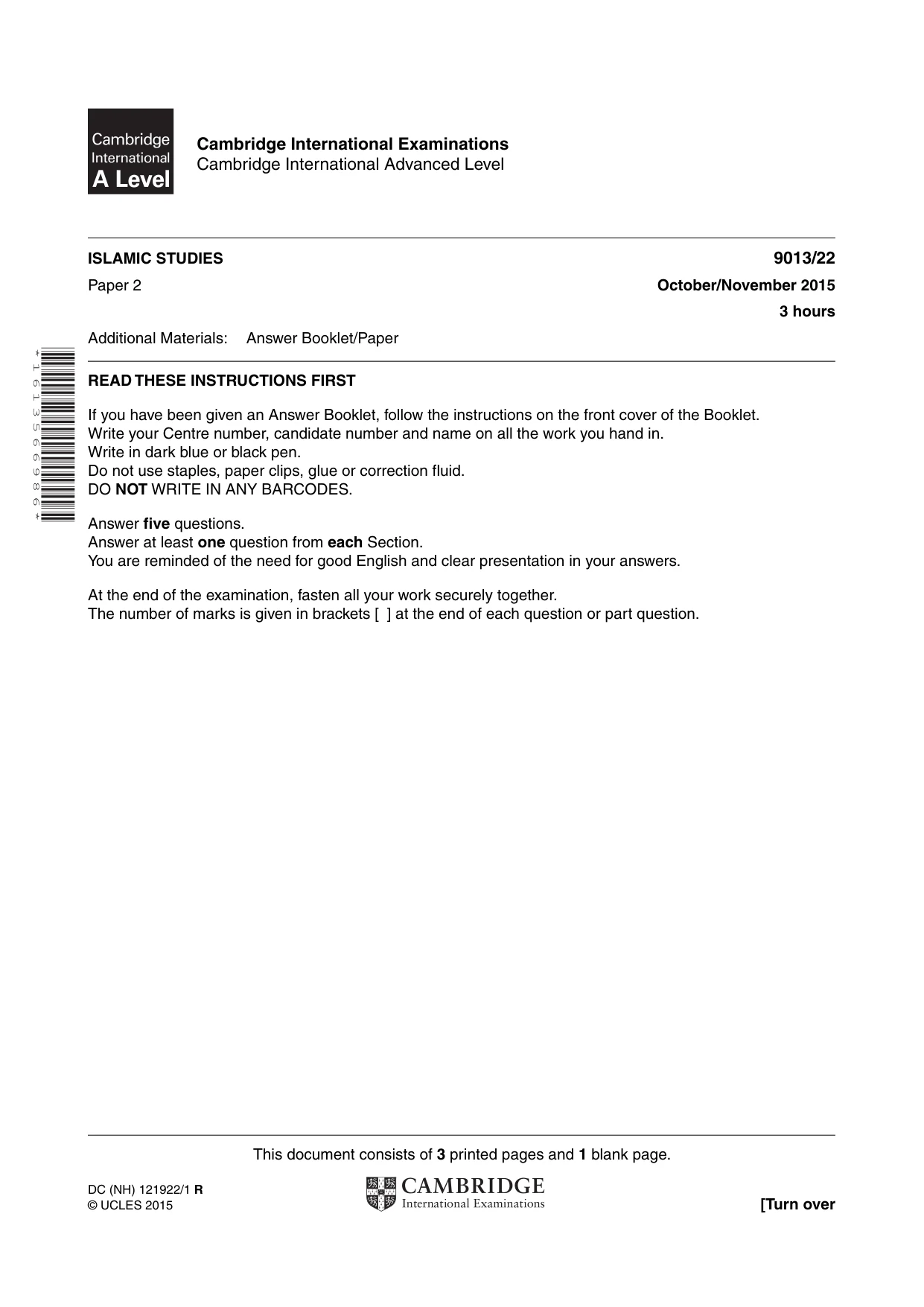
Question paper, page 1
This document consists of 3 printed pages and 1 blank page. DC (NH) 121922/1 R © UCLES 2015 [Turn over * 1 6 1 3 5 6 6 9 8 6 * ISLAMIC STUDIES 9013/22 Paper 2 October/November 2015 3 hours Additional Materials: Answer Booklet/Paper READ THESE INSTRUCTIONS FIRST If you have been given an Answer Booklet, follow the instructions on the front cover of the Booklet. Write your Centre number, candidate number and name on all the work you hand in. Write in dark blue or black pen. Do not use staples, paper clips, glue or correction fluid. DO NOT WRITE IN ANY BARCODES. Answer five questions. Answer at least one question from each Section. You are reminded of the need for good English and clear presentation in your answers. At the end of the examination, fasten all your work securely together. The number of marks is given in brackets [ ] at the end of each question or part question. Cambridge International Examinations Cambridge International Advanced Level
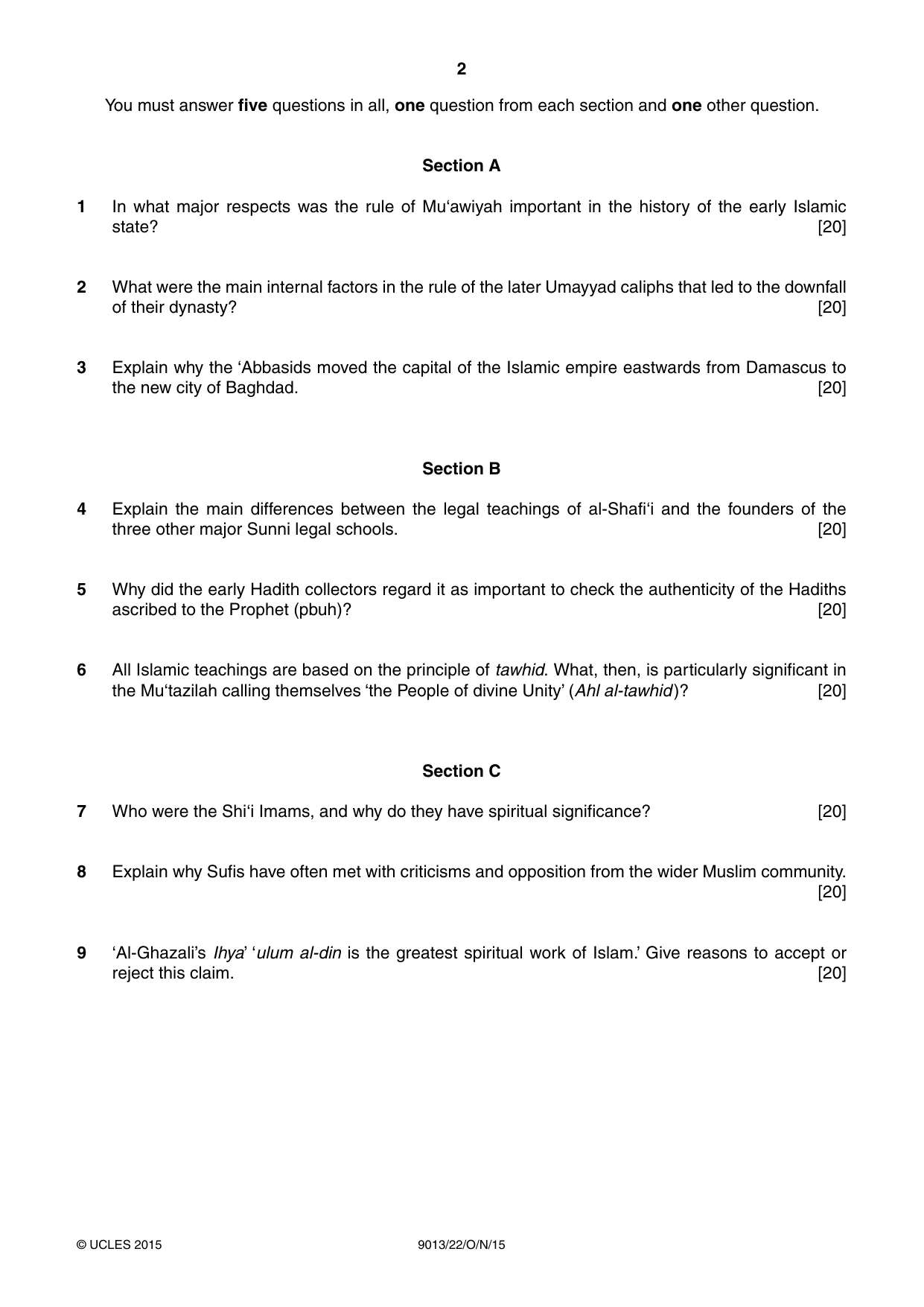
Question paper, page 2
2 9013/22/O/N/15 © UCLES 2015 You must answer five questions in all, one question from each section and one other question. Section A 1 In what major respects was the rule of Mu‘awiyah important in the history of the early Islamic state? [20] 2 What were the main internal factors in the rule of the later Umayyad caliphs that led to the downfall of their dynasty? [20] 3 Explain why the ‘Abbasids moved the capital of the Islamic empire eastwards from Damascus to the new city of Baghdad. [20] Section B 4 Explain the main differences between the legal teachings of al-Shafi‘i and the founders of the three other major Sunni legal schools. [20] 5 Why did the early Hadith collectors regard it as important to check the authenticity of the Hadiths ascribed to the Prophet (pbuh)? [20] 6 All Islamic teachings are based on the principle of tawhid. What, then, is particularly significant in the Mu‘tazilah calling themselves ‘the People of divine Unity’ (Ahl al-tawhid )? [20] Section C 7 Who were the Shi‘i Imams, and why do they have spiritual significance? [20] 8 Explain why Sufis have often met with criticisms and opposition from the wider Muslim community. [20] 9 ‘Al-Ghazali’s Ihya’ ‘ulum al-din is the greatest spiritual work of Islam.’ Give reasons to accept or reject this claim. [20]
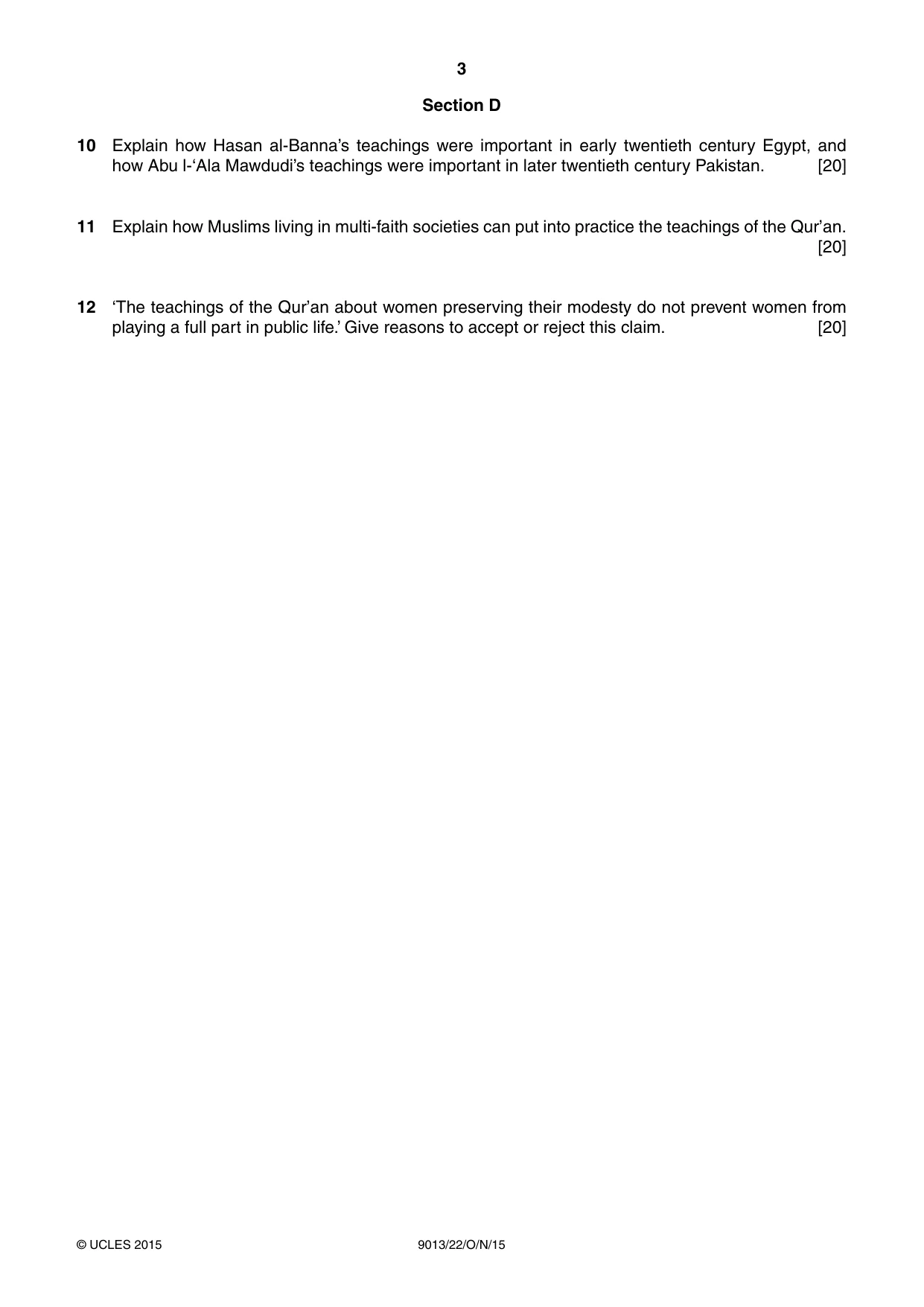
Question paper, page 3
3 9013/22/O/N/15 © UCLES 2015 Section D 10 Explain how Hasan al-Banna’s teachings were important in early twentieth century Egypt, and how Abu l-‘Ala Mawdudi’s teachings were important in later twentieth century Pakistan. [20] 11 Explain how Muslims living in multi-faith societies can put into practice the teachings of the Qur’an. [20] 12 ‘The teachings of the Qur’an about women preserving their modesty do not prevent women from playing a full part in public life.’ Give reasons to accept or reject this claim. [20]
Question paper, page 4
4 9013/22/O/N/15 © UCLES 2015 BLANK PAGE Permission to reproduce items where third-party owned material protected by copyright is included has been sought and cleared where possible. Every reasonable effort has been made by the publisher (UCLES) to trace copyright holders, but if any items requiring clearance have unwittingly been included, the publisher will be pleased to make amends at the earliest possible opportunity. To avoid the issue of disclosure of answer-related information to candidates, all copyright acknowledgements are reproduced online in the Cambridge International Examinations Copyright Acknowledgements Booklet. This is produced for each series of examinations and is freely available to download at www.cie.org.uk after the live examination series. Cambridge International Examinations is part of the Cambridge Assessment Group. Cambridge Assessment is the brand name of University of Cambridge Local Examinations Syndicate (UCLES), which is itself a department of the University of Cambridge.
Mark scheme, page 1
® IGCSE is the registered trademark of Cambridge International Examinations. CAMBRIDGE INTERNATIONAL EXAMINATIONS Cambridge International Advanced Level MARK SCHEME for the October/November 2015 series 9013 ISLAMIC STUDIES 9013/22 Paper 2, maximum raw mark 100 This mark scheme is published as an aid to teachers and candidates, to indicate the requirements of the examination. It shows the basis on which Examiners were instructed to award marks. It does not indicate the details of the discussions that took place at an Examiners’ meeting before marking began, which would have considered the acceptability of alternative answers. Mark schemes should be read in conjunction with the question paper and the Principal Examiner Report for Teachers. Cambridge will not enter into discussions about these mark schemes. Cambridge is publishing the mark schemes for the October/November 2015 series for most Cambridge IGCSE®, Cambridge International A and AS Level components and some Cambridge O Level components.
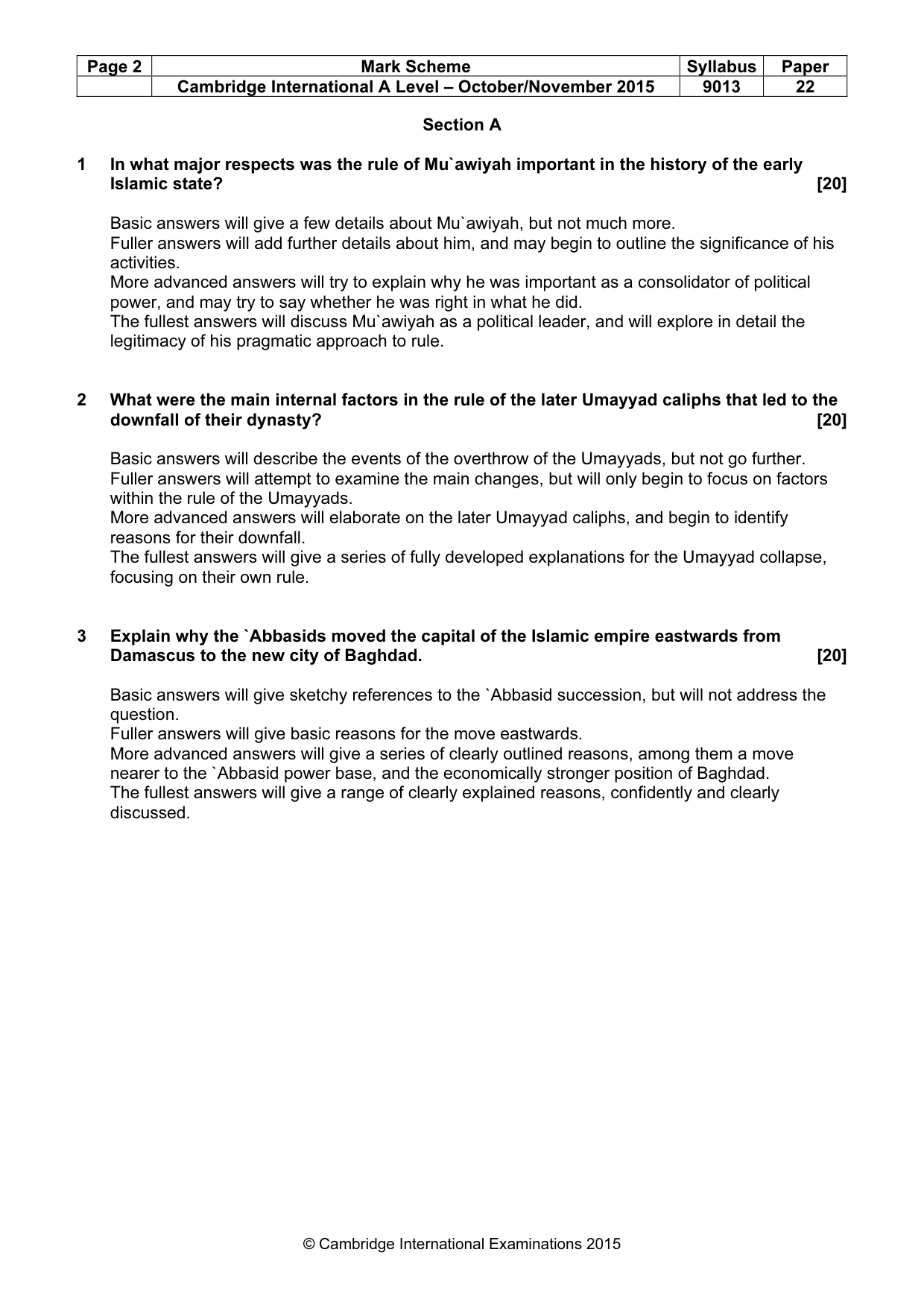
Mark scheme, page 2
Page 2 Mark Scheme Syllabus Paper Cambridge International A Level – October/November 2015 9013 22 © Cambridge International Examinations 2015 Section A 1 In what major respects was the rule of Mu`awiyah important in the history of the early Islamic state? [20] Basic answers will give a few details about Mu`awiyah, but not much more. Fuller answers will add further details about him, and may begin to outline the significance of his activities. More advanced answers will try to explain why he was important as a consolidator of political power, and may try to say whether he was right in what he did. The fullest answers will discuss Mu`awiyah as a political leader, and will explore in detail the legitimacy of his pragmatic approach to rule. 2 What were the main internal factors in the rule of the later Umayyad caliphs that led to the downfall of their dynasty? [20] Basic answers will describe the events of the overthrow of the Umayyads, but not go further. Fuller answers will attempt to examine the main changes, but will only begin to focus on factors within the rule of the Umayyads. More advanced answers will elaborate on the later Umayyad caliphs, and begin to identify reasons for their downfall. The fullest answers will give a series of fully developed explanations for the Umayyad collapse, focusing on their own rule. 3 Explain why the `Abbasids moved the capital of the Islamic empire eastwards from Damascus to the new city of Baghdad. [20] Basic answers will give sketchy references to the `Abbasid succession, but will not address the question. Fuller answers will give basic reasons for the move eastwards. More advanced answers will give a series of clearly outlined reasons, among them a move nearer to the `Abbasid power base, and the economically stronger position of Baghdad. The fullest answers will give a range of clearly explained reasons, confidently and clearly discussed.
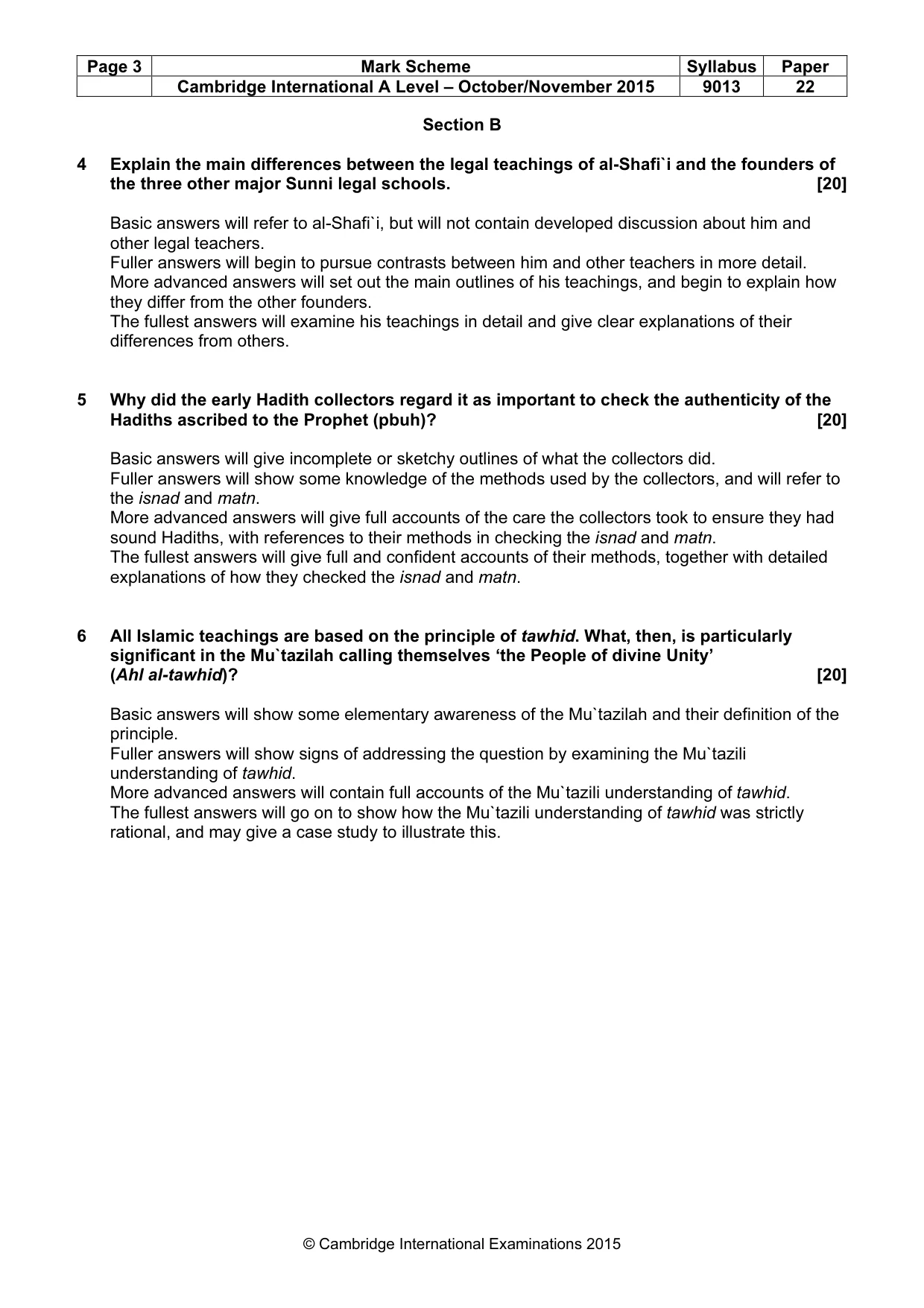
Mark scheme, page 3
Page 3 Mark Scheme Syllabus Paper Cambridge International A Level – October/November 2015 9013 22 © Cambridge International Examinations 2015 Section B 4 Explain the main differences between the legal teachings of al-Shafi`i and the founders of the three other major Sunni legal schools. [20] Basic answers will refer to al-Shafi`i, but will not contain developed discussion about him and other legal teachers. Fuller answers will begin to pursue contrasts between him and other teachers in more detail. More advanced answers will set out the main outlines of his teachings, and begin to explain how they differ from the other founders. The fullest answers will examine his teachings in detail and give clear explanations of their differences from others. 5 Why did the early Hadith collectors regard it as important to check the authenticity of the Hadiths ascribed to the Prophet (pbuh)? [20] Basic answers will give incomplete or sketchy outlines of what the collectors did. Fuller answers will show some knowledge of the methods used by the collectors, and will refer to the isnad and matn. More advanced answers will give full accounts of the care the collectors took to ensure they had sound Hadiths, with references to their methods in checking the isnad and matn. The fullest answers will give full and confident accounts of their methods, together with detailed explanations of how they checked the isnad and matn. 6 All Islamic teachings are based on the principle of tawhid. What, then, is particularly significant in the Mu`tazilah calling themselves ‘the People of divine Unity’ (Ahl al-tawhid)? [20] Basic answers will show some elementary awareness of the Mu`tazilah and their definition of the principle. Fuller answers will show signs of addressing the question by examining the Mu`tazili understanding of tawhid. More advanced answers will contain full accounts of the Mu`tazili understanding of tawhid. The fullest answers will go on to show how the Mu`tazili understanding of tawhid was strictly rational, and may give a case study to illustrate this.
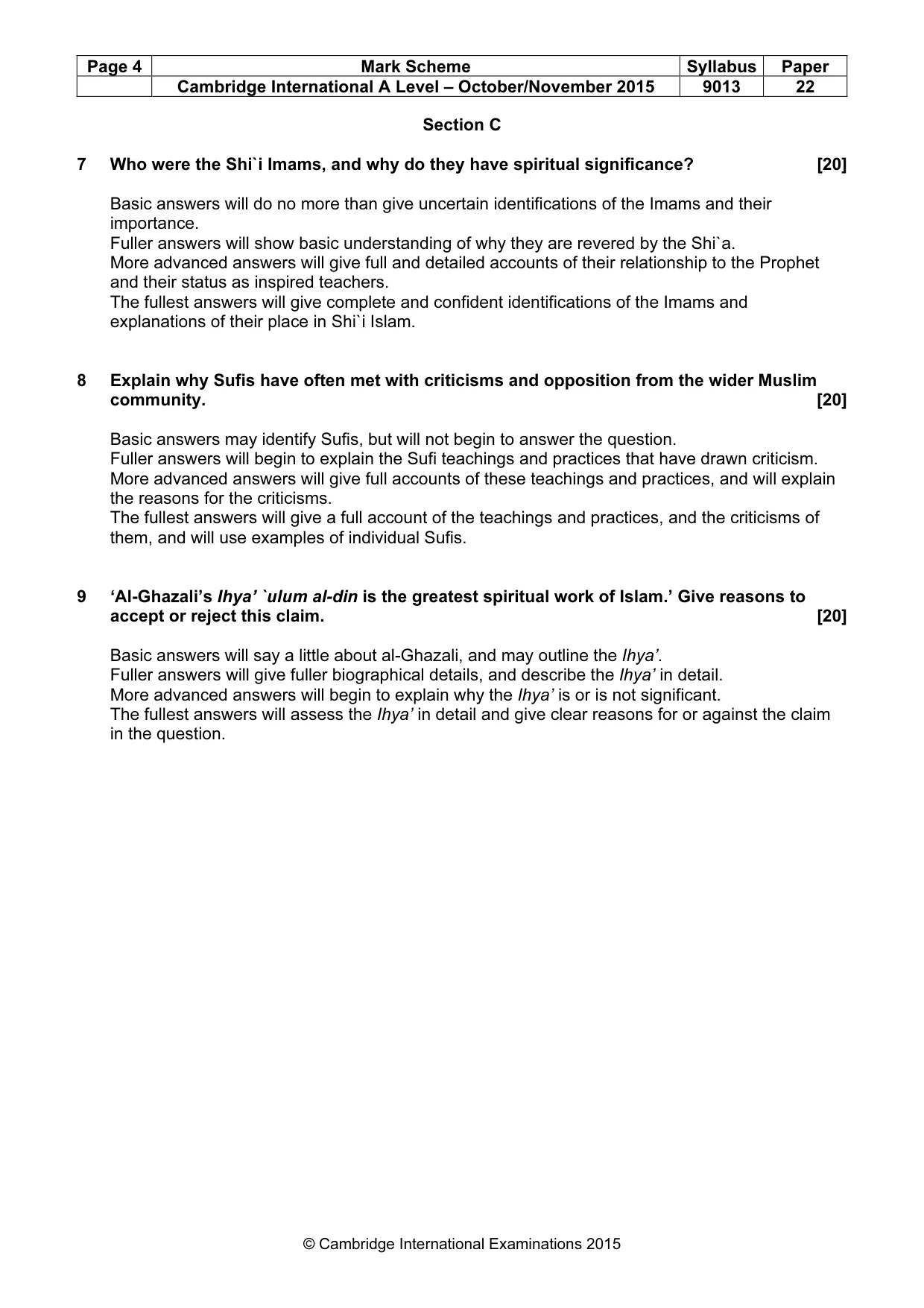
Mark scheme, page 4
Page 4 Mark Scheme Syllabus Paper Cambridge International A Level – October/November 2015 9013 22 © Cambridge International Examinations 2015 Section C 7 Who were the Shi`i Imams, and why do they have spiritual significance? [20] Basic answers will do no more than give uncertain identifications of the Imams and their importance. Fuller answers will show basic understanding of why they are revered by the Shi`a. More advanced answers will give full and detailed accounts of their relationship to the Prophet and their status as inspired teachers. The fullest answers will give complete and confident identifications of the Imams and explanations of their place in Shi`i Islam. 8 Explain why Sufis have often met with criticisms and opposition from the wider Muslim community. [20] Basic answers may identify Sufis, but will not begin to answer the question. Fuller answers will begin to explain the Sufi teachings and practices that have drawn criticism. More advanced answers will give full accounts of these teachings and practices, and will explain the reasons for the criticisms. The fullest answers will give a full account of the teachings and practices, and the criticisms of them, and will use examples of individual Sufis. 9 ‘Al-Ghazali’s Ihya’ `ulum al-din is the greatest spiritual work of Islam.’ Give reasons to accept or reject this claim. [20] Basic answers will say a little about al-Ghazali, and may outline the Ihya’. Fuller answers will give fuller biographical details, and describe the Ihya’ in detail. More advanced answers will begin to explain why the Ihya’ is or is not significant. The fullest answers will assess the Ihya’ in detail and give clear reasons for or against the claim in the question.
Mark scheme, page 5
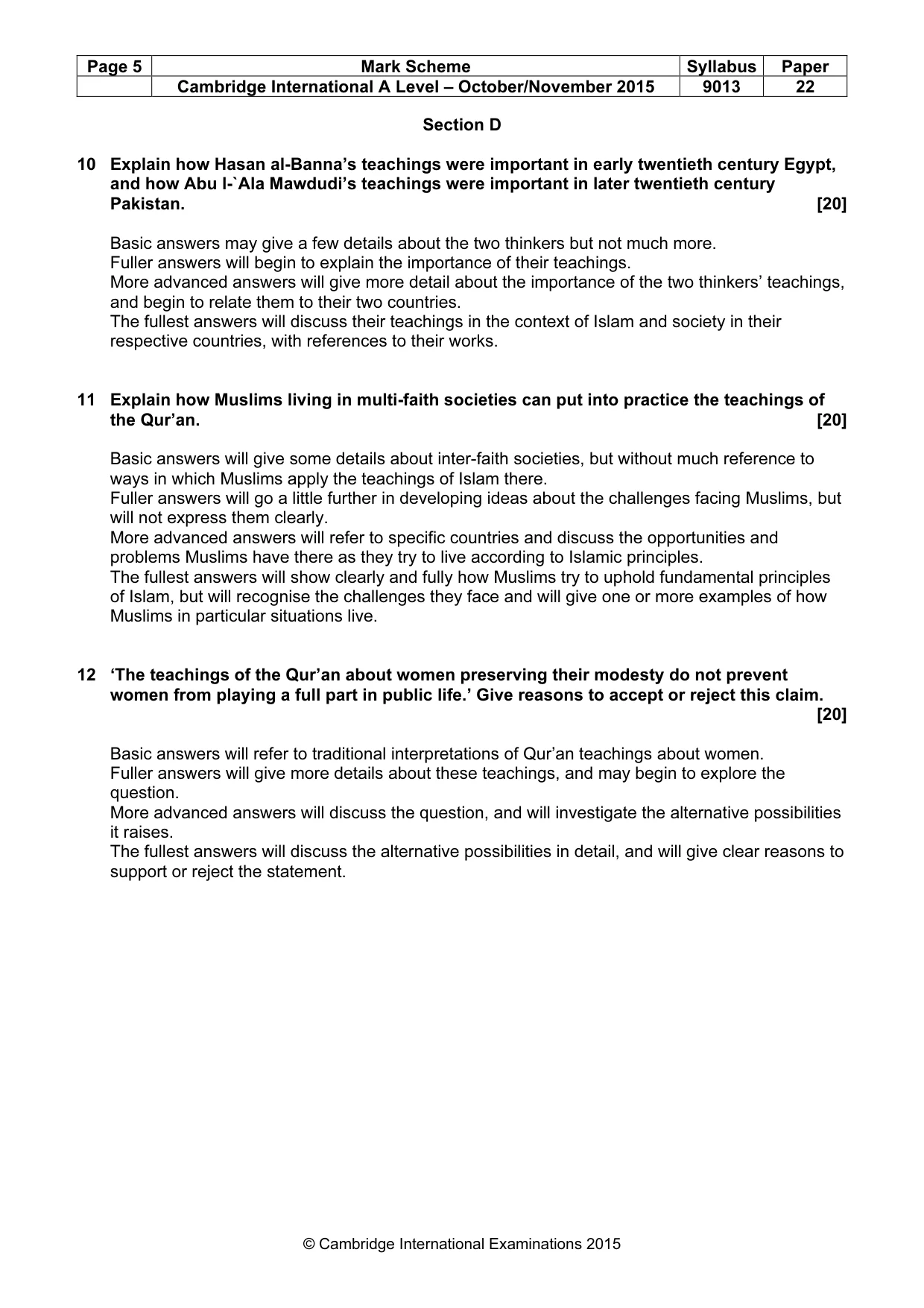
Page 5 Mark Scheme Syllabus Paper Cambridge International A Level – October/November 2015 9013 22 © Cambridge International Examinations 2015 Section D 10 Explain how Hasan al-Banna’s teachings were important in early twentieth century Egypt, and how Abu l-`Ala Mawdudi’s teachings were important in later twentieth century Pakistan. [20] Basic answers may give a few details about the two thinkers but not much more. Fuller answers will begin to explain the importance of their teachings. More advanced answers will give more detail about the importance of the two thinkers’ teachings, and begin to relate them to their two countries. The fullest answers will discuss their teachings in the context of Islam and society in their respective countries, with references to their works. 11 Explain how Muslims living in multi-faith societies can put into practice the teachings of the Qur’an. [20] Basic answers will give some details about inter-faith societies, but without much reference to ways in which Muslims apply the teachings of Islam there. Fuller answers will go a little further in developing ideas about the challenges facing Muslims, but will not express them clearly. More advanced answers will refer to specific countries and discuss the opportunities and problems Muslims have there as they try to live according to Islamic principles. The fullest answers will show clearly and fully how Muslims try to uphold fundamental principles of Islam, but will recognise the challenges they face and will give one or more examples of how Muslims in particular situations live. 12 ‘The teachings of the Qur’an about women preserving their modesty do not prevent women from playing a full part in public life.’ Give reasons to accept or reject this claim. [20] Basic answers will refer to traditional interpretations of Qur’an teachings about women. Fuller answers will give more details about these teachings, and may begin to explore the question. More advanced answers will discuss the question, and will investigate the alternative possibilities it raises. The fullest answers will discuss the alternative possibilities in detail, and will give clear reasons to support or reject the statement.
What you needed in this session
Cambridge’s own grade thresholds for 2015 Oct/Nov, Paper 2 · Variant 2. A higher threshold means an easier paper — the bar moves with how the cohort did.