Cambridge A Level Islamic Studies 9013 — 2014 Oct/Nov Paper 2 · Variant 1
9013/21/O/N/14 · 100 marks · ≈113 min
The question paper and its mark scheme, free to read here and free to download. This is Cambridge’s own paper, exactly as it was sat.
Question paper4 pages
Mark scheme5 pages
Answers below. Sit the paper first if you are practising.
Paper as text
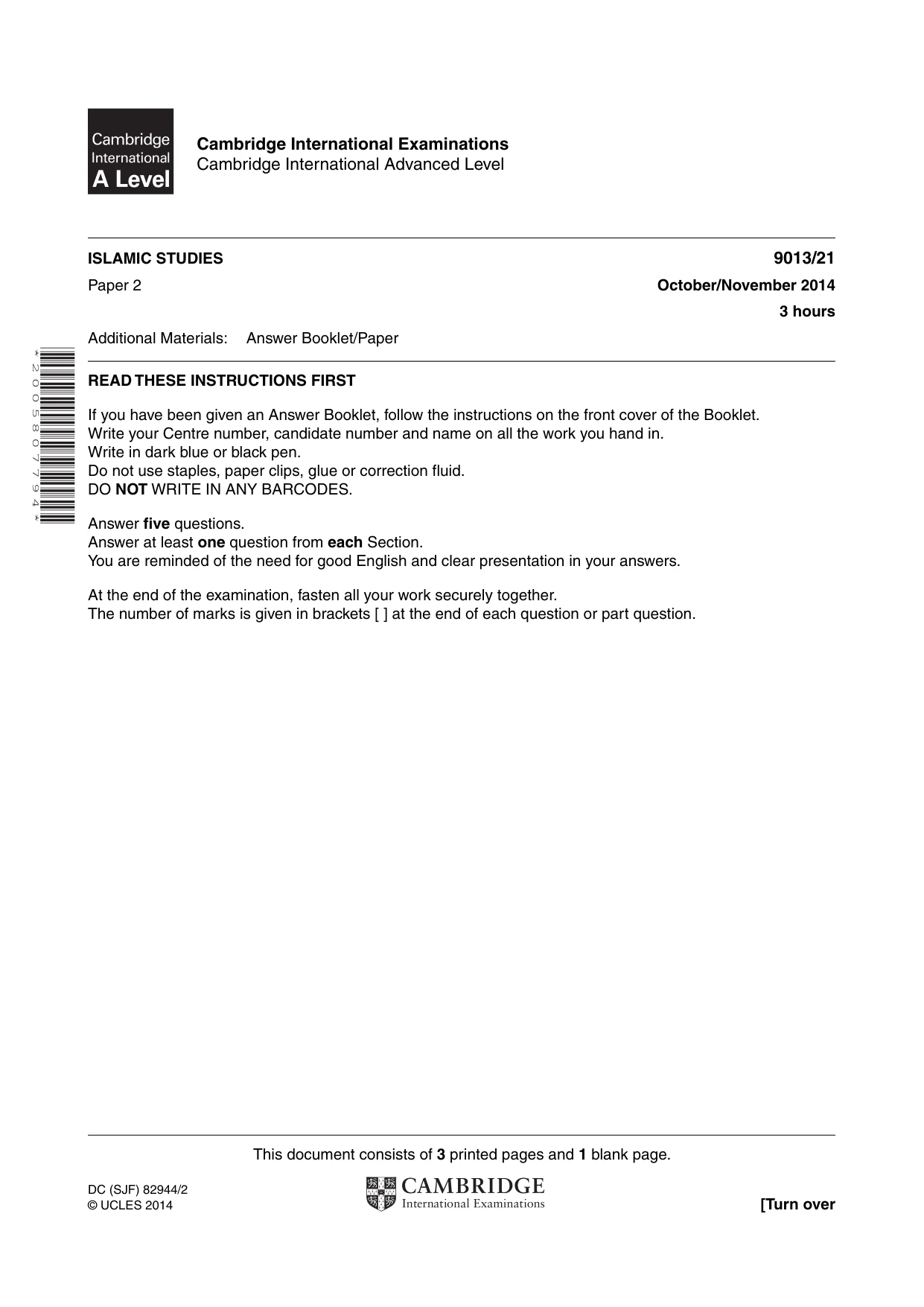
Question paper, page 1
This document consists of 3 printed pages and 1 blank page. DC (SJF) 82944/2 © UCLES 2014 [Turn over Cambridge International Examinations Cambridge International Advanced Level * 2 0 0 5 8 0 7 7 9 4 * ISLAMIC STUDIES 9013/21 Paper 2 October/November 2014 3 hours Additional Materials: Answer Booklet/Paper READ THESE INSTRUCTIONS FIRST If you have been given an Answer Booklet, follow the instructions on the front cover of the Booklet. Write your Centre number, candidate number and name on all the work you hand in. Write in dark blue or black pen. Do not use staples, paper clips, glue or correction fluid. DO NOT WRITE IN ANY BARCODES. Answer five questions. Answer at least one question from each Section. You are reminded of the need for good English and clear presentation in your answers. At the end of the examination, fasten all your work securely together. The number of marks is given in brackets [ ] at the end of each question or part question.
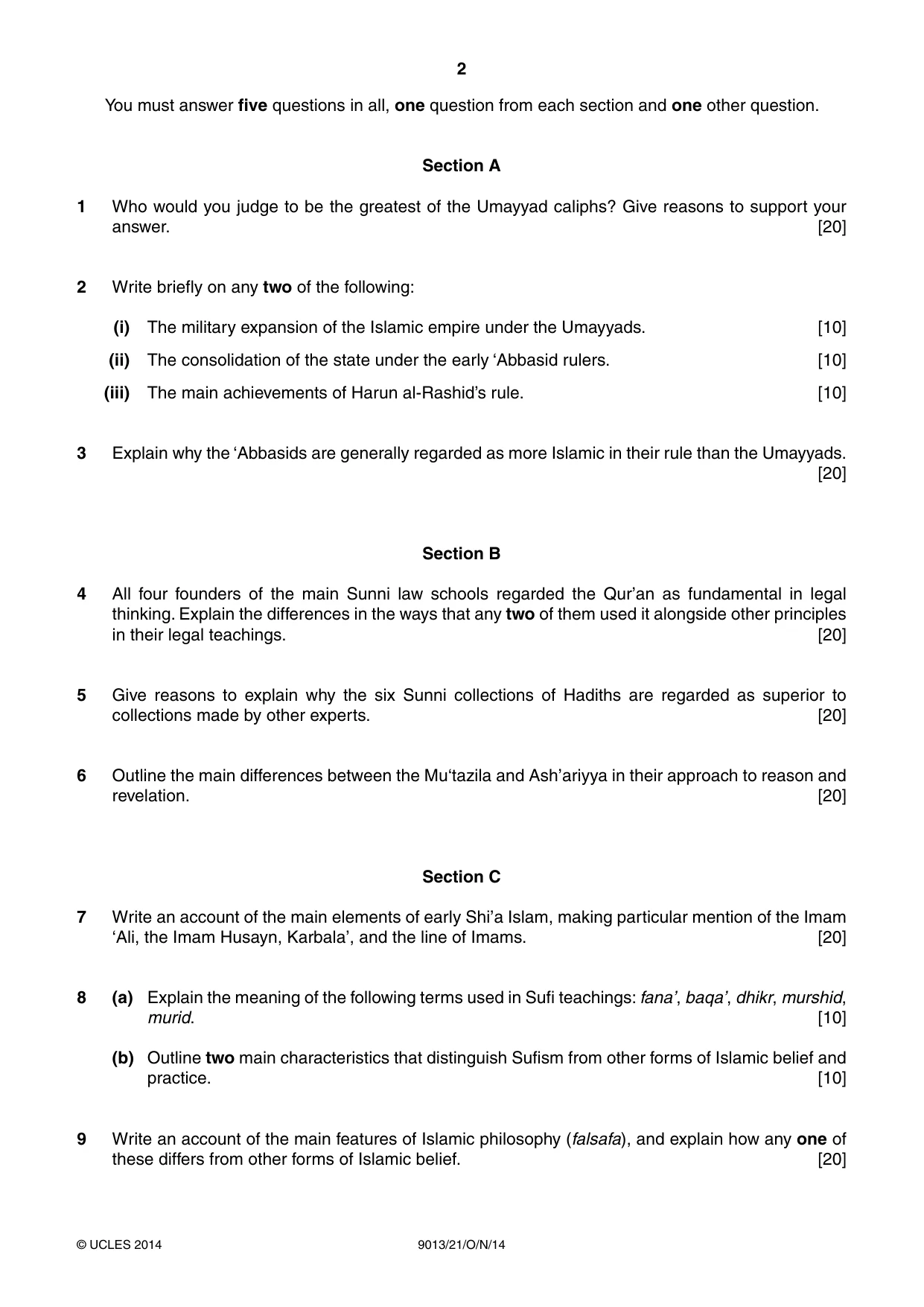
Question paper, page 2
2 9013/21/O/N/14 © UCLES 2014 You must answer five questions in all, one question from each section and one other question. Section A 1 Who would you judge to be the greatest of the Umayyad caliphs? Give reasons to support your answer. [20] 2 Write briefly on any two of the following: (i) The military expansion of the Islamic empire under the Umayyads. [10] (ii) The consolidation of the state under the early ‘Abbasid rulers. [10] (iii) The main achievements of Harun al-Rashid’s rule. [10] 3 Explain why the ‘Abbasids are generally regarded as more Islamic in their rule than the Umayyads. [20] Section B 4 All four founders of the main Sunni law schools regarded the Qur’an as fundamental in legal thinking. Explain the differences in the ways that any two of them used it alongside other principles in their legal teachings. [20] 5 Give reasons to explain why the six Sunni collections of Hadiths are regarded as superior to collections made by other experts. [20] 6 Outline the main differences between the Mu‘tazila and Ash’ariyya in their approach to reason and revelation. [20] Section C 7 Write an account of the main elements of early Shi’a Islam, making particular mention of the Imam ‘Ali, the Imam Husayn, Karbala’, and the line of Imams. [20] 8 (a) Explain the meaning of the following terms used in Sufi teachings: fana’, baqa’, dhikr, murshid, murid. [10] (b) Outline two main characteristics that distinguish Sufism from other forms of Islamic belief and practice. [10] 9 Write an account of the main features of Islamic philosophy (falsafa), and explain how any one of these differs from other forms of Islamic belief. [20]
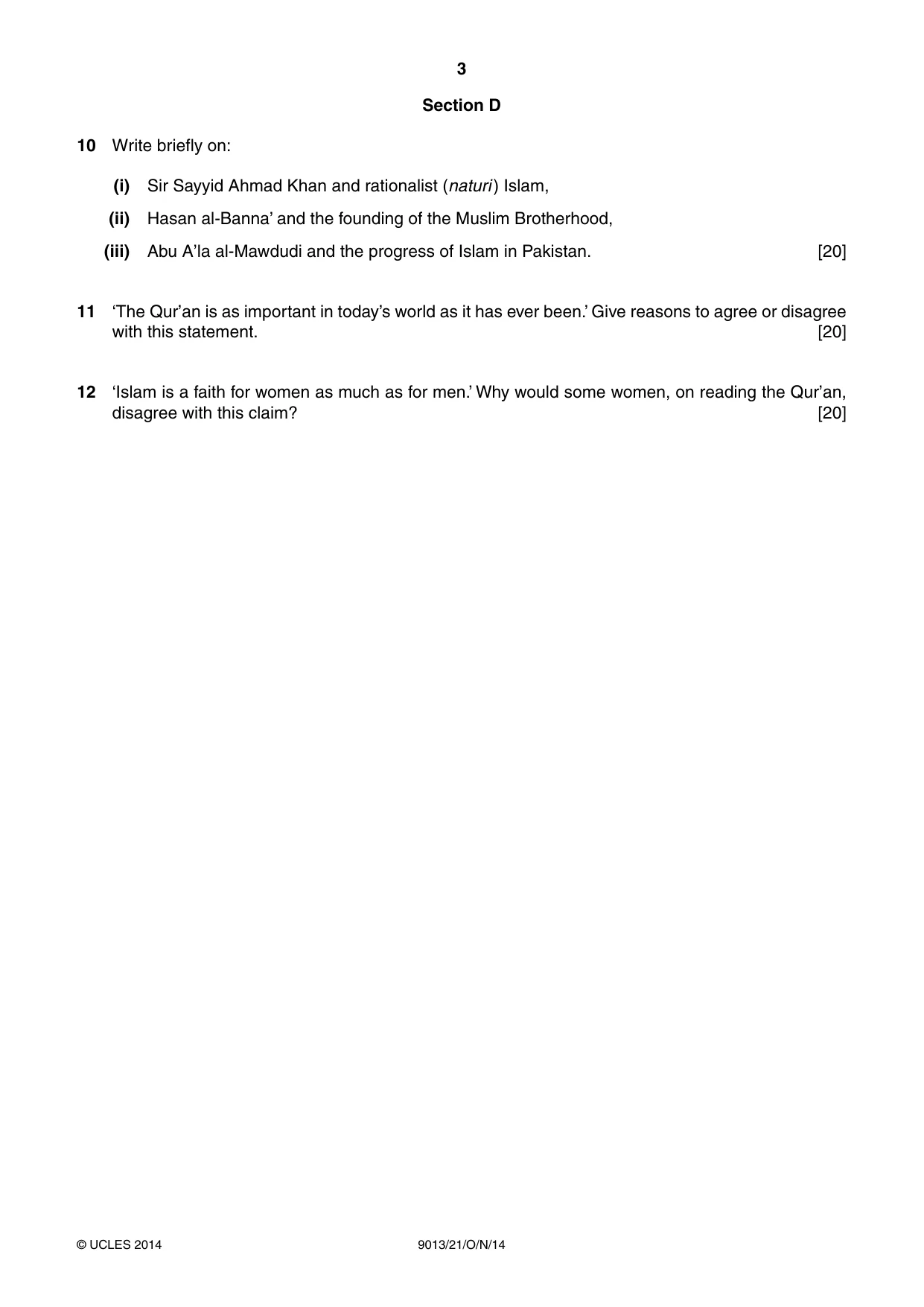
Question paper, page 3
3 9013/21/O/N/14 © UCLES 2014 Section D 10 Write briefly on: (i) Sir Sayyid Ahmad Khan and rationalist (naturi ) Islam, (ii) Hasan al-Banna’ and the founding of the Muslim Brotherhood, (iii) Abu A’la al-Mawdudi and the progress of Islam in Pakistan. [20] 11 ‘The Qur’an is as important in today’s world as it has ever been.’ Give reasons to agree or disagree with this statement. [20] 12 ‘Islam is a faith for women as much as for men.’ Why would some women, on reading the Qur’an, disagree with this claim? [20]
Question paper, page 4
4 9013/21/O/N/14 © UCLES 2014 Permission to reproduce items where third-party owned material protected by copyright is included has been sought and cleared where possible. Every reasonable effort has been made by the publisher (UCLES) to trace copyright holders, but if any items requiring clearance have unwittingly been included, the publisher will be pleased to make amends at the earliest possible opportunity. Cambridge International Examinations is part of the Cambridge Assessment Group. Cambridge Assessment is the brand name of University of Cambridge Local Examinations Syndicate (UCLES), which is itself a department of the University of Cambridge. BLANK PAGE
Mark scheme, page 1
® IGCSE is the registered trademark of Cambridge International Examinations. CAMBRIDGE INTERNATIONAL EXAMINATIONS Cambridge International Advanced Level MARK SCHEME for the October/November 2014 series 9013 ISLAMIC STUDIES 9013/21 Paper 2, maximum raw mark 100 This mark scheme is published as an aid to teachers and candidates, to indicate the requirements of the examination. It shows the basis on which Examiners were instructed to award marks. It does not indicate the details of the discussions that took place at an Examiners’ meeting before marking began, which would have considered the acceptability of alternative answers. Mark schemes should be read in conjunction with the question paper and the Principal Examiner Report for Teachers. Cambridge will not enter into discussions about these mark schemes. Cambridge is publishing the mark schemes for the October/November 2014 series for most Cambridge IGCSE®, Cambridge International A and AS Level components and some Cambridge O Level components.
Mark scheme, page 2
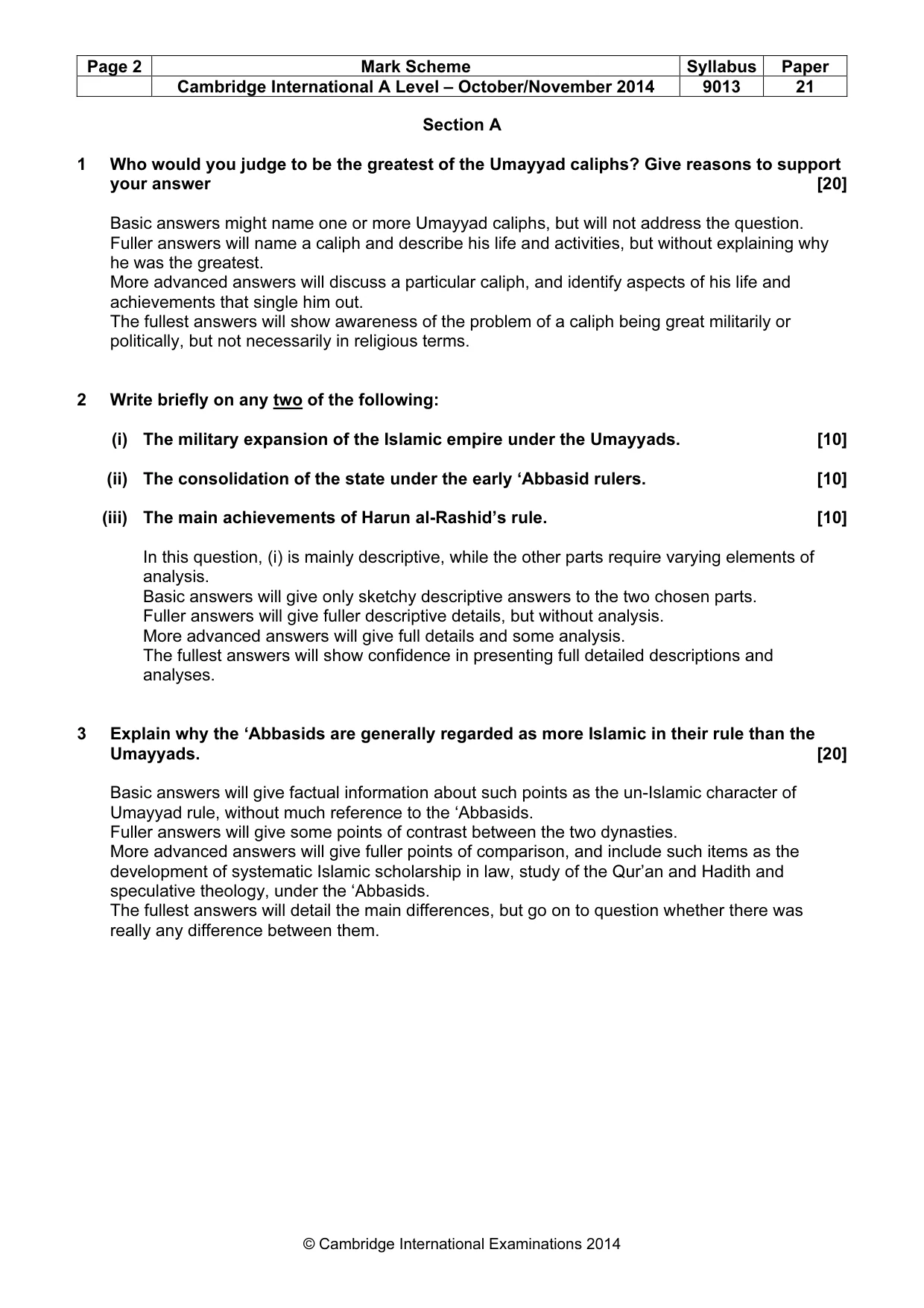
Page 2 Mark Scheme Syllabus Paper Cambridge International A Level – October/November 2014 9013 21 © Cambridge International Examinations 2014 Section A 1 Who would you judge to be the greatest of the Umayyad caliphs? Give reasons to support your answer [20] Basic answers might name one or more Umayyad caliphs, but will not address the question. Fuller answers will name a caliph and describe his life and activities, but without explaining why he was the greatest. More advanced answers will discuss a particular caliph, and identify aspects of his life and achievements that single him out. The fullest answers will show awareness of the problem of a caliph being great militarily or politically, but not necessarily in religious terms. 2 Write briefly on any two of the following: (i) The military expansion of the Islamic empire under the Umayyads. [10] (ii) The consolidation of the state under the early ‘Abbasid rulers. [10] (iii) The main achievements of Harun al-Rashid’s rule. [10] In this question, (i) is mainly descriptive, while the other parts require varying elements of analysis. Basic answers will give only sketchy descriptive answers to the two chosen parts. Fuller answers will give fuller descriptive details, but without analysis. More advanced answers will give full details and some analysis. The fullest answers will show confidence in presenting full detailed descriptions and analyses. 3 Explain why the ‘Abbasids are generally regarded as more Islamic in their rule than the Umayyads. [20] Basic answers will give factual information about such points as the un-Islamic character of Umayyad rule, without much reference to the ‘Abbasids. Fuller answers will give some points of contrast between the two dynasties. More advanced answers will give fuller points of comparison, and include such items as the development of systematic Islamic scholarship in law, study of the Qur’an and Hadith and speculative theology, under the ‘Abbasids. The fullest answers will detail the main differences, but go on to question whether there was really any difference between them.
Mark scheme, page 3
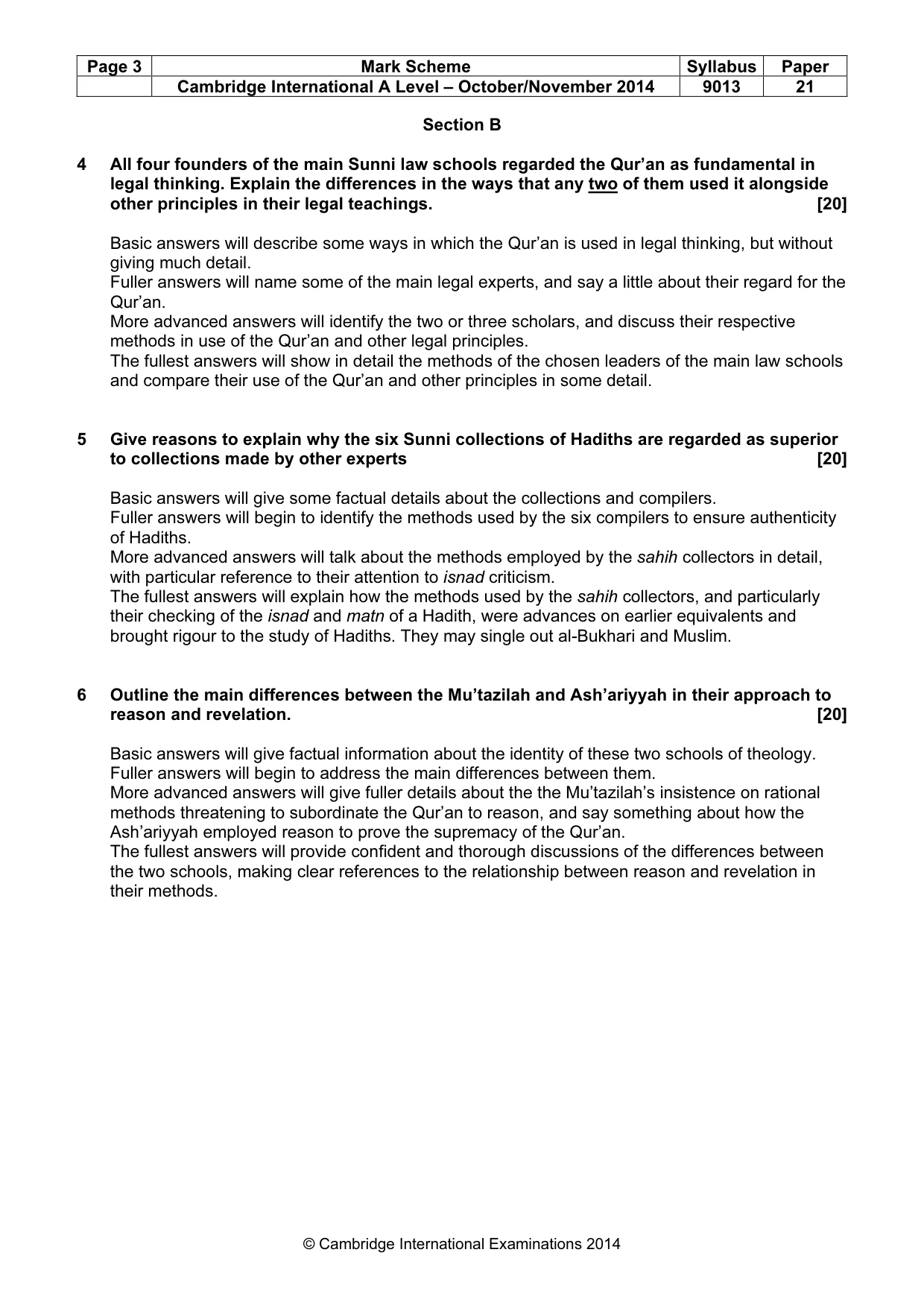
Page 3 Mark Scheme Syllabus Paper Cambridge International A Level – October/November 2014 9013 21 © Cambridge International Examinations 2014 Section B 4 All four founders of the main Sunni law schools regarded the Qur’an as fundamental in legal thinking. Explain the differences in the ways that any two of them used it alongside other principles in their legal teachings. [20] Basic answers will describe some ways in which the Qur’an is used in legal thinking, but without giving much detail. Fuller answers will name some of the main legal experts, and say a little about their regard for the Qur’an. More advanced answers will identify the two or three scholars, and discuss their respective methods in use of the Qur’an and other legal principles. The fullest answers will show in detail the methods of the chosen leaders of the main law schools and compare their use of the Qur’an and other principles in some detail. 5 Give reasons to explain why the six Sunni collections of Hadiths are regarded as superior to collections made by other experts [20] Basic answers will give some factual details about the collections and compilers. Fuller answers will begin to identify the methods used by the six compilers to ensure authenticity of Hadiths. More advanced answers will talk about the methods employed by the sahih collectors in detail, with particular reference to their attention to isnad criticism. The fullest answers will explain how the methods used by the sahih collectors, and particularly their checking of the isnad and matn of a Hadith, were advances on earlier equivalents and brought rigour to the study of Hadiths. They may single out al-Bukhari and Muslim. 6 Outline the main differences between the Mu’tazilah and Ash’ariyyah in their approach to reason and revelation. [20] Basic answers will give factual information about the identity of these two schools of theology. Fuller answers will begin to address the main differences between them. More advanced answers will give fuller details about the the Mu’tazilah’s insistence on rational methods threatening to subordinate the Qur’an to reason, and say something about how the Ash’ariyyah employed reason to prove the supremacy of the Qur’an. The fullest answers will provide confident and thorough discussions of the differences between the two schools, making clear references to the relationship between reason and revelation in their methods.
Mark scheme, page 4
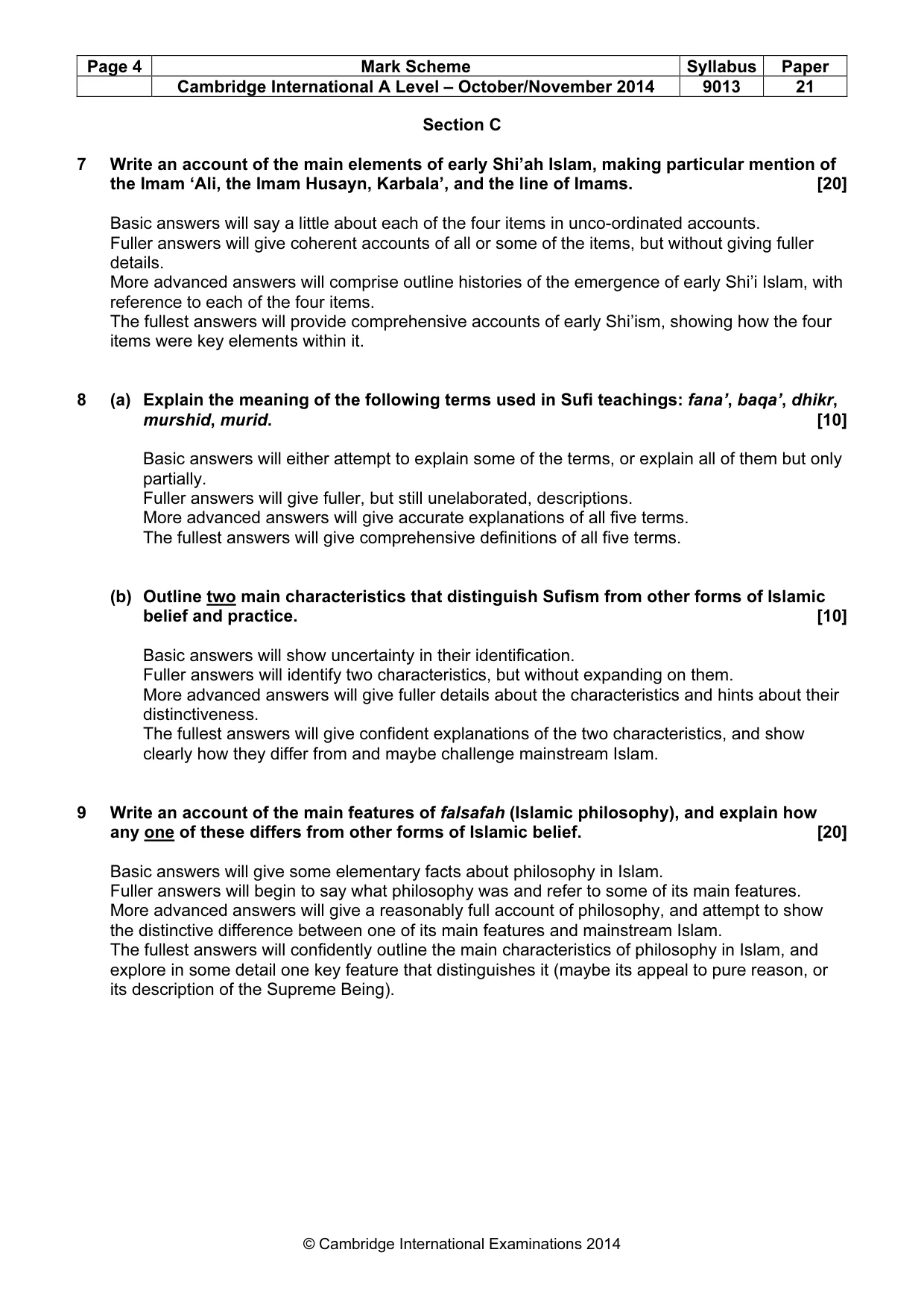
Page 4 Mark Scheme Syllabus Paper Cambridge International A Level – October/November 2014 9013 21 © Cambridge International Examinations 2014 Section C 7 Write an account of the main elements of early Shi’ah Islam, making particular mention of the Imam ‘Ali, the Imam Husayn, Karbala’, and the line of Imams. [20] Basic answers will say a little about each of the four items in unco-ordinated accounts. Fuller answers will give coherent accounts of all or some of the items, but without giving fuller details. More advanced answers will comprise outline histories of the emergence of early Shi’i Islam, with reference to each of the four items. The fullest answers will provide comprehensive accounts of early Shi’ism, showing how the four items were key elements within it. 8 (a) Explain the meaning of the following terms used in Sufi teachings: fana’, baqa’, dhikr, murshid, murid. [10] Basic answers will either attempt to explain some of the terms, or explain all of them but only partially. Fuller answers will give fuller, but still unelaborated, descriptions. More advanced answers will give accurate explanations of all five terms. The fullest answers will give comprehensive definitions of all five terms. (b) Outline two main characteristics that distinguish Sufism from other forms of Islamic belief and practice. [10] Basic answers will show uncertainty in their identification. Fuller answers will identify two characteristics, but without expanding on them. More advanced answers will give fuller details about the characteristics and hints about their distinctiveness. The fullest answers will give confident explanations of the two characteristics, and show clearly how they differ from and maybe challenge mainstream Islam. 9 Write an account of the main features of falsafah (Islamic philosophy), and explain how any one of these differs from other forms of Islamic belief. [20] Basic answers will give some elementary facts about philosophy in Islam. Fuller answers will begin to say what philosophy was and refer to some of its main features. More advanced answers will give a reasonably full account of philosophy, and attempt to show the distinctive difference between one of its main features and mainstream Islam. The fullest answers will confidently outline the main characteristics of philosophy in Islam, and explore in some detail one key feature that distinguishes it (maybe its appeal to pure reason, or its description of the Supreme Being).
Mark scheme, page 5
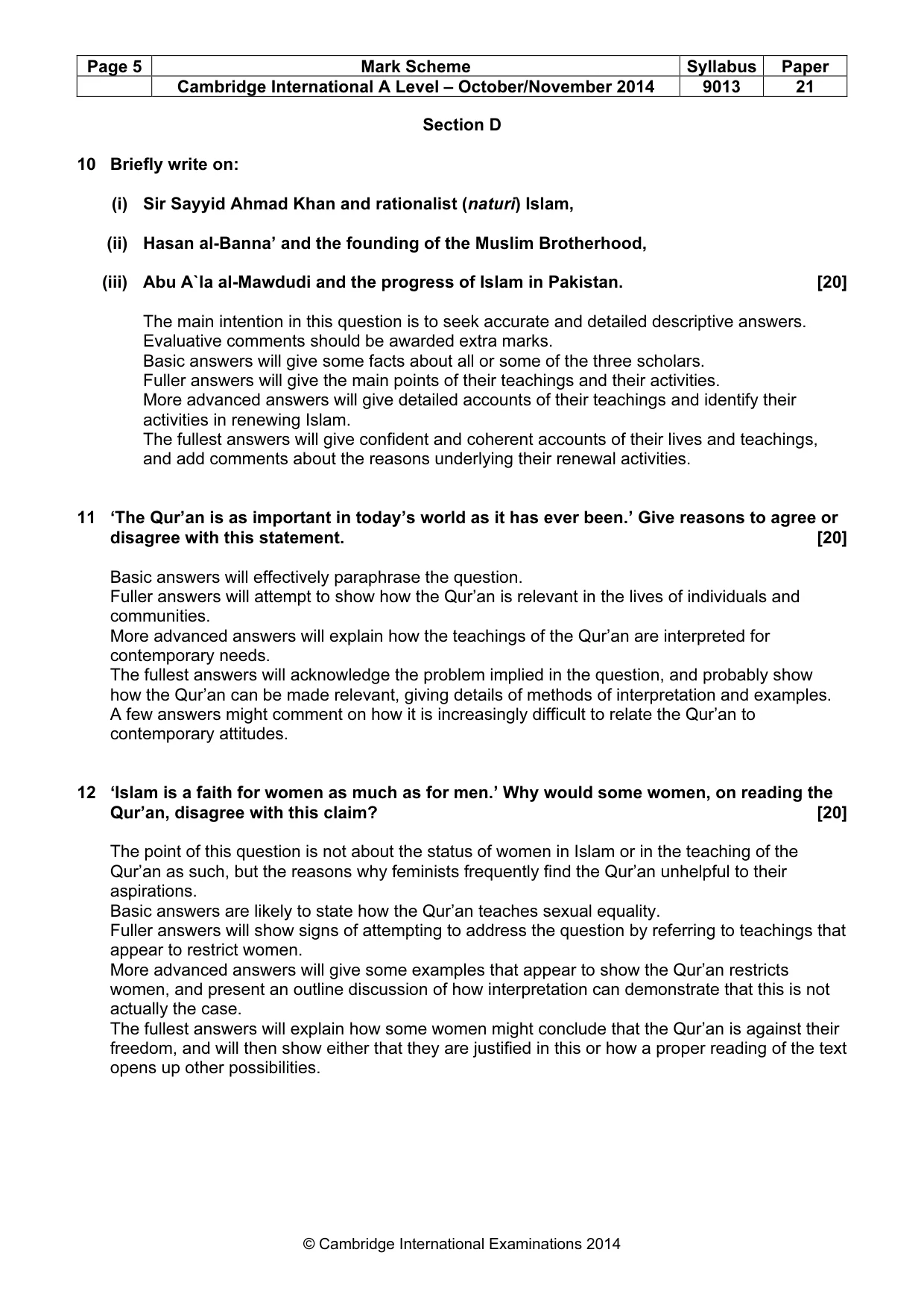
Page 5 Mark Scheme Syllabus Paper Cambridge International A Level – October/November 2014 9013 21 © Cambridge International Examinations 2014 Section D 10 Briefly write on: (i) Sir Sayyid Ahmad Khan and rationalist (naturi) Islam, (ii) Hasan al-Banna’ and the founding of the Muslim Brotherhood, (iii) Abu A`la al-Mawdudi and the progress of Islam in Pakistan. [20] The main intention in this question is to seek accurate and detailed descriptive answers. Evaluative comments should be awarded extra marks. Basic answers will give some facts about all or some of the three scholars. Fuller answers will give the main points of their teachings and their activities. More advanced answers will give detailed accounts of their teachings and identify their activities in renewing Islam. The fullest answers will give confident and coherent accounts of their lives and teachings, and add comments about the reasons underlying their renewal activities. 11 ‘The Qur’an is as important in today’s world as it has ever been.’ Give reasons to agree or disagree with this statement. [20] Basic answers will effectively paraphrase the question. Fuller answers will attempt to show how the Qur’an is relevant in the lives of individuals and communities. More advanced answers will explain how the teachings of the Qur’an are interpreted for contemporary needs. The fullest answers will acknowledge the problem implied in the question, and probably show how the Qur’an can be made relevant, giving details of methods of interpretation and examples. A few answers might comment on how it is increasingly difficult to relate the Qur’an to contemporary attitudes. 12 ‘Islam is a faith for women as much as for men.’ Why would some women, on reading the Qur’an, disagree with this claim? [20] The point of this question is not about the status of women in Islam or in the teaching of the Qur’an as such, but the reasons why feminists frequently find the Qur’an unhelpful to their aspirations. Basic answers are likely to state how the Qur’an teaches sexual equality. Fuller answers will show signs of attempting to address the question by referring to teachings that appear to restrict women. More advanced answers will give some examples that appear to show the Qur’an restricts women, and present an outline discussion of how interpretation can demonstrate that this is not actually the case. The fullest answers will explain how some women might conclude that the Qur’an is against their freedom, and will then show either that they are justified in this or how a proper reading of the text opens up other possibilities.
What you needed in this session
Cambridge’s own grade thresholds for 2014 Oct/Nov, Paper 2 · Variant 1. A higher threshold means an easier paper — the bar moves with how the cohort did.