Cambridge A Level Islamic Studies 9013 — 2012 Oct/Nov Paper 2 · Variant 1
9013/21/O/N/12 · 100 marks · ≈113 min
The question paper and its mark scheme, free to read here and free to download. This is Cambridge’s own paper, exactly as it was sat.
Question paper4 pages
Mark scheme6 pages
Answers below. Sit the paper first if you are practising.
Paper as text
Question paper, page 1
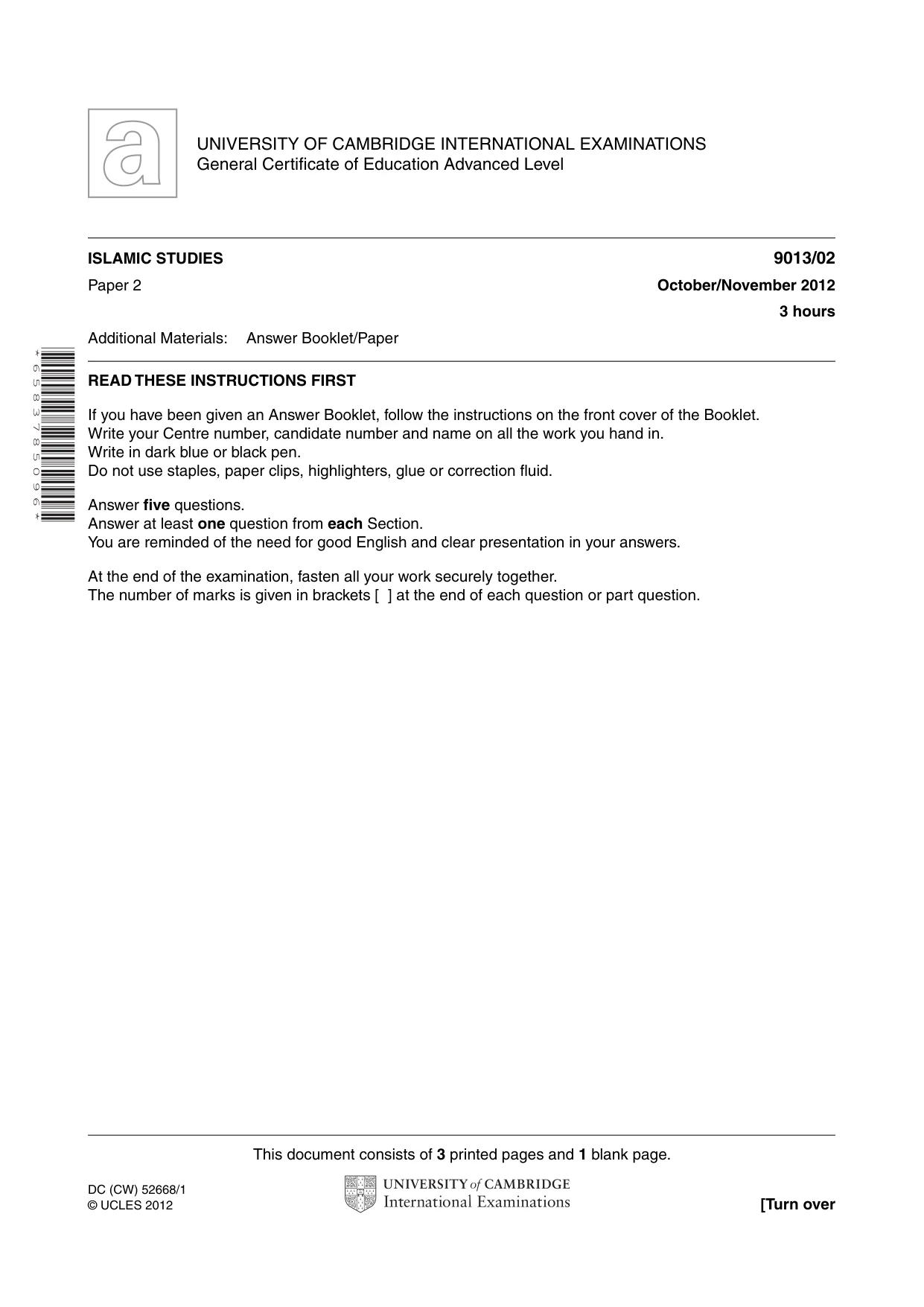
This document consists of 3 printed pages and 1 blank page. DC (CW) 52668/1 © UCLES 2012 [Turn over UNIVERSITY OF CAMBRIDGE INTERNATIONAL EXAMINATIONS General Certificate of Education Advanced Level * 6 5 8 3 7 8 5 0 9 6 * ISLAMIC STUDIES 9013/02 Paper 2 October/November 2012 3 hours Additional Materials: Answer Booklet/Paper READ THESE INSTRUCTIONS FIRST If you have been given an Answer Booklet, follow the instructions on the front cover of the Booklet. Write your Centre number, candidate number and name on all the work you hand in. Write in dark blue or black pen. Do not use staples, paper clips, highlighters, glue or correction fluid. Answer five questions. Answer at least one question from each Section. You are reminded of the need for good English and clear presentation in your answers. At the end of the examination, fasten all your work securely together. The number of marks is given in brackets [ ] at the end of each question or part question.
Question paper, page 2
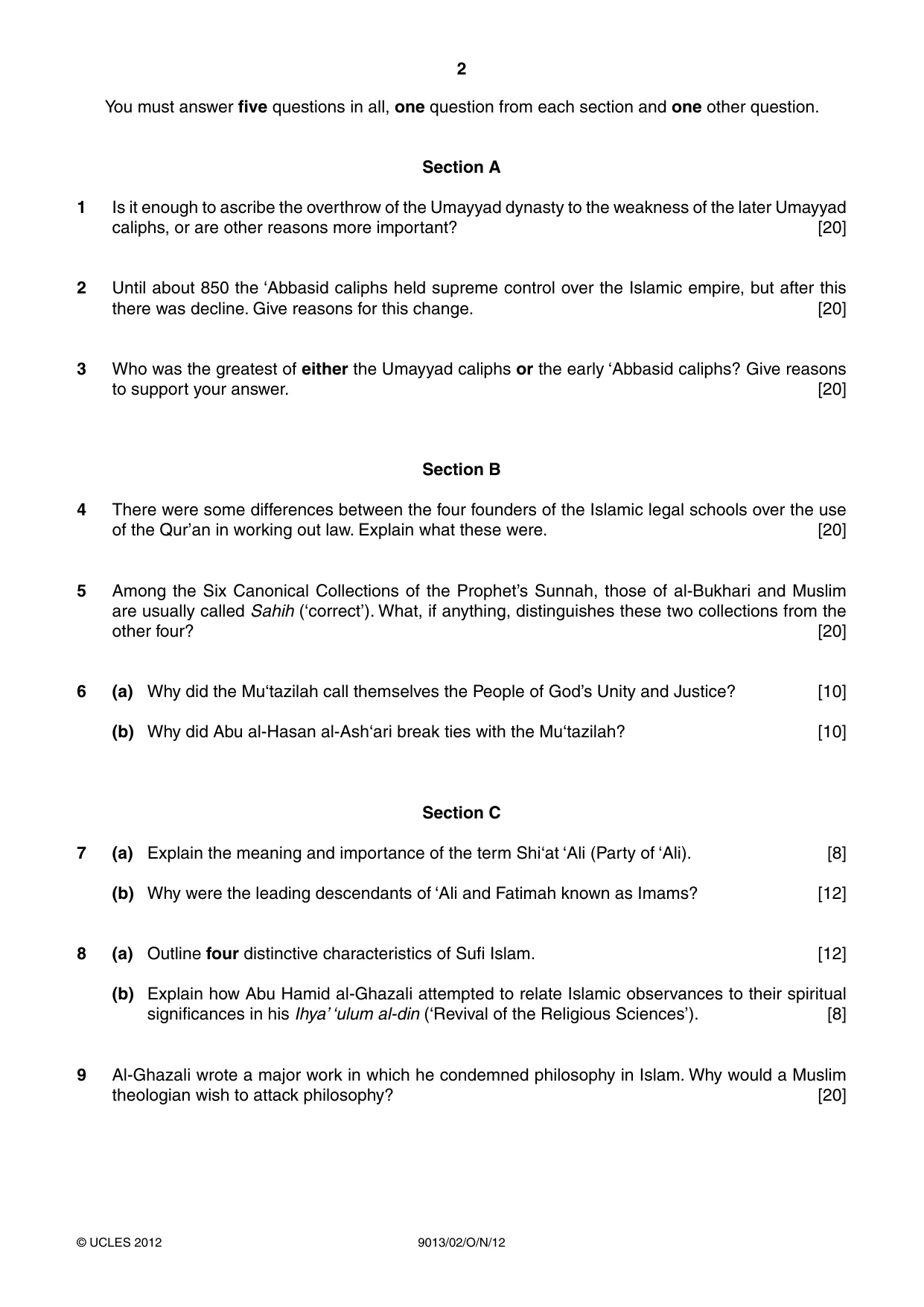
2 9013/02/O/N/12 © UCLES 2012 You must answer five questions in all, one question from each section and one other question. Section A 1 Is it enough to ascribe the overthrow of the Umayyad dynasty to the weakness of the later Umayyad caliphs, or are other reasons more important? [20] 2 Until about 850 the ‘Abbasid caliphs held supreme control over the Islamic empire, but after this there was decline. Give reasons for this change. [20] 3 Who was the greatest of either the Umayyad caliphs or the early ‘Abbasid caliphs? Give reasons to support your answer. [20] Section B 4 There were some differences between the four founders of the Islamic legal schools over the use of the Qur’an in working out law. Explain what these were. [20] 5 Among the Six Canonical Collections of the Prophet’s Sunnah, those of al-Bukhari and Muslim are usually called Sahih (‘correct’). What, if anything, distinguishes these two collections from the other four? [20] 6 (a) Why did the Mu‘tazilah call themselves the People of God’s Unity and Justice? [10] (b) Why did Abu al-Hasan al-Ash‘ari break ties with the Mu‘tazilah? [10] Section C 7 (a) Explain the meaning and importance of the term Shi‘at ‘Ali (Party of ‘Ali). [8] (b) Why were the leading descendants of ‘Ali and Fatimah known as Imams? [12] 8 (a) Outline four distinctive characteristics of Sufi Islam. [12] (b) Explain how Abu Hamid al-Ghazali attempted to relate Islamic observances to their spiritual significances in his Ihya’ ‘ulum al-din (‘Revival of the Religious Sciences’). [8] 9 Al-Ghazali wrote a major work in which he condemned philosophy in Islam. Why would a Muslim theologian wish to attack philosophy? [20]
Question paper, page 3
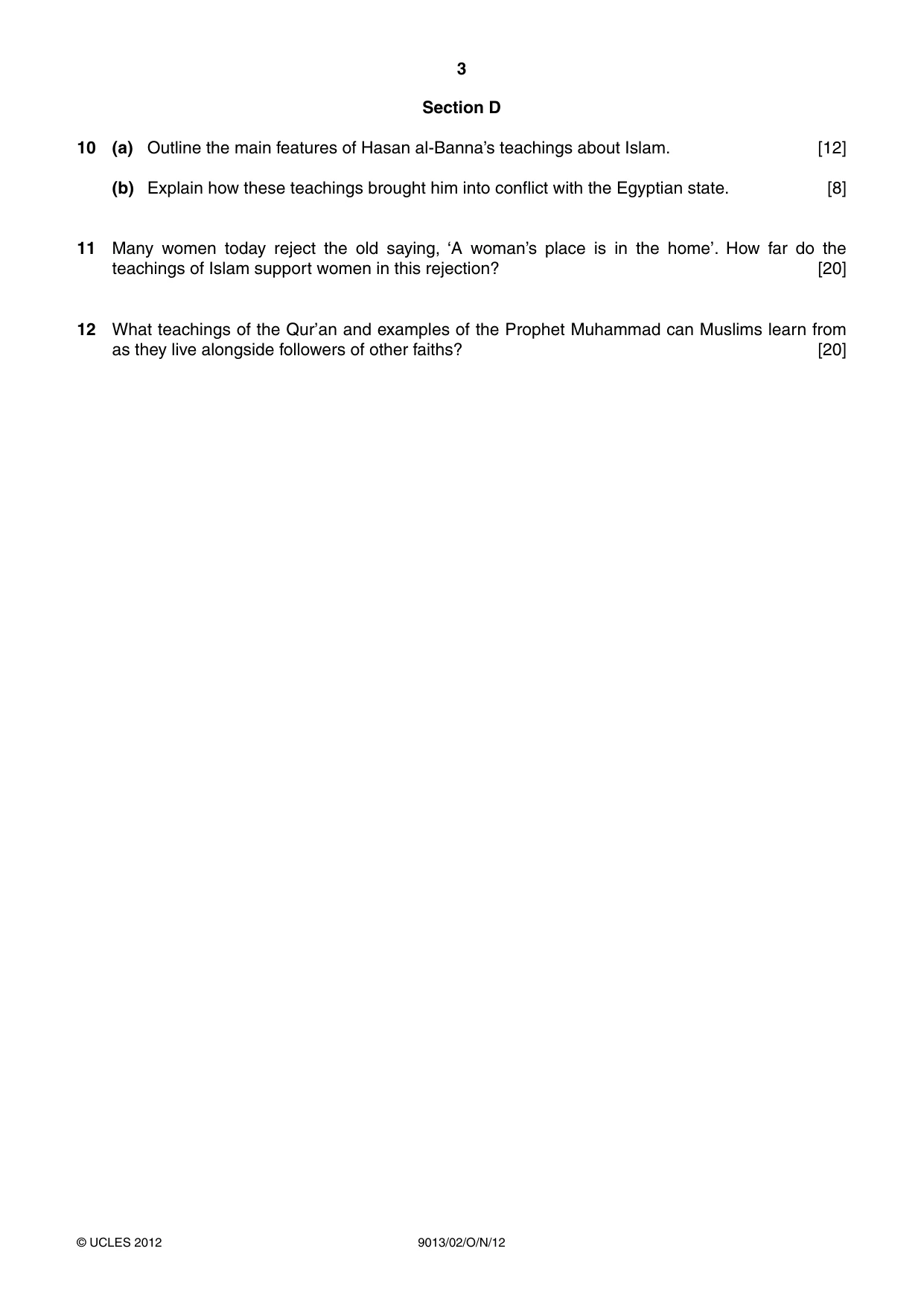
3 9013/02/O/N/12 © UCLES 2012 Section D 10 (a) Outline the main features of Hasan al-Banna’s teachings about Islam. [12] (b) Explain how these teachings brought him into conflict with the Egyptian state. [8] 11 Many women today reject the old saying, ‘A woman’s place is in the home’. How far do the teachings of Islam support women in this rejection? [20] 12 What teachings of the Qur’an and examples of the Prophet Muhammad can Muslims learn from as they live alongside followers of other faiths? [20]
Question paper, page 4
4 9013/02/O/N/12 © UCLES 2012 BLANK PAGE Permission to reproduce items where third-party owned material protected by copyright is included has been sought and cleared where possible. Every reasonable effort has been made by the publisher (UCLES) to trace copyright holders, but if any items requiring clearance have unwittingly been included, the publisher will be pleased to make amends at the earliest possible opportunity. University of Cambridge International Examinations is part of the Cambridge Assessment Group. Cambridge Assessment is the brand name of University of Cambridge Local Examinations Syndicate (UCLES), which is itself a department of the University of Cambridge.
Mark scheme, page 1
CAMBRIDGE INTERNATIONAL EXAMINATIONS GCE Advanced Level MARK SCHEME for the October/November 2012 series 9013 ISLAMIC STUDIES 9013/02 Paper 2, maximum raw mark 100 This mark scheme is published as an aid to teachers and candidates, to indicate the requirements of the examination. It shows the basis on which Examiners were instructed to award marks. It does not indicate the details of the discussions that took place at an Examiners’ meeting before marking began, which would have considered the acceptability of alternative answers. Mark schemes should be read in conjunction with the question paper and the Principal Examiner Report for Teachers. Cambridge will not enter into discussions about these mark schemes. Cambridge is publishing the mark schemes for the October/November 2012 series for most IGCSE, GCE Advanced Level and Advanced Subsidiary Level components and some Ordinary Level components.
Mark scheme, page 2
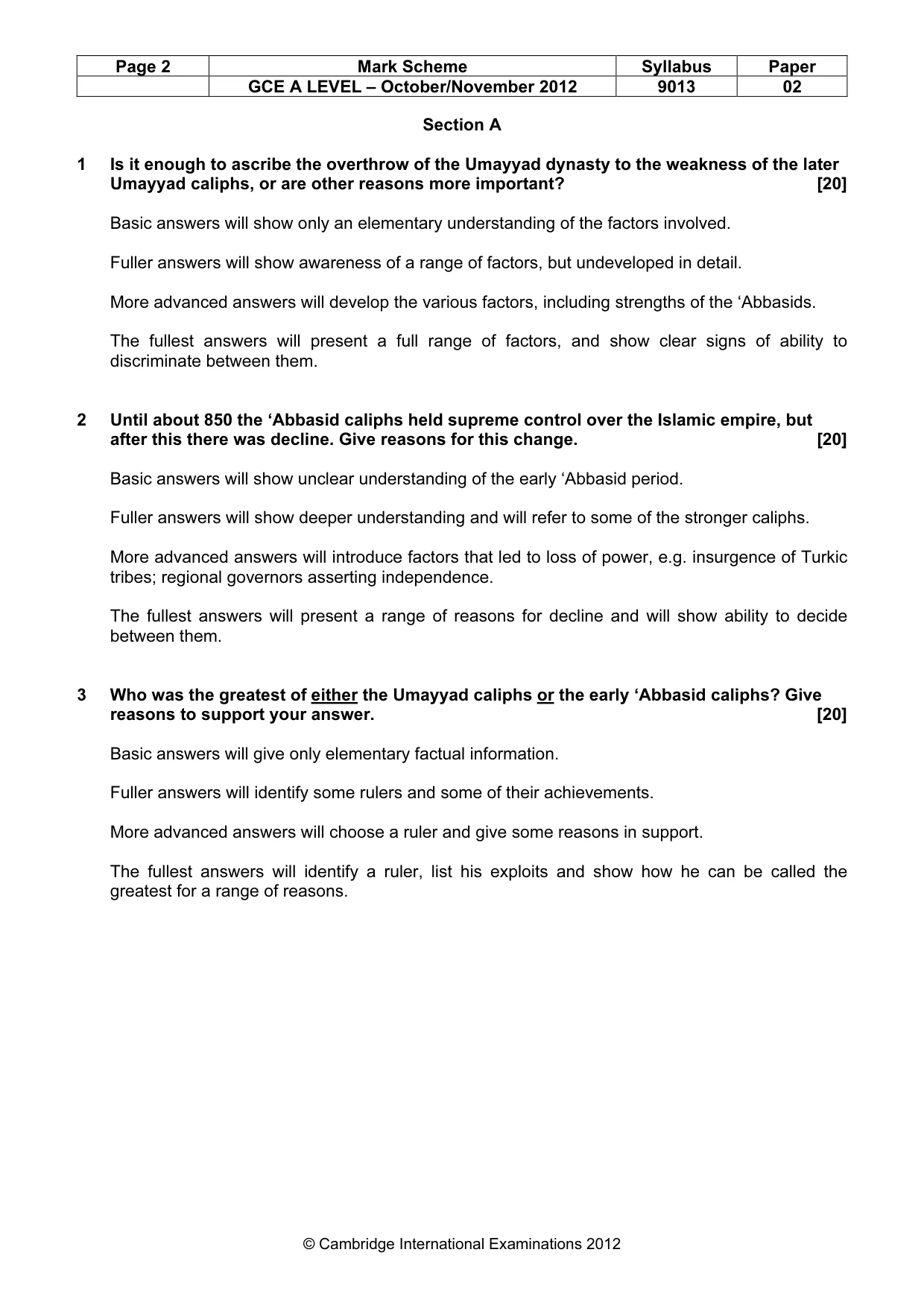
Page 2 Mark Scheme Syllabus Paper GCE A LEVEL – October/November 2012 9013 02 © Cambridge International Examinations 2012 Section A 1 Is it enough to ascribe the overthrow of the Umayyad dynasty to the weakness of the later Umayyad caliphs, or are other reasons more important? [20] Basic answers will show only an elementary understanding of the factors involved. Fuller answers will show awareness of a range of factors, but undeveloped in detail. More advanced answers will develop the various factors, including strengths of the ‘Abbasids. The fullest answers will present a full range of factors, and show clear signs of ability to discriminate between them. 2 Until about 850 the ‘Abbasid caliphs held supreme control over the Islamic empire, but after this there was decline. Give reasons for this change. [20] Basic answers will show unclear understanding of the early ‘Abbasid period. Fuller answers will show deeper understanding and will refer to some of the stronger caliphs. More advanced answers will introduce factors that led to loss of power, e.g. insurgence of Turkic tribes; regional governors asserting independence. The fullest answers will present a range of reasons for decline and will show ability to decide between them. 3 Who was the greatest of either the Umayyad caliphs or the early ‘Abbasid caliphs? Give reasons to support your answer. [20] Basic answers will give only elementary factual information. Fuller answers will identify some rulers and some of their achievements. More advanced answers will choose a ruler and give some reasons in support. The fullest answers will identify a ruler, list his exploits and show how he can be called the greatest for a range of reasons.
Mark scheme, page 3
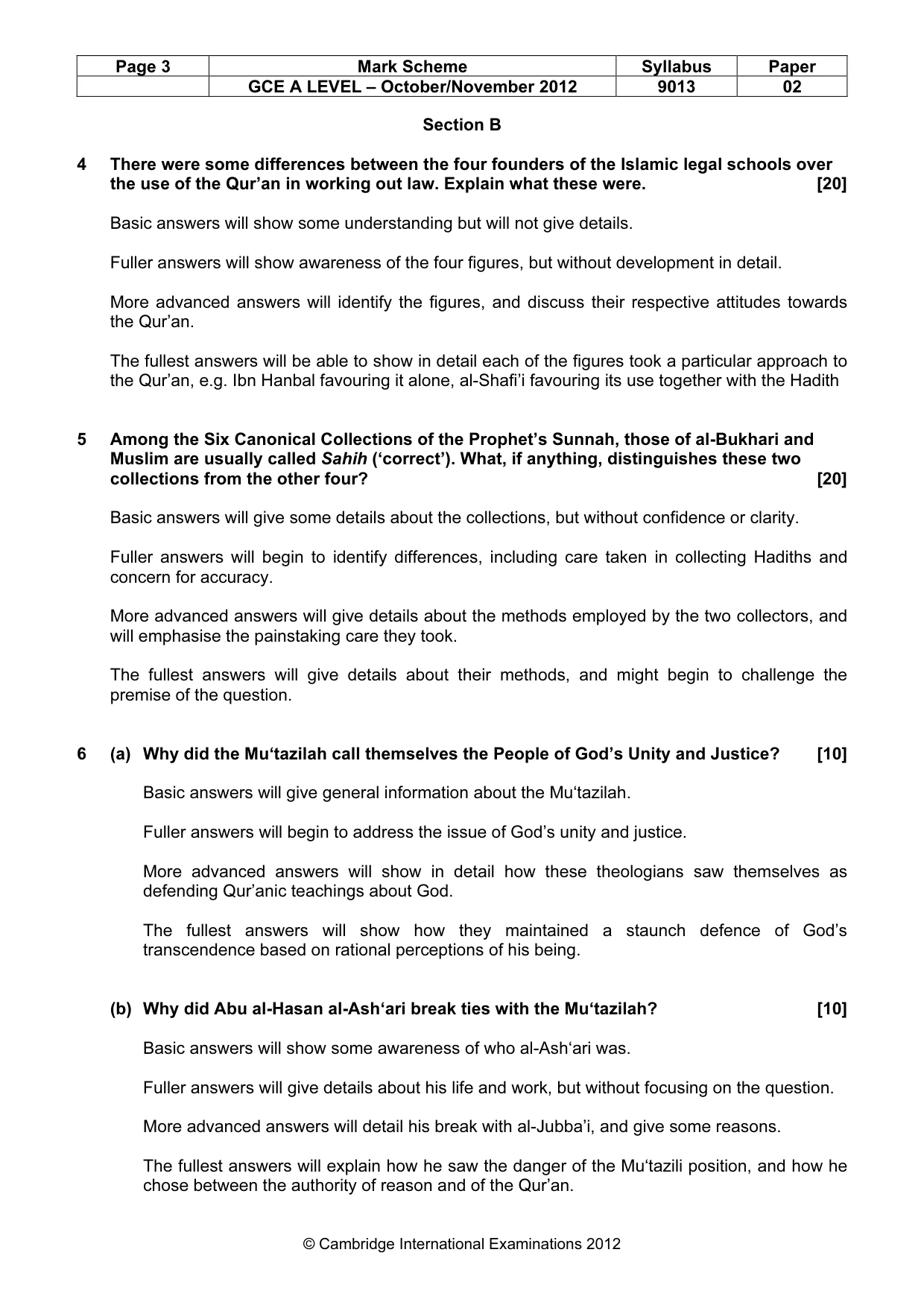
Page 3 Mark Scheme Syllabus Paper GCE A LEVEL – October/November 2012 9013 02 © Cambridge International Examinations 2012 Section B 4 There were some differences between the four founders of the Islamic legal schools over the use of the Qur’an in working out law. Explain what these were. [20] Basic answers will show some understanding but will not give details. Fuller answers will show awareness of the four figures, but without development in detail. More advanced answers will identify the figures, and discuss their respective attitudes towards the Qur’an. The fullest answers will be able to show in detail each of the figures took a particular approach to the Qur’an, e.g. Ibn Hanbal favouring it alone, al-Shafi’i favouring its use together with the Hadith 5 Among the Six Canonical Collections of the Prophet’s Sunnah, those of al-Bukhari and Muslim are usually called Sahih (‘correct’). What, if anything, distinguishes these two collections from the other four? [20] Basic answers will give some details about the collections, but without confidence or clarity. Fuller answers will begin to identify differences, including care taken in collecting Hadiths and concern for accuracy. More advanced answers will give details about the methods employed by the two collectors, and will emphasise the painstaking care they took. The fullest answers will give details about their methods, and might begin to challenge the premise of the question. 6 (a) Why did the Mu‘tazilah call themselves the People of God’s Unity and Justice? [10] Basic answers will give general information about the Mu‘tazilah. Fuller answers will begin to address the issue of God’s unity and justice. More advanced answers will show in detail how these theologians saw themselves as defending Qur’anic teachings about God. The fullest answers will show how they maintained a staunch defence of God’s transcendence based on rational perceptions of his being. (b) Why did Abu al-Hasan al-Ash‘ari break ties with the Mu‘tazilah? [10] Basic answers will show some awareness of who al-Ash‘ari was. Fuller answers will give details about his life and work, but without focusing on the question. More advanced answers will detail his break with al-Jubba’i, and give some reasons. The fullest answers will explain how he saw the danger of the Mu‘tazili position, and how he chose between the authority of reason and of the Qur’an.
Mark scheme, page 4
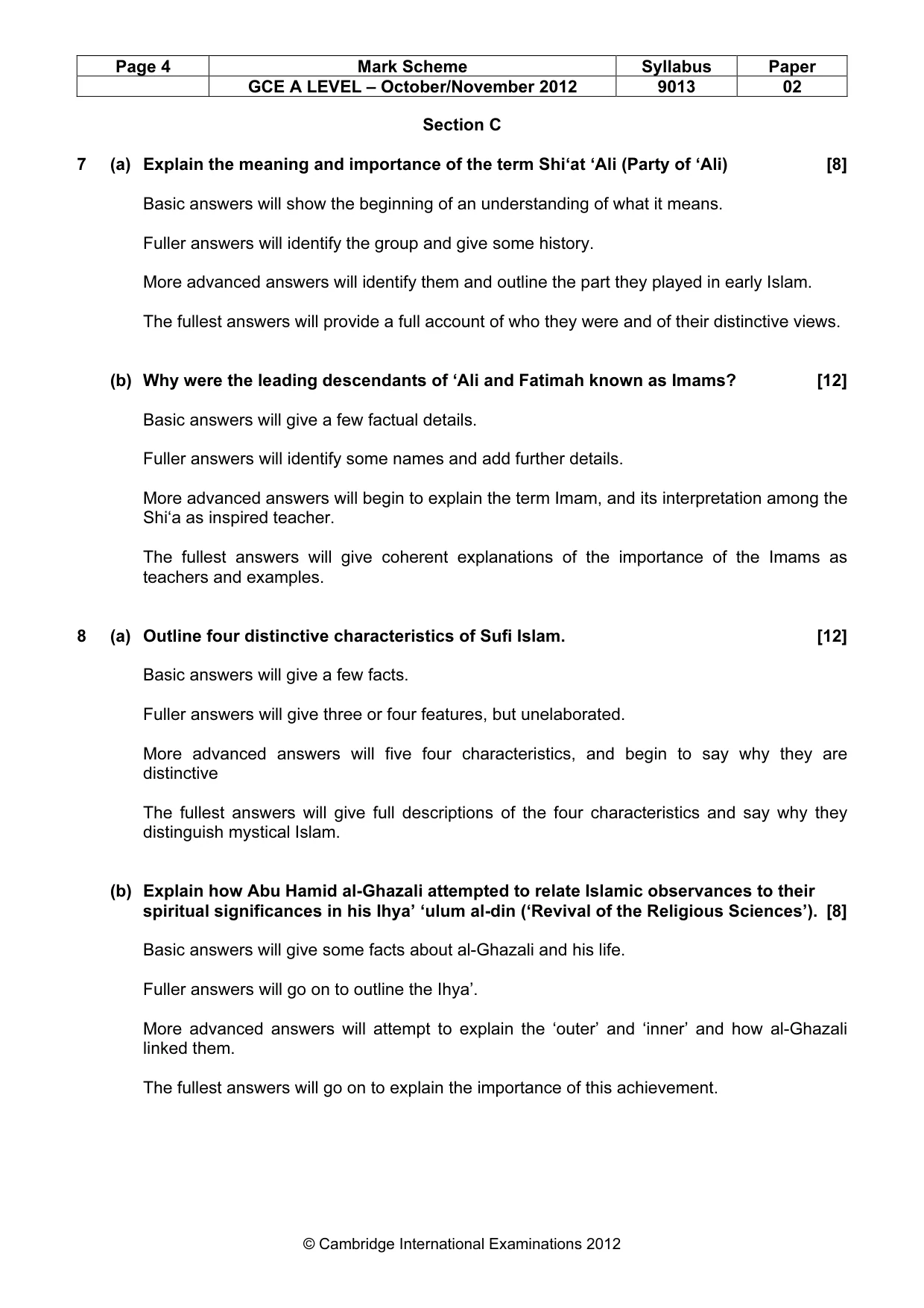
Page 4 Mark Scheme Syllabus Paper GCE A LEVEL – October/November 2012 9013 02 © Cambridge International Examinations 2012 Section C 7 (a) Explain the meaning and importance of the term Shi‘at ‘Ali (Party of ‘Ali) [8] Basic answers will show the beginning of an understanding of what it means. Fuller answers will identify the group and give some history. More advanced answers will identify them and outline the part they played in early Islam. The fullest answers will provide a full account of who they were and of their distinctive views. (b) Why were the leading descendants of ‘Ali and Fatimah known as Imams? [12] Basic answers will give a few factual details. Fuller answers will identify some names and add further details. More advanced answers will begin to explain the term Imam, and its interpretation among the Shi‘a as inspired teacher. The fullest answers will give coherent explanations of the importance of the Imams as teachers and examples. 8 (a) Outline four distinctive characteristics of Sufi Islam. [12] Basic answers will give a few facts. Fuller answers will give three or four features, but unelaborated. More advanced answers will five four characteristics, and begin to say why they are distinctive The fullest answers will give full descriptions of the four characteristics and say why they distinguish mystical Islam. (b) Explain how Abu Hamid al-Ghazali attempted to relate Islamic observances to their spiritual significances in his Ihya’ ‘ulum al-din (‘Revival of the Religious Sciences’). [8] Basic answers will give some facts about al-Ghazali and his life. Fuller answers will go on to outline the Ihya’. More advanced answers will attempt to explain the ‘outer’ and ‘inner’ and how al-Ghazali linked them. The fullest answers will go on to explain the importance of this achievement.
Mark scheme, page 5
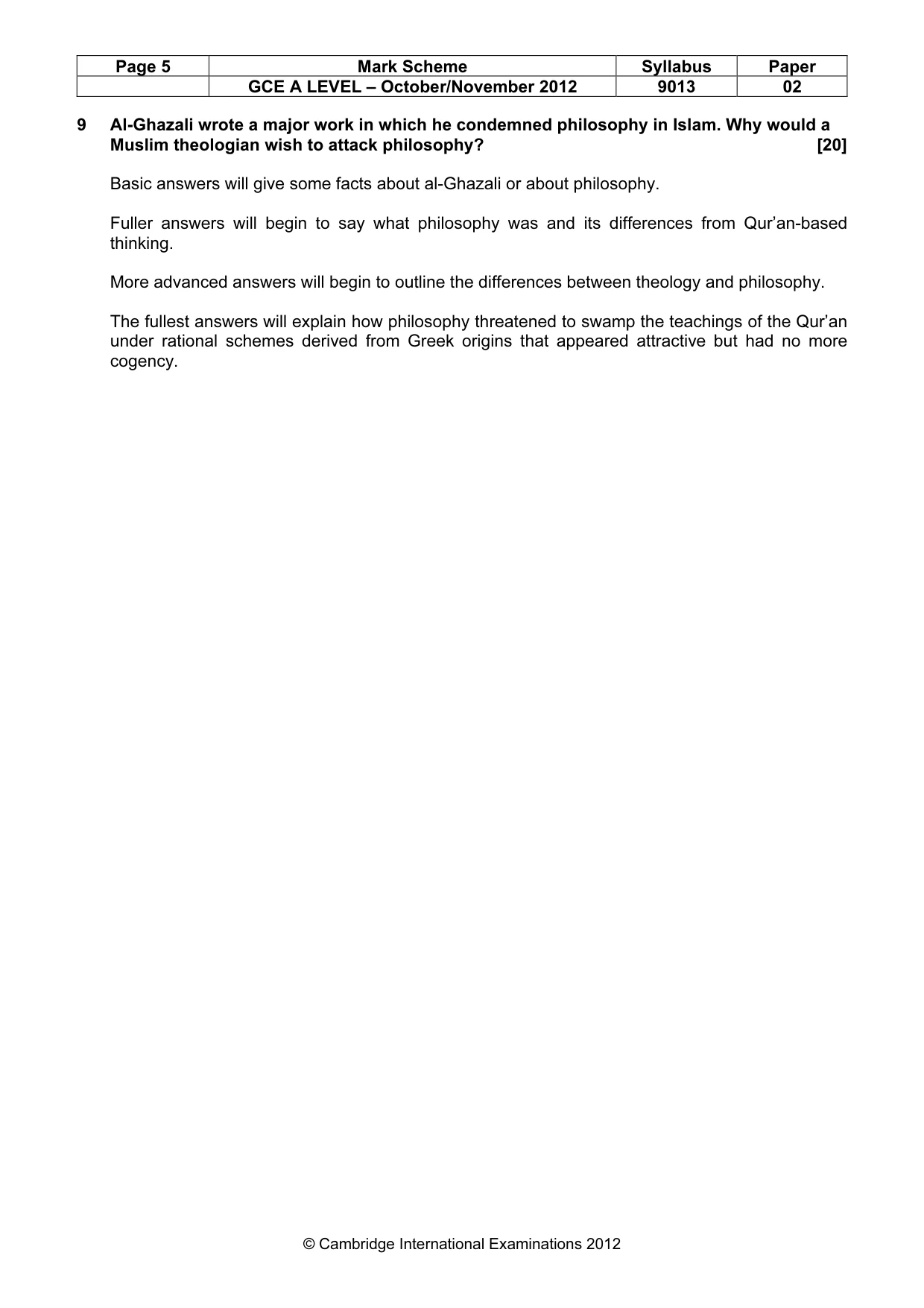
Page 5 Mark Scheme Syllabus Paper GCE A LEVEL – October/November 2012 9013 02 © Cambridge International Examinations 2012 9 Al-Ghazali wrote a major work in which he condemned philosophy in Islam. Why would a Muslim theologian wish to attack philosophy? [20] Basic answers will give some facts about al-Ghazali or about philosophy. Fuller answers will begin to say what philosophy was and its differences from Qur’an-based thinking. More advanced answers will begin to outline the differences between theology and philosophy. The fullest answers will explain how philosophy threatened to swamp the teachings of the Qur’an under rational schemes derived from Greek origins that appeared attractive but had no more cogency.
Mark scheme, page 6
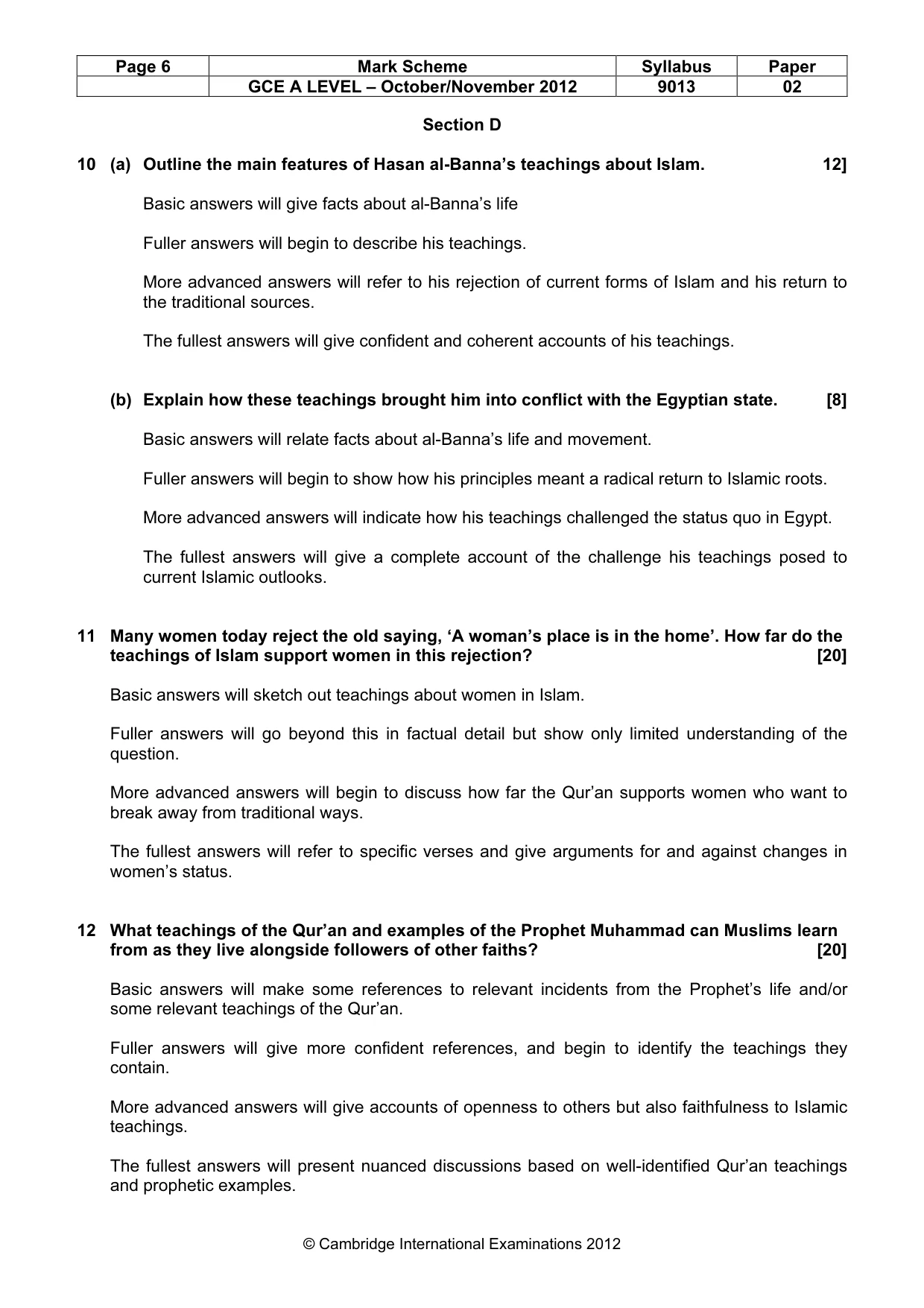
Page 6 Mark Scheme Syllabus Paper GCE A LEVEL – October/November 2012 9013 02 © Cambridge International Examinations 2012 Section D 10 (a) Outline the main features of Hasan al-Banna’s teachings about Islam. 12] Basic answers will give facts about al-Banna’s life Fuller answers will begin to describe his teachings. More advanced answers will refer to his rejection of current forms of Islam and his return to the traditional sources. The fullest answers will give confident and coherent accounts of his teachings. (b) Explain how these teachings brought him into conflict with the Egyptian state. [8] Basic answers will relate facts about al-Banna’s life and movement. Fuller answers will begin to show how his principles meant a radical return to Islamic roots. More advanced answers will indicate how his teachings challenged the status quo in Egypt. The fullest answers will give a complete account of the challenge his teachings posed to current Islamic outlooks. 11 Many women today reject the old saying, ‘A woman’s place is in the home’. How far do the teachings of Islam support women in this rejection? [20] Basic answers will sketch out teachings about women in Islam. Fuller answers will go beyond this in factual detail but show only limited understanding of the question. More advanced answers will begin to discuss how far the Qur’an supports women who want to break away from traditional ways. The fullest answers will refer to specific verses and give arguments for and against changes in women’s status. 12 What teachings of the Qur’an and examples of the Prophet Muhammad can Muslims learn from as they live alongside followers of other faiths? [20] Basic answers will make some references to relevant incidents from the Prophet’s life and/or some relevant teachings of the Qur’an. Fuller answers will give more confident references, and begin to identify the teachings they contain. More advanced answers will give accounts of openness to others but also faithfulness to Islamic teachings. The fullest answers will present nuanced discussions based on well-identified Qur’an teachings and prophetic examples.
What you needed in this session
Cambridge’s own grade thresholds for 2012 Oct/Nov, Paper 2 · Variant 1. A higher threshold means an easier paper — the bar moves with how the cohort did.