Cambridge A Level Islamic Studies 9013 — 2013 Oct/Nov Paper 2 · Variant 1
9013/21/O/N/13 · 100 marks · ≈113 min
The question paper and its mark scheme, free to read here and free to download. This is Cambridge’s own paper, exactly as it was sat.
Question paper4 pages

Mark scheme5 pages
Answers below. Sit the paper first if you are practising.
Paper as text
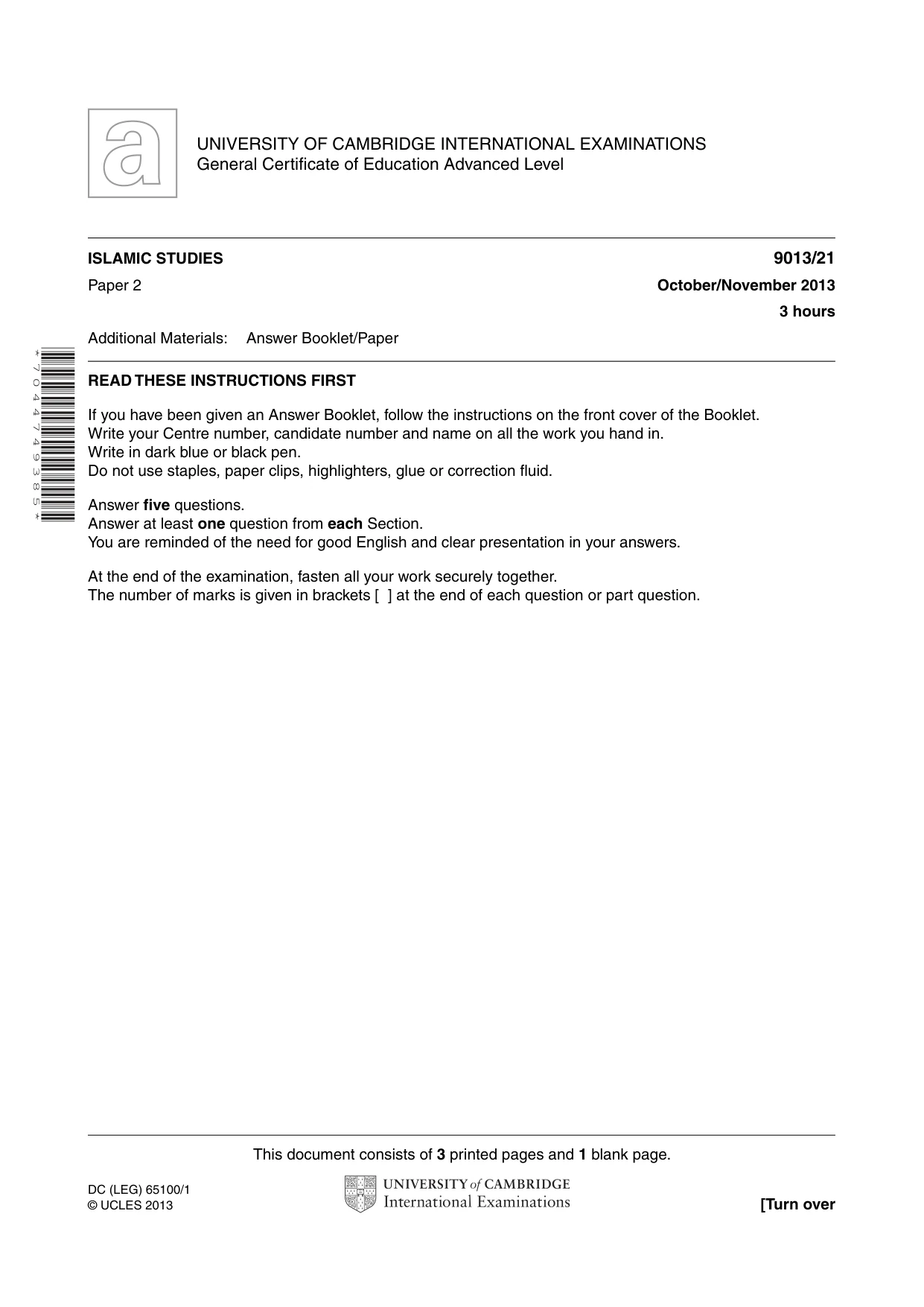
Question paper, page 1
This document consists of 3 printed pages and 1 blank page. DC (LEG) 65100/1 © UCLES 2013 [Turn over UNIVERSITY OF CAMBRIDGE INTERNATIONAL EXAMINATIONS General Certificate of Education Advanced Level * 7 0 4 4 7 4 9 3 8 5 * ISLAMIC STUDIES 9013/21 Paper 2 October/November 2013 3 hours Additional Materials: Answer Booklet/Paper READ THESE INSTRUCTIONS FIRST If you have been given an Answer Booklet, follow the instructions on the front cover of the Booklet. Write your Centre number, candidate number and name on all the work you hand in. Write in dark blue or black pen. Do not use staples, paper clips, highlighters, glue or correction fluid. Answer five questions. Answer at least one question from each Section. You are reminded of the need for good English and clear presentation in your answers. At the end of the examination, fasten all your work securely together. The number of marks is given in brackets [ ] at the end of each question or part question.
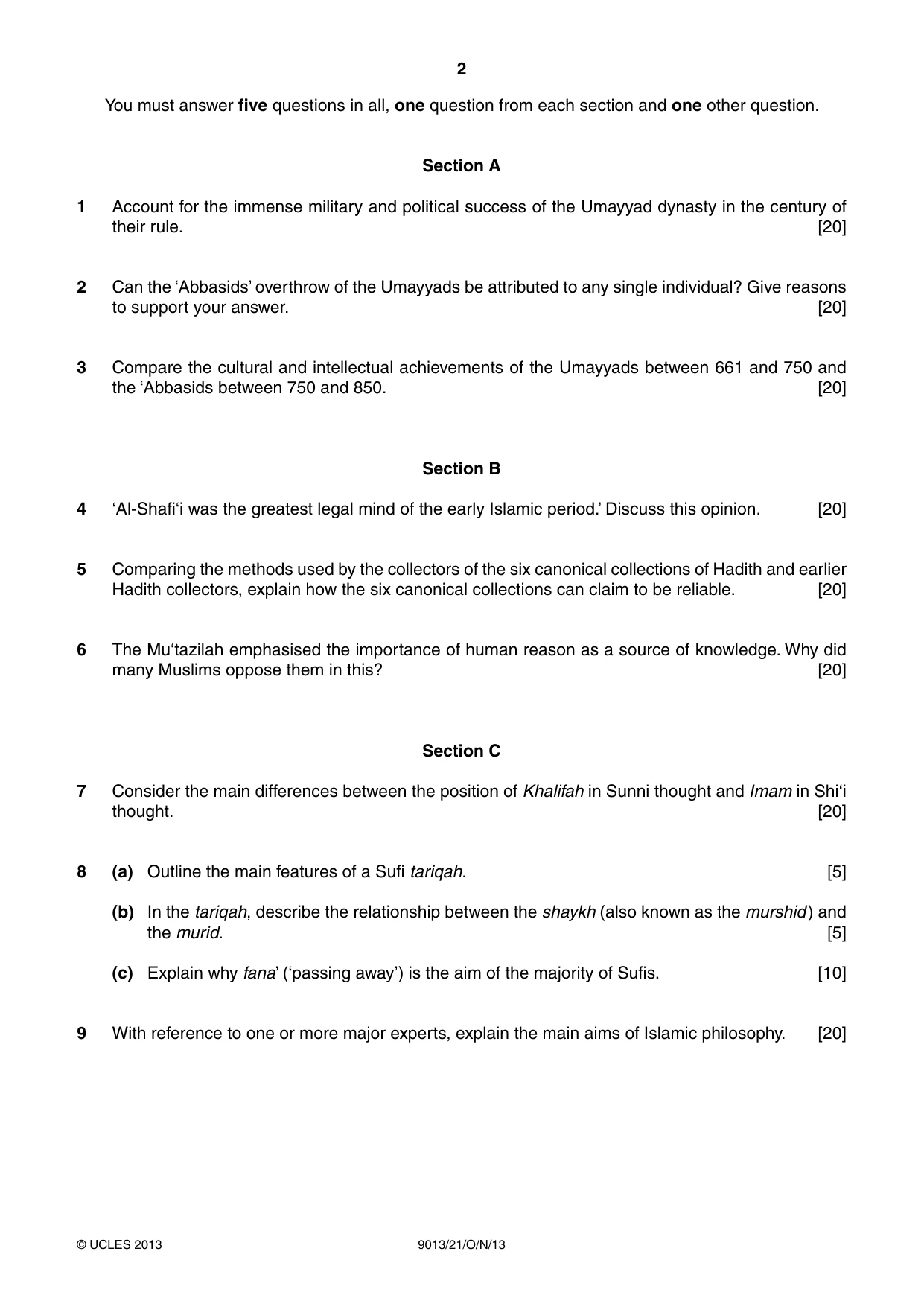
Question paper, page 2
2 9013/21/O/N/13 © UCLES 2013 You must answer five questions in all, one question from each section and one other question. Section A 1 Account for the immense military and political success of the Umayyad dynasty in the century of their rule. [20] 2 Can the ‘Abbasids’ overthrow of the Umayyads be attributed to any single individual? Give reasons to support your answer. [20] 3 Compare the cultural and intellectual achievements of the Umayyads between 661 and 750 and the ‘Abbasids between 750 and 850. [20] Section B 4 ‘Al-Shafi‘i was the greatest legal mind of the early Islamic period.’ Discuss this opinion. [20] 5 Comparing the methods used by the collectors of the six canonical collections of Hadith and earlier Hadith collectors, explain how the six canonical collections can claim to be reliable. [20] 6 The Mu‘tazilah emphasised the importance of human reason as a source of knowledge. Why did many Muslims oppose them in this? [20] Section C 7 Consider the main differences between the position of Khalifah in Sunni thought and Imam in Shi‘i thought. [20] 8 (a) Outline the main features of a Sufi tariqah. [5] (b) In the tariqah, describe the relationship between the shaykh (also known as the murshid ) and the murid. [5] (c) Explain why fana’ (‘passing away’) is the aim of the majority of Sufis. [10] 9 With reference to one or more major experts, explain the main aims of Islamic philosophy. [20]
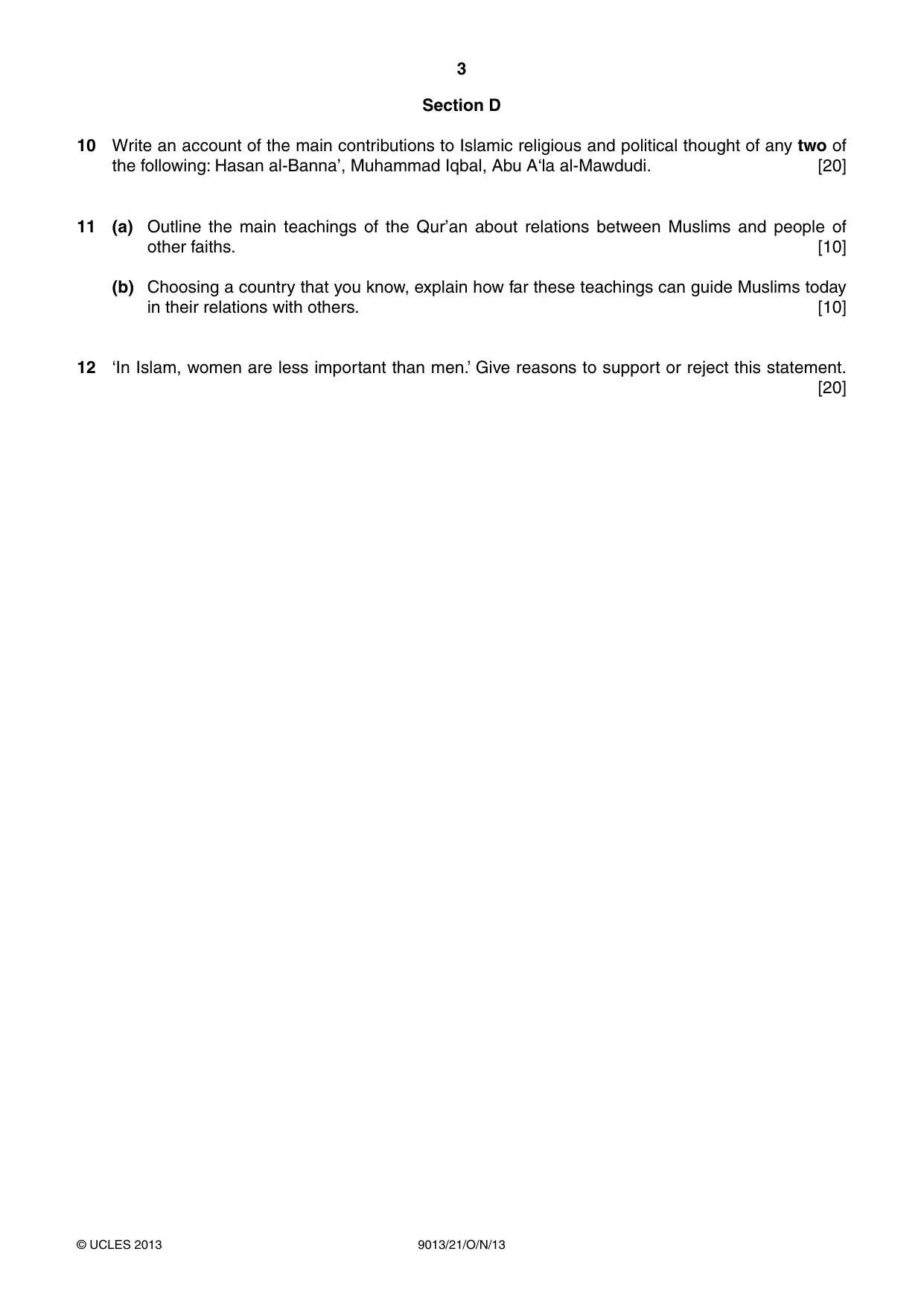
Question paper, page 3
3 9013/21/O/N/13 © UCLES 2013 Section D 10 Write an account of the main contributions to Islamic religious and political thought of any two of the following: Hasan al-Banna’, Muhammad Iqbal, Abu A‘la al-Mawdudi. [20] 11 (a) Outline the main teachings of the Qur’an about relations between Muslims and people of other faiths. [10] (b) Choosing a country that you know, explain how far these teachings can guide Muslims today in their relations with others. [10] 12 ‘In Islam, women are less important than men.’ Give reasons to support or reject this statement. [20]
Question paper, page 4
4 9013/21/O/N/13 © UCLES 2013 Permission to reproduce items where third-party owned material protected by copyright is included has been sought and cleared where possible. Every reasonable effort has been made by the publisher (UCLES) to trace copyright holders, but if any items requiring clearance have unwittingly been included, the publisher will be pleased to make amends at the earliest possible opportunity. University of Cambridge International Examinations is part of the Cambridge Assessment Group. Cambridge Assessment is the brand name of University of Cambridge Local Examinations Syndicate (UCLES), which is itself a department of the University of Cambridge. BLANK PAGE
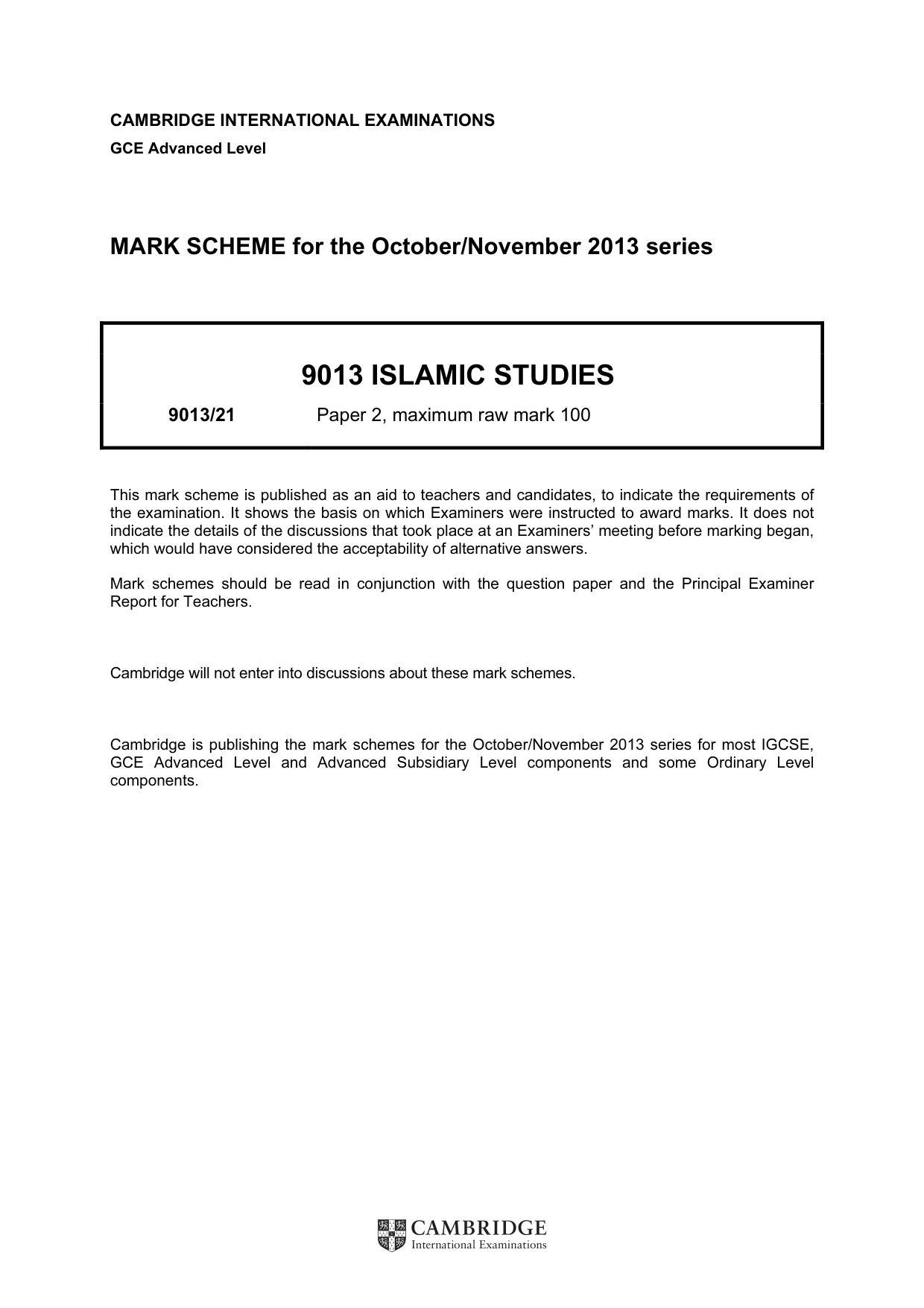
Mark scheme, page 1
CAMBRIDGE INTERNATIONAL EXAMINATIONS GCE Advanced Level MARK SCHEME for the October/November 2013 series 9013 ISLAMIC STUDIES 9013/21 Paper 2, maximum raw mark 100 This mark scheme is published as an aid to teachers and candidates, to indicate the requirements of the examination. It shows the basis on which Examiners were instructed to award marks. It does not indicate the details of the discussions that took place at an Examiners’ meeting before marking began, which would have considered the acceptability of alternative answers. Mark schemes should be read in conjunction with the question paper and the Principal Examiner Report for Teachers. Cambridge will not enter into discussions about these mark schemes. Cambridge is publishing the mark schemes for the October/November 2013 series for most IGCSE, GCE Advanced Level and Advanced Subsidiary Level components and some Ordinary Level components.
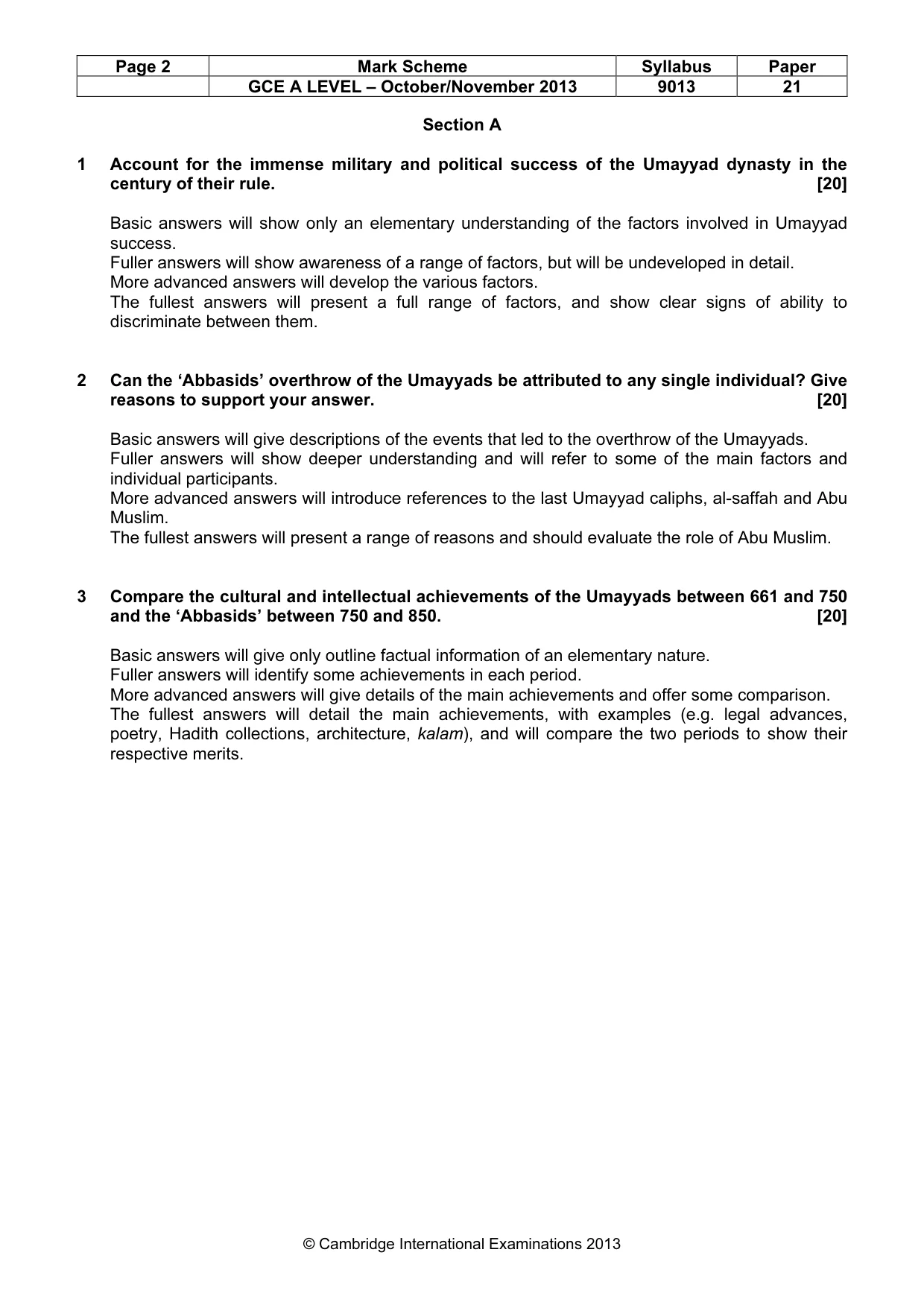
Mark scheme, page 2
Page 2 Mark Scheme Syllabus Paper GCE A LEVEL – October/November 2013 9013 21 © Cambridge International Examinations 2013 Section A 1 Account for the immense military and political success of the Umayyad dynasty in the century of their rule. [20] Basic answers will show only an elementary understanding of the factors involved in Umayyad success. Fuller answers will show awareness of a range of factors, but will be undeveloped in detail. More advanced answers will develop the various factors. The fullest answers will present a full range of factors, and show clear signs of ability to discriminate between them. 2 Can the ‘Abbasids’ overthrow of the Umayyads be attributed to any single individual? Give reasons to support your answer. [20] Basic answers will give descriptions of the events that led to the overthrow of the Umayyads. Fuller answers will show deeper understanding and will refer to some of the main factors and individual participants. More advanced answers will introduce references to the last Umayyad caliphs, al-saffah and Abu Muslim. The fullest answers will present a range of reasons and should evaluate the role of Abu Muslim. 3 Compare the cultural and intellectual achievements of the Umayyads between 661 and 750 and the ‘Abbasids’ between 750 and 850. [20] Basic answers will give only outline factual information of an elementary nature. Fuller answers will identify some achievements in each period. More advanced answers will give details of the main achievements and offer some comparison. The fullest answers will detail the main achievements, with examples (e.g. legal advances, poetry, Hadith collections, architecture, kalam), and will compare the two periods to show their respective merits.
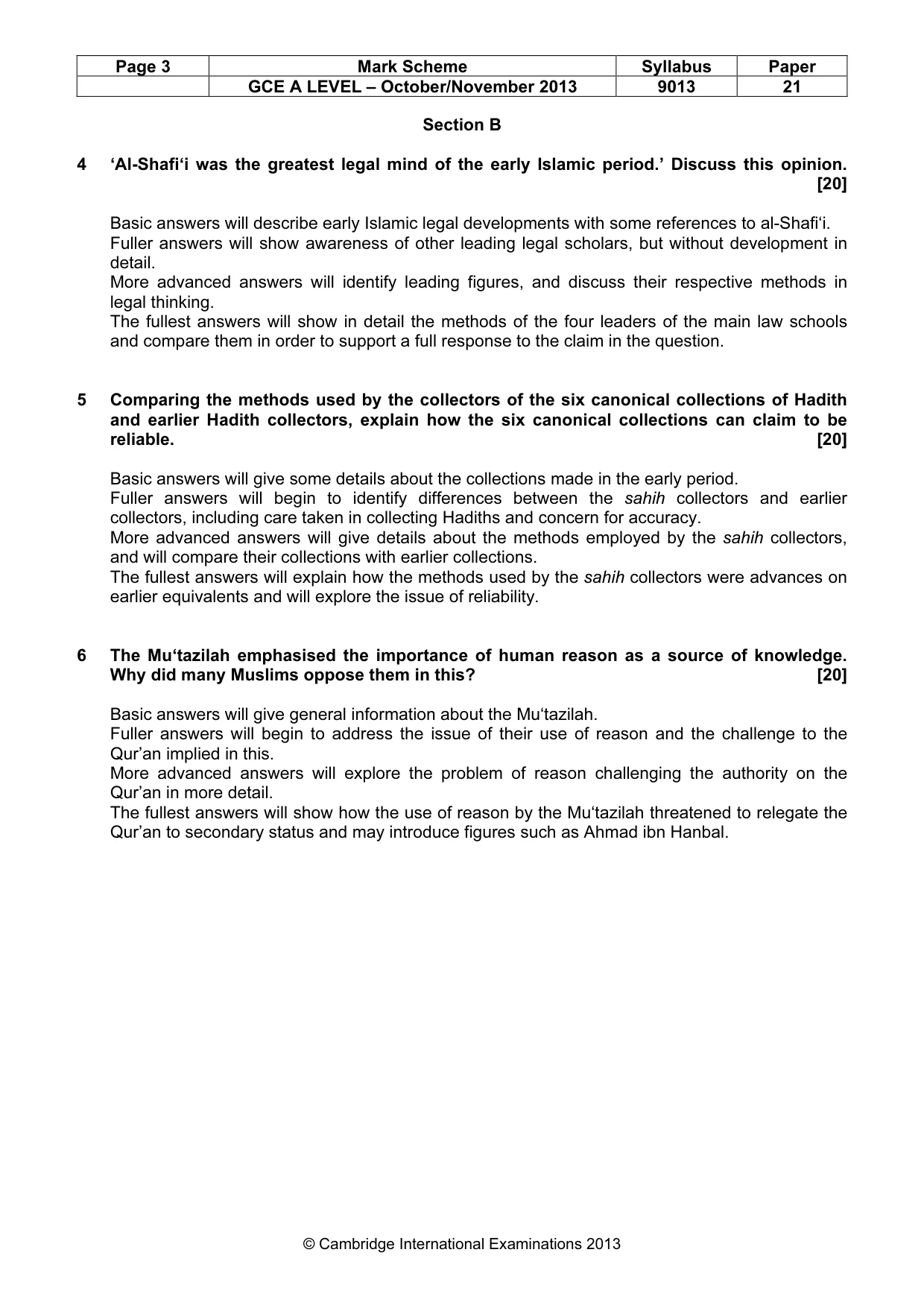
Mark scheme, page 3
Page 3 Mark Scheme Syllabus Paper GCE A LEVEL – October/November 2013 9013 21 © Cambridge International Examinations 2013 Section B 4 ‘Al-Shafi‘i was the greatest legal mind of the early Islamic period.’ Discuss this opinion. [20] Basic answers will describe early Islamic legal developments with some references to al-Shafi‘i. Fuller answers will show awareness of other leading legal scholars, but without development in detail. More advanced answers will identify leading figures, and discuss their respective methods in legal thinking. The fullest answers will show in detail the methods of the four leaders of the main law schools and compare them in order to support a full response to the claim in the question. 5 Comparing the methods used by the collectors of the six canonical collections of Hadith and earlier Hadith collectors, explain how the six canonical collections can claim to be reliable. [20] Basic answers will give some details about the collections made in the early period. Fuller answers will begin to identify differences between the sahih collectors and earlier collectors, including care taken in collecting Hadiths and concern for accuracy. More advanced answers will give details about the methods employed by the sahih collectors, and will compare their collections with earlier collections. The fullest answers will explain how the methods used by the sahih collectors were advances on earlier equivalents and will explore the issue of reliability. 6 The Mu‘tazilah emphasised the importance of human reason as a source of knowledge. Why did many Muslims oppose them in this? [20] Basic answers will give general information about the Mu‘tazilah. Fuller answers will begin to address the issue of their use of reason and the challenge to the Qur’an implied in this. More advanced answers will explore the problem of reason challenging the authority on the Qur’an in more detail. The fullest answers will show how the use of reason by the Mu‘tazilah threatened to relegate the Qur’an to secondary status and may introduce figures such as Ahmad ibn Hanbal.
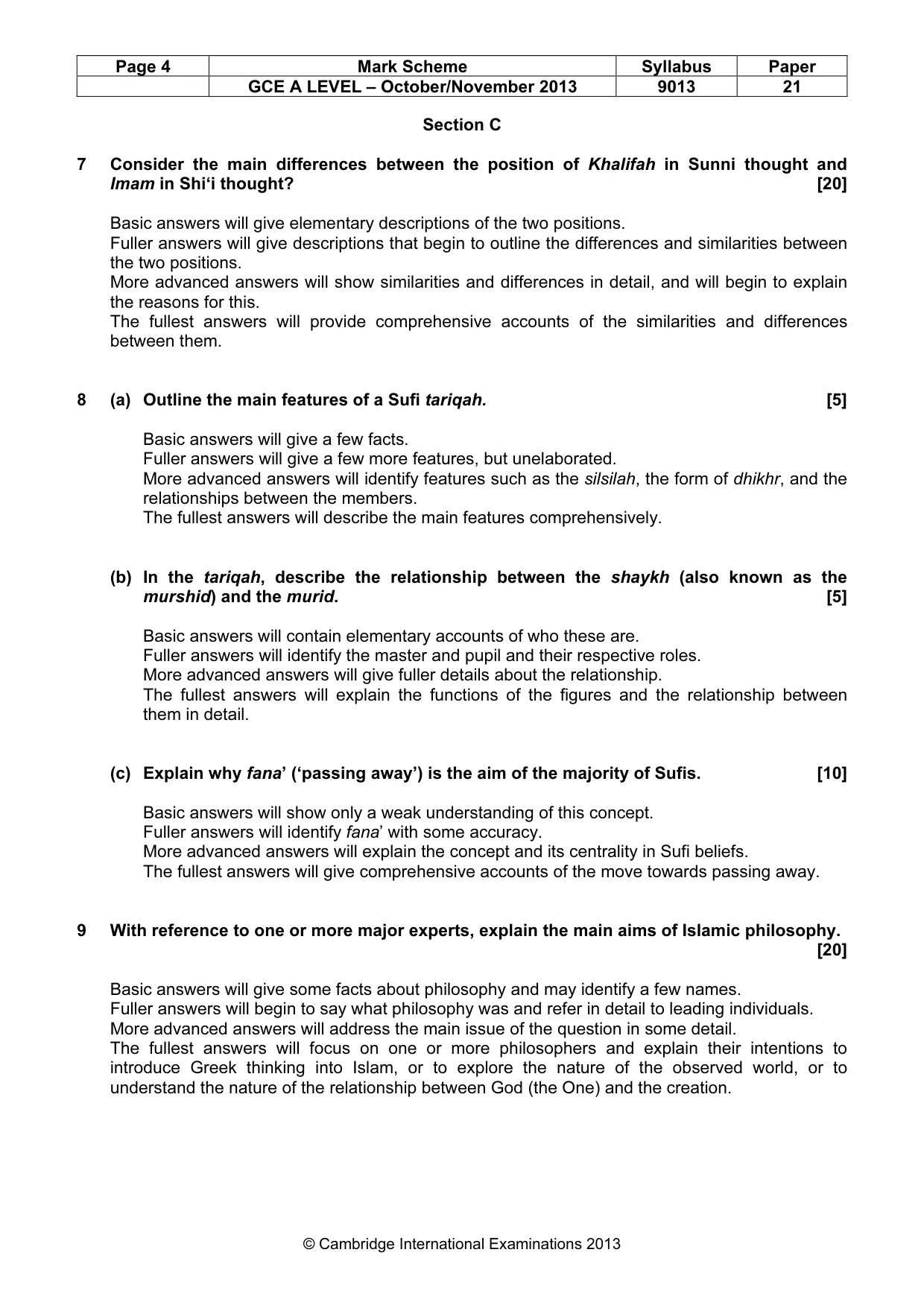
Mark scheme, page 4
Page 4 Mark Scheme Syllabus Paper GCE A LEVEL – October/November 2013 9013 21 © Cambridge International Examinations 2013 Section C 7 Consider the main differences between the position of Khalifah in Sunni thought and Imam in Shi‘i thought? [20] Basic answers will give elementary descriptions of the two positions. Fuller answers will give descriptions that begin to outline the differences and similarities between the two positions. More advanced answers will show similarities and differences in detail, and will begin to explain the reasons for this. The fullest answers will provide comprehensive accounts of the similarities and differences between them. 8 (a) Outline the main features of a Sufi tariqah. [5] Basic answers will give a few facts. Fuller answers will give a few more features, but unelaborated. More advanced answers will identify features such as the silsilah, the form of dhikhr, and the relationships between the members. The fullest answers will describe the main features comprehensively. (b) In the tariqah, describe the relationship between the shaykh (also known as the murshid) and the murid. [5] Basic answers will contain elementary accounts of who these are. Fuller answers will identify the master and pupil and their respective roles. More advanced answers will give fuller details about the relationship. The fullest answers will explain the functions of the figures and the relationship between them in detail. (c) Explain why fana’ (‘passing away’) is the aim of the majority of Sufis. [10] Basic answers will show only a weak understanding of this concept. Fuller answers will identify fana’ with some accuracy. More advanced answers will explain the concept and its centrality in Sufi beliefs. The fullest answers will give comprehensive accounts of the move towards passing away. 9 With reference to one or more major experts, explain the main aims of Islamic philosophy. [20] Basic answers will give some facts about philosophy and may identify a few names. Fuller answers will begin to say what philosophy was and refer in detail to leading individuals. More advanced answers will address the main issue of the question in some detail. The fullest answers will focus on one or more philosophers and explain their intentions to introduce Greek thinking into Islam, or to explore the nature of the observed world, or to understand the nature of the relationship between God (the One) and the creation.
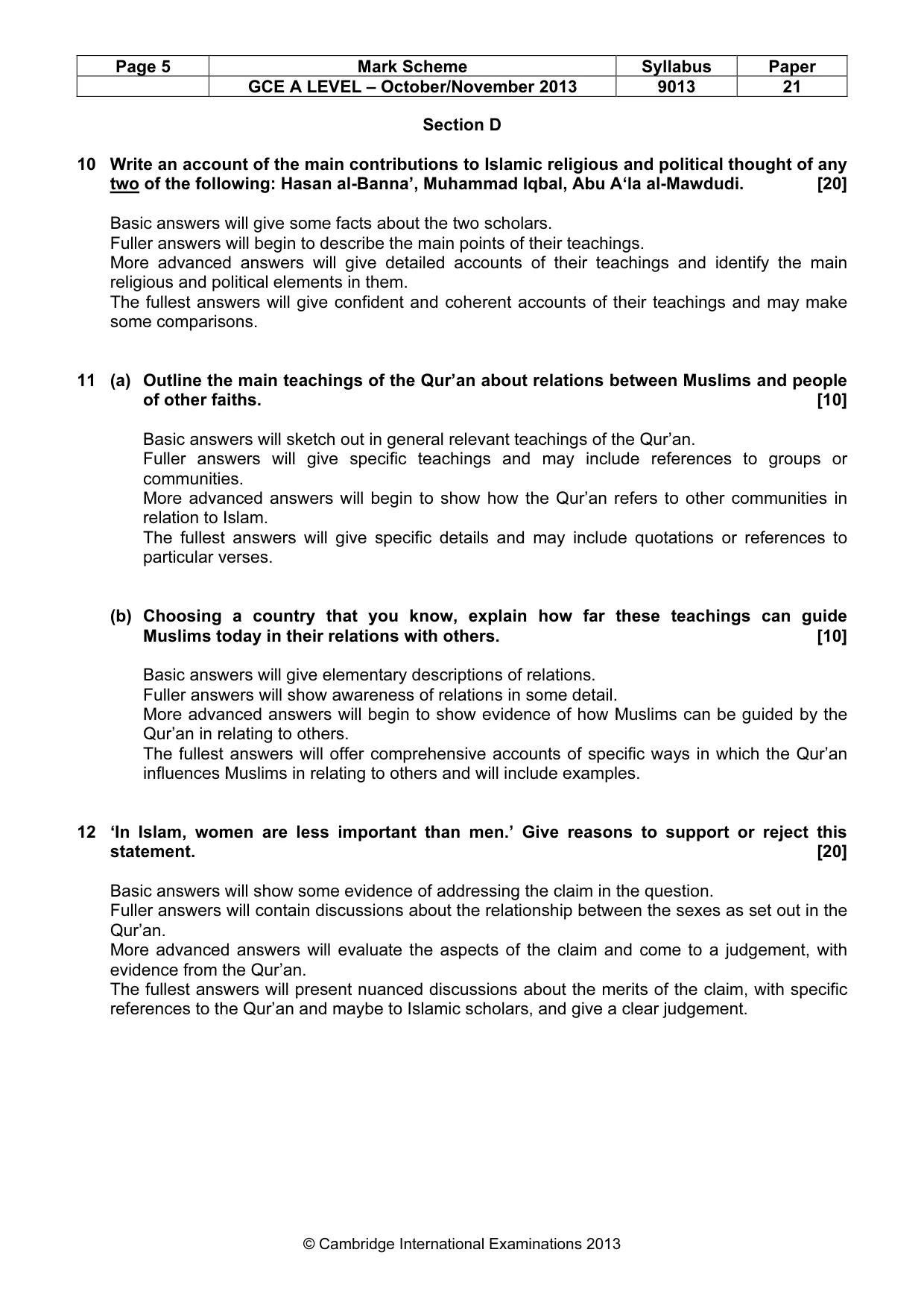
Mark scheme, page 5
Page 5 Mark Scheme Syllabus Paper GCE A LEVEL – October/November 2013 9013 21 © Cambridge International Examinations 2013 Section D 10 Write an account of the main contributions to Islamic religious and political thought of any two of the following: Hasan al-Banna’, Muhammad Iqbal, Abu A‘la al-Mawdudi. [20] Basic answers will give some facts about the two scholars. Fuller answers will begin to describe the main points of their teachings. More advanced answers will give detailed accounts of their teachings and identify the main religious and political elements in them. The fullest answers will give confident and coherent accounts of their teachings and may make some comparisons. 11 (a) Outline the main teachings of the Qur’an about relations between Muslims and people of other faiths. [10] Basic answers will sketch out in general relevant teachings of the Qur’an. Fuller answers will give specific teachings and may include references to groups or communities. More advanced answers will begin to show how the Qur’an refers to other communities in relation to Islam. The fullest answers will give specific details and may include quotations or references to particular verses. (b) Choosing a country that you know, explain how far these teachings can guide Muslims today in their relations with others. [10] Basic answers will give elementary descriptions of relations. Fuller answers will show awareness of relations in some detail. More advanced answers will begin to show evidence of how Muslims can be guided by the Qur’an in relating to others. The fullest answers will offer comprehensive accounts of specific ways in which the Qur’an influences Muslims in relating to others and will include examples. 12 ‘In Islam, women are less important than men.’ Give reasons to support or reject this statement. [20] Basic answers will show some evidence of addressing the claim in the question. Fuller answers will contain discussions about the relationship between the sexes as set out in the Qur’an. More advanced answers will evaluate the aspects of the claim and come to a judgement, with evidence from the Qur’an. The fullest answers will present nuanced discussions about the merits of the claim, with specific references to the Qur’an and maybe to Islamic scholars, and give a clear judgement.
What you needed in this session
Cambridge’s own grade thresholds for 2013 Oct/Nov, Paper 2 · Variant 1. A higher threshold means an easier paper — the bar moves with how the cohort did.