Cambridge A Level Information Technology (from 2017) 9626 — 2021 Oct/Nov Paper 1 · Variant 2
9626/12/O/N/21 · 90 marks · ≈101 min
The question paper and its mark scheme, free to read here and free to download. This is Cambridge’s own paper, exactly as it was sat.
Question paper20 pages








Mark scheme11 pages
Answers below. Sit the paper first if you are practising.
Paper as text
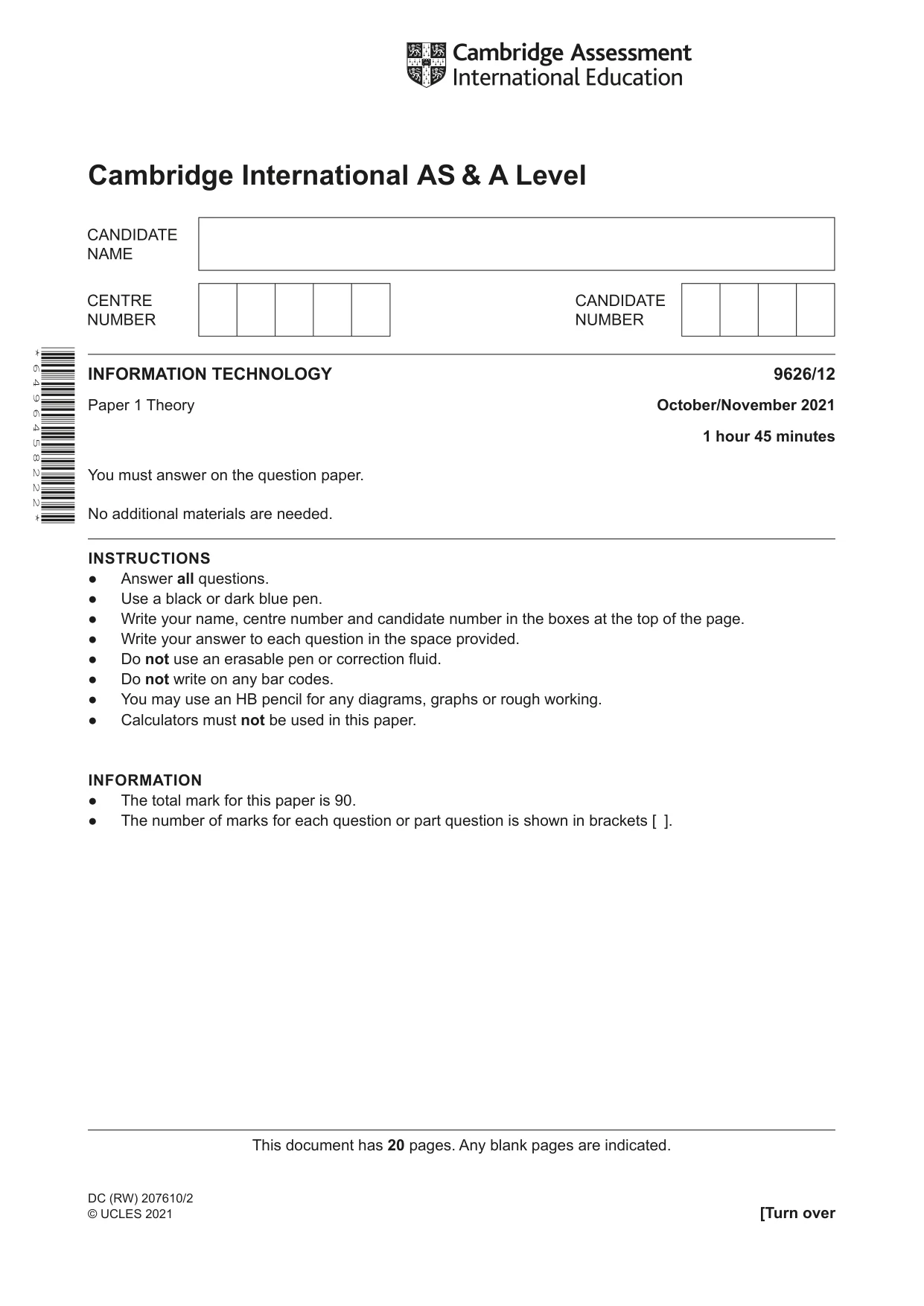
Question paper, page 1
This document has 20 pages. Any blank pages are indicated. DC (RW) 207610/2 © UCLES 2021 [Turn over * 6 4 9 6 4 5 8 2 2 2 * INFORMATION TECHNOLOGY 9626/12 Paper 1 Theory October/November 2021 1 hour 45 minutes You must answer on the question paper. No additional materials are needed. INSTRUCTIONS ● Answer all questions. ● Use a black or dark blue pen. ● Write your name, centre number and candidate number in the boxes at the top of the page. ● Write your answer to each question in the space provided. ● Do not use an erasable pen or correction fluid. ● Do not write on any bar codes. ● You may use an HB pencil for any diagrams, graphs or rough working. ● Calculators must not be used in this paper. INFORMATION ● The total mark for this paper is 90. ● The number of marks for each question or part question is shown in brackets [ ]. Cambridge International AS & A Level
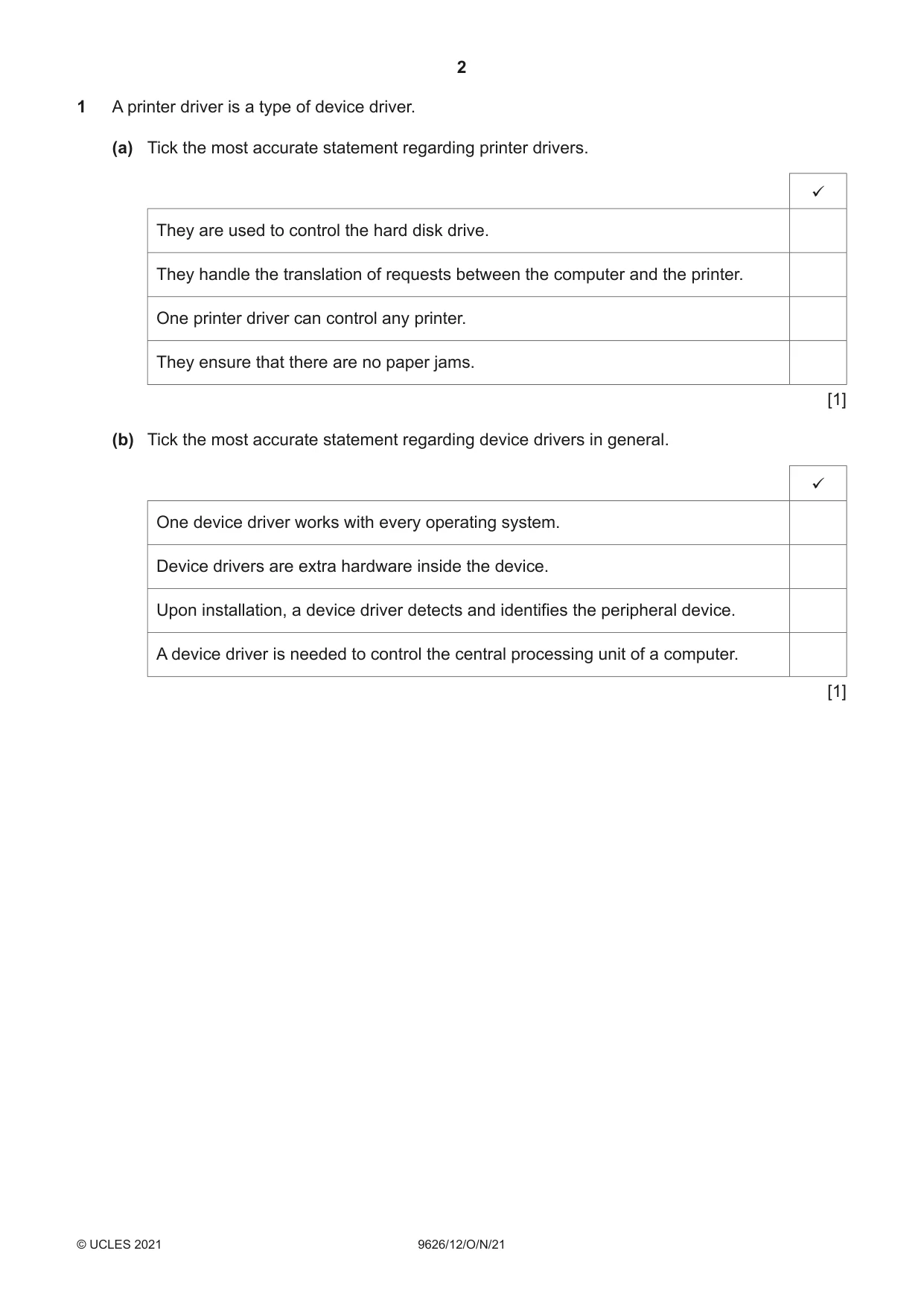
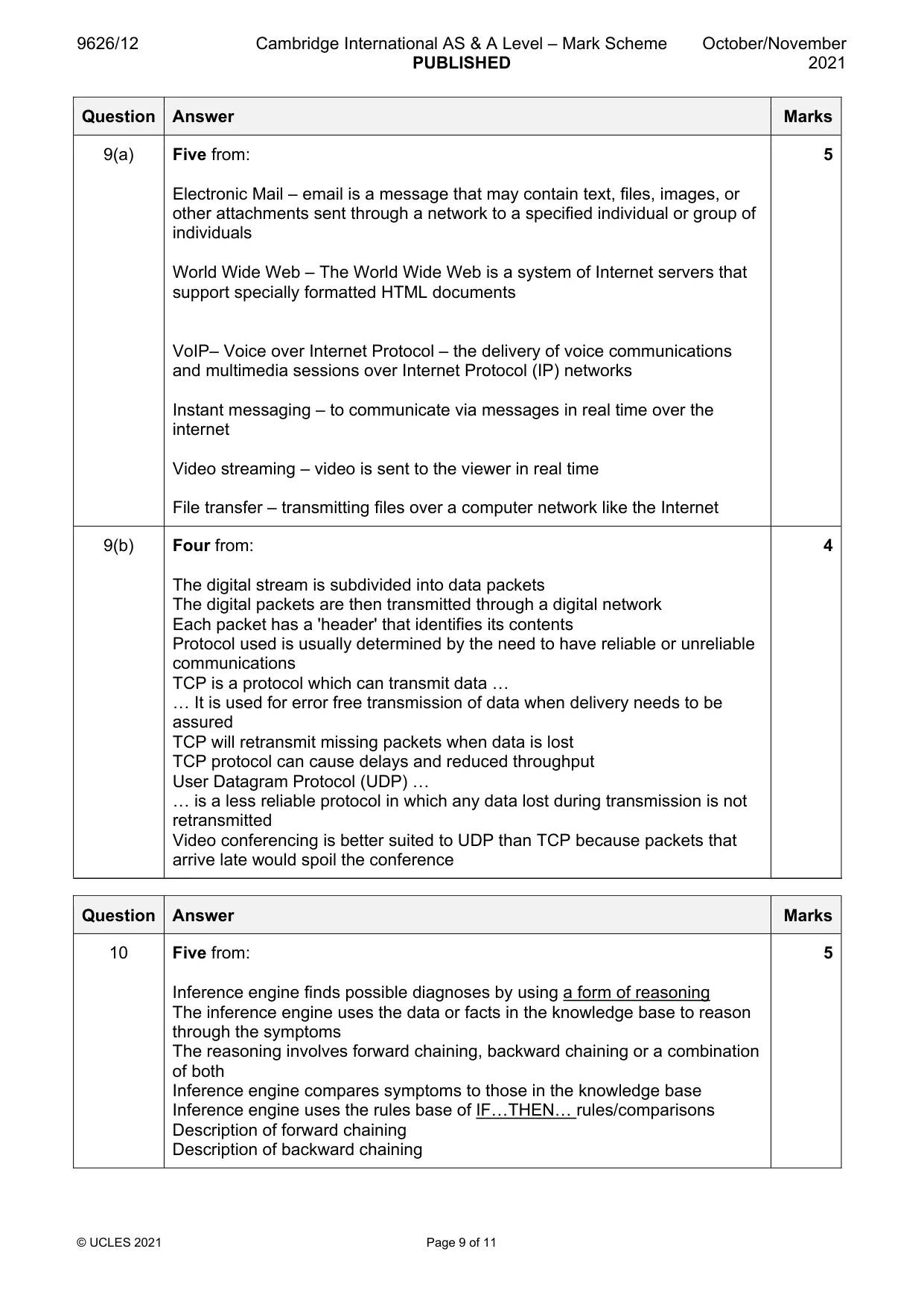
Question paper, page 2
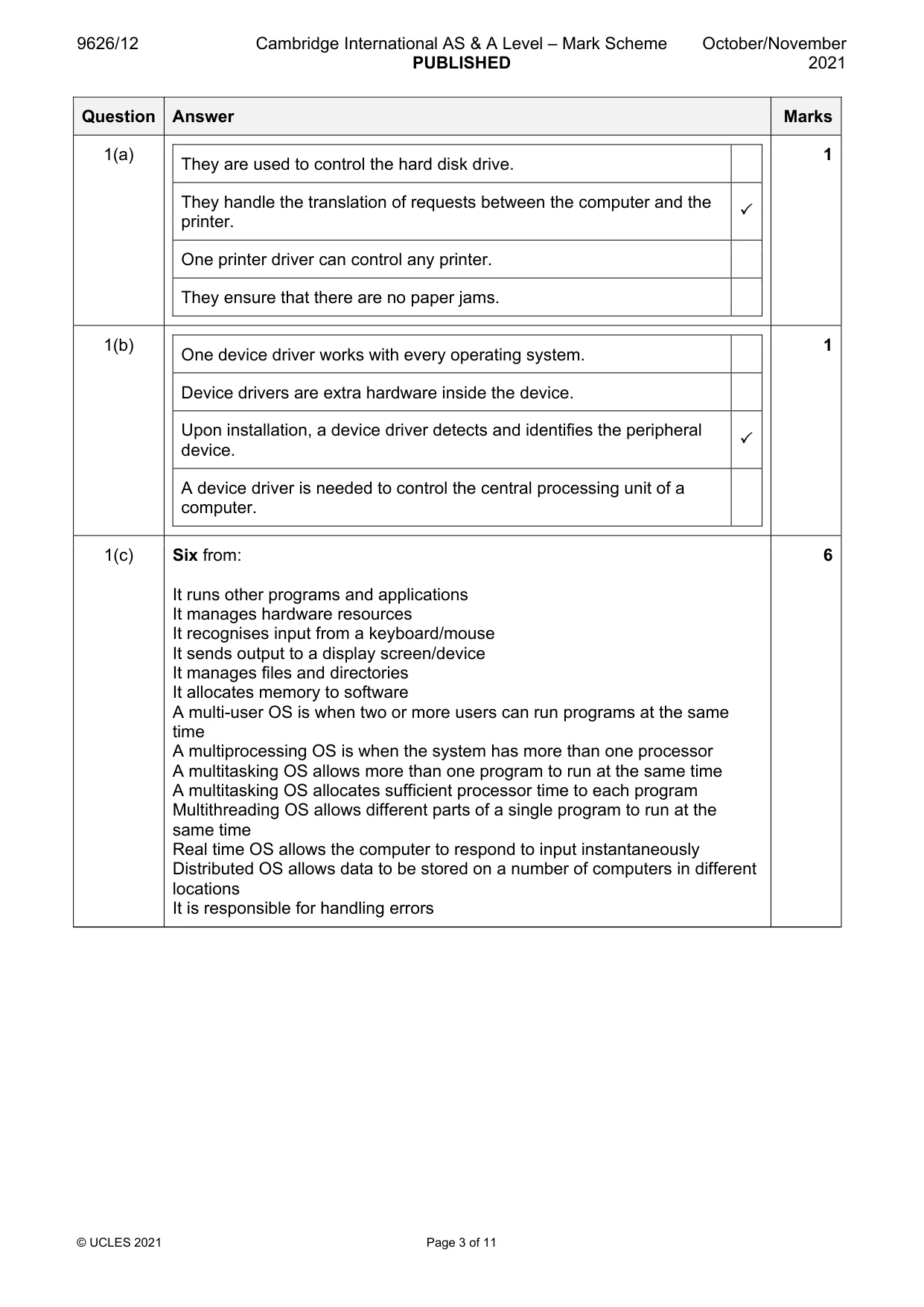
2 9626/12/O/N/21 © UCLES 2021 1 A printer driver is a type of device driver. (a) Tick the most accurate statement regarding printer drivers. They are used to control the hard disk drive. They handle the translation of requests between the computer and the printer. One printer driver can control any printer. They ensure that there are no paper jams. [1] (b) Tick the most accurate statement regarding device drivers in general. One device driver works with every operating system. Device drivers are extra hardware inside the device. Upon installation, a device driver detects and identifies the peripheral device. A device driver is needed to control the central processing unit of a computer. [1]
Question paper, page 3
3 9626/12/O/N/21 © UCLES 2021 [Turn over (c) Explain the purpose of an operating system. … … … … … … … … … … … … … … [6]
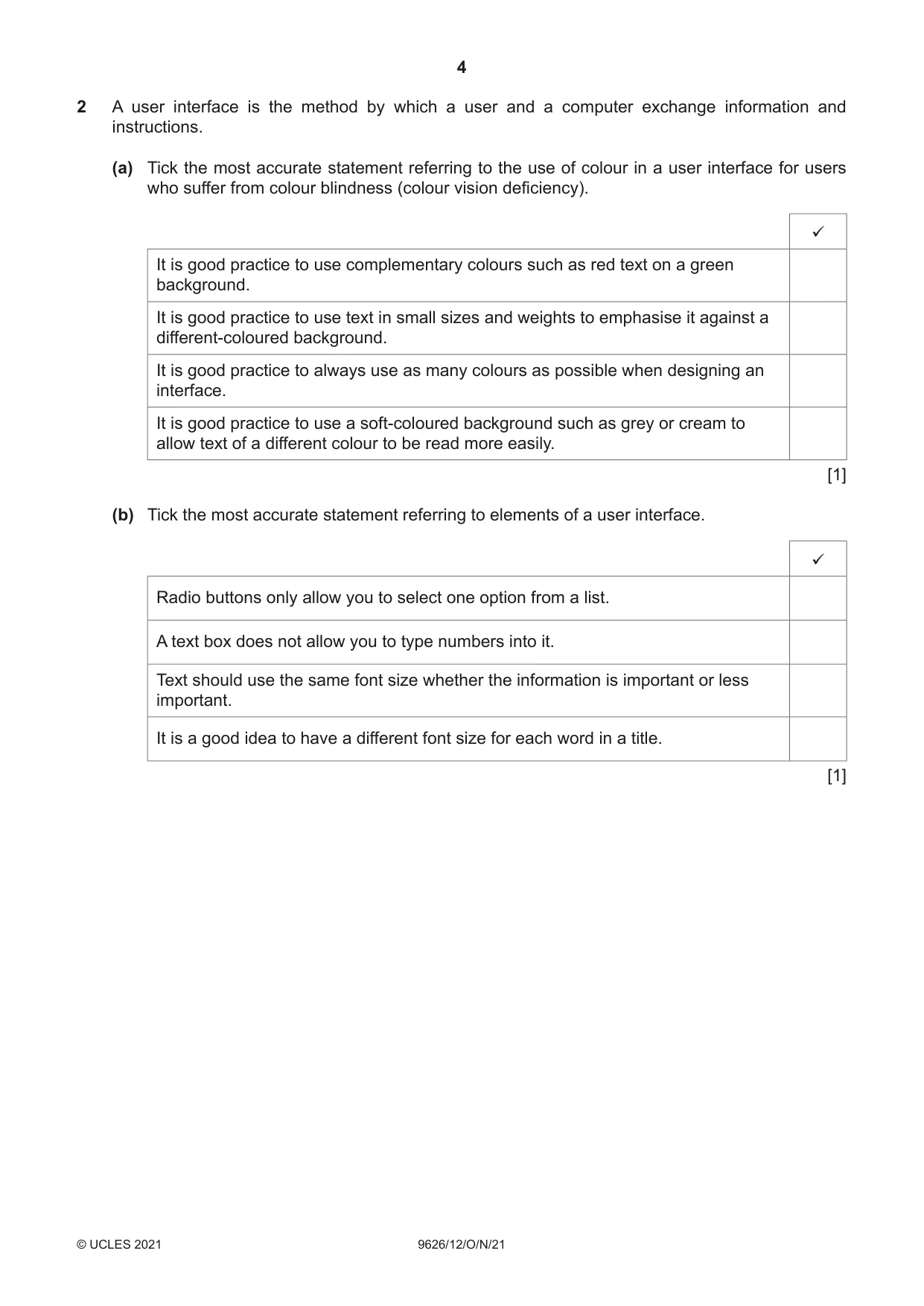
Question paper, page 4
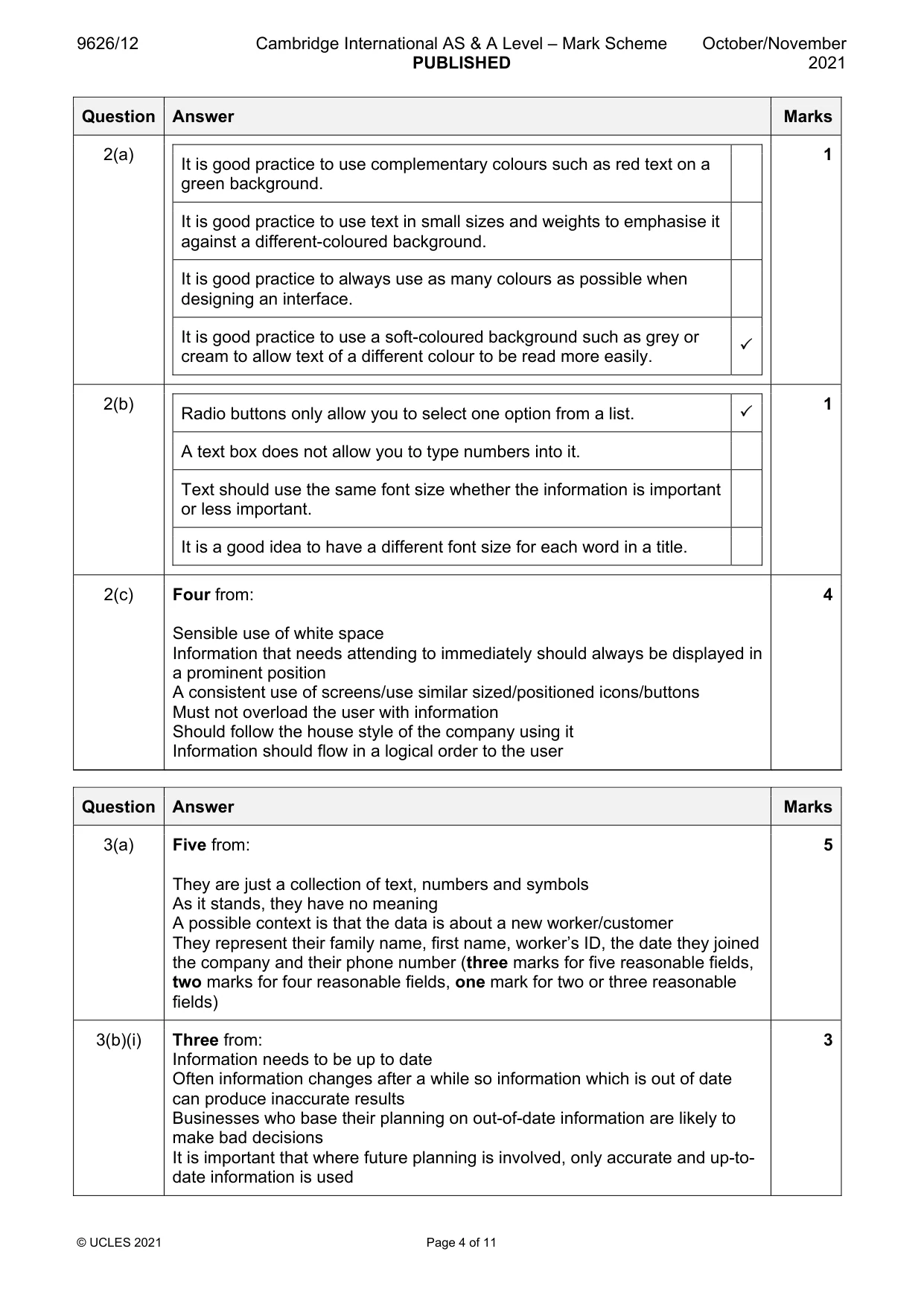
4 9626/12/O/N/21 © UCLES 2021 2 A user interface is the method by which a user and a computer exchange information and instructions. (a) Tick the most accurate statement referring to the use of colour in a user interface for users who suffer from colour blindness (colour vision deficiency). It is good practice to use complementary colours such as red text on a green background. It is good practice to use text in small sizes and weights to emphasise it against a different‑coloured background. It is good practice to always use as many colours as possible when designing an interface. It is good practice to use a soft‑coloured background such as grey or cream to allow text of a different colour to be read more easily. [1] (b) Tick the most accurate statement referring to elements of a user interface. Radio buttons only allow you to select one option from a list. A text box does not allow you to type numbers into it. Text should use the same font size whether the information is important or less important. It is a good idea to have a different font size for each word in a title. [1]
Question paper, page 5
5 9626/12/O/N/21 © UCLES 2021 [Turn over (c) A developer has been asked to produce software. The software will allow a company’s employees to enter data. The user interface will be a graphical user interface (GUI) and must be easy to use. Describe four features of the layout of such a user interface. 1 … … … 2 … … … 3 … … … 4 … … … [4]
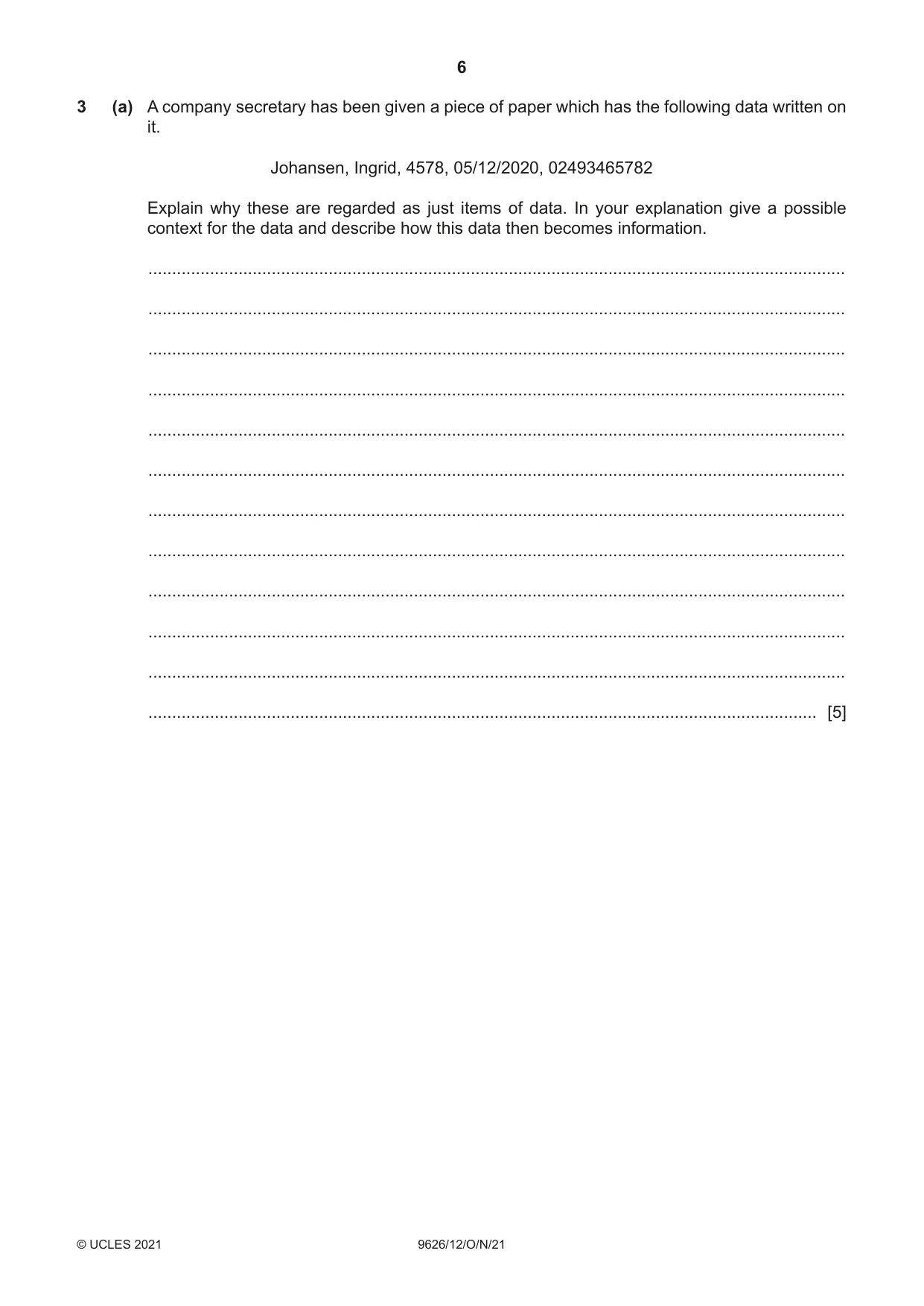
Question paper, page 6
6 9626/12/O/N/21 © UCLES 2021 3 (a) A company secretary has been given a piece of paper which has the following data written on it. Johansen, Ingrid, 4578, 05/12/2020, 02493465782 Explain why these are regarded as just items of data. In your explanation give a possible context for the data and describe how this data then becomes information. … … … … … … … … … … … … [5]
Question paper, page 7
7 9626/12/O/N/21 © UCLES 2021 [Turn over (b) Companies rely on the quality of the information that they use to make decisions. Describe how each of the following can affect the quality of the information. In your answers, give detail about the possible effects on companies. (i) The age of the information. … … … … … … … … [3] (ii) The level of detail in the information. … … … … … … [2]
Question paper, page 8
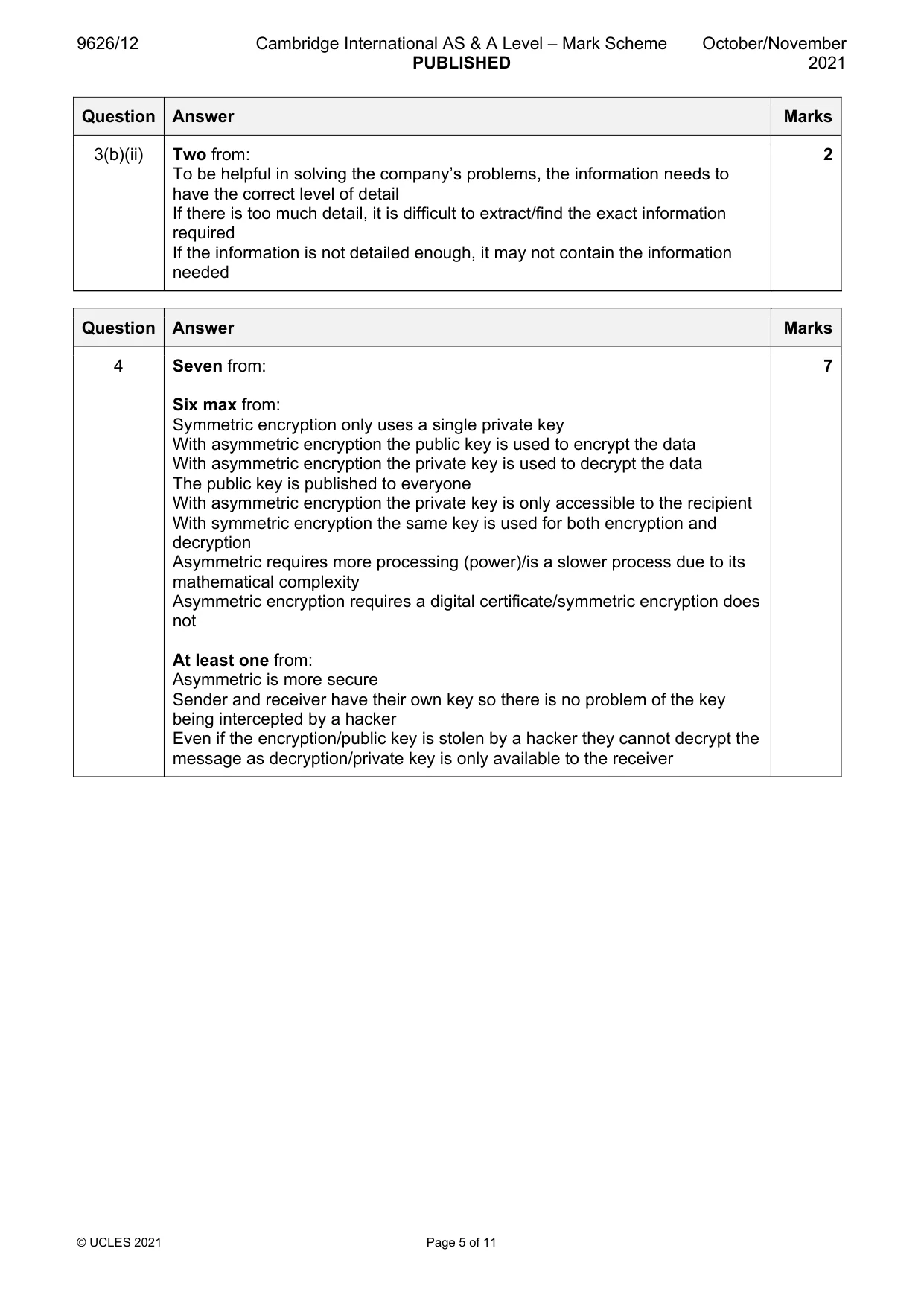
8 9626/12/O/N/21 © UCLES 2021 4 Describe the differences between symmetric and asymmetric encryption, explaining which is more secure. … … … … … … … … … … … … … … … … [7]
Question paper, page 9
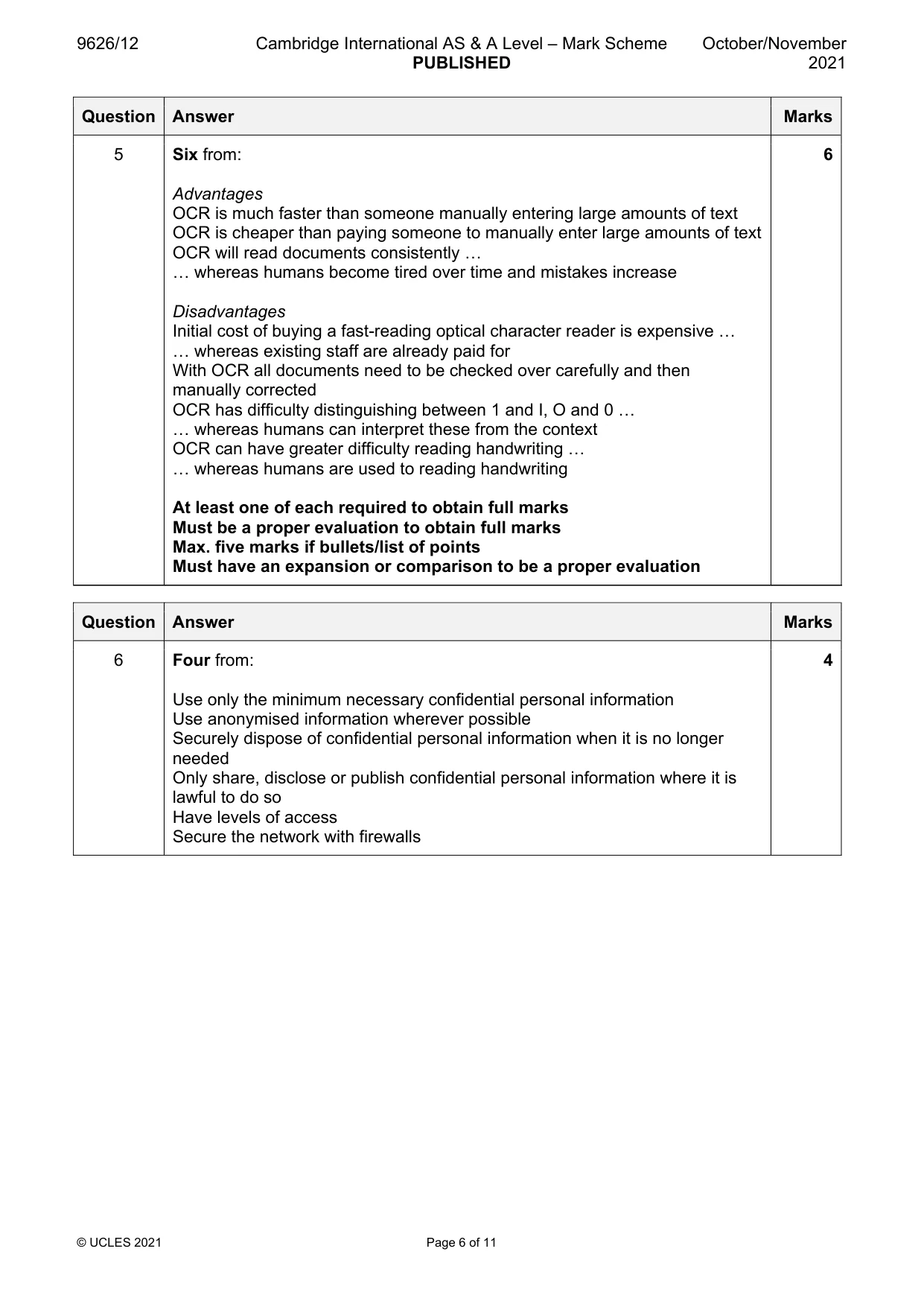
9 9626/12/O/N/21 © UCLES 2021 [Turn over 5 A company is investigating converting its paper files into computer data files. The company must choose between its existing staff entering the data manually or using an Optical Character Reader (OCR). Evaluate, by weighing up the advantages and disadvantages, the use of an OCR compared to manual data entry. … … … … … … … … … … … … … … [6]
Question paper, page 10
10 9626/12/O/N/21 © UCLES 2021 6 Personal data should always be kept confidential and secure. Data can be kept secure by using encryption and by restricting access using methods such as passwords and biometrics. Describe other methods of keeping data confidential and secure. … … … … … … … … … … [4]
Question paper, page 11
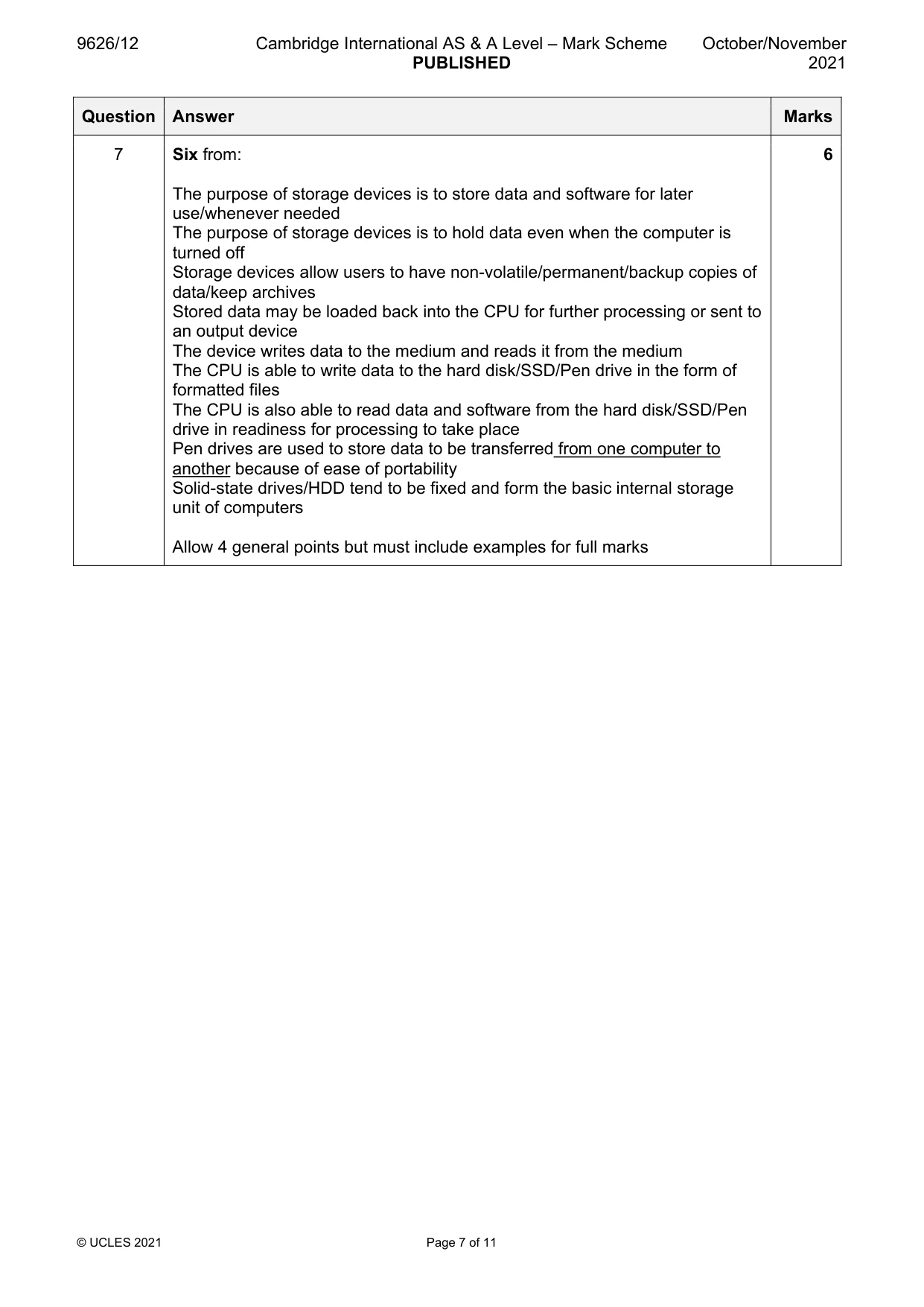
11 9626/12/O/N/21 © UCLES 2021 [Turn over 7 There are many types of storage device. Explain the purpose of storage devices. You should refer to hard disk drives (HDDs), solid‑state drives (SSDs) and pen drives in your answer. … … … … … … … … … … … … … … [6]
Question paper, page 12
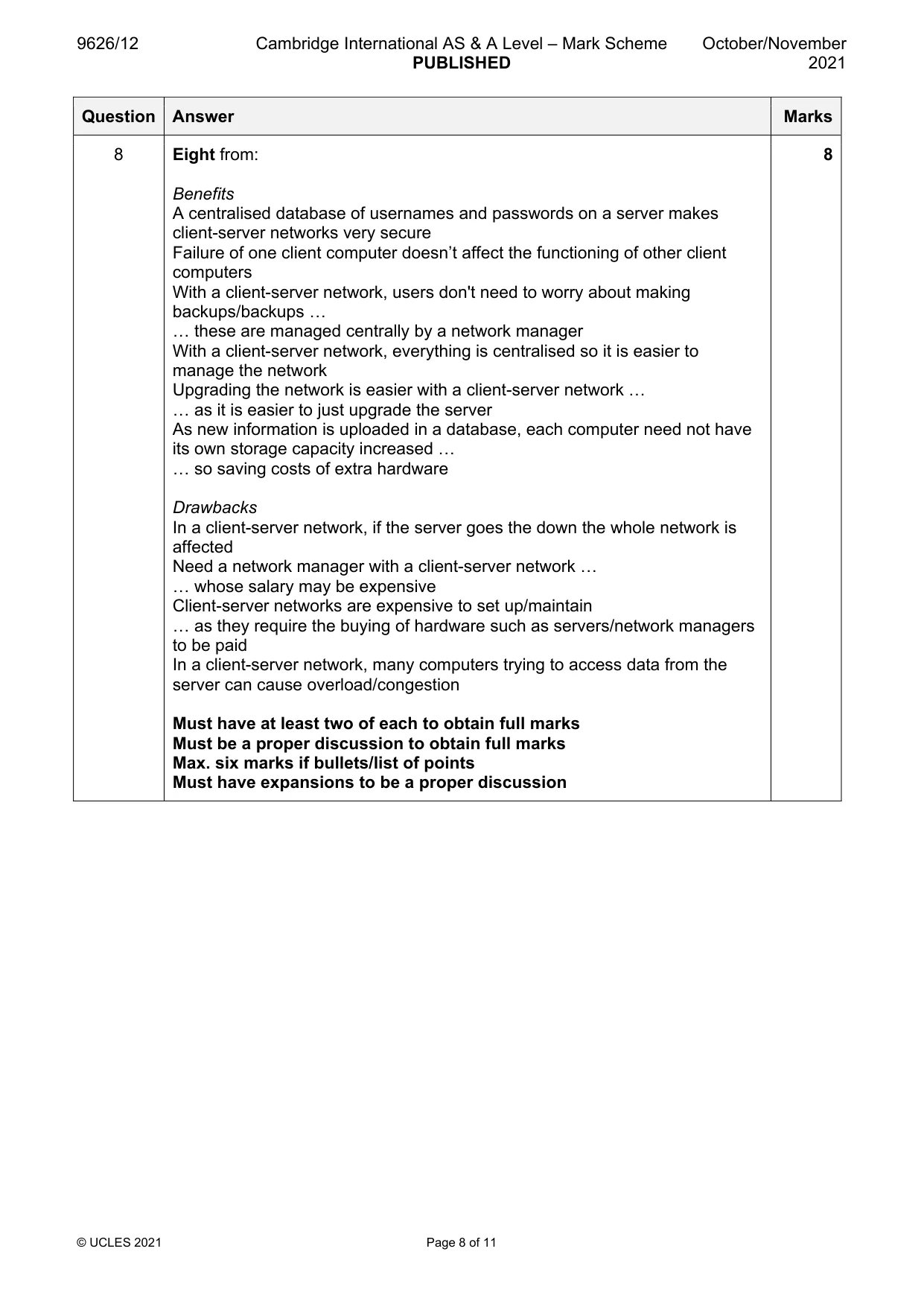
12 9626/12/O/N/21 © UCLES 2021 8 The computer configuration in many schools is based on client‑server networks. Discuss the benefits and drawbacks of using a client‑server network. … … … … … … … … … … … … … … … … … … … … [8]
Question paper, page 13
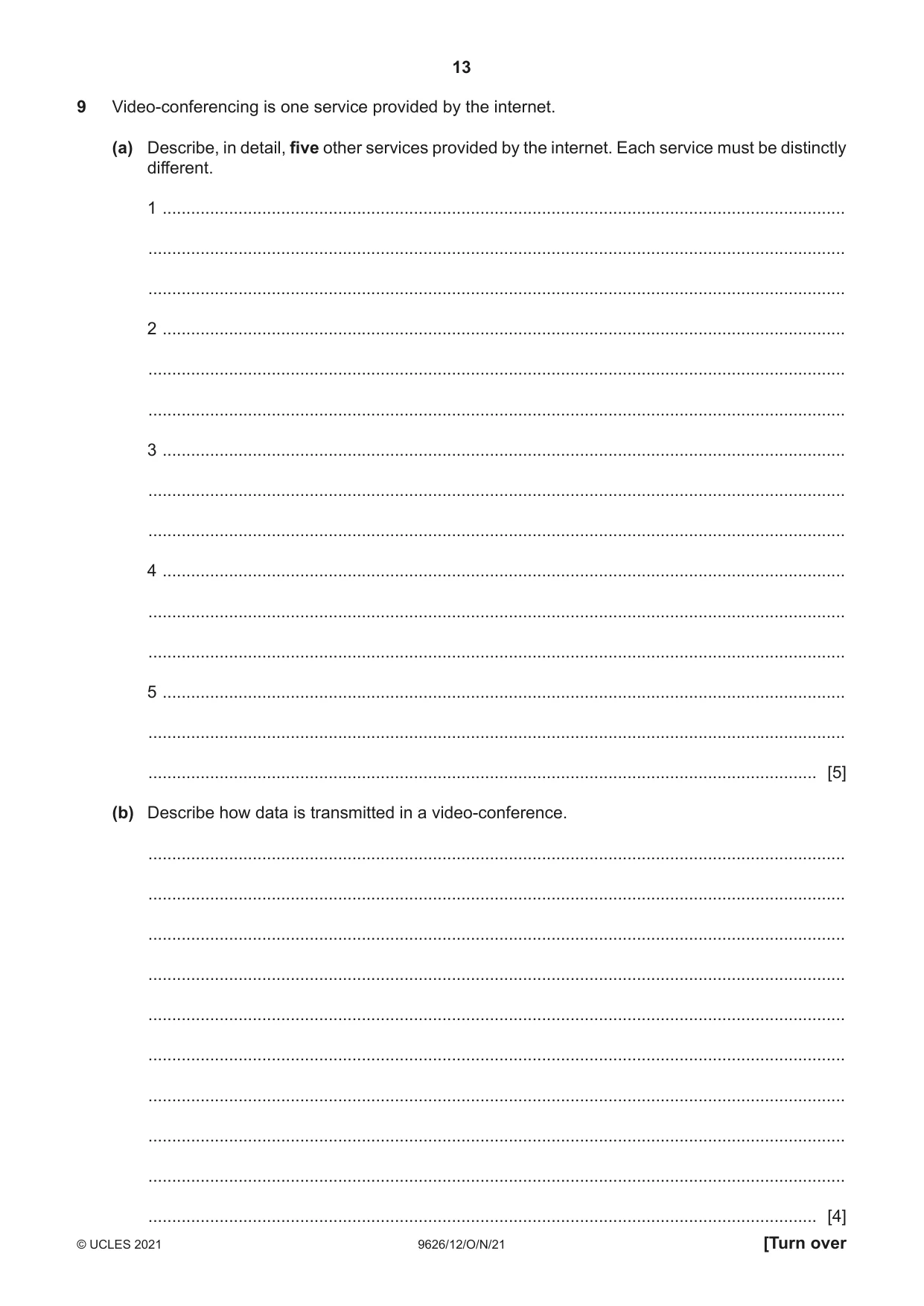
13 9626/12/O/N/21 © UCLES 2021 [Turn over 9 Video‑conferencing is one service provided by the internet. (a) Describe, in detail, five other services provided by the internet. Each service must be distinctly different. 1 … … … 2 … … … 3 … … … 4 … … … 5 … … … [5] (b) Describe how data is transmitted in a video‑conference. … … … … … … … … … … [4]
Question paper, page 14
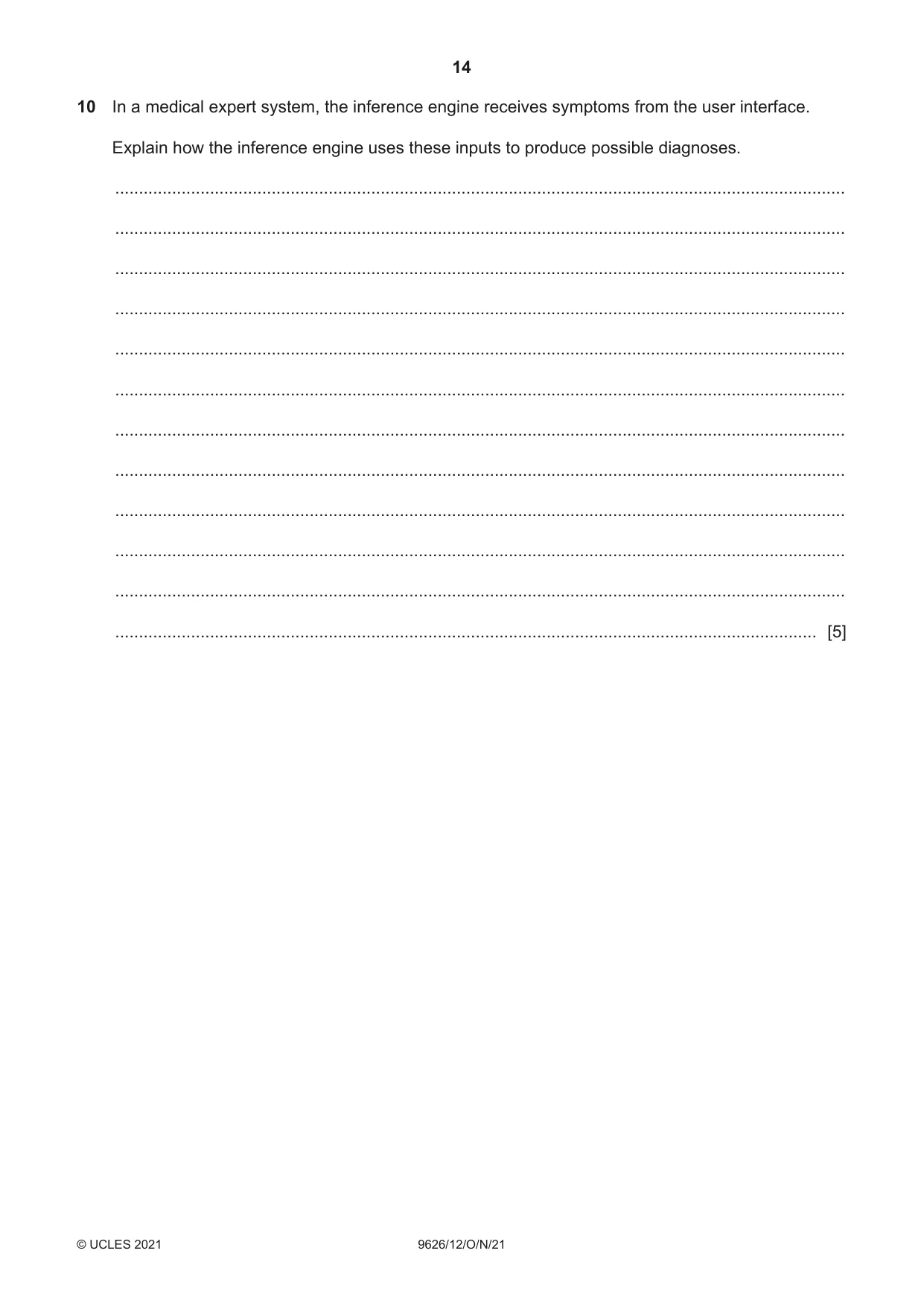
14 9626/12/O/N/21 © UCLES 2021 10 In a medical expert system, the inference engine receives symptoms from the user interface. Explain how the inference engine uses these inputs to produce possible diagnoses. … … … … … … … … … … … … [5]
Question paper, page 15
15 9626/12/O/N/21 © UCLES 2021 [Turn over BLANK PAGE Please turn over for Question 11.
Question paper, page 16
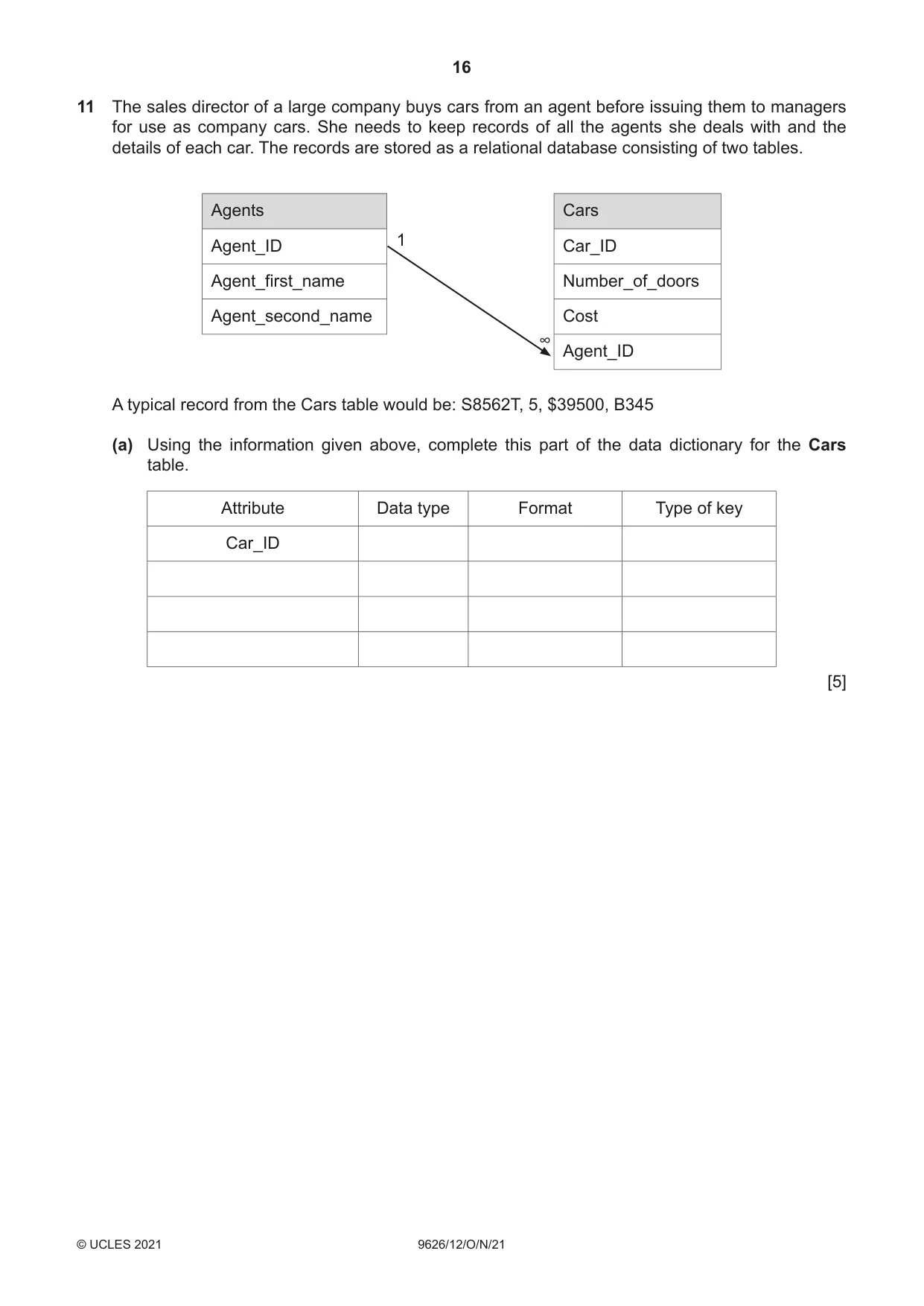
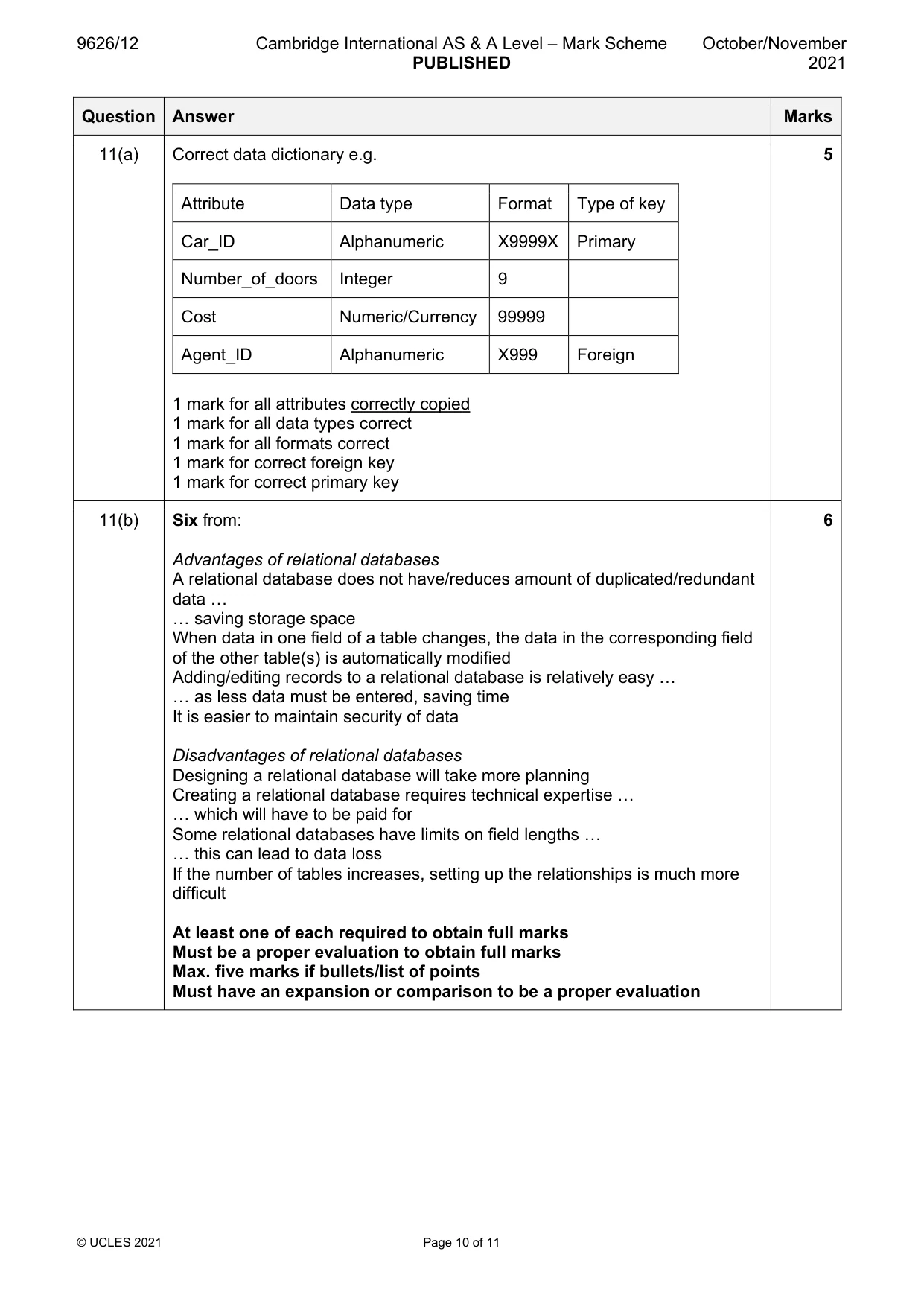
16 9626/12/O/N/21 © UCLES 2021 11 The sales director of a large company buys cars from an agent before issuing them to managers for use as company cars. She needs to keep records of all the agents she deals with and the details of each car. The records are stored as a relational database consisting of two tables. Agents ∞ 1 Cars Agent_ID Car_ID Agent_first_name Number_of_doors Agent_second_name Cost Agent_ID A typical record from the Cars table would be: S8562T, 5, $39500, B345 (a) Using the information given above, complete this part of the data dictionary for the Cars table. Attribute Data type Format Type of key Car_ID [5]
Question paper, page 17
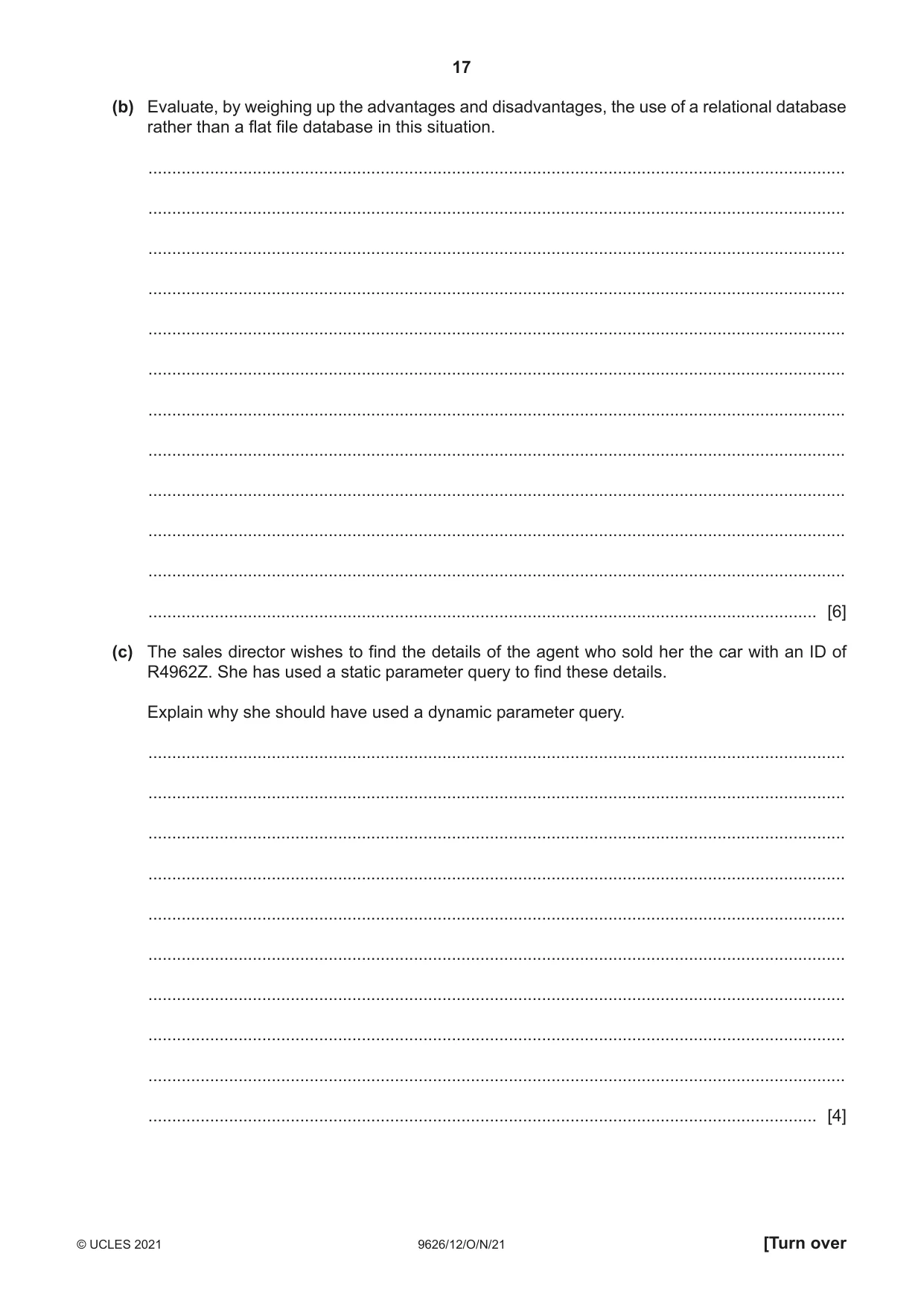
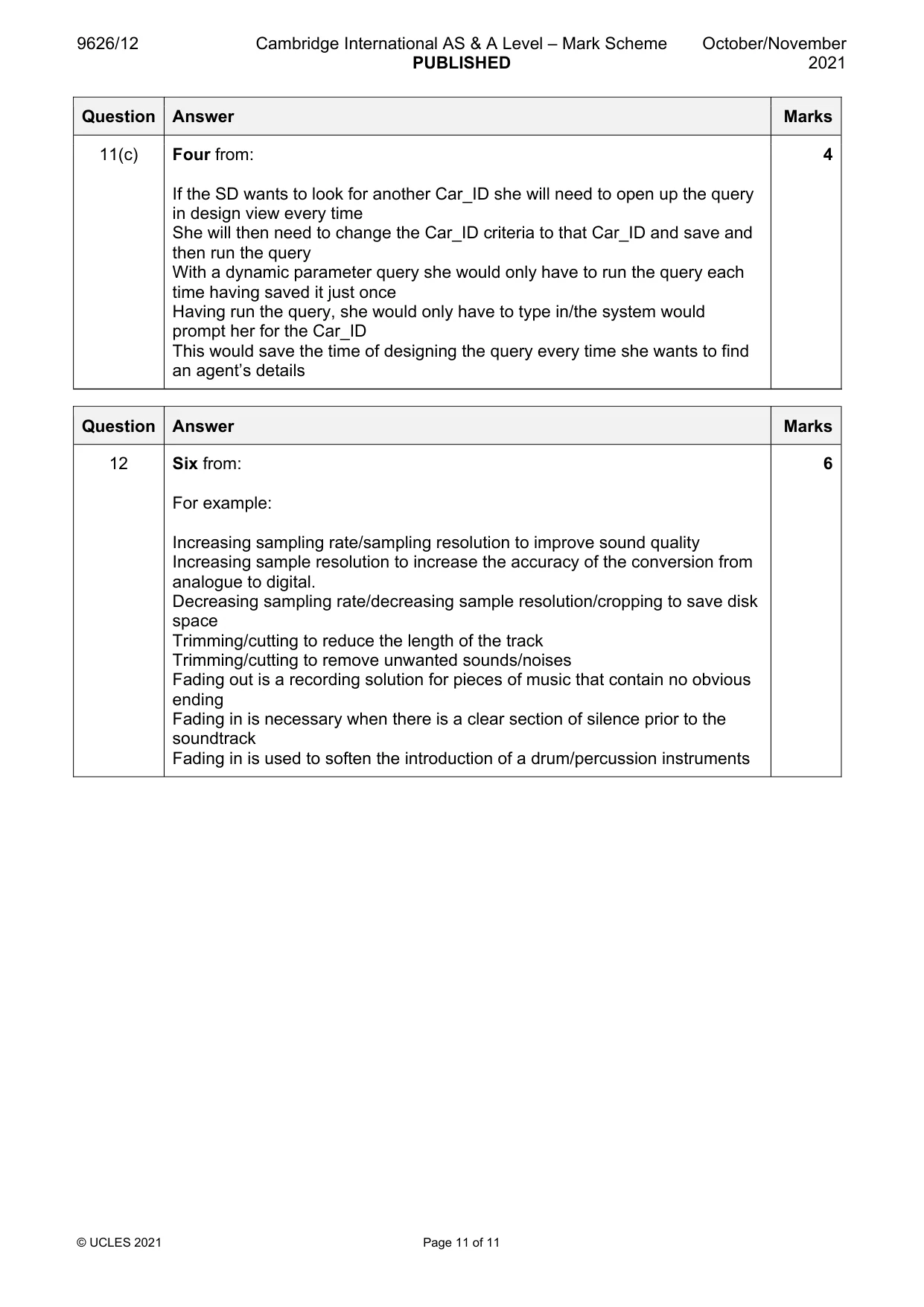
17 9626/12/O/N/21 © UCLES 2021 [Turn over (b) Evaluate, by weighing up the advantages and disadvantages, the use of a relational database rather than a flat file database in this situation. … … … … … … … … … … … … [6] (c) The sales director wishes to find the details of the agent who sold her the car with an ID of R4962Z. She has used a static parameter query to find these details. Explain why she should have used a dynamic parameter query. … … … … … … … … … … [4]
Question paper, page 18
18 9626/12/O/N/21 © UCLES 2021 12 Sound editing software is used to input or record sounds, save them and output the results to various speaker devices. Describe the use of other features found in sound editing software. Each use must be different. … … … … … … … … … … … … … … [6]
Question paper, page 19
19 9626/12/O/N/21 © UCLES 2021 BLANK PAGE
Question paper, page 20
20 9626/12/O/N/21 © UCLES 2021 Permission to reproduce items where third‑party owned material protected by copyright is included has been sought and cleared where possible. Every reasonable effort has been made by the publisher (UCLES) to trace copyright holders, but if any items requiring clearance have unwittingly been included, the publisher will be pleased to make amends at the earliest possible opportunity. To avoid the issue of disclosure of answer‑related information to candidates, all copyright acknowledgements are reproduced online in the Cambridge Assessment International Education Copyright Acknowledgements Booklet. This is produced for each series of examinations and is freely available to download at www.cambridgeinternational.org after the live examination series. Cambridge Assessment International Education is part of the Cambridge Assessment Group. Cambridge Assessment is the brand name of the University of Cambridge Local Examinations Syndicate (UCLES), which itself is a department of the University of Cambridge. BLANK PAGE
Mark scheme, page 1
This document consists of 11 printed pages. © UCLES 2021 [Turn over Cambridge International AS & A Level INFORMATION TECHNOLOGY 9626/12 Paper 1 Theory October/November 2021 MARK SCHEME Maximum Mark: 90 Published This mark scheme is published as an aid to teachers and candidates, to indicate the requirements of the examination. It shows the basis on which Examiners were instructed to award marks. It does not indicate the details of the discussions that took place at an Examiners’ meeting before marking began, which would have considered the acceptability of alternative answers. Mark schemes should be read in conjunction with the question paper and the Principal Examiner Report for Teachers. Cambridge International will not enter into discussions about these mark schemes. Cambridge International is publishing the mark schemes for the October/November 2021 series for most Cambridge IGCSE™, Cambridge International A and AS Level components and some Cambridge O Level components.
Mark scheme, page 2
9626/12 Cambridge International AS & A Level – Mark Scheme PUBLISHED October/November 2021 © UCLES 2021 Page 2 of 11 Generic Marking Principles These general marking principles must be applied by all examiners when marking candidate answers. They should be applied alongside the specific content of the mark scheme or generic level descriptors for a question. Each question paper and mark scheme will also comply with these marking principles. GENERIC MARKING PRINCIPLE 1: Marks must be awarded in line with: • the specific content of the mark scheme or the generic level descriptors for the question • the specific skills defined in the mark scheme or in the generic level descriptors for the question • the standard of response required by a candidate as exemplified by the standardisation scripts. GENERIC MARKING PRINCIPLE 2: Marks awarded are always whole marks (not half marks, or other fractions). GENERIC MARKING PRINCIPLE 3: Marks must be awarded positively: • marks are awarded for correct/valid answers, as defined in the mark scheme. However, credit is given for valid answers which go beyond the scope of the syllabus and mark scheme, referring to your Team Leader as appropriate • marks are awarded when candidates clearly demonstrate what they know and can do • marks are not deducted for errors • marks are not deducted for omissions • answers should only be judged on the quality of spelling, punctuation and grammar when these features are specifically assessed by the question as indicated by the mark scheme. The meaning, however, should be unambiguous. GENERIC MARKING PRINCIPLE 4: Rules must be applied consistently, e.g. in situations where candidates have not followed instructions or in the application of generic level descriptors. GENERIC MARKING PRINCIPLE 5: Marks should be awarded using the full range of marks defined in the mark scheme for the question (however; the use of the full mark range may be limited according to the quality of the candidate responses seen). GENERIC MARKING PRINCIPLE 6: Marks awarded are based solely on the requirements as defined in the mark scheme. Marks should not be awarded with grade thresholds or grade descriptors in mind.
Mark scheme, page 3
9626/12 Cambridge International AS & A Level – Mark Scheme PUBLISHED October/November 2021 © UCLES 2021 Page 3 of 11 Question Answer Marks 1(a) They are used to control the hard disk drive. They handle the translation of requests between the computer and the printer. One printer driver can control any printer. They ensure that there are no paper jams. 1 1(b) One device driver works with every operating system. Device drivers are extra hardware inside the device. Upon installation, a device driver detects and identifies the peripheral device. A device driver is needed to control the central processing unit of a computer. 1 1(c) Six from: It runs other programs and applications It manages hardware resources It recognises input from a keyboard/mouse It sends output to a display screen/device It manages files and directories It allocates memory to software A multi-user OS is when two or more users can run programs at the same time A multiprocessing OS is when the system has more than one processor A multitasking OS allows more than one program to run at the same time A multitasking OS allocates sufficient processor time to each program Multithreading OS allows different parts of a single program to run at the same time Real time OS allows the computer to respond to input instantaneously Distributed OS allows data to be stored on a number of computers in different locations It is responsible for handling errors 6
Mark scheme, page 4
9626/12 Cambridge International AS & A Level – Mark Scheme PUBLISHED October/November 2021 © UCLES 2021 Page 4 of 11 Question Answer Marks 2(a) It is good practice to use complementary colours such as red text on a green background. It is good practice to use text in small sizes and weights to emphasise it against a different-coloured background. It is good practice to always use as many colours as possible when designing an interface. It is good practice to use a soft-coloured background such as grey or cream to allow text of a different colour to be read more easily. 1 2(b) Radio buttons only allow you to select one option from a list. A text box does not allow you to type numbers into it. Text should use the same font size whether the information is important or less important. It is a good idea to have a different font size for each word in a title. 1 2(c) Four from: Sensible use of white space Information that needs attending to immediately should always be displayed in a prominent position A consistent use of screens/use similar sized/positioned icons/buttons Must not overload the user with information Should follow the house style of the company using it Information should flow in a logical order to the user 4 Question Answer Marks 3(a) Five from: They are just a collection of text, numbers and symbols As it stands, they have no meaning A possible context is that the data is about a new worker/customer They represent their family name, first name, worker’s ID, the date they joined the company and their phone number (three marks for five reasonable fields, two marks for four reasonable fields, one mark for two or three reasonable fields) 5 3(b)(i) Three from: Information needs to be up to date Often information changes after a while so information which is out of date can produce inaccurate results Businesses who base their planning on out-of-date information are likely to make bad decisions It is important that where future planning is involved, only accurate and up-to- date information is used 3
Mark scheme, page 5
9626/12 Cambridge International AS & A Level – Mark Scheme PUBLISHED October/November 2021 © UCLES 2021 Page 5 of 11 Question Answer Marks 3(b)(ii) Two from: To be helpful in solving the company’s problems, the information needs to have the correct level of detail If there is too much detail, it is difficult to extract/find the exact information required If the information is not detailed enough, it may not contain the information needed 2 Question Answer Marks 4 Seven from: Six max from: Symmetric encryption only uses a single private key With asymmetric encryption the public key is used to encrypt the data With asymmetric encryption the private key is used to decrypt the data The public key is published to everyone With asymmetric encryption the private key is only accessible to the recipient With symmetric encryption the same key is used for both encryption and decryption Asymmetric requires more processing (power)/is a slower process due to its mathematical complexity Asymmetric encryption requires a digital certificate/symmetric encryption does not At least one from: Asymmetric is more secure Sender and receiver have their own key so there is no problem of the key being intercepted by a hacker Even if the encryption/public key is stolen by a hacker they cannot decrypt the message as decryption/private key is only available to the receiver 7
Mark scheme, page 6
9626/12 Cambridge International AS & A Level – Mark Scheme PUBLISHED October/November 2021 © UCLES 2021 Page 6 of 11 Question Answer Marks 5 Six from: Advantages OCR is much faster than someone manually entering large amounts of text OCR is cheaper than paying someone to manually enter large amounts of text OCR will read documents consistently … … whereas humans become tired over time and mistakes increase Disadvantages Initial cost of buying a fast-reading optical character reader is expensive … … whereas existing staff are already paid for With OCR all documents need to be checked over carefully and then manually corrected OCR has difficulty distinguishing between 1 and I, O and 0 … … whereas humans can interpret these from the context OCR can have greater difficulty reading handwriting … … whereas humans are used to reading handwriting At least one of each required to obtain full marks Must be a proper evaluation to obtain full marks Max. five marks if bullets/list of points Must have an expansion or comparison to be a proper evaluation 6 Question Answer Marks 6 Four from: Use only the minimum necessary confidential personal information Use anonymised information wherever possible Securely dispose of confidential personal information when it is no longer needed Only share, disclose or publish confidential personal information where it is lawful to do so Have levels of access Secure the network with firewalls 4
Mark scheme, page 7
9626/12 Cambridge International AS & A Level – Mark Scheme PUBLISHED October/November 2021 © UCLES 2021 Page 7 of 11 Question Answer Marks 7 Six from: The purpose of storage devices is to store data and software for later use/whenever needed The purpose of storage devices is to hold data even when the computer is turned off Storage devices allow users to have non-volatile/permanent/backup copies of data/keep archives Stored data may be loaded back into the CPU for further processing or sent to an output device The device writes data to the medium and reads it from the medium The CPU is able to write data to the hard disk/SSD/Pen drive in the form of formatted files The CPU is also able to read data and software from the hard disk/SSD/Pen drive in readiness for processing to take place Pen drives are used to store data to be transferred from one computer to another because of ease of portability Solid-state drives/HDD tend to be fixed and form the basic internal storage unit of computers Allow 4 general points but must include examples for full marks 6
Mark scheme, page 8
9626/12 Cambridge International AS & A Level – Mark Scheme PUBLISHED October/November 2021 © UCLES 2021 Page 8 of 11 Question Answer Marks 8 Eight from: Benefits A centralised database of usernames and passwords on a server makes client-server networks very secure Failure of one client computer doesn’t affect the functioning of other client computers With a client-server network, users don't need to worry about making backups/backups … … these are managed centrally by a network manager With a client-server network, everything is centralised so it is easier to manage the network Upgrading the network is easier with a client-server network … … as it is easier to just upgrade the server As new information is uploaded in a database, each computer need not have its own storage capacity increased … … so saving costs of extra hardware Drawbacks In a client-server network, if the server goes the down the whole network is affected Need a network manager with a client-server network … … whose salary may be expensive Client-server networks are expensive to set up/maintain … as they require the buying of hardware such as servers/network managers to be paid In a client-server network, many computers trying to access data from the server can cause overload/congestion Must have at least two of each to obtain full marks Must be a proper discussion to obtain full marks Max. six marks if bullets/list of points Must have expansions to be a proper discussion 8
Mark scheme, page 9
9626/12 Cambridge International AS & A Level – Mark Scheme PUBLISHED October/November 2021 © UCLES 2021 Page 9 of 11 Question Answer Marks 9(a) Five from: Electronic Mail – email is a message that may contain text, files, images, or other attachments sent through a network to a specified individual or group of individuals World Wide Web – The World Wide Web is a system of Internet servers that support specially formatted HTML documents VoIP– Voice over Internet Protocol – the delivery of voice communications and multimedia sessions over Internet Protocol (IP) networks Instant messaging – to communicate via messages in real time over the internet Video streaming – video is sent to the viewer in real time File transfer – transmitting files over a computer network like the Internet 5 9(b) Four from: The digital stream is subdivided into data packets The digital packets are then transmitted through a digital network Each packet has a 'header' that identifies its contents Protocol used is usually determined by the need to have reliable or unreliable communications TCP is a protocol which can transmit data … … It is used for error free transmission of data when delivery needs to be assured TCP will retransmit missing packets when data is lost TCP protocol can cause delays and reduced throughput User Datagram Protocol (UDP) … … is a less reliable protocol in which any data lost during transmission is not retransmitted Video conferencing is better suited to UDP than TCP because packets that arrive late would spoil the conference 4 Question Answer Marks 10 Five from: Inference engine finds possible diagnoses by using a form of reasoning The inference engine uses the data or facts in the knowledge base to reason through the symptoms The reasoning involves forward chaining, backward chaining or a combination of both Inference engine compares symptoms to those in the knowledge base Inference engine uses the rules base of IF…THEN… rules/comparisons Description of forward chaining Description of backward chaining 5
Mark scheme, page 10
9626/12 Cambridge International AS & A Level – Mark Scheme PUBLISHED October/November 2021 © UCLES 2021 Page 10 of 11 Question Answer Marks 11(a) Correct data dictionary e.g. Attribute Data type Format Type of key Car_ID Alphanumeric X9999X Primary Number_of_doors Integer 9 Cost Numeric/Currency 99999 Agent_ID Alphanumeric X999 Foreign 1 mark for all attributes correctly copied 1 mark for all data types correct 1 mark for all formats correct 1 mark for correct foreign key 1 mark for correct primary key 5 11(b) Six from: Advantages of relational databases A relational database does not have/reduces amount of duplicated/redundant data … … saving storage space When data in one field of a table changes, the data in the corresponding field of the other table(s) is automatically modified Adding/editing records to a relational database is relatively easy … … as less data must be entered, saving time It is easier to maintain security of data Disadvantages of relational databases Designing a relational database will take more planning Creating a relational database requires technical expertise … … which will have to be paid for Some relational databases have limits on field lengths … … this can lead to data loss If the number of tables increases, setting up the relationships is much more difficult At least one of each required to obtain full marks Must be a proper evaluation to obtain full marks Max. five marks if bullets/list of points Must have an expansion or comparison to be a proper evaluation 6
Mark scheme, page 11
9626/12 Cambridge International AS & A Level – Mark Scheme PUBLISHED October/November 2021 © UCLES 2021 Page 11 of 11 Question Answer Marks 11(c) Four from: If the SD wants to look for another Car_ID she will need to open up the query in design view every time She will then need to change the Car_ID criteria to that Car_ID and save and then run the query With a dynamic parameter query she would only have to run the query each time having saved it just once Having run the query, she would only have to type in/the system would prompt her for the Car_ID This would save the time of designing the query every time she wants to find an agent’s details 4 Question Answer Marks 12 Six from: For example: Increasing sampling rate/sampling resolution to improve sound quality Increasing sample resolution to increase the accuracy of the conversion from analogue to digital. Decreasing sampling rate/decreasing sample resolution/cropping to save disk space Trimming/cutting to reduce the length of the track Trimming/cutting to remove unwanted sounds/noises Fading out is a recording solution for pieces of music that contain no obvious ending Fading in is necessary when there is a clear section of silence prior to the soundtrack Fading in is used to soften the introduction of a drum/percussion instruments 6
What you needed in this session
Cambridge’s own grade thresholds for 2021 Oct/Nov, Paper 1 · Variant 2. A higher threshold means an easier paper — the bar moves with how the cohort did.